Water and Sanitation Program:
guidance note
community Slum Sanitation
in india
a Practitioner’s guide
Most importantly, the pioneers – the leaders and implementers of these innovative initiatives in different cities – who have been extremely patient with repeated queries, and magnanimous with making time for discussions, and for making documents, photos, and other resources available for this Guide.
These include but are not restricted to:
Ahmedabad: Bijal Bhatt (MHT, Ahmedabad); and officials from Ahmedabad Municipal Corporation Bhopal: Anup Sahai (Aarambh, Bhopal) and officials from Bhopal Municipal Corporation;
Kalyani/Kolkata: Shantanu Jha (Former Chairman, and officials from Kalyani Municipal Council); Kamal Kar (CLTS Foundation), Shibani Goswami (KUSP, Kolkata);
Mumbai: Rajeev Jalota (AMC, MCGM), Jokin Arputhum, Sheela Patel, Celine D’Cruz and others (NSDF/SPARC, Mumbai), Anand Jagtap (OSD, SSP, MCGM) and members and officials from Pratha and MCGM;
Pune; Pratima Joshi (Shelter Associates, Pune), and officials from Pune Municipal Corporation; and Trichy: D. Damodaran and Geetha Jegan (Gramalaya, Trichy), and officials from Trichy City Corporation.
In addition, numerous other officers, community leaders and members of organizations, local bodies, and slum communities have contributed to this Guide.
This work started with the support of the Cities Alliance under the guidance of Junaid Ahmad (World Bank, formerly WSP). Soma Ghosh Moulik (World Bank, formerly WSP), Deepak Sanan (Additional Chief Secretary, Government of Himachal Pradesh, formerly WSP) and Cathy Revels (formerly WSP and World Bank), in discussion with the Ministry of Urban Development, Government of India and selected NGO partners (especially Sheela Patel and Celine D’Cruz of SPARC), had provided the initial conceptualization and direction to a note on how to ensure sanitation services for slum dwellers. Pronita Chakraborti (formerly WSP), Sara Almqvist (formerly WSP), and Vivek Raman (World Bank, formerly WSP) assisted with taking the research efforts forward to develop this further. This work was supported by the Ministry of Urban Development Officers, including M. Rajamani, A.K. Mehta and M. Ramachandran. The Task Team Leader for supervising the development of the Guide has been Joseph Ravi Kumar. Christopher Juan Costain, WSP, provided support and guidance in development of this document. The research and drafting team comprised Meera Bapat, Barkha Goel, Pravin More, Rajiv Raman, and Somnath Sen.
We would like to thank all the reviewers who took the time to go through draft/s of the Guide, and suggest changes and improvements. Reviewers included Dirk Walther, GIZ; Susmita Sinha, Centre for DEWATS Dissemination; Pete Kolsky, University of North Carolina, Chapel Hill; Raghu Kesavan, World Bank; Shyamal Sarkar, formerly with the World Bank, apart from officers and leaders from the implementing organizations of the initiatives in the cities.
The responsibility of all errors and omissions rests with the drafting team.
The Water and Sanitation Program is a multi-donor partnership, part of the World Bank Group’s Water Global Practice, supporting poor people in obtaining affordable, safe, and sustainable access to water and sanitation services. WSP’s donors include Australia, Austria, Denmark, Finland, France, the Bill & Melinda Gates Foundation, Luxembourg, Netherlands, Norway, Sweden, Switzerland, United Kingdom, United States, and the World Bank.
The findings, interpretations, and conclusions expressed herein are entirely those of the author and should not be attributed to the World Bank or its affiliated organizations, or to members of the Board of Executive Directors of the World Bank or the governments they represent.
© 2015 International Bank for Reconstruction and Development/The World Bank Group © 2015 Water and Sanitation Program (WSP)
Table of contents
Abbreviations and Acronyms 3
Color Indicators 4
Summary 5
Section 1: Background and Objectives 13
Objectives of the Guide 13
Selection of Slum Sanitation Initiatives for the Guide 13
Target Group of the Guide 14
Section 2: The Urban Sanitation Challenge and the Response 15
Government Initiatives in Improving Slums 15
Jawaharlal Nehru National Urban Renewal Mission (2005-14) 16
Rajiv Awas Yojana 16
National Urban Sanitation Policy 2008 17
State Sanitation Strategies 17
City Sanitation Plans 17
National Sanitation Rating and Service Level Benchmarking 18
Swachh Bharat Mission (Urban) 2014-19 19
Community Toilet Complexes as a Response to the Slum Sanitation Deficit 19
Section 3: Drivers of Successful Slum Sanitation Initiatives 21
1. Enabling Frameworks for Slum Sanitation (Tenure and Provision of Services) 21
2. Political Will, Executive Engagement and Local Government Institutional Capacities 25
3. Addressing Indignity and Promoting Public Health 28
4. Promote Participation of Poor and Institutionalize Special Roles for Women 30
5. Choice of Location, Technology Choice and Design Features 33
6. Frameworks for Partnerships and Contracts 38
7. Empower Communities to Take the Responsibility of Managing Community Toilets 40
8. Management Models and Financial Viability as Key Elements for Successful Long-term Operation 43
9. Performance Monitoring and Evaluation 48
10. Integration of Slums with Sustainable Services in City-wide Services 52
Section 4: Generic Steps for Slum Sanitation Initiatives 54
A) Preparatory and Planning Stage 55
B) Implementation Stage 58
C) Monitoring and Evaluation Stage 62
D) List of Recommended Reference Material for Practitioners 65
List of Figures
Figure E1: Slum Sanitation – Generic Steps 11
Figure 1: A Sample MoU 49
Figure 2: Slum Sanitation – Generic Steps 54
Figure 3: Details of the Preparatory and Planning Stage 58
Figure 4: Details of the Implementation Stage 62
Figure 5: Details of the M&E Stage 65
List of Tables
Table 1: Study Locations for Approaches to Slum Sanitation 13
Table 2: Average capital cost per seat: a comparison between Mumbai SSP and Tamil Nadu ISP 37
List of Boxes
Box 1: Slums ….Defined 16
Box 2: Madhya Pradesh Sanitation Vision 2025 17
Box 3: NUSP Emphasizes CSPs to Serve the Urban Poor and Slum Settlements 18
Box 4: Public Toilets and Community Toilets 20
Box 5: Relevant Definitions 22
Box 6: Parivartan Slum Networking Program in Ahmedabad 23
Box 7: Bengaluru’s Experience with Delinking Tenure and Service Provision 25
Box 8: KMC Attempts a New Way of Addressing Sanitation 27
Box 9: Mobilizing Children around Health and Hygiene Practices 29
Box 10: The Tiruchirappalli Initiative 31
Box 11: Common Design Deficiencies 34
Box 12: A Comparison of the Mumbai and Tiruchirappalli Approaches 35
Box 13: Recommendations for Construction 36
Box 14: Mumbai SSP “Compact” Contract 39
Box 15: Innovations in Training 42
Box 16: The Tiruchirappalli Model 44
Box 17: Estimated Daily Operating Surplus in Mumbai SSP 46
Box 18: Tiruchirappalli’s Approach to M&E 50
aec ahmedabad electricity Company Limited
aMc ahmedabad municipal Corporation
BPL Below Poverty Line
BPMc Bombay Provincial municipal Corporation
BSuP Basic Services to the Urban Poor
BWSSB Bangalore Water Supply and Sewerage
Board
cBo community based organization
cBHi Community Based Health initiative
ci cast iron
cSP City Sanitation Plan
ct Community toilet
ctB Community toilet Block
eiS environmental improvement of Slums
gi galvanized iron
goi government of india
goM government of maharashtra
HV Health Volunteer
iec information, education, and
Communication
iLcS integrated Low Cost Sanitation
iSc integrated Sanitary Complex
iSP integrated Sanitation Project
JnnuRM Jawaharlal nehru national Urban renewal mission
KMc Kalyani municipal Council (also, Kolkata
municipal Corporation)
KuSP Kolkata Urban Services for the Poor
Project
McgM municipal Corporation of greater mumbai
mm millimeter
Mou memorandum of Understanding
MHada maharashtra Housing and area
development authority
Moud ministry of Urban development
MHuPa ministry of Housing and Urban Poverty
alleviation
M&e monitoring and evaluation
nBa nirmal Bharat abhiyan
ngo nongovernmental organization
nL natural Leader
noc no objection Certificate
nSSo national Sample Survey organisation
nSPd national Slum development Programme
nuSP national Urban Sanitation Policy
odF open defecation Free
o&M operations and maintenance
PMc Pune municipal Corporation
Pt Public toilet
RaY rajiv awas Yojana
Rcc reinforced cement concrete
SBM Swachh Bharat mission
SeWa Self-employed Women’s association
SHe Sanitation Health education
SHg self-help group
SLB Service Level Benchmarking
SJSRY Swarna Jayanti Shahari rozgar Yojana
SnP Slum networking Project
SPaRc Society for Promotion of area resource
Centres
SSP Slum Sanitation Program
SSS State Sanitation Strategy
tcc trichy City Corporation
tnudP tamil nadu Urban development Project
uBS Urban Basic Services
uidSSMt Urban infrastructure development Scheme for Small and medium towns
uLB Urban Local Body
uSaid United States agency for international development
ut Union territory
VaMBaY Valmiki ambedkar malin Basti awas Yojana
WaSH Water, Sanitation and Hygiene
WatSan Water and Sanitation
WaVe Women’s action for Village empowerment
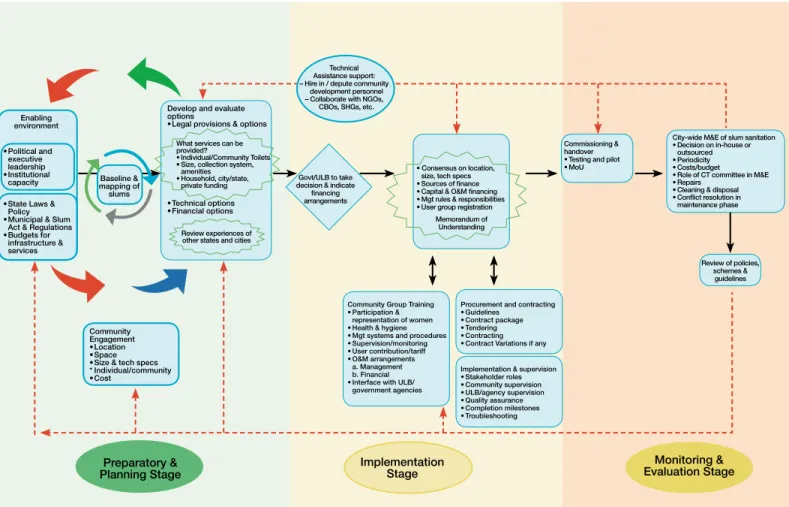
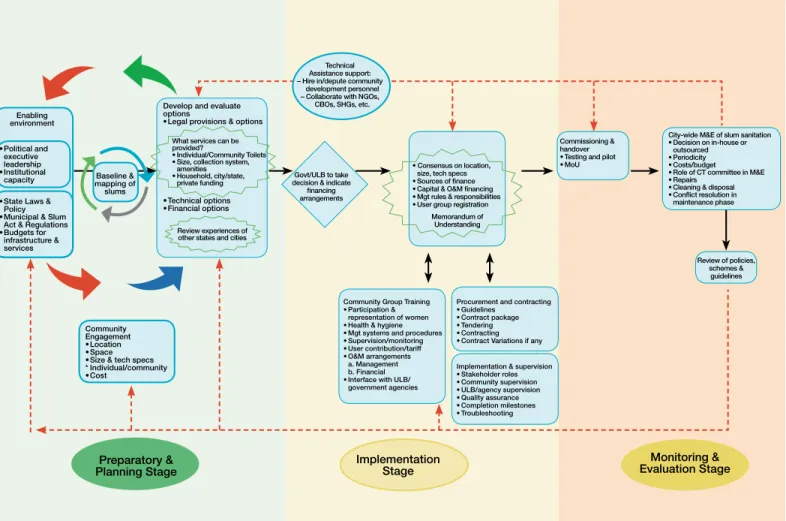
In this document, three broad stages of preparation and planning through implementation to maintenance management, monitoring and evaluation have been identified in the full cycle of community slum sanitation.
For ease of reading and reference, these boxes are present where appropriate drivers are presented Chapter 3 onwards.
Preparatory and Planning Stage Implementation Stage Monitoring and Evaluation Stage
In order to mark their relative importance, the boxes for these stages may be colored orange to signify their criticality, whereas a yellow ochre color is used when these are important although not critical.
Preparatory and planning stage Implementation stage Monitoring and evaluation stage
Summary
Background
Following the launch of the National Urban Sanitation Policy (NUSP, 2008), a number of initiatives were taken: states formulated their State Sanitation Strategies, and more than 150 cities drafted or are in the process of drafting the City Sanitation Plans (CSPs, by March 2014). The NUSP recommended development of special strategies for slums and poor settlements as an integral part of the CSPs. But the significant presence of slums in Indian cities (estimated between 9 and 14 million – or 12 to 16 percent of India’s 79 million urban households), and the specific difficulties that these settlements face in accessing basic sanitation (and other) services, demanded a greater understanding of the conditions, and exploration of strategies used to address these.
Based on the experience of slum sanitation initiatives implemented in a number of urban centers in India, over the last decades, this Guide draws out the critical drivers that appear to explain some facets of successful community slum sanitation initiatives. Initiatives from the cities of Ahmedabad, Pune, Mumbai, Bhopal, Trichy, and Kalyani are used as the examples to learn from (based on convenience and easy availability of information). A set of generic steps are identified and described thereafter for the preparatory, planning, implementation, and monitoring and evaluation stages of community sanitation initiatives.
Audience
The Guide is aimed at assisting state urban development departments and agencies, Urban Local Bodies (ULBs), Water Supply and Sewerage Boards, Public Health and Engineering Departments, nongovernmental organizations (NGOs), community based organizations (CBOs) or self-help groups (SHGs), as well as the private sector consultants, contractors and other services providers. The Guide has been drafted such that personnel with diverse educational backgrounds and training can easily understand and, hopefully, apply it with necessary adaptation, in their work.
This Guide does not recommend a single set of solutions either for technology or for approaches, but serves as resource material for options on planning, implementation, and operation and maintenance (O&M) of community sanitation solutions for urban areas. The options, tried and tested in these cities, have to be considered in light of the local conditions, before adapting them as relevant.
Why Community Sanitation, why not Individual Toilets?
It is well-known that sanitary facilities for each household, that is, individual toilets, when constructed, used and maintained, and cleaned properly, are the ideal solution from a public health point of view.
However, it may be practically impossible for households living in slums to have their own toilets for a variety of reasons including uncertain tenure, lack of space and/or affordability constraints. Hence, this Guide concentrates on the improvement of slum sanitation through community toilets or Community Toilet Blocks (CTBs), focusing on possible immediate practical action. Of course, all cities must strive for a situation whereby individual toilets become possible for each household to own and use. Some of the initiatives reviewed in this note have indeed included individual toilets in slums.
Why not Wait for Slum Upgradation?
Starting in the 1970s, a number of national and state level programs and schemes sought to address the problems of slums including provision of basic services. These included Basti Improvement Programme (Kolkata); Urban Community Development Programmes (Hyderabad, Visakhapatnam); Environmental Improvement in Slums (EIS); and then in the 1980s, the Urban Basic Services (UBS) and the Integrated Low Cost Sanitation (ILCS) scheme. The National Slum Development Programme (NSDP, 1996) aimed at upgrading urban slums, whereas the Swarna Jayanti Shahari Rozgar Yojana (SJSRY, 1997) sought to provide gainful employment
to the urban unemployed or underemployed. The Government of India’s (GoI’s)Valmiki Ambedkar Malin Basti Awas Yojana (VAMBAY, 2001) had the primary objective of facilitating construction and upgradation of dwelling units in slums and providing a healthy environment by constructing community toilets under the Nirmal Bharat Abhiyan (NBA, Clean India Campaign).
In 2005, GoI launched India’s urban flagship program, the Jawaharlal Nehru National Urban Renewal Mission (JNNURM) for strengthening and reforming urban infrastructure provision and service delivery, especially in 63 select cities, in a Mission mode. This comprised urban infrastructure provision and governance reforms, and the development of basic services to the urban poor. A national program dedicated to making India “slum-free”, the Rajiv Awas Yojana (RAY) was launched in 2009, and targets ‘slum-free India’ by encouraging states/Union Territories (UTs) to tackle the problem of slums in a definitive manner.
In keeping with the vision of the NUSP and GoI’s priority to make India clean, litter free and Open Defecation Free, the Swachh Bharat Mission (with separate components for rural and urban) was launched in October 2014. Estimated at a cost of approximately INR 62 lakh crore (INR 62 billion), SBM urban has the following objectives:
• Eliminate open defecation; • Eradicate manual scavenging;
• 100 percent collection and scientific processing/disposal
of municipal solid waste;
• Bring about a behavioral change in people regarding
healthy sanitation practices;
• Generate awareness among citizens about sanitation and
its linkages with public health;
• Strengthen ULB to design, execute and operate systems;
and
• Create an enabling environment for private sector
participation in capital and operation expenditure. With such a clear indication that slums are now being accorded legitimacy, and their development or upgradation being on the anvil, the question arises as to why not wait for the slum-free project to enable
households to go in for individual toilets? Two practical considerations are in order:
• With the launch of the SBM, the construction of
individual toilets to cover households without access is likely to be accelerated. However, in many locations, only community toilets will be feasible owing to constraints of space and tenure; and
• In most of the medium and small urban centers, the SBM
or other programs may not be possible to implement in the short run.
Therefore, it is with urgency that states and cities must address the acute sanitation deficits in slums, even though these may be transient arrangements and, for many, the
only solution for a few if not several years.Sanitation is a
daily need, and expedient responses are the only way to ensure healthy liveable cities in the short and long run. The SBM provides the requisite momentum and programmatic framework to achieve this.
Drivers of Successful Slum Sanitation Initiatives
The review of the cities led to the identification of the following factors or drivers of successful slum sanitation initiatives:
1. Enabling frameworks for slum sanitation (tenure and provision of services): Municipal Acts, Slum Acts, Acts enabling services provision such as that of utilities, and the regulations and executive orders thereunder recognize the slum settlements, and define the bounds of feasible options for sanitation services. Improved services may require some changes in these. Working on the enabling environment involves the following:
1. Examining the existing Municipal, State, Slum and Utility Acts and rules for type of services permissible; 2. Examining how, by law, the framework for service
provision can be made more inclusive of households and settlements currently excluded;
3. Examining the extent to which tenure can be delinked from service provision – the NUSP recommends this and a few cities have implemented it;
4. Drafting and proposing changes to existing laws and regulations to enable access to individual household level
services ideally, and community services as a second-best option; and
5. Examining existing national and state level programs and schemes that may be utilized for improved sanitation service provision.
2. Political will, executive engagement and local government institutional capacities: Given the legal framework, the political and executive leadership of the city, extent to which the leadership of the ULB and other agencies is engaged with questions of slum services provision, and institutional capacities and incentives for the ULB to do so, form the second major driver of successful
initiatives. This also depends on the extent of devolution
of funds and functionaries for sanitation in general and for slum sanitation in particular, under the 74th Constitutional Amendment (see Annex 1). The considerations to assess the drivers of leadership, engagement and capacity are:
1. What is the structure of the local political leadership? What are the ways to have them lend support to improved sanitation services to slum communities?
2. What is the structure of the local political leadership (in the ULB, development authorities, water and sanitation utility/board)? How can it be mobilized to commit to sanitation services delivery to slums?
3. What is the extent to which functions, funds and functionaries are devolved to the ULB in the city?
4. Does the local body have an organizational unit or division with specialized and dedicated personnel for dealing with sanitation issues?
5. What are the means of building awareness amongst urban communities about the necessity of improved sanitation systems and practices?
3. Addressing indignity and promoting public health:
Investments in water and sanitation result in huge preventive health benefits, and the importance of these benefits is far more pronounced in case of slums where provision and service levels are poor. Accessing portable water remains a struggle for most slum dwellers but these struggles vary based on different local factors and influences. In contrast though, sanitation in slums poses the dual risk of increased disease incidence, on one hand, and personal safety,
security and indignity, on the other, especially for women and girls. In a departure then from construction of toilets, slum sanitation initiatives have increasingly attempted to mobilize communities around health outcomes and safety and dignity, also a strategy for involving and empowering women through such initiatives. It is vital to think through certain considerations for integrating public health and dignity in sanitation initiatives:
1. What is the baseline condition of disease incidence (especially water borne diseases such as diarrhea, and so on) in the community and what are the community’s perceptions regarding these?
2. What are the constraints of space and concerns of safety and dignity especially of women and children in the community?
3. What are the infrastructure and services required to address health and safety concerns, for example, well-lit toilets with adequate water, separate and secure toilet blocks for women, child friendly features, easy availability of soap and cleaning materials?
4. What better communication and measures can be used to promote robust menstrual hygiene management in the community?
5. Are there community level and formal mechanisms for monitoring health outcomes?
6. Is there regular communication and messaging for mobilizing the local community to adopt and use toilets, and sustain changed behavior and practices?
4. Promote participation of the poor and institutionalize special roles for women: Many slum sanitation initiatives have been sub-optimal since communities were not involved or even consulted in the design of the process or structure. All successful sanitation initiatives have, therefore, given high priority to instituting participatory processes in a structured manner right from the preparatory and planning stages. The participation of the poor households was central to their taking ownership of the initiatives. The special role of women in decision-making, community mobilization, health promotion and maintenance management finds differing but definitive treatment in all successful projects. Most of the projects stipulated representation of women in local committees, and made spaces for their active participation
in management and supervision.In some projects, women SHGs were also able to establish links with their livelihoods. The considerations for this driver are:
1. Does the initiative involve individual households to benefit or community groups or a mix thereof?
2. What are the ways to structure the participation of community members and especially provide spaces for women to be in key decision making processes?
3. What mechanisms can be used to ensure that community members including women are not excluded because of unsuitable timing, place, and so on, of decision making bodies?
4. In what ways can the formation of women-based groups be promoted?
5. What are the ways of linking livelihoods to construction and O&M of toilets – especially for women’s groups? 6. Developing and utilizing innovative training and
communication material to empower community members including illiterate and neo-literate groups; 7. The potential for community members being in the
driver’s seat by structuring financial and technical assistance around this;
8. Identifying risks to participatory processes being rushed or curtailed and providing flexibility to respond to these; and
9. Understanding local community dynamics and removing barriers to success (such as local forces that may oppose change and participation of new members).
5. Choice of location, technology and design features:
Starting from the availability of open spaces in slums, structure, access to safe disposal, and design features that attract users, involve a host of legal and practical considerations. The ULB and local communities need to work closely together to identify the options for location and size. Access to water supply, drainage and sewerage/ septic tank cleaning services need close attention while evaluating possible locations since these can have long-term cost and management implications. A well-designed community toilet needs to have good quality construction and be well-maintained to attract a steady stream of paying users, and for it to last long. The introduction of services (for example, water supply and power), and separate
facilities for women, men and children in each section, user responsive features, and so on, are necessary to accord priority to:
1. Availability of land and its location to be identified along with the user community;
2. Access to network services including sewerage services, clear access to septage cleaning machinery, electricity, and so on;
3. Design options for sub-structure and super structure and their capital costs;
4. Sufficient separate facilities for men, women, children, differently-abled persons;
5. Space for supervision, meetings, and other related activities so that the toilet complex becomes an extra source of revenue for the community or brings about a sense of togetherness;
6. Provision of fixtures and user responsive features; 7. Financing, O&M management, O&M cost implications
of preferred option; and
8. Supervision and quality control to ensure construction quality and good finish.
6. Frameworks for partnerships and contracts: Most slum sanitation initiatives fall under the purview of government rules for making budgetary allocation, and following the due process, rules and regulations for planning and authorizing expenditure. Procurement and contracting must be studied early on in the project cycle and remedial action taken, as they can pose considerable challenges in contracting and implementation. Since contractors and service providers are unlikely to have experience of having creating community infrastructure and service projects, the ULB needs to bring in expertise and develop a framework that brings parties together, builds trust, and provides clear risks and rewards for convergent performance. The following aspects need to be considered:
1. Mechanisms to clearly identify users and user groups that form the key community body to take ownership of design, construction and later maintenance management, that is, CBOs, women’s SHGs, Water and Sanitation (WatSan) or Water Sanitation and Hygiene (WASH) committees, and so on;
2. Exploring options of design and construction agencies including NGOs, private companies, existing resources within the ULB or state agencies;
3. Assessment of the capacity of NGOs, CBOs, public agencies and private contractors;
4. Carefully developing the Memorandum of Understanding
(MoU)/contracting/partnering frameworksuch that roles
and responsibilities and risks and rewards for each party are balanced;
5. Reviewing government procurement guidelines and securing special provisions in these to enable a flexible and suitable framework (for example, the 100 percent contract variation in Mumbai Slum Sanitation Program contracts);
6. Training and deploying a team competent in managing and supervising the contractors;
7. Developing trust and providing an environment for all parties to work together – removing perverse incentives; 8. Providing flexibility in design and costs to accommodate
different types of implementation situations on ground; and
9. Supervision of implementation and robust methods of assessing quality at the time of commissioning and handover.
7. Empower communities to take the responsibility
of managing community toilets: Most successful
community slum sanitation initiatives are based on the premise that communities are best placed to carry out O&M management of the CTBs. Therefore, in case of CTBs, it is critical that community groups are organized, trained and provided support and incentives so that they can manage the technical, institutional and financial tasks for maintenance. The community group must be registered under a relevant law as a trust or society (as a sanitation or water and sanitation committee) so that it is able to operate bank accounts, receive and expend money, and account for it in a transparent way to its
members. Forming such an association also helps in
ensuring accountability and preventing misuse /“capture” of the CTB. In some cases, informal committees such as a WatSan committee or a women’s SHG that is not registered but trained in accounting and has leadership skills, may be involved from the beginning, and assisted
in opening bank accounts, and so on, (as an SHG) especially if the registration of a CBO as a trust is likely to be time-consuming and complicated in the short run. The following aspects are important:
1. Developing a strategy for individuals and groups in the community at the forefront of the initiative;
2. Identifying the appropriate composition, roles and responsibilities of the association;
3. Formalizing and/or registering under the relevant acts; 4. Training and capacity building of the CBO members in
decision making processes, maintenance of records and accounts, periodic elections, and so on; and
5. Ensuring smooth functioning of the CBO and rapidly addressing any conflicts and disputes especially in the early stages. NGOs need to empower CBOs with the required skill-sets to ensure sustainability aspects;
8. Management models and financial viability as key elements for successful long-term operation: While the formal organization and setting up of the CBO is an important milestone, the rules and arrangements for managing CTBs sustainably need also to be carefully designed. These arrangements and rules or “management models” are also closely linked to the structure of costs and revenues of the CTB. This is critical in ensuring long-term sustainability of the CTB in long-terms of institutional and financial arrangements.
The CTB’s running costs include electricity, water supply, sewerage and septage clearance, cleaning tools and equipment, cleaning materials, salaries of cleaners, caretakers, minor and major repairs, and other contingent costs. Revenues come typically from user charges, as periodic/monthly passes for families, and from pay-per-use users. Additional revenues can come from sale of soap, and so on, at the CTB. The question of pricing is a critical one since, on the one hand, this can or cannot make the CTB sustainable financially and, on the other, affordability needs to be accorded attention since the CTB is intended for use by slum communities (and is not just a business proposition such as public toilets in public places could be). Water and electricity costs can be prohibitive for CBOs in certain cases where prices and/or number of users are low.
If borne by the city corporation, the maintenance burden is reduced and resources can be put to other uses such as septage clearance, solid waste management, drainage improvement, and other toilet or slum improvement items. Waiving off utility costs (water, electricity, and so on) also needs to be done carefully since this may disincentivize efficient maintenance management leading to dilapidation of toilets.
Capital finance has hitherto been provided by state budgets or private sources, and availability of capital will be crucial in future in financing scaled-up slum sanitation initiatives. The management models currently available are:
1. Sharing of responsibilities within CBO members; 2. Management by CBO members including supervision of
cleaning staff, and so on;
3. Appointment by the CBO of the caretaker for day-to-day management along with overall supervision;
4. Management handed over to SHGs; and
5. Others such as management handed over to city-level women’s or WASH groups’ federation/s.
The nature of the CTB (that is, location, technology,
physical design features discussed above), management
model adopted, pricing of monthly pass and per use charges, and amount of subsidy available from the ULB together determine the financial sustainability of the CTB. There are other options that could be considered as well for the management of CTBs that may be more suitable. The following aspects are worth considering:
1. The type and design of the toilet and attendant capital cost options must be evaluated for O&M management and cost implications in the planning stages;
2. The maturity and capacities of the CBOs in undertaking management tasks – training and capacity building required for enabling them to do so;
3. Affordability of different sub-segments in the community, and potential “markets” of floating pay-and-use population;
4. Estimation of regular O&M costs, and contingencies for repairs, to arrive at monthly and per annum costs. The
possibility of ULBs taking care of part of the utility costs may be explored;
5. Assessment of the match between revenues and costs and detailed discussions with community members on the pricing and necessary contributions;
6. Agreement with the ULB/local ward offices about cleaning of septic tanks, major repairs and maintenance needs, and sharing of/contribution to water, electricity bills as necessary;
7. Projection and agreement of the CBO with the community on time-bound increases in membership/ user fees; and
8. Regular review and evaluation of the management model and changes.
9. Performance monitoring and evaluation: Long-term benefits from improved sanitation can only be sustained if households continue to use their individual toilets or CTBs are properly maintained and managed. In either case, there needs to be a robust mechanism to track use behavior and monitor whether the upkeep arrangements are satisfactory. Monitoring and evaluation (M&E) of the performance of community toilets city-wide needs to be organized, resources provided for, and incorporated in the core service delivery function of the ULB or the responsible agency. The reasons for a formalized monitoring system of CTBs are manifold:
i. The physical systems of the CTBs may break down requiring minor and major repairs – these have to be addressed immediately as communities cannot use toilets that are partially dysfunctional;
ii. Disputes regarding management, or amongst users, can jeopardize the use of the CTBs by users, and hence need to be resolved immediately;
iii. Stoppage of services/utilities, for example, water, power, septage clearance, and so on, can severely affect the functioning of the CTBs, and hence issues related to these will have to be addressed in consultation with the respective service providers; and
iv. Changes in project rules and policies may be possible to incorporate based on actual experience of use and management in various CTBs.
Instituting an M&E framework involves:
1. Identification of different critical aspects and levels of monitoring during the preparatory and planning phases, including project monitoring at one level (usually done by the project/ULB) and identification of indicators of use, physical condition, CBO management, accounts and finance, health and hygiene behavior changes, inclusion of stakeholders, at another;
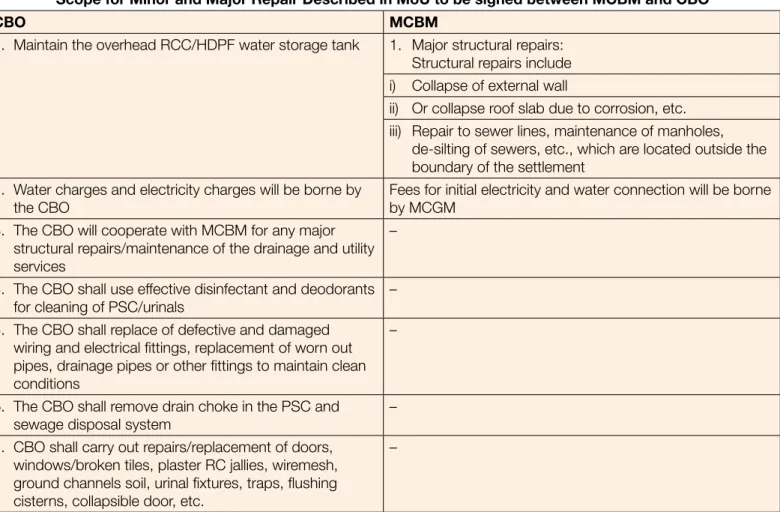
2. Incorporation of key monitoring indicators in the MoU between parties so that these indicators become the action items for specific partners;
3. Some monitoring indicators may need standards to be set out to measure actual performance against. For instance, what would be the indicators of “cleanliness”? This could be “no spit”, “no slime”, “no yellow pans”, and so on; 4. Identification of penalties and rewards however soft or
hard, for achieving certain performance standards;
5. Periodic studies and assessments on user behavior, satisfaction, management and financial indicators of CBOs, condition assessment of physical features and fixtures of CTBs, and so on; and
6. Systematic and rapid sharing of the results of M&E with all stakeholders including CBOs, communities, ULBs, NGOs, and others members of the public. For example, Yearly Public Toilet Surveys on the condition of assets, usage and maintenance management, revenue situation, users’ satisfaction, and household surveys for behavioral changescould be undertaken.
Generic Steps for Slum Sanitation Initiatives
Under the NUSP 2008, a series of iterative steps were listed out as an aide to preparing the CSP. One of the detailed tasks in overall city sanitation planning is to prioritize sanitation in slums and informal settlements of the city. Even in cities where a CSP has not been prepared, the task of addressing
Summary
FiguRe e1:Slum Sanitation – generic Steps
enabling environment • Political and executive leadership • Institutional capacity
develop and evaluate options
• Legal provisions & options
community group training
• Participation &
representation of women
• Health & hygiene • Mgt systems and procedures • Supervision/monitoring • User contribution/tariff • O&M arrangements
a. Management b. Financial
• Interface with ULB/
government agencies
Procurement and contracting
• Guidelines • Contract package • Tendering • Contracting • Contract Variations if any
implementation & supervision
• Stakeholder roles • Community supervision • ULB/agency supervision • Quality assurance • Completion milestones • Troubleshooting • Technical options • Financial options
What services can be provided?
• Individual/Community Toilets • Size, collection system,
amenities
• Household, city/state,
private funding
• Consensus on location, size, tech specs • Sources of finance • Capital & O&M financing • Mgt rules & responsibilities • User group registration
Memorandum of understanding
commissioning & handover
• Testing and pilot • MoU
Review of policies,
schemes & guidelines city-wide M&e of slum sanitation
• Decision on in-house or
outsourced
• Periodicity • Costs/budget • Role of CT committee in M&E • Repairs
• Cleaning & disposal • Conflict resolution in
maintenance phase
Review experiences of other states and cities
• State Laws &
Policy
• Municipal & Slum
act & Regulations
• Budgets for infrastructure & services community engagement • Location • Space • Size & tech specs * Individual/community • Cost
Preparatory &
Planning Stage implementation Stage evaluation StageMonitoring &
Govt/ULB to take
decision & indicate
financing
arrangements technical assistance support:
– Hire in / depute community
development personnel
– Collaborate with NGOs, CBOs, SHGs, etc.
Baseline & mapping of slums
a sanitation crisis in slum areas and informal settlements should be taken up on a priority basis. The full cycle of activities for slum sanitation initiatives can be clustered into three broad stages:
A) Preparatory and planning stage; B) Implementation stage; and C) M&E stage.
Each of the above stages includes a number of activities and tasks, and many of these are iterative in nature, for example, the baseline and mapping of slums can either be done in one stretch, or broken down into phases over time or areas, so that it does not become a bottleneck to starting some of the other activities early.
It may also be noted that activity-blocks in each of the three stages have inter-connections with those in other stages, and this is desirable for constant learning while doing. While using information in boxes and in a somewhat liner fashion, the intent of the sequencing is to show the connections and how feedback loops can help improve planning, implementation and monitoring.
These activity clusters are presented in Figure ES1. A detailed description of these is presented in Section 4.
Recommendation and Review
The Guide is recommended for use by states and city agencies, as well as by NGOs, private sector organizations, and so on. Feedback on the utility of this Guide will be welcome, as this will help in improving and making it more useful and functional in practice. It is important to understand that this Guide needs to be treated as a framework document, needing revisions based on practice, rather than be an inflexible set of guidelines.
Presentation of the Guide
Section 1 presents a short introduction to the context of urban India and urban sanitation, followed by a brief review of programmatic responses by GoI to improve slum
sanitation services. Thereafter, the Guide draws out the
critical factors or drivers using examples from successful community slum sanitation initiatives reported from the urban centers selected for this study. A set of generic activity clusters and steps are included at the end the preparatory, planning, implementation, and M&E stages of community sanitation initiatives.
1.
Background and Objectives
Objectives of the GuideThe National Urban Sanitation Policy (NUSP, Ministry of Urban Development (MoUD), Government of India (GoI), 2008) envisages the formulation of State Sanitation Strategies (SSSs) and City Sanitation Plans (CSPs). A CSP is expected to be an integrated sanitation plan for the entire city, and provision of sanitation in slums and unserved areas is an integral component of it. However, given the acute problems suffered by residents in slum settlements, it is necessary to accord special attention to identifying strategies that will lead to affordable, practical and sustainable sanitation solutions for all of them. The objective of this Guide is to focus attention on such strategies and identify crucial steps leading to sustainable sanitation for urban poor settlements. It draws lessons from approaches and experiments in slums and unserved areas implemented in different towns and cities over the last two decades to apply them to the new paradigm of city-wide planning, implementation and management of sanitation facilities, especially for the poor.
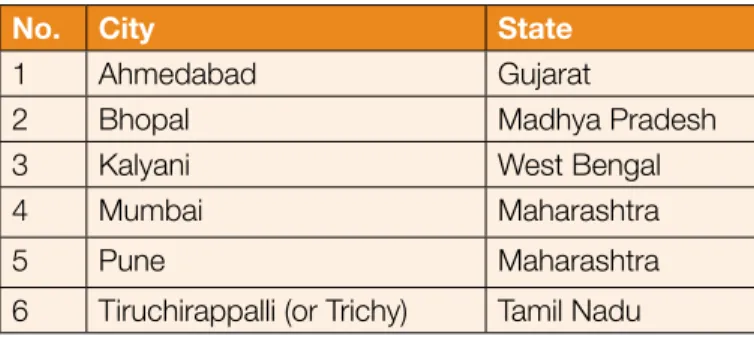
Selection of Slum Sanitation Initiatives for the Guide
The last two decades have witnessed a number of initiatives in services provision in general, as well as sanitation services provision in particular, from different cities in India. These have come from the metropolitan centers, Class I cities and smaller cities. A smaller set of these initiatives was selected for the development of the Guide, for reasons of convenience and easy availability of information.
As presented in Table 1, these locations range from larger cities such as Mumbai to small towns like Kalyani where different approaches to sanitation provision to poor settlements have been attempted. This selective set is by no means exhaustive, nor does it purport to be representative of all types of urban areas, but the diversity of examples from
these cities provide the basis for identifying the elements or factors of city-wide approaches to slum sanitation approaches, that are critical for delivering sustainable sanitation.
Table 1: Study Locations for Approaches to Slum Sanitation
No. City State
1 ahmedabad gujarat
2 Bhopal madhya Pradesh
3 Kalyani West Bengal
4 mumbai maharashtra
5 Pune maharashtra
6 tiruchirappalli (or trichy) tamil nadu
It may be noted that each of the above initiatives was founded on its own context-specific objectives and strategies and, hence, the lessons will need to be assessed and adapted to the local circumstances and conditions. Indeed, even the formulation of the NUSP has benefitted from some of these experiences, since these initiatives were pioneers in some aspect or the other, and therefore, used in formulating some of the principles of NUSP.
While the Guide uses “slums”, “informal” settlements and “urban poor” settlements interchangeably, it is well recognized that slums may have households other than poor households. The thrust of the Guide is on identifying approaches to such settlements irrespective of their composition in terms of the poor and other households. It may also be noted that many urban poor households do not live in slums but in dispersed locations, or are homeless – this Guide does not address their particular circumstances.
Target Group of the Guide
The Guide is aimed at helping decision makers and practitioners from all disciplines and training, including but not restricted to engineering, finance, social and community development, planning, administration, and so forth. The Guide shall assist state urban development departments and agencies, Urban Local Bodies (ULBs), water supply and sewerage boards, public health and engineering departments, nongovernmental organizations (NGOs), community based organizations (CBOs) or self-help groups (SHGs), as well as the private sector consultants, contractors and other services providers.
Individual Household Sanitation is Ideal, and Community Sanitation Second-best
While sanitary facilities for each households are the ideal solution, and some initiatives covered in this note have
included the construction of individual toilets in slums, this Guide concentrates on the improvement of slum sanitation through community toilets. It focuses on possible immediate practical action when it is impossible to provide individual latrines for a variety of reasons including uncertain tenure, lack of space and/or affordability constraints – a reality in most slum settlements in India. Of course, all cities must strive for a situation whereby individual toilets become possible for each household, as this is most sustainable, and best in terms of health outcomes.
This Guide does not provide a single set of solutions either for technology or for approaches, but will serve as resource material for options on planning, implementation, and operation and maintenance (O&M) of shared, community sanitation solutions for urban areas. The options presented have to be further considered in light of the local circumstances and prevailing conditions, before being adapted as relevant.
2.
The Urban Sanitation
Challenge and the Response
The trouble though is that even when households have access to toilets – this is more than 80 percent of urban households as presented in the preceding section – the safe collection, treatment and disposal of human excreta is woefully inadequate and poses major challenges to health and environment of urban India.
Sanitation is more than just household access: the full cycle of safe collection, conveyance and treatment/reuse is still a challenge – a bigger challenge for slum settlements whence safe collection and conveyance pose numerous challenges.
A 2009 study of Class I and Class II towns found that treatment capacities were less than 32 percent of sewage generated. Two-thirds of this capacity was in the 35 one million-plus population cities, but nearly 37 percent of the treatment plants did not conform to discharge standards into water bodies (CPCB, 2013). A National Sanitation Rating of 423 Class I cities, which covered 72 percent of the country’s urban population, reported that 90 percent of the cities (379) had less than 40 percent of their sewage treated; and 65 percent of the cities (274) had unsatisfactory arrangements for safe collection of human excreta, whether onsite or sewerage (MoUD, GoI, 2010).
Government Initiatives in Improving Slums
One of the challenges that rapid urbanization brought was the growth of slum settlements owing to failure of public agencies to provide affordable housing and services to rapidly growing urban populations. According to the NSSO 69th Round (NSSO, 2013), 8.8 million households, or about 12 percent of urban Indian households were estimated to be living in slums.
The problem of inadequate provision and unsatisfactory O&M of sanitation facilities is acute in the urban centers of India and, given the rapid urban growth rates (Census, 2011), it is more than likely to become aggravated in the years to come. According to Census 2011, 17.4 percent of urban India was estimated to be living in slums. The National Sample Survey Organisation (NSSO) (69th Round, 2013) estimated 8.8 million households, or about 12 percent of urban Indian households, to be living in slums. However, the latest Census (2011) report on housing stock, amenities and assets in slums reveals that 13.74 million out of the 78.9 million urban households live in slums.
Deficiencies in the existing sanitation infrastructure and services are widespread. According to Census 2011, coverage of urban households by sewerage and septic tanks was 33 percent and 38 percent, respectively. About 14.6 percent
households were reported to have pit latrines.Further, 6
percent urban households (4.7 million) were reported to be using public toilets, with 12 percent urban households (about 10 million households or about 50 million people) being forced to defecate in the open.
In slums, about 19 percent households had to defecate in the open and 15 percent slum households had to use public (perhaps including community) toilets. Every third household (34 percent) in slums had no latrine facility within the premises (Census 2011). In slums, septic latrines and sewage systems are reported but from a smaller proportion of households.
This underlines the severity of sanitation deficits in slums, and the high reportage of use of shared and community/ public toilets by households poses considerable challenges for provision of sustainable sanitation solutions for slum and other poor households.
In the NSSO 69th round survey, for operational purposes, slums were defined as follows:
• Areas notified as slums by the concerned municipalities, corporations, local bodies or development authorities were termed notified slums.
• Also, any compact settlement with a collection of poorly built tenements, mostly of temporary nature, crowded together, usually with inadequate sanitary and drinking water facilities in unhygienic conditions, was considered a slum by the survey, provided at least 20 households lived there. Such a settlement, if not a notified slum, was called a non-notified slum. (Note that while a non-notified slum had to consist of at least 20 households, no such restriction was imposed in case of notified slums.) The word “slum” covered both notified slums and non-notified slums.
Source: NSSO 69th Round, 2013.
Box 1: Slums ….Defined
Jawaharlal Nehru National Urban Renewal Mission (2005-14)
In 2005, GoI launched two ambitious national programs (the Jawaharlal Nehru National Urban Renewal Mission (JNNURM) and the Urban Infrastructure Development Scheme for Small and Medium Towns (UIDSSMT)) for strengthening and reforming urban infrastructure provision and service delivery. In order to address the issues of rapid urban growth and cope with it challenges, GoI decided to draw up a coherent urbanization policy/strategy to implement projects in 63 select cities on mission mode. Under JNNURM and UIDSSMT focused attention was accorded to the development of Basic Services to the Urban Poor (BSUP in JNNURM cities and Integrated Housing and Slum Development Program for UIDSSMT towns) in the cities covered under the Mission. This included:
1) Security of tenure at affordable prices; 2) Improved housing;
3) Water supply; 4) Sanitation; and
5) Ensuring delivery through convergence of other already existing universal services of the government for education, health and social security.
Rajiv Awas Yojana
A national program dedicated to making India “slum-free”, the Rajiv Awas Yojana (RAY) launched in 2009, marked an important advance in GoI’s approach to social housing and basic public service for the urban poor. The program
focused on improving and provisioning of housing, basic civic infrastructure and social amenities in the intervened slums; promoting enabling reforms to address some of the causes leading to creation of slums; facilitating a supportive environment for expanding institutional credit linkages for the urban poor; institutionalizing mechanisms for prevention of slums including creation of affordable housing stock; and strengthening institutional and human resource capacities at the municipal, city and state levels through comprehensive capacity building and strengthening of resource networks. For the slum dwellers and urban poor, RAY envisages a ‘Slum-free India’ through encouraging states/Union Territories (UTs) to tackle the problem of slums in a definitive manner. It aimed to empower communities by ensuring their participation at every stage of decision-making through strengthening and nurturing slum dwellers’ association/ federations (MHUPA 2011).
In sum, the situation of unsatisfactory sanitation provision persists despite state efforts to provide basic infrastructure to unserved poor areas and informal settlements or slums in urban centers. For quite a few decades post India’s independence, “slum improvement” was regarded as a short-term palliative to be implemented till all urban households were accommodated in decent housing with proper services arrangements. Over the years, however, a more pragmatic view has been taken finally leading to the formulation of the NUSP in 2008, with the goal of transforming “urban India into community-driven, totally sanitized, healthy and
The Government of Madhya Pradesh, for example, aims to make all urban areas in in the state fully sanitized by 2025 and attempts to bring a comprehensive service delivery orientation to its implementation by setting targets that can be identified and monitored. Among other things, the Madhya Pradesh Sanitation Vision 2025 aims to: • Make urban areas in the state Open Defecation Free (ODF) by 2017;
• Facilitate toilet access initially with community toilets provision and migration to 99.8 percent individual toilet coverage by 2025; and
• Achieve 100 percent safe disposal of waste-water generated by 2025 through a combination of sewerage systems (75 percent coverage), onsite systems (23.5 percent septic tanks + 1.5 percent pit latrines).
Box 2: Madhya Pradesh Sanitation Vision 2025
liveable cities and towns” and ensuring proper sanitation services to all including the poor and unserved households (NUSP, 2008).
National Urban Sanitation Policy 2008
Despite these efforts, a large proportion of people living in informal settlements in towns and cities still bear deleterious effects of poor sanitation. In 2008, therefore, MoUD, GoI launched NSUP with a vision to make all Indian towns and cities totally sanitized, healthy and liveable for all citizens with a special focus on hygienic and affordable sanitation
facilities for the urban poor and women. The policy
recognizes that some key issues related to the urban poor and unserved settlements need to be addressed to achieve the vision:
• Raising awareness regarding inherent linkages between
sanitation and public health;
• Creating an integrated city-wide approach to sanitation;
and
• Resolving constraints of lack of tenure, space or
affordability in informal settlements.
It recommends that provisioning of basic sanitation should be delinked from the issues of land tenure and every urban dweller should be provided with minimum levels of sanitation, irrespective of the legal status of the land on which he/she is dwelling, possession of identity proof or status of migration. It, however, stresses that the provision of sanitation would not entitle the dweller to any legal right to the land on which he/she is residing (p.14, NUSP, MoUD 2008). It emphasizes that priority should be given to the provision of individual toilets but wherever this is not
feasible community-planned and managed toilets should be promoted.
State Sanitation Strategies
Traditional approaches to sanitation investments have involved piece-meal asset creation focused infrastructure provisioning, often with very little focus on service delivery. As a result, several urban projects in water and sanitation have often not rendered the envisaged service delivery benefits. It is in this context that states are building on the intent of the NUSP guidelines and articulating service delivery targets to achieve inclusive and affordable access to sanitation in urban areas (see Annex 2).
By April 2014, about 11 state governments had formulated their state-wide sanitation service targets, and estimated financing needs (covering both capital expenditure and maintenance costs) required to achieve these targets based on normative gaps and transition path at a household level and at the network level.
City Sanitation Plans
In order to realize its vision of 100 percent totally sanitized Indian cities and towns, NUSP envisages all Indian states develop SSSs and all Indian cities formulate CSPs. The policy provides the necessary framework for state governments and municipalities to approach sanitation in an integral manner. CSPs are understood as integrated and holistic sanitation master plans for entire cities detailing out short-, medium- and long-term strategies. It also considers improvement and extension of sanitation infrastructure including toilet access, confinement, transport, treatment and disposal of wastewater and septage together with all related technical,
Reaching the Unserved Populations and the Urban Poor
Experiences from many Indian cities show that a differentiated approach is necessary to extend good quality sanitation services to the poor — the group that suffers the most in terms of adverse impacts on health and lost earnings.
Participatory approaches are needed to consult the poor settlements and involve them in the process of planning and management of sanitation arrangements. Many settlements may have the necessary conditions to support the provision of individual onsite sanitation arrangements (for example, as tried out in some pockets in Ahmedabad) that are ideal; in many others, tenure and legal issues prevent provision of individual toilets and hence community toilets (CTs) are the only way for immediate succor and access (for example, as is the case with Mumbai, Pune). In some places, conventional and shallow sewers have also been tried out as alternative to on site solutions in dense settlements. Examination of legal/tenurial, space and affordability issues in close consultation with communities becomes a key step in planning innovative means that are owned by users and will be sustainably managed by them.
NGOs can play an important role in mobilizing slum communities. Further, when community groups themselves take over the O&M of community facilities, then sustainable services become possible.
Another segment of population normally without sanitation is those who live in dispersed urban locations not being slums or in groups of houses that have legally not been notified as slums. Innovative approaches are required to extend services to these population groups too.
The Implementing Agency will need to take stock of the legal and non-notified settlements in the city and, in partnership with NGOs and CB0s, initiate a process of collaborative planning and delivery of services.
At least 20 percent of the funds under the sanitation sector should be earmarked for the urban poor. The issues of cross subsidization of the urban poor and their involvement in the collection of O&M charges should be addressed. The last and not least of all obstacles is the mindset of the officers of ULBs and other citizens: biases and myths often hinder proper service provision to poor settlements. There must be a concerted effort to raise awareness amongst all stakeholders about the huge health and environmental costs that all have to bear if services are not comprehensively provided to all citizens.
Source: NUSP, MoUD, GoI, 2008.
Box 3: NUSP Emphasizes CSPs to Serve the Urban Poor and Slum Settlements
financial, institutional and social aspects.Further, issues
related to governance, awareness creation and capacity building are also detailed in the CSP.
As of March 2014, more than 150 cities were reported to be in the process of drafting their CSPs.
While designing the CSP, the ULB will need to ensure services to the poor, regardless of space, tenure or economic constraints.
National Sanitation Rating and Service Level Benchmarking
The two major national-level initiatives in support of implementing the NUSP include: National Sanitation Rating of Cities (2009-10) and Service Level Benchmarking (SLB) of ULBs.
1) National Sanitation Rating of Cities (2009-10)
In order to assess the performance in urban sanitation, GoI has instituted a rating of cities on urban sanitation indicators
for self-assessment of cities and highlight the areas where improvements are required. The ratings aimed to track public health and environmental standards as two outcomes that cities must seek to ensure for their citizens. The first round of the rating of cities was conducted between December 2009 and April 2010 under the guidance of the National Advisory Group on Urban Sanitation and in consultations with the state governments and ULBs. As many as 436 cities were rated included metros, big Class I (with 1 to 5 million populations) cities and other Class I (100,000 up to 1 million population) cities, covering almost 72 percent of India’s total urban population (NUSP 2010).
Each city was scored on 19 indicators that are divided into the categories of Output (50 points), Process (30 points) and Outcome (20 points) indicators.
The second round of Rating (2014-15) proposes to also measure the number of community and public toilets (seats) for more than 460 Class I (population with more than 100,000 persons) cities.
2) Service Level Benchmarking of ULBs
SLB focuses on service delivery and not just infrastructure creation, and ranks ULBs in terms of their performance on 29 indicators across four key service sectors (water supply, sewerage, solid waste management, and storm water drainage).
The awards and ranking from both initiatives are available on http://moud.gov.in. The Second Round of National Sanitation Rating of Cities (2014-15) covering more than 460 Class I cities is expected to be completed by early 2015.
Swachh Bharat Mission (Urban) 2014-19
In keeping with the vision of the NUSP and GoI’s priority to make India clean, litter free and ODF, the Swachh Bharat Mission (SBM) (with separate components for rural and urban) was launched in October 2014. Estimated at a cost of approximately INR 62 lakh crore (INR 62 billion), the SBM urban has the following objectives:
• Eliminate open defecation; • Eradicate manual scavenging;
• 100 percent collection and scientific processing/disposal
of municipal solid waste;
• Bring about a behavioral change in people regarding
healthy sanitation practices;
• Generate awareness among citizens about sanitation and
its linkages with public health;
• Strengthen ULB to design, execute and operate systems;
and
• Create an enabling environment for private sector
participation in capital and operation expenditure. The Mission has been launched and received priority and attention at all levels, including national, state and cities and towns. This has provided the much-needed priority to sanitation and hygiene, and has given a great push forward to achieving clean, healthy cities as envisaged by the NUSP.
Community Toilet Complexes as a Response to the Slum Sanitation Deficit
As noted above, individual toilets must be promoted as much as possible since these are known to be the healthiest and most sustainable arrangements that households use and maintain (given that the toilets are sanitary and have adequate
disposal arrangements). Individual sanitary facilities may
not be possible, though, in dense urban settlements due to a multitude of reasons such as tenure, space constraints, financial factors, and so on. In such cases, community toilets play a very large role in providing sanitation facilities to the urban poor and, to a large extent, form an effective alternative for improving sanitation coverage for these households. NUSP, in a significant departure from earlier policy positions, recommends that provisioning of basic sanitation be delinked from the issues of land tenure, so that a basic minimum level of sanitation is ensured for the poor. It promotes sustainable service delivery and acknowledges that priority needs to be given to the provision of individual toilets but, wherever this is not feasible, community (and public) sanitation solutions need to be supported (NUSP, p. 12).
In India, CTs have, in the past, been provided by the municipalities and corporations as well as by NGOs. The success of these toilets has been mixed when judged on use and maintenance aspects. Due to inadequate financial and
While both Public Toilets (PTs) and CTs provide vital sanitation services in urban areas, there is a clear distinction between the two:
1. PTs usually are located in commercial areas such as markets, train and bus stations, and so on in areas characterized by high population throughput. These are pay-and-use toilets (in some cases, free to use), and could be operated by the government, private operators or NGOs. Examples of such toilets are the Sulabh complexes prevalent in many Indian cities.
2. CTs are usually situated in or near slum locations, and have a core group of identifiable regular users. Sometimes CTs may be located near a commercial or high population throughput area but their distinctive feature is the regular user group and a management arrangement by users themselves, or someone on their behalf.
PTs can be run as commercial ventures by the government or sub-contracted to the private sector, while CTs need to be accountable to user groups while being viable either through user contributions or some other ways of financing of expenses.
Box 4: Public Toilets and Community Toilets
human resources, and inappropriate institutional incentives, many of the CTs are poorly maintained, fall into unsanitary conditions and, in some cases, are abandoned by users within a few years of construction. The major deficiencies of many of these community toilets were identified as:
a. Lack of cleanliness and poor up-keep, and lack of proper disposal facilities (septic tanks, sewerage, and so on) especially in the ‘free to use’ toilets;
b. Poor construction standards;
c. Insufficient water and electricity supply; d. Inappropriate accessibility due to location; e. Insecurity (especially for women users); and f. Inadequate funds and arrangements for O&M.
Many of these deficiencies can be effectively addressed through better planning, design, construction,O&M – as illustrated by the cases in this guide.
This note recommends individual toilets wherever possible since these prove to be much cheaper, more sustainable and more scalable compared to CTs. The NUSP and the
Technology Options for Urban Sanitation in India manual (WSP/ MoUD 2008) dwell on the technology and design issues for these toilets and hence readers are encouraged to refer to the manual for further information on technology and design aspects.
Where CTs are also not possible, people have to depend on public toilets nearby – as is the case in densely populated
slums adjacent to commercial and public places. Such
situations are best avoided because of poor affordability by households that, in turn, is likely to force them to defecate in the open.
3.
Drivers of Successful Slum Sanitation Initiatives
The analysis of selected slum sanitation initiatives helped in identifying some of the key factors or drivers that appear to have significantly contributed to the success of these initiatives. Different strategies have worked in different locations – and this section attempts to describe, with examples, how these drivers actually worked in practice.
The importance of each of the drivers is briefly described followed by examples from different cities on how these worked. The cost of not paying attention to the driver is also highlighted in some cases. At the end of information on each driver, a set of issues or questions are listed for readers to keep in view while thinking about sanitation initiatives. A color box at the top and a para in the end also help in understanding at the stage of planning, implementation or monitoring and evaluation (M&E) the driver becomes critical.
Please note that drivers are the main blocks around which slum sanitation can be approached – but these have many interlinkages and are therefore not either mutually exclusive or exhaustive.
1. Enabling Frameworks for Slum Sanitation (Tenure and Provision of Services)
Preparatory and planning stage Implementation stage Monitoring and evaluation stage
The starting point of provision of services to slum communities is the legal and administrative recognition accorded to them. Slums are often “invisible” to municipal authorities in that they may not be recognized at all as settlements. The first difficulty arises in agreeing on a definition of what constitutes a slum and what do with these settlements. Since this is a state subject, usually state government laws determine how slums are defined, how these may be recognized and categorized,
and dealt with, that is, either improved or developed; or how residents in different categories or locations may be relocated and rehabilitated in a new site. Apart from evictions that are a controversial issue in many cities, under-counting or non-recognition of squatter or informal settlements under the legal provisions of the relevant state law has been highlighted as a major issue that makes these settlements “invisible”. In addition to slum acts, the municipal acts that govern ULBs, and those laws that create and govern service providers, for example, water and sewerage boards, together determine the kind of services that can be provided to slum settlements. Hence, this is the starting point of any exercise to plan slum sanitation services provision.
Since questions of urban land tenure are deeply contested issues, relevant state department or specialized state level agencies are often responsible for recognition of slum settlements, and make provisions for their development, relocation, regularization, and so on. This brings into account the relative roles of the state agencies and department,
and the role of ULBs. The latter are typically supported
administratively by the state urban departments but are governed by the relevant state municipal acts. These acts and rules may have provisions that have a bearing on services provision in slums too.
For ULBs, it is often convenient to postpone service provision till such time that the legal tenure questions are resolved. Even though slums were not accorded attention earlier, in the past four decades, different states have enacted legislation to recognize and notify slums in their cities. These acts and rules also specify the method by which “re-development”, “resettlement”, and attendant services may
be provided. Therefore, the starting point of any slum
sanitation initiative would have to be enabled by such a legal framework that first accords some sort of legal status to slum settlements.