VOLUME 5 ISSUE 28 OCTOBER 2017 ISSN 2050-4349
Quality and reporting standards, resources, training
materials and information for realist evaluation:
the RAMESES II project
Geoff Wong, Gill Westhorp, Joanne Greenhalgh, Ana Manzano,
Justin Jagosh and Trisha Greenhalgh
resources, training materials and
information for realist evaluation:
the RAMESES II project
Geoff Wong,
1
* Gill Westhorp,
2
Joanne Greenhalgh,
3
Ana Manzano,
3
Justin Jagosh
4
and Trisha Greenhalgh
1
1
Nuffield Department of Primary Care Health Sciences, University of Oxford,
Oxford, UK
2
Realist Research Evaluation and Learning Initiative, Charles Darwin University,
Darwin, NT, Australia
3
Sociology and Social Policy, University of Leeds, Leeds, UK
4
Centre for Advancement in Realist Evaluation and Syntheses (CARES),
University of Liverpool, Liverpool, UK
*Corresponding author
Declared competing interests of authors:Geoff Wong is a member of the National Institute for Health Research Health Technology Assessment programme Primary Care Panel, and is a panel member of the Health and Safety Executive External Peer Review Panel Evaluation Governance Group. During the course of the project Gill Westhorp worked as a consultant and consulting academic undertaking realist
evaluations and reviews, and provided some capacity building and some PhD supervision on a commercial basis. These activities were not undertaken under the auspices of this project.
Published October 2017
DOI: 10.3310/hsdr05280This report should be referenced as follows:
Wong G, Westhorp G, Greenhalgh J, Manzano A, Jagosh J, Greenhalgh T. Quality and reporting standards, resources, training materials and information for realist evaluation: the RAMESES II project.Health Serv Deliv Res2017;5(28).
ISSN 2050-4349 (Print)
ISSN 2050-4357 (Online)
This journal is a member of and subscribes to the principles of the Committee on Publication Ethics (COPE) (www.publicationethics.org/).
Editorial contact: [email protected]
The full HS&DR archive is freely available to view online at www.journalslibrary.nihr.ac.uk/hsdr. Print-on-demand copies can be purchased from the report pages of the NIHR Journals Library website: www.journalslibrary.nihr.ac.uk
Criteria for inclusion in theHealth Services and Delivery Researchjournal
Reports are published inHealth Services and Delivery Research(HS&DR) if (1) they have resulted from work for the HS&DR programme or programmes which preceded the HS&DR programme, and (2) they are of a sufficiently high scientific quality as assessed by the reviewers and editors.
HS&DR programme
The Health Services and Delivery Research (HS&DR) programme, part of the National Institute for Health Research (NIHR), was established to fund a broad range of research. It combines the strengths and contributions of two previous NIHR research programmes: the Health Services Research (HSR) programme and the Service Delivery and Organisation (SDO) programme, which were merged in January 2012.
The HS&DR programme aims to produce rigorous and relevant evidence on the quality, access and organisation of health services including costs and outcomes, as well as research on implementation. The programme will enhance the strategic focus on research that matters to the NHS and is keen to support ambitious evaluative research to improve health services.
For more information about the HS&DR programme please visit the website: http://www.nets.nihr.ac.uk/programmes/hsdr
This report
The research reported in this issue of the journal was funded by the HS&DR programme or one of its preceding programmes as project number 14/19/19. The contractual start date was in March 2015. The final report began editorial review in March 2017 and was accepted for publication in July 2017. The authors have been wholly responsible for all data collection, analysis and interpretation, and for writing up their work. The HS&DR editors and production house have tried to ensure the accuracy of the authors’report and would like to thank the reviewers for their constructive comments on the final report document. However, they do not accept liability for damages or losses arising from material published in this report.
This report presents independent research funded by the National Institute for Health Research (NIHR). The views and opinions expressed by authors in this publication are those of the authors and do not necessarily reflect those of the NHS, the NIHR, NETSCC, the HS&DR
programme or the Department of Health. If there are verbatim quotations included in this publication the views and opinions expressed by the interviewees are those of the interviewees and do not necessarily reflect those of the authors, those of the NHS, the NIHR, NETSCC, the HS&DR programme or the Department of Health.
© Queen’s Printer and Controller of HMSO 2017. This work was produced by Wonget al.under the terms of a commissioning contract issued by the Secretary of State for Health. This issue may be freely reproduced for the purposes of private research and study and extracts (or indeed, the full report) may be included in professional journals provided that suitable acknowledgement is made and the reproduction is not associated with any form of advertising. Applications for commercial reproduction should be addressed to: NIHR Journals Library, National Institute for Health Research, Evaluation, Trials and Studies Coordinating Centre, Alpha House, University of Southampton Science Park, Southampton SO16 7NS, UK.
Published by the NIHR Journals Library (www.journalslibrary.nihr.ac.uk), produced by Prepress Projects Ltd, Perth, Scotland (www.prepress-projects.co.uk).
Health Services and Delivery Research
Editor-in-Chief
Professor Jo Rycroft-Malone Professor of Health Services and Implementation Research, Bangor University, UK
NIHR Journals Library Editor-in-Chief
Professor Tom Walley Director, NIHR Evaluation, Trials and Studies and Director of the EME Programme, UK
NIHR Journals Library Editors
Professor Ken Stein Chair of HTA and EME Editorial Board and Professor of Public Health, University of Exeter Medical School, UK
Professor Andrée Le May Chair of NIHR Journals Library Editorial Group (HS&DR, PGfAR, PHR journals) Dr Martin Ashton-Key Consultant in Public Health Medicine/Consultant Advisor, NETSCC, UK
Professor Matthias Beck Chair in Public Sector Management and Subject Leader (Management Group), Queen’s University Management School, Queen’s University Belfast, UK
Dr Tessa Crilly Director, Crystal Blue Consulting Ltd, UK
Dr Eugenia Cronin Senior Scientific Advisor, Wessex Institute, UK
Dr Peter Davidson Director of the NIHR Dissemination Centre, University of Southampton, UK Ms Tara Lamont Scientific Advisor, NETSCC, UK
Dr Catriona McDaid Senior Research Fellow, York Trials Unit, Department of Health Sciences, University of York, UK
Professor William McGuire Professor of Child Health, Hull York Medical School, University of York, UK Professor Geoffrey Meads Professor of Wellbeing Research, University of Winchester, UK
Professor John Norrie Chair in Medical Statistics, University of Edinburgh, UK
Professor John Powell Consultant Clinical Adviser, National Institute for Health and Care Excellence (NICE), UK Professor James Raftery Professor of Health Technology Assessment, Wessex Institute, Faculty of Medicine, University of Southampton, UK
Dr Rob Riemsma Reviews Manager, Kleijnen Systematic Reviews Ltd, UK
Professor Helen Roberts Professor of Child Health Research, UCL Institute of Child Health, UK Professor Jonathan Ross Professor of Sexual Health and HIV, University Hospital Birmingham, UK
Professor Helen Snooks Professor of Health Services Research, Institute of Life Science, College of Medicine, Swansea University, UK
Professor Jim Thornton Professor of Obstetrics and Gynaecology, Faculty of Medicine and Health Sciences, University of Nottingham, UK
Professor Martin Underwood Director, Warwick Clinical Trials Unit, Warwick Medical School, University of Warwick, UK
Please visit the website for a list of members of the NIHR Journals Library Board: www.journalslibrary.nihr.ac.uk/about/editors
Abstract
Quality and reporting standards, resources, training
materials and information for realist evaluation:
the RAMESES II project
Geoff Wong,
1* Gill Westhorp,
2Joanne Greenhalgh,
3Ana Manzano,
3Justin Jagosh
4and Trisha Greenhalgh
11Nuffield Department of Primary Care Health Sciences, University of Oxford, Oxford, UK
2Realist Research Evaluation and Learning Initiative, Charles Darwin University, Darwin,
NT, Australia
3Sociology and Social Policy, University of Leeds, Leeds, UK
4Centre for Advancement in Realist Evaluation and Syntheses (CARES), University of Liverpool,
Liverpool, UK
*Corresponding author [email protected]
Background:Many of the problems confronting policy- and decision-makers, evaluators and researchers today are complex, as are the interventions designed to tackle them. Their success depends both on individuals’responses and on the wider context of people’s lives. Realist evaluation tries to make sense of these complex interventions. It is a form of theory-driven evaluation, based on realist philosophy, that aims to understand why these complex interventions work, how, for whom, in what context and to what extent.
Objectives:Our objectives were to develop (a) quality standards, (b) reporting standards, (c) resources and training materials, (d) information and resources for patients and other lay participants and (e) to build research capacity among those interested in realist evaluation.
Methods:To develop the quality and reporting standards, we undertook a thematic review of the literature, supplemented by our content expertise and feedback from presentations and workshops. We synthesised findings into briefing materials for realist evaluations for the Delphi panel (a structured method using experts to develop consensus). To develop our resources and training materials, we drew on our experience in developing and delivering education materials, feedback from the Delphi panel, the RAMESES JISCMail e-mail list, training workshops and feedback from training sessions. To develop information and resources for patients and other lay participants in realist evaluation, we convened a group consisting of patients and the public. We built research capacity by running workshops and training sessions.
Results:Our literature review identified 152 realist evaluations, and when 37 of these had been analysed we were able to develop our briefing materials for the Delphi panel. The Delphi panel comprised 35 members from 27 organisations across six countries and five disciplines. Within three rounds, the panels had reached a consensus on 20 key reporting standards. The quality standards consist of eight criteria for realist evaluations. We developed resources and training materials for 15 theoretical and methodological topics. All resources are available online (www.ramesesproject.org). We provided methodological support to 17 projects and presentations or workshops to help build research capacity in realist evaluations to 29 organisations. Finally, we produced a generic patient information leaflet for lay participants in realist evaluations.
Limitations:Our project had ambitious goals that created a substantial workload, leading to the need to prioritise objectives. For example, we truncated the literature review and focused on standards and training material development.
Conclusions:Although realist evaluation holds much promise, misunderstandings and misapplications of it are common. We hope that our project’s outputs and activities will help to address these problems. Our resources are the start of an iterative journey of refinement and development of better resources for realist evaluations. The RAMESES II project seeks not to produce the last word on these issues, but to capture current expertise and establish an agreed state of the science. Much methodological development is needed in realist evaluation but this can take place only if there is a sufficient pool of highly skilled realist evaluators. Capacity building is the next key step in realist evaluation.
Funding:The National Institute for Health Research Health Services and Delivery Research programme.
Contents
List of tables ix
List of figures xi
List of boxes xiii
List of abbreviations xv
Plain English summary xvii
Scientific summary xix
Chapter 1Background 1
What is realist evaluation? 1 The need for standards and training materials in realist evaluation 3
Chapter 2Methods 5
Objectives 5
Strategic objectives 5
Operational objectives 5
Overview of methods 5
Details of literature search methods 6 Details of online Delphi process 9 Developing quality standards 10 Developing, delivering and refining resources and training materials for realist evaluation 10 Support and consultancy to realist evaluations 12 Realist evaluation and‘training the trainers’workshops 12 Develop, deliver and refine information and resources for patients and other lay
participants in realist evaluation 12
Chapter 3Results 13
Literature search 13
Delphi panel 17
Developing quality standards 18
Quality standards for evaluators and peer reviewers of realist evaluations 20
Quality standards for funders or commissioners of realist evaluations 20 Developing, delivering and refining resources and training materials for realist evaluation 20 Support and consultancy to realist evaluations 38 Realist evaluation and‘training the trainers’workshops 38 Develop, deliver and refine information and resources for patients and other lay
participants in realist evaluation 43
Chapter 4Discussion 45
Changes to the protocol 46
Limitations 47
Research recommendations and implications for practice 48
Acknowledgements 53
References 57
Appendix 1Example of search terms use for MEDLINE (via OvidSP) 61 Appendix 2RAMESES II Delphi Panel Briefing Document: developing reporting
standards for realist evaluations 63
Appendix 3‘Paper’version of round 2 online Delphi panel survey 71 Appendix 4‘Paper’version of round 3 online Delphi panel survey 101 Appendix 5Agenda and notes from public participant session 105 CONTENTS
List of tables
TABLE 1 Citations returned for databases searched 14 TABLE 2 Characteristics of realist evaluation documents used to inform Delphi
process materials (listed by year submitted for publication) 15
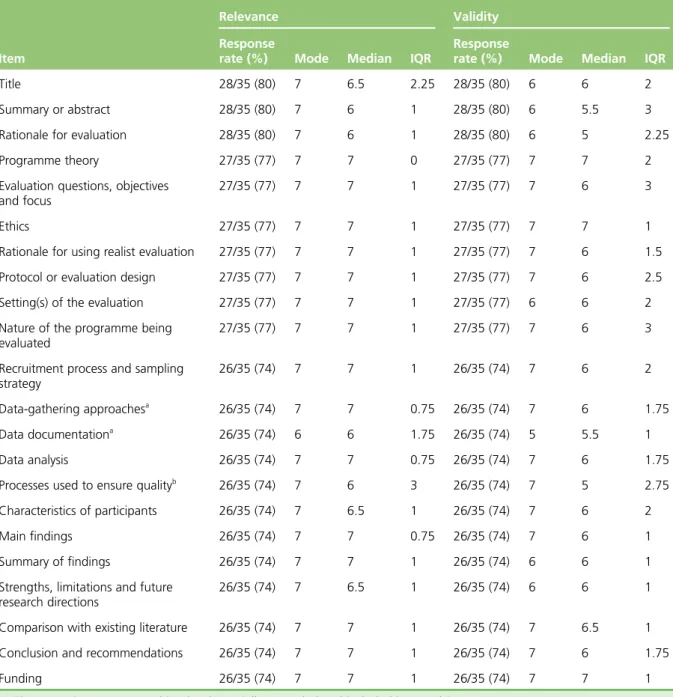
TABLE 3 Summary of results for round 2 of Delphi panel 19 TABLE 4 Summary of results for round 3 of Delphi panel 19 TABLE 5 Quality standards for peer reviewers of realist evaluation reports 21 TABLE 6 Quality standards for funders or commissioners of realist evaluations 30 TABLE 7 Summary of the topics covered in the training materials for
realist evaluations 38
TABLE 8 Overview of the realist evaluations for which the project team provided
methodological support or consultancy 39
List of figures
FIGURE 1 Overview of study processes 7
List of boxes
BOX 1 Illustration of the type of data we drew on to identify the need for, and
develop, quality standards 11
List of abbreviations
CINAHL Cumulative Index to Nursing andAllied Health Literature CMOC context–mechanism–outcome
configuration
CPCI-S Conference Proceedings, Citation Index–Science
ERIC Education Resources Information Center
IQR interquartile range
NIHR National Institute for Health Research
RDS Research Design Service SCI Science Citation Index SSCI Social Science Citation Index
Plain English summary
R
ealist evaluation is used to answer questions such as‘what works for whom, in what circumstances, how and why?’It is an approach to evaluating interventions or programmes in health and other fields. When we started this project, there were no standards setting out how to judge if realist evaluations were of high quality–something we have called quality standards. Nor did any standards exist to guide evaluators on how best to write up their evaluations–we have called these reporting standards. Although there were some resources and training materials for realist evaluation, more were needed that showed evaluators in detail how to rigorously undertake certain parts of an evaluation.In this project, we developed quality and reporting standards and resources and training materials for realist evaluations. We used a range of methods (e.g. a review of the literature and a structured consensus-building process called a Delphi panel) to help us choose and agree on what should be in the standards and training materials. We used a pre-existing e-mail list for additional input. We asked researchers we worked with on realist evaluations for their comments, and we got feedback from researchers we trained in workshops or presented to at conferences. We analysed and wove together all this information to produce quality and reporting standards and resources and training materials. We needed to prioritise certain parts of the project as a result of its ambitious nature and the workload this created. We have made all of our project’s outputs freely available online (www.ramesesproject.org).
Scientific summary
Background
Many of the problems confronting policy- and decision-makers, evaluators and researchers today are complex. For example, much health service need results from the effects of smoking, suboptimal diets (including obesity), excessive alcohol intake, inactivity or adverse family circumstances (e.g. partner violence), all of which, in turn, have multiple causes operating at both individual and societal level. Interventions or programmes designed to tackle such problems are themselves complex, with multiple, interconnected components delivered individually or targeted at communities or populations. Their success depends both on individuals’responses and on the wider context in which people strive (or not) to live meaningful and healthy lives. What works in one family, one organisation or one city may not work in another.
Designing and evaluating complex interventions is challenging. Randomised trials that compare‘intervention on’with‘intervention off’, and their secondary research equivalent, meta-analyses of such trials, may produce statistically accurate statements (e.g. that the intervention works‘on average’), but these leave us none the wiser about where to target resources or how to maximise impact.
Realist evaluation seeks to address these problems. It is a form of theory-driven evaluation, based on realist philosophy, and it aims to advance understanding of why these complex interventions work, how, for whom, in what context and to what extent, as well as to explain the many situations in which a programme fails to achieve the anticipated benefit.
Realist evaluation assumes both that social systems and structures are‘real’(because they have real effects) and that human actors respond differently to interventions in different circumstances. To understand how an intervention might generate different outcomes in different circumstances, realism introduces the concept of mechanisms, which may be helpfully conceptualised as underlying changes in the reasoning and behaviour of participants who are triggered in particular contexts.
This project aims to develop quality and reporting standards, resources and training materials, to build research capacity and to develop materials for lay participants involved in realist evaluations.
Objectives
1. Recruit an interdisciplinary Delphi panel of, for example, researchers, support staff, policy-makers, patient advocates and practitioners with various types of experience relevant to realist evaluation. 2. Summarise the current literature and expert opinion on best practice in realist evaluation to serve as a
baseline/briefing document for the panel.
3. Run three rounds (and more if needed) of the online Delphi panel to generate and refine items for a set of quality standards and reporting guidance.
4. In parallel with the Delphi panel:
(a) provide ongoing advice and consultancy to up to 10 realist evaluations, including any funded by the National Institute for Health Research (NIHR), thereby capturing the‘real-world’problems and challenges of this methodology
(b) host the RAMESES JISCMail list on realist research (www.jiscmail.ac.uk/RAMESES), capturing relevant discussions about theoretical, methodological and practical issues
5. Write up the quality standards and guidance for reporting in an open access journal.
6. Collate examples of learning/training needs for researchers, postgraduate students and peer reviewers in relation to realist evaluation.
7. Develop, deliver and refine resources and training materials for realist evaluation. Deliver three 2-day
‘realist evaluation’workshops and three 2-day‘training the trainers’workshops for a range of audiences [including interested NIHR Research Design Service (RDS) staff].
8. Develop, deliver and refine information and resources for patients and other lay participants in realist evaluation. In particular, draft template information sheets and consent forms that could be adapted for ethics and governance activity.
9. Disseminate training materials and other resources, for example via public-access websites.
Methods
In this project we used a range of methods to meet the objectives set out above. To fulfil objectives 1 and 2 we undertook a thematic review of the literature that was supplemented by our content expertise and by collating feedback from presentations and workshops. We synthesised our findings into briefing materials for realist evaluations. We recruited members to the Delphi panel, which had wide representation from researchers, students, policy-makers, theorists and research sponsors. We used the briefing materials to brief the Delphi panel so that they could help us in fulfilling objective 3. For the advice and consultancy in objective 4, we drew on not only our experience in developing and delivering education materials, but also relevant feedback from the Delphi panel, the RAMESES JISCMail e-mail list on realist research approaches, training workshops and the evaluations teams we had supported methodologically in the past. To help us refine our reporting standards (objective 5), we captured methodological and other challenges that arose within the realist evaluation projects we provided methodological support to. To produce the definitive reporting standards, quality standards and resources and training materials (objective 5), we synthesised expert input (from the Delphi panel), literature review and real-time problem analysis (e.g. feedback from the e-mail list, training sessions and workshops and presentations).
Throughout this project we did not set specific time points when we would refine the drafts of our project outputs. Instead, we iteratively and contemporaneously fed any data we captured into our draft reporting standards, quality standards and resources and training materials, making changes gradually. Only our Delphi panel ran within a specific time frame. The definitive guidance and standards were, therefore, the product of continuous refinements. To understand and develop information and resources for patients and other lay participants in realist evaluation (objective 8) we convened a group consisting of patients and the public. We addressed objective 9 through academic publications, online resources and delivery of presentations and workshops.
Results
Our literature review identified 152 realist evaluations, and when we had analysed 37 of these we had reached thematic saturation. Our analysis and discussion within the project team produced a summary of the published literature, and common questions and challenges in briefing materials for the Delphi panel. The Delphi panel comprised 35 members from 27 organisations across six countries and five disciplines. Within three rounds, the panels had reached a consensus on 20 key reporting standards, with an overall response rate of 76% and 80% for rounds 2 and 3, respectively. The RAMESES II reporting standards for realist evaluations have been published in an open-access journal and the EQUATOR (Enhancing the QUAlity and Transparency Of health Research) network (www.equator-network.org).
The quality standards and resources and training materials drew on the following sources of data: (1) personal expertise from researchers and trainers; (2) data from the Delphi panels; (3) feedback from participants at training sessions we ran; and (4) comments made on RAMESES JISCMail mailing list.
We developed eight quality criteria for realist evaluations with different versions for evaluators, researchers, peer reviewers and funders/commissioners of research. For our resources and training materials, we used the data we captured to identify the methodological topics that were highlighted by the majority of realist evaluators as most challenging. We developed training materials for 15 theoretical and methodological topics in realist evaluations. The quality standards and training materials are freely available online (www.ramesesproject.org).
We provided methodological support to 17 projects and presentations or workshops to help build research capacity in realist evaluations to 29 organisations, both nationally and internationally. This training included two‘training the trainers’workshops run in conjunction with the NIHR RDS East Midlands. Finally, we produced a generic patient information leaflet for lay participants in realist evaluations.
Conclusions
In conclusion, although realist evaluation holds much promise for developing theory and informing policy in some of the health and other sectors’most pressing questions, misunderstandings and misapplications of it is common. To try to address these problems, we have produced reporting and quality standards, and resources and training materials. In addition, we provided methodological support and advice to realist evaluation projects, ran training workshops for fellow realist evaluators and developed information and resources for patients and other lay participants in realist evaluation. However, for the quality of realist evaluations to improve, evaluators who wish to use realist evaluation will have to develop the necessary skills and use the materials we have developed.
We hope that our resources will be the start of an iterative journey of refinement and development of better resources for realist evaluations. Acknowledging that the science of evaluation should never be static, the RAMESES II project seeks not to produce the last word on these issues but to capture current expertise and establish an agreed state of the science on which future researchers will no doubt build. Much methodological development is needed in realist evaluation (e.g. work on appropriate quantitative methods, implications for research ethics, development of realist approaches in particular sectors and adaptation of existing evaluation tools for realist approaches). However, this can take place only if there is a sufficient pool of highly skilled realist evaluators. Capacity building through, for example, training and
‘apprenticeships’of less experienced evaluators with more experienced ones is the next key step in realist evaluation.
Funding
Funding for this study was provided by the Health Services and Delivery Research programme of the National Institute for Health Research.
Chapter 1
Background
M
any of the problems confronting policy- and decision-makers, evaluators and researchers today are complex. For example, much health service demand results from the effects of smoking, suboptimal diets (including obesity), excessive alcohol, inactivity or adverse family circumstances (e.g. partner violence), all of which, in turn, have multiple causes operating at both individual and societal level. Interventions or programmes designed to tackle such problems are themselves complex, often having multiple, interconnected components delivered individually or targeted at communities or populations. Their success depends both on individuals’responses and on the wider context in which people strive (or not) to live healthy lives. What works in one family, one organisation or one city may not work in another.Similarly, the‘wicked problems’of contemporary health services research–how to improve quality and assure patient safety consistently across the service, how to meet rising need from a shrinking budget and how to realise the potential of information and communication technologies (which often promise more than they deliver)–require complex delivery programmes with multiple, interlocked components that engage with the particularities of context. What works in hospital A may not work in hospital B.
Designing and evaluating complex interventions is challenging. Randomised trials that compare‘intervention on’with‘intervention off’, and their secondary research equivalent, meta-analyses of such trials, may produce statistically accurate statements (e.g. that the intervention works‘on average’), but may leave us none the wiser about where to target resources or how to maximise impact.
Realist evaluation seeks to address these problems. It is a form of theory-driven evaluation, based on realist philosophy,1that aims to advance understanding of why these complex interventions work, how, for whom, in what context and to what extent, as well as to explain the many situations in which a programme fails to achieve the anticipated benefit.
Realist evaluation assumes both that social systems and structures are‘real’(because they have real effects) and that human actors respond differently to interventions in different circumstances. To understand how an intervention might generate different outcomes in different circumstances, realism introduces the concept of mechanisms–which may be helpfully conceptualised as underlying changes in the reasoning of participants who are triggered in particular contexts.2For example, a school-based feeding programme may work by relieving hunger in young children in a low-income rural setting where famine has produced overt nutritional deficiencies, but for teenagers in a troubled inner-city community where many young people are disaffected, it may work chiefly by making pupils feel valued and nurtured.3What constitutes
‘working’is also likely to be somewhat different in the two settings.
Realist evaluations have addressed numerous topics of central relevance in health services research, including what works and for whom when‘modernising’health services,4
introducing breastfeeding support groups,5 using communities of practice to drive change,6involving patients and the public in research,7how robotic surgery impacts on team-working and decision-making within the operating theatre8
and fines for delays in discharge from hospitals.9They have also been used in fields as diverse as international development, education, crime prevention and climate change.
What is realist evaluation?
Realist evaluation was developed by Pawson and Tilley in the 1990s,10originally in the field of criminology, to address the question,‘what works for whom in what circumstances and how?’in criminal justice interventions. This early work highlighted the following points:
l Social programmes (closely akin to what health service researchers call complex interventions) are an attempt to address an existing social problem (i.e. to create some level of social change).
l Programmes‘work’by enabling participants to make different choices (although choice-making is always constrained by such things as participants’previous experiences, beliefs and attitudes, opportunities and access to resources).
l Making and sustaining different choices may require a change in a participant’s reasoning (e.g. in their values, beliefs, attitudes or the logic they apply to a particular situation) and/or the resources (e.g. information, skills, material resources, support) they have available to them. Programmes provide opportunities and resources. The interaction between what the programme provides and the participant’s
‘reasoning’is what enables the programme to‘work’and is known as a‘mechanism’.
l Programmes work in different ways for different people (that is, the contexts within programmes can trigger different change mechanisms for different participants).
l The contexts in which programmes operate make a difference to the outcomes they achieve. Programme contexts include features such as social, economic and political structures, organisational context,
programme participants, programme staffing, geographical and historical context, and so on. In realist terms, context does not simply denote spatial, geographical or institutional locations. Context refers, among other things, to the sets of‘social rules, norms values and interrelationships’that operate within these locations.10
l Some aspects of the context enable particular mechanisms to be triggered. Other aspects of the context may prevent particular mechanisms from being triggered. That is, there is always an interaction between context and mechanism, and that interaction is what creates the programme’s impacts or outcomes: context+mechanism=outcome.
l Because programmes work differently in different contexts and through different change mechanisms, they cannot simply be replicated from one context to another and automatically achieve the same outcomes. Theory-based understandings about‘what works for whom, in what contexts, and how’ are, however, transferable.
l Therefore, one of the tasks of evaluation is to learn more about:‘what works’, in what respects and to what extent, including intended and unintended outcomes;‘for whom’, that is, for which subgroups of participants;‘in which contexts’; and‘what mechanisms are triggered by what programmes in what contexts’.
A realist evaluation approach assumes that programmes are‘theories incarnate’. That is, whenever a programme is implemented, it rests on a theory about what‘might cause change’, even though that theory may not be explicit. One of the tasks of a realist evaluation is, therefore, to make the theories underpinning a programme explicit, by developing clear hypotheses about how, and for whom, programmes might‘work’. The implementation of the programme, and the evaluation of it, then tests those hypotheses. This means collecting data, not just about programme impacts or the processes of programme implementation, but about the specific aspects of context that might impact on programme intended and unintended outcomes, and about the specific mechanisms that might be creating change. Pawson and Tilley10also argue that a realist approach has particular implications for the methods required to evaluate a programme. For example, rather than comparing changes for participants who have undertaken a programme with a group of people who have not (as is done in randomised controlled or quasi-experimental designs), a realist evaluation compares context–mechanism–outcome configurations (CMOCs) within programmes. It may ask, for example, whether a programme works more or less well, and/or through different mechanisms, in different localities (and if so, how and why) or for different subgroups of the population. Furthermore, they argue that different stakeholders will have different information and understandings about how programmes are supposed to work and whether or not they in fact do so. Data collection processes (interviews, focus groups, questionnaires and so on) should be constructed to identify and collect the particular information that those stakeholder groups will have, and thereby to confirm, refute or refine theories about how and for whom the programme‘works’.
Realist evaluation is underpinned by a realist philosophy of science (‘realism’).11Philosophically speaking, realism can be thought of as sitting between positivism (‘there is a real external world which we can come to know directly through experiment and observation’) and constructivism (‘given that all we can know has
been interpreted through human senses and the human brain, we cannot know for sure what the nature of reality is’). However, it is worth pointing out that this is not to suggest that‘constructivism’and
‘positivism’represent opposite poles on the same continuum. Realism holds that there is a real social world but that our knowledge of it is amassed and interpreted (partially and/or imperfectly) via our senses and brains, and filtered through our language, culture and past experience. In other words, realism sees the human agent as operating in a wider social reality, encountering experiences, opportunities and resources, and interpreting and responding to the world within particular personal, social, historical and cultural frames. For this reason, different people respond differently to the same experiences, opportunities and resources. Hence, a programme (or, in the language of health services research, a complex intervention) aimed at improving health outcomes is likely to have different levels of success with participants in different contexts, and even in the same context at different times.
The need for standards and training materials in realist evaluation
The RAMESES JISCMail listserv [www.jiscmail.ac.uk/RAMESES (an e-mail list for discussing realist approaches)] postings suggest that enthusiasm for realist evaluation and belief in its potential for application in many fields have outstripped the development and application of robust quality standards in the field. Two important prior publications have systematically shown that many so-called‘realist evaluations’were not applying the concepts appropriately and were, as a result, producing potentially misleading findings and recommendations.12,13 Pawson and Manzano-Santaella, in their paper,‘A realist diagnostic workshop’, used case examples of flawed realist evaluations to highlight three common errors in such studies.13First, while it is possible to show associations and correlations in data from many types of evaluation, the focus of a realist evaluation should be to explore and explain why such associations occur. Second, they explain what may constitute valid data for use in realist evaluation. Producing a realist explanation is likely to require a mix of data types to provide explanations and support for the relationships within and between CMOCs. Third, realist explanations require CMOCs to be produced. Pawson and Manzano-Santaella note that some realist evaluations have presented finely detailed lists of contexts, mechanisms and outcomes, but have failed to produce a coherent explanation of how these contexts, mechanisms and outcomes were linked and related, or not related, to each other. Pawson and Manzano-Santaella called for greater emphasis on elucidating programme theory (the theory about what a programme or intervention is expected to do and, in some cases, how it is expected to work) expressed as CMO configurations.
Marchalet al.12undertook a review of the realist evaluation literature in health systems research to quantify and analyse the field. They identified 18 realist evaluations and noted a range of challenges that arose for researchers. Absence of prior theoretical and methodological guidance appeared to have led to recurring problems in the realist evaluations they appraised. Marchalet al.12noted that‘[t]he philosophical principles that underlie realist evaluation are variably interpreted and applied to different degrees’. Different researchers had conceptualised concepts used in realist evaluation such as‘middle-range theory’,‘mechanism’ and‘context’differently. This, they concluded, was often related to fundamental misunderstandings, and the rigour of the evaluation suffered as a result.
These two papers12,13showed that, although realist evaluation had been embraced by parts of the health research community, it had also proven a challenging task for some who were unfamiliar with the practical application of realism. Both sets of authors called for methodological guidance to allay misunderstandings about the purpose, underlying philosophical assumptions, analytic concepts and methods of realist evaluation.
Chapter 2
Methods
Objectives
The project had both strategic and operational objectives, and, because it was funded through the health sector, the objectives were framed in relation to health. However, representatives from beyond the health sector were involved to ensure that the products were relevant to any realist evaluation.
Strategic objectives
(a) To develop quality standards, reporting guidance and resources and training materials for realist evaluation.
(b) To build capacity in health services research for supporting and assessing realist approaches to research. (c) Acknowledging the unique potential of realist research to address the patient’s agenda (‘what will
work for us in our circumstances?’), to produce resources and training materials for lay participants, and those seeking to involve them, in research.
Operational objectives
1. Recruit an interdisciplinary Delphi panel of, for example, researchers, support staff, policy-makers, patient advocates and practitioners with various types of experience relevant to realist evaluation. 2. Summarise the current literature and expert opinion on best practice in realist evaluation, to serve as a
baseline/briefing document for the panel.
3. Run three rounds (and more if needed) of the online Delphi panel to generate and refine items for a set of quality standards and reporting guidance.
4. In parallel with the Delphi panel:
(a) provide ongoing advice and consultancy to up to 10 realist evaluations, including any funded by the National Institute for Health Research (NIHR), thereby capturing the‘real-world’problems and challenges of this methodology
(b) host the RAMESES JISCMail list on realist research, capturing relevant discussions about theoretical, methodological and practical issues
(c) feed problems and insights from 4a and 4b into the deliberations of the Delphi panel. 5. Write up the quality standards and guidance for reporting in an open-access journal.
6. Collate examples of learning/training needs for researchers, postgraduate students and peer reviewers in relation to realist evaluation.
7. Develop, deliver and refine resources and training materials for realist evaluation. Deliver three 2-day
‘realist evaluation’workshops and three 2-day‘training the trainers’workshops for a range of audiences [including interested NIHR Research Design Service (RDS) staff].
8. Develop, deliver and refine information and resources for patients and other lay participants in realist evaluation. In particular, draft template information sheets and consent forms that could be adapted for ethics and governance activity.
9. Disseminate training materials and other resources, for example via public-access websites.
Overview of methods
We first provide a brief overview of the range of methods we used to meet the objectives set out above and of how they related to each other. The methods we used in this project closely resemble those we
used in another project (the RAMESES project), which developed methodological guidance, reporting standards and training materials for realist and meta-narrative reviews.14We have previously published a protocol paper that outlined the methods we intended to use in this project.15The following methods sections outline, in more detail, specific aspects of the methods used.
To fulfil operational objectives 1 and 2, we undertook a thematic review of the literature. Findings were supplemented by our content expertise and with feedback collated from presentations and workshops for researchers using or intending to use realist evaluation. We synthesised our findings into briefing materials on realist evaluation for the Delphi panel. We recruited members to the Delphi panel, which had wide representation from researchers, students, policy-makers, evaluators, theorists and research sponsors. We used the briefing materials to inform the Delphi panel in preparation for the task, so they could contribute to developing standards (objective 3). For the advice and consultancy to realist evaluations (objective 4a), we drew on our experience in conducting realist evaluations and developing and delivering education materials, but also on relevant feedback from the Delphi panel, an e-mail list on realist research approaches (www.jiscmail.ac.uk/RAMESES) and the evaluations teams we had supported in the past. To help us refine our reporting standards (objective 5), we captured methodological and other challenges that arose within the realist evaluation projects to which we provided methodological support. All of these sources fed into the reporting standards, quality standards and resources and training materials (objective 7). We did not set specific time points when we would refine the drafts of our project outputs. Instead, we iteratively and contemporaneously fed the data we captured into our draft reporting standards, quality standards and resources and training materials, making changes gradually. Only our Delphi panel ran within a specific time frame. The final guidance and standards were, therefore, the product of continuous refinements. To understand and develop information and resources for patients and other lay participants in realist evaluation (objective 8), we convened a group consisting of patients and the public. We addressed objective 9 through academic publications, online resources and delivery of presentations and workshops. The project was overseen by a Project Advisory Group, which comprised three independent members (see
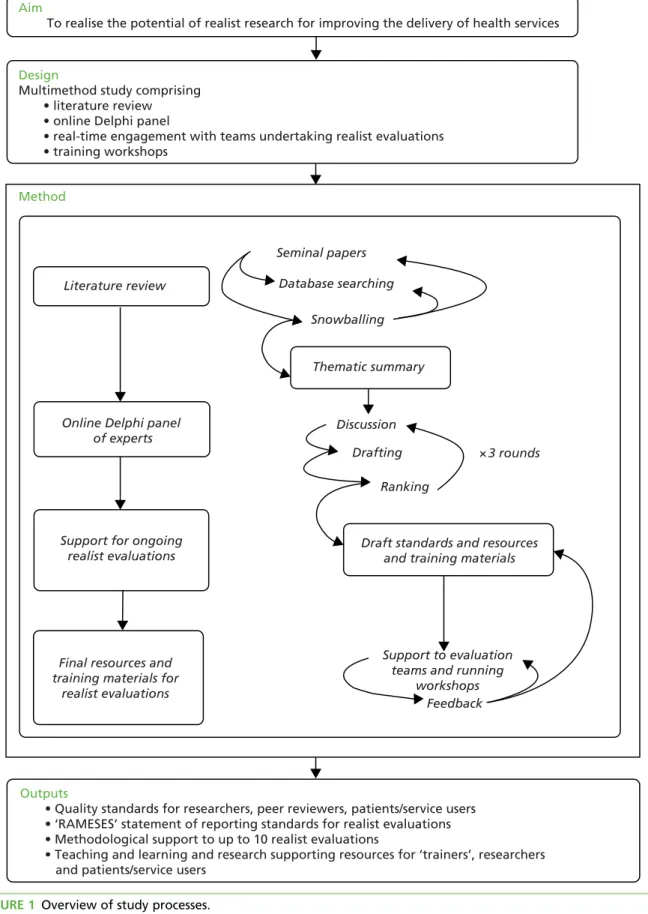
Acknowledgements). This group met with the project team on three occasions (May 2015, November 2015 and May 2016) and provided advice to the project team.Figure 1provides a pictorial overview of how the different methods we used fed into each other.
Details of literature search methods
With input from an expert librarian, we identified reviews, scholarly commentaries, models of good practice and examples of (alleged) misapplication of realist evaluation. To identify the relevant documents we refined and developed the search used by Marchalet al.12for a previous review on a similar topic, and also applied contemporary search methods designed to identify‘richness’when exploring complex interventions.16,17 A search was conducted on 3 March 2015 across 10 databases. Free-text terms were selected to describe realist methods and thesaurus terms were used where available (seeAppendix 1). The following databases were searched:
l Cumulative Index to Nursing and Allied Health Literature (CINAHL; via EBSCOhost)
l The Cochrane Library (Wiley Online Library)
l Dissertations & Theses database (ProQuest)
l EMBASE (via OvidSP)
l Education Resources Information Center (ERIC; via EBSCOhost)
l Global Health (via OvidSP)
l MEDLINE and MEDLINE In-Process & Other Non-Indexed Citations (via OvidSP)
l PsycINFO (via OvidSP)
l Scopus, Science Citation Index (SCI), Social Science Citation Index (SSCI) & Conference Proceedings, Citation Index–Science (CPCI-S)
l Web of Science Core Collection (Thomson Reuters Corporation, New York, NY, USA).
Aim
To realise the potential of realist research for improving the delivery of health services
Outputs
• Quality standards for researchers, peer reviewers, patients/service users • ‘RAMESES’ statement of reporting standards for realist evaluations • Methodological support to up to 10 realist evaluations
• Teaching and learning and research supporting resources for ‘trainers’, researchers and patients/service users
Design
Multimethod study comprising • literature review • online Delphi panel
• real-time engagement with teams undertaking realist evaluations • training workshops Snowballing Database searching Seminal papers Drafting Discussion
Draft standards and resources and training materials
Final resources and training materials for
realist evaluations Support for ongoing
realist evaluations Online Delphi panel
of experts Literature review Thematic summary Ranking × 3 rounds Support to evaluation teams and running
workshops Feedback Method
A forward citation search was conducted via the Web of Science Core Collection for the following key text: Pawson R, Tilley N.Realistic Evaluation. London: Sage; 1997.10
No language or study design filters were applied. We included any document that referred to or claimed to be a realist evaluation that used the approach as set out by Pawson and Tilley in their key publication,
Realistic Evaluation.10Documents were excluded if they were not realist evaluations, published prior to the year 2000, book reviews, letters and comment. We set the cut-off point at 2000, as we assumed that evaluations based on Pawson and Tilley’s work would begin appearing in the literature from this point onwards. All citation screening was undertaken by Geoff Wong. The whole searching process, from start to the retrieval of all full-text documents, took approximately 1 month.
We decided that, because of the narrow purpose of our review and the number of relevant citations retrieved, we would stop analysing data when we had reached thematic saturation. As a strategy to manage the potential number of realist evaluations, we decided to start our analysis and synthesis from the most recent (i.e. from 2015) realist evaluations and work‘backwards’. The decision on when thematic saturation had been reached was made in discussion with the whole project team. For both practical reasons (e.g. resource constraints) and academic ones (no new data), we stopped including new papers when there was agreement that saturation of themes had been reached. Thematic saturation was reached once the group agreed by consensus that the new realist evaluations identified contained no new themes or only subthemes that related to the three questions listed below in bullet points.
The thematic analysis was led by Geoff Wong, who undertook all stages of the review and shared findings with the rest of the project team so that discussion, debate and refinement of interpretations of the data could take place. Findings were shared by e-mail and, when necessary, face-to-face meetings were conducted to discuss interpretations of the data.
In undertaking our thematic analysis, we familiarised ourselves with the included evaluations to identify patterns in the data. Aware that the purpose of the review was to produce briefing documents for the Delphi panel, we considered the following questions:
l What is considered by experts in realist evaluation to be current best practice (and what is the range and diversity of such practice)?
l What do experts in realist evaluation, and other researchers who have undertaken a realist evaluation, believe counts as high quality and necessary to report?
l What issues do researchers struggle with (based on thematic analysis of postings on the RAMESES JISCMail list archive as well as the published literature)?
In the panels, we wanted to achieve a consensus on quality and reporting standards, and thus what we needed from our review of the literature were data to inform us on what might constitute quality in executing and reporting realist evaluations. We accepted that we might need to refine, discard or add additional questions and topic areas in order to better capture our analysis and understanding of the literature as these emerged from our reading of the evaluations.
Data were extracted to a Microsoft Excel®(Microsoft Corporation, Redmond, WA, USA) spreadsheet that we iteratively refined to capture the data needed to produce our briefing materials. This review was undertaken in a short time frame. The time taken from obtaining full-text documents to producing the final draft for circulation of the briefing documents was approximately 12 weeks. The output of this phase was a provisional summary that addressed the questions above and highlighted, for each question, the key areas of knowledge, ignorance, ambiguity and uncertainty. This was distributed to the Delphi panel (as our briefing document) as the starting point for its work.
Our purpose in identifying published reviews was not to complete a census of realist evaluations. We make no claims that the review we undertook was exhaustive; thus, we never intended that it should be
published as a stand-alone piece of research. In other words, the purpose of our review was not to produce definitive summaries in response to the themes above but to prepare a baseline set of briefing materials for the Delphi panel, and to deliberate on and add to them in the next step. As such, the review we undertook would be best considered as being a rapid, accelerated or truncated thematic review. Such an approach will predictably produce limitations, and these are discussed inChapter 4, Limitations.
Details of online Delphi process
We recruited Delphi panel members purposefully, to ensure that we had representation from evaluators, researchers, funders, journal editors and experts in realist evaluation. Individuals were recruited through relevant organisations and targeted e-mails, and also through personal contacts and recommendations. Those interested in participating were provided with an outline of the study, and individuals who indicated the greatest commitment and potential to balance the sample were selected.
The Delphi panel was run online using SurveyMonkey (SurveyMonkey, Palo Alto, CA, USA). Participants in round 1 were provided with the briefing materials we developed from the literature review and were invited to suggest what might be included in the reporting standards. Responses were analysed and fed into the design of questionnaire items for round 2.
In round 2 of the Delphi Panel, participants were asked to rank each potential item twice on a 7-point Likert scale (1=strongly disagree to 7=strongly agree), once for relevance (i.e.’Should an item on this theme/topic be included at all in the guidance?’) and once for validity (i.e.’To what extent do you agree with this item as currently worded?’). Those who agreed that an item was relevant, but disagreed on its wording, were invited to suggest changes to the wording via a free-text comments box. In this second round, participants were again invited to suggest additional topic areas and items. We did not prespecify stop-points for establishing when consensus has been achieved. This was because we wanted to have the flexibility to return to the Delphi panel items that we judged might need further input. Although we accept that this may have enabled us to preferentially return some items and not others, we guarded against this by sending all Delphi panel members an end-of-round report detailing all the findings, changes made to the text and items to be returned to the next round. Panel members were invited to contact us should they have any concerns with the items that were not returned for re-rating, such as believing that the item should be returned to the panel, or disagreeing with wording changes.
Participants’responses were collated and the numerical rankings were entered onto an Excel spreadsheet. The response rate, average, mode, median and interquartile range (IQR) for each item was calculated. Items that scored low on relevance were omitted from subsequent rounds. We invited further online discussion on items that scored high on relevance but low on validity (indicating that a rephrased version of the item was needed) and on those for which there was wide disagreement about relevance or validity. The panel members’free-text comments were also collated and analysed thematically.
Following analysis and discussion within the project team, we drew up a second list of statements that were circulated for ranking (round 3). Round 3 contained items for which consensus had not yet been reached. For items on which consensus had been reached, we did not return these to rounds 3, 4 or beyond for panel members to re-rate, even if we had made changes to the wording. This was because, when we undertook the RAMESES project, we had received informal feedback from the Delphi panel members indicating that round 2 of the online Delphi process had been very time-consuming. We were advised that to retain a high response rate for subsequent rounds, we should minimise the time commitment we asked of panel members. We planned that the process of collating responses, further e-mail discussion and re-ranking would be repeated until a maximum consensus was reached (rounds 4, 5, and so on). In practice, very few Delphi panels, online or face to face, go beyond three rounds because participants tend to‘agree to differ’ rather than move towards further consensus. We used e-mail reminders to optimise our response rate from Delphi panel members. We considered consensus to be achieved when the median score was 6 or above.
We planned to report residual non-consensus as such and to report the nature of the dissent described (if any). Making such dissent explicit tends to expose inherent ambiguities, which may be philosophical or practical, and acknowledges that not everything can be resolved; such findings may be more use to those who use realist evaluation than a firm statement that implies that all tensions have been fixed. We used the findings from the Delphi panel to develop the reporting standards and methodological quality standards for realist evaluations.
Developing quality standards
The quality standards were designed to support professional development, assist evaluators to assess the quality of various aspects of the evaluation process and to assist reviewers with meta-evaluation (i.e. assessing the quality of evaluations).
To develop the quality standards, we drew on the following sources of data:
l free-text comments from participants and findings from the Delphi panels
l personal expertise as evaluators, researchers, peer reviewers and trainers in the field
l feedback from participants at workshops and training sessions run by members of the project team
l comments made on RAMESES JISCMail.
The data from the sources above were collated contemporaneously and discussed within the project team. Iterative cycles of discussion and revisions for content and clarity of the drafts were needed to develop the standards.Box 1provides an illustration of how we drew on the data sources to produce the quality standards.
Developing, delivering and refining resources and training materials for
realist evaluation
An important part of our project was to produce publicly accessible resources to support training in realist evaluations. We anticipated that these resources will need to be adapted, and perhaps supplemented, for different groups of learners, and interactive learning activities added. We developed, and iteratively refined, draft learning objectives, example course materials and teaching and learning support methods. We drew on a range of sources to inform the content and format of our training materials as well as our experience as trainers and consultants on realist evaluations.
We sought out examples of the kinds of requests that are often made by evaluators for support on realist evaluation, for example using the rich archive of postings on the RAMESES JISCMail listserv from both novice and highly experienced practitioners, going back 3 years. We also proactively asked the list members for additional examples, and used our empirical data from the Delphi panel and our literature review to identify relevant examples. Finally, we sought input from UK RDS staff interested in realist evaluation to describe the kind of problems people bring to them, and where they feel that further guidance, support and resources are needed.
We used a thematic approach to classify examples into a list of problems and issues, each with a
corresponding training need(s) and resources to address them. These were developed iteratively in regular discussions and meetings of the research team. Our goal was to develop a coherent and comprehensive curriculum for training realist researchers and for‘training the trainers’.
BOX 1 Illustration of the type of data we drew on to identify the need for, and develop, quality standards
Quality standard: programme theories
Identification of need
As evaluators, researchers and trainers in realist evaluation, we had noted that there was some confusion among researchers about the nature, need and role of realist programme theory (or theories) in realist
evaluations. To develop the briefing materials and initial drafts of the reporting standards for realist evaluations, we searched for and analysed a number of published evaluations and noted that our impressions were
well founded.
When providing methodological support for a realist evaluation, the importance of programme theory emerged again. One of the project team commented,‘I felt the development of the initial“programme theory”pulled things together . . .’In our Delphi process, we encouraged participants to provide free-text comments. These closely reflected the comments we received about the importance of programme theory.
Development of the quality criteria
We drew on our content expertise of the topic area and published methodological literature to develop the quality criteria. In addition, we found that some of our Delphi panel participants provided us with clear indications that supported the criteria we set. For example, we suggested that realist evaluations should develop a programme theory and one that did not was‘inadequate’. Delphi panel participants’free-text comments echoed our suggestion:
Really important . . .
Initial programme theories will be clearly stated . . .
Many people’s efforts at realist evaluation fall at the programme theory stage . . .
We were also able to draw on the discussions that took place on JISCMail to support some of our criteria. For example, under‘adequate’, we suggested that:‘initial tentative programme theory (or theories) were identified and (as far as possible) described in realist terms (that is, in terms of the causal relationship between contexts, mechanisms and outcomes). These were refined as the evaluation progressed’.
As illustration, a comment from JISCMail that we drew upon to support this criterion was:
It’s good to read that you are planning to develop a programme theory. It may be that even before you start data collection that you may wish to develop an initial‘best guess’programme theory of the . . . intervention. Do not worry that it may be a best guess and has no CMOCs (i.e. is not particularly realist in nature)–it is a starting point. As the evaluation progresses your job is to gradually (iteratively)‘convert’it into a more detailed realist programme theory that has data to support any inferences you have made.
Support and consultancy to realist evaluations
The support we offered to fellow evaluators and researchers using realist evaluations consisted of two overlapping and complementary levels:
1. Online discussion and support via JISCMail for evaluators and researchers, at any level, interested in or undertaking a realist evaluation. When questions or issues were raised, either one of the project team or another list member would reply. Where necessary, summaries were made of discussions and clarification was provided by members of the project team.
2. Direct requests for support and training. During the course of the study, members of the project team were frequently approached to provide methodological support to realist evaluation projects. The exact content, nature and duration of the support provided was discussed between the relevant team members to ensure that what was provided met the needs of those who requested the support.
Realist evaluation and
‘
training the trainers
’
workshops
Throughout the 24 months of the project, members of the project team offered training workshops to other evaluators, researchers and patient organisations on an as-requested basis. When asked to provide a workshop, the logistics and content of each workshop were discussed between the relevant project team member and the hosts.
For the‘training the trainers’workshops, we engaged with the NIHR’s RDS. We did this by e-mailing each regional service and also asking for expressions of interest via e-mail lists and personal contacts.
Develop, deliver and refine information and resources for patients and
other lay participants in realist evaluation
To develop these resources, we convened a panel of lay participants with the help of the Patient and Public Involvement Co-ordinator from the Nuffield Department of Primary Care Health Sciences at the University of Oxford. We sought to invite lay participants who had been involved in research studies and came from a range of backgrounds and ages. During the panel, we sought to understand what lay
participants might wish to know if they were to participate in a realist evaluation and provided examples of the potential materials for their consideration.
Chapter 3
Results
W
e produced four outputs related to realist evaluations for this project, namely: 1. reporting standards2. methodological quality standards
3. resources and training materials (for researchers, evaluators and lay participants) 4. capacity building.
This chapter provides details of the results we obtained from the methods and approaches we used, and how they contributed to the content of our outputs.
Literature search
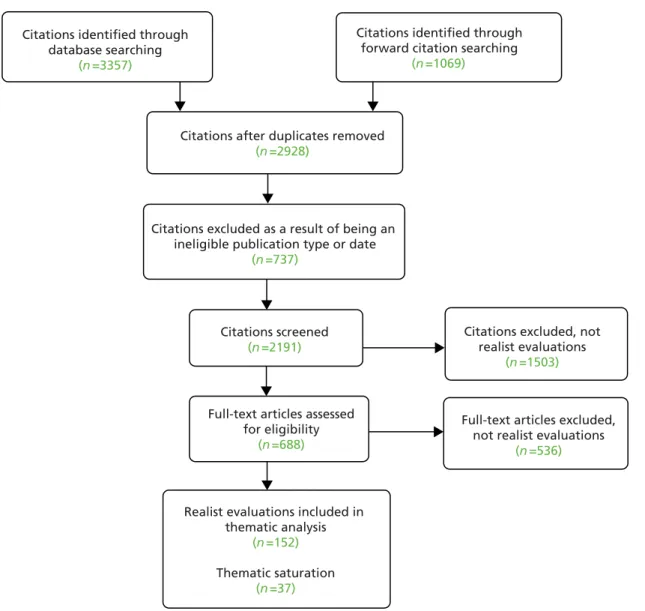
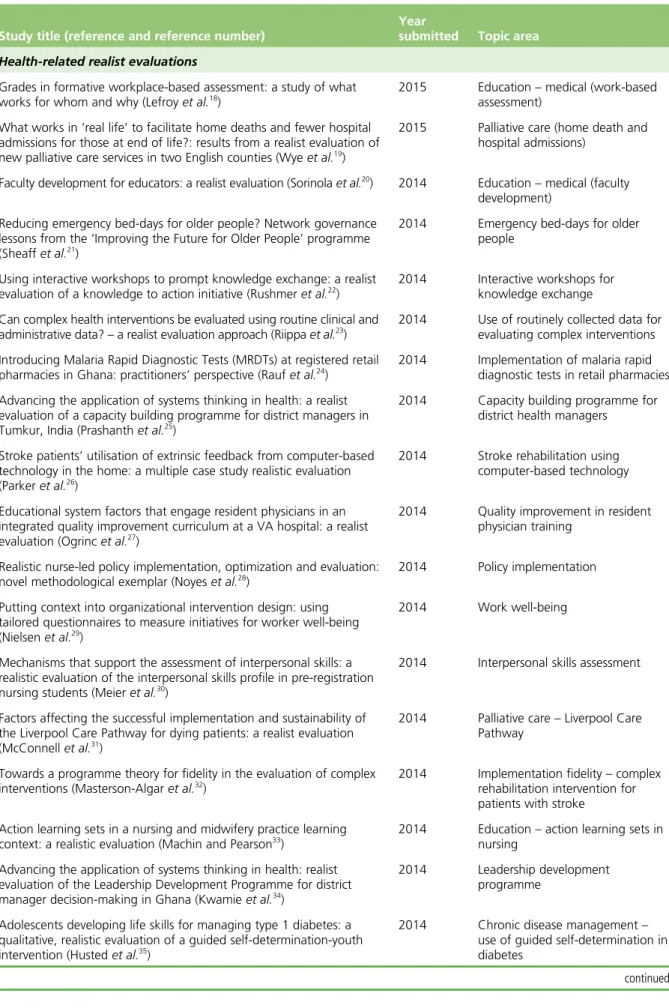
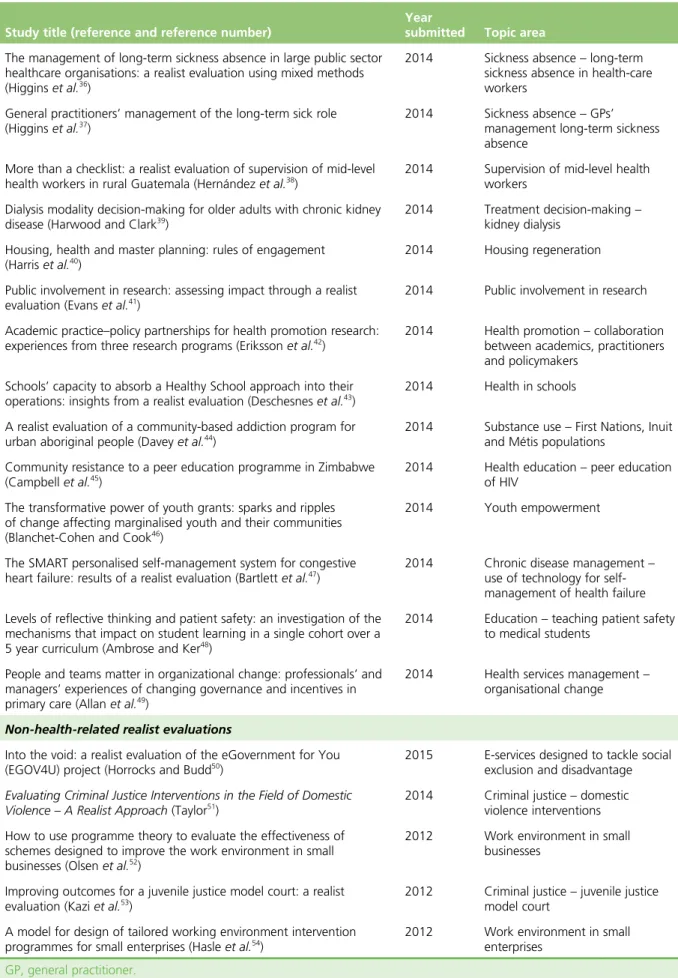
We searched 10 electronic databases from inception (where applicable) to March 2015 and, along with citation tracking, retrieved 4426 documents after removal of duplications. A total of 1498 duplicates were removed, along with a further 737 papers that did not meet our inclusion criteria. A total of 2191 papers were screened by title and abstract for inclusion with 1503 excluded at this stage.Figure 2shows the disposition of the documents andTable 1the number of citations returned for each database searched. One of the project team (GWo) screened the abstracts and titles and included documents that claimed to be realist evaluations. In total, 152 documents were judged to be realist evaluations. Because of the narrow focus of our review of the literature on realist evaluations, as discussed inChapter 2,Details of literature search methods, we worked‘backward’from 2015 to earlier years and sought to stop analysis at the point of thematic saturation. We achieved thematic saturation after analysis of 37 out of the 152 realist evaluations. Out of these realist evaluations, 32 (from years 2015 and 2014 inclusively) evaluated health-related topics, and five (from years 2015 to 2012 inclusively) evaluated non-health-related topics. We made this distinction to ensure that we analysed realist evaluations that covered a range of topic areas, as the approach is used in a broad range of topic areas beyond health research. Hence,Table 2shows only the characteristics of the documents we analysed (evaluation title, type of document, year submitted for publication and topic area) and drew on to produce our briefing document for the Delphi panel.
Because many evaluation reports are not published and our search strategy focused on published materials, the great majority of documents we analysed were journal articles about evaluations rather than complete evaluation reports. We acknowledge that full evaluation reports may have provided greater detail. However, because journal articles usually require a description of both methods and findings, our focus was methodological and the literature review served only to identify issues to refer to the Delphi panel; therefore, we remain confident that the sample was adequate for the task.
We conducted a thematic analysis guided, initially, by the three questions set out above (seeChapter 2, Details of literature search methods) to produce the briefing documents for the realist evaluation Delphi panel (seeAppendix 2). All the data we extracted were either entered into an Excel spreadsheet or written up directly into a draft of our briefing document. Of the three questions set out above, two refer to what experts in realist evaluation and researchers who have undertaken a realist evaluation consider to be best practice and high quality. Much of this information was contained in the documents listed inTable 2, but we also had to supplement our understanding by drawing on more methodological documents.1,10,12,13 Our first question [what is considered by experts to be current best practice (and what is the range and diversity of such practice)?] related to perceptions of methodological rigour in the execution of realist evaluations. Addressing this question required the most immersion and analysis. With this question,
TABLE 1 Citations returned for databases searched
Database Number of citations returned
CINAHL 215
The Cochrane Library 26
Dissertations & Theses 147
EMBASE 484
ERIC 209
Global Health 94
MEDLINE and MEDLINE In-Process & Other Non-Indexed Citations 455
PsycINFO 533
Scopus, SCI, SSCI and CPCI-S 854
Web of Science Core Collection 340
Citation tracking
Pawson R, Tilley N.Realistic Evaluation. London: Sage; 199710
1069 Citations identified through
database searching (n = 3357)
Full-text articles excluded, not realist evaluations
(n = 536)
Realist evaluations included in thematic analysis
(n = 152) Thematic saturation
(n = 37)
Full-text articles assessed for eligibility
(n = 688)
Citations excluded, not realist evaluations
(n = 1503) Citations screened
(n = 2191)
Citations excluded as a result of being an ineligible publication type or date
(n = 737)
Citations after duplicates removed (n = 2928)
Citations identified through forward citation searching
(n = 1069)
FIGURE 2 Flow diagram outlining the disposition of documents.
TABLE 2 Characteristics of realist evaluation documents used to inform Delphi process materials (listed by year submitted for publication)
Study title (reference and reference number)
Year
submitted Topic area
Health-related realist evaluations
Grades in formative workplace-based assessment: a study of what works for whom and why (Lefroyet al.18
)
2015 Education–medical (work-based assessment)
What works in‘real life’to facilitate home deaths and fewer hospital admissions for those at end of life?: results from a realist evaluation of new palliative care services in two English counties (Wyeet al.19
)
2015 Palliative care (home death and hospital admissions)
Faculty development for educators: a realist evaluation (Sorinolaet al.20
) 2014 Education–medical (faculty development)
Reducing emergency bed-days for older people? Network governance lessons from the‘Improving the Future for Older People’programme (Sheaffet al.21
)
2014 Emergency bed-days for older people
Using interactive workshops to prompt knowledge exchange: a realist evaluation of a knowledge to action initiative (Rushmeret al.22
)
2014 Interactive workshops for knowledge exchange Can complex health interventions be evaluated using routine clinical and
administrative data?–a realist evaluation approach (Riippaet al.23 )
2014 Use of routinely collected data for evaluating complex interventions Introducing Malaria Rapid Diagnostic Tests (MRDTs) at registered retail
pharmacies in Ghana: practitioners’perspective (Raufet al.24 )
2014 Implementation of malaria rapid diagnostic tests in retail pharmacies Advancing the application of systems thinking in health: a realist
evaluation of a capacity building programme for district