Perception of Quality in Cloud
Computing Based Services
Aleksandar Karadimce
Danco Davcev
Faculty of Computer Science and Engineering
University Ss Cyril and Methodius, Skopje, R. Macedonia
ICT COST Action IC1304 - ACROSS 02.2016
Contents
Introduction
Motivation
Related work
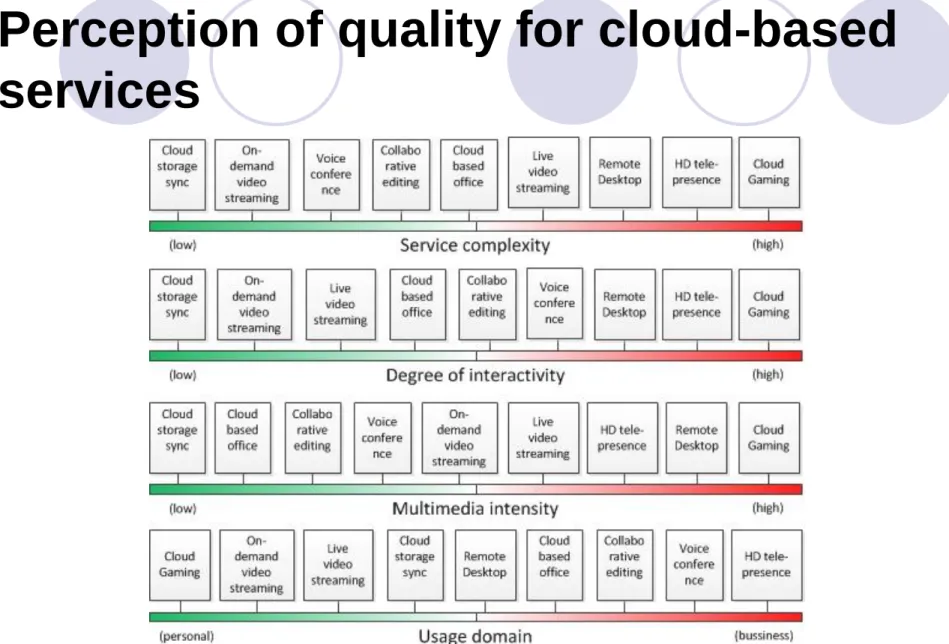
Perception of quality for cloud-based
services
Bayesian model for evaluation of quality
for cloud-based services
Introduction
Cloud computing aims to provide stable, reliable
and encapsulated dynamic information and communication environment.
The end users are able to simultaneously access
shared resources that are available anywhere and at any time.
The perception of quality is different from the
perception of quality in traditional applications, it mainly depends on the quality of parameters that are specific for cloud computing.
Motivation
The cloud applications are intended for distributed
usage, which contributes to a greater degree of complexity of the system.
It is a computing paradigm that provides an
abstraction of the mobile network management.
It enables mobile applications to provide end users
with personalized, context-aware delivery of multimedia content.
Motivation
The accurate assessment on the quality for
services and applications in the "cloud" provides greater control over the quality of the delivered multimedia content.
Research challenge is to define an appropriate
perception of quality for cloud computing based services offered to end users.
Given that there is no direct way to measure the
perception of quality of the cloud-based services offered, the challenge is to design appropriate models that will ensure transparent quality
Main contribution of research
The major benefit of cloud computing is used to
improve the perception of quality for the client requests.
The main contribution of this research is to
propose a classification of cloud-based services
based on objective and subjective
characteristics for perception of quality.
We have done assessment of QoE level for
cloud-based services considering the level of interactivity, service complexity, usage domain, and multimedia–intensity.
Related work
The online live streaming services are using innovative approach for online QoE prediction.
Models are developed for QoE prediction, where machine learning technique is used for online
estimation of real-time user feedback [10].
The Back propagation neural network is used to
reflect the mapping relations of the QoS parameters and QoE are used to build a three-layer QoE model for HTTP video streaming [11].
Statistical nonlinear regression analysis has been used to build the models with a group of influencing factors as independent predictors [12].
Perception of quality
The QoE is defined as “the degree of delight or
annoyance of the user of an application or
service. It results from the fulfillment of his or her expectations with respect to the utility and/or
enjoyment of the application or service in the light of the user’s personality and current
state”[3].
Primarily the factors that influence the
perception of quality can be roughly grouped
into three categories, namely human, system,
Perception of quality for cloud-based
services
Considering the analysis of all the factors and
parameters that affect QoE, we noted various subjective factors affecting the user’s
environment for cloud computing.
Depending on the cloud service type, we have
proposed QoE-based classification of different cloud services, with regard to level of
interactivity, service complexity, usage domain, and multimedia–intensity.
Perception of quality for cloud-based
services
Perception of quality for cloud-based
services
Bayesian modeling allows analysis of both linear
and non-linear relationships between variables.
It works with probabilities and therefore it is
expected to produce discrete data containing nominal and ordinal attributes [13].
The cloud storage synchronization service has low multimedia intensity (MI), low level of
interactivity (DI), also low service complexity (SC) and the service is more intended for
Bayesian model for evaluation of quality
for cloud-based services
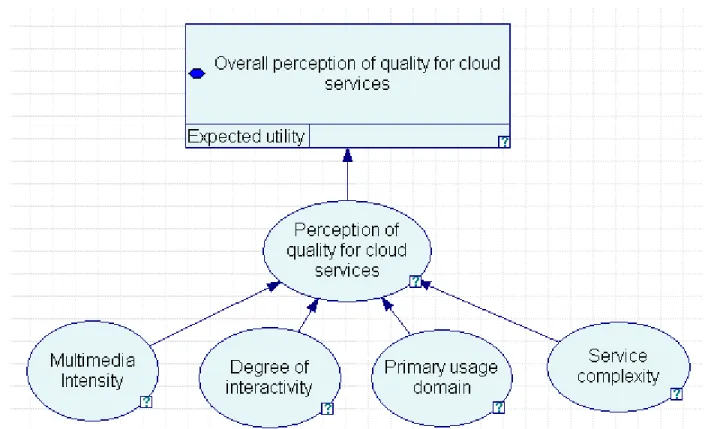
The model is comprised of the four predetermined
factors that influence the perception of quality.
The benefit of using Bayesian models to build QoE
model for interactive services [13], has been used as a reference to develop our own prototype for cloud-based services QoE assessment using the GeNIe 2.0 platform [18], see Figure 2.
Bayesian model for evaluation of quality
for
cloud storage synchronization
service
Bayesian model for evaluation of
quality for cloud-based services
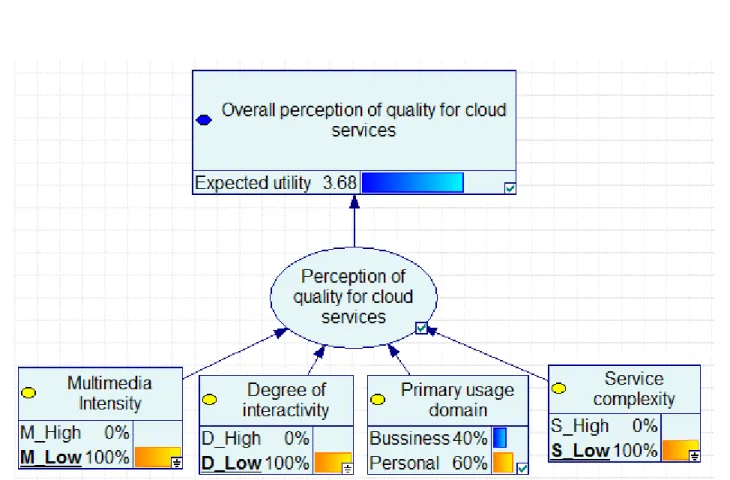
Figure 3. Bayesian model for perception of quality for cloud storage synchronization service
Established classification of cloud-based services and using the conventional Bayesian model has allowed to measure the overall perception of quality, in the Table 1.
Cloud service type Overall perception of quality Influencing factors Multimedia intensity Degree of interactivity Primary usage
domain Service complexity Cloud storage sync good (3.68) low (1) low (1) bussines (0.4), personal (0.6) low (1) On-demand video good
(3.8325)
high (0.45), low
(0.55) low (1) personal (1) low (1) Voice conference very good
(4.334) high (0.3), low (0.7) high (0.6), low (0.4) bussines (1) low (1) Collaborative
editing
very good
(4.07192) high (0.3), low (0.7) high (0.6), low (0.4)
bussines (0.4),
personal (0.6) high (0.3), low (0.7) Cloud based
office
good
(3.7488) low (1) high (0.6), low (0.4)
bussines (0.6),
personal (0.4) high (0.6), low (0.4) Live video
stream-ing good (3.64146) high (0.55), low (0.45) high (0.4), low (0.6) bussines (0.4),
personal (0.6) high (0.6), low (0.4) Remote Desktop very good
(4.134) high (1) high (0.6), low (0.4)
bussines (0.4),
personal (0.6) high (0.6), low (0.4) HD telepre-sence very good
(4.368)
high (0.55), low
(0.45) high (1)
bussines (0.4),
personal (0.6) high (1) Cloud gaming excellent
Bayesian model for evaluation of
quality for cloud-based services
The expected utility function values, for the overall perception of quality of cloud services, are conveyed on 5-point MOS scale, in Table 1.
The perception of the quality for cloud storage
synchronization service has “good” perception (3.68)
that is calculated as overall perception of quality for cloud services, in the established Bayesian network.
This assessment has provided the realistic
estimation for the different intensity of usage on cloud-based services based on the proposed classification.
Conclusion and future work
This research has provided new insight to what it is of particular importance for users of cloud computing in order to assess the quality of services offered.
This research contributed to the creation of models for end user perception of quality that are based on the technology of cloud computing.
It has been developed a QoE metrics that could be
used for estimating the quality by effectively measuring cloud-based services with consideration of the
influencing factors: level of interactivity, service
complexity, usage domain, and multimedia–intensity that are affecting the user perception.
References
[3] A. Raake and S. Egger, “Quality and Quality of Experience,” in
Quality of Experience, S. Möller and A. Raake, Eds. Springer
International Publishing, 2014, pp. 11–33. ISBN: 978-3-319-02680-0.
[10] V. Menkovski, G. Exarchakos, and A. Liotta, “Online QoE
prediction,” 2010, pp. 118–123. DOI: 10.1109/QOMEX.2010.5517692.
[11] W. Kaiyu, W. Yumei, and Z. Lin, “A new three-layer QoE
modeling method for HTTP video streaming over wireless networks,” 2014, pp. 56–60. DOI: 10.1109/ICNIDC.2014.7000265.
[12] W. Song and D. W. Tjondronegoro, “Acceptability-Based QoE
Models for Mobile Video,” IEEE Transactions on Multimedia, vol. 16, no. 3, pp. 738–750, Apr. 2014. DOI: 10.1109/TMM.2014.2298217.
[13] S. Tasaka, “A Bayesian hierarchical model of QoE in
interactive audiovisual communications,” 2015, pp. 6983–6989. DOI: 10.1109/ICC.2015.7249439.
[18] Genie software package,https://dslpitt.org/genie/ [online] access date: 03/01/2016.