The Private Equity Negotiation Myth
William W. Clayton†Private equity fund agreements have been criticized for failing to protect investors from exploitation by fund managers. One defense frequently used by the industry has been to invoke what I call the private equity negotiation myth, which claims that because fund agreements are highly negotiated, substantive concerns about their terms are unwarranted. This myth assumes that large investors will use their bargaining power to demand strong fund agreement protections for all of the investors in a fund.
This Article questions the private equity negotiation myth. First, I show that large investors’ incentives to negotiate fund agreements can often be weaker than the myth suggests. Because large private equity fund investors are commonly able to negotiate for individualized benefits outside of fund agreements, they have strong incentives to use their bargaining power to maximize individualized benefits before negotiating for better fund-wide protections. Individualized benefits thus can dampen the extent to which fund agreements are actually negotiated. Second, I show that large investors cannot always be expected to “vote with their feet,” either, by avoiding funds with suboptimal protections. When large investors have bargaining power, it makes them less sensitive to the quality of fund agreement terms because they can negotiate for individualized benefits that offset the harm caused by weak protections. As a result, the marginal investors in private equity funds—those whose preferences have the greatest influence on the quality of fund terms— may sometimes be ones that lack bargaining power rather than the ones that have it. Lastly, some of the largest institutional investors in private equity funds may suffer from internal agency problems that reduce their incentives to demand strong protections.
The private equity negotiation myth thus encourages policymakers to make policy decisions based on incomplete information in this $5 trillion industry. By challenging the myth and showing the true incentives associated with bargaining power in private equity funds, this Article contributes to
† Associate Professor, BYU Law School. I am thankful to Robert Daines, Elisabeth de Fontenay, Jessica Erickson, Jill Fisch, Jesse Fried, Michael Guttentag, Christine Hurt, Cathy Hwang, John Morley, Roberta Romano, Megan Shaner, Andrew Tuch, and participants in the “New Voices in Business Law” workshop at the 2019 Association of American Law Schools Annual Meeting, the “Perspectives on Cutting-Edge Issues in Venture Capital and Private Equity” workshop at the 2019 A.B.A. Business Law Section Annual Meeting, and the 2019 BYU Law Winter Deals Conference for helpful discussions and comments on earlier versions of this Article. All errors are my own.
important and timely policy discussions at both the state and federal levels on the regulation of private investments.
Introduction ... 69
I. Conflicts of Interest in Private Equity Funds ... 73
A. Basic Conflicts of Interest ... 73
B. Protections Against Conflicts ... 75
II. The Private Equity Negotiation Myth ... 78
A. Critiques of Private Equity LPAs ... 78
1. Scholarly Critiques ... 78
2. Journalistic Critiques ... 82
3. The SEC’s Critique ... 84
B. The Industry’s Negotiation-Based Defense ... 85
III. Problems With the Myth ... 88
A. Large Investors Cannot Be Counted on to Negotiate LPAs ... 89
1. Why Large Investors Have Bargaining Power ... 89
2. Diminished Incentives to Negotiate LPA Terms ... 91
3. Most Important Protections Are Least Likely to Be Negotiated When There Is Information Asymmetry ... 96
B. Large Investors Cannot Be Counted on to Vote with Their Feet ... 97
1. How Contract Terms Are Shaped in the Absence of Negotiation ... 97
2. Large Investors Won’t Always Be the Marginal Investors ... 98
C. Agency Problems Can Reduce Incentives to Demand Strong Protections ... 102
D. Forms of Individualized Benefits in Private Equity ... 103
1. Fee Discounts ... 103
2. Co-Investments ... 104
3. Other Rights in Side Letters ... 105
4. Separately Managed Accounts ... 106
IV. Policy Implications ... 107
A. State Law: Waiving Fiduciary Duties in Limited Partnerships ... 107
B. Federal Law: Regulating Access to Private Funds ... 110
V. Conclusion ... 113
Introduction
Strong criticisms have been levied against private equity fund agreements in recent years. Fund agreements have been accused of enabling managers to charge exorbitant fees,1 encouraging managers to engage in excessive
risk-taking,2 allowing managers to operate behind a veil of secrecy,3 and eliminating
negative consequences for managers’ bad behavior,4 among other critiques.
One commentator has accused fund agreements of being so deficient that they create an “incubator for agency costs.”5 Given the vast size of the private equity
market,6 and the heavy investment by public institutions in private equity
funds,7 these criticisms have raised alarm.
In response, one defense frequently used by the private equity industry has been to invoke what I call the private equity negotiation myth.8 The myth is
simple. It claims that large investors in private equity funds use their bargaining power to negotiate for robust protections in fund agreements that benefit all investors in a fund. Because fund agreements are highly negotiated, so the myth goes, concerns about the substantive quality of their terms must be unwarranted.9
This defense has strong surface-level appeal. If fund agreements really are heavily negotiated by large investors, it would create a presumption that the terms in them are not deficient, despite what critics say. Classical contract theory holds that unrestricted freedom of contract between parties that possess equal bargaining power, skill, and knowledge of relevant market conditions enhances individual welfare and promotes an efficient allocation of resources.10
1. See infra note 77 and accompanying text. 2. See infra note 54 and accompanying text. 3. See infra notes 76-79 and accompanying text. 4. See infra notes 87-90 and accompanying text.
5. James C. Spindler, How Private Is Private Equity, and at What Cost?, 76 U.CHI.L.REV.
311, 333 (2009) (“One could view the typical private-equity setup as creating almost an incubator for agency costs, an incredibly hospitable environment for opportunistic managerial behavior.”).
6. See The Rise and Rise of Private Equity, MCKINSEY & COMPANY (Feb. 2018), https://www.mckinsey.com/industries/private-equity-and-principal-investors/our-insights/the-rise-and-rise-of-private-equity [https://perma.cc/6XRJ-KQ9J] (“Private markets’ assets under management (AUM), which include committed capital, dry powder, and asset appreciation, surpassed $5 trillion in 2017, up 8 percent year on year.”).
7. Public pension plans are by far the largest investor type in private equity funds, representing
35% of all investment. See PREQIN,GLOBAL PRIVATE EQUITY &VENTURE CAPITAL REPORT 73 (2018);
see also Andrew J. Bowden, Dir., Office of Compliance Inspections & Examinations, U.S. Sec. & Exch. Comm’n, Address at the Private Equity International Private Fund Compliance Forum: Spreading
Sunshine in Private Equity (May 6, 2014),
https://www.sec.gov/news/speech/2014--spch05062014ab.html [https://perma.cc/QK8R-XKV8] (noting that misconduct in the private equity industry “adversely affects the retirement savings of teachers, firemen, police officers, and other workers across the U.S.”).
8. See infra note 91 and accompanying text. 9. See infra Part II.
10. See, e.g., RESTATEMENT (SECOND) OF CONTRACTS § 72 cmt. b (AM.LAW INST.1981) (“Bargains are widely believed to be beneficial to the community in the provision of opportunities for
The benefits of fund agreement negotiations thus would be enjoyed by all investors in private equity funds, not just the large ones.
Closer examination, however, reveals that large investors cannot simply be relied on to play this role. Unlike in a corporate setting,11 large investors in
private equity funds commonly use their bargaining power to negotiate for individualized benefits outside of fund agreements, where the benefit of the bargain is not shared with other investors in the fund. These individualized benefits, which can include fee discounts and rights to participate in co-investments alongside the fund (among others),12 fundamentally alter large
investors’ incentives. When individualized benefits are common, they can diminish large investors’ incentives to demand strong protections in fund agreements in two ways.
First, individualized benefits can weaken large investors’ incentives to negotiate fund agreements. In general, the more that an investor can use its bargaining power to negotiate for individualized benefits before it negotiates for things that will benefit all investors in the fund (like fund agreement protections), it will be a more “efficient” use of that investor’s bargaining power.13 This does not eliminate the negotiation of fund agreements, but, when
individualized benefits are common, it is likely to have a dampening effect on the extent to which fund agreements are negotiated.
Second, individualized benefits can also weaken large investors’ incentives to “vote with their feet” by refusing to invest in funds that have suboptimal protections. In the absence of negotiation, the quality of a fund agreement’s terms will be shaped by the preferences of the “marginal” investors in that market,14 which are the investors that will stop investing when
the quality of the fund agreement terms starts to decline.15 This Article shows
that bargaining power can actually make large investors less sensitive to the
freedom of individual action and exercise of judgment and as a means by which productive energy and product are apportioned in the economy. The enforcement of bargains rests in part on the common belief that enforcement enhances that utility.”).
11. One of the core principles of corporate law is that shareholders holding the same class of
shares should be treated similarly. See REINIER H.KRAAKMAN ET AL.,THE ANATOMY OF CORPORATE
LAW:ACOMPARATIVE AND FUNCTIONAL APPROACH 96 (2d ed. 2009) (stating that the equal treatment of shareholders in the same class is a fundamental norm of corporate law); Victor Brudney, Equal Treatment of Shareholders in Corporate Distributions and Reorganizations,71 CALIF.L.REV. 1072, 1074 (1983) (stating that all shares of common stock are to be treated as “homogeneous claims on enterprise wealth” in a public corporation).
12. See infra Section III.D for a discussion of the various forms that these individualized benefits can take.
13. An “efficient” use of bargaining power in this context is one that achieves the greatest personal benefit possible in return for the investor’s bargaining power. See infra Section III.A.2.
14. This assumes a competitive market where buyers have alternative options. See G. Marcus
Cole, Rational Consumer Ignorance, 11 J.L.ECON &POL’Y 413, 414 (2015) (“[N]on-price terms, like price terms, are ‘policed’ in competitive markets by the marginal consumer for each term.”).
15. See id. at 422 (“[T]he marginal consumer, by definition, is the party for whom a particular term means the most. . . . The marginal consumer is someone who cares so much about that particular term, that she has educated herself, researched the product terms, and its closest substitutes along the margin of that all-important dimension—whatever it happens to be.”).
quality of fund agreement terms because it enables them to negotiate for individualized benefits that offset the harm caused by weak fund agreement protections. This means that large investors may sometimes be willing to invest in funds that they would otherwise find unacceptable if they lacked bargaining power.16 As a result, large investors with bargaining power may not always be
the marginal investors—those whose preferences have the greatest influence on the quality of fund terms—in the private equity funds that they invest in.17
The incentives described above will apply when large investors are acting rationally to maximize returns for their beneficiaries. But this may not always be the case. The largest investors in private equity funds are public pension plans, whose staff members have sometimes been shown to suffer from agency problems.18 These agency problems can dampen their incentive to demand
strong protections, even when doing so would be beneficial for plan beneficiaries.19
Challenging the private equity negotiation myth is important for a few reasons. Most fundamentally, it shows that the criticisms of fund agreements raised in recent years cannot be dismissed by simply invoking negotiation. At its core, the private equity negotiation myth is a process-based response to substantive criticisms. It argues that because the process by which fund agreement terms are created is sound, substantive scrutiny of those terms is unwarranted and unnecessary. This Article shows that policymakers should not simply take the negotiation myth at face value. Just because there are large investors in the industry that have bargaining power, it cannot automatically be assumed that fund agreements will always have robust protections for all investors in them.20
This Article also contributes to broader policy discussions at both the state and federal levels. At the state level, this analysis advances the literature on the controversial practice of waiving fiduciary duties in non-corporate entities like
16. See infra Section III.B.2 for an illustrative example. 17. See infra Section III.B.2.
18. See Josef Lakonishok, Andrei Shleifer & Robert W. Vishny, The Structure and
Performance of the Money Management Industry, in BROOKINGS PAPERS ON ECONOMIC ACTIVITY, MICROECONOMICS 339 (Clifford Winston ed., 1992) (finding significant underperformance by pension plans attributable to agency problems, including actions taken by pension employees to shift
responsibility for poor performance); Paul Gompers & Josh Lerner, The Use of Covenants: An
Empirical Analysis of Venture Partnership Agreements, 39 J.L.&ECON. 463 (1996) (finding that institutional investor employees show a willingness to allow value to be transferred to fund managers in complex ways that are difficult for outsiders and superiors to detect, but not in ways that can be more easily observed and scrutinized); George Pennacchi & Mahdi Rastad, Portfolio Allocation for Public Pension Plans, 10 J.PENSION ECON.& FIN. 221 (2011) (finding that public pension plans tend to allocate assets based on the performance of peer pension funds rather than based on hedging the plan’s liabilities due to staff career concerns).
19. See infra Section III.C.
20. To be clear, I am not claiming that a legitimate process-based defense does not exist for
private equity fund agreements. For example, if all investors in the private equity market are sufficiently sophisticated to analyze fund agreements and search the market for alternatives, then lack of negotiation may not be problematic at all. This Article focuses on the negotiation-based defense raised by the industry in recent years and does not examine the legitimacy of alternative defenses.
limited partnerships and limited liability companies. It builds on commentary by Leo Strine, Chief Justice of the Delaware Supreme Court, and Travis Laster, Vice Chancellor of the Delaware Chancery Court, questioning the policy of allowing alternative entity managers to waive their fiduciary duties, and it also fills important gaps in that analysis in the context of private equity funds.21
At the federal level, this Article’s analysis lends important insights to current policy initiatives aimed at responding to the dramatic rise of private markets in recent years.22 The SEC recently launched a comprehensive
re-examination of the federal securities laws that regulate investor access to private funds,23 with an eye toward opening up more opportunities for retail
investors to gain exposure to private investments.24 In response to concerns
about investor safety, one influential research organization has argued that retail investors could rely on large institutional investors to demand strong protections on their behalf if they were granted access to private equity funds.25
This Article shows why policymakers should view any such claims skeptically. This Article proceeds as follows. Part I discusses conflicts of interest that arise in private equity funds and the various forms of protection against these conflicts commonly used in private equity funds. Part II summarizes some of the most pointed criticisms of private equity fund agreements in recent years and shows how the industry has responded by raising the private equity negotiation myth in its defense. Part III challenges the myth by arguing that 21. See Leo E. Strine, Jr. & J. Travis Laster, The Siren Song of Unlimited Contractual Freedom, in RESEARCH HANDBOOK ON PARTNERSHIPS,LLCS AND ALTERNATIVE FORMS OF BUSINESS
ORGANIZATIONS 11 (Robert W. Hillman & Mark J. Loewenstein eds., 2015).
22. See infra Section IV.B. The rise of private markets has been attended by a related decline
in U.S. public markets. See Maureen Farrell, America’s Roster of Public Companies Is Shrinking Before
Our Eyes, WALL ST. J. (Jan. 6, 2017), https://www.wsj.com/articles/americas-roster-of-public-companies-is-shrinking-before-our-eyes-1483545879 [https://perma.cc/ELA4-YN6A] (“Since the financial crisis, the equity market has become bifurcated, with a private option available to select
investors and a public one that is more of a last resort for companies.”); Jonathan Macey, Opinion, As
IPOs Decline, the Market Is Becoming More Elitist, L.A. TIMES (Jan. 10, 2017) https://www.latimes.com/opinion/op-ed/la-oe-macey-ipo-democracy-20170110-story.html
[https://perma.cc/66K2-4A9D] (“It’s not an exaggeration to say that the IPO market is in the beginning of a death spiral as observers assume that any company that resorts to raising money in an IPO must already have been rejected by the more sophisticated investors in the private capital markets.”).
23. See SEC, Concept Release on Harmonization of Securities Offering Exemptions (June 18,
2019), https://www.sec.gov/rules/concept/2019/33-10649.pdf [https://perma.cc/N4V3-WEGG]. 24. See DAVIS POLK, PRIVATE EQUITY REGULATORY UPDATE 3 (July 31, 2019), https://www.davispolk.com/files/2019-07-31_private_equity_regulatory_update_july_2019.pdf [https://perma.cc/K8BH-LZ48] (“[T]here are [Concept Release] sections that focus on opening up investments in private companies and private funds to retail investors. One of the major themes of the Concept Release is that the SEC has recognized that retail investors’ inability to participate in private opportunities, either directly or through investment funds, may be disadvantaging them economically.”).
25. See COMM. ON CAPITAL MKTS. REGULATION, EXPANDING OPPORTUNITIES FOR
INVESTORS AND RETIREES: PRIVATE EQUITY 36 (Nov. 2018),
https://www.capmktsreg.org/wp-content/uploads/2018/10/Private-Equity-Report-FINAL-1.pdf [https://perma.cc/4SR9-KVQN]
(“Congress could establish or empower the SEC to establish any . . . protections for retail investors that they deem necessary. For example, . . . Congress or the SEC could only permit a private equity fund to accept retail investors if the assets managed by the affiliated manager include a material institutional component (e.g., more than 50%). Such a requirement would enable retail investors to leverage the demands of institutional investors.”).
large investors cannot be counted on to demand strong protections in fund agreements through negotiation or by “voting with their feet.” It also provides a concise description of the various forms of individualized benefits that investors can seek to negotiate for in private equity funds. Part IV concludes with a discussion of policy implications.
I. Conflicts of Interest in Private Equity Funds A. Basic Conflicts of Interest
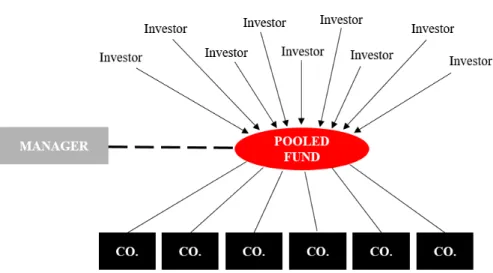
Private equity managers26 invest other people’s money for a fee. They
raise money by pooling the capital of their various investors into a single vehicle called a fund. Fund investors generally commit different levels of capital to the fund—some commit very large amounts while others commit much smaller amounts. These “pooled” funds are typically organized as limited partnerships27 and governed by a limited partnership agreement (an “LPA”), a
document that is collectively negotiated between the manager and the fund’s investors and sets forth the terms of the fund. Private equity LPAs are long and complicated agreements, typically over 100 pages long.28 By and large, the
industry is very lightly regulated.29
26. To avoid unnecessary complexity, I will use the term “manager” through most of this
Article, even in cases where other terms (like “sponsor” or “adviser” or “general partner”) may be more technically correct. Any technical distinctions will not be important for purposes of this Article. I will also generally use the term “investor” throughout this Article, even in cases where the term “limited partner” might be more technically correct, for similar reasons.
27. Because funds are usually structured as limited partnerships, the limited partnership
architecture applies to these vehicles. Accordingly, investors are passive “limited partners,” and the manager acts through a “general partner” that has broad authority to control the fund.
28. See Marco Da Rin & Ludovic Phalippou, The Importance of Size in Private Equity:
Evidence from a Survey of Limited Partners, 31 J.FIN.INTERMEDIATION 64, 69 (2016) (“LPAs are technical and lengthy documents, typically over 100 pages.”).
29. See Douglas Cumming & Sofia Johan, Regulatory Harmonization and the Development of
Private Equity Markets, 31 J. BANKING &FIN. 3218, 3219 (2007) (“The dearth or lack of regulations in private equity to which we refer is related to the fact that investors in private equity funds are institutional investors and high net worth individuals (not the so-called unsophisticated retail investors) and therefore these funds do not receive the same degree of scrutiny as other types of retail based funds, such as mutual funds.”).
Figure A. Illustrative Private Equity Fund
Once a fund is formed, a manager has an “investment period”—typically three to five years30—during which the fund is free to make investments. These
investments are known as “portfolio companies,” and a manager’s objective is to buy companies that are undervalued or that would benefit from changes to strategy or management. During the investment period, investors are contractually obligated to contribute capital to the fund each time the manager makes a “capital call” so the fund can make investments and pay the fund’s fees and other expenses. Managers typically have extremely broad discretion to select investments, and investors generally have very few rights to influence the fund’s activities.31
After a number of years, the manager seeks to sell the fund’s portfolio companies or take them public through initial public offerings, hoping to make profits upon the disposition. Each fund has a stipulated end date (typically around ten years after the date of the fund’s closing)32 by which the manager
30. See STEPHANIE BRESLOW &PHYLLIS SCHWARTZ, PRIVATE EQUITY FUNDS:FORMATION AND OPERATION § 2:4.2 (Carol Benedicto ed., Practising Law Inst. 2015) (“The appropriate length of the commitment period will vary depending on the investment strategy of the fund, with a time period of three to five years being typical for many strategies.”).
31. For this reason, traditional private equity funds are commonly called “blind pools” because
investors are signing up to invest in them without any knowledge of, or control over, the investments
that will be made by the manager. See Spindler, supra note 5, at 328-29 (“While the [LPA] will usually
impose strict obligations upon the limited partner to provide capital to the partnership, the limited partner has very little control over what the capital is used for.”).
32. See Ronald W. Masulis & Randall S. Thomas, Does Private Equity Create Wealth? The Effects of Private Equity and Derivatives on Corporate Governance, 76 U.CHI.L.REV. 219, 222 (2009) (noting that private equity funds are typically established for ten-year terms).
must dispose of any remaining assets and distribute the proceeds to the fund’s investors.33
Conflicts of interest in private equity funds stem from the separation of ownership and control in the private equity fund structure.34 For example,
private equity managers may be incentivized to invest less time and effort than they would if they were managing their own money, or they may seek to enrich themselves at the expense of their investors. Manager self-dealing could take the form of secretly charging excessive fees and expenses or of keeping the best investment opportunities for personal investment rather than allocating them to the fund, among any number of others.35
B. Protections Against Conflicts
Legal scholars and financial economists have theorized about the ways in which private equity investors can defend against agency conflicts in the absence of mandatory legal protections.36 The combination of contractual
protections, paired with a manager’s reputational incentives, are generally seen as the most important tools. Each is considered below.
Before committing to invest in a fund, investors have an opportunity to review the LPA governing the terms of the fund. LPAs contain a number of provisions that are designed to protect investors from conflicts with the fund manager.37 One way that LPAs seek to limit these conflicts is through the
33. Often, the life of a fund can be extended for successive one- or two-year periods to liquidate and wind up investments.
34. See generally ADOLF A.BERLE,JR.&GARDINER C.MEANS,THE MODERN CORPORATION AND PRIVATE PROPERTY (1933); Michael C. Jensen & William H. Meckling, Theory of the Firm: Managerial Behavior, Agency Costs and Ownership Structure, 3 J. FIN. ECON. 305, 308 (1976) (describing the relationship between investor and manager as one “under which one or more persons (the principal(s)) engage another person (the agent) to perform some service on their behalf which involves delegating some decision-making authority to the agent”).
35. See infra Section II.A for a discussion of some of the conflicts that have been criticized in private equity funds.
36. See, e.g.,PAUL GOMPERS &JOSH LERNER,THE VENTURE CAPITAL CYCLE 158 (2d ed.
2004); Vladimir A. Atanasov, Vladimir I. Ivanov & Kate Litvak, Does Reputation Limit Opportunistic
Behavior in the VC Industry? Evidence from Litigation Against VCs, 67 J.FIN.2215(2012);Victor
Fleischer, The Missing Preferred Return, 31 J.CORP.L. 77, 80 (2005); Lee Harris, A Critical Theory of
Private Equity, 35 DEL.J.CORP.L. 259, 285 (2010); Steve Kaplan & Antoinette Schoar, Private Equity Performance: Returns, Persistence and Capital Flows, 60 J.FIN. 1791, 1791 (2005) (finding that better performing managers are more likely to raise successor funds and larger funds); Kate Litvak, Monte Carlo Simulation of Contractual Provisions: An Application to Default Provisions in Venture Capital Limited Partnership Agreements, 98 CORNELL L.REV. 1495, 1498 (2013);Kate Litvak, Venture Capital Limited Partnership Agreements: Understanding Compensation Arrangements, 76 U.CHI.L.REV. 161,
162 (2009); Andrew Metrick & Ayako Yasuda, The Economics of Private Equity Funds, 23 REV.FIN.
STUD. 2303 (2010); John Morley, The Separation of Funds and Managers: A Theory of Investment Fund
Structure and Regulation, 123 YALE L.J. 1228, 1254-55 (2014); Larry E. Ribstein, Partnership Governance of Large Firms, 76 U.CHI.L.REV. 289, 298-99 (2009); William A. Sahlman, The Structure and Governance of Venture-Capital Organizations, 27 J.FIN.ECON. 473, 489-516 (1990); Spindler,
supra note 5, at 332.
37. See David T. Robinson & Berk A. Sensoy, Do Private Equity Fund Managers Earn Their
manager’s compensation arrangements. In addition to “management fees,” which are calculated as an annual percentage of the investor’s total investment in the fund,38 private equity managers typically receive a percentage interest in
the profits of the fund called a “carried interest,”39 which generally results in
them receiving higher compensation as the profitability of the fund increases. Managers are also generally required to invest a certain amount of their own money directly in the fund itself alongside the pooled fund investors. Depending on how the manager’s carried interest and commitment to invest in the fund are structured in the LPA, they can shape the manager’s incentives in various ways and afford greater or lesser protection to investors.
LPAs also contain various non-economic provisions designed to address agency conflicts. For example, investors are sometimes granted the right to consent to certain transactions when the manager’s interest is conflicted, or to dissolve the fund if the manager engages in certain forms of misconduct.40
LPAs also sometimes include requirements that the manager’s key employees dedicate a certain percentage of their time to working for the fund.41 Terms
designed to limit risk-taking by the manager—such as restrictions on borrowing and requirements for diversification of investments—can also be included.42
Funds also commonly establish “advisory boards” consisting of the fund’s largest investors, which are sometimes given limited rights to consult with the manager or consent to certain types of transactions.43
In addition to contractual protections, agency conflicts in funds are limited by managers’ incentive to maintain a good reputation. Because private equity funds have limited lives,44 private equity managers must raise funds on a serial
basis if they desire to remain in business. Managers commonly start raising a (“In private equity, the agency relationship between fund managers (the general partners, or GPs) and investors (the limited partners, or LPs) is governed by a management contract that is signed at the inception of the fund.”).
38. See BRESLOW & SCHWARTZ, supra note 30, § 2:8.2[B][1] (“The market rate for management fees of private equity funds is approximately 1.5%-2% of the fund’s aggregate capital commitments during the fund’s investment period.”).
39. Historically, the conventional carried interest percentage has been between 15-20% of the
fund’s profits over a “hurdle” rate of 5-12%. See JAMES M.SCHELL ET AL.,PRIVATE EQUITY FUNDS: BUSINESS STRUCTURE AND OPERATIONS § 2.03[2] (2018) (“Fixed rate preferred returns commonly range from 5% to 12%.”).
40. Seeid. § 11.12[1].
41. Seeid. § 11.04[6] (“[A] ‘key person provision’ generally refers to a contractual provision
that grants various rights and remedies to the investors upon the departure or disabling conduct of a specified number of ‘key persons.’ The ‘key persons’ are typically defined in the partnership agreement as the Principals or senior managers of the Fund.”).
42. See id. § 11.07[2][b] (“In the case of most private equity funds, a policy concerning diversification is imposed as a contractual requirement. In many cases, a private equity fund will generally not be allowed to invest more than 20% to 25% of its total capital commitments in the securities of any single portfolio company.”).
43. See id. § 11.07[8] (“From the Limited Partners’ perspective, an Advisory Board represents a mechanism for a limited degree of oversight in areas where the interests of the General Partner may not be fully aligned with those of the Limited Partners.”).
44. See Masulis & Thomas, supra note 32, at 222 (noting that private equity funds are typically established for ten-year terms).
new fund for a given strategy every three to five years, launching a new fund each time the investment period of a prior fund draws to a close.
If a manager wants to raise funds in the future, it has an incentive to achieve a successful “track record” of investment returns in its current fund because investors want to see evidence of the manager’s capabilities before they commit their money.45 A manager’s history of past performance is
typically provided to investors in the marketing materials that they distribute to prospective investors when they raise a fund.
Managers are also subject to fiduciary duties under state limited partnership law46 and under the federal Investment Advisers Act of 1940 (the
“Advisers Act”).47 However, in Delaware, the state in which most private
equity fund limited partnerships are formed,48 fiduciary duties can be modified,
or even waived entirely, by an LPA’s terms,49 and under the Advisers Act,
fiduciary duties can largely be satisfied by disclosure of conflicts and other risks.50 The world of private equity funds is thus highly contractual, and neither
45. See Ronald J. Gilson, Engineering a Venture Capital Market: Lessons from the American
Experience, 55 STAN.L.REV. 1067, 1089-90 (2003) (“A [manager’s] track record . . . is the [manager’s] principal tool for persuading investors to invest in successor funds.”); see also PREQIN, KEY DUE
DILIGENCE CONSIDERATIONS FOR PRIVATE EQUITY INVESTORS (2014),
https://docs.preqin.com/reports/Preqin-Special-Report-Due-Diligence-Private-Equity-Investors-Jul-14.pdf [https://perma.cc/RFA6-ZRXQ] (reporting the results of a survey showing that both placement agents and investment consultants believe the track record of the investment team is the most important
indicator that a fund will outperform peer funds); Curtis J. Milhaupt, The Market for Innovation in the
United States and Japan: Venture Capital and the Comparative Corporate Governance Debate, 91 NW. U.L.REV. 865, 886 (1997) (“[T]he short life of limited partnerships virtually guarantees that the venture capitalists will undergo a ‘periodic performance review’ at the hands of their current investors who are, inevitably, potential future investors as well.”).
46. These include a duty of loyalty, which, among other things, requires that the general partner refrain from dealing with the partnership on behalf of a party that has an adverse interest and from competing with the partnership, and a duty of care. See, e.g.,DEL.CODE ANN. tit. 6, § 15-404(b), (c) (2018); REVISED UNIF.LTD.P’SHIP ACT § 403(b) (1976); UNIF.LTD.P’SHIP ACT § 408 (1916).
47. See SEC v. Capital Gains Research Bureau, 375 U.S. 180, 196 (1963) (“The Investment
Advisers Act of 1940 thus reflects a congressional recognition ‘of the delicate fiduciary nature of an investment advisory relationship,’ as well as a congressional intent to eliminate, or at least to expose, all conflicts of interest which might incline an investment adviser . . . to render advice which was not disinterested.”).
48. See Private Equity (Fund Formation), GETTING THE DEAL THROUGH (Mar. 2019), https://gettingthedealthrough.com/area/28/jurisdiction/23/private-equity-fund-formation-2019-united-states [https://perma.cc/33XJ-VHSR] (“In the United States, private equity funds are typically formed as limited partnerships in the State of Delaware, pursuant to the Delaware Revised Uniform Limited
Partnership Act (DRULPA).”); Robert Schwartz, Delaware as a Location for Private Funds: The Why
and the What, WORLD SEC.L.REP. (BNA) (Aug. 10, 2012).
49. See, e.g., DEL.CODE ANN. tit. 6, § 17-1101(d) (2018) (“To the extent that, at law or in equity, a partner or other person has duties (including fiduciary duties) to a limited partnership or to another partner or to another person that is a party to or is otherwise bound by a partnership agreement, the partner’s or other person’s duties may be expanded or restricted or eliminated by provisions in the partnership agreement; provided that the partnership agreement may not eliminate the implied contractual covenant of good faith and fair dealing.”). Note, however, that the more limited implied contractual covenant of good faith and fair dealing cannot be waived under Section 18-1101(c) of the Delaware Limited Liability Company Act. See DEL.CODE ANN. tit. 6, § 18-1101(c) (2018).
50. See Capital Gains Research Bureau, 375 U.S. at 196 (citing United States v. Miss. Valley Generating Co., 364 U.S. 520 (1961)) (holding that investors must “be permitted to evaluate overlapping motivations, through appropriate disclosure, in deciding whether an adviser is serving ‘two masters’ or
state nor federal law provide investors with meaningful back-up protection if the combination of LPA-based protections and reputation-based protections is deficient.
II. The Private Equity Negotiation Myth
LPAs are held up as one of the primary sources of investor protection against managerial exploitation in private equity funds, but they have been criticized by many in recent years. One response to this criticism has been for the industry to invoke what I call the private equity negotiation myth as a defense.51 Because LPAs are heavily negotiated by large investors, so the
argument goes, there is no basis for outside observers to criticize the substance of these agreements.
A. Critiques of Private Equity LPAs 1. Scholarly Critiques
Scholars have accused LPAs of being deficient in a number of ways over the years.52 One line of criticism argues that the compensation arrangements set
forth in LPAs, which are supposed to align managers’ interests with their investors’ interests,53 actually create serious conflicts of interest. Scholars have
criticized carried interest compensation for encouraging excessive risk-taking by managers in their investment decisions,54 creating a moral hazard problem
because managers enjoy the upside of strong performance without downside
only one, ‘especially . . . if one of the masters happens to be economic self-interest’”); Andrew Ceresney, Dir., Div. of Enforcement, U.S. Sec. & Exch. Comm’n, Securities Enforcement Forum West
2016 Keynote Address: Private Equity Enforcement (Mar. 12, 2016),
https://www.sec.gov/news/speech/private-equity-enforcement.html [https://perma.cc/47JT-FLA7]
(indicating that managers must “disclose sufficiently specific facts such that the client is able to understand the [manager’s] conflicts of interest and business practices, and can give informed consent to such conflicts or practices”). As a result, if a manager has disclosed certain risks and investors have not negotiated for contractual protections against those risks, the investors will be exposed to those risks without any protection from federal fiduciary duties.
51. See infra note 91 and accompanying text.
52. See, e.g., Robinson & Sensoy, supra note 37, at 2761 (“[T]he typical private equity contract allows GPs to earn excessive compensation and does too little to discipline GPs or to provide them with incentives to maximize LP returns.”).
53. See supra note 39 and accompanying text.
54. See, e.g., Gilson, supra note 45, at 1089 (“While aligning the interests of the GP and the investors, the intensity of the GP’s compensation incentive in turn creates a different agency cost. The GP’s carried interest has option-like characteristics, which may cause it to prefer investments of greater risk than the investors. This is especially true with respect to the fund’s later investments if the early ones have done poorly. In that circumstance, the GP actually may be best served by making negative net present value investments if the investments are sufficiently risky.”); Harris, supra note 36, at 285 (“One of the problems of incentive compensation provisions . . . is that the compensation structure may encourage a manager to make overly risky investment decisions . . . .”).
risk.55 Carried interest has also been criticized for distorting managers’
decision-making in other ways, including giving them an incentive to shorten their investment horizons and time cash flows in ways that will increase incentive fees.56 Separately, scholars have also argued that the carried interest
formulations in LPAs are unnecessarily and overly complex, making it harder for investors to understand exactly how much they are obligated to pay.57
One of the most controversial critiques of LPAs in recent years has to do with portfolio company fees charged by private equity fund managers. These fees are not paid directly by investors. Instead, they are paid by the portfolio companies owned by the fund, as illustrated in Figure B. These fees have often taken the form of “monitoring” fees or “consulting” fees—the idea is that the portfolio companies pay managers for “services” that the managers provide to the portfolio companies. However, because portfolio companies are ultimately controlled by a fund’s manager (because the manager controls the fund that owns the portfolio company), the timing and amount of these payments have historically been controlled by the manager. Skeptical of the value actually provided by these services, some scholars have called these fees “money for doing nothing.”58
55. See, e.g.,William Magnuson, The Public Cost of Private Equity, 102 MINN.L.REV. 1847, 1872 (2018) (“The carried interest element of private equity compensation creates a moral hazard problem in the private equity industry that in many ways mirrors the critiques levied against the banking industry after the financial crisis of 2008-2009.”).
56. See Ludovic Phalippou, Beware of Venturing into Private Equity, 23 J.ECON.PERSPS. 147, 162 (2009) (“To isolate further potential conflicts between the managers of private equity buyout funds and their outside investors, I discuss a few features of buyout contracts that exacerbate conflicts of interest, rather than mitigate them. First, managers have an incentive to time cash flows in a way that will increase incentive fees. Second, certain contracts provide steep incentives for shortening investment horizons. Third, transaction fees may distort choices of buyout firms in terms of leverage, size of investment, and number of changes in capital structure.”).
57. See, e.g., Peter Morris & Ludovic Phalippou, A New Approach to Regulating Private Equity, 12 J.CORP.L.STUD.59 (2012) (positing that complexity in an LPA’s carried interest provision can benefit managers by making it harder for investors to understand it).
58. EILEEN APPELBAUM &ROSEMARY BATT, CTR. FOR ECON.&POLICY RESEARCH,FEES, FEES AND MORE FEES:HOW PRIVATE EQUITY ABUSES ITS LIMITED PARTNERS AND U.S.TAXPAYERS 12
(May 2016), http://cepr.net/images/stories/reports/private-equity-fees-2016-05.pdf
Figure B. Portfolio Company Fees
The payment of portfolio company fees has historically been authorized by language in LPAs that permits managers to charge them in a general sense but otherwise provides little specificity about the timing and nature of these fees.59 Scholars have raised concerns that LPAs thus effectively gave managers
freedom to charge an unspecified amount in fees in the future without obtaining investors’ specific consent to those fees.60 While many LPAs stipulate that all
or a portion of these portfolio company fees will eventually be reimbursed to investors or offset fees that would otherwise be paid by investors,61 critics have
argued that vague language in LPAs can lead to those rebates and offsets never being realized.62
59. See id.at 1(“[V]ague and misleading wording allows PE firms to take advantage of their asymmetric position of power vis-à-vis investors and the lack of transparency in their activities.”).
60. See, e.g., Ludovic Phalippou, Christian Rauch & Marc Umber, Private Equity Portfolio Company Fees, 129 J.FIN.ECON. 559, 560 (2018) (“[Investors] do not agree on all fees ex ante and leave ex post discretion to [managers]. . . . The amount of fees charged to portfolio companies is not specified in the LPA; they are contracted upon in the Management Services Agreements which are signed by the [manager] and representatives of the company at the time of the transaction.”).
61. This approach has become quite common in recent years. See Graeme Kerr, LPs Demand
More Granularity, PRIV.FUNDS MGMT., Nov. 2018, https://www.pepperlaw.com/resource/33536/14G0 [https://perma.cc/FYZ8-JJBA] (showing that 47% of survey respondents offset 100% of portfolio company monitoring fees against management fees, with 35% of survey respondents offsetting between 80-100% of portfolio company monitoring fees against management fees).
62. See APPELBAUM &BATT, supra note 58, at 10-11 (“Many current Limited Partnership Agreements stipulate that a portion of the transaction and monitoring fees charged to portfolio companies will be rebated to the PE fund’s limited partners. But vague and confusing wording in the LPAs has meant that too often . . . these investors have not received the fee income that is owed them; instead, it has been pocketed by the PE firm. Even when LPs are reimbursed out of these fees, the LP can only receive the amount it has paid in management fees. Monitoring fees in excess of those payments are retained solely by the PE firm.”).
Scholars have also criticized LPAs for failing to require that managers provide sufficiently robust information disclosures to their investors.63
Compared to shareholders in publicly traded companies, private equity funds have been accused of giving investors only “barebones” information about the fund, and of subjecting investors’ information rights to numerous caveats and conditions that benefit managers and keep investors in the dark.64 Weak LPAs
have thus, according to critics, led to private equity fund managers being among the least transparent actors in the financial marketplace.65
When LPAs do not require robust disclosure, it can have compounding effects.66 Scholars have argued that weak disclosure diminishes the
effectiveness of reputation67 as a source of protection against exploitation.68 In
order for investors to assess a manager’s reputation, they need information about the manager’s history and past performance in prior funds. However, if information about a manager’s bad acts is never disclosed, the manager cannot be held accountable for those acts. The effectiveness of reputation will be particularly diminished if, as some scholars have argued, weak disclosure obligations enable managers to overstate the performance of their current and prior funds.69
The critiques described above, if valid, are exacerbated by the fact that LPAs have long granted weak control rights and exit rights to private equity fund investors. Accordingly, if incentive compensation and reputation really do provide insufficient protection, investors will have limited options for taking matters into their own hands. Some scholars have advocated for stronger control rights.70
63. See id. at 7 (“The reporting requirements for private equity [managers] under Dodd Frank are modest compared with what publicly traded companies, mutual funds, and other investment funds
must disclose to the SEC.”); Spindler, supra note 5, at 325-28 (“[O]nce the investment decision has been
made, limited partners are largely in the dark. . . . [T]he information that limited partners receive is somewhat useful in terms of keeping in check gross malfeasance by the general partners but not useful in terms of knowing what their investments are likely to be worth at any point in time or whether the general partners are doing a good job.”).
64. See Magnuson, supra note 55, at 1882(“[E]ven the limited information disclosures that
private equity investors are entitled to come saddled with myriad caveats and carve outs.”).
65. See APPELBAUM & BATT, supra note 58, at 6 (“Private equity is among the least transparent financial actors in the economy.”).
66. For example, it could mean that investors may never find out, even after the fact, how much a manager was paid in the form of portfolio company fees.
67. See supra note 45 and accompanying text.
68. See, e.g., Magnuson, supra note 55, at 1900 (“[R]eputation can only constrain a party’s behavior if the party believes that others will receive information about the party’s past behavior and base their decision making on that past behavior. In other words, reputation is only as good as the information that underlies it.”); Spindler, supra note 5, at 332 (“There is a tendency to overstate the salutary effect of reputation; from a theoretical perspective, the gradual learning that takes place through reputation is inefficient compared to more immediate revelation through greater transparency.”).
69. See Magnuson, supra note 55, at 1900-01 (“In this atmosphere of extreme confidentiality,
it is unsurprising that a number of studies have found that private equity firm disclosures systematically tend to overstate fund performance.”).
70. See, e.g., Magnuson, supra note 55, at 1905 (“[P]rivate equity structures could be reformed to grant limited-partner investors greater governance rights, including voting, transfer, and
This leads to the last scholarly criticism of private equity fund LPAs that I will summarize here—the elimination of fiduciary duties under state limited partnership law.71 If all of the criticism described above applies to a fund and
investors cannot rely on the LPA or the manager’s reputation for meaningful protection, then their protection of last resort would be the fiduciary duties that managers owe to their investors. Because funds are typically formed as limited partnerships, managers act as general partners of their funds, and are therefore subject to default fiduciary duties under state limited partnership law.72
However, as noted above, private equity fund LPAs have long included provisions that explicitly modify, or even eliminate, these fiduciary duties altogether.73 Many scholars strongly oppose this highly contractarian approach
to fiduciary duties and argue that fiduciary duties are necessary in light of other weaknesses in the private equity fund governance model.74
The above criticism does not reflect the full universe of critical academic commentary on private equity fund LPAs, but it gives the reader a sense of some of the most important and frequently cited issues in this area.
2. Journalistic Critiques
The news media has also raised strong criticisms of private equity LPAs. Journalists have taken private equity LPAs to task for, among other things, failing to protect against managers engaging in conflicted investment
information rights. Investors would not necessarily need broad governance rights in all of these areas in order to ensure that they are protected from misbehavior or shirking by private equity firms. Instead, greater governance rights in one area might obviate the need for greater governance rights in another.”);
Spindler, supra note 5, at 314 (“[O]ne need not take a Bebchukian view of firm agency costs to believe
that something more than zero shareholder empowerment is optimal. Some degree of privately negotiated disclosure and control would seem intuitively best.”). From a practical perspective, stronger exit rights would be difficult for managers to grant given the long-term holdings of private equity funds.
71. As previously noted, managers also have fiduciary duties pursuant to the Advisers Act. A
manager’s fiduciary duties under the Advisers Act cannot be waived entirely by contract, but they can be satisfied when the manager simply discloses the existence of the relevant conflicts of interest and
risks. See supra note 50 and accompanying text.
72. See, e.g., Paige Cap. Mgmt., LLC v. Lerner Master Fund, LLC, 2011 WL 3505355, at *31 (Del. Ch. Aug. 8, 2011) (holding that “[a]s a matter of default law, [the] General Partner clearly owes fiduciary duties to the limited partners” unless the limited partnership agreement waives such duties).
73. See supra note 49 and accompanying text.
74. See, e.g., APPELBAUM &BATT, supra note 58, at 16 (“Analyses of Limited Partnership Agreements (LPAs) have also uncovered clauses that specifically allow private equity firms to waive their fiduciary responsibility towards their limited partners—leading to serious conflicts of interest and negative spillover effects for the beneficiaries of pension funds that invest in private equity.”);
Magnuson, supra note 55, at 1877 (“The inability of private equity investors to participate in governance
decisions might be less worrisome if they were protected by strong fiduciary duties. . . . But many limited partnership agreements require investors to waive any fiduciary duties that the private equity firm might otherwise have, thus depriving private equity investors of this judicial check on misbehavior.”). But see Larry E. Ribstein, Fiduciary Duties and Limited Partnership Agreements, 37 SUFFOLK U.L.REV. 927, 930-31 (2004) (arguing against the restriction of fiduciary duty waivers in limited partnerships).
activities,75 allowing managers to engage in practices that overstate their returns
and enable them to receive inflated incentive compensation,76 and failing to
provide adequate disclosure of portfolio company fees and other fees.77
One particularly controversial practice drawing media scrutiny in recent years has been the custom of requiring investors to sign non-disclosure provisions prohibiting them from sharing LPAs with any third parties.78
Commentators have argued that these provisions are included by managers primarily to prevent the public from evaluating LPAs and exposing the unfair provisions in them,79 and to make it difficult for investors to benchmark and
compare LPAs against each other. Concerns in this area even led one commentator to create a publicly available collection of “leaked” private equity fund LPAs, including LPAs from many of the largest private equity managers
75. See, e.g., Anupreeta Das & Juliet Chung, Wall Street’s New Problem: When Fund Titans Invest on the Side, WALL ST. J. (Apr. 26, 2017), https://www.wsj.com/articles/wall-streets-new-problem-when-fund-titans-invest-on-the-side-1493218214 [https://perma.cc/MQ66-CAMM] (“Wall Street billionaires, their fortunes built by investing other people’s money, increasingly are putting some of their own in sideline investment ventures, while continuing to operate their hedge funds or private-equity funds for clients. The side businesses . . . are a growing concern to the pension funds, university endowments and other institutional investors that make up the clientele of hedge funds and private-equity funds.”).
76. See, e.g., Chris Flood, Private Equity’s Dirty Finance Secret, FIN.TIMES (July 27, 2017), https://www.ft.com/content/48d107b2-5fed-11e7-91a7-502f7ee26895 [https://perma.cc/T7GX-QHZ6] (“Money promised by investors is increasingly being used by private equity managers as security for bank loans that are then used to pay for deals in place of a client’s capital. This little-discussed technique, known as subscription-line financing, helps private equity managers earn performance fees because one of their funds’ key assessment metrics, the internal rate of return, is based on the date an investor’s cash is put to work.”).
77. See, e.g., Gretchen Morgenson, Challenging Private Equity Fees Tucked in Footnotes,
N.Y.TIMES (Oct. 17, 2015),
https://www.nytimes.com/2015/10/18/business/challenging-private-equity-fees-tucked-in-footnotes.html [https://perma.cc/9X2V-3XNB] (“How much do private equity investors pay to the firms overseeing their portfolios? You might think such a question would be a no-brainer. But in the supersecret world of private equity, it is anything but.”); Gretchen Morgenson, Private Equity Funds Balk at Disclosure, and Public Risk Grows, N.Y. TIMES (July 1, 2016),
https://www.nytimes.com/2016/07/03/business/private-equity-funds-balk-at-disclosure-and-public-risk-grows.html [https://perma.cc/87HL-CLJM]; Dan Primack, Private Equity’s New Fee Trick, FORTUNE
(July 1, 2013), https://fortune.com/2013/07/01/private-equitys-new-fee-trick [https://perma.cc/27CS-6V9P] (“Most limited partnership agreements allow for additional fees to be charged if the fund is required to hire outside help, such as in the case of a serious legal issue. But . . . some general partners are hiring others for tasks that should reasonably be expected to fall under the management fee, in order to juice the bottom line.”).
78. See, e.g., Madison Marriage & Chris Newlands, Pension Funds Forced to Sign Non-Disclosure Agreements, FIN.TIMES (Oct. 26, 2014), https://www.ft.com/content/94524a60-5b96-11e4-81ac-00144feab7de [https://perma.cc/7F39-SFHD] (“Anger has erupted over the practice of asset managers coercing pension funds into signing non-disclosure agreements.”); Gretchen Morgenson,
Behind Private Equity’s Curtain, N.Y. TIMES (Oct. 18, 2014), https://www.nytimes.com/2014/10/19/business/retirement/behind-private-equitys-curtain.html
[https://perma.cc/9TTN-GM79] (“[I]n exchange for what they hope will be hefty returns, many pension funds have signed onto a kind of omerta, or code of silence, about the terms of the funds’ investments.”). 79. See, e.g., Marriage & Newlands, supra note 78 (“Critics believe the non-disclosure agreements allow fund managers to overcharge some of their pension clients significantly.”); Gretchen
Morgenson, The Deal’s Done. But Not the Fees, N.Y. TIMES (May 25, 2014),
https://www.nytimes.com/2014/05/25/business/the-deals-done-but-not-the-fees.html
[https://perma.cc/4WPN-MT7E] (quoting SEC official Andrew Bowden as saying in an exclusive interview that “in some instances, investors’ pockets are being picked”).
in the industry.80 These criticisms of LPAs are part of a long list of journalistic
critiques brought against the private equity industry, relating to various controversial practices in the industry.81
3. The SEC’s Critique
The scholarly and journalistic criticism described above has helped to draw attention to the controversial elements of private equity fund LPAs. But the most impactful critique—the one that has done the most to draw attention to concerns about LPAs—came from the SEC. In the years following the financial crisis, the SEC launched an industry-wide “sweep” of the private equity industry. The goal was for the SEC to establish a presence within the private equity industry82 following the enactment of the Dodd-Frank Act, which gave
the SEC authority to perform examinations on a much wider universe of fund managers.83 Because private equity LPAs and other fund documentation are
almost never publicly filed, the SEC’s newly expanded authority gave it an opportunity to become more familiar with the unique issues surrounding the private equity business model.
Following this initiative, the SEC publicly announced strongly worded criticisms of what examiners found in the LPAs they examined.84 Specifically,
80. Private Equity Limited Partnership Agreements, NAKED CAPITALISM, https://nakedcapitalism.net/documents.html [https://perma.cc/PC42-HXVR] (last visited Sept. 12, 2019). 81. See, e.g., Pat Garofalo, The Real Scandal in Private Equity? It’s the Taxes, THE ATLANTIC
(Jan. 17, 2012), https://www.theatlantic.com/business/archive/2012/01/the-real-scandal-in-private-equity-its-the-taxes/251463 [https://perma.cc/25LY-CFE6] (“[T]here’s no value added by letting private equity managers treat the paycheck they receive as capital gains: that particular tax loophole just lets
very wealthy money managers avoid paying the top tax rate, for no real reason.”); Josh Kosman, Why
Private Equity Firms Like Bain Really Are the Worst of Capitalism, ROLLING STONE (May 23, 2012), https://www.rollingstone.com/politics/politics-news/why-private-equity-firms-like-bain-really-are-the-worst-of-capitalism-241519 [https://perma.cc/8H6M-3XFE] (describing private equity as “a predatory
system created and perpetuated by Wall Street solely to pump its own profits”); Steven Pearlstein, The
$786 Million Question: Does Steve Schwarzman—or Anyone—Deserve to Make That Much?, WASH.
POST (Jan. 4, 2019),
https://www.washingtonpost.com/business/the-786-million-question-does-steve-
schwarzman--or-anyone--deserve-to-make-that-much/2019/01/04/ea9f9e9c-0df1-11e9-84fc-d58c33d6c8c7_story.html [https://perma.cc/JY8F-LXXJ] (“[I]f we, as a society, decide that we find the current distribution of income unacceptable—if it offends our moral intuitions that a single financier earns as much in a year as 15,000 elementary school teachers—then it violates no great moral or
economic principle to alter that distribution.”); James Surowiecki, Private Inequity, NEW YORKER (Jan.
22, 2012), https://www.newyorker.com/magazine/2012/01/30/private-inequity [https://perma.cc/9Z84-KMUC] (describing the wealth created by private equity as derived “not from management or investing skills but, rather, from the way the U.S. tax system works”).
82. See Bowden, supra note 7 (stating that the exam initiative was designed to “establish a presence with the private equity industry and to better assess the issues and risks presented by its unique business model”).
83. See Dodd-Frank Wall Street Reform and Consumer Protection Act, Pub. L. No. 111-203,
tit. IV, 124 Stat. 1376, 1570 (2010) (eliminating the “private adviser” exemption to registration requirements under the Investment Advisers Act of 1940, which had the effect of requiring all but a small minority of private fund managers to register with the SEC and become subject to the SEC’s examination authority).
84. In this Article, I focus on the SEC’s claim that private equity fund LPAs are deficient. To
the SEC raised the issue of portfolio company fees, noting that broad language in LPAs enabled managers to charge fees and expenses at the portfolio company level that were “not reasonably contemplated by investors.”85 This
helped create an environment where, according to the SEC, “violations of law or material weaknesses in controls” related to fees and expenses were observed in more than half of the funds that were examined.86 The SEC also indicated
other areas where lack of clarity in the LPA gave managers too much discretion in their interactions with investors, including with respect to asset valuation, fund investment strategies, and protocols for mitigating conflicts of interest.87
The SEC also criticized the light disclosure requirements set forth in LPAs. SEC examiners found that LPAs did not provide investors with sufficient information rights to be able to monitor their investments adequately, and that they had broad, imprecise language, which enabled managers to be opaque in areas where investors would benefit from transparency.88 This was,
from the SEC’s perspective, the most important finding of the examination initiative, reinforcing the view of academics that poor disclosure has compounding effects that weaken other forms of investor protection in private equity funds.89
All in all, the SEC’s comments were a sweeping rebuke of common practices throughout the private equity industry, and they pointedly questioned the adequacy of the LPA as a source of investor protection.
B. The Industry’s Negotiation-Based Defense
In response to the various critiques levied against LPAs, the private equity industry90 has frequently defended itself by arguing that these agreements are
those cases, the problem had to do with the manager’s conduct, not with shortcomings in the LPAs that permitted managers to engage in harmful conduct. This Article is interested in the deficient LPAs.
85. Bowden, supra note 7 (“Many limited partnership agreements are broad in their
characterization of the types of fees and expenses that can be charged to portfolio companies (as opposed to being borne by the adviser). This has created an enormous grey area, allowing advisers to charge fees and pass along expenses that are not reasonably contemplated by investors.”).
86. Id.(“When we have examined how fees and expenses are handled by advisers to private
equity funds, we have identified what we believe are violations of law or material weaknesses in controls over 50% of the time.”).
87. Id. (“We’ve also seen limited partnership agreements lacking clearly defined valuation
procedures, investment strategies, and protocols for mitigating certain conflicts of interest, including investment and co-investment allocation.”).
88. Id. (“[M]ost importantly, we see that most limited partnership agreements do not provide
limited partners with sufficient information rights to be able to adequately monitor not only their investments, but also the operations of their manager. Of course, many managers voluntarily provide important information and disclosures to their investors, but we find that broad, imprecise language in limited partnership agreements often leads to opaqueness when transparency is most needed.”).
89. See supra notes 68-69 and accompanying text.
90. References to the “private equity industry” in this Article refer primarily to private equity
industry trade groups, including the American Investment Council (formerly known as the Private Equity Growth Capital Council), a national trade association, and the Association for Corporate Growth,