Pattern of Acquisition of ICT-based Skills by Student-Teachers:
Implications for Teacher Education in Nigeria in this Era of
Digitalization
Nnenna Orieoma Emesini, PhD
Department of Educational Foundations, Ebonyi State University, PMB 053 Abakaliki, Nigeria Abstract
The study examined the pattern of acquisition of ICT-based skills by student-teachers and its implications for teacher- education in Nigeria in this era of digitalization. The study was a survey research type with two research questions guiding it. The population for the study was 1,570, made up of 3rd and 4th year Faculty of Education students of 2010/2011 academic session of Ebonyi State University, Abakaliki-Nigeria. A sample of 300 students was drawn using proportionate random sampling technique. A 9- item questionnaire was used for data collection that was duly validated, and it yielded a reliability coefficient of 0.72 using Cronbach Alpha Method. Two-hundred and thirty three (233) copies of the questionnaire were properly filled and returned and the data collected was analyzed using frequency count and percentages. The findings of the study revealed that many students have acquired basic ICT skills like: data processing using computer; to type and edits works; improvement on ICT literate level and peer tutoring others among others, and that student-teachers’ acquisition of ICT skills is directly related to their course of study. The implications of the findings for teacher education were drawn and recommendations made in line with these findings.
Keywords: ICT, student-teachers, acquisition, teacher-education, digitalization
1. Introduction
The purpose of education is to enable one to fortify oneself with basic skills and knowledge for a worthwhile life. It then means that for any meaningful development to occur in any nation, it needs individuals who have gone through special training to solve national problems as they emerge (Igbokwe & Eke, 2011). As a result, Ivowi (2009) maintains that education needs to be properly planned for the development of its citizenry. Teachers are the hub of any education system and as nation builders; they need to be prepared in such a way that they can transmit worthwhile skills, values and knowledge to the learners.
In this era of digitalization, teachers and students alike are bracing up to be digitally competent in order to fit into the global economy (Emesini, 2009). Ukwungwu and Oyedepo (2012) posit that students through the use of computers can acquire communication, creative, coordinating, calculating, commercial, concentration and cognitive skills. The authors believe that these skills once developed by students would lead to the improvement of their status in life, development of the nation’s economy, creation of self-employment, and proper utilization of human and material resources. ICT enhances educational processes whereby teachers can handle large classes conveniently using computer–aided gadgets; aids skill acquisition and enhances problem-solving skills; make the evaluation of students’ works a lot easier; create room for individualized instruction for different learning styles, and collaborations with peers and colleagues globally. It introduces easier ways of searching for research/ study materials at anytime and anywhere. So there is the need to build up these areas of interest into teacher education programme (Abubakar, 2012)
Teacher education goals in the National Policy on Education (2013:38) can be summed up thus: producing highly motivated teachers, who are efficient and creative, and can fit into the larger society, and to provide teachers with the intellectual and professional background adequate for their assignment, and to make them adaptable to changing situations. It then implies that teacher education programme must be fashioned to include the contents and methods of ICT applications for effective curricular delivery in this era of digitalization. Teachers are the hub of any education system, and as nation builders, they must be professionally trained to meet the challenges and demands of their job. As curriculum implementers, they play key role roles in determining the quality of education. In order to guide learners properly, teachers should be current in emerging global trends and challenges, in order to impart same to the learners; hence the Federal Government of Nigeria in its National Policy (FRN, 2013:54) section 11, sub-section 102(a&b) stipulates that: “The government shall provide facilities and necessary infrastructure for the promotion of ICT at all levels of the education system”.
Preparing the new breed of teachers using technology is such a complex endeavour, requiring the infusion of ICT into teacher education programme. The practice has been that of preparing prospective teachers to take a computer literacy class separate from the contents and methods they are used to. Wentworth (2004) sees this approach as a failure and emphasized that what teachers need is, how to teach contents more effectively through proper infusion of ICT skills. Training of teachers in ICT applications, according to Villanueva (2004), involves two aspects: (i) Training in technical procedures to learn how to use and maintain ICT equipment and software, and (ii) Training on how to integrate ICT into the curricula; Computer appreciation in data processing(typing and processing of documents) and spread sheet application involving arranging and computing basic statistical data; online process of retrieving - downloading and uploading of educational materials; digital video and photo coverage services, which are aspects of the social media are some of the ICT skills that can enhance active classroom interaction in the present globalization process. Student-teachers need to be updated in their training in these basic areas, in order to prepare learners in the Nigerian classrooms with such survival skills, so that they can be digitally relevant in the global village.
Information and Communication Technology (ICT) is the new communication trend globally. ICT according to Raheen (2010) is the electronic pathways with viable communication devices like computers and other electronics. Babangida and Bissallah (2011) state that ICT education is the scientific process of application of ICT technologies through teachers’ vested interest and positive attitude. The use of ICT in education leads to sustainable development and global competitiveness, wealth creation, poverty alleviation and job creation (Nworgu, 2006). Mbachu (2008) makes it clear that most of the developing countries have experienced the potentials of ICT in transforming their educational landscape at all levels. This is because with the use of ICT in education, teachers and students globally become more connected, and develop more positive attitude to educational processes as they interact (Villanueva, 2000). Villanueva reiterates that ICT have created pathways that stimulate teachers and students because of its interesting interactive procedures and linkages. ICT increases the time learners devote to learning and enhances the speed of availability of data and information, as it provides immediate feedback and assist less qualified teachers and increases teachers’ efficiency and effectiveness (Igwebuike & Gideon, 2007). According to Abubakar (2012), ICT exposes learners to the world of works and acquisition of skills. It is also flexible in its delivery patterns, thereby making it easy to train learners from diverse backgrounds. The author points out that the training of students should be in line with the recommendations of Africa Union (AU) on ICT skills’ acquisition. In line with this, Anowor (2010) observes that the Federal Ministry of Education of Nigeria formulated ICT policies and objectives which include among others: facilitating the teaching and learning process; promotion of problem–solving techniques; enhancing critical thinking and innovative skills; promoting life-long education; enhancing universal access to education, instructional options and opportunities. The laudable policies and steps taken by many nations of the world including Nigeria in this era of digitalization, has led to the present study, which examined the pattern of student-teachers’ acquisition of ICT skills, and its implications for Nigerian education system.
2. Statement of the Problem
One of the major concerns of educationists has been how to make teaching and learning more effective and efficient in this era of digitalization. Current researches in education have shown that ICT possesses the potential for effective teaching and learning. Functional education involves training youths in such a way that they would be independent, and contribute their own quota in national development.
Preparing the new breed of teachers using newer technology involves the infusion of ICT into teacher education programme. The practice has been that of preparing prospective teachers to take a computer literacy class separate from the contents and methods they are used to. This approach has been a failure because; teachers in their training have not been prepared on how to teach contents more effectively through proper infusion of ICT skills. Presently, student-teachers in their areas of specialization are now faced with the challenges of aligning
2. The pattern of student-teachers’ acquisition of ICT-based skills according to their course of study. 4. Research Questions
The following research questions guided the study:
1. What is the nature of student-teachers’ acquisition of ICT-based skills in this era of digitalization? 2. What is the pattern of student-teachers’ acquisition of ICT-based skills according to their course of study?
4. Theoretical Framework
The present study is backed up by humanism theory of Mautner (2000) cited in Ubong (2013), and globalization theory of Robertson (1987) in Agbiogwu (2012). Mautner emphasized that humanism has relationship with entrepreneurship, which has a link to self-reliance. According to the author, entrepreneurship emphasizes individual action that will lead to self-determination and self-sufficiency. This theory is based on the assumption that man is an autonomous being capable of self-determination, and that his choices can make a real difference to a society or to a course of history.
Globalization theory according to Robertson (1987) in Agbiogwu (2012:93) “is an accelerated compression of the contemporary world and the intensification of consciousness of the world as a singular entity”. Accordingly, the compression makes the world a single place by virtue of the power of a set of globally diffused ideas that make other societal and ethnic identities and traditions irrelevant except with reference to the global trend. These theories are related to the study because they emphasize skill acquisition and the global trend of Information and Communication Technology (ICT).
5. Methods
The study adopted a descriptive survey design to elicit information from the respondents. According to Nworgu (2006), descriptive survey design is most appropriate when a survey involves describing certain variables in relation to a given population. The area of the study is Ebonyi State University, Abakaliki-Nigeria. Ebonyi is a young State in Nigeria with teeming population of youths who are eager to acquire higher education, or to be trained in some vocational skills in order to be self-dependent.
The area of the study was Ebonyi State University, Abakaliki, Nigeria. The population for the study was all the 3rd and 4th year students of the Faculty of Education of the university for 2010/2011 academic session totaling 1,570. These groups of students were selected as the target population as they were at the verge of graduation that academic session. The sample for the study was 300 students drawn using proportionate random sampling techniques from the seven Departments of the Faculty.
A nine (9) item questionnaire was used for data collection titled: “ICT-based skill acquisition pattern of student- teachers” The instrument was structured on yes or no response pattern, and was face -validated by three experts; one in Measurement and Evaluation and two in Curriculum Studies, all in Ebonyi State University, Abakaliki. The reliability of the instrument was determined using Cronbach Alpha, and it yielded a coefficient of 0.72, which was considered high enough to make the instrument reliable for the study.
Three hundred (300) copies of the instrument were personally administered to the sampled respondents, and 233 copies were properly filled that were now used for the study (78% return was achieved). The data were analyzed using frequency counts and percentages. The positive responses were the respondents’ opinions that affirmed the stated items, while the negative responses were the response counts that disagree with the stated items
6. Results
Table 1: Nature of acquisition of ICT skills by student-teachers (N = 233)
S/N. General ICT Skills Items Number of positive
responses
Number of negative responses
f % f %
1. Deeper understanding of using computer for data processing
143 61 90 39
2. To type and edit research materials and other works
139 60 94 40
3. Improvement in ICT literate level and to peer-tutor others
156 67 77 33
4. Rendering of online educational services 132 57 101 43
5. Packaging of online innovative ideas for a fee 118 51 115 49 6. Creation of wealth using
ICT skills
121 52 112 48
7. Improved skills for digital salesmanship/marketing
133 57 100 43
8. Digital video and photo coverage 64 27 169 73
9. Expanded horizon on digital
communication and transport services
87 37 146 63
Table 1 presents the analysis of the responses to the 9 items for the study. Items 1, 2, 3, 4 and 7 recorded the highest number of positive responses on ICT skill acquisition, while items 5 and 6 had moderate favorable responses. On the other hand, items 8 and 9 recorded lower number of negative responses. On the whole, the study findings showed that143 (61%) of the students have acquired the skill of computer data processing, while 90 students (39%) have not done so; 139 students (60%) can type and edit research materials and other works, but 94 of them (40%) could not yet. In improvement on general ICT level and to peer tutor others, 156 students (67%) affirmed that they have acquired the potentials, while 77 of them (33%) don’t have the potential yet. 132 students (57%) agreed that they can render educational online services, while 101 of them (43%) said that they don’t have the potential. Packaging of online innovative ideas for a fee had 118 students (51%) attesting to that, while 115 of them (49%) could not do so.
Again, 121(57%) students indicated that they can create wealth using ICT skills, while 112 (48%) were unable to acquire the skill. The study findings showed that 133 (57%) students said that they have acquired the online skill of salesmanship/marketing, while 100 (43%) of the students could not do so. Coming to digital/video coverage, only 64 (27%) of the students have acquired the skill, while 169 (73%) of them don’t have the potential. Finally item 9 that was based on expanded horizon on digital communication and transport services had only 87 (37%) of the students possessing the skills, while the rest of the students-146 of them (63%) indicated that they have
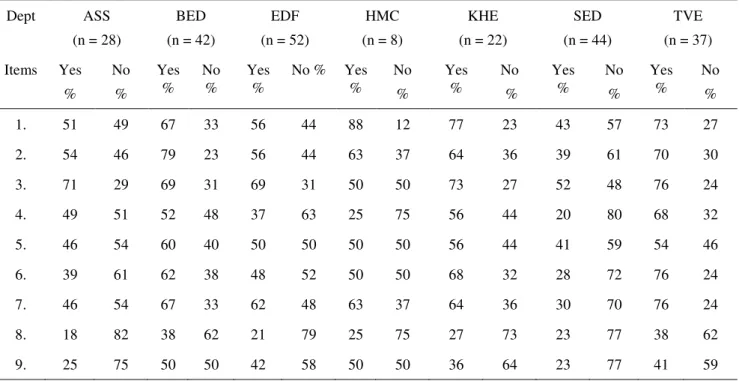
Table 2: Pattern of acquisition of ICT-based skills by student-teachers based on their course of study (N =233) Dept ASS (n = 28) BED (n = 42) EDF (n = 52) HMC (n = 8) KHE (n = 22) SED (n = 44) TVE (n = 37) Items Yes % No % Yes % No % Yes % No % Yes % No % Yes % No % Yes % No % Yes % No % 1. 51 49 67 33 56 44 88 12 77 23 43 57 73 27 2. 54 46 79 23 56 44 63 37 64 36 39 61 70 30 3. 71 29 69 31 69 31 50 50 73 27 52 48 76 24 4. 49 51 52 48 37 63 25 75 56 44 20 80 68 32 5. 46 54 60 40 50 50 50 50 56 44 41 59 54 46 6. 39 61 62 38 48 52 50 50 68 32 28 72 76 24 7. 46 54 67 33 62 48 63 37 64 36 30 70 76 24 8. 18 82 38 62 21 79 25 75 27 73 23 77 38 62 9. 25 75 50 50 42 58 50 50 36 64 23 77 41 59
Note: Items referred to in Table 2 are as in Table
Table 2 presents the pattern of acquisition of the ICT skills by students-teachers based on their course of study. The study findings revealed that students doing vocationally based courses like Business Education, Technical and Vocational Education and Home Economics have acquired a lot of these ICT skills. Students in Educational Foundations, Human and Kinetic Education and Arts and Social Sciences courses seem not to have acquired most of these ICT skills as can be seen in Table 2. On the contrary, Science Education students who ought to have excelled in the acquisition of these skills could not do so; this was a startling revelation from the study.
7. Discussion
The findings of the study indicated that some of the student-teachers have made efforts to acquire some of the ICT skills which they may use to support their education, and to boost their entrepreneurial acumen. These findings is in line with the view of Emesini (2009) who pointed out that in this era of digitalization, teachers and students alike are bracing up in order to be digitally competent and to fit into the global economy. Corroborating this view point, Ukwungwu and Oyedepo (2012) stated that students through the use of computers can acquire communication, creative, coordinating, calculating, commercial, concentration and cognitive skills. The authors believe that these skills once developed by students would lead to the improvement of their status in life, development of the nation’s economy, creation of self-employment, and proper utilization of human and material resources.
The findings also showed that the students acquired ICT-based of data processing using computer; to type and edits works; improvement on ICT literate level and peer tutoring others; rendering of online services and improved skills in digital salesmanship/marketing respectively. These findings suggest that the student-teachers are set to key in into the new trend of digitalization of the Nigerian classroom in line with the vision of the Federal Government of Nigeria in the globalization process. Buttressing these findings, Villanueva (2000) and Mbachu (2008) explained that most of the developing countries have experienced the potentials of ICT in transforming their educational landscape at all levels. This is because with the use of ICT in education, teachers and students globally become more connected, and develop more positive attitude to educational processes as they interact. Packaging of online innovation ideas for a fee, and creation of wealth using ICT respectively recorded moderate positive responses, as the students wants to be self reliant after graduation. These findings were in consonance with the views of Igbokwe and Eke (2011) who observed that before the ratification of the MDGs’goals, most educational institutions in Africa were producing graduates who cannot stand on their own, and youths looking for jobs that where not available. This necessitated the introduction of entrepreneurship education into the university curriculum in Nigeria.
On the other hand, digital/video coverage and expansion on digital communication and transport services respectively recorded high number of negative responses. This is likely so as these two areas are highly technical, and need proper digital training and finance to make the acquisition of these skills viable. These findings tally with the position of Onuegbu (2012) who reiterated that when students are properly trained in skill acquisition, they would be motivated to establish and manage their own business, and thereby be self-employed than looking for white-collar jobs.
A close observation of the analysis based on their course of study showed that students in the vocationally based courses like Business Education, Technical and Vocational Education and Home Economics have acquired a lot of these ICT skills. This is as a result of Nigeria University Commission’s regulations (2004) that emphasized high level of skill acquisition in vocational courses, to make them relevant and worthwhile. This has led to the beefing up of the curricula of these courses in line with ICT loaded packages; hence the high level of acquisition of ICT skills by the students. Students in Educational Foundations, Human and Kinetic Education and Arts and Social Sciences courses have acquired minimally most of these ICT skills as can be seen in Table 2. Howbeit, the students are now exposed to rudimentary ICT courses under General Studies (GST) called CSC 101 and CSC 201, though this is not enough for them to acquire these basic skills in ICT. Hence Esu (2010) stressed that the nation’ curricula should be functional and relevant to current global trends. Anowor (2010) observed that the Federal Ministry of Education of Nigeria formulated ICT policies and objectives which include among others: facilitating the teaching and learning process; promotion of problem–solving techniques; enhancing critical thinking and innovative skills; promoting live-long education; enhancing universal access to education.
Contrary to the expectation of the researcher, many science education students showed high negative responses to most of the ICT skills. This revelation was startling as one expects the science students to take the lead in ICT based skill acquisition. This revelation led the researcher to interview some of the science students to ascertain why most of them have not acquired these skills. The students stated that their laboratory practical which is manually done take the bulk of their time; so they do not have enough time to acquire enough of the ICT skills, as they only depend on the ones they are exposed to during their GST courses. Even those of them in the Computer option lamented that most of the ICT equipment for their practical sessions are not in good conditions, and that they are not given enough time to practice with the few good ones. These findings negate the laudable steps of the Federal Government of Nigeria in its National Policy (FRN, 2013:54) section 11, sub-sections 102(a and b)which stipulated that “The government shall provide facilities and necessary infrastructure for the promotion of ICT at all levels of the education system”. Again, in line with these findings, Omirin (2009) reiterated that the tertiary education sector has been charged with the responsibility of endowing their students with innovative, adaptive, maintenance and development of production skills; this would enable them to meet up with the ever changing needs of the society, and prepare them for the information age. The author now concludes that the acquisition and utilization of ICT skills in the tertiary institutions in Nigeria have thus become imperative.
The study findings on the whole revealed that most student-teachers in Nigeria, with special reference to Ebonyi State University, Abakaliki in Nigeria are not yet ICT compliant. This is because most of them have not made efforts to acquire the basic ICT skills, and their courses of study have equally failed to expose them to the skills. This now implies that most of them have not been equipped to impart same ICT skills to the learners in the Nigerian classroom when they graduate; hence the need to train and re-train them in these skills when they become full-time teachers.
8. Educational Implications of the Findings for Teacher- Education in Nigeria
The study findings have obvious implications for teacher-education in Nigeria. The findings portray that student-teachers’ acquisition of ICT skills is directly related to their course of study. For instance, those of them in the
The indispensable role of ICT in education and other spheres of life informed government’s effort in organizing ICT training for teachers and other personnel in other ministries in Nigeria. Many teachers have in recent time undergone ICT training in order to update themselves and become computer literate, in order to meet up with the challenges of our contemporary ICT-driven world. The teachers thus equipped with ICT skills are expected to apply same in teaching-learning process. It then implies that teacher education programme needs to be beefed up to follow the pattern of digitalization, as they are at the hub of any education system. ICT usage and training is a complex undertaking that involve huge capital investment in the areas of proper training in software development and general ICT integration, infrastructural installations, technical supports and regular power supply. As such, enough budgetary allocation by the Federal Government of Nigeria for teacher education becomes imperative for them to be equipped with ICT skills during their training.
9. Conclusion
The study examined the pattern of acquisition of ICT based skills by student-teachers in Nigerian universities, and its implications for teacher education in this era of digitalization. The findings in table 1 showed that some of the student-teachers are set to key in into the new trend of digitalization of the Nigerian classrooms. On pattern of acquisition of the ICT skills by students-teachers based on their course of study, the findings revealed that students doing vocationally based courses like Business Education, Technical and Vocational Education and Home Economics have acquired a lot of these ICT skills. Students in Educational Foundations, Human and Kinetic Education and Arts and Social Sciences courses acquired a little of these ICT skills. On the contrary, Science Education students who ought to have excelled in the acquisition of these skills could not do so; this ought not to be so if basic machinery is put in place for the training of student-teachers in Nigeria. It then implies that teacher-education programme needs to be beefed up to follow the pattern of digitalization, as teachers are at the hub of any education system.
10. Recommendations
Based on the findings of the study and the implications drawn, the following recommendations are made: 1. The Federal Government of Nigeria should as a matter of urgency, review teacher-education curricula
in the country to reflect ICT trend.
2. Re-training of all teacher–trainers in the universities by ICT experts to update their knowledge in the ICT trend, so that they can impart same to the student-teachers.
3. There is the urgent need to build up the digital libraries/rooms of universities in Nigeria by concerned authorities, for easy practical of ICT skills by staff and students.
4. The students who have acquired the ICT based skills should be re-trained in advanced packages by ICT experts for perfection. These students should now be encouraged to peer-tutor their mates that are still lagging behind.
5. Making the ICT facilities available and accessible to both the teacher-trainers and the trainees for better output.
References
Abubakar, Z.S. (2012). Integrating ICT in fostering entrepreneurship skills acquisition into secondary school curriculum for national development. Nigerian Journal of Curriculum Studies, 19(3), 102-110.
Ada, N. A. (2011). Curriculum and entrepreneurship skill acquisition in Nigeria. Keynote address presented at the 24th annual conference of Curriculum Organization of Nigeria (CON), held at Benue State University, Makurdi, from 14-17th September.
Agbiogwu, A. (2010). Starting ones own business. In I.N. Kanu & B.N. Nwigwe (Eds.), Entrepreneurs’ alternatives in entrepreneurship: Essential themes in theory and practices (pp.13-21). Owerri: Great International Press.
Agbiogwu, A. (2012). Impact of globalization on education. Journal of Qualitative Education, 8(1), 92-97.
Anowor, O.O. (2010). Imperative of ICT in teachers. In L.O. Ocho (Ed.). Reform in education (pp. 56-62). Enugu: New Generation Ventures.
Babangida, A.A., & Bissallah, C.E. (2011). Focusing on teachers’ attitudes, methodology and ICT education delivery practices in the 21st century Nigeria. A conference paper presented at an international conference organized by the University of Nigeria, Nsukka, 20th – 23rd June.
Emesini, N.O. (2009). Effective integration and implementation of ICT into Nigerian curricula and the challenges ahead. Paper in the proceedings of the first International Conference of the Faculty of Education, University of Nigeria, Nsukka, 17th –21st June.
Emesini, N.O. (2011). Assessment of entrepreneurship skills acquisition by student-teachers in universities in Nigeria. Nigerian Journal of Curriculum Studies, 19(1), 114-122.
Esu, A.E.O. (2010). Functionality of curriculum in Nigeria. WCCI Seminar Series, (no.5), held at University of
Nigeria, Nsukka on October.
Federal Republic of Nigeria. (2013). National policy on education. Lagos: NERDC Press.
Igbokwe, U.L. & Eke C.C. (2011). Entrepreneurship education: Implications for curriculum development. Nigerian Journal of Curriculum Studies, 19(1), 161- 169.
Igwebuike, B., & Gideon, O.O. (2007). The effects of computer-aided instruction on achievement of N.C.E. educatees in Mathematics. Paper presented at the 20th Annual Conference of Curriculum Organization of Nigeria (CON), held at Abia State University, Uturu, 19th-22nd September.
Ivowi, U.M.O. (2009). The struggle for Nigerian curriculum. In U.M.O. Ivowi & K. Nwufo (Eds.), Curriculum theory and practice. Abuja: CON Publications.
Mbachu, C.E. (2008). ICT: A reform strategy to enhance curriculum improvement in secondary and tertiary education in Nigeria. Paper presented at the 21st Annual Conference of Curriculum Organization of Nigeria (CON), at NERDC, Sheda-Abuja, 17th – 20th September.
Nworgu, B.G. (2006). Educational research: Basic issues and methodology. Owerri: Wisdom Publishers. Omirin, F.F. (2009). Emerging ICT issues in the tertiary institutions. Paper presented at the 22nd annual conference of Curriculum Organization of Nigeria (CON), held at College of Educat ion, Agbor, 16th-19th September.
Onuegbu, C.I. (2012). Vocational technical education (VTE) skills acquisition for job creation in Nigeria: The need for competency based programme. Journal of Qualitative Education, 8(1), 92-97.
Raheen, U.S. (2010). Information and Communication Technology as a means of achieving the objectives of vision 2020 in Nigeria. Journal of Education Review, 9: 9, 52-57.
Ubong, B. (2013). National development: Can entrepreneurship be the beautiful bride? An inaugural lecture of the Federal College of Education (Technical), Omoku delivered on 5th April.
Ukwungwu, J.O., & Oyedepo, A.D. (2012). Curriculum and entrepreneurship skills acquisition at tertiary education levels: A case study of computer science education in Colleges of Education in Nigeria. Nigerian Journal of Curriculum Studies, 19(1), 161-169.
Villanueva, C. (2000). General trends in the use of ICT in education. In M. Lee (Ed), Newer technology for the learning society (pp. 6-12). Paris: Learning Society Press.
Wentwhorth, C.T. (2004). Infusion of ICT into teacher education programme. In E. Boshman, (Ed.), The electronic classroom: A handbook for education in the electronic classroom (pp. 6-12). Medford: Learned Environment Press.