Social Work Master’s Clinical Research Papers School of Social Work
2016
Restorative Practices in the School Setting: A
Systematic Review
Laura Byer
University of St. Thomas, Minnesota, [email protected]
Follow this and additional works at:https://ir.stthomas.edu/ssw_mstrp
Part of theClinical and Medical Social Work Commons, and theSocial Work Commons
This Clinical research paper is brought to you for free and open access by the School of Social Work at UST Research Online. It has been accepted for inclusion in Social Work Master’s Clinical Research Papers by an authorized administrator of UST Research Online. For more information, please [email protected].
Recommended Citation
Byer, Laura, "Restorative Practices in the School Setting: A Systematic Review" (2016).Social Work Master’s Clinical Research Papers. 640.
Running head: RESTORATIVE PRACTICES IN THE SCHOOL SETTING
Restorative Practices in the School Setting:
A Systematic Review
by
Laura Byer, B.A.
MSW Clinical Research Paper
Presented to the Faculty of the School of Social Work
St. Catherine University and the University of St. Thomas St. Paul, Minnesota
In Partial fulfillment of the Requirements for the Degree of Master of Social Work
Committee Members Lance Peterson, Ph.D., LICSW
Chul Schwanke, MSW, LISW Sarah Noble, Ed.S.
The Clinical Research Project is a graduation requirement for MSW students at St. Catherine University/University of St. Thomas School of Social Work in St. Paul, Minnesota and is conducted within a nine-month time frame to
demonstrate facility with basic social research methods. Students must independently conceptualize a research problem, formulate a research design that is approved by a research committee and the university Institutional Review Board, implement the project, and publicly present the findings of the study. This project is neither a
Master’s thesis nor a dissertation.
Abstract
This systematic review explored the use of restorative practices in a school setting. It looks at what practices are used, how those practices are used and the effectiveness of those practices. Peacemaking circles, family group conferencing and victim-offender mediation are the three models of restorative practices that were reviewed. Twenty-three schools and school districts were reviewed. Five were school districts, four were primary schools and 14 were secondary schools. The most common outcomes with the use of restorative practices included: reduced suspension rates, reduced behavioral referrals out of the classroom, improved attendance, decreased expulsions, decreased student fights and a decrease in general student misbehavior. The reduction of suspensions was documented at 15 schools. Peacemaking circles were the most common model of restorative practices used. They were used by 17 schools. Family group conferences were used by 12 schools and mediations were used by 9 schools. All of the studies and reports review showed positive outcomes with the use of restorative practices.
Acknowledgements
I would like to thank my research chair, Lance Peterson, for his guidance and support in completing this systematic review. I would like to also thank my committee members, Chul Schwanke and Sarah Noble for their time, support and guidance through this process. A special thank you to my cohort members for their continued support and encouragement throughout this project and the program. I would also like to thank my family for their continued support and sacrifice to help me complete this project and the program.
Table of Contents Abstract………2 Acknowledgements………....………..3 Table of Contents……….4 List of Tables………....………....5 Introduction………...6 Literature Review……….………8 Conceptual Framework……….………….16 Methods……….……….18 Findings……….…...………..21 Discussion……….……….……....27 References……….…...32
Tables and Figures
Restorative Practices in the School Setting: A Systematic Review One of the main issues schools all over the world face is how to manage student
misbehavior (Hemphill, Plenty, Herrenkohl, Toumbourou, & Catalano, 2014). The current trend in discipline is a punitive approach (Payne & Welch, 2015). Zero tolerance policies have been used at schools all over the nation. These polices have not had the positive effect that was intended and they do more harm than good (Martinez, 2009). For over 20 years the use of suspension and expulsion have been used as a punishment for violating zero tolerance policies (American Psychological Association Zero Tolerance Task Force (APA), 2008). Zero tolerance policies lead to increased numbers of suspensions and expulsions (Monahan, VanDerhei, Bechtold, & Cauffman, 2014).
Suspension and expulsion policies that remove students for rule violations have become common in public education and suspension rates have doubled since the 1970s (Perry & Morris, 2014). Out-of-school suspensions are the most commonly assigned punishment for misbehavior (Pfleger & Wiley, 2012). School suspensions and expulsions have been associated with long lasting negative impacts on students. These impacts include a higher risk of: academic failure and school dropout (Hemphill et al., 2014), becoming involved in physical fights and using substances (Dupper, Theriot, & Craun, 2009); and involvement in the juvenile justice system (Monahan et al., 2014). Many schools have been moving away from zero tolerance policies and toward the use of a restorative justice approach towards discipline (Payne & Welch, 2015; Teasley, 2014). The restorative justice approach looks at who has been harmed instead of what laws have been broken and what the losses are of the victim who has suffered instead of who the offender is (Ball, 2003).
Restorative justice has been used in the criminal justice system with offenders as an approach to crime and it developed into restorative practices when it started being used in the schools as an approach to discipline (McCluskey, et al., 2008). Restorative justice most often involves professionals working with the offender (McCluskey et al., 2008) Restorative practice was built on the framework of the criminal justices’ system of restorative justice (McMorris, Beckman, Shea, Baumgartner, & Eggert, December 2013). Restorative practice brings together the student who caused the harm, the student’s family, the victim, and others affected by the harm (McGrath, 2002); while giving a voice to victims and repairing harm (Bazemore & Umbreit, 2001). The school restorative conference is also called a family group conference in some literature and practice.
School social workers are a student’s most crucial advocate (Edmonds-Cady & Hock, 2008). Social workers have a duty to promote social justice, and the restorative practices model is a form of social justice. They need to be informed about restorative practices and advocate for changes in policy to use them (Teasley, 2014). The social worker can play an important part of the school restorative practices by understanding the process and serving as the facilitator during the restorative process. Social workers have the skills, training and ethical obligation to support and advocate for the implementation of restorative practices in the schools (Dupper et al., 2009).
This study will review restorative practices as an alternative to the zero tolerance practices of expulsions and suspensions in a school setting. The focus of this study is to look at how restorative practices are used in the school setting and the effectiveness of the use of
restorative practices in the school setting. A systematic review will be used for this project, in an effort to inform social work practice.
Literature Review School Discipline
Nearly all U.S. schools have policies that allow students who threaten the safety of classmates or who compromise the quality of the classroom experience to be removed, either temporarily with a suspension or permanently with an expulsion (Monahan et al., 2014).
Reducing conflict and misbehavior in schools has been an ongoing problem for most schools and the traditional methods for dealing with misbehavior have not achieved this aim (McGrath, 2002). All of the literature reviewed agreed that removal of students through suspension or expulsion is justifiable and necessary for students who pose a danger to others.
Zero Tolerance
Zero tolerance is swift, certain and strict punishment for specific unwanted behavior (Wilson, 2014). In the beginning zero tolerance policies were applied to drug possession, gang activity, and gun possession (Allman & Slate, 2011). Zero tolerance was designed to serve as a deterrent against serious crime (Moore, 2010). Over time the interpretation of zero tolerance slowly changed from “no guns” to “no weapons”; and, the definition of a weapon varied (Moore, 2010). The definition of zero tolerance continued to change over time to include a wide range of misbehaviors, some being trivial, that punish children harshly by excluding them from the learning environment (Browne-Dianis, 2011). The presumption of zero tolerance policy is that strong and strict punishment can act as a deterrent to other students considering misbehavior (Skiba, 2014) and create an improved learning environment for those who remain (APA, 2008). Unfortunately, removing the student from the learning environment can be counterproductive as these students often have lower academic performance (Kalimeris & Borrelli, 2013; Perry & Morris, 2014).
The American Psychological Association Zero Tolerance Task Force (APA, 2008) found that “zero tolerance has not been shown to improve school climate or school safety”(p. 860). Monahan, VanDerhei, Bechtold, & Cauffman (2014) found that zero tolerance polices have led to increased rates of school suspension and expulsion. Kalimeris and Borrelli (2013) found that traditional suspensions generally occur in the absence of interventions that focus on developing more appropriate pro-social responses to situations. They also found that the use of the
traditional approach to suspension hampers, rather than improves safety. Using suspensions and expulsions can perpetuate the behaviors they attempt to punish (Pei, Forsyth, Teddlie, Asnus, & Stokes, 2013). Expulsions and suspensions that are for an extended amount of time should only be used when the misbehavior is serious enough that it puts others’ physical safety at risk. Zero tolerance policies have been misused and there is a need for change in how these policies are applied (APA, 2008).
Moreover, research suggests that school suspensions are frequently applied to less serious transgressions, including disobedience, disrespect, attendance problems, and general classroom disruptions and often are intended to serve as a quick fix (Monahan et. al., 2013). Dupper, Theriot, & Craun (2009) found near epidemic rates of suspensions for relatively minor offenses rather than for serious behavior that threatens the safety of others. Many of the students that are suspended from school have low academic achievement; and, a higher risk of academic failure and missing school puts them further behind their peers academically (Allman & Slate, 2011; Hemphill et al., 2014).
Critics of zero tolerance policies argue that the schools are not allowed to take individual circumstances into account when dealing with misbehavior. This often leads to unjust and unequal consequences for the offender (McMorris et al., 2013). One of the main hopes of zero
tolerance policy was that it would eliminate subjective influences from disciplinary decisions, thus eliminating the overrepresentation of students of color receiving disciplinary action; however, research has found that not to be the case (APA 2008). Research has shown that the zero tolerance policies have a disproportionate and increasingly negative impact on youth of color (Browne-Dianis, 2011). Research has also shown that zero tolerance has been misused by schools when it is used for minor misbehaviors (Martinez, 2009).
Racial Disparities in School Discipline
When looking at school suspensions and expulsions there is a large racial disparity (Skiba, 2014). Research on behavior does not support the assumption that African American students are suspended and expelled more because they have higher rates of behavior problems (Losen & Skiba, 2010; Skiba, 2013). Research does show that African American students receive more serious forms of discipline for more subjective misbehaviors. African American students are exposed to exclusionary approaches of discipline at a higher rate than any other race of students (Skiba, 2013). African American students may be disciplined more seriously for less serious and more subjective reasons (APA 2008). In the United States 4.6% of white students are suspended and 16.4% of black students are suspended (U.S Department of Education Office for Civil Rights (OCR), March 2014). Suspensions and expulsions of black students are three times greater than those of other students (OCR, 2014; Skiba, 2014). Sixteen percent of students in the United States are African American and 32-42% of them are suspended or expelled. In contrast, 51% of students in the United States are white and 31-40% of them are suspended or expelled; 24% of the students in the United States are Hispanic/Latino and 21-23% of them are suspended or expelled; and 1% of students in the United States are American Indian and Native Alaskan and 2-3% are suspended and expelled (OCR, 2014). This research illustrates that African
Americans are most likely to suffer from strong policies regarding suspension or expulsion. Payne & Welch (2015) found that schools were less likely to use restorative practices if they had a high percentage of African American students.
Alternatives to Zero Tolerance
Schools are challenged to decide how to draw the line between zero tolerance and full tolerance (Moore, 2010). Perry & Morris’ (2014) research shows the need for a change in
extremely punitive school discipline policies. School discipline is not effective solely through the use of suspension and expulsion as punishment (Kalimeris & Borrelli, 2013; Perry & Morris, 2014). Zero tolerance policy does not provide tolerance and understanding for students to be successful (Browne-Dianis, 2011). The implementation of preventative alternatives to
suspension and expulsion that use both student and school change strategies is needed (Dupper, et al., 2009). Instead of focusing on the student, both the student and the school community need to be involved to reduce the rates of suspension (Hemphill et al., 2014).
Restorative Practices
School administrators need to be ready to deal differently with inappropriate behaviors within the school environment (McGrath, 2002). Changing the views schools have towards suspension from using a punishment to using a restorative approach to discipline is not an easy process (Kalimeris & Borrelli, 2013). Perry & Morris (2014) found that the foundation of
effective discipline lies in the achievement of positive relationships. Students should be given the opportunity to resolve the conflict that has led to their suspension (Kalimeris & Borrelli, 2013). Moreover, Payne & Welch (2015) found that students prefer restorative practices to suspensions and expulsions.
The restorative practices model in a school setting focuses not only on the victim, but also on the student who has caused harm to another person or property within the school
community and is in violation of school rules. This practice “encourages schools to democratize the problem solving approach to incidents of misconduct” (McGrath, 2002, p. 195). Restorative practices are victim centered responses to misbehavior that give individuals most affected by the misbehavior the chance to be directly involved in responding to the harm caused by the
misbehavior (Bolitho, 2012). Those individuals can include the victim, the offender, their families, and community members (Bolitho, 2012). The misbehavior is viewed as a violation of relationships, not school rules (Reimer, 2011). Restorative practice is designed to bring together the victims and offender to attempt to come to a mutual resolution of the harm caused by the offender (Riestenberg, 2001; Walgrave, 2011). Restorative practices aim to address the harm that was done by the offender, not the actual rule violation (Vaandering, 2014). There are three main models of restorative practices: circles, conferences and mediations (Latimer, Dowden, & Muise, 2005).
In the school setting restorative practices can help student offenders work to understand the impact of their behavior on others and help everyone involved learn from the harm that was done in a non-judgmental way (McCluskey et al., 2008). It also focuses on relational
rehabilitation (Karp & Breslin, 2001). The family group conferencing model of restorative practices (described below) has been used by the Minneapolis Public Schools for students who are recommened for expulsion. These conferences do not always include the victim due to the seriousness of some of the offenses. School staff, family members, the offender and group leader are present for the conference. The student and family members identify their strengths. The incident is reviewed and the offender reflects on his accountabilty for the incident. A plan is
created to support the student at school, home and within the community. Resources are provided to the student and the student’s family as needed (McMorris et al., 2013).
Repairative action replaces punishment in the restorative practives approach to dicipline (Ball, 2003). Victims and others who have been harmed have power and a voice when restorative practices are used (Mullet, 2014). The victim of an offender can be an individual, a small group of individuals or the community as a whole. The student offender misbehavior against an individual includes, but is not limited to, bullying, assault, and theft. The misbehavior towards a small group includes, but is not limited to, theft, vandalism, and classroom disruption. The misbehavior towards a community includes, but is not limited to, weapon possession, arson, and property crimes (Latimer, Dowden, & Muise, 2005). Next is an explanation of three main models of restorative practices: circles, conferences and mediations.
Peacemaking Circles. Peace makingcircles is a model of restorative practices that can be used in the school setting as a classroom management tool and as a way to repair harm (Riestenberg, 2001). Peacemaking circles can be designed around the needs of the participants (Kelly, 2013). Getting to know each other, building relationships, addressing harm and repairing harm are the four stages in the circle process (Kelly, 2013). Circles can be highly emotional and last an hour to several hours. In the circle process there is a facilitator, offender, and those impacted by the harm (Calhoun, 2013). The circles can focus on talking, a specific topic, community building, or conflict resolution (Kelly, 2013). The goal of the peacemaking circle is to promote healing for all involved, allow the offender to make amends, and provide
empowerment and responsibility for all involved to find resolution (Bazemore & Umbreit, 2001). Peacemaking circles were used when a Minneapolis High School had an incident where students took pictures of a black baby doll that they hung from an upstairs stairwell. The image
brought to mind pictures of lynchings and the community was outraged. The District sent several Circle Keepers to the school to meet with the students as a way to address the controversy. The Circle Keepers were paired into groups of two and met with students in groups of about 30. They opened up the circle to let them know why they were there and to get their perspective. The students were upset about the incident, and there appeared to be a split where students said that this was not how the school really was and others said it was and named several other incidents that they felt were examples of intolerance. The students had a chance to be heard and to let the adults know how they felt. There were many different perspectives regarding the consequence where some students wondered about the safety of the students coming back to school, and others thought that the community was blowing this out of proportion. It was startling to the Circle Keepers the lack of history that most of the students had in that room and there was hardly any knowledge about the historical impact of an image like a black baby hanging from an
upstairs stairwell would have. The students were able to go to the administration with input about what they wanted to see happen.
Family Group Conferencing. Family group conferencingis another model of restorative practices that brings together the offender, service providers, family members, and sometimes the victim, to come up with a plan to help the offender repair harm and create a plan for change (Macgowan & Pennell, 2001). Conferencing allows anyone who was affected by the harm to have a chance to express the impact and harm it has had on them (McGrath, 2002). Family group conferencing focuses on the offender and others that have been impacted by the offender’s wrongdoing (Calhoun, 2013). This restorative practice has grown in popularity across the country (Gumz & Grant, 2009).
A Family Group Conference was used for a student returning to a Minneapolis high school after an expulsion referral. The student was recommended for expulsion the prior year and the team was getting together at the beginning of the school year to support this student. The conference facilitator started out with listing the student’s strengths. He was a very likable student and the team had no problems coming up with strengths. The team then listed some challenges. As they did this it came out that this student was supposed to be on Homebound instruction the previous year, but did not get any service. The team noted this and planned for academic support. The team tried to be proactive regarding potential conflicts for this student and ways for this student to avoid them or minimize them. The family and the school agreed to work together to support the student. This was a very different experience for this family to the previous year. The family finally felt like they were part of the team and had input on their child. The team had to come back together a couple of times to address different ways to support this student, including changing his schedule to classes that he was able to be successful in.
Victim-Offender Mediation. Victim-offender mediation is a restorative practice model that focuses on the victim and offender. This allows the victim and the offender the power to work out their differences and constructively work on solutions (Varnham, 2005). It allows the victim and the offender to learn how to take responsibility, treat others respectfully and
communicate effectively (Varnham, 2005). This process allows the victim to meet with the offender to mediate with a trained mediator in a safe and structured setting (Bazemore & Umbreit, 2001). Mediation is commonly used for less serious offenses (Gumz & Grant, 2009).
At a Minneapolis Public School there were two sisters who got into a fight with two students over a mutual friend that they felt was being disrespected. This brought together two families on two distinct academic tracks for a mediation. The two sisters were students who
struggled academically; the two friends were great students who were on the A honor roll. The school wanted to see if they could salvage the placement for all the students before looking at a transfer. The mediation brought out many issues that seemed to be unrelated to the incident, but were underlying reasons for the conflict. There was resentment from the two sisters, because they felt the two friends thought they were “better than” anyone else. The two friends were confused about the conflict in the first place and how their interaction could be viewed as disrespectful. The resentment was deep and the families did not seem to like each other. The mediation was not as effective as it could be due to the lack of commitment from the parties. One of the students ended up transferring out of the district and that seemed to ease the tension at the school. The mediation was not as effective as it could have been in this case due to the lack of cooperation by the parties involved. Cooperation from both parties is crucial for mediation to work.
There is limited research on restorative practices in the school setting (Teasley, 2014). This study is being conducted to look at how restorative practices are used in the school setting and the effectiveness of those practices. This review will add to the current research by exploring the different ways each restorative practice model is implemented in the school setting. The three models that will be reviewed are: peacemaking circles, family group conferencing and victim-offender mediation. Research on the processes and outcomes of restorative practices will benefit future applications and successes (Calhoun, 2013).
Conceptual Framework
The strengths perspective focuses on client strengths and capabilities to help the client feel empowered to face challenges and make decisions. Rather than focusing on weaknesses, the
client strengths are the emphasis. The strengths perspective shares common beliefs with the restorative practice model (Ball, 2003).
Strengths based perspective views are described as follows: “subjective state of mind, feeling competent, and experiencing a sense of control” and on an interpersonal level as “a sense of interdependence, support, and respected status” (Miley, O'Melia, & DuBois, 2013, p.80). Restorative practices empower both the victim and the offender by giving them the opportunity to meet and make a decision together on what should be done to repair the harm (Calhoun, 2013). Empowerment is important throughout the restorative practices process. For the offender the strengths perspective provides the opportunity to make a choice to improve their situation and to repair at least some of the harm they have caused. It engages those involved with the harm and allows them to be actively involved in the decision making process. It gives everyone involved the chance to have a voice during the process.
Both the restorative practice model and the strengths based perspective build on the strengths of clients. “Both individual and relational skills are strengthened” (Ball, 2003, p. 52) during the restorative practice process. Restorative practices highlight the importance of human relationships. Emphasis is placed on relationships and repairing the harm that has come to all those affected by the wrongdoing of the offender.
The social work values of social justice and human worth are consistent with the strengths perspective and restorative practice model. Both place an emphasis on the well-being and inherent worth of everyone involved in the process (Vaandering, 2014). The dignity and worth of all involved is maintained throughout the restorative practice process. The restorative practice model and the strengths perspective are consistent with the social work value of social justice by providing an opportunity for all involved to be heard.
Methods Research Design
This study uses a systematic review of restorative practices literature to evaluate the types of practices, implementation, use, and the effectiveness of restorative practices in the school setting. Three models of restorative practices will be used in this review: peacemaking circles, family group conferencing and victim-offender mediation.
Literature Search
Databases were searched for literature written about restorative practices using social work, criminal justice and education databases. In order to find the most recent studies, search parameters were set to find articles between the dates of January 2000 and October 2015. The search targeted articles with combinations of the following key words: “restorative practices”, “restorative justice”, “education”, “zero tolerance”, “discipline”, and “policy”. Articles written in other languages were excluded. The databases that were used to search for articles included, EBSCOhost, SOCIndex and ERIC. The US Department of Education, the Minnesota Department of Education and the University of Minnesota websites were also searched for relevant literature. A Google search was used to find schools that have published reports on their use of restorative practices. The following key words were used in the Google search: “restorative practices in schools”, “school district restorative practices implementation”, “restorative practice school reports”, and “data collection on restorative practices in schools”. Some of the research used in this study was done by education organizations, non-profits and government agencies and has not been published.
Articles were first reviewed using the abstract and article title with the following criteria: the study includes the use of restorative practices; the study takes place in a grade school, middle
school or high school setting; and the study was completed on or after January 1, 2000. Once the initial review was complete the full text of the remaining articles was read. During this review the following criteria were used: the study includes the implementation of restorative practices; the study includes outcomes of using restorative practices; and the study includes at least one of the following: circles, conferencing, or mediation. Qualitative and quantitative studies and reports were included as long as they met the above criteria.
Data Analysis
Data was collected and coded from the individual studies. After that process was
complete the data was reviewed and synthesized. The findings were sorted by the setting that the restorative practices were used in: primary schools, secondary schools and school districts as a whole. It was then narratively summarized by school including the following themes: use of restorative practices, implementation of restorative practices, and effectiveness of restorative practices.
Restorative justice uses the same principles, but in the criminal justice system. The literature relating to the criminal justice system and the implementation and use of restorative justice in the criminal justice system was not reviewed for this study. This study will contribute to the existing literature by reviewing the usage and effectiveness of three models of restorative practices in the school setting.
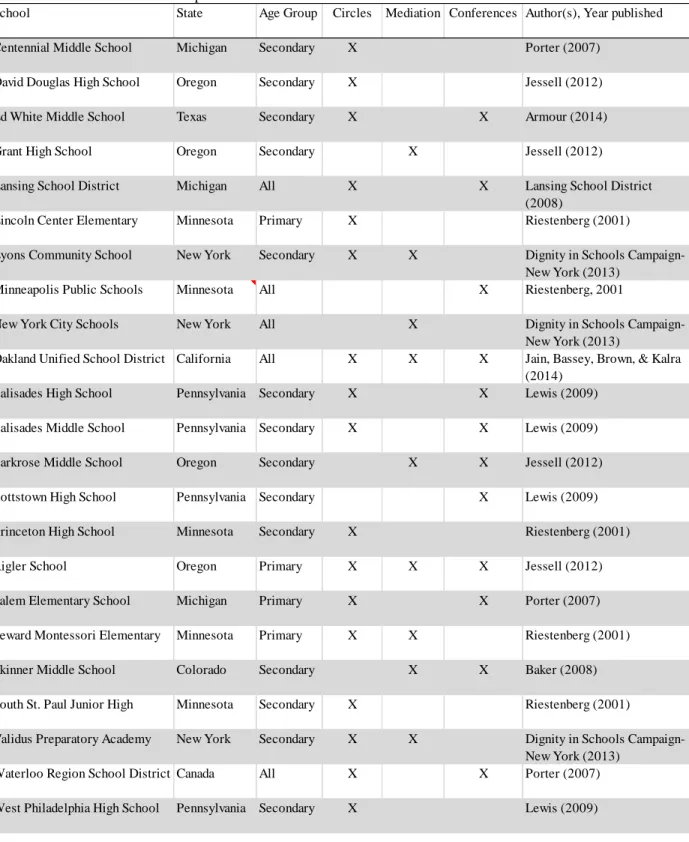
Table 1 Included Studies and Reports
School State Age Group Circles Mediation Conferences Author(s), Year published
Centennial Middle School Michigan Secondary X Porter (2007)
David Douglas High School Oregon Secondary X Jessell (2012)
Ed White Middle School Texas Secondary X X Armour (2014)
Grant High School Oregon Secondary X Jessell (2012)
Lansing School District Michigan All X X Lansing School District
(2008)
Lincoln Center Elementary Minnesota Primary X Riestenberg (2001)
Lyons Community School New York Secondary X X Dignity in Schools Campaign-
New York (2013)
Minneapolis Public Schools Minnesota All X Riestenberg, 2001
New York City Schools New York All X Dignity in Schools Campaign-
New York (2013)
Oakland Unified School District California All X X X Jain, Bassey, Brown, & Kalra
(2014)
Palisades High School Pennsylvania Secondary X X Lewis (2009)
Palisades Middle School Pennsylvania Secondary X X Lewis (2009)
Parkrose Middle School Oregon Secondary X X Jessell (2012)
Pottstown High School Pennsylvania Secondary X Lewis (2009)
Princeton High School Minnesota Secondary X Riestenberg (2001)
Rigler School Oregon Primary X X X Jessell (2012)
Salem Elementary School Michigan Primary X X Porter (2007)
Seward Montessori Elementary Minnesota Primary X X Riestenberg (2001)
Skinner Middle School Colorado Secondary X X Baker (2008)
South St. Paul Junior High Minnesota Secondary X Riestenberg (2001)
Validus Preparatory Academy New York Secondary X X Dignity in Schools Campaign-
New York (2013)
Waterloo Region School District Canada All X X Porter (2007)
Findings
Twenty-three schools and school districts met the selection criteria and fell into three groups: primary schools, secondary schools and school districts. Four of the schools reviewed were primary schools. Two of the primary schools serve students from kindergarten to eighth grade, one school serves students in kindergarten to sixth grade and one school did not specify the grades other than the school being an elementary school. Fourteen schools reviewed were secondary schools. Three of the secondary schools served students in grades 6-8, seven of the schools served students in grades 9-12, one school served students in grades 6-12, one school served students in grades 7-12, and two schools did not specify the grades served other than that they were middle schools. Five studies were conducted on school districts. Four studies
reviewed the school district overall and one school district study reviewed students referred for transfer or expulsion.
Seventeen schools and districts used circles as part of their restorative practices. Nine schools and districts used mediation and twelve used conferences. Eleven schools and districts used a combination of two of the three practices and two schools used all three practices. Nine schools and districts used just one of the three practices.
School Districts
The Lansing School District is located in Michigan. In 2005 they began using the
restorative process for school discipline. By 2008 they had implemented it in most of the schools within the district. The district has implemented circles into classrooms and family group
conferencing for more serious behavior issues. In 2008 1,615 students participated in the restorative process instead of being suspended. They found that restorative practices were powerful for helping students manage behavior, resolving student conflicts and teaching
alternatives to violence. Eleven expulsions were avoided using restorative practices (Lansing School District, 2008).
Minneapolis Public Schools are located in Minneapolis, Minnesota. In 2008 restorative practices were implemented with students that went through transfer and expulsion process. Family group conferences were used instead of expulsion. This report covered the years 2010-2012. Students that participated in family group conferences and returned to school had improved attendance, fewer suspensions and fewer fights (McMorris et al., 2013).
New York City Schools are located in New York. In 2011 restorative practices started to be implemented in many of the schools. Mediations and other unidentified restorative practices have been used. In 2011 the district had over 69,000 suspensions. By 2012 that number
decreased by 35% to under 45,000 suspensions (Dignity in Schools Campaign-New York, 2013). Oakland Unified School District is located in Oakland, California. There are 86 schools in the district. In 2005 the school district began implementing restorative practices, starting with one school. By 2014, 24 schools were participating in restorative practices. Circles, mediations, and family group conferencing were implemented. The most recent data from 2012-2013 shows a district wide decrease in suspensions of 22.6% (Jain, Bassey, Brown, & Kalra, 2014).
Waterloo Region School District is located in Ontario, Canada. In 2005 they began using restorative conferencing and circles as alternatives to suspending and expelling students. By using these restorative practices in 2006, they were able to avoid suspending 115 students and expelling eight students (Porter, 2007).
Primary Schools
Lincoln Center Elementary School is located in South St. Paul, MN. Circles were implemented as part of the discipline process over a three-year period. Prior to implementing
circles the school had 1,662 behavior referrals in 1998. By 2001 the number of referrals was down to 407. Student attendance had improved by 10.5% over the same period (Riestenberg, 2001).
Rigler School is located in Portland, Oregon and serves students in grades K-8. Restorative practices were implemented in 2008 and included mediations, circles and
conferencing. An administrators focus group reported that with the use of restorative practices, suspensions went down and the school climate improved. A teachers focus group reported a positive shift in school climate, a decrease in bullying and a general observation that students were less angry (Jessell, 2012).
Salem Elementary School is located in South Lyon, Michigan. The school struggled with discipline problems and lacked a sense of community. Circles were implemented in all
classrooms and conferencing was used for more serious issues. In less than a year teachers reported fewer disciplinary issues and discipline referrals were down 75% (Porter, 2007).
Seward Montessori Elementary is located Minneapolis, Minnesota and serves grades kindergarten-8th grade. Circles were used as a communication tool for students to help with conflict resolution. Mediation was also used for conflict resolution and rule violations. Over a three-year period, from 1999-2001, out of school suspension went from 28-19 (Riestenberg, 2001).
Secondary Schools
Centennial Middle School is located in South Lyon, Michigan. After implementing circles and other unidentified forms of restorative practices, the school staff reported an increase in the cooperation and trust among students and staff. They had a 73% drop in disciplinary referrals (Porter, 2007).
David Douglas High School is located in Portland, Oregon and serves student in grades 9-12. Restorative practices were first implemented in 2011. Circles and other unidentified forms of restorative practices were used. Student behavior and student attendance improved (Jessell, 2012).
Ed White Middle School is located in San Antonio, TX and serves students in grade 6-8. In 2013 restorative practices were implemented for students in sixth grade. In 2014 seventh grade students were included. Circles and family group conferences were the main restorative practices implemented. Between 2012 and 2014 in-school suspensions dropped 65% for sixth grade students and dropped 47% for seventh grade students. Attendance improved for both sixth and seventh grade students (Armour, 2014).
Grant High School is located in Portland, Oregon and serves students in grades 9-12. Restorative practices were implemented in 2012. By the end of the year disciplinary referrals were down by 548 from the previous year. Mediations and other unidentified forms of restorative practices were used (Jessell, 2012).
Lyons Community School is located in Brooklyn, New York and serves students in grades 6-12. Circles and mediations were first implemented in 2010. Over a three-year period, suspensions decreased by 25% (Dignity in Schools Campaign-New York, 2013).
Palisades High School is located in Kintnersville, Pennsylvania and serves students in grades 9-12. Restorative practices were first implemented during the 1999 school year. Circles and group conferencing were used. From 1999 to 2002 the number of referrals to the office went from 1752 to 1154, detentions went from 716 to 282 and out of school suspensions went from 105 to 65 (Lewis, 2009).
Palisades Middle School is located in Kintnersville, Pennsylvania and serves grades 6-8. Restorative practices were introduced in 2000. The school climate was poor and altercations were common. Circles were used in the classrooms and restorative conferences were used when needed. Over a two-year period from 2000-2002 referrals to the office went from 913 to 516 (Lewis, 2009).
Parkrose Middle School is located in Parkrose, Oregon and serves grades 6-8. Restorative practices were first implemented in 2009 and included the use of mediations and conferencing. They have provided a positive effect on students and reduced the number of fights and conflicts. Many issues were able to be solved before an office referral was needed (Jessell, 2012).
Pottstown High School is in Pottstown, Pennsylvania. It serves grades 9-12 and had been struggling with physical fights, disrespect to teachers and classroom disruptions. In the fall of 2006 restorative conferencing was implemented. Over a three-year period, from the 2006 to the 2008 school year, the number of fights went from 20 to 9, general misbehavior went from 168 to nine incidents and out of school suspensions went from 140 to 108 (Lewis, 2009).
Princeton High School is located in Princeton, Minnesota and serves grades 9-12. Circles were used in place of some suspensions over a two-year period. Before implementing circles there were 132 out of school suspensions and 1,940 behavior referrals. After two years of using circles the out of school suspensions dropped to 95 and behavior referrals were down to 1,478 (Riestenberg, 2001).
Skinner Middle School is located in Denver, Colorado. Family conferences and mediations were implemented to help reduce interpersonal conflicts, physical fights and harassment. Over a two-year period, from 2007-2008, suspensions were reduced by 32% and overall average daily attendance improved (Baker, 2007-2008).
South St. Paul Junior High School is located in South St. Paul, Minnesota and serves grades 7-12. The circle process was used as part of the discipline process. Before circles were implemented there were 110 out of school suspensions in 1999. By 2001, after two years of using the circle process, the number of out of school suspensions had decreased to 55 (Riestenberg, 2001).
Validus Preparatory Academy is located in Bronx, New York and serves students in grades 9-12. Circles, peer mediations and other restorative practices were implemented in 2010. By the third year of implementation the school had only one long term suspension (Dignity in Schools Campaign-New York, 2013).
West Philadelphia High School is in Philadelphia, Pennsylvania. It serves students in grades 9-12 and is known as one of Philadelphia’s most dangerous and high-risk schools. The school began using circles in the classrooms in 2008. Student assaults went down from 46 in 2007 to 18 after using restorative practices. Assaults on teachers during the same period went from 25 to six (Lewis, 2009).
Summary of Restorative Practice Approaches
Circles were used in 11 schools that had reduced suspension rates and in two schools that had reduced expulsion rates. Attendance improved at three schools and behavior referrals
decreased at six schools using circles. Circles were not mentioned at schools as a means to reduce school fights.
Mediations were used in seven schools that had reduced suspension rates. Attendance improved at one school using mediation. One school using mediation showed a decrease in fights. Mediation was not mentioned at schools seeing a reduction in expulsions and behavior referrals.
Conferences were used in nine schools that had a reduction in suspensions. Behavior referrals in three schools using conferences decreased. Three schools using conferences saw a reduction in fights. Three schools using conferences had a reduction in expulsions and three schools had better attendance.
Discussion
The purpose of this systematic review was to provide a summary of the best available studies on three models of restorative practices, how they are used in a school setting and their effectiveness. The models reviewed include circles, mediation and conferencing. Twenty-three schools and districts were included in the study. Based on the results shared above the use of restorative practices is an effective way to deal with student behavior and conflicts.
Restorative practices had the biggest effect on the number of suspensions schools and districts had. Fifteen reported a reduction in suspensions. Behavior referrals decreased at seven schools and attendance improved at five schools. The number of expulsions decreased at three schools and fights also decreased at three schools. Other results included two schools and districts reporting general misbehavior decreasing, one reporting assaults on students and teachers decreasing, and one reporting conflicts and detentions decreasing.
The first model reviewed was peacemaking circles, also referred to as circles. In some schools and districts circles were used in classrooms as a daily activity. In other schools they were used for conflict resolution on an as needed basis. Circles were the most popular restorative practice and were used in 17 schools and districts. Circles can be time consuming to prepare and implement (Gumz & Grant, 2009). Three districts, four primary and 10 secondary schools used circles as part of their restorative practices. Circles were used the most often in schools that had a reduction in suspensions.
The second model reviewed was victim-offender mediation, also referred to as mediation. Nine of the schools and districts used mediations as part of their restorative practices. Mediation was the least documented restorative practice in the studies. Only nine schools reported the use of mediation. The use of mediations may be under reported. Mediations have been used in schools to help prevent and solve conflict long before the use of restorative practices. Schools may not see it as part of the change going on in the school since they have already been using mediations. Two districts, two primary schools and five secondary schools used mediations as part of the restorative practices. Mediation was used in seven schools that saw a reduction in the student suspensions.
The third model reviewed was family-group conferencing, also referred to as
conferencing. This model was used in 12 of the schools and districts. The success and ability to use family group conferencing relies heavily on the level of parent involvement. Three school districts, two primary schools and six secondary schools reported the use of conferencing. Conferencing was used in nine schools that showed reductions in student suspensions.
All schools and districts that were reviewed saw positive outcomes and results from implementing and using restorative practices. Of the three restorative practice models reviewed, circles were implemented the most. Conferences came in second and lastly mediations. The most documented outcome was the reduction in suspensions. This was followed by a reduction in behavior referrals and then increased student attendance rates.
Limitations, Strengths and Practice Implications
Some schools and districts have implemented policies for the implementation and use of restorative practices; however, most have not. I was unable to find any state or federal policies on the use of restorative practices in the schools. Moreover, there is still limited research on the
use of restorative practices in the school setting (Teasley, 2014). Some districts and schools do not collect data and when the data is collected it is not always consistent. Each school or school district decides what data to collect and how it will be interpreted. There is not a common or well defined template for collecting data on the use of restorative practices in the school setting.
I was able to find 10 studies and reports with school information about the used and effects of restorative practices. These studies and reports contained information on five school districts, four primary schools and 14 secondary schools. All of these schools had information on the use of at least one of the three types of restorative practice discussed in this review. Many of the studies and reports were not accessible using traditional searches and alternative search methods were used. Searches using the Google search engine led to school district and non-profit organizations web sites.
Restorative practices have been implemented at different levels of use in each school. Some schools use a restorative approach as needed and other schools use it on a daily basis and it is implemented into curriculum. It can be costly to implement restorative practices and that keeps some school districts from fully implementing and using them. The studies and reports reviewed were unclear as to what role social workers have in the restorative practices process. However, a school social worker could use the family group conference model when working with students and their families. It provides a process that is family centered and gives all members a voice in the decision making process. The circle process could be used by school social workers to help resolve conflicts amongst groups of students. The process allows students to discuss their conflicts in a safe setting with a circle keeper.
The data collected for this review is not an exhaustive review of all literature related to restorative practices and restorative justice. The literature reviewed for this study is related to
restorative practices in the school setting. Not all studies gave full details of the types of
restorative practices that the school implemented. This systematic review focuses on mediations, circles and group conferencing even though other types of restorative practices were also used in some of the studies. Data was collected differently by each school and district and may not have been consistently collected. The schools and districts had different levels of implementation, staff assigned and money invested to implement restorative practices. None of the studies tracked individual students and their recidivism rate with behavior issues at school. There is also no data or research mentioned in these studies about the offender and the short and long term affects restorative practices has on them. These studies showed overall results for schools and not individuals. Overall the research on restorative practices in the school setting is limited and vague. It is unknown if other changes within the districts and schools polices played a role in the results of these studies.
Suggestions for Future Research
This systematic review shows a need for more research on the use and implementation of restorative practices in the school setting. There is a lack of studies on the long term effects of restorative practices including recidivism, community change and the psychological impact on the victim (Gumz & Grant, 2009). There is a need for longitudinal studies using multiple schools and standardized data measurement tools to monitor the short and long term effects of restorative practices. There is also a need for research following the victim and offender and the short and long term affects restorative practices have on them. This could be done for the
offender using follow up interviews and/or behavior monitoring over a set period of time. Follow up with the victim could include interviews and/or surveys. The role of the demographics of students and schools and how that relates to restorative practice success needs further research.
School and student demographics are only listed in some of the schools and districts reviewed and their role in the process and success is not discussed.
References
Allman, K. L., & Slate, J. R. (2011). School Dicipline in Public Education: A Brief Review of Current Practices. International Journal of Educational Leadership Preparation, 6 (2). American Psychological Association Zero Tolerance Task Force (APA). (2008). Are Zero
Tolerance Policies Effective in the Schools? American Psychologist, 63 (9), 852-862. doi:10.1037/0003-066X.63.9.852
Armour, M. (2014). Ed White Middle School Restorative Discipline Evaluation: Implementation
and Impact, 2013/2014 Sixth & Seventh Grade. Austin, TX: The University of Texas at
Austin. Retrieved from http://www.utexas.edu/research/cswr/rji/pdf/Year2-Final-EW-Report.pdf
Baker, Myriam L. (2007-2008). Skinner Middle School Restorative Justice Project. Outcomes, Inc. Retrieved from www.rjcolorado.org/restorative-justice-in-schools.html
Ball, R. (2003). Restorative Justice as Strength-Based Accountability. Reclaiming Children
and Youth, 12 (1), 49-52.
Bazemore, G., & Umbreit, M. (2001). A Comparison of Four Restorative Conferencing
Models. Department of Justice, Office of Juvenile Justice and Delinquency
Prevention. Washington: Juvenile Justice Clearinghouse.
Bolitho, J. (2012). Restorative Justice: The Ideals and Realities of Conferencing for Young People. Critical Criminology, 20 (1), 61-78. doi:10.1007/s10612-011-9150-z
Browne-Dianis, J. (2011). Stepping Back from Zero Tolerance. Educational Leadership, 69 (1), 24-28.
Calhoun, A. (2013). Introducing Restorative Justice: Re-Visioning Responses to Wrongdoing. Prevention Researcher, 20 (1), 3-6.
Dignity in Schools Campaign-New York. (2013). Building Safe, Supportive and Restorative
School Communities in New York City. Retrieved from
http://www.dignityinschools.org/files/DSC-NY_CaseStudy_2013.pdf
Dupper, D. R., Theriot, M. T., & Craun, S. W. (2009). Reducing Out-of-School Suspensions: Practice Guidelines for School Social Workers. Children & Schools, 31(1), 6-14. doi:10.1093/cs/31.1.6
Edmonds-Cady, C., & Hock, R. (2008). Children in Crisis: Special Education Status and Other Stressors in the Lives of Children Removed from School by Expulsion. School
Social Work Journal, 32 (2), 72-86.
Gumz, E. J., & Grant, C. L. (2009). Restorative Justice: A Systematic Review of the Social Work Literature. Families in Society, 90 (1), 119-126. doi:10.1606/1044-3894.3853 Hemphill, S. A., Plenty, S. M., Herrenkohl, T. I., Toumbourou, J. W., & Catalano, R. F.
(2014). Student and school factors associated with school suspension: A multilevel analysis of students in Victoria, Australia and Washington State, United States. Children
and Youth Review, 36, 187-194. doi:10.1016/j.childyouth.2003.11.022
Jain, S., Bassey, H., Brown, M. A., & Kalra, P. (2014). Restorative Justice in Oakland Schools
Implementation and Impacts. Oakland, CA: Oakland Unified School District. Retrieved
from http://www.ousd.org/restorativejustice
Jessell, L. (2012). Restorative Justice in Multnomah County Schools Program Evaluation: Part 1. Portland State University, Center for Student Success, Portland, OR. Retrieved from http://multnomah.granicus.com/MetaViewer.php?view_id=3&clip_id=583&meta_id=372 00
Kalimeris, G., & Borrelli, A. (2013). School Suspensions- from Crisis to Opportunity.
Relational Child and Youth Care Practice, 26 (4), 77-79.
Karp, D. R., & Breslin, B. (2001). Restorative Justice in School Communities. Youth &
Society, 33 (2), 249-272. doi:10.1177/0044118X01033002006
Kelly, R. (2013). Making Circles, Making Peace. Relational Child & Youth Care Practice, 26 (4), 74-76.
Lansing School District. (2008). Lansing School District Restorative Justice Annual Report. Retrieved from
http://www.lansingschools.net/downloads/restorative_justice_files/lansing_school_distric t_restorative_justice_annual_report_07-08.pdf
Latimer, J., Dowden, C., & Muise, D. (2005). The effectiveness of restorative justice
practices: A meta-analysis. Ottawa: Canada Department of Justice Research and
Statistics Division.
Lewis, S. (2009). Improving School Climate: Findings from Schools Implementing Restorative
Practices. International Institute for Restorative Practices. Retrieved from
http://www.iirp.org/iirpWebsites/web/uploads/article_pdfs/92115_IIRP-ImprovingSchool-Climate.pdf
Losen, D. J., & Skiba, R. J. (2010). Suspended Education: Urban Middle Schools in Crisis. Montgomery: Southern Poverty Law Center. Retrieved from
https://www.splcenter.org/20100901/suspended-education-urban-middle-schools-crisis Macgowan, M. J., & Pennell, J. (2001). Building Social Responsibility Through Family Group
Martinez, S. (2009). A System Gone Berserk: How Are Zero-Tolerance Policies Really Affecting Schools? Preventing School Failure, 53 (3), 153-158.
doi:10.3200/PSFL.53.3.153-158
McCluskey, G., Lloyd, G., Stead, J., Kane, J., Riddell, S., & Weedon, E. (2008). "I was dead restorative today": from restorative justice to restorative approaches in school.
Cambridge journal of Education, 38 (2), 199-216. doi:10.1080/03057640802063262
McGrath, J. (2002). School Restorative Conferencing. Child Care in Practice, 8(3), 187- 200. doi:10.1080/1357527022000040408
McMorris, B. J., Beckman, K. J., Shea, G., Baumgartner, J., & Eggert, R. C. (December 2013). Applying Restorative Practices to Minneapolis Public Schools Students
Recommended for Possible Expulsion: A Pilot Program Evaluation of the Family and
Youth Restorative Conference Program. School of Nursing and Healthy Youth
Development & Research Center. Minneapolis, MN: Department of Pediatrics, University of Minnesota. Retrieved from
http://www.legalrightscenter.org/uploads/2/5/7/3/25735760/lrc_umn_report-final.pdf Miley, K. K., O'Melia, M. W., & DuBois, B. L. (2013). Generalist Social Work Practice: An
empowering approach (7th ed.). Boston, MA: Pearson.
Monahan, K. C., VanDerhei, S., Bechtold, J., & Cauffman, E. (2014). From the School Yard to the Squad Car: School Discipline, Truancy, and Arrest. Journal of Youth &
Adolescence, 43, 1110-1122. doi:10.1007/s10964-014-0103-1
Moore, B. N. (2010). Tolerating Zero Tolerance? School Business Affairs, 76 (8), 8-10. Mullet, J. H. (2014). Restorative Discipline: From Getting Even to Getting Well. Children &
Payne, A. A., & Welch, K. (2015). Restorative Justice in Schools: The Influence of Race on Restorative Discipline. Youth & Society, 47, 539-564. doi:10.1177/0044118X12473125 Pei, L. K., Forsyth, C. J., Teddlie, S. K., Asnus, G., & Stokes, B. R. (2013). Bad Behavior,
Ethnicity, and Level of School Diversity. Deviant Behavior (34), 1-10. doi:10.1080/01639625.2012.679891
Perry, B. L., & Morris, E. W. (2014). Suspending Progress: Collateral Consequences of Exclusionary Punishment in Public Schools. American Sociological Review, 79(6), 1067-1087. doi:10.1177/0003122414556308
Pfleger, R., & Wiley, K. (2012). Colorado Disciplinary Practices, 2008-2010: Disciplinary
Actions, Student Behaviors, Race, and Gender. Bolder, CO: National Education
Policy Center. Retrieved from http://nepc.colorado.edu/publication/colorado-disciplinary-practices
Porter, A. J. (2007). Restorative Practices in Schools: Research Reveals Power of Restorative
Approach, Part I. International Institute for Restorative Practices. Retrieved from
http://www.iirp.org/pdf/schoolresearch1.pdf
Reimer, K. (2011). An Exploration of the Implementation of Restorative Justice in an Ontario Public School. Canadian Journal of Educational Administration and Policy (119).
Riestenberg, N. (2001). In-School Behavior Intervention Grants Final Report 1999-2001. St. Paul, MN: Minnesota Department of Education.
Skiba, R. J. (2013). Reaching a Critical Juncture for Our Kids: The Need to Reassess School- Justice Practices. Family Court Review, 51 (3), 380-387. doi: 10.1111/fcre.12034
Skiba, R. J. (2014). The Failure of Zero Tolerance. Reclaiming Children & Youth, 22 (4), 27-33.
Tacker, M. K., & Hoover, J. H. (2011). Restorative Circles in Schools. Reclaiming Children
and Youth, 20 (1), 59-60.
Teasley, M. (2014). Shifting from Zero Tolerance to Restorative Justice in Schools. Children
& Schools, 36 (3), 131-133. doi:10.1093/cs/cdu016
U.S Department of Education Office for Civil Rights. (March 2014). Civil Rights Data
Collection Data Snapshot: School Discipline. Retrieved from
http://ocrdata.ed.gov/Downloads/CRDC-School-Discipline-Snapshot.pdf
Vaandering, D. (2014). Implementing restorative justice practice in schoold: what pedagogy reveals. Journal of Peace Education, 11 (1), 64-80. doi:10.1080/17400201.2013.794335 Varnham, S. (2005). Seeing things differently: restorative justice and school dicipline.
Education and the Law, 17 (3), 87-104. doi:10.1080/09539960500334061
Walgrave, L. (2011). Investigating the potentials of restorative justice practice. Washington
University Journal of Law & Policy, 36, 91-135.
Wilson, H. (2014). Turning off the School-to-Prison Pipeline. Reclaiming Children & Youth, 23 (1), 49-53.