THE THEORETICAL COMPONENT OF A
PROFESSIONAL NURSING PROGRAMME IS
PIVOTAL TO NURSE REGISTRATION: A
PRE-REGISTRATION STUDENT NURSES
PERSPECTIVE.
ELLEAN ANN HILEY
A thesis submitted to the University of Huddersfield in partial fulfilment of the requirements for the degree of Doctor of Education
The University of Huddersfield July 2016
1
Copyright statementi. The author of this thesis (including any appendices and/or schedules to this thesis) owns any copyright in it (the “Copyright”) and s/he has given The
University of Huddersfield the right to use such copyright for any administrative, promotional, educational and/or teaching purposes.
ii. Copies of this thesis, either in full or in extracts, may be made only in accordance with the regulations of the University Library. Details of these regulations may be obtained from the Librarian. This page must form part of any such copies made. iii. The ownership of any patents, designs, trademarks and any and all other
intellectual property rights except for the Copyright (the “Intellectual Property Rights”) and any reproductions of copyright works, for example graphs and tables (“Reproductions”), which may be described in this thesis, may not be owned by the author and may be owned by third parties. Such Intellectual Property Rights and Reproductions cannot and must not be made available for use without the prior written permission of the owner(s) of the relevant
2
Abstract
This case study research involves a unique cohort of seven third year pre-registration student nurses (PRSNs) towards the end of their nursing programme with a North West Higher Educational Institution (HEI).
The aim of the research was to provide the reader with a deeper understanding of the experiences, motivation and challenges of the PRSNs when completing the theoretical component of their nursing programme within the current socio-political and professional nurse education reforms.
A Case study approach to gather and interpret the PRSNs perceptions of their nursing programme was necessary. Data was collected through use of focus groups, PRSNs Personal reflections and academic grades. Thematic network analysis and descriptive analysis were used to interpret the data followed by Triangulation of the findings.
The key findings suggest that a definitive demarcation between the engagement of PRSNs to the theory and practical components of the nursing programme. Other key findings included which impacted on the PRSNs learning and motivation were, the actions of others, the increase in academic level and the use of formative assessment. The main external challenge to be recognised was the need for some of the PRSNs to undertake additional paid work distracting them from their studies.
The nursing programme is currently ‘fit for prurpose’ with PRSNs meeting all the necessary requirements to apply for registration status. However, amendments to the programme would improve the PRSNs expereince. Therefore the recommendations would be as follows, to increase student engagement and maintain flexibility within programme development, change the delivery model, amalgamate academic and professional regulations and change the current grading system.
It should be recognised that pre -registration programmes throughout the country incorporate similar standards and therefore generality of the study can be applied. Future research to enhance student re-motivation, to decrease the theory practice gap, change assessment marking practices and raise public awareness of degree awards for nurses will prove beneficial.
3
Table of Contents
Chapter One: The Research ... 10
1.0 Introduction ... 10
1.1 The need for the study ... 10
1.2 The purpose of the study ... 12
1.3 Nursing and nurse education in context ... 12
1.4 The nurse register ... 12
1.5 ‘Vocation’ or ‘Profession’ ... 13
1.6 Outline of thesis ... 15
Chapter Two: Literature Review ... 17
2.0 Overview ... 17 2.1 Introduction ... 17 2.2 Theoretical component ... 17 2.2.1 Practical component ... 18 2.3 Search strategy ... 18 2.3.1 Grey literature ... 19
2.3.2 Hand searching and back referencing ... 19
2.3.3 Inclusion criteria... 20 2.3.4 Exclusion criteria ... 20 2.4 Themes ... 20 2.5 Search results ... 21 2.6 A conceptual framework ... 21 2.6.1 Conceptualisation ... 23 2.6.2 Tripartite model ... 23 2.7 Socio-political ... 24 2.7.1 Societal expectations ... 24 2.7.2 Economic recession/austerity ... 25 2.7.3 Financial pressure ... 25 2.7.4 Socio-political summary ... 27 2.8 Universities ... 27 2.8.1 Widening participation ... 29 2.8.2 Adult learners... 30 2.8.3 Motivation ... 31 2.8.4 Student-centred ... 32 2.8.5 Universities summary ... 33
4
2.9 Multifaceted life ... 333
2.9.1 Undergraduate study ... 34
2.9.2 Belongingness ... 36
2.9.3 Student stress, low self-esteem, low confidence and the learning process ... 37
2.9.4 Multifaceted life summary ... 388
2.9.5 Chapter summary ... 399
Chapter Three: Method ... 411
3.0 Overview ... 41
3.1 Introduction ... 411
3.2 Philosophical position conceptual framework ... 422
3.3 Why case study? ... 455
3.3.1 The approach: Case study ... 477
3.3.2 Development of the research questions ... 477
3.4 Methodological issues ... 488
3.4.1 Strengths of case study ... 488
3.4.2 Weaknesses of case study ... 49
3.4.3 Rigour of case study ... 50
3.4.4 Pilot study ... 500
3.4.5 Participant recruitment ... 511
3.5 Data collection tools ... 522
3.5.1 Triangulation: why use three collection tools? ... 522
3.6 Focus group sessions ... 53
3.6.1 Focus groups: Practicalities ... 544
3.6.2 Focus group: Question development ... 555
3.6.3 Focus groups: Process ... 555
3.6.4 Focus groups: Moderators ... 566
3.6.5 Personal development reflections ... 577
3.6.6 Academic transcripts ... 577
3.7 Data collection ... 577
3.7.1 Focus group data... 577
3.7.2 Personal development reflections ... 588
3.7.3 Academic grades ... 588
3.8 Data Analysis ... 58
3.8.1 Thematic network analysis tool ... 60
5
3.8.3 Personal development reflections ... 611
3.8.4 Descriptive analysis of the academic transcripts ... 622
3.9 Ethics ... 622
3.9.1 Ethical consideration... 622
3.9.2 Informed consent ... 622
3.9.3 Openness ... 633
3.9.4 Disclosure and confidentiality... 633
3.9.5 Privacy ... 644 3.9.6 Vulnerability of PRSNs ... 644 3.9.7 Incentives ... 655 3.10 Negotiatiated access ... 666 3.11 Interviewer effect ... 666 3.12 Reflexivity ... 666 3.13 Summary: Methods ... 677
Chapter Four: Findings ... 68
4.0 Overview ... 68
4.1 Introduction ... 68
4.2 Focus group data analysis ... 68
4.3 Global network theme: Personal learning ... 68
4.3.1 Organisational theme: Classroom etiquette ... 69
4.3.2 Basic theme: Poor classroom behaviour (students) ... 69
4.3.3 Basic theme: Classroom behaviour (tutor role)………70
4.3.4 Basic theme: Favouritism ... 711
4.3.5 Organisational theme: Attendance/non-attendance ... 711
4.3.6 Basic theme: Absenteeism ... 722
4.3.7 Basic theme: Hidden consequences ... 722
4.3.8 Summary: Personal learning ... 722
4.3.9 Interpretation: Personal learning ... 733
4.4 Undergraduate study overview ... 755
4.4.1 Organisational theme: Personal perspective ... 766
4.4.2 Basic theme: What is theory? ... 766
4.4.3 Basic theme: Level of commitment ... 777
4.4.4 Basic theme: Degree nurses ... 777
4.4.5 Basic theme: Prior learning/Learning styles………..78
6
4.4.7 Organisational theme: Faculty expectations ... 79
4.4.8 Basic theme: Distribution of theoretical and practice contact time ... 79
4.4.9 Basic theme: Learning in theory and practice ... 80
4.4.10 Basic theme: Delivery of content ... 811
4.4.11 Summary: Undergraduate study ... 811
4.4.12 Interpretation: Undergraduate study ... 811
4.5 Academic balance overview ... 844
4.5.1 Organisational theme: Achieving balance ... 844
4.5.2 Basic theme: The importance of degree classification ... 844
4.5.3 Basic theme: Strategies to study ... 855
4.5.4 Basic theme: Motivation ... 866
4.5.5 Organisational theme: Faculty expectations ... 866
4.5.6 Basic theme: Programme structure ... 866
4.5.7 Basic theme: Academic level………..87
4.5.8 Summary: Academic challenge ... 87
4.5.9 Interpretation: academic challenge ... 88
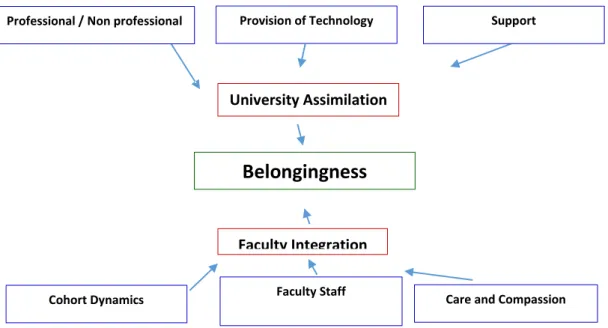
4.6 Belongingness: Overview ... 89
4.6.1 Organisational theme: University assimilation ... 90
4.6.2 Basic theme: Professional programmes and integration ... 90
4.6.3 Basic theme: Provision of technology ... 911
4.6.4 Basic theme: Individual support ... 922
4.6.5 Organisational theme: Faculty integration ... 922
4.6.6 Basic theme: Cohort dynamics ... 922
4.6.7 Basic theme: Faculty staff ... 933
4.6.8 Basic theme: Care and compassion ... 944
4.6.9 Summary: Belongingness ... 944
4.6.10 Interpretation: Belongingness ... 944
4.7 Personal reflections: Overview ... 955
4.7.1 Introduction ... 955
4.7.2 Organisational theme: Practice related content ... 966
4.7.3 Basic theme: Mentor/assessment ... 966
4.7.4 Basic theme: Skill acquisition ... 977
4.7.5 Basic theme: Reality of qualified nurse role ... 97
7
4.7.7 Basic theme: Underpinning knowledge ... 98
4.7.8 Basic theme: Personal development ... 98
4.7.9 Basic theme: Support ... 98
4.7.10 Exclusion of data ... 99
4.7.11 Summary: Personal reflections ... 99
4.7.12 Interpretation: Personal reflections ... 99
4.8 Academic grades overview ... 101
4.8.1 Introduction ... 101
4.8.2 Overview: Academic grades ... 1011
4.8.3 Findings: ... 1022
4.8.4 Interpretation: Academic grades ... 1033
4.8.5 Summary: Academic grades ... 1055
4.9 Overview ... 1055
Chapter Five: Conclusion, Limitations and Recommendations ... 10707
5.0 Overview ... 10707 5.1 Introduction ... 10707 5.2 Conclusion ... 10707 5.3 Research limitations ... 11212 5.3.1 Case study ... 11313 5.3.2 Participant sample ... 1133 5.3.3 Data collection ... 1133 5.3.4 Findings ... 1133 5.4 Dissemination of findings ... 1144
5.5 Recommendations for education ... 1144
5.6 Recommendations for future research ... 1166
Bibliography ... 13636
8
List of Figures
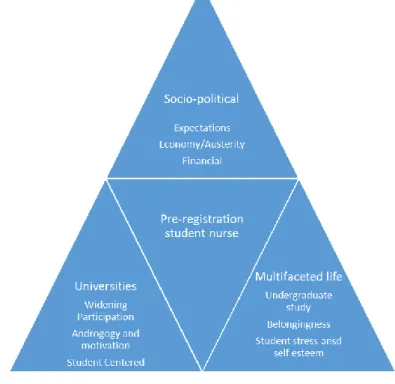
Figure One: Conceptual framework: Interrelated key themes within a pre-registration nursing
programme ... 22
Figure Two: A thematic network for the representation of themes ... 61
Figure Three: Global theme illustration: Personal learning ... 69
Figure Four: Global theme illustration: Undergraduate study ... 76
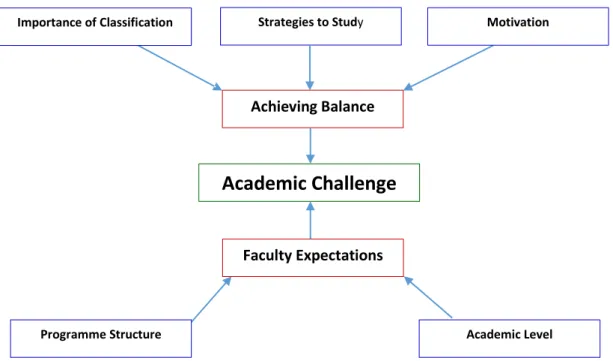
Figure Five: Global theme illustration: Academic challenge ... 84
Figure Six: Global theme illustration: Belongingness ... 89
Figure Seven: Global theme illustration: Personal reflections ... 96
List of Tables
Table 1: Initial search ... 19Table 2: Reviewed search... 19
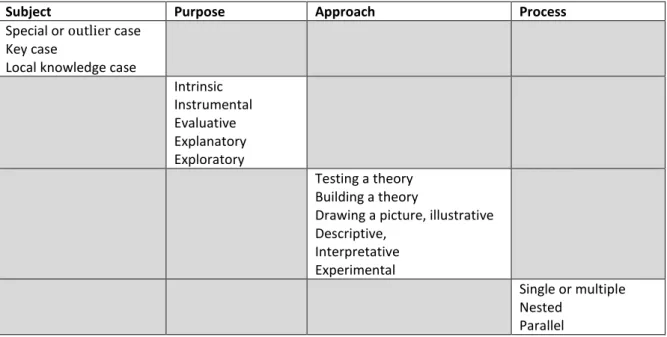
Table 3: Types of case study ... 45
List of Appendices
Appendix 1: Systematic review Summary ... 118Appendix 2: AACODS Checklist 1 ... 122
Appendix 3: Inclusion criteria and exclusion criteria: ... 124
Appendix 4: An outline of the initial focus group questions ... 125
Appendix 5: Transcription ... 126
Appendix 6: Coding ... 127
Appendix 7: Outcome for Stages 1-6 of Attride-Stirling thematic network analysis tool ... 128
Appendix 8: Consent Form ... 130
Appendix 9: Participant information ... 132
Appendix 10: Reflective accounts received ... 134
9
Dedications and Acknowledgements
I would like to thank all the participants in this study who generously gave their time to be interviewed and who allowed me to view their personal reflections and share their academic accomplishments. Without their help I could not have completed the thesis.
I am sincerely grateful to Dr Mike Snowden, University of Huddersfield, for his help, support, critical feedback, encouragement and extensive patience, all of which have enabled me to complete this work.
Thanks also needs to be given to the many avenues of support offered by the Faculty of Health and Social Care, Edge Hill University, the provision of financial support and study time. More importantly, my thanks goes to my many good friends (in particular Dr Juliet Thomas who supported me throughout as a critical friend) and colleagues for the caring and compassionate encouragement given throughout the study which sustained my motivation.
A final thanks needs to go to my family who without their support I would not have completed this study, thank you for your love, encouragement, and for just being there.
10
Chapter One: The Research
This chapter and subsequent chapters have been formatted in a similar way with the signposting of decisions made throughout the case study, thereby increasing the reliability and transferability of the study.
Chapter one provides the rationale of the need and purpose of the study followed by the outline of the remaining chapters.
1.0 Introduction
The role and expectations of the Pre-Registered Student Nurse (PRSN) has altered dramatically over recent decades, some of which I have experienced on a personal level as a registered nurse and as an educationalist. This thesis explores whether PRSNs perceive the theoretical component of their nursing programme to their registration to be pivotal. Major changes have taken place to the delivery of the PRSNs’ educational programme, namely the integration of nurse education into the Higher Education institution (HEI) (UKCC 1986) and the introduction of a degree award for all PRSNs (NMC 2011). The inspiration for this study and the following thesis has emerged due to my involvement over the last eighteen years with the delivery of the theoretical component of a nursing education programme in a university within the North West of England.
1
.
1 The need for the study
Having been involved in, and passionate about, nurse education since 1996 I have become increasingly concerned with the public’s negative perception and criticism of nurse training undertaken in the HEI setting and their belief that student nurses on completion of their degree programmes are unable to nurse. Believing this to be an important and pressing issue for the nursing professional, this study sought to find out if the HEI delivers the curriculum that PRSNs need from their perception. Nurse education has always involved a symbiotic relationship between the theoretical and practical components, however the allocation of time to each component has been reformed over the years. The allocation of an equal weighting of 50% of the programme to both the theoretical and practical component of the programme, has been a consideration since 1990. Prior to this date, an apprentice format was followed where student nurses learned ‘on the job’ with an unspecified amount of time learning theory in a local school of nursing (Eaton 2012, Draper 2013). However the application of European legislation to all nursing degrees from 2005 has included a minimum of 4,600 hours covering the duration of three years (EU 2015). Each component equating to 50% of the programme consisting of 2,300 hours distributed equally over the three years. However the monitoring and delivery of these
11 hours varies for each HEI, albeit the content and standards deemed necessary by the NMC have to be incorporated (NMC 2010).
This aligned the education of nurses within the United Kingdom with that of their counterparts in Europe, thereby addressing European directives and alignment with international nursing (NMC 2004, EU 2015). A professional requirement of the Nursing and Midwifery Council (NMC) is for nursing to be an evidence based profession with research supporting and informing the practical application of nursing and nursing theories (NMC 2015). However, on review of the literature such demands have not been applied to the development of the curricula with a paucity of literature relating to the theoretical component of the programme and PRSNs being found. The literature typically examined student retention and/or attrition and the associated reasons as to why PRSNs do not complete their nursing programme, such as the lack of academic preparation and prior family commitments (Shepherd 2008, Urwin et al 2010, Gillen 2012, Cowin and Johnson 2015).
Despite the paucity of literature regarding the theoretical component of the nursing programme anecdotal evidence however, appears to be abundant. Novella (2008) argues that anecdotal evidence is often associated with emotional rather than scientific outputs and one where positive outcomes are expected. He expands further by suggesting that there are recognised limitations of anecdotal evidence/research being of an uncontrolled nature and therefore the unreliability of the assumptions being made limit their usefulness. However, this position fails to address the issue that anecdotal evidence does provide stories of what people believe to be happening. For example, as part of many conversations with colleagues and PRSNs it has been suggested that although the academic outcomes need to be met more kudos is associated with the practical component of the nursing programme because nursing is a practical role. Furthermore, there is doubt as to the value of the degree classification, and by implication the academic component, as all classification of degree awards permit registration and employment as a nurse. This research study will investigate whether the learning needs of the PRSNs are met enabling them to achieve their full academic potential and if they perceived any factors which could hinder their learning. Subsequently, if factors are found preventing them achieving their full potential, it will discover where in the programme these can be found. Finally, the study will explore the question of how the PRSNS respond to these factors in ensuring their personal learning takes place.
12
1.2 The purpose of the study
The initial prima facie question therefore was:
‘How do PRSNs engage with learning in the theoretical component of the pre-registration programme?’
Following the literature review, three research questions were formulated to address the aims of the study. Firstly, to provide the reader with a deeper understanding of the experiences of the PRSNs in relation to the theoretical component of their nursing programme within the current socio-political and professional nurse education reforms. Secondly, to ascertain if the motivational levels of PRSNs vary from year to year throughout their three year nursing programme, with the intent of improving the PRSNs' learning journey. Finally, to inform and establish, a contemporary delivery of the theoretical component of the nursing programme and reduce potential challenges experienced by PRSNs.
1.3 Nursing and nurse education in context
In order to enable the reader to contextualise nurse education and provide an understanding of how and why nurse education has continued to progress, a brief overview of the importance of the development of the nurse ‘register’ and the progression of nursing from a vocational to a professional status has been provided. All PRSNs enrol onto a nursing programme with two main intentions, firstly to complete a programme of study which will enable them to register with the nursing regulatory body, the NMC, and practice as a registered nurse and secondly to complete an academic education to degree level.
1.4 The nurse register
The NMC is the recognised professional regulator for nurse education (training), nurse registration, nursing legislation and post registration issues in the United Kingdom (UK), (DOH 2014). On completion of their programme nurses and midwives must be recorded on the ‘register’ in order to practice. Therefore all nurses and midwives on the register must meet the professional standards set by the NMC during a programme of education. The register allows for the review of the numbers of registered nurses/midwives enabling the forward planning in developing the needs of the future workforces. The NMC provide current data as to the numbers on the register:
13 This information has assisted the Department of Health in recognising current and future workforce challenges affecting the number of nurses on the nurse register and of those who will become registered nurses in the forthcoming years affecting workforce planning (Addicott et al 2015). Four main challenges have been recognised, a decline in the number of young people in the UK available to apply for nurse training, an already ageing nursing workforce close to retirement (NMC 2008), international nursing shortages and the migration of qualified nurses to other countries (Foster 2010). The most recent challenge is the increased number of registered nurses leaving the profession through issues such as demotivation and demoralisation, resulting from the increase in negatively related media coverage associated with poor patient care and the standard of nurse education being scrutinised (Ford 2013). A combination of these factors demonstrates the potential for a decline in the number of qualified nurses within the health system. Attempts to address this decline include a strategy to increase the number of registered nurses by moving to an all degree programme allowing existing internationally registered (degree) nurses to apply to work in the UK (Sturgeon 2010). Therefore, contextualisation of the evolution of nurse education and practice and how this underpins current nurse education has been included.
1.5 ‘Vocation’ or ‘Profession’
An attempt was made in 1889 to define nursing using terms such as ‘vocation’ or ‘gift’ as indicated below:
‘What is nursing? It has been called an art, a science, a profession, a vocation a Heaven-born gift, a laboriously acquired task’. (The Nursing Record. 1889:131)
These terms remain associated with contemporary nursing today. Originally, nurse training comprised two tiers of vocational training. The two tier system included registered nurses who followed a theory and practice curriculum and assistant State Enrolled Nurses (SENs) who followed a more practically based curriculum (RCN 2008, UKCC 1986). The training on both routes followed the apprenticeship system. In response to a change in the exit award for nurses in 1986 with an increase to diploma level for all nurses on qualification saw the demise of the SEN with only the registered nurse route being available. More recently the need to fill the work gap left by SENs has become apparent with an increase in the employment of unqualified Health Care Assistants (HCAs) and the development of assistant practitioners who support the registered nurses in a practical care role (Merrifield 2015).
Much of the literature reviewed proffers opinions and debate with regard to whether or not nursing is a ‘profession’, ‘occupation’ or a ‘vocation’. In general, the terminology is interchangeable and prior to the 1990s the terms ‘occupation’ and ‘vocational’ were being used, with the term ‘profession’ being
14 used in a more consistent way after this decade. This is comparable with other health professions, for example, social work students follow a vocational education programme despite describing social work throughout the literature as a profession (Hafford-Leitchfield 2007). Similarly, nurse training is often referred to as nurse education and both terms remain interchangeable with the term nurse education being more commonly used following the move to the HEIs and the resulting increase in academic achievement. Unquestionably many practitioners, myself included, view ourselves as professionals; however, I also consider nursing to be a vocation.
There is significant discussion, debate and a diversity of opinion throughout the available literature as to what constitutes a profession or the term ‘professional’. Rutty (1998), Castledine (2003), and Keogh (2013) suggest a profession requires some or all of the following characteristics, a degree of academic credibility, a code of ethics, its own body of knowledge, self-regulation, autonomy and independence. Using these characteristics as an evaluation of nursing as a profession, many of these characteristics are indeed present (Keogh 2013), having developed substantially over the decades.
A contemporary movement towards a professional programme was developed with the integration of nurse education into the higher education sector providing a measured academic level and therefore academic credibility (UKCC 1986). Degree education provides this academic credibility and is an integral part in the process of becoming a qualified nurse, a professional (NMC 2008). The development of the NMC code of ethics (NMC 2008) further aided the recognition of nursing as a profession and nurses as autonomous professionals. Professionalism and accountability in nursing have been researched globally, Wynd’s (2003) descriptive and comparative/correlation study of 774 graduate nurses examined whether levels of professionalism existed and if so what affected these levels. Postal questionnaires were used to collect the data. The study revealed two key issues which related to the importance of autonomy and self-regulation of the nurse as being a major part of a professional. One notable finding was the more experienced a nurse became, the greater their level of autonomy, suggesting that encouraging experienced nurses to remain on the register is therefore essential.
In addition, the professionalism of the nurse’s role within society is fundamentally defined by society which expects certain standards and behaviour from a nurse as alluded to in the Mid-Staffordshire report. Within the Mid-Staffordshire report (2013) the expectations of patients and the public as to what is acceptable and unacceptable behaviour in the delivery of care by the professional regulatory bodies and health commissioners are evident. A failure to act on the delivery of sub-standard care and inadequate interventions resulted in the reduced confidence of the public in the NHS and nursing standards. One recommendation to address this lack of care was the integral provision of professional
15 development training to all levels of nurses from students to directors (Mid-Staffordshire report, 2013). This incorporated professional development in both theory and practice for PRSNs.
PRSNs have to learn professionalism through their academic setting through the involvement of teaching staff, clinical staff and their peers who can assist with the development of professional values (Keogh 2013, Castledine 2003, Rutty 1998). Therefore different levels of professional knowledge in combination with the body of nursing knowledge are incorporated into the three year nursing programme with incremental aspects of professional knowledge delivered throughout the programme, with the last year concentrating on the requirements and preparation for ‘Fitness for Practice’ on qualification (DOH 2000, NMC 2015).
1.6 Outline of thesis
This thesis comprises five chapters
The first chapter provides an introduction to the research, including the need and purpose of the study. In addition it gives a brief overview of ‘how’ and ‘why’ nurse education has evolved, from its inception to present day and, importantly, the significant role of the NMC’s contribution to pre-registration nurse education, including the importance of the requirement for nurse education to be accepted as a degree awarded profession. Finally, this chapter directs the reader through the research process undertaken in the content of the subsequent chapters.
The second chapter presents an explanation of the search strategy, identifying gaps within the current literature in relation to the theoretical component of the PRSNs nursing programme. Subsequent information as to the current socio-political events and social expectations of PRSNs are considered, with the final section focusing on the movement of nurse training from schools of nursing to higher educational establishments and the impact this has had on PRSNs.
Chapter three contextualises the study with the provision of the philosophical, the ontological and epistomological perspective of interpretivism. In addition, the methodological perspective of case study, data collection tools and participant inclusion has been discussed. Included within this are the ethical considerations and the underlying principles of interviewer effect and reflexivity.
Data analysis with disclosure and interpretation of the findings are outlined in chapter four. The focus groups were completed over a six week period, and the collection of the PRSNs’ reflections and academic transcripts collected in week twelve on completion of all academic assessment. The application of Attride-Stirling’s (2001) model of thematic analysis proved beneficial in determining
16 themes from the focus group and reflective data with interpretation of the academic transcripts achieved with the utilisation of descriptive analysis. In conclusion, triangulation and interpretation of the three data collection tools were completed.
The final chapter, offers the conclusion, highlights the limitations to this particular study and provides recommendations for improvements to the current programme and recommendations for further areas of research.
17
Chapter Two: Literature Review
2.0 Overview
The previous chapter has provided the context for the study by introducing the reader to the historical origins of the nursing profession and information regarding more recent developments to nurse training for pre-registration student nurses (PRSNs). The rationale for these changes is defended by the NMC, the governing regulatory body for nursing. The potential impact of these changes on the learning journey of the PRSN remains unclear.
2.1 Introduction
This chapter provides the reader with a conceptual framework and a review of the factors relating to the learning journey of PRSNs while undertaking nurse training. In order to facilitate this and provide clarity of the current research available this chapter has been separated into six sections.
A précis of the importance of both the theoretical and practical components of the nursing programme to the PRSNs has been discussed in this first section with the greater emphasis of this study being placed on the theoretical component of the nursing programme.
The second section explains the search strategy followed to ascertain gaps in information and knowledge available in the research area. An outline conceptualising the study, including the rationale as to the inclusion of three pivotal interrelated areas, the current socio-political environment including societal expectations of PRSNs, the recent ideological changes to the type of knowledge delivered at universities and lastly the complex multifaceted life of undergraduateson a nursing programme have been provided. Each of these has been discussed individually in the next three sections.
The final section contains a summary of the literature review.
2.2 Theoretical component
The HEI of the case study delivers the content of the programme in modular form; each module consisting of one block of theory of between six and ten weeks in duration with a related assessment attached. A further block of theory is completed after a block of practice learning. The content of each module is related to the experiences students will potentially encounter when returning to practice. Each module carries a specific amount of academic credit with individual modules using a wide variety of assessment strategies. Fulfilment of academic regulations in awarding academic credit is reliant on the academic staff following internal marking and moderation processes in combination with external moderation (Muir 2006, EHU 2014). Academic credit is awarded at yearly examine boards prior to
18 PRSNs progressing to the next academic level, included within this, is the credit awarded for the completion and passing of the practice modules.
2.2.1 Practical component
The content of the practical component is constructed around the stipulations and regulations of the nursing governing body, the NMC, with each PRSN completing field and generic nursing competencies at a minimum of degree level prior to registration (NMC 2010). Practice learning placements are between six to twelve weeks in length in order to facilitate the completion of these competencies. However, these competencies are not graded or included in the overall degree classification. Sturgeon (2010) infers that greater emphasis is placed on the practical component of the programme; a point reinforced by the NMC (2015) that nurses need to be ‘fit for practice’ with the overarching aim of protecting the public, with any academic achievement coming second. A prolific amount of literature would appear to support this statement therefore providing further evidence of the disproportionate importance given to the practice component of the programme. A somewhat contradictory and misleading statement when a degree award has just been implemented for all PRSNs. Nevertheless, the significance of grading practice learning competencies and how this could relate to the PRSNs’ overall interaction with their academic studies warrants further investigation.
2.3 Search strategy
A systematic process was adopted to undertake a comprehensive and detailed review. Aveyard (2014) advocates the use of a systematic process of review, a rigorous procedure to ensure all pertinent literature is included within the review. Included within this procedure was a broad search strategy inclusive of ‘grey’ literature to remove bias. In addition, an inclusion and exclusion criterion was set to filter information relevant to the review. The use of critical appraisal tools and evaluation checklists strengthened this process and a systematic review summary completed the process (appendix 1). An extensive search of the electronic data bases which included EBSCO host (MedLine, CINAHL), Internurse, ProQuest Nursing and Allied Health Sources and ScienceDirect, for appropriate published peer reviewed papers and conference papers was completed. Combinations of several of the key terms were used such as ‘pre-registration student nurses’ and ‘student healthcare professions’. Initially this produced an excessive amount of literature however once the terms ‘theory component’ and ‘academic’ were used fewer results were obtained. Consequently, a dearth of research linking the theory component and pre-registration student nurses was found, therefore additional terms such as ‘student nurse’, ‘training’, ‘education’, ‘factors affecting learning’ and ‘professional’ were used to
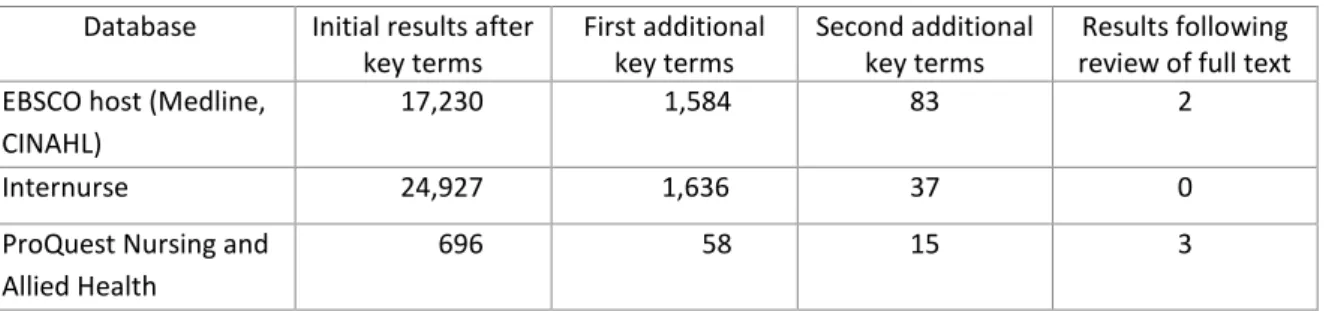
19 expand the search. Following this additional search a paucity of papers were found as illustrated in the table below.
Table 1: Initial search
Database Initial results after key terms First additional key terms Second additional key terms Results following review of full text EBSCO host (Medline,
CINAHL)
17,230 1,584 83 2
Internurse 24,927 1,636 37 0
ProQuest Nursing and Allied Health
696 58 15 3
This original search was replicated using the same databases and search terms in 2014/15 to reassess if additional literature (between 2010 and 2015) could be uncovered. Two additional papers were found.
Table 2: Reviewed search
Database Initial results after key terms
First additional key terms
Second additional key terms
Results following review of full text EBSCO host (Medline,
CINAHL)
2,189 35 30 0
Internurse 1,824 173 45 11
ProQuest Nursing and Allied Health
515 50 50 1
2.3.1 Grey literature
Additionally, a search of grey literature for pertinent unpublished research was completed, a phase endorsed by Brine (2015) to minimise publication bias. Several sources were utilised, the Bielefeld Academic Search Engine (BASE), the Department of Health (DH), the Nursing and Midwifery Council (NMC) and the Higher Education Academy (HEA), for reports, reviews, theses, dissertations and conference abstracts. Following the implementation of a critical appraisal and evaluation checklist (AACODS checklist appendix 2) one piece of relevant material was obtained.
2.3.2 Hand searching and back referencing
The search concluded with the hand searching and back referencing of the selected studies and literature from other established journals, this included one post registration and one practice related article to enhance contextual relevance. These journals found to be omitted from the databases include the Journal of Research in Nursing, Journal of Advanced Nursing, Learning in Health and Social Care and the Nursing Standard.
20
Additional sources Results following review of full text
Grey literature/ BASE 1
Hand searching 3
Back referencing 4
The application of an inclusion and exclusion criteria in conjunction with the critical appraisal tool allowed for the scrutiny for the research utilised within the study (PubMedHealth 2014) (appendix 3).
2.3.3 Inclusion criteria
Primarily, the search was limited to research of the United Kingdom however due to the restricted research in this area, relevant international works and literature relating to other professional healthcare and social care programmes was utilised. This provided an opportunity to compare and contrast known factors which affect the learning capabilities of PRSNs and other professional healthcare students during their training.
International works were included from Europe, Australia, America and New Zealand, all of which deliver professional healthcare degree related programmes. The initial timeline used in the inclusion criteria was post ‘2009’. However, following manual searching of journals, prior secondary references proved to be beneficial allowing valid but dated work to be included to underpin the study.
2.3.4 Exclusion criteria
Much of the literature had a clinical or practical element and this was scrutinised for the key terms before being excluded from the study. Literature not written in English or peer reviewed was excluded. In addition, works from China were excluded as nurse training is not standardised throughout China or taught to degree level. The term student was also associated with post registration courses; these were similarly excluded from the study.
2.4 Themes
Initial reading and questioning of the literature for the identification of themes was found to be time consuming and a confusing process at times in the organisation of my ideas. This was congruent with Burgess et al (2006) who indicates that researchers should acknowledge that this is a normal stage of the research process. Miles and Huberman (1994) and Aveyard (2010) offer similar views to aid the reduction of such confusion of the thematic process by suggesting the inclusion of a framework and the completion of a coherent meta–analysis summary or systematic review of literature to inform that particular area of inquiry. Furthermore, as defended by Childress (2013) the inclusion of a meta–
21 analysis summary process provides opportunities for the comparison and clustering of key themes which have been identified across the studies. Further endorsement is provided by Sandelowski and Barroso (2002) and Childress (2013) who explain that the key benefit of meta-analysis summary/systematic review is the recording of key findings found within a report or article for further examination to gain a deeper understanding of the topic.
Flick (2010) suggests the recognition of patterns and the checking of the repetition of topics should be continued until saturation is reached with no further themes being identified. This was achieved through a process of extensive reading and reflection on the available literature with the generic and individual themes being organised into three overarching themes; the current socio-political environment, the changing face of universities and the multifaceted nature of student life.
2.5 Search results
Initially, 42,853 papers where located using the key terms. Following the application of two further key terms this number was reduced dramatically to 3,278. To determine the relevance of these papers titles and abstracts were read, this resulted in many papers being excluded where post-registration students were being classed as student nurses. In addition many of the papers incorporating the term ‘education’ involved the practice element of the nursing programme and therefore were excluded from the study. The implementation of a critical appraisal tool facilitated the inclusion of relevant papers. A re-evaluation of the search strategy following the process described above was undertaken in 2014/2015, with an additional two studies found and included into the literature review. This resulted in the review being constructed around thirteen studies from both a qualitative and quantitative nature relating to the theory component rather than the practical component of the nursing programme. Due to the paucity of available nursing literature to underpin this study two pieces of non-nursing literature were included by way of comparison. Firstly, Murdoch-Eaton et al (2007) who had researched themes affecting medical students learning during their programme and secondly that of Hafford-Leitchfield (2007) who had previously researched factors pertaining to the factors affecting the retention of social work students during their programme.
2.6 A conceptual framework
In order to provide clarity and purpose to a study Parahoo (2014) suggests the use of a conceptual framework, a guide for every stage of the research process, which can be further enhanced with the addition of defining the workings and operational definitions. The utilisation of a conceptual framework which incorporated my main ideas and beliefs enabled me to organise my thoughts.
22 Consequently, this provided a way of starting the research and the development of theory to explain key concepts and the association between them and presumed relationships (Miles and Huberman 1994, Robson 2002, Parahoo 2014).
Previous research of the theoretical component of the PRSNs’ nursing programme remains limited and is further reinforced by the lack of literature in the emerged themes, therefore necessitating further research. Figure one below provides an illustrative representation of the equal importance of the three interrelated themes to the study.
Figure One. Conceptual framework: Interrelated key themes within a pre-registration nursing programme
Preliminary readings of formative works on teaching, learning and assessment in higher education provided initial information as to the influential people and their works concerning changes to the higher education environment. One such person being Professor Ron Barnett whose significant and prolific works on changes to higher education were prominent within the literature with reference made in additional works. During my attendance at an educational conference (Innovative approaches to curriculum design and delivery in higher education 2014), Barnett, a key speaker made reference to an interconnected multilateral system existing within the higher education system comprising three key areas, that is, knowledge, education and society. A close similarity to the themes identified in the literature review was noted. Therefore the seminal works of Barnett have been utilised in the conceptualisation of this study.
23
2.6.1 Conceptualisation
The study draws upon Barnett’s early work and his concept that the fundamentals of higher education have changed to what he calls the ‘modern university’ (Barnett 1993). The premise of Barnett’s concept of higher education is that of a three way association (tripartite model) between knowledge, higher education and society, all of which have an interdependent influence on each other; this is further reinforced in his later works (Barnett 2014). Utilising the relationship between these three themes alluded to in Barnett’s concept have been used to underpin the case study to provide an understanding of the daily challenges faced by PRSNs. I consider Barnett’s tripartite model of knowledge, higher education and society to be commended as a concept, though I feel logically that socio-political issues first and foremost, need to be considered. Socio-political issues such as the current levels of austerity, high unemployment and the raising of student fees have all contributed to the changing expectations required of universities, a university’s performance and the programmes that they deliver.
Three comparable terms therefore have been used which have influence on today’s PRSNs, these have been signposted throughout the review to provide a systematic and coherent structure. The tripartite model will be respected with the comparable terms being socio-political/society (society’s expectations of newly registered nurses, university/higher education (the move of nurse education to the higher education arena) and complex multifaceted student life (the types of knowledge and challenges PRSNs face during their nursing programme). The balance of Barnett’s three interdependent influences within the tripartite model had an equal importance; however, currently the expectations and employability of graduates on completion of their programmes may bring socio-political issuesto the forefront.
2.6.2 Tripartite model
Each of the emergent themes comprises of three elements. The first theme encompasses literature concerned with the expectations of society and nursing staff, the effects of economic/austerity changes within society to the increased applications to nursing programmes and the financial adversities that PRSNs experience. Literature incorporating the changing face of universities resulting from the implementation of widening participation, application of andragogical theory and student-centred learning provides the basis for the second theme. The third and final emergent theme identifies the multifaceted life of students specifically centred on the undertaking of an undergraduate programme, particularly the feeling of ‘belongingness’ and the effect student stress and low self-esteem can have on student learning.
24
2.7 Socio-political
The current socio-economic feature of austerity and the existing political agenda has had a significant impact on universities’ recruitment to pre-registration nursing programmes with an increase in local applications seen in nursing from 3,400 in 2014/15 to 4,000 in 2015/16 (EHU 2015). The increase of detrimental media coverage and personal financial hardship faced by PRSNs does not appear to have deterred applications or to the nursing programmes. However, the inclusion of paid tuition fees by the Department of Health and the inclusion of a student bursary might explain this increase in times of austerity.
2.7.1 Societal expectations
Since the conception of the NHS in the mid-twentieth century, the principal role of the registered nurse, that of delivering hands-on bedside care has remained unchanged. Maben and Griffiths (2008:13) have argued that the stereotype of a nurse appears outdated, with members of society being unaware of ‘what a registered nurse is’ and ‘what a registered nurse does’. This lack of understanding began with the demise of the second level nurses (SENs) in the 1980s, the SEN was phased out with all registered nurses now expected to achieve a diploma level of education. This however led to a fall in the number of trained nurses with the equivalent rise in the number of health care assistants (HCAs). These HCA’s now provide the majority of the bedside care, with minimal practical training compared with their contemporaries. This is currently causing confusion to the public who believe that anyone looking after them is a nurse (Clews 2010, Cavendish Review 2013).
Furthermore, with the increase of health information available from a variety of media technologies, members of society are able to gain information and knowledge about every aspect of life, thereby raising their expectations (Keen 2007). However, the views and opinions of the public regarding ‘the role of a nurse’ have been hampered due to a lack of education and information illustrating the changes in the role of the nurse and supporting staff. Therefore this lack of education and explanation of these facts to members of society have produced harmful and damaging negative perceptions of registered nurses and the nursing profession. In particular, negative and harmful criticism of the nursing profession in the media has resulted in a lack of confidence from the public in relation to ‘basic nursing hands-on care’ and by implying that to deliver caring skills does not require any expertise (Scott et al 2013). Recent public enquiries into poor care provision and reviews into care delivery, improving the levels of care and patient safety substantiate many of these negative perceptions (Mid-Staffordshire 2013, Keogh 2013, and Berwick 2013).
25 Moreover, a lack of understanding and insufficient explanation to ‘society’ as to why a nurse should require a degree level of education has challenged the stereotypical concept of what a nurse should be, further compounded by the lack of an appropriate definition of a registered nurse. Scott et al (2013) infer that this is because past and current governments do not understand what is required to be a caring, professional nurse. Therefore further explanation providing clarity of the role, including the additional expectations of a registered nurse of the twenty-first century is necessary.
2.7.2 Economic recession/austerity
With the introduction of austerity measures in 2012, a reduction in the commissioned numbers for nurse training was announced which further compounded the shortage of registered nurses (RCN 2014). However, since 2012, the realisation of this national shortage of registered nurses has resulted in an additional 1,407 commissioned places being made available to nursing programmes in 2013/14 and 2014/15. In addition, the more recent promise of a large influx of monies to the NHS with the complete removal of restricted commissioned places for student nurse training should eventually address this problem (Gummer 2016). Nursing, however remains a fairly secure employment (Davis 2008), with a starting salary of approximately £21,000 (Willis 2013). In addition, Foster (2010) argues that nursing has become a more attractive career pathway, especially to men, as it is seen as a dependable career choice with a progressive career ladder, with new improved pay scales and the potential for career development with a top pay band of £98,453 (DOH 2013). The latter raises two questions, the first being how does the current societal political environment impact on people’s employment choices and secondly, does the prospect of a relatively good wage on registration, especially during an economic recession attract unsuitable and uncaring people.
Davies (2008) perceives an economic recession with increased redundancies to be advantageous to members of society by providing them with the opportunity to retrain for a new career or for the change of a job to gain more job satisfaction (Davis 2008). Equally, Santry (2010) implies that an increase in applications to nursing programmes is due to the economic recession. However, although Gillen (2014) and the RCN (2014) agree that a 75% increase in nurse training applications has been seen, doubling year on year, they do not confirm this is due to a recession.
2.7.3 Financial pressure
Despite good monetary prospects available on qualification, the burden of significant levels of financial pressure on PRSNs during the nursing programme and how this might impact on their learning requires further debate. A discontinuation of a salary during apprentice nurse training in 1989 coincided with the movement of nursing programmes to the HEIs and the move to a means
26 tested bursary with the added option of PRSNs being able to apply for a concurrent student loan (Sturgeon 2010). Consequently, a high number of current PRSNs endure hardship and financial struggle, a problem consistently highlighted within the literature (Glogowska et al 2007, Karstadt 2009, and West 2015).
Glogowska et al (2007) and Karstadt (2009) claim that despite the PRSNs’ university fees being paid and the receiving of a bursary or student loan, the majority of PRSNs endure a financial struggle, living below the poverty line with financial instability throughout their nursing programme which impacts on their learning journey. In an effort to support themselves, PRSNs have needed to take on additional paid work, a view substantiated by the multi-methods approach of Glogowska et al (2007). They conducted face to face Interviews with 30 nursing students who had considered leaving the nursing programme but had then stayed, in addition 19 phone interviews with nursing students were made to students who had taken the decision to leave the nursing programme. The study investigated the reasons as to why some students stayed and why some withdrew. It is unclear in the study whether the students were diploma or degree students. Six factors were revealed; some students experienced more than one factor as to why they left the programme. How many of the students were affected by multiple factors, was also unclear. Subsequently, 12 out of the 19 students withdraw due to financial strain. Again, it was unclear as to why the other seven students withdrew. Of the 30 students that considered leaving, only seven related this to financial strain, however underlying threads can be seen, with other factors which were closely linked to financial strain. The solution for many students was to undertake part-time paid work. This was considered to have a major impact on the PRSNs’ ability to study and learn. This additional work was associated with increased tiredness and an increase in stress levels with the PRSNs trying to cope with completion of multiple components of their course whilst, at the same time, undertaking part-time work (Glogowska et al 2007). Remarkably, despite negative factors connected to additional work, PRSNs correspondingly considered an improvement in their time management skills as a positive motivator. A more comprehensive study could have included socio-political factors such as social deprivation or affluence of the area included in the study, either of which could have had an impact on the findings. An increase or decrease in part-time work might have had additional/reduced impact on the PRSNs’ learning or completion of the programme. My experience with personal students suffering financial hardship has been a cause for concern, which has threatened their progression and completion of their nursing programme. Similarly, medical students are reported to suffer serious levels of financial hardship while completing their programme of study. Murdoch-Eaton et al (2007) conducted an evaluative study comprising appraisal interviews of first and second year medical students with a total of 511 students included over a three year
27 period. The appraisal interviews were conducted as a support mechanism for medical students to review their progression on their programme and future career. The findings produced three key themes affecting the students’ learning; study habits, personal issues and approaches to university life with no one theme emerging as more important than the others. Financial hardship was included under the theme of personal issues that medical students struggled with, nhsCareers (2014) stressed that this was typical of students who had received financial support for prior study. The opportunity for medical students to undertake additional paid work had limited discussion with the assumption that they take on summer work, reference to work on a daily or weekly basis was omitted. In comparison, Hafford-Leitchfield’s (2007) small scale study including seven social work students suggests that due to the reduced number of assessment hours on the programme, social work students have more time to take on part-time paid work if needed to reduce financial adversity. In contrast PRSNs who complete their academic and practice hours already complete sufficient hours to equate to full time working, the undertaking of additional paid work therefore has the potential of impinging on their learning, study time, motivation and overall classification.
Although financial difficulties are recognised for PRSNs, recent debate between the RCN (2015) and Health Education England (2015) has brought the financial difficulties of PRSNs to the forefront once again. The controversial removal of the financial support to PRSNs in September 2017 is a development where both positive and negative aspects need to be monitored.
2.7.4 Socio-political summary
The political and existing condition of austerity in society reflects the increased application process to health-related programmes and the financial incentives. In order to improve the positive societal view of nurses and nurse education, the role of the nurse must be more open and transparent to members of society if the impact of an all degree nursing award is to be recognised. Further consideration as to the changes in the financial package available to PRSNs requires additional investigation to establish whether these reforms have any significant effect on the PRSNs’ learning and motivation or if there are any additional positive or negative challenges placed on the PRSNs in the completion of their nursing programme.
2.8 Universities
The expectations and demands by society of students graduating from universities has altered considerably, with participation required between society and universities (economically driven) to reap any economic benefits for both groups (Rossi and Rosli 2013). The increase in student fees and the student experience has become much more central to the operationalisation in the delivery of
28 course provision and the learning and teaching undertaken in universities. Ensuring a good quality student experience requires the engagement of students as partners, this can only be achieved by listening to students (Ramsden 2010, Healey et al 2014) and this is evidenced within results gained in the National Student Survey (NSS). With the use of the NSS, HEFCE (2016) inform potential students of national data regarding the quality of courses and what HEIs offer to enhance the student experience. Student satisfaction is therefore paramount if HEIs are to cultivate future applications to their programmes and demonstrate how they are proactively changing their provision to improve a student’s HEI experience.
Flexibility, within a programme can therefore been seen as advantageous, for example, the integration of information technology for learning and teaching allows study to take place in any environment and at any time of the day, accommodating family friendly hours, the inclusion of longer university study days, and the potential to provide PRSNs with the opportunity to undertake part-time work (Ramsden 2010) and reducing financial adversity as previously discussed. Similarly, Barnett (2014) promotes flexibility of the curriculum, suggesting that it is much more than just changes to learning environments that is important and therefore recommends the inclusion of a 15 point benchmark to assist with the evaluation of flexibility within a programme. Furthermore, incorporating these benchmarks in the modification of course provision, knowledge provision and attainment of transferable life skills ensures employability of students (DoBIS 2014, Barnett 2004).
The expectation of contemporary society for graduates is high in comparison to the expectations of previous graduates. Society now demands that graduates have employability at the end of their programmes, Barnett (2000) more specifically explains how society expects graduates to have professional insight, analytical skills and knowledge related to a work-based market including the global work markets on completion of their courses. In fulfilling this expectation, Healey et al (2014) recognise that the philosophy within universities has moved from a philosophy based knowledge, to that of productive knowledge thereby providing students with work based knowledge and hence the greater chance of employability (Healey et al 2014) thus meeting the end product for nursing programmes, that of employability.
This is a sentiment echoed by the RCN (2012) who state that deep learning has been replaced with new forms of knowledge such as the transferability of skills, which Barnett (2014) maintains are valued in the wider world and allows the international movement of graduates within the global workforce. Lowden et al (2011) has provided additional evidence that suggests many universities have provided major investment to ensure graduates possess these employability skills. The university used in the
29 case study has a good reputation and being ranked in the top four in the North West for graduate employability from all of its professional programmes. Nursing programmes specifically incorporate NMC requisites required by PRSNs on graduation which include the above mentioned employability skills, otherwise known as ‘fit for practice and purpose’, including the gaining of an award at degree level on completion of their studies (NMC 2001, 2012). A major change identified to universities is the provision of professional programmes with the adjustment to curricula which accommodate skills and competencies (Barnett 2003, 2004). This is further illustrated by Rossi and Rosli (2013) who explain how work-based professional programmes rather than philosophical programmes of study are being offered with productive knowledge being the main purpose, emphasising the professional impetus. In conjunction with the nursing programme being fit for purpose, examination of the delivered curriculum warrants further investigation in order to establish if it too is fit for purpose acknowledging the need for an innovative, flexible curriculum with the ability to deliver productive knowledge (Barnett 2014). In summary, the changes to the nursing programmes in order to incorporate a degree award have presented some new challenges. Additionally, the impact of such changes to nurse education has changed the recruitment process which has transformed the dynamics of the cohorts of PRSNs with an increase in the numbers of non-traditional students in relation to the numbers of traditional students.
2.8.1 Widening participation
The concept of ‘widening participation’ and the encouragement of the participation of potential students from all social groups, who have previously been under-represented, are widely recognised in the literature (Department of Education and Employment 1997, Powney 2002). More recently, the concept of widening participation has been reviewed resulting in a national strategy being developed. The strategy incorporates a much broader viewpoint of widening participation by considering the importance of other departments such as schools and social communities and their role in the success of widening participation; monies to work alongside these additional departments to determine the achievements of learners entering the higher educational system are available (Moore et al 2013, DoBIS 2015).
The university within the study has embraced the widening participation agenda since its inception by encouraging diverse student groups, the inclusion of under-represented social groups providing a diversification of the social and cultural environment experienced by all students and one that creates a rich learning environment (Kaehne et al 2014). Within McKendry et al’s (2014) qualitative study they investigated the retention strategies of student nurses of another university embracing widening
30 participation. A grounded theory approach was utilised to ascertain if students’ motivation and individual experiences during their first year affected the students overall performance. The study included 46 nursing and midwifery students who attended focus groups at two intervals throughout the year. Their findings highlighted some common themes such as motivation levels, support, transition to an HEI environment and ‘juggling’ demands. However, it was unclear from their findings if students without traditional qualifications had similar experiences to the students who had entered the programme with traditional qualifications, which equated to 43% of the recruited participants. Two separate focus groups, one comprising the traditional student participants and the other with the non-traditional participants may have been more productive and accurate allowing comparison of the themes.
The most significant impact within the university has been the diversity of students enrolled on the health related programmes, with an increase in the number of mature non–traditional students in comparison to traditional student numbers and an increase in men enrolling onto health related courses, albeit with no significant increase in men enrolling on to the nursing programmes. Despite this diversity, all HEI students are considered to be adult learners, a concept supported by Norrie and Dalby (2007) who intimate how there is an assumption in higher education that students are all adults so they should be able to function as adult learners.
2.8.2 Adult learners
Knowles (1998) advocates the incorporation of six main principles to underpin teaching strategies when teaching adult learners. However, on further examination, it was evident that these principles were not conducive for the teaching of professional programmes, therefore additional theory was sought. There has been a plethora of additional theorists with an interest in the teaching of adult learners, one example being Brookfield (1986). Although dated, Brookfield’s theory which comprises six categories is particularly pertinent to professional programmes with the development of professional skills and not just the teaching of adult learners. Recommendations made by the NMC for nurse education ensuring PRSNs are ‘fit for purpose’ mirror Brookfield’s six categories. Inclusive within this the NMC require students to be reflective practitioners, critical thinkers, problem solvers, have self-awareness skills and have the skills to be lifelong learners (NMC 2004, 2015). To achieve ‘fit for purpose’ the nurse curriculum is evidence based and at times prescriptive so very ‘teacher’ focused (NMC 2004, NMC 2008b). Therefore, it is inevitable that both passive and active learning will take place throughout the programme, the type of learning is dependent on the specific subject required to be delivered in the curriculum at any particular juncture, for example, compliance with the professional statutory educational regulations. These regulations are information based which
31 requires adult learners to take a passive rather than an active role in their learning and consequently faculty staff must be aware of the disadvantages of such a ‘teacher focused’ curriculum so that this does not prevent the students from learning (Candela et al 2006). The seminal works of Knowles advocates that there is a need for adults to be active participants in their learning and as such the way we teach adult learners should reflect this (Knowles 1968). Norrie and Dalby’s (2007) cross-sectional study explored the learning characteristics of 555 PRSNs across a three year nursing programme. Data was captured using questionnaires to determine whether PRSNs are equipped with the necessary skills and capabilities to be taught as adult learners. However they fail to draw a distinction between traditional and non-traditional students. Universities conventionally categorise students into two categories, traditional and non-traditional students. Traditional students, viewed as those under the age of 21 years and with traditional entry qualifications, whereas non-traditional or mature students, recognised as anyone over the age of 21 (mature students), gaining entry with a variety of non-traditional qualifications. This contradicts Knowles earlier definition of an adult as anyone from the age 16 years and upwards with a commonly accepted upper age limit of age of 25 years (Rogers 1996, Knowles 1990). A recognition that non-traditional students are over the 21 years of age rather than 25 years of age provides one explanation as to the increase to the number of non-traditional students onto HEI programmes. In addition, an expectation that non-traditional students have diverse learning needs compared to traditional students is challenged by Norrie and Dolby (2007) who found no statistical evidence of this in their study. Their study however, would have been more reliable if they had considered not just the effect of age and ethnicity on the learning needs of the group but also the impact of other factors such as gender on the dynamics and learning needs of such a diverse group. For example, the findings of Wehrwein et al’s (2007) study suggest that the learning needs of males differ to females and therefore teaching approaches need to be adjusted to meet these needs. An acknowledgement therefore of the learning needs of PRSNs and the type of learning undertaken is important for learning to take place and is intrinsically linked to their motivation.
2.8.3 Motivation
Motivation is deemed to be a necessity for adult learners to be able to learn. The seminal works of Maslow (1954), and his five tiered hierarchical theory of motivation, hypothesises how motivation is inherent in human behaviour with progression from one tier to another only taking place once one tier is met (Murphy 2006). Although motivation complements learning, limited literature relating to PRSNs and motivation during their theoretical component of their programme was available. Nonetheless, Newton et al (2009) and Murphy (2006) offer differing views as to the importance of motivation.
32 Newton et al (2009) explored motivation within the nursing profession; the study included 29 undergraduates and 35 registered nurses, some of whom were senior managers. Data was gathered via interviews, surveys and field work. Four themes were identified, which centred on the need to care for people; they did however draw conclusions from their findingsthat non-