Digital Commons@Georgia Southern
Electronic Theses and Dissertations Graduate Studies, Jack N. Averitt College ofSpring 2017
Teaching Techniques of Athletic Training Educators
During Instruction of Concussion Assessment Tools
Michelle LimaFollow this and additional works at: https://digitalcommons.georgiasouthern.edu/etd Part of the Educational Assessment, Evaluation, and Research Commons
Recommended Citation
Lima, Michelle, "Teaching Techniques of Athletic Training Educators During Instruction of Concussion Assessment Tools" (2017). Electronic Theses and Dissertations. 1577.
https://digitalcommons.georgiasouthern.edu/etd/1577
This thesis (open access) is brought to you for free and open access by the Graduate Studies, Jack N. Averitt College of at Digital Commons@Georgia Southern. It has been accepted for inclusion in Electronic Theses and Dissertations by an authorized administrator of Digital Commons@Georgia Southern. For more information, please contact [email protected].
Electronic Theses & Dissertations Jack N. Averitt College of Graduate Studies (COGS)
Spring 2017
Teaching Techniques of Athletic Training
Educators During Instruction of Concussion
Assessment Tools
Michelle Lima
Follow this and additional works at:http://digitalcommons.georgiasouthern.edu/etd Part of theEducational Assessment, Evaluation, and Research Commons
This thesis (open access) is brought to you for free and open access by the Jack N. Averitt College of Graduate Studies (COGS) at Digital Commons@Georgia Southern. It has been accepted for inclusion in Electronic Theses & Dissertations by an authorized administrator of Digital Commons@Georgia Southern. For more information, please [email protected].
by
MICHELLE LIMA
(Under the Direction of Tamerah Hunt)
ABSTRACT
Context: Standards for concussion management in clinical practice are essential to best practices in health care. Even with the heightened awareness of concussion education in medical
professionals over the past decade, there have been no studies to date to investigate the educational practices of instructors at CAATE-accredited institutions and how they teach concussion assessment tools.
Purpose: To evaluate the educational practices of instructors teaching the course on concussion assessment tools at CAATE-accredited institutions.
Design: Mixed-methods, exploratory study.
Methods: Nine instructors from CAATE-accredited Athletic Training Education Programs that varied in geographical and division completed a 34-item survey using Qualtrics (2015)©. A semi-structured interview based upon the responses on the survey was then completed using the phone or an online video chat. Quantitative data was analyzed using frequency tables and mode for the survey questions. Interview questions were analyzed using triangulation of themes.
Results: The most common credential participants marked was ‘ATC’ (100%). Survey responses indicated that the most common teaching methods were: ‘Laboratory’ (100%), ‘Didactic’
taught in the classroom were: SCAT2/3, SAC, BESS (88.9% respectively); while in the laboratory the most common assessment tools were: SCAT2/3, BESS, and cranial nerve assessment (100% respectively). The semi-structured interview found four overarching themes with multiple subcategories. The four major themes were: (1) characteristics of instructors teaching the concussion assessment tools and education, (2) factors effecting how the instructors teach concussion assessment tools and concussion education, (3) the components incorporated into a concussion assessment per the instructor, and (4) barriers and future solutions to teaching concussion assessment tools.
Conclusion: This exploratory study shed light on the understanding that athletic training educators come from a variety of educational, clinical, and research backgrounds. The
instructors’ foundational knowledge and experience level effects the teaching techniques they utilize and which teaching methods they employ in the classroom. Time is the number one barrier instructors find prevents them from doing more in the classroom for their students. Future studies should investigate athletic trainers’ knowledge of educational theory and teaching
effectiveness.
INDEX WORDS: Education, Barriers, Knowledge, Didactic, Lecture, PowerPoint, Teaching methods
INSTRUCTION OF CONCUSSION ASSESSMENT TOOLS by
MICHELLE LIMA B.S., Rowan University, 2015 M.S., Georgia Southern University, 2017
A Thesis Submitted to the Graduate Faculty of Georgia Southern University in Partial Fulfillment of the Requirements for the Degree
MASTER OF SCIENCE STATESBORO, GEORGIA
© 2017 MICHELLE LIMA All Rights Reserved
TEACHING TECHNIQUES OF ATHLETIC TRAINING EDUCATORS DURING INSTRUCTION OF CONCUSSION ASSESSMENT TOOLS
by
MICHELLE LIMA
Major Professor: Tamerah Hunt Committee: Jody Langdon Jessica Mutchler
Electronic Version Approved: May 2017
DEDICATION
I would like to dedicate this completed Master’s thesis to my family. My mother Sylvia and father Michael have never failed to inspire me in life and I would not be the person I am today without them. My sister Ariella keeps me grounded and is my rock, always pushing me to be the best version of myself. Lastly, my brothers Christopher and Daniel have always supported me, providing a stress-free moment when most needed. The love and support they provide for me from afar is more than I could ever ask for during this process.
ACKNOWLEDGMENTS
I would like to acknowledge my entire committee for the time, effort, and commitment they put into this study. Specifically, I would like to thank Dr. Hunt for believing in me and providing me with the best possible environment to develop myself professionally and personally. I would also like to thank Dr. Langdon for her constant feedback and for instilling in me the same passion and drive she carries within herself. In addition, I would like to thank Dr. Mutchler for always having a positive outlook on life and showing an inspiring interest in this study. Additionally, I would like to thank my close friends Nichole LaFortune and Jessica Pearson for being a constant support system and avenue of inspiring messages.
TABLE OF CONTENTS DEDICATIONS ...2 ACKNOWLEDGMENTS ...3 LIST OF TABLES ...6 CHAPTER 1 INTRODUCTION ...7 2 METHODS ...14 Participants ...14 Instrument ...15 Procedures ...16 Data Analysis ...18 3 RESULTS ...19 Quantitative Results ...19 Qualitative Results ...20 4 DISCUSSION ...28 APPENDICES APPENDIX A ...38 Research Questions ...38
Inclusion and Exclusion Criteria ...38
Limitations ...38 Delimitations ...39 Assumptions ...39 Definitions ...39 APPENDIX B ...41 Review of Literature ...41
APPENDIX C ...68
Institutional Review Board Proposal Narrative ...68
Institutional Review Board Survey Informed Consent ...72
Institutional Review Board Interview Informed Consent ...74
APPENDIX D ...76
Survey Instrument ...76
Semi-Structured Interview ...80
LIST OF TABLES
Table 1: Participants Demographics ...19
Table 2: Characteristics of Instructors Teaching Concussion Assessment Tools...21
Table 3: Teaching Methods Utilized in the Classroom ...24
Table 4: Factors Affecting How Instructors Teaching Concussion Assessment Tools ...24
Table 5: Assessment Tools Taught in the Classroom and Laboratory ...25
Table 6: The Components Incorporated into a Concussion Assessment ...26
Table 7: Barriers and Future Solutions to Teaching Concussion Assesment Tools ...27
CHAPTER 1 INTRODUCTION
Concussion
Concussion, also referred to as a mild traumatic brain injury (mTBI), has been the highlighted topic of interest for the general population, legislators, and the sports medicine community as a whole.1–3 Prevalent in competitive and recreational sports, concussion is a major public health concern worldwide.4 Concussions occur in males and females of all ages and all sports, but are most common in collision activities.2 The Center for Disease Control (CDC) states concussion in the United States of America is considered to be at an ‘epidemic level,’ with an estimated 1.6-3.8 million traumatic brain injuries occurring annually.5 Data collected from
emergency department visits show a 62% increase in nonfatal traumatic brain injuries between 2001 and 2009.6 As a result of the heightened attention and prevalence of this injury, many organizations are taking action to inform clinicians.
Medical organizations, such as the National Athletic Trainers’ Association (NATA) and American Neurology Association (ANA), have produced numerous position or consensus statements.1 According to the NATA’s position statement on the management of sport
concussion,2 there are specific steps athletic trainers are recommended to follow and practice. Although there are education and prevention recommendations given to current practicing athletic trainers, only a broad description of what should be included in the evaluation process are provided, with no specific evaluation tools following a head injury.2 The concussion
diagnosis is made through both clinical evaluation and supported assessment tools, such as a brief evaluation tool (e.g., Standard Assessment of Concussion [SAC]) combined with motor
control and symptom assessment to support a physical and neurologic evaluation.2 It is suggested to consult members of the sports medicine team regarding the best tools for the clinical setting.2
All 50 states and the District of Columbia7 have passed concussion-management or head injury legislation with education as the cornerstone to prevention. These laws are most often created in regard to school-organized sport and recreational activities while some target a
broader population such as youth, group or organizations that use property or facilities owned by a school district, state, or local parks and recreation departments.7 The laws enacted by each state, although pertaining to concussion, vary in regard to who receives concussion information and how the information is obtained. Laws also vary in regard to athlete clearance and return to play following a concussion; most states include requirements that before returning to
participation, an athlete must have written clearance from a physician or another licensed health professional.8
In order to successfully manage concussions in the clinical setting, athletic trainers must understand the education curriculum of their accredited programs to establish what is being taught and if that teaching is effective enough in establishing a foundation for proper
management.9 Although the NATA2 provides a broad recommendation for which tools should be used in evaluating and managing a concussion, it gives freedom to the athletic training education programs to consult with their physician and determine the best assessment battery to use. This creates concern about the standardization of educational practices regarding concussion
assessment tool administration across athletic training education programs. The goal is to maintain a standardized and objective process of administration. In line with the NATA’s position statement, the 5th Edition of Education Competencies for athletic training curriculums
does not mention what tools to teach, what evaluations should be made, and only states broad terms of evaluation to focus on, such as “cognitive, neurologic, and motor-control assessment.”10 Educational Theory
Focus must be given first to the educators themselves, including background and knowledge base. Although research on teaching was well established, Shulman in 1986,
described three types of knowledge that helped educators and policymakers understand teaching more in depth: Content Knowledge, Curricular Knowledge, and Pedagogical Content
Knowledge.11 These three types of knowledge have since been used in various educational settings, further expanded upon by researchers, and placed into practice. Of the three, the focus remains on Content Knowledge and Pedagogical Content Knowledge (PCK), as they form the key components of current teaching standards, subject specific standards, and policy
organization.12
Teaches need the knowledge base that would allow them to respond effectively as educators.11,13 Shulman11 described four sources of knowledge base: education in specific
content, the materials and structure used, study in pedagogy, and the “wisdom of practice itself.” Experience in not only the content, but also Pedagogical Knowledge that plays a major role in teaching. Differences can be seen in the way novice and experienced teachers plan, think and reflect on their teaching.14 Experienced teachers know the characteristics, interests, and abilities (schemata) of the students which allows them to plan lessons according to experience rather than relying on the textbook.14 They also have a wide range of experiences with teaching strategies that allow them to create variations in the lesson, while novice teachers cannot generally gauge where in the lesson something needs to be adjusted, cannot create variations, and rely heavily on the textbook and written materials.14 Another difference is seen in regards to the teachers’ focus
during instruction. Experienced teachers for example, focus more on the student’s needs, while a novice teacher focuses on students on-task behavior and where their interest/attention is during the lesson.14,15 Novice teachers rely on specific activities for lessons, from their limited
background knowledge; experienced teachers rely on years of trial and error with many classes, thus allowing them a large bank of activities and resources. 14,16 Teaching experience is a key component to the development of the schemata and pedagogical content knowledge that eventually leads to a successful teacher.14
Athletic Training Education
Athletic Training Education Programs follow similar curriculum evaluation needs when comparing to medical schools in regards to concussion education. Emphasis on concussion awareness and evaluation is growing in the education of future health care professionals. Burke9 found that there is a marked deficiency in concussion education in medical schools. These findings show the need for more concussion education as well as a gap in concussion
management. Currently, it is strongly recommended that all concussed individuals seek medical attention.17 Athletes must have physician clearance before return to play, but if the gap between assessments performed by athletic trainers and evaluations performed by physicians is
inconsistent, the student-athletes’ standard of health care may be affected.17 Of the 14 responding Canadian medical schools in the Burke study, four provided concussion-specific education (29%), six offered head injury education that incorporated concussion component (43%), and four reported no concussion teaching in their curriculum.9
The Center for Disease Control and Prevention estimates that concussions account for up to 75% of the 1.5 million traumatic brain injuries in the United States each year.17 As the Burke and Boggild studies9,17 discovered, incomplete understanding of concussion management in
medical students and schools curriculum is worrisome as these individuals must be sought out for clearance of concussion before return to play. The gap between curriculum and clinical practice could also be seen in athletic training education students, as the education guidelines lack the specifications necessary for understanding. With little known about the education of concussion assessment tools in the ATEP programs, this gap between standardized concussion management practices and standardized administration of assessment tools could be larger than the literature is currently indicating. Future studies will need to look into the specifications of ATEP curricula and syllabi.
Student Learning Techniques
Methods such as cooperative learning, problem-based learning and others have been shown to foster athletic training student’s learning.18 Individual student learning is dependent
upon many variables, including, but not limited to, sleep, nutrition, classroom environment, interest in topic, learning style and emotional state. The learning techniques discussed include Experiential Learning Theory, Standardized Patient (SP) Encounter, and Brain Based Learning. Experiential learning is used to represent hands-on or clinical environment learning. A SP encounter includes an individual who has been trained to portray signs and symptoms of either an injury or illness.19 Brain-based learning, although it involves learning, is not a specific methodology but rather describes how the human brain actually learns.
Although little reference is made to athletic training educational theory or models, mastery learning is thought to similarly resemble current ATEPs. Mastery learning divides educational content into smaller, attainable units according to the importance and subject matter. By creating smaller sections, objectives are formulized to guide the instructional process.20 Students are tested; those who pass continue to the next step while those who do not, repeat the
unit until reaching the satisfactory level.20,21 This theory can also be called programmed instruction,22 competency-based education,23 skills-based curricula, or outcome-based education.21
Significance of the Study
Emphasis on concussion management practices in the clinical setting has been consistently reported in the literature.2,24 Although guided by policies and recommendations created by NATA to follow a standardized approach to concussion management, there is little evidence regarding what is being taught in the educational setting on these concussion
management practices and if they are standardized across programs. Additionally, few studies look at the actual educational practices of instructors at CAATE-accredited athletic training education programs.
According to athletic training education literature, there has been no specific educational theory or instructional model mentioned that informs teaching practices in ATEPs.20 Although no concrete theory has been found to reflect the practices of athletic training education, Mastery Learning is seen in the literature in connection with ATEPs. The smaller organized sections create learning objectives which are used as a guide in the instructional process.20 Mastery learning allows ATEPs to implement a student clinical education matrix that consists of checkoff lists for necessary tasked to be completed.20 By utilizing this approach, instructors have the opportunity to evaluate learning outcomes and remains a teacher-centered classroom.20
The Commission on Accreditation of Athletic Training Education (CAATE) requires that athletic training education programs use the 5th edition of the Athletic Training Competencies to guide the program’s structure. The Competencies set minimum requirements and standards that are typically exceeded in one form or another.10,20 Programs are encouraged to implement
innovative, student-centered teaching and learning methods to connect the classroom, laboratory and clinical setting to provide the highest quality education.10 Policies are based off of a specific approach to organize ATEPs but as these are minimum requirements, there are no exact
specifications to follow. No two athletic training education programs are the same.10,20 There is a
growing need to adapt and evolve in order to propel the profession forward both organizationally and educationally.
Literature is available on the current concussion management practices in the clinical athletic training setting but not on the standardization of how concussion assessment tools are being taught in the ATEP classrooms. With limited information available on what concussion assessment tools are being taught in ATEPs, even less is known on how the administration of each test is being taught to the students. The need for such information is paramount to the athletic training profession in order to obtain a sound, objective assessment measure to base standardized concussion policies on.
Purpose Statement
Therefore, the purpose of this study is to evaluate the educational practices of instructors teaching the course on concussion assessment tools at CAATE accredited institutions.
Specifically, to assess who is teaching the course on concussion assessment tools, what concussion assessment tool resources are being utilized, what teaching techniques are being employed, and how each assessment tool is being taught.
CHAPTER 2 METHODS
Participants
A convenience sample of CAATE-accredited institution instructors were asked to participate in this study. The instructors had taught a course on concussion assessment tools in the previous year. In order to recruit participants, an interest e-mail was sent to 28 athletic training education instructors. After initial interest letters were sent out, nine instructors from eight institutions and three divisions completed the survey and semi-structured interview. Web-based survey research has a desired response rate of between 25-30%. We had a 32% response rate for agreement to participate in the study. The nine participants are evenly distributed across the three NCAA Divisions.
The inclusion criteria included:(1) individuals teaching at a CAATE-accredited
institution, (2) instructor teaching content regarding concussion assessment tools, (3) instructors who previously taught the concussion assessment tool no later than the 2014-2015 academic year, and (4) completion of the entire survey, followed by an online or phone interview. The Athletic Training Education programs selected represent a convenience sample of a variety of regions and sizes. In addition, the geographical locations provide a diverse sample from the following states: Delaware, Florida, Georgia, Maryland, New Jersey, Ohio, Pennsylvania, Tennessee, and Virginia. The exclusion criteria included: (1) instructors at non-CAATE-accredited institutions, (2) instructors from courses that did not include concussion assessment tools module, and (3) instructors where concussion assessment tools were not taught in
informed consent form approved by Human Subjects Review Committee prior to completing both the survey and the semi-structured interview. Participation in the survey was entirely voluntary, with no reward or compensation for survey completion.
Instrumentation
The instrumentation used in this study consisted of a survey that was constructed to evaluate instructors and is unique to this study. Although several surveys exist on assessing concussion knowledge and curriculums in medical students17,25 none target the current study’s
specific research goals.
A 34-item online survey was developed through literature review, expert review, and pilot testing. The online survey was administered using Qualtrics, © (2015) software. An individualized survey link was e-mailed to each instructor, allowing only one submission. Each survey and response was coded with a letter and number prior to being sent to participants, while still allowing the primary investigator to keep track of completed surveys. Reminder emails were sent to those instructors who had not completed the survey approximately 2 weeks after the initial email. A follow-up online (Skype or Google Hangout) or phone interview was completed using the coding system to track survey responses to interview responses. The interview
questions consisted of approximately 15 questions with additional probing questions dependent upon the survey responses. All interviews were recorded using two devices; one for audio and one for video.
The survey included sections on: demographics and instructor educational background information, course structure/curriculum, concussion assessment tools and guidelines being utilized in the classroom, and how these items were being taught. Responses were measured using multiple-choice, check all that apply, and Likert-scale questions. A follow-up qualitative
interview required the participant to provide additional information regarding teaching techniques and applications of educational theory (Appendix D).
All survey items were reviewed and assessed for understanding, clarity, and relevance to the research question. Face validity was established for the survey using the three researchers with experience in the content. For those items not unanimously agreed upon, edits were made. As those edits were completed, agreement between research members was determined for all question items. The survey was then pilot tested using instructors at Georgia Southern University who currently teach or previously taught the course. This step was to ensure clarity and
understanding by participants, as well as to ensure the validity of the survey. Procedures
An initial recruitment e-mail briefly explaining the study was sent to 28 athletic training education instructors to gain interest. The use of program directors, when the instructor was unknown, was utilized as no database exists to access which instructors teach courses specific to concussion assessment tools. The program directors read and forwarded the e-mail, when
necessary, to any prospective instructor.
Following IRB approval and interest, participants were enrolled in the study by completing the passive consent form prior to the online survey. Using Qualtric (2015), the 34-item survey was administered via an online email link to the instructors. The online survey took approximately 5-8 minutes. Within two weeks of survey completion, the researcher contacted the participant to schedule the interview and to complete a secondary informed consent specifically for the audio recording of the interview. Completion of the follow-up interview was conducted online or by phone and took approximately 30-45 minutes. The primary researcher took notes and recorded the discussions using two devices.
Pilot Study
A pilot study was conducted to allow the primary investigator to gain practice in interviewing participants and data collection of all responses. It was also used to address the basics of triangulation of themes relating to educational practices of instructors teaching concussion assessment tools. Procedure was followed according to the methods, including recording devices and modes of contact with participants. The primary investigator surveyed and interviewed two participants who met all inclusion criteria. Both participants were faculty
members whose credentials included ‘ATC’ and ‘PhD’ at their respective institutions with over 20 years of clinical and educational experience in athletic training. Two common themes were: (1) factors affecting how instructors taught concussion assessment tools and (2) what methods were utilized in the classroom. Participant 1 in the pilot study utilized PowerPoint in a lecture setting and attempted to touch upon all of the student learning styles by adding scenarios, visuals, and laboratory exercises. In regard to what assessment tools Participant 2 utilized, they emphasized how “using different tools and measures as far as how you’re going to present it will hopefully reach all of them.” Both participants described similarities in how these items affect the teaching of concussion assessment tools to athletic training students.
After the pilot testing, the survey and interview questions were altered to reflect the areas of necessary change. These changes included adding examples of the definition of expert in the survey and adding more probing questions during the interview to gain in-depth understanding of teaching techniques. The semi-structured interview was changed and enhanced to gain a well-rounded understanding of common factors affecting instructors teaching methods and resources utilized to teach the concussion assessment tools.
Data Analysis
This study design is considered mixed-methods as it incorporated both descriptive quantitative and qualitative analyses. Of the 34-item survey participants received, all nine participants answered every question.
Statistical Analysis
Quantitative data from the survey response were analyzed using descriptive methods. Statistical Package for Social Sciences (SPSS) software was used to run frequencies and descriptive data on participants (SPSS,Inc, Chicago, IL). Frequency tables described the most common responses and outliers, if present, were reported.
Qualitative Data Analysis
Qualitative data was collected based on the responses to the survey and interview
questions. Triangulation was utilized to provide credibility and trustworthiness of the data. After the primary investigator transcribes the interviews, four researchers including the primary investigator reviewed the answers to discover common themes. The responses were analyzed for themes associated with teaching techniques used by the instructors. Researchers independently analyzed the transcriptions, then used peer debriefing to discuss the common results. Any commonalities were combined into themes.
CHAPTER 3 RESULTS
Quantitative Results
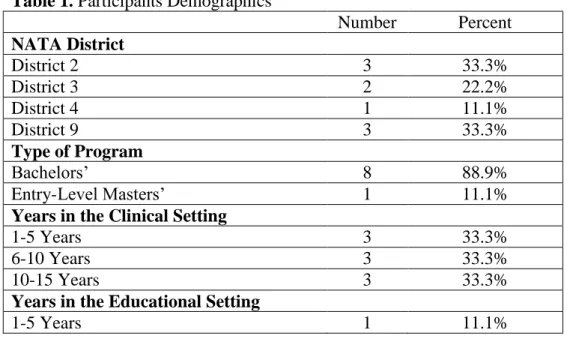
The most common credential participants marked was ‘ATC’ (100%), followed by ‘PhD in Other’ (44.4%). Some participants selected multiple credentials. The third most common credential was ‘EdD’ (n=2). One participant indicated they held credentials in the following: EMT, MAT (Masters’ in Teaching), and Other (Masters’ degree). Educational training was indicated via four options, with the potential to mark multiple choices. The leading resource used to obtain educational training by the participants was ‘Symposiums’ (88.9%) followed by
‘Workshops’ (77.8%), and ‘Masters’ Courses’ (66.7%) respectively. The least commonly selected educational training was ‘Degree in education’ (55.6%). By the number of responses (n=26), it is evident that instructors are gaining their educational training from not only one source, but multiple opportunities. Participant demographics are below in Table 1.
Table 1. Participants Demographics
Number Percent NATA District District 2 3 33.3% District 3 2 22.2% District 4 1 11.1% District 9 3 33.3% Type of Program Bachelors’ 8 88.9% Entry-Level Masters’ 1 11.1%
Years in the Clinical Setting
1-5 Years 3 33.3%
6-10 Years 3 33.3%
10-15 Years 3 33.3%
Years in the Educational Setting
6-10 Years 5 55.6%
10-15 Years 2 22.2%
Over 20 Years 1 11.1%
Actively Providing Patient Care
Yes 4 44.4%
No 5 55.6%
Position Title
Faculty 8 88.9%
Other 1 11.1%
Year Students are Enrolled in Program
Freshman 1 11.1%
Sophomore 5 55.6%
Junior 2 22.2%
First Year Masters’ Student 1 11.1%
Course Structure
One Lecture Course 2 22.2%
Lecture/Laboratory Split Course 5 55.6%
Separate Lecture and Lab Course Credits 2 22.2%
Instructors Role in the Course
Laboratory Instructor 1 11.1%
Both Lecture and Lab Instructor 7 77.8%
Other 1 11.1%
Years Instructor Taught the Course
1-2 Years 2 22.2%
3-5 Years 1 11.1%
Over 5 Years 6 66.7%
Minutes Spent on Concussion Assessment Tools
50-150 Minutes 3 33.3%
151-450 Minutes 6 66.7%
Qualitative Results
Through the semi-structured questions presented to participants during the interview, four overarching themes with multiple subcategories were agreed upon through triangulation with the research team. Tables 2-7 represent the supporting themes of this study.
Of the nine participants, 4 were males and 5 were females. The male participants in this study were given the following pseudonyms: Harry, Patrick, Chris, and Nick, while the female participants were given the pseudonyms Sarah, Betsy, Heather, Marie, and Cindy. These
pseudonyms were given to protect their identity. Participants were instructed to respond to the questions on the survey honestly and to the best of their knowledge.
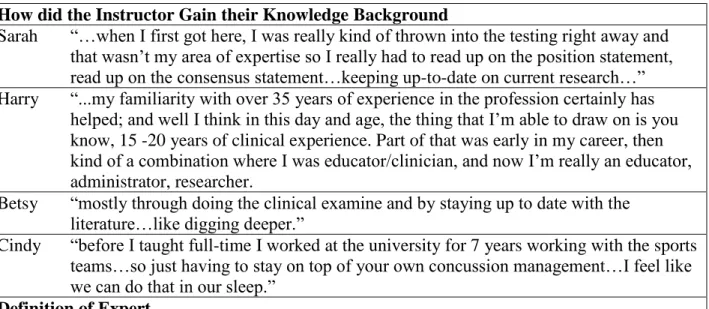
Although all participants came from different educational backgrounds, all had similar responses in how they reached their current level of knowledge and what they thought was necessary to gain additional knowledge. Common responses under the first major theme were that instructors’ foundational knowledge came from both clinical and education/research experiences (See Table 2). Another component of this theme was how participants described what an expert would be considered in their own words. The variations in answers can be presumably linked to each participant’s background experiences, which is supported in the quotes below. As described by the participants, an expert was someone currently engrossed in the literature, research, and/or day-to-day clinical setting performing the tests. It was also evident that preceptors in the athletic training education program were integral parts of student learning. Each faculty member at various institutions utilized the preceptor as an extension of their academic program, although the preceptor’s involvement varied.
Table 2. Characteristics of Instructors Teaching the Concussion Assessment Tools and Education
How did the Instructor Gain their Knowledge Background
Sarah “…when I first got here, I was really kind of thrown into the testing right away and that wasn’t my area of expertise so I really had to read up on the position statement, read up on the consensus statement…keeping up-to-date on current research…” Harry “...my familiarity with over 35 years of experience in the profession certainly has
helped; and well I think in this day and age, the thing that I’m able to draw on is you know, 15 -20 years of clinical experience. Part of that was early in my career, then kind of a combination where I was educator/clinician, and now I’m really an educator, administrator, researcher.
Betsy “mostly through doing the clinical examine and by staying up to date with the literature…like digging deeper.”
Cindy “before I taught full-time I worked at the university for 7 years working with the sports teams…so just having to stay on top of your own concussion management…I feel like we can do that in our sleep.”
Patrick “that’s someone who spends their day-to-day clinical practice in the evaluation, reading; the individual that is competent in multiple platforms, in multiple exam tools; I think is the expert.”
Heather “I would say that an expert is comfortable with the content and is able to think
clinically through multiple facets and measures…and make the best diagnosis, the best care plan without having to go into reference materials; they serve as their own
reference material.”
Nick “I think it’s someone that has a handle on the literature and has also been using it in their clinical practice; it also should probably be someone who has done some of the research on it.
Instructor Perception of Own Knowledge
Patrick “And so, I think for me, in terms of teaching it, if you haven’t implemented it or haven’t spent time with it and utilized it clinically, then it’s much tougher to convey reliance in that and it’s much tougher to explain to your students ‘this is a tool you should utilize,’ if you can’t really justify that.”
Marie “You know be honest, a lot of my understanding of some tests isn’t going to be great because I haven’t gone through training even on all of those…”
Heather “a lot of it is my own comfort level…you have a tendency to fall back on what you’re comfortable with”
Preceptors Role in Teaching of Concussion Assessment Tools
Patrick “Often times we have such a good relationship with our preceptors, they know what…what’s kind of coming down the pipe.”
Marie “We give them a little bit of money but in most cases a preceptor is serving out of a professional desire to serve our profession, but at the end of the day they get paid to do a job; And at the end of the day, they have to do a job as a function of the
administrative support.”
Cindy “research has also shown, because I just finished my doctorate (laughs) that students have to have a positive experience in their program, in order to have academic success; so they really need that hands on experience with their preceptor, they need mentorship with their preceptor; umm I tell my preceptors all the time, I’m not just sucking up to them, our program would not survive without preceptors…really good preceptors; their role is vital. I don’t think our students would get a great experience without them.”
Nick “I think they’re vital because we can say whatever we want, but when they go out in the field that’s the gold standard.”
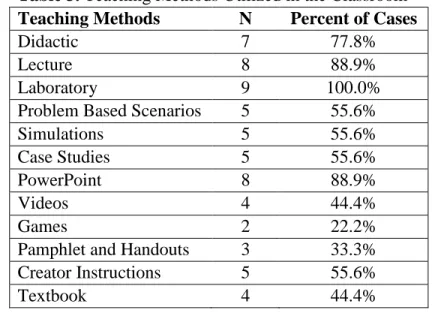
When asked about teaching methods in the classroom setting, participants all selected multiple methods, opting for a combination. All participants (n=9) selected at minimum one method, with 100% of participants incorporating ‘Laboratory’ into their teaching. Participants in this study selected ‘Didactic’ (77.8%) as a common teaching method. Didactic is defined as a way to convey information and to teach to someone involving lecture and textbook instruction
rather than demonstration and laboratory study.26 Students in an athletic training program will be exposed to this type of teaching where the information is coming directly from the instructor as seen by a large percentage of instructors utilizing ‘Lecture’ (88.9%). Those selecting lecture typically utilized ‘PowerPoint’ (88.9%) to convey the information. All methods selected are referenced in Table 3.
Teaching methods identify the different methods used to help students learn the desired content and be able to develop achievable goals in the future. Participants had various reasons for choosing their teaching methods (Table 3 and the thematic evidence in Table 4). Two
contributing themes included presentation style of the instructor and student learning styles. Teaching techniques utilized included: standardization of the instruction of material, utilization of PowerPoint, and instructors experiential learning.
Table 3. Teaching Methods Utilized in the Classroom Teaching Methods N Percent of Cases
Didactic 7 77.8%
Lecture 8 88.9%
Laboratory 9 100.0%
Problem Based Scenarios 5 55.6%
Simulations 5 55.6%
Case Studies 5 55.6%
PowerPoint 8 88.9%
Videos 4 44.4%
Games 2 22.2%
Pamphlet and Handouts 3 33.3%
Creator Instructions 5 55.6%
Textbook 4 44.4%
Table 4. Factors Affecting How Instructors Teach Concussion Assessment Tools
Two Main Contributing Themes included Presentation Style and Student Learning Style
Harry “…whereas if I do a combination of different presentations styles or models, I’m going to be able to connect to another small portion.. and my hope is by doing different types of presentation styles and models and connecting to all 17
at some point, I’m going to make connections.”
Patrick “I’m never going to be the smartest guy in the room; so I realize that a lot of my experiential learning…the lecture works for me because I can fill in those gaps.”
Marie “I kind of feel like this is like the question ‘What’s the gold standard for a concussion assessment?’ and I think that because as an educator I have
different strengths and learners…I think we’re whole-brain learners and I don’t think we should get hung on ‘this is not your learning style’…I think that you go with what your strengths are and the students are and you look at where they are developmentally.”
Nick “I think it’s this idea of let’s flip this and make this student-run”
Nick “I’m very socratic. I’m very let’s talk this through, let’s have a discussion about this; I feel like I’ve gone you know 180 degree turn since I first
started…when I first started in athletic training education, it was ‘you need to know these facts or someone’s going to die, you’re going to kill someone’ so I need to be very autocratic…and now graduate students it’s completely
different, it’s much more socratic, it’s much more discussion…”
Teaching Techniques Utilized were Standardized Instruction, PowerPoint, and Experiential Learning
Patrick “And we hope through reading the position statements, we expose them, and also having that taught from clinical instructors or preceptors and even in the classroom, just gets them more familiar. So, that when they are on their own as practitioners, when they are in graduate school, they’re well-prepared.” Heather “[Teaching] critical thinking…especially when they’re first learning
evaluation have a very linear thought process…So by using the simulations and the case studies and having them actually perform a full evaluation...”
Nick “We’re hoping that it allows them to think critically once they get out there because we’ve used several different methods and we haven’t spoon fed them with a PowerPoint.”
Of the tools taught in the classroom, no one tool was utilized in every participant (Table 5). Balance Error Scoring System (BESS), Standardized Assessment of Concussion (SAC), and Standardized Concussion Assessment Tool 2/3 (SCAT) were utilized by 88.9%. Those who taught Immediate Post-Assessment Concussion Tool (ImPACT) in the classroom (66.7%) also taught the Post-Concussion Symptom Score (PCSS) (66.7%) that is typically associated with the online assessment program and are not taught as separate entities. Participants selected ‘Other’ (66.7%) with increased frequency, as three participants wrote in “VOMS” (Vestibular/Ocular Motor Screening) as one of the assessments they teach in the classroom, one indicated “CNS
Vital Signs,” while another taught “saccades assessment/training.” In the laboratory, 100% of participants taught the SCAT2/3, BESS, and cranial nerve/neurological assessment in their courses.
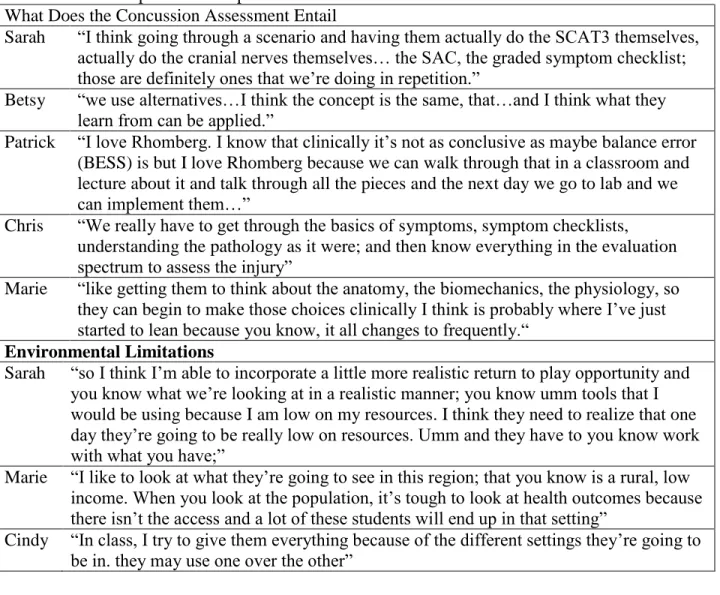
The most common return to play guidelines utilized in the classroom are the NATA Position Statement: Management of Sport Concussion, 2014 and the 4th Consensus Statement on Concussion in Sports, Zurich 2012 (43.8% respectively). One participant selected ‘Other’ for return to play guidelines and indicated that they taught the “institutional guidelines” used at their university. Table 6 addresses how instructors determined what assessment tools were taught in both the classroom and laboratory setting. A third major theme discovered was what concussion assessment tools and evaluation techniques instructors taught to the students. All participants began with the basics of anatomy, biomechanics, and injury evaluation.
Table 5. Assessment Tools Taught in the Classroom and Laboratory N Percent of Cases Assessment Tools Taught in the Classroom
ImPACT 6 66.7% SCAT2/3 8 88.9% SAC 8 88.9% BESS 8 88.9% SOT 1 11.1% GSC 5 55.6% PCSS 6 66.7% Cranial Nerve 7 77.8% Other 6 66.7%
Assessment Tools Taught in the Laboratory
SCAT2/3 9 100.0% SAC 8 88.9% BESS 9 100.0% SOT 1 11.1% GSC 5 55.6% PCSS 6 66.7% Cranial Nerve 9 100.0% Other 4 44.4%
Table 6. The Components Incorporated into a Concussion Assessment What Does the Concussion Assessment Entail
Sarah “I think going through a scenario and having them actually do the SCAT3 themselves, actually do the cranial nerves themselves… the SAC, the graded symptom checklist; those are definitely ones that we’re doing in repetition.”
Betsy “we use alternatives…I think the concept is the same, that…and I think what they learn from can be applied.”
Patrick “I love Rhomberg. I know that clinically it’s not as conclusive as maybe balance error (BESS) is but I love Rhomberg because we can walk through that in a classroom and lecture about it and talk through all the pieces and the next day we go to lab and we can implement them…”
Chris “We really have to get through the basics of symptoms, symptom checklists, understanding the pathology as it were; and then know everything in the evaluation spectrum to assess the injury”
Marie “like getting them to think about the anatomy, the biomechanics, the physiology, so they can begin to make those choices clinically I think is probably where I’ve just started to lean because you know, it all changes to frequently.“
Environmental Limitations
Sarah “so I think I’m able to incorporate a little more realistic return to play opportunity and you know what we’re looking at in a realistic manner; you know umm tools that I would be using because I am low on my resources. I think they need to realize that one day they’re going to be really low on resources. Umm and they have to you know work with what you have;”
Marie “I like to look at what they’re going to see in this region; that you know is a rural, low income. When you look at the population, it’s tough to look at health outcomes because there isn’t the access and a lot of these students will end up in that setting”
Cindy “In class, I try to give them everything because of the different settings they’re going to be in. they may use one over the other”
Barriers affecting instructors when teaching concussion assessment tools vary by institution, but the most common response was time. Time played a major role in what instructors taught in their classroom and influenced how they taught the content to athletic training students. Other factors identified by participants during the interview included (Table 7): lack of enough clinical experiences/practice, lack of enough time, resources or lack of resources available to instructor; and solutions to these barriers to allow for more effective teaching.
Table 7. Barriers and Future Solutions to Teaching Concussion Assessment Tools Lack of Clinical Experience
Sarah “the students are not able to see as much of that process because it’s kind of being taken by someone else that’s doing their testing” [in regard to the CARE study] Betsy “It makes it difficult for students to observe it because it’s not happening in their
normal umm setting. We…we try to encourage them to send a student with the athlete so that they can observe that but it doesn’t always happen” [in regard to the CARE study]
Cindy “So I think that’s it, giving the students more practice with it in class so they feel more comfortable administering it on their own.”
Nick “I think we need to spend a little more time giving the students more time practicing the assessment tools. I don’t know if we do that in the…in the lab portion of the course enough.”
Lack of Enough Time
Betsy I just think you can’t do it all…there’s not enough time to do it all.”
Patrick “time is certainly one; but I also think comfort level [and] familiarity with these things”
Cindy “I would think time. I have to make sure I hit all the body parts in 15 weeks.” Resources Available
Chris “you have to constantly stay on top of the newer content that is there as to avoid being outdated”
Marie “Like access; Like it would be great if I had at least a version of every single one of these tests to teach the students on, but you know if I’m choosing where I’m spending my resources, would it necessarily be there? So I guess if I had all the money in the world, I would do it.”
Nick “the amount of information that’s out there and being able to find the good evidence from the bad evidence; I think it’s being able to filter all of that information” Solutions to Barriers
Patrick “It would be more of a stand-alone course… the head, neck and spine; or at least we would devote you know, 8 weeks, as opposed to four or six to this topic.”
Heather “So having those standardized patients would really be an invaluable part of the education process that we just don’t have the means for right now.”
Marie “standardized patient rooms with recording; our school of health sciences will get to the point where we will train standardized patients [and] then we can simulate but at this point, that’s just not a resource.”
Nick “I like for us to be a little more proactive on how we [give more practice time] in the laboratory setting.”
CHAPTER 4 DISCUSSION
This exploratory study is the first study in athletic training education to delve into the educational practices regarding concussion assessment tools in the classroom. This study supported four major themes: (1) characteristics of instructors teaching the concussion
assessment tools, (2) factors affecting how the instructors teach concussion assessment tools, (3) the components incorporated into a concussion assessment per the instructor, and (4) barriers and future solutions to teaching concussion assessment tools.
Theme 1: Characteristics of the Instructor Teaching the Course on Concussion Assessment Tools and Concussion Education
The first major theme that emerged distinguished differences between the instructors’ foundational knowledge being effected by clinical and educational/research experiences. According to McCaughtry, differences exist between expert and novice teachers, experienced and inexperienced, those teaching in and out of their areas of expertise, and teachers with and without formal education training.27 Within general education, previous experience is heavily relied upon in athletic training professional education, as instructors use examples from their own clinical practice to make connections in the classroom to content specific information.27 Experienced teachers know the characteristics, interests, and abilities of the students which allows them to plan lessons according to experience rather than relying on the textbook.14 Experienced teachers also have a wide range of experiences with teaching strategies that allow for the creation of variations in the lesson, while novice teachers cannot generally gauge where
lessons need to be adjusted, cannot create variations, and rely heavily on the textbook and written materials.14 Harry explained in the interview that he had 35 years of experience with
15-20 years of clinical experience providing his foundational knowledge. Harry’s extensive background in the athletic training clinical and educational setting allows him to better
understand not only himself as an instructor but the content specifically. Cindy agreed with the use of clinical experience to support her background knowledge. She based her teaching on the stories she could draw upon when speaking about certain concussion assessment tools or evaluation steps.
A sub-theme included how an instructor defined an “expert.” Those with more experience in total years in the clinical setting versus a heavy background in the
educational/research setting, tended to have a more clinical definition of an expert when asked during the interview. The participants related their descriptions of an expert to what their backgrounds were grounded in. Those with more experience versus a novice instructor, possess detailed content knowledge, making their knowledge more accurate and allowing them to see the “big picture” of curriculum.27–29 The experiences of an instructor contribute to the development
process and the knowledge integration that takes place over time.30 Instructors take what they
learn year after year to incorporate different teaching techniques and examples based off of their experiences. On the one side, Patrick has a Masters’ in Teaching and 10-15 years of clinical experience. He described an expert as someone with the hands-on knowledge of the assessment tools who has been doing the evaluations for a long time. He stated,
- “that it’s someone who spends their day-to-day clinical practice in the evaluation, reading; the individual that is competent in multiple platforms, in multiple exam tools, I think is the expert.”
Betsy has a PhD in human movement science, with an emphasis in biomechanics and works in an institution who is a participant in the CARE study. Betsy’s current work
environment has strict guidelines to follow and her experience in research, sets her perception of what an expert would be considered. Betsy’s description falls in line with her daily work
procedures. This participant describes an expert as someone who is,
- “…well versed in the strengths and weaknesses of the exam…familiar with the clinometric, its sensitivity and specificity, reliability, and performance over time.”
Another sub-theme was the instructors’ perception of their own knowledge. A teachers’ self-efficacy beliefs contribute to their teaching style, openness to new ideas, and development of new teaching attitudes.31–33 Self-efficacy is defined by Bandura as one’s belief in their ability to succeed.34 An instructor may feel less inclined to change or create additions to lessons when they are comfortable in their process. Beginning instructors are less able to plan and predict when a lesson may need to be altered.14 The inability of a novice instructor to read the students and change lessons forces them to rely heavily on textbooks and written materials which creates discomfort with items where the knowledge level is limited.35 This can be seen in both Marie and Heather’s responses when asked what they believed influenced their teaching. The participants described how they stayed within their comfort level, as the more comfortable they were with items, the more confidence they had in teaching the items.
- “You know be honest, a lot of my understanding of some tests isn’t going to be great because I haven’t gone through training even on all of those…” (Marie)
- “a lot of it is my own comfort level…you have a tendency to fall back on what you’re comfortable with” (Heather)
The last sub-theme within characteristics of the instructor, was how the preceptor plays a vital role in the clinical education of athletic training students. Burke et al. and Boggild et al.9,17described the presence of incomplete understanding of concussion management in medical
students and medical education curriculum. They suggested that this trend is worrisome as these individuals must be sought out for clearance to make return to play decisions.9,17 As previously
mentioned, education of concussion assessment has not been evaluated and therefore little is known. According to the Competencies set forth for athletic training education, programs are encouraged to implement innovative, student-centered teaching and learning methods to connect the classroom, laboratory and clinical setting to provide the highest quality education.10 Some educators are utilizing their preceptors when making this connection. Cindy explained during the interview how significant it was to have good preceptors working as an extension of the
academic program.
- “I tell my preceptors all the time, I’m not just sucking up to them, our program would not survive without preceptors…really good preceptors; their role is vital. I don’t think our students would get a great experience without them.”
The Standards for the Accreditation of Professional Athletic Training Programs (Standards) and CAATE Competencies: 5th Edition, set guidelines for educators to follow in
terms of content to be taught, but does not set standards for the educators themselves.10,36 Little focus in the curriculum of athletic training education is placed on the educational
teaching/learning philosophies.20 As seen in the first theme, previous experience and foundational knowledge plays a key role in determining the characteristics of an instructor teaching concussion assessment tools. Sub-themes within the first theme include: how these participants described what an “expert” was considered in their own words; instructors’
perception of their own knowledge; and what the preceptors’ role is in relation to athletic
training study education. Descriptions of the term “expert” varied based on participants’ previous experience with the clinical versus research setting. Instructors’ perception of their own
knowledge affected their comfort level with teaching different assessment tools other than the ones they found greater experience with. Lastly, preceptors played a vital role in educating athletic training students and functioned as an extension of the academic instructor but also placed emphasis on their own separate experiences.
Theme 2: Factors Affecting How the Instructors Teach Concussion Assessment Tools and Concussion Education
The second major theme of this study evolved into participants describing various factors that affect their presentation of content. Specific presentation styles and student learning styles were the most common contributing factors. According to Graham’s study on novice versus experienced physical education teachers, experienced teachers tended to spend more time developing tasks based on their observations of the students’ needs.14 Experienced teachers predict concepts and skills that students will have difficulty understanding, foresee common misconceptions, predict motivational concerns, understand students prior knowledge and skill level, are better at organizing lessons, and rely less on the course materials.15,27 Livingston and Borko,37 found that experts taught in ways similar to improvisational acting; extensive behind-the-scenes prepping connected content knowledge and curriculum, knowledge about students, and knowledge about how to teach within a classroom to achieve an adept, interactive, and fluid performance.30 Participants overwhelming indicated that they utilize the laboratory (100%) and didactic (77.8%) methods when teaching concussion assessment tool content. These methods are
used as the basis of information delivery in the athletic training course. Harry described how his presentation style of concussion content changes depending on the student learning styles in his classroom as he is trying to make connections with each student at some point during the lesson.
A sub-theme that emerged included commonly utilized teaching techniques such as: standardized instruction of material, PowerPoint, and experiential learning. Borko and
Livingston16 believed that experienced instructors relied on a rich bank of activities that had been tested over the years with many classes. Experienced instructors “perform” teaching in a way that focuses on classroom interactions and is highly responsive to student performance interactions and the discussions that occur from them.30This can be related to the teaching techniques employed by the study participants, those with and without extensive experience as seen by the responses; participants relied on lecture and PowerPoint (88.9% respectively) to present their content to students. Simulations, case studies, and problem-based scenarios (55.6% respectively) were utilized by participants when class timing and student level of understanding permitted. The experiential learning described by participants represents the hands-on, clinical experience instructors utilize in teaching athletic training students.38 Sarah and Heather explained how they utilize all three of these sub-theme components.
- “Since we are a part of the DOD CARE [study], it’s very structured. We are all using the same tests that are being used in our athletic training room so that they’re seeing the test that they’re going to use…that you know are at the highest level, that are up-to-date” (Sarah) - “So I use the PowerPoints as a frame for my lecture, but if at any point in the PowerPoint
sparks my memory of something, from my years of clinical practice, or as a student then we go off on a story tangent” (Heather)
Theme two identified factors affecting how concussion assessment tools are taught to athletic training students. The two contributing factors included instructor presentation styles and
students learning styles. Berliner39 stated that the development of in-depth representations of
subject content is a strong determinant for distinguishing between experts and non-experts.30
Sub-themes included: standardized material, utilization of PowerPoint, and experiential learning.
Theme 3: The Components Incorporated into a Concussion Assessment per the Instructor The third emerging theme described what instructors felt were important components of a concussion assessment as well as tools and evaluation paradigm. According to the literature, competent instructors make various decisions based on predictions of probable effects of the actions on students accomplishing the task requested of them.14,35 The planning by instructors are anticipatory and based largely on beliefs acquired from previous experience.35 Experienced instructors do not plan in step-by-step details but rather systematic thoughts about outcomes serve more as a rationalization for teaching.36 (p296)
The concussion evaluation tools taught in the classroom are based on multiple factors as described by previous themes. Under this theme, participants described components they utilized while also describing what encouraged them to choose these items. In the classroom, participants utilized concussion assessment tools that were easily administered and hands-on, such as
SCAT2/3, SAC, and BESS (88.9% respectively). Marie described how she would start her students with the anatomy, biomechanics, and physiology so that they could begin making clinical choices based on the foundation. She stated how it (concussion) is changing frequently so she wants them to understand the basics first, in case the concussion assessment tools change.
Under the third theme, a sub-theme is evident in how environmental limitations can negatively affect the resources available to instructors. Individual student learning is dependent upon dozens of variables, including but not limited to the classroom environment, interest in
topic, and learning style.18 Environment can also refer to geographical location, policies involved
at the respective institution, and the status of program finances.
- “I think they need to realize that one day they’re going to be really low on resources and they have to you know work with what you have;” (Sarah)
- “I like to look at what they’re going to see in this region; that you know is a rural, low income. When you look at the population, it’s tough to look at health outcomes because there isn’t the access and a lot of these students will end up in that setting” (Marie)
Theme three describes what components are included in the concussion assessment. This is important because although instructors are incorporating many common concussion
assessment tools (BESS, SAC, BESS, etc.) they are also placing emphasis on the foundation of a clinical exam. The importance is placed on the basics, as the concussion topic is constantly changing. Unfortunately, it was commonly discussed that environmental limitations and geographical locations limit access to resources and what is taught by instructors.
Theme 4: Barriers and Future Solutions to Teaching Concussion Assessment Tools and Concussion Education
The last major theme analyzed in this study touches upon the barriers instructors face, such as time. Time is one of the major barriers to effective teaching.40,41 Time is the number one common barrier described by participants of not utilizing a method, teaching an assessment tool, or not going further in-depth with the content.
- “I just think you can’t do it all…there’s not enough time to do it all.” (Betsy) Other contributing factors include lack of resources and lack of clinical experience/practice for athletic training students.
- “Like access; Like it would be great if I had at least a version of every single one of these tests to teach the students on, but you know if I’m choosing where I’m spending my resources,
would it necessarily be there? So I guess if I had all the money in the world, I would do it.” (Marie)
As stated in a study by DaRosa40 on barriers to teaching in the medical school setting, faculty members tend not to focus their teaching on how the clinical practice can be applied to various settings, which reduces the students ability to transfer learning from setting/patient population to another. This can be seen in Betsy’s response to how students at her institution may be lacking that clinical, hands-on experience.
- “the students are not able to see as much of that process because it’s kind of being taken by someone else that’s doing their testing” [inregard to the CARE study]”
Conclusion
This study helped explain the educational practices of instructors teaching the course with concussion assessment tools at CAATE-accredited institutions. Four overarching themes
included: (1) characteristics of instructors teaching the concussion assessment tools, (2) factors affecting how the instructors teach concussion assessment tools, (3) the components incorporated into a concussion assessment per the instructor, and (4) barriers and future solutions to teaching concussion assessment tools. The findings of this study provided an initial understanding that athletic training educators come from a variety of educational, clinical, and research
backgrounds; that instructors’ foundational knowledge effects the teaching techniques they utilize; and which teaching methods they employ in the classroom.
No glaring differences were seen between the three separate sport divisions (DI-III), although assumptions can be made about those institutions who are participants in the CARE study. The participants with strict research backgrounds and who participated in the CARE study have a stronger view and opinion on the standardization of concussion assessment material, the reliance on written material, and greater access to resources. Although these findings cannot be
generalized to all athletic training educators across CAATE-accredited institutions, this study gives a foundation for future research to build upon.
Future research should continue to focus on novice-expert differences in instructors, specifically in athletic training educators. Emphasis should also be placed on investigating athletic trainers’ knowledge of educational theory and teaching effectiveness. Research on athletic training educators should also include athletic training educational theories and models with focus on the relationship between Content Knowledge, Curricular Knowledge, and Content Pedagogical Knowledge.
APPENDIX A
Research Questions
The following research questions were asked prior to conducting the study: 1. Who is teaching the course on concussion assessment tools?
2. What concussion assessment tool resources are being utilized? 3. What teaching techniques are being employed in the classroom? 4. How are each concussion assessment tool being taught?
Inclusion Criteria
▪ Individuals teaching at a CAATE accredited institution
▪ Instructor teaching content regarding concussion assessment tools
▪ Instructors who previously taught the concussion assessment tool no later than the
2014-2015 academic year
▪ Completion of the entire online survey, followed by an online or phone interview
Exclusion Criteria
▪ Instructors at non-CAATE accredited institutions
▪ Course does not include concussion assessment tools module
▪ Concussion assessment tools not taught in connection with concussion assessment
module/courses Limitations
The limitations for this study include:
▪ Reporting bias that could cause participant to with-hold information that they believe will
shed poorly on their program
▪ Only one fully-transitioned master’s program was used
Delimitations
The delimitations of this study include:
▪ This study limited to District 2-4 and 9 within NATA
▪ The study was limited to programs currently not transitioning to entry-level masters
Assumptions
The following are assumptions made by researchers:
▪ Participants answered each survey question honestly
▪ Participants answered each interview question to the best of their ability, being open
about their thoughts and feelings regarding their teaching Definitions
The following operational definitions will be used in this paper:
▪ Concussion:
- Concussion is a brain injury and is defined as a complex pathophysiological process
affecting the brain, induced by biomechanical forces.”3
▪ Self-efficacy:
- a person’s belief or perception in their ability to plan and accomplish specific tasks
or behaviors; characterized by one’s work performance.42
- Instructor self-efficacy can be further defined as the ability to successfully teach and
challenge students in the topic at hand.43
- Also considered an educational theory or instructional model20
▪ Teaching Method:
- Defined as ways to convey content and knowledge to students
- Examples utilized in this study include: didactic, lecture, laboratory, problem-based
scenarios, simulations, case studies, PowerPoint, videos, games, pamphlets and handouts, creator instructions, and textbooks