An Architecture of Decision Support System for
Visual-Auditory-Kinesthetic (VAK) Learning Styles Detection Through Behavioral
Modelling
Fatihah Mohd1, Wan Fatin Fatihah Wan Yahya2, Suryani Ismail3, Masita Abdul Jalil4, and Noor Maizura Mohamad Noor5
1,2,3,4,5Universiti Malaysia Terengganu, Malaysia
[email protected], [email protected]2, [email protected]3, [email protected]4, [email protected]3
*Corresponding author: [email protected]
Received: 15 September 2018,Accepted: 16 January 2019, Published: 13 July 2019
Abstract—Learning style (LS) is a description of the attitudes and behaviors which determine an individual’s preferred way of learning. Since each student has different LS, it is important for the teacher to recognize the differences in LS. Thus, an appropriate technique to detect students' LS, improve the motivation and academic achievement are required. The common approach using questionnaires to identify LS is less accurate due to complete the questionnaire is a tedious task for students and tend to choose answers randomly without understanding the questions. Emotions such as anger, sadness, and happiness resulting the different questionnaire answers. Due to the approach constrains, this study has focused on automated approaches that identify student LS from student behavior in the learning process. Implementation of decision support system (DSS) as automated application systems is needed to help teachers make decisions in determining students' LS. Thus, the objective of this study is to propose the architecture of LS detection automatically using decision support system. The development of the architecture is applying the behavioral modelling, that are contained student’s behavior parameters for visual-auditory-kinesthetic (VAK) model. Evaluation of the architecture is tested with the precision DSS engine. The accuracy of the rule technique achieves significant 80% accuracy. This study aims to help teachers to identify the ability of the student through the learning style (LS) in order to create effectiveness of learning and improving student’s achievement indirectly.
Keywords— decision support system, reasoning engines,
learning style detection, user behavior, visual-auditory-kinesthetic (VAK) model
I. INTRODUCTION
The relevant learning style (LS) in education has been playing an essential role in improving student’s achievement. Thus, to create effectiveness of learning, detecting of LS for each student is practiced, either collaborative student modelling or automatic student modelling [1]. Collaborative methods are mainly based on a questionnaire while the automated is determined by behavioral patterns during online learning. Collaborative are said to be inaccurate because users are not sincere in answering the questionnaire. Emotions such as anger, sadness, disappointment and joy give results of questionnaires of different values and will influence the validity of the decision [2], [1]. Unlike the collaborative, automatic methods are considered better in terms of data accuracy as they are based on actual student behavior
[1], [3]. However, the automatic has its own disadvantages. It takes a lot of time in acquiring the behavioral pattern of students participating in online learning and the habitual behavior patterns obtained from the data are not strong enough [2]. The automated learning style detection (LSD) is believed effectively because this method is capable to identify the LS more accurately [4], [3].
In order to make LSD more accurate and easier to use, the computer applications are introduced into the LSD method; one of the valuable application is a decision support system (DSS). DSS is defined as an interactive computer system using models and algorithms such as decision analysis, mathematical programming, simulation and logical models for problem solving and decision making [5]. This system works also to help individuals who are responsible in resolving a problem and making choices based on predetermined criteria [6], [7], [8]. In education, DSS applies to improved student’s assessment and as an interactive tool for decision-makers collect useful information from raw data, documents, knowledge to identify and solve next generation decisions [9], [10]. In a study by [11] an automatic application has been developed to support the teacher in LSD of disabilities children.
Thus, the aim of this study is to propose the architecture of LSD automatically using DSS. This study investigates the student’s behavior parameters for visual-auditory-kinesthetic (VAK) model. The detailed process of developing the DSS architecture is also presented. The paper is organized as follows. Section 2 presents the related works of the study. Section 3 provides the design of architecture for a DSS. The evaluation of DSS architecture is described in section 4. Finally, conclusions are presented in Section 5.
II. RELATED WORKS
This section heading and discussion of decision support system, behavioral modeling, and learning
style detection (LSD) model.
2.1. Decision Support System
Decision support system (DSS) is as an interactive tool for decision-makers collect useful information from raw data, documents, knowledge to identify and solve next-generation decisions [9], [10]. The architecture of this system has five major components, namely the database, model base, user interface, knowledge base and reasoning engine (RE) [8]. The database contains a data management system (DMS) that stores and maintains the information. The DMS works to support data modeling through the operation of storage, access and modification of overlapping and interconnected data.
Basically, the model base acts to manipulate and formulate data. It consists of various sets of computerized decision models such as algebra model, decision analysis, finance, forecasting, simulation and optimization implemented for the purpose of solution from the evaluation process [5]. The knowledge base contains rules and data collected and represented in the form of IF-THEN rules. The ability to translate the data and information in the form of essential knowledge to improve the effectiveness of decision making through the reasoning engine. It combines rules from the KB with internal data in databases to generate new knowledge. This new knowledge will be used by users to help make decisions [12]. The user interface controls the acceptance of input from and output displays to decision makers. It plays an important role in supporting direct communication between decision makers and software applications. DSS is designed as a specialized computerized information system that supports business and organization-al decision-making activities. Many studies reported, DSS has been applied in various fields to support decision-making, such as in education [10], [13], [14], [15], crime analysis [16] and economics [17]. In this system, pattern mapping from user behavior is applied in supporting decision making automatically [18].
2.2. Behavioral Modeling
Analyzing user behavior is important to help decision makers in predicting future decisions more accurate. [19] listed a number of user behaviors that assist in decision making, such as time spent completing activity, number of occurrences of activity, and number of completed activities. Even in online applications, the number or page frequencies visited, and the mouse click through the interface is also stored as a user behavior pat-tern. [20] also listed some examples of user behavior used in decision-making for recommendation systems, such as a click or purchase
behavior, consumer rate item value, criticism, value setting to item attributes, and user specific user requirements. All of these behaviors are considered and analyzed to produce recommendations according to user needs. This will help the user make better and more accurate choices. [21] has conducted a study on the analysis of past customer behavior in order to predict future customer behavior. This research proposes a pattern search and predicts changes in customer behavior. It can help mobile phone service providers to predict the type of service or brand selected. In addition, other researchers focus on modeling behavior in education, such as models to automatically identify LS through student behavior [22], [23], [24], [25], [26].
In the development of behavior model, various approaches are applied such as decision tree, neural network, fuzzy set, Bayesian network and rule-based techniques [1], [27], [28], [26]. Rule-base technique (RBT) is easy to understand and able to form a knowledge from the corresponding number of indicators through user behavior without involving user set data [1], [29], [2], [30], [31] conducted a study on the expert knowledge representation approach and rule-based on the construction of a proprietary engine so that predictions can be made in line with the expert knowledge of building user models. The study presented that, user models based on expert knowledge representation and rules are easy to use as the basis and technique of tracking LS based on user behavior. In addition, [32] conducted re-search by producing electronic learning prototypes capable of making suggestions and learning activities. Each programming language based on rules, contains a syntactic representation of the rule’s structure IF-THEN. The structure of rule is stored in the knowledge base [29]. Additionally, most of the expert systems applied RBT in forming a knowledge representation scheme. This scheme uses production rule to represent the relationship of condition-action [31] RBT contains two parts: IF that is a condition and THAT is action: IF <condition>, THEN <action>.
2.3. Learning Style Detection
According to [33], each student has their own needs and abilities such as level of knowledge, cognitive abilities, motivation, favoritism, different attitudes and different LS. This difference makes the students have different ways of acquiring knowledge. Indirectly, the relationship between LS in the learning environment facilitates the learning process and makes the students more competent in acquiring knowledge [1]. Studies in cognitive and psychological sciences, indicate that each student has different capabilities that determine
the way and tendencies they receive and process information [34], [1], [35]. In the learning environment, this tendency is known as a learning style, which is the way an individual begins to concentrate, process and maintain new information and difficult information [33].
The appropriate teaching methods of student LS will enable students to accept and understand the concepts taught, and contribute to better achievement indirectly [36], [37], [38]. [26] reported that by identifying learning style, making each of student know of their strengths and weaknesses in learning and they have the option to personalize their learning environment. [39] defined the LS as an explanation of the attitudes and behaviors of learning practices by individuals. There are more than 71 types of LS models identified from previous studies, such as Kolb, Dun and Dun's learning models, Felder Silvermaann and Visual, Auditory and Kinesthetic (VAK) [34], [40], [41], [42], [43], [35].
VAK model, is commonly used as a theory foundation in learning studies [44], [45]. Furthermore, VAK model is implemented in learning environment because of its applicability and compatibility to the principles of interactive learning systems design, straightforward, and its results are easily understood. This model explains that each learning process will be influenced by three types of LS; visual, auditory and kinesthetic. Some students focused on one style and other students are able to combine all types of VAK models in their learning process. Based on VAK model, a student who learns visually learn best by seeing and think in pictures. For this student, pictures, flow diagrams and videos are the best learning material. Auditory student learns best by hearing and audible lectures are the best learning material. While, kinesthetic student is who learns best by feeling and doing. Example of the learning material for this student such as computer games, interactive animations and practical hands-on experiences [46], [43], [35].
III. VAKDECISION SUPPORT SYSTEM ARCHITECTURE
In this study, the decision support system architecture for VAK learning style detection based on the student’s behavior is presented. The main reason of selecting the VAK learning style for this study because VAK is suitable for structural characteristics in creating the content of the system. It can be applied to learning approaches that are represented using media for all learning modalities. For example, visually, there are presented in words and images. For auditory, there are spoken words and sound explanation. Similarly, in kinesthetic, interactive animation is presented. Thus, the different contents or materials are prepared
according to the three styles of VAK that are offered to the student.
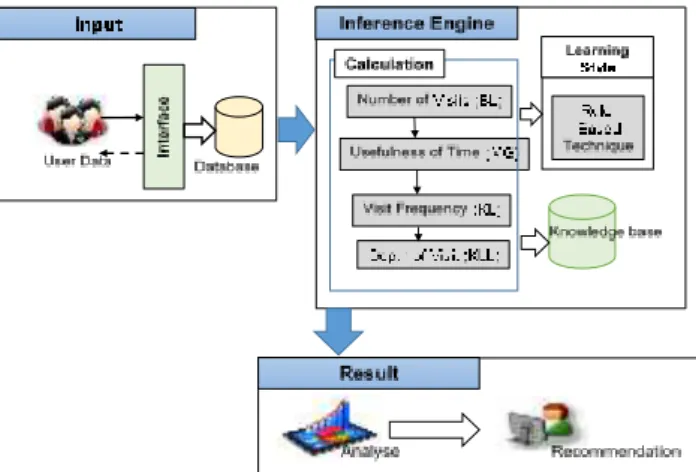
This architecture comprises three parts included system input, DSS inference engine and result evaluation (see Fig. 1). The system input includes a user interface and database. The user interface is a component that manages the interaction between decision makers, students, and systems. Interface design is important to determine the usability of a system. There are two user interface designs that function to control the flow of information, which is interfaced style learning modules and decision support module interfaces.
Fig. 1 Learning style decision support system architecture The learning style interface connects LS tracking functions based on student behavior using a RBT. While the DSS interface is a function that supports decision makers during the process of LS analysis. The database serves as a storage for keeping student information and student behavioral information. The detection process begins once a student logs into the system. User behaviors are obtained based on number of visits (BL), usefulness of time or time used (MG), visit frequency (KL) and depth of path visit (KLL) on each learning object are recorded and stored in the DB. The DSS inference engine works to generate a LS recommendation according to student behaviors. The information about student behaviors obtained from the process is stored in the LS knowledge base.
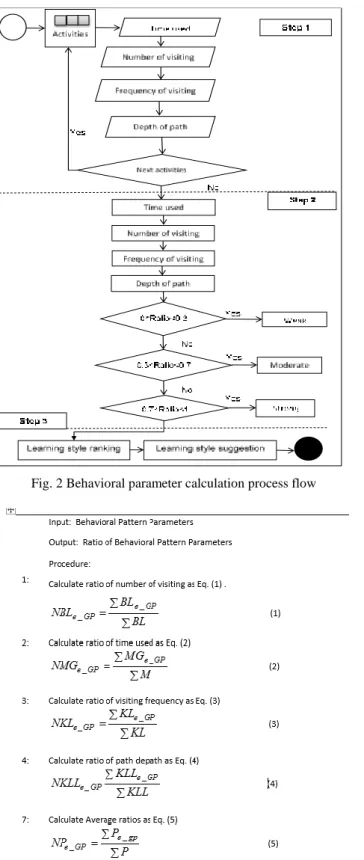
Meanwhile, the result evaluation part is composed of LS data and analysis. The overall flow of determining LS based on behavior is divided into three steps (see Fig. 2). The first step is to collect a user behavioral parameters information from the activities on learning object usage to the database. The second step classifies a LS element. This step contains two main processes. Firstly, the calculation of LS behavior parameters (refer to Fig. 3) and then, determines the LS element using the RBT. The input for the LS element determination is obtained from the average ration (N)
of all parameters from the previous process. Rule production of LS element determination is based on the average ratio of the LS element which is constructed from the previous studies: 0 ≤ N < 0.3 is a weak, 0.3 ≤ N < 0.7 is a moderate, and 0.7 ≤ N ≤ 1.0 is a strong [30], [3]. The third step is the LS recommendation which is produced by the ranking of the order of average ratios.
Fig. 2 Behavioral parameter calculation process flow
Fig. 3 Algorithm 1: calculation of behavioral pattern parameters ratio.
IV. RESULTS AND DISCUSSION
A prototype DSS to the VAK learning style detection, called VAKLeS is implemented in order to evaluate the propose architecture. The VAKLeS is a combination of NeatBeans, Java and MySQL to present the suitable application, including the activity, format and media type. It was developed with two modules; LS module (student module) and decision support module (teacher module). The teacher is acting as a decision maker, while the student is a system user that is evaluated their LS based on user behavior. Both modules interact together to execute the LS prediction. The precision test on the LS generated by the DSS has been done on 20 pre-school students and teachers. This testing is conducted to evaluate the impact on LSD achievement. Under teacher’s supervision, the students are asked and guided from start until end of learning activities by use the VAKLeS. Teachers are also required to fill out a list of visual, auditory and kinesthetic LS questionnaires for comparing the results of the type of learning predicted by the system. The evaluation of DSS engines in LSD is based on the precision presented by the previous researchers as Eq. (6) [47], [2],[31].
Precision
=
∑ni=1Sim(GPr, GPs)n
x
100 (6)where ∑ni=1Sim(GPr,GPs) is a total of similarity
prediction and LSs questionnaire, and n is a total of respondent (R).
In Eq. (6), functional Sim is used determine the differences between VAKLeS (r) and a questionnaire (s). The value of Sim is 1 if the values obtained with the r and s are equal, 0 if they are opposite, and 0.5 if one is neutral and the other an extreme value; and n is the number of respondents (student) studied. Based on the functional Sim, Table 1 is developed.
Based on Table 1, the total similarity prediction with value 1 is calculated. Using the formula as Eq. (6), this study presented the percentages of LS precision that predicted by VAKLeS. The precision is generated as follows:
Precision=(1620).100 = 80%
The finding shows that, 80% accuracy of rule representation in predicting student’s LS is achieved by using the precision formulas as Eq. (6). Referred to the study conducted by Garcia et al. (2007), the percentages over than 65% is qualified to accept by using the simple RBT. Therefore, the finding of precision generated by the proposed DSS engine is able to assign a student’s LS accurately. This study
also identified that, the VAKLeS is mostly accepted used as the automated system in VAK learning style detection based on the student’s behavior and significantly improves teacher decision-making process in LSD. Generally, the results obtained have supported the study objective in developing DSS architecture of student LSD and directly help teachers make a decision automatically and effectively.
TABLE1
COMPARISON ANALYSIS BETWEEN VAKLES AND QUESTIONNAIRE
FINDING
V. CONCLUSION
DSS is used in education in making wise and effective’s decision. This application helps teachers to identify the ability of the student through the learning style (LS). Thus, in this study, DSS for LSD based on the student behavior is discussed. Four parameters of student behavior are identified: the number of visits, time used, visit frequency and depth of path visit on each learning object. Visual, auditory and kinesthetic (VAK) is chosen as a LS model to detect LS pre-school student. The proposed DSS architecture contains with four components: user interface, decision support engine, knowledge base and database are present-ed. The flow of DSS architecture is divided into three steps. Firstly, is a collecting a user behavioral parameter from the activities on learning object usage to the DSS database. Then, classifies a LS element which comprises two processes; calculates LS behavior parameters and determines the LS element using the RBT. The last step is the LS recommendation which is produced by the ranking of the order of
parameters user behavior average ratios. The evaluation among 20 pre-school students shows that, 80% precision of rule representation in predicting student LS is achieved. For the future work, a generic DSS can be developed in other areas by making changes to the structure of the rules according to the other relevant domain.
ACKNOWLEDGMENT
This study has been supported in part of the Fundamental Research Grant Scheme (FRGS) with vot number 59504, under the Malaysia Ministry of Higher
Education (MOHE) and Universiti Malaysia
Terengganu (UMT). The authors would like to acknowledge all contributors who have provided their assistance in the completion of the study and the anonymous reviewers of this paper.
REFERENCES
[1] S. Graf, and T. C. Liu, “Supporting teachers in identifying students' learning styles in learning management systems: An automatic student modelling approach,” Journal of Educational Technology & Society, vol. 12, no. 4, pp. 3-14, 2009, Retrieved from http://citeseerx.ist.psu.edu/viewdoc/
summary?doi=10.1.1.597.6419
[2] N. Ahmad, Z. Tasir, J. Kasim, and H. Sahat, “Automatic detection of learning styles in learning management systems by using literature-based method,” Procedia-Social and Behavioral Sciences, vol. 103, pp. 181-189. 2013, Retrieved from https://www.sciencedirect.com/science/article/pii/ S1877042813037695
[3] P. Q. Dung, and A. M. Florea, “A method for detection of learning styles in learning management systems,” UPB Scientific Bulletin, Series C: Electrical Engineering, vol. 75, no. 4, pp. 3-12, 2013, [Online]:
Retrieved from
https://www.scientificbulletin.upb.ro/rev_docs_arhiva/ fulla28_972381.pdf
[4] H. Ateia, and T. Hamtini, “Designing and implementing of dynamic technique for detecting learning style using literature-based approach,” International Journal of Database Theory and Application, vol. 9, no. 6), pp. 9-20, 2016, [Online]:
Retrieved from
http://www.sersc.org/journals/IJDTA/vol9_no6/2.pdf [5] D. J. Power, and R. Sharda, R. Springer Handbook of
Automation. Decision Support Systems, 2009, pp. 1539-1548.
[6] H. R. Nemati, D. Steiger, L. S. Iyer, and R. T. Herschel, “Knowledge warehouse: An architectural integration of knowledge management, decision support, artificial intelligence and data warehousing,” Decision Support Systems, vol. 33, no. 2, pp. 143-161, 2002, [Online]: doi: 10.1016/S0167-9236(01)00141-5
[7] V. L. Sauter, “Competitive intelligence systems: qualitative DSS for strategic decision making,” ACM
R VAKLeS Questionnaire ∑ 𝑆𝑖𝑚 1 Visual Visual 1 2 Kinesthetic Visual 0 3 Auditory Visual 0 4 Auditory Auditory 1 5 Visual Visual 1 6 Visual Visual 1 7 Kinesthetic Kinesthetic 1 8 Kinesthetic Kinesthetic 1 9 Kinesthetic Auditory 0 10 Auditory Auditory 1 11 Auditory Auditory 1 12 Auditory Auditory 1 13 Kinesthetic Kinesthetic 14 Kinesthetic Kinesthetic 1 15 Kinesthetic Visual 0 16 Visual Visual 1 17 Visual Visual 1 18 Visual Visual 1 19 Visual Auditory 1 20 Kinesthetic Kinesthetic 1
SIGMIS Database: the DATABASE for Advances in Information Systems, vol.36, no.2, pp. 43-57, 2005, [Online]: doi:10.1145/1066149.1066154
[8] E. Turban, J. E. Aronson, T. P. Liang, and R. Sharda, Decision Support and Business Intelligence System. Upper Saddle River, New Jersey: Pearson Prentice Hall, 2007.
[9] S. Negash, “Business intelligence,” Communications of the Association for Information Systems,” vol. 13, pp. 177-195, 2004, [Online]: Retrieved from https://aisel.aisnet.org/cais/vol13/iss1/15/
[10]A. A. Kardan, and H. Sadeghi, “A decision support system for course offering in online higher education institutes,” International Journal of Computational Intelligence Systems, vol. 6, no. 5, pp. 928-942, 2013.
[Online]: Retrieved from
https://www.tandfonline.com/doi/abs/10.1080/187568 91.2013.808428
[11]W. Yahya, and N. Noor, “Decision support system for learning disabilities children in detecting visual-auditory-kinesthetic learning style,” In The 7th International Conference on Information Technology, pp. 667-671, 2015, [Online]: Retrieved from http://icit.zuj.edu.jo/icit15/DOI/
Software_Engineering/ 0115.pdf
[12]F. Mohd, M. A. Jalil, N. M. M. Noor, and Z. A. Bakar, “Improving the accuracy in classification using the bayesian relevance feedback (BRF) model,” in Fourth International Conference on Information Retrieval and Knowledge Management (CAMP), pp. 1-5, 2018,
Retrieved from
https://ieeexplore.ieee.org/abstract/document/8464783. [13]K. D. Zahra, “New approach to the design of decision support system to improve e-learning environments,” Proceeding of the 4th International Conference on e-Learning and e-Teaching (ICELET 2013), pp. 26-29, 2013, [Online]: doi: 10.1109/ICELET.2013.6681640. [14]V. Gorgan, “Requirement analysis for a higher
education decision support system. Evidence from a Romanian University,” Procedia-Social and Behavioral Sciences, vol. 197, pp. 450-455, 2015, [Online]: doi: 10.1016/j.sbspro.2015.07.165
[15]B. G. Al-Bastami, and S. S. A. Naser, “Design and Development of an Intelligent Tutoring System for C# Language,” 2017, [Online]: Retrieved from https://philpapers.org/archive/ALBDAD-4.pdf
[16]A. Jalil, C. P. Ling, N. M. M. Noor, and F. Mohd, “Knowledge Representation Model for Crime Analysis,” Procedia Computer Science, vol. 116, pp.
484-491, 2017, Retrieved from
https://www.sciencedirect.com/science/article/pii/S187 7050917321178
[17]J. A. Grover, “Literature Review of Bayes’ Theorem and Bayesian Belief Networks (BBN),” in Strategic Economic Decision-Making, pp. 11-27, New York, NY: Springer, 2013, doi: 10.1007/978-1-4614-6040-4_2 [18]S. Khademolqorani, A. Z. Hamadani, “An adjusted
decision support system through data mining and multiple criteria decision making,” Procedia-Social and Behavioral Sciences, vol. 73, pp. 388-395. 2013.
[Online]: Retrieved from
https://www.sciencedirect.com/science/article/pii/S187 7042813003595
[19]F. A. Khan, E. R. Weippl, and A. M. Tjoa, “Integrated approach for the detection of learning styles and affective states,” in G. Siemens & C. Fulford (Eds.), Proceedings of ED-MEDIA 2009-World Conference on Educational Multimedia, Hypermedia & Telecommunications, pp. 753-761, 2009, Retrieved from https://www.learntechlib.org/primary/p/31584/. [20]B. P. Knijnenburg, M. C. Willemsen, Z. Gantner, H.
Soncu and C. Newell, “Explaining the user experience of recommender systems,” User Modeling and User-Adapted Interaction, vol. 22, no. 4-5, pp. 441-504, 2012, [Online]: doi:10.1007/s11257-011-9118-4 [21]S. Banerjee, N. El-Bendary, A. E. Hassanien, and M. F.
Tolba, “Decision support system for customer churn reduction approach,” in Hybrid Intelligent Systems (HIS), 2013 13th International Conference on, pp.
228-233, 2013, Retrieved from
https://ieeexplore.ieee.org/abstract/document/6920487/ [22]S. V. Kolekar, R. M. Pai, and M. M. Pai, “Modified literature based approach to identify learning styles in adaptive E-learning,” in K. M. Kumar, D. Mohapatra, A. Konar, A. Chakraborty (Eds.), Advanced Computing, Networking and Informatics: Vol. 1. Smart Innovation, Systems and Technologies, vol. 27, pp. 555-564, 2014, Cham: Springer. doi: 10.1007/978-3-319-07353-8_64
[23]M. Abdullah, A. Alqahtani, J. Aljabri, R. Altowirgi, and R. Fallatah, “Learning style classification based on student's behavior in model learning management system,” Transactions on Machine Learning and Artificial Intelligence, vol. 3, no. 1, pp. 28-40, 2015. Retrieved from http://scholarpublishing.org/index.php/ TMLAI/article/view/868/478
[24]J. Bernard, T. W. Chang, E. Popescu, and S. Graf, “Improving learning style identification by considering different weights of behavior patterns using particle swarm optimization,” in State-of-the-Art and Future Directions of Smart Learning, pp. 39-49, Springer, Singapore. 2016, Retrieved from https://link.springer.com/chapter/10.1007/978-981-287-868-7_5
[25]H. M. Truong, “Integrating learning styles and adaptive e-learning system: Current developments, problems and opportunities,” Computers in Human Behavior, vol. 55, pp. 1185-1193, 2016, [Online]: Doi: 10.1016/j.chb.2015.02.014
[26]J. Bernard, T. W. Chang, E. Popescu, and S. Graf, “Learning style Identifier: Improving the precision of learning style identification through computational intelligence algorithms,” Expert Systems with Applications, vol. 75, pp. 94-108. 2017, Retrieved from https://www.sciencedirect.com/science/article/pii/S095 7417417300301
[27]J. Feldman, A. Monteserin, and A. Amandi, “Automatic detection of learning styles: state of the art,” Artificial Intelligence Review, vol. 44, no. 2, pp. 157-186, 2015,
https://link.springer.com/article/10.1007/s10462-014-9422-6
[28]K. R. Premlatha, B. Dharani, and T. V. Geetha, “Dynamic learner profiling and automatic learner classification for adaptive e-learning environment,” Interactive Learning Environments, vol. 24, no. 6, pp. 1054-1075, 2016, [Online]: Doi: 10.1080/10494820.2014.948459
[29]W. L. Chen, S. S. Xie, F. F. Zeng, and B. M. Li, “A new process knowledge representation approach using parameter flow chart,” Computers in Industry, vol. 62, no. 1, pp. 9-22, 2011, Retrieved from https://www.sciencedirect.com/science/article/pii/S016 6361510000898
[30]T. Gaikwad, and M. A. Potey, “Personalized course retrieval using literature based method in e-learning system,” Proceeding of the 2013 IEEE Fifth International Conference on Technology for Education
(T4E 2013), pp. 147-150, 2013, doi:
10.1109/T4E.2013.44
[31]R. Mokhtar, N. A. M. Zin, & S. N. H. S. Abdullah, “K-Stailo user model through simple rule base technique,” Jurnal Teknologi Maklumat Multimedia, vol. 10, pp. 43-51, 2011, [Online]: Retrieved from http://journalarticle.ukm.my/6248/1/1299-2505-1-SM.pdf
[32]T. Kaewkiriya, N. Utakrit, and M. Tiantong, “The design of a rule base for an e-learning recommendation system based on multiple intelligences,” International Journal of Information and Education Technology, vol. 6, no. 3, pp. 206, 2016, doi: 10.7763/IJIET.2016.V6.685
[33]B. L. Grabowski, and D. H. Jonassen, Handbook of Individual Differences, Learning and Instruction, Lawrence Erlbaum Associates Publishers, 1993). [34]R. Dunn, and K. J. Dunn, Teaching students through
their individual learning styles: A practical approach. Reston, VA: Reston Publishing Company, 1978. [35]H. D. Surjono, “The evaluation of a Moodle based
adaptive e-learning system,” International Journal of Information and Education Technology, vol. 4, no. 1, pp. 89, 2014, [Online]: Retrieved from http://www.ijiet.org/papers/375-L1029.pdf
[36]A. Dutt, M. A. Ismail, and T. Herawan, “A systematic review on educational data mining,” IEEE Access, vol.5, pp. 15991-16005, 2017, Retrieved from https://ieeexplore.ieee.org/stamp/stamp.jsp?arnumber= 7820050
[37]K. Crockett, A. Latham, and N. Whitton, “On predicting learning styles in conversational intelligent tutoring systems using fuzzy decision trees,” International Journal of Human-Computer Studies, vol. 97, 98-115, 2017, Retrieve from https://e-space.mmu.ac.uk/617098/1/HCI-REV3-KC2.pdf [38]A. K Jaiswal, N. Singh, and N. J. Ahuja, “Learning
styles based adaptive intelligent tutoring systems: Document analysis of articles published between 2001 and 2016,” International Journal of Cognitive
Research in Science, Engineering and
Education:(IJCRSEE), vol. 5, no. 2, pp. 83-98, 2017,
Retrieved from
https://dialnet.unirioja.es/servlet/articulo?codigo=6233 580
[39]P. Honey, and A. Mumford, The Manual of Learning Styles. Peter Honey Publications. 1992.
[40]R. M. Felder, and L. K. Silverman, “Learning and teaching styles in engineering education,” Engineering Education, vol. 78, no. 7, pp. 674-681, 1988, Retrieved from http://winbev.pbworks.com/f/LS-1988.pdf [41]D. A. Kolb, (1984). Experiential Learning: Experience
as the Source of Learning and Development. Prentice Hall Inc: Englewood Cliffs:
[42]D. A. Kolb, Experiential learning: Experience as the source of learning and development. FT press, 2014. [43]O. Ozyurt, H. Ozyurt, and A. Baki, “Design and
development of an innovative individualized adaptive and intelligent e-learning system for teaching–learning of probability unit: Details of UZWEBMAT,” Expert Systems with Applications, vol. 40, no. 8, pp.
2914-2940, 2013, Retrieved from
https://www.sciencedirect.com/science/article/pii/S074 7563212003184
[44]W. B. Barbe, and M. N. Milone Jr, “What We Know About Modality Strengths,” Educational Leadership, vol. 38, no.5, pp. 378-80, 1981, Retrieved from https://eric.ed.gov/?id=EJ242311
[45]C. K. Chang, T. Y. Chuang, and W. L. Kuo, “Relationships between engagement and learning style for using VPL on game design,” in 2012 IEEE Fourth International Conference on Digital Game and Intelligent Toy Enhanced Learning (DIGITEL), pp. 153-155, 2012, Doi: 10.1109/DIGITEL.2012.43 [46]A. P. Gilakjani, “Visual, auditory, kinaesthetic learning
styles and their impacts on English language teaching,” Journal of Studies in Education, vol. 2, no. 1, pp. 104-113, 2011, Retrieved from
http://brainbutter.com.au/wp/wp- content/uploads/2013/01/Visual-Auditory-Kinaesthetic-.pdf
[47]P. García, A. Amandi, S. Schiaffino, and M. Campo, “Evaluating Bayesian networks’ precision for detecting students’ learning styles,” Computers & Education, vol. 49, no. 3, pp. 794-808, 2007, Retrieved from https://www.sciencedirect.com/science/article/pii/S036 0131505001788