DOI: 10.5897/IJLIS2013.0390
ISSN 2141–2537 ©2013 Academic Journals http://www.academicjournals.org/IJLIS
International Journal of Library and Information
Science
Full Length Research Paper
Analytical study on knowledge about open source
software in technological institutional LIS professionals
Kumar K. and Reddy T. Raghunadha*
Librarian, SVCET, Chittoor-517001, India.
Accepted 10 September, 2013
In this epoch of transition from information age to knowledge society, the libraries have much greater challenges to face. The whole insight of library has now changed from collection of books to a single window knowledge bank. This paper discusses the definition and features of open source libraries software, criteria of selection of best open source library management software and describes in opinion of library automation and digital library of open source software in technological institution libraries like Koha, NewGenlib, PhpMyLibrary, OpenBiblio, Avanti, Greenstone, DSpace and E-Prints.
Key words: Open Source Software, Koha, DSpace, Greenstone, librarians.
INTRODUCTION
In the present era, digitalized databases are being com-piled in majority of the library services, which are based on information technology as well as resources available in electronic formats. In order to manage all kinds of resources and information, libraries require high quality integrated software, along with cutting edge retrieval tools. However, the high price of such software prevents most of the libraries from using them. So as to deal with this issue, and for the benefit of research scholars and the user communities of libraries, different NGOs, organizations and individuals have developed software, which are distributed free of cost, known as free/open source software. These are extensively available on the internet and can be downloaded, installed and distributed.
OPEN SOURCE SOFTWARE
Open source software (OSS) is computer software whose source code is available under a license for users to look at and modify freely and permits users study, change, and improve the software, and to redistribute it in modified or unmodified form. The OSS differs from the closed source or proprietary software. The primary difference between the two is the freedom to modify the
software.
DEFINITIONS
Open source promotes software reliability and quality by supporting independent peer review and rapid evolution of source code. To be certified as open source, the license of a program must guarantee the right to read, redistribute, modify, and use it freely."(Rich, 1999) Open Source Software is computer software whose source code is available under a license (or arrangement such as the public domain) that permits users to use, change, and improve the software, and to redistribute it in modified or unmodified from, It is often developed in a public, collaborative manner. It is the most prominent example of open source development and often compared to user generated content (Wikipedia).
SELECTION OF LIBRARY MANAGEMENT SOFTWARE
Selection of library management software (LMS) is not a simple task. Sometimes librarians go with either renowned
440 Int. J. Lib. Inf. Sci.
software or maximum number of usage of the library. Selection of LMS may consist the following points/steps, which might help the librarians to select the right software for their housekeeping operations as well as information retrieval. There are many LMS, which are very popular and being used by number of libraries. Librarians may have the comprehensive study about them before taking decision in this regard. While examining the software, LIS professionals must have the subsequent information about the software which might help to select the right software for housekeeping operations as well as information retrieval.
1. How it matches the library’s requirements, 2. Product quality,
3. Features and functions,
4, Staff training and support service, 5. Operating system,
6. Hardware and software requirements,
7. Functionality: What modules are available, values additions to existing functions,
8. User interface: Navigation, error alerts, intuitive, custo-mization,
9.Design: Flexibility, switching from one module to another, multifunction modules, does it enhance the productivity,
10. Conforming to standards: MARC, Z39.50, ISO-2709, etc.
11. Scalability: Single user-multi use network. Can it be used in client server LAN architecture or fully web browsing architecture?
12. User-controlled customization, 13. Reports that help take decisions, 14. Security levels,
15. Migration of data or data transfer.
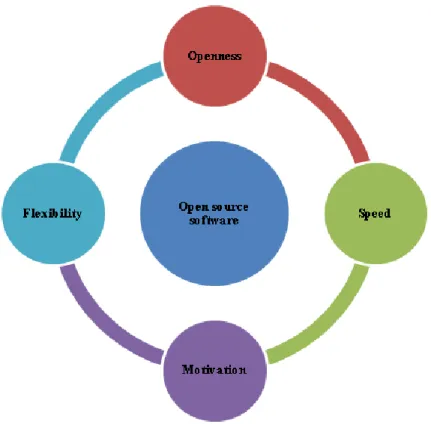
REASONS FOR THE SUCCESS OF OPEN SOURCE SOFTWARE
Openness: The generally open conducted development corresponds to the academic tradition to directly exchange results of (scientific) work, provide research data etc. So far, that “rule” attaches itself to the experien-ces of many people uses established communication channels and co-operation methods.
Flexibility: Many OSS projects integrate a large number of developers with very different emphasis and back-ground. This facilitates the understanding for special requirements and, at the same time, offers the potential to quickly implement needed adjustments.
Speed: The speed by which there is reaction to problems, errors or security leaks of the software is legendary. A large group of people that want to make a product successful immediately undertake the tasks and test new versions, is significantly faster and more successful than the proprietary competitors.
Motivation: OSS developers are (experience them-selves) part of a community that works on a collaborative success (product). They are not part-time hobby developers but professional developers that create OSS full-time. Also, the standard for governmental financed projects to provide the resulting software cost-free for others (that doesn’t necessarily mean OSS or free software), supports the motivation Figure 1.
LIMITATION
The study covers only for top 50 engineering institutional librarians in India.The survey was made only with librarians of respective engineering colleges and other library staffs like assistant librarian, library assistant, etc were not covered.
METHODOLOGY
The present study was carried out to assess the opinion of open source software in selected technological institution libraries. The survey was conducted to identify the view of LIS professionals with regard to library automation network and digital library software’s in engineering college libraries. So the investigator collected opinions of few engineering college librarians, India. Engineering college which were accredited by AICTE and approved by NAAC were taken for survey. Out of 50 (100%) engineering college librarians to whom structured questionnaires were distributed 39 (78%)responses were received. This constitutes of total responses and it was used for the below Table 1.
OPINION OF OPEN SOURCE SOFTWARE IN ENGINEERING COLLEGE LIBRARIANS
Table 1 shows that Koha (48.72%) is majority of librarians are aware and have ranked first, while 30.77% is NewGenlib software are second rank and Evergreen (12.82%) is third rank in library automation software.
CLUSTER ANALYSIS FOR FREQUENTLY USED LIBRARY AUTOMATION SOFTWARE
The variables and variable codes considered for the cluster analysis representing the frequently used library services by users are show in Table 2. The resulting Dendrogram is shown as Figure 2.
In cluster 1, six variables are grouped as shown in the Table 3. The agree and disagree ratio is 0.12:11, which can be interpreted that the librarians is least frequently used library automation software.
Figure 1. Reasons for the success of open source software.
Table 1. Distribution of librarians according to their replies with regard to the automation of engineering college libraries.
S/N Knowledge of e-resources Never Least frequently Less frequently Frequently Most frequently Rank
1 Koha 5 (12.82) 6 (15.38) 4 (10.26) 5 (12.82) 19 (48.72) 1 2 ABCD 9 (23.08) 9 (23.08) 8 (20.51) 9 (23.08) 4 (10.26) 4 3 NewGenlib 5 (12.82) 4 (10.26) 9 (23.08) 9 (23.08) 12 (30.77) 2 4 Evergreen 19 (48.72) 4 (10.26) 7 (17.95) 4 (10.26) 5 (12.82) 3 5 PHP my library 21 (53.85) 5 (12.82) 6 (15.38) 5 (12.82) 2 (5.13) 5 6 Open Biblio 29 (74.36) 3 (7.69) 2 (5.13) 3 (7.69) 2 (5.13) 7 7 Avanti 24 (61.54) 6 (15.38) 4 (10.26) 4 (10.26) 1 (2.56) 6
(Figures in Parentheses indicate percentage); N=39 Response Rate (78%).
Table 2. Frequently used library automation software (variables and variable codes).
S/N Variable Code Variable Name
1 LAS A Koha
2 LAS B ABCD
3 LAS C NewGenlib
4 LAS D Evergreen
5 LAS E PHP my library
6 LAS F Open Biblio
7 LAS G Avanti
4. The agree and disagree ratio has been arrived at 0.94:1, which can be interpreted that the librarians utilize
high frequency of library automation software.
SPECIAL FEATURES IN OPEN SOURCE SOFTWARE FOR LIBRARY AUTOMATIONS
Major software’s developed and available are described briefly along with their special features and uses.
KOHA
KOHA has the distinction of being the first open source integrated library management system, which includes all the main functions related to library management. It is
442 Int. J. Lib. Inf. Sci.
Figure 2. Dendrogram for frequently used library automation software.
Table 3. Cluster1- Least frequently used library automation software
S/N Variable code Variable name Agree Disagree
1 LAS B ABCD 4 (10.26) 35 (89.74)
2 LAS C NewGenlib 12 (30.77) 27 (69.23)
3 LAS D Evergreen 5 (12.82) 34 (87.18)
4 LAS E PHP my library 2 (5.13) 37 (94.87)
5 LAS F Open Biblio 2 (5.13) 37 (94.87)
6 LAS G Avanti 1 (2.56) 38 (97.44)
Total 26 208
N=39.
Agree: 26; Disagree: 208
Agree Ratio: 26/39 = 0.67; Disagree Ratio: 208/39 = 5.33. Agree and Disagree Ratio (0.67:5.33) = 0.12:1.
Table 4. Cluster2- Most frequently used library automation software.
S.No Variable code Variable name Agree Disagree
1 LAS A Koha 19 (48.72) 20 (51.28) Total 19 20 N=39. Agree: 19. Disagree: 20. Agree Ratio: 19/39 = 0.48. Disagree Ratio: 20/39 = 0.51.
Agree and Disagree Ratio (0.48:0.51) = 0.94:1.
web-based open source software distributed under the general public license. KOHA supports windows as well as Linux platform. The first version of it was released in
year 2000. The ‘KOHA Development Team’ offers to host the website for KOHA library system on its server. KOHA also has the capacity to manage digital libraries and
online and offline electronic resources.
Features
KOHA is web-based Integrated Library Management System (ILS), with a SQL database (My SQL preferred) backend with cataloguing data stored in MARC and accessible via Z39.50. The user interface is very configurable and adaptable and has been translated into many languages. KOHA has most of the features that would be expected in an ILS, including:
1. Simple, clear interface for librarians and members (patrons).
2. Various Web 2.0 facilities like tagging and RSS feeds. 3. Union catalog facility.
4. Customizable search.
5. Circulation and borrower management.
6. Full acquisitions system including budgets and pricing information (including supplier and currency conversion). 7. Simple acquisitions system for the smaller library. 8. Ability to cope with any number of branches, patron categories, item categories, currencies and other data. 9. Serials system for magazines or newspapers. 10. Reading lists for members.
11. Easy barcode printing and so on.
ABCD
ABCD represents the “Automation of libraries and Cen-tres of Documentation”. The name itself expresses the ambition of the software suite to provide not only automation functions for traditional libraries but also other information providers such as documentation centers. It has been developed by BIREME (WHO, Brazil) in collaboration with the Flemish Interuniversity Council, Belgium, and using UNESCO’s ISIS database techno-logy. This software provides flexibility and versatility. The bibliographic structures, including all types of digital resources, can be managed by this software and created along with non-bibliographic structures (Dhamdhere, 2011). The first version of ABCD (v1.0) was released on 5th December 2009. ABCD has been built up with tech-nologies such as ISIS database, ISIS formatting language, CISIS, ISIS Script, ISIS NBP, Java Script, Groovy and Jetty, PHP, My SQL, Apache, and YAZ.
Features
1. The software is fully web-based, so can be used and managed from any current web-browser.
2. All main functions of the library management are integrated using the same interface and databases. 3. Bibliographic records can be imported from external library catalogs/servers through Z39.50 facilities.
4. Full MARC 21 compatibility with fields, indicators, and subfields defined by Library of Congress.
5. OPAC with simple Google-like search as well as advanced search with Boolean operators, truncation, and field-limitation for all kinds of databases, locally created or external.
6. Access to both physical and electronic documents (local or on the internet) with the same interface.
7. Library staff can define copy or edit any new database structure with existing ISIS-applications such as MARC, CEPAL, UNIMARC, and Dublin Core.
8. Available in many languages like English, French, Spanish, Portuguese while more language versions are on the way.
9. Contents and bibliographic resources, both local and external, can be added easily without HTML-program-ming.
10. Excellent serials management with a fully implemen-tation of the ISSN standard and union catalog function. 11. Statistical report generation with graphical presen-tation of any defined set of variables in the databases. 12. Freedom of database structure.
NewGenlib
NewGenlib (New Generation Library) is an integrated library management system developed by Versus Solu-tions Pvt. Ltd. Domain expertise is provided by Kesavan Institute of Information and Knowledge Management (KIIKM) in Hyderabad, India. NewGenlib version 1.0 was released in March 2005. On 9 January 2008, NewGenLib was declared Open Source Software under GNU General Public License (GPL) License by Versus Solutions. Currently NewGenLib 3.0.3 U2 is the latest version running. Presently about 2,500 libraries and information centres are using NewGenlib across the world.
Features
1. Functional modules are completely web based. Uses Java Web Start™ Technology.
2. Compatibility - Complies with international metadata and interoperability standards: MARC-21, MARC-XML, z39.50, SRU/W, OAI-PMH.
3. Scalable, manageable and efficient.
4. OS independent -Windows and Linux flavors available. 5. Unicode 4.0 complaint.
6. Easily extensible to support other languages.
7. Data entry, storage, retrieval in any (Unicode 3.0) language.
8. Networking – Hierarchical and Distributed networks. 9. Automated email/instant messaging integrated into different functions of the software.
10. Form letters are configurable and use XML-based Open Office templates.
444 Int. J. Lib. Inf. Sci.
Table 5. Distribution of librarians according to their replies with regard to the digital library of engineering college libraries.
S.No Knowledge of e-resources Never Least frequently Less frequently Frequently Most frequently Rank
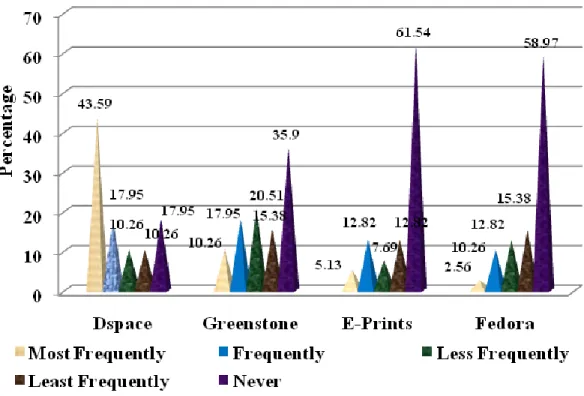
1 DSpace 7 (17.95) 4 (10.26) 4 (10.26) 7 (17.95) 17 (43.59) 1
2 Greenstone 14 (35.90) 6 (15.38) 8 (20.51) 7 (17.95) 4 (10.26) 2
3 E-Prints 24 (61.54) 5 (12.82) 3 (7.69) 5 (12.82) 2 (5.13) 3
4 Fedora 23 (58.97) 6 (15.38) 5 (12.82) 4 (10.26) 1 (2.56) 4
(Figures in Parentheses indicate percentage). N=39 Response Rate (78%).
12. Allows digital attachments to metadata.
Evergreen
Evergreen is an open source Integrated Library System (ILS), initially developed by the Georgia Public Library Service (2006), Public Information Network for Electronic Services (PINES) and the Evergreen Community. It is distributed under the GNU General Public License. Evergreen has been written primarily in Perl and Postgre SQL, with a few optimized sections rewritten in C. The catalog interface is primarily JavaScript with XHTML, and the staff client user interface is written in Mozilla's XUL (XML + JavaScript). The user interface for most new staff client functionality is being built with the Dojo Toolkit JavaScript framework. Python is used for the interna-tionalization built infrastructure. EDI functionality for the acquisitions system depends upon Ruby support.
Features
1. Search/Retrieve via URL and Z39.50 servers.
2. Flexible, powerful reporting for retrieval of any statistical information stored in the database.
3. Online Public Access Catalogue (OPAC).
4. Customization of various features fulfilling specific user requirement.
PhpMyLibrary
PhpMyLibrary is a PHP/My SQL web-based library automation application meant for smaller libraries. The software has the facilities intended for cataloguing, circu-lation, and OPAC module. The software also has an import export feature. It strictly follows the USMARC standard for adding materials. This software is compatible with the content management system and has as facility of online reservation system for library and also supports import from ISIS database with an ISIS2MARC program.
OpenBiblio
OpenBiblio is an easy to use, open source, automated
library software written in PHP. This software has facilities of OPAC, circulation, cataloging, and other administrative work. OpenBiblio is well documented, easy to install with minimal expertise and designed with common library feature.
Avanti
Avanti Micro LCS (Library Computing System) Software is developed by Avanti Library Systems in Java language. This is a small, simple, and easy to install and use open source software and can run on any system that supports a Java runtime environment. This software is useful for small libraries; it has a powerful and very flexible architecture that allows it to be adapted for use in libraries of any type. This software incorporates standards such as MARC and Z39.50 as modules and interfaces.
Table 5 reveals that DSpace (43.59%) is majority of librarians are aware and have ranked first, while 10.26% is Greenstone software are second rank and E-Prints (5.13%) is third rank of digital library software (Figure 3)
SPECIAL FEATURES IN OPEN SOURCE SOFTWARE FOR DIGITAL LIBRARY
Major software’s developed and available are described briefly along with their special features and uses.
D-Space
D-Space is an open source software package that provides the tools for management of digital assets, and is commonly used as the basis for an institutional reposi-tory. It supports a wide variety of data, including books, theses, and 3D digital scans of objects, photographs, film, video, research data sets and other forms of content. The data is organized in groups rather than individual items.
D-Space is also intended as a platform for digital preservation activities. D-Space was released by HP-MIT Alliance in 2002 and since its release has turned out to be very popular open source software. It has been installed and effectively implemented in a number of
Figure 3. Frequency of digital library software used.
universities, colleges, cultural organizations, and research centers etc. It is shared under a Berkeley Software Distribution license, which enables users to customize or extend the software as needed.
Features
1. D-Space is written in Java.
2. It uses a relational database, and supports the use of Postgre SQL and Oracle.
3. It currently support two primary web interfaces—a classic one (JSPUI) which uses JSP and the Java Servlet API, and a newer interface (XMLUI) based on Apache Cocoon and using XML and XSLT technologies.
4. D-Space holdings are made available primarily via a web interface, but it also supports the OAI-PMH v2.0, and is capable of exporting METS (Metadata Encoding and Transmission Standard) packages.
5. Future versions are likely to see increasing use of web services, and changes to the user interface layer.
6. The system is organized into communities, sub-communities, and collections.
7. Supported all type of digital formats, including books, theses, datasets, computer programmes, bibliographic datasets, Images, audio files, video files, learning objects web pages and so on.
8. Access control over items in repository at collection and individual item levels.
9. Allows easy migration of items in the system across newer versions.
10. Able to interoperate other systems in the organi-zations.
11. Allows customization of subsystems as per require-ment.
12. D-Space can be used for self archiving by institutions and faculties. It provides long-term physical storage and management of digital items in a repository.
Greenstone
The Greenstone Digital Library Software (GSDL) is a top of the line and internationally renowned ‘Open Source Software’ system for developing digital libraries, promo-ted by the New Zealand Digital Library project research group at the University of Waikato and is sponsored by the UNESCO. The software is issued under the terms of GNU General Public License. Greenstone provides a way of building, maintaining and distributing digital library collections, opening up new possibilities for organizing information and making it available over the Internet or on CD-ROM.
Features
1. Greenstone builds collections using almost popular and standard digital formats such as HTML, XML, Word, Post Script, PDF, RTF, and many other formats which include audio as well as video.
446 Int. J. Lib. Inf. Sci.
metadata-based browsing facilities that are attractive and easy to use.
3. It runs on a wide variety of platforms such as Windows, Unix/Linux, Apple Mac etc. and provides full-text mirroring, indexing, searching, browsing and metadata extraction.
4. UNICODE based multi-lingual capabilities and a user-friendly multimedia interfacing.
5. Customization of various features fulfilling specific user requirements.
6. Browser based access.
7. Use of Dublin Core and other metadata scheme. 8. Use of plug-in for converting the file format into standard XML-based internal format for indexing purposes.
9. Administrative features that support access control and user activity logs.
10. Different interfaces for user choice for collection-building like command mode, web, and Java-based GUI interface.
11. Multilingual interface available in English, Arabic, Chinese, Dutch, French, German, Maori, Portuguese, and Spanish etc.
12. Z39.50 client available on Linux systems.
E-Prints
E-Prints have been developed at the University of Southampton School of Electronics and Computer Science in 2000 and released under a GPL license for building open access repositories that are compliant with the Open Archives Initiative Protocol for Metadata Harvesting (OAI-PMH). It shares many of the features commonly seen in document management systems, but is primarily used for institutional repositories and scientific journals.
Fedora
Fedora software gives organizations a flexible service oriented architecture for managing and delivering their digital content. Digital objects exist within a repository architecture that supports a variety of management functions. All functions of Fedora, both at the object and repository level, are exposed as web services. These functions can be protected with complex access control policies. This unique combination of features makes Fedora an attractive solution in a variety of domains. Some examples of applications that are built upon Fedora include library collections management, multi-media authoring systems, archival repositories, institu-tional repositories, and digital libraries for education.
CONCLUSION
Libraries with small budgets always consider automation of housekeeping operations as a financial burden due to the high cost of commercial software. However, develop-ment of Open Source Software is an effective way to automate library operations without undertaking sub-stantial financial investment. Libraries are taking up Open Source Software as a way to reduce the costs of expensive commercial products and as a viable alternative to the often expensive proprietary library automation systems. “The benefits of Open Source Software can potentially reduce costs; give users more control and increase software performance” (Courant and Griffiths, 2006). Librarians need to ensure whether the OSS is licensed or commercially available to facilitate the use of Open Source Software in academic libraries. This is the only way to face the challenges posed by com-mercial software in the market. It will also increase the autonomy and control of the professional over software solutions. In conclusion, the advent of open source library software has ushered in a revolution in the field of library and information resources management, and has become popular choice for most library and information professionals because of their numerous benefits and useful features.
REFERENCES
Courant PN, Griffiths RJ (2006). Software and collaboration in higher education: A study of open source software. Ithaca, NY: Organization for Open Source Software Study. Available at ttp://www.ithaka.org/ strategicservices/oss/OOSS_Report_FINAL.pdf.
Dhamdhere S (2011). “ABCD, Open Source Software for Modern Libraries”, Chinese Librarianship: an International Electronic Journal 32. http://www.iclc.us/cliej/ cl32dhamdhere.pdf.
Kamble VT, Raj H, Sangeeta (2012). Open source library management and Digital library software. DESIDOC J. Libr. Inform. Technol. 32(5):388-392.
Rich C (1999). Open Source Software. www.RichChristie@Christie Computer.com.
Seeran A (2011). “Development of FOSS (Free Open Source Software) for Libraries.” PEARL – J. Lib. Inform. Sci. 5(1).
Singh J (2007). “Open-source software and knowledge management in digital context: Issues and implications”, 5th International CALIBER-2007, Panjab University, Chandigarh pp.543-553.
Top 50 engineering college list available at: http://aieee.learnhub.com/ lesson/10373-top-50-indian-engineering-colleges.