The SH-Verification Tool
Peter Ochsenschl¨
ager
and
J¨
urgen Repp
and
Roland Rieke
SIT – Institute for Secure Telecooperation,
GMD – German National Research Center for Information Technology, Rheinstr. 75, D-64295 Darmstadt, Germany
E-Mail: {ochsenschlaeger,repp,rieke}@darmstadt.gmd.de
Abstract
The sh-verification tool supports a verification method for cooperating systems based on formal languages. It comprises computing abstractions of finite-state behaviour representations as well as automata and temporal logic based verification approaches. A small but typical example shows the steps for analysing its dynamic behaviour using the sh-verification tool.
Keywords: Cooperating Systems; Finite State
Systems, Abstraction; Simple Language Homomor-phisms; Formal Specification; Verification
Introduction
The sh-verification tool1supports the method for
ver-ification of cooperating systems described in
(Ochsen-schl¨ager, Repp, Rieke 1999). The reader is referred to
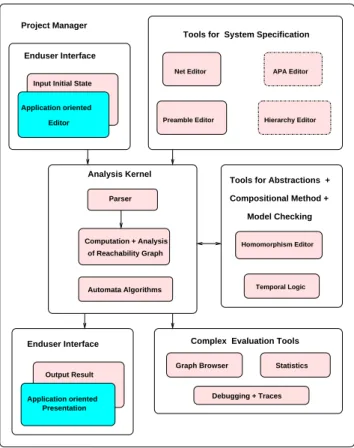
this paper for notations, definitions and theorems. Fig-ure 1 shows the structFig-ure of the tool. The main com-ponents of the system are the tools for specification, the analysis kernel, the tools for abstraction and the project manager. It is possible to extend the tool by different application oriented user interfaces. A small but typical example shows the steps for analysing a systems behaviour using the sh-verification tool.
Specification
The presented verification method does not depend on a specific formal specification technique. For practical use the sh-verification tool has to be combined with a specification tool generating labeled transition
sys-tems LTS 2. The current implementation uses
prod-uct nets3(Burkhardt, Ochsenschl¨ager, Prinoth 1989;
1sh abbreviates simple homomorphism
2The semantics of formal specification techniques for
distributed systems is usually based on LTS.
3
a special class of high level petri nets
Copyright c2000, American Association for Artificial Intelligence (www.aaai.org). All rights reserved.
Parser
Computation + Analysis of Reachability Graph
Automata Algorithms
Debugging + Traces Graph Browser Statistics Input Initial State
Application oriented
Enduser Interface Complex Evaluation Tools Model Checking Compositional Method + Tools for Abstractions + Analysis Kernel
Enduser Interface
Tools for System Specification
Preamble Editor
Net Editor APA Editor
Hierarchy Editor Temporal Logic Homomorphism Editor Project Manager Output Result Application oriented Presentation Editor
Figure 1: Components of the sh-verification tool
Ochsenschl¨ager Prinoth 1995) as specification
envi-ronment. A second specification environment based
on asynchronous product automata (APA),
(Ochsen-schl¨ageret al. 1998) is planned.
To illustrate the usage of the methods described in
(Ochsenschl¨ager, Repp, Rieke 1999) we consider an
ex-ample of a system that consists of a client and a server
as its main components. The client sends requests
REQ to the server, expecting the server to produce
particular results. Nevertheless, for some reasons, the server may not always respond to a request by sending
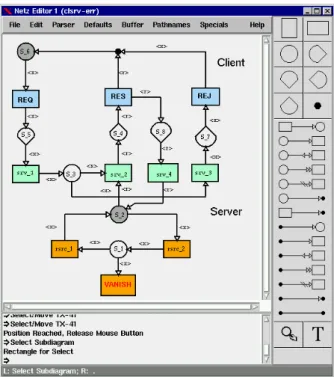
Figure 2: Client Server Example
a resultRES, but may, as well, reject a requestREJ
(Figure 4).
Figure 2 shows a product net specification of this ex-ample. It is a global model for the systems behaviour. Note that the resource may eventually be locked for-ever. In Figure 2 we do not use most of product nets’ possible features. Indeed, it is a product net represen-tation of a Petri net.
Usually complex systems are specified hierarchically.
This is supported by the project managerof the tool.
(In our simple example the specification is flat.) The LTS in Figure 3, which is the reachability graph of the product net in Figure 2, is computed by the tool. This LTS consists of two strongly connected compo-nents (marked by diffent colors). Usually the LTS of a specification is too complex for a complete graphical presentation; there are several features to inspect the LTS.
Abstraction
In the example the important actions with respect to the client’s behaviour, are sending a request and re-ceiving a result or rejection.
We will regard the whole system running properly,if
the client, at no time, is prohibited completely from re-ceiving a result after having sent a request(correctness criterion).
For the moment, we regard the server as a black box; i.e. we neither consider its internal structure nor look
S_3 S_4 S_5 S_6 S_2 S_6 start: S_2 S_5 S_2 S_4 S_2 S_3 S_1 S_6 S_1 S_5 S_1 S_4 S_1 S_3 RES T_3 T_3 REJ T_2 T_2 T_2 T_2 T_3 T_3 T_7 REQ T_4 REJ T_7 VANISH REQ REQ REJ T_7 T_4 VANISH VANISH T_4 VANISH Figure 3: LTS
REQ RES REJ
Figure 4: Client Server Abstract View
at its internal actions. Not caring about particular
actions of a specification when regarding the
specifica-tion’s behaviour is behaviour abstraction. If we define
a suitable abstraction for the client/server system with respect to our correctness criterion, we only keep
ac-tions REQ, RES, and REJ visible, hiding all other
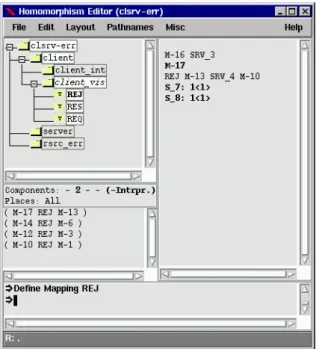
actions. This is supported by the homomorphism edi-tor of the tool (Figure 5).
An automaton4representing the abstract behaviour
of the specification can be computed by the sh-verification tool (Figure 6). It obviously satisfies the required property. The next step is to check whether the concrete behaviour also satisfies the correctness re-quirement mentioned above. For that purpose we have to prove simplicity of the defined homomorphism.
Simplicity of an abstraction can be investigated in-specting the strongly connected components of the LTS
by a sufficient condition (Ochsenschl¨ager, Repp, Rieke
1999). The component graph in Figure 7 (combined with the homomorphic images of the arc labels of the
4
Figure 5: Defining an Abstraction A-2 A-1 start: (REJ) (RES) (REQ)
Figure 6: Minimal Automaton.
corresponding graph components) does not satisfy this condition, so nothing can be said about simplicity.
(REQ) (RES) (REJ) A-1 start: (REQ) (REJ) A-2
Figure 7: Component Graph
We now try to refine the homomorphism such that the sufficient condition for simplicity can be proven. Inspecting the edge between the two nodes of the
com-ponent graph shows that the actionV AN ISH causes
the transitions between this two components (Fig-ure 8). The refined homomorphism, which additionally
keeps V AN ISH visible, satisfies the sufficient
condi-tion for simplicity. Figure 9 shows the corresponding automaton. This automaton obviously violates the re-quired property, so the systems behaviour does not
sat-isfy this property.
(REQ) (REJ) A-2 (REQ) (RES) (REJ) A-1 start: (VANISH)
Figure 8: Component Graph
A-2 A-4 A-3 A-1 start: (REQ) (REJ) (REQ) (VANISH) (REJ) (RES) (VANISH)
Figure 9: Minimal Automaton (with VANISH) These simplicity investigations, which are supported by the tool, detect the error in the specification. In
(Ochsenschl¨ager 1992; 1994a) a necessary condition for
simplicity is given. It is based on so called deadlock
languages and shows non-simplicity of ourREQ-RES
-REJ-homomorphism (Ochsenschl¨ager et al. 1998).
To handle the well known state space explosion prob-lem a compositional method(Ochsenschl¨ager 1996) is implemented in the sh-verification tool. This approach can also be used iteratively and provides a basis for in-duction proofs in case of systems with several identical
components (Ochsenschl¨ager 1996). Using our
compo-sitional method a connection establishment and release protocol has been verified by investigating automata with about 100 states instead of 100000 states.
Temporal Logic
Our verification approach can also be combined with
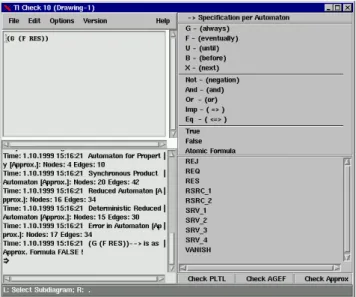
temporal logic (Ochsenschl¨ager et al. 1998). In terms of temporal logic, the automaton of Figure 6
approx-imately satisfies (Ochsenschl¨ager et al. 1998) the
for-mulaG(F(RES)) (G: always-operator,F:
eventually-operator; thusG(F(RES)) means ”infinitely often
re-sult”), but the system in Figure 3 does not. This is in-deed the case because the abstracting homomorphism
is not simple. Using an appropriate type of model
checking, approximate satisfaction of temporal logic formulae can be checked by the sh-verification tool.
Our experience in practical examples shows that the combination of computing a minimal automaton of an LTS and model checking on this abstraction is signifi-cantly faster than direct model checking on the LTS.
Figure 10: Temporal Logic Formula Editor
Applications
Practical experiences have been gained with large spec-ifications:
• ISDN and XTP protocols (Klug 1992; Schremmer
1992; Ochsenschl¨ager Prinoth 1993)
• Smartcard systems (Nebel 1994; Ochsenschl¨ager
1994b)
• Service interactions in intelligent telecommunication
systems (Capellmannet al. 1996b; 1996a).
• The tool has also been applied to the analysis
of cryptographic protocols (Basak 1999; Rudolph 1998). In this context an application oriented user-interface has been developed for input of crypto-graphic formulae and presentation of results in this syntax.
• Currently our interest is focused on the verification
of binding cooperations including electronic money and contract systems. Recently some examples in that context have been investigated with our tool (Fox 1998; Roßmann 1998).
Technical Requirements
The sh-verification tool is implemented in Allegro
Common Lisp. An interpreter-based version of the
software is freely available (currently for Solaris, Linux and Windows NT) for non commercial purposes (http://sit.gmd.de/META/projects.html). For inves-tigation of large systems a compiler-based version of the tool is needed. For more information please con-tact the authors.
Conclusions
We have presented the basic functionality of the sh-verification tool in this article. The tool is equipped with the main features necessary to verify specifica-tions of cooperating systems of industrial size. It sup-ports a verification method based on formal languages
(Ochsenschl¨ager, Repp, Rieke 1999).
There exists a variety of verification tools which
can be found in the literature. Some are based
on model checking, others use proof systems. We
consider COSPAN (Kurshan 1994) to be closest to the sh-verification tool. COSPAN is automata based and contains a homomorphism based abstraction concept. Since the transition labels of automata in COSPAN are in a Boolean algebra notation, the abstraction
homomorphisms are Boolean algebra
homomor-phisms which correspond to non-erasing alphabetic language homomorphisms on the automata level. The sh-verification tool, in addition, offers erasing homomorphisms as an abstraction concept. COSPAN also considers only linear satisfaction of properties. Thus fairness assumptions need to be made explicitly
in this tool. A tool which uses the modalµ-calculus as
a specification language for properties (Stirling 1989) is the concurrency workbench (Cleaveland, Parrow,
Steffen 1993). In (Hartel et al. 1999) ten tools in this
area including ours are compared.
We consider the main strength of our tool to be the combination of an inherent fairness assumption in the satisfaction relation, an abstraction technique
compatible with approximate satisfaction, and a
suitable compositional and partial order method for the construction of only a partial state space. The sh-verification tool’s user interface and general handling has reached a level of maturity that enabled its successful application in the industrial area.
References
Basak, G. 1999. Sicherheitsanalyse von
Authen-tifizierungsprotokollen – model checking mit dem SH-Verification tool. Diploma thesis, University of Frank-furt.
Burkhardt, H. J.; Ochsenschl¨ager, P.; and Prinoth,
R. 1989. Product nets — a formal description
tech-nique for cooperating systems. GMD-Studien 165,
Gesellschaft f¨ur Mathematik und Datenverarbeitung
(GMD), Darmstadt.
Capellmann, C.; Demant, R.; Fatahi, F.;
Galvez-Estrada, R.; Nitsche, U.; and Ochsenschl¨ager, P.
1996a. Verification by behavior abstraction: A case study of service interaction detection in intelligent
telephone networks. In Computer Aided Verification (CAV) ’96, volume 1102 of Lecture Notes in Com-puter Science, 466–469.
Capellmann, C.; Demant, R.; Galvez-Estrada, R.;
Nitsche, U.; and Ochsenschl¨ager, P. 1996b. Case
study: Service interaction detection by formal verifi-cation under behaviour abstraction. In Margaria, T., ed., Proceedings of International Workshop on Ad-vanced Intelligent Networks’96, 71–90.
Cleaveland, R.; Parrow, J.; and Steffen, B. 1993. The concurrency workbench: A semantics-based tool for
the verification of finite-state systems. In TOPLAS
15, 36–72.
Fox, S. 1998. Sezifikation und Verifikation eines Sep-aration of Duty-Szenarios als verbindliche Telekoop-ertation im Sinne des Gleichgewichtsmodells. GMD Research Series 21, GMD – Forschungszentrum Infor-mationstechnik, Darmstadt.
Hartel, P.; Butler, M.; Currie, A.; Henderson, P.; Leuschel, M.; Martin, A.; Smith, A.; Ultes-Nitsche, U.; and Walters, B. 1999. Questions and answers
about ten formal methods. In Proc. 4th Int.
Work-shop on Formal Methods for Industrial Critical
Sys-tems, volume II, 179–203. Pisa, Italy: ERCIM.
Klug, W. 1992. OSI-Vermittlungsdienst und sein
Verh¨altnis zum ISDN-D-Kanalprotokoll.
Spezifika-tion und Analyse mit Produktnetzen.
Arbeitspa-piere der GMD 676, Gesellschaft f¨ur Mathematik und
Datenverarbeitung (GMD), Darmstadt.
Kurshan, R. P. 1994. Computer-Aided Verification
of Coordinating Processes. Princeton, New Jersey: Princeton University Press, first edition.
Nebel, M. 1994. Ein Produktnetz zur
Verifika-tion von Smartcard-Anwendungen in der
STARCOS-Umgebung. GMD-Studien 234, Gesellschaft f¨ur
Mathematik und Datenverarbeitung (GMD), Darm-stadt.
Ochsenschl¨ager, P., and Prinoth, R. 1993.
For-male Spezifikation und dynamische Analyse
verteil-ter Systeme mit Produktnetzen. In Informatik
ak-tuell Kommunikation in verteilten Systemen, 456–
470. M¨unchen: Springer Verlag.
Ochsenschl¨ager, P., and Prinoth, R. 1995.
Mod-ellierung verteilter Systeme – Konzeption, Formale Spezifikation und Verifikation mit Produktnetzen. Wiesbaden: Vieweg.
Ochsenschl¨ager, P.; Repp, J.; Rieke, R.; and Nitsche,
U. 1998. The SH-Verification Tool –
Abstraction-Based Verification of Co-operating Systems. Formal
Aspects of Computing10:381–404.
Ochsenschl¨ager, P.; Repp, J.; and Rieke, R. 1999.
Verification of Cooperating Systems – An Approach
Based on Formal Languages. Submitted to
FLAIRS-2000Special Track on Validation, Verification &
Sys-tem Certification.
Ochsenschl¨ager, P. 1992. Verifikation
kooperieren-der Systeme mittels schlichter Homomorphismen.
Ar-beitspapiere der GMD 688, Gesellschaft f¨ur
Mathe-matik und Datenverarbeitung (GMD), Darmstadt.
Ochsenschl¨ager, P. 1994a. Verification of cooperating
systems by simple homomorphisms using the product net machine. In Desel, J.; Oberweis, A.; and Reisig,
W., eds.,Workshop: Algorithmen und Werkzeuge f¨ur
Petrinetze, 48–53. Humboldt Universit¨at Berlin.
Ochsenschl¨ager, P. 1994b. Verifikation von
Smartcard-Anwendungen mit Produktnetzen. In
Struif, B., ed.,Tagungsband des 4. GMD-SmartCard
Workshops. GMD Darmstadt.
Ochsenschl¨ager, P. 1996. Kooperationsprodukte
for-maler Sprachen und schlichte Homomorphismen. Ar-beitspapiere der GMD 1029, GMD – Forschungszen-trum Informationstechnik, Darmstadt.
Roßmann, J. 1998. Formale Analyse der Business-Phase des First Virtual Internet Payment Systems basierend auf Annahmen des Gleichgewichtsmodells. Diploma thesis, University of Frankfurt.
Rudolph, C. 1998. Analyse krypotgraphischer Pro-tokolle mittels Produktnetzen basierend auf
Model-lannahmen der BAN-Logik. GMD Research Series
13/1998, GMD – Forschungszentrum Information-stechnik GmbH.
Schremmer, S. 1992. ISDN-D-Kanalprotokoll der
Schicht 3. Spezifikation und Analyse mit
Produktnet-zen. Arbeitspapiere der GMD 640, Gesellschaft f¨ur
Mathematik und Datenverarbeitung (GMD), Darm-stadt.
Stirling, C. 1989. An introduction to modal and tem-poral logics for CCS. In Yonezawa, A., and Ito, T.,
eds.,Concurrency: Theory, Language, and
Architec-ture, volume 391 of Lecture Notes in Computer