Practice Guide 3 - Performance
Management
Version control Version 9-1 Date 2010-10-16 Status DraftThe IDMS Prov Infr Strat G1(a) G1(b) G2 U-AMP C-AMP PC 1 PF1.4 PF1.3 PF2.1 PF2.2 PF2.3 PF3 PF4 PF5 PF1.1 PF1.2 DP1: Portfolio Management DP1-2 Programme Management DP1-1 Infrastructure Planning
Develop/review U-AMP (including prioritised MTEF works list)
Develop/review C-AMP (incl portfolio level Work Plans)
Develop /review Constr Proc Strat Develop /review IPMP Manage Implementation Authorise Implementation Monitor &
Control Close Out
G3 G4 G5 G6(a) G6(b) G7 G8 PC 2 PC 3 PC 4a PC 5 PC 4b PF1.4 PF1.3 PF2.1 PF2.2 PF2.3 PF3 PF4 PF5 T1 T2 PEP2
PEP1 IPIP PEP3
DP2: Project Management DP2-1 Implementation Planning Prepare Packages Define Packages Develop/Review IPIPs (Prgr & Proj level)
DP2-2 Design Design devlpmt Detailed design Compile MFC Info DP2-3 Works Construct / Deliver works Handover works DP2-4 Close Out Contracts Close Out Adminstv Close Out
PEP4 PEP5 PEP6 PEP7
PF1.4
PF1.3 PF2.1 PF2.2 PF2.3 PF3 PF4
PF5 G8
DP3: Operations & Maintenance
DP3-1 Recognise & accept assets
DP3-2 Mobilisation
for Facilities Mgt DP3-3 Operations DP3-4 Maintenance
DP3-5 Demobilisation of Facilities Mgt
Structure of the Infrastructure Delivery Management Toolkit (IDMT)
Delivery Management Guidelines
Management Companion
Infrastructure Delivery Management System
(IDMS)
Practice
guides
PG1:
Prov Infr
Strategy
PG2:
Constr
Proc
Strat
PG3:
Perform
Mgt
Table of Contents
1. Purpose of this module ...6
2. Where am I within the Delivery Management Guidelines ...6
3. Introduction...7
3.1 How to use this practice guide ...7
3.2 Performance management for service delivery ...8
3.3 The performance management process ...9
4. Performance management and infrastructure management ...10
4.1 Outcomes based performance management ...10
4.2 Accountability through reporting ...12
4.3 Performance of the individual ...13
4.4 The performance management system for infrastructure management ...13
4.4.1 Performance management definition ...14
4.5 Integrating service delivery performance management ...15
5. Performance Management Roadmaps ...17
5.1 Developing performance indicators ...19
5.1.1 Step 1.1: Agree on what you aim to achieve (Impacts and Outcomes) ...19
5.1.2 Step 2: Specify the Outputs, Activities and Inputs ...20
5.1.3 Step 3: Select Key Performance Indicators (KPI’s) ...21
5.1.4 Step 4: Set realistic Performance Targets ...21
5.1.5 Step 5: Determine the process and format for Reporting performance ...21
5.1.6 Step 6: Establish Processes and Mechanisms to facilitate corrective action ...22
5.1.7 Points to consider ...23
5.2 Monitor and evaluate programme, project and operational performance ...23
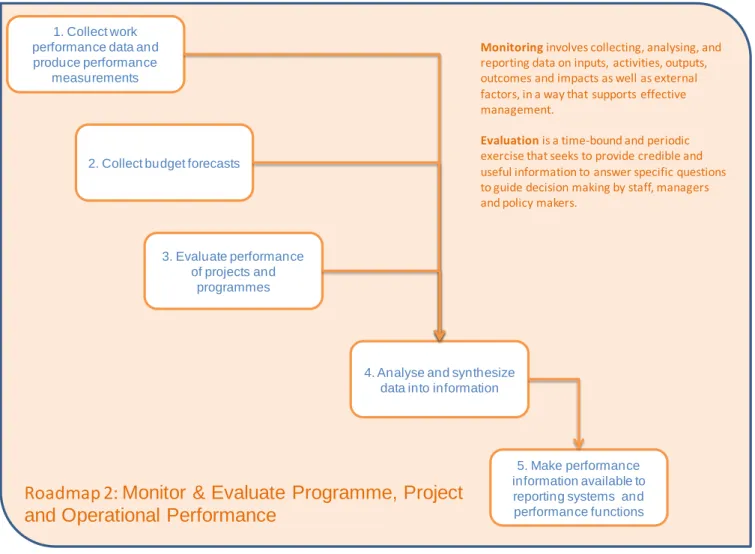
5.2.1 Step 2.1 - Collect Work Performance Data ...24
5.2.2 Step 2.2 -Collect Budget Forecasts ...25
5.2.3 Step 2.3 - Evaluate performance ...25
5.2.4 Step 2.4 - Analyse and synthesize data into information ...25
5.2.5 Step 2.5 - Make performance information available to corporate systems and functions...26
5.3 Publish performance information ...27
5.3.1 Step 3.1 - Develop a reporting register ...27
5.3.2 Step 3.2 - Develop report templates ...27
5.3.3 Step 3.3 - Produce, publish and distribute reports...28
5.3.4 Step 3.4 - Confirm receipt and obtain feedback ...28
5.4 Review and appraise performance of individuals ...29
5.4.1 Step 4.1 - Develop and maintain Master Responsibility Assignment Matrix and provide performance information to HR function ...29
5.4.2 Step 4.2 - Provide Individual Performance Information to HR function ...30
5.4.3 Step 4.3 - Provide Management with performance management information ...30
5.5.1 Step 5.1 - Obtain and study performance related information and critically reflect on root causes of
good and bad performance ...31
5.5.2 Step 5.2 - Extract and disseminate learning from good performance to improve performance in other areas ...31
5.5.3 Step 5.3 - Take appropriate action to address causes of poor performance ...31
6. Putting it all together – how performance management works ...32
6.1 The Performance Management System ...32
6.1.1 A practical example ...33
6.2 Legislative requirements ...39
6.2.1 The Framework for the Infrastructure Grant to Provinces (IGP) ...39
6.3 Establishing and improving the performance management function ...41
6.4 Conclusion...41
Table of Figures
Figure 1: Performance Management in relation to other modules ...6Figure 2: Performance Management - The Outcomes based model for improved service delivery ...8
Figure 3: Performance Management - Overview and context of the process ...9
Figure 4: The Outcomes based Performance model ...11
Figure 5: The Performance Management System for infrastructure management ...14
Figure 6: Performance Management to integrate service delivery ...16
Figure 7: Performance Management Function – The highest level performance management process ...17
Figure 8: Performance management roadmap ...18
Figure 9: Roadmap 1: Develop Performance Indicators ...19
Figure 10: Roadmap 2: Monitor and Evaluate performance ...24
Figure 11: Roadmap 3: Publish Performance Information ...27
Figure 12: Roadmap 4: Review and appraise performance of individuals ...29
Figure 13: Roadmap 5: Take management action ...30
Figure 14: The Performance Management System for infrastructure management in the Toolkit context...32
Figure 15: Programme structure ...33
Figure 16: Organisational structure ...34
Figure 17: The RASCI table for the Capital Programme ...34
Figure 18: Capital Programme Team Structure ...35
Figure 19: Project delivery targets ...35
Figure 20: Project reporting template ...36
Figure 21: Two Performance graphs...36
Figure 22: Project 107 pie chart ...36
Figure 23: Programme level report ...37
Figure 24: The complete example ...38
1.
Purpose of this module
The purpose of this module is to:
Introduce users to the concepts of performance management and how they relate to infrastructure management
Guide users in developing performance indicators
Guide users in monitoring and evaluating programme, project and operational performance Guide users in publishing performance information
Guide users in reviewing and appraising performance of individuals Guide users in taking management action
Provide the outline of a performance management system
2.
Where am I within the Delivery Management
Guidelines
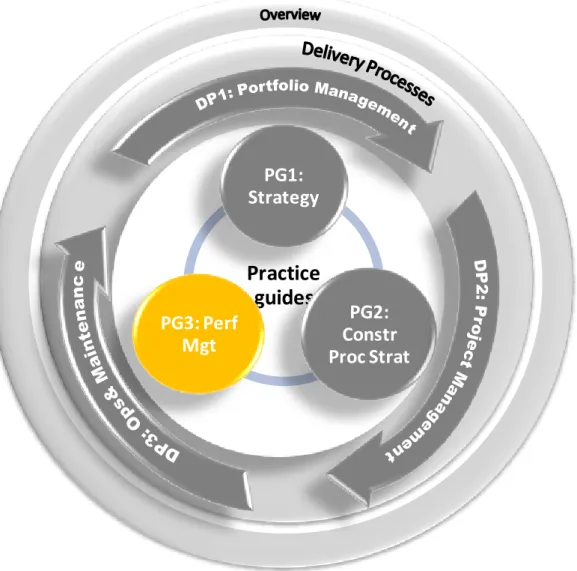
Figure 1: Performance Management in relation to other modules
Practice
guides
PG1:
Strategy
PG2:
Constr
Proc Strat
PG3: Perf
Mgt
3.
Introduction
3.1 How to use this practice guide
This performance management practice guide is structured as follows:
Part 1 – An introduction to the subject matter.
Part 2 – Presents a more detailed discussion on the concepts of outcomes based performance
management and how these are integrated throughout government legislation and toolkit guideline documentation. This section builds the arguments supporting the way in which performance management for service delivery is applied in this toolkit guide. It also clearly indicates the legislated and statutory imperatives for compliance with the principles presented in this toolkit.
Part 3 – Starts with a high level process flow diagram or roadmap of the performance management process
to be followed across each department from top management down to the most junior project manager. This process presents five process steps that are each broken down into their own roadmaps showing the lower level steps to be followed.
Part 4 – Presents more detail on how performance management works and how it would be applied in a
department.
Each of the other toolkit delivery management guides contains a relevant performance management section that discusses specific aspects of performance management and indicators.
The roadmaps presented in section 4 of this guide also form the backbone of the toolkit’s Infrastructure Delivery Management System, or IDMS, where these steps are expanded upon with inputs and outputs and related responsibility assignments. The IDMS also links the process steps to examples, templates and other supporting information.
3.2 Performance management for service delivery
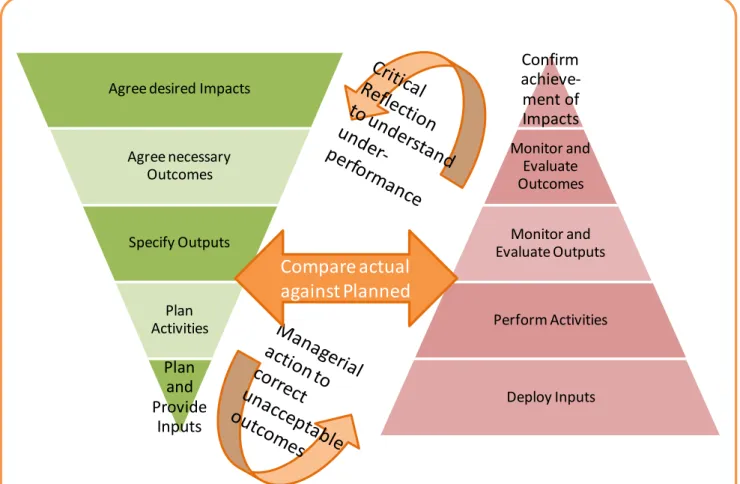
Figure 2: Performance Management - The Outcomes based model for improved service delivery Performance management for service delivery (as illustrated in Figure 2 above) is:
An ongoing, systematic approach to improving infrastructure management and infrastructure delivery results. (Results are defined and categorised as inputs, activities, outputs, outcomes and impacts)
This is achieved through a clear sequence of events based on critical reflection and managerial action in response to analysis of the relationships between:
o Agreement on the desired impacts flowing from the agreed planned strategic objectives o The planning of the necessary outcomes and specific inputs, activities and outputs required
to achieve those outcomes and associated impacts
o The deployment of inputs and the generation of service delivery outputs through planned activities
o The achievement of associated outcomes and impacts resulting from the outputs delivered The performance of programmes, projects and operations are mapped to the performance of those individuals responsible for the performance of the work and accountable for the results achieved The results are accounted for through publication of reports recording actual performance against planned targets
Reviewing and appraising the performance of individuals responsible for the performance of deploying the inputs, performing the activities and measuring the performance is vital for the success of the performance management system. This step does not only happen once per year, but on an ongoing basis and must input into and be part of management action
Agree desired Impacts
Agree necessary Outcomes Specify Outputs Plan Activities
Plan
and
Provide
Inputs
Confirm
achieve-ment of
Impacts
Monitor and Evaluate Outcomes Monitor and Evaluate Outputs Perform Activities Deploy InputsOutcomes Performance Management Approach
Compare actual
against Planned
Variances from planned performance are followed by management action to rectify, normalise and improve poor or unacceptable delivery performance of the portfolio, programme, project and individual. Management action must also exploit good performance by rewarding those responsible for achieving excellence and disseminating that learning in order to continuously improve the organisation.
Performance management is integrated into all aspects of a department’s management and policy-making processes and transforms the department’s programme management, project management and operational practices so that they are focused on achieving improved service delivery results for the public in the spirit and letter of the Batho Pele principles.
Performance management of individual departments are also integrated into the provincial delivery strategy and national sector and cluster service delivery strategies in the spirit and letter of the principles of the National Planning Commission and the Government-wide monitoring and evaluation policies of the Presidency.
3.3 The performance management process
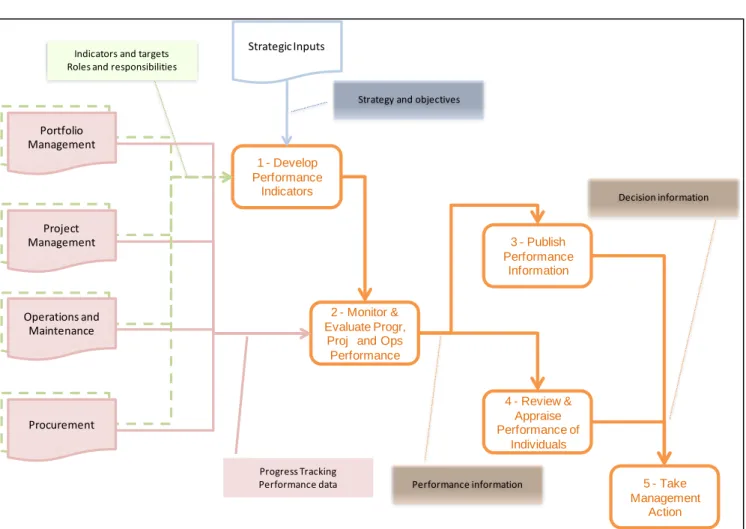
The process of performance management applicable to an individual department is presented in graphical form in Figure 3 below, which also places this guide in the context of other toolkit guides.
Figure 3: Performance Management - Overview and context of the process
Performance management is an integral part of every topic covered in all of the other guides of this toolkit as it is an integral part of the corporate fibre of every activity and process of any organisation in the public or private sector. Performance management is the responsibility of every single manager responsible for any part (big or small) of the service delivery value chain across all spheres of government, from the Director
1 - Develop Performance
Indicators
2 - Monitor & Evaluate Progr,
Proj and Ops Performance 3 - Publish Performance Information 4 - Review & Appraise Performance of Individuals 5 - Take Management Action Strategic Inputs
Strategy and objectives Indicators and targets
Roles and responsibilities
Progress Tracking Performance data
Module 3 –
Portfolio PlanningPortfolio
Management Module 4 – ImplementationProject Management Module 5 – Operations and Maintenance Operations and Maintenance Module 6 – ProcurementProcurement Performance information Decision information
General, Head of Department or Municipal Manager down to the most junior manager tasked with the delivery of a specific project or the execution of a specific operational maintenance function.
The performance management process consists of only five high level process steps, namely: 1. Develop performance indicators
2. Monitor and evaluate programme, project and operational performance 3. Publish performance information
4. Review and appraise performance of individuals 5. Take management action.
The relationships between this guide and the other toolkit guides will be discussed in general in the next section.
4.
Performance management and infrastructure
management
4.1 Outcomes based performance management
The South African Government has adopted an outcomes-, or results-based performance management approach. In this section of the module, various components of, and statements about, outcomes performance management are brought together to support the performance management for service delivery model defined in the previous section.
The Framework for Managing Programme Performance Information1emphasises the importance of having performance information available to managers and summarises the results-based approach to managing service delivery in the following statement:
“This approach emphasises planning and managing with a focus on desired results, and managing inputs and activities to achieve these results.”
In the Green Paper on National Strategic Planning2 the Presidency states:
1
Framework for Managing Programme Performance Information, 2007, Published by National Treasury.
Outcomes Based performance Management:
“President Jacob Zuma has yesterday in his State of the Nation Address presented to the nation some of these outcomes and measurable outputs. The outcomes effectively mark the beginning of a process for improving government performance and providing focus to our delivery. This is the year of improving service delivery and a year of action.”
“The outcomes approach we have adopted is based on a few questions that government had to ask to achieve its objectives:
What are the key outcomes that government wants to achieve?
Which priority outputs should we measure to see if we are achieving each outcome? Where should the system focus in order to achieve the outputs?
How much do we need to invest, within limited resources, to achieve the best mix of desired outcomes?
What targets should we set to achieve our desired results?”
“We proceed from the understanding that governance consists of a continuum of related activities which feed into one another: policy development, strategic and operational planning; resource allocation; Implementation; performance monitoring and evaluation.”
The green paper continues to make it clear that it is the responsibility of all departments and spheres of government to undertake elements of each of these activities. Performance monitoring and evaluation is therefore the responsibility of every government department involved in the delivery chain, the level of detail is to be appropriate as to where the respective department is in terms of the reporting chain.
The Policy Framework for the Government-wide Monitoring and Evaluation System (GWM&E)3, defines a monitoring and evaluation system as:
“A set of organisational structures, management processes, standards, strategies, plans, indicators, information systems, reporting lines and accountability relationships, which enables national and provincial departments, municipalities and other institutions to discharge their M&E functions effectively.”
The GWM&E policy continues by stating that the GWM&E system is intended to facilitate:
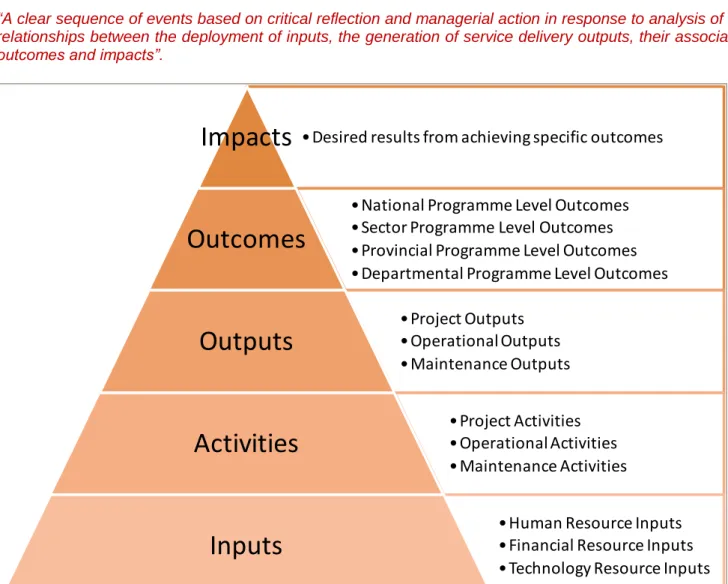
“A clear sequence of events based on critical reflection and managerial action in response to analysis of the relationships between the deployment of inputs, the generation of service delivery outputs, their associated outcomes and impacts”.
Figure 4: The Outcomes based Performance model
2
Green Paper: National Strategic Planning; September 2009, published by The Presidency
3
Policy Framework for the Government-wide Monitoring and Evaluation System, November 2007 , published by The Presidency
• Desired results from achieving specific outcomes
Impacts
• National Programme Level Outcomes
• Sector Programme Level Outcomes
• Provincial Programme Level Outcomes
• Departmental Programme Level Outcomes
Outcomes
• Project Outputs
• Operational Outputs
• Maintenance Outputs
Outputs
• Project Activities
• Operational Activities
• Maintenance Activities
Activities
• Human Resource Inputs
• Financial Resource Inputs
• Technology Resource Inputs
Inputs
From the above extracts a clear picture is emerging, namely that monitoring and evaluation (M&E) is much more than just identifying and measuring performance indicators. The reference to reporting lines and accountability clearly links M&E and performance of work to the performance of the individual on the one hand while on the other hand the outcomes based approach links performance management back to the achievement of strategic objectives.
4.2 Accountability through reporting
National Treasury’s Induction Manual for Accounting Officers provides the following definitions and guidance:
The Induction Manual for Accounting Officers states:
“A further requirement for performance information stems from the responsibility of public institutions to publish administrative and performance information, to account to Parliament and provincial legislatures as outlined in the Constitution sections 92 and 114. Provincial MECs are accountable to their legislatures and have to provide these with full reports on matters under their control.”
The Guide for the Implementation of Provincial Quarterly Performance Reports expands on the above concepts as follows:
“The fundamental role of managers, whether individually or collectively, is to manage performance. In South Africa, accountability for performance management is governed by the PFMA, the Framework for Programme Performance Information, the Public Audit Act No. 25 of 2004 and DPSA Regulations. Accountability is reinforced by the practical requirements of workplace agreements and financial management reforms. Programme performance management strategies, processes and systems, whether for departments or independently legislated statutory authorities, must provide the information required by managers to continuously measure, monitor, evaluate, and improve program performance.”
Performance management therefore also includes accounting through reporting on the performance of the organisation in respect of achieving delivery results to internal and external governance institutions.
The Induction Manual for Accounting Officers published by National Treasury summarises the accountability cycle and links results (outcomes) to strategy as follows:
“In short, the cycle of accountability connects the national strategic plans and priorities with the allocation of funds in the budget to the reporting by departments, as to how they have utilised funds, and the results that have been created as a result.
As managers, accounting officers need to know whether programmes of their institutions are delivering the expected results. This is a key imperative for any manager in any form of institution. Monitoring of the performance of programmes is a key management tool, which is indispensable for managers in both the public and private sector.”
The purpose of performance monitoring and evaluation is to provide performance information so that performance information can be reported. Performance information is then used by managers to apply the
Accountable: Required or expected to justify actions or decisions Accountability: Obligation of an individual, firm, or institution to
account for its activities, accept responsibility for them, and to disclose the results in a transparent manner. It also includes the responsibility for money or other entrusted property.
principles of results or outcomes based management to manage performance, including that of the individual, to address issues relating to inputs, activities or outputs.”
4.3 Performance of the individual
Chapter 4: Performance Management and Development; of the SMS Handbook4 appropriately provides the link between outcomes based performance of the organisation and the performance of the individuals follows:
“Individual performance assessments should therefore, be informed by and, in turn, inform the evaluation and review of organisational and unit achievement over the preceding period. Reviews of achievement against departmental strategic objectives and business plans should coincide with individual quarterly performance reviews, to enable individual and organisational performance to be more effectively linked.”
At the core of all of the above lies the issue of accountability. The non-performance buck must stop at the level where a specific manager is accountable for the work performed by those individuals reporting to him or her.
Non-performance cannot just be accepted without consequences. There is a clear obligation on every manager in government to take management action whenever and wherever poor performance is identified. More than that, the concept of accountability presented in the previous section, places a further obligation on those who are accountable to provide full reports on matters under their control. Reviews of programme performance should coincide with individual performance reviews. Reports must be scrutinised and evaluated and after critical reflection, management action must follow where unacceptable performance is encountered.
The obligation of all managers in government to comply with the performance management approach is clear and unambiguous. This approach:
Starts with planning based on strategy
monitors and evaluates inputs and activities and the resultant outputs, outcomes and impacts reports on performance information and
results in management action, either to sanction non- or poor performing individuals or to reward individuals performing better than expected.
This process cannot only be performed once per annum through the formal appraisal process, but must be performed on a continuous day-to-day basis in interaction up and down the organisational chain of command based on the contents of the performance reports.
4.4 The performance management system for infrastructure
management
“Effective program performance management requires a performance management system which links planning for program performance and resource management with performance monitoring and program evaluation. Program performance management links what is being done to what is being achieved. It focuses attention on the effectiveness and efficiency of achieving government policy objectives, meeting community needs, and satisfying statutory and ethical accountabilities.” 5
This extract from The Guide for the Implementation of Provincial Quarterly Performance Reports introduces the concept of an integrated performance management system. The components of such a system can be
4
Chapter 4: Performance Management and Development; SMS Handbook, published 2006 by DPSA
5
The Guide for the Implementation of Provincial Quarterly Performance Reports, National Treasury
Call to account: Require (someone) to explain a mistake or poor performance.
found in the performance management concepts presented in the preceding sections, which can be summarised as follows:
Infrastructure management covers all aspects of the life cycle of infrastructure assets, from acquisition, through operation and maintenance to eventual disposal. The importance of infrastructures in the context of the South African Government today relates directly to the pivotal role and function that these assets perform in the service delivery value chain.
Figure 5: The Performance Management System for infrastructure management
4.4.1 Performance management definition
Performance management for service delivery is therefore defined as an ongoing
systematic approach to improving infrastructure asset management and infrastructure delivery results. This is achieved through a clear sequence of events based on critical reflection and managerial action in response to analysis of the relationships between agreement on the desired impacts flowing from the agreed strategic objectives; the planning of the necessary outcomes and specific inputs activities and outputs required to achieve those outcomes and associated impacts; the deployment of inputs and the generation of service delivery outputs through planned activities and the associated outcomes and impacts resulting from the outputs delivered. The performance of programmes, projects and operations are mapped to the performance of those individuals responsible for the performance of the work and accountable for the results achieved. The results are accounted for through publication of reports, recording actual performance against planned targets. Variances from planned performance are followed by management action after critical reflection in order to rectify, normalise and improve poor or unacceptable delivery performance.
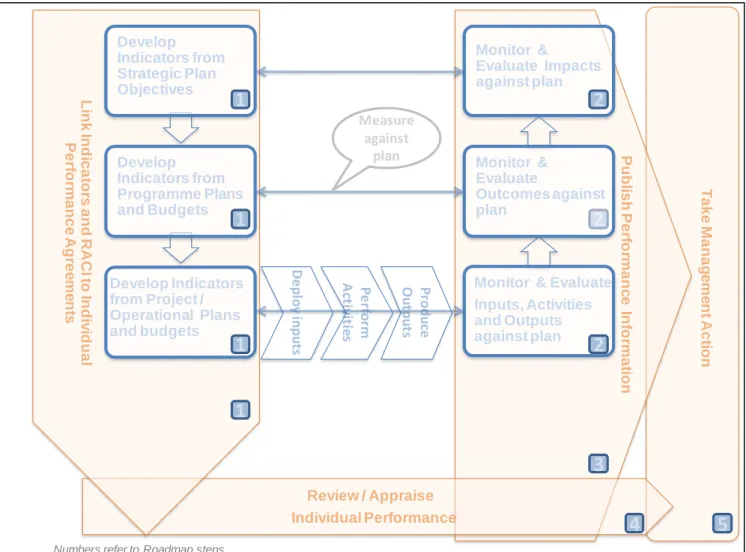
Numbers refer to Roadmap steps
P u b lis h P e rf o rm a n c e I n fo rm a tio n Review / Appraise Individual Performance L in k In d ic a to rs a n d R A C I t o In d iv id u a l P e rf o rm a n c e A g re e m e n ts T a k e M a n a g e m e n t A c tio n Monitor & Evaluate Impacts against plan Develop Indicators from Strategic Plan Objectives Develop Indicators from Programme Plans and Budgets Develop Indicators from Project / Operational Plans and budgets
Monitor & Evaluate Inputs, Activities and Outputs against plan
1
1
1
1
2
2
2
3
4
5
Measure against plan De p lo y in p u ts P e rfo rm A ct ivi tie s P ro d u ce O u tp u ts Monitor & Evaluate Outcomes against planPerformance management in this toolkit covers all matters related to financial and non-financial performance of the acquisition, refurbishment, operation, maintenance and disposal of infrastructures. Performance refers to both the performance of the organisation as well as the performance of those individuals responsible and accountable for performing and managing the work required to achieve the infrastructure related objectives of the organisation. Performance management not only includes elements traditionally seen as being monitoring and evaluation, but also includes reporting and the subsequent management action.
Performance management is not the responsibility of a single junior manager in the department’s M&E section, but it is the responsibility of each and every manager starting with the Accounting Officer and spanning across the whole infrastructure delivery chain and life cycle.
Infrastructure is a critical and fundamental input into the process of almost every aspect of service delivery. Education service delivery cannot happen without a network of school infrastructure, nor can health services be delivered without an infrastructure of clinics and hospitals, the economy cannot grow without transportation services, and so forth. However, almost more importantly, the already existing infrastructure assets must be operated and maintained so that they can perform as the service delivery input resources that they have been designed and built to be.
These assets are thus components of our service delivery system, and if any system component fails the service delivery system of the country is stressed and could fail. A very recent reminder of how catastrophic such a failure can be is the chain of events all South Africans experienced during 2008 when the electricity service delivery system was stressed. It started with overworked power generating infrastructure failing, which event triggered a chain reaction that was exacerbated by inadequate maintenance of all components of the electrical grid. In the end cities were without power for weeks not because of load-shedding, but because poorly maintained switchgear could not handle the strain of the frequent shut-down and switch-on of power.
4.5 Integrating service delivery performance management
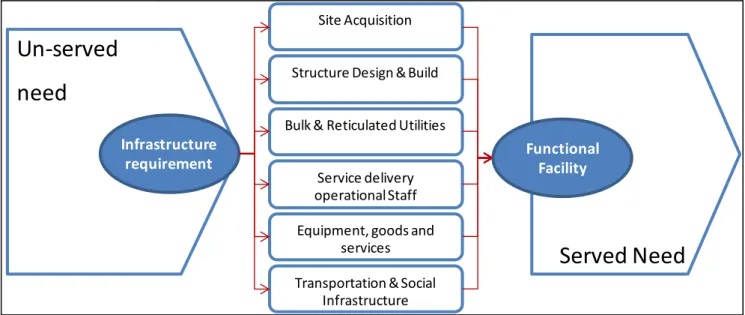
The context of performance management for infrastructure asset performance management must therefore be understood from a broader service delivery perspective. It must clearly be understood that the consequences of a performance failure in infrastructure asset delivery will affect the whole service delivery system.Performance management for the delivery of infrastructures must therefore be integrated as shown in the Figure 6 below. This illustrates how several different facets are required to come together when a new facility, such as a school or a clinic is delivered. Not only is a physical structure required, but trained personnel, with administrative support and appropriate equipment and consumables is also required. Operations and maintenance budgets and resources are needed, the site must be serviced with basic utilities and links are required to integrate the facility into transportation and other social services such as child welfare, for example.
A properly planned performance management system will ensure that a senior manager responsible for the delivery of the complete facility will have insight into the integrated performance reporting through an appropriate governance structure designed to ensure coordination so that all facets of the facility are completed and operational at the same time and that the various components are properly integrated and coordinated.
Figure 6: Performance Management to integrate service delivery
There is a danger that, if incorrectly implemented, performance management can lead to an increase in silo mentality. Therefore, in designing a new Performance Management measurement system, the organisation must establish several coordination or cooperative measures such as perhaps a teamwork index, to encourage and ensure that cross-functional harmony is achieved. Important diverse functional units and departments involved in the delivery of a facility could rate themselves on how well they interact with other units of the organisation and could in turn be rated by the other units.
Un-served
need
Site Acquisition
Structure Design & Build
Bulk & Reticulated Utilities
Service delivery operational Staff Equipment, goods and
services Transportation & Social
Infrastructure Infrastructure requirement
Served Need
Functional Facility5.
Performance Management Roadmaps
Figure 7: Performance Management Function – The highest level performance management process
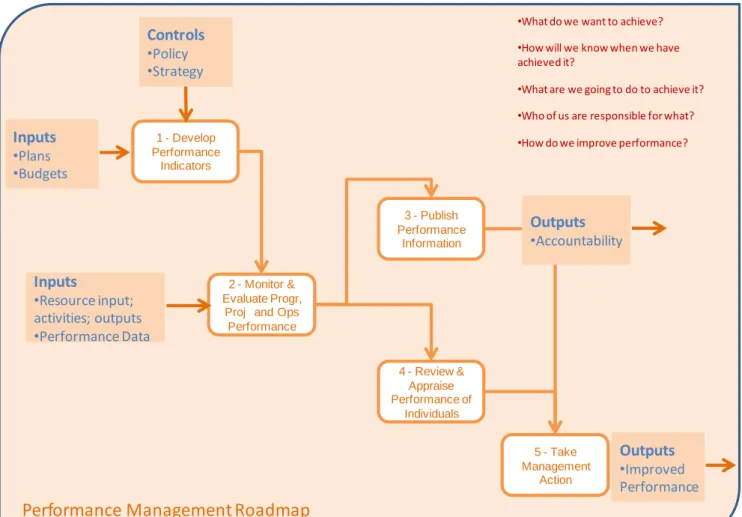
At the highest level, as shown in Figure 7 above shows that performance management is about answering the following fundamental questions, namely:
What do we want to achieve? This requires an unpacking of our strategy
How will we know when we have achieved it? This requires the development of a system of indicators to measure the performance
What are we going to do to achieve it? This requires indicators not only measuring deliverables, but also inputs and activities
Who of us are responsible for what? This requires us to link responsibilities and accountability to individuals
How do we improve performance? This requires management action after critical reflection.
The purpose of this roadmap is to guide the user in the steps necessary to perform the functions necessary to implement a performance management system for infrastructure in support of service delivery.
Expanding on the above, the high level roadmap emerges as shown in Figure 8 below.
Performance Management Function
Performance Management • What do we want to achieve?
• How will we know when we have achieved it?
• What are we going to do to achieve it?
• Who of us are responsible for what?
• How do we improve performance?
Inputs •Plans •Budgets •Resource input; activities; outputs •Performance Data Controls •Policy •Strategy Outputs •Accountability •Improved Performance Mechanisms •Performance management system
Figure 8: Performance management roadmap This roadmap shows how in:
Step 1: policy and strategy and plans and budgets are used to develop indicators complete with targets that can be used to measure performance
Step 2: measures the actual input resources, activities performed and outputs achieved, as well as other performance data sources, as needed, and produces performance information. This step is performed wherever work is performed, be it at strategic management level or down at the coalface where the real work is performed
Step 3: publishes the performance information in a variety of reports and formats as required by various stakeholders. The common factor amongst the reports is that they all report on variances, whether good or bad, between planned and actual performance. This fulfils one element of the concept of accountability, namely disclosure of results in a transparent manner.
Step 4: brings the concepts of corporate or programme performance management together with the concepts of performance management and development of the individual. This is done by using the RASCI or responsibility assignment matrices to identify individuals responsible for work components and by making available reports on the performance of those work components to managers when appraising the performance of individuals. This step closes the loop on accountability by calling individuals to account and to justify their actions and decisions
Step 5: managers complete the performance management process when they are provided with performance and decision support information showing the variance between planned and actual achieved, and they reflect on the underlying reasons and most importantly take appropriate managerial action to either reward or learn from good performance and sanction or address poor performance.
Performance Management Roadmap
1 - DevelopPerformance
Indicators
2 - Monitor & Evaluate Progr,
Proj and Ops
Performance 3 - Publish Performance Information 4 - Review & Appraise Performance of Individuals 5 - Take Management Action
•What do we want to achieve?
•How will we know when we have
achieved it?
•What are we going to do to achieve it?
•Who of us are responsible for what?
•How do we improve performance?
Inputs •Plans •Budgets Inputs •Resource input; activities; outputs •Performance Data Controls •Policy •Strategy Outputs •Improved Performance Outputs •Accountability
Each of the above steps is now presented in further detail below. The format is as follows:
Each of the highest level performance management roadmap steps are expanded upon with their own roadmaps (Roadmap steps 1 to 5).
These second level roadmap steps are again, in turn, broken down into level 3 steps as shown in the five separate roadmaps (e.g. for roadmap 1 there are six steps from step 1.1 to step 1.6.) Where necessary, these level 3 steps are expanded upon in level 4 steps described in the text below. Level 4 steps are not shown diagrammatically on roadmap diagrams.
5.1 Developing performance indicators
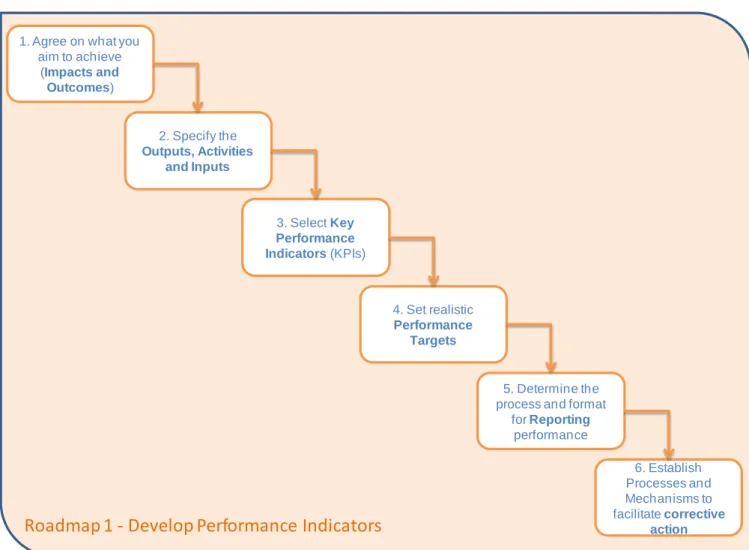
Figure 9: Roadmap 1: Develop Performance Indicators
5.1.1 Step 1.1: Agree on what you aim to achieve (Impacts and Outcomes)
The purpose of this step is to ensure an understanding of a specific strategic objective; the associated problem and its solution in order that clear outcomes and impacts can be defined in measurable terms.
Step 1.1: Understand the Strategic Objective under review
Step 1.2: Understand the associated problem or issues relating to achieving the objectives.
There can be multiple issues involved, especially at higher levels and care must be taken to apply appropriate tools and techniques such as root cause analysis and decision tree analysis as well as academic research on the subject at hand to identify the real underlying issues that need to be addressed.
Roadmap 1 - Develop Performance Indicators
1. Agree on what youaim to achieve (Impacts and Outcomes) 2. Specify the Outputs, Activities and Inputs 3. Select Key Performance Indicators (KPIs) 4. Set realistic Performance Targets 5. Determine the process and format
for Reporting performance 6. Establish Processes and Mechanisms to facilitate corrective action
Step 1.3: Understand the appropriate solutions for the identified issues
Step 1.4: Define the long term Impact Indicators mapped to and aligned with existing higher level indicators, which can verify that the strategic objectives have had the desired impact.
Examples of such high level impacts would for instance be infant mortality rates, or employment rates, or the movement per capita GDP etc. The key here is that these are long term indicators are proving that the policies and objectives are effective.
Note: in the case of a provincial department these high level impact indicators will in most cases already have been defined at a national sector or a provincial PGDS level, and can merely be verified before being incorporated into the performance management system.
Step 1.5: Define the Outcomes that will allow verification that the medium term results have been achieved for each programme and sub-programme element.
This step brings strategy closer to home, because here the infrastructure manager operates at Portfolio and Programme level. Again, in the Department the manager will inherit certain prescribed higher level indicators6. However it is crucial that appropriate programme level outcome indicators are selected. Examples are the rate of service backlog eradication or the percentage access to services, whether the infrastructure delivery rate is improving or accelerating etc.
Note: that the development of indicators is a complex exercise and will require extensive technology and specialist support to keep track of the cascading sets of indicators relating to the objectives. Designing an Integrated performance management system, supported by appropriate governance coordination structures and performance indicators that measures teamwork and cooperation can ensure increased integration of service delivery with enhanced cooperation across silos.
5.1.2 Step 2: Specify the Outputs, Activities and Inputs
The purpose of this step is to specify WHAT the institution needs to do to achieve the desired outcomes and impacts.
Step 2.1: Determine which parties (stakeholders) will be negatively or positively impacted. (Information obtained from a Stakeholder Analysis)
This exercise is essential in order to map benefits (results achieved) to various stakeholders as well as to ensure in a later step, that all stakeholders are provided with appropriate reports.
This step also covers developmental elements such as job creation, poverty reduction, EPWP indicators, gender and youth empowerment indicators and the like.
Step 2.2: What does the institution need to deliver in the short term to achieve the desired impacts and outcomes - These are the OUTPUTS
Step 2.3: What does the institution need to do in order to produce these Outputs - These are the ACTIVITIES
Step 2.4: What resources (financial, human, technology) are required by the institution to perform these activities - These are the INPUTS.
This exercise is as much a bottom up as a top down exercise. The important factor here is to ensure completeness. The information will in the majority of cases be found in the appropriate programme and project implementation and execution plans.
Defining a good performance indicator requires careful analysis of what is to be measured. One needs to have a thorough understanding of the nature of the input or output, the activities, the desired outcomes and
impacts, and all relevant definitions and standards used in the field. For this reason it is important to involve subject experts and line managers in the process.
When assessing government performance, one must consider not only the service delivery dimensions (such as quality, access, equity, timeliness) but also the financial dimensions of performance (such as effectiveness, efficiency and value for money)7.
5.1.3 Step 3: Select Key Performance Indicators (KPI’s)
The purpose of this step is to, from the complete set of indicators defined in step 2, select a key set of indicators that will be (and can be) measured.
Step 3.1: Select a potential Key Performance Indicator (KPI) and test it for its ability to communicate whether the institution is achieving its strategic objectives
Step 3.2: if the candidate KPI passes step 3.1, test it for availability of data to measure the KPI, robustness of the data (will it always be readily available), and verifiability of the data. Data must also have the ability to be "rolled-up"
Step 3.3: Repeat steps 3.1 to 3.2 until a Key set of indicators have been selected.
Step 3.4: Lower level managers will require a larger number of KPIs than higher level managers. During this step, the hierarchy of indicators are planned including how lower level KPIs will be rolled up from project / operational level to Programme level to the top level portfolio / Strategic Dashboard / balanced scorecard.
A litmus test here is to ensure that all higher level indicators are required in statuary reports (IRM etc are provided as a minimum).
5.1.4 Step 4: Set realistic Performance Targets
A realistic performance target must be set for each Key Performance Indicator. Unrealistically high targets will not be achieved and will demoralise people. Unrealistically low targets will not stretch the organisation to continuously improve and will lead to poor and underperforming individuals being fraudulently rewarded for under-performing. The targets must be set, taking into account what can be achieved innovatively but realistically by extracting the maximum efficiency and effectiveness of available resources. Business Unit / Programme targets must be aligned with targets contained in line / project / programme manager's individual Performance Agreements.
Step 4.1: Analyse and understand current base-lines (previous performance achievements) and where base-lines are appropriate given available resources, adjust these to reflect budget and agreed efficiency induced growth factors
Step 4.2: Where the analysis in Step 4.1 indicates that current baselines are reflective of severe under-performance, re-base lining is done to eliminate behaviour that leads to underperformance going forward
Step 4.3: Verify that the aggregate of lower level targets realistically rolls up to higher level targets. If not, management intervention is required to either adjust higher level targets downwards, or increase inputs available to increase production, or if in management’s opinion adequate resources are available, adjust lower level targets upward
Step 4.4: Scrutinise plans and budgets and performance indicators and targets to ensure that the Performance Management System is integrated within and across business units, Departments and the Province. Any discrepancies are identified and addressed in relevant coordination forums.
5.1.5 Step 5: Determine the process and format for Reporting performance
7
For more information on this topic, please see the Framework for Managing Programme Performance Information; May 2007, National Treasury
The purpose of this step is to design and implement a comprehensive reporting system that is fully aligned with the:
External KPI’s and the Higher level reporting requirements Internal KPI's.
Step 5.1: From the stakeholder analysis and other statutory requirements determine and map who the parties requiring reports are, also determine what if any content, frequency and format requirements exist. This is documented in a Stakeholder Reporting Analysis Document.
Step 5.2: Develop and publish a Reporting Strategy for the Department. This strategy must be aligned with the Provincial and Sector and National Reporting Strategy, e.g. when specific systems are used to report on specific programmes. The Reporting strategy will define reporting mechanisms and processes, what technologies will be used by whom and how interface issues between systems will be handled.
Step 5.3: Adjust existing reporting templates for each regular reporting recipient stakeholder and agree the format in accordance with the Reporting Strategy
Step 5.4: implement and manage the reporting processes to ensure that all reports contain the agreed contents in agreed formats and reach its intended recipients regularly at the agreed frequencies. This process is managed using a Reporting Management Control Document.
5.1.6 Step 6: Establish Processes and Mechanisms to facilitate corrective action
The objective of this step is to establish the Monitoring and Evaluation (M&E) functions in support to management at all levels to facilitate management in its obligation to take corrective actions. These actions cover the full life cycle of the delivery value chain, namely from impacts, outcomes, outputs and activities, right down to variances in respect of financial, human and technology resource inputs.
Step 6.1: Engage with the Stakeholder Reporting Analysis in step 5.1 to ensure that management's reporting requirements in respect of the Performance Management function is adequately addressed in the standard reports. If not, specific performance reports for management must be included. Note this step is performed at each level of the Department across every Department and is the responsibility of each line / project / programme / functional / portfolio / executive manager
Step 6.2: Design and document the M&E process for the Department. This process must be tightly aligned with the requirements of the Individual Performance Management cycles to ensure that all prescribed individual performance steps can be supported. These processes however do not focus only on the individual, but also on the performance of units such as projects, operational work units, programmes and sections in the department and even the whole department as a unit. The output is a documented M&E Process
Step 6.3: Establish the various forums / meetings where the M&E process can interact with the delivery units as well as management
Step 6.4: Perform the M&E function by critically reflecting on the contents of the report, identifying poor performance, analysing underlying causes for under performance, and developing solutions and proposed actions in support of the management functions
Step 6.5: after obtaining management decisions on the corrective action to be applied to the situation, follow up and ensure that such actions have been taken and monitor whether these actions are producing the desired correction in the indicators. This process is managed through a Management Decision Log
Step 6.6: If, despite regular prompting, no decision is forthcoming, the agreed escalation process is implemented to bring the matter under the attention of more senior management.
A performance management system works only if there is a mechanism to hold the responsible person accountable. The unintended consequences of choosing some measure that promotes inappropriate behaviour or malicious compliance can undermine the proposed reform. These need to be rooted out if they exist.
5.1.7 Points to consider
The “Improving Government Performance: our Approach; 2009” published by The Presidency describes a delivery strategy which contains important points to consider when defining the KPIs:
What is the sector’s service delivery chain (who does what to ensure delivery)?
Who are all the relevant role players in the service delivery chain (inside and outside government)? Who is accountable at the top and all along the delivery chain?
What critical activities and outputs are required to achieve the sector outcomes? What are the agreed norms and standards for this sector in the delivery of services?
How will budgets be prioritized to align with the service delivery agreement or savings effected in other areas which could be utilised here?
What are the timelines?
How will M&E information on activities, outputs and outcomes be reported and analysed?
Will it be early enough to permit corrective action? How will it be known that change is happening? How much capacity does the sector Ministry have to deliver? Do they require any help?
In case of disagreements or disputes, how will these be resolved? A list of all the likely blockages and the plan to solve them.
What is the role of each stakeholder in the sector, and how will they be held accountable? Evidence-based decision making is the systematic application of the best available evidence to the
evaluation of options and to decision making in management and policy settings. Evidence can come from any of the three data terrains outlined in the GWM&E system: programme performance information, evaluation and census data/ statistics – as well as from research studies and local community information.
5.2 Monitor and evaluate programme, project and operational
Figure 10: Roadmap 2: Monitor and Evaluate performance
5.2.1 Step 2.1 - Collect Work Performance Data
The purpose of this step is to collect all of the necessary work performance data and work performance information so that the performance measures can be produced.
Step 1.1: Collect information from activities such as:
o Input Status – resource availability, which resources are not available, which resources are available, which resources have completed their work
o Output status – percentage deliverables complete, actual numbers delivered, which deliverables have not started, which have started, which deliverables are completed
o Schedule progress – progress tracking on key tasks
o Cost and Expenditure reports – actual expenditure in various categories – committed, certified, paid - cash flow estimates, actual costs of work performed
Step 1.2: Collect Key Performance Indicator measurements
Step 1.3: Collect additional local management measurements as required: o Planned versus actual schedule performance
o Planned versus actual cost performance o Planned versus actual technical performance
Scope
Quality
Safety
Step 1.4: Verify for accuracy, completeness and reality checks.
Roadmap 2:
Monitor & Evaluate Programme, Project
and Operational Performance
1. Collect workperformance data and produce performance
measurements
2. Collect budget forecasts
3. Evaluate performance of projects and
programmes
4. Analyse and synthesize data into information
5. Make performance information available to reporting systems and performance functions
Monitoringinvolves collecting, analysing, and reporting data on inputs, activities, outputs, outcomes and impacts as well as external factors, in a way that supports effective management.
Evaluationis a time-bound and periodic exercise that seeks to provide credible and useful information to answer specific questions to guide decision making by staff, managers and policy makers.
5.2.2 Step 2.2 -Collect Budget Forecasts
The purpose of this step is to collect the entire relevant budget forecasting information to allow estimates of the final outturn costs and the budget over or under expenditure can be determined.
Step 2.1: Budget forecasts provides information on:
o the additional funds that are expected to be required for the remaining work o Status of the contingency management
o Estimates of final outturn costs (cost at completion)
Step 1.2: Verify for accuracy, completeness, reality checks
5.2.3 Step 2.3 - Evaluate performance
Evaluation is a time-bound and periodic exercise that seeks to provide credible and useful information to answer specific questions in order to guide decision making by staff, managers and policy makers.
Evaluation is performed through informal (internal) reviews or formal audits of the project or function being evaluated.
Step 3.1: Evaluate performance through reviews at regular (quarterly / annual) intervals or at project completion.
Step 3.2: Evaluate Programmes
o Impact or goals -based evaluation: Determine whether the programme has achieved its pre-determined objectives
o Governance review – determine to what extent the programme and its projects is complying with prescribed risk and control processes
o Outcomes or benefits evaluation – review to what extent the delivery of programme benefits have been achieved
Step 3.3: Evaluate Projects
o Governance review – determine to what extent the project is complying with prescribed risk and control processes
o Cost Review – determine to what extent the project is meeting the cost versus budget objectives
o Schedule review – determine to what extent the project is meeting the schedule objectives o Safety review – determine to what extent the project is meeting the safety objectives o Quality review – determine to what extent the project is meeting the quality objectives
Step 3.4: Evaluate Operational functions
o Governance review – determine to what extent the operations and maintenance functions are performed in compliance with prescribed risk and control processes
o Maintenance review – determine to what extent prescribed maintenance procedures are being performed on key components
o Cost and budget review – determine to what extent the operations functions meet the cost and budget objectives
o Safety review – determine to what extent the operations functions meet the safety objectives o Quality review – determine to what extent the operations functions meet the cost and quality
objectives
o Condition assessment of facilities – perform condition assessment at agreed intervals o Functional assessment of facilities and major equipment – perform functional assessments
at agreed intervals.
5.2.4 Step 2.4 - Analyse and synthesize data into information
The purpose of this step is to integrate the performance related information collected and produced in the monitor and evaluate function into data tables, various performance graphs, and calculate the performance indices.
Step 4.1: Prepare data in Key Performance Indicator formats
Step 4.2: Analyse additional local management measurements o Past performance and trends
o Variance Analysis such as Earned Value analysis.
Step 4.3: Synthesize all performance data into data repositories, such as databases or business intelligence systems
Step 4.4: Produce pivot reports and graphical analysis
Step 4.5: Verify for accuracy, completeness, reality checks
Data rich/information poor (DRIP).
Many of the current performance measures are buried in the numerous management and operational reports making it difficult for the recipients to understand and use the measures. To avoid the DRIP syndrome, the performance measurement reports should focus on the few relevant measures for the intended recipients stating the specific measurement goals and using appropriate presentation tools such as charts and storylines as appropriate.
5.2.5 Step 2.5 - Make performance information available to corporate systems
and functions
The purpose of this step is to ensure data and information compatibility across functional and departmental interfaces.
Step 5.1: Establish a KPI Dictionary to control KPI definitions
Step 5.2: Ensure data conforms to Government’s Minimum inter-operability Standards (MIOS) to ensure that performance management information systems (including spreadsheets) can interface with each other.
5.3 Publish performance information
Figure 11: Roadmap 3: Publish Performance Information
5.3.1 Step 3.1 - Develop a reporting register
The purpose of this step is to collect reporting requirements to manage the production and publication of reports.
Step 1.1: Extract reporting requirements from stakeholder management plan and legislated requirements
Step 1.2: Record report related information o Stakeholder details o Report details o Template requirements o Publishing dates o Media requirements o Delivery requirements
Step 1.3: Update Report Register monthly with changes
Step 1.4: Record all requests for ad hoc reports on Register. Check whether existing format will suffice. If repeated requests, formalise the report.
5.3.2 Step 3.2 - Develop report templates
The purpose of this step is to develop reporting templates to ensure consistent reporting across the department as well as alignment with external reporting requirements.
Roadmap 3 -
Publish Performance Information
1. Develop areporting register
2. Develop report templates
3. Produce, publish and distribute reports
5.Confirm receipt and obtain feedback
Step 2.1: Obtain current prescribed template
Step 2.2: Analyse template and determine any gaps
Step 2.3: Determine whether any new data fields are required and if so modify appropriate monitoring processes
Step 2.4: Modify template if necessary to include local performance data (without affecting required data)
Step 2.5: Record any changes in the Report Register
Step 2.6: Make configuration changes to reporting system to produce reports.
5.3.3 Step 3.3 - Produce, publish and distribute reports
The purpose of this step is to take the performance information produced in Roadmap 2, populate and publish the various reporting formats required by various stakeholders.
Step 3.1: Confirm reports required from Register
Step 3.2: Produce report from system (corporate system or local system of databases (preferable) or spreadsheets (not recommended))
Step 3.3: If ad hoc request – build new report
Step 3.4: Update tracking function on register when complete
Step 3.5: Confirm Template requirements, publishing dates, media requirements and delivery requirements from register
Step 3.6: Publish and distribute reports
5.3.4 Step 3.4 - Confirm receipt and obtain feedback
The purpose of this step is to communicate with the report recipients to confirm receipt and obtain any feedback.
Step 4.1: Confirm receipt in writing and record on report register
Step 4.2: Record any feedback received in writing
Step 4.3: Communicate feedback received to appropriate projects or functional units.
Performance information is essential to focus the attention of the public and oversight bodies on whether public institutions are delivering value for money, by comparing their performance against their budgets and service delivery plans, and to alert managers to areas where corrective action is required.
5.4 Review and appraise performance of individuals
Figure 12: Roadmap 4: Review and appraise performance of individuals
5.4.1 Step 4.1 - Develop and maintain Master Responsibility Assignment Matrix
and provide performance information to HR function
The purpose of this step is to provide the Human Resources (HR) function with information on which individuals are responsible and accountable for which programmes and projects so that the benefits, goals and objectives (in the form of impact, outcome, output, activity and input indicators) of the programmes and projects can be linked (mapped) to the individual's - performance agreement.
NOTE: The need for this step to be placed with a centralised function, such as HR, is because Departments are matrixed organisations with individuals simultaneously performing different roles on projects and functional assignments.
Step 1.1: Obtain Responsibility Assignment Matrix (RASCI or other format) information from programmes, projects and asset management operations and maintenance functional units
Step 1.2: Integrate into a master Responsibility Assignment Matrix (RASCI or other format) to map individuals to programmes, projects and asset management operations and maintenance functional responsibilities
Step 1.3: Coordinate with Individual Performance Management and Development (PM&D) cycle and provide information in respect of individual’s Responsibilities, Accountability, and Authority to the appropriate HR function for inclusion in Individual’s formal Performance Agreement as an addendum
Step 1.4: Track and maintain changes.
Roadmap 4 -
Review & Appraise Performance of Individuals
1. Develop and maintain Master Responsibility Assignment Matrix 2. Provide Responsibility assignment information to HR 3. Provide Performance Information to HR function 4. Provide Management with performance management information
5.4.2 Step 4.2 - Provide Individual Performance Information to HR function
The purpose of this step is to provide programme, project and operational functional performance inputs into the formal Departmental Performance appraisal cycle of individuals as prescribed by the DPSA
Step 2.1: Provide HR function with information on project and programme reporting lines
Step 2.2: Provide the appropriate HR function with performance Information related to programmes, projects and asset management operations and maintenance activities as input into the individual performance appraisal process.
5.4.3 Step 4.3 - Provide Management with performance management
information
The purpose of this step is to provide information on performance variance from baselines (time, scope, cost, quality etc.) to managers to empower them to take the necessary corrective, preventative or defect repair actions as appropriate.
Step 3.1: On an ongoing basis, provide the appropriate top, senior and functional managers responsible for Capital Programmes and Projects as well as Infrastructure management operations with appropriate decision support information to enable management to take appropriate managerial action.
5.5 Take management action
Figure 13: Roadmap 5: Take management action
Roadmap 5 -
Take Management Action
1. Obtain and study performance related information and critically
reflect on root causes of good and bad performance
2. Extract and disseminate learning from good performance to improve
performance
3. Take appropriate action to address causes of poor