stage of growth development of bitterbrush, t h e duration of favorable growing conditions after spraying, and the size of bitterbrush p 1 a n t s. Although various phenological stages of development are not always con- sistent among sites, it appears that the proper timing for spray- ing mixed stands of big sage- brush and bitterbrush on dry sites is indicated by the appear- ance of (1) new leaves on big sagebrush and bitterbrush and (2) heads on Sandberg bluegrass (Hyder and Sneva, 1955). Spray- ing may then continue until bitterbrush is in flower.
Summary
The results of spraying mixed stands of big sagebrush and bitterbrush with 2,4-D and 2,4,5- T provide a guide for moderately successful selective control of big sagebrush on dry sites. These two herbicides were applied at 1.5 and 3.0 lb/A on six dates each in 1958 and 1959. Their effects w e r e evaluated by mortality counts and crown reduction es-
SELECTIVE CONTROL
timates.
An ester of 2,4-D was slightly more selective for big sagebrush than 2,4,5-T ester, and may be applied at recommended rates (1.5 to 2.0 lb/A) for the selective control of big sagebrush under the limitations imposed by (1) the stage of growth development of bitterbrush, (2) the duration of favorable growing conditions after spraying, and (3) the size of bitterbrush plants.
Delaying spraying progressive- ly from the time of leaf appear- ance until early fruit develop- ment of bitterbrush resulted in greater 2,4-D damage. Spraying at any time killed virtually all leaf tissue and current twig growth of bitterbrush; however, spraying at the time of leaf origin and before the appearance of distinct twig elongation or flowers left only a small amount of dead tissue on large plants. Subsequently, d o r m a n t buds initiated new growth, and in the autumn only slight evidence of spray i n j u r y remained. The amount of growth attained from
215
dormant buds depended upon the duration of favorable grow- ing conditions after spraying. In contrast to 1 a r g e bitterbrush, those less than 12 inches tall were killed consistently.
The proper timing for spraying mixed stands of big sagebrush and bitterbrush on dry sites is indicated by the appearance of (1) new leaves on big sagebrush and bitterbrush and (2) heads on Sandberg bluegrass. Spraying may then continue until bitter- brush is in flower.
LITERATURE CITED BLAISDELL, JAMES P. AND WALTER F.
MUEGGLER. 1956. Effect of 2,4-D on forbs and shrubs associated with big sagebrush. Jour. Range Mangt. 9: 38-40.
HYDER, D. N. AND F. A. SNEVA. 1955. Effect of form and rate of active ingredient, spraying season, solu- tion volume, and type of solvent on mortality of big sagebrush, Artemisia tridentata. Oregon Agri- cultural Exp. Sta. Tech. Bul. 35, I6 PP.
. 1960. Spraying for big sagebrush in stands of bitterbrush. 1960 Research Progress Report, Western Weed Control Conference.
A Comparison of Methods of Renovating Old
Stands of Crested Wheatgrass
RUSSELL J. LORENZ AND GEORGE A. ROGLER Research Agronomists, Crops Research Division, Agri- cultural Research Service, U.S. Department of Agricul- ture, U.S. Northern Great Plains Field Station, Mandan, North Dakota.
A method of economically increas- ing production from many acres of old, low-producing crested wheat- grass would be of great benefit to livestock producers throughout the West. Various renovation methods have been tried and reported in the literature; however, little has been reported on comparison of methods involving partial or complete de- struction of the old stand with methods which retain a degree of soil protection by not removing the existing stand. Results of a study comparing various renovation meth- ods are presented here.
Review of Literature
After studying the effects of var- ious tillage implements including
the disk, one-way, heavy-duty cul- tivator, and Noble blade, Knowles (1956) recommended plowing un- productive crested wheatgrass stands, cropping for a few years, and and then reseeding to a grass-al- falfa mixture. Double one-waying was the best tillage treatment. It resulted in l/3 of a ton per acre in- crease in hay yield, which would not pay for the cost of the treat- ment. Furthermore, all tillage im- plements left the fields rough and difficult to mow.
Houston (1957) reported an in- crease in forage production from 50 pounds of N in the year of applica- tion, but residual response was small and 2 years after application little or no increase in yield was ob-
tained. Moderate disturbance of the stand by springtooth harrowing had little effect on forage production although seed production was re- duced the year of treatment. Double disking or plowing and reseeding decreased forage and seed produc- tion and increased weed growth in the first year. Two years after plowing and reseeding, the stand was near optimum density and pro- duction was increased slightly.
Lodge (1960) reported a reduction in first year forage yield from mow- ing, burning and double disking, but forage harvested from burned treat- ments contained no previous sea- son’s growth; thus the total ma- terial suitable for grazing was greater on the fall-burned than on the check treatment.
Seamards and Lang (1960) con- cluded that addition of N to old stands of crested wheatgrass would increase production if soil moisture was available during the season of growth of crested wheatgrass.
practical on the Oregon high desert as reported by Sneva et al. (1958). By June 1 of each year herbage yields were doubled when 30 pounds of N was added. Limited soil mois- ture in any one year increased the residual response the following year. Eckert et al. (1961) reported a response to N but they concluded that fertilization at the rates and with materials used would not be practical in the 8- to 12-inch pre- cipitation sites studied in Nevada.
Procedure
A renovation study was initiated at Mandan, North Dakota, in 1949 to evaluate various methods of in- creasing production from an old stand of crested wheatgrass (Agro- pyron desertorum (Fisch.) Schult.) . The area selected for study was seeded to crested wheatgrass in 1932 and was grazed each spring beginning in 1933. The vigor of the grass decreased with increasing age, and as fringed sage (Artemisia frigida Willd.) invaded the stand. This resulted in very low forage production and reduced livestock carrying capacity.
common yellow sweet clover at 8 pounds per acre, (5) scarification plus application of 60 pounds of P205 per acre each fall, (6) scarifi- cation plus application of 30 pounds of nitrogen per acre (30-N) each fall, (7) 30 pounds of nitrogen per acre (30-N) each fall, (8) 60 pounds of nitrogen per acre (60-N) each fall, (9) spring plowing followed by a corn crop and reseeding crested wheatgrass in the fall of 1949, and
(10) spring plowing followed by summer fallow and reseeding crested wheatgrass in the fall of 1949.
Each of the following treatments was replicated 3 times in 12- by 30- foot plots: (1) no treatment (check),
(2) tearing up sod to a depth of 3 inches with a heavy field cultivator with shanks 9 inches apart and shovels 3 inches wide to kill about l/3 of the existing plants on April 13, 1949 (scarification), (3) scarifi- cation followed by seeding Ladak alfalfa at 8 pounds per acre, (4) scarification followed by seeding
A sickle-bar mower which left 1.5 inches of stubble was used to harvest the forage for hay each year when the crested wheatgrass was in flower. The samples were sep- arated to determine the percentage grass and sage (and legume when included in the treatment). When the air-dried hay samples were weighed, subsamples were oven- dried at 72 degrees C. for about 48 hours and forage yields in pounds of hay (grass or grass plus legume) per acre were calculated at la-per- cent moisture.
To determine the effect of weed competition on forage production, half of each plot was sprayed with 2.5 pounds acid equivalent of 2,4-D per acre as low-volatile ester on June 18, 1958. A 4- by 12-foot sheet of pressboard was used to reduce drift to the unsprayed half of the plot. On the same date, a 75-foot strip of the 1932 crested wheatgrass pasture was sprayed with 2.7 pounds
acid equivalent of 2,4-D ester in 12 gallons of water per acre . To mea- sure the effect of removal of fringed sage on forage production, 6 paired areas were caged on the sprayed and nonsprayed portions of the pasture during the grazing periods of 1959, 1960, and 1961.
The soil type in the experimental area is Eakin silt loam. The 45-year
(1915-60) annual precipitation aver- aged 15.81 inches with a seasonal (April-August) average of 11.04 inches. April through September evaporation from a free-water sur- face averaged 32.65 inches with a 136-day average frost-free period.
Resulfs And Discussion
First Year
When comparing methods of re- novation involving various degrees of destruction of the old sod, the first consideration should be the im- mediate effects of the treatment. Plowing plus preparation of a seed- bed for reseeding grass resulted in complete removal of the grass cover. Erosion of topsoil by wind or water is possible and in many instances very probable. Loss of 2 years’ production is usually involved in plowing and reseeding; however a portion of this loss can be eliminated by growing an annual crop and re- seeding the grass in the fall after the crop has been removed. Corn used in treatment 9 of this study produced 5241 pounds of stover per acre the year the sod was plowed.
Tearing up the sod in early spring to reduce the plant population (scar- ification) reduced yields the year
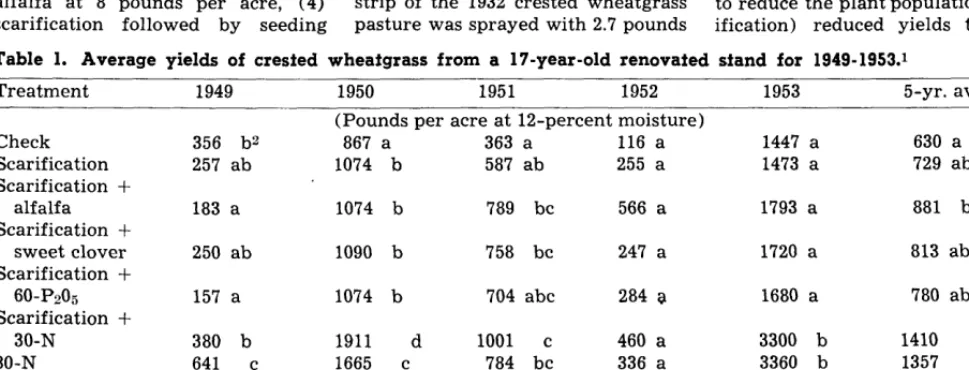
Table 1. Average yields of crested wheatgrass from a 17-year-old renovated stand for 1949-1953.1
Treatment 1949 1950 1951 1952 1953
(Pounds per acre at 12-percent moisture)
5-yr. av.
Check Scarification Scarification +
alfalfa Scarification +
sweet clover Scarification +
6O-P2O5 Scarification +
30-N 30-N 60--N
Plowed + corn Plowed + fallow
Average
356 b2
257 ab 1074 b 867 a
363 a 587 ab
183 a 1074 b 789 bc
250 ab 1090 b 758 bc
157 a 1074 b 704 abc
380 b 1911 d 1001 c
641 c 1665 c 784 bc
907 d 2195 e 1795 d
3
___._. _-._.. 1935 d
_____. _-._.. 2882 e
313 1095 1160
116 a 255 a
566 a
247 a
284 a
460 a 336 a 503 a 448 a 376 a 359
1447 a 1473 a 1793 a 1720 a 1680 a
3300 b 3360 b 4013 c 1733 a 1860 a 2238
630 a 729 ab
881 bc
813 ab
780 ab
1410 d 1357 d 1883 e
823 b 1024 c 1033 1 Each value is the mean of 3 replications.
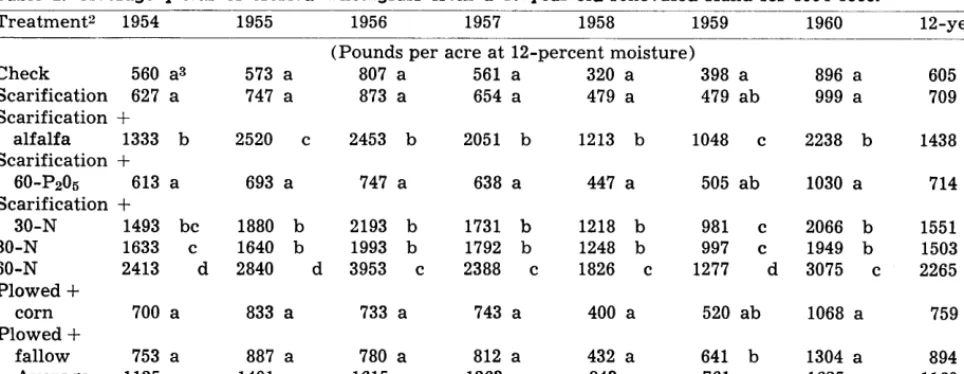
Table 2. Average yields of crested wheatgrass from a 17-year-old renovated stand for 1954-1960.1
Treatment2 1954 1955 1956 1957 1958 1959 1960 12-year av.4
(Pounds per acre at 12-percent moisture)
Check 560 a3 573 a 807 a 561 a 320 a 398 a 896 a 605 a
Scarification 627 a 747 a 873 a 654 a 479 a 479 ab 999 a 709 a
Scarification +
alfalfa 1333 b 2520 c 2453 b 2051 b 1213 b 1048 c 2238 b 1438 c
Scarification +
6O-PsO6 613 a 693 a 747 a 638 a 447 a 505 ab 1030 a 714 a
Scarification +
30-N 1493 bc 1880 b 2193 b 1731 b 1218 b 981 c 2066 b 1551 c
30-N 1633 c 1640 b 1993 b 1792 b 1248 b 997 c 1949 b 1503 c
60-N 2413 d 2840 d 3953 c 2388 c 1826 c 1277 d 3075 c 2265 d
Plowed +
corn 700 a 833 a 733 a 743 a 400 a 520 ab 1068 a 759 ab
Plowed +
fallow 753 a 887 a 780 a 812 a 432 a 641 b 1304 a 894 b
Average 1125 1401 1615 1263 843 761 1625 1160
1 Each value is the mean of 3 replications.
2 Scarification + sweet clover discontinued after 1953.
3 Within each column, means followed by the same letter do not differ significantly (5%) (Duncan 1955). 4 Includes 1949-1953 data from table 1.
of treatment, 1949 (Table 1). Two of the 5 scarification treatment means were significantly lower than the mean of the check, and difference between mean yields of each of the remaining 3 scarification treatments and the check were not significant. Application of N to undisturbed sod was the most effective means of increasing yields in the first year of treatment. Each increment of N pro- duced a significant yield increase. Aplication of 30-N to undisturbed sod increased the yield by 9.5 pounds per pound of N applied or 285 pounds per acre; however, 30-N applied to scarified sod did not in- crease the yield significantly over that of the check in the first year. On undisturbed sod, the 60-N treat- ment was almost as efficient as the 30-pound rate. It produced 9.2 pounds of forage per pound of N, or 551 pounds more than the 356- pound average for the check. .
Second Year
In 1950, the second harvest year all plots scarified in 1949 produced significantly more than the check; however, the addition of a legume to scarified sod did not produce the expected increase in yield. The alfalfa plants were small and lacked vigor. The sweet clover flowered, but it also lacked vigor. Only 5 per- cent of the stand of each plot con- taining alfalfa or sweet clover was estimated to be legume on June 30, 1950.
Application of phosphorus follow- ing scarification had no effect on
yield but 30-N increased the yield and it produced significantly more when applied to scarified rather than to undisturbed sod. As in the first year, the plots receiving 60 pounds of N were most productive, yielding 1328 pounds more than the check, an increase of over 22 pounds of forage per pound of N applied.
Yields were not taken from the plowed and reseeded plots in 1950; however, it was evident that the grass seeded in the fall of 1949 was more vigorous and grew more rapidly on the fallowed plots than on those cropped with corn in 1949.
Third Year
In 1951, the third year of study, the plowed-fallowed-and-reseeded plots produced 2882 pounds of herb- age per acre, significantly more than any other treatment. Comparison of the 2 treatments plowed in 1949 shows a 947-pound yield advantage for the fallow over the corn system. The value of fallow was evident during establishment of the seed- lings and in the herbage yields the harvest year. The annual precipita- tion in 1949, 1950, and 1951 was 16.29, 19.30, and 20.31 inches, re- spectively, all above the long-time average. The moisture advantage of fallow would be of even greater value in establishing grass during years of below-normal precipitation.
Response to scarification was less in 1951 than in 1950. Scarification alone and with phosphorus was no better than no treatment; however, scarification plus legume or plus
30-N produced significantly more than the check. About 8 percent of the stand was alfalfa, but it con- tributed little to the forage produc- tion. No sweet clover was found in 1951.
Fourth and Fifth Years
The 2 years with extremes in precipitation and herbage produc- tion during the la-year period oc- curred in succession. Precipitation was far below normal in 1952, with only 10.25 inches, and far above normal in 1953, with 21.76 inches. Lack of moisture in 1952 resulted in an average yield of only 359 pounds per acre with no significant dif- ference between means (Table 1). In contrast, yields were unusually high in 1953, averaging 2238 pounds per acre. As would be expected with an abundance of moisture, the N plots produced the most. Yields from the 30-N plots were signifi- cantly higher than those of any of the plots not receiving N; and 60-N produced significantly more than either of the 30-N treatments. Thirty pounds of N produced an in- crease of over 60 pounds of herbage per pound of N applied on both the scarified and undisturbed sod. Sixty pounds of N on undisturbed sod produced only 43 pounds of addi- tional herbage per pound of N.
Table 3. Average yields for sprayed1 and nonsprayed plots of 8 treatments of a la-year crested wheafgrass re- novation study.2
Treatments
Check Scarification Scarification +
6O-PsO5 Scarification +
30-N 30-N 60-N
Plowed + corn Plowed + fallow
Average
Sprayed
701 a4 950 ab
1959 1960 a-year av.
Nonsprayed Sprayed Nonsprayed Sprayed Nonsprayed
(Pounds per acre at 12-percent moisture)
398 a 1132 a 896 a 917 a 647 a
479 ab 1356 b 999 ab 1153 ab 739 a
1091 ab 505 ab 1242 ab 1030 ab 1167 b 768 ab
1718 c 981 c 2128 c 2066 c 1923 c 1524 c
1349 bc 997 c 2186 c 1949 c 1768 c 1473 c
1681 c 1277 d 2986 d 3075 d 2333 d 2176 d
1182 ab 520 ab 1400 b 1068 ab 1291 b 794 ab
1007 ab 641 b 1256 ab 1304 b 1132 ab 973 b
1210 725 1711 1548 1461 1137
i Sprayed with 2.5 lbs. acid equivalent of 2,4-D ester on June 18, 1958. 2 Each value is the mean of 3 replications.
s Treatments containing legume omitted from this part of the study.
4 Within each column, means followed by the same letter do not differ significantly (5%) (Duncan 1955). 1953, which was larger than the
majority of the renovation treat- ment means during the previous 4 years.
Five-year Average
Several factors influenced the average yield for the first 5 years of this study. Normally the first in- crease in yield through effective rejuvenation of an old stand of grass would be expected to be the largest if climatic conditions are conducive to normal plant growth. Annual precipitation in 1949 and 1950 was 16.29 and 19.30 inches. Increases in yield from 1949 to 1950 were 144 percent for the check and ranged from 318 to 584 percent for the scarification treatments without N. Scarification was effective in in- creasing yields significantly above those of the check in the year after treatment although yields of scari- fied plots had been no better than or less than those of the check in the first year. Application of N had a different initial effect on yield. A 155-percent increase in yield was obtained in the year of initial ap- plication of 60-N, and another 153- percent increase was obtained the second year of application. This re- sulted in a 142-percent increase in yield for the 60-N treatment from 1949 to 1950 compared with 144 per- cent for the check. Thus, other growth factors being the same for both treatments, the application of 60 pounds of N in 1950 was as ef- ficient in increasing yields as was the 60-pound rate applied to the same plots in the previous year.
Plowing and reseeding produced still another initial response to treatment. Yields the first harvest year were very high, the mean yield of the plowed plus fallow treatment significantly exceeded the mean of the 60-N treatment. How- ever, the following year (1952) was the driest of the 12 years, with only 10.25 inches of precipitation, and yields of all treatments were ex- ceptionally low. In the first har- vest year the fallow plots had pro- duced significantly more than those cropped in 1949, but fallow showed no advantage in 1952 or in 1953, the year of highest precipitation (21.76 inches) during the study.
Drought, above-normal precipita- tion, and variation in initial response to various treatments are all re- flected in the 5-year average. Scari- fication alone, with sweet clover, and with phosphorus produced no more than the check. The addition of alfalfa, sweet clover, or phos- phorus to scarified sod produced no more hay than scarification alone. Application of 30 pounds of N on scarified sod produced significantly more than any of the other scarifi-
cation treatments, but it was no better than 30-N on undisturbed sod for the 5-year period. The loss of 2 years’ production by plowing and reseeding reduced the average yields for these treatments and their 5- year production was no better than that of the scarification treatments. By far the best yields of the 5-year period were obtained by application of N. The 60-N treatment produced significantly more than the 30-N treatment.
Years Six Through Twelve During the last 7 years of the study the year-to-year yield pattern for the various treatments was very similar. The scarification plus sweet clover treatment was discontinued after 1953 because there had been no sweet clover in the plots since 1950 and the legume had no effect on the yield. Mean yields of the scarified, scarified p 1 u s phosphorus, and plowed plus corn treatments did not differ significantly from those of the check during this period, and the plowed plus fallow mean yield sig- nificantly exceeded that of the check in 1959 only (Table 2). The few alfalfa plants established in the Table 4. Average yields from sprayed1 and nonsprayed portions of an old
crested wheafgrass pasture.2
Year Sprayed Nonsprayed Increase
(Pounds per acre at 12 per-moisture) Percent
1959 1604 1004 600 60
1960 2502 1554 948 61
1961 1482 1002 480 48
1 Sprayed with 2.6 lbs. acid equivalent of 2,4-D ester on June 18, 1958. 2 Each value is the mean of 6 caged areas in 1959 and 1960 and 5 caged areas
scarification plus alfalfa plots be- came very large. Their contribution to the total yield was out of propor- tion to their population, thus this treatment often yielded as much as the 30-N treatments.
As in the first 5 years of the study, the application of N was the most effective method of increasing yield. Each year 60-N produced signifi- cantly more than either of the 30-N treatments.
Fringed sage re-invaded the plowed and reseeded plots rapidly after 1953. In 1956 over half of the material harvested from the plowed, scarified, and check plots was fringed sage. The weight of fringed sage from the plots receiving N actually exceeded the amount from the plots of the other treatments, but the in- crease in forage production due to the application of N resulted in a relatively lo w e r percentage sage from the N plots.
Twelve-year average
Application of 60 pounds of N annually was the most effective means of increasing production over the la-year period. The average yield of 2265 pounds per acre for the 60-N treatment exceeded the 30-N yield by an average of 762 pounds and furnished a return of 25 pounds of additional herbage per pound of N applied in the second 30-pound in- crement. The average yield of the 60-N treatment exceeded the check yield by 1660 pounds per acre, or an additional 28 pounds per pound of N applied.
Scarification plus alfalfa was the only treatment not receiving N to have a 12-year average yield of over 900 pounds per acre.
Fringed sage control
Perfect control of fringed sage was obtained by spraying with 2,4-D June 18, 1958. Yields of sprayed and nonsprayed halves of plots of each treatment harvested for 2 years are shown in Table 3. Differences be tween sprayed and nonsprayed means were highly significant for each year and for the 2-year aver- age. The interaction of treatments with spraying was not significant for the 1959 data or for the 2-year aver- age, but it was significant for the 1960 data. In 1959 and 1960, spraying increased yields by an average of 67 and 10 percent, respectively. Re- moval of the competition for mois-
ture offered by the fringed sage may have been more beneficial in 1959, a year of below-normal precipita- tion (11.97 inches), than it was in 1960, when precipitation was near normal (14.98 inches). Yields of the nonsprayed areas in 1960 averaged more than twice those in 1959.
Three years’ data from paired cages in the 1932 crested wheatgrass pasture showed a marked yield re- sponse to removal of the fringed sage (Table 4). The yields were all higher than those of the plot study presented in table 3 because the paired cages were clipped by hand at the soil surface. Removal of the fringed sage increased the herbage production by 2028 pounds over a S-year period. The percentage in- crease in yield was less in 1961 than it was in the 2 previous years. A natural decrease in fringed sage oc- curred in 1961; thus competition in the nonsprayed area was less. The percentage sage in the nonsprayed areas averaged 19, 21, and 8 percent in 1959, 1960, and 1961, respectively.
Summary
Ten renovation treatments involv- ing complete, partial, and no de- struction of the old sod were com- pared on a 17-year-old crested wheatgrass pasture for 12 years.
Killing % of the grass plants by scarification with a field cultivator resulted in a decrease in production the year of treatment and an in- crease in production 1 year after treatment. Y i e 1 d increases from scarification were not significant for the remainder of the 12-year period. Application of phosphorus or seed- ing sweet clover on scarified sod showed no advantage over scarifica- tion alone. Alfalfa seeded on scari- fied sod was very slow to become established, but after the fifth year following seeding the alfalfa, this treatment produced more forage than scarification alone.
Killing all the old plants by plow- ing and reseeding resulted in very high yields the second year after reseeding the grass; however, two years of production were lost in establishing the new stand and the new stand rapidly declined in pro- ductivity. This method had very 1 i t t 1 e long-time advantage over scarification. Growing corn rather than fallowing the plowed sod sup- plied a crop for one of the two pro- duction years lost during reseeding,
but the first hay crop and the total production for the first 3 harvest years were significantly decreased when the corn crop was grown.
The outstanding renovation treat- ment was application of N to undis- turbed sod. Yields were significantly increased by each of the two 30- pound increments of N in each year, including the first year of applica- tion, except in the drought year of 1952. Yields of the 30- and 60-N treatments averaged 2.5 and 3.7 times those of the check for the 12-year period. Scarification before application of 30-N produced no more herbage during the 12-year period than 30-N applied to un- disturbed sod.
Removal of the fringed sage by s,p r a y i n g significantly increased yields from all treatments.
The results of this study indicate that a combination of weed control and nitrogen fertilization should be an effective means of renovating low-producing crested wheatgrass stands containing a fair to good stand of low-vigor plants in areas having enough soil moisture during the spring to promote active growth of the grass.
LITERATURE CITED DUNCAN, D. B. 1955. Multiple range
and multiple F tests. Biometrics 11: l-42.
ECKERT, RICHARD E. JR., A. T. BLEAK, AND Jos. H. ROBERTSON. 1961. Ef- fects of macro- and micronutri- ents on the yield of crested wheat- grass. Jour. of Range Mangt. 14: 149-155.
HOUSTON, WALTER R. 1957. Renova- tion and fertilization of crested wheatgrass stands in the Northern Great Plains. Jour. of Range Mangt. 10: 9-11.
KNOWLES, R. P. 1956. Crested wheat- grass. Canada Dept. of Agri. Pub. 986.
LODGE, ROBERT W. 1960. Effects of burning, cultivating, and mowing on the yield and consumption of crested wheatgrass. Jour. of Range Mangt. 13: 318-321.
SEAMARDS, WESLEY J. AND ROBERT LANG. 1960. Nitrogen fertilization of crested wheatgrass in south- eastern Wyoming. Univ. of Wyo- ming Agri. Exp. Sta. Bul. 364. SNEVA, FORREST A., DONALD N. HY-