is an open access repository that collects the work of Arts et Métiers ParisTech researchers and makes it freely available over the web where possible.
This is an author-deposited version published in: https://sam.ensam.eu Handle ID: .http://hdl.handle.net/10985/10696
To cite this version :
Mehdi EL AMINE, Jérôme PAILHES, Nicolas PERRY - Selection and use of a multi-criteria decision aiding method in the context of conceptual design with imprecise information: Application to a solar collector development - Concurrent Engineering: Research and Applications - Vol. 24, n°1, p.35-47 - 2016
Any correspondence concerning this service should be sent to the repository Administrator : [email protected]
decision aiding method in the context
of conceptual design with imprecise
information: Application to a solar
collector development
Mehdi El Amine, Je´ro
ˆ me Pailhe`s and Nicolas Perry
Abstract
Making decisions on a sound basis in early phases is one of the most difficult challenges in the product development pro-cess, especially when dealing with immature concepts. Moreover, life-cycle cost can be influenced up to 70% by decisions taken during the conceptual design phases. The need for reliable multi-criteria decision aiding methods is thus greater in these phases. Various multi-criteria decision aiding methods are proposed and used in the literature. The main criticism of these methods is that they usually produce contradictory results for the same problem. In this work, seven widely used multi-criteria decision aiding methods (weighed sum, weighted product, Kim and Lin, compromise programming, TOPSIS, quadratic mean and ELECTRE I) are analysed. This analysis was based on a real industrial case to develop a solar collector. The proposed multi-criteria decision aiding methods were compared in terms of three criteria deemed rele-vant in the relerele-vant context: (1) adaptation of the type of results the multi-criteria decision aiding method is expected to bring, (2) correct handling of input information and (3) adaptation of the degree of compensation. Based on these cri-teria, it was proven that weighted product is the most appropriate multi-criteria decision aiding method in our case. In addition, it has been demonstrated that sensitivity analysis can improve the benefit of using the multi-criteria decision aiding method chosen when dealing with imprecise information due to immaturity of concepts.
Keywords
conceptual design phase, multi-criteria decision aiding methods, concept maturity, imprecision, sensitivity study
Introduction
Decision support was first proposed by Nobel Prize winner Herbert Simon in the 1960s (Simon, 1960). Broadly speaking, decision-making is conducted in four steps: (1) identifying the problem, (2) generating design concepts, (3) evaluating design concepts via evaluation schemes and (4) selecting the best concept. The research community in decision support methods usually recog-nizes that the most critical step in the decision-making process is how to choose among a given number of design concepts (step (4)). The ability of decision-makers (DMs) to make the best choice is strongly con-ditioned by two factors: (1) having a clear definition of design objectives and requirements and (2) being able to evaluate or predict the performance of the proposed concepts against these objectives and requirements. However, imprecisions and vagueness are inherent in
engineering design and they affect both design objec-tives and concepts evaluation schemes. This is particu-larly true in the conceptual design phases. Paradoxically, life-cycle cost can be influenced up to 70% by decisions taken during these phases (Zimmer and Zablit, 2001). It is thus very important to adopt appropriate theories and methodologies to structure and ease the decision-making process. This can signifi-cantly reduce product development lead-time as well as the amount of human and material resources involved in the development process.
Arts et Me´tiers ParisTech, I2M – UMR 5295, Talence, France
Corresponding author:
Mehdi El Amine, Arts et Me´tiers ParisTech, I2M – UMR 5295, F-33400 Talence, France.
Multi-criteria decision-making process can be decomposed into three principal steps (Guitouni and Martel, 1998): (1) observation, when data are col-lected about each concept (mass, maximum stress, car-bon footprint, etc.), (2) interpretation, when DMs express their preferences for each design criterion on the basis of the data collected in the observation step and (3) aggregation, when DMs combine the interpre-tation step outcomes for the different design criteria in order to determine the best concept(s). This process represents the natural way of human thinking when confronted with a multi-criteria decision problem. However, when the DM is facing a complex decision-making problem (with many concepts and many cri-teria), it becomes difficult for him to intuitively follow this process, especially to combine information in an appropriate way. Multi-criteria decision aiding (MCDA) methods can be used to aid in multi-criteria decision-making.
Various MCDA methods are proposed and adopted by researchers and engineers to support decision-making in engineering design. Choosing the ‘right’ MCDA method to compare multiple concepts is a cru-cial issue since these methods may yield contradictory results for the same problem (Guitouni and Martel, 1998; Mahmoud and Garcia, 2000; Triantaphyllou and Lin, 1996; Zanakis et al., 1998). There are two families of MCDA methods: (1) multi-criteria selection meth-ods, where interpretation step outcomes are taken into account simultaneously to compare initial concepts, and (2) the family of multi-attribute utility theory (MAUT) methods, that consists of aggregating the dif-ferent interpretation step outcomes into a single attri-bute of evaluation, which has to be maximized. In this study, this numerical attribute is called the overall pre-ference value (OPV). It reflects the overall utility of the design concept. The multi-criteria decision problem is thus transformed into a mono-criteria decision prob-lem. In the case of MAUT methods, the interpretation step is formalized by associating a numerical attribute to each objective to express its level of satisfaction. In this article, this attribute is called local preference value (LPV) and is comprised between 0 and 1. The closer a LPV is to 1, the more satisfied is the corresponding objective.
The main objective of this article is to identify the relevant criteria to consider when selecting a MCDA method in the context of decision-making in conceptual design phase. The second objective is to investigate the benefit of using a sensitivity study with a MCDA method to deal with imprecise information due to the immaturity of initial concepts. In order to illustrate the proposed approach, many MCDA methods are evalu-ated and compared in a real industrial case.
State of the art
Stewart (1992) produced a theoretical review by identi-fying pitfalls in using various MCDA methods. He con-cluded that in selecting an appropriate method to use, the following desiderata must be identified: (1) the input information required from the DM should be opera-tionally meaningful and free from ambiguities of mean-ing, (2) the translation of this input information into partial or complete recommendations should be consis-tent with the input information used and with reason-able behavioural assumptions, and should be as far as possible transparent to the DM, and (3) the method should be simple and efficient to use. Ozernoy (1988) proposed a MCDA expert system to guide the DM in selecting an appropriate method. This system uses a database containing the different MCDA methods with their characteristics. To select an appropriate method, the system matches the characteristics of the decision-making situation with those of the MCDA method. These characteristics fall into three categories: charac-teristics of the decision problem, characcharac-teristics of the DM and resource constraints. A similar system was used by Sun et al. (2012) for an aircraft conceptual design process. Based on the analysis of different MCDA methods and the review of the psycho-cognitive literature, Guitouni et al. (1998) proposed six guidelines to help DM choose a MCDA method. The proposed guidelines are as follows: adaptation of the type of results produced by MCDA method, correct handling of input information, appropriateness of the degree of compensation of the method, respect for the fundamen-tal hypothesis of the method, adaptation of the decision support system that accompanies the method and adap-tation of the preference elucidation mode with DM cognition.
These studies propose some relevant criteria to con-sider when selecting a MCDA method. However, they do not give the order in which these criteria should be considered or even their relative importance. The fol-lowing question thus arises: what is the DM supposed to do when no method exactly satisfies all the suggested criteria? In this situation, it becomes necessary to adopt a compromise by accepting the degradation or even the non-compliance of some criteria. However, this requires the establishment of a certain hierarchy, from the most important criterion to the least important. Recently, Roy and Slowinski (2013) established a set of questions to guide DM in selecting a MCDA method. In addi-tion, they present these questions in a hierarchical order (from the most pertinent question to the least perti-nent). They argue that the most crucial question is what type of results the method is expected to bring. The other pertinent questions concern requirements on pre-ference scales, acquisition of prepre-ference information,
handling of imperfect knowledge, acceptance of com-pensation among criteria and existence of interaction among criteria. The least pertinent questions are about the ease of understanding by stakeholders and the pres-ence or not of axiomatic characterization of the method. This hierarchical order in the establishment of questions facilitates the selection of a MCDA method. However, the authors argue that the proposed hierar-chy is quite general and may appear incomplete or inad-equate in some specific cases. According to Roy and Slowinski (2013), the content of the proposed questions, and the diversity of answers that can be given with respect to the decision context, lead to great difficulties to conceive a family of criteria which would permit a multi-criteria formulation of the problem of choosing a MCDA method. Many other authors claim that the choice of an appropriate method is one of the most dif-ficult problems to which the DM is faced in MCDA (Belton and Stewart, 2002; Guitouni and Martel, 1998; Roy and Slowinski, 2013). Added to this, many authors argue that the choice of the most appropriate MCDA method depends very much on the decision-making context under consideration (Guitouni and Martel, 1998; Hobbs et al., 1992; Roy and Slowinski, 2013;
Stewart, 1992). Based on these elements, it becomes clear that in order to effectively address the issue of MCDA method selection, one should first determine a specific context of decision-making in which the MCDA methods are evaluated. For example, Masseia et al. (2014) investigate selecting a MCDA method for the specific case of environmental management deci-sions. To our knowledge, there have been no attempts to date to investigate the selection of MCDA methods in the specific case of conceptual design decisions.
MAUT is a family of MCDA methods in which an aggregation operator is used to obtain a single evalua-tion attribute (more explanations in section ‘Introduction’). As this family of MCDA methods is considered in this study, mathematical axioms that must be respected by an aggregation operator are investigated. Keeney and Raiffa (1994) established a set of mathematical axioms applicable for the general case of decision-making (without referring to a specific con-text). Scott (1999) constructed the set of mathematical axioms to respect in the case of engineering design. They are shown in Table 1. wirefers to weight of a
cri-terion i. The axioms of monotonicity, commutativity and continuity are common to many multi-attribute
Table 1. Mathematical axioms for a design-appropriate aggregation operator (Scott, 1999). Monotonicity: OPV((LPV1, w1),. . ., (LPVn, wn))OPV((LPV1, w1),. . ., (LPV 0 n, wn)) for LPVnLPV0nfor LPVnLPV0n OPV((LPV1, w1),. . ., (LPVn, wn))OPV((LPV1, w1),. . ., (LPVn, w 0 n)) for wnw0n; LPViLPVn8in for wnw0n; LPViLPVn8in Commutativity: OPV((LPV1, w1),. . ., (LPVi, wi),. . ., (LPVj, wj),. . ., (LPVn, wn)) ¼OPV((LPV1, w1),. . ., (LPVj, wj),. . ., (LPVi, wi),. . ., (LPVn, wn)) 8i, j Continuity: OPV((LPV1, w1),. . ., (LPVk, wk),. . ., (LPVn, wn)) ¼limLPV0 k!LPVkOPV((LPV1, w1),. . ., (LPV 0 k, wk),. . ., (LPVn, wn)) 8k OPV((LPV1, w1),. . ., (LPVk, wk),. . ., (LPVn, wn)) ¼limLPV0 k!LPVkOPV((LPV1, w1),. . ., (LPVk, w 0 k),. . ., (LPVn, wn)) 8k Idempotency: OPV((LPV, w1),. . ., (LPV, wn))¼LPV forw1,. . ., wn0; w1þ þwn.0 Annihilation: OPV((LPV1, w1),. . ., (0, w),. . ., (LPVn, wn))¼0 for w6¼0 Self-scaling weights: OPV((LPV1, w1t),. . ., (LPVn, wnt))¼OPV((LPV1, w1),. . ., (LPVn, wn)) 8w1,. . ., wn0; w1þ þwn, t.0 Zero weights: OPV((LPV1, w1),. . ., (LPVk, 0),. . ., (LPVn, wn)) ¼OPV((LPV1, w1),. . ., (LPVk1, wk1), (LPVkþ1, wkþ1),. . ., (LPVn, wn)) for w6¼0
decision-making schemes, and they are uncontroversial (Fodor and Roubens, 1994; Keeney and Raiffa, 1994). The axiom of annihilation is specific to engineering design and it is recognized by other authors (Biegel and Pecht, 1991; Otto and Antonsson, 1993; Vincent, 1983). It states that if the satisfaction for any criterion of the proposed design is null (acceptance thresholds not reached), then the design solution is not valid, regardless of the degree of satisfaction for the other cri-teria. The aggregation operators respecting these axioms are called design-appropriate aggregation operators. The aggregation operators respecting the axiom of annihilation are called conservative aggrega-tion operators.
These axioms restrict the field of suitable aggrega-tion operators since they must be verified in the case of engineering design. However, they are not a guarantee of finding the ‘most suitable’ aggregation operator. In addition to these axioms, Grabisch (1996) suggests some desired behavioural properties for an aggregation operator: possibility of expressing weights of impor-tance on criteria if necessary, possibility of expressing the behaviour of the DM, possibility of expressing a compensatory effect or an interaction between criteria, and possibility of an easy semantical interpretation of aggregation operator parameters.
Presentation of MCDA methods
In this study, seven aggregation operators were consid-ered (weighed sum, quadratic mean, weighted product (WP), Kim and Lin (KL), two variants of compromise programming (CP) and TOPSIS (Technique for Order Preference by Similarity to Ideal Solution) as well as an outranking method (ELECTRE I – ELimination Et Choix Traduisant la REalite´ I). The weighted sum (WS) is the most widely used aggregation operator. The weights assignment (wi) reflects the proportional
impor-tance of the different aggregated variables (LPVi). The
OPV is expressed by equation (1). The quadratic mean is also used in this study and its OPV is expressed by equation (2) OPV =X i (wiLPVi) ð1Þ OPV =X i (wi(LPVi)2) where X i wi=1and wi0 ð2Þ The WP was first proposed by Derringer (1994). The meaning of weights is less intuitive than in the case of
WS (Choo and Wedley, 2008). The WP has the follow-ing characteristic: if LPV of a given criterion is equal to zero (the satisfaction of this criterion is null), then the resulted OPV is equal to zero too (unacceptable con-cept) whatever the LPVs of the other criteria. The OPV is expressed by OPV =Y i ((LPVi)wi), where X i wi=1and wi0 ð3Þ
Kim and Lin (2000) aggregation operator does not allow any kind of compensation between criteria. Its use is very limited in engineering design. The OPV is expressed by
OPV = min(LPVi) ð4Þ
TOPSIS is an aggregation operator that was devel-oped by Chen and Hwang (1992) and has been widely applied by other researchers (Cheng et al., 2003; Deng et al., 2000; Montanari, 2004; Singh and Agrawal, 2012; Tong et al., 2004). In the conceptual design phase, TOPSIS has been used in a very limited way (Chang and Chen, 2014; Lin et al., 2008). The basic principle is that the best concept should have the shortest distance from the ideal concept and the farthest distance from the negative-ideal concept. The TOPSIS procedure con-sists of the following steps: (1) calculate the normalized decision matrix, (2) calculate the weighted normalized decision matrix, (3) determine the ideal and negative-ideal concept, (4) calculate the separation measures from the ideal and negative-ideal concept (A2and A+, respectively) using the n-dimensional Euclidean dis-tance and (5) calculate the relative closeness to the ideal concept, and (vi) calculate the OPV of each concept by the following formula
OPV = A
A+ A+ ð5Þ
The separation measures from the ideal and negative-ideal concept for the concept i are calculated by the following formula
A+i = ffiffiffiffiffiffiffiffiffiffiffiffiffiffiffiffiffiffiffiffiffiffiffiffiffiffiffiffiffiffiffiffiffiffiffiffiffiffiffiffiffiffiffiffiffiffi Xn j =1 LPVijLPV+j 2 v u u t ð6Þ Ai = ffiffiffiffiffiffiffiffiffiffiffiffiffiffiffiffiffiffiffiffiffiffiffiffiffiffiffiffiffiffiffiffiffiffiffiffiffiffiffiffiffiffiffiffiffiffi Xn j =1 LPVijLPVj 2 v u u t ð7Þ
where LPVj is the minimum LPV for criterion j and LPV+j is the maximum LPV for criterion j.
CP was developed by Zeleny and Cochrane (1973). The basic principle of CP is that the best concept should
have the shortest distance from the ideal solution. The OPV is expressed by OPV =1 X n j =1 wi LPV+j LPVj LPV+j LPVj 0 B @ 1 C A p 0 B @ 1 C A 1=p , whereX i wi=1and wi0 ð8Þ
where LPV+j and LPVj have the same meaning as in TOPSIS. The parameter p defines the desired type of distance. In this study, the CP method has been applied twice with parameter p equals to 1 and 2.
The ELECTRE I belongs to the family of outrank-ing methods. It is widely used by DMs in many fields. It was first developed by Roy (1968). ELECTRE I proce-dure consists of the following steps: (1) define a concor-dance index for each pair of concepts, which represents the sum of weights of attributes for which concept A is better than B; (2) define a discordance index for each pair of concepts, which denotes the absolute difference of this pair of attributes divided by the maximum differ-ence over all pairs; (3) establish threshold values for the two indices; and (4) generate the set of concepts that is not outranked by any other concept. In this study, the thresholds used for concordance and discordance indexes are, respectively, 0.7 and 0.2.
Evaluation of MCDA methods: relevant
criteria to consider
In this section, the objective is to identify the relevant criteria to take into account when evaluating and selecting a MCDA method for the context of decision-making in conceptual design. In section ‘State of the art’, the review of the state of the art highlights the dif-ficulties of selecting a MCDA method and indicates that the choice of the relevant criteria to take into account is very dependent on the decision-making con-text. Therefore, the argumentation provided in pro-posed reasoning is specific to the context of decision-making in the conceptual design.
Adaptation of the type of results the method is
expected to bring
Most authors dealing with the issue of MCDA method selection admit that this criterion must be considered (Guitouni and Martel, 1998; Mahmoud and Garcia, 2000; Ozernoy, 1988; Roy and Slowinski, 2013; Zanakis et al., 1998). Roy and Slowinski (2013) claim that this criterion is the first and the most important to take into account. For example, if the DM want to get a complete ordering of initial concepts, then the family
of outranking methods is not appropriate. In the con-ceptual design phase, due to the limited number of design concepts and the critical importance of concept choice, results produced by the MCDA method must provide as much information as possible about design concepts in order to ease decision-making and reduce the risk. Thereby, a utility value with cardinal meaning can be required by DMs because it allows not only to determine a ranking but also to measure how much each concept is better than another one. This is impor-tant information to have since rank reversal could take place due to uncertainties in input information. It is also useful in helping the allocation of resources among many design concepts when the DM aims to develop many concepts in parallel to finally select the most suit-able one. We assume that the adaptation of the type of results the method is expected to bring with the decision-making situation is a crucial criterion. In the industrial case being studied, the MCDA method is expected to produce a utility value with cardinal meaning.
Correct handling of input information
Input information refers to the relative importance of the different criteria and preferences related to the satis-faction of these criteria by initial concepts. This infor-mation can take various forms (Choo et al., 1999; Roy and Slowinski, 2013; Vincke, 1982): ordering of criteria, ordering of some concepts, acceptable tradeoffs, pair-wise comparisons of some concepts, assignment of some concepts to categories, assessment of lotteries, presence of veto and so on. Each MCDA method requires a certain form of input information. Many authors claim that the input information required by a MCDA method must be the same as the available input information (Guitouni and Martel, 1998; Ozernoy, 1988; Roy and Slowinski, 2013; Stewart, 1992). This condition can be very restrictive in some cases because many forms of input information exist. In addition, other conditions could be required by a MCDA method. Roy and Slowinski (2013) recommend modify-ing input information if necessary to adapt it for a given MCDA method. They also recommend taking some precautions for such a transformation, especially to avoid degrading the quality of the information. In the studied case, the types of input information avail-able are utility values with cardinal meaning (see sec-tion ‘Input informasec-tion’), for both design concepts and criteria. This can be transformed into another kind of information. For example, in order to be adapted to PROMETHEE (Preference Ranking Organisation METHod for Enrichment Evaluation) method, it can be converted into preference relations. However, such a transformation leads to a loss of some information on
initial concepts. In the case of conceptual design, the number of design concepts is limited (three in the indus-trial case being studied) and the concept choice has a crucial importance for the success of the development project. Such a loss of information is difficult for the DM to accept. We argue that the ‘correct handling of input information’ criterion is another essential criter-ion to respect in the present context. For the industrial case being studied, input information is given in section ‘Input information’.
Adaptation of the degree of compensation
Broadly speaking, compensation refers to the existence of ‘tradeoffs’, that is, the possibility of offsetting a ‘dis-advantage’ on some criterion by a sufficiently large ‘advantage’ on another criterion – whereas smaller ‘advantages’ would not do the same (Bouyssou, 1986). Each MCDA method has its own compensation strat-egy. When using an aggregation operator in engineer-ing design, one of the characteristics required by this compensation strategy is the respect the axiom of anni-hilation (Biegel and Pecht, 1991; Otto and Antonsson, 1993; Scott, 1999; Vincent, 1983). This condition restricts considerably the field of aggregation operators usable for engineering design. However, it is not a guarantee that the degree of compensation of the cho-sen aggregation operator is consistent with DM atti-tude since there is a multiatti-tude of possible degrees of compensation. The main issue is that there is no recog-nized approach, to our knowledge, to characterize the degree of compensation of a MCDA method. In the present case, since the results produced by a MCDA method must be as consistent as possible with DM pre-ference (given the importance of concept choice), we claim that it is important to consider this criterion. In section ‘Results and interpretation’, it can be seen that two aggregation operators (WP and KL) yield signifi-cantly different OPVs even if they respect the two cri-teria cited before (‘Adaptation of the type of results the method is expected to bring’ and ‘Correct handling of input information’) and axioms of Scott (that includes the axiom of annihilation). The reason is that the degrees of compensation of these two aggregation operators are significantly different.
Case study
The product considered in this article is a Fresnel solar collector. Its function in a concentrated solar power (CSP) plant is to concentrate and redirect sunlight onto absorber tubes to heat up the working fluid. The cost of raw material for the manufacturing of solar collec-tors represents 50% of investment cost for a CSP plant (Kumara et al., 2015). Three concepts have been
proposed initially: truss structure (S1), sandwich struc-ture (S2) and tube strucstruc-ture (S3). The criteria taken into account in this study are as follows: elastic deflec-tion (C1), angular elastic deformadeflec-tion (C2), raw mate-rial cost (C3), durability (C4), development time (C5) and acquisition cost of manufacturing machinery (C6). The criteria C1 and C2 are related to optical performance.
Input information
As described in section ‘Introduction’, a set of input information needs to be prepared before using a MCDA method. This input information is decomposed into: information expressing relative importance of the different criteria and information related to the satis-faction of the different criteria by initial concepts. It is important to note that the same input information is used for all MCDA methods compared in this article.
It is difficult and risky to directly assign weights to criteria from heterogeneous natures. Analytic hierarchy process (AHP) was used in this study since it uses pair-wise comparison which is well adapted as preference elucidation mode to deal with heterogeneous criteria (Guitouni and Martel, 1998; Vincke, 1982). Using a semantic scale, pairwise comparisons between criteria were performed by DM and the outcomes form a jud-gement matrix. The matrix normalization method pro-posed by LeBel (2009) was then used to obtain criteria weights from the judgement matrix. In order to limit the inconsistencies that occur when performing pairwise comparisons, the consistency ratio (CR) proposed by Saaty (1977) was used as a guidance to check the degree of consistency. As recommended by Saaty, a value of 0.1 was used as threshold for CR (Saaty, 1977). Criteria weights obtained using AHP are shown in Table 2.
In this industrial context, the design activity is very collaborative since many stakeholders are involved in the product development process. As a consequence, there is a need to normalize the preference related to the achievement of the different criteria for easier colla-boration between stakeholders. In this study, we chose to use LPV, which is a utility value (with cardinal mean-ing) that measures the degree of achievement of a criter-ion by a given concept. In this article, this is between 0 and 1. This normalization of preference can be easily understood by the different stakeholders in the develop-ment project. As explained in section ‘Introduction’, a set of observation data (mass, maximum stress, carbon footprint, etc.) is needed before establishing LPVs. Contrary to these observation data, the determination of LPVs is dependent on DMs preferences. Therefore, they must be established in close cooperation with DMs.
Compared to aleatory uncertainties, epistemic uncer-tainties are predominant in the early phases of the development process (Antonsson and Otto, 1995). Triangular fuzzy numbers were used to represent impre-cision in LPVs in the present case since they are more suitable to deal with epistemic uncertainties. In this case, three values are assessed to represent imprecision in LPV of a given concept against a given criterion: the lowest possible value LPVl, the most likely value LPVm,
and the highest possible value LPVh. The results are
shown in Table 2 (they are expressed in the form (LPVl,
LPVm, LPVh). The main sources of imprecision in
LPVs are as follows:
Errors when fixing embodiment design choices
(selec-tions of structural dimensions, materials, components,
etc.): It is considered as the most important
impre-cision source in the early design phases. As investi-gations about concepts progress, these errors are progressively reduced.
The low exactness of behaviours models used to
eval-uate observational data: Given the hypothesis
adopted in these models, their capacity to represent product behaviours is limited.
In order to simplify the process of assessing LPVs, preference functions are initially established by DM for each criterion and allow the mapping between observa-tion variables (mass, maximum stress, etc.) and LPVs. They make it possible to capture and capitalize decision-making aims towards observation variables.
Results and interpretation
In the first part of this section, the three initial concepts are ranked with the MCDA methods presented in sec-tion ‘Presentasec-tion of MCDA methods’. Results are then analysed considering the criteria cited in section ‘Evaluation of MCDA methods: relevant criteria to consider’. In the first part of this section, only nominal values of LPVs are considered (LPVm) and no
sensitiv-ity analysis is performed. In the second part of this sec-tion, sensitivity analyses are performed and results are
then interpreted. The objective in this second part is to highlight the limitations of the standard application of a MCDA method and demonstrate that sensitivity analysis can improve the benefit of using a MCDA method in the presence of imprecise information due to the immaturity of initial concepts.
Figure 1 shows OPVs obtained using the seven aggregation operators. The concepts outranked by ELECTRE I are S2 and S1. As shown in Figure 1, clear discrepancies are observed in concepts ranking between the different aggregation operators. This con-firms the need to adopt a methodology to select a MCDA method to avoid misleading DM. Apart from TOPSIS and KL aggregation operators, it can be seen, for the other aggregation operators, that OPVs pro-duced for the different concepts are substantially simi-lar to each other. It is thus difficult and risky for DMs to draw a conclusion based on these results since a small error in LPVs could provoke a rank reversal.
The seven aggregation operators respect the criteria ‘Adaptation of the type of results the method is expected to bring’ and ‘Correct handling of input infor-mation’ since they all use utility values with cardinal meaning, as input information (called LPVs in this study) and produce a utility value, also with cardinal meaning, as an output result (called OPV in this study), Table 2. Criteria weights and fuzzy LPVs for the three concepts.
C1 C2 C3 C4 C5 C6 Criteria weights 0.017 0.1 0.494 0.067 0.048 0.274 S1: truss (0.88, 0.99, 0.99) (0.32, 0.35, 0.57) (0.75, 0.90, 0.91) (0.35, 0.50, 0.61) (0.17, 0.20, 0.37) (0.25, 0.27, 0.57) S2: sandwich (0.49, 0.50, 0.51) (0.64, 0.65, 0.67) (0.50, 0.52, 0.52) (0.61, 0.62, 0.66) (0.64, 0.65, 0.66) (0.65, 0.67, 0.70) S3: tube (0.49, 0.50, 0.52) (0.85, 0.90, 0.91) (0.52, 0.57, 0.58) (0.69, 0.80, 0.90) (0.46, 0.48, 0.52) (0.40, 0.42, 0.60)
LPV: local preference value.
S1 S2 S3
which is desirable in decision-making situation being considered.
TOPSIS, which is widely used in the literature (Chang and Chen, 2014; Cheng et al., 2003; Deng et al., 2000; Montanari, 2004; Singh and Agrawal, 2012; Tong et al., 2004), has a high degree of compensation since it greatly intensifies the effect of high LPVs. This intensifi-cation effect is mainly attributed to the use of a sum of an Euclidean distance to calculate the closeness of ini-tial concepts to the reference concepts. In addition, this aggregation operator does not satisfy the axiom of annihilation that is fundamental in engineering design (Biegel and Pecht, 1991; Otto and Antonsson, 1993; Scott, 1999; Vincent, 1983). Another inconvenient is that this aggregation operator is not the same for all decision-making problems since it uses distances from reference concepts, which depend on the set of concepts being studied. This is manifested by the non-respect of the axiom of idempotency (Table 1).
TOPSIS and CP (p = 1 and p = 2) have, as a com-mon feature, the use of a distance from a reference con-cept. In addition, the family of CP operators has the advantage of allowing different degrees of compensa-tion (by varying p). However, as TOPSIS, CP (p = 1) and CP (p = 2) do not satisfy the axioms of annihila-tion and idempotency. Therefore, they cannot be used in the present case.
Compared to WS, QM has a higher degree of com-pensation since it uses the sum of the square of the terms LPVs, which intensify the impact of highly satis-fied criteria (high LPV). However, these two aggrega-tion operators do not satisfy the axiom of annihilaaggrega-tion. Their use is thus not appropriate in the present case. ELECTRE I produces only an outranking relation between initial concepts. Compared to utility values (with cardinal meaning), this type of result bring little information on initial concepts. The criterion ‘Adaptation of the type of results the method is
expected to bring’ is thus not respected for the case of ELECTRE I. Its use is thus not appropriate in the present case.
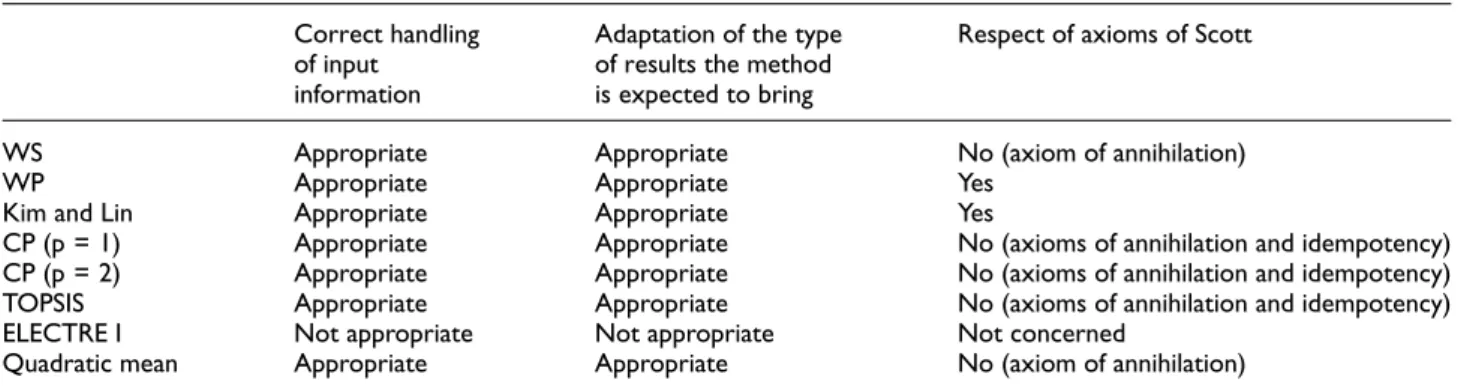
According to this analysis, it appears that only WP and KL aggregation operator respect the seven axioms of Scott (1999) and the two criteria ‘Adaptation of the type of results the method is expected to bring’ and ‘Correct handling of input information’. Concerning the criterion ‘Adaptation of the degree of compensa-tion’, it is clear that WP has a higher degree of compen-sation than KL. In fact, KL does not provide any kind of compensation between criteria. Its use is thus reserved for the case DM is extremely conservative (any compensation between criteria is allowed) is its decision-making attitude. In the industrial case being studied, DM aims to have a kind of compensation between criteria. Therefore, we conclude that WP is the most appropriate among the initial MCDA methods.
If we go back to Table 2, it can be seen that the truss concept, which is considered as a new and immature concept for the company, is of a real interest for some criteria compared to the other concepts, especially for the criterion ‘raw material cost’ which is the most important criterion in this industrial case. In contrast, it reveals very low LPVs for other criteria (C2, C5, C6). Especially for the criterion ‘acquisition cost of manu-facturing machinery’ which also has a strong impor-tance in this industrial case. Since conservative aggregation operators (respecting the axiom of annihi-lation) intensify the impact of criteria whose LPVs are close to zero (Scott, 1999), the truss concept obtains a low OPV with WP and KL aggregation operators (they both respect the axiom of annihilation). In practice, when the evaluation of an immature concept reveals that it does not satisfy some criteria (or very weakly), designers do not systematically reject the concept. They consider that modifications could eventually be intro-duced in embodiment design choices (selections of
Table 3. Summarization of comparison results (of MCDA methods). Correct handling
of input information
Adaptation of the type of results the method is expected to bring
Respect of axioms of Scott
WS Appropriate Appropriate No (axiom of annihilation)
WP Appropriate Appropriate Yes
Kim and Lin Appropriate Appropriate Yes
CP (p = 1) Appropriate Appropriate No (axioms of annihilation and idempotency)
CP (p = 2) Appropriate Appropriate No (axioms of annihilation and idempotency)
TOPSIS Appropriate Appropriate No (axioms of annihilation and idempotency)
ELECTRE I Not appropriate Not appropriate Not concerned
Quadratic mean Appropriate Appropriate No (axiom of annihilation)
MCDA: multi-criteria decision aiding; WS: weighted sum; WP: weighted product; CP: compromise programming; TOPSIS: Technique for Order Preference by Similarity to Ideal Solution; ELECTRE: ELimination Et Choix Traduisant la REalite´.
structural dimensions, materials, components, etc.) dur-ing the development process in order to insure better LPVs of these weakly satisfied criteria. In the present case, for example, the high potential of improvement in the truss structure makes it particularly attractive for DMs. Using a deterministic value is thus not adapted when dealing with immature concepts and imprecision and this is particularly true when using conservative aggregation operator.
According to this first analysis (summarized in Table 3), WP is the most appropriate MCDA method in our case (compared to the other MCDA methods compared) since it respects the seven axioms of Scott (1999) and the two criteria ‘Adaptation of the type of results the method is expected to bring’ and ‘Correct handling of input information’. However, the following limits can be remarked in yielded results: (1) it is very difficult and risky to draw a conclusion when OPV is similar to each other, and (2) the use of a conservative aggregation operator (respecting the axiom of annihila-tion) systematically discriminates immature concepts. In the rest of this section, sensitivity analyses are per-formed in an attempt to address these problems. In the rest of the proposed analysis, it is assumed that WP is chosen since it corresponds to the most appropriate aggregation operators (compared to the initial MCDA methods compared).
The impact of certain LPVs on OPV can be more or less high depending on the degree of compensation of the MCDA method and the criterion weight. For exam-ple, an aggregation operator with low degree of com-pensation accentuates the impact of criteria with low LPVs. In this study, a first sensitivity study called ‘local sensitivity study’ is performed. For a given concept, a sensitivity calculation using Monte Carlo simulation is performed for each criterion, that is, the imprecision in LPV for the criterion concerned (shown in Table 2) is propagated through WP towards OPV. The three esti-mates LPVl, LPVmand LPVh(Table 2) define a
trian-gular probability distribution, which is used by Monte Carlo simulation. All statistical properties of this distri-bution are uniquely determined by the three estimates. For the other criteria, LPV is assumed to be fixed (equal to LPVm). The results of local sensitivity study
are shown in Table 4 and are expressed in terms of standard deviations of OPVs. The interest of local sen-sitivity study is to identify inputs (LPVs) that cause sig-nificant uncertainty (high standard deviation) in the output (OPV) and that should therefore be the focus of attention, even by a reassessment or by further investi-gations. Since WP has been chosen as the most appro-priate MCDA method in the present case, the standard deviation resulting from the other MCDA methods can be ignored. In Table 4, the standard deviations with
bold characters are those which need to be reassessed in Table
4. Results of local sensitivity study for each MCD A method (standar d de viatio n). C1 C2 C3 C4 C5 C6 S1 S2 S3 S1 S2 S3 S1 S2 S3 S1 S2 S3 S1 S2 S3 S1 S2 S3 WS 1.10 0.55 0.70 1.15 0.55 0.75 1.20 0.55 0.80 1.30 0.55 0.85 1.30 0.55 0.85 1.60 1.50 0.70 WP 1.50 0.80 1.20 1.90 1.00 1.30 2.90 a 0.90 1.60 2.30 1.00 1.70 2.40 1.10 1.70 5.80 a 5.40 a 1.20 KL 1.32 4.10 2.78 1.32 4.10 2.78 1.32 4.10 2.78 1.32 4.10 2.78 1.60 4.14 2.80 1.32 4.74 3.60 CP (p = 1) 2.57 1.14 1.57 2.71 1.29 1.71 2.71 1.14 1.86 2.86 1.14 2.00 2.86 1.29 1.86 3.57 3.29 1.71 CP (p = 2) 0.33 0.00 0.00 0.67 0.33 0.33 1.00 0.00 1.33 1.33 0.00 1.33 1.33 0.00 1.33 5.33 3.33 2.00 T OPSIS 0.06 0.02 0.02 0.34 0.08 0.44 0.60 0.10 0.68 0.66 0.12 0.78 0.68 0.08 0.76 3.96 3.58 0.38 QM 0.67 0.58 0.83 1.25 0.75 1.00 1.50 0.75 1.25 1.75 0.83 1.33 2.17 1.08 1.42 7.33 6.50 1.17 MCD A : mul ti-criteria dec ision aid ing; WS: w eigh ted sum; WP : w eighted pr odu ct; KL: Kim and Lin; CP: compr omise pr ogr amming; T OPSI S: Technique for Or der Pr efer ence by Sim ilarity to Ideal Solu tion; LPV: local pr efer ence va lue. aLPVs that need to be reassess ed.
the present case. The local sensitivity analysis has no impact on the choice of MCDA method. Its unique interest is to improve the quality of LPVs assessments.
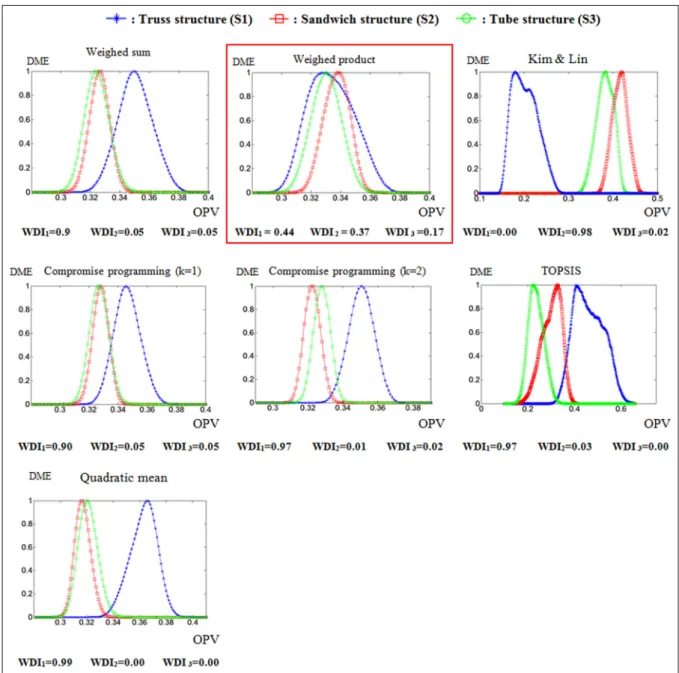
A ‘global sensitivity study’ is then performed. For a given concept, a unique sensitivity calculation using Monte Carlo simulation is performed to propagate, simultaneously, the imprecision of all LPVs (corre-sponding to all criteria) through WP towards OPV. Such a study makes it possible to explore the potential of improving OPV. The results are shown in Figure 2. It represents the degree of membership (DME) as a function of OPV. The analysis is performed for each
concept. Starting from this analysis, the function of weak dominance index (WDI) introduced by Roubens (1989) is used to exploit fuzzy ranking results. It can be interpreted as the truth value of the statement ‘concept A is better than each of other concept’. When using Monte Carlo analysis, it can be calculated by equation (9). NS is the number of samples where OPV of con-cept A is greater than the others. N is the total number of samples.
WDI =NS
N ð9Þ
Figure 2. Results of global sensitivity analysis for each MCDA method. DME: degree of membership.
Figure 2 shows the results of the WDIs calculation. Considering WP outcomes, it can be seen that the new ranking obtained by WDIs differs considerably from that obtained in Figure 1. Using WDIs allows taking into account imprecision in embodiment design choices (dimensions, materials, etc.) and thus considers the pos-sibilities of improvement of the product. We therefore argue that the ranking obtained using WDI is more consistent than the first ranking (Figure 1) and that it is more appropriate for highlighting the potential of immature concepts. However, we argue that it is impor-tant to build judgements not only on WDI values but also graphically by analysing the curves of DME as a function of OPV.
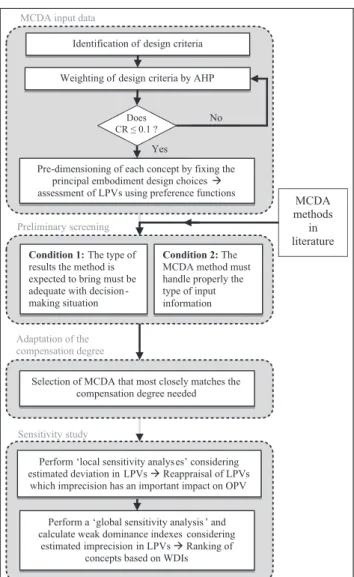
Figure 3 gives a summary of the different steps fol-lowed in this article to choose and apply a MCDA method in the present industrial case. As shown in this figure, the input data are first generated (LPVs and
criteria weights). Then, the most appropriate MCDA method is chosen by considering the three criteria in section ‘Evaluation of MCDA methods: relevant cri-teria to consider’. Finally, sensitivity analysis are per-formed to improve the quality of LPVs (global sensitivity analysis) and then to improve the consis-tency of final ranking (global sensitivity analysis).
Conclusion and future work
Decision-making in conceptual design phase has a very important impact on the global life-cycle cost. Therefore, it must be structured by the appropriate the-ories and methodologies. A comparative study of MCDA methods of different kinds was performed in this study. We argue that the most relevant criteria to consider in the context of decision-making in concep-tual design are as follows: adaptation of the type of results the method is expected to bring, correct han-dling of input information and adaptation of the degree of compensation. In addition, when using an aggrega-tion operator, it must verify the axioms of Scott (1999) to be design-appropriate. Considering these criteria, it was found that WP is the most suitable MCDA meth-ods in the present industrial case (compared to the other MCDA methods studied).
It was found that the application of sensitivity study (global sensitivity study) can improve the benefit of using the chosen MCDA method in the presence of imprecise information since it allows DM to explore more effectively the potential of improvement of imma-ture concepts. The new ranking obtained using the degree of weak dominance is more consistent with DM preferences. Another sensitivity study (local sensitivity study) was applied individually on the different LPVs in order to improve their quality by a reappraisal of LPVs which imprecision has an important impact on OPV.
However, two main issues are still open: (1) the true meaning and the validity of criteria weights are crucial in order to avoid improper use of the MCDA methods, and (2) there is no recognized approach, to our knowl-edge, to characterize the degree of compensation of a MCDA method. In the present case, since the results produced by MCDA method must be as consistent as possible with DM preference (due to the importance of decisions in conceptual design); we consider that these issues are important and must be investigated for future research.
Declaration of conflicting interests
The author(s) declared no potential conflicts of interest with respect to the research, authorship and/or publication of this article.
Figure 3. General framework used to choose and use a MCDA method in the present industrial case.
Funding
The author(s) received no financial support for the research, authorship and/or publication of this article.
References
Antonsson EK and Otto KN (1995) Imprecision in engineer-ing design.Journal of Mechanical Design, Transactions of the ASME117(B): 25–32.
Belton V and Stewart TJ (2002) Multiple Criteria Decision Analysis: An Integrated Approach. Boston, MA: Kluwer Academic.
Biegel P and Pecht M (1991) Design trade-offs made easy. Concurrent Engineering: Research and Applications 1(3): 29–40.
Bouyssou D (1986) Some remarks on the notion of compensa-tion in MCDM.European Journal of Operational Research 26(1): 150–160.
Chang H-C and Chen H-Y (2014) Optimizing product form attractiveness using Taguchi method and TOPSIS algorithm: a case study involving a passenger car. Concur-rent Engineering: Research and Applications 22(2): 135–147.
Chen SJ and Hwang CL (1992)Fuzzy Multiple Attribute Deci-sion Making: Methods and Applications. Berlin: Springer-Verlag.
Cheng S, Chan CW and Huang GH (2003) An integrated multi-criteria decision analysis and inexact mixed integer linear programming approach for solid waste manage-ment.Engineering Applications of Artificial Intelligence16: 543–554.
Choo EU and Wedley WC (2008) Comparing fundamentals of additive and multiplicative aggregation in ratio scale multi-criteria decision making. The Open Operational Research Journal2: 1–7.
Choo EU, Schoner B and Wedley WC (1999) Interpretation of criteria weights in multicriteria decision making. Com-puters & Industrial Engineering37: 527–541.
Deng H, Yeh CH and Willis RJ (2000) Inter-company com-parison using modified TOPSIS with objective weights. Computers & Operations Research27(10): 963–973. Derringer R (1994) A balancing act: optimizing a product’s
properties.Quality Progress27(6): 51–58.
Fodor JC and Roubens M (1994)Fuzzy Preference Modeling and Multi-Criteria Decision Aid. Dordrecht: Kluwer Academic.
Grabisch M (1996) The application of fuzzy integrals in mul-ticriteria decision making.European Journal of Operational Research89: 445–456.
Guitouni A and Martel JM (1998) Tentative guidelines to help choosing an appropriate MCDA method.European Jour-nal of OperatioJour-nal Research109: 501–521.
Hobbs BF, Chankong V, Hamadeh W, et al. (1992) Does choice of multicriteria method matter? An experiment in water resources planning.Water Resources Research28(7): 1767–1779.
Keeney RL and Raiffa H (1994) Decisions with Multiple Objectives: Preferences and Value Tradeoffs. Cambridge: Cambridge University Press.
Kim K and Lin D (2000) Simultaneous optimization of mechanical properties of steel by maximizing exponential desirability functions.Journal of the Royal Statistical Soci-ety Series C: Applied Statistics49(3): 311–325.
Kumara V, Shrivastavaa RL and Untawaleb S-P (2015) Fres-nel lens: a promising alternative of reflectors in concen-trated solar power. Renewable and Sustainable Energy Reviews4: 376–390.
LeBel L (2009)Prise de de´cision multi crite`res, Prise de de´ci-sion Multi crite`res. Que´bec City, QC, Canada: Universite´ Laval.
Lin MC, Wang CC, Chen MS, et al. (2008) Using AHP and TOPSIS approaches in customer-driven product design process.Computers in Industry59: 17–31.
Mahmoud MR and Garcia LA (2000) Comparison of differ-ent multicriteria evaluation methods for the Red Bluff diversion dam. Environmental Modelling & Software 15: 471–478.
Masseia G, Rocchia L, Paolottia L, et al. (2014) Decision sup-port systems for environmental management: a case study on wastewater from agriculture.Journal of Environmental Management146: 491–504.
Montanari R (2004) Environmental efficiency analysis for Fresnel thermo-power plants.Journal of Cleaner Produc-tion12: 403–414.
Otto KN and Antonsson EK (1993) The method of impreci-sion compared to utility theory for design selection prob-lems.Design Theory and Methodology – DTM’;9353: 167– 173.
Ozernoy VM (1988) Some issues in designing an expert sys-tem for multiple criteria decision making.Acta Psycholo-gica68: 237–253.
Roubens M (1989) Some properties of choice functions based on valued binary relations. European Journal of Opera-tional Research40: 309–321.
Roy B (1968) Classement et choix en pre´sence de points de vue multiples, Revue francxaise d’automatique. d’informa-tique et de recherche ope´rationnelle2: 57–75.
Roy B and Slowinski R (2013) Questions guiding the choice of a multicriteria decision aiding method.EURO Journal on Decision Processes1: 69–97.
Saaty TL (1977) A scaling method for priorities in hierarchi-cal structures. Journal of Mathematical Psychology 15: 234–281.
Scott MJ (1999)Formalizing negotiation in engineering design. PhD Thesis, California Institute of Technology, Pasadena, CA.
Simon HA (1960)The New Science of Management Decision. New York: Harper & Row.
Singh T and Agrawal VP (2012) Concurrent design of a nanoactuator for ‘X-abilities’ using the multiple-attribute decision-making approach. Concurrent Engineering: Research and Applications20(4): 301–314.
Stewart TJ (1992) A critical survey on the status of multiple criteria decision making theory and practice. Omega 20(5–6): 569–586.
Sun X, Meng P, Boehnke D, et al. (2012) Multi-criteria deci-sion analysis techniques in aircraft conceptual design pro-cess. In: 28th congress of the international council of the
aeronautical sciences 2012 (ICAS 2012), vol. 5, pp. 3975–3984.
Tong LI, Wang CH, Chen CC, et al. (2004) Dynamic multi-ple responses by ideal solution analysis.European Journal of Operational Research156: 433–444.
Triantaphyllou E and Lin CT (1996) Development and eva-luation of five fuzzy multiattribute decision-making meth-ods.International Journal of Approximate Reasoning14(4): 281–310.
Vincent T (1983) Game theory as a design tool.ASME Jour-nal of Mechanisms, Transmissions, and Automation in Design105: 165–170.
Vincke PH (1982) Preference modelling: a survey and an experiment. In: Brans JP (ed.) Operational Research’81. Amsterdam: North-Holland, pp. 341–353.
Zanakis SH, Solomon A, Wishart N, et al. (1998) Multi-attri-bute decision making: a simulation comparison of select methods. European Journal of Operational Research 107: 507–529.
Zeleny M and Cochrane JL (1973)Compromise Programming: Multicriteria Decision Making. Columbia, SC: University of South Carolina Press, pp. 262–301.
Zimmer L and Zablit P (2001) Global aircraft predesign based on constraint propagation and interval analysis. In: Pro-ceedings of CEAS conference on multidisciplinary aircraft design and optimisation, Ko¨ln.
Author biographies
Mehdi El Amineis a PhD student in Arts & Me´tiers ParisTech engineering school (Bordeaux), and also a member of the Mechanical and Engineering Institute of Bordeaux (I2M). His main research topics include decision-making in design engineering, design methodologies, physical modelling, 3D-CAD system, CAE.
Je´roˆ me Pailhe`sreceived his PhD degree from the University of Bordeaux, France in 1999. He is currently an Assistant Professor in the Arts et Me´tiers ParisTech engineering school (Bordeaux), and also a member of the Mechanical and Engineering Institute of Bordeaux (I2M) from 2001. His main research topics include design engineering methodology, optimization, functional anal-ysis, physical modelling, model-building processes.
Nicolas Perry received his PhD in material and process interaction from Ecole Centrale de Nantes and Nantes University in 2000. He spent 7 years at IRCCyN (UMR 6597) working as an Assistant Professor in the field of virtual engineering and developing Computer-Aided Systems to help decision-making. He moved to Bordeaux University in 2007 and focused his research activities on the field of composite, integrating manufacturing aspects in the behaviour and design of composite parts in I2M Institute (UMR 5295). He also developed environmental inte-gration into product design (focusing design for recycling and LCA into early product design) and on manufacturing processes (such as additive layer manufacturing). In 2011, he took up the position of professor position at Arts et Me´tiers ParisTech Bordeaux and co-head of the Mechanical Engineering research team at I2M.