Finding Security Vulnerabilities in Java Applications
with Static Analysis
V. Benjamin Livshits and Monica S. Lam
Computer Science Department
Stanford University
{livshits,lam}@cs.stanford.eduAbstract
This paper proposes a static analysis technique for detecting many recently discovered application vulner-abilities such as SQL injections, cross-site scripting, and HTTP splitting attacks. These vulnerabilities stem from unchecked input, which is widely recognized as the most common source of security vulnerabilities in Web appli-cations. We propose a static analysis approach based on a scalable and precise points-to analysis. In our system, user-provided specifications of vulnerabilities are auto-matically translated into static analyzers. Our approach finds all vulnerabilities matching a specification in the statically analyzed code. Results of our static analysis are presented to the user for assessment in an auditing interface integrated within Eclipse, a popular Java devel-opment environment.
Our static analysis found 29 security vulnerabilities in nine large, popular open-source applications, with two of the vulnerabilities residing in widely-used Java libraries. In fact, all but one application in our benchmark suite had at least one vulnerability.Context sensitivity, com-bined with improved object naming, proved instrumen-tal in keeping the number of false positives low. Our approach yielded very few false positives in our experi-ments: in fact, only one of our benchmarks suffered from false alarms.
1 Introduction
The security of Web applications has become increas-ingly important in the last decade. More and more Web-based enterprise applications deal with sensitive financial and medical data, which, if compromised, in addition to downtime can mean millions of dollars in damages. It is crucial to protect these applications from hacker attacks. However, the current state of application security leaves much to be desired. The 2002 Computer Crime and Security Survey conducted by the Computer Secu-rity Institute and the FBI revealed that, on a yearly ba-sis, over half of all databases experience at least one
se-curity breach and an average episode results in close to $4 million in losses [10]. A recent penetration test-ing study performed by the Imperva Application De-fense Center included more than 250 Web applications from e-commerce, online banking, enterprise collabo-ration, and supply chain management sites [54]. Their vulnerability assessment concluded that at least 92% of Web applications are vulnerable to some form of hacker attacks. Security compliance of application vendors is especially important in light of recent U.S. industry reg-ulations such as the Sarbanes-Oxley act pertaining to in-formation security [4, 19].
A great deal of attention has been given to network-level attacks such as port scanning, even though, about 75% of all attacks against Web servers target Web-based applications, according to a recent survey [24]. Tra-ditional defense strategies such as firewalls do not pro-tect against Web application attacks, as these attacks rely solely on HTTP traffic, which is usually allowed to pass through firewalls unhindered. Thus, attackers typically have a direct line to Web applications.
Many projects in the past focused on guarding against problems caused by the unsafe nature of C, such as buffer overruns and format string vulnerabilities [12, 45, 51]. However, in recent years, Java has emerged as the lan-guage of choice for building large complex Web-based systems, in part because of language safety features that disallow direct memory access and eliminate problems such as buffer overruns. Platforms such as J2EE (Java 2 Enterprise Edition) also promoted the adoption of Java as a language for implementing e-commerce applications such as Web stores, banking sites, etc.
A typical Web application accepts input from the user browser and interacts with a back-end database to serve user requests; J2EE libraries make these common tasks easy to code. However, despite Java language’s safety, it is possible to make logical programming errors that lead to vulnerabilities such as SQL injections [1, 2, 14] and cross-site scripting attacks [7, 22, 46]. A simple
pro-gramming mistake can leave a Web application vulner-able to unauthorized data access, unauthorized updates or deletion of data, and application crashes leading to denial-of-service attacks.
1.1 Causes of Vulnerabilities
Of all vulnerabilities identified in Web applications, problems caused byunchecked inputare recognized as being the most common [41]. To exploit unchecked in-put, an attacker needs to achieve two goals:
Inject malicious data into Web applications.Common
methods used include:
• Parameter tampering: pass specially crafted
ma-licious values in fields of HTML forms.
• URL manipulation: use specially crafted
parame-ters to be submitted to the Web application as part of the URL.
• Hidden field manipulation: set hidden fields of
HTML forms in Web pages to malicious values.
• HTTP header tampering: manipulate parts of
HTTP requests sent to the application.
• Cookie poisoning: place malicious data in cookies, small files sent to Web-based applications.
Manipulate applications using malicious data.
Com-mon methods used include:
• SQL injection: pass input containing SQL
com-mands to a database server for execution.
• Cross-site scripting: exploit applications that out-put unchecked inout-put verbatim to trick the user into executing malicious scripts.
• HTTP response splitting: exploit applications that output input verbatim to perform Web page deface-ments or Web cache poisoning attacks.
• Path traversal: exploit unchecked user input to
control which files are accessed on the server. • Command injection: exploit user input to execute
shell commands.
These kinds of vulnerabilities are widespread in today’s Web applications. A recent empirical study of vulnera-bilities found that parameter tampering, SQL injection, and cross-site scripting attacks account for more than a third of all reported Web application vulnerabilities [49]. While different on the surface, all types of attacks listed above are made possible by user input that has not been (properly) validated. This set of problems is similar to those handled dynamically by thetaint modein Perl [52], even though our approach is considerably more extensi-ble. We refer to this class of vulnerabilities as thetainted object propagationproblem.
1.2 Code Auditing for Security
Many attacks described in the previous section can be detected with code auditing. Code reviews pinpoint potential vulnerabilities before an application is run. In fact, most Web application development methodologies recommend a security assessment or review step as a sep-arate development phase after testing andbefore applica-tion deployment [40, 41].
Code reviews, while recognized as one of the most effective defense strategies [21], are time-consuming, costly, and are therefore performed infrequently. Secu-rity auditing requires secuSecu-rity expertise that most devel-opers do not possess, so security reviews are often car-ried out by external security consultants, thus adding to the cost. In addition to this, because new security errors are often introduced as old ones are corrected, double-audits(auditing the code twice) is highly recommended. The current situation calls for better tools that help velopers avoid introducing vulnerabilities during the de-velopment cycle.
1.3 Static Analysis
This paper proposes a tool based on a static analy-sis for finding vulnerabilities caused by unchecked in-put. Users of the tool can describe vulnerability pat-terns of interest succinctly in PQL [35], which is an easy-to-use program query language with a Java-like syntax. Our tool, as shown in Figure 1, applies user-specified queries to Java bytecode and finds all potential matches statically. The results of the analysis are integrated into Eclipse, a popular open-source Java development envi-ronment [13], making the potential vulnerabilities easy to examine and fix as part of the development process.
The advantage of static analysis is that it can find all potential security violations without executing the appli-cation. The use of bytecode-level analysis obviates the need for the source code to be accessible. This is espe-cially important since libraries whose source is unavail-able are used extensively in Java applications. Our ap-proach can be applied to other forms of bytecode such as MSIL, thereby enabling the analysis of C# code [37].
Our tool is distinctive in that it is based on a precise context-sensitive pointer analysis that has been shown to scale to large applications [55]. This combination of scalability and precision enables our analysis to find all vulnerabilities matching a specification within the por-tion of the code that is analyzed statically. In contrast, previous practical tools are typically unsound [6, 20]. Without a precise analysis, these tools would find too many potential errors, so they only report a subset of er-rors that are likely to be real problems. As a result, they can miss important vulnerabilities in programs.
Figure 1:Architecture of our static analysis framework.
1.4 Contributions
A unified analysis framework. We unify multiple,
seemingly diverse, recently discovered categories of se-curity vulnerabilities in Web applications and propose an extensible tool for detecting these vulnerabilities using a sound yet practical static analysis for Java.
A powerful static analysis.Our tool is the first prac-tical static security analysis that utilizes fully context-sensitive pointer analysis results. We improve the state of the art in pointer analysis by improving the object-naming scheme. The precision of the analysis is effec-tive in reducing the number of false posieffec-tives issued by our tool.
A simple user interface. Users of our tool can find a variety of vulnerabilities involving tainted objects by specifying them using PQL [35]. Our system provides a GUI auditing interface implemented on top of Eclipse, thus allowing users to perform security audits quickly during program development.
Experimental validation. We present a detailed
ex-perimental evaluation of our system and the static analy-sis approach on a set of large, widely-used open-source Java applications. We found a total of 29 security errors, including two important vulnerabilities in widely-used li-braries. Eight out of nine of our benchmark applications had at least one vulnerability, and our analysis produced only 12 false positives.
1.5 Paper Organization
The rest of the paper is organized as follows. Section 2 presents a detailed overview of application-level security vulnerabilities we address. Section 3 describes our static analysis approach. Section 4 describes improvements that increase analysis precision and coverage. Section 5 describes the auditing environment our system provides. Section 6 summarizes our experimental findings. Sec-tion 7 describes related work, and SecSec-tion 8 concludes.
2 Overview of Vulnerabilities
In this section we focus on a variety of security vulnerabilities in Web applications that are caused by unchecked input. According to an influential sur-vey performed by the Open Web Application Security Project [41], unvalidated input is the number one secu-rity problem in Web applications. Many such secusecu-rity
vulnerabilities have recently been appearing on special-ized vulnerability tracking sites such asSecurityFocus
and were widely publicized in the technical press [39, 41]. Recent reports include SQL injections in Oracle products [31] and cross-site scripting vulnerabilities in Mozilla Firefox [30].
2.1 SQL Injection Example
Let us start with a discussion of SQL injections, one of the most well-known kinds of security vulnerabilities found in Web applications. SQL injections are caused by unchecked user input being passed to a back-end database for execution [1, 2, 14, 29, 32, 47]. The hacker may embed SQL commands into the data he sends to the application, leading to unintended actions performed on the back-end database. When exploited, a SQL injection may cause unauthorized access to sensitive data, updates or deletions from the database, and even shell command execution.
Example 1. A simple example of a SQL injection is
shown below:
HttpServletRequest request = ...;
String userName = request.getParameter("name"); Connection con = ...
String query = "SELECT * FROM Users " + " WHERE name = ’" + userName + "’"; con.execute(query);
This code snippet obtains a user name (userName) by in-vokingrequest.getParameter("name")and uses it to construct a query to be passed to a database for execution (con.execute(query)). This seemingly innocent piece of code may allow an attacker to gain access to unautho-rized information: if an attacker has full control of string
userNameobtained from an HTTP request, he can for example set it to’OR 1=1;−−. Two dashes are used to indicate comments in the Oracle dialect of SQL, so the
WHEREclause of the query effectively becomes the tau-tology name=’’ OR 1=1. This allows the attacker to circumvent the name check and get access to all user records in the database. 2
SQL injection is but one of the vulnerabilities that can be formulated as tainted object propagation prob-lems. In this case, the input variableuserNameis con-sidered tainted. If a tainted object (the source or any other object derived from it) is passed as a parameter to
con.execute(thesink), then there is a vulnerability. As discussed above, such an attack typically consists of two parts: (1) injecting malicious data into the application and (2) using the data to manipulating the application. The former corresponds to thesourcesof a tainted object propagation problem and the latter to thesinks. The rest of this section presents attack techniques and examples of how exploits may be created in practice.
2.2 Injecting Malicious Data
Protecting Web applications against unchecked input vulnerabilities is difficult because applications can obtain information from the user in a variety of different ways. One must check all sources of user-controlled data such as form parameters, HTTP headers, and cookie values systematically. While commonly used, client-side filter-ing of malicious values is not an effective defense strat-egy. For example, a banking application may present the user with a form containing a choice of only two account numbers; however, this restriction can be easily circum-vented by saving the HTML page, editing the values in the list, and resubmitting the form. Therefore, inputs must be filtered by the Web application on the server. Note that many attacks are relatively easy to mount: an attacker needs little more than a standard Web browser to attack Web applications in most cases.
2.2.1 Parameter Tampering
The most common way for a Web application to accept parameters is through HTML forms. When a form is sub-mitted, parameters are sent as part of an HTTP request. An attacker can easily tamper with parameters passed to a Web application by entering maliciously crafted values into text fields of HTML forms.
2.2.2 URL Tampering
For HTML forms that are submitted using the HTTP GETmethod, form parameters as well as their values ap-pear as part of the URL that is accessed after the form is submitted. An attacker may directly edit the URL string, embed malicious data in it, and then access this new URL to submit malicious data to the application.
Example 2. Consider a Web page at a bank site that al-lows an authenticated user to select one of her accounts from a list and debit $100 from the account. When the submit button is pressed in the Web browser, the follow-ing URL is requested:
http://www.mybank.com/myaccount?
accountnumber=341948&debit_amount=100
However, if no additional precautions are taken by the Web application receiving this request, accessing
http://www.mybank.com/myaccount?
accountnumber=341948&debit_amount=-5000
may in fact increase the account balance. 2
2.2.3 Hidden Field Manipulation
Because HTTP is stateless, many Web applications use hidden fields to emulate persistence. Hidden fields are just form fields made invisible to the end-user. For example, consider an order form that includes a hidden field to store the price of items in the shopping cart:
<input type="hidden" name="total_price" value="25.00">
A typical Web site using multiple forms, such as an on-line store will likely rely on hidden fields to transfer state information between pages. Unlike regular fields, hid-den fields cannot be modified directly by typing values into an HTML form. However, since the hidden field is part of the page source, saving the HTML page, editing the hidden field value, and reloading the page will cause the Web application to receive the newly updated value of the hidden field.
2.2.4 HTTP Header Manipulation
HTTP headers typically remain invisible to the user and are used only by the browser and the Web server. However, some Web applications do process these head-ers, and attackers can inject malicious data into applica-tions through them. While a normal Web browser will not allow forging the outgoing headers, multiple freely available tools allow a hacker to craft an HTTP request leading to an exploit [9]. Consider, for example, the Refererfield, which contains the URL indicating where the request comes from. This field is commonly trusted by the Web application, but can be easily forged by an attacker. It is possible to manipulate theRefererfield’s value used in an error page or for redirection to mount cross-site scripting or HTTP response splitting attacks.
2.2.5 Cookie Poisoning
Cookie poisoning attacks consist of modifying a cookie, which is a small file accessible to Web applica-tions stored on the user’s computer [27]. Many Web ap-plications use cookies to store information such as user login/password pairs and user identifiers. This informa-tion is often created and stored on the user’s computer af-ter the initial inaf-teraction with the Web application, such as visiting the application login page. Cookie poison-ing is a variation of header manipulation: malicious in-put can be passed into applications through values stored within cookies. Because cookies are supposedly invisi-ble to the user, cookie poisoning is often more dangerous in practice than other forms of parameter or header ma-nipulation attacks.
2.2.6 Non-Web Input Sources
Malicious data can also be passed in as command-line parameters. This problem is not as important be-cause typically only administrators are allowed to ex-ecute components of Web-based applications directly
from the command line. However, by examining our benchmarks, we discovered that command-line utilities are often used to perform critical tasks such as initializ-ing, cleaninitializ-ing, or validating a back-end database or mi-grating the data. Therefore, attacks against these impor-tant utilities can still be dangerous.
2.3 Exploiting Unchecked Input
Once malicious data is injected into an application, an attacker may use one of many techniques to take advan-tage of this data, as described below.
2.3.1 SQL Injections
SQL injections first described in Section 2.1 are caused by unchecked user input being passed to a back-end database for execution. When exploited, a SQL in-jection may cause a variety of consequences from leak-ing the structure of the back-end database to addleak-ing new users, mailing passwords to the hacker, or even executing arbitrary shell commands.
Many SQL injections can be avoided relatively eas-ily with the use of better APIs. J2EE provides the
PreparedStatement class, that allows specifying a SQL statement template with?’s indicating statement pa-rameters. Prepared SQL statements are precompiled, and expanded parameters never become part of executable SQL. However, not using or improperly using prepared statements still leaves plenty of room for errors.
2.3.2 Cross-site Scripting Vulnerabilities
Cross-site scripting occurs when dynamically gener-ated Web pages display input that has not been properly validated [7, 11, 22, 46]. An attacker may embed mali-cious JavaScript code into dynamically generated pages of trusted sites. When executed on the machine of a user who views the page, these scripts may hijack the user ac-count credentials, change user settings, steal cookies, or insert unwanted content (such as ads) into the page. At the application level, echoing the application input back to the browser verbatim enables cross-site scripting.
2.3.3 HTTP Response Splitting
HTTP response splitting is a general technique that enables various new attacks including Web cache poi-soning, cross-user defacement, sensitive page hijacking, as well as cross-site scripting [28]. By supplying unex-pected line break CR and LF characters, an attacker can causetwoHTTP responses to be generated forone mali-ciously constructed HTTP request. The second HTTP re-sponse may be erroneously matched with the next HTTP request. By controlling the second response, an attacker can generate a variety of issues, such as forging or poi-soningWeb pages on a caching proxy server. Because the proxy cache is typically shared by many users, this makes the effects of defacing a page or constructing a
spoofed page to collect user data even more devastating. For HTTP splitting to be possible, the application must include unchecked input as part of the response headers sent back to the client. For example, applications that embed unchecked data in HTTP Locationheaders re-turned back to users are often vulnerable.
2.3.4 Path Traversal
Path-traversal vulnerabilities allow a hacker to ac-cess or control files outside of the intended file acac-cess path. Path-traversal attacks are normally carried out via unchecked URL input parameters, cookies, and HTTP request headers. Many Java Web applications use files to maintain an ad-hoc database and store application re-sources such as visual themes, images, and so on.
If an attacker has control over the specification of these file locations, then he may be able to read or remove files with sensitive data or mount a denial-of-service attack by trying to write to read-only files. Using Java secu-rity policies allows the developer to restrict access to the file system (similar to usingchrootjail in Unix). How-ever, missing or incorrect policy configuration still leaves room for errors. When used carelessly, IO operations in Java may lead to path-traversal attacks.
2.3.5 Command Injection
Command injection involves passing shell commands into the application for execution. This attack technique enables a hacker to attack the server using access rights of the application. While relatively uncommon in Web applications, especially those written in Java, this attack technique is still possible when applications carelessly use functions that execute shell commands or load dy-namic libraries.
3 Static Analysis
In this section we present a static analysis that ad-dresses the tainted object propagation problem described in Section 2.
3.1 Tainted Object Propagation
We start by defining the terminology that was infor-mally introduced in Example 1. We define anaccess path
as a sequence of field accesses, array index operations, or method calls separated by dots. For instance, the result of applying access path f.gto variablevisv.f.g. We denote the empty access path by; array indexing opera-tions are indicated by[].
Atainted object propagation problemconsists of a set of source descriptors, sink descriptors, and derivation descriptors:
• Source descriptors of the form hm, n, pi specify ways in which user-provided data can enter the pro-gram. They consist of a source methodm, parame-ter numbernand an access pathpto be applied to
argumentnto obtain the user-provided input. We use argument number -1 to denote the return result of a method call.
• Sink descriptors of the formhm, n, pispecify un-safe ways in which data may be used in the program. They consist of a sink methodm, argument number n, and an access pathpapplied to that argument. • Derivation descriptors of the form
hm, ns, ps, nd, pdi specify how data
propa-gates between objects in the program. They consist of a derivation method m, a source object given by argument numberns and access pathps, and a
destination object given by argument number nd
and access pathpd. This derivation descriptor
spec-ifies that at a call to methodm, the object obtained by applyingpdto argumentnd is derived from the
object obtained by applyingpsto argumentns.
In the absence of derived objects, to detect potential vul-nerabilities we only need to know if a source object is used at a sink. Derivation descriptors are introduced to handle the semantics of strings in Java. BecauseStrings are immutable Java objects, string manipulation routines such as concatenation create brand newStringobjects, whose contents are based on the originalStringobjects. Derivation descriptors are used to specify the behavior of string manipulation routines, so that taint can be explic-itly passed among theStringobjects.
Most Java programs use built-inStringlibraries and can share the same set of derivation descriptors as a result. However, some Web applications use multiple
String encodings such as Unicode, UTF-8, and URL encoding. If encoding and decoding routines propagate taint and are implemented using native method calls or character-level string manipulation, they also need to be specified as derivation descriptors. Sanitization rou-tines that validate input are often implemented using character-level string manipulation. Since taint does not propagate through such routines, they should not be in-cluded in the list of derivation descriptors.
It is possible to obviate the need for manual specifica-tion with a static analysis that determines the relaspecifica-tionship between strings passed into and returned by low-level string manipulation routines. However, such an analy-sis must be performed not just on the Java bytecode but on all the relevant native methods as well.
Example 3. We can formulate the problem of detecting
parameter tampering attacks that result in a SQL injec-tion as follows: the source descriptor for obtaining pa-rameters from an HTTP request is:
hHttpServletRequest.getParameter(String),−1, i
The sink descriptor for SQL query execution is: hConnection.executeQuery(String),1, i.
To allow the use of string concatenation in the construc-tion of query strings, we use derivaconstruc-tion descriptors:
hStringBuffer.append(String), 1, ,−1, i,and
hStringBuffer.toString(), 0, ,−1, i
Due to space limitations, we show only a few descrip-tors here; more information about the descripdescrip-tors in our experiments is available in our technical report [34]. 2 Below we formally define a security violation:
Definition 3.1 Asource objectfor a source descriptor hm, n, piis an object obtained by applying access pathp to argumentnof a call tom.
Definition 3.2 A sink object for a sink descriptor
hm, n, piis an object obtained by applying access path pto argumentnof a call to methodm.
Definition 3.3 Object o2 is derived from object o1,
written derived(o1, o2), based on a derivation descrip-torhm, ns, ps, nd, pdi,if o1 is obtained by applyingps
to argumentnsando2is obtained by applyingpdto
ar-gumentndat a call to methodm.
Definition 3.4 An object istaintedif it is obtained by applying relationderivedto a source object zero or more times.
Definition 3.5 Asecurity violationoccurs if a sink ob-ject is tainted. A security violation consists of a sequence of objectso1. . . oksuch thato1is a source object andok
is a sink object and each object is derived from the pre-vious one:
∀ 0≤i<k
i:derived(oi, oi+1).
We refer to object pairho1, okias asource-sink pair.
3.2 Specifications Completeness
The problem of obtaining a complete specification for a tainted object propagation problem is an important one. If a specification is incomplete, important errors will be missed even if we use a sound analysis that finds all vul-nerabilities matching a specification. To come up with a list of source and sink descriptors for vulnerabilities in our experiments, we used the documentation of the rele-vant J2EE APIs.
Since it is relatively easy to miss relevant descriptors in the specification, we used several techniques to make our problem specification more complete. For example, to find some of the missing source methods, we instru-mented the applications to find places where application code is called by the application server.
We also used a static analysis to identify tainted ob-jects that have no other obob-jects derived from them, and examined methods into which these objects are passed. In our experience, some of these methods turned out to be obscure derivation and sink methods missing from our initial specification, which we subsequently added.
3.3 Static Analysis
Our approach is to use a sound static analysis to find all potential violations matching a vulnerability specifi-cation given by its source, sink, and derivation descrip-tors. To find security violations statically, it is necessary to know what objects these descriptors may refer to, a general problem known aspointerorpoints-to analysis.
3.3.1 Role of Pointer Information
To illustrate the need for points-to information, we consider the task of auditing a piece of Java code for SQL injections caused by parameter tampering, as described in Example 1.
Example 4. In the code below, string param is
tainted because it is returned from a source method getParameter. So isbuf1, because it is derived from param in the call toappend on line 6. Finally, string queryis passed to sink methodexecuteQuery.
1 String param = req.getParameter("user"); 2
3 StringBuffer buf1; 4 StringBuffer buf2; 5 ...
6 buf1.append(param);
7 String query = buf2.toString(); 8 con.executeQuery(query);
Unless we know that variablesbuf1andbuf2maynever
refer to the same object, we would have to conservatively assume that they may. Since buf1 is tainted, variable querymay also refer to a tainted object. Thus a conser-vative tool that lacks additional information about point-ers will flag the call toexecuteQueryon line 8 as po-tentially unsafe. 2
An unbounded number of objects may be allocated by the program at run time, so, to compute a finite answer, the pointer analysis statically approximates dynamic pro-gram objects with a finite set of static object “names”. A common approximation approach is to name an object by itsallocation site, which is the line of code that allocates the object.
3.3.2 Finding Violations Statically
Points-to information enables us to find security viola-tions statically. Points-to analysis results are represented as the relationpointsto(v, h), wherevis a program vari-able andhis an allocation site in the program.
Definition 3.6 Astatic security violationis a sequence of heap allocation sitesh1. . . hksuch that
1. There exists a variable v1 such that pointsto(v1, h1), where v1 corresponds to ac-cess path p applied to argument n of a call to methodmfor a source descriptorhm, n, pi. 2. There exists a variable vk such that
pointsto(vk, hk), where vk corresponds to
ap-plying access path p to argument n in a call to methodmfor a sink descriptorhm, n, pi.
3. There exist variablesv1, . . . , vksuch that
∀
1≤i<k
:pointsto(vi, hi)∧pointsto(vi+1, hi+1),
where variablevicorresponds to applyingpsto
ar-gumentnsandvi+1corresponds applyingpdto
ar-gumentnd in a call to methodm for a derivation
descriptorhm, ns, ps, nd, pdi.
Our static analysis is based on a context-sensitive Java points-to analysis developed by Whaley and Lam [55]. Their algorithm uses binary decision diagrams (BDDs) to efficiently represent and manipulate points-to results for exponentially many contexts in a program. They have developed a tool calledbddbddb(BDD-Based Deductive DataBase) that automatically translates program analy-ses expressed in terms of Datalog [50] (a language used in deductive databases) into highly efficient BDD-based implementations. The results of their points-to analysis can also be accessed easily using Datalog queries. Notice that in the absence of derived objects, finding security vi-olations can be easily done with pointer analysis alone, because pointer analysis tracks objects as they are passed into or returned from methods.
However, it is relatively easy to implement the tainted object propagation analysis usingbddbddb. Constraints of a specification as given by Definition 3.6 can be trans-lated into Datalog queries straightforwardly. Facts such as “variablevis parameternof a call to methodm” map directly into Datalog relations representing the internal representation of the Java program. The points-to results used by the constraints are also readily available as Dat-alog relations after pointer analysis has been run.
Because Java supports dynamic loading and classes can be dynamically generated on the fly and called reflec-tively, we can find vulnerabilities only in the code avail-able to the static analysis. For reflective calls, we use a simple analysis that handles common uses of reflection to increase the size of the analyzed call graph [34].
3.3.3 Role of Pointer Analysis Precision
Pointer analysis has been the subject of much compiler research over the last two decades. Because determining what heap objects a given program variable may point to during program execution is undecidable, sound analy-ses compute conservative approximations of the solution. Previous points-to approaches typically trade scalability for precision, ranging from highly scalable but imprecise techniques [48] to precise approaches that have not been shown to scale [43].
In the absence of precise information about pointers, a sound tool would conclude that many objects are tainted and hence report many false positives. Therefore, many
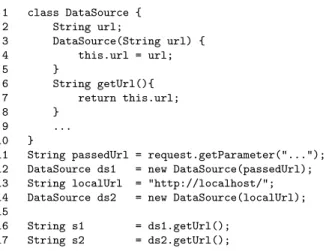
1 class DataSource { 2 String url; 3 DataSource(String url) { 4 this.url = url; 5 } 6 String getUrl(){ 7 return this.url; 8 } 9 ... 10 }
11 String passedUrl = request.getParameter("..."); 12 DataSource ds1 = new DataSource(passedUrl); 13 String localUrl = "http://localhost/"; 14 DataSource ds2 = new DataSource(localUrl); 15
16 String s1 = ds1.getUrl(); 17 String s2 = ds2.getUrl();
Figure 2:Example showing the importance of context sensitivity. practical tools use an unsound approach to pointers, as-suming that pointers are unaliased unless proven other-wise [6, 20]. Such an approach, however, may miss im-portant vulnerabilities.
Having precise points-to information can significantly reduce the number of false positives. Context sensitivity refers to the ability of an analysis to keep information from different invocation contexts of a method separate and is known to be an important feature contributing to precision. The effect of context sensitivity on analysis precision is illustrated by the example below.
Example 5. Consider the code snippet in Figure 2.
The class DataSource acts as a wrapper for a URL string. The code creates two DataSourceobjects and callsgetUrlon both objects. A context-insensitive an-alysis would merge information for calls ofgetUrlon lines 16 and 17. The reference this, which is consid-ered to be argument 0 of the call, points to the object on line 12 and 14, sothis.urlpoints to either the ob-ject returned on line 11 or"http://localhost/"on line 13. As a result, boths1ands2will be considered tainted if we rely on context-insensitive points-to results. With a context-sensitive analysis, however, onlys2will be considered tainted. 2
While many points-to analysis approaches exist, until recently, we did not have a scalable analysis that gives a conservative yet precise answer. The context-sensitive, inclusion-based points-to analysis by Whaley and Lam is both precise and scalable [55]. It achieves scalability by using BDDs to exploit the similarities across the expo-nentially many calling contexts.
Acall graphis a static approximation of what methods may be invoked at all method calls in the program. While there are exponentially many acyclic call paths through the call graph of a program, the compression achieved by BDDs makes it possible to efficiently represent as many as1014contexts. The framework we propose in this pa-per is the first practical static analysis tool for security to leverage the BDD-based approach. The use of BDDs has
query main() returns
object Object sourceObj, sinkObj; matches {
sourceObj := source();
sinkObj := derived*(sourceObj); sinkObj := sink();
}
Figure 3:Main query for finding source-sink pairs. allowed us to scale our framework to programs consist-ing of almost 1,000 classes.
3.4 Specifying Taint Problems in PQL
While a useful formalism, source, sink, and deriva-tion descriptors as defined in Secderiva-tion 3.1 are not a user-friendly way to describe security vulnerabilities. Data-log queries, while giving the user complete control, ex-pose too much of the program’s internal representation to be practical. Instead, we use PQL, a program query language. PQL serves as syntactic sugar for Datalog queries, allowing users to express vulnerability patterns in a familiar Java-like syntax; translation of tainted object propagation queries from PQL into Datalog is straight-forward. PQL is a general query language capable of ex-pressing a variety of questions about program execution. However, we only use a limited form of PQL queries to formulate tainted object propagation problems.Due to space limitations, we summarize only the most important features of PQL here; interested readers are re-ferred to [35] for a detailed description. A PQL query is a pattern describing a sequence of dynamic events that involves variables referring todynamic object instances. Theusesclause declares all object variables the query refers to. Thematchesclause specifies the sequence of events on object variables that must occur for a match. Finally, thereturnclause specifies the objects returned by the query whenever a set of object instances partici-pating in the events in thematchesclause is found.
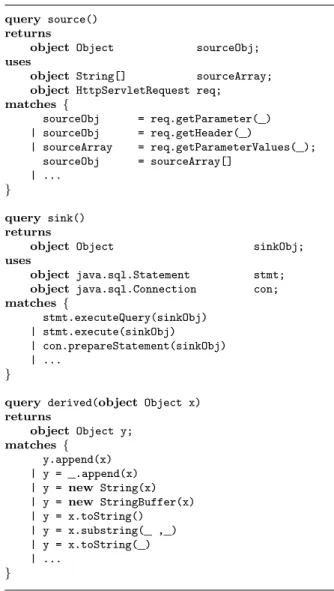
Source-sink object pairs corresponding to static se-curity violations for a given tainted object propagation problem are computed by querymainin Figure 3. This query uses auxiliary queriessourceandsink used to define source and sink objects as well as queryderived∗ shown in Figure 4 that captures a transitive derivation re-lation. ObjectsourceObjinmainis returned by
sub-query derived*(object Object x) returns
object Object y; uses
object Object temp; matches {
y := x |
temp := derived(x); y := derived*(temp); }
query source()
returns
object Object sourceObj;
uses
object String[] sourceArray;
object HttpServletRequest req;
matches { sourceObj = req.getParameter(_) | sourceObj = req.getHeader(_) | sourceArray = req.getParameterValues(_); sourceObj = sourceArray[] | ... } query sink() returns
object Object sinkObj;
uses
object java.sql.Statement stmt;
object java.sql.Connection con;
matches { stmt.executeQuery(sinkObj) | stmt.execute(sinkObj) | con.prepareStatement(sinkObj) | ... }
query derived(object Object x)
returns object Object y; matches { y.append(x) | y = _.append(x) | y = new String(x) | y = new StringBuffer(x) | y = x.toString() | y = x.substring(_ ,_) | y = x.toString(_) | ... }
Figure 5:PQL sub-queries for finding SQL injections. querysource. ObjectsinkObjis the result of sub-query
derived?withsourceObjused as a sub-query param-eter and is also the result of sub-querysink. Therefore,
sinkObjreturned by querymainmatches all tainted ob-jects that are also sink obob-jects.
Semicolons are used in PQL to indicate a sequence of events that must occur in order. Sub-queryderived∗ de-fines a transitive derived relation: objectyis transitively derived from objectxby applying sub-queryderived
zero or more times. This query takes advantage of PQL’s sub-query mechanism to define a transitive closure re-cursively. Sub-queriessource,sink, andderivedare specific to a particular tainted object propagation prob-lem, as shown in the example below.
Example 6. This example describes sub-queries
source, sink, and derived shown in Figure 5 that can be used to match SQL injections, such as the one described in Example 1. Usually these sub-queries are structured as a series of alternatives separated by|. The wildcard character_is used instead of a variable name if
1 class Vector {
2 Object[] table = new Object[1024]; 3
4 void add(Object value){ 5 int i = ...; 6 // optional resizing ... 7 table[i] = value; 8 } 9 10 Object getFirst(){
11 Object value = table[0]; 12 return value;
13 } 14 }
15 String s1 = "...";
16 Vector v1 = new Vector(); 17 v1.add(s1);
18 Vector v2 = new Vector(); 19 String s2 = v2.getFirst();
Figure 6:Typical container definition and usage. the identity of the object to be matched is irrelevant.
Query source is structured as an alterna-tion: sourceObj can be returned from a call to
req.getParameter or req.getHeader for an object
req of type HttpServletRequest; sourceObj may also be obtained by indexing into an array returned by a call toreq.getParameterValues, etc. Querysink
defines sink objects used as parameters of sink methods such as java.sql.Connection.executeQuery, etc. Queryderiveddetermines when data propagates from objectx to object y. It consists of the ways in which Java strings can be derived from one another, including string concatenation, substring computation, etc. 2
As can be seen from this example, sub-queries
source, sink, and derivedmap to source, sink, and derivation descriptors for the tainted object propagation problem. However, instead of descriptor notation for method parameters and return values, natural Java-like method invocation syntax is used.
4 Precision Improvements
This section describes improvements we made to the object-naming scheme used in the original points-to an-alysis [55]. These improvements greatly increase the precision of the points-to results and reduce the number of false positives produced by our analysis.
4.1 Handling of Containers
Containers such as hash maps, vectors, lists, and oth-ers are a common source of imprecision in the original pointer analysis algorithm. The imprecision is due to the fact that objects are often stored in a data structure al-locatedinside the container class definition. As a result, the analysis cannot statically distinguish between objects stored in different containers.
Example 7. The abbreviated vector class in Figure 6
allocates an array calledtableon line 2 and vectorsv1
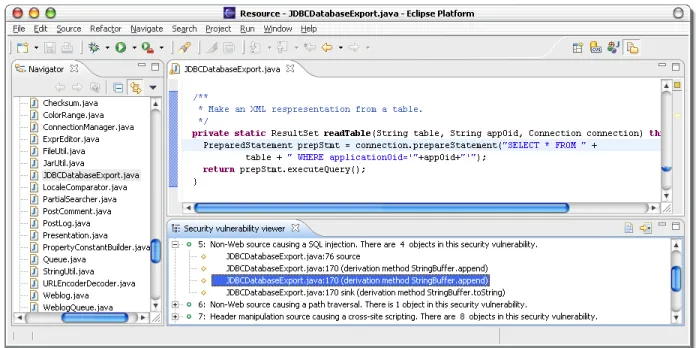
Figure 7:Tracking a SQL injection vulnerability in the Eclipse GUI plugin. Objects involved in the vulnerability trace are shown at the bottom. will conclude that theString object referred to bys2
retrieved from vectorv2may be the same as theString objects1deposited in vectorv1. 2
To alleviate this problem and improve the precision of the results, we create a new object name for the inter-nally allocated data structure for every allocation site of the external container. This new name is associated with the allocation site of the underlying container object. As a result, the type of imprecision described above is elim-inated and objects deposited in a container can only be retrieved from a container created at the same allocation site. In our implementation, we have applied this im-proved object naming to standard Java container classes includingHashMap,HashTable, andLinkedList.
4.2 Handling of String Routines
Another set of methods that requires better object naming is Java string manipulation routines. Methods such as String.toLowerCase() allocate String ob-jects that are subsequently returned. With the default object-naming scheme, all the allocated strings are con-sidered tainted if such a method is ever invoked on a tainted string.
We alleviate this problem by giving unique names to results returned by string manipulation routines at differ-ent call sites. We currdiffer-ently apply this object naming im-provement to Java standard libraries only. As explained in Section 6.4, imprecise object naming was responsible forallthe 12 false positives produced by our analysis.
5 Auditing Environment
The static analysis described in the previous two sec-tions forms the basis of our security-auditing tool for Java applications. The tool allows a user to specify secu-rity patterns to detect. User-provided specifications are expressed as PQL queries, as described in Section 3.4. These queries are automatically translated into Datalog queries, which are subsequently resolved usingbddbddb. To help the user with the task of examining violation reports, our provides an intuitive GUI interface. The in-terface is built on top of Eclipse, a popular open-source Java development environment. As a result, a Java pro-grammer can assess the security of his application, of-ten without leaving the development environment used to create the application in the first place.
A typical auditing session involves applying the anal-ysis to the application and then exporting the results into Eclipse for review. Our Eclipse plugin allows the user to easily examine each vulnerability by navigating among the objects involved in it. Clicking on each object allows the user to navigate through the code displayed in the text editor in the top portion of the screen.
Example 8. An example of using the Eclipse GUI
is shown in Figure 7. The bottom portion of the screen lists all potential security vulnerabilities re-ported by our analysis. One of them, a SQL injec-tion caused by non-Web input is expanded to show all the objects involved in the vulnerability. The source object on line 76 ofJDBCDatabaseExport.java is passed to derived objects using derivation methods
until it reaches the sink object constructed and used on line 170 of the same file. Line 170, which contains a call toConnection.prepareStatement, is highlighted in the Java text editor shown on top of the screen. 2
6 Experimental Results
In this section we summarize the experiments we per-formed and described the security violations we found. We start out by describing our benchmark applications and experimental setup, describe some representative vulnerabilities found by our analysis, and analyze the im-pact of analysis features on precision.
6.1 Benchmark Applications
While there is a fair number of commercial and open-source tools available for testing Web application secu-rity, there are no established benchmarks for comparing tools’ effectiveness. The task of finding suitable bench-marks for our experiments was especially complicated by the fact that most Web-based applications are propri-etary software, whose vendors are understandably reluc-tant to reveal their code, not to mention the vulnerabili-ties found. At the same time, we did not want to focus on artificial micro-benchmarks or student projects that lack the complexities inherent in real applications. We fo-cused on a set of large, representative open-source Web-based J2EE applications, most of which are available on SourceForge.
The benchmark applications are briefly described be-low. jboard, blueblog, blojsom, personalblog, snipsnap,pebble, androllerare Web-based bulletin board and blogging applications.webgoatis a J2EE ap-plication designed by the Open Web Apap-plication Secu-rity Project [40, 41] as a test case and a teaching tool for Web application security. Finally,road2hibernateis a test program developed forhibernate, a popular object persistence library.
Applications were selected from among J2EE-based open-source projects on SourceForge solely on the ba-sis of their size and popularity. Other than webgoat, which we knew had intentional security flaws, we had no prior knowledge as to whether the applications had security vulnerabilities. Most of our benchmark appli-cations are used widely: rolleris used on dozens of sites including prominent ones such asblogs.sun.com. snipsnaphas more than 50,000 downloads according to its authors. road2hibernate is a wrapper around hibernate, a highly popular object persistence library that is used by multiple large projects, including a news aggregator and a portal. personalbloghas more than 3,000 downloads according to SourceForge statistics. Fi-nally,blojsomwas adopted as a blogging solution for the Apple Tiger Weblog Server.
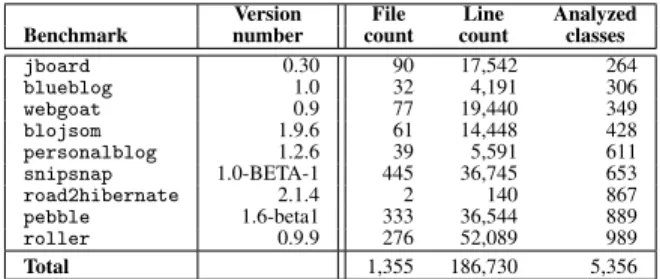
Figure 8 summarizes information about our
bench-Version File Line Analyzed
Benchmark number count count classes
jboard 0.30 90 17,542 264 blueblog 1.0 32 4,191 306 webgoat 0.9 77 19,440 349 blojsom 1.9.6 61 14,448 428 personalblog 1.2.6 39 5,591 611 snipsnap 1.0-BETA-1 445 36,745 653 road2hibernate 2.1.4 2 140 867 pebble 1.6-beta1 333 36,544 889 roller 0.9.9 276 52,089 989 Total 1,355 186,730 5,356
Figure 8: Summary of information about the benchmarks. Applica-tions are sorted by the total number of analyzed classes.
mark applications. Notice that the traditional lines-of-code metric is somewhat misleading in the case of ap-plications that use large libraries. Many of these bench-marks depend on massive libraries, so, while the appli-cation code may be small, the full size of the appliappli-cation executed at runtime is quite large. An extreme case is road2hibernate, which is a small 140-line stub pro-gram designed to exercise the hibernate object per-sistence library; however, the total number of analyzed classes for road2hibernate exceeded 800. A better measure is given in the last column of Figure 8, which shows the total number of classes in each application’s call graph.
6.2 Experimental Setup
The implementation of our system is based on the joeqJava compiler and analysis framework. In our sys-tem we use a translator from PQL to Datalog [35] and the
bddbddbprogram analysis tool [55] to find security vio-lations. We applied static analysis to look for all tainted object propagation problems described in this paper, and we used a total of 28 source, 18 sink, and 29 derivation descriptors in our experiments. The derivation descrip-tors correspond to methods in classes such as String, StringBuffer, StringTokenizer, etc. Source and sink descriptors correspond to methods declared in 19 different J2EE classes, as is further described in [34].
We used four different variations of our static analysis, obtained by either enabling or disabling context sensitiv-ity and improved object naming. Analysis times for the variations are listed in Figure 9. Running times shown in the table are obtained on an Opteron 150 machine with 4 GB of memory running Linux. The first section of
Pre- Points-to analysis Taint analysis
Context sensitivity proces- X X X X
Improved naming sing X X X X
jboard 37 8 7 12 10 14 12 16 14 blueblog 39 13 8 15 10 17 14 21 16 webgoat 57 45 30 118 90 69 66 106 101 blojsom 60 18 13 25 16 24 21 30 27 personalblog 173 107 28 303 32 62 50 19 59 snipsnap 193 58 33 142 47 194 154 160 105 road2hibernate 247 186 40 268 43 73 44 161 58 pebble 177 58 35 117 49 150 140 136 100 roller 362 226 55 733 103 196 83 338 129
Figure 9: Summary of times, in seconds, it takes to perform prepro-cessing, points-to, and taint analysis for each analysis variation. Analy-sis variations have either context sensitivity or improved object naming enabled, as indicated byXsigns in the header row.
Sources Sinks Tainted objects Reported warnings False positives Errors
Context sensitivity X X X X X X
Improved object naming X X X X X X
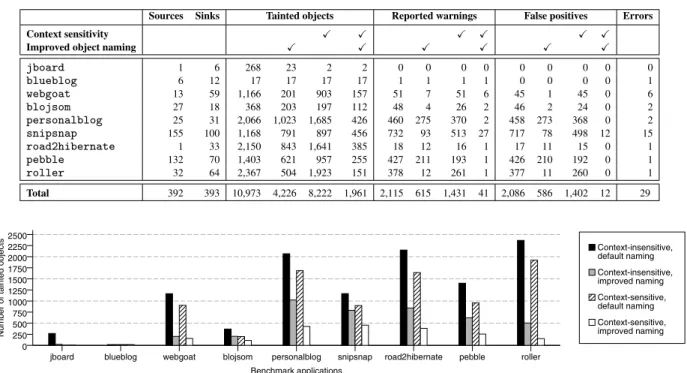
jboard 1 6 268 23 2 2 0 0 0 0 0 0 0 0 0 blueblog 6 12 17 17 17 17 1 1 1 1 0 0 0 0 1 webgoat 13 59 1,166 201 903 157 51 7 51 6 45 1 45 0 6 blojsom 27 18 368 203 197 112 48 4 26 2 46 2 24 0 2 personalblog 25 31 2,066 1,023 1,685 426 460 275 370 2 458 273 368 0 2 snipsnap 155 100 1,168 791 897 456 732 93 513 27 717 78 498 12 15 road2hibernate 1 33 2,150 843 1,641 385 18 12 16 1 17 11 15 0 1 pebble 132 70 1,403 621 957 255 427 211 193 1 426 210 192 0 1 roller 32 64 2,367 504 1,923 151 378 12 261 1 377 11 260 0 1 Total 392 393 10,973 4,226 8,222 1,961 2,115 615 1,431 41 2,086 586 1,402 12 29
jboard blueblog webgoat blojsom personalblog snipsnap road2hibernate pebble roller Benchmark applications 0 250 500 750 1000 1250 1500 1750 2000 2250 2500 N u m b e r o f ta in te d o b je c ts Context-insensitive, default naming Context-insensitive, improved naming Context-sensitive, default naming Context-sensitive, improved naming
Figure 10: (a)Summary of data on the number of tainted objects, reported security violations, and false positives for each analysis version. Enabled analysis features are indicated byXsigns in the header row.(b)Comparison of the number of tainted objects for each version of the analysis. the table shows the times to pre-process the application
to create relations accepted by the pointer analysis; the second shows points-to analysis times; the last presents times for the tainted object propagation analysis.
It should be noted that the taint analysis times often
decreaseas the analysis precision increases. Contrary to intuition, we actually payless for a more precise an-alysis. Imprecise answers are big and therefore take a long time to compute and represent. In fact, the context-insensitive analysis with default object naming runs sig-nificantly slower on the largest benchmarks than the most precise analysis. The most precise analysis version takes a total of less than 10 minutes on the largest application; we believe that this is acceptable given the quality of the results the analysis produces.
6.3 Vulnerabilities Discovered
The static analysis described in this paper reports a to-tal of 41 potential security violations in our nine bench-marks, out of which 29 turn out to be security errors, while 12 are false positives. All but one of the bench-marks had at least one security vulnerability. Moreover, except for errors inwebgoatand one HTTP splitting vul-nerability insnipsnap[16], none of these security er-rors had been reported before.
6.3.1 Validating the Errors We Found
Not all security errors found by static analysis or code reviews are necessarilyexploitablein practice. The error may not correspond to a path that can be taken dynam-ically, or it may not be possible to construct meaningful
malicious input. Exploits may also be ruled out because of the particular configuration of the application, but con-figurations may change over time, potentially making ex-ploits possible. For example, a SQL injection that may not work on one database may become exploitable when the application is deployed with a database system that does not perform sufficient input checking. Furthermore, virtually all static errors we found can be fixed easily by modifying several lines of Java source code, so there is generally no reasonnotto fix them in practice.
After we ran our analysis, we manually examined all the errors reported to make sure they represent security errors. Since our knowledge of the applications was not sufficient to ascertain that the errors we found were ex-ploitable, to gain additional assurance, we reported the errors to program maintainers. We only reported to ap-plication maintainers only those errors found in the ap-plication code rather than general libraries over which the maintainer had no control. Almost all errors we re-ported to program maintainers were confirmed, resulting in more that a dozen code fixes.
Becausewebgoatis an artificial application designed to contain bugs, we did not report the errors we found in it. Instead, we dynamically confirmed some of the statically detected errors by runningwebgoat, as well as a few other benchmarks, on a local server and creating actual exploits.
It is important to point out that our current analysis ignores control flow. Without analyzing the predicates, our analysis may not realize that a program has checked its input, so some of the reported vulnerabilities may turn
XXXXSOURCES XXXSINKS SQL injections HTTP splitting Cross-site scripting Path traversal Total
Header manip. 0 snipsnap= 6 blueblog: 1,webgoat: 1,pebble: 1,roller: 1 = 4 0 10
Parameter manip. webgoat: 4,personalblog: 2 = 6 snipsnap= 5 0 blojsom= 2 13
Cookie poisoning webgoat= 1 0 0 0 1
Non-Web inputs snipsnap: 1,road2hibernate: 1 = 2 0 0 snipsnap= 3 5
Total 9 11 4 5 29
Figure 11:Classification of vulnerabilities we found. Each cell corresponds to a combination of a source type (in rows) and sink type (in columns). out to be false positives. However, our analysis shows all
the steps involved in propagating taint from a source to a sink, thus allowing the user to check if the vulnerabilities found are exploitable.
Many Web-based application perform some form of input checking. However, as in the case of the vulnera-bilities we found insnipsnap, it is common that some checks are missed. It is surprising that our analysis did not generate any false warnings due to the lack of pred-icate analysis, even though many of the applications we analyze include checks on user input. Two security er-rors inblojsomflagged by our analysis deserve special mention. The user-provided inputwas in fact checked, but the validation checks were too lax, leaving room for exploits. Since the sanitization routine inblojsomwas implemented using string operations as opposed to direct character manipulation, our analysis detected the flow of taint from the routine’s input to its output. To prove the vulnerability to the application maintainer, we created an exploit that circumvented all the checks in the vali-dation routine, thus making path-traversal vulnerabilities possible. Note that if the sanitation was properly imple-mented, our analysis would have generated some false positives in this case.
6.3.2 Classification of Errors
This section presents a classification of all the errors we found. A summary of our experimental results is pre-sented in Figure 10(a). Columns 2 and 3 list the number of source and sink objects for each benchmark. It should be noted that the number of sources and sinks for all of these applications is quite large, which suggests that se-curity auditing these applications is time-consuming, be-cause the time a manual security code review takes is roughly proportional to the number of sources and sinks that need to be considered. The table also shows the number of vulnerability reports, the number of false pos-itives, and the number of errors for each analysis version. Figure 11 presents a classification of the 29 secu-rity vulnerabilities we found grouped by the type of the source in the table rows and the sink in table columns. For example, the cell in row 4, column 1 indicates that there were 2 potential SQL injection attacks caused by non-Web sources, one in snipsnapand another in road2hibernate.
Overall, parameter manipulation was the most com-mon technique to inject malicious data (13 cases) and
HTTP splitting was the most popular exploitation tech-nique (11 cases). Many HTTP splitting vulnerabilities are due to an unsafe programming idiom where the ap-plication redirects the user’s browser to a page whose URL is user-provided as the following example from snipsnapdemonstrates:
response.sendRedirect(
request.getParameter("referer"));
Most of the vulnerabilities we discovered are in appli-cation code as opposed to libraries. While errors in ap-plication code may result from simple coding mistakes made by programmers unaware of security issues, one would expect library code to generally be better tested and more secure. Errors in libraries expose all applica-tions using the library to attack. Despite this fact, we have managed to find two attack vectors in libraries: one in a commonly used Java libraryhibernateand another in the J2EE implementation. While a total of 29 security errors were found, because the same vulnerability vec-tor in J2EE is present in four different benchmarks, they actually corresponded to 26uniquevulnerabilities.
6.3.3 SQL Injection Vector inhibernate
We start by describing a vulnerability vector found inhibernate, an open-source object-persistence library commonly used in Java applications as a lightweight back-end database. hibernateprovides the function-ality of saving program data structures to disk and load-ing them at a later time. It also allows applications to search through the data stored in ahibernatedatabase. Three programs in our benchmark suite,personalblog, road2hibernate, and snipsnap, use hibernate to store user data.
We have discovered an attack vector in code pertain-ing to the search functionality in hibernate, version 2.1.4. The implementation of methodSession.find re-trieves objects from ahibernate database by passing its input string argument through a sequence of calls to a SQL execute statement. As a result, all invocations of Session.findwith unsafe data, such as the two errors we found inpersonalblog, may suffer from SQL injec-tions. A few other public methods such asiterateand deletealso turn out to be attack vectors. Our findings highlight the importance of securing commonly used software components in order to protect their clients.
6.3.4 Cross-site Tracing Attacks
Analysis ofwebgoatand several other applications re-vealed a previously unknown vulnerability in core J2EE libraries, which are used by thousands of Java applica-tions. This vulnerability pertains to theTRACEmethod specified in the HTTP protocol. TRACEis used to echo the contents of an HTTP request back to the client for debugging purposes. However, the contents of user-provided headers are sent back verbatim, thus enabling cross-site scripting attacks.
In fact, this variation of cross-site scripting caused by a vulnerability in HTTP protocol specification was discovered before, although the fact that it was present in J2EE was not previously announced. This type of attack has been dubbedcross-site tracing and it is re-sponsible for CERT vulnerabilities 244729, 711843, and 728563. Because this behavior is specified by the HTTP protocol, there is no easy way to fix this problem at the source level. General recommendations for avoiding cross-site tracing include disablingTRACEfunctionality on the server or disabling client-side scripting [18].
6.4 Analysis Features and False Positives
The version of our analysis that employs both context sensitivity and improved object naming described in Sec-tion 4 achieves very precise results, as measured by the number of false positives. In this section we examine the contribution of each feature of our static analysis ap-proach to the precision of our results. We also explain the causes of the remaining 12 false positives reported by the most precise analysis version. To analyze the impor-tance of each analysis feature, we examined the number of false positives as well as the number of tainted objects reported by each variation of the analysis. Just like false positives, tainted objects provide a useful metric for an-alysis precision: as the anan-alysis becomes more precise, the number of objects deemed to be tainted decreases.
Figure 10(a) summarizes the results for the four differ-ent analysis versions. The first part of the table shows the number of tainted objects reported by the analysis. The second part of the table shows the number of reported security violations. The third part of the table summa-rizes the number of false positives. Finally, the last col-umn provides the number of real errors detected for each benchmark. Figure 10(b) provides a graphical represen-tation of the number of tainted objects for different anal-ysis variations. Below we summarize our observations.
Context sensitivity combined with improved object naming achieves a very low number of false positives. In fact, the number of false positives was 0 for all applica-tions butsnipsnap. Forsnipsnap, the number of false positives was reduced more than 50-fold compared to the context-insensitive analysis version with no naming im-provements. Similarly, not counting the small program
jboard, the most precise version on average reported 5 times fewer tainted objects than the least precise. More-over, the number of tainted objects dropped more that 15-fold in the case ofroller, our largest benchmark.
To achieve a low false-positive rate,bothcontext sen-sitivity and improved object naming are necessary. The number of false positives remains high for most pro-grams whenonlyone of these analysis features is used. One way to interpret the importance of context sensitiv-ity is that the right selection of object “names” in pointer analysis allows context sensitivity to produce precise re-sults. While it is widely recognized in the compiler com-munity that special treatment of containers is necessary for precision, improved object namingaloneis not gener-ally sufficient to completely eliminate the false positives. All 12 of the false positives reported by the most precise version for our analysis were located in snipsnap and were caused by insufficient preci-sion of the default allocation site-based object-naming scheme. The default naming caused an allocation site in snipsnap to be conservatively considered tainted because a tainted object could propagate to that al-location site. The allocation site in question is lo-cated withinStringWriter.toString(), a JDK func-tion similar to String.toLowerCase() that returns a taintedStringonly if the underlyingStringWriteris constructed from a tainted string. Our analysis conser-vatively concluded that the return result of this method may be tainted, causing a vulnerability to be reported, where none can occur at runtime. We should men-tion that allthe false positives in snipsnap are elim-inated by creating a new object name at every call to,
StringWriter.toString(), which is achieved with a
one-line changeto the pointer analysis specification.
7 Related Work
In this section, we first discusspenetration testingand
runtime monitoring, two of the most commonly used ap-proaches for finding vulnerabilities besides manual code reviews. We also review the relevant literature on static analysis for improving software security.
7.1 Penetration Testing
Current practical solutions for detecting Web applica-tion security problems generally fall into the realm of penetration testing [3, 5, 15, 36, 44]. Penetration testing involves attempting to exploit vulnerabilities in a Web application or crashing it by coming up with a set of appropriate malicious input values. Penetration reports usually include a list of identified vulnerabilities [25]. However, this approach is incomplete. A penetration test can usually reveal only a small sample of all possible se-curity risks in a system without identifying the parts of the system that have not been adequately tested.
Gener-ally, there are no standards that define which tests to run and which inputs to try. In most cases this approach is not effective and considerable program knowledge is needed to find application-level security errors successfully.
7.2 Runtime Monitoring
A variety of both free and commercial runtime mon-itoring tools for evaluating Web application security are available. Proxies intercept HTTP and HTTPS data be-tween the server and the client, so that data, including cookies and form fields, can be examined and modified, and resubmitted to the application [9, 42]. Commercial application-level firewalls available from NetContinuum, Imperva, Watchfire, and other companies take this con-cept further by creating a model of valid interactions be-tween the user and the application and warning about vi-olations of this model. Some application-level firewalls are based on signatures that guard against known types of attacks. The white-listing approach specifies what the valid inputs are; however, maintaining the rules for white-listing is challenging. In contrast, our technique can prevent security errorsbeforethey have a chance to manifest themselves.
7.3 Static Analysis Approaches
A good overview of static analysis approaches applied to security problems is provided in [8]. Simple lexical approaches employed by scanning tools such as ITS4 and RATS use a set of predefined patterns to identify poten-tially dangerous areas of a program [56]. While a signif-icant improvement on Unixgrep, these tools, however, have no knowledge of how data propagates throughout the program and cannot be used to automatically and fully solve taint-style problems.
A few projects use path-sensitive analysis to find er-rors in C and C++ programs [6, 20, 33]. While capa-ble of addressing taint-style procapa-blems, these tools rely on an unsound approach to pointers and may therefore miss some errors. The WebSSARI project uses combined un-sound static and dynamic analysis in the context of ana-lyzing PHP programs [23]. WebSSARI has successfully been applied to find many SQL injection and cross-site scripting vulnerabilities in PHP code.
An analysis approach that uses type qualifiers has been proven successful in finding security errors in C for the problems of detecting format string violations and user/kernel bugs [26, 45]. Context sensitivity sig-nificantly reduces the rate of false positives encountered with this technique; however, it is unclear how scalable the context-sensitive approach is.
Much of the work in information-flow analysis uses a type-checking approach, as exemplified by JFlow [38]. The compiler reads a program containing labeled types and, in checking the types, ensures that the program cannot contain improper information flow at runtime.
The security type system in such a language enforces information-flow policies. The annotation effort, how-ever, may be prohibitively expensive in practice. In addition to explicit information flows our approach ad-dresses, JFlow also deals with implicit information flows. Static analysis has been applied to analyzing SQL statements constructed in Java programs that may lead to SQL injection vulnerabilities [17, 53]. That work an-alyzes strings that represent SQL statements to check for potential type violations and tautologies. This approach assumes that aflow graphrepresenting how string values can propagate through the program has been constructed a priori from points-to analysis results. However, since accurate pointer information is necessary to construct an accurate flow graph, it is unclear whether this technique can achieve the scalability and precision needed to detect errors in large systems.
8 Conclusions
In this paper we showed how a general class of se-curity errors in Java applications can be formulated as instances of the generaltainted object propagation prob-lem, which involves finding all sink objects derivable fromsource objectsvia a set of givenderivation rules. We developed a precise and scalable analysis for this problem based on a precise context-sensitive pointer alias analysis and introduced extensions to the handling of strings and containers to further improve the preci-sion. Our approach finds all vulnerabilities matching the specification within the statically analyzed code. Note, however, that errors may be missed if the user-provided specification is incomplete.
We formulated a variety of widespread vulnerabili-ties including SQL injections, cross-site scripting, HTTP splitting attacks, and other types of vulnerabilities as tainted object propagation problems. Our experimental results showed that our analysis is an effective practical tool for finding security vulnerabilities. We were able to find a total of 29 security errors, and all but one of our nine large real-life benchmark applications were vulner-able. Two vulnerabilities were located in commonly used libraries, thus subjecting applications using the libraries to potential vulnerabilities. Most of the security errors we reported were confirmed as exploitable vulnerabili-ties by their maintainers, resulting in more than a dozen code fixes. The analysis reported false positives for only one application. We determined that the false warnings reported can be eliminated with improved object naming.
9 Acknowledgements
We are grateful to Michael Martin for his help with PQL and dynamic validation of some of the vulnerabili-ties we found and to John Whaley for his support with the bddbddb tool and the joeq framework. We thank