Trial and Evaluation of Assertion Training Involving Nursing Students
Yuko Nishina* and Shizuko Tanigaki†*Department of Nursing Care Environment and Mental Health, School of Health Science, Tottori University Faculty of Medicine, Yonago 683-8503, Japan and †Graduate School of Health Sciences, Okayama University, Okayama 700-8558, Japan
ABSTRACT
Background The concept of assertion and conceptu-al/practical methods of assertion (assertiveness) train-ing were originally developed in the United States and Europe. These principles were embraced and adapted in Japan in 1970’s. However, only a few studies relat-ing to assertion (assertiveness) have been undertaken thus far in Japan, especially so in the domain of nurs-ing students in comparison with other countries. The purpose of this study was to design and implement as-sertion training with nursing students and to clarify its effects.
Methods The participants were all volunteers,
invit-ed from a class of 3rd year nursing students. Ten stu-dents (intervention group) participated in the assertion training comprised of five sessions in February 2006. Fifty-six students (control group) were participated only in the questionnaire. Both groups were asked to complete the same questionnaire twice, before and af-ter the assertion training. The questionnaire measured levels of assertiveness, social skills, self-esteem, so-cial support and satisfaction with university life. The results and variances, both before and after assertion training, between the intervention group and the con-trol group were analyzed. The effectiveness of the as-sertion training was determined by changes in pre and post training questionnaire scores.
Results The scores for social skills in the control
group had a tendency to decline while the scores for social skills in the intervention group remained con-stant.
Conclusion Although there were no statistically
sig-nificant results in the intervention group, the present study highlights areas appropriate for further study.
Key words assertion; assertiveness; nursing student; communication; self-esteem
The concept of assertion and conceptual/practical meth-ods of assertion training (assertiveness training) were originally developed in the United States and Europe. According to Hiraki,1 the person accredited with
in-troducing “assertion” principles to Japan, assertion is a self-motivated form of expression in which a person or a group, respectfully and through speaking assertively,
Corresponding author: Yuko Nishina, MNS, RN, PHN [email protected]
Received 2013 April 2 Accepted 2013 June 13
Abbreviations: J-RAS, Japanese version of Rathus Assertiveness Schedule; KiSS-18, Kikuchi’s Scale of Social Skills: 18 items
express their feelings, ideas and beliefs, both honestly and frankly, in a manner appropriate to the situation.1
Along with the concept of assertion, Hiraki introduced methods for assertion training designed specifically for the Japanese. Hiraki’s methods are widely utilised in clinical psychology involving a wide range of people, including nurses, teachers, counselors, children, students and the general public.
The purpose of assertion training is to establish better interpersonal relationships. Previous studies high-lighted the beneficial effects on nurses received having undertaken assertion training (assertiveness training) as: improved assertiveness,2 reduced stress at work3 and
improved self-esteem.4 The author, having learned the
concept of assertion from books and training (seminars), felt the necessity for nursing students to understand the concept of assertion because nursing is considered a process involving important and sensitive interpersonal relations,5, 6 including daily conversations with patients
and their families. Day to day life requires that nursing students develop strategies to establish and maintain better relationship with all those they have contact with. Good communication is crucial to the well being of nursing students, allowing them to cooperate with the various specialists and patients they interact with and it is important for the students themselves to establish better relationships with others close to them, in order to maintain their own mental well being.
The purpose of the present study was to design and implement assertion training with students, and to clarify the effects that assertion training had on its par-ticipants. The reasons for including nursing students in the design of the assertion training program were: i) it was important for them to be spontaneous and active in a participatory setting for the better learning of assertion and ii) in cognitive-behavioral therapy programs, such as assertion training, practical experience (experimental learning1) is regarded as important, and so it was
con-sidered that experimental learning would be better pro-moted in a participatory setting.
Thus, in the present study, which was designed and implemented together with students, we aimed to clarify the beneficial effects of assertion training on communi-cation abilities and mental health of the nursing students.
SUBJECTS AND METHODS Subjects
The participants in this study were all volunteers, in-vited from a class of 3rd year nursing students from the School of Health Science, Tottori University Faculty of Medicine. All participants consented of their own accord to take part in the study (n = 90). Of these participants, students who did not complete the questionnaire twice were excluded (n = 12). We also excluded those who had previously attended seminars on assertion (n = 9). In addition, because all students in the intervention group were female, male students were excluded from the con-trol group (n = 3). As a result, a total of 66 students were extracted as the study subjects. The number of students who participated in assertion training was 10, and the number of those who responded to questionnaire before and after assertion training (control group) was 56.
Survey methods
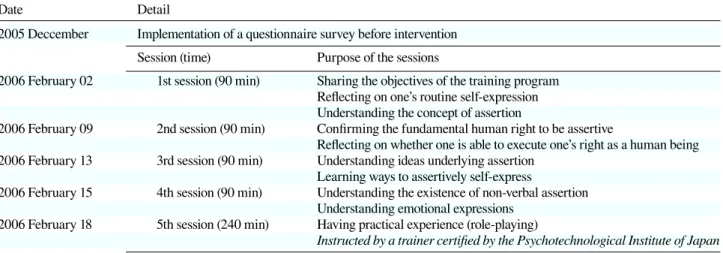
A self-rating questionnaire survey was conducted before and after assertion training. All subjects received an outline of the study’s objectives and methods in writing. The subjects then responded to the questionnaire which was duly collected and analyzed. Table 1 shows the schedule of the surveys and intervention program.
Assertiveness and social-skills scales were used to evaluate communication abilities. A self-esteem scale, acknowledging both levels of social-support cognition and satisfaction with university life, were used to
evalu-ate mental health. Details of the scales and question items are as follows:
Assertiveness scale, J-RAS
The original Rathus Assertiveness Schedule (RAS) was developed by Rathus,7 and its Japanese version (J-RAS)
was created by Shimizu et al.,8 the reliability and
valid-ity of which has been verified. The J-RAS scale consists of 30 items with 6 choices. Scores range from –90 to 90 points, with higher scores indicating higher degrees of assertiveness.
Social-skills scale, KiSS-18
Kikuchi’s Scale of Social Skills: 18 items (KiSS-18), developed by Kikuchi,9 is widely used in Japan, and the
reliability and validity of which has been verified. The scale comprises 18 items with 5 choices. Scores range from 18 to 90 points, with higher scores indicating great-er social skills. The definition of social skills is “skills to facilitate interpersonal relationships”, and our previous study suggested that there is a correlation between asser-tiveness and social skills.10, 11 Also, it has been reported
that social skills are correlated with: the degree of so-ciability among female junior college students,9
group-activity skills among junior high school students, and communication skills among colleagues.9
Self-esteem scale
The scale, developed by Rosenberg, is being widely used within and outside Japan. The present study used the Japanese version.12 The scale consists of 10 items with 5
choices. Scores range from 10 to 50 points, with higher scores indicating higher levels of self-esteem.
Table 1. Schedule and details of questionnaire surveys and assertion training Date Detail
2005 Deccember Implementation of a questionnaire survey before intervention Session (time) Purpose of the sessions
2006 February 02 1st session (90 min) Sharing the objectives of the training program Reflecting on one’s routine self-expression Understanding the concept of assertion
2006 February 09 2nd session (90 min) Confirming the fundamental human right to be assertive
Reflecting on whether one is able to execute one’s right as a human being 2006 February 13 3rd session (90 min) Understanding ideas underlying assertion
Learning ways to assertively self-express
2006 February 15 4th session (90 min) Understanding the existence of non-verbal assertion Understanding emotional expressions
2006 February 18 5th session (240 min) Having practical experience (role-playing)
Instructed by a trainer certified by the Psychotechnological Institute of Japan 2006 April Implementation of a questionnaire survey after intervention
Social support
Questions regarding social support were created based on investigation criteria devised by Kubo et al.13 The
frequency of consultations from each social support provider (i.e., family, friends, and others) was assessed. Each question has 4 response options, and scores range from 3 to 12 points, with higher scores indicating higher degrees of social-support cognition (the degree of one’s recognition that one is able to ask others for help).
Degree of satisfaction with university life
Subjects were asked to choose between 4 response op-tions (from “Not satisfied” to “Very satisfied”) for an-swering “Overall, how much are you satisfied with your university life?” Higher scores indicated higher degrees of satisfaction with university life.
Intervention methods
Subjects were informed of the study objectives and methods and volunteers were selected to participate in assertion training. A total of 5 training sessions were scheduled, and the session dates were determined to-gether with students. Table 1 shows the program sched-ule and purposes of each session.
The assertion training was implemented with “As-sertion training—for smooth self-expression” by Hiraki1
as a reference book. The authors developed the 5-session program. A short lecture and orientation were provided at the beginning of each session, followed by group work, group discussion and short roll-playing activities. Participatory learning was regarded as important so subjects were required to read the reference book in ad-vance of each session. For the final session, an assertion training trainer from the Psychotechnological Institute of Japan introduced and guided a role play exercise with the participants. The objectives of assertion training pre-sented to the intervention group were to: i) reflect on the way of their routine self-expression, ii) consider ways of self-expression based on equal interpersonal relation-ships and iii) confirm that their feelings and opinions can be expressed with confidence. Of the 10 participants, 7 attended all 5 sessions, and the other 3 were each ab-sent from 1 session, but analyses were performed involv-ing all participants. When a participant was absent from a session, this session was reviewed at the beginning of the next session, and self-study using the reference book was promoted, thereby making up for the absence.
Cooperation with an assertion training trainer cer-tified by the Psychotechnological Institute of Japan
Assertion training developed by the Psychotechno-logical Institute of Japan is implemented by assertion
training trainers certified by the institute (Nisseiken-certified trainers). At the final session of our assertion training, a Nisseiken-certified trainer was invited as an instructor for the overall review of the first 4 sessions: we attempted to enhance students’ learning through the introduction of role-playing experience. The trainer was consulted prior to the session, in order to provide and ex-change information regarding students’ learning. We in-formed the trainer of the study objectives and methods, and obtained consent in advance.
Statistical analyses
Basic statistics of scores for each scale were calculated before and after intervention. We compared the aver-ages of the ranks between the intervention and control groups, using the Mann-Whitney U test. To examine the effects of the intervention, the Wilcoxon rank-sum test was used. Due to the total number of subjects being low and there being a difference in the number of subjects between groups, a distribution-free test was used. The level of significance was set at 0.05 for all analyses. Ethical considerations
Prior to the study, the study protocol was submitted to the Ethics Committee of Tottori University, and approval (No.583) was obtained. Subjects were explained that: i) the study would only be undertaken with the subjects’ consent, ii) questionnaires would be conducted with subjects’ identity being protected and iii) participation/ non-participation in or withdrawal from the study would not influence subjects’ grades in any way. An agreement document was signed by all participants to confirm their intention to participate. We then explained that subjects could withdraw from the study at any time, and distrib-uted withdrawal documents.
RESULTS
Subject attributes
The mean (SD) ages were 21.1 (0.7) and 21.2 (0.9) years in the intervention and control groups, respectively.
Comparing mean scores in the intervention and control groups before intervention
The mean (SD) scores for assertiveness were –7.0 (20.6) and –10.5 (17.7) points in the intervention and control groups, respectively. The mean (SD) scores for social skills were 54.3 (9.6) and 57.2 (8.6) points in the in-tervention and control groups, respectively. The mean (SD) scores for self-esteem were 34.7 (5.7) and 30.3 (6.3) points in the intervention and control groups, respec-tively. The mean (SD) scores for social support were 9.11 (1.17) and 8.71 (1.50) points in the intervention and
control groups, respectively. The mean (SD) scores for the degree of satisfaction with university life were 3.20 (0.63) and 2.86 (0.67) points in the intervention and con-trol groups, respectively. Comparisons of the means of the ranks showed a significant difference in the score for self-esteem (P < 0.05) (Table 2).
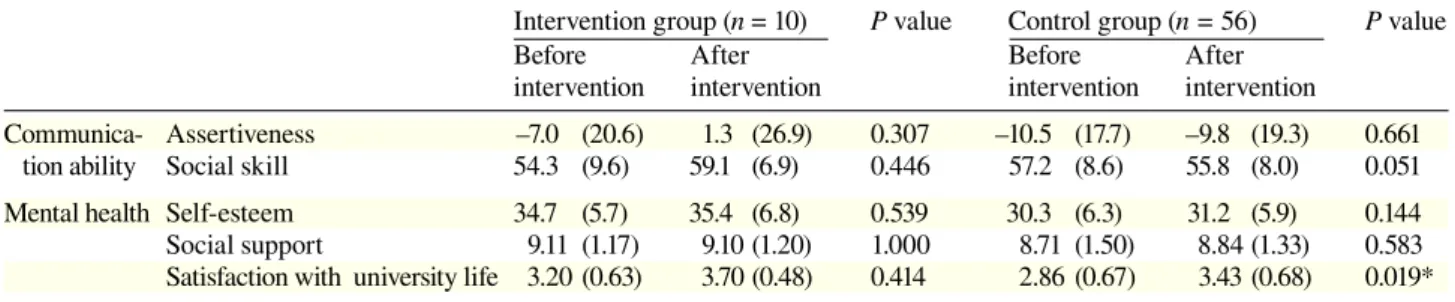
Results of the Wilcoxon rank-sum test to compare the means between pre- and post-intervention
In the intervention group, the scores for assertiveness creased by 8.3 points and the scores for social skills in-creased by 4.8 points, there were not significant though. Also in the intervention group, the scores for self-esteem increased by 0.7 points, the scores for social support declined by 0.01 points and the scores for the degree of
satisfaction with university life increased by 0.50 points, there were not significant. Compared with the scores in the control group, the scores for assertiveness and so-cial skills in the intervention group remained constant (Fig. 1).
In the control group, the scores for social skills had a tendency to decline (P = 0.051). Also in the control group, the scores for the degree of satisfaction with uni-versity life increased significantly (P < 0.05) (Table 3).
DISCUSSION
In assertion training, effective learning can be promoted through students’ pre-session preparation; learning through practical experience in a participatory setting was regarded as important. A difference in self-esteem
Fig. 1. Scores for each assessment scale before and after intervention.
Table 2. Comparisons between the groups before assertion training
Intervention group (n = 10) Control group (n = 56) P value
Mean (SD) Mean (SD)
Age 21.1 (0.7) 21.2 (0.9) 0.771
Communication ability Assertiveness –7.0 (20.6) –10.5 (17.7) 0.405
Social skills 54.3 (9.6) 57.2 (8.6) 0.659
Mental health Self-esteem 34.7 (5.7) 30.3 (6.3) 0.022*
Social support 9.11 (1.17) 8.71 (1.50) 0.451
Satisfaction with university life 3.20 (0.63) 2.86 (0.67) 0.138 *P < 0.05.*
Table 3. Changes in communication abilities and mental health of the participants
Intervention group (n = 10) P value Control group (n = 56) P value
Before After Before After
intervention intervention intervention intervention
Communica- Assertiveness –7.0 (20.6) 1.3 (26.9) 0.307 –10.5 (17.7) –9.8 (19.3) 0.661 tion ability Social skill 54.3 (9.6) 59.1 (6.9) 0.446 57.2 (8.6) 55.8 (8.0) 0.051 Mental health Self-esteem 34.7 (5.7) 35.4 (6.8) 0.539 30.3 (6.3) 31.2 (5.9) 0.144 Social support 9.11 (1.17) 9.10 (1.20) 1.000 8.71 (1.50) 8.84 (1.33) 0.583 Satisfaction with university life 3.20 (0.63) 3.70 (0.48) 0.414 2.86 (0.67) 3.43 (0.68) 0.019* Data, mean (SD).
* P < 0.05.
Significant differences are not noted in the intervention group.
was noted between the intervention group and the con-trol group before intervention, suggesting that training participants had higher-level of self-esteem. It can be suggested that students are willing to participate in as-sertion training would have increased levels of self-esteem.
In prior studies, the assertiveness of those in nurs-ing professions improved after participatnurs-ing in assertion training.2, 3 A significant improvement in the
assertive-ness of participants in the present study was not found. Social skills did not show a significant improvement, either. In contrast, the scores for social skills had a ten-dency to decline in the control group, so the assertion training could maintain the social skills in the interven-tion group. Because assertiveness is correlated with social skills,10, 11 social skills could remain constant in
nursing students that undergo assertion training.
Previous studies have suggested beneficial effects of assertion training on mental health and well-being. The benefits include reduced stress3 and improved
self-esteem.4 But the present study did not produce beneficial
effects on mental health of participants. It was not deter-mined why the degree of satisfaction with university life increased in the control group in the present study.
The number of participants in the present study was low and there were several obstacles to the study. The characteristics of the intervention group and those of the control were not alike. And the possibility of factors which might have influenced communication abilities and mental health of the participants cannot be denied. This suggests that there are limitations to the benefits that the general use of assertion training among nursing students can achieve.
The present study also suggests that it is advisable to improve intervention program, including the evalua-tions method of their techniques and effects. Firstly, in this study, the self-esteem of the intervention group was high, due to the participants being willing volunteers, therefore future studies would benefit from having larger
intervention groups that would include a greater number of students with low self esteem to better determine the effects that an assertion training program has on nursing students. Secondly, previous studies have demonstrated the benefits that follow-up sessions have to assertion training, future studies should therefore include the follow-up session in the program. Finally, research in the present study focused on assertion in the daily lives of the nursing students; future studies should include sev-eral sessions which focusing issues relating to the practi-cal training of nursing students. The practipracti-cal training course that nurses undergo is one of the most important learning opportunities that nursing students have. One of the problems that nursing students face during this time is effective communication with various specialists, nurses, patients and their family members. Further study would clarify the effects of assertion training on the communication abilities in nursing practice. In conclu-sion, the present trial study suggests future possibilities for the further study of assertion training for nursing students.
Acknowledgments: We would like to express our deep gratitude to the nursing students who cooperated in our study, and those who participated in our assertion training. We also acknowledge the co-operation of Mr. Yukitoshi Kuroki (former teacher of a secondary school attached to Kobe University, and current teacher of Kak-ogawa Yamate Junior High School), an assertion training trainer certified by the Psychotechnological Institute of Japan, who com-prehended the study objectives, instructed in our assertion training (role-playing), and markedly contributed to our study.
The authors declare no conflict of interest. REFERENCES
1 Hiraki N. [Assertion training – for smooth self-expression]. Tokyo: Kaneko Shobo; 2009. Jananese. NCID: BN10254248. 2 Katsuhara Y, Mashino S. Development and evaluation of an
assertiveness training program for Japanese nurses. Hyogo Kenritsu Kango Daigaku Kiyo. 2001;8:71-85. Japanese with English abstract. NAID: 110000558787.
of stress and assertiveness experienced by nurses in Taiwan, Republic of China. Issues Ment Health Nurs. 1994;15:419-32. PMID: 8056571.
4 Shimizu T, Kubota S, Mishima N, Nagata S. Relationship be-tween self-esteem and assertiveness training among Japanese hospital nurses. J Occup Health. 2004;46:296-298. NAID: 110003722961.
5 Peplau HE. Interpersonal relations in nursing: a conceptual frame of reference for psychodynamic nursing. Tokyo: Igaku-Shoin; 2001. Japanese. Translated by Inata Y, Kobayashi F, Takeyama M, Tsuru N, Hokama K. NCID: BN00703618. 6 Travelbee J. Interpersonal aspects of nursing. Tokyo:
Igaku-Shoin; 2003. Japanese. Translated by Hasegawa H, Fujieda T. NCID: BN00672445.
7 Rathus SA. A 30-Item schedule for assessing assertive behav-ior. Behavior Therapy. 1973;4:398-406. DOI: 10.1016/S0005-7894(73)80120-0.
8 Shimizu T, Morita S, Takezawa M, Shazuki A, Kubota S, Mishima N, et al. Development of the Japanese version of the Rathus assertiveness schedule. Sangyo Ika Daigaku Zasshi.
2003;25:35-42. Japanese with English abstract. NAID: 110001261752.
9 Kikuchi A. Notes on the researches using KiSS-18. Iwate Kenritsu Daigaku Shakaifukushi Gakubu Kiyo. 2004;6:41-51. Japanese with English abstract. NAID: 110004677435. 10 Nishina Y, Tanigaki S, Norikoshi C. The relationships
be-tween mental health condition, communication skills, and self-esteem of nursing students. Yonago Igaku Zasshi. 2010;61:67-74. Jananese with English abstract. NAID: 40017139241. 11 Nishina Y, Tanigaki S. Factors related to intragroup conflict in
the workplace among visiting nurses. Nihon Kango Kenkyu Gakkai Zasshi. 2009;32:113-21. Japanese with English ab-stract. NAID: 10026505444.
12 Yamamoto M, Matsui Y, Yamashiro Y. [The structure of perceived aspects of self]. Kyoiku Shinrigaku Kenkyu. 1982;30:64-8. Japanese. NAID: 110001892417.
13 Kubo, M. The relationships between burnout and social sup-port among human service workers. Osaka Kyoiku Daigaku Kiyo Dai IV Bumon. 1999;48:139-47. Japanese with English abstract. NAID: 110000119419.