How Best to Target the Poor?
An operational targeting of the poor using indicator-based proxy means tests
By
Houssou, Nazaire; Zeller, Manfred; Alcaraz V., Gabriela;
Johannsen, Julia; and Schwarze, Stefan
Contributed Paper presented at the Joint 3
rdAfrican Association of Agricultural
Economists (AAAE) and 48
thAgricultural Economists Association of South Africa
How Best to Target the Poor?
An operational targeting of the poor using indicator-based proxy means tests
Nazaire Houssou1, Manfred Zeller1, Gabriela Alcaraz V.1,
Julia Johannsen2, and Stefan Schwarze3
1
Dr. Nazaire Houssou (corresponding author)
Department of Agricultural Economics and Social Sciences in the Tropics and Subtropics, University of Hohenheim, 70599 Stuttgart, Germany.
Email: [email protected]/[email protected]
Phone: +49 71145922548 Fax: +4971145923934 Prof. Manfred Zeller
Email: [email protected]
Gabriela Alcaraz V.
Email: [email protected]
2
Dr. Julia Johannsen
Inter-American Development Bank, Washington DC., USA.
Email: [email protected]
3
Dr. Stefan Schwarze
Department of Agricultural Economics and Rural Development, University of Goettingen,
Goettingen, Germany.
Email: [email protected]
Abstract
This paper seeks to answer an operational development question: how best to target the poor? In their endeavor, policy makers, program managers, and development practitioners face the daily challenge of targeting policies, projects, and services at the poorer strata of the population. This is also the case for microfinance institutions that seek to estimate the poverty outreach among their clients. This paper addresses these challenges. Using household survey data from Uganda, we estimate four alternative models for improving the identification of the poor in the country. Furthermore, we analyze the model sensitivity to different poverty lines and test their validity using bootstrapped simulation methods.
While there is bound to be some errors, no indicator being perfectly correlated with poverty, the models developed achieve fairly accurate out-of-sample predictions of absolute poverty. Furthermore, findings suggest that the estimation method is not relevant for developing a fairly accurate model for targeting the poor. The models developed are potentially useful tools for the development community in Uganda. This research can also be applied in other developing countries. Keywords: Uganda, poverty assessment, targeting, proxy means tests, validations, bootstrap.
How Best to Target the Poor?
An operational targeting of the poor using indicator-based proxy means tests
1. Introduction
Many developing countries seek to target a wide range of programs, such as basic health care, education, food aid as well as services, such as agricultural credit and extension and other safety net measures, to poorer segments of the population. Most of these countries use an absolute poverty line as the criteria for targeting specific policies. Those households whose incomes are below the poverty line, i.e. below the minimum budget to satisfy food and other basic needs, are considered eligible for targeted benefits.
However, the measurement of income through lengthy expenditure surveys is too costly among households who derive their incomes mostly from smallholder agriculture and employment in the informal sector1. Therefore, alternative low-cost and practical methods for identifying and targeting the poor are demanded by policy makers, program managers, microfinance institutions, and non-governmental organizations in many developing countries. This is also the case in Uganda where the recent economic growth has mostly favored the wealthy in urban areas and led to rising inequalities between poor and non-poor in the country (Ssewanjana et al., 2004; Kappel et al., 2005).
Therefore, we develop operational tools for targeting the country’s poor using proxy means tests. Proxy means tests seek the best correlates of household welfare measured by income or consumption expenditures. In general, the aim is to proxy the household means of living using a few indicators which can be easily verified, but sufficiently correlate with welfare
to be used for targeting the poor. The efficacy of proxy means testing is demonstrated in various studies (Coady and Parker, 2009; Johannsen, 2009; Zeller and Alcaraz V., 2005; Zeller et al., 2005; Ahmed and Bouis, 2002; Braithwaite et al., 2000; Grosh and Baker, 1995).
Using household-level data from Uganda and stepwise selection of variables, this paper designs low-cost and fairly accurate models for improving the targeting efficiency of development policies in the country. Furthermore, the research compares the targeting accuracy of four alternative models, such as the Ordinary Least Square method, the Linear Probability Model, the Logit, and the Quantile regressions. These models were calibrated to two poverty lines, while their targeting performances were validated through bootstrapped simulations. This paper is organized as follows. Section 2 reviews the data and methodology, whereas section 3 presents the main findings of the research. Section 4 concludes the work with observations on policy implications. 2. Data and Methodology
2.1 Data Source
This research used the IRIS survey data2. The survey was conducted within the frame of the IRIS project at the University of Maryland and has been specifically designed for developing poverty assessment tools for Uganda. The data were collected between August and October 2004 and covered a nationally representative sample of 800 households (Zeller and Alcaraz V., 2005). These households were selected based on probability proportional to size sampling design. The survey consisted of two questionnaires: i) a composite questionnaire consisting of indicators from various poverty dimensions and ii) a Living Standard Measurement Survey (LSMS) type questionnaire used to collect data on household consumption expenditures and measure absolute poverty3.
2 We gratefully acknowledge the IRIS Center for providing us with the data. 3 See Zeller and Alcaraz V. (2005) for further details on the IRIS survey.
In Uganda, there is no single national poverty line; instead the poverty line is disaggregated into different regional poverty lines which reflect the differences in costs of living between the four divisions of the country (central, eastern, western, and northern regions, each divided into urban and rural areas). In order to simplify the identification of the poor and concur with the definition of poverty under the Millennium Development Goals however, this research used an expenditure-based definition of welfare with an international poverty line of $1.08 a day as benchmark. Households with daily per capita expenditures lower than $1.08 a day were considered poor, otherwise they were deemed non-poor. Since the poverty line is a policy variable, we analyzed the sensitivity of the results using an international poverty line of $2.15. Table 1 compares Uganda’s poverty rates under different poverty lines.
Table 1. Uganda’s poverty rates as of 2004
Poverty lines Number of observations4
Poverty rate (%)
percent of households percent of people National poverty line
(differentiated by 8 regions) 800 31.60 37.51
$1.08 a day
(Ugsh. 664.98 ppp) 800 32.36 38.84
$2.15 a day
(Ugsh. 1323.80 ppp) 800 67.51 76.26
Source: Zeller and Alcaraz V. (2005). PPP denotes Purchasing Power Parity. Ugsh denotes Ugandan shillings.
Table 1 shows that under the national poverty line (disaggregated), the poverty rate is almost the same as the rate according to the one-dollar international poverty line. Furthermore, the poverty rate of 37.51% in the IRIS sample coincides well with the national poverty rate of 37.7% estimated from the Ugandan National Household Survey in 2002/03 (Zeller and Alcaraz V., 2005).
As poorer households tend to have higher sizes, the poverty rates are higher when expressed in percent of people.
2.2 Estimation methods
Initially, about 90 poverty indicators were prepared for the estimations. A model with high explanatory power is a prerequisite for good predictions of household consumption expenditures and thereby poverty status. Therefore, a set of best ten indicators was selected using the MAXR (Maximum R-square, see SAS Institute, 2003) selection routine of SAS which maximizes a model’s explained variance. Likewise, the selection of indicators included practicality criteria regarding the ease and the accuracy with which information can be quickly elicited in an interview as well as considerations regarding the objectiveness and verifiability of an indicator (Zeller et al., 2006). Previous researches show that the inclusion of more than ten regressors only generates marginal gains in accuracy (see for example Zeller and Alcaraz V., 2005; Zeller et al., 2005). Therefore, we restricted the number of indicators to the best ten regressors. Annex 1 summarizes the model variables.
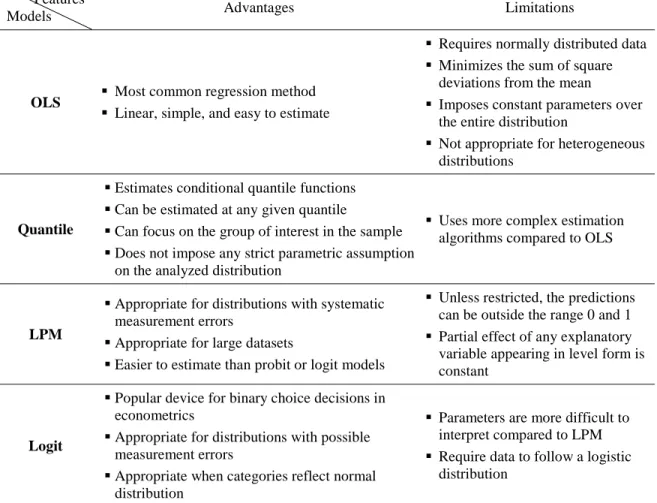
Since we sought the best way of identifying the poor, we used four alternative models, including the Ordinary Least Square (OLS), the Linear Probability Model (LPM), the Logit, and the Quantile regressions. All of these models have been previously used for assessing poverty: they do have advantages, but also some limitations. Indeed, the use of welfare versus binary regressions models is subject to debate in the literature5. Furthermore, most previous studies did not conduct any tests on model validity. Hence, we considered in this research four models and systematically assessed their validity to derive the best for identifying those living below the poverty line. Table 2 summarizes the main features of the models.
Table 2. Comparison of estimated models Features
Models Advantages Limitations
OLS Most common regression method
Linear, simple, and easy to estimate
Requires normally distributed data
Minimizes the sum of square deviations from the mean
Imposes constant parameters over the entire distribution
Not appropriate for heterogeneous distributions
Quantile
Estimates conditional quantile functions
Can be estimated at any given quantile
Can focus on the group of interest in the sample
Does not impose any strict parametric assumption on the analyzed distribution
Uses more complex estimation algorithms compared to OLS
LPM
Appropriate for distributions with systematic measurement errors
Appropriate for large datasets
Easier to estimate than probit or logit models
Unless restricted, the predictions can be outside the range 0 and 1
Partial effect of any explanatory variable appearing in level form is constant
Logit
Popular device for binary choice decisions in econometrics
Appropriate for distributions with possible measurement errors
Appropriate when categories reflect normal distribution
Parameters are more difficult to interpret compared to LPM
Require data to follow a logistic distribution
Source: Compiled from the literature. OLS denotes Ordinary Least Square. LPM is Linear Probability Model.
The Quantile and OLS regressions used as dependent variable the log of daily per-capita expenditures, whereas the Logit and LPM models had as dependent variable a dummy variable that is coded one if the household is poor (expenditure below poverty line) and zero otherwise6. Since we are interested in identifying the poor segment of the population, we estimated the Quantile regression at the point that matches the poverty rate in the sample.
In order to determine the best performing model, all four regressions were restricted to the same set of ten indicators. Furthermore, we controlled for differences between the main regional divisions as well as variations between urban and rural areas in the models.
The estimated models can be specified as follows (Greene, 2003; Maddala, 1983; Koenker and Hallock, 2001):
1 1 2 2
...
i o i i k ik iy
=
β β
+
x
+
β
x
+ +
β
x
+
ε
(OLS)y
i= Ω + Ω + Ω
o 1x
i1 2x
i2+ + Ω
...
kx
ik+
ε
i (Quantile) 1 1 2 2(
1
)
...
iz
ix
i ox
ix
i kx
ik iρ
=
=
λ λ
+
+
λ
+ +
λ
+
ε
(LPM)1
(
1
)
1
i iz
ix
ie
ηρ
=
=
−+
(Logit)whereyi is the logarithm of daily per-capita expenditures, xik,k =1....K and i=1....n is the set of poverty predictors, including the control variables,
β
o,Ωo,λ
oare intercept terms,, , , 1... k k k k K
β
Ωλ
= are parameter estimates,ε
i is the random error, n is the total number of observations in the sample,ρ
i is the probability of being poor,e
is an exponential function,z
iis the poverty status variable,
z
i{
1 ( )0 ( ), i poor if cut off non poor otherwise
ρ≥ − −
=
,η
i is the linearpredictor:
η α α
i=
o+
1x
i1+
α
2x
i2+ +
...
α
kx
ik+
ε
i.α
o is the intercept term,α
k,k =1...K are parameter estimates.The OLS and LPM models minimize the sum of squared residuals given by:
2 1
ˆ
min
(
)
n i i iy
y
=−
∑
withyˆi, the estimated value ofyi. Under the Quantile model, the minimization problem is formulated as:
where
ρ
τis a tilted absolute value function with theτthsample quantile as solution,(
,)
ik kx
ξ
β
is aparametric function that can be formulated as linear. Under the Logit model, a maximum likelihood function is estimated as:
(
)
ˆ ˆ 11
1
max
ln
1
ln 1
1
i1
i n i i iz
z
e
−ηe
−η =
+
−
−
+
+
∑
2.3 Measuring the model targeting accuracy
Having predicted the household per capita expenditures and likelihood of being poor, the question arises as to what cut-off to use to classify the household as poor and non-poor. The most obvious cut-off that can be used is the poverty line. However, a policy maker or program manager may set any desired cut-off depending on administrative, budgetary, or other reasons. We used in this research the cut-off that maximizes a model’s overall performance measure BPAC as the benchmark cut-off (see Table 4 for definition of BPAC)7. Households with expenditures (under the OLS and Quantile models) lower than the benchmark were predicted as poor, otherwise they were deemed non-poor8. This classification was then crossed with the actual household poverty status as determined by the applied poverty line. The results yield the following net benefit matrix (Table 3).
Table 3. Predicted vs. actual poverty status (hypothetical figures) Predicted vs.
Actual poverty status Poor Non-poor Total
Poor
(Expenditures below poverty line) 205 95 300
Non-poor 70 130 200
Total 275 225 500
Source: Own figures.
7 The BPAC is an aggregate measure of targeting performance which can be computed at any single point along the
prediction spectrum of expenditures.
8 Under the LPM and Logit models, households whose probability of being poor is higher than the benchmark
Table 3 indicates that 205 out of 300 actually poor households are correctly predicted as poor, whereas 95 are wrongly predicted as non-poor. Likewise, 130 of 200 non-poor households are correctly predicted as non-poor, whereas 70 are incorrectly predicted as poor. 205 and 130 are correct predictions, whereas 95 and 70 are errors of predictions. From the above results, one can compute the following seven ratios to assess the targeting accuracy of the models (Table 4). Table 4. Definitions of accuracy ratios
Accuracy Ratios Definitions
Total Accuracy Percentage of the total sample households whose poverty status is correctly predicted by the model.
Poverty Accuracy Number of households correctly predicted as poor, expressed as a percentage of the total number of poor.
Non-Poverty Accuracy Number of households correctly predicted as non-poor, expressed as percentage of the total number of non-poor.
Undercoverage Number of poor households predicted as being non-poor, expressed as a percentage of the total number of poor.
Leakage Number of non-poor households predicted as poor, expressed as a percentage of the total number of poor.
Poverty Incidence Error (PIE) Difference between predicted and actual poverty incidence, measured in percentage points. Balanced Poverty Accuracy
Criterion (BPAC)
Poverty accuracy minus the absolute difference between undercoverage and leakage, measured in percentage points.. Source: Compiled IRIS (2005) and Houssou and Zeller (2009).
The above ratios are illustrated based on the results in Table 3. Observed poverty status:
Percentage of poor = (300 / 500) * 100 = 60%
Percentage of non-poor = (200 / 500) * 100 = 40% Predicted poverty status:
Percentage of predicted poor = (275 / 500) * 100 = 55%
Model performances: Total Accuracy = ((205 + 130) / 500) * 100 = 67% Poverty Accuracy = (205 / 300) * 100 = 68.33% Non-Poverty Accuracy = (130 / 200) * 100 = 65% Undercoverage = (95 / 300) * 100 = 31.67% Leakage = (70 / 300) * 100 = 23.33%
PIE = 55-60 = -5 percentage points
BPAC = 68.33-abs (31.67-23.33) = 59.99 percentage points 2.4 Validating the models
The main purpose of the validation tests is to gauge the likely accuracy of the models on the field. Without such tests, the accuracy of the models on the field would be unknown. In order to perform the validation tests, bootstrapped replicates of the initial sample were used. Bootstrapped simulations were introduced by Efron in 1979 (Efron, 1987; Horowitz, 2000). It is a statistical procedure which models sampling from a population by the process of resampling from the sample (Hall, 1994). The idea is that since the original sample is representative, any derived samples would mimic the population for which the models were built.
Using the bootstrap approach, we applied for each model the set of best ten indicators, their weights (parameter estimates), and the benchmark cut-off to 1000 repeated random samples of the same size as the original sample9. The household daily per capita expenditures and probability of being poor were computed and their poverty statuses predicted for each resample. The resulting accuracy estimates were then used to build upempirical distributions. The means
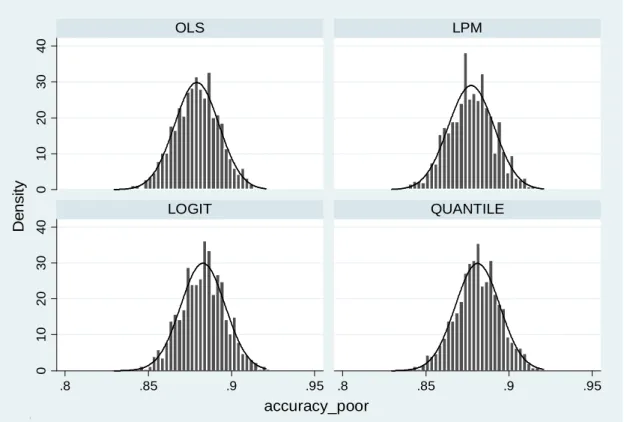
of the distributions were reported as accuracy estimates of the models. The 2.5th and 97.5th percentiles of the distributions were used as limits for the predictions at 95% confidence level. For illustrative purposes, we show in Figure 1 the distribution of poverty accuracy for the estimated models. Each graph is superimposed with a normal curve.
0 1 0 2 0 3 0 4 0 0 1 0 2 0 3 0 4 0 .8 .85 .9 .95 .8 .85 .9 .95 OLS LPM LOGIT QUANTILE D e n s it y accuracy_poor ()
Figure 1: Distribution of poverty accuracy for 1000 samples (under the calibrations to $2.15)
Source: Own results based on IRIS survey data. OLS denotes Ordinary Least Square. LPM denotes Linear Probability Model.
3. Results and Discussions 3.1 Model results
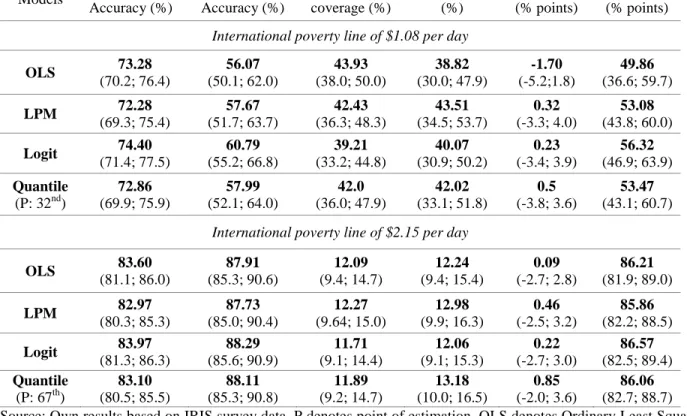
This section discusses the model results and compares the achieved performances. The parameter estimates are presented in annex 2. They are all statistically significant and exhibit expected signs. It is all important to emphasize that this research primarily aims at predicting but not explaining poverty. Hence, a causal relationship should not be inferred from the results. Table 5 describes the model targeting performances by poverty lines.
Table 5. Model targeting efficiency by poverty lines (means of 1000 bootstrapped replicates) Models Total Accuracy (%) Poverty Accuracy (%) Under-coverage (%) Leakage (%) PIE (% points) BPAC (% points)
International poverty line of $1.08 per day
OLS 73.28 (70.2; 76.4) 56.07 (50.1; 62.0) 43.93 (38.0; 50.0) 38.82 (30.0; 47.9) -1.70 (-5.2;1.8) 49.86 (36.6; 59.7) LPM 72.28 (69.3; 75.4) 57.67 (51.7; 63.7) 42.43 (36.3; 48.3) 43.51 (34.5; 53.7) 0.32 (-3.3; 4.0) 53.08 (43.8; 60.0) Logit 74.40 (71.4; 77.5) 60.79 (55.2; 66.8) 39.21 (33.2; 44.8) 40.07 (30.9; 50.2) 0.23 (-3.4; 3.9) 56.32 (46.9; 63.9) Quantile (P: 32nd) 72.86 (69.9; 75.9) 57.99 (52.1; 64.0) 42.0 (36.0; 47.9) 42.02 (33.1; 51.8) 0.5 (-3.8; 3.6) 53.47 (43.1; 60.7)
International poverty line of $2.15 per day
OLS 83.60 (81.1; 86.0) 87.91 (85.3; 90.6) 12.09 (9.4; 14.7) 12.24 (9.4; 15.4) 0.09 (-2.7; 2.8) 86.21 (81.9; 89.0) LPM 82.97 (80.3; 85.3) 87.73 (85.0; 90.4) 12.27 (9.64; 15.0) 12.98 (9.9; 16.3) 0.46 (-2.5; 3.2) 85.86 (82.2; 88.5) Logit 83.97 (81.3; 86.3) 88.29 (85.6; 90.9) 11.71 (9.1; 14.4) 12.06 (9.1; 15.3) 0.22 (-2.7; 3.0) 86.57 (82.5; 89.4) Quantile (P: 67th) 83.10 (80.5; 85.5) 88.11 (85.3; 90.8) 11.89 (9.2; 14.7) 13.18 (10.0; 16.5) 0.85 (-2.0; 3.6) 86.06 (82.7; 88.7) Source: Own results based on IRIS survey data. P denotes point of estimation. OLS denotes Ordinary Least Square.
LPM denotes Linear Probability Model.
Table 5 suggests that the Logit model yields the highest BPAC (56% points) when calibrated to $1.08 a day poverty line. It is followed by the Quantile, the LPM, and the OLS models. Furthermore, the Logit model yields the best performance in terms of total accuracy, poverty accuracy, and PIE; they were estimated at about 74%, 61%, and 0.21% points, respectively. These results indicate that the Logit model performs fairly well in predicting not only the overall poverty status of the households, but also in correctly predicting the status of many poor, targeting about two out of every three poor. Likewise, the model performs relatively well in predicting the observed poverty rate as its estimated PIE nears zero. However, the OLS model is the best model in terms of leakage, yielding the lowest error (about 39%). Nonetheless,
the observed differences in targeting performances between the models are minor, though statistically significant10.
The same trend applies with regard to the international poverty line of $2.15 a day: the Logit is the best performing model. Likewise, the observed differences are minor between estimated models. However, the model targeting performances improve considerably with about 90% (nine in every ten poor) of the poor being correctly targeted and 12% to 13% of the non-poor being wrongly covered. Considering the prediction intervals, the model results suggest that the widths are larger when calibrated to $1.08 a day poverty line, but shorter with the calibrations to $2.15 a day poverty line. These results imply that the $2.15-a-day models are more robust that the $1.08-a-day models.
Overall, the above results suggest that there are no sizable differences in targeting performances between the estimated models. The implication for research and development is that the estimation method per se is not relevant as such for developing a reasonably accurate and operational poverty targeting tool. Other factors, such as model practicality and implementation may deserve greater consideration when developing valid proxies of poverty. Furthermore, the results indicate that development policies can be very effective in reaching Ugandan’s poor, especially those living below a $2.15 a day poverty line if targeted using the models developed. 3.2. Distribution of model overall accuracy and targeting errors
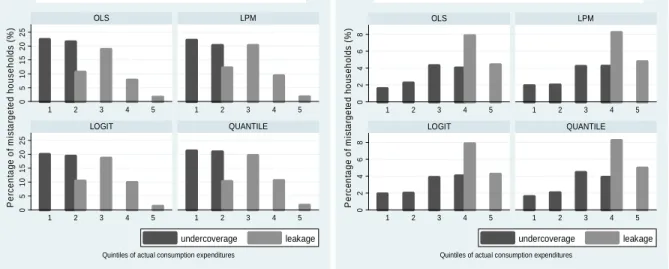
The above results are means-based estimates of model performances. As such, they do not say much about the distribution of targeting performances across welfare quintiles. Since some models might do better than others in different poverty quintiles, we explore in this section the distributions of total accuracy and targeting errors by expenditure quintiles (Figures 2 and 3).
10 The comparisons of the means reveal the existence of statistically significant differences between the models with
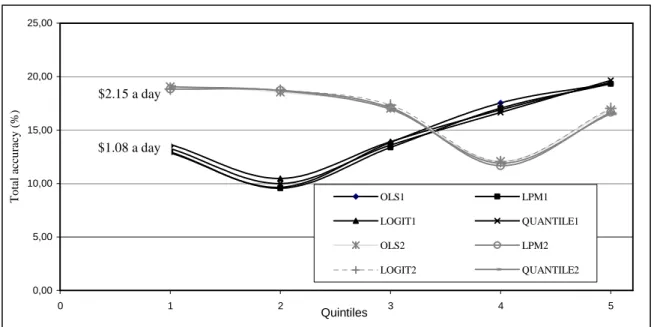
0,00 5,00 10,00 15,00 20,00 25,00 0 1 2 3 4 5 Quintiles T o ta l ac cu ra cy ( % ) OLS1 LPM1 LOGIT1 QUANTILE1 OLS2 LPM2 LOGIT2 QUANTILE2
Figure 2: Distributions of correct predictions by quintiles of expenditures (mean of 1000 resamples) Source: Own results based on IRIS survey data.
Figure 2 shows that given the poverty line, all of the curves follow the same pattern. This trend suggests that the models yield approximately the same level of overall accuracy across poverty quintiles. Therefore, none of them can be deemed more target-effective in any particular expenditure quintile. Nonetheless, the shape of the curves depends on the applied poverty line. While overall accuracy is higher in the richest quintiles under $1.08 a day poverty line, the models cover much of the poorest quintiles under $2.15 a day poverty line.
Furthermore, under the calibrations to $1.08 a day poverty line, total accuracy drops in the 2nd quintile which includes the poverty line. The same pattern is observed in the 4th quintile under the calibrations to $2.15 a day poverty line. This trend implies that all four models fail to identify many households among those living near the poverty line (just below and above). We examine the distributions of model errors in Figure 3.
$1.08 a day $2.15 a day
0 5 1 0 1 5 2 0 2 5 0 5 1 0 1 5 2 0 2 5 1 2 3 4 5 1 2 3 4 5 1 2 3 4 5 1 2 3 4 5 OLS LPM LOGIT QUANTILE undercoverage leakage P e rc e n ta g e o f m is ta rg e te d h o u s e h o ld s ( % )
Quintiles of actual consumption expenditures
0 2 4 6 8 0 2 4 6 8 1 2 3 4 5 1 2 3 4 5 1 2 3 4 5 1 2 3 4 5 OLS LPM LOGIT QUANTILE undercoverage leakage P e rc e n ta g e o f m is ta rg e te d h o u s e h o ld s ( % )
Quintiles of actual consumption expenditures
Figure 3: Targeting errors by expenditure quintiles Source: Own results based on IRIS survey data.
Figure 3 shows that under the same poverty line, targeting errors follow the same pattern across welfare quintiles, irrespective of the estimated model: there are no differences between the models. These results are also consistent with the findings in section 3.1.
3.3. Targeting in practice: implementing the proxy means test models
The set of indicators selected are objective and fairly easy to verify compared to costly and lengthy data collection on household consumption expenditures. However, the collection of information on these indicators might entail an effective verification process (e.g. triangulation, random home visits, etc.) to limit misreports, especially when that the stakes are high for potential program beneficiaries. To screen these beneficiaries, a one-page questionnaire consisting of the best ten indicators, including the control variables should be administered to each household in a relatively quick interview. The household per capita daily expenditures or probability of being poor should then be predicted using the information provided, the parameter estimates, and the benchmark cut-off.
If it were to target using the Logit model, households whose predicted probability of being poor is higher than the benchmark cut-off should be considered as poor and eligible for
program benefits (e.g. free health care, free education, free or subsidized agricultural inputs, free food, cash-for-work, food-for-work, cash transfers, etc.). The remaining households should be deemed non-poor and therefore considered ineligible for program benefits. To improve program outreach however, potential beneficiaries with the support of community representatives, should be allowed to appeal if they think that they qualify for benefits. This appeal process can improve program management and ensure greater local participation.
4. Conclusions
This research answers an operational development question: how best to target the poor? Using a stepwise selection of variables and household data from Uganda, the paper seeks the best indicators for targeting the poor. Furthermore, we compare the performances of four alternative models using bootstrapped simulation methods and analyze the sensitivity of the models to the chosen poverty line.
While there is bound to be some errors, no indicator being perfectly correlated with poverty, the models developed achieve fairly accurate out-of-sample predictions of absolute poverty. Furthermore, estimation results suggest that there are no sizable differences in targeting performances between the estimated models. Likewise, the model performances and targeting errors follow the same pattern across expenditure quintiles. The implication for research and development is that the estimation method is not relevant for developing a reasonably accurate and operational poverty targeting tool.
Although not perfect, the models developed can be potentially useful for identifying the country’s poor and targeting development policies. Likewise, they can be used to assess the poverty outreach of microfinance institutions and measure changes in poverty over time in the population. This research can also be applied in other developing countries.
References
Ahmed, A. and Bouis, H. E. (2002). Weighting what’s practical: Proxy means tests for targeting food subsidies in Egypt. Food Policy, Vol. 27: 519-540.
Besley, T. and Kanbur, R. (1993). The principles of targeting. In: Lipton, M. and J. Van Der Gaag, (eds) Including the poor. Proceedings of a Symposium organized by the World Bank and the International Food Policy Research Institute in December, Washington D.C.: The World Bank.
Braithwaite, J. Grootaert, C. and Milanovic, B. (2000). Poverty and social assistance in transition countries. New York.
Campbell, M.K. and Torgerson,D. J. (1999). Bootstrapping: estimating confidence intervals for cost-effectiveness ratios. QJM: International Journal of Medicine, Vol. 92 (3): 177-182.
Coady, D. and Parker, S. (2009). Targeting performance under self-selection and administrative targeting methods. Economic Development and Cultural Change, Vol. 57 (3): 559-587. Efron, B. (1987). Better bootstrap confidence intervals. Journal of the American Statistical
Association, Vol. 82 (397): 171-185.
Greene, W. H. (2003). Econometric Analysis. Fifth edition, Pearson Education Inc. Prentice Hall, New Jersey.
Grosh, M. E. and Baker, J. L. (1995). Proxy means tests for targeting social programs: Simulations and speculation Working paper No. 118. Washington D.C.: The World Bank. Hall, P. (1994). Methodology and theory for the bootstrap. In: R. F. Engle and D. L. McFadden
(eds) Handbook of Econometrics IV, Elsevier Science B. V.
Houssou N. and Zeller M. (2009). Operational models for improving the targeting efficiency of agricultural and development policies: A systematic comparison of different estimation methods using out-of-sample tests. Paper presented at the 27th Conference of the International Association of Agricultural Economists (IAAE), 16-22. 09. 2009 Beijing, China
IRIS. (2005). Note on assessment and improvement of tool accuracy. Mimeograph, IRIS Center, University of Maryland.
Johannsen J. (2009). Operational assessment of monetary poverty by proxy means tests: The example of Peru. Development Economics and Policy Series, Peter Lang Vol. 65 Frankfurt. Kappel, R., Lay, L., and Steiner, S. (2005). Uganda: No more pro-poor growth? Development
Policy Review, Vol. 23 (1): 27-53.
Koenker, R. and Hallock, K. F. (2001). Quantile regression. Journal of Economic Perspectives, Vol. 15 (4): 143-156.
Maddala, G. S. (1983). Limited dependent and qualitative variables in econometrics. Econometric Society Monographs, Cambridge University Press, Cambridge.
SAS Institute (2003). Introduction to regression procedures. Cary, North Carolina.
Ssewanjana, N.S., Okidi, A.J., Angemi, D., and V. Barungi. (2004). Understanding the determinants of income inequality in Uganda. CSAE/WPS No. 29. Economic Policy Research Centre, Makerere University, Kampala.
Zeller, M., Sharma, M., Henry, C., and Lapenu, C. (2006). An operational tool for assessing the poverty outreach performance of development policies and projects: Results of case studies in Africa, Asia and Latin America. World Development, Vol. 34 (3): 446-464.
Zeller, M. and Alcaraz V., G. (2005). Developing and testing poverty assessment tools: Results from accuracy tests in Uganda. IRIS Center, University of Maryland, College Park.
Zeller, M., Alcaraz V., G., and Johannsen, J. (2005). Developing and testing poverty assessment tools: Results from accuracy tests in Bangladesh. IRIS Center, University of Maryland, College Park.
Annexes
Annex 1: Descriptive statistics of the indicators used in the model estimations
Variable label Minimum Maximum Mean Median Std.
Deviation Number of observations: 788
Daily per capita expenditures (in Ugandan Shillings) 42.65 11545.66 1293.77 942.11 1167.71
WESTERN location 0 1 0.32 0 0.47
NORTHERN location 0 1 0.12 0 0.33
EASTERN location 0 1 0.27 0 0.45
URBAN location 0 1 0.12 0 0.33
Household size 1 18 5.83 5 2.97
Cooking fuel is charcoal or paraffin 0 1 0.13 0 0.34
Lighting source is gas lamp or electricity 0 1 0.09 0 0.28
Toilet is shared or own ventilated, improved or flush toilet 0 1 0.08 0 0.28
Number of rooms per person 0.07 6 0.69 0.5 0.69
Household head is widow 0 1 0.14 0 0.34
Household head completed only secondary/post primary education 0 1 0.05 0 0.23
Do you have primary school in your community? 0 1 0.40 0 0.49
Do you have local council village center? 0 1 0.76 1 0.43
Do you have access to piped drinking water grid in the community? 0 1 0.16 0 0.37 Source: Own results based on IRIS data. Std. denotes standard.
Annex 2a: Estimated models calibrated to the international poverty line of $1.08 a day
Number of observations: 788 OLS
F: 52.16*** Adj. R2: 0.48 LPM F: 15.68*** Adj. R2: 0.21 LOGIT L. R.: 220.11*** Score: 174.27*** QUANTILE Point of estimation: 32nd quantile Indicator set Parameter
Estimates Std. Error Parameter Estimates Std. Error Parameter Estimates Std. Error Parameter Estimates Std. Error Intercept 6.45*** 0.11 0.50*** 0.08 0.53 0.53 6.35*** 0.14 C o n tr o l v ar ia b le s WESTERN location -0.004 0.06 0.02 0.04 -0.003 0.28 0.05 0.08 NORTHERN location 0.48*** 0.10 -0.17** 0.08 -0.95** 0.44 0.40*** 0.13 EASTERN location 0.01 0.06 0.03 0.04 0.11 0.27 -0.07 0.08 URBAN location 0.19* 0.11 0.02 0.08 0.38 0.68 0.17 0.13 B es t se le ct ed i n d ic at o rs Household size -0.07*** 0.01 0.03*** 0.01 0.13*** 0.04 -0.08*** 0.01 Cooking fuel is charcoal or paraffin (Yes: 1; No: 0) 0.46*** 0.10 -0.17*** 0.07 -2.85*** 0.91 0.51*** 0.12 Lighting source is gas lamp or electricity (Yes: 1; No: 0) 0.33*** 0.08 -0.11** 0.06 -1.14* 0.78 0.26** 0.10 Toilet is shared or own ventilated, improved or flush
toilet (Yes: 1; No: 0) 0.23*** 0.08 -0.09** 0.06 -0.98** 0.49 0.21* 0.12
Number of rooms per person 0.21*** 0.03 -0.09*** 0.03 -1.23*** 0.31 0.20*** 0.04 Household head is widow (Yes: 1; No: 0) -0.28*** 0.06 0.16*** 0.04 1.02*** 0.26 -0.38*** 0.10 Household head completed only secondary/post
primary education (Yes: 1; No: 0) 0.43*** 0.09 -0.12** 0.07 -0.86 0.54 0.52*** 0.16
Do you have primary school in your community (Yes: 1;
No: 0)? 0.26*** 0.05 -0.14*** 0.04 -0.79*** 0.22 0.32*** 0.07
Do you have local council village center (Yes: 1; No: 0)? 0.45*** 0.07 -0.25*** 0.05 -1.04*** 0.28 0.39*** 0.09 Do you have access to piped drinking water grid in the
community (Yes: 1; No: 0)? 0.25*** 0.08 -0.13*** 0.06 -0.52 0.37 0.21** 0.10 Source: Own results based on IRIS data. *** denotes significant at the 99% level. ** denotes significant at the 95% level. * denotes significant at the 90% level. Std. denotes Standard. OLS denotes Ordinary Least Square. LPM denotes Linear Probability Model. LR denotes Likelihood Ratio.
Annex 2b: Estimated models calibrated to the international poverty line of $2.15 a day
Number of observations: 788 OLS
F: 52.16*** Adj. R2: 0.48 LPM F: 35.40*** Adj. R2: 0.38 LOGIT LR: 359.55*** Score: 307.86*** QUANTILE Point of estimation: 67th quantile Indicator set Parameter
Estimates Std. Error Parameter Estimates Std. Error Parameter Estimates Std. Error Parameter Estimates Std. Error Intercept 6.45*** 0.11 0.81*** 0.07 2.04*** 0.73 6.59*** 0.13 C o n tr o l v ar ia b le s WESTERN location -0.004 0.06 -0.03 0.04 -0.30 0.30 0.02 0.06 NORTHERN location 0.48*** 0.10 -0.16** 0.07 -1.87*** 0.72 0.49*** 0.11 EASTERN location 0.01 0.06 -0.04 0.04 -0.26 0.29 -0.03 0.06 URBAN location 0.19* 0.11 0.12** 0.07 -0.55 0.50 0.29 0.18 B es t se le ct ed i n d ic at o rs Household size -0.07*** 0.01 0.04*** 0.01 0.35*** 0.05 -0.06*** 0.01 Cooking fuel is charcoal or paraffin (Yes: 1; No: 0) 0.46*** 0.10 -0.30*** 0.06 -1.71*** 0.44 0.43*** 0.15 Lighting source is gas lamp or electricity (Yes: 1; No: 0) 0.33*** 0.08 -0.16*** 0.06 -1.17*** 0.41 0.16 0.11 Toilet is shared or own ventilated, improved or flush
toilet (Yes: 1; No: 0) 0.23*** 0.08 -0.12** 0.05 -0.86** 0.38 0.28*** 0.09
Number of rooms per person 0.21*** 0.03 -0.11*** 0.02 -0.54*** 0.18 0.19*** 0.06 Household head is widow (Yes: 1; No: 0) -0.28*** 0.06 0.12*** 0.04 0.94*** 0.31 -0.21** 0.09 Household head completed only secondary/post
primary education (Yes: 1; No: 0) 0.43*** 0.09 -0.28*** 0.06 -1.91*** 0.43 0.48*** 0.08
Do you have primary school in your community (Yes: 1;
No: 0)? 0.26*** 0.05 -0.13*** 0.03 -0.86*** 0.26 0.30*** 0.05
Do you have local council village center (Yes: 1; No: 0)? 0.45*** 0.07 -0.14*** 0.05 -1.70*** 0.58 0.49*** 0.07 Do you have access to piped drinking water grid in the
community (Yes: 1; No: 0)? 0.25*** 0.08 -0.15*** 0.06 -0.91** 0.36 0.23** 0.09 Source: Own results based on IRIS data. *** denotes significant at the 99% level. ** denotes significant at the 95% level. * denotes significant at the 90% level. Std. denotes Standard. OLS denotes Ordinary Least Square. LPM denotes Linear Probability Model. LR denotes Likelihood Ratio.