T TrraaiinniinnggGGaappssAAnnaallyyssiiss f foorr R ReeccoorrddeeddMMuussiiccPPrroodduuccttiioonn Presented to the
Cultural Human Resources Council (CHRC) February 28, 2008 by 5181 Earnscliffe Montréal, Québec H3X 2P7 Phone: 514-489-2332 Fax: 514-680-9084 E-mail: [email protected]
Final report
T
ABLE OFC
ONTENTSEXECUTIVE SUMMARY ... 4
1. BACKGROUND... 11
2. PURPOSE OF THE STUDY ... 12
3. METHODOLOGY ... 12
4. PROFILE OF RECORDED MUSIC PRODUCERS... 16
5. THE TRAINING NEEDS OF RECORDED MUSIC PRODUCERS ... 19
6. TRAINING OFFERINGS ... 28
Table 1 – Distribution of the Sample of Recorded Music Producers by Province ... 14
Table 2 – Distribution of Training Offerings by Province ... 15
Table 3 – Sound Recording Industry Value Chain... 16
Table 4 – Age of Recorded Music Producers ... 18
Table 5 – Validation of the Chart of Competencies for Recorded Music Producers ... 20
Table 6 – Degree of Mastery of the Competencies in the Chart... 21
Table 7 – The Skill Sets Mastered by the Recorded Music Producers ... 22
Table 8 – The Skills Mastered Less Well by the Recorded Music Producers ... 22
Table 9 – Need for Training in Acquiring Projects ... 23
Table 10 – Training Needs in Administering Projects ... 25
Table 11 – Training Needs for Developing Opportunities for Artists... 26
Table 12- Training Offerings in Recorded Music Production ... 29
Table 13 – Training Offerings for each Skill Set ... 31
Table 14 – Training Offering by Competency in the Chart for Recorded Music Producers (Canada and by Province) ... 34
Table 15 – Acquire Projects ... 35
Table 16 – Oversee Pre-production Process... 36
Table 17 – Oversee Recording Process ... 37
Table 18 – Oversee Mixing, Editing and Mastering Processes ... 38
Table 19 – Administer Projects ... 39
Table 21 – The More Frequently Used Training Methods in the Current Sound Recording Training Offerings... 40 APPENDIX 1 – Recording Studios Approached for an Interview ……… 43 APPENDIX 2 – Associations/Organizations Approached for an Interview ……… 46 APPENDIX 3 – Coordinates of the Institutions or Associations Whose Training Offerings Specifically or Particularly Concern Recorded Music Producers……… 47
Final report
EXECUTIVE SUMMARY
This study of the training needs of recorded music producers in the music sector, commissioned by the CHRC, aims to answer the following three questions:
What perception do recorded music producers have of their degree of mastery of the skills identified in the Chart of Competencies for recorded music production prepared by the Cultural Human Resources Council (CHRC)?
Which teaching and training institutions, and which professional organizations offer the necessary training in recorded music production?
To what extent does the training meet the training needs identified by the recorded music producers in the music sector for this study?
To answer these questions, we:
• conducted telephone interviews with 100 recorded music producers in every part of Canada except for Prince Edward Island, the Yukon and the Northwest Territories;
• drew up an exhaustive inventory of teaching establishments and organizations or associations in the music industry; and
• identified 39 organizations that provided training applicable to the skills in the Chart for recorded music producers.
The highlights of our analysis of the data collected are as follows: GENERAL OBSERVATIONS
Recorded music producers have been practicing their trade for more than 10 years (62%).
While 65% of them have a college or university diploma, only 20% have taken courses in sound recording. Most of them learned on the job or taught themselves.
Only 10% of the producers interviewed had taken any training in the previous 12 months. The training was provided by organizations or associations in the music industry.
Not only were producers found to have learned their trade on the job, but very few of them spent time on professional development, and when they did, they appeared to prefer short courses or self-learning to improve on a specific aspect of their work.
TRAINING NEEDS OF RECORDED MUSIC PRODUCERS
Overall, the recorded music producers who took part in this study considered that they had mastered their profession.
More than 80% of producers acknowledged the importance of the skills in the Chart. Only one skill was found to be less essential to the work of producers:
o Develop opportunities for artists (67% of producers considered this essential) More than half of the producers do not believe that they have to assist artists in their development because this is the role of artists’ managers. Nonetheless, this skill is one of the less well mastered skills.
The less well-mastered skills are the following:
o developing projects,
o administering projects, and
o developing opportunities for artists.
The following are the skills that most producers have mastered the best:
o overseeing the pre-production process,
o overseeing the recording process, and
o overseeing the mixing, editing and mastering processes. Two training needs have been identified as priorities in the Chart:
o developing projects, in particular marketing services, and
o administering projects, namely preparing and managing a budget.
According to the producers who participated in this study, interpersonal and communications skills are more challenging, that is to say more difficult to master, than the skills related to sound recording. These skills are directly related to the ability to form relationships with artists and crews.
Producers identified three training needs that are indirectly related to the business skills in the Chart as being needed for them to be able to oversee the overall recorded music production process (see chart on page 10 – Skills B, C and D):
o remaining current and maintaining technical skills in music recording with the new technologies (C and D),
o acquiring musical skills, namely in arranging (B4), acoustics (C11), composition (B2) and music instruments, and
o developing marketing, dissemination and distribution skills with the new technologies, namely the Internet, multimedia and e-commerce.
Final report
TRAINING OFFERINGS IN RECORDED MUSIC PRODUCTION
Approximately 38 specialized private and public sector establishments, and seven music industry associations were identified and found to provide specific recorded music programs or training activities.
Training offerings are mainly concentrated in three Canadian provinces: British Columbia, Ontario and Quebec.
The Maritime and Prairie provinces have fewer resources for the development of recorded music producers.
In Saskatchewan, only one association offers activities related to recorded music production. No specialized establishment was found.
No training offering was found in Prince Edward Island or the Yukon, Northwest Territories or Nunavut.
Most of the training is offered by public or private establishments.
The training that is currently offered is more for people who want to learn this trade (basic common training) than for the practitioners themselves (continuing training). This training is generally spread out over a one-year period in private establishments. IN
colleges and universities, it is generally provided as two- to three-year programs.
The current training offering covers all of the skills in the Chart of Competencies for recorded music producers. Moreover, there are some gaps in terms of specific skills in provinces such as Nova Scotia, New Brunswick, Manitoba, Alberta and Saskatchewan. Most of the available training offering is in the form of lectures and practical workshops,
whereas producer prefer on-the-job training, self-training and short courses.
Many of the training providers consulted expressed interest in finding out about the outcome of the study and a willingness to improve their services.
RECOMMENDATION 1 – CREATING AN INVENTORY OF CURRENT TRAINING OFFERINGS IN RECORDED MUSIC PRODUCTION
Given that:
most of the available training offering is basic common training; and
the continuous training offering in Canada appears to be limited to certain private establishment and is little known;
we recommend that:
an inventory of the current training offering be set up and made available to recorded music producers; and
a distinction be made between continuing training and common basic training offerings.
RECOMMENDATION 2–HELP IMPROVE THE CONTINUING TRAINING OFFERING IN LIGHT OF THE NEEDS IDENTIFIED
Given that:
a careful review of the Chart has given providers the opportunity to learn about some of the gaps in their training offering; and
several training providers have expressed interest in and willingness to improve their training offering in order to better respond to the needs of the music industry;
we recommend that:
the Cultural Human Resources Council provide the results of the gaps analysis to training providers and give them the opportunity to discuss them with music industry representatives;
private teaching establishments, which have more short-term flexibility, propose an improved continuing training offering that will develop the business skills of recorded music producers, in particular those related to the less well mastered skills, specifically:
o developing recording projects (with a priority on marketing services);
o administering projects (with a priority on preparing and managing budgets); and
Final report
RECOMMENDATION 3–SHIFTING THE FOCUS TO PRACTICE-ORIENTED TRAINING
Given that:
most producers learned their recorded music production trade on the job; only 10% spent time on their own professional development in the past year;
when producers spend time on their professional development, they tend to favour short courses or self-learning to improve specific aspects of their work;
the current training offering is mainly based on structured training programs with lectures and work shops spread out over a longer time period;
we recommend that training providers (common basic and continuing) favour:
a training offering that maximizes practice-oriented learning techniques, specifically in the form of practical workshops, demonstrations, mentoring, coaching services, practical internships or online training, etc.
RECOMMENDATION 4 – ENCOURAGE AND STIMULATE THE INVOLVEMENT OF PROFESSIONAL ASSOCIATIONS IN NETWORKING AND ORGANIZING SHORT-TERM DEVELOPMENT ACTIVITIES FOR RECORDED MUSIC PRODUCERS
Given that:
the study has helped highlight the continuing training needs of recorded music producers;
producers have indicated that they prefer networking as a learning method;
most of the producers who took courses in the past year turned to organizations or associations in the music industry;
producers mostly relied on on-the-job training, self-learning and short courses to acquire skills needed for their work;
recorded music producers do not belong to associations in most of the provinces; and existing associations do not necessarily get involved in training for producers;
we recommend:
together with the professional associations in the music industry, capitalizing on the
organization of networking events to include short-term training activities. This training could focus on the development of technical skills that do not require specific equipment and the development of non-technical skills such as business development, project administration or interpersonal and communication skills; and
foster the establishment of a professional exchange network for recorded music producers in the provinces where no community-based organization represents them.
RECOMMENDATION 5–ENSURE THE AVAILABILITY OF BASIC COMMON TRAINING IN RECORDED MUSIC PRODUCTION IN EVERY PROVINCE ACROSS CANADA
Given that:
basic common training offerings in recorded music production are non-existent in Saskatchewan, Prince Edward Island, the Yukon, the Northwest Territories and Nunavut; and
basic common training encourages the development of a new generation equipped with the skills required to succeed in their professional careers;
we recommend:
promoting the importance of basic common training to give future recorded music producers the opportunity to acquire and consolidate their music recording skills; and ensuring that teaching establishments1 provide basic common training that covers all of
Final report
RECOMMENDATION 6 – EXPAND THE TRAINING OFFERING TO THE SKILLS RELATED TO SOUND RECORDING TECHNIQUES AND MUSIC
Given that:
many producers have more than 10 years’ experience; only 20% of them have taken courses in sound recording;
that the producers consulted believe that recorded music production requires mastering a range of technical and musical skills along with business skills; and
that the producers favour updating and maintaining their technical skills and developing their musical skills;
we recommend that training providers:
offer common basic training programs that foresee the development of musical knowledge as well as technical skills in sound recording;
provide a continuing training offering that helps update and maintain technical and musical knowledge; and
pay special attention to maintaining skills that are likely to change over time, including:
o new sound recording technologies, and
o digital distribution technologies.
RECOMMENDATION 7 – INCLUDE THE DEVELOPMENT OF INTERPERSONAL AND COMMUNICATION SKILLS IN THE TRAINING OFFERING
Given that:
more than 40% of the producers consulted believed that interpersonal skills are among
the most important to succeeding in their work;
according to 46% of the producers who participated in this survey, interpersonal and communication skills are more challenging, that is to say more difficult to master, than the skills related to a recorded music production; and
these skills are directly related to the ability to establish a rapport with the artist and the crew;
we recommend that training providers:
include in their common basic and continuing training programs the development of interpersonal and communication skills so that recorded music producers can display them at every step of the process of producing artists’ recorded music works.
1. BACKGROUND
This study aims to identify the training needs of recorded music producers in the music industry. It is part of the analysis of skills sponsored by the Cultural Human Resources Council (CHRC). The objective is to support the professionalization of Canada’s music industry.
The study was made possible by the invaluable cooperation of the CHRC team (Susan Annis, Executive Director and Project Head), the Music Industry Steering Committee and the group of Canadian experts in recorded music production. The work by the group of experts in recorded music production provided the opportunity to develop a competency chart and profile identifying the skills that producers have to draw on to do their work.
The CHRC mandated GROUPE RÉSEAU CONSEIL to conduct this study, with the following objectives:
to identify the training needs of recorded music producers; and
to identify the gaps in the training offerings in Canada that serve those needs.
Phone interviews were conducted in English and French with 100 recorded music producers across Canada. We also collected information from training providers (colleges, universities and music industry associations) that provide training in recorded music production.
The outcome of this survey will be presented as part of a round table that will aim to promote the use of the competency chart and profile for recorded music producers among professionals in the music industry and educational and training establishments. The CHRC hopes to thereby contribute to the development of a national training strategy linked to the development of skills in the music industry.
Final report
2. PURPOSE OF THE STUDY
More specifically, the Cultural Human Resources Council (CHRC) is doing this study to:
document the training offerings (basic common and continuing) for the development of skills for recorded music producers in the music sector for all of Canada;
analyze the training provided in Canada in regard to the Chart of Competencies developed by the working group comprising expert practitioners in the occupation;
identify, based on the Chart of Competencies, the degree of mastery of skills required to perform effectively in this occupation;
identify the priority training needs, as indicated by recorded music production professionals;
analyze the appropriateness of the current training options in terms of the needs identified by recorded music production professionals;
highlight the observations regarding the training needs that have to be met for recorded music production and the strengths and gaps in the current training offerings compared to the competency profile and the needs identified; and
prepare recommendations based on the observations from this analysis to foster the development of skills among recorded music production professionals in the music industry.
3. METHODOLOGY
3.1-DATA COLLECTION
In order to achieve these objectives, GROUPE RÉSEAU CONSEIL designed and followed a five-step research approach:
Step 1: Research and survey the training offerings in teaching and training establishments, as well as in the professional organizations or associations that provide training across the country
Develop and validate a bilingual questionnaire based on the Chart of Competencies for recorded music production.
Identify the organizations that should be consulted (147 national teaching and training establishments, Canadian professional organizations and associations in the music industry); and
Consult through phone interviews with 39 organizations that could provide training that might meet the needs identified.
Step 2: Survey of recorded music producers in the music industry Develop and validate the survey strategy;
Develop, based on the Chart of Competencies, the bilingual survey questionnaire – recorded music producers, and validate it with the Music Industry Steering Committee; and
Phone survey of the target population: recorded music producers (100 respondents out of 699 people approached).
Step 3: Process and analyze the data
Step 4: Draft and validate a preliminary report Step 5: Draft and table the final report
3.2SAMPLE STRATEGY
The sample strategy developed for this survey comprises two levels of consultation. These are: Recorded music production professionals
Teaching establishments or organizations that provide training in recorded music production
1- Recorded music production practitioners
The survey of recorded music producers in the music industry covered producers across the country. Our preliminary research enabled us to contact at least one association per province connected to the music industry. Thanks to the cooperation of these associations and the active efforts of some of them, we gained access to 860 businesses in the sound recording industry (independent recorded music producers, recording studios and record companies) listed by province. Recording studios and record companies were chosen as places where recorded music producers were likely to work. Every respondent was asked to provide referrals to colleagues working as recorded music producers.
The target sample of respondents was 75 to 100 recorded music producers. The survey to identify the training needs was conducted through guided telephone interviews. The diagnosis rested on a questionnaire based on the Chart of Competencies produced by the CHRC experts. The respondents were assured of full confidentiality and anonymity.
Final report
The representativeness criteria selected were designed to ensure: Francophone and Anglophone distribution
geographic representation
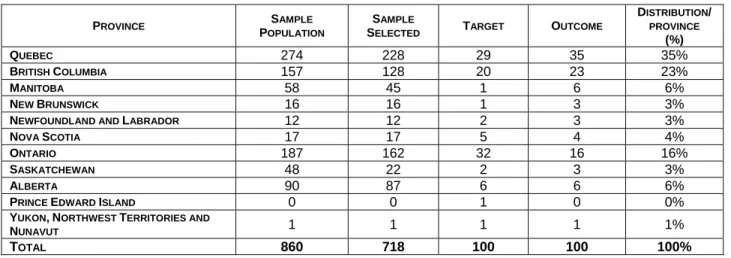
The sample of producers consulted breaks down as follows:
Table 1 – Distribution of the Sample of Recorded Music Producers by Province
PROVINCE SAMPLE
POPULATION
SAMPLE
SELECTED TARGET OUTCOME
DISTRIBUTION/ PROVINCE (%) QUEBEC 274 228 29 35 35% BRITISH COLUMBIA 157 128 20 23 23% MANITOBA 58 45 1 6 6% NEW BRUNSWICK 16 16 1 3 3%
NEWFOUNDLAND AND LABRADOR 12 12 2 3 3%
NOVA SCOTIA 17 17 5 4 4%
ONTARIO 187 162 32 16 16%
SASKATCHEWAN 48 22 2 3 3%
ALBERTA 90 87 6 6 6%
PRINCE EDWARD ISLAND 0 0 1 0 0%
YUKON,NORTHWEST TERRITORIES AND
NUNAVUT 1 1 1 1 1%
TOTAL 860 718 100 100 100%
The survey took a little over three weeks, from January 14 to February 6, 2008 and resulted in the completion of 100 interviews across Canada. Call-backs were required an average 3.3 times to achieve this objective.
In total, 100 recorded music producers participated in our survey. All but two provinces were well represented. It should be noted that the survey’s overlap with the MIDEM did not help. In Prince Edward Island, our efforts overlapped the East Coast Music Association, preventing us from achieving the results we had hoped for. Our timing was perhaps not the best given this overlap with the East Coast Music Awards. As for Ontario, which was under-represented in view of the real place it holds in the industry, we had some difficulty generating interest in this study on the part of producers. Nonetheless, in a second wave of call-backs and with the support of the Canadian Independent Recorded music production Association (CIRPA), we were able to triple the number of respondents. However, a relatively high number of businesses in the Ontario music industry could not be reached or called back because they were not members of CIRPA.
2- Training offerings
The inventory of training offerings available in Canada was prepared using a very thorough research strategy with six main sources:
1- research over the Internet to target inventories in teaching establishments linked to the music industry;
2- a call to all organizations surveyed in other needs studies supervised by the CHRC (artists’ managers, music editors and record companies);
3- a systematic call to associations in every discipline in the music industry;
4- specific requests during telephone interviews with recorded music producers to identify the places where they had taken training;
5- calls to members of the Music Industry Steering Committee; and
6- calls to experts in the working group in charge of the Chart of Competencies.
Based on this detailed research, we were able to identify 147 organizations across Canada. Among the organizations we approached, 39 reported that they had applicable training offerings. They received the questionnaire based on the Chart of Competencies for recorded music producers. In order to document these training offerings, these organizations took part in a planned interview of approximately 30 minutes to assess their training offerings against the competencies listed in the Chart of Competencies for recorded music producers.
Appendixes 1 and 2 list the different training providers who were approached, including those that did not take part in the telephone interviews.
The survey of these organizations extended over a four-week period, from January 21 to February 12, 2008.
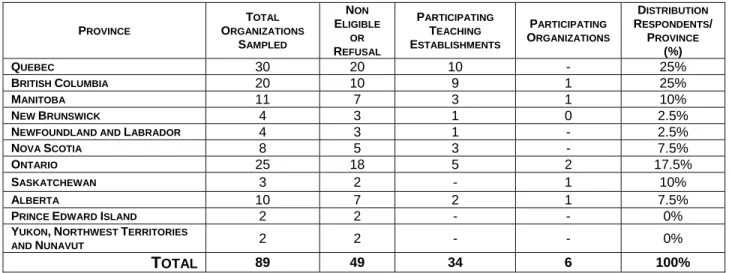
Table 2 – Distribution of Training Offerings by Province
PROVINCE TOTAL ORGANIZATIONS SAMPLED NON ELIGIBLE OR REFUSAL PARTICIPATING TEACHING ESTABLISHMENTS PARTICIPATING ORGANIZATIONS DISTRIBUTION RESPONDENTS/ PROVINCE (%) QUEBEC 30 20 10 - 25% BRITISH COLUMBIA 20 10 9 1 25% MANITOBA 11 7 3 1 10% NEW BRUNSWICK 4 3 1 0 2.5%
NEWFOUNDLAND AND LABRADOR 4 3 1 - 2.5%
NOVA SCOTIA 8 5 3 - 7.5%
ONTARIO 25 18 5 2 17.5%
SASKATCHEWAN 3 2 - 1 10%
ALBERTA 10 7 2 1 7.5%
PRINCE EDWARD ISLAND 2 2 - - 0%
YUKON,NORTHWEST TERRITORIES
AND NUNAVUT 2 2 - - 0%
Final report
4. PROFILE OF RECORDED MUSIC PRODUCERS
4.1 DEFINITION OF THE OCCUPATION OF RECORDED MUSIC PRODUCER
In a study of the sound recording industry2, Nordicity Group Ltd. described the sound recording industry traditional value chain. This chain comprises multiple players that work together from the creation of a musical work to the sale of the work to consumers.
The following table identifies the main elements of the traditional music industry value chain and situates the contribution of recorded music producers in this value chain.
Table 3 – Sound Recording Industry Value Chain
Source: Nordicity Group Ltd., 2004
The role of recorded music producers involves a number of components. Essentially, their main contribution is to enhance the quality of the musical work through an understanding of the creative process. Producers supervise the entire recording process, and assemble the creative team of authors, composers, performing artists, and sound recording engineers/technicians to capture, enhance and edit the creative content into electronic format. Although producers do not have to sit at the console, they require sufficient knowledge of the technology to be able to guide their teams in charge of mixing, editing and mastering. All in all, the producer’s influence will be a determining factor in the development of the artist’s career.
The recording process typically takes place using in-house and third-party recording facilities. Some recording studios offer these services to the artists. However, our study revealed that fewer and fewer studios have producers on staff. They tend to contract with independent producers. Many producers have their own recorded music production business. Finally the popularization of the recording industry technology has encouraged many artists to produce their own work. Thus, the number of people acting as recorded music producers for their own musical creations and those of other artists is multiplying.
The group of expert practitioners set up by the CHRC developed a Chart of Competencies that describes all of the activities that could be carried out by a recorded music producer. This Chart identifies seven skills broken down into tasks.
2
Nordicity Group Ltd., Profile of the Sound Recording Industry in Canada, Telefilm Canada, 2004, p. 19
Composers Lyricists Publishers
Performe rs
Producer Recording studio CD/DVD
manufacturing Consumers
Radio broadcaster Retailers
RECORDED MUSIC PRODUCER CHART OF COMPETENCIES
A. ACQUIRE PROJECTS
1. Create a professional profile 2. Market services
3. Evaluate potential clients
4. Negotiate contractual terms and conditions B. OVERSEE PRE-PRODUCTION PROCESS
1. Ensure artist’s preparation 2. Assess compositions 3. Choose repertoire
4. Supervise orchestral / ensemble arrangements 5. Secure/provide performance materials
6. Select recording location
7. Determine project’s recording requirements 8. Determine session/project schedules C. OVERSEE RECORDING PROCESS
1. Establish recording ambiance
2. Present/adjust technical and artistic criteria 3. Coordinate technical personnel
4. Coordinate musical personnel 5. Encourage performance 6. Evaluate performance 7. Correct performance
8. Manage levels of fatigue and stress 9. Ensure studio decorum
10. Supervise and evaluate audio 11. Tailor acoustic environment
D. OVERSEE MIXING, EDITING AND MASTERING PROCESSES
1. Prepare for mixing 2. Approve mix 3. Oversee mastering E. ADMINISTER PROJECTS
1. Prepare a budget
2. Source and secure funders
3. Manage budget
4. Negotiate contractual agreements 5. Administer contractual agreements 6. Book studios and rental equipment 7. Hire musical personnel
8. Hire technical support 9. Provide hospitality
10. Provide guidance on music industry practices and issues
11. File reports
12. Verify accuracy of copy and credits 13. Liaise with interested parties
F. DEVELOP OPPORTUNITIES FOR ARTISTS
1. Assess artists in their development
2. Cultivate relationships in the music industry 3. Share connections in the music industry
Final report 4.2 PROFILE OF RECORDED MUSIC PRODUCERS
Based on our sample and the data collected during the survey, we can now develop a portrait of recorded music producers in Canada. This description covers the following elements:
Sex Age Education
Work experience as a producer Time spent on production work Number of artists recorded Type of music recorded Size of crews
Most (95%) of the producers interviewed were men. There are not many women in this occupation.
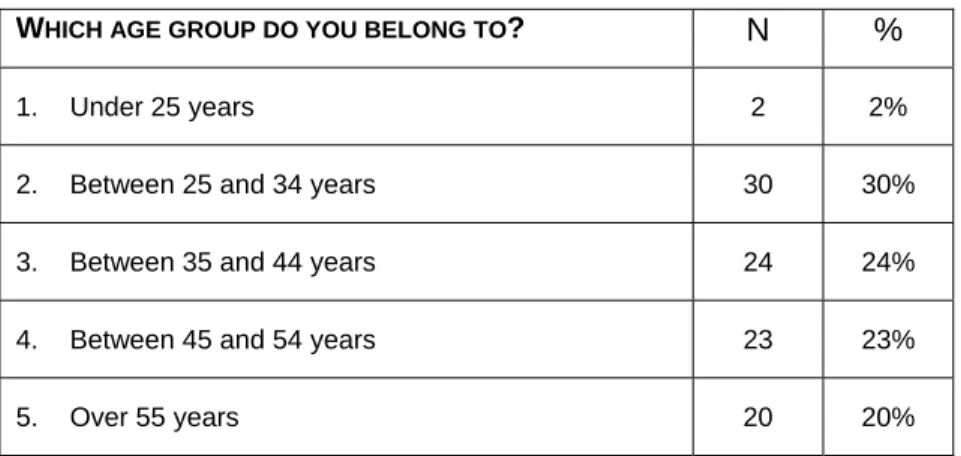
The recorded music producers interviewed were over 25 years of age, with two exceptions. They were almost equally split among the different age categories (Table 4). The data collected do not reveal any succession problems for this occupation3.
Table 4 – Age of Recorded Music Producers
WHICH AGE GROUP DO YOU BELONG TO? N %
1. Under 25 years 2 2%
2. Between 25 and 34 years 30 30% 3. Between 35 and 44 years 24 24% 4. Between 45 and 54 years 23 23%
5. Over 55 years 20 20%
Producers are quite well educated, given that 34% of them have a college degree and 31% have a university degree. However, only 20% of them have taken courses in sound recording. The ones who did, took specialized programs in audio engineering, sound design or music. Every training establishment where this training was taken was asked to participate in our survey.
Approximately two-thirds (62%) of our sample reported that they had more than ten years’ experience in recorded music production. Only a small proportion (6%) had less than two years’ experience in this type of activity, whereas 32% had between two and nine years’ experience in this trade. This situation might affect the results because most producers reported that they know their trade well.
3
Close to 75% of these producers had recorded more than two artists, and close to 30% had recorded more than 10. Thus, it is not surprising to find that for 42% of them, recorded music production was their main activity, generating more than 50% of their business income. For approximately ten of them, this involved full-time work as an independent producer. Only a very small proportion of them (12%) saw this activity as a means of producing their own work.
The type of music produced varied tremendously. Pop (46%) and jazz (40%) were the most frequent, closely followed by country (34%), pop rock (33%) and cotemporary folk (30%).
Most of the businesses in our sample were smaller ones. The majority of producers interviewed (61%) worked alone, and 35% had small crews of two to five people. Only three of the respondents indicated that they had crews of more than six people.
5. THE TRAINING NEEDS OF RECORDED MUSIC PRODUCERS
5.1 NEEDS ANALYSIS BASED ON THE CHART OF COMPETENCIES
For this survey, the Chart of Competencies for recorded music producers in the music industry was used to define the skills required of producers. Thus, this Chart was pivotal in developing the questionnaire for assessing respondents’ skills.
During the telephone interviews, we asked these professionals to self-assess based on the skills listed in the Chart. They were asked to start by answering the following question for each of the six skill sets:
“As a recorded music producers, do you consider this skill essential to your work?”
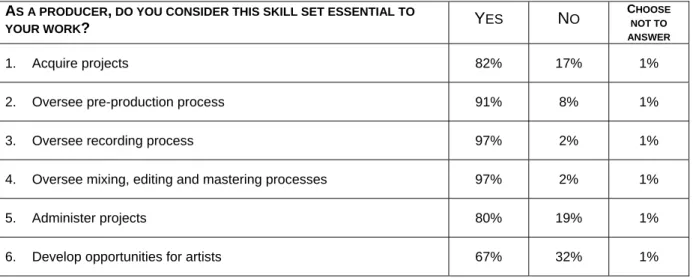
This exercise helped validate the Chart of Competencies (Table 5) because almost all of these skill sets were considered necessary by more than 80% of respondents.
Final report
Table 5 – Validation of the Chart of Competencies for Recorded Music Producers AS A PRODUCER, DO YOU CONSIDER THIS SKILL SET ESSENTIAL TO
YOUR WORK? YES NO
CHOOSE NOT TO ANSWER
1. Acquire projects 82% 17% 1%
2. Oversee pre-production process 91% 8% 1%
3. Oversee recording process 97% 2% 1%
4. Oversee mixing, editing and mastering processes 97% 2% 1%
5. Administer projects 80% 19% 1%
6. Develop opportunities for artists 67% 32% 1%
It should be noted that the skill set “Develop opportunities for artists” was only seen as essential to the work of a producer by 67% of respondents. These results indicate that not all producers do this work or at least see it as part of a producer’s role. Many of the respondents considered this to be the artist manager’s job, even though they recognized that the producer’s work plays a key role in the artist’s career.
5.2 SELF-ASSESSMENT OF SKILLS
The approach used to target training needs required that producers self-assess, specifying their degree of mastery of the different skill sets in the Chart based on the following scale (Table 6):
I:I HAVE NOT MASTERED THIS COMPETENCY;II:I SHOULD IMPROVE THIS COMPETENCY;III:I HAVE MASTERED THIS COMPETENCY VERY WELL
When the response indicated a need to acquire skills (I or II), the interviewer would continue by investigating the skill set in greater depth. However, if the respondent indicated having mastered the skill set, the interviewer would immediately move to the next set.
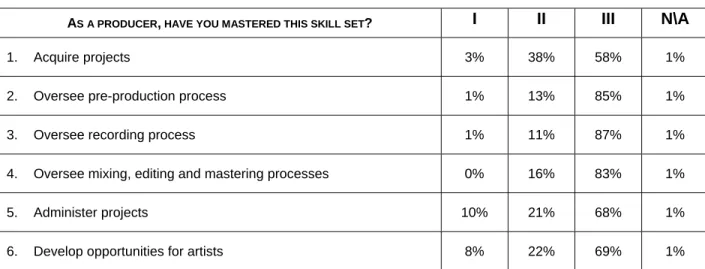
Table 6 – Degree of Mastery of the Competencies in the Chart
AS A PRODUCER, HAVE YOU MASTERED THIS SKILL SET? I II III N\A
1. Acquire projects 3% 38% 58% 1%
2. Oversee pre-production process 1% 13% 85% 1%
3. Oversee recording process 1% 11% 87% 1%
4. Oversee mixing, editing and mastering processes 0% 16% 83% 1%
5. Administer projects 10% 21% 68% 1%
6. Develop opportunities for artists 8% 22% 69% 1%
In general, the results indicate that the skill sets associated with the production of a record (competencies 2, 3 and 4) had been mastered by more than 80% of the respondents. This is hardly surprising when we consider that more than two-thirds of the respondents had more than ten year’s experience. Moreover, the skill sets that are peripheral to the technical aspects of the trade appear to be more difficult to master, namely in terms of getting new recording projects (41%), managing these projects (31%) and setting in place the right conditions for the development of the artists’ careers (30%).
5.3 THE SKILLS MASTERED
Three professional skill sets come out as having been better mastered, and these are:
OVERSEE PRE-PRODUCTION PROCESS
OVERSEE RECORDING PROCESS
OVERSEE MIXING, EDITING AND MASTERING PROCESSES
More than 80%, of respondents self-assessed as having “very well mastered” the skills in these sets. We asked these producers how they had acquired these skills (Table 7).
Final report
Table 7 – The Skill Sets Mastered by the Recorded Music Producers
ON THE
JOB SELF-LEARNING
STRUCTURED
TRAINING CONFERENCE/WORKSHOP OTHER DNK
1. Oversee pre-production process 72.9% 60% 10.6% 10.6% 3.5% - 2. Oversee recording process 81.6% 59.8% 18.4% 6.9% 6.9% - 3. Oversee mixing, editing and mastering processes 85.5% 55.4% 16.9% 10.8% 4.8% -
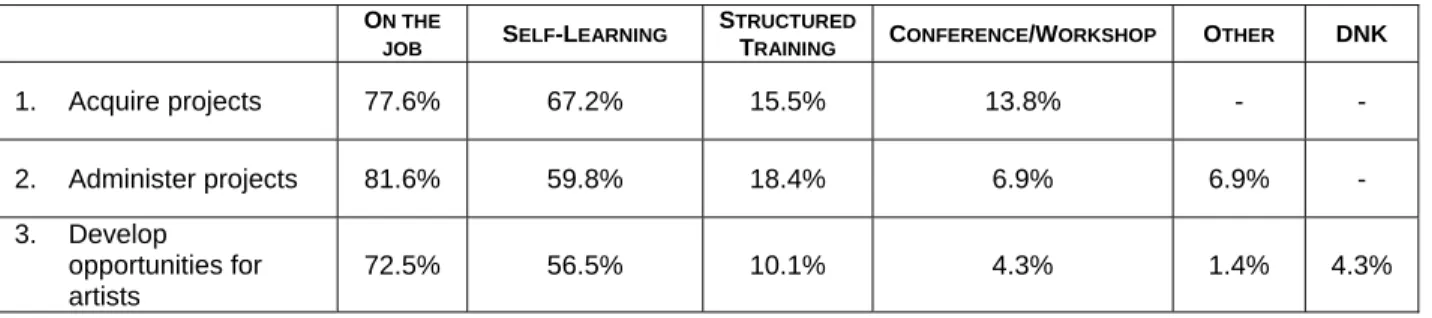
The majority of producers interviewed considered that they had acquired these skills on the job or through self-learning. Only a small proportion of them took any structured training, or attended conferences or workshops on the topic.
5.4 THE LEAST WELL MASTERED SKILLS
In general, three skill sets were identified as having been less well mastered than the others, namely:
ACQUIRE PROJECTS
ADMINISTER PROJECTS
DEVELOP OPPORTUNITIES FOR ARTISTS
For each of these skill sets, the interviews aimed to get the producers to clarify how they had acquired the skills (Table 8).
Table 8 – The Skills Mastered Less Well by the Recorded Music Producers
ON THE
JOB SELF-LEARNING
STRUCTURED
TRAINING CONFERENCE/WORKSHOP OTHER DNK
1. Acquire projects 77.6% 67.2% 15.5% 13.8% - - 2. Administer projects 81.6% 59.8% 18.4% 6.9% 6.9% - 3. Develop opportunities for artists 72.5% 56.5% 10.1% 4.3% 1.4% 4.3%
The data collected indicate that these skills were also acquired mainly on the job or through self-learning. A few of them had a mentor who helped them develop the skills.
ACQUIRE PROJECTS
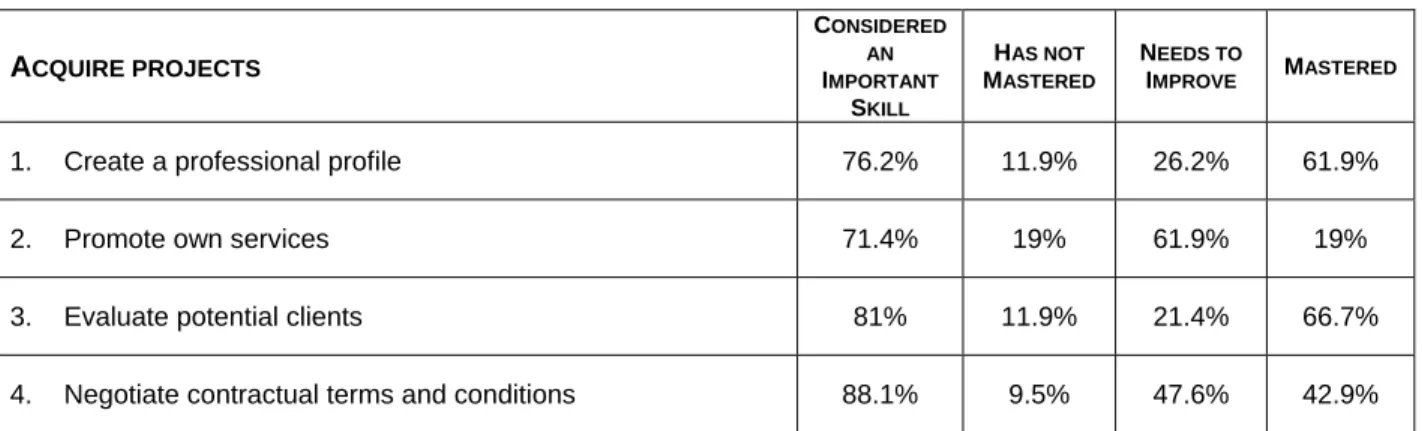
Some 41% of respondents indicated that they had not mastered this skill well enough. Of these, only 3% believed that they had not mastered it at all, whereas 38% would have liked to improve their mastery of it. For these 41 producers, we conducted a more in-depth analysis in order to properly identify the nature of the need perceived (Table 9).
Table 9 – Need for Training in Acquiring Projects
ACQUIRE PROJECTS CONSIDERED AN IMPORTANT SKILL HAS NOT MASTERED NEEDS TO IMPROVE MASTERED
1. Create a professional profile 76.2% 11.9% 26.2% 61.9%
2. Promote own services 71.4% 19% 61.9% 19%
3. Evaluate potential clients 81% 11.9% 21.4% 66.7%
4. Negotiate contractual terms and conditions 88.1% 9.5% 47.6% 42.9%
Thus, we were able to identify the relative degree of difficulty encountered in mastering these skills deemed important by more than 70% of producers. The proportion of those who believed that they had not mastered the ability to acquire projects was broken down as follows:
Promote services (80.9%)
Negotiate contractual terms and conditions (57.1%) Create a professional profile (38.1%)
Evaluate potential clients (33.3%)
All of these skills were mainly acquired on the job or through self-learning. Not many received any training in this field, whether structured or otherwise. Moreover, fewer than ten producers indicated an interest in improving their ability to acquire projects. These few mainly targeted the following specific skills:
Create a personal profile Develop a client approach Develop a marketing approach Identify projects
Final report
ADMINISTER PROJECTS
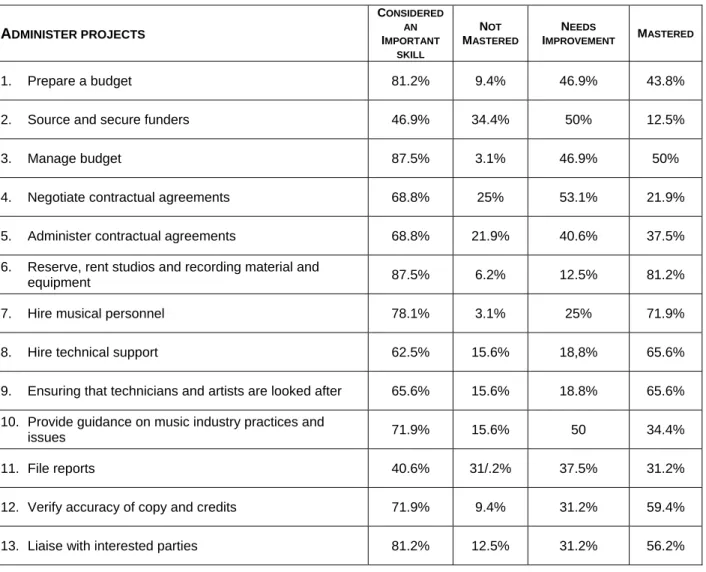
Even though 80% of the producers interviewed assessed the ability to administer projects as essential to their work, 31% of them felt a need to better master this skill set. For these 30 producers, many of the skills deemed important4 had not been mastered.
The results presented in Table 10 clearly show that, based on the importance and current level of mastery, the most pressing skills to be developed in terms of administering projects are:
Negotiate contractual agreements (78.1%)
Provide guidance on music industry practices and issues (65.6%) Prepare a budget (56.3%)
Manage budget (50%)
Liaise with interested parties (43.7%) Book studios and rental equipment (18.7%)
In the same manner as the previous skills, the ability to administer projects had been acquired on the job or through self-learning. Only a small number took part in conferences or workshops on these themes.
Finally, one-quarter of producers identifying a weakness indicated that they would like to improve their skills in this field. The skills they specifically targeted were:
Administer contractual agreements and agreements with different sectors Secure funders for recordings
Manage a technical crew
4
We consider that a skill is important when more than 80% of the people concerned identify it as essential to their work.
Table 10 – Training Needs in Administering Projects ADMINISTER PROJECTS CONSIDERED AN IMPORTANT SKILL NOT MASTERED NEEDS IMPROVEMENT MASTERED 1. Prepare a budget 81.2% 9.4% 46.9% 43.8%
2. Source and secure funders 46.9% 34.4% 50% 12.5%
3. Manage budget 87.5% 3.1% 46.9% 50%
4. Negotiate contractual agreements 68.8% 25% 53.1% 21.9%
5. Administer contractual agreements 68.8% 21.9% 40.6% 37.5% 6. Reserve, rent studios and recording material and
equipment 87.5% 6.2% 12.5% 81.2%
7. Hire musical personnel 78.1% 3.1% 25% 71.9%
8. Hire technical support 62.5% 15.6% 18,8% 65.6%
9. Ensuring that technicians and artists are looked after 65.6% 15.6% 18.8% 65.6% 10. Provide guidance on music industry practices and
issues 71.9% 15.6% 50 34.4%
11. File reports 40.6% 31/.2% 37.5% 31.2%
12. Verify accuracy of copy and credits 71.9% 9.4% 31.2% 59.4%
13. Liaise with interested parties 81.2% 12.5% 31.2% 56.2%
DEVELOP OPPORTUNITIES FOR ARTISTS
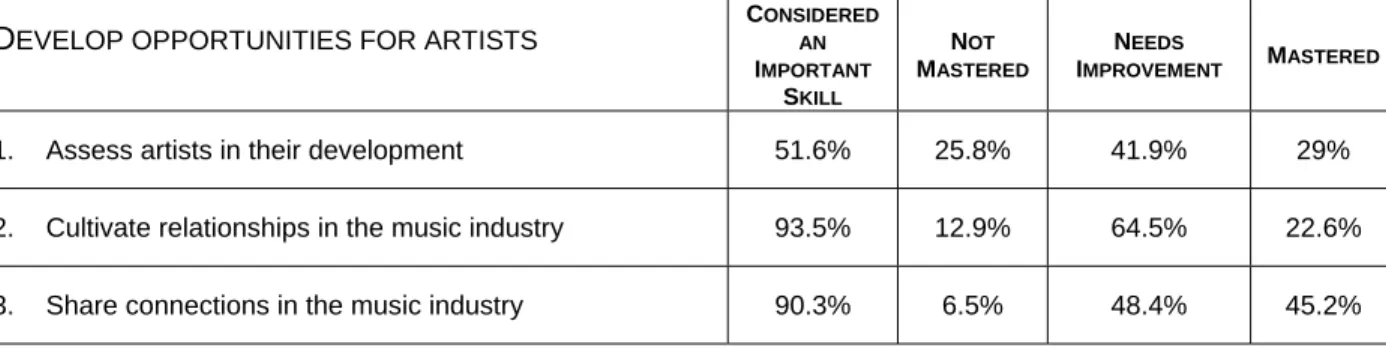
One-third of the producers interviewed identified a weakness in their ability to “develop opportunities for artists”. Specifically, two skills were identified almost unanimously as being important to their work, and a large number of producers were dissatisfied with their mastery of these two:
Cultivate relationships in the music industry (77.4%) Share connections in the music industry (54.9%)
Moreover, even though only 51.6% of these producers believed that it was essential to “assess artists in their development”, more than two-thirds of them identified weaknesses in their application of this skill.
Final report
Table 11 – Training Needs for Developing Opportunities for Artists
DEVELOP OPPORTUNITIES FOR ARTISTS
CONSIDERED AN IMPORTANT SKILL NOT MASTERED NEEDS IMPROVEMENT MASTERED
1. Assess artists in their development 51.6% 25.8% 41.9% 29% 2. Cultivate relationships in the music industry 93.5% 12.9% 64.5% 22.6%
3. Share connections in the music industry 90.3% 6.5% 48.4% 45.2%
Essentially acquired on the job (72.5%) and through self-learning (56.5%), a small group had signed up for structured training or conferences/workshops on the subjects. One producer had had a mentoring experience that enabled him to “cultivate relationships in the music industry”. Finally, one-quarter of producers who had identified weaknesses in this skill indicated that they were prepared to take steps to improve it by forming relationships with artists’ managers or through other means at work. One producer saw training in this field as a waste of time.
5.5 PRIORITY SKILLS
When asked to identify which skills they considered the most important, the producers interviewed identified four:
Musical knowledge/culture and skills (66%) Interpersonal and communication skills (41%)
Technical knowledge related to sound recording (29%) Time organization and management (10%)
Moreover, when asked to specify which were the most EXACTING, personal skills and business skills came ahead of technical skills in music and sound recording.
Interpersonal and communication skills (46%) Time organization and management (28%)
Project administration skills (budgeting, marketing, other) (17%) Musical knowledge/culture and skills (15%)
Technical knowledge related to sound recording (14%)
However, when asked about their priority training needs, almost three-quarters of the producers once again highlighted the technical side of their occupation by targeting the following needs as
PRIORITIES:
Update the skills related to sound recording technologies (41%)
Musical knowledge/culture and skills – arrangement, composition, writing, instrument (24%)
New technologies for disseminating music – Internet, multimedia, licence, e-commerce, etc. (22%)
Acquire projects (promote services, negotiate contractual terms and conditions) (20%) Administer projects (budgets) (20%)
Given that the new technologies are transforming the music industry, as well as several other cultural sectors, it is not surprising that the priority training needs are focused around these concerns. We will attempt to take them into consideration in the analysis of training offerings in the different teaching establishments and other Canadian organizations.
Final report
6. TRAINING OFFERINGS
6.1 AMOUNT OF TIME SPENT BY RECORDED MUSIC PRODUCERS ON THEIR PROFESSIONAL
DEVELOPMENT
It is all very well to identify the training needs of recorded music producers and to analyze the appropriateness of the fit between these needs and the learning resources that are currently available across Canada, but the individuals concerned still have to be willing and able to invest in their professional development.
Where do things stand in this regard? It is to find the answer to this that our survey included the following question: Have you taken any training during the past year?
Only a small number of respondents indicated that they had spent time on their training during the past 12 months, including:
• 7 Anglophone producers
• 4 Francophone producers
The main types of training they had used were:
• seminars and colloquiums offered by different organizations and associations • practical internships in studios
Not only does this reveal that producers learned their trade on the job, but that not many of them spent time on their professional development, and when they did, they seemed to prefer short courses or self-learning to improve a specific aspect of their work.
The following themes were covered:
• Francophones: arts management, copyright • Anglophones: electronics, audio, sound recording
6.2 THE MAP OF TRAINING OFFERINGS IN RECORDED MUSIC PRODUCTION IN CANADA
In Canada, training in recorded music production is essentially concentrated in three provinces: Ontario (11), British Columbia (10) and Quebec (10). In these three provinces, training is provided by different public and private teaching establishments that have developed basic common programs in sound recording. In addition, other than in Quebec, there are professional associations that offer professional development activities in the form of short seminars or workshops.
Moreover, in Manitoba, even though there are fewer training offerings, this is still structured training offered by recognized training establishments and an association that is very active in the music industry. In the other provinces, even though we were able to identify providers, there are far fewer training offerings and, in some cases, they are not very structured.
Table 12- Training Offerings in Recorded Music Production
TEACHING ESTABLISHMENTS Institut Trebas
École du Show Business Musi Technic
Institut des métiers de la musique Vanier College McGill University Université de Sherbrooke CEGEP de Drummondville CEGEP d'Alma Q UEB E C
Recording Arts Canada (RAC)
TEACHING ESTABLISHMENTS Trebas Institute
Fanshawe College, London Harris Institute for the Arts
Metalworks Institute of Sound and Music Production Ontario Institute of Audio Recording Technology (OIART) Recording Arts Canada (RAC) Digital Arts College The Audio Recording Academy (TARA)
Seneca College of Applied Arts & Technology University of Ottawa
ASSOCIATIONS/ORGANIZATIONS IN THE MUSIC INDUSTRY
Society of Composers, Authors and Music Publishers of Canada (SOCAN)
O
NTA
R
IO
North By Northeast Music and Film Festival
TEACHING ESTABLISHMENTS
Centre for Arts & Technology (Kelowna campus) Stylus Music School
Vancouver Film School Simon Fraser University Columbia Academy
The Art Institute of Vancouver (Burnaby campus) Vancouver Community College
University of British Columbia Pacific AudioVisual Institute
ASSOCIATIONS/ORGANIZATIONS IN THE MUSIC INDUSTRY
B RITISH C OLU M BI A
Final report TEACHING ESTABLISHMENTS
Precursor Productions Mid-Ocean School of Media Arts Collège Boniface
Assiniboine Community College
ASSOCIATIONS/ORGANIZATIONS IN THE MUSIC INDUSTRY
M
ANITOB
A
Manitoba Audio Recording Industry Association (MARIA)
TEACHING ESTABLISHMENTS
The Banff Centre for the Arts
Grant MacEwan College - Centre for the Arts and Communications
ASSOCIATIONS/ORGANIZATIONS IN THE MUSIC INDUSTRY
A
LBERT
A
Alberta Music Industry Association (AlbertaMusic)
TEACHING ESTABLISHMENTS
Centre for Arts & Technology (Fredericton campus)
ASSOCIATIONS/ORGANIZATIONS IN THE MUSIC INDUSTRY
N EW B RUNSW I CK
Music/Musique New Brunswick
TEACHING ESTABLISHMENTS
Centre for Arts & Technology (Halifax campus)
N
OVA
S
COTIA
Nova Scotia Community College (Waterfront Campus)
TEACHING ESTABLISHMENTS N EW F O UND
-LAND AND LABRADOR College of the North Atlantic (Bay St. George Campus)
ASSOCIATIONS/ORGANIZATIONS IN THE MUSIC INDUSTRY
S
ASKAT
-CHEWAN Saskatchewan Recording Industry Association (SaskMusic)
For our survey, we approached 147 teaching establishments and associations/organizations in the music industry, and ended up with the ones listed in Table 12. We sent them our questionnaire based on the Chart of Competencies for recorded music producers in the music industry. Approximately 31 teaching establishments and 7 associations in the music industry offered appropriate training for recorded music producers. These organizations provided a description of their training in phone interviews.
Table 13 shows the detailed results of this assessment. The names of the teaching institutions and associations/organizations in the industry that offer applicable training are listed by skill set.
TABLE 13 –TRAINING OFFERINGS FOR EACH SKILL SET
ANGLOPHONES FRANCOPHONES
ONTARIO QUEBEC
Fanshawe College, London Harris Institute for the Arts
Metalworks Institute of Sound and Music Production Ontario Institute of Audio recording technology (OIART) Seneca College of Applied Arts & Technology Trebas Institute
BRITISH COLUMBIA
Centre for Arts & Technology (Kelowna) Stylus Music School
Columbia Academy
The Art Institute of Vancouver (Burnaby campus) New Music West
MANITOBA
Precursor Productions
Manitoba Audio Recording Industry Ass’n (MARIA)
ALBERTA
The Banff Centre for the Arts
Grant MacEwan College- Music Program Grant MacEwan College – Arts & Cultural Management Program
SASKATCHEWAN
Saskatchewan Recording Industry Association
NEW BRUNSWICK
Centre for Arts & Technology (Fredericton)
NOVA SCOTIA
Centre for Arts & Technology (Halifax) Nova Scotia Community College (Waterfront)
NEWFOUNDLAND AND LABRADOR
1. ACQUIRE PROJECTS
College of the North Atlantic (Bay St. George)
Institut Trebas
École du Show Business Musitechnic
Institut des métiers de la musique CEGEP de Drummondville CEGEP d'Alma
ONTARIO QUEBEC
Fanshawe College, London Harris Institute for the Arts
Metalworks Institute of Sound and Music Production Ontario Institute of Audio recording technology (OIART) Seneca College of Applied Arts & Technology Trebas Institute
North By Northeast Music and Film Festival BRITISH COLUMBIA
Centre for Arts & Technology (Kelowna) Stylus Music School
Vancouver Community College New Music West
Columbia Academy
The Art Institute of Vancouver (Burnaby campus)
MANITOBA
Precursor Productions
Manitoba Audio Recording Industry Ass’n (MARIA)
ALBERTA
The Banff Centre for the Arts
Grant MacEwan College- Music Program Alberta Music Industry Association
SASKATCHEWAN
Saskatchewan Recording Industry Association
NEW BRUNSWICK
Centre for Arts & Technology (Fredericton)
NOVA SCOTIA
Centre for Arts & Technology (Halifax)
2. OVERSEE PRE
-PRODUCTION PROCESS Institut Trebas
École du Show Business Musitechnic
Institut des métiers de la musique Vanier College
Université de Sherbrooke CEGEP de Drummondville CEGEP d'Alma
Final report
ONTARIO QUEBEC
Fanshawe College, London Harris Institute for the Arts
Metalworks Institute of Sound and Music Production Ontario Institute of Audio recording technology (OIART) Seneca College of Applied Arts & Technology Trebas Institute
North By Northeast Music and Film Festival
BRITISH COLUMBIA
Centre for Arts & Technology (Kelowna) Stylus Music School
Vancouver Film School Simon Fraser University Vancouver Community College
University of British Columbia School of Music New Music West
Columbia Academy
The Art Institute of Vancouver (Burnaby campus)
MANITOBA
Precursor Productions
Mid-Ocean School of Media Arts Assiniboine Community College
Manitoba Audio Recording Industry Ass’n (MARIA)
ALBERTA
Alberta Music Industry Association The Banff Centre for the Arts
Grant MacEwan College- Music Program
SASKATCHEWAN
Saskatchewan Recording Industry Association
NEW BRUNSWICK
Centre for Arts & Technology (Fredericton)
NOVA SCOTIA
Centre for Arts & Technology (Halifax) Nova Scotia Community College (Waterfront)
NEWFOUNDLAND AND LABRADOR
3. OVERSEE RECORDING PROCESS
College of the North Atlantic (Bay St. George)
Institut Trebas
École du Show Business Musitechnic
Institut des métiers de la musique Vanier College
Université de Sherbrooke CEGEP de Drummondville CEGEP d'Alma
ONTARIO QUEBEC
Fanshawe College, London Harris Institute for the Arts
Metalworks Institute of Sound and Music Production Ontario Institute of Audio recording technology (OIART) Seneca College of Applied Arts & Technology Trebas Institute
BRITISH COLUMBIA
Centre for Arts & Technology (Kelowna) Stylus Music School
Vancouver Film School Simon Fraser University Vancouver Community College
University of British Columbia School of Music New Music West
Columbia Academy
The Art Institute of Vancouver (Burnaby campus)
MANITOBA
Precursor Productions
Mid-Ocean School of Media Arts Assiniboine Community College
Manitoba Audio Recording Industry Ass’n (MARIA)
ALBERTA
Alberta Music Industry Association The Banff Centre for the Arts
Grant MacEwan College- Music Program
SASKATCHEWAN
Saskatchewan Recording Industry Association
NEW BRUNSWICK
Centre for Arts & Technology (Fredericton)
NOVA SCOTIA
Centre for Arts & Technology (Halifax) Nova Scotia Community College (Waterfront)
NEWFOUNDLAND AND LABRADOR
Institut Trebas
École du Show Business Musitechnic
Institut des métiers de la musique Vanier College Université de Sherbrooke CEGEP de Drummondville CEGEP d'Alma 4. OVERSEE MIXING, EDITING AND MASTERING PROCESSES
ONTARIO QUEBEC Fanshawe College, London
Harris Institute for the Arts
Metalworks Institute of Sound and Music Production Ontario Institute of Audio recording technology (OIART) Seneca College of Applied Arts & Technology Trebas Institute
North By Northeast Music and Film Festival
Society of composers, Authors and Music Publishers of Canada (SOCAN)
BRITISH COLUMBIA
Centre for Arts & Technology (Kelowna) Stylus Music School
Vancouver Community College New Music West
Columbia Academy
The Art Institute of Vancouver (Burnaby campus)
MANITOBA
Precursor Productions
Manitoba Audio Recording Industry Ass’n (MARIA)
ALBERTA
Alberta Music Industry Association The Banff Centre for the Arts
Grant MacEwan College- Music Program
Grant MacEwan College – Arts & Cultural Management Program
SASKATCHEWAN
Saskatchewan Recording Industry Association
NEW BRUNSWICK
Centre for Arts & Technology (Fredericton)
NOVA SCOTIA
Centre for Arts & Technology (Halifax) Nova Scotia Community College (Waterfront)
NEWFOUNDLAND AND LABRADOR
5. ADMINISTER PROJECTS
College of the North Atlantic (Bay St. George)
Institut Trebas
École du Show Business Musitechnic
Institut des métiers de la musique Vanier College
Université de Sherbrooke CEGEP de Drummondville CEGEP d'Alma
ONTARIO QUEBEC
Fanshawe College, London Harris Institute for the Arts
Metalworks Institute of Sound and Music Production Ontario Institute of Audio recording technology (OIART) Seneca College of Applied Arts & Technology Trebas Institute
North By Northeast Music and Film Festival
Society of composers, Authors and Music Publishers of Canada (SOCAN)
BRITISH COLUMBIA
Centre for Arts & Technology (Kelowna) Stylus Music School
Vancouver Community College New Music West
Columbia Academy
The Art Institute of Vancouver (Burnaby campus)
MANITOBA
Precursor Productions
Manitoba Audio Recording Industry Ass’n (MARIA)
ALBERTA
Alberta Music Industry Association The Banff Centre for the Arts
Grant MacEwan College- Music Program
SASKATCHEWAN
Saskatchewan Recording Industry Association
NEW BRUNSWICK
Centre for Arts & Technology (Fredericton)
6. DEVELOP
OPPORTUNITIES FOR ARTISTS
Institut Trebas
École du Show Business Musitechnic
Institut des métiers de la musique Vanier College
Université de Sherbrooke CEGEP de Drummondville CEGEP d'Alma
Final report
The analysis of Table 13 reveals the following preliminary observations:
Basic common training that is applicable to recorded music production is available in eight provinces (Ontario, Quebec, British Columbia, Manitoba, Alberta, New Brunswick, Nova Scotia and Newfoundland/Labrador), in at least one public or private teaching establishment.
In Saskatchewan, this offer of training is only provided by the Saskatchewan Recording Industry Association (Sask-Music).
The offer available in these nine provinces covers every competency in the Chart for recorded music producers.
No training offering was identified in the Yukon or Prince Edward Island.
Training is offered in French in Quebec and Manitoba. Training is available in English in every province that took part in the survey.
Training offerings were designed based on the expertise and experience of the trainers coming from the industry (77.5%) and an analysis of the training needs (67.5%) in terms of industry and technological development trends.
6.2 THE STRENGTHS AND WEAKNESSES OF TRAINING OFFERINGS
In the telephone interviews, the people in charge of training were asked to assess their training offering in light of their ability to meet the needs of each competency defined in the Chart of Competencies for recorded music producers (Table 14).
To begin, it is important to specify that more than three-quarters of the organizations identified as offering appropriate training covered all six of the competencies in the Chart, regardless of the competency in question.
Table 14 – Training Offering by Competency in the Chart for Recorded Music Producers (Canada and by Province)
CANADA RESPONDENTS BY PROVINCE
DO YOU OFFER RECORDED MUSIC PRODUCERS IN THE MUSIC INDUSTRY
APPROPRIATE TRAINING FOR THE
DEVELOPMENT OF THEIR ABILITY TO? YES % ON QC BC MB AL NB NS NL SK
1. Acquire projects 29 74.4% 4/7 8/8 7/11 2/4 2/3 1/1 3/3 1/1 1/1 2. Oversee pre-production
process 31 79.5% 6/7 7/8 7/11 2/4 3/3 1/1 3/3 1/1 1/1
3. Oversee recording process 35 89.7% 6/7 8/8 10/11 3/4 3/3 1/1 2/3 1/1 1/1 4. Oversee mixing, editing and
mastering processes 33 84.6% 5/7 8/8 10/11 3/4 3/3 1/1 2/3 1/1 - 5. Administer projects 34 87.2% 7/7 8/8 8/11 2/4 3/3 1/1 3/3 1/1 1/1 6. Develop opportunities for
artists 31 79.5% 7/7 7/8 6/11 2/4 3/3 1/1 3/3 1/1 1/1
Eight of the provinces appear to be well served. However, five of them have access to fewer than four organizations providing training in recorded music production. Saskatchewan appears to be less well equipped in terms of training to “supervise mixing, editing and mastering.” As for the Yukon and Prince Edward Island, our research was unable to find any teaching establishment offering such a thing. Our call-backs to associations connected to the music industry were inconclusive.
Below, we show the main considerations related to every competency covered by the Chart.
ACQUIRE PROJECTS (29 PROVIDERS)
Most training providers offer training that covers each of the specific skills required to “acquire projects.” It should be noted that this skill set was identified as a training need by 41% of the producers interviewed. The inventory that we were able to prepare on the training offerings applicable to the development of this skill set clearly shows that they generally have access to different resources required to meet their need to master this skill set (Table 15).
Table 15 – Acquire Projects
TRAINING OFFERED
1. Create a professional profile 96.6%
2. Promote own services 93.1%
3. Evaluate potential clients 96.6% 4. Negotiate contractual terms and conditions 86.2%
Yet in Manitoba, training aimed at developing the ability to “negotiate contractual terms and conditions” is only available in half of the organizations consulted. In Nova Scotia, one out of three organizations does not offer this type of training, whereas two out of three do not address the “promote own services” aspect.
Overall, 42.8% of Canadian organizations offering a program in recorded music production consider it one of the strengths of their training offerings. At the same time, a high proportion (53.8%) have shown themselves open to improving this training offering as a way of better serving producers’ needs. This situation is particularly true for 80% of the teaching establishments in Quebec and 25% in British Columbia and Ontario. Moreover, it should be noted that 14.3% of the organizations in British Columbia see this aspect as something missing from their program.
Final report
OVERSEE PRE-PRODUCTION PROCESS (31 PROVIDERS)
Training offerings aimed at developing producers’ skills required to “oversee pre-production process” are also important (Table 16). Three aspects appear somewhat less frequently in the offerings of the organizations consulted:
Choose repertoire
Supervise the production of arrangements of orchestra or other ensembles Secure/provide performance materials
It is not that there is no offering, but rather that it tends to be concentrated in the music teaching establishments. This situation is particularly evident in Ontario and British Columbia where, respectively, one-third and one-quarter of the programs offered do not address the development of these specific skills. It is also the case with the Maritime provinces, where two out of three organizations in Nova Scotia and the only one in New Brunswick have identified a weakness in their offering in regard to these three skills. It is also the case in Saskatchewan, Manitoba and Alberta, where the training provided barely—if at all—addresses these areas.
Table 16 – Oversee Pre-production Process
TRAINING
OFFERED
1. Ensure artist’s preparation 96.8%
2. Assess compositions 90.3%
3. Choose repertoire 77.4%
4. Supervise orchestral / ensemble arrangements 64.5% 5. Secure/provide performance materials 71.0% 6. Select recording location 93.5% 7. Determine project’s recording requirements 93.5% 8. Determine session/project schedules 90.3%
Thus, even though 64.5% of the organizations consulted considered that the training provided to develop the “oversee pre-production process” skill is one of their program’s strengths, one-third saw opportunities to improve it, and considered this study as a source of information that would help them in this regard.
OVERSEE RECORDING PROCESS (35 PROVIDERS)
Training offerings to develop the skill to “oversee recording process” are more abundant, this being the case in every province. Our study did not identify any weaknesses worth mentioning.
Table 17 – Oversee Recording Process
TRAINING
OFFERED
1. Establish recording ambiance 94.3% 2. Present/adjust technical and artistic criteria 94.3% 3. Coordinate technical personnel 85.3% 4. Coordinate musical personnel 88.2%
5. Encourage performance 97.1%
6. Evaluate performance 91.4%
7. Correct performance 94.3%
8. Manage levels of fatigue and stress 85.3%
9. Ensure studio decorum 91.2%
10. Supervise and evaluate audio 100% 11. Tailor acoustic environment 91.2%
Thus, even though the training offerings were seen as a strength by 70.6% of the training providers consulted, slightly more than 20% of them expressed an interest in further improving this offering. This was the case in Ontario (33%), Saskatchewan, where these skills were seen as falling short in their program, Alberta (33%) and Manitoba, where one-third of the providers perceived a significant weakness.
Final report
OVERSEE MIXING, EDITING AND MASTERING PROCESSES (33 PROVIDERS)
The development of skills required to “oversee mixing, editing and mastering processes” appeared to be a concern among most of the recorded music production training providers (Table 18). Other than Saskatchewan, all of the other provinces had training in this area.
Table 18 – Oversee Mixing, Editing and Mastering Processes
TRAINING
OFFERED
1. Prepare for mixing 100%
2. Approve mix 97.0%
3. Oversee mastering 93.9%
Thus, 71.9% of providers saw this training offering as a strength in their sound recording program. At the same time, 21.9% of them saw room for improvement in this offering.
ADMINISTER PROJECTS (34 PROVIDERS)
Managing recording projects is a popular theme in the training offered by providers (Table 19). The least well-developed aspects concern:
the hiring of technical support and musical personnel and providing hospitality the filing of reports
The weaknesses in managing the hiring were most pronounced in Quebec (62.5%), British Columbia (37.5%), Saskatchewan (100%) and Manitoba (50%).
Moreover, the training weaknesses in recorded music production were more pronounced in Ontario (42.9%) and British Columbia (50%).
Of course, it should be noted that 54.5% of providers considered their training in “project administration” one of the strengths of their program. Nonetheless, many of them (39.4%) indicated a willingness to improve in order to be better equipped to meet the needs.
Table 19 – Administer Projects
TRAINING
OFFERED
1. Prepare a budget 94.1%
2. Source and secure funders 91.2%
3. Manage budget 91.2%
4. Negotiate contractual agreements 88.2% 5. Administer contractual agreements 82.4% 6. Book studios and rental equipment 82.4%
7. Hire musical personnel 79.4%
8. Hire technical support 73.3%
9. Provide hospitality 64.7%
10. Provide guidance on music industry practices and issues 94.1%
11. File reports 70.6%
12. Verify accuracy of copy and credits 75.8% 13. Liaise with interested parties 79.4%
DEVELOP OPPORTUNITIES FOR ARTISTS (31 PROVIDERS)
Although many recorded music producers were sceptical about whether their role rightfully included this skill, almost all training providers offered training to support them in this regard (Table 20).