PRINCIPAL-AGENT DYNAMIC INTERACTION IN THE CONTEXT OF THE
LIFE-CYCLE OPERATION OF INFRASTRUCTURE SYSTEMS
David Paez-Perez and Mauricio Sanchez-Silva*
Department of Civil and Environmental Engineering, Universidad de los Andes, Cra 1 Nº 19A- 40, Edificio Mario Laserna, ML 630, Bogotá, Colombia 111011
*Email: [email protected]
ABSTRACT
A Public-private partnership (PPP) is a contract framework designed to carry out public works in the hope that the more advanced knowledge and financial support of private agents may be advantageous to develop better infrastructure projects that serve public needs. This relationship, which is embodied by a principal (e.g., government) and an agent (e.g., independent contractor), is inherently conflictive. Three main factors give rise to such conflict: the interests of the public and private party do not generally coincide, there is information asymmetry between them and their interaction unfolds in environments under uncertainty. Traditionally, the regulations put forth to mitigate the cost overruns caused by moral hazard, low performance levels and litigations are determined by methods which neither take into account a formal mathematical description of the interaction among participants nor the deterioration of physical components and their susceptibility to natural hazards. In this paper we propose an alternative approach that addresses these issues. We describe an agent-based model which represents the infrastructure system as an entity that is affected by the operations of three players: principal, agent and nature. They perform operations on the infrastructure, based on their own strategies and perceived payoffs, but are bound by a contract that constraint their actions. The purpose of the model is to simulate the interaction history among players and compute the resulting outcome in the form of the utility that each player receives. The model can be used within an optimization routine to determine which contractual rules maximize the utility for both players simultaneously.
KEYWORDS
Life-cycle, principal-agent problem, agent-based model, infrastructure, decision-making. INTRODUCTION
The development of infrastructure systems often come about when the principal (i.e., the entity who owns the project, usually a government agency) delegates to an agent (i.e., a private firm) the design, construction and operation of the infrastructure. One of the most widely used category of this kind of delegation is the Public-Private Partnership or PPP (Yescombe 2007). The history of an infrastructure project results from the interplay between: (1) the economic game that is set up between the principal and the agent, (2) the regulatory framework that imposes additional constraints on them, and (3) the behavior of the physical systems. The very act of delegation creates a moral hazard (Dutta and Radner 1994), which the principal must control. The design of the regulatory framework is the primary leverage point that the principal has at her disposal to control the moral hazard problem.
The study of contracts for infrastructure projects often come in two variants. The first approach is fundamentally inductive, managerial and mostly qualitative; it deals with the many subtleties in the interface of finance, regulation and institutions (Meunier and Quinet 2010; Yescombe 2007). The second is based on game theory and economics; it is deductive and quantitative, and deals with economic agents, information, utility functions and optimization problems (Auriol and Picard 2013; Medda 2007). The former, while being empirical and close to concrete examples often lack the ability to produce a rigorous prescription of contract design, and is often sustained by experience, the extrapolation from past events and guided by subjective opinion. The latter, on the other hand, is only able to produce precise quantitative specifications at the cost of reducing the real problem by imposing overly simplified assumptions that allows the problem to be mathematically tractable. Neither the first nor the second approach typically model the problem as a dynamic and path dependent interaction; they both overlook the fact that the physical system deteriorates over time, which in turn elicits reactive actions from players. Thus, an ideal solution should focus on designing contracts based on reliable, reproducible quantitative
models that acknowledged the intricate details of real socio-economic interactions and the inevitable deterioration of physical systems.
Such approach to this problem is challenging, since it encompasses several disciplines. The usual way in which economists analyze economic games is by using formal mathematical models. However, this approach is only feasible for simple problems; when features of non-linearity, discontinuity or heterogeneity are included, the model quickly becomes intractable. The alternative to analytical methods are the computational models. The advent of powerful computers has made it possible to approach questions and problems of a complex nature in almost all fields of knowledge, from formal and natural sciences to social sciences (Epstein 1999). The most prominent example in the social sciences, the agent-based computational models (ABM), have provided a framework to better understand complex interactions among individuals (i.e, agents) and to simulate the evolution of their interactions (Helbing and Balietti 2011; Johansson and Helbing 2010). Due to its generality, agent-based models have begun to transcend the boundary of social sciences to be applied to engineered systems. The remarkable advantage of ABMs is that besides simulating socio-economic interactions, they could simultaneously emulate a realistic description of physical interactions between agents. The addition of the latter feature is not yet widely used, and we have found only in K. L. Sanford Bernhardt and McNeil (2008) an instance with the mentioned feature being specifically targeted at modeling the life-cycle of civil infrastructure systems.
In this paper we present an agent-based model that includes the three aspects that influence the history of an infrastructure project: the interaction among stakeholders, the regulatory framework, and the physical performance of the system. This model defines the existence of players that interact with each other to accomplish their goals, while being restricted by a natural environment. The proposed approach represents a substantial contribution to the development of large infrastructure systems since it integrates technical, economic and contractual aspects that are essential for the success of a project. In essence, this model goes beyond the use of traditional life-cycle cost modeling –which is only focused on the relationship between costs and the physical performance of the system– by including in the analysis actors and strategies that actually define in practice the system behavior.
METHODOLOGY
Principal-agent problem
The principal-agent problem in the economics literature describes the conflict that arises when an uninformed entity (the principal) delegates a task to a better informed entity (the agent) in exchange of a wage (Bolton and Dewatripont 2005; Laffont and Martimort 2009). The principal’s problem is described by the following bi-level (Colson et al. 2007) optimization problem
𝑚𝑎𝑥 𝐸[𝑢𝑃(𝑞, 𝑤)] 𝑤(∙) (1) subject to: 𝑒̃ =𝑎𝑟𝑔 𝑚𝑎𝑥 𝐸[𝑢𝐴(𝑒, 𝑤)] 𝑒 (2) 𝑢̅ ≤ 𝐸[𝑢𝐴(𝑒̃, 𝑤)]
where 𝑞(𝑒, 𝜃) is the output (the result of the agent’s activity as a measurable quantity) that depends on the effort 𝑒 exerted by the agent, and a random variable 𝜃 that introduces uncertainty in the value of output; 𝑤(𝑞) is the wage function; 𝑢𝑃 is the principal’s utility which increases with output (𝜕𝑢𝑃/𝜕𝑞 > 0) and decreases with wage transferred (𝜕𝑢𝑃/𝜕𝑤 < 0); and 𝑢𝐴 is the agent’s utility which decreases with effort (𝜕𝑢𝐴/𝜕𝑒 < 0) and increases with wage received (𝜕𝑢𝐴/𝜕𝑤 > 0). The first constraint (incentive compatibility constraint) is used to model the fact that the agent will try to maximize his own utility for any choice of 𝑤(∙); in other words it models the rationality of the agent. The second constraint (participation constraint) makes sure that the wage offered will be greater than some reservation utility 𝑢̅ that the agent would receive if he hadn’t accepted the contract. This makes sure that the contract offer is in fact voluntarily accepted by the agent.
The basic principal-agent has two limitations. First, it is a static model that does not consider the intrinsic dynamic nature of actions and thus is unable to model the behavior of agents and physical systems throughout
time. Second, it assumes that the principal has perfect knowledge of the output, which is clearly contrary to the reality of infrastructure projects.
Agent-based model
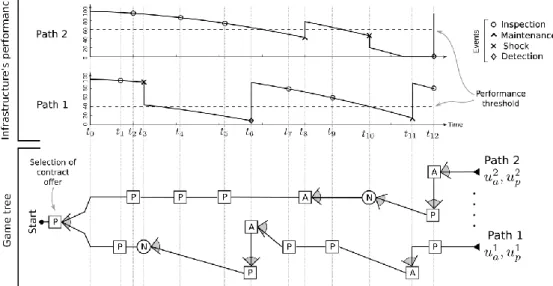
These two limitations are solved by the agent-based model proposed in this paper. The relationship between principal and agent is a continuous-time dynamic game where they both can perform proactive actions at any time. Also, the infrastructure system is an object with specific physical characteristics (e.g., material properties, topology, etc.) and whose behavior is defined by physical laws. Finally, nature is a third player, which does not have preferences, but can exert discrete or continuous demands on the infrastructure affecting its performance, for example, favoring degradation (Sanchez-Silva et al. 2011). The model is path dependent and it is constructed by the sequential actions of the three players (principal, agent and nature). Figure 1 shows two possible history paths of a game: the upper figure is the history of the infrastructure’s performance while the lower tree represents the two possible branching histories built by the sequential action of players.
Figure 1. Two sample paths of a game. Top: Performance history of infrastructure. Bottom: Two branches of a game tree. P: Principal, A: Agent, N: Nature (adapted from Paez-Perez and Sanchez-Silva 2015).
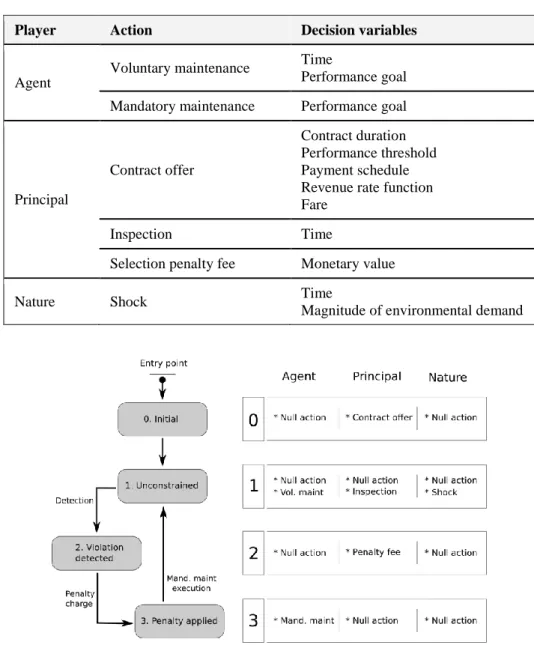
In a sample path of this complex interaction, the principal offers a contract to the agent at the beginning of the game. If the agent accepts, a time continuous interaction will begin until the end of the contract. The principal can perform inspections to the system: if the performance measured is below some threshold –specified by the contract– she will impose a penalty fee to the agent. The main objective of the principal is to maximize the time that the system is operating above certain specific threshold; i.e., guarantee an acceptable availability. On the other hand, the agent has to operate the system so that he can maximize his profit. This means that he has to define the design criteria and a voluntary maintenance program that complies with the principal requirements; if detected under the threshold, he will be forced to pay some penalty and repair the system to some performance level greater than the threshold. The decision variables of the actions of each one of the three players are listed in Table 1.
The central part of the model is the definition of the interaction among all three players. Then, the model assumes that this interaction is built by the successive actions of players. At any given time, the game is in one of four stages, as shown in Figure 2. Stage 0 represents the beginning of the game, where the contract is offered. If accepted, the game switches to Stage 1, where the three players can perform proactive actions. If a violation is detected, the game is on Stage 2, where only the principal is allowed to act by selecting the penalty fee. Once it has been charged to the agent, the game transitions to Stage 3 where the agent must perform a mandatory maintenance action, the completion of which leads the game to return to Stage 1. The game will transition between these stages until the end of the contract is reached.
Table 1. Decision variables of player's actions Player Action Decision variables
Agent
Voluntary maintenance Time
Performance goal Mandatory maintenance Performance goal
Principal
Contract offer
Contract duration Performance threshold Payment schedule Revenue rate function Fare
Inspection Time
Selection penalty fee Monetary value
Nature Shock Time
Magnitude of environmental demand
Figure 2. State chart of the game.
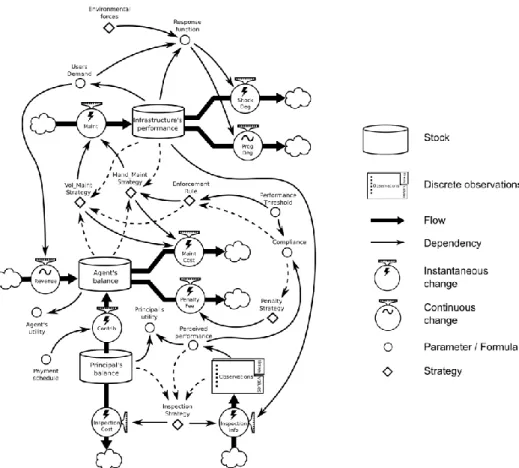
Players’ actions are discrete and instantaneous. However, during the time that elapses between two successive actions, the game is governed by a different process. While the actions of players are realized by instantaneous changes in the state variables of the game, the continuous processes –such as progressive deterioration or the permanent flow of revenue received the agent– evolve gradually. This evolution is governed by a set of differential equations. The relationship between the state variables of the game is presented in Figure 3 with a stock-flow diagram, widely used in problems of system dynamics. The alternation of agent-based behavior with system dynamics makes our model a hybrid simulation (Swinerd and McNaught 2012).
A stock represents the accumulation of a substance and a flow represents the rate of its movements between stocks. Arrows represent relationships of influence between different components (stocks and flows). The stocks in this model are: (1) the performance of the infrastructure, (2) the principal’s monetary balance and (3) the agent’s monetary balance. These are the basic state variables of the game. These variables are increased or decreased by flows, whose rates are controlled by various other elements. This creates the network of dependencies depicted in Figure 3. For further details, see Paez-Perez and Sanchez-Silva (2015).
Figure 3. Stock and flow diagram of dynamic interaction (adapted from Paez-Perez and Sanchez-Silva 2015).
Strategies
The series of actions performed by a player during the interaction are dictated by a strategy. A strategy is an algorithm that tells a player which action to perform (by computing the appropriate decision variables. See Table 1) contingent upon the perceived current state of the world and recalled information. A player’s strategy therefore determines his behavior throughout the entire game. The game simulated by the agent-based model is the transformation:
(𝑢𝐴, 𝑢𝑃) = 𝐺(𝑠𝐴, 𝑠𝑃, ϕ) (3)
where 𝑠𝐴 and 𝑠𝑃 are the strategies of agent and principal, respectively, and 𝜙 is a vector of problem parameters. Therefore, the principal’s optimization problem for our agent-based model can be re-written as
𝑚𝑎𝑥 𝐸[𝑢𝑃∗] 𝑠𝑃 (4) subject to 𝑠̃ =𝐴 𝑎𝑟𝑔 𝑚𝑎𝑥 𝐸[𝑢𝐴] 𝑠𝐴 (5) 𝑢̅ ≤ 𝐸[𝑢𝐴∗]
where the utilities (𝑢𝐴∗, 𝑢𝑃∗) = 𝐺(𝑠̃ , 𝑠𝐴 𝑃, ϕ) are the result of some principal’s strategy 𝑠𝑃 and the agent’s optimum response 𝑠𝐴̃ to 𝑠𝑃. The expected values of utility are obtained from the iterated execution of 𝐺 with the appropriate input.
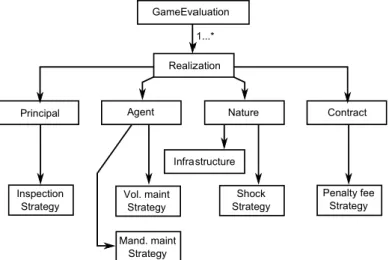
The agent-based model that describes the transformation 𝐺 was implemented as an object-oriented program in MATLAB, whose class diagram is presented in Figure 4. Principal, Agent and Nature are classes. Each player class computes their next action by using their strategy objects. The particular strategy objects for each player are assigned at the beginning of the game. The players also have attributes (not shown in the class diagram) which serve as a memory database storing past observed events. Strategies are able (but not required) to use this memory to compute the values for the decision variables of the action they produce. Infrastructure class contains a shock and continuous response function (see Figure 3) and a record of the performance history. Nature contains the infrastructure object, so that all actions on infrastructure must be performed through the nature class. The contract class has a penalty fee strategy object and contains other information about the game (mostly problem parameters), considered as common knowledge. A realization object builds one interaction history of the game. The game evaluation class contains many realization objects of a single game specification. A realization object is therefore the concrete implementation of the transformation 𝐺. The public repository of the implemented model can be found at https://github.com/davpaez/contract-design.
Figure 4. Simplified UML class diagram (adapted from Paez-Perez and Sanchez-Silva 2015). RESULTS AND DISCUSSIONS
In this section, we present an example problem in order to illustrate some of the specifications needed to run a realization of a game (i.e., the transformation 𝐺) and the produced outcome. Consider a PPP for the construction of some interurban highway. For the purpose of this example, assume that the infrastructure performance is measured in a scale from 0 to 100 (in appropriate units). The environmental conditions cause the system to degrade as a result of progressive deterioration (e.g., oxidation of asphalt binder on hot mixed asphalt concrete) or shocks as a result of extreme natural events (e.g., earthquakes or floods). The contract specifies (according to the principal needs) that the highway must operate above a performance threshold of 70 and that the contract duration is 25 years. The initial construction investment is $875M and the agent receives a total revenue of $1800M which is evenly spread throughout the duration of the contract. Each inspection costs $0.875M and a $400M government contribution is transferred to the agent at the beginning of the game. The principal has established a strategy of inspections whose interval is exponentially distributed with rate 𝜆 = 0.5. The agent’s voluntary maintenance strategy is adaptive and it tries to predict, based on previous observations, when the next inspection will occur and will perform a maintenance intervention just before.
At the top of Figure 5, a realization of the system performance (measured with respect to some physical quantity within the range [0,100]) is shown. The x marks indicate the points at which shocks occur, circles the state of the system at the time of inspections, crosses the points where the agent carries out an intervention and diamonds, the points where a detection occurred and a mandatory intervention by the agent is required. It is important to note that the principal’s knowledge of performance is only approximate as seen in Figure 5, it is merely a belief she holds based on the discrete inspections. Note also that because inspections are carried out at random, in certain periods the system is operating below the required threshold without being detected by the principal. In some other cases, this unacceptable condition is detected and the agent is punished with a penalty and forced to update the system. For simplicity it is assumed that all maintenance interventions take the infrastructure system to the maximum performance.
Figure 5. Single realization of a game. Top: Performance history of infrastructure system. Center: Agent’s monetary balance. Bottom: mean value of performance as approximated by the principal using a linear interpolation between inspections (continuous line) and exact mean value of performance (dotted line).
Incentives are not only sensitive to contractual conditions but also to some problem parameters. For instance, if the maintenance cost function (the function that relates a change in performance to the cost of such intervention) were non-linear and a unitary improvement in performance was much cheaper when the infrastructure is performing well than when it is not, then the agent may be naturally inclined to keep the system at high performance levels. As it is rather usual in economic games, the goodness of a strategy is contingent on what other players’ strategies are; in other words, there may not be a dominant strategy. Thus, the goodness of this maintenance strategy would also depend on the inspection strategy and the penalty policy imposed.
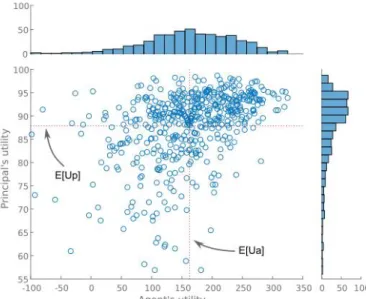
If this game is executed several times (using Monte Carlo simulation), we can plot the variables of interest, i.e., the player’s utilities, as shown in Figure 6. The agent’s utility is assumed to be equal to his monetary balance at the end of the game, while the principal’s utility is equal to the approximate mean value of performance at the end of the game. Also, we can plot histograms to inspect their distribution and compute the probability that the game yields utilities above some desired values. This means the model can effectively calculate the reliability of a particular contract for the game specified. Thus, the model can be used to assess the effects of different strategies and/or parameters by comparing the outcome of each variation. Further expansion of this model includes the implementation of an optimization routine for finding the best contract for a specific problem instance.
CONCLUSIONS
Based on the principal-agent problem, the paper presents a dynamic continuous-time game where the principal, the agent and nature interact and affect one another and the infrastructure system under consideration. By characterizing the possible primitive interactions, we constructed an agent-based model whose execution allows us to model the various history paths that could have unfolded and derive from those a distribution for the variables of interest and reliability measures of the contract. This model may be used in a variety of circumstances where economic actions between self-interested agents are intertwined with physical systems that are subject to natural pressures and whose behavior is uncertain.
The development of an infrastructure project is at its core a social endeavor, for no single individual could by himself design, build and maintain a large physical system. Given its social nature, economic mechanisms must be designed so that they lead to a prescriptive account of concrete desired output. However, the means to achieve
what should be (economic mechanisms) are blind if they are not guided by the descriptive knowledge of what is
(the natural sciences and its application in engineering). Computational models give us the tools to embrace complexity and design mechanisms in a more holistic manner.
ACKNOWLEDGMENTS
This publication was made possible by the support of the “Research Program 2012” of the Office of the Vice President for Research — Universidad de los Andes (Bogotá, Colombia). Its contents are solely the responsibility of the authors and do not necessarily represent the official views of the Universidad de los Andes (Bogotá, Colombia).
REFERENCES
Auriol, E. and Picard, P. M. (2013). “A theory of BOT concession contracts”, Journal of Economic Behavior & Organization, 89, 187–209.
Bolton, P. and Dewatripont, M. (2005). Contract Theory. MIT Press.
Colson, B., Marcotte, P. and Savard, G. (2007). “An overview of bilevel optimization”, Annals of Operations Research, 153(1), 235–256.
Dutta, P. K., and Radner, R. (1994). “Moral hazard”, Handbook of Game Theory with Economic Applications
Chapter 26, 2, 869–903.
Epstein, J. M. (1999). “Agent-based computational models and generative social science”, Complexity, 4(5), 41– 60.
Helbing, D. and Balietti, S. (2011). “Agent-based modeling”, Social Self-Organization: Agent-Based Simulations and Experiments to Study Emergent Social Behavior, Understanding complex systems. Springer Berlin Heidelberg.
Johansson, A and Helbing, D. (2010). “Analysis of Empirical Trajectory Data of Pedestrians”, Pedestrian and Evacuation Dynamics. Springer Berlin Heidelberg
Laffont, J. J. and Martimort, D. (2009). The Theory of Incentives: The Principal-Agent Model. Princeton University Press.
Medda, F. (2007). “A game theory approach for the allocation of risks in transport public private partnerships”, International Journal of Project Management, 25(3), 213–218.
Meunier, D. and Quinet, E. (2010). “Tips and Pitfalls in PPP design”, Research in Transportation Economics, 30(1), 126–138.
Paez-Perez, D. and Sánchez-Silva, M. (2015). “A dynamic principal-agent framework for modeling the performance of infrastructure”, European Journal of Operational Research (Under review)
Sanchez-Silva, M., Klutke, G.-A. and Rosowsky, D. V. (2011). “Life-cycle performance of structures subject to multiple deterioration mechanisms”, Structural Safety, 33(3), 206–217.
Sanford Bernhardt, K. L. and McNeil, S. (2008). “Agent-Based Modeling: Approach for Improving Infrastructure Management”, Journal of Infrastructure Systems, 14(September), 253–261.
Swinerd, C. and McNaught, K. R. (2012). “Design classes for hybrid simulations involving agent-based and system dynamics models”, Simulation Modelling Practice and Theory, 25, 118–133.