1.0
1
Developing the
Master Plan:
Introduction
1.1
Trails and Cycling in Milton
The Town of Milton is committed to developing and implementing an update to their 2007 Trails Master Plan. This Update, which addresses trails and cycling, will create and improve opportunities throughout the Town for active transportation and recreation for residents and visitors alike.
An important part of the Update is the creation of an overall system of trails and cycling facilities. The system builds upon the routes on the ground now, including those implemented as part of the 2007 plan, as well as those routes previously identified as part of the 2007 long-term implementation plan.
The trail and cycling network will provide residents and visitors with a system of on-road and off-on-road trail and cycling friendly routes that connect the urban and rural areas of the Town as well as key community destinations, areas of natural and cultural significance and the Town’s surrounding communities.
An equally important part of the plan is the promotion of trail use and cycling activities. Promotion can include education, outreach and encouragement initiatives which are used to raise awareness of the health, environmental, social and economic benefits of investing in trails and cycling infrastructure. All of these elements are needed to bring about a shift in culture towards leading more active lifestyles including the integration of active modes of transportation into day to day activities as well as recreation. For a community with the population and cultural background such as the Town of Milton’s, and its placement within an area of the province poised for substantial growth and development, it is essential to establish long-term strategies to facilitate the development of healthy and sustainable communities.
1.1.1 What is the Goal of the Study?
The development of the Master Plan Update was based on an overall study goal identified at the beginning of the study by the Town’s Engineering and Community Services Departments.
The involvement of staff from these two departments demonstrates the Town’s understanding of and commitment to the requirements necessary to successfully implement a connected and continuous trails and cycling master plan. The goal is:
“To develop a comprehensive and connected network within the Town of Milton of on-road and off-road routes for pedestrians, cyclists and trail users which meets both recreational and commuter / utilitarian needs.”
The goal is supported by a number of objectives / study focuses which were used to establish the content of the Master Plan Update including:
► Building upon the Town’s existing system of
trails and cycling facilities;
► Building upon planned routes within the
Town and connections from surrounding municipalities;
► Identifying recreational and commuter /
utilitarian needs for pedestrians, cyclists and trail users; and
► Establishing recommendations and
strategic priorities for the Town to consider increasing connectivity within the trail and cycling network.
1.1.2 Master Plan Assumptions: Who are the Users and What are their Trips?
As part of the Master Plan Update, consideration and assumptions regarding the types of network users has been expanded to include a greater focus on cyclists. The design and development of a trails and cycling network is not a one-size-fits-all approach. It is important that the design considers who the users will be so that the network can facilitate the trips that are intended. Based on the scope of this Update, assumptions were made regarding the user groups and the types of trips being taken. These assumptions help to establish the route alignment, types of facilities and timeline for many of the projects.
The Public Health Agency defines active transportation (AT) as:
“Any form of human-powered transportation – walking, cycling, using a wheelchair, in-line skating or skateboarding.”
Active transportation can be defined in more detail to include the use of active modes of transportation for different types of trips.
Figure 1-1 identifies four types of trips which
could be undertaken using active modes of transportation including walking and cycling.
Figure 1-1 – Active Transportation Trip Types – Source: MMM Group
Active Recreation
► Using active transportation modes for
fitness and recreation (e.g., hiking, walking, cycling, etc.)
Active Commuting
► Using active transportation to get to and
from work and school including trips to drop off children at day-care or school.
Active Destination Oriented Trips
► Using active transportation modes for
shopping, visiting friends, attending sporting events, running errands, etc.
Active Workplace Travel
► Using Active Transportation modes during
the business day to attend meetings, deliver materials, etc.
Typically, pedestrians and cyclists are the prominent users of a trails and cycling network.
Figure 1-2 illustrates the different types of
pedestrians and cyclists.
Cyclists
Utilitarian Recreational TouringPedestrians
Walkers Hikers Joggers / Runners Utilitarian RecreationalFigure 1-2 – Trails and Cycling Network User Groups. Source: MMM Group
It is important to note that other user groups may use the system once the facilities have been developed. These groups may include but will not be limited to in-line skaters, e-bikes, cross country skiers, etc.; however, the network will not be designed to specifically address the wants and needs of these user groups and will primarily be focused on pedestrians and cyclists.
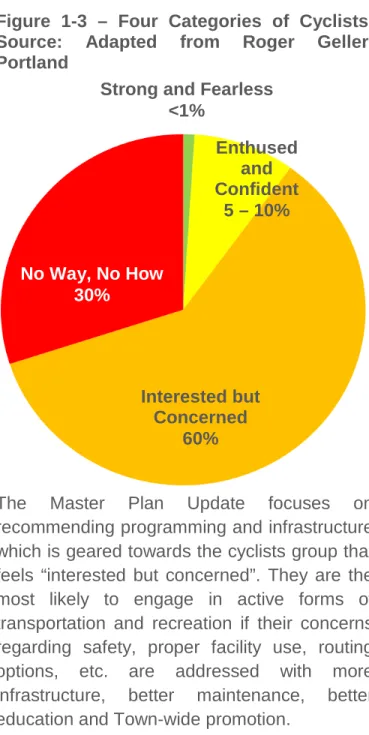
When considering the different types of cyclists who could ultimately use the Town-wide trail and cycling network, there are four categories, based on level of comfort and skill that can be
assumed. Figure 1-3 identifies these
categories and how they are representative of the typical cycling population. Additional definitions of these groups can be found in Appendix D – Design Guidelines, Section D-2.
Figure 1-3 – Four Categories of Cyclists. Source: Adapted from Roger Geller, Portland Interested but Concerned 60% No Way, No How 30%
Strong and Fearless <1%
Enthused and Confident
5 – 10%
The Master Plan Update focuses on recommending programming and infrastructure which is geared towards the cyclists group that feels “interested but concerned”. They are the most likely to engage in active forms of transportation and recreation if their concerns regarding safety, proper facility use, routing options, etc. are addressed with more infrastructure, better maintenance, better education and Town-wide promotion.
In the Portland study by Geller the “enthused and confident” group is credited with the major increase in ridership, as this demographic of cyclists is the primary reason why bicycle
commuting doubled between 1990 and 20001.
It is also important to note that less experienced cyclists, over time, tend to become enthused and confident. In addition to the four categories identified above, cyclists can also be categorized based on cycling specific trip types. The trips vary based on distance, duration, and overall intent. In many cases, the type of trip also influences the type of facility that may be used.
Utilitarian
Includes cyclists who use their bicycle for day-to-day activities such as getting to and from work, school, errands, etc. These cyclists often use the streets that are part of the cycling network year-round in all weather conditions as opposed to those roads which do not make up part of the formal cycling network. In some cases, they may choose to use public transit or other modes of transportation during the winter season. Typically, utilitarian cyclists have good mobility skills and are cognisant of the "rules of the road".
Recreational
Includes cyclists who typically use the network for fitness or leisure purposes. Their trips are typically used for travel on weekends as opposed to weekdays and will consist of trips to and from destinations of cultural or natural significance including off-road recreational trails. This cyclist will typically use secondary / local neighbourhood connections as part of
their overall network.
1 Geller, 2006 – Four types of Cyclists, Portland Office of Transportation
Touring
Includes cyclists who use cycling as a means of exploring areas that are a long-distance from their point of origin. Trips can vary from full day excursions to multi-day trips. These cyclists may plan their trips in advance and are willing to spend money for accommodation and food at their destination point. In some cases, they
travel in groups.
The assumptions regarding the different user groups and the types of trips they could make have formed the basis for the Town-wide trails and cycling network.
1.2
Benefits of Walking and Cycling
There is clear evidence of growing demand for facilities which support walking and cycling throughout Ontario and across North America for utilitarian / commuter and recreational purposes. As people become more aware of the negative health effects that come from a lack of physical activity and reduced air quality from our reliance on motor vehicles, the demand for municipal governments to adopt more sustainable land use and urban mobility strategies increases. The development of infrastructure, policies and promotional strategies which respond to this growing demand can also yield a number of community benefits.
Share the Road Awareness Signage
Source: MMM Group
Research has been conducted by a number of different sources on the community health, community safety, transportation, environmental, economic and tourism benefits
associated with municipal investment in cycling and trail use. This section summarizes some of the market research which has been done to support the business case of municipal investment in cycling and trail infrastructure and programming.
Community Health
Municipalities in Southern Ontario and throughout North America are implementing initiatives to promote and encourage active transportation activities as a method of fostering a more active and healthy lifestyle. Studies have shown that people who use active transportation are, on average, more physically fit, less obese, and have a reduced risk of developing cardiovascular disease and other chronic health ailments.
Physical activity such as walking and cycling is further noted to reduce the symptoms of mental illnesses. Similar to meditation or relaxation, physical activity may reduce symptoms of depression, anxiety, and panic
disorder2. Towns, cities, and counties/regions
that promote walking and cycling tend to be healthier, more user-friendly and efficient for
individuals of all ages, specifically children3.
Research supports increase in attention and concentration in children with active commuting
to school4. Active transportation (AT) friendly
communities tend to be “better places to grow up in that they allow children a certain degree of autonomy essential to their development. Being able to go to daily destinations like school on foot or by bike allows young people to discover and experience their neighbourhood” in a more active and health
oriented manner5. Replacing car trips with
active transportation can contribute to the prevention of the leading causes of mortality in Halton: cancer, heart disease and stroke.
A 2012 report from the City of Toronto Public Health Division concluded that the implementation of active transportation routes and facilities has very important health benefits to improve quality of life. Some of the key findings include:
► Prevention of the occurrence of Type 2
diabetes;
► Reduced overall risk of cancer, particularly
colon cancer and breast cancer. Physical activity has been found to reduce the overall risk of colon cancer by 24%; and
► Reduced rates of motor-vehicle collision.
Some of the key means of encouraging active transportation activities include:
► Reduction in roadway costs (maintenance,
safety, and enhancement costs);
► Less damage to road surfaces; and
► Lower space requirement than motor
vehicles6
A trail and cycling network, including hard infrastructure, must be complemented by soft infrastructure such as education, promotion and awareness campaigns and initiatives.
.
2 Toronto Public Health, Road to Health: Improving Walking and Cycling in Toronto
(2012)
3 Bassett, D.R., et al. “Walking, Cycling and Obesity Rates in Europe, North America
and Australia.” Journal of Physical Activity and Health. 2008 (5): p. 795 - 814
4 Marinez-Gomez, D., Ruiz, J.R, Gomez-Martinez, S., et al. (2011). Active Commuting
to School and Cognitive Performance in Adolescents. Archives of Pediatrics & Adloescent Medicine, 165(4).
5Torres. J. “Children & Cities: Planning to Grow Together”. The Vanier Institute of the
Family , Institut d’urbanisme, Université de Montréal (2009)
6 Litman, T. “Evaluating Non-Motorized Transportation Benefits and Costs”. Victoria
Examples of potential initiatives include:
► Canby (2003) recommends the creation of
a strong education and advocacy program. European cities have experienced widespread change in pedestrian and cyclist safety with the implementation of traffic safety education programs for children at an early age continued through into their teens.
► Zuks (2002) notes that programming
related to bicycle handling, road sense, route selection, and road rules should be developed to enhance the user’s perception of safety while increasing physical safety on and off the roadways.
Community Safety
A research paper completed by Buehler & Pucher (2011) states that “Cycling safety is an important determinant of cycling levels. The causation probably goes in both directions. Several studies confirm that increased cycling safety encourages more people to cycle. Conversely, the concept of ‘safety in numbers’ proposes that, as more people cycle, it becomes safer because more cyclists are more visible to motorists and an increasing number of motorists are also cyclists, which probably makes them more considerate of cyclists when driving7.”
A paper published in 2010 by the Toronto Coalition for Active Transportation / Clean Air Partnership defines the two principle safety concerns for pedestrians and cyclists as
personal safety and traffic safety concerns8.
Personal safety concerns pertain to a feeling that one’s safety could be jeopardized by crime, whereas traffic safety concerns typically arise when all modes, both motorized and non-motorized, are expected to share the same infrastructure. Research has found that in the United States, pedestrians and cyclists suffer 2-3 times more accidents than a car driver (per 100 million trips)9.
In another study completed by the Thunderhead Alliance, collision data was compared to the presence of bicycle and pedestrian fatalities and active transportation mode share. Results indicated a positive correlation between the levels of cycling and walking and increased safety of users.
Cities with the highest raw numbers of walking and cycling also had the lowest per capita fatality rates for pedestrians and cyclists10.
TOWN OF MILTON | TRAILS AND CYCLING MASTER PLAN UPDATE
7 Buehler, R. and Pucher, J. “Cycling to Work in 90 Large American cities: New
Evidence on the Role of Bike paths and Lanes”. Sprinter Science+Business Media. LLC (2011)
8 Behan, K & Smith Lea, N. “Benchmarking Active Transportation in Canadian Cities”.
Toronto Community Foundation. Clean Air Partnership (2010).
9 Pucher, J. and Dijkstra, L. “Making Walking and Cycling Safer: Lessons from
Europe”. Transportation Quarterly 54 (2000): 25 - 50
10 Thunderhead Alliance. “Bicycling and Walking in the US; Benchmarking Report,
Substandard infrastructure can also increase the safety concerns of pedestrians and cyclists. Inadequate hard infrastructure such as sidewalks and bicycle paths, dangerous intersections, crosswalks and poor lighting were found to be significant contributors to increased fatality and injury rates among
pedestrians and cyclists11. Another study
completed in 2001 noted the following factors which tend to impact the safety of pedestrians12:
► Presence of a sidewalk;
► Lateral separation from motor vehicle
traffic;
► Barriers and buffers between pedestrians
and motor vehicle traffic;
► Motor vehicle volume and composition;
► Effects of motor vehicle traffic speed; and
► Driveway frequency and access volume.
Public opinion research indicates that with the development and/or enhancement of hard infrastructure, such as the implementation of separated bike lanes, bike boxes and cycle tracks, application of the complete street design principles, and improved signage along designated cycle routes, many pedestrians and cyclists report that they feel safer and thus participate more frequently in active transportation activities.
Transportation
Walking and cycling are both popular recreational activities and a means of transportation that are efficient, affordable, and accessible. These modes of transportation are the most energy efficient which also do not directly generate pollution (with the exception of bicycle manufacturing).
The term walkability is a measure of how friendly an area is to walking. Areas that are considered to be more walkable display many common characteristics including but not limited to the presence and connectivity of sidewalks, trails and pedestrian rights-of-way, separation of pedestrians from busy motor vehicle traffic, convenience of pedestrian crossings of busy roads, supportive land use mix, visual and aesthetic quality of the physical environment, etc. Walkable neighbourhoods and communities are an important aspect of sustainable community design, and places that are considered walkable may be correlated with improved physical and mental health of residents.
The transportation benefits of walking, cycling, and other active transportation modes include reduced road congestion (i.e., move more people by AT along a road compared to moving the same number of people by car), reduced maintenance costs, less costly infrastructure, increased road safety, and decreased user costs.
11 Zeeger, C.V. “Designing for Pedestrians”. In the Traffic Safety Toolbox: A primer of
Traffic Safety. Washington D.C.: Institute for Traffic Engineers (1993)
12 Buehler, R. and Pucher, J. “Cycling to Work in 90 Large American cities: New
Evidence on the Role of Bike paths and Lanes”. Sprinter Science Business Media. LLC (2011)
Bike Lane on Tremaine Road facing North
Source: MMM Group
In general, cycling is as fast as driving for trips of 7 kilometres or less in urban areas and walking is as fast as driving for trips of 500 metres or less. Studies approximate that the construction of sidewalks on all city streets could increase non-motorized travel by 0.16 km and reduce automobile travel by 1.84 vehicles per capita.
Congestion costs in Ontario were estimated at $6.4 billion annually and could grow by an additional $7 billion annually by 2021 without increased investment in alternative modes of
transportation13. Studies have shown that
walking and cycling improvement may reduce personal expenditures on taxi costs and public
transit fares14. Reducing automobile ownership
and usage may further contribute to lower parking costs and fewer parking spaces required at a place of employment.
Seven in ten Canadians say they would cycle to work if there “were a dedicated lane which would take me to my workplace in less than 30
minutes at a comfortable pace”15.
Bike Lane with Roll Curb
Source: MMM Group
15 Ontario Trails Strategy. Ministry of Health Promotion, 2005 13 Transportation Demand Management Strategy, City of Ottawa – TravelWise
Transportation, Utilities and Public Works, April 2003.
14 Litman, T. “Evaluating Non-Motorized Transportation Benefits and Costs”. Victoria
Transport Policy Institute. Wwwbpti.org (2006)
What is a complete street?
A complete street is designed for all ages, abilities and modes of travel. On a complete street, safe and comfortable access for pedestrians, bicycles and transit users is ensured. Mobility impaired individuals are not an afterthought, but an integral planning consideration.”
(Toronto Centre for Active Transportation)
TOWN OF MILTON | TRAILS AND CYCLING MASTER PLAN UPDATE
Cycling Connection to Oakville
Source: MMM Group
Environmental
Active transportation activities are energy-efficient, non-polluting modes of travel. Promoting the bike as a clean and efficient alternative to the personal automobile is a practical way for cities to reduce traffic
congestion and smog16. Short distance motor
vehicle trips are the least fuel efficient and generate the most pollution per kilometre. These trips have the greatest potential of being replaced by walking or cycling trips and integrated walking-transit and cycling-transit trips. It is estimated that each 1% shift from automobile to non-motorized travel typically
reduces fuel consumption by 2-4%17.
Active transportation may provide large energy savings as it provides the opportunity to replace short motor vehicle trips that have high
emission rates per mile per capita18. For some
smaller commuter-oriented communities,
however, trip savings are more likely to be explored for the shorter daily trips including errands, dropping of kids at extracurricular activities, going to the gym or out for dinner. Planning and constructing communities in a more sustainable way so they are less vehicle dependent by providing infrastructure for alternative transportation modes, such as walking, cycling and public transit, can reduce the amount of land required to construct new communities, thus creating more compact communities that make more efficient use of available land. This in turn may reduce water pollution and hydrologic disruptions related to factors such as road salting products, air pollution settlement, roadside herbicides, road construction along shorelines, and increased impervious surfaces.
Initiatives which promote and encourage active transportation are a viable option to reducing discretionary motor vehicle usage and promoting economic benefits.
Some of the key environmental benefits include19:
► Resource conservation (less dependency
on natural resources such as petroleum and coal);
16 Roney, Matthew, J. Bicycles Pedaling into the Spotlights, 2008, Earth Policy Institute 17 Litman, T. “Evaluating Non-Motorized Transportation Benefits and Costs”. Victoria
Transport Policy Institute. Wwwbpti.org (2006)
18 Litman, T. “Evaluating Non-Motorized Transportation Benefits and Costs”. Victoria
Transport Policy Institute. Wwwbpti.org (2006)
19 Litman, T. “Evaluating Non-Motorized Transportation Benefits and Costs”. Victoria
► Pollution reduction such as noise, carbon monoxide and particulates; and
► Integration of compact mixed development
due to reduced transport land requirements.
Economic
Active transportation reduces expenditures related to automobiles and in some cases can reduce the need for residents to own a vehicle, where savings can total hundreds or thousands
of dollars annually per capita20. Active
transportation provides benefits to the local economy during both construction and operation. The construction of these active transportation facilities results in direct benefits such as jobs, including the supply and installation of materials. Following construction, benefits emerge in the form of expenditures by active transportation facility users.
Non-automotive expenditures are estimated to have a regional impact of $0.22 per dollar more
than automobile expenditures21. In 2002,
Canadian households spent an average of $42 on bicycle parts and accessories for a total of approximately $500 million. Studies estimate that over 40 years, Portland, Oregon’s $138 million to $605 million bicycle facility
investment will provide net economic benefits22
including healthcare savings of $388-594 million, fuel savings of $143-218 million and $7-12 billion in longevity value.
Tourism
There is a growing demand for cycling and eco-tourism throughout southern Ontario and North America. Studies indicate that economic benefits of tourism related to active transportation infrastructure will continue to
grow23. The demand stems from an increasing
desire to explore new areas using active modes of transportation and to experience one’s natural surroundings. The largest beneficiaries of cycling and eco-tourism are eating/drinking establishments, retail and lodging services.
Though tourism benefits from active transportation and trail facilities provide an injection into the local economy, there are also social, environmental and health benefits associated with AT and trail tourism. As people become aware of the benefits of cycling and walking, the number of cycling tourists has been shown to increase. These tourists will ultimately contribute economically to the communities that they live in and visit.
The Economic Benefits of Walking and Cycling, published in Halton Region’s “Economic Value: Active Transportation & Local Businesses” noted some of the following examples of benefits24:
TOWN OF MILTON | TRAILS AND CYCLING MASTER PLAN UPDATE
20 Litman, T. “Evaluating Non-Motorized Transportation Benefits and Costs”. Victoria
Transport Policy Institute. Wwwbpti.org (2006)
21 The Business Case for Active Transportation, Better Environmentally Sound
Transportation – BEST, Go for Green, March 2004
22 Litman, T. “Evaluating Non-Motorized Transportation Benefits and Costs”. Victoria
Transport Policy Institute. Wwwbpti.org (2006)
23 Halton Region Health Department (2013) Active Transportation and Tourism
Resources/
► Pedestrians on Bloor Street in Toronto spend more than drivers at local businesses;
► A study completed in Portland USA found
people who walked to a bar or restaurant spent more money than drivers;
► People who travelled by bike visited bars
and restaurants more often and spent more or the same amount of money as people who arrived by car;
► When new bike racks and bike lanes were
added on Magnolia Street in Fort Worth, Texas, business increased by nearly 200%;
► The cost of building a parking space for a
bicycle is about 5% of the cost of building a parking space for a car
► Almost 20 bicycles can be parked in the
space needed for one car;
► The development and maintenance costs of
AT infrastructure are far lower than the costs of other transportation infrastructure, both on an overall and per-capita basis;
► AT infrastructure can accommodate
between 7 and 20 times the volume of people than can roads for cars. positive economic impact of bicycle tourism;
► The positive economic impact of bicycle
sales and manufacturing;
► Increased property values along greenways
and trails; and
► Increased productivity and reduction of sick
days and injuries in the workplace.
Pedestrian Crossing Design Treatment at Intersection
Source: MMM Group
Findings from a number of recent studies such as a 2009 study completed by Transportation
Options25 indicate an increase in business and
employment opportunities and health and environmental benefits associated with cycle tourism. Key highlights include:
► “As the demand for cycle tourism increases,
cyclists’ spending on food, drinks, entertainment and other expenses related to the sport will also increase at travel destinations.26”
► “There are many employment opportunities
with the growth of cycle tourism. The Bicycle Trade Association of Canada (BTAC) suggests that an annual requirement between 50 and 100 new mechanics in the GTA, and as many as 1000 in other major cities in Canada, will be demanded as cycling continues to gain popularity.27”
25 La Fontaine, J. “2009 Bike Train Final Report”. Transportation Options. 2009. 26 BTAC – Bicycle Trade Association of Canada. “2009 Data Capture”. Retrieved
September 2010 from www.btac.org - the BTAC website.
27 BTAC – Bicycle Trade Association of Canada. “2009 Data Capture”. Retrieved
September 2010 from http://www.btac.org/files/BTAC-2009_Data_Capture-Media.pdf
► “Cycle tourism has become an increasingly important component within rural sustainable development projects. Cycle tourism plays a part in eliminating the use of motorized travel (i.e. for sightseeing purposes) thus decreasing the amount of green-house emissions generated from motorized vehicle touring.”
Similarly, Transportation Options also developed and initiated the “Welcome Cyclists” program in 2009. The program certifies and promotes bicycle friendly businesses and cycle tourism in a growing number of regions across Ontario. The network is open to accommodations, food services, attractions, cycling related businesses and organizations interested in cycle tourism.
The Welcome Cyclists Network is launched in each region with an informative workshop, after which local businesses may register on-line, at no charge, to participate and ultimately reach the growing number of cycle tourists in Ontario. The cycle tourism and economic benefits realized by this program have grown as the program is implemented in new communities. A linked system / database of cycle touring supporters as well as local businesses helps to boost the local economy with cycle tourism dollars while increasing local awareness about the safe practices of cycle touring.
Cyclist on Lower Baseline Road
Source: MMM Group
1.3
How was the Master Plan
Developed
?
One of the primary goals of developing the Trails and Cycling Master Plan Update was to establish strategic priorities to facilitate a continuous and connected system of on-road and off-road facilities to facilitate recreational as well as utilitarian / commuter travel.
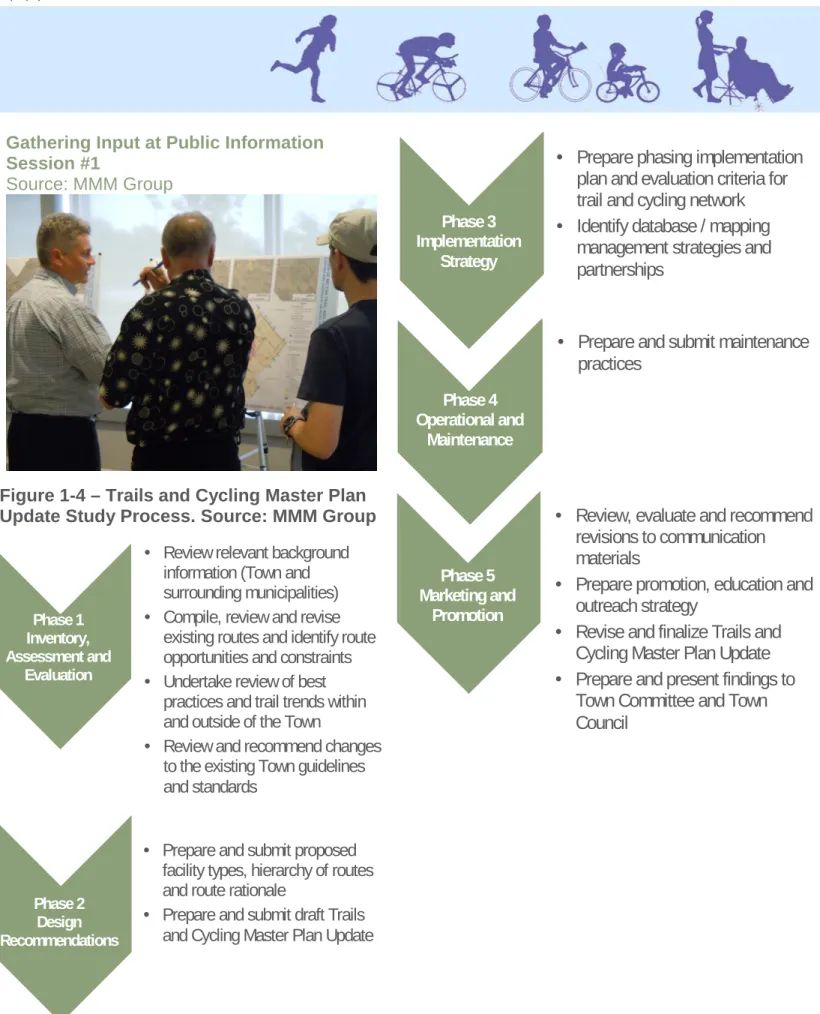
The study process used to develop the network for the Town of Milton required continuous communication and a rigorous consultation
program as illustrated in Figure 1-4. Each of
the steps formed a key component of the study and ultimately led to the development of the Master Plan report. The study was undertaken between December 2012 and November 2013.
Gathering Input at Public Information Session #1
Source: MMM Group
Figure 1-4 – Trails and Cycling Master Plan Update Study Process. Source: MMM Group
Prepare and submit proposed
facility types, hierarchy of routes and route rationale
Prepare and submit draft Trails
and Cycling Master Plan Update
Phase 2 Design Recommendations
Review relevant background
information (Town and surrounding municipalities)
Compile, review and revise
existing routes and identify route opportunities and constraints
Undertake review of best
practices and trail trends within and outside of the Town
Review and recommend change
to the existing Town guidelines and standards Phase 1 Inventory, Assessment and Evaluation s
Prepare phasing implementation
plan and evaluation criteria for trail and cycling network
Identify database / mapping
management strategies and partnerships
Phase 3 Implementation
Strategy
Prepare and submit maintenance
practices Phase 4
Operational and Maintenance
Review, evaluate and recommend
revisions to communication materials
Prepare promotion, education and
outreach strategy
Revise and finalize Trails and
Cycling Master Plan Update
Prepare and present findings to
Town Committee and Town Council
Phase 5 Marketing and
1.3.1 Informing the Study Process: A Made in Milton Solution
As noted, an essential element of the Trails and Cycling Master Plan Update was public and stakeholder engagement and consultation. The Master Plan is designed to be a “Made in Milton” solution for trail and cycling related challenges currently being experienced by the municipality.
By engaging with the public and stakeholders continuously over the study process, the study team was able to develop a network and set of Master Plan recommendations which respond to the wants and needs of residents, visitors, businesses, municipal employees, etc. The following text outlines some of the key consultation activities which were undertaken to inform the development of the Master Plan Update.
The comments received from the public and stakeholder engagement indicated significant support for ongoing development of trail and cycling facilities. A full list of consultation activities as well as a summary of responses that were gathered and key highlights can be found in Appendix A.
Phase 1 Public & Stakeholder Consultation
Timeline: December 2013 – July 2013
► Launch Study and Public Outreach
Campaign – study promotional business card and mobile display board (Downtown Milton Street Festival – June 1st, 2013)
► Online Study Promotion – key study
information posted on the Town’s webpage, on webpages for local interest groups and committees, an online questionnaire and Facebook and Twitter promotion of online questionnaire
► Public Input Session #1 (June 27th, 2013)
► Public Agency Workshop (July 9th, 2013)
► Stakeholder Workshop (July 9th, 2013)
► Two Meetings with the Project Working
Group (December 18th, 2012 and July 9th, 2013)
Phase 2 – 5 Public and Stakeholder Consultation
Timeline: August 2013 – June 2014
► Meeting #1 with the Technical Advisory
Committee (August 13th, 2013)
► Project Overview Session with Town Staff
(August 13th, 2013)
► Public Outreach Campaign & Online Study
Promotion (Ongoing)
► Project Overview Presentation with CSAC (September 17th, 2013)
► Meeting #2 with the Technical Advisory
Committee (October 1st, 2013)
► Public Input Session #2 (October 2nd,
2013)
► Presentation to Town Committee & Town
Council (June 2014)
► Meeting #1 with the Technical Advisory
Committee (August 13th, 2013)
► Project Overview Session with Town Staff
(August 13th, 2013)
► Public Outreach Campaign & Online Study
Promotion (Ongoing)
► Project Overview Presentation with CSAC
(September 17th, 2013)
► Meeting #2 with the Technical Advisory
Committee (October 1st, 2013)
► Public Input Session #2 (October 2nd,
2013)
► Presentation to Town Committee & Town
Council (June 2014)
1.
4
Setting a Direction: The Study
Vision
As an initial step in the study process and based on priorities identified by Town staff, the public and stakeholders, a study vision was developed to guide the future development of trails and cycling facilities Town-wide.
The Town of Milton supports cycling and trail use for recreational and commuter purposes in order to promote healthy lifestyles, facilitate economic and tourism growth, foster environmentally friendly and strategic community design and reduce the number of single occupancy motor vehicle trips. The Town will achieve this through a continuous and connected Town-wide cycling and trail network of varying cycling and trail facility types. The network will provide residents and visitors with connections to the rural and urban communities, commercial and employment nodes, open spaces, significant natural, historic and recreational features, community facilities, and tourist destinations.
The vision is supported by a set of goals which outline specific outcomes that the Master Plan Update is intended to achieve through implementation. The Master Plan goals include:
► Support Community Growth: reflect the changes in community planning, growth and development which are occurring in the Town of Milton;
► Build on Work Already Completed: enhance and improve connections to existing and previously proposed cycling and trail facilities in the Town, including those proposed in the previous Trails Master Plan, Secondary Plans, draft plans of subdivision, Regional and surrounding municipal active transportation (AT) and trail master plans, etc.;
► Respond to Local Demand: consult with residents, stakeholders, local interest groups, the Town, Halton Region, local school boards, surrounding municipalities, Council and other partners and agencies that could have a role in facilitating and promoting cycling and trail use in Milton, and seek their input on infrastructure and programming;
► Design for a Range of Users: provide a balance of recreational and utilitarian facility types in Milton’s rural and urban areas which connect employment, recreation and commercial nodes;
► Map a System of Cycling Routes and Trail Links: document a continuous and connected network of cycling and trail facilities within and around Milton, including the identification of opportunities on non-Town lands which may complement the network;
► Facilitate Master Plan Implementation:
develop an ‘opportunity-based’ implementation strategy which will be used as a guide to implement a well-planned system of on and off-road routes for pedestrians and cyclists tailored for the Town of Milton, including but not limited to a cost effective and practical strategy that identifies priorities, roles and responsibilities, annual costs, potential partners and agencies and funding alternatives; and
► Ensure Ongoing Trail and Cycling Promotion and Outreach: provide the Town with creative recommendations to help ensure trails and cycling facilities are promoted throughout the Town including signage, promotional campaigns and marketing strategies tailored for people of all ages and abilities, and identify opportunities with partners and agencies to optimize funding and resources to achieve the most successful results.