Testing the gravitational properties of the quantum
vacuum within the Solar System
Dragan Hajdukovic
To cite this version:
Dragan Hajdukovic. Testing the gravitational properties of the quantum vacuum within the
Solar System. 2014.
<
hal-00908554v3
>
HAL Id: hal-00908554
https://hal.archives-ouvertes.fr/hal-00908554v3
Submitted on 18 Feb 2014
HAL
is a multi-disciplinary open access
archive for the deposit and dissemination of
sci-entific research documents, whether they are
pub-lished or not.
The documents may come from
teaching and research institutions in France or
abroad, or from public or private research centers.
L’archive ouverte pluridisciplinaire
HAL
, est
destin´
ee au d´
epˆ
ot et `
a la diffusion de documents
scientifiques de niveau recherche, publi´
es ou non,
´
emanant des ´
etablissements d’enseignement et de
recherche fran¸
cais ou ´
etrangers, des laboratoires
publics ou priv´
es.
1
Testing the gravitational properties of the
quantum vacuum within the Solar System
Dragan Slavkov Hajdukovica, b
a
Physics Department, CERN; CH-1211 Geneva 23
b
Institute of Physics, Astrophysics and Cosmology; Cetinje, Montenegro E-mail: [email protected]
Abstract: The existence of the quantum vacuum is well established in the Standard Model of Particles and Fields but completely neglected in contemporary Astrophysics and Cosmology. Independently of any theory it is a major and absolutely urgent task of astronomical observations to reveal if and how quantum vacuum contributes to the gravitational field of baryonic matter in the Universe. We point out that a first signature of the gravitational impact of the quantum vacuum might be seen in the perihelion precession of orbits of satellites of minor planets in the outer part of the Solar System. As an example we consider the minor planet 2002 UX25 and its satellite.
1. Introduction
So far we had two scientific revolutions in our understanding of gravitation: Newton’s law and
Al e t Ei stei ’s General Relativity. Whatever happens in the future, these two revolutions will remain among the greatest achievements of
theoretical physics and the human mind. We know today that both theories have in
common a wrong assumption. The wrong assumption is that the matter of the Universe exists in classical, non-quantum vacuum.
While it is systematically neglected in Astrophysics and Cosmology, quantum vacuum is an inherent part (see for instance [1-3]) of the Standard Model of Particles and Fields which is in perfect agreement with experimental findings. However, without quantum vacuum taken into account, quantum field theory would be in perfect
disagreement with experimental findings. Einstein said (and I agree): Imagination is more important than knowledge. So, I invite you to imagine that, you can switch off and switch on, the quantum vacuum in our Universe. As we live in the Universe with quantum vacuum switched on, you firstly must switch it off. What would happen? In fact I must warn you not to do it; after switching off the quantum vacuum, you will not stay alive to switch it on again! This is not a speculation but
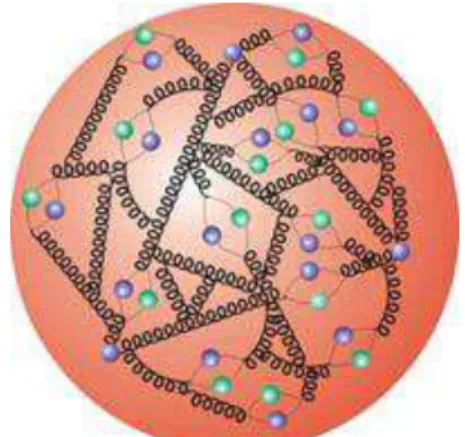
prediction based on our best knowledge. For instance, sophisticated experiments [4] have revealed that the proton is not an elementary particle but a very complex system that in addition to three valence quarks contains virtual (or see) quark-antiquark pairs and gluons (see Fig. 1).
Fig. 1 Inner structure of a proton revealed at HERA Black spirals represent gluons while purple-green particles denote virtual quark-antiquark pairs (up to 100 of these quark/anti-quark pairs a e isi le at any instant!). Note that there are three more quarks (two up, one down) than anti-quarks. These are the three valence quarks we would normally refer to when speaking of the proton. (Source: DESY in Hamburg)
In simple words, quantum vacuum significantly contributes to the structure of protons (and
2
neutrons as well). If this contribution is switched off, protons would become quite different particles. A radical change of constituents of atoms would perturb everything; the Universe without quantum vacuum would be a completely different place (and certainly without us). Hence, quantum vacuum is not only a strange state of matter in quantum field theory, but also the root of our existence.Before we continue let us give a simplified (but basically true) description of the quantum vacuum. Quantum vacuum should be considered as a state
of matter, completely different from familiar
states gas, li uid, solid, plas a… ut as real as
they are [1-3]. Popularly speaking, quantum vacuum is a sea of sho t li i g virtual particle-antiparticle pairs (like quark-antiquark, neutrino-antineutrino and electron-positron pairs). According to our best knowledge: (1) quantum vacuum is a state with perfect symmetry between matter and antimatter; a particle always appears in pair with its antiparticle, which is totally different from mysterious matter-antimatter
asymmetry, i.e. the fact that everything on the Earth (and apparently in the Universe) is made from matter, with only traces of antimatter; (2) contrary to all other states of matter which are composed from the long living particles (electrons and protons in stars and flowers, have existed before them and will exist after them), the quantum vacuum is a state composed from extremely short living virtual particles and antiparticles (for instance, the lifetime of a virtual electron-positron pair is only about
22
10
seconds). Popularly speaking, as fishes, we live in an o ea ; ou o ea is the quantum vacuum.Our knowledge about gravitational properties of the quantum vacuum is zero.
There are two possibilities. The first possibility is that quantum vacuum has no impact (or at least has no significant impact) on the gravitational field in the Universe. In fact, contemporary Astrophysics and Cosmology are based on this assumption. The second possibility is that quantum vacuum contributes greatly to the gravitational field in the Universe. If so, any theory that neglects the existence of the quantum vacuum is blind to some crucial gravitational phenomena, and, as a compensation for the lost phenomena, must invoke some artificial stuff. The inevitable question is if dark matter and dark energy are such artificial stuff which (in our incomplete theory) mimics well the phenomena which are in fact caused by the quantum vacuum.
Contrary to the other candidates for new physics (supersymmetries, dark matter, dark
e e gy… ua tu a uu is ot a spe ulatio
but a key feature of Quantum Electrodynamics, Quantum Chromodynamics and Electroweak theory, i.e. a key feature of the Standard Model of Particles and Fields, the most successful and the best tested theory of all times. It is a major and absolutely urgent task of astronomical observations to reveal if and how quantum vacuum contributes to the gravitational field of baryonic matter in the Universe. In the present article we point out that a first signature of the gravitational impact of the quantum vacuum might be seen in the perihelion precession of orbits of satellites of minor planets in outer part of the Solar System. As an example we consider the minor planet 2002 UX25 and its satellite.
2. Some reflections on quantum
vacuum and gravity
We do not know if quantum vacuum contributes or not to the gravitational field in the Universe. The answer must come from astronomical observations and experiments in our laboratories. However it seems plausible to assume that quantum vacuum contributes to the gravitational field.
The first question after this assumption is if the contribution of quantum vacuum is independent or
dependent on the quantity and distribution of the immersed matter. Once again the answer must come from observations and experiments. From a theoretical point of view, if quantum vacuum produces a non-zero gravitational field
independent of the immersed matter, it means that we should observe a non-homogeneous and non-isotropic background, which is apparently not the case. Hence, it seems plausible that the gravitational contribution of the quantum vacuum depends on the quantity and distribution of the immersed matter. In other words, if we attribute to the quantum vacuum, an effective gravitational charge density, it has a non-zero value only in the presence of an external gravitational field produced by the immersed matter. Let me note that I have used an unusual te g a itatio al
ha ge instead of gravitational mass or simply mass; of course, according to the weak equivalence principle all these terms are synonyms for ordinary matter, but it is preferable to keep the
3
term gravitational charge and to stay open for possibility of violation of the weak equivalence principle for non-ordinary matter.Our theory of gravitation describes the gravitational field of a spherical body (like a star) immersed in the gravitationally featureless classical vacuum. Hence, the second basic question is how quantum vacuum modifies classical gravitational field around a spherical body. The gravitational charge (mass) of the considered spherical body is a constant. Contrary to it, the quantum vacuum around the body should have certain effective gravitational charge density; hence the effective gravitational charge within a sphere of radius
r
must increase withr
. In other words an observer at a larger distancer
from a star would observe a larger effective gravitational mass of the star. It is obvious from observations that the effective gravitational charge of the quantum vacuum within the Solar System must be a tiny fraction of the mass of the Sun. Only at very large distances, this fraction can be significant. It is interesting to note that in Quantum Electrodynamics, quantum vacuum has properties analogous to the above suppositions.3. The simplest gravitational
signature of new physics
The simplest problem in celestial mechanics is to determine orbit of a point-like body in a central gravitational field. The orbit is an ellipse fixed with respect to the centre of gravity if and only if the central gravitational field has perfect spherical symmetry and the gravitational force strictly follows the Newton inverse square law. Any departure from spherical symmetry and/or the inverse square law of gravity, leads to the precession of the perihelion (see for instance [5-6]).
General Relativity (describing a spherically symmetric central gravitational field by Schwarzschild metric) is more accurate than Newtonian theory and it predicts a tiny precession even in the case of spherical symmetry. The general relativistic precession is well approximated by
a
R
e
S GR 21
3
(1)where
Gris the extra rotation per orbit in radians,a
the semi-major axis of the orbit,e
the eccentricity of the ellipse andR
S the Schwarzschild radius of the central body.It is worth noting that the perihelion precession of planets predicted by classical theory (Newtonian mechanics together with the inverse square law for gravity) is close to the observed values; the largest discrepancy occurs for the
Me u y Me u y’s o it p e esses at a rate that is about 8% greater than the predicted one). The discrepancy has been explained by general relativistic correction (1) which must be added to the Newtonian result.
In brief, in the case of a central gravitational field with the exact spherical symmetry, Newtonian precession of the perihelion is zero, while the general relativistic result (1) is too small to be detected (with the current accuracy of measurements) for satellites of small central bodies like minor planets in the outer part of the Solar System.
Of course, a minor planet (which orbits around the Sun with a period
T
Sun) and its satellite (which orbits around the planet with a periodT
P) are not an isolated system but subject to an external gravitational field dominated by the Sun. This external gravitational field produces a Newtonian perihelion shift in the orbit of the satellite: the shift per orbit is well approximated [5, 7] with2
2
3
Sun P NT
T
(2)Any significant difference between observed precession and the expected value (2) must be considered as a signature of new physics. Typical value of the shift (2) for satellites of trans-Neptunian minor planets is a few tens of arc seconds per century. As we will argue, the shift caused by quantum vacuum might be greater by more than one order of magnitude.
However, independently of any theoretical argument it is of major importance to observe and see if there is any anomalous perihelion shift in the orbits of satellites of trans-Neptunian minor planets. With the existing infrastructure of satellites and telescopes it would be less expensive but potentially not less important than LHC
4
experiments at CERN or detectors devoted to search for dark matter.4. An illustration of hypothetical
gravitational effects of quantum
vacuum
Let us assume that a satellite (with mass
m
) orbiting about a minor planet (with mass M) is subject to both Newtonian gravitational force and a tiny additional radial acceleration Aqv
r caused by the presence of the quantum vacuum
A
r
r
GM
r
g
2
qv (3)As known from the classical celestial mechanics (see for instance the book of Murray and Dermott, 1999, page 55) in this problem characterized with spherical symmetry, the time evolution of the argument of pericentre
is determined by the equation
r
f
A
a
e
e
dt
d
qvcos
1
2
(4)where
G
m
m
andf
denotes the true anomaly.In order to integrate the equation (4) it is necessary to know the function
A
qv(r
)
and to expressr
,cos
f
anddt
as functions of the eccentric anomalyE
:
e
E
a
r
1
cos
(5)E
e
e
E
f
cos
1
cos
cos
(6)dE
n
E
e
dt
1
cos
(7) wheren
2
T
de otes a e age a gulavelocity (or the mean motion) and
T
is the orbital period. Equations (4), (5), (6) and (7) yields the extra rotation per orbit (
qv) in radians.
r
E
e
dE
A
a
e
e
qv qv
1
cos
2 0 2 2 2
(8)In the simplest but illuminating case,
A
qv
r
has a constant value denoted byA
qv. In this case theperihelion shift per orbit can be written [5, 8] in the following way
M
m
G
a
e
A
qv qv
2 21
2
(9)Hence, the internal precession (9) caused by the quantum vacuum is mixed with the precession (2) induced by the external Newtonian gravitational field dominated by the Sun. Let us note that according to equations (2) and (9) quantum vacuum might be dominant only for small systems far from the Sun.
Now, as an example let us consider the minor planet 2002 UX25; the needed data taken from Reference [9] are given in Table 1
According to Table 1 and Equation (2)
sec
0064
.
0
10
09
.
3
8rad
arc
N
(10)while
qv depends on the choice ofA
qvin Equation (9). As an interesting choice suggested recently [10-11], let us take2 11
/
10
673
.
6
m
s
A
qv
. It leads tosec
23
.
0
arc
qv
(11) Table 1Parameters for 2002 UX25 and its Satellite UX25 Mass
UX25 Semimajor axis UX25 Orbital Period Satellite Semimajor axis Satellite Orbital Period Satellite Eccentricity 1.25x10²⁰ kg 42.869 AU 280.69 years 4770 km 8.3094 days 0.17
Comparison of (10) and (11) shows that in this example the effect of quantum vacuum is strongly dominant (it is larger nearly two orders of magnitude). Hence, there is potential for a clear signal of new physics.
5. Comments
Of course in addition to 2002 LX25 there are other trans-Neptunian objects with satellites which might be appropriate for the proposed measurement of the perihelion precession. Logos-Zoe, Quaoar-Weywot, (66652)-Borasisi are just a few examples of interesting trans-Neptunian planet-satellite pairs. It seems that otherwise the most attractive candidate, system Eris-Dysnomia
5
[8] is perhaps excluded because of very small eccentricity of the orbit of Dysnomia.Apparently the best strategy is to focus firstly on the measurement of the perihelion precession of a single satellite (for instance the satellite of 2002 LX25). If the result reveals new physics, in the second step it would be necessary to measure perihelion precession of many more satellites in order to derive insight on how the acceleration
r
A
qv changes with distancer
. Information on dependence on distance should be crucial to distinguish between different theoretical models forA
qv
r
.In principle, the hypothetical effect of the quantum vacuum can be revealed by the study of the orbits of inner planets, the satellites of inner planets or even artificial satellites. However in these systems the hypothetical effect is only a tiny fraction of the total perihelion precession.
While it is not directly related to the proposed observations let me finish with one interesting comment. According to the Standard Model of Cosmology we live in a Universe with three spatial
dimensions and non-Euclidian geometry; the Big-Bang is considered not as an explosion in space but rather expansion of space (see for instance Reference [12]). However, it is also known that the Big-Bang can be considered as an explosion in a Euclidian space with four spatial dimensions [12] which is presumably not reality. The interesting and never asked question is if the quantum vacuum and matter immersed in it have the same number (three) of spatial dimensions. One interesting possibility is that quantum vacuum has
four spatial dimensions; if so the Big Bang might be considered as both, expansion of three dimensional space and explosion in a four dimensional space. I am not claiming that it is so, but just underlining how rich the spectrum of possibilities is, and how important it is to keep open mind.
Appendix: Quantum vacuum and
virtual gravitational dipoles
As we have strongly stressed in this paper, the proposed test is of high importance independently of any theory. The study of orbits of satellites of minor planets in the outer part of the Solar system
is a sensitive test of the eventual existence of tiny non-Newtonian component of gravity.
In this Appendix we present a far reaching theoretical possibility: the quantum vacuum containing virtual gravitational dipoles might be source of a weak gravitational component that
does ’t follo the Ne to ’s inverse square law. Let us start with the hypothesis that quantum vacuum contains virtual gravitational dipoles, i.e. the gravitational charges of the opposite sign on a distance smaller than the Compton wavelength of the corresponding virtual particles. Apparently, the most natural is to attribute the hypothetical positive and negative gravitational charge respectively to virtual particles and antiparticles [13-15]. However, some caution is needed; we still have to learn a lot about the content of the quantum vacuum and it is possible that the hypothesis of the existence of gravitational dipoles is more robust than the identification of dipoles with virtual particle-antiparticle pairs. Whatever is the nature of gravitational dipoles, if they exist, a gravitational polarization density
P
g(i.e. the gravitational dipole moment per unit volume) can be attributed to the quantum vacuum.As well known, in a dielectric medium the spatial variation of the electric polarization generates a charge density
b
P
e, known as the bound charge density. In an analogous way, the gravitational polarization of the quantum vacuum should result in a gravitational bound charge density of the vacuum
bg
P
g, which, in the simplest case of spherical symmetry reduces to
r
P
r
P
r
P
r
dr
d
r
g g g bg
1
2 2;
(12)The simplest possible case of the gravitational polarization of the quantum vacuum is saturation
i.e. the case when the external gravitational field is sufficiently strong to align all dipoles along the field. If all dipoles are aligned in the same direction, the gravitational polarization density has the maximal magnitude
P
g
r
P
gmax. The equation (A1) leads to the conclusion that in the region of saturation, quantum vacuum acts as the source of a constant accelerationmax
4
gqv
GP
6
directed towards the centre of the spherical symmetry. As argued in [10, 11] the numerical value ofP
gmax is well approximated by
3 2 max4
1
2
1
m
kg
c
P
g
(14)where
denotes the Compton wavelength of a pion (basically a quark-antiquark pair).Additionally, for a central body of massM
the region of saturation is a sphere with radiusR
S which can be approximated [11, 13, 14, ] with
m
M
R
S
(15)In the case of UX25,
R
Scalculated from the
equation (15) is about three orders of
ag itude g eate tha the satellite’s se i
-major axis. Hence, the satellite of UX25 is in
the region of saturation and its orbit should
be perturbed with the constant acceleration
(13).
References
1. Aitchison I.J.R. Nothi g’s ple ty—The vacuum in modern quantum field theory.
Contemp. Phys. 50, 261–319 (2009) 2. L3 Collaboration. Measurement of the
running of the fine-structure constant. Physics Letters B 476, 40-48 (2000) 3. Wilson, C.M. et. al. Observation of the
dynamical Casimir effect in a superconducting circuit. Nature479, 376-379 (2011)
4. Perez E and Rizvi E, The quark and gluon structure of the proton. Rep. Prog. Phys.
76 046201 (2013)
5. Murray C.D and Dermott S.F. Solar system dynamics. Cambridge University Press, Cambridge (1999)
6. Fitzpatrick R. An Introduction to Celestial Mechanics. Cambridge University Press, Cambridge (2012)
7. Urbassek H.U. Eur. J. Phys 30 1427 (2009) 8. Hajdukovic D S. Astrophys. Space Sci. 343,
505-509 (2013)
9. Brown M.E. The Astrophysical Journal Letters 778, L34 (2013)
10. Hajdukovic D.S. Mod. Phys. Lett. A, 28, 1350124 (2013)
11. Hajdukovic D.S. hal-00905914 (2013)
http://hal.archives-ouvertes.fr/hal-00905914
12. Hobson M.P, Efstathiou G and Lasenby A.N, General Relativity, Cambridge University Press, Cambridge, UK (2006) 13. Hajdukovic D.S. Astrophys Space Sci 334:
215–218 (2011)
14. Hajdukovic D.S. Astrophys Space Sci 337: 9–14 (2012)
15. Hajdukovic D.S. Astrophys Space Sci 339: 1–5 (2012)