POTSHARDS: Secure Long-Term Storage Without Encryption
Mark W. Storer
Kevin M. Greenan
University of California, Santa Cruz
Ethan L. Miller
Kaladhar Voruganti
Network Appliance
†Abstract
Users are storing ever-increasing amounts of infor-mation digitally, driven by many factors including gov-ernment regulations and the public’s desire to digitally record their personal histories. Unfortunately, many of the security mechanisms that modern systems rely upon, such as encryption, are poorly suited for storing data for indefinitely long periods of time—it is very diffi-cult to manage keys and update cryptosystems to pro-vide secrecy through encryption over periods of decades. Worse, an adversary who can compromise an archive need only wait for cryptanalysis techniques to catch up to the encryption algorithm used at the time of the com-promise in order to obtain “secure” data.
To address these concerns, we have developed POT-SHARDS, an archival storage system that provides long-term security for data with very long lifetimes without using encryption. Secrecy is achieved by using prov-ably secure secret splitting and spreading the resulting shares across separately-managed archives. Providing availability and data recovery in such a system can be dif-ficult; thus, we use a new technique, approximate point-ers, in conjunction with secure distributed RAID tech-niques to provide availability and reliability across in-dependent archives. To validate our design, we devel-oped a prototype POTSHARDS implementation, which has demonstrated “normal” storage and retrieval of user data using indexes, the recovery of user data using only the pieces a user has stored across the archives and the reconstruction of an entire failed archive.
1 Introduction
Many factors motivate the need for secure long-term archives, ranging from the relatively short-term (for archival purposes) requirements on preservation, re-trieval and security properties demanded by recent
leg-†Work performed while a member of IBM Almaden Research
islation [1, 20] to the indefinite lifetimes of cultural and family heritage data. As users increasingly create and store images, video, family documents, medical records and legal records digitally, the need to securely preserve this data for future generations grows correspondingly. This information often needs to be stored securely; data such as medical records and legal documents that could be important to future generations must be kept indefi-nitely but must not be publicly accessible.
The goal of a secure, long-term archive is to provide security for relatively static data with an indefinite life-time. There are three primary security properties that such archives aim to provide. First, the data stored must only be viewable by authorized readers. Second, the data must be available and accessible to authorized users within a reasonable amount of time, even to those who might lack a specific key. Third, there must be a way to confirm the integrity of the data so that a reader can be reasonably assured that the data that is read is the same as the data that was written.
The usage model of secure, long-term archival stor-age is write-once, read-maybe, and thus stresses through-put over low-latency performance. This is quite different from the top storage tier of a hierarchical storage solu-tion that stresses low-latency access or even bottom-tier backup storage. The usage model of long-term archives also has the unique property that the reader may have little knowledge of the system’s contents and no contact with the original writer; while file lifetimes may be in-definite, user lifetimes certainly are not. For digital “time capsules” that must last for decades or even centuries, the writer is assumed to be gone soon after the data has been written.
There are many novel storage problems [3, 32] that re-sult from the potentially indefinite data lifetimes found in long-term storage. This is partially due to mecha-nisms such as cryptography that work well in the short-term but are less effective in the long-short-term. In long-short-term applications, encryption introduces the problems of lost
keys, compromised keys and even compromised cryp-tosystems. Additionally, the management of keys be-comes difficult because data will experience many key rotations and cryptosystem migrations over the course of several decades; this must all be done without user in-tervention because the user who stored the data may be unavailable. Thus, security for archival storage must be designed explicitly for the unique demands of long-term storage.
To address the many security requirements for long-term archival storage, we designed and implemented POTSHARDS (Protection Over Time, Securely Harbor-ing And Reliably DistributHarbor-ing Stuff), which uses three primary techniques to provide security for long-term storage. The first technique is secret splitting [28], which is used to provide secrecy for the system’s contents. Se-cret splitting breaks a block inton pieces, m of which must be obtained to reconstitute the block; it can be proven that any set of fewer thanmpieces containsno information about the original block. As a result, se-cret splitting does not require the same updating as en-cryption, which is only computationally secure. By pro-viding data secrecy without the use of encryption, POT-SHARDS is able to move security from encryption to the more flexible and secure authentication realm; unlike en-cryption, authentication need not be done by computer, and authentication schemes can be easily changed in re-sponse to new vulnerabilities. Our second technique, ap-proximate pointers, makes it possible to reconstitute the data in a reasonable time even if all indices over a user’s data have been lost. This is achieved without sacrificing the secrecy property provided by the secret splitting. The third technique is the use of secure, distributed RAID techniques across multiple independent archives. In the event that an archive fails, the data it stored can be recov-ered without the need for other archives to reveal their own data.
We implemented a prototype of POTSHARDS and conducted several experiments to test its performance and resistance to failure. The current, CPU-bound im-plementation of POTSHARDS can read and write data at 2.5–5 MB/s on commodity hardware but is highly par-allelizable. It also survives the failure of an entire archive with no data loss and little effect seen by users. In addi-tion, we demonstrated the ability to rebuild a user’s data from all of the user’s stored shares without the use of a user index. These experiments demonstrate the sys-tem’s suitability to the unique usage model of long-term archival storage.
2 Background
Since POTSHARDS was designed specifically for se-cure, long-term storage, we identified three basic design
tenets to help focus our efforts. First, we assumed that encrypted data could be read by anyone given sufficient CPU cycles and advances in cryptanalysis. This means that, if all of an archives encrypted contents are obtained, an attacker can recover the original information. Second, data must be recoverable without any information from outside the set of archives. Thus, fulfilling requests in a reasonable time cannot require anything stored outside the archives, including external indexes or encryption keys. If this assumption is violated, there is a high risk that data will be unrecoverable after sufficient time has passed because the needed external information has been lost. Third, we assume that individuals are more likely to be malicious than an aggregate. In other words, our sys-tem can trust a group of archives even though it may not trust an individual archive. The chances of every archive in the system colluding maliciously is small; thus, we de-signed the system to allow rebuilding of stored data if all archives cooperate.
In designing POTSHARDS to meet these goals, we used concepts from various research projects and de-veloped additional techniques. There are many existing storage systems that satisfy some of the design tenets dis-cussed above, ranging from general-purpose distributed storage systems to distributed content delivery systems, to archival systems designed for short-term storage and archival systems designed for very specific uses such as public content delivery. A representative sample of these systems is summarized in Table 1. The remainder of this section discusses each of these primary tenets within the context of the related systems. Since these existing sys-tems were not designed with secure, archival storage in mind, none has the combination of long-term data secu-rity and proof against obsolescence that POTSHARDS provides.
2.1 Archival Storage Models
Storage systems such as Venti [23] and Elephant [26] are concerned with archival storage, but tend to focus on the near-term time scale. Both systems are based on the philosophy that inexpensive storage makes it feasible to store many versions of data. Other systems, such as Glacier [13], are designed to take advantage of the under-utilized client storage of a local network. These systems, and others that employ “checkpoint-style” backups, ad-dress neither the security concerns of the data content nor the needs of long-term archival storage. Venti and commercial systems such as the EMC Centera [12] use content-based storage techniques to achieve their goals, naming blocks based on a secure hash of their data. This approach increases reliability by providing an easy way to verify the content of a block against its name. As with the short-term storage systems described above, security
System Secrecy Authorization Integrity Blocks for Compromise Migration
FreeNet encryption none hashing 1 access based
OceanStore encryption signatures versioning m(out ofn) access based FarSite encryption certificates Merkle trees 1 continuous relocation Publius encryption password (delete) retrieval based m(out ofn)
SNAD / Plutus encryption encryption hashing 1
GridSharing secret splitting replication 1
PASIS secret splitting repair agents, auditing m(out ofn)
CleverSafe information dispersal unknown hashing m(out ofn) none Glacier user encryption node auth. signatures n/a
Venti none retrieval n/a
LOCKSS none vote based checking n/a site crawling
POTSHARDS secret splitting pluggable algebraic signatures O(Rm−1) device refresh
Table 1:Capability overview of the storage systems described in Section 2. “Blocks to compromise” lists the number of data blocks needed to brute-force recover data given advanced cryptanalysis; for POTSHARDS, we assume that an approximate pointer points to R shard identifiers. “Migration” is the mechanism for automatic replication or movement of data between nodes in the system. is ensured by encrypting data using standard encryption
algorithms.
Some systems, such as LOCKSS [18] and Intermem-ory [10], are aimed at long-term storage of open content, preserving digital data for libraries and archives where file consistency and accessibility are paramount. These systems are developed around the core idea of very long-term access for public information; thus file secrecy is explicitly not part of the design. Rather, the systems ex-change information about their own copies of each docu-ment to obtain consensus between archives, ensuring that a rogue archive does not “alter history” by changing the content of a document that it holds.
2.2 Storage Security
Many storage systems seek to enforce a policy of secrecy for their contents. Two common mechanisms for enforc-ing data secrecy are encryption and secret splittenforc-ing.
2.2.1 Secrecy via Encryption
Many systems such as OceanStore [25], FARSITE [2], SNAD [19], Plutus [16], and e-Vault [15] address file se-crecy but rely on the explicit use of keyed encryption. While this may work reasonably well for short-term se-crecy needs, it is less than ideal for the very long-term security problem that POTSHARDS is addressing. En-cryption is only computationally secure and the struggle between cryptography and cryptanalysis can be viewed as an arms race. For example, a DES encrypted mes-sage was considered secure in 1976; just 23 years later, in 1999, the same DES message could be cracked in un-der a day [29]; future advances in quantum computing have the potential to make many modern cryptographic algorithms obsolete.
The use of long-lived encryption implies that re-encryption must occur to keep pace with advances in cryptanalysis in order to ensure secrecy. To prevent a
single archive from obtaining the unencrypted data, re-encryption must occur over the old re-encryption, resulting in a long key history for each file. Since these keys are all external data, a problem with any of the keys in the key history can render the data inaccessible when it is requested.
Keyed cryptography is only computationally secure, so compromise of an archive of encrypted data is a poten-tial problem regardless of the encryption algorithm that is used. An adversary who compromises an encrypted archive need only wait for cryptanalysis techniques to catch up to the encryption used at the time of the com-promise. If an insider at a given archive gains access to all of its data, he can decrypt any desired informa-tion even if the data is subsequently re-encrypted by the archive, since the insider will have access to the new key by virtue of his internal access. This is unacceptable, since the data’s existence on a secure, long-term archive suggests that data will still be valuable even if the mali-cious user must wait several years to read it.
Some content publishing systems utilize encryption, but its use is not motivated solely by secrecy. Pub-lius [34] utilizes encryption for write-level access con-trol. Freenet [6] is designed for anonymous publication and encryption is used for plausible deniability over the contents of a users local store. As with secrecy, the use of encryption to enforce long-lived policy is problematic due to the mechanism’s computationally secure nature.
2.2.2 Secrecy via Splitting
To address the issues resulting from the use of encryp-tion, several recent systems including PASIS [11, 36] and GridSharing [33] have used or suggested the use [31] ofsecret splittingschemes [5, 22, 24, 28]; a related ap-proach used by Mnemosyne [14] and CleverSafe [7] uses encryption followed by information dispersal (IDA) to attempt to gain the same security. In secret splitting, a secret is distributed by splitting it into a set numbernof
shares such that no group ofk shares (k<m≤n) re-veals any information about the secret; this approach is called an(m,n) threshold scheme. In such a scheme, any m of the n shares can be combined to reconsti-tute the secret; combining fewer thanm shares reveals no information. A simple example of an(n,n)secret splitting scheme for a block B is to randomly gener-ate X0, . . . ,Xn−2, where|Xi|=|B|, and chooseXn−1 so thatX0⊕ · · · ⊕Xn−2⊕Xn−1=B. Secret splitting satis-fies the second of our three tenets—data can be rebuilt without external information—but it can have the unde-sirable side-effect of combining the secrecy and redun-dancy aspects of the systems. Although related, these two elements of security are, in many respects, orthogo-nal to one another. Combining these elements also risks introducing compromises into the system by restricting the choices of secret splitting schemes.
To ensure that our third design tenet is satisfied, a se-cure long-term storage system must ensure that an at-tempt to breach security will be noticed by somebody, ensuring that the trust placed in the collection of archives can be upheld. Existing systems do not meet this goal because the secret splitting and data layout schemes they use are minimally effective against an inside attacker that knows the location of each of the secret shares. None of PASIS, CleverSafe, or GridSharing are designed to pre-vent attacks by insiders at one or more sites who can determine which pieces they need from other sites and steal those specific blocks of data, enabling a breach of secrecy with relatively minor effort. This problem is par-ticularly difficult given the long time that data must re-main secret, since such breaches could occur over years, making detection of small-scale intrusions nearly im-possible. PASIS addressed the issue of refactoring se-cret shares [35]; however, this approach could compro-mise data in the system because the refactoring process may reveal information during the reconstruction process that a malicious archive could use to recover user data. By keeping this on separate nodes, the PASIS designers hoped to avoid information leakage. Mnemosyne used a local steganographic file system to hide chunks of data, but this approach is still vulnerable to rapid information leakage if the encryption algorithm is compromised be-cause the IDA provides no additional protection to the distributed pieces.
2.3 Disaster Recovery
With long data lifetimes, hardware failure is a given; thus, dealing with a failed archive is inevitable. In ad-dition, a long-term archival storage solution that relies upon multiple archives must be able to survive the loss of an archive for other reasons, such as business fail-ure. Recovering from such large-scale disasters has long
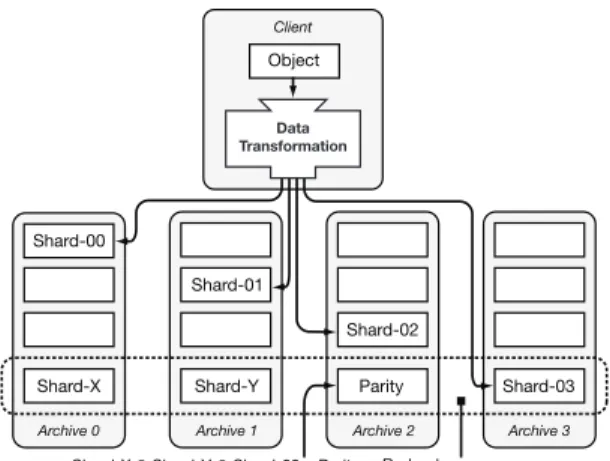
Figure 1: An overview of POTSHARDS showing the data transformation component producing shards from objects and distributing them to independent archives. The archives utilize distributed RAID algorithms to securely recover shards in the event of a failure.
been a concern for storage systems [17]. To address this issue, systems such as distributed RAID [30], Myr-iad [4] and OceanStore [25] use RAID-style algorithms or more general redundancy techniques including(m,n) error correcting codes along with geographic distribution to guard against individual site failure. Secure, long-term storage adds the requirement that the secrecy of the dis-tributed data must be ensured at all times, including dur-ing disaster recovery scenarios.
3 System Overview
POTSHARDS is structured as a client communicating with a number of independent archives. Though the archives are independent, they assist each other through distributed RAID techniques to protect the system from archive loss. POTSHARDS stores user data by first split-ting it into secure shards. These shards are then dis-tributed to a number of archives, where each archive exists within its own security domain. The read proce-dure is similar but reversed; a client requests shards from archives and reconstitutes the data.
Data is prepared for storage during ingestion by adata transformationcomponent that transformsobjectsinto a set of secure shards which are distributed to the archives, as shown in Figure 1; similarly, this component is also responsible for reconstituting objects from shards dur-ing extraction. The data transformation component runs on a system separate from the archives on which the shards reside, and can fulfill requests from either a sin-gle client or many clients, depending on the implementa-tion. This approach provides two benefits: the data never reaches an archive in an unsecured form; and multiple CPU-bound data transformation processes can generate shards in parallel for a single set of physical archives.
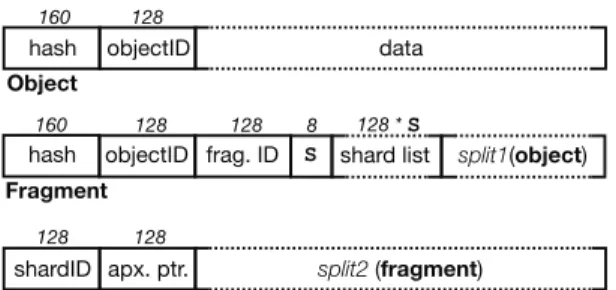
Figure 2:Data entities in POTSHARDS, with size (in bits) in-dicated above each field. Note that entities are not shown to scale relative to one another. is the number of shards that the fragment produces.split1is an XOR secret split andsplit2is a Shamir secret split in POTSHARDS.
The archives operate in a manner similar to financial banks in that they are relatively stable and they have a in-centive (financial or otherwise) to monitor and maintain the security of their contents. Additionally, the barrier to entry for a new archive should be relatively high (al-though POTSHARDS does takes precautions against a malicious insider); security is strengthened by distribut-ing shards amongst the archives, so it is important that each archive can demonstrate an ability to protect its data. Other benefits of archive independence include re-ducing the effectiveness of insider attacks and making it easier to exploit the benefits of geographic diversity in physical archive locations. For these reasons, a sin-gle entity, such as a multinational company, should still maintain multiple independent archives to gain these se-curity and reliability benefits.
3.1 Data Entities and Naming
There are three main data objects in POTSHARDS: ob-jects,fragmentsandshards. As Figure 1 shows, objects contain the data that users submit to the system at the top level. Fragments are used within the data transformation component during the production of shards, which are the pieces actually stored on the archives. The details of these data entities can be seen in Figure 2.
All data entities in the current implementation of POT-SHARDS are given unique 128-bit identifiers. The first 40 bits of the name uniquely identify the client in the same manner as a bank account is identified by an ac-count number. The remaining 88 bits are used to identify the data entity. The length of the identifier could be ex-tended relatively easily in future implementations. The names for entities that do not directly contribute to secu-rity within POTSHARDS, such as those for objects, can be generated in any way desired. However, the security and recovery time for a set of shards is directly related to the shards’ names; thus, shards’ IDs must be chosen with great care to ensure a proper density of names, providing sufficient security.
In addition to uniquely identifying data entities within the system, IDs play an important role in the secret ting algorithms used in POTSHARDS. For secret split-ting techniques that rely on linear interpolation [28], the reconstitution algorithm must know the original order of the secret shares. Knowing the order of the shards in a shard tuple can greatly reduce the time taken to recon-stitute the data by avoiding the need to try each permu-tation of share ordering. Currently, this ordering is done by ensuring that the numerical ordering of the shard IDs reflects the input order to the reconstitution algorithm.
3.2 Secrecy and Reliability Techniques
POTSHARDS utilizes three primary techniques in the creation and long-term storage of shards. First, se-cret splitting algorithms provide file secrecy without the need to periodically update the algorithm. This is due to the fact that perfect secret splitting is information-theoretically secure as opposed to only computationally secure. Second, approximate pointers between shards al-low objects to be recovered from only the shards them-selves. Thus, even if all indices over a user’s shards are lost, their data can be recovered in a reasonable amount of time. Third, secure, distributed RAID techniques across multiple independent archives allow data to be re-covered in the event of an archive failure without expos-ing the original data durexpos-ing archive reconstruction.POTSHARDS provides data secrecy through the use of secret splitting algorithms; thus, there is no need to maintain key history because POTSHARDS does not use traditional encryption keys.Additionally, POTSHARDS utilizes secret splitting in a way that does not combine the secrecy and redundancy parameters. Storage of the secret shares is also handled in a manner that dramat-ically reduces the effectiveness of insider attacks. By using secret splitting techniques, the secrecy in POT-SHARDS has a degree of future-proofing built into it—it can be proven that an adversary with infinite computa-tional power cannot gain any of the original data, even if an entire archive is compromised. While not strictly nec-essary, the introduction of a small amount of redundancy at the secret splitting layer allows POTSHARDS to han-dle transient archive unavailability by not requiring that a reader obtainallof the shards for an object; however, redundancy at this level is used primarily for short-term failures.
POTSHARDS provides approximate pointers to en-able the reasonably quick reconstitution of user data without any information that exists outside of the shards themselves. POTSHARDS users normally keep indexes allowing them to quickly locate the shards that they need to reconstitute a particular object, as described in Sec-tion 4.3, so normal shard retrieval consists of asking
Figure 3:Approximate pointers point to R “candidate” shards (R=4in this example) that might be next in a valid shard tuple. Shards0X make up a valid shard tuple. If an intruder mistak-enly picks shard21, he will not discover his error until he has retrieved sufficient shards and validation fails on the reassem-bled data.
archives for the specific shards that make up an object, and is relatively fast. Approximate pointers are used when these user indexes are lost or otherwise unavail-able. Since POTSHARDS can be used as a time capsule to secure data, it is foreseeable that a future user may be able to access the shards that they have a legal right to but have no idea how to combine them. The shards that can be combined together to reconstitute data form ashard tuple; an approximate pointer indicates the re-gion in the user’s private namespace where the next shard in the shard tuple exists, as shown in Figure 3. An ap-proximate pointer has the benefit of making emergency data regeneration tractable while still making it difficult for an adversary to launch a targeted attack. If exact pointers were used, an adversary would know exactly which shards to target to rebuild an object. On the other hand, keeping no pointer at all makes it intractable to combine the correct shards without outside knowledge of which shards to combine. With approximate pointers, an attacker with one shard would only know theregion where the next shard exists. Thus, a brute force attack re-questingeveryshard in the region would be quite notice-able because the POTSHARDS namespace is intention-ally kept sparse and an attack would result in requests for shards that do not exist. Unlike an index relating shards to objects that users would keep (and not store in the clear on an archive), an approximate pointer is part of the shard and is stored on the archive.
The archive layer in which the shards are stored con-sists of independent archives utilizing secure, distributed RAID techniques to provide reliability. As Figure 1 shows, archive-level redundancy is computed across sets ofunrelatedshards, so redundancy groups provide no in-sight into shard reassembly. POTSHARDS includes two novel modifications beyond the distributed redundancy explored earlier [4, 30]. The first is a secure reconstruc-tion procedure, described in Secreconstruc-tion 4.2.1, that allows a failed archive’s data to be regenerated in a manner that prevents archives from obtaining additional shards dur-ing the reconstruction; shards from the failed archive
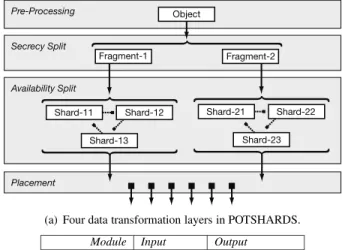
(a) Four data transformation layers in POTSHARDS.
Module Input Output
Pre-processing file object Secrecy split object set of fragments Availability split fragment set of shards
Placement set of shards msgs for archives (b) Inputs and outputs for each transformation layer. Figure 4:The transformation component consists of four lev-els. Approximate pointers are utilized at the second secret split. Note that locating one shard tuple provides no informa-tion about locating the shards from other tuples.
are rebuilt only at the new archive that is replacing it. Second, POTSHARDS uses algebraic signatures [27] to ensure intra-archive integrity as well as inter-archive in-tegrity. Algebraic signatures have the desirable property that the parity of a signature is the same as the signature of the parity, which can be used to prove the existence of data on other archives without revealing the data.
4 Implementation Details
This section details the components of POTSHARDS and how each contributes to providing long-term, secure storage. We first describe the transformation that POT-SHARDS performs to ensure data secrecy. Next, we de-tail the inter-archive techniques POTSHARDS uses to provide long-term reliability. We then describe index construction; the use of indices makes “normal” data re-trieval much simpler. Finally, we describe how we use approximate pointers to recover data with no additional information beyond the shards themselves, thus ensuring that POTSHARDS archives will be readable by future generations.
4.1 Data Transformation: Secrecy
Before being stored at the archive layer, user data trav-els through the data transformation component of POT-SHARDS. This component is made up of four layers as shown in Figure 4.
b-byte objects. Additionally, objects include a hash that is used to confirm correct reconstitution.
2.A secret splitting layer tuned for secrecytakes an object and produces a set of fragments.
3.A secret splitting layer tuned for availability takes a fragment and produces a tuple of shards. It is also at this layer that the approximate pointers between the shards are created.
4.The placement layer determines how to distribute the shards to the archives.
4.1.1 Secret Splitting Layers
Fragments are generated at the first level of secret split-ting, which is tuned for secrecy. Currently we use an XOR-based algorithm that producesnfragments from an object. To ensure security, the random data required for XOR splitting can be obtained through a physical process such as radio-active decay or thermal noise. As Figure 2 illustrates, fragments also contain metadata including a hash of the fragment’s data which can be used to confirm a successful reconstitution.
A tuple of shards is produced from a fragment us-ing another layer of secret splittus-ing. This second split is tuned for availability which allows reconstitution in the event that an archive is down or unavailable when a request is made. In this version of POTSHARDS, shards are generated from a fragment using an(m,n) se-cret splitting algorithm [24, 28]. As the Figure 2 shows, shards contain no information about the fragments that they make up.
The two levels of secret splitting provide three impor-tant security advantages. First, as Figure 4 illustrates, the two-levels of splitting can be viewed as a tree with an increased fan out compared to one level of splitting. Thus, even if an attacker is able to locate all of the mem-bers of a shard tuple they can only rebuild a fragment and they have no information to help them find shards for the other fragments. Second, it separates the secrecy and availability aspects of the system. With two levels of secret splitting we do not need to compromise one as-pect for the other. Third, it allows useful metadata to be stored with the fragments as this data will be kept secret by the second level of splitting. The details of shards and fragments are shown in Figure 2.
One cost of two-level secret splitting is that the over-all storage requirements for the system are increased. A two-way XOR split followed by a(2,3)secret split increases storage requirements by a factor of six; dis-tributed RAID further increases the overhead. If a user desires to offset this cost, data can be submitted in a com-pressed archival form [37]; comcom-pressed data is handled just like any other type of data.
4.1.2 Placement Layer
The placement layer determines which archive will store each shard. The decision takes into account which shards belong in the same tuple and ensures that no single archive is given enough shards to recover data.
This layer contributes to security in POTSHARDS in four ways. First, since it is part of the data transforma-tion component, no knowledge of which shards belong to an object need exist outside of the component. Second, the effectiveness of a insider attack at the archives is re-duced because no single archive contains enough shards to reconstitute any data. Third, the effectiveness of an ex-ternal attack is decreased because shards are distributed to multiple archives, each of which can exist in their own security domain. Fourth, the placement layer can take into account the geographic location of archives in order to maximize the availability of data.
4.2 Archive Design: Reliability
Storage in POTSHARDS is handled by a set of in-dependent archives that store shards, actively monitor their own security and actively question the security of the other archives. The archives do not know which shards form a tuple, nor do they have any information about fragments or object reconstitution. A compro-mised archive does not provide an adversary with enough shards to rebuild user data. Nor does it provide an adver-sary with enough information to know where to find the appropriate shards needed to rebuild user data. Absent such precautions, the archive model would likely weaken the strong security properties provided by the other sys-tem components.
Since POTSHARDS is designed for long-term stor-age, it is inevitable that disasters will occur and archive membership will change over time. To deal with the threat of data loss from these events, POTSHARDS uti-lizes distributed RAID techniques. This is accomplished by dividing each archive into fixed-sized blocks and re-quiring all archives to agree on distributed, RAID-based methods over these blocks. Each block on the archive holds either shards or redundancy data.
When shards arrive at an archive for storage, inges-tion occurs in three steps. First, a random block is cho-sen as the storage location of the shard. Next, the shard is placed in the last available slot in the the block. Fi-nally, the corresponding parity updates are sent to the proper archives. Each parity update contains the data stored in the block and the appropriate parity block lo-cation. The failure of any parity update will result in a roll-back of the parity updates and re-placement of the shard into another block. Although it is assumed that all of the archives are trusted, we are currently
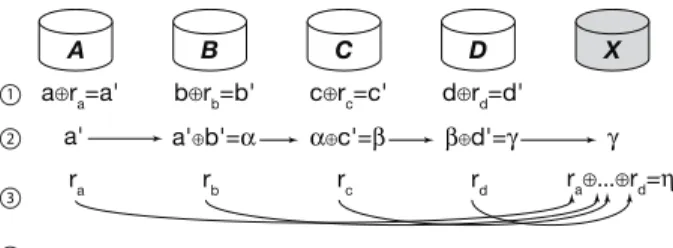
analyz-Figure 5: A single round of archive recovery in a RAID 5 redundancy group. Each round consists of multiple steps. Archive N contains data n and generates random blocks rn. ing the security effects of passing shard data between the archives during parity updates and exploring techniques for preventing archives from maliciously accumulating shards.
The distributed RAID techniques used in POT-SHARDS are based on those from existing systems [4, 30]. In such systems, cost-effective, fault-tolerant, dis-tributed storage is achieved by computing parity across unrelated data in wide area redundancy groups. Given an(n,k)erasure code, a redundancy group is an ordered set ofkdata blocks andn−kparity blocks where each block resides on one ofndistinct archives. The redun-dancy group can survive the loss of up ton−karchives with no data loss. The current implementation of POT-SHARDS has the ability to use Reed-Solomon codes or single parity to provide flexible and space-efficient re-dundancy across the archives.
POTSHARDS enhances the security of existing dis-tributed RAID techniques through two important ad-ditions. First, the risk of information leakage during archive recovery is greatly mitigated through secure re-construction techniques. Second, POTSHARDS utilizes algebraic signatures [27] to implement a secure protocol for both storage verification and data integrity checking. 4.2.1 Secure Archive Reconstruction
Reconstruction of data can pose a significant security risk because it can involve many archives and considerable amounts of data passing between archives. The secure recovery algorithm implemented within POTSHARDS exploits the independence of the archives participating in a redundancy group and the commutativity of evaluat-ing the parity. Our reconstruction algorithm permits each archive to independently reconstruct a block of failed data without revealing any information about its data. The commutativity of the reconstruction procedure re-sults in a reconstruction protocol that can occur in per-mutations, which greatly decreases the likelihood of suc-cessful collusion during archive recovery.
The recovery protocol begins with the confirmation of a partial or whole archive failure and, since each archive is a member of one or more redundancy groups,
pro-ceeds one redundancy group at a time. If a failure is confirmed, the archives in the system must agree on the destination of recovered data. A fail-over archive is cho-sen based on two criteria: the fail-over archive must not be a member of the redundancy group being recovered and it must have the capacity to store the recovered data. Due to these constraints multiple fail-over archives may be needed to perform reconstruction and redistribution. Future work will include ensuring that the choice of fail-over archives prevent any archive from acquiring enough shards to reconstruct user data.
Once the fail-over archive is selected, recovery occurs in multiple rounds. A single round of our secure recov-ery protocol over a single redundancy group is illustrated in Figure 5. In this example, the available members of a redundancy group collaborate to reconstruct the data from a failed archive onto a chosen archiveX. An archive (which cannot be the fail-over and cannot be one of the collaborating archives) is appointed to manage the pro-tocol by rebuilding one block at a time through multi-ple rounds of chained requests. A request contains an ordered list of archives, corresponding block identifiers and a data buffer and proceeds as follows at each archive in the chain:
1. Requestαinvolving local blocknarrives at archiveN. 2. The archive creates a random blockrnand computes
n⊕rn=n#.
3. The archive computesβ=α⊕n#and removes its entry
from the request
4. The archive sendsrndirectly to archiveX. 5. β is sent to the next archive in the list.
This continues at each archive until the chain ends at archiveX and the block is reconstructed. The commu-tativity of the rebuild process allows us to decrease the likelihood of data exposure by permuting the order of the chain in each round. This procedure is easily paral-lelized and continues until all of the failed blocks for the redundancy group are reconstructed. Additionally, this approach can be generalized to any linear erasure code; as long as the generator matrix for the code is known, the protocol remains unchanged.
4.2.2 Secure Integrity Checking
Preserving data integrity is a critical task in all long-term archives. POTSHARDS actively verifies the integrity of data using two different forms of integrity checking. The first technique requires each of the archives to periodi-cally check its data for integrity violations using a hash stored in the header of each block on disk. The sec-ond technique is a form of inter-archive integrity check-ing that utilizes algebraic signatures [27] across the re-dundancy groups. Algebraic signatures have the
prop-erty that the signatures of the parity equals the parity of the signatures. This property is used to verify that the archives in a given redundancy group are properly storing data and are performing the required internal checks [27].
Secure, inter-archive integrity checking is achieved through algebraic signature requests over a specific in-terval of data. A check begins when an archive asks the members of a redundancy group for an algebraic sig-nature over a specified interval of data. The algebraic signature forms a codeword in the erasure code used by the redundancy group and integrity over the interval of data is checked by comparing the parity of the data sig-natures to the signature of the parity. If the comparison check fails, then the archive(s) in violation may be found as long as the number of incorrect signatures is within the error-correction capability of the code. In general, a small signature (typically 4 bytes) is computed from a few megabytes of data. This results in very little infor-mation leakage. If necessary, restrictions may be placed on algebraic signature requests to ensure that no data is exposed during the integrity check process.
4.3 User Indexes
When shards are created, theexactnames of the shards are returned to the user along with their archive place-ment locations; however, these exact pointers are not stored in the shards themselves, so they are not avail-able to someone attacking the archives. Typically, a user maintains this information and the relationship between shards, fragments, objects, and files in an index to allow for fast retrieval. In the general case, the user consults her index and requests specific shards from the system. This index can, in turn, be stored within POTSHARDS, re-sulting in an index that can be rebuilt from a users shards with no outside information.
The index for each user can be stored in POTSHARDS as a linked list of index pages with new pages inserted at the head of the list, as shown in Figure 6. Since the index pages are designed to be stored within POTSHARDS, each page is immutable. When a user submits a file to the system, a list of mappings from the file to its shards is returned. This data is recorded in a new index page, along with a list of shards corresponding to the previous head of the index list. This new page is then submitted to the system and the shard list returned is maintained as the new head of the index list. These index root-shards can be maintained by the client application or even on a physical token, such as a flash drive or smart card.
This approach of each user maintaining their own pri-vate index has three advantages. First, since each user maintains his own index, the compromise of a user index does not affect the security of other users’ data. Second,
Figure 6: User index made up of two pages. One page was created at time t0and the other at time t1.
the index for one user can be recovered with no effect on other users. Third, the system does not know about the relationship between a user’s shards and their data.
In some ways, the index over a user’s shards can be compared to an encryption key because it contains the information needed to rebuild a user’s data. However, the user’s index is different from an encryption key in two important ways. First, the user’s index is not a sin-gle point of failure like an encryption key. If the index is lost or damaged, it can be recovered from the data without any input from the owner of the index. Second, full archive collusion can rebuild the index. If a user can prove a legal right to data, such as by a court subpoena, than the archives can provide all of the user’s shards and allow the reconstitution of the data. If the data was en-crypted, the files without the encryption key might not be accessible in a reasonable period of time.
4.4 Approximate Pointers and Recovery
Approximate pointers are used to relate shards in the same shard tuple to one another in a manner that al-lows recovery while still reducing an adversary’s ability to launch a targeted attack. Each shard has an approxi-mate pointer to the next shard in the fragment, with the last shard pointing back to the first and completing the cycle, as shown in Figure 3. This allows a user to recover data from their shards even if all other outside informa-tion, such as the index, is lost.
There are two ways that approximate pointers can be implemented: randomly picking a value within R/2 above or below the next shard’s identifier, or masking off the low-orderrbits (R=2r) of the next shard’s identi-fier, hiding the true value. Currently, POTSHARDS uses the latter approach; we are investigating the tradeoffs be-tween the two approaches. One benefit to using theR/2 approach is that it allows a finer-grained level of adjust-ment compared to the relatively coarse-grained bitmask approach.
The use of approximate pointers provides a great deal of security by preventing an intruder who compromises an archive or an inside attacker from knowing exactly which shards to steal from other archives. An intruder would have to steal all of the shards an approximate pointer could refer to, and would have to steal all of the shards they refer to, and so on. All of this would have to bypass the authentication mechanisms of each archive, and archives would be able to identify the access pattern of a thief, who would be attempting to obtains shards that
may not exist. Since partially reconstituted fragments cannot be verified, the intruder might have to stealall of the potential shards to ensure that he was able to re-constitute the fragment. For example, if an approximate pointer points toRshards and a fragment is split using (m,n)secret splitting, an intruder would have to steal, on average,Rm−1/2 shards to decode the fragment.
In contrast to a malicious user, a legitimate user with access to all of his shards can easily rebuild the fragments and, from them, the objects and files they comprise. Sup-pose this user created shards from fragments using an (m,n)secret splitting algorithm. A user would start by obtaining all of her shards which, in the case of recover-ies, might require additional authentication steps. Once she obtains all of her shards from the archives, there are two approaches to regenerating those fragments. First, she could try every possible chain of lengthm, rebuild-ing the fragment and attemptrebuild-ing to verify it. Second, she could narrow the list of possible chains by only at-tempting to verify chains of length n that represented cycles, an approach we call thering heuristic. As Fig-ure 2 illustrates, fragments include a hash that is used to confirm successful reconstitution. Fragments also in-clude the identifier for the object from which they are de-rived, making the combination of fragments into objects a straightforward process.
Because the Shamir secret splitting algorithm is com-putationally expensive, even when combining shards that do not generate valid fragments, we use the ring heuris-tic to reduce the number of failed reconstitution attempts in two ways. First, the number of cycles of lengthnis lower than the number of paths of lengthmsince many paths of lengthn do not make cycles. Second, recon-stitution using the Shamir secret splitting algorithm re-quires that the shares be properly ordered and positioned within the share list. Though the shard ID provides a natural ordering for shards, it does not assist with posi-tioning. For example, suppose the shards were produced with a 3 of 5 split. A chain of three shards,"s1,s2,s3#, would potentially need to be submitted to the secret split-ting algorithm three times to test each possible order: "s1,s2,s3,φ,φ#,"φ,s1,s2,s3,φ#, and"φ,φ,s1,s2,s3#.
5 Experimental Evaluation
Our experiments using the current implementation of POTSHARDS were designed to measure several things. First, we wanted to evaluate the performance of the sys-tem and identify any bottlenecks. Next, we compared the behavior of the system in an environment with heavy contention for processing and network resources against that in a dedicated, lightly loaded environment. Finally, we evaluated POTSHARDS’ ability to recover from the loss of an archive as well as the loss of a user index.
During our experiments, the data transformation com-ponent was run from the client’s system using object sizes of 750 KB. The first layer of secret splitting used an XOR based algorithm and produced two fragments per object, and the second layer utilized a(2,3)Shamir threshold scheme. The workloads contained a mixture of PDF, Postscript files, and images. These files are representative of the content that a long-term archive might contain, although it is important to note that POT-SHARDS sees all objects as the same regardless the ob-jects’ origin or content. File sizes ranged from about half a megabyte to several megabytes in size; thus, most were ingested and extracted as multiple objects.
For the local experiments, all systems were located on the same 1 Gbps network with little outside contention for computing or network resources. The client com-puters were equipped with two 2.74 GHz Pentium 4 pro-cessors, 2 GB of RAM and Linux version 2.6.9-22.01.1. Each of the sixteen archives were equipped with two 2.74 GHz Pentium 4 processors, 3 GB of RAM, 7.3 GB of available local hard drive space and Linux version 2.6.9-34. In contrast to the local experiments, the global-scale experiments were conducted using PlanetLab [21], resulting in considerable contention for shared resources. For these experiments, both the clients and archives were run in a slice that contained twelve PlanetLab nodes (eight archives and four clients) distributed across the globe.
The POTSHARDS prototype system itself consists of roughly 15,000 lines of Java 5.0 code. Communications between layers used Java sockets over standard TCP/IP, and the archives used Sleepycat Software’s BerkeleyDB version 3.0 for persistent storage of shards.
5.1 Read and Write Performance
Our first set of experiments evaluated the performance of ingestion and extraction on a dedicated set of systems and on PlanetLab. Table 2 profiles the ingestion and ex-traction of one block of data. comparing the time taken on an unloaded local cluster of machines and the heavily loaded, global scale PlanetLab. In addition to the time, the table details the number of messages exchanged dur-ing the request.
As Table 2 shows, most of the time on the local cluster is spent in the transformation layer. This is to be expected as Shamir secret-splitting algorithm is compute-intensive. While slower than many encryp-tion algorithms, such secret-splitting algorithms do not suffer from the problems discussed earlier with long-term encryption and are fast enough for archival storage. The compute-intensive nature of secret-splitting is fur-ther highlighted in the local experiments due to the local cluster’s dedicated network with almost no outside
cross-Ingestion Profile Cluster PlanetLab Secret Splitting time (ms) 1509 2276
Layers msgs in 1 1 Request msgs out 1 1 Placement time (ms) 37 30606 Layer msgs in 1 1 Request msgs out 6 6 Archive time (ms) 67 39109 Layer msgs in 6 6 Request msgs out 6 6
Response Trip time (ms) 88 54271 Total Round Trip time (ms) 1731 95952 Extraction Profile Cluster PlanetLab Request Trip time (ms) 28 6493
Shard time (ms) 832 29666
Acquisition msgs 34 34
Transformation time (ms) 1009 1698
Layer msgs in 1 1
Response msgs out 1 1
Total Round Trip time (ms) 1843 31410
Table 2:Profile of the ingestion and extraction of one object, comparing trials run on a lightly-loaded local cluster with the global-scale PlanetLab. Results are the average of 3 runs of 36 blocks per run using a(2,2)XOR split to generate fragments and a(2,3)Shamir split to generate shards.
traffic. The transformation time for ingestion is greater than for extraction for two reasons. First, during inges-tion, the transformation must generate many random val-ues. Second, during extraction, the transformation layer performs linear interpolation using only those shards that are necessary. That is, given an(m,n)secret split, alln are retrieved but calculation is only done on the firstm shards; the minimum required to rebuild the data. Dur-ing extraction, the speed improvements in the transfor-mation layer are balanced by the time required to collect the requested shards from the archive layer.
In a congested, heavily loaded system, the time to move data through the system begins to dominate the transformation time as the PlanetLab performance fig-ures in Table 2 show. This is evident in the comparable times spent in the transformation layers in the two envi-ronments contrasted with the very divergent times spent on requests and responses in the two environments. For example, the extraction request trip took only 28 ms on the local cluster but required about 6.5 seconds on the PlanetLab trials. Since request messages are quite small, the difference is even more dramatic in the shard acqui-sition times for extraction. Here, moving the shards from the archives to the transformation layer took only 832 ms on the local cluster but over 29.5 seconds on PlanetLab.
The measurements per object represent two distinct scenarios. The cluster numbers are from a lightly-loaded,
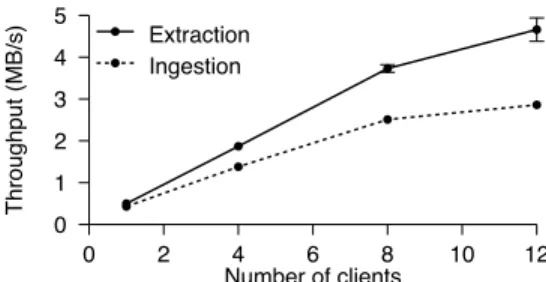
Number of clients 0 2 4 6 8 10 12 Th ro ug hp ut (M B/ s) 0 1 2 3 4 5 Extraction Ingestion
Figure 7:System throughput with sixteen archives and a work-load of 100 MB per client using the same system parameters as in Table 2.
well-equipped and homogeneous network with unsatu-rated communication channels. In contrast, the Planet-Lab numbers feature far more congestion and resource demands as POTSHARDS contended with other pro-cesses for both host and network facilities. However, in archival storage, latency is not as important as through-put. Thus, while these times are not adequate for low-latency applications, they are acceptable for archival storage.
The results from local tests show a per client through-put of 0.50 MB/s extraction and 0.43 MB/s ingestion— per-client performance is largely limited by the current design of the data transformation layer. In the current version, both XOR splitting and linear interpolation split-ting is performed in a Java-based implementation; fu-ture versions will use GF(216) arithmetic in an opti-mized C based library. Additionally, clients currently submit objects to the data transformation component and synchronously await a response from the system before submitting the next object. In contrast, the remainder of the system is highly asynchronous. The high level of parallelism in the lower layer is demonstrated in the throughput as the number of clients increases. As Fig-ure 7 shows, the read and write throughput scales as the number of clients increases. With a low number of clients, much of the system’s time is spent waiting for a request from the secret splitting layers. As the num-ber of clients increases, however, the system is able to take advantage of the increased aggregate requests of the clients to achieve system throughput of 4.66 MB/s for ex-traction and 2.86 MB/s for ingestion. Write performance is further improved through the use of asynchronous par-ity updates. While an ingestion response waits for the archive to write the data before being sent, it does not need to wait for the parity updates.
An additional factor to consider in measuring through-put is the storage blow-up introduced by the two levels of secret splitting. Using parameters of(2,2)XOR splitting and(2,3)shard splitting requires six bytes to be stored for every byte of user data. In our experiments, system throughput is measured from the client perspective even though demands inside the system are six times those
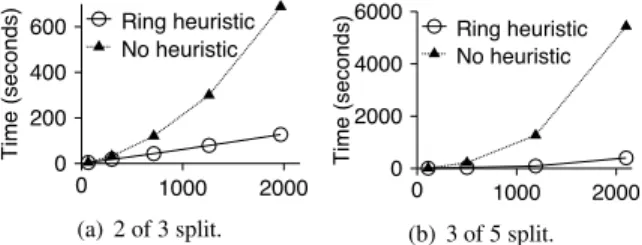
0 1000 2000 Ti m e (s ec on ds ) 0 200 400 600 Ring heuristic No heuristic (a) 2 of 3 split. 0 1000 2000 Ti m e (s ec on ds ) 0 2000 4000 6000 Ring heuristic No heuristic (b) 3 of 5 split. Figure 8:Brute force recovery time for an increasing number of shards generated using different secret splitting parameters.
Name Space Shards False Rings Time
16 bits 4190 24451 6715 sec
32 bits 4190 0 225 sec
Table 3: Recovery time in a name space with 5447 allocated names for two different name space sizes. For larger sys-tems, this time increases approximately linearly with system size; name density and secret splitting parameters determine the slope of the line.
seen by the client. Nonetheless, one goal for future work is to improve system throughput by implementing asyn-chronous communication in the client.
5.2 User Data Recovery
In the event that the index over a user’s shards is lost or damaged, user data, including the index, if it was stored in POTSHARDS, can be recovered from the shards themselves. To begin the procedure, the user authenti-cates herself to each of the individual archives and ob-tains all of her shards. The user then applies the algo-rithm described in Section 4.4 to rebuild the fragments and the objects that make up her data.
We ran experiments to measure the speed of the covery process for both algorithm options. While the re-covery process is not fast enough to use as the sole ex-traction method, it is fast enough for use as a recovery tool. Figure 8 shows the recovery times for two different secret splitting parameters. Using the ring heuristic pro-vides a near-linear recovery time as the number of shards increases, and is much faster than the na¨ıve approach. In contrast, recovery without using the ring heuristic re-sults in an exponential growth. This is very apparent in Figure 8(b), which must potentially try each path three times. The ring heuristic provides an additional layer of security because a user that can properly authenticate to all of the archives and acquire all of their shards can re-cover their data very quickly. In contrast, an intruder that cannot acquire all of the needed shards must search in exponential time.
The density of the name space has a large effect on the time required to recover the shards. As shown in Table 3, a sparse name space results in fewer false shard rings (none in this experiment) and is almost 30 times faster
than a densely packed name space. An area of future re-search is to design name allocation policies that balance the recovery times with the security of the shards. One simple option would be to utilize a sliding window into the name space from which names are drawn. As the cur-rent window becomes saturated it moves within the name space. This would ensure adequate density for both new names and existing names.
5.3 Archive Reconstruction
The archive recovery mechanisms were run on our lo-cal system using eight 1.5 GB archives. Each redun-dancy group in the experiment contained eight archives encoded using RAID 5. A 25 MB client workload was ingested into the system using(2,2)XOR splitting and
(2,3) Shamir splitting, resulting in 150 MB of client shards, excluding the appropriate parity. After the work-load was ingested, an archive was failed. We then used a static recovery manager that sent reconstruction requests to all of the available archives and waited for successful responses from a fail-over archive. Once the procedure completed, the contents of the failed archive and the re-constructed archive were compared. This procedure was run three times, recovering at 14.5 MB/s, with the veri-fication proving successful on each trial. The procedure was also run with faults injected into the recovery pro-cess to ensure that the verification propro-cess was correct.
6 Discussion
While we have designed and implemented an infrastruc-ture that supports secure long-term archival storage with-out the use of encryption, there are still some with-outstanding issues. POTSHARDS assumes that individual archives are relatively reliable; however, automated maintenance of large-scale archival storage remains challenging [3]. We plan to explore the construction of archives from au-tonomous power-managed disk arrays as an alternative to tape [8]. The goal would be devices that can distribute and replicate storage amongst themselves, reducing the level of human intervention to replacing disks when suf-ficiently many have failed.
A secure, archival system must deal with the often conflicting requirements of maintaining the secrecy of data while also providing a degree of redundancy. To this end, further work will explore the contention between these two demands in such areas as parity building. In future versions, we hope to improve the security of parity updates in which sensitive data must be passed between archives.
Currently, POTSHARDS depends on strong authenti-cation and intrusion detection to keep data safe, but it is not clear how to defend against intrusions that may occur
over many years, even if such attacks are detected. We are exploring approaches that can refactor the data [35] so that partial progress in an intrusion can be erased by making new shards “incompatible” with old shards. Un-like the failure of an encryption algorithm, which would necessitate wholesale re-encryption, refactoring for se-curity could be done over time to limit the window over which a slow attack could succeed. Refactoring could also be applicable to secure migration of data to new stor-age devices.
We have introduced the approximate pointer mecha-nism as a means of making data recovery more tractable while maintaining security. While we believe they are useful in this capacity, we admit that there is more work to be done in understanding their nature. Specifically, we plan on exploring the relationship between the ID names-pace and approximate pointer parameters.
We would also like to reduce the storage overhead in POTSHARDS, and are considering several approaches to do so. Some information dispersal algorithms may have lower overheads than Shamir secret splitting; we plan to explore their use, assuming that they maintain the information-theoretic security provided by our cur-rent algorithm.
The research in POTSHARDS is only concerned with preserving the bits that make up files; understanding the bits is an orthogonal problem that must also be solved. Others have begun to address this problem [9], but main-taining the semantic meanings of bits over decades-long periods may prove to be an even more difficult problem than securely maintaining the bits themselves.
7 Conclusions
This paper introduced POTSHARDS, a system designed to provide secure long-term archival storage to address the new challenges and new security threats posed by archives that must securely preserve data for decades or longer.
In developing POTSHARDS, we made several key contributions to secure long-term data archival. First, we use multiple layers of secret splitting, approximate point-ers, and archives located in independent authorization domains to ensure secrecy, shifting security of long-lived data away from a reliance on encryption. The combina-tion of secret splitting and approximate pointers forces an attacker to steal an exponential number of shares in or-der to reconstitute a single fragment of user data; because he does not know which particular shares are needed, he must obtainallof the possibly-required shares. Second, we demonstrated that a user’s data can be rebuilt in a relatively short time from the stored sharesonlyif suffi-ciently many pieces can be acquired. Even a sizable (but incomplete) fraction of the stored pieces from a subset of
the archives will not leak information, ensuring that data stored in POTSHARDS will remain secret. Third, we made intrusion detection easier by dramatically increas-ing the amount of information that an attacker would have to steal and requiring a relatively unusual access pattern to mount the attack. Fourth, we ensure long-term data integrity through the use of RAID algorithms across multiple archives, allowing POTSHARDS to utilize het-erogeneous storage systems with the ability to recover from failed or defunct archives and a facility to migrate data to newer storage devices.
Our experiments show that the current prototype im-plementation can store user data at nearly 3 MB/s and retrieve user data at 5 MB/s. Since POTSHARDS is an archival storage system, throughput is more of a concern than latency, and these throughputs exceed typical long-term data creation rates for most environments. Since the storage process is parallelizable, additional clients in-crease throughput until the archives’ maximum through-put is reached; similarly, additional archives linearly in-crease maximum system throughput.
By addressing the long-term threats to archival data while providing reasonable performance, POTSHARDS provides reliable data protection specifically designed for the unique challenges of secure archival storage. Storing data in POTSHARDS ensures not only that it will remain available for decades to come, but also that it will remain secure and can be recovered by authorized users even if all indexing is lost.
Acknowledgments
We would like to thank our colleagues in the Storage Systems Research Center (SSRC) who provided valu-able feedback on the ideas in this paper. This research was supported by the Petascale Data Storage Institute, UCSC/LANL Institute for Scalable Scientific Data Man-agement and by SSRC sponsors including Los Alamos National Lab, Livermore National Lab, Sandia National Lab, Digisense, Hewlett-Packard Laboratories, IBM Re-search, Intel, LSI Logic, Microsoft ReRe-search, Network Appliance, Seagate, Symantec, and Yahoo.
References
[1] Health Information Portability and Accountability act, Oct. 1996. [2] ADYA, A., BOLOSKY, W. J., CASTRO, M., CHAIKEN, R.,
CERMAK, G., DOUCEUR, J. R., HOWELL, J., LORCH, J. R., THEIMER, M.,ANDWATTENHOFER, R. FARSITE: Federated, available, and reliable storage for an incompletely trusted envi-ronment. InProceedings of the 5th Symposium on Operating
Systems Design and Implementation (OSDI)(Boston, MA, Dec.
2002), USENIX.
[3] BAKER, M., SHAH, M., ROSENTHAL, D. S. H., ROUSSOPOU
look at the reliability of long-term digital storage. InProceedings
of EuroSys 2006(Apr. 2006), pp. 221–234.
[4] CHANG, F., JI, M., LEUNG, S.-T. A., MACCORMICK, J., PERL, S. E.,ANDZHANG, L. Myriad: Cost-effective disas-ter tolerance. InProceedings of the 2002 Conference on File and
Storage Technologies (FAST)(San Francisco, CA, Jan. 2002).
[5] CHOI, S. J., YOUN, H. Y.,ANDLEE, B. K. An efficient dis-persal and encryption scheme for secure distributed information storage. Lecture Notes in Computer Science 2660(Jan. 2003), 958–967.
[6] CLARKE, I., SANDBERG, O., WILEY, B.,ANDHONG, T. W. Freenet: A distributed anonymous information storage and re-trieval system. Lecture Notes in Computer Science 2009(2001), 46+.
[7] CLEVERSAFE. Highly secure, highly reliable, open source stor-age solution. Available from http://www.cleversafe.org/, June 2006.
[8] COLARELLI, D.,ANDGRUNWALD, D. Massive arrays of idle disks for storage archives. InProceedings of the 2002 ACM/IEEE
Conference on Supercomputing (SC ’02)(Nov. 2002).
[9] GLADNEY, H. M.,ANDLORIE, R. A. Trustworthy 100-year digital objects: Durable encoding for when it’s too late to ask.
ACM Transactions on Information Systems 23, 3 (July 2005),
299–324.
[10] GOLDBERG, A. V.,ANDYIANILOS, P. N. Towards an archival intermemory. InAdvances in Digital Libraries ADL’98(April 1998), pp. 1–9.
[11] GOODSON, G. R., WYLIE, J. J., GANGER, G. R.,ANDRE
-ITER, M. K. Efficient Byzantine-tolerant erasure-coded storage.
InProceedings of the 2004 Int’l Conference on Dependable
Sys-tems and Networking (DSN 2004)(June 2004).
[12] GUNAWI, H. S., AGRAWAL, N., ARPACI-DUSSEAU, A. C., ARPACI-DUSSEAU, R. H.,ANDSCHINDLER, J.
Deconstruct-ing commodity storage clusters. InProceedings of the 32nd Int’l
Symposium on Computer Architecture(June 2005), pp. 60–71.
[13] HAEBERLEN, A., MISLOVE, A.,ANDDRUSCHEL, P. Glacier: Highly durable, decentralized storage despite massive correlated failures. InProceedings of the 2nd Symposium on Networked
Systems Design and Implementation (NSDI)(May 2005).
[14] HAND, S.,ANDROSCOE, T. Mnemosyne: Peer-to-peer
stegano-graphic storage.Lecture Notes in Computer Science 2429(2002), 130–140.
[15] IYENGAR, A., CAHN, R., GARAY, J. A.,ANDJUTLA, C. De-sign and implementation of a secure distributed data repository.
InProceedings of the 14th IFIP International Information
Secu-rity Conference (SEC ’98)(Sept. 1998), pp. 123–135.
[16] KALLAHALLA, M., RIEDEL, E., SWAMINATHAN, R., WANG,
Q.,ANDFU, K. Plutus: scalable secure file sharing on untrusted storage. InProceedings of the Second USENIX Conference on
File and Storage Technologies (FAST)(San Francisco, CA, Mar.
2003), USENIX, pp. 29–42.
[17] KEETON, K., SANTOS, C., BEYER, D., CHASE, J., AND
WILKES, J. Designing for disasters. InProceedings of the Third USENIX Conference on File and Storage Technologies (FAST)
(San Francisco, CA, Apr. 2004).
[18] MANIATIS, P., ROUSSOPOULOS, M., GIULI, T. J., ROSEN
-THAL, D. S. H.,ANDBAKER, M. The LOCKSS peer-to-peer digital preservation system.ACM Transactions on Computer
Sys-tems 23, 1 (2005), 2–50.
[19] MILLER, E. L., LONG, D. D. E., FREEMAN, W. E., AND
REED, B. C. Strong security for network-attached storage. In
Proceedings of the 2002 Conference on File and Storage
Tech-nologies (FAST)(Monterey, CA, Jan. 2002), pp. 1–13.
[20] OXLEY, M. G. (H.R.3763) Sarbanes-Oxley Act of 2002, Feb. 2002.
[21] PETERSON, L., MUIR, S., ROSCOE, T.,ANDKLINGAMAN, A. PlanetLab Architecture: An Overview. Tech. Rep. PDN–06–031, PlanetLab Consortium, May 2006.
[22] PLANK, J. S. A tutorial on Reed-Solomon coding for
fault-tolerance in RAID-like systems.Software—Practice and
Experi-ence (SPE) 27, 9 (Sept. 1997), 995–1012. Correction in James S.
Plank and Ying Ding, Technical Report UT-CS-03-504, U Ten-nessee, 2003.
[23] QUINLAN, S.,ANDDORWARD, S. Venti: A new approach to archival storage. InProceedings of the 2002 Conference on File
and Storage Technologies (FAST)(Monterey, California, USA,
2002), USENIX, pp. 89–101.
[24] RABIN, M. O. Efficient dispersal of information for security, load balancing, and fault tolerance. Journal of the ACM 36
(1989), 335–348.
[25] RHEA, S., EATON, P., GEELS, D., WEATHERSPOON, H.,
ZHAO, B.,ANDKUBIATOWICZ, J. Pond: the OceanStore proto-type. InProceedings of the Second USENIX Conference on File
and Storage Technologies (FAST)(Mar. 2003), pp. 1–14.
[26] SANTRY, D. S., FEELEY, M. J., HUTCHINSON, N. C., VEITCH, A. C., CARTON, R. W.,ANDOFIR, J. Deciding when to forget in the Elephant file system. InProceedings of the 17th ACM
Symposium on Operating Systems Principles (SOSP ’99)(Dec.
1999), pp. 110–123.
[27] SCHWARZ, S. J., T.,ANDMILLER, E. L. Store, forget, and check: Using algebraic signatures to check remotely adminis-tered storage. InProceedings of the 26th International
Confer-ence on Distributed Computing Systems (ICDCS ’06)(Lisboa,
Portugal, July 2006), IEEE.
[28] SHAMIR, A. How to share a secret.Communications of the ACM 22, 11 (Nov. 1979), 612–613.
[29] STINSON, D. R. Cryptography Theory and Practice, 2nd ed. Chapman & Hall/CRC, Boca Raton, FL, 2002.
[30] STONEBRAKER, M.,ANDSCHLOSS, G. A. Distributed RAID— a new multiple copy algorithm. InProceedings of the 6th
Interna-tional Conference on Data Engineering (ICDE ’90)(Feb. 1990),
pp. 430–437.
[31] STORER, M., GREENAN, K., MILLER, E. L., AND
MALTZAHN, C. POTSHARDS: Storing data for the long-term without encryption. InProceedings of the 3rd International IEEE
Security in Storage Workshop(Dec. 2005).
[32] STORER, M. W., GREENAN, K. M.,ANDMILLER, E. L. Long-term threats to secure archives. InProceedings of the 2006 ACM
Workshop on Storage Security and Survivability(Oct. 2006).
[33] SUBBIAH, A.,ANDBLOUGH, D. M. An approach for fault toler-ant and secure data storage in collaborative work environements.
InProceedings of the 2005 ACM Workshop on Storage Security
and Survivability(Fairfax, VA, Nov. 2005), pp. 84–93.
[34] WALDMAN, M., RUBIN, A. D.,AND CRANOR, L. F. Pub-lius: A robust, tamper-evident, censorship-resistant web publish-ing system. InProceedings of the 9th USENIX Security Sympo-sium(Aug. 2000).
[35] WONG, T. M., WANG, C.,ANDWING, J. M. Verifiable secret redistribution for threshold sharing schemes. Tech. Rep. CMU-CS-02-114-R, Carnegie Mellon University, Oct. 2002.
[36] WYLIE, J. J., BIGRIGG, M. W., STRUNK, J. D., GANGER, G. R., KILIC¸C¸ ¨OTE, H.,ANDKHOSLA, P. K. Survivable storage
systems.IEEE Computer(Aug. 2000), 61–68.
[37] YOU, L. L., POLLACK, K. T., ANDLONG, D. D. E. Deep Store: An archival storage system architecture. InProceedings of the 21st International Conference on Data Engineering (ICDE ’05)(Tokyo, Japan, Apr. 2005), IEEE.