Security Target for Cisco IOS IPSEC on the
Integrated Services Routers, VPN Services
Module (VPNSM), and IPSec VPN Shared Port
Adapter (SPA), Including VLAN Separation
Reference: ST May 2008 Version: 1.0
Table of Contents
Table of Contents 1
Conventions 3
Terminology 3
Introduction 6
Identification 6
Security Target Overview 6
CC Conformance Claim 7
TOE Description 7
Product Type 7
Routers 8
VPNSM / IPSec VPN SPA 9
Scope and Boundaries 9
Physical 9
Logical 11
Secure Usage Assumptions 13
Threats to Security 14
Threats Addressed by the TOE 14
Organizational Security Policies 14
Security Objectives 16
Security Objectives for the TOE 16
Security Objectives for the Environment 16
IT Security Requirements 17
TOE Security Functional Requirements 17
Security Requirements for the IT Environment 26
TOE Security Assurance Requirements 26
TOE Summary Specification 27
IT Security Functions 27
IPSec Implementation 27
Packet Filtering 30
VLAN Management 30
Configuration and Management 31
Key Management 32
Remote Management 32
Self Protection 33
Assurance Measures 36
PP Claims 38
Rationale 38
Security Objectives Rationale 38
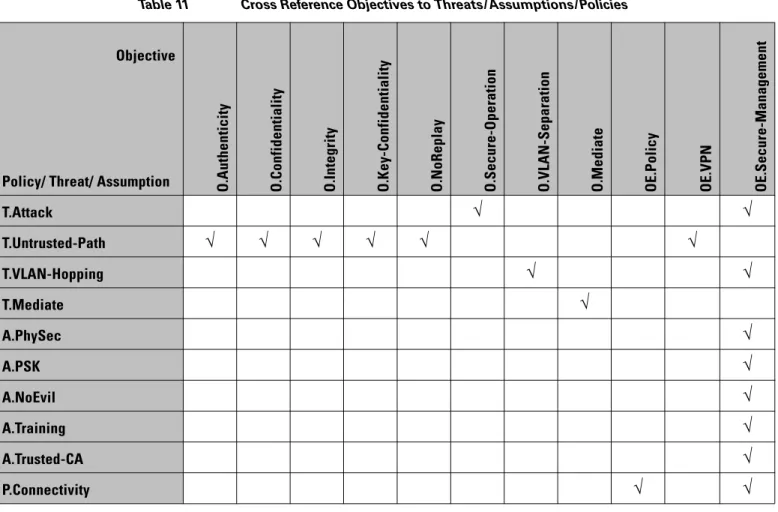
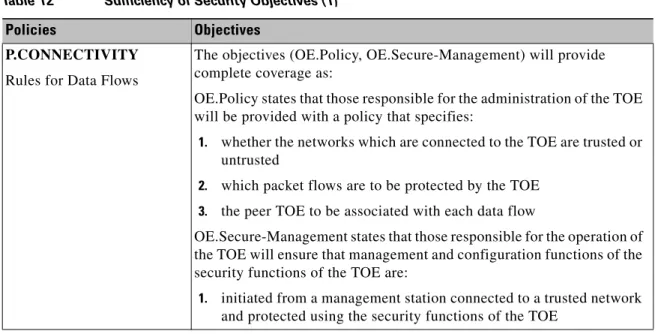
All Assumptions, Policies and Threats Addressed 39
Sufficiency of Security Objectives 39
Security Requirements Rationale 42
Functional Security Requirements Rationale 43
Assurance Security Requirements Rationale 49
Mutually Supportive Security Requirements 49
Strength of Function Claims 51
Rationale for Security Functional Requirements of the IT Environment 52
Rationale for Explicitly Stated SFRs for the TOE 52
TOE Summary Specification Rationale 52
Suitability of TOE Security Functions to Meet Security Requirements 52
Appendix A - IPSec Operation 59
IPSec Standards 59
IPSec Security Associations 60
IPSec Operation 61
Conventions
Appendix B - FIPS Conformance 62
Appendix C - Ports, Interfaces, and Modules in the TOE 64
Security Relevance of Ports / Interfaces / Modules 64
Cisco 1841 65
Cisco 2800 65
Cisco 3800 67
Cisco 7200 and 7300 70
Cisco 7600 and Cisco Catalyst 6500 72
Cisco Catalyst 6500 and Cisco 7600 Modules Specifically Excluded from the TOE 74
Appendix D - ACL Options 75
Obtaining Documentation, Obtaining Support, and Security Guidelines 77
Conventions
The notation, formatting and conventions used in this Security Target are consistent with those used in Version 2.2 of the Common Criteria (CC). Selected presentation choices are discussed here to aid the Security Target reader. The CC allows several operations to be performed on functional requirements;
refinement, selection, assignment and iteration are defined in Section 2.1.4 of Part 2 of the CC.
• Refinements are indicated by bold text and strikethrough
• Selections are enclosed in [square brackets]
• Assignments are enclosed in [square brackets and underlined]
• Iterations are numbered in sequence as appropriate.
Terminology
In the Common Criteria, many terms are defined in Section 2.3 of Part 1. A subset of those definitions is included in the list below with supplemental definitions that are exclusive to Cisco products. They are listed here to aid the reader of the Security Target.
Acronym Expansion or Definition
CC Common Criteria
EAL Evaluation Assurance Level OSP Organizational Security Policy
PP Protection Profile
SAR Security Assurance Requirement
SF Security Function
SFP Security Function Policy
SFR Security Functional Requirement SOF Strength of Function
The following terminology specific to the TOE and its environment is also provided to aid the user of the Security Target.
ST Security Target
TOE Target of Evaluation TSC TSF Scope of Control TSF TOE Security Functions TSFI TSF Interface TSP TOE Security Policy
TSS TOE Summary Specification TTP Trusted Third Party
Acronym Expansion or Definition
Word Definition
Assets Data transmitted over a network
AH Authentication Header, a security protocol that provides authentication. AH is embedded in the data to be protected (a full datagram).
Crypto access control list
Crypto access control lists are used to define which IP traffic is protected by crypto and which traffic is not protected by crypto. (These access lists are
not
the same as regular access control lists (ACL), which determine what traffic to forward or block at an interface.)DMVPN Dynamic Multipoint VPN. The DMVPN feature combines generic routing encapsulation (GRE) tunnels, IPSec encryption, and next hop resolution protocol (NHRP) routing to provide administrators an ease of configuration via crypto profiles, which override the requirement for defining static crypto maps, and dynamic discovery of tunnel endpoints.
End System A client or server system with an IP address
ESP Encapsulating Security Payload. A security protocol that provides data
confidentiality services and optional authentication and replay-detection services. ESP encapsulates the data to be protected.
Extranet The interconnection of two or more intranets interconnected with an untrusted network using internetworking devices compliant with the TOE to protect packet flows between the intranets.
IKE Internet Key Exchange, which negotiates the security association between two entities and exchanges key material
Internetworking Device
A device that interconnects two or more network segments and forwards IP traffic between the end systems connected to the attached network segments (e.g.. a router or firewall).
Intranet An organization’s internal network, constructed from trusted networks (typically LAN’s) interconnected with untrusted networks or network segments using internetworking devices
Conventions
The following abbreviations are used when referring to Cisco routers.
MD5 Message Digest 5, a one-way hash that combines a shared secret and the message (the header and payload), to produce a 128-bit value. The recipient of the message runs the same hash of the message and compares it with the inserted hash value to yield the same result, indicating that nothing in the packet has been changed in transit.
Network A single network segment or two or more network segments interconnected by internetworking devices
Network Segment
A single physical segment to which end systems are connected
Packet Flow A unicast flow of IP packets identified by some combination of source/destination IP address, source/destination TCP/UDP port number, TOS field and input interface
SA Security Association
SHA-1 Secure Hash Algorithm 1, similar to MD5, but produces a 160-bit hash value. Takes longer to calculate than MD5, but provides less chance of collision. SPA Shared Port Adapter
Replay Attack An attempt by an eavesdropper to capture some portion of a transmission and retransmit it at a later time to gain authorized access to the receiver or to spoof the security functions of the receiver.
User A human that interacts with the TOE to configure and operate the TOE, i.e. an administrator. End users (clients) do not interact with the TOE.
VLAN Virtual Local Area Network VPN Virtual Private Network
Word Definition
Acronym Expansion or Definition
AIM Advanced Interface Module (an internal plug-in hardware accelerator) E Ethernet
PA Port Adapter (a large, high performance, modular network interface) VAM VPN Accelerator Module (a hardware accelerator in port adapter format)
Introduction
Identification
Title Security Target for IOS IPSEC on the Integrated Services Routers, VPN Services Module (VPNSM) and IPSec VPN Shared Port Adapter (SPA), Including VLAN Separation
Version 1-0
Authors Cisco Systems, Inc.
Last Updated May 2008
CC Version Common Criteria for Information Technology Security Evaluation, Version 2.3, August 2005. No NIAP or CCIMB interpretations are applicable to the ST as of August 8, 2005. This ST uses the CCEVS Precedents PD-0108 to correctly specify remote
administration.
Keywords: IPSec, VLAN
TOE Software Identification: The following Cisco IOS releases: Cisco IOS 12.4(11)T3
Cisco IOS 12.2(18)SXF10
TOE Hardware Identification: The following hardware platforms and IPSec Hardware Acceleration Modules are included in the evaluated configuration:
– Cisco 870 Series Integrated Services Routers
– Cisco 1800 Series Integrated Services Routers (with optional AIM-VPN/EPII-PLUS or AIM-VPN/SSL-1)
– Cisco 2800 Series Integrated Services Routers (with optional AIM-VPN/EPII-PLUS or AIM-VPN/SSL-2)
– Cisco 3800 Series Integrated Services Routers (with optional AIM-VPN/EPII-PLUS or AIM-VPN/SSL-3)
– Cisco 7204VXR and 7206VXR Routers with NPE-G1 and (SA-VAM2 or SA-VAM2+)
– Cisco 7204VXR and 7206VXR Routers with NPE-G2 and (SA-VAM2, SA-VAM2+ or VSA)
– Cisco 7301 Router with SA-VAM2, SA-VAM2+ or VSA
– Cisco Catalyst 6500 Series Switches with VPNSM or IPSEC VPN SPA
– Cisco 7600 Series Routers with VPNSM or IPSEC VPN SPA
Security Target Overview
The TOE consists of hardware and software used to construct Virtual Private Networks (VPNs) between networks or a remote access client. The TOE is made up of a single Cisco router or Cisco Catalyst 6500 switch, inclusive of IOS software and hardware modules used to accelerate the performance of the IPSEC protocol. The included Cisco hardware provides options for deploying VPNs from the small office to the large Enterprise.
TOE Description
Hardware encryption acceleration modules are installed in slots within the 1800, 2800, 3800, 7200 and 7300 series routers. The VPN Service Module / IPSec VPN SPA are installed in a single slot on either the Cisco Catalyst 6500 series switches or Cisco 7600 series routers.
IPSec provides confidentiality, authenticity and integrity for IP data transmitted between trusted (private) networks or remote clients over untrusted (public) links or networks. The TOE therefore provides confidentiality, authenticity and integrity for IP data transmitted between a combination of Cisco Systems routers, Cisco Catalyst switches, VPN clients (within the IT Environment), VPNSM and IPSec VPN SPA.
Virtual Local Area Networks (VLANs) group network devices together based on logical instead of physical connections. The VLAN functionality is configured using IOS Software and creates separate logical networks.
Configuring VPNs using the VPNSM or IPSec VPN SPA is similar to configuring VPNs on routers. When you configure VPNs with the VPNSM or IPSec VPN SPA on the Cisco Catalyst 6500 series switches or Cisco 7600 series routers, you attach crypto maps to VLANs (using interface VLANs); when you configure VPNs on routers running Cisco IOS software, you configure individual interfaces. The TOE implements the following security functions: IPSEC, Packet Filtering, VLAN Management, Configuration and Management and Key Management.
CC Conformance Claim
The TOE conforms to the following parts of the CC (Version 2.3):
• Part 2 extended; and
• Part 3 EAL 4 augmented with ALC_FLR.1.
TOE Description
This section provides context for the TOE evaluation by identifying the product type and describing the evaluated configuration.
Product Type
The TOE consists of hardware and software used to form Virtual Private Networks. The TOE is Cisco IOS 12.4(11)T3 executing on Cisco 870, 1800, 2800, and 3800 Integrated Services Routers, Cisco 7204VXR, 7206VXR, and 7301 and Cisco IOS 12.2(18)SXF10 executing on Cisco Catalyst 6500 Series Switches and Cisco 7600 Series Routers. IPSec hardware modules (i.e., AIM-VPN/BPII-PLUS, VPNSM, and IPSec VPN SPA) are used to accelerate the performance of the IPSec protocol. The TOE is all inclusive of the routers and switches. No portion of the physical boundary of the included routers or switches is considered outside the scope of the TOE. The VPN peers for which the TOE is used to establish and maintain a VPN connection is considered part of the IT Environment. From hereon the TOE is referred to as the TOE, router, or router/ switch.
The routers are standalone with physical Ethernet and serial interfaces used to provide many different network interconnections. The routers receive power from their own power supply, and are standalone, self-supporting units. The routers are a board with CPU and memory enclosed within a chassis. The routers support the inclusion of a hardware cryptographic acceleration board which contributes to higher performance for IPSec.
On the Cisco Catalyst 6500 series switches or 7600 series routers, the VPNSM and IPSec VPN SPA do not have any physical network interfaces. They are housed within one of the host devices (6500 or 7600) and provide virtual interfaces (via interface VLANs) for communication. Both the VPNSM and the IPSec VPN SPA consist of a board with CPU and memory enclosed within the bigger 6500 or 7600 chassis. They both receive power from the host chassis.
Routers
Routers forward packets from one network segment to another based on network layer information (e.g.. IP address). Interconnected routers will exchange information to determine the optimal path along which network traffic should be forwarded. The primary function of a router is to provide connectivity between networks of end systems. Routers filter packets to permit or deny packet flows.
The routers use a common operating system called Cisco IOS. Cisco IOS software is distributed using feature sets (IP Base, Enterprise, Advanced Security). The IOS software includes the necessary feature set for IPSec. The TOE-compliant software versions are identified in the “Identification ” section on page 6.
Routers that support the TOE have a number of common hardware characteristics.
• Central processor that supports all system operations, e.g.. Intel Pentium, PowerPC, MIPS
• Dynamic memory, used by the central processor for all system operations
• Flash memory, used to store the operating system image
• Non-volatile memory, which stores configuration parameters used to initialize the system at system startup
• Multiple physical network interfaces (minimally two). Some models will have a fixed number and/or type of interfaces; some models will have slots that accept additional network interfaces.
Figure 1 Common Hardware Components of a Cisco Router
The basic operation of a router is as follows:
1. At system start-up the operating system is transferred from flash memory to dynamic memory using a built-in hardware bootstrap (some models execute the operating systems directly from flash memory).
2. The operating system reads the configuration parameters from non-volatile memory, builds the necessary data structures in dynamic memory and commences operation.
3. IP packets are forwarded to the router over one or more of it’s physical network interfaces, which processes them according to the system’s configuration and state information dynamically
maintained by the router. This processing typically results in the IP packets being forwarded out of the router over another interface, or dropped in accordance with a configured policy.
CPU DRAM NVRAM Flash Network Interfaces Fixed Modular
TOE Description
When you configure a VPN on the Cisco routers, a packet is sent to a routed interface that is associated with an IP address. If the interface has an attached crypto map, the software checks that the packet is on a crypto access control list that is specified by the crypto map. If a match occurs, the packet is
transformed (encrypted) before it is routed to the appropriate IPSec peer; otherwise, the packet is routed in the clear (unencrypted) state.
VPNSM / IPSec VPN SPA
The TOE comprises the Cisco Catalyst 6500 series switches and Cisco 7600 series routers running Cisco IOS with the VPN Service Module (VPNSM) or IPSec VPN SPA installed. Although termed switches and routers, both platforms are identical in terms of functionality as they both run the same image of IOS. Both platforms support layer 2 switching and layer 3 routing, a capability which can be configured on a per port basis. Both platforms support multiple physical interfaces (typically Local Area Network (LAN) interfaces, but other interface types are supported) and multiple logical interfaces (or Virtual LANS).
In the context of the TOE the Cisco 6500 / 7600 chassis runs IOS under the control of the Supervisor 720. The supervisor 720 Engine is responsible for the configuration of Access Control Lists (ACLs), VLANs and crypto maps which are associated to the network interfaces. Neither the VPN Service Module (VPNSM) or IPSec VPN SPA has physical external network interfaces and its internal interfaces must be associated to an “inside” and “outside” VLAN. The supervisor identifies VLAN traffic flows and sends appropriate VLAN packets to the VPNSM or IPSec VPN SPA which performs hardware accelerated IPSec processing on VPN traffic destined for a particular VLAN. The Supervisor 720 software has the responsibility of ensuring VLAN separation is maintained at all times.
In order for the TOE to perform IPSec processing the VPN Service Module (VPNSM) and IPSec VPN SPA must be placed in the path of VPN Traffic. Once either module is installed into the 6500 / 7600 chassis it will view the 6500 / 7600 interfaces and ports as either the inside network (local LAN) or the outside network (outside world). The VPN Service module and IPSec VPN SPA do not contain any external physical ports but have two logical ports that connect the module to the backplane of the chassis. One logical port is assigned as a VPN inside port and the other a VPN outside port. The VPN inside port is used to transfer data to and from the 6500 / 7600 inside ports and the VPN outside port is used to transfer data to and from the 6500 / 7600 outside ports.
Scope and Boundaries
Physical
The routers and switches included within the TOE have two or more network interfaces. When the TOE is in use, at least one of the network interfaces of the internetworking device will be attached to a trusted network, and at least one other interface will be attached to an untrusted network. The TOE
configuration will determine how packet flows received on one interface will be transmitted on another. Packet flows that are protected by the IPSec security function of the TOE are received on a trusted network interface and encrypted using IPSec before being transmitted out an untrusted interface.
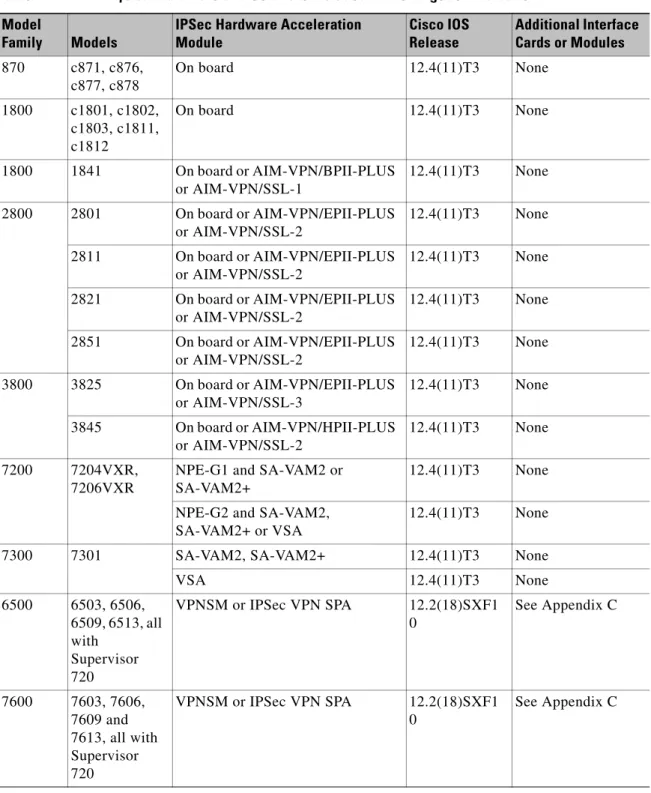
The contents of Table 1 and Appendix C constitute the TOE physical boundary. Table 1 contains the hardware and software compliant with Common Criteria evaluated CISCO IOS/IPSec. Only these specific models, hardware acceleration modules, and IOS Releases may be used.
Table 1 Physical Hardware and Software Included in the Target of Evaluation Model
Family Models
IPSec Hardware Acceleration Module Cisco IOS Release Additional Interface Cards or Modules 870 c871, c876, c877, c878 On board 12.4(11)T3 None 1800 c1801, c1802, c1803, c1811, c1812 On board 12.4(11)T3 None 1800 1841 On board or AIM-VPN/BPII-PLUS or AIM-VPN/SSL-1 12.4(11)T3 None 2800 2801 On board or AIM-VPN/EPII-PLUS or AIM-VPN/SSL-2 12.4(11)T3 None 2811 On board or AIM-VPN/EPII-PLUS or AIM-VPN/SSL-2 12.4(11)T3 None 2821 On board or AIM-VPN/EPII-PLUS or AIM-VPN/SSL-2 12.4(11)T3 None 2851 On board or AIM-VPN/EPII-PLUS or AIM-VPN/SSL-2 12.4(11)T3 None 3800 3825 On board or AIM-VPN/EPII-PLUS or AIM-VPN/SSL-3 12.4(11)T3 None 3845 On board or AIM-VPN/HPII-PLUS or AIM-VPN/SSL-2 12.4(11)T3 None 7200 7204VXR, 7206VXR
NPE-G1 and SA-VAM2 or SA-VAM2+
12.4(11)T3 None
NPE-G2 and SA-VAM2, SA-VAM2+ or VSA
12.4(11)T3 None
7300 7301 SA-VAM2, SA-VAM2+ 12.4(11)T3 None
VSA 12.4(11)T3 None 6500 6503, 6506, 6509, 6513, all with Supervisor 720 VPNSM or IPSec VPN SPA 12.2(18)SXF1 0 See Appendix C 7600 7603, 7606, 7609 and 7613, all with Supervisor 720 VPNSM or IPSec VPN SPA 12.2(18)SXF1 0 See Appendix C
TOE Description
Note Although several TOE components are FIPS validated cryptographic modules, the software running on those FIPS validated cryptographic modules is not one of the specific software code versions for this evaluated configuration. The TOE for this evaluation does not formally claim to have FIPS validated TOE components within the TOE boundary.
IPSec Hardware Acceleration components offload much of the processor intensive aspects of
cryptography, such as encryption, key generation, and compression. All of the devices in the TOE can operate in hardware accelerated mode or software only mode for encryption.
An instance of a TOE also supports remote access clients by supporting VPN connections with VPN clients. When active, the VPN Client helps to provide confidentiality, authenticity, and integrity for traffic transmitted over the untrusted network to the router or switch by its proper implementation of the IPSec policy negotiated with the TOE.
The Cisco IOS contains a collection of features that build on the core components of the system. The following are Cisco IOS features included in the evaluated configuration:
• Advanced Encryption Standard (AES)
• Firewall
• Internet Key Exchange (IKE)
• IPSec
• SSH v2
• VPN
• VLAN
• RIPv2 and OSPF
There are Cisco IOS features that are excluded from the evaluated configuration. These features are disabled. These features are listed below:
• HTTP Server
• EasyVPN
• IEEE 802.11 Wireless Standards
• L2TP • MPLS • SNMP • Syslog • Telnet • SSL VPN
Logical
IPSecIPSec is an Internet standard developed by the IETF and described in RFCs 2401-2404, 2406-2409 and 2451. It provides network data encryption at the IP packet level to guarantee the confidentiality, authenticity and integrity of IP packets. IPSec only supports IP packets - other network protocols must be encapsulated within IP to be encrypted with IPSec.
Individual IP packets encrypted with IPSec can be detected during transmission, but the IP packet contents (payload) cannot be read. IPSec encrypted packets are forwarded through an IP network in exactly the same manner as normal IP packets, allowing IPSec encrypted packets to be transported across networks and internetworking devices that do not participate in IPSec.
The actual encryption and decryption of IP packets therefore occurs only at devices that are capable of and configured for, IPSec. When an IP packet is transmitted or received by an IPSec-enabled device, it is encrypted or decrypted only if the packet meets criteria defined by the administrator. These criteria are typically described in the form of crypto access control lists.
Internetworking devices such as switches and routers are used to connect networks together to form larger networks. They are therefore logical places in which to implement IPSec to provide
confidentiality, authenticity and integrity for packet flows passing from one network to another. The TOE supports the following IPSec options:
A more detailed description of the operation of IPSec (based on the standards) can be found in the
“Appendix A - IPSec Operation” section on page 59.
Packet Filtering
To enable the TOE to be “self defending” the inbound filtering functions of the IOS operating system are included. This allows (for example) IP packets that are not IPSec to be ignored by the TOE, which is particularly important as the TOE will typically operate with one interface facing a public network.
Function Operation
Authentication between TOE and VPN Peer IPSec Internet Key Exchange (IKE) with
• Pre-Shared Keys, or
• Digital Certificates
Confidentiality of Packet Flows IPSec Encapsulating Security Payload (ESP) with
• Triple DES, or
• AES
Using IPSec Tunnel or Transport Mode
Integrity and Authenticity of Packet Flows IPSec Encapsulating Security Payload (ESP) with
• HMAC Keyed Hash Algorithm, using
• SHA-1, or
• MD-5
TOE Security Environment
TOE internetworking devices are deployed at the edges of untrusted networks (such as the Internet) to provide controlled communications between two networks that are physically separated. When a packet flow reaches the TOE stateful packet filtering is applied to the traffic before forwarding it into the remote network. Packet flows arriving at a network interface of the TOE are checked to ensure that they conform with the configured packet filter policy, this may include checking attributes such as the presumed source or destination IP address, the protocol used, the network interface the packet flow was received on, and source or destination UDP/TCP port numbers. Packet flows not matching the configured packet filter policy are dropped.
VLAN Separation
VLANs enable efficient traffic separation, provide better bandwidth utilization, and alleviate scaling issues by logically segmenting the physical local-area network (LAN) infrastructure into different subnets so that VLAN packets are presented to interfaces within the same VLAN.
The most important requirement of VLANs is the ability to identify which packets belong to which VLANs to ensure packets can only travel to interfaces for which they are authorized.
The VPNSM and IPSec VPN SPA on the Cisco Catalyst 6500 series switches and Cisco 7600 series routers require VLANs to function. When the administrator configures VPNs with the VPNSM or IPSec VPN SPA they attach crypto maps to VLANs (using interface VLANs). The other routers included in the TOE provide the capability to utilize VLANs but are not dependent on them for operation.
Administration
Configuration, management and operation are performed directly from the operating system (IOS) running on the router or switch, using the console and SSH. To ensure that only the authorized administrator can gain secure access to the TOE over a network, the security target specifies that remote management be conducted using SSH or over an IPSec connections to the remote routers.
TOE Security Environment
In order to clarify the nature of the security problem that the TOE is intended to solve, this section describes the following:
• Any assumptions about the security aspects of the environment and/or of the manner for which the TOE is intended.
• Any known or assumed threats to the assets against which specific protection within the TOE or its environment is required.
• Any organizational security policy statements or rules with which the TOE must comply.
Secure Usage Assumptions
Threats to Security
The Threat agents against the TOE are attackers with expertise, resources, and motivation that combine to be a low attack potential.
Threats Addressed by the TOE
The TOE addresses the following threats:
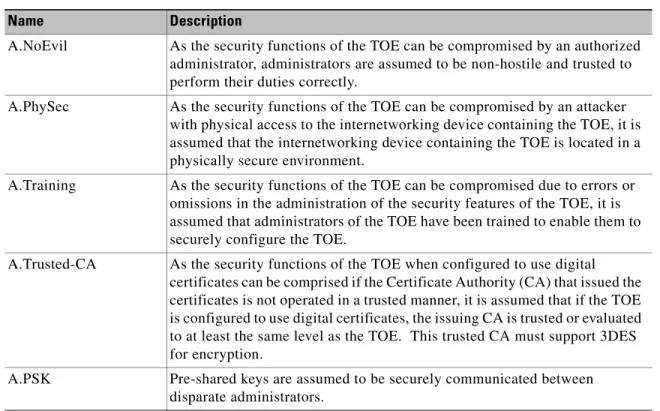
Table 2 Secure Usage Assumptions
Name Description
A.NoEvil As the security functions of the TOE can be compromised by an authorized administrator, administrators are assumed to be non-hostile and trusted to perform their duties correctly.
A.PhySec As the security functions of the TOE can be compromised by an attacker with physical access to the internetworking device containing the TOE, it is assumed that the internetworking device containing the TOE is located in a physically secure environment.
A.Training As the security functions of the TOE can be compromised due to errors or omissions in the administration of the security features of the TOE, it is assumed that administrators of the TOE have been trained to enable them to securely configure the TOE.
A.Trusted-CA As the security functions of the TOE when configured to use digital certificates can be comprised if the Certificate Authority (CA) that issued the certificates is not operated in a trusted manner, it is assumed that if the TOE is configured to use digital certificates, the issuing CA is trusted or evaluated to at least the same level as the TOE. This trusted CA must support 3DES for encryption.
A.PSK Pre-shared keys are assumed to be securely communicated between disparate administrators.
Table 3 Threats Addressed by the TOE
Name Description
T.Attack An attacker may gain access to the TOE and compromise its security functions by altering its configuration.
T.Untrusted-Path An attacker may attempt to disclose, modify or insert data within packet flows transmitted/received by the TOE over an untrusted network.
If such an attack was successful, then the confidentiality, integrity and
authenticity of packet flows transmitted/received over an untrusted path would be compromised.
TOE Security Environment
Organizational Security Policies
The following table describes the organizational security policies relevant to the operation of the TOE.
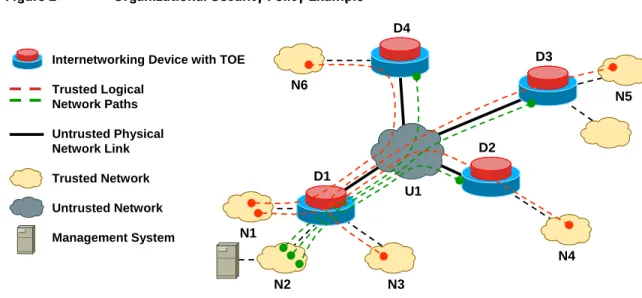
The organizational security policy, P.Connectivity, is required because it determines how packet flows between trusted networks can be transmitted over an untrusted network. Each instance of the TOE implements a portion of P.Connectivity, which must be matched to, and consistent with, other VPN peers for the TOE security functions to be effective.
For example, in Figure 2, an instance of the TOE, D1, has three trusted networks attached to it (N1, N2, N3).
Figure 2 Organizational Security Policy Example
T.VLAN-Hopping An attacker forces a packet destined for one VLAN to cross into another VLAN for which it is not authorized compromising the confidentiality and integrity of information.
T.Mediate An attacker may send impermissible information through the TOE which results in the exploitation of resources on the protected network.
Table 3 Threats Addressed by the TOE
Name Description
Table 4 Organizational Security Policies
Name Description
P.Connectivity The organizational security policy will
a) Specify whether networks connected to the TOE are trusted or untrusted (including VLANs and subnets),
b) Define which packet flows are to be protected by the TOE, and
c) Associate each protected packet flow with a VPN peer that will decrypt/encrypt the flow.
Internetworking Device with TOE
Trusted Logical Network Paths Untrusted Physical Network Link Trusted Network Untrusted Network Management System N6 N1 N2 N3 N4 N5 D1 D2 D3 D4 U1
This example implements the following policy for three trusted network to network packet flows (red) and three secure management packet flows (green) that cross the untrusted network (U1):
Notice that in this example, flows are identified solely by the source and destination addresses of IP packets within the flow. As the TOE D1 transmits a packet flow into the untrusted network it encrypts only that traffic which matches the encryption policy, using an encryption key that has been negotiated with the matching peer. Each VPN peer of D1 must have a matching policy implemented to successfully encrypt/decrypt any flow in accordance with P.Connectivity.
The above example demonstrates a single untrusted network interface for each router. Each instance of the TOE is not limited to one untrusted interface and multiple trusted interfaces. The designation of trusted versus untrusted interfaces is specific to the security policy of the organization.
Security Objectives
The security objectives are a high-level statement of the intended response to the security problem. These objectives indicate how the security problem, as characterized in the “TOE Security Environment” section on page 13, is to be addressed.
Security Objectives for the TOE
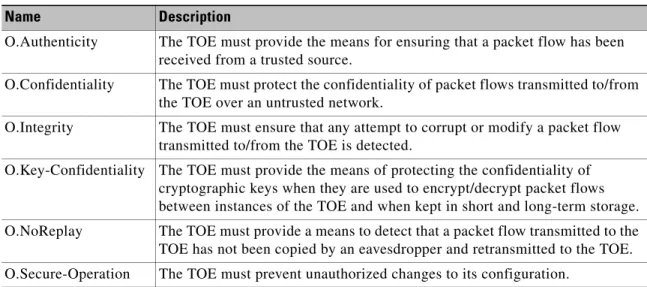
Table 5 describes security objectives for the TOE.
Source Destination Peer TOE
N1 N6 D4 N1 N5 D3 N3 N4 D2 N2 D2 D2 N2 D3 D3 N2 D4 D4
Table 5 Security Objectives for the TOE
Name Description
O.Authenticity The TOE must provide the means for ensuring that a packet flow has been received from a trusted source.
O.Confidentiality The TOE must protect the confidentiality of packet flows transmitted to/from the TOE over an untrusted network.
O.Integrity The TOE must ensure that any attempt to corrupt or modify a packet flow transmitted to/from the TOE is detected.
O.Key-Confidentiality The TOE must provide the means of protecting the confidentiality of cryptographic keys when they are used to encrypt/decrypt packet flows between instances of the TOE and when kept in short and long-term storage. O.NoReplay The TOE must provide a means to detect that a packet flow transmitted to the
TOE has not been copied by an eavesdropper and retransmitted to the TOE. O.Secure-Operation The TOE must prevent unauthorized changes to its configuration.
Security Objectives
Security Objectives for the Environment
Table 6 describes objectives for the environment.O.VLAN-Separation The TOE must provide a means for the logical separation of Virtual LANs to ensure that packets flows are restricted to their authorized Virtual LANs ensuring VLAN separation is achieved.
O.Mediate The TOE must mediate the flow of all information transmitted to the TOE over an untrusted network.
Table 5 Security Objectives for the TOE
Name Description
Table 6 Security Objectives for the Environment
Name Description
OE.Policy Those responsible for the administration of the TOE must provide a policy that specifies
a) Whether networks connected to the TOE are trusted or untrusted
b) The packet flows that are to be protected by the TOE, and
c) The VPN peer that will encrypt/decrypt each packet flow. OE.Secure-Management Those responsible for the operation of the TOE must ensure that the TOE
environment is physically secure, and management and configuration of the security functions of the TOE are:
a) Initiated from a management station connected to a trusted network and protected using the security functions of the TOE
b) Undertaken by trusted staff trained in the secure operation of the TOE
c) Implemented in conjunction with an evaluated or trusted Certificate Authority (CA), if digital certificates are used for TOE authentication
d) Configured to interface only to trusted authentication servers.
e) VLANs are configured and created correctly.
f) Pre-shared Keys used for configuration in cryptographic maps are securely distributed amongst disparate administrators.
OE.VPN The VPN external IT entity must be able to encrypt data transmitted to the TOE and decrypt data received from the TOE in accordance with the negotiated IKE/IPSec policy for the established VPN tunnel.
IT Security Requirements
TOE Security Functional Requirements
The TOE functional security requirements are drawn from [CC] Part 2 functional requirement components, with the exception of FTP_RTC.1. FTP_RTC.1 is used to correctly specify the use of a trusted channel for remote administration per CCEVS PD-0108.
Selections are enclosed in [square brackets], assignments are enclosed in [square brackets and underlined], refinements are in bold and/or strikethrough. Iterations are numbered in sequence as appropriate.
Explicitly stated SFRs are identified by having a label (EXP) meaning ‘Explicit Stated SFR for the TOE’ after the requirement name for TOE SFRs.
Audit Data Generation (FAU_GEN.1)
The TSF shall be able to generate an audit record of the following auditable events:
a) Start-up and shutdown of the audit functions
b) All auditable events for the [not specified] level of audit;
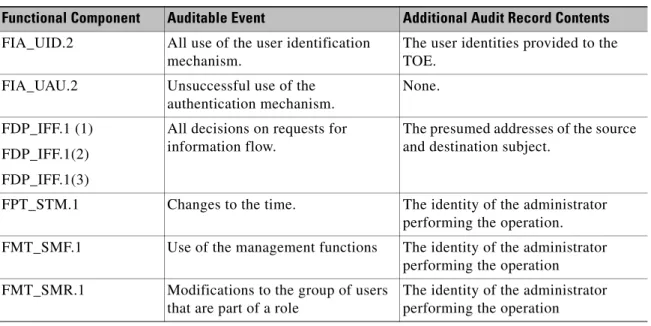
c) [the events in the Table 7 ] FAU_GEN.1.1
The TSF shall record within each audit record at least the following information:
a) Date and time of the event, type of event, subject identity, the outcome (success or failure) of the event; and
b) For each audit event type, based on the auditable event definitions of the functional components included in the PP/ST, [information specified in column three of Table 7] FAU_GEN.1.2
Table 7 Auditable Events
Functional Component Auditable Event Additional Audit Record Contents
FIA_UID.2 All use of the user identification mechanism.
The user identities provided to the TOE.
FIA_UAU.2 Unsuccessful use of the authentication mechanism.
None.
FDP_IFF.1 (1) FDP_IFF.1(2) FDP_IFF.1(3)
All decisions on requests for information flow.
The presumed addresses of the source and destination subject.
FPT_STM.1 Changes to the time. The identity of the administrator performing the operation. FMT_SMF.1 Use of the management functions The identity of the administrator
performing the operation FMT_SMR.1 Modifications to the group of users
that are part of a role
The identity of the administrator performing the operation
IT Security Requirements
Security Audit Review (FAU_SAR.1)
The TSF shall provide [administrators] with the capability to read [all audit trail data] from the audit records.FAU_SAR1.1
The TSF shall provide the audit records in a manner suitable for the user to interpret the information.FAU_SAR.1.2
Enforced Proof of Origin (FCO_NRO.2)
The TSF shall enforce the generation of evidence of origin for transmitted [IP packets protected by the IPSec information flow control policy] at all times.FCO_NRO.2.1
The TSF shall be able to relate the [IPSec SA peer] of the originator of the information, and the [digital signature] of the information to which the evidence applies.FCO_NRO.2.2
The TSF shall provide a capability to verify the evidence of origin of information to [the receiving SA peer] given [the successful establishment of an IPSec SA with the transmitting SA peer].FCO_NRO.2.3
Cryptographic Key Generation (FCS_CKM.1) (1) RSA
The TSF shall generate cryptographic keys in accordance with a specified cryptographic key generation algorithm [RSA] and specified cryptographic key sizes [512, 1024 bits] that meet the following: [PKCS #1].FCS_CKM.1.1(1)
Cryptographic Key Generation (FCS_CKM.1) (2) Diffie-Hellman
The TSF shall generate cryptographic keys in accordance with a specified cryptographic key generation algorithm [Diffie-Hellman key agreement] and specified cryptographic key sizes [768 bit, 1024 bit, and 1536 bit] that meet the following: [PKCS #3].FCS_CKM.1.1(2)
Cryptographic Key Destruction (FCS_CKM.4)
The TSF shall destroy cryptographic keys in accordance with a specified cryptographic key destruction method [overwrite] that meets the following: [no standard].FCS_CKM.4.1
Cryptographic Operation (FCS_COP.1(1)) – Encryption
The TSF shall perform [bulk encryption and decryption] in accordance with a specified cryptographic algorithms [3DES, AES] and cryptographic key sizes [168 bit, 256 bit] that meet the following: [FIPS 46-3 , FIPS 197].FCS_COP.1.1(1)
Cryptographic Operation (FCS_COP.1(2)) – Signing
The TSF shall perform [digital signing and signature verification] in accordance with a specified cryptographic algorithm [SHA-1, MD5] and cryptographic key sizes [160 bit, 128 bit] that meet the following: [RFC 2404, RFC 2403].FCS_COP.1.1(2)
Cryptographic Operation (FCS_COP.1(3)) – Remote Administration
The TSF shall perform [encryption of remote authorized administrator sessions] in accordance with a specified cryptographic algorithm: [Triple Data Encryption Standard (DES) as specified in FIPS PUB 46-3 and implementing any mode of operation specified in FIPS PUB 46-3 with Keying Option 1 (K1, K2, K3 are independent keys)] and cryptographic key sizes [that are 192 binary digits in length] that meet the following: [FIPS PUB 46-3 with Keying Option 1 and FIPS PUB 140-1 (Level 1)]. FCS_COP.1.1(3)
Cryptographic Operation (FCS_COP.1(4)) – SCEP signing
The TSF shall perform [digital signing and signature verification] in accordance with a specified cryptographic algorithm [MD5 with RSA Encryption] and cryptographic key sizes [128, 512, or 1024 bits] that meet the following: [PKCS#1, PKCS#7].FCS_COP.1.1(4)
Cryptographic Operation (FCS_COP.1(5)) – SCEP encryption
The TSF shall perform [encryption/decryption] in accordance with a specified cryptographic algorithm [3DES] and cryptographic key sizes [168 bits] that meet the following: [FIPS 46-3].FCS_COP.1.1(5)
Subset Information Flow Control (FDP_IFC.1(1)) - IPSec
The TSF shall enforce the [IPSec information flow control SFP] on [ Subject: IP network devices
Information: IP packets
Operations: encrypt, decrypt or ignore]FDP_IFC.1.1(1)
Subset Information Flow Control (FDP_IFC.1(2)) - VLAN
The TSF shall enforce the [VLAN information flow control SFP] on [ Subject: physical network interfaces
Information: IP packets
Operations: permit or deny layer two communication] FDP_IFC.1.1(2)
Subset Information Flow Control (FDP_IFC.1(3)) – Packet Filter
The TSF shall enforce the [packet filter information flow control SFP] on [ Subject: IP network devices
Information: IP packet
Operations: permit or deny]FDP_IFC.1.1(3)
Simple Security Attributes (FDP_IFF.1(1)) - IPSec
The TSF shall enforce the [IPSec information flow control SFP] based on the following types of subject and information security attributes: [
Subject Security Attributes
• Presumed address;
Information Security Attributes
• Receiving/transmitting interface;
• Source/destination IP address;
• Source/destination port number;
• transport layer protocol;
• IPSec Security Association].FDP_IFF.1.1 (1)
The TSF shall permit an information flow between a controlled subjects and of controlled information via a controlled operation if the following rules hold: [
• if one subject can authenticate another subject through the establishment of an IPSec Security Association based on VPN security attributes established by the authorised administrator
• ]. FDP_IFF.1.2(1)
The TSF shall enforce the [the following additional rules:
• incoming IPSec-encapsulated traffic shall be decrypted per FCS_COP.1(1) and verified in accordance with FDP_UCT.1 and FDP_UIT.1, based on VPN security attributes defined in crypto access control list established by the authorised administrator for the security association
IT Security Requirements
• outgoing traffic shall be encrypted per FCS_COP.1.(1) using IKE/IPSec in accordance with FDP_UCT.1 and FDP_UIT.1, based on VPN security attributes defined in crypto access control list established by the authorised administrator for the security association and tunnelled to the VPN peer corresponding to the destination address].FDP_IFF.1.3(1)
The TSF shall provide the following [inbound packet filtering based on access control lists to filter on presumed source/destination IP address, protocol, interface and source/destination port number as configured by the administrator and defined by rules specified in FDP_IFF.1(3).]FDP_IFF.1.4(1)
The TSF shall explicitly authorize an information flow based on the following rules: [none].FDP_IFF.1.5(1) The TSF shall explicitly deny an information flow based on the following rules: [the
administrator-configured explicit “deny” rules based on the above Information Security Attributes].FDP_IFF.1.6(1)
Simple Security Attributes (FDP_IFF.1(2)) - VLAN
The TSF shall enforce the [VLAN information flow control SFP] based on the following types of subject and information security attributes: [
Subject Security Attributes:
• Receiving/transmitting VLAN interface Information Security Attributes:
• VLAN ID in Packet Header] FDP_IFF.1.1 (2)
The TSF shall permit an information flow between a controlled subjects and of controlled information via a controlled operation if the following rules hold: [if the VLAN interfaces (subjects) are configured to be in the same VLAN] FDP_IFF.1.2(2)
The TSF shall enforce the [information flow so that only packets contain a matching VLAN ID in the header will be forwarded to the appropriate VLAN interfaces] FDP_IFF.1.3(2)
The TSF shall provide the following [modification of VLAN ID after information flow has been permitted via FDP_IFF.1(1) or FDP_IFF.1(3)] FDP_IFF.1.4(2)
The TSF shall explicitly authorize an information flow based on the following rules: [none]. FDP_IFF.1.5(2) The TSF shall explicitly deny an information flow based on the following rules: [packets associated with a VLAN will not be forwarded to VLAN interfaces (subjects) not configured to be in that VLAN]
FDP_IFF.1.6(2).
Simple Security Attributes (FDP_IFF.1(3)) – Packet Filter
The TSF shall enforce the [packet filter Information Flow Control SFP] based onthe following types of subject and information security attributes: [
Subject Security Attributes
• Presumed address
Information Security Attributes
• presumed address of source subject
• presumed address of destination subject
• transport layer protocol (TCP or UDP)
• network layer protocol (Internet Protocol number 0 to 255 or defined name: eigrp, gre, icmp, igmp, ip, ipinip, nos, ospf, or pim)
The TSF shall permit an information flow between a controlled subject and controlled informationvia a controlled operation if the following rules hold:[
a) Subjects on an internal network can cause information to flow through the TOE to another connected network if:
– the packet’s source and destination address, protocol (IP/TCP/UDP) and port are specifically permitted by the information flow security policy rules
– the presumed address of the source subject, in the information, translates to an internal network address
– and the presumed address of the destination subject, in the information, translates to an address on another connected network
b) Subjects on the external network can cause information to flow through the TOE to another connected network if:
– the packet’s source and destination address, protocol (IP/TCP/UDP) and port are specifically permitted by the information flow security policy rules
– the presumed address of the source subject, in the information, translates to an external network address
– and the presumed address of the destination subject, in the information, translates to an address on another connected network.] FDP_IFF.1.2(3)
The TSF shall enforce the [none]. FDP_IFF.1.3(3)
The TSF shall provide the following [none]. FDP_IFF.1.4(3)
The TSF shall explicitly authorize an information flow based on the following rules: [none]. FDP_IFF.1.5(3)
The TSF shall explicitly deny an information flow based on the following rules: [
a) The TOE shall reject requests for access or services where the information arrives on an external TOE interface, and the presumed address of the source subject is an external IT entity on an internal network
b) The TOE shall reject requests for access or services where the information arrives on an internal TOE interface, and the presumed address of the source subject is an external IT entity on the external network
c) The TOE shall reject requests for access or services where the information arrives on either an internal or external TOE interface, and the presumed address of the source subject is an external IT entity on a broadcast network;
d) The TOE shall reject requests for access or services where the information arrives on either an internal or external TOE interface, and the presumed address of the source subject is an external IT entity on the loopback network.] FDP_IFF.1.6(3)
Basic Data Exchange Confidentiality (FDP_UCT.1(1))
The TSF shall enforce the [IPSec information flow control SFP] to be able to [transmit and receive] objects IP packets in a manner protected from unauthorized disclosure.FDP_UCT.1.1(1)
Data Exchange Integrity (FDP_UIT.1(1))
The TSF shall enforce the [IPSec information flow control SFP] to be able to [transmit and receive] user data IP packets in a manner protected from [modification, insertion and replay] errors.FDP_UIT.1.1(1) The TSF shall be able to determine on receipt of user data IP packets, whether [modification, insertion
IT Security Requirements
User Authentication Before Any Action (FIA_UAU.2)
The TSF shall require each user to be successfully authenticated before allowing any other TSF-mediated actions on behalf of that user.FIA_UAU.2.1
Multiple Authentication Mechanisms (FIA_UAU.5(1))
The TSF shall provide [password based, signature, and certificate based mechanisms ] to support user authentication.FIA_UAU.5.1(1)
The TSF shall authenticate any user's claimed identity according to the [following rules:
• Reusable password based authentication mechanism shall be used for authorised administrators to access the TOE such that successful authentication must be achieved before allowing any other TSF mediated actions on behalf of that user.
• IKE-based authentication mechanism shall be used for external IT entities for site-to-site and remote client VPN connections such that successful authentication must be achieved before allowing any other TSF mediated actions on behalf of that user
• Reusable password for IKE extended authentication (XAUTH) shall be used for remote client VPN connections such that successful authentication must be achieved before allowing any other TSF mediated actions on behalf of that user]. FIA_UAU.5.2(1)
User Identification Before Any Action (FIA_UID.2)
The TSF shall require each user to identify itself before allowing any other TSF-mediated actions on behalf of that user. FIA_UID.2.1
Management of Security Functions Behavior (FMT_MOF.1)
The TSF shall restrict the ability to [determine the behavior of, disable, enable, and modify the behavior of] the functions [:
• that implement the IPSec information flow control SFP
• that implement the VLAN information flow control SFP
• that implement the packet filter information flow control SFP
• use of an external authentication server] to [administrators]. FMT_MOF.1.1
Management of Security Attributes (FMT_MSA.1(1))
The TSF shall enforce the [IPSec information flow control SFP] to restrict the ability to [query, modify,
delete, and define ] thesecurity attributes [VPN policy settings in crypto maps, VPN configuration attributes and crypto map client authentication list] to [administrator.]FMT_MSA.1.1(1)
Management of Security Attributes (FMT_MSA.1(2))
The TSF shall enforce the [VLAN information flow control SFP] to restrict the ability to [query, modify
and delete] thesecurity attributes [VLAN policy settings] to [administrator.]FMT_MSA.1.1(2)
Management of Security Attributes (FMT_MSA.1(3))
The TSF shall enforce the [packet filter information flow control SFP] to restrict the ability to [query, modify and delete] thesecurity attributes [information security attributes values within packet filtering rules] to [administrator.]FMT_MSA.1.1(3)
Secure Security Attributes (FMT_MSA.2)
Static Attribute Initialization (FMT_MSA.3(1))
The TSF shall enforce the [IPSec information flow control SFP] to provide [restrictive] default values for security attributes that are used to enforce the SFP.FMT_MSA.3.1(1)
The TSF shall allow the [administrator] to specify alternative initial values to override the default values when an object or information is created. FMT_MSA.3.2(1)
Static Attribute Initialization (FMT_MSA.3(2))
The TSF shall enforce the [VLAN information flow control SFP] to provide [restrictive] default values for security attributes that are used to enforce the SFP.FMT_MSA.3.1(2)
The TSF shall allow the [administrator] to specify alternative initial values to override the default values when an object or information is created. FMT_MSA.3.2(2)
Static Attribute Initialization (FMT_MSA.3(3))
The TSF shall enforce the [packet filter information flow control SFP] to provide [restrictive] default values for security attributes that are used to enforce the SFP.FMT_MSA.3.1(3)
The TSF shall allow the [administrator] to specify alternative initial values to override the default values when an object or information is created. FMT_MSA.3.2(3)
Management of TSF Data (FMT_MTD.1(1))
The TSF shall restrict the ability to [delete, [generate and view]] the [IPSec Pre-Shared Keys] to [administrators]. FMT_MTD.1.1(1)
Management of TSF Data (FMT_MTD.1(2))
The TSF shall restrict the ability to [query, modify, delete and clear] the [TSF configuration] to [administrator].FMT_MTD.1.1(2)
Specification of Management Functions (FMT_SMF.1)
The TSF shall be capable of performing the following security management functions: [
• disable, enable, and modify the behavior of the functions that implement the IPSec, VLAN, and packet filtering information flow control SFPs
• disable, enable, and modify the behavior of the functions for use of an external authentication server
• query, modify, define, and delete VPN policy settings, VPN configuration attributes and crypto map client authentication list
• query, modify and delete VLAN policy settings
• query, modify and delete information security attributes values within packet filtering rules
• delete, generate, and view IPSec pre-shared keys
• verify TSF data and executable code
• specify alternative initial values to override the default values of security attributes for IPSec information flow control SFP, VLAN information flow control SFP, and packet filtering information flow control SFP
• query, modify, delete, and clear the TSF configuration] FMT_SMF.1.1
Security Roles (FMT_SMR.1)
The TSF shall maintain the roles: [VPN Client user and administrator]. FMT_SMR.1.1
The TSF shall be able to associate human users with VPN Client user,administrator and privileged
IT Security Requirements
Application Note The VPN Client user role does not have access to the administrative functions or interfaces to the TOE.
Non-bypassability of the TSP (FPT_RVM.1)
The TSF shall ensure that TSP enforcement functions are invoked and succeed before each function within the TSC is allowed to proceed. FPT_RVM.1.1
TSF Domain Separation (FPT_SEP.1)
The TSF shall maintain a security domain for its own execution that protects it from interference and tampering by untrusted subjects.FPT_SEP.1.1
The TSF shall enforce separation between the security domains of subjects in the TSC.FPT_SEP.1.2
Reliable Time Stamps (FPT_STM.1)
The TSF shall be able to provide reliable time stamps for its own use. FPT_STM.1.1
Abstract Machine Testing (FPT_AMT.1)
The TSF shall run a suite of tests [during initial start-up] to demonstrate the correct operation of the security assumptions provided by the abstract machine that underlies the TSF.FPT_AMT.1.1
TSF Testing (FPT_TST.1)
The TSF shall run a suite of self tests [during initial start-up] to demonstrate the correct operation of [the TSF]. FPT_TST.1.1
The TSF shall provide authorised users with the capability to verify the integrity of [TSF data].
FPT_TST.1.2
The TSF shall provide authorised users with the capability to verify the integrity of stored TSF executable code.FPT_TST.1.3
TOE Session Establishment (FTA_TSE.1)
The TSF shall be able to deny session establishment based on [access control list specifying a combination of source/destination IP address and source/destination TCP/UDP port number].FTA_TSE.1.1
Inter-TSF Trusted Channel (FTP_ITC.1(1))
The TSF shall provide a communication channel between itself and a remote trusted IT product that is logically distinct from other communication channels and provides assured identification of its end points and protection of the channel data from modification or disclosure.FTP_ITC.1.1(1)
The TSF shall permit [the TSF or the remote IT trusted product] to initiate communication via the trusted channel.FTP_ITC.1.2(1)
The TSF shall initiate communication via the trusted channel for [IPSec VPN traffic].FTP_ITC.1.3(1)
Inter-TSF Trusted Channel (FTP_ITC.1(2))
The TSF shall provide a communication channel between itself and a remote trusted IT product that is logically distinct from other communication channels and provides assured identification of its end points and protection of the channel data from modification or disclosure.FTP_ITC.1.1(2)
The TSF shall permit [the TSF] to initiate communication via the trusted channel.FTP_ITC.1.2(2) The TSF shall initiate communication via the trusted channel for [external authentication services].FTP_ITC.1.3(2)
Application Note The TOE can be configured to use local authentication mechanisms or use authentication services provided by an external authentication server. The use of an external authentication server is optional in all TOE configurations, and not required for any TOE configuration. The TOE shall be responsible for correctly invoking the external authentication mechanism, and for taking the correct actions based on authentication decisions. In keeping with industry practice the choice of authentication server is not mandated by this ST.
Remote Administration Trusted Channel (FTP_RTC.1) (EXP)
The TSF shall provide a communication channel between itself and a remote trusted IT product that is logically distinct from other communication channels and provides assured identification of its end points and protection of the channel data from modification or disclosure.FTP_RTC.1.1
The TSF shall permit the remote IT trusted product to initiate communication via the trusted channel.FTP_RTC.1.2
The TSF shall use a trusted channel for the following functions: secure remote administration.FTP_RTC.1.3
Application Note Secure remote administration is provide by SSH.
Security Requirements for the IT Environment
The following functional requirements are met by the VPN peer .
Basic Data Exchange Confidentiality (FDP_UCT.1(2))
The IT environment shall enforce the [IPSec information flow control SFP] to be able to [transmit and
receive] objects IP packets in a manner protected from unauthorized disclosure.FDP_UCT.1.1(2)
Data Exchange Integrity (FDP_UIT.1(2))
The IT environment shall enforce the [IPSec information flow control SFP] to be able to [transmit and
receive] user data IP packets in a manner protected from [modification, insertion and replay] errors.FDP_UIT.1.1(2)
The IT environment shall be able to determine on receipt of user data IP packets, whether [modification, insertion and replay] has occurred. FDP_UIT.1.2(2)
Inter-TSF Trusted Channel (FTP_ITC.1(3))
The IT environment shall provide a communication channel between itself and the TSF that is logically distinct from other communication channels and provides assured identification of its end points and protection of the channel data from modification or disclosure.FTP_ITC.1.1(3)
The IT environment shall permit [the TSF or the remote IT trusted product] to initiate communication via the trusted channel.FTP_ITC.1.2(3)
The IT environment shall initiate communication via the trusted channel for [IPSec VPN traffic].FTP_ITC.1.3(3)
TOE Summary Specification
TOE Security Assurance Requirements
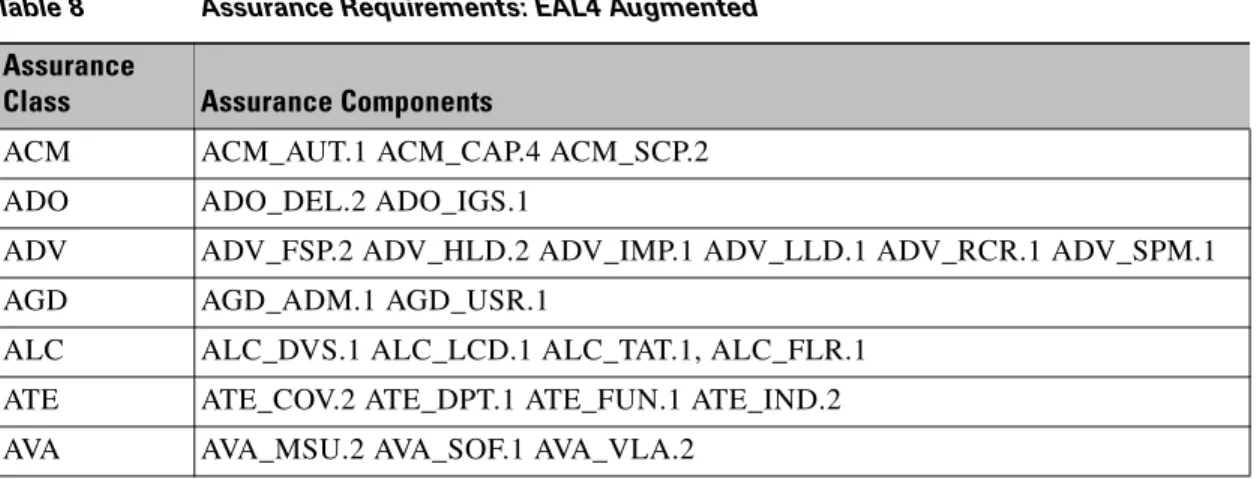
The TOE meets all the EAL4 assurance requirements as defined in CC Part 3 augmented with ALC_FLR.1 (Basic Flaw Remediation). They are summarized by Assurance Class in Table 8.
TOE Summary Specification
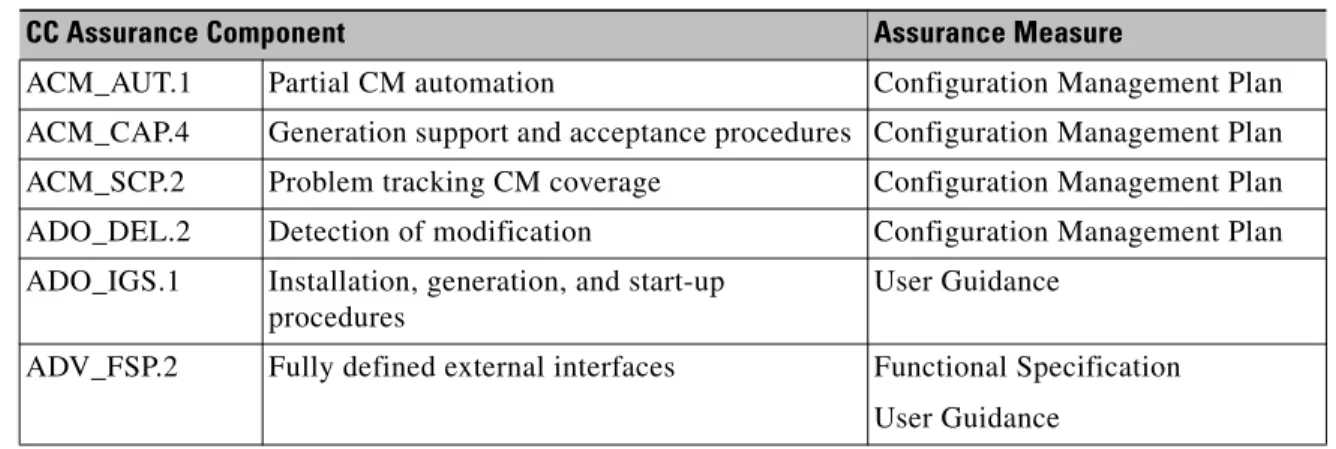
This section presents the Security Functions implemented by the TOE and the Assurance Measures applied to ensure their correct implementation.
IT Security Functions
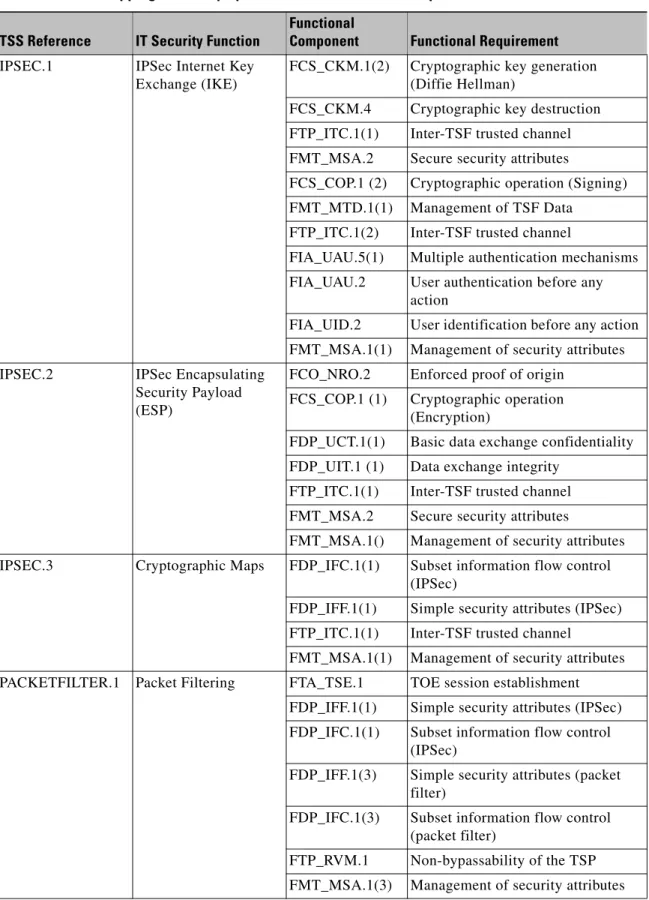
This section presents the security functions performed by the TOE and provides a mapping between the identified security functions and the Security Functional Requirements that it must satisfy. This ST claims compliance with the external standards for DES, 3DES, SHA-1 and MD-5 for the definition of the encryption algorithms as indicated in FCS_COP.1(1), FCS_COP.1(2), and FCS_COP.1(3). For the IPSEC.1, IPSEC.2 and REMOTE.1 Security Functions described below, the encryption was not analyzed or tested to conform to cryptographic standards as part of this evaluation. The cryptography used in the TOE has been FIPS certified as indicated in Appendix B, FIPS Conformance.
IPSec Implementation
The TOE implements the IETF IPSec protocols (RFCs 2401-2404, 2406-2409) to provide
confidentiality, authenticity and integrity for packet flows transmitted from and received by the TOE. The TOE IPSec implementation contains a number of functional components that meet the IPSec TSF. IPSec provides secure tunnels between two VPN (IPSec) peers, such as a pair of security gateways (TOEs), a TOE and a security gateway, or a TOE and a host (VPN Client). With IPSec, the administrator defines what traffic should be protected between two IPSec peers by configuring crypto access control lists and applying these access lists to interfaces by way of cryptographic (crypto) map sets. Therefore, traffic may be selected on the basis of source and destination address, and optionally Layer 4 protocol, and port. (The crypto access control lists used for IPSec are used only to determine which traffic should be protected by IPSec, not which traffic should be blocked or permitted through the interface. Separate access control lists define blocking and permitting at the interface.)
Table 8 Assurance Requirements: EAL4 Augmented Assurance
Class Assurance Components
ACM ACM_AUT.1 ACM_CAP.4 ACM_SCP.2 ADO ADO_DEL.2 ADO_IGS.1
ADV ADV_FSP.2 ADV_HLD.2 ADV_IMP.1 ADV_LLD.1 ADV_RCR.1 ADV_SPM.1
AGD AGD_ADM.1 AGD_USR.1
ALC ALC_DVS.1 ALC_LCD.1 ALC_TAT.1, ALC_FLR.1 ATE ATE_COV.2 ATE_DPT.1 ATE_FUN.1 ATE_IND.2 AVA AVA_MSU.2 AVA_SOF.1 AVA_VLA.2
A crypto map set can contain multiple entries, each with a different crypto access control list. The crypto map entries are searched in order and the TOE attempts to match the packet to the crypto access control list specified in that entry.
When a packet matches a permit entry in a particular crypto access control list, and the corresponding crypto map entry is tagged as cisco, connections are established if necessary. If the crypto map entry is tagged as ipsec-isakmp, IPSec is triggered. If no security association (SA) exists that IPSec can use to protect this traffic to the peer, IPSec uses IKE to negotiate with the remote peer to set up the necessary IPSec SAs on behalf of the data flow. The negotiation uses information specified in the crypto map entry as well as the data flow information from the specific crypto access control list entry.
If the crypto map entry is tagged as ipsec-manual, IPSec is triggered. If no SA exists that IPSec can use to protect this traffic to the peer, the traffic is dropped. In this case, the SAs are installed via the configuration, without the intervention of IKE. If the SAs did not exist, IPSec did not have all of the necessary pieces configured.
Once established, the set of SAs (outbound, to the peer) is then applied to the triggering packet and to subsequent applicable packets as those packets exit the TOE. "Applicable" packets are packets that match the same access control list criteria that the original packet matched. For example, all applicable packets could be encrypted before being forwarded to the remote peer. The corresponding inbound SAs are used when processing the incoming traffic from that peer. Multiple IPSec tunnels can exist between two peers to secure different data streams, with each tunnel using a separate set of SAs.
Crypto access control lists associated with IPSec crypto map entries also represent which traffic the TOE requires to be protected by IPSec. Inbound traffic is processed against the crypto map entries—if an unprotected packet matches a permit entry in a particular access control list associated with an IPSec crypto map entry, that packet is dropped because it was not sent as an IPSec-protected packet.
Crypto map entries also include transform sets. A transform set is an acceptable combination of security protocols, algorithms, and other settings to apply to IPSec protected traffic. During the IPSec SA negotiation, the peers agree to use a particular transform set when protecting a particular data flow.
IPSEC.1 - IPSec Internet Key Exchange (IKE)
IKE is a key management protocol standard that is used in conjunction with the IPSec. IKE automatically negotiates IPSec security associations (SAs) and enables IPSec secure communications without costly manual pre-configuration. Specifically, IKE provides the following benefits:
• Eliminates the need to manually specify all the IPSec security parameters in the crypto maps at both peers
• Allows specification of a lifetime for the IPSec SA
• Allows encryption keys to change during IPSec sessions
• Allows IPSec to provide anti-replay services
• Permits certification authority (CA) support for a manageable, scalable IPSec implementation
• Allows dynamic authentication of peers
IKE has two phases of key negotiation: phase 1 and phase 2. Phase 1 negotiates a security association (a key) between two IKE peers. The key negotiated in phase 1 enables IKE peers to communicate securely in phase 2. During phase 2 negotiation, IKE establishes keys (security associations) for IPSec. The TOE destroys keys by overwriting them.
Because IKE negotiations must be protected, each IKE negotiation begins by agreement of both peers on a common (shared) IKE policy. This policy states which security parameters will be used to protect subsequent IKE negotiations and mandates how the peers are authenticated. After the two peers agree upon a policy, the security parameters of the policy are identified by an SA established at each peer, and these SAs apply to all subsequent IKE traffic during the negotiation.
TOE Summary Specification
IKE authenticates IPSec peers using pre-shared keys, RSA keys or digital certificates. It also handles the generation and agreement of secure session keys using the Diffie-Hellman algorithm and negotiates the parameters used during IPSec ESP (IPSEC.2)
IKE maintains a trusted channel, referred to as a Security Association (SA), between IPSec peers that is also used to manage IPSec connections, including:
• The negotiation of mutually acceptable IPSec options between peers,
• The establishment of additional Security Associations to protect packets flows using ESP (as per IPSEC.2), and
• The agreement of secure bulk data encryption 3DES (168-bit) /AES (128, 192 or 256 bit) keys for use with ESP (IPSEC.2).
Implementation of the various cryptographic standards and RFCs ensure that only appropriate secure values are used for the cryptographic functions performed.
IKE extended authentication (Xauth) is a draft RFC based on the IKE protocol and requires user name and password to perform user authentication in a separate phase after the IKE authentication phase 1 exchange. Xauth does not replace IKE. IKE allows for device authentication (using pre-shared keys, RSA keys or digital certificates) and Xauth allows for user authentication, which occurs after IKE device authentication. Xauth occurs after IKE authentication phase 1 but before IKE IPSec SA negotiation phase 2. The TOE can be configured to use the local authentication mechanism or an external
authentication server for Xauth user authentication. To configure Xauth on the TOE, the administrator defines a client authentication list for a crypto map and applies the crypto map to an interface. The client authentication list identifies the authentication method (local and/or external authentication server) to use for user authentication. The administrator creates user name and password entries into the local user name database or the external authentication server.
IPSEC.2 - IPSec Encapsulating Security Payload (ESP)
The TOE uses ESP to protect packet flows between IPSec peers across interconnected untrusted networks in accordance with a TOE security policy (TSP). ESP is a method of encapsulating IP Packets and provides confidentiality using the 3DES and AES ciphers, integrity and authenticity using the MD5 and SHA-1 algorithms, and a mechanism to detect the capture and retransmission of packets (replay attacks) ensuring proof of origin cannot be repudiated. Implementation of the various cryptographic standards and RFCs ensure that only appropriate secure values are used for the cryptographic functions performed.
The parameters used by ESP, including session encryption keys, are negotiated via IPSec security associations (SAs) established via IKE (IPSEC.1) in accordance with the TSP. Note that security associations are unidirectional so that between IPSec peers protecting a packet flow (labelled A and B for example) there are at least two SA’s - one from A to B and one from B to A. Each SA, and associated session encryption key, has a lifetime, which upon expiry results in a new SA and session encryption key being established by the SA peers.
The packet flows between two remote IPSec peers that are to be protected by the TOE are defined by way of cryptographic maps (IPSEC.3).
IPSEC.3 - Cryptographic Maps
Cryptographic (crypto) Maps are used by the routers/switch to pull together the various parts used to setup IPSec SAs, including:
• Which packet flow (i.e. IP packets) that are to be protected by encryption, identified by a crypto access control list that can include IP protocol, source/destination IP address and source/destination UDP/TCP port number