UK Academy for Information Systems Conference Proceedings 2017. Paper 34
E-COMMERCE READINESS OF SMEs
IN DEVELOPING COUNTRIES:
A MODEL-DRIVEN SYSTEMATIC
LITERATURE REVIEW
Abdulhakeem Idris, Helen Edwards, Sharon McDonald Faculty of Computing, University of Sunderland, Sunderland, UK.
[email protected], [email protected], [email protected]
Abstract
It is important that modern IS decision making is accomplished using a systematic evaluation of research. A Model Driven Systematic Literature Review (MD-SLR) was used to examine the factors that influence e-commerce adoption readiness of Small and Medium Enterprises (SMEs) in developing countries. An initial review of commonly used theories of e-commerce adoption and e-readiness assessment theories was conducted to provide the model driving the MD-SLR. During the MD-SLR evidence was sought from all relevant empirical qualitative studies identified to refine the initial model based on evidence. The evidence supported the existence of internal SME factors (such as: awareness, commitment, technological resources, size of organisation, business resources, social relationship, relational complexities and human resources) and external factors (such as government readiness, market forces, supporting industries). New factors emerged: power supply instability, social and relationships, family support, political uncertainty, and cultural issues.
Keywords: Systematic Literature review, Model-driven SLR, e-Commerce adoption, SMEs, Developing countries, Evidence Based Practice
1.0
Introduction
It is widely acknowledged that e-commerce can boost efficiency and effectiveness of SMEs in both developed and developing countries (Jagoda, 2010). Despite the many benefits e-commerce offers, SMEs in developing countries are still far from achieving e-commerce success: the reasons for this are not entirely clear. Studies on e-commerce adoption in developing countries have mostly placed emphasis on the barriers and motivators of e-commerce adoption but these studies often lack contextual depth. Existing studies often use surveys as the main data collection instrument, which offering little insight into the heterogeneous nature of SMEs in developing countries. As a result, our understanding of what drives a sustainable e-commerce adoption amongst SMEs in developing countries is still very limited. The aim of this research is to address why some SMEs fail and others succeed by investigating the contextual factors influencing SMEs at various level of e-commerce adoption.
However, before undertaking fieldwork we believe it is important to systematically evaluate published research to provide a solid foundation for further investigations. This leads to the use of a systematic review since, without this insight the opportunity mistakes may be made in subsequent decision-making (Atkins and Louw, 2000). The benefits of systematic literature reviews (SLRs) have been acknowledged in other disciplines, such as the health care sector (Sackett et al., 1996) where evidence-based practice has become the modus operandi with SLRs providing additional synthesised
evidence to support decision-making: whether for practice or research. However, in Webster and Watson (2002) regretted the lack of evidence-based and theoretical progress in the IS field and suggested that authors’ examination of previous literature should be based on a “conceptual structuring” of reviews rather than using uninformed listings of citations. More than a decade later systematic literature reviews are not yet as well established in IS research but their value and contribution is under active discussion as evidenced by the recent set of papers in the Journal of Information Technology, viz: (Boell and Cecez-Kecmanovic, 2015a, Watson, 2015, Boell and Cecez-Kecmanovic, 2015b, Chiasson, 2015, Oates, 2015, Schultze, 2015). This renewed consideration of them has led to a range of guidelines to support their use in IS. Oates et al. (2012) proposed the model-driven systematic literature review (MD-SLR) for those with a realist perspective. drawing on the work of Pawson (2006) to define the steps needed for a MD-SLR to enable researchers to conduct their own reviews. This is the research approach presented within this paper.
To build on what is known from previous work the authors undertook a theoretical literature review to understand the range of models and theories used in this field and to create an initial model (Idris, 2015) to act as a prompt from which to evaluate the evidence available in qualitative empirical studies. The MD-SLR focused on the question of what field-based evidence exists to provide insights into the factors influencing the e-commerce readiness of SME in developing countries. The MD-SLR was an important step to undertake before venturing into detailed case-based fieldwork. This paper explains the motivation for conducting a MD-SLR of e-commerce readiness in SMEs in developing countries; outlines the process adopted; discusses the findings that emerged and led to a refinement of the initial model. The limitations and future work are considered in our conclusions.
2.0 E-commerce Adoption and Use in SMEs
Small and medium enterprises are regarded as the engine of growth of the world economy because they contribute to more than eighty per cent of a nation’s economy growth and account for more than ninety per cent of the entire businesses (Offstein and Childers, 2008). According to Jagoda (2010) SMEs play a significant role in creating employment opportunities in many countries across the globe. Likewise, Ifinedo (2011) stated that the adoption of e-commerce has become a fundamental approach which business organisations particularly SMEs are using to gain competitive advantage in the global environment. Furthermore, e-commerce has allowed SMEs to overcome their limitation related to size by giving them the opportunity to extend beyond their geographical reach and secure new market opportunities (Jagoda, 2010).
Examination of the literature reveals extensive research on SME e-commerce adoption especially in developed countries, e.g. (Grandon and Pearson, 2004, Simpson and Docherty, 2004, Beckinsale et al., 2006, Wilson et al., 2008, Scupola, 2009, Chibelushi and Costello, 2009). Research has also been carried out in developing countries such as (Looi, 2005, Tan et al., 2007, Kapurubandara and Lawson, 2007, Bartholomew et al., 2010, Taylor and Owusu, 2012, Shemi and Proctor, 2013, Idris, 2015). Within these studies the quantitative approach appears to dominate, see (Tan et al., 2007, Brown and Jayakody, 2008, Ghobakhloo et al., 2011, Awa et al., 2012). While the quantitative approach has its own merit, its deterministic nature does not give room for in-depth investigation into individual SMEs (Shemi and Proctor, 2013). In-depth investigation
of SMEs is important because they are individualistic in nature (Parker and Castleman, 2009)
While there are existing studies on e-commerce adoption in both developed and developing countries, there are few on the latter. Prior e-commerce adoption studies in developing countries (Belkhamza and Wafa, 2015, Nezakati et al., 2012, Awa et al., 2012) mostly use models or frameworks that were designed for innovation adoption in developed countries such as Theory of Planned Behaviour (Ajzen, 1991), Technology acceptance model (Davis Jr, 1986), Diffusion of innovation theory (Rogers, 1983), and Technology Organisation Framework (Tornatzky and Fleischer, 1990). It is acknowledged that these theories have contributed to innovation adoption research in developed countries due to affluence of resources and infrastructures. However, they are still inadequate because they do not capture the particular nature of SMEs in developing countries. Moreover, organisations in developing countries experience challenges that are very different from their developed counterparts (Molla and Licker, 2005).
Finally, it is worth noting that most e-commerce adoption studies conducted in developing countries consider the perception of potential e-commerce adopters (Bartholomew et al., 2010), rather than e-commerce adopters/users. This clearly limits our understanding. Where adoption is considered in developing nations the focus tends to be on the barriers and motivators that influence SMEs owners’ decisions on adopting e-commerce, e.g. (Kartiwi, 2006, Jamali et al., 2015). While it is important to know the barriers and motivation before adopting e-commerce, there is paucity of investigation into what happen to SMEs post e-commerce adoption (Rahayu and Day, 2016). Kartiwi (2006) suggests investigating the views of successful e-commerce adopters to enable researchers to have a holistic understanding of SMEs e-commerce adoption in developing countries. The MD-SLR presented in this paper sought to identify in more detail what published field-based evidence exists of the factors that influence the e-commerce readiness of SME in developing countries.
3. The MD-SLR Process
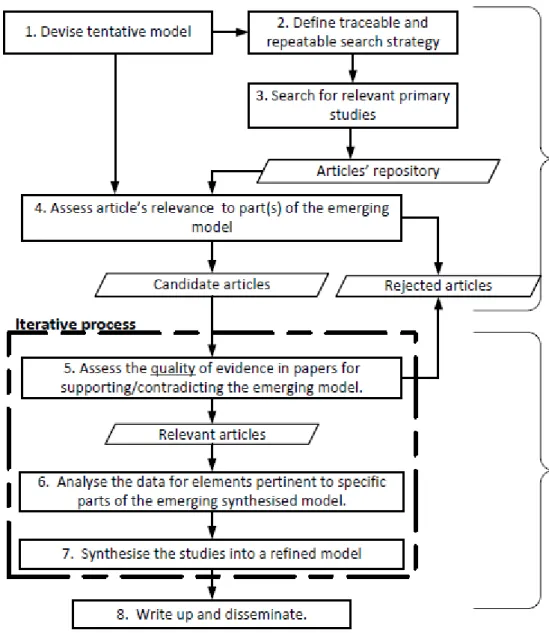
This section gives a stage-by-stage discussion of the process we followed, the results achieved and some of the issues we faced during the MD-SLR. Three researchers carried out the MD-SLR. Each researcher performed different tasks, such as conducting an initial theoretical literature review to develop an initial tentative model, designing the MD-SLR protocol, searching for academic papers from different databases, skimming through search results, analysing research papers and developing shared interpretation, and documenting researcher experience. Figure 1 shows the stages we followed.
Figure 1 MD-SLR Process Adopted from Oates et al (2012)
3.1 Stage 1 Devise Tentative Model:
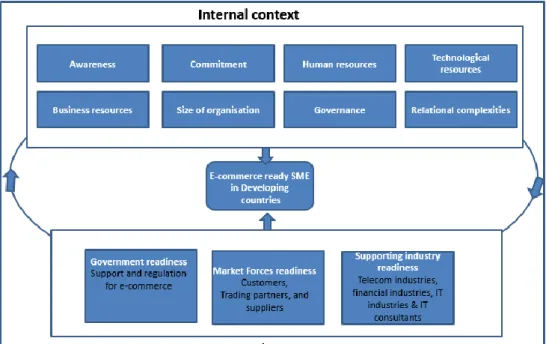
The tentative model was derived from a review of commonly used adoption theories from previous e-commerce adoption and e-readiness research. Consequently, themes from two theories were integrated to form the tentative model which centred on the internal and external factors that may influence e-commerce adoption of SMEs in developing countries (as shown in Figure 2). The detail of the derivation of this model is given in (Idris, 2015).
Figure 2 Initial tentative model of e-commerce readiness model adapted from (Molla and Licker, 2005) and (Tornatzky and Fleischer, 1990)
Our rationale for integrating commonly used frameworks and theories as a foundation for our MD-SLR can be traced to Webster and Watson (2002) who suggested that the justification for a conceptual model might come from either theoretical explanations, past empirical findings, and practice or experience.
3.2 Stage 2 Define a Traceable and Repeatable Search Strategy for Searching The Literature:
In this stage, we defined a traceable search strategy for searching the literature for primary studies. There were a number of elements to consider: the search strings to use, the databases to search, and the inclusion criteria for candidate papers for further analysis.
The Boolean search terms and fields to search were defined as shown in Figure 3.
“e-commerce adoption” OR “electronic commerce adoption” OR “e-readiness assessment” AND,
“SME” OR “Small and Medium enterprises” AND
“Developing Countries”
Search in fields: «Title », « Abstract », «Keywords » Figure 3 Boolean search terms and fields to search
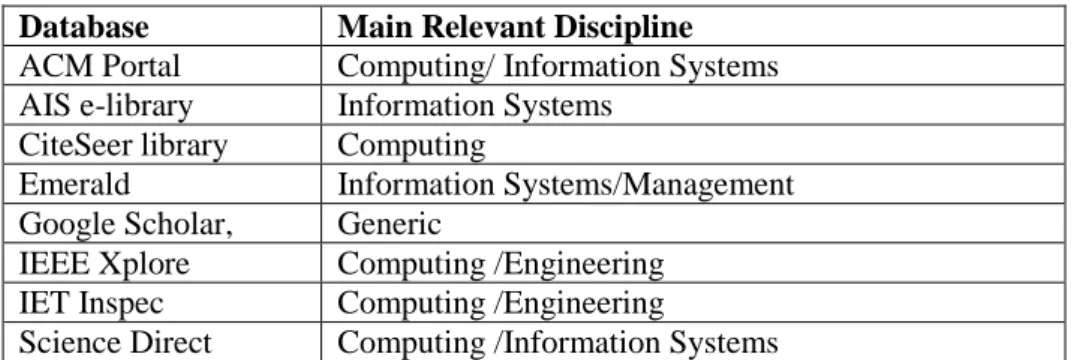
The decision was taken to restrict the search to electronically available bibliographical databases and to target those covering Information Systems, Computing, Management, and Engineering disciplines; as a “catch-all” we also included Google Scholar. Analysis of the resources available to us led to the selection of the bibliographic resources in Table 1. Restricting our searches to databases that were available to us is a limitation of the study, but since these covered the major IS, computing and management resources we felt it unlikely that significant resources would have been missed.
Database Main Relevant Discipline
ACM Portal Computing/ Information Systems
AIS e-library Information Systems
CiteSeer library Computing
Emerald Information Systems/Management
Google Scholar, Generic
IEEE Xplore Computing /Engineering
IET Inspec Computing /Engineering
Science Direct Computing /Information Systems
Table 1 The electronic databases selected.
We devised a set of criteria each paper would have to fully match in order to be included in the set of papers for further analysis. These were to ensure that we effectively focused on articles likely to contain useful evidence. The criteria and their explanation are provided in Table 2.
Inclusion Criteria Rationale
Pragmatic Criteria
Publication between 2000 and 2016. Publication in the fields began to emerge from 2000, the study was conducted in 2016.
Contents in English We could not effectively analyse papers in other
languages.
Full text download available. We needed access to the detail of the studies.
Content-Relevant Criteria
Empirical qualitative study The detailed field-based evidence was sought E-commerce adoption content This is the domain of interest
Based in developing countries. This is the domain of interest For a set of publications about the
same study, only the most extensive would be included.
This was to avoid wasted effort where minimal learning would take place.
Table 2 The inclusion criteria.
3.3 Stage 3 Search for Relevant Primary Studies:
In this stage we implemented the strategy defined in Stage 2. Table 3 shows the number of papers returned from each database search. The total number of unique papers returned were not ascertained because some were returned by more than one database.
Database Match Inclusion
Criteria
Do Not Match Inclusion Criteria Total ACM 11 2 13 AIS e-library 13 21 26 CiteSeer 0 0 0 Emerald 17 53 70 Google scholar 29 19691 19720 IEEE Xplore 8 5 13 IET Inspec 0 0 1 Science Direct 10 62 72
3.4 Stage 4 Assess Article’s Relevance to Part(s) of the Emerging Model: In this stage, we conducted an initial selection on which candidate articles to include based on the criteria in stage 2 (in Table 2 above). It can be seen that there were many “false positives” that were rejected once the inclusion criteria were applied. This was particularly so in the case of Google Scholar, and although this resource provided the greatest number of included articles the effort used to detect these could be argued to beyond a reasonable level for a manual activity. In our case the content-relevant criteria were applied by skimming through the abstract, and occasionally full text when necessary, to identify articles with empirical evidence on SME e-commerce adoption in developing countries. Many of the rejected papers were literature reviews of SMEs e-commerce adoption in developing countries with no accompanying qualitative empirical studies. The outcome of this stage led to 88 (non-unique) relevant papers being included in our candidate article set for further analysis and synthesis, see Table 3. The total number of unique papers was not determined at this time as some were returned by more than one database.
3.5 Stage 5 Assess quality of evidence in paper for supporting/contradicting the emerging model:
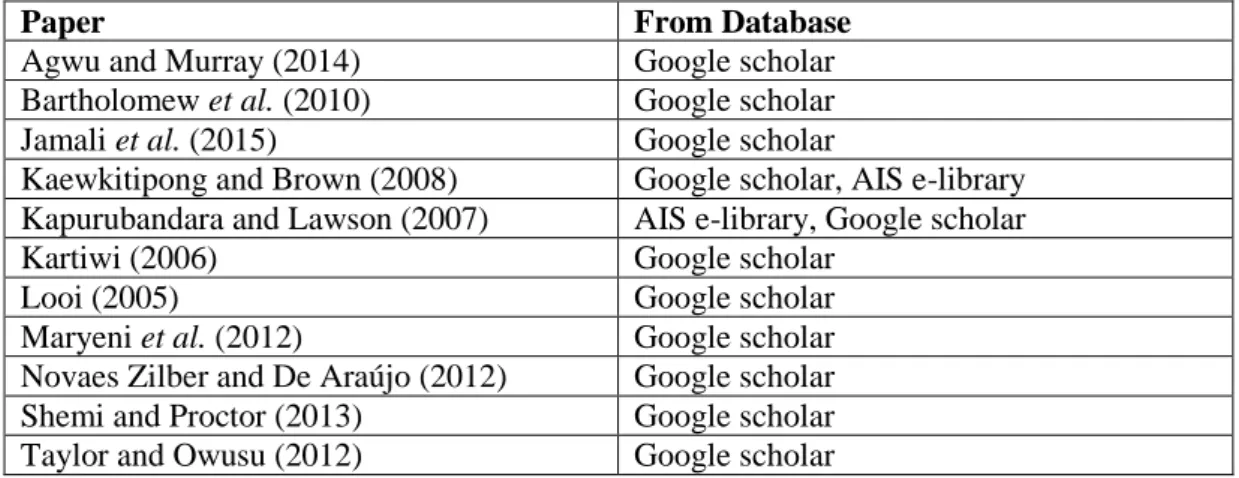
The primary reviewer looked through the 88 relevant papers for empirical evidence that could support or contradict our initial tentative model. The reviewer found that although some of the candidate papers mentioned the use of qualitative study in their abstract there was no empirical evidence or results to support the claim in the full text. This reduced the number of included papers to only 11 (as listed in Table 4).
Paper From Database
Agwu and Murray (2014) Google scholar
Bartholomew et al. (2010) Google scholar
Jamali et al. (2015) Google scholar
Kaewkitipong and Brown (2008) Google scholar, AIS e-library
Kapurubandara and Lawson (2007) AIS e-library, Google scholar
Kartiwi (2006) Google scholar
Looi (2005) Google scholar
Maryeni et al. (2012) Google scholar
Novaes Zilber and De Araújo (2012) Google scholar
Shemi and Proctor (2013) Google scholar
Taylor and Owusu (2012) Google scholar
Table 4 Analysed papers containing qualitative empirical evidence.
Since the number of papers remaining was so small the decision was taken to retain all in the next stage, rather than applying any further “quality of evidence” tests. If there had been a high number of papers at this stage we would have focused next on the rigorous with which the data collection and analysis had been done before including a paper in the final set. In this case we simply used the paper but recorded the information about data collection and analysis in our analysis.
3.6 Stage 6 Analyse the data for elements pertinent to specific parts of the emerging synthesised model:
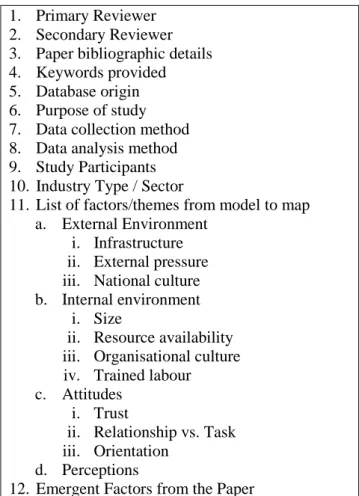
To ensure traceability of the relevant articles template was used to record the analysis of each paper: the headings of the template are given in Table 5. To ensure credibility of the analysis the two secondary reviews were provided with the templates and a subset of paper to analyse. These were compared against the original templates and where
there were disagreements the researchers discussed and reviewed the paper once more to come to an agreement on the outputs.
1. Primary Reviewer 2. Secondary Reviewer 3. Paper bibliographic details 4. Keywords provided 5. Database origin 6. Purpose of study 7. Data collection method 8. Data analysis method 9. Study Participants 10. Industry Type / Sector
11. List of factors/themes from model to map a. External Environment
i. Infrastructure ii. External pressure iii. National culture b. Internal environment
i. Size
ii. Resource availability iii. Organisational culture iv. Trained labour c. Attitudes
i. Trust
ii. Relationship vs. Task iii. Orientation
d. Perceptions
12. Emergent Factors from the Paper
Table 5: Template headings for analysis of individual empirical papers
The templates with the individual analyses of the 11 papers are available from https://goo.gl/ig8iiE. The tables below present the summarised analysis of the factors that were identified form the qualitative empirical studies. Table 6 shows the extent to which evidence for the elements in the original model was detected. Table 7 indicates the new factors that were elicited and their origin. Section 4 provides a more detailed discussion of what our analysis revealed.
Awareness Commitment Human resources Technological resources Business resources Size of Organisation Governance Relational complexities Government readiness Market forces readiness
Supporting industry readiness
Agwu and Murray (2014) y y y y y y Bartholomew et al. (2010) y y y y y Jamali et al. (2015) y y y y y y y y y y Kaewkitipong and Brown (2008) y y y y y y y y y y Kapurubandara and Lawson (2007) y y y Kartiwi (2006) y y y y y y
Looi (2005) y y y y
Maryeni et al. (2012) y y y y y Novaes Zilber and De Araújo (2012) y y y y y y Shemi and Proctor (2013) y y y y y Taylor and Owusu (2012) y y y y Frequency of evidence 10 5 11 6 9 2 2 2 2 6 9
Table 6: Evidence for the model elements detected in the analysed papers
Relational complexities as family orientation Social relationship within the SME Subjective norms
Cultural factor
Presentation in the media Political uncertainty Economic uncertainty Preference for Cash Power supply
Agwu and Murray (2014) y y
Jamali et al. (2015) y y
Kaewkitipong and Brown (2008) y
Kapurubandara and Lawson (2007) y y
Taylor and Owusu (2012) y y y y
Shemi and Proctor (2013) y
Frequency of evidence 1 1 1 1 1 2 3 1 1
Table 7: Evidence of new elements detected in the analysed papers
3.7 Synthesise the studies into a refined model
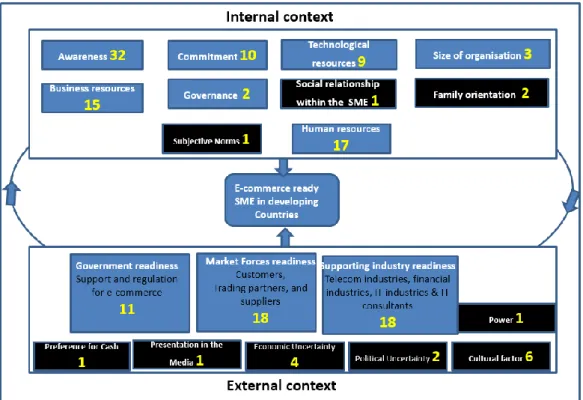
Evidence was found for all factors in the initial model from the papers analysed and nine new factors were identified. These were added to the refined model as shown in Figure 4. Superimposed on the model (in yellow) are the counts for the number of pieces of evidence that were found to support a factor: this is greater than the number of papers since in several instances a number of different pieces of evidence could be detected within one paper. The nine emergent factors have face validity. For instance, in many developing countries electricity power supplies are frequently disrupted which impacts on the surety with which an e-commerce business can be operated. Similarly, large
sections of the Nigerian population, for instance, still expect to work within a cash economy which provides a significant obstacle for e-business entrepreneurs.
Figure 4 Evolved model
4. Findings Extracted from the Analysed Papers
This section discussed in more detail the analysis of the individual papers that were summarised in sections 3.6 and used to refine the evolved model shown in subsection 3.7. These summaries are provided in alphabetical order for ease of comparison with the data provided in earlier tables.
4.1 Agwu and Murray (2014)
The study focused on understanding the challenges facing e-commerce adoption in Nigerian SMEs. They conducted interviews with 30 SMEs and analysed those from the 23 participants whose interviews contained useful data. They adopted an open-question interview style with a set of headings: internal, external, environment, organization, e-commerce. The paper lacked a detailed explanation of the interview process but identified that the interviews were recorded with notes taken and later transcribed. In keeping with the open-questions they analysed their findings using open coding of the transcribed data. Their findings indicate the lack a regulatory framework for e-Commerce security, as well as a lack of technical skills and basic infrastructure erecting barriers to e-commerce adoption. Their findings support most of elements from our initial model.
4.2 Bartholomew et al. (2010)
The study investigated how United Nations Industrial Development Organisation (UNIDO) ICT centre innovation acted as a catalyst for ICT adoption and e-business innovation. Their participants were owner/managers of 27 Small Agribusiness Enterprises in Southeast Nigeria. A variety of data collection techniques were used:
semi-structured interviews, observations, focus group discussion, and document analysis. Little explanation was given about the protocols used for these, although mention was made of videotaped focus group discussion and audio recorded interviews. The video and audio recording were transcribed and analysed using Atlas.ti and template analysis was used for thematic analysis and to code and categorise the data. We extracted from their findings matches to a number of our factors: awareness, business resources, external infrastructure, SME governance strategy, and Human resources. There were no new factors.
4.3 Jamali et al. (2015)
This case study investigated e-commerce adoption in Iranian family SMEs. Six CEOs of Iranian family SMEs participated. For their sample of CEOs the researchers required that they fulfilled the requirements of: a Master degree (or higher) in a relevant field, two or more years’ work experience as a CEO in an EC-adopted family SME, completed at least one ICT implementation project. Data were collected via semi-structured telephone interviews: the interview questions and process were included in the paper. Deductive content analysis was used in a three step process: preparation, organising and reporting. Finally correspondence comparisons were used to determine the content validity. They found that perceived need and usefulness influenced the e-commerce. Other influential perceptions were regarding: national structure, organisational resources, disadvantages, subjective norms, family orientation and inter-organisational succession. Of these factors family orientation and inter-inter-organisational succession were emergent factors.
4.4 Kaewkitipong and Brown (2008)
This case study was carried out in a medium-sized tourism business in Thailand to explore the linkage between e-business adoption and evaluation from a process perspective. The researchers stated that they had adopted an interpretive case study approach focusing on one business that was using e-business (i.e. more than emails and static websites). They conducted semi-structured interviews with eight participants from all levels within the company (from Managing Director to reservations staff) and supplemented this with data drawn from local e-business magazines and the company’s websites. No specific insight is given into their analysis approach and their finding s are presented in a narrative format. They found economic characteristics, firm size, skilled staff, and social relationship within the SME and owner’s characteristics as the factors affecting their e-commerce adoption. An emergent factor was social relationship in the SME.
4.5 Kapurubandara and Lawson (2007)
This exploratory case study aimed to investigate barriers to SME adoption of ICT and e-commerce and was conducted with seven SMEs in Sri Lanka. Their data were collected for the exploratory investigation using semi-structured interviews with 17 SME owners and managers. Audio recordings of the interviews were transcribed and cross-case analysis was undertaken by organizing the data in a spreadsheet, with rows representing each SME and columns containing the data. A questionnaire was also used with a wide range of SMEs but we did not include data from that in our analysis since this did not generate data that could be closely related to specific SME experiences. From the qualitative data they determined that lack of awareness was the highest barrier to adoption as most owners and managers described themselves as having basic computer literacy. Other barriers include cost of technology, inadequate telecom
infrastructure, an unstable e-economy and political uncertainty. There was one emergent factor: political uncertainty.
4.6 Kartiwi (2006)
This exploratory case study focused on two Indonesian SMEs that used e-commerce. The first was a provider of educational services to schools in West Java. The second was inner city bus operator with bus rental in central Java. The owner-managers of the SMEs were each interviewed for around two hours using semi-structured interviews. These interviews were recorded and transcribed and relevant company documents were analysed for triangulation purposes. There is little information about the data analysis process undertaken. The findings in the paper identified that both businesses had adopted e-commerce to reduce cost operation, increase sales and improve productivity. However, the two businesses started facing problems within months of adoption. The lack of a clear strategy govern the e-commerce adoption was problematic. Moreover, customers appeared to prefer traditional ways of doing business and the staff lacked the skills to effectively handle e-commerce in one SME.
4.7 Looi (2005)
The study in 10 Brunei SMEs aimed to develop a model of factors inhibiting e-commerce adoption. The author interviewed ten owner-managers of SMEs, randomly chosen from a local business directory: four had adopted e-commerce. The interviews were held at the SMEs and lasted around 90 minutes each. Semi-structured interviews were used with questions derived from a research literature and focused on the SME profile, benefits of e-commerce adoption, perceived barriers, perceived motivators and ranking of factors. There is no explanation in the paper of how the data were analysed. The author elicited that owner’s characteristics such as lack of skill, perceived lack of trust, and lack of knowledge were the major inhibitors. In addition, environmental characteristics such as government support, infrastructure, and competitive pressure were motivators of e-commerce in Brunei SMEs. The factors identify mapped against those in our initial model.
4.8 Maryeni et al. (2012)
This pilot case study aimed to explore the technological and organisation factors influencing e-commerce adoption in Indonesian SMEs. The authors conducted semi-structured interviews with owners, managers and IT staff in three textile manufacturing medium-sized companies in West Java. Two had adopted e-commerce. There is no discussion in the paper regarding data collection and analysis beyond the recording of the interviews and the use of “relevant company documents”. The findings presents by the authors were that relative advantage, compatibility, complexity, infrastructure and security were technological factors. While organisational factors such as IT skills of users, IT knowledge of owners, management support and funding were major factors influencing e-commerce adoption. The evidence in the discussion section of the paper supported the authors’ claims. All findings in this paper supported elements in our initial model.
4.9 Novaes Zilber and De Araújo (2012)
This case study aimed to understand e-business business models adopted by SMEs in a Brazil. The paper included results from a large scale survey, but these were not considered in our analysis of their findings since we wanted to retain a focus to direct experiences. For their qualitative exploratory work they focused on small businesses in
the goods and services sectors as being representative of many small enterprises in Brazil. 13 small enterprises were involved all of which operated with e-commerce. An interview approach was used to gather data, using 20 open-ended questions based around: what had prompted the company to be internet-based, business; what their difficulties had been, what changes they had made in business processes, and what were the characteristics of their organizational structure after they started using the internet. Content analysis was used to analyses the data. From their analysis they deduced that owner’s awareness, lack of appropriate planning, market competition, technical infrastructure, the customers readiness, inadequate availability of IT specialist, lack of funding were significant factors. These mapped onto our initial model with no additional insights emerging.
4.10 Shemi and Proctor (2013)
This interpretive case studied challenges facing e-commerce in Botswana SMEs. Six SMEs in the ICT and Tourism sectors participated. The paper provides detailed information about the sampling approach and rationale, data collection and analysis. Data were collected via unstructured and semi-structured face-to-face interviews, web-site analysis, observation and document analysis: in total 32 formal interviews were conducted. Data collection and analysis overlapped within this interpretivist approach, cases were analysed individually as well as in comparison with each other, and pattern and themes were generated for further analysis. This process took seven months and was aided by use of NVivo for electronic coding. This was the most methodologically transparent and robust of the studies we analysed. They found that major challenges were: time to devote to website improvement, lack of website interactivity, lack of skill, slow speed of internet, lack of regulation, lack of funding, customer preference for traditional way of business, and economic recession. These factors mapped onto our initial model with the addition of economic situation.
4.11 Taylor and Owusu (2012)
This case study focused on two Ghanaian handicraft-exporting SMEs to determine what factors affect internet and e-commerce adoption. Purposive sampling was used to identify small wood carving firms that had been using the Internet in their export activities. Semi-structured interviews lasting about two hours each were carried out with each SME manager. The authors stated that they used content analysis for data analysis. There was no further detail about data collection or analysis protocols. The internal factors they identified that affecting adoption were: lack of qualified staff to develop and support e-commerce website, limited financial resources and limited perceived benefits of the technology by the owner-manager. External factors also emerged: lack of online payment process, limited availability of online banking, power failure and competition in the industry. Taylor and Owusu’s findings supported many elements in our model with an addition factor of power failure which they suggest could be a major factor influencing e-commerce adoption in developing countries.
5. Conclusions
Using the MD-SLR we were able to take our initial model and find evidence to support its contents and add to it in terms of evidence-based factors. However as with all research studies there are limitations to be acknowledged in the work.
5.1 The Value of the MD-SLR
The MD-SLR process that we adopted to derive our evolved model has been defined in this paper, but it is not without shortcomings. For instance, since only 11 empirical papers were used to refine the model it is possible that the emergent model is not sufficient to explain all the relevant factors that influence SME e-commerce adoption in developing countries. However the MD-SLR could be re-implemented by ourselves, or others following our protocols, to include new evidence from papers not included in the databases we searched, or that have been published since our study. Indeed, in the EBP community, regardless of discipline, it is an expectation that SLRs will be rerun to capture and incorporate emerging evidence.
5.2 Internal Limitations of the MD-SLR Process
There were limitations in our process which need to be acknowledged as they have an impact on the efficacy of the work. We limited our use of databases, as explained in section 3.2, to eight databases that we considered mostly likely to return the relevant result were used for this review. It is possible that there are other databases with relevant empirical studies, which could have led to further refinement of our initial model. We limited our searches to those articles published in English, and we are aware that there is a world of research publications in other languages, again we may have missed valuable insights here. As we were limited in (human) resources we did not attempt to investigate any grey literature or any articles not readily available electronically. The resource limitation means that the initial searching for candidate articles and filtering down to relevant articles was left to one researcher and the other two simply reviewed the process at that stage and were brought in for discussion and resolution where difficulties were encountered. The process undertaken was essentially manual using templates and spreadsheets where helpful, but there was a lack of supporting software tools for the activity.
5.3 External Limitations and Problems in the MD-SLR Process
Although the search protocol (as given in section 3.2) was defined and explicit it had to be implemented differently in the different databases, dependent on the fields that could be searched. Moreover, the databases often lacked consistency, a search within one could generate different results on a different occurrence. Therefore the dates and time of searches were recorded by the researcher so that it was clear what resources had been found and when. Repeated searches until there was no variance was simply not practicable. Another observation is that some of the databases we searched did not return any results: however, Google Scholar returned papers that it identified as contained within those very databases. This leads to questions about the effectiveness of the searching algorithms in a number of bibliographic databases. A further difficulty was that there was significant redundancy with most papers being returned by more than one database. Related to this, but more time consuming to deal with, were the studies that were reported in multiple publications with different titles but contained the same content. This led to further screening efforts to identify and eliminate duplications of papers. There were also some cases where we could not access papers returned by some databases due to subscription issues: in these cases we used the inter-library loans process to access them, but there was a small set where even this failed to generate the text requested. It is possible that those papers contained valuable, different, evidence. Perhaps of more concern, in terms of the evidence being sought, was that many authors
who claimed in their abstract to have conducted qualitative primary studies were found to have used a quantitative survey approach only, or produced no qualitative evidence in their paper at all: this led to a continuing reduction in the number of relevant papers that we believed we had. This issue would be easy to overcome if authors paid scrupulous attention to word and phrases used in abstracts to ensure they do usefully reflect the contents of the paper.
5.4 Future work
Our evolved model contains only factors for which there is evidence to support their relevance in terms of influencing e-commerce adoption in developing countries SMEs. Our aim is to use this model as a lens through which to examine e-commerce adoption in sets of case studies based in Nigerian SMEs. We will investigate SMEs at different levels of e-commerce adoption. Our main aim is to generate an assessment framework that is tailored for SMEs to use to self-diagnose their e-commerce readiness for continued e-commerce progress. A secondary, but also important aim is to publish the case studies in the research literature and thus provide additional primary studies for future SLRs.
References
Agwu, M. & Murray, J. P. (2014). Drivers and inhibitors to e-Commerce adoption among SMEs in Nigeria. Journal of Emerging Trends in Computing and Information Sciences, 5 3 192-199.
Ajzen, I. (1991). The theory of planned behavior. Organizational behavior and human decision processes, 50 2 179-211.
Atkins, C. & Louw, G. (2000).Reclaiming Knowledge: A Case for Evidence Based Information Systems. InEuropean Conference on Information Systems, Association for Information Systems.
Awa, H., Ukoha, O. & Emecheta, B. (2012).Integrating TAM and TOE Frameworks and Expanding their Characteristic Constructs for E-Commerce Adoption by SMEs. InProceedings of Informing Science and IT Education Conference (InSITE), Montreal, Canada
Bartholomew, A., Wainwright, D. & Udechukwu, O. Diffusion of ICT innovation and e-business adoption in agribusiness SMRs: A developing country perspective. UK Academy for Information Systems Conference Proceedings 2010, 2010. Beckinsale, M., Levy, M. & Powell, P. (2006). Exploring internet adoption drivers in
SMEs. Electronic Markets, 16 4 361-370.
Belkhamza, Z. & Wafa, S. A. (2015). The effect of perceived risk on the intention to use e-commerce: The case of Algeria. The Journal of Internet Banking and Commerce, 2009.
Boell, S. K. & Cecez-Kecmanovic, D. (2015a). Debating systematic literature reviews (SLR) and their ramifications for IS: a rejoinder to Mike Chiasson, Briony Oates, Ulrike Schultze, and Richard Watson. Journal of Information Technology, 30 2 188-193.
Boell, S. K. & Cecez-Kecmanovic, D. (2015b). On being ‘systematic’ in literature reviews in IS. Journal of Information Technology, 30 2 161-173.
Brown, I. & Jayakody, R. (2008). B2C e-commerce success: A test and validation of a revised conceptual model. The Electronic Journal Information Systems
Evaluation, 11 3 167-184.
Chiasson, M. W. (2015). Avoiding methodological overdose: a declaration for independent ends. Journal of Information Technology, 30 2 174-176.
Chibelushi, C. & Costello, P. (2009). Challenges facing W. Midlands ICT-oriented SMEs. Journal of small business and enterprise development, 16 2 210-239. Davis Jr, F. D. (1986). A technology acceptance model for empirically testing new
end-user information systems: Theory and results. Massachusetts Institute of Technology.
Ghobakhloo, M., Arias-Aranda, D. & Benitez-Amado, J. (2011). Adoption of
e-commerce applications in SMEs. Industrial Management & Data Systems, 111 8 1238-1269.
Grandon, E. E. & Pearson, J. M. (2004). Electronic commerce adoption: an empirical study of small and medium US businesses. Information & Management, 42 1 197-216.
Idris, A. O. (2015). Assessing a Theoretically-Derived Readiness Framework for E-Commerce in a Nigerian SME. Evidence Based Information Systems Journal, 1 1.
Ifinedo, P. (2011). An empirical analysis of factors influencing Internet/e-business technologies adoption by SMEs in Canada. International Journal of
Information Technology & Decision Making, 10 04 731-766.
Jagoda, K. (2010). The Use of Electronic Commerce by SME’s. Entrepreneurial Practice Review, 1 3.
Jamali, S. K., Marthandan, G., Khazaei, M., Samadi, B. & Fie, D. Y. G. (2015). Conceptualizing Model of Factors Influencing Electronic Commerce Adoption in Iranian Family SMEs. Asian Social Science, 11 10 256.
Kaewkitipong, L. & Brown, D. (2008). Adoption and evaluation of e-business in Thai SMEs: a process perspective.
Kapurubandara, M. & Lawson, R. (2007). SMEs in developing countries need support to address the challenges of adopting e-commerce technologies. BLED 2007 Proceedings, 24.
Kartiwi, M. (2006). Case studies of e-commerce adoption in Indonesian SMEs: The evaluation of strategic use. Australasian Journal of Information Systems, 14 1. Looi, H.-C. (2005). A model of factors influencing electronic commerce adoption
among small and medium enterprises in Brunei Darussalam. International Journal of Information Technology and Management, 10 1.
Maryeni, Y. Y., Govindaraju, R., Prihartono, B. & Sudirman, I. Technological and organizational factors influencing the e-commerce adoption by Indonesian SMEs. Management of Innovation and Technology (ICMIT), 2012 IEEE International Conference on, 2012. IEEE, 436-441.
Molla, A. & Licker, P. S. (2005). e-commerce adoption in developing countries: a model and instrument. Information & Management, 42 6 877-899.
Nezakati, H., Jofreh, M., Liong, G. L. W. & Asgari, O. (2012). Assessing E-Commerce Adoption by Small and Medium Enterprises in Malaysia,
Singapore and Thailand. World Applied Sciences Journal, 19 10 1406-1411. Novaes Zilber, S. & De Araújo, J. B. (2012). Small companies innovations in
emerging countries: E-business adoption and its business model. Journal of Technology Management & Innovation, 7 2 102-116.
Oates, B. J. (2015). On systematic reviews for evidence-based practice. J Inf technol, 30 2 177-179.
Oates, B. J., Edwards, H. & Wainwright, D. W. (2012).A Model-Driven Method for the Systematic Literature Review of Qualitative Empirical Research. In2012 International Conference on Information Systems (ICIS2012) Digital
Innovation in the Service Economy, Association for Information Systems Electronic Library (AISeL), Orlando, Florida, USA.
Offstein, E. H. & Childers, J. S. (2008). Small business e-commerce adoption through a qualitative lens: Theory and observations. Journal of Small Business
Strategy, 19 1 32.
Parker, C. M. & Castleman, T. (2009). Small firm e-business adoption: a critical analysis of theory. Journal of Enterprise Information Management, 22 1/2 167-182.
Pawson, R. (2006). Evidence-based policy. A realist perspective., Sage, London. Rahayu, R. & Day, J. (2016). E-commerce adoption by SMEs in developing countries:
evidence from Indonesia. Eurasian Business Review, 1-17.
Rogers, E. M. (1983). Diffusion of Innovations (3rd ed.), Free Press of Glencoe, New York.
Sackett, D. L., Rosenberg, W., Gray, J., Haynes, R. B. & Richardson, W. S. (1996). Evidence based medicine: what it is and what it isn't. BMJ, 312 7023 71-72. Schultze, U. (2015). Skirting SLR’s language trap: reframing the ‘systematic’ vs
‘traditional’ literature review opposition as a continuum. Journal of Information Technology, 30 2 180-184.
Scupola, A. (2009). SMEs' e‐commerce adoption: perspectives from Denmark and Australia. Journal of Enterprise Information Management, 22 1/2 152-166. Shemi, A. & Proctor, C. (2013). Challenges of E-Commerce Adoption in SMEs: An
Interpretive Case Study of Botswana. Botswana Journal of Business, 6 1 17-30.
Simpson, M. & Docherty, A. J. (2004). E-commerce adoption support and advice for UK SMEs. Journal of small business and enterprise development, 11 3 315-328.
Tan, J., Tyler, K. & Manica, A. (2007). Business-to-business adoption of e-commerce in China. Information & Management, 44 3 332-351.
Taylor, T. & Owusu, E. D. E. (2012). Factors affecting internet and e-commerce adoption among small and medium-sized enterprise non-traditional exporters: Case studies of Ghanaian handicraft exporters. European Journal of Business and Management, 4 13 25-37.
Tornatzky, L. & Fleischer, M. (1990). The process of technology innovation, Lexington Books, Lexington, MA.
Watson, R. T. (2015). Beyond being systematic in literature reviews in IS. Journal of Information Technology, 30 2 185-187.
Webster, J. & Watson, R. T. (2002). Analyzing the past to prepare for the future: Writing a literature review. MIS Quarterly, 26 2.
Wilson, H., Daniel, E. & Davies, I. A. (2008). The diffusion of e-commerce in UK SMEs. Journal of marketing management, 24 5-6 489-516.