Identifying Important Skill Sets to Support
Healthcare Data Processing and Analytics:
An Empirical Examination of Perceptions
from HIT Practitioners
Research-in-Progress
Lei Li
School of Computing and Software
Engineering
Southern Polytechnic State University
Chi Zhang
School of Computing and Software
Engineering
Southern Polytechnic State University
Guangzhi Zhang
School of Computing and Software Engineering
Southern Polytechnic State University
Abstract
Business intelligence (BI) is a set of methods and technologies that can provide analytical power to help the healthcare industry to tackle the challenges brought by ever-growing and complex medical data. However, such component is largely missing from current health information technology (HIT) or health informatics (HI) educational programs. To develop a successful HIT or HI curriculum, it is critical to first identify sets of important skills that a HIT or HI graduate should possess, especially from HIT professionals’ perspective. In this paper, we investigated the current HIT educational programs, BI industry, and healthcare-related BI job listings. We developed a web-based questionnaire to study HIT practitioners’ perceptions of BI and the skill sets in the field that they think important. The implementation strategy and implications of our study are discussed.
Keywords
Business Intelligence, Skill Set, Health Information Technology, Health Informatics.
Introduction
The healthcare industry depends on many sources of data to support the diagnosis, treatment and prevention of disease, illness, injury and other physical and mental impairments in humans, as well as the operation of healthcare service providers and organizations. Healthcare data include patient information, clinical data, financial data, medical knowledge, and operational data (Groves et al. 2013). Healthcare data has some unique features such as multiple sources of data, complexity of different data sets (Weber 2013), levels of regulations, and the potential impact on a patient's health and life. Another major challenge to healthcare IT today is the explosive data growth, such as digital imaging and electronic health records in general. This is where business intelligence (BI) systems come in to help manage and integrate data, turn data into in meaningful information, and therefore improve patient care, reduce costs, and optimize service provision (Madsen 2012; Weber 2013). BI is believed to be the key for enhancing healthcare quality with less cost (Madsen 2012).
Demand for BI applications for healthcare continues to grow with the increasing volume of data and the desire to learn from the data. The demand for data management and analysis expertise in healthcare is growing at a rapid rate. “Healthcare as an industry is behind in adopting BI, yet no other industry needs it
more”, as stated in (Madsen 2012). The KLAS report showed more than half of the healthcare organizations intended to purchase new or replace existing BI systems, and providers are looking at a wide variety of BI tool sets and products to satisfy this need (Graaff and Cameron 2012). However, the lack of industry knowledge and experience slows the implementation and adoption of BI in healthcare settings.
TEKsystems recently released the results of a survey on the current state of business intelligence investments in healthcare (Manos 2014). The research explored the challenges that healthcare organizations face. The survey found out that data complexities and lack of resources and skills are two major challenges they have. The survey also showed that data IT expertise will present the greatest hiring challenge.
Academic institutions also realize the trend (College of Coastal Georgia 2011; Martz et al. 2007) and have laid out great visions on developing such programs. But one of the barriers is the limited educational and training resources (e.g., model curriculum and programs) to focus on the use of health information for higher level analytical processing. In the existing healthcare information technology or health informatics programs, few have specifically covered the BI component in HIT.
We believe that there is a need to bring education and training on BI concepts, technologies, and processes to HIT curricula and programs. The questions are: What learning outcomes should be achieved and what content need to be covered? What skills are considered to be important and needed by the HIT industry? In this paper, we first introduce BI in healthcare and the current situation of BI coverage in HIT programs. We then report our survey design for the practitioners’ perceptions of BI. Future research directions are also discussed.
Background
Business Intelligence Capabilities
Business intelligence is a broad term to describe a set of methods, processes, architectures, applications, and technologies that transform raw data into meaningful and useful information to support business operation and growth (Cardin 2007). It is used to enable more effective strategic, tactical, and operational insights and decision-making. BI systems combine data gathering, data storage, data integration, and knowledge management with analytical tools to present complex internal and competitive information to planners and decision makers (Negash 2004). Traditionally it has evolved from executive information systems and management information systems to specifically focus on data driven decision making (Power 2007).
With each new iteration, BI system’s capabilities increased as enterprises grew more sophisticated in their computational and analytical needs and as computer hardware and software matured (Negash 2004). A complete BI enterprise system is able to cover the full spectrum of a BI process, including major components of data management and integration, analysis, presentation, delivery, and domain applications which involve all components.
The data management and integration component prepares data to be ready for analysis and reporting. It is the starting stage of the BI process to acquire and store data (Olszak and Ziemba 2007). The major functions of the component usually include data modeling, storage, collection, integration, and management. Popular technologies and tools used include database, data warehouse, data mart, data model, and ETL (extraction, transformation, and loading).
The analysis component spans multiple levels of data analysis, including simple descriptive and operational queries, specialized multidimensional analysis such as OLAP (online analytical processing, a particular data processing and analysis based on data facts and dimensions), statistical analysis, business analytics, advanced data mining techniques, and even visual analytics (Thomas and Cook 2006). It is the analytics that drives the transformation of data into meaningful and relevant information and knowledge, which supports decision making.
The presentation component is a more recently focused layer which brings sense-making and decision support directly to users. It includes various interaction and visualization techniques that add additional
intuition and cognition to decision makers (Tegarden 1999). Common tools include reporting (static and interactive reports), digital dashboards, and more complex analytical visualizations.
The delivery component focuses on user access to data, reports, presentations, and all kinds of analysis and reporting tools. Common delivery approaches include BI web portal, personal office applications such as Excel, mobile applications, etc.
Finally, many common business or industry specific functions require all components above work together to realize a complete solution. These include common horizontal business management at strategic, tactical, and operations levels (Olszak and Ziemba, 2007), such as performance management, strategic management, customer relationship management, and also include industry specific businesses and processes such as institutional effectiveness, learning analytics, web analytics, patient care, etc. In healthcare, BI can help reduce hospital supply costs, improve patient flow, benchmark for hospitals to assess relative performance and improve processes, improve planning and lowering emergency wait times, enhance visibility into financial, operational, and clinical performance (Gartner 2013; Henchey 2013; Stanley Healthcare 2013).
Many healthcare BI related jobs have specified skills similar to the components above. A recent search for healthcare BI related job postings from HIMSS JobMine, LinkedIn, and Indeed showed these skills include understanding business requirements and translating the appropriate technical solutions to implement a BI solution to end users; ensuring high levels of BI availability through support function; designing data structures and in-depth testing; developing and generating standard and ad-hoc reporting capabilities from new and existing data sources; working towards automation of systems in order to meet Meaningful Use guidelines as per regulatory requirements; assisting in data integration; and working with nurses and physicians to increase EHR adoption as mandated by the HITECH ACT (2009).
BI Education in Current HIT Programs
We are interested in how current HIT programs in higher education institutions have responded to the market demand and at what level of healthcare business intelligence is covered in their HIT curricula. We used the Health IS Programs list compiled by AIS SIG-Health (Wilson and Tulu 2010) to examine the programs. The list includes healthcare-related academic programs that are based in or substantially comprised of Information Systems, Information Science, and/or Computer Science academic units. The list has a total of 32 institutions worldwide. Three authors of this paper independently examine all institutions and programs by following the web links and browsing the public course information related to HIT programs and curricula published on the institution websites. A general curriculum/program assessment template was used. The assessment items in the template include institution location, program level, HIT program focus, BI course availability, focus, level and coverage. We then cross-examined the findings and verify the information together for a few schools that showed different results from the individual assessment.
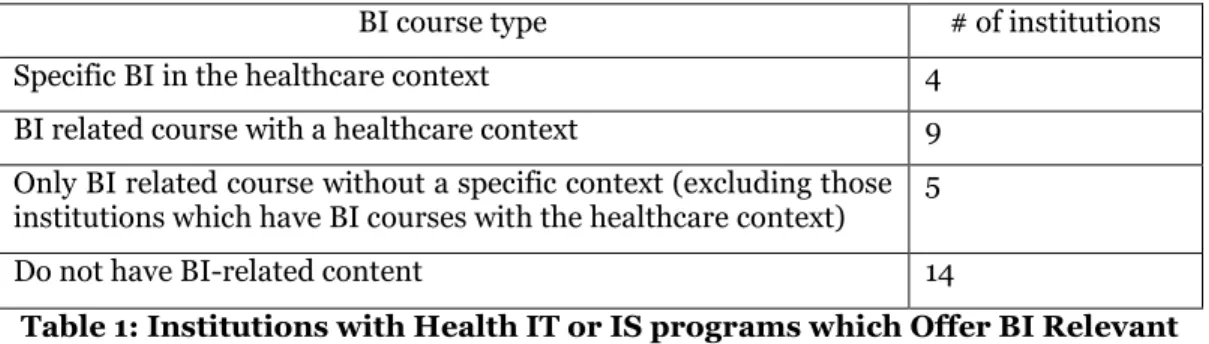
The result indicates a limited effort in the comprehensive BI-HIT education (Table 1). Among the 32 institutions, as of fall 2013, only 4 of them are found to have a specific course covering BI and decision support; only one of them is explicitly related to BI. Nine institutions offer BI related courses in a healthcare context, but the course commonly only cover one component of BI, such as data management, database design, or analysis.
BI course type # of institutions Specific BI in the healthcare context 4
BI related course with a healthcare context 9 Only BI related course without a specific context (excluding those institutions which have BI courses with the healthcare context)
5 Do not have BI-related content 14
Table 1: Institutions with Health IT or IS programs which Offer BI Relevant Courses
The findings showed that BI has not yet become a mainstream in current established HIT curricula, although a number of programs cover some part of BI such as data analysis and data management. Some institutions have shown a good vision on health informatics and BI. They have recognized the missing part in health informatics which is about using data to facilitate the business of delivering healthcare and enable health practitioners make better decisions about patient care and service (College of Coastal Georgia 2011). As informatics and BI are getting their due attention in the industry, education and training should also address the gap in the curricula.
Survey Studies on Student Skill Sets
One integral part of curriculum development is to have a clear understanding of the practical skill sets that students should have when they graduate from the program. There are many survey studies being conducted along this line in the IS field. McMurtrey et al. (2008) investigated the critical skill sets of entry-level IT professionals based on the perceptions from field personnel. Their survey results showed IT professionals perceive both technical and non-technical skills as being important for entry-level IT jobs. BI congress conducted a comprehensive survey on educators, students, and employers regarding the state of BI curriculum in academia (Wixom et al. 2013). This study gave us insight into the important BI skill sets. In September 2013, TEKsystems conducted an online survey of nearly 900 IT leaders in the U.S. and Canada. IT leaders believe that business intelligence/Big Data, security and mobile will have the biggest impact in 2014 (TEKsystems 2014). The survey explored the current state of business intelligence (BI) system deployments among healthcare organizations. On the trend of BI, they investigated the areas in which BI systems are implemented, the challenges of BI system implementation, and which BI positions are hard to hire (Business Wire 2014). However, there is no survey study conducted on the BI skill sets in the context of healthcare. This study is to fill such gap.
Research Questions
The objective of this study is to explore the important skills for an entry-level BI/data analytical job in HIT based on the perceptions of HIT practitioners. In addition to creating rankings of the skills, we also want to investigate if one area of skills (e.g. soft skills) is more important than another area of skill (e.g. technical skills). A good understanding of those skills will be very beneficial to HIT industry and university, especially for those who want to develop BI curriculum in HIT context. This leads to our first two research questions.
What are the important skills for an entry-level BI/data analytical position in HIT?
What are the important skill areas for an entry-level BI/data analytical professional in HIT?
There are a couple of other factors that may impact HIT professionals’ perception on job skills. For example, a manager may rate the skills differently than a software developer. Demographic characteristics, such as age, gender, education, and work experience may also influence the ranking of the job skills. This leads to the next research question.
How do HIT professionals’ demographics and job positions influence their perceptions on the importance of BI skill in HIT?
Research Methodology
Research Design and Status
This study will be conducted in two phases. In phase one, a survey instrument was developed through extensive survey of literatures and reviewed by three field experts and one HIT professional. Then the questionnaire is distributed to a group of professionals in a HIT company for a pilot study and changes are to be made to the instrument based on the survey result. In phase two, the revised survey will be distributed to HIT related groups on LinkedIn, such as HIMSS and AHIMA. The survey will also be sent to multiple HIT companies soliciting for participation. The survey responses including both quantitative and qualitative data will be analyzed and reported.
We are currently in phase one. A survey instrument was developed (see appendix 1) and we are in the process of collecting feedback from the participants. The phase 2 of the study is expected to be completed by the end of spring 2014.
Survey Instrument Development
To address our research questions, a survey instrument was created to collect following information: 1) demographic information; 2) respondents’ perceptions on business intelligence in general; 3) respondents’ perceptions on the needs of BI skill in HIT field; 4) respondents’ perceptions on the importance of BI and other skills; and 5) respondents’ perception on importance of experience of a BI professional in HIT field.
We defined a list of skill sets in the survey by drawing from four literature sources: 1) a conceptual analysis of BI in HIT and survey on BI program in HIT by Zheng et al. 2014; 2) McMurtrey et al. 2008’ survey instrument on entry level IT professional skill sets; 3) Wixom et al. 2013’ survey instrument on business intelligence; (4) Survey by TEKsystems (TEKsystems 2014). The survey also contains open-ended questions that allow participants to enter additional skills they identify as important. The pre-defined skill sets may need to be modified based on the pilot study results.
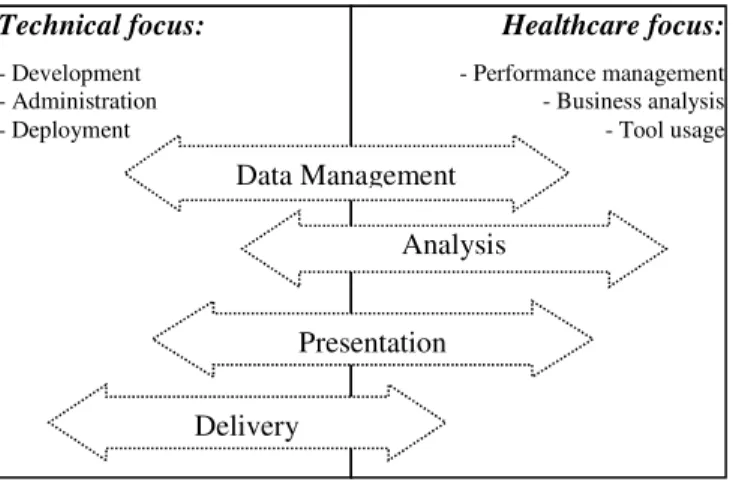
The findings of TEKsystems survey showed four positions in BI are difficult to find - data architects, data analysts, business analysts, and software developers. The job responsibilities and skills needed for these positions provide insight to our survey development. Zheng et al. (2014) conducted a preliminary study focusing on the conceptual analysis of general BI systems and processes, characteristics of BI in healthcare, the industry demand and student survey data. A framework of delivering BI in Healthcare IT was proposed from both technical and managerial perspectives. The framework corresponds to the full spectrum of BI system (data management, analysis, presentation, and delivery) from both technical and healthcare perspectives (as illustrated in Figure 1).
Figure 1: Coverage of BI in an HIT Curriculum (adapted from Zheng et al. 2014)
The framework is used as starting point for skill sets to be investigated. Besides technical skills related to BI, we believe general IT skills, business skills, healthcare skill and soft skills are also important for entry-level BI professionals in the HIT field. The summary of skill sets covered by our survey is listed in table 2.
Discussion
The concepts, principles, tools and applications in business intelligence can help healthcare organizations reduce costs, increase revenue and improve patient safety and outcomes. Lack of BI resources and BI skills are found to be top obstacle to implement BI systems for healthcare organizations. BI education and training need to catch up with this vision. In this paper, we propose to conduct an empirical study on the importance of BI skill sets for an entry-level position based on the perceptions of HIT professionals. Our study is research in progress. The survey instrument was developed and we are currently in the process of conducting a pilot study.
Technical focus: - Development - Administration - Deployment Healthcare focus: - Performance management - Business analysis - Tool usage Delivery Presentation Analysis Data Management
This study, after completion of collecting feedback from HIT professionals, will offer valuable insight into what the critical BI skill sets are in the field of HIT. Our survey results, in particular, will be greatly beneficial to the educators who plan to integrate BI curriculum for HIT programs, HIT professionals who are interested in learning new skills, and HIT industry who is eager to add BI workforce to their organizations to stay more efficient and more competitive.
Skill Category Individual Skills
Technical BI Skills
Data
Management and Integration
Data integration, Data/Database administration, SQL and query
Analysis Data analytics, Data mining, Data modeling, OLAP (dimensional analysis)
Presentation and UI
Data visualization and dashboard, Usability design
Delivery BI application development, Experience of one of the 4 mega BI system (Microsoft, SAP, IBM, Oracle)
General IT Skills Information security, Mobile application/web development, Programming
Business Skills Business analysis, General business knowledge, Requirement engineering
Soft Skills Ability to work in teams, Communication, Creativity, Independent learning, Problem solving
Healthcare Skills Clinical processes and workflows, Clinical/healthcare knowledge, Concepts and terminology of EHR systems, HIT regulations and policies (for example, HIPAA, HITECH, and Meaningful Use rules)
Table 2. Skills for Entry-Level BI Professional in HIT
References
Business Wire. 2014. “More Than Half of Healthcare Organizations Have Yet to Implement Business
Intelligence Systems,” Retrieved from
http://www.businesswire.com/news/home/20140218006132/en/Healthcare-Organizations-Implement-Business-Intelligence-Systems#.UxFVI4UXdXY.
Cardin, L. 2007. The Forrester Wave: Project Portfolio Management Tools, Q4 2007.
College of Coastal Georgia. 2011. Health Informatics: A Simple Definition for a Pile of Information. College of Coastal Georgia - the Magazine, 1(1).
Gartner. 2013. “Gartner Announces Finalists for the North America Gartner Business Intelligence & Analytics Excellence Award 2013,” Retrieved from http://www.gartner.com/newsroom/id/2358418. Graaff, J. V. D., and Cameron, A. 2012. Business Intelligence Perception 2012: A Wave is Coming. KLAS.
Retrieved from http://www.informationweek.com/healthcare/clinical-systems/healthcare-providers-have-big-bi-plans/240000032.
Groves, P., Kayyli, B., Knott, D., & Kuiken, S. V. 2013. The “big data” revolution in healthcare. McKinsey & Company.
Henchey, P. 2013. “The Many Types of Clinical Analytics (Module 3),” Retrieved from http://www.himss.org/ResourceLibrary/ResourceDetail.aspx?ItemNumber=18254.
HITECH. 2009. “HITECH Act Enforcement Interim Final Rule,” Retrieved from http://www.hhs.gov/ocr/privacy/hipaa/administrative/enforcementrule/hitechenforcementifr.html. Madsen, L. B. 2012. Healthcare Business Intelligence: A Guide to Empowering Successful Data Reporting
and Analytics (1st ed.). Wiley.
Manos, D. 2014. “BI adoption pace slowed by skills gap | Healthcare IT News,” Retrieved from http://www.healthcareitnews.com/news/healthcare-slow-get-board-bi.
Martz, B., Zhang, X., & Ozanich, G. 2007. Information Systems and Healthcare XIX: Developing an Integrative Health Informatics Graduate Curriculum. Communications of the Association for Information Systems, 19(1). Retrieved from http://aisel.aisnet.org/cais/vol19/iss1/30.
McMurtrey M. E., Downey J. P., and Zeltmann S. M., 2008, Critical Skill Sets of Entry-Level IT Professionals: An Empirical Examination of Perceptions from Field Personnel, Journal of Information Technology Education Volume 7, 2008.
Negash, S. 2004. Business intelligence. Communications of the Association for Information Systems, 13(1), 177–195.
Olszak, C. M., and Ziemba, E. 2007. Approach to building and implementing business intelligence systems. Interdisciplinary Journal of Information, Knowledge, and Management, 2, 134–148.
Power, D. J. 2007. A Brief History of Decision Support Systems. Retrieved from http://DSSResources.COM/history/dsshistory.html.
Stanley Healthcare. 2013. “Clinical Operations & Workflow | STANLEY Healthcare,” Retrieved from http://www.stanleyhealthcare.com/solutions/clinical-operations-workflow.
Tegarden, D. P. 1999. Business Information Visualization. Communications of the AIS, 1(4).
TEKsystems. 2014. “2014 TEKsystems Annual IT Forecast,” Retrieved from http://www.teksystems.com/~/media/Files/resources/executive-summaries/2014-teksystems-annual-it-forecast.ashx.
Thomas, J. J., and Cook, K. A. 2006. A visual analytics agenda. Computer Graphics and Applications, IEEE, 26(1), 10 – 13. doi:10.1109/MCG.2006.5.
Weber, M. 2013. Rising to the Challenges of Healthcare BI. Slashdot. Retrieved September 21, 2013, from http://slashdot.org/topic/bi/rising-to-the-challenges-of-healthcare-bi/.
Wilson, E. V., and Tulu, B. 2010. The rise of a health-IT academic focus. Communications of ACM, 53(5), 147–150. doi:10.1145/1735223.1735259.
Wixom, B. H., T. Ariyachandra, and J. Mooney 2013. State of Business Intelligence in Academia, BI Congress 3.
Zheng, J., Zhang C., and Li, L. 2014. Bringing Business Intelligence to Health Information Technology Curriculum, SIGCSE 2014.
Appendix 1. Survey Instrument
HIT-BI Industry Survey
Consent Form
The purpose of this survey is to obtain key insights from Health IT (HIT) professionals on Business Intelligence (BI) in HIT. As HIT educators, we would like to know what skill sets are desired by HIT companies so we will be able to better prepare our students for their future careers in the HIT field. The survey may take you less than 10 minutes to complete and your participation is totally voluntary. Your responses will be confidential and we do not collect any identifying information such as your name, email address or IP address. The results of this study will be used for scholarly purposes only.
ELECTRONIC CONSENT: Please select your choice below. Select the "Agree" radio button to indicate that: 1) you have already read the above information; 2) you voluntarily agree to participate; 3) you are at least 18 years of age.
Select the "Disagree" radio button to indicate that you do not wish to participate in this study. Agree
Disagree
In the context of this survey, we view BI as a broad category of applications and technologies that transform data into meaningful and useful information to support business operations, and enable better decision-making. BI covers areas of data management (data warehouse), data integration, data analysis
(OLAP, data mining, etc.), presentation (reporting, visualization, dashboard, etc.), and delivery (BI portal, mobile BI, etc.)
1.What is the name of your company? 2. What’s your gender?
Male Female
3. What’s your age group? <20
20-29 30-39 40-49 50+
4. What’s your highest degree earned? High school
Associate/tech degree (2 year) Some Undergraduate school Undergraduate degree Some graduate school Graduate degree
5. Which of following best defines your position level in your organization? CIO/CTO/Executive
Director/middle management Supervisory/Team Leader Professional (no subordinates)
6. What’s your job function? (Check all that apply) Programmer/developer
Business analyst System analyst
Technical support specialist Network administrator Database administrator Project manager Manager
Other, please specify ____________________ 7. How long have you been working in the IT field?
3-5 years 6-9 years
>=10 years
8. Is your current job related to data management, analysis, or reporting? Not related
Somewhat related Highly related
9. Please indicate your opinion on the following statements. Strongly
disagree
Disagree Neutral Agree Strongly Agree
I don't know
The demand for BI
skills in HIT is
expected to increase
BI is fast growing and
important field in HIT
I’m interested in
learning more about
BI
10. Where did you learn about Business Intelligence? (Check all that apply) From my job
From the classes I took in college From training/workshops
From the Web (news, blogs, online articles, etc.) From my co-workers
Other, please specify ____________________
11. Please indicate your opinion on the following statements regarding the future need and opportunity of BI.
Strongly Disagree
Disagree Neutral Agree Strongly Agree
I don't know
The availability of BI job
opportunities at my
organization will increase in
the future
My organization’s need for
BI skills will increase in the
future
The HIT internship and
co-op co-opportunities at my
organization will increase in
the future.
12. Does your organization currently have HIT internship and/or co-op programs for HIT students? Yes
No
I don't know
13. Please indicate your opinion on the importance of the skills listed below for an entry-level HIT BI related job. The job skills are listed alphabetically.
Very Unimportant Somewhat Unimportant Neutra l Somewhat Important Very Important I don't know
Ability to work in
teams
BI application
development
Business analysis
Clinical processes and
workflows
Clinical/healthcare
knowledge
Communication skill
Concepts and
terminology of EHR
systems
Creativity
Data analytics
Data integration
Data mining
Data modeling
Data visualization and
dashboard
Data/Database
administration
Experience of one of
the 4 mega BI system
(Microsoft, SAP, IBM,
Oracle)
General business
knowledge
HIT regulations and
policies (for example,
HIPAA, HITECH, and
Meaningful use rules)
Independent learning
Information security
Mobile
application/web
development
OLAP (dimensional
analysis)
Problem solving
Programming
Requirement
engineering
Research methods
SQL and query
Usability design
14. Please specify other skills not listed above:
15. Please indicate the importance of the experiences an entry-level BI-HIT job candidate should have. The experiences are listed in an alphabetical order.
Very Unimportant Somewhat Unimportant Neutral Somewhat Important Very Important I don't know
Job experience related
to healthcare or
Healthcare IT
Course projects
Degree programs
related to HIT
General IT
Certifications
HIT certification
(CPHIMS, RHIT,
RHIA, CompTIA,
CHDA, CHTS, etc.)
HIT Internship and job
experience
IT internship and IT job
experience
Workshops/training on
HIT
Course work in HIT
16. Please specify other types of experiences not listed above:
17. Do you have any additional comments or suggestions? Please enter here: