© Turkish Society of Radiology 2009
Sonography of scrotal abnormalities in adults:
an update
İsmail Mihmanl
ı
, Fatih Kantarc
ı
U
ltrasonography (US) is the imaging modality of choice for evalu-ating scrotal abnormalities. Familiarity with US pitfalls, tips, and tricks are essential for establishing the correct diagnosis. The first objective of this pictorial review is to demonstrate newly described con-ditions such as whirlpool sign, fibrosis, benign testicular lobulation, and effect of hydrocele on the testis; and the second objective is to provide current information on common and unusual scrotal abnormalities. In addition, normal anatomy and examination technique of the scrotum with tips are briefly summarized.Normal anatomy and technique
In adults, the normal testes are paired organs with a symmetrical fine echotexture; each testis has a volume of 12–20 cm3 (Fig. 1a). The
epidi-dymis is mostly isoechoic to the testis. The ductus deferens, with a lu-minal diameter of 0.1 mm, is a continuum of the tail of the epididymis. The key feature to identify the ductus deferens is its typical thick smooth muscle wall. Of the appendages, the appendix testis and the appendix epididymis (Fig. 1b) are well seen at US. In contrast to the appendix testis, which is located in the groove between the testis and the epidi-dymis, appendix epididymis is found mostly on top of the epididymal head (1).
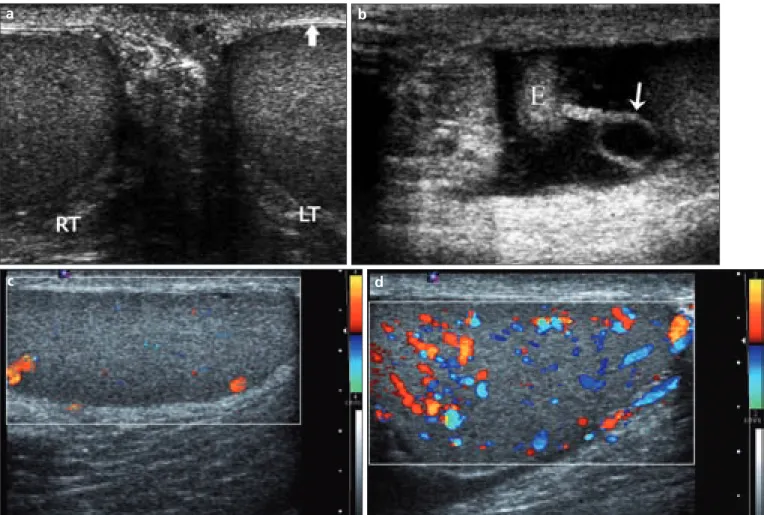
Motion and maladjusted imaging parameters are pitfalls to color Dop-pler imaging of blood flow. To optimize color flow, imaging should be performed with a low wall filter, a low pulse repetition frequency, and a relatively high color gain output setting (Figs. 1c, d). Color priority with some equipments and a small color sampling box may also contribute to the optimization of the color flow image. Power and/or pulsed Doppler imaging as well as comparison with the contralateral testis are especially useful in cases of epididymoorchitis and incomplete testicular torsion. Pulsed Doppler provides a great deal of information about blood flow that is simply not available with color Doppler, particularly in a still im-age. During pulsed Doppler evaluation, changing transducer position is advised whenever beam steering is a problem. In addition, wider sample volume improves the spectral waveform.
Normally in the cord, the testicular artery has low resistance and a mean resistive index (RI) of 0.62, whereas deferens and cremasteric arter-ies have higher resistance (mean RI >0.75). Intratesticular arterial vascu-lar trees also have low resistance, as in the cord.
Acute scrotal pain
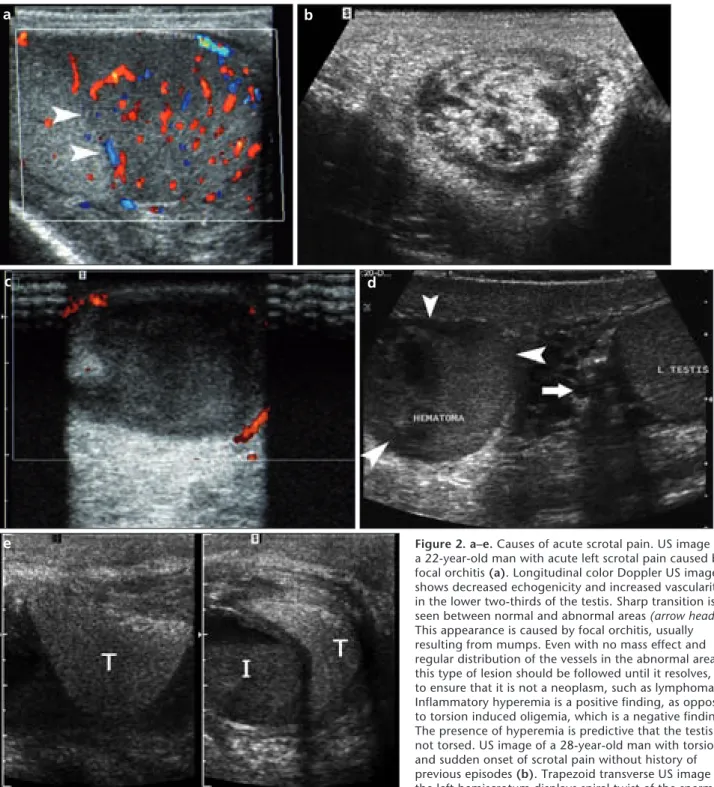
Causes of acute scrotal pain include epididymoorchitis or focal orchi-tis (Fig. 2a), torsed appendix or torsion of tesorchi-tis (Fig. 2b), infarction (Fig. 2c), trauma (Fig. 2d), incarcerated inguinal hernia (Fig. 2e), neoplasm (in 10% of cases) (Fig. 2f), and scrotal wall inflammation (Fig. 2g). The
P I C T O R I A L E S S A Y
Diagn Interv Radiol 2009; 15:64–73
U L T R A S O N O G R A P H Y
From the Department of Radiology (İ.M. mihmanli@ yahoo.com), İstanbul University Cerrahpaşa School of Medicine, İstanbul, Turkey.
Received 1 November 2007; accepted 6 December 2007. ABSTRACT
The purpose of this pictorial review is both to dem-onstrate newly described conditions such as whirlpool sign, fibrosis, benign testicular lobulation, and effect of hydrocele on the testis and to scrutinize usual and unusual scrotal abnormalities to bring the reader up to date. The use of ultrasonography will give the cor-rect diagnosis in most conditions providing that it is used appropriately. Familiarity with the ultrasonogra-phy features of both common and newly described entities is important for the management of scrotal abnormalities.
moved down along the cord, and a ro-tation of the cord structures is looked for. If an acute rotation is seen, it is taken as a positive whirlpool sign.
On pulsed Doppler, peak systolic ve-locity in intratesticular arteries increase 1.7–2.0 fold on symptomatic side in epididymoorchitis (3). The RIs in the testicular artery (<0.5) and epididymal artery (<0.7) decrease. High resistance in the testicular arteries is a clue for developing infarction in epididymoor-chitis or incomplete torsion.
Traumamay increase the risk of tor-sion, lead to epididymoorchitis, or may result in fracture of the testis with or without large hematocele. Parates-ticular coagulum may mimic tesParates-ticular fracture in trauma patients. An
impor-tant question in trauma is the status of tunica albuginea. If it is ruptured, sur-gery is required to maintain testicular viability and to prevent development of antibodies (4). Testicular rupture is a surgical emergency; more than 80% of ruptured testes can be saved if surgery is performed within 72 hours after in-jury. But, in some cases, orchiectomy is the treatment of choice. Other in-dications for US are assessment of the integrity of the epididymis, vascular status, and follow-up of patients un-dergoing conservative therapy.
Complications of acute epididymoor-chitis include chronic pain, infarction, abscess (Fig. 2h), pyocele (Fig. 2i), gan-grene, infertility, and atrophy.
asymptomatic testis should be thor-oughly evaluated first. After US settings are adjusted according to asymptomat-ic side, interpretation of findings of symptomatic side will be easier. Start-ing the spermatic cord examination on the symptomatic side is also important for detection of a twisted cord or whirl-pool sign. The whirlwhirl-pool sign is re-cently described: various appearances of a whirlpool sign are described as a snail, a snail shell (Fig. 2b), a doughnut shape, a target with concentric rings, and a storm on a weather map (2). The whirlpool sign is elicited in the follow-ing manner: When tortuosity of the spermatic cord is seen, a short axis scan of the cord above the level of tortuos-ity is obtained. The transducer is then
Figure 1.a–d. Normal anatomy and techniques. A 35-year-old man with transverse gray-scale US image of both testes (a) through the median
raphe of the scrotum in order to compare the echogenicity of the testes on a single image. Symmetrical homogenous fine granular echo
pattern with detail of the surface of the testes showing hyperechoic lines, tunics (arrow). Transverse axis median raphe view is usually angled
inferiorly on the left due to lower position of the left testis (RT, right testis; LT, left testis). Longitudinal gray-scale US image of the scrotum (b)
in a 23-year-old man. Cystic, long stalked appendix epididymis (arrow) is seen in the minimal fluid between the layers of tunica vaginalis, which
makes easier to detect it (E, epididymis). Cystic appearance of the appendix epididymis is occasionally seen as a normal variant and should
not be mistaken for a torsed testicular appendage. Color Doppler US images of the same testis (c, d) of a 32-year-old man with different US
machine settings and positions. High wall filter, high pulse repetition frequency, and decreased color gain output settings produce scanty color
coding on the testis (c). Instead, using low wall filter, low pulse repetition frequency, and increased color gain output settings in addition to
changing the transducer position to a different location on the surface of the scrotum clearly improves color detection (d). No change of beam
b
a
c
d
Figure 2.a–e. Causes of acute scrotal pain. US image of
a 22-year-old man with acute left scrotal pain caused by
focal orchitis (a). Longitudinal color Doppler US image
shows decreased echogenicity and increased vascularity in the lower two-thirds of the testis. Sharp transition is
seen between normal and abnormal areas (arrow heads).
This appearance is caused by focal orchitis, usually resulting from mumps. Even with no mass effect and regular distribution of the vessels in the abnormal area, this type of lesion should be followed until it resolves, to ensure that it is not a neoplasm, such as lymphoma. Inflammatory hyperemia is a positive finding, as opposed to torsion induced oligemia, which is a negative finding. The presence of hyperemia is predictive that the testis is not torsed. US image of a 28-year-old man with torsion and sudden onset of scrotal pain without history of
previous episodes (b). Trapezoid transverse US image of
the left hemiscrotum displays spiral twist of the spermatic
e
cord at the external inguinal ring, which is diagnostic for torsion, regardless of color Doppler findings in the testis. On this image, the spermatic cord resembles a snail shell, with enlargement and increased echogenicity. On a 28-year-old man with infarcted left
testis due to torsion, longitudinal power Doppler US image (c) shows markedly hypoechogenic, enlarged testis without detectable
blood flow, but peripheral blood flow is seen. Increased blood flow in the wall of the scrotum, tunica vasculosa, is a sign of late period torsion. Most adults with acute scrotal pain have infection, which can also complicate with infarction, rather than torsion that can be intravaginal or extravaginal. Intravaginal torsion, the most common type, is generally associated with a preexisting anomaly of fixation of the testis, termed bell and clapper testis. A 34-year-old man with testicular fracture and acute pain after a
ball hit on the scrotum (d). Gray-scale transverse US image of the right testis shows hypoechoic heterogenous areas with anterior
surface irregularities (arrowheads). All findings are consistent with testicular fracture with intratesticular hematoma needing surgical
emergency. Also notice dilatation (>2 mm) of the paratesticular plexus pampiniformis veins on the left side (arrow). This shows
retrograde flow during deep inspiration (not shown), consistent with varicocele. A 42-year-old man with inguinal hernia and acute
scrotal pain (e). Split transverse (left) and longitudinal (right) gray-scale US images of the left hemiscrotum show bowel with
fluid-fluid level next to the medial side of the testis, which is distorted by compression but otherwise normal. No peristalsis was seen during real-time examination, which supported the diagnosis of incarcerated hernia (T, testis; I, intestine). Inguinal hernia can be divided into indirect hernia, which is lateral to the inferior epigastric vessels and seen in the scrotum through the inguinal canal, and direct
Scrotal masses
The primary function of US in the diagnosis of a testicular mass is to dis-tinguish intratesticular from
extrates-ticular location because the majority of extratesticular masses are benign, but intratesticular ones are malignant (5). US does not offer the histologic
diagnosis. Gray-scale US is extremely sensitive for detection of testicular masses.
g
h
i
Figure 2 (continued). f–i. A 32-year-old man with a testicularneoplasm who presented with scrotal pain without fever (f).
Color Doppler longitudinal US image of the left testis shows a relatively small hypoechoic area with a large feeding vessel
(arrowhead) in the lower third of the testis. Also notice limited microlithiasis (arrow). The lesion was identified by histopathology as a seminoma, the most frequent testicular germ cell tumor. Ten percent of testicular neoplasms present with acute symptoms caused by hemorrhage into the lesion. A 30-year-old man with scrotal wall cellulitis (g). Transverse gray-scale US image of the scrotum. On this trapezoid image, which shows larger areas than can be seen on a linear image, the anterior portion of the scrotal septum shows markedly hypoechoic areas with wall thickness and increased blood flow (increased blood flow not shown). Scrotal wall cellulitis may lead to scrotal abscess. Otherwise both testes and paratesticular areas are normal (RT, right testis; LT, left testis). A 36-year-old man with a palpable mass and persistent pain in the
right hemiscrotum (h). Trapezoid gray-scale longitudinal image
reveals an ectophytic bilobed markedly hypoechoic lesion in the tail of the epididymis in addition to enlargement and hypoechogenicity of the other parts of the epididymis (epididymitis). The patient had a history of acute scrotal pain. But persistent pain with palpable lesion suggests epididymal abscess formation as a complication of epididymitis. Patients with predominant involvement of the tail are diagnosed clinically, therefore, less frequently require imaging studies for definitive diagnosis. Otherwise, infection is routinely spread in the order of deferentitis,
epididymitis (tail through body via head) and orchitis if untreated. A 34-year-old man with pyocele as a complication of epididymoorchitis (i).
Trapezoid gray-scale longitudinal US image of the left hemiscrotum displays multiseptated fluid collections between parietal and visceral layers of the tunica vaginalis. Fluid is relatively hypoechoic because of pus accumulation. Chronic hydrocele can mimic pyocele.
Cysts and cyst-like lesions
Tubular ectasia of the rete testis is a benign condition and seen as fluid-filled tubular structures at the level of the mediastinum. Intratesticular reten-tion cysts are also situated near the mediastinum (Fig. 3a). Although in-tratesticular retention cysts and intra-testicular spermatoceles cannot be dif-ferentiated on US, intratesticular sper-matocele communicates with the sem-iniferous tubules; this is unlike other cysts or ectasia of the rete testis, which do not communicate directly with the seminiferous tubule on histopathol-ogy (6). Spermatocele and simple cysts in the epididymis are encountered in
most adults (Fig. 3b). Spermatocele is similar to cysts elsewhere, but it con-tains low-level echoes or can be septat-ed. Clinically, differentiation of these two entities is not important. In typical cases, epidermoid cysts show a charac-teristic pattern of concentric layers of rings. The center is totally avascular, and any vascularity within the lesion excludes the diagnosis. But this is not always observed. Furthermore, most epidermoid cysts are intratesticular le-sions in young men. The true reason for recognizing the lesion preopera-tively is that in such cases, testis-spar-ing surgery (employtestis-spar-ing intraoperative ultrasound assistance) should be
con-sidered as a treatment option. Cysts of the tunica albuginea may bulge into the testis or out into the paratesticular space (Fig. 3c).
Intratesticular neoplasms
Most palpable intratesticular lesions are neoplasms, and most nonpalpable lesions (>1 cm) are not neoplasms. Le-sions smaller than 1 cm may be non-palpable neoplasms or benign lesions (Fig. 4). The presence of abnormally increased flow within testicular neo-plasms depends on their size rather than their cell type. Masses larger than 1.5 cm are more likely to have demon-strable flow (7). In general, color or
Figure 3.a–c. Longitudinal color Doppler US image
(a) of a 55-year-old man with negative tumor markers
and a nonpalpable, mildly complex cyst in the right testis. A cyst including septations, located next to the mediastinum, may result from a stricture in the rete testis from previous trauma or inflammation. A cyst within the testis generally fulfills the criteria of any simple cyst: smooth contour, anechoic center without solid elements, and enhancement through transmission. In this case, a tumor such as teratoma or intratesticular spermatocele should be in the differential diagnosis. Also notice minimal hydrocele
and the transmediastinal artery (arrow), which are
seen unilaterally in 50% of cases and bilaterally in 25%, accompanying the transmediastinal vein
(arrowhead), which is visible in 25% of cases, through the mediastinum within the testis. Longitudinal
gray-scale US image (b) of a 36-year-old man with
a simple cyst in the right epididymal tail and fibrosis of the testis. A small simple cyst is detected in the tail of the epididymis (arrow), consistent with an
b
a
c
epididymal simple cyst instead of spermatocele (a cyst containing echoic particles [dead sperm] and located in the head of the epididymis is generally referred to as spermatocele.) Epididymal simple cysts can be single or multiple, very tiny, and situated in every part of the epididymis.
Also notice the hypoechoic striations in the testicular parenchyma (arrowheads) radiating toward the mediastinum (not in the image plane),
consistent with fibrosis. This condition can be misdiagnosed as tumors if these areas become more confluent. Scanning another plane will overcome this pitfall. A 35-year-old man with a firm small palpable nodule which moves with the testis during the physical examination in the
right hemiscrotum (c). Trapezoid, longitudinal color Doppler US image reveals a small, solitary unilocular simple cyst in the tunica of the testis
pulsed Doppler is not necessary for de-tection of intratesticular tumors. Dis-tortion of the normal vessel course is more likely found in neoplasms than in inflammation. Intratesticular neo-plasms can be divided into primary germ cell tumors, other primary tu-mors, and secondary tumors. Malig-nant germ cell tumors constitute 90% to 95% of intratesticular primary
neo-plasms. Germ cell tumors are divided into seminomas (Fig. 2f) and nonsemi-nomatous tumors, including burned-out germ cell tumors (Fig. 5a). Burned-out germ cell tumors occur secondary to rapid tumor growth, resulting in oc-clusion of blood supply and subsequent tumor regression. When present, nodal metastases help confirm the presence and stage of a tumor. Whenever
retro-Extratesticular neoplasms
If the lesion is limited to the epidi-dymis, the differentiationcan easily be made. But, if the lesion originates from the tunica of the testis, differentiation can be difficult (Fig. 5b). Most extrat-esticular neoplasms are benign adeno-matoid tumors (9). Other rare extrates-ticular masses are lipoma/liposarcoma, fibrous pseudotumor, papillary benign mesothelioma, and sperm granuloma.
Hydrocele
A hydrocele is an abnormally large collection of fluid between layers of tunica vaginalis and is the most com-mon cause of painless scrotal swelling.
Figure 4. A 54-year-old man with a lipoma in the left testis. Transverse gray-scale US image
reveals an incidentally found, 4-mm, markedly hyperechoic, well-demarcated solid lesion in
the parenchyma (arrow). It was not palpable, and tumor markers were negative. Color Doppler
examination (not shown) revealed little vascular coding at the periphery of the lesion (RT, right testis; LT, left testis).
a
b
Figure 5.a, b. Testicular tumors. US image of a 28-year-old man with biopsy-proven retroperitoneal extragonadal germ cell nodal metastases
and burned-out tumor in the left testis; scrotum felt normal on physical examination (a). Trapezoid, gray-scale US image reveals small calcific
clusters with hypoechogenic rim in the testis (arrows). Notice also minimal hydrocele. Burned-out germ cell tumor occurs secondary to rapid
tumor growth and results in the occlusion of blood supply itself and subsequent tumor regression. US image of a 45-year-old man with a
one-month history of a right scrotal mass (b). Transverse gray-scale US image reveals a homogeneous, hypoechoic, 7.9 × 5.3 mm solid lesion on
the anterior surface of the testis (between calipers) (RT, right testis). The lesion was surgically proven to be an adenomatoid tumor of the tunica
vaginalis. Association of the mass with the testis can be determined by pushing the testis during real-time examination. In this situation, the mass will remain at its original location while the testis is displaced.
Until recently, the effect of hydrocele on the testis was poorly understood; it was thought that hydrocele needed no treatment except for cosmetic rea-sons or patient request. Butidiopathic hydrocele may cause testicular enlarge-ment and increased vascular resistance
in the intratesticular arteries (Fig. 6). Hence, it may beassociated with infer-tility by interfering with spermatogen-esis. Increase in testicular volume and increased vascular resistance are ex-plained by an increase in impedance to venous and lymphatic flow (10).
Infertility
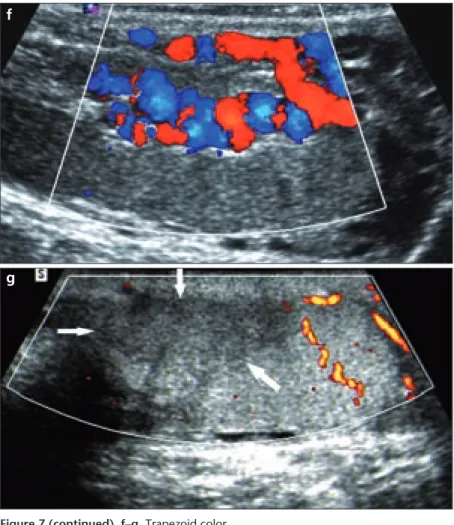
Ultrasonography is used to evaluate testicular location (Fig. 7a), size and appearance of testicular parenchyma, contour abnormalities (Fig. 7b) and epididymis (Figs. 7c, d), presence of initial varicocele (intra- or extratesticu-lar) (Figs. 7e, f), and any postoperative complications (Fig. 7g). Agenesis or partial agenesis of the epididymis and ductus deferens can be evaluated by ul-trasound. In such cases, additional im-aging of the seminal vesicles, prostate, bladder, ureterovesical junctions, and kidneys is essential for full evaluation of developmental abnormalities.
Approximately 80% of undescended testes are located within the inguinal canal. Sonography is especially useful for identifying testes in the inguinal canal. Evaluation of mediastinum is sometimes important to differenti-ate testes from lymph nodes. Intraab-dominal testes occur in the retroperi-toneum from the level of the kidneys to the internal inguinal ring (11). Magnetic resonance imaging can be helpful in detection of intraabdominal testes. If orchiopexy is not performed in childhood (possibly before 5 years of age, and certainly before puberty), the undescended testis is usually ster-ile or hypospermic and atrophic (12). The incidence of malignancy, mostly seminoma, is 2.5 to 8 times as great in the undescended testis as in the gen-eral population (greater increase with increased distance from the scrotum) (12). Because of the increased risk of malignancy in the undescended testis, even after orchiopexy and in the con-tralateral testis, it would be reasonable to use US as a screening test, although detection of tumors can sometimes be difficult in hypoplastic testis due to isoechogenicity (hypoechoic lesion in hypoechoic testis).
Benign testicular lobulation may be an idiopathic embryologic variant (13) or may develop after orchiopexy as a consequence of fibrosis (14). A contour abnormality onphysical examination is not always indicative of malignancy. In this situation, sonographyis helpful for excluding testicular lesions.
Varicocele may be extratesticular or intratesticular; intratesticular varicocele is rare and is usually found with extrat-esticular varicocele (15, 16). The size of the veins in varicocele is measured at rest and during Valsalva maneuver. US criteria for diagnosis of varicocele are
a
b
Figure 6.a, b. Hydrocele. Doppler US images (a, b) from a 45-year-old man with right
hydrocele. Pulsed Doppler US image of the testis before hydrocelectomy (a) shows a resistive
index (RI) value of 0.74. Pulsed Doppler US of the same testis 4 months after hydrocelectomy
(b) displays decreased RI (0.57). In addition, testis volume decreased after hydrocelectomy
the largest plexus pampiniformis vein measured more than 2 mm in diameter in supine position or more than 3 mm in diameter in standing/semierect posi-tion and/or more than 1 mm increase in size of the largest vein during Val-salva on gray-scale examination and/or more than 2-s retrograde flow during
Valsalva maneuver on color Doppler US (7). A combination of the first and the second or the first and the third criteria are used. However, the pres-ence of venous reflux should be deter-mined by color Doppler US (reflux in seconds). Varicocele can also be graded as follows: grade 1, slight reflux (<2 s)
during Valsalva; grade 2, reflux (>2 s) during Valsalva, but no continuous re-flux during the maneuver; and grade 3, reflux in rest during normal respira-tion or continuously during the entire Valsalva maneuver (7). Recurrence of varicocele is diagnosed with presence of reflux on color Doppler US. In the
Figure 7.a–e. Causes of infertility. Trapezoid, longitudinal
power Doppler US image (a) from a 20-year-old man with an
undescended left testis; testis is seen next to the internal inguinal ring, anterior to the proximal segment of the external iliac vessels. Testis is small and hypoechogenic in appearance with
little perfusion (arrows) on power Doppler sonography (opposite
side was normal and is not shown) (EIA, external iliac artery; EIV,
external iliac vein). Color Doppler US image (b) from a
30-year-old man with a painless contour abnormality (benign testicular lobulation) of the left testis. Longitudinal color Doppler US image
of the testis reveals the lobulated contour (arrowheads) on the
superioraspect of the testis, but otherwise normal appearance.
Symmetrical vascular distribution was detected on both testes on color Doppler imaging (not shown). Patient had a history of orchiopexy in his childhood. A 28-year-old man seeking treatment for infertility after 3 yearsof normal sexual intercourse (with hypoplastic left epididymis) (c, d). Longitudinal
gray-scale US images (c, d) of epididymis on both sides. Normal
e
right epididymis (c) and partially hypoplastic left epididymis (tail) (d). Right epididymis has a head (thick arrow), body (thin arrows), and tail
(arrowhead) isoechoic to the testis, situated on the superior and posterolateral aspect of the testis. But left epididymis consists of head (thick arrow), and body (thin arrows). Both parts are isoechoic and located on the superior and posterolateral aspect of the testis. The tail (globus
minor) of the left epididymis is not present (asterisk). US images of a 31-year-old man with intratesticular varicocele, seeking treatment for
infertility after 2 yearsof normal sexual intercourse (e, f). Trapezoid, longitudinal gray-scale US image (e) shows dilated intratesticular tubular
Figure 7 (continued). f–g. Trapezoid color Doppler US image (f) displays these are intratesticular vessels, confirming varicocele rather than tubular ectasia of the rete testis. Pulsed Doppler confirmed the diagnosis (not shown). A 34-year-old man with left scrotal pain and focal infarct in the testis after
varicocelectomy (g). Longitudinal trapezoid
power Doppler US shows an infarcted area in the anterosuperior portion of the testis that is
hypoechoic with no perfusion (arrows). Focal
infarct is not a frequent cause of acute scrotal pain, but it is not uncommon after inguinal surgery, especially hernia operation. It can also occur after a varicocele operation, as in this case.
f
g
b
a
Figure 8.a, b. Microlithiasis. A 26-year-old man
with microlithiasis, seeking treatment for infertility after 1.5 yearsof normal sexual intercourse (a). Trapezoid longitudinal color Doppler US shows classic microlithiasis with numerous fine (<2 mm), bright, nonshadowing hyperechoic foci that are uniform in size and are distributed in a diffuse pattern on this single slice. Notice also twinkle artifact (arrow)
behind a microlith. A 27-year-old man with limited testicular microlithiasis (b). Trapezoid, longitudinal gray-scale US image shows fewer than 5 microliths in the testis (arrows), classified as limited microlithiasis. Microliths can also be clustered at the periphery of the testis. Limited microlithiasis is regarded as a benign condition.
elderly, it is essential to look for sec-ondary varicoceles (secsec-ondary to retro-peritoneal disease processes), particu-larly in men with newly developing varicoceles.
Testicular microlithiasis
Testicular microlithiasis (TM) may be described as classic (Fig. 8a) or limited (Fig. 8b) based on the presence of five or more microliths on one or more im-ages of the testes (17). Its association with tumor development is controver-sial.
The etiology of TM is unknown, though an association with Sertoli cell dysfunction and an anomaly in the LKB1 gene, which maps the 19p13.3 chromosome, have been hypothesized to be responsible for TM (18). TM can be associated with several conditions, such as undescended testis, alveolar microlithiasis, congenital urethroperi-neal fistula, and Klinefelter syndrome. They are more common in patients with oligospermia. Men with TM, es-pecially classical form, are at increased risk of developing germ cell tumors, particularly seminoma (7); the risk is small but not clearly quantified. Yearly
Cystic appendix epididymis: a sonomor-phologic study. Surg Radiol Anat 2005; 27:557–561.
2. Vijayaraghavan SB. Sonographic differen-tial diagnosis of acute scrotum: real-time whirlpool sign, a key sign of torsion. J Ultrasound Med 2006; 25:563–574.
Med 2003; 22:303–305.
10. Mihmanli I, Kantarci F, Kulaksizoglu H, et al. Testicular size and vascular resistance before and after hydrocelectomy. AJR Am J Roentgenol 2004; 183:1379–1385. 11. Aso C, Enriquez G, Fite M, et al.
Gray-scale and color Doppler sonography of scrotal disorders in children: an update. RadioGraphics 2005; 25:1197–1214.
ysis of prevalence and associated tumor. Radiology 2002; 224:425–428.
18. Backus ML, Mack LA, Middleton WD, King BF, Winter TC 3rd, True LD. Testicular microlithiasis: imaging appearances and pathologic correlation. Radiology 1994; 192:781–785.