Biola University
Biola University
Digital Commons @ Biola
Digital Commons @ Biola
Faculty Articles & Research
2019
Performance Attribution of the First Biblically Responsible-based
Performance Attribution of the First Biblically Responsible-based
SRI Index
SRI Index
Shane Enete
Biola UniversityFollow this and additional works at: https://digitalcommons.biola.edu/faculty-articles Part of the Finance and Financial Management Commons
Recommended Citation
Recommended Citation
Enete, Shane, "Performance Attribution of the First Biblically Responsible-based SRI Index" (2019). Faculty Articles & Research. 394.
https://digitalcommons.biola.edu/faculty-articles/394
This Article is brought to you for free and open access by Digital Commons @ Biola. It has been accepted for inclusion in Faculty Articles & Research by an authorized administrator of Digital Commons @ Biola. For more
1,600 1,600 1,400 1,400 1,:200 1,:200 1,000 Index.mutual -1,000
"'
000 000~
600 600 cri 400 400 ;j :200 200 0 0 0!
-:200 -200 !!I -400 -400 -600 -600 -800 -800 -1,000 -1,000 -1,:200 -1,200 '2001 :lOOl '2009 2010 2011 20,2 2013 2014 2015 20·5 ~ - .,_.,,.,.,,~,rtvriu.;s.nfint 0.-Sta..Nofl. US. domedcitql,lf)-lundll; 2CU6,...•ol 111:r.114
SUSTAINABLE INVESTING GROWTH IN THE UNITED STATES (lllLIONS) 2005·2018
SUSTAINABLE INVESTING GROWTH SINCE 2014 33%
•
1110 INCORPOltAllOH ■··-"'
_,. 8 VJ ::, 0 ,§ iliBiblically-based
SRI
Index
S
hane
E
nete
, CFA
Biola University
Working Draft
Abstract
In the U.S., two of the most important investment trends over the last 10 years have been the rise of index investing and the rise of Sustainable, Responsible and Impact (SRI) investing. So, it would make sense that new indexes would emerge based on SRI principles. One such index is the new Inspire Small/Mid Cap Impact Equal Weight Index, which is the frst biblically-based SRI index. This paper briefy discusses the methodology of this index and shows that its strong back-tested risk-adjusted returns (relative to its non-SRI S&P benchmark), are not due to sector bias (as one would expect), but are attributed to favorable stock selection within each industry sector. This index is likely the beginning of a wave of more sophisticated passive products that will meet the needs of niche investor populations better than the active products of the past.
I. I
ntroduction
I
nthe U.S., two investment trends have beendramatic over the last 10 years: • the rise of index investing, and
• the rise of Sustainable, Responsible and Impact (SRI) investing
As of 2016, fows from active to index funds have surpassed one trillion dollars and SRI In-vesting has achieved $9 trillion of assets under management (see Figures 1 and 2)1.
So, it would make sense that these two trends would collide and new SRI indexes would emerge. One such index is the Inspire Small/Mid Cap Impact Equal Weight Index. This index has a unique faith-based construc-tion that has performed well relative to its non-SRI S&P benchmark. This is likely the beginning of a new breed of indexes that will serve niche investors better than previous ac-tive products of the past.
1Sources: Figure 1: Mauboussin, Michael, J., Dan
Calla-han, and Darius Majd, “Looking for the Easy Game,” Credit Suisse, 2017, Figure 2: U.S. SIF Foundation
Figure1:Index investing has grown dramatically at the expense of active investing.
Figure2:SRI investing has grown dramatically to just under $9 billion of AUM as of 2016.
Performance Attribution of Inspire BRI Index •working draft
II. I
ndex
construction
Unlike most existing SRI indexes2, this in-dex focuses on small-to-medium companies, weighting its index constituents equally3.
In addition, this is the frst passive SRI prod-uct that explicitly ties the constrprod-uction of its in-dex to a biblically-based worldview, in particu-lar, a reformed, non-denominational Christian worldview that emphasizes traditional Biblical views on all environmental, social and gover-nance issues.
Although applying a Christian worldview to active investing products has been done for more than 100 years4, this is the frst passive index based on “Biblically Responsible Invest-ing” (BRI) principles to be introduced to the fnancial markets.
The Inspire index is constructed using an Im-pact Scoring methodology that essentially over-weights companies that are aligned with bibli-cal values and excludes companies that are not aligned with biblical values.
Companies with a high Impact score may have one or more of the following characteris-tics:
• inspiring primary business activity that uplifts society
• positive environmental policies
• support biblical values through philan-thropy
• operate with a perceived high level of in-tegrity
Companies that have a low Impact Score would likely be involved in the enabling of cer-tain types of activities that are contrary to what the Bible says will enable human fourishing, such as abortion, pornography, labor abuse, non-traditional family values, and gambling.
2For example: MSCI's KLD 400 Social Index, FTSE's
4Good Index Series, Calvert's Social Index, Dow Jones'Sustainability Index
3Chow et al., (2011), found a signifcant improvement in
returns when equally-weighting an index (versus market-cap weighting)
4During the late 1800s, the Quakers and the Methodists
followed investment practices that prohibited investing in companies that were involved in slavery, smuggling and conspicuous consumption
III. P
erformance
i. Risk-adjusted Returns
Probably the biggest criticism of SRI investing is that constructing a portfolio from a restricted universe of opportunities will impose too great a cost on the portfolio's risk-adjusted returns, relative to their unrestrained counterparts. In other words, when trying to “do good,” there will be too heavy a cost on the portfolio.
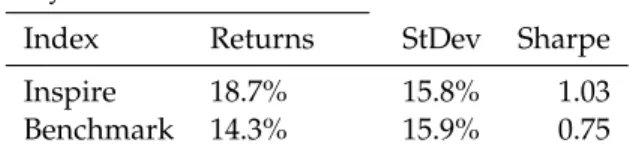
When looking at the Inspire Small/Mid Cap Impact Equal Weight Index, early indications show a possible positive risk-adjusted perfor-mance beneft when using Inspire's Impact Scoring methodology to construct their index. From 2012 to 2016, the Inspire index outper-formed an equally weighted 50/50 blend of the S&P 400 and S&P 600 by over 4%, on an annualized basis, while maintaining a similar standard deviation.
Table1:Risk-adjusted Performance
5-year annualized returns
Index Returns StDev Sharpe
Inspire 18.7% 15.8% 1.03
Benchmark 14.3% 15.9% 0.75
This back tested performance result is not inconsistent with many academic studies over the years, which have shown that there is ei-ther a neutral or small beneft to risk-adjusted performance when adding different types of SRI criteria to the managing of an investment product.5
ii. Attribution
Another signifcant criticism of SRI investing is that sector bias is really what drives the perfor-mance. DiBartolomeo and Kurtz [1999] demon-strated that the positive outperformance of one of the oldest SRI indexes, the Domini 400 Social
5Revelli, C. and Viviani, J.-L. (2015), Stone et al. [2002],
Hamilton, Jo, and Statman [1993], Guerard [1997], Gol-dreyer, Ahmed, and Diltz [1999], and Bauer, Koedijk, and Otten [2005] provide similar evidence
index, was largely due to economic and sector exposures that are the result of the screening process itself.
It would make sense that certain sectors, like oil and gas, would naturally “screen them-selves out” of most SRI indexes looking to protect the environment. So, given the possibil-ity of sector biases embedded in SRI products, should it be assumed that any outperformance relative to a benchmark is simply due to large “sector bets” that happen to go in the favor of
the SRI index?
When conducting a performance attribution on the Inspire index relative to the S&P bench-mark, there is no evidence that sector bets con-tributed to the outperformance.6
Table2:Performance Attribution
5-year annualized alpha
Category Alpha
Total Alpha 4.2%
Sector Weighting Effect -0.5% Security Selection Effect 4.7%
In fact, according to the data summarized in Table 2, sector bets were a drag on relative per-formance (-50 basis points) while security se-lection within each sector was the primary rea-son for the strong relative performance of the Inspire Small/Mid Cap Impact Equal Weight Index relative to the equally weighted 50/50 blend of the S&P 400 and S&P 600 (+470 basis points).
IV. C
onclusion
Given the continued popularity of both pas-sive index and SRI investing, new SRI indexes will likely proliferate during the next couple of years. The creation of the Inspire Small/Mid Cap Impact Equal Weight Index is the begin-ning of a wave of more sophisticated passive products that will better meet the needs of niche investor populations (e.g., faith-based in-vestors) than the high-fee active products of the past.
6Using the BHB model for attribution (Brinson, Hood,
and Beebower, 1986). GICS sectors were used for the S&P benchmark; However, for the Inspire index, the sectors were frst determined using The Industrial Classifcation Benchmark (ICB) sectors and then they were unoffcially mapped to a GICS sector manually. An “Other” sector was used, which primarily represents the Real Estate sector, which was carved out of the S&P Financials sector during September of 2016. The small difference in alpha between tables 1 and 2 (4.4% vs. 4.2%) is due to rounding errors associated with the attribution methodology
R
eferences
[Bauer, Koedijk, and Otten, 2005] Bauer, Rob, Kees Koedijk, and Roger Otten (2005). “In-ternational Evidence on Ethical Mutual Fund Performance and Investment Style.”
Journal of Banking and Finance, 29-7 (2005), pp. 1751-1767. (as cited in Milevsky et al., 2006).
[Brinson, Hood, and Beebower, 1986]
Brinson, Gary P., L. Randolph Hood, and Gilbert L. Beebower. (1986). “De-terminants of Portfolio Performance,”
Financial Analysts Journal, vol. 42, no. 4 (July/August):39:44.
[Chow et al, 2011] Tzee-man Chow, Jason Hsu, Vitali Kalesnik, and Bryce Little (2011). “A Survey of Alternative Equity Index Strategies” FAJ, Volume 67,5, 2011 [DiBartolomeo and Kurtz, 1999]
DiBartolomeo, Dan, and Lloyd Kurtz (1999). “Managing Risk Expo- sures of Socially Screened Portfolios.” North-feld Information Services. (as cited in Milevsky et al., 2006)
[Goldreyer, Ahmed, and Diltz, 1999]
Goldreyer, Ahmed, and Diltz (1999). “The Performance of Socially Responsible Mutual Funds: Incorporating Sociopolit-ical Information in Portfolio Selection”
Managerial Finance, 25-1 (1999), pp. 23-3. (as cited in Milevsky et al., 2006).
Performance Attribution of Inspire BRI Index •working draft
[Guerard, John B., Jr., 1997] Guerard, John B., Jr. (1997). “Is There a Cost to Being So-cially Responsible in Investing?” TheJour-nal ofInvesting, 6-2 (1997), pp. 11-18. (as cited in Milevsky et al., 2006).
[Hamilton, Jo, and Statman, 1993] Hamilton, Sally, Hoje Jo, and Meir Statman (1993). “Doing Well While Doing Good? The Investment Performance of Socially Responsible Mutual Funds.” Financial Analysts Journal, 49(6) (1993), pp. 62-66 [Milevsky et al., 2006] Milevsky, Moshe,
An-drew Aziz, Allen Goss, Jane (Thom-son) Comeault and David Wheeler (2006). “Cleaning a Passive Index” Journal of
Port-folio Management, Spring 2006:110-118. [Revelli, C. and Viviani, J.-L., 2015] Revelli, C.
and Viviani, J.-L. (2015). “Financial per-formance of socially responsible invest-ing (SRI): what have we learned? A meta-analysis.” Business Ethics: A European Re-view, 24: 158:185. doi: 10.1111/beer.12076. [Stone et. al, 2002] Stone, Bernell K., John B. Guerard, Jr., Mustafa N. Gultekin, and Greg Adams (2002). “Socially Responsible Investment Screening: Strong Evidence of No Signifcant Cost for Actively Man-aged Portfolios” Working paper, Marriott School of Finance, Brigham Young Univer-sity, October 2002. (as cited in Milevsky et al., 2006).