Approved by Faculty Council 2007 November 28
and by the Senate Committee on Undergraduate Studies 2007 December 20 Introduction
The Faculty of Engineering recently restructured all its undergraduate programs into a new curriculum for the classes of 2013 and later. These changes were approved by Senate in June, 2006. As well as shortening the programs from 10 academic to 8 academic terms, a major focus of the new curriculum of the Electrical Engineering and Computer Engineering programs is the redesign of the stream of project courses associated with engineering design (a curriculum component defined by the Canadian Engineering Accreditation Board (CEAB) accreditation process). These project-oriented, design-heavy courses are mostly contained in the last 3 academic terms (terms 6 to 8) of the programs.
In this document, a proposal is outlined for modifications to the existing Electrical Engineering and Computer Engineering programs. The intent of these modifications is to provide a transition from the existing programs, for the classes of 2012 and earlier, to the new programs, which begin for the class of 2013. Most significantly, these transition programs are aimed at updating the project stream of courses to be similar to the structure in the new curriculum for the classes of 2013 and later. The proposed transition programs will only affect academic terms 6 to 8, starting for term 6 in the fall 2008, and will be applicable to the classes of 2010, 2011, and 2012 only.
There are two principal motivations for the creation of the transition programs. The first motivation is that, while it is believed that the new project-oriented curriculum will be a significant enhancement over the existing curriculum, it is several years before the curriculum will take effect. Since it is possible to move ahead with many of the improvements earlier with the transition programs, it is desirable to do so. The second motivation relates to the accreditation process for the engineering programs. Instituting the project-oriented curriculum early, before the full new curriculum, will give an opportunity to phase in aspects of the new curriculum. Such a phasing-in will enable the Faculty to effectively "iron out the kinks" prior to the first accreditation visit for the new curriculum, expected in 2013. Note that the transition programs fully satisfy the accreditation AU analysis requirements (as indicated in the accreditation summary contained in the Appendix) and, in fact, strengthen many of the subjective aspects of the accreditation process, particularly with respect to improved engineering design and project components.
The proposed new transition programs are applicable to the following programs: (1) Electrical Engineering (General Option)
(2) Electrical Engineering (Offshore Oil and Gas Engineering option) (3) Computer Engineering (General Option)
In the following two sections, a detailed description and rationale of the changes is provided, followed by the curriculum charts for the new programs.
Description of Changes
Electrical Engineering
Term 6
• Delete ENGI 6806 "Project Design Labs"
• Add ENGI 5800 "Electrical Engineering Design" Term 7
• Delete ENGI 7800 "ECE Design Project I" (1 credit hour)
• Add ENGI 7803 "Electrical Engineering Design Project I" (3 credit hours) • Move ENGI 7844 "Power System Analysis" from list of required courses to list
of technical electives
• Update the list of technical electives to be ENGI 7844, 7846, 7855, 7944, 8680, 8879, and 8806-8809
Term 8
• Delete ENGI 8800 "ECE Design Project II"
• Add ENGI 8853 "Electrical Engineering Design Project II"
• Update the list of technical electives to be ENGI 5865, 7680, 7811, 8821, 8845,
and 8806-8809
• Add free elective choice
Electrical Engineering (Offshore Oil and Gas Engineering Option)
Term 6
• Delete ENGI 6806 "Project Design Labs"
• Add ENGI 5800 "Electrical Engineering Design"
• Delete ENGI 6601 "Introduction to Offshore Petroleum Engineering" • Add ENGI 6602 "Offshore Petroleum Geology and Technology" Term 7
• Delete ENGI 7601 "Geosciences Applied to Offshore Engineering" • Delete ENGI 7680 "Supervisory Control and Data Acquisition" • Add ENGI 8680 "Process Control and Instrumentation"
• Move ENGI 7844 "Power System Analysis" from list of required courses to list
of technical electives
• Add ENGI 7650 "OOGE Project I"
• Add technical elective choice of ENGI 7844, 7846, 7855, 7944, 8671, 8692,
8879, and 8806-8809
Term 8
• Delete ENGI 8680 "Process Control and Instrumentation" • Add ENGI 7680 "Supervisory Control and Data Acquisition"
• Update the list of technical electives to be ENGI 8670, 5865, 7811, 8821, 8845,
and 8806-8809
Computer Engineering
Term 6
• Delete ENGI 6806 "Project Design Labs"
• Add ENGI 7893 "Software Engineering" Term 7
• Delete ENGI 7800 "ECE Design Project I" (1 credit hour)
• Add ENGI 7804 "Computer Engineering Design Project I" (3 credit hours)
• Delete ENGI 7863 "Operating Systems and File Organization"
• Delete ENGI 7893 "Software Engineering"
• Add ENGI 7894 "Concurrent Programming"
• Update the list of tech. elect. to be ENGI 7855, 7858, 7944, 8680, 8879, 8801-8805 Term 8
• Delete ENGI 8800 "ECE Design Project II"
• Add ENGI 8854 "Computer Engineering Design Project II"
• Add ENGI 8894 "Real-time Operating Systems"
• Move ENGI 8879 "Digital Communication" from list of required courses to Term 7 technical electives
• Update the list of technical electives to be ENGI 7680, 7814, 8821, 8826, 8863,
and 8801-8805
• Add free elective choice
Computer Engineering (Offshore Oil and Gas Engineering)
Term 6
• Delete ENGI 6806 "Project Design Labs"
• Add ENGI 7893 "Software Engineering"
• Delete ENGI 6601 "Introduction Offshore Petroleum Engineering"
• Add ENGI 6602 "Introduction to Offshore Geology and Technology" Term 7
• Delete ENGI 7601 "Geosciences Applied to Offshore Engineering"
• Delete ENGI 7680 "Supervisory Control and Data Acquisition"
• Add ENGI 8680 "Process Control and Instrumentation"
• Delete ENGI 7863 "Operating Systems and File Organization"
• Delete ENGI 7893 "Software Engineering"
• Add ENGI 7894 "Concurrent Programming"
• Add ENGI 7650 "OOGE Project I"
• Add technical elective choice of ENGI 7855, 7858, 7944, 8671, 8692, 8879, and 8801-8805
Term 8
• Delete ENGI 8680 "Process Control and Instrumentation"
• Add ENGI 7680 "Supervisory Control and Data Acquisition"
• Add ENGI 8894 "Real-time Operating Systems"
• Move ENGI 8879 "Digital Communications" from list of required courses to Term 7 technical electives
• Update the list of tech. elec. to be 8670, 7814, 8821, 8826, 8863, and 8801-8805
Detailed Rationale of Changes
The rationale for changes relating to the affected courses is provided in the following table.
Affected Course
Program Reason for Change 5800, 6806,
7800, 7803, 7853
Elec (General)
Improvement of project course stream consistent with new curriculum for classes of 2013 and later
5800, 6806, 7650, 8600, 8650
Elec (OOGE)
Improvement of project course stream consistent with new curriculum for classes of 2013 and later
6806, 7800, 7893, 7804, 7854
Comp (General)
Improvement of project course stream consistent with new curriculum for classes of 2013 and later
6806, 7893, 7650, 8600, 8650
Comp (OOGE)
Improvement of project course stream consistent with new curriculum for classes of 2013 and later
7680 Comp/Elec (General)
Strong interest to be an elective for general option. 8680 Comp/Elec
(General)
Strong interest to be an elective for general option. 6601, 6602,
7601,8670, 8671, 8692
Comp/Elec (OOGE)
Preferred course selection for OOGE option. Also consistent with new curriculum for classes of 2013 and later.
4322 Elec No longer considered a suitable elective choice for electrical engineering.
7811 Elec Move elective choice to winter to provide better balance in student choices between term 7 and term 8.
7814 Elec Move elective choice to winter to provide better balance in student choices between term 7 and term 8.
7844 Elec Preferred as elective, rather than core course. 8879 Comp Preferred as elective, rather than core course. 7894, 8894 Comp Preferred presentation of material on concurrent
programming and operating system consistent new curriculum for classes of 2013 and later. Both courses are made core and the re-ordered.
8874 Elec/Comp No longer considered a suitable elective choice. 8882 Elec No longer considered a suitable elective choice.
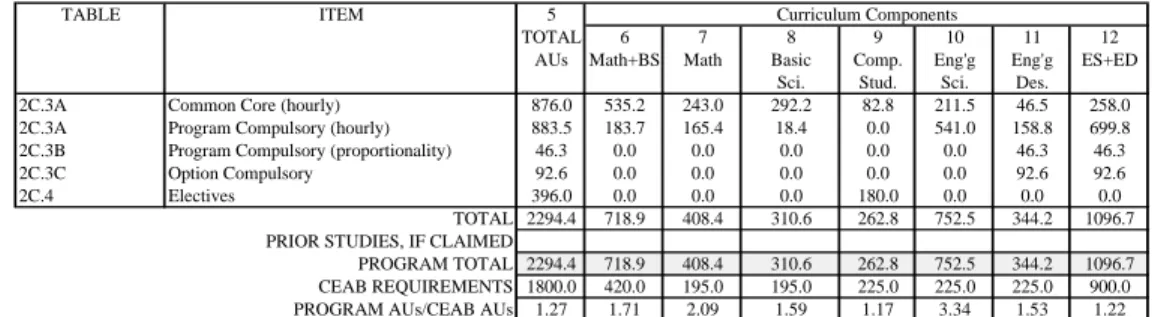
Page 12 contains a summary of the CEAB accreditation analyses for the transition programs.
Evidence of Consultation
E-mail from the Head of the Department of Computer Science to the Chair of the ECE Discipline:
Date: Wed, 07 Nov 2007 13:38:56 -0330 From: Wolfgang Banzhaf <[email protected]> To: Howard Heys <[email protected]>
Cc: Wolfgang Banzhaf <[email protected]>
Subject: Re: Feedback on ECE Transition Program
Dear Howard,
our undergrad studies committee has looked at the changes
Engineering will implement and found they do not have an impact on our programs.
We thank you for consulting us and wish the best success with the revised program,
Wolfgang
Curriculum Charts for Transition Program (2010-2012)
The following tables outline the program courses for the transition program for classes 2010 to 2012. Note that courses that are bolded are courses that have been newly defined for the Engineering 2010 curriculum (and thus are available in the 2007/08 Calendar for the classes of 2013 and later). The courses that are not bolded are courses which exist already for the classes of 2010-2012 and course descriptions are available in the 2006/07 Calendar.
Electrical Engineering (General Option)
Term Required Courses Elective Courses Fall Academic Term 3 ENGI 3423 ENGI 3821 ENGI 3422 ENGI 3891 ENGI 3861
Complementary Studies Elective (Fast-track students only)
Winter Work Term 2 Spring Academic Term 4 ENGI 4102 ENGI 4823 ENGI 4423 ENGI 4892 ENGI 4862 ENGI 4854 Fall Work Term 3 Winter Academic Term 5 ENGI 5821 ENGI 5432 ENGI 5842 ENGI 5812 ENGI 5854
Complementary Studies Elective
Spring Work Term 4 Fall Academic Term 6 ENGI 5800 ENGI 6871 ENGI 6813 ENGI 6843
3 credit hours from Engineering 6101, Philosophy 2801, Sociology 2120, or Women's Studies 4107
3 credit hours from: ENGI 6825, ENGI 6876, or other courses as specified by the Discipline Chair
Winter Work Term 5 Spring
Academic Term 7
ENGI 7803 ENGI 7824 ENGI 7858
6 credit hours from: ENGI 7844, ENGI 7846, ENGI 7855, ENGI 7944, ENGI 8680, ENGI 8879, ENGI 8806-8809, other courses as specified by Discipline Chair
Fall Work Term 6 Winter
Academic Term 8
ENGI 8853 ENGI 8826
One free elective which must be a 5000-level or higher Engineering course, or a 2000-level or higher course either from the Faculty of Arts or the Faculty of Science, or a 3000-level or higher course from the Faculty of Business Administration. Selection of a course must be approved by the Discipline Chair.
6 credit hours from: ENGI 5865, ENGI 7680, ENGI 7811, ENGI 8821, ENGI 8845, ENGI 8806-8809, other courses as specified by the Discipline Chair
Electrical Engineering (Offshore Oil and Gas Engineering Option) Term Required Courses Elective Courses
Fall Academic Term 3 ENGI 3423 ENGI 3821 ENGI 3422 ENGI 3891 ENGI 3861
Complementary Studies Elective (Fast-track students only)
Winter Work Term 2 Spring Academic Term 4 ENGI 4102 ENGI 4823 ENGI 4423 ENGI 4892 ENGI 4862 ENGI 4854 Fall Work Term 3 Winter Academic Term 5 ENGI 5821 ENGI 5432 ENGI 5842 ENGI 5812 ENGI 5854
Complementary Studies Elective
Spring Work Term 4 Fall Academic Term 6 ENGI 5800 ENGI 6871 ENGI 6813 ENGI 6843 ENGI 6602
3 credit hours from Engineering 6101, Philosophy 2801, Sociology 2120, or Women's Studies 4107
Winter Work Term 5 Spring Academic Term 7 ENGI 7650 ENGI 7824 ENGI 7858 ENGI 8680
3 credit hours from: ENGI 7844, ENGI 7846, ENGI 7855, ENGI 7944, ENGI 8671, ENGI 8692, ENGI 8879, ENGI 8806-8809, other courses as specified by Discipline Chair Fall Work Term 6
Winter
Academic Term 8
ENGI 8650 ENGI 8826 ENGI 7680
One free elective which must be a 5000-level or higher Engineering course, or a 2000-level or higher course either from the Faculty of Arts or the Faculty of Science, or a 3000-level or higher course from the Faculty of Business Administration. Selection of a course must be approved by the Discipline Chair.
3 credit hours from: ENGI 8670, ENGI 5865, ENGI 7811, ENGI 8821, ENGI 8845, ENGI 8806-8809, other courses as specified by the Discipline Chair
Computer Engineering (General Option)
Term Required Courses Elective Courses Fall Academic Term 3 ENGI 3423 ENGI 3821 ENGI 3422 ENGI 3891 ENGI 3861
Complementary Studies Elective (Fast-track students only)
Winter Work Term 2 Spring Academic Term 4 ENGI 4102 ENGI 4823 ENGI 4423 ENGI 4892 ENGI 4862 ENGI 4854 Fall Work Term 3 Winter Academic Term 5 ENGI 5821 ENGI 5891 ENGI 5895 ENGI 5865 ENGI 5854
Complementary Studies Elective
Spring Work Term 4 Fall Academic Term 6 ENGI 6861 ENGI 6871 ENGI 6876 ENGI 7893
3 credit hours from Engineering 6101, Philosophy 2801, Sociology 2120, or Women's Studies 4107
3 credit hours from: ENGI 6825, ENGI 6891, Computer Science courses or other courses as specified by the Discipline Chair
Winter Work Term 5 Spring
Academic Term 7
ENGI 7804 ENGI 7824 ENGI 7894
6 credit hours from: ENGI 7855, ENGI 7858, ENGI 7944, ENGI 8680, ENGI 8879, ENGI 8801-8805, other courses as specified by Discipline Chair
Fall Work Term 6 Winter
Academic Term 8
ENGI 8854 ENGI 8894
One free elective which must be a 5000-level or higher Engineering course, or a 2000-level or higher course either from the Faculty of Arts or the Faculty of Science, or a 3000-level or higher course from the Faculty of Business Administration. Selection of a course must be approved by the Discipline Chair.
6 credit hours from: ENGI 7680, ENGI 7814, ENGI 8821, ENGI 8826, ENGI 8863, ENGI 8801-8805, Computer Science courses as specified by the ECE Discipline Chair, other courses as specified by the Discipline Chair
Computer Engineering (Offshore Oil and Gas Engineering Option) Term Required Courses Elective Courses
Fall Academic Term 3 ENGI 3423 ENGI 3821 ENGI 3422 ENGI 3891 ENGI 3861
Complementary Studies Elective (Fast-track students only)
Winter Work Term 2 Spring Academic Term 4 ENGI 4102 ENGI 4823 ENGI 4423 ENGI 4892 ENGI 4862 ENGI 4854 Fall Work Term 3 Winter Academic Term 5 ENGI 5821 ENGI 5891 ENGI 5895 ENGI 5865 ENGI 5854
Complementary Studies Elective
Spring Work Term 4 Fall Academic Term 6 ENGI 6861 ENGI 6871 ENGI 6876 ENGI 7893 ENGI 6602
3 credit hours from Engineering 6101, Philosophy 2801, Sociology 2120, or Women's Studies 4107
Winter Work Term 5 Spring Academic Term 7 ENGI 7650 ENGI 7824 ENGI 7894 ENGI 8680
3 credit hours from: ENGI 7855, ENGI 7858, ENGI 7944, ENGI 8671, ENGI 8692, ENGI 8879, ENGI 8801-8805, other courses as specified by Discipline Chair
Fall Work Term 6 Winter
Academic Term 8
ENGI 8650 ENGI 8894 ENGI 7680
One free elective which must be a 5000-level or higher Engineering course, or a 2000-level or higher course either from the Faculty of Arts or the Faculty of Science, or a 3000-level or higher course from the Faculty of Business Administration. Selection of a course must be approved by the Discipline Chair.
3 credit hours from: ENGI 8670, ENGI 7814, ENGI 8821, ENGI 8826, ENGI 8863, ENGI 8801-8805, Computer Science courses as specified by the ECE Discipline Chair, other courses as specified by the Discipline Chair
Appendix - Summary of Accreditation Analysis
PROGRAM: Electrical Engineering OPTION: General
TABLE ITEM 5
TOTAL 6 7 8 9 10 11 12
AUs Math+BS Math Basic Comp. Eng'g Eng'g ES+ED Sci. Stud. Sci. Des. 2C.3A Common Core (hourly) 876.0 535.2 243.0 292.2 82.8 211.5 46.5 258.0 2C.3A Program Compulsory (hourly) 883.5 183.7 165.4 18.4 0.0 541.0 158.8 699.8 2C.3B Program Compulsory (proportionality) 46.3 0.0 0.0 0.0 0.0 0.0 46.3 46.3 2C.3C Option Compulsory 92.6 0.0 0.0 0.0 0.0 0.0 92.6 92.6 2C.4 Electives 396.0 0.0 0.0 0.0 180.0 0.0 0.0 0.0
TOTAL 2294.4 718.9 408.4 310.6 262.8 752.5 344.2 1096.7 PRIOR STUDIES, IF CLAIMED
PROGRAM TOTAL 2294.4 718.9 408.4 310.6 262.8 752.5 344.2 1096.7 CEAB REQUIREMENTS 1800.0 420.0 195.0 195.0 225.0 225.0 225.0 900.0 PROGRAM AUs/CEAB AUs 1.27 1.71 2.09 1.59 1.17 3.34 1.53 1.22
PROGRAM: Electrical Engineering OPTION: Offshore Oil and Gas Engineering
TABLE ITEM 5 Curriculum Components
TOTAL 6 7 8 9 10 11 12
AUs Math+BS Math Basic Comp. Eng'g Eng'g ES+ED Sci. Stud. Sci. Des. 2C.3A Common Core (hourly) 876.0 535.2 243.0 292.2 82.8 211.5 46.5 258.0 2C.3A Program Compulsory (hourly) 883.5 183.7 165.4 18.4 0.0 541.0 158.8 699.8 2C.3B Program Compulsory (proportionality) 46.3 0.0 0.0 0.0 0.0 0.0 46.3 46.3 2C.3C Option Compulsory 212.6 0.0 0.0 0.0 0.0 91.2 121.4 212.6 2C.4 Electives 288.0 0.0 0.0 0.0 180.0 28.8 0.0 0.0
TOTAL 2306.4 718.9 408.4 310.6 262.8 872.5 373.0 1216.7 PRIOR STUDIES, IF CLAIMED
PROGRAM TOTAL 2306.4 718.9 408.4 310.6 262.8 872.5 373.0 1216.7 CEAB REQUIREMENTS 1800.0 420.0 195.0 195.0 225.0 225.0 225.0 900.0 PROGRAM AUs/CEAB AUs 1.28 1.71 2.09 1.59 1.17 3.88 1.66 1.35
Curriculum Components
PROGRAM: Computer Engineering OPTION: General
TABLE ITEM 5
TOTAL 6 7 8 9 10 11 12
AUs Math+BS Math Basic Comp. Eng'g Eng'g ES+ED Sci. Stud. Sci. Des. 2C.3A Common Core (hourly) 876.0 535.2 243.0 292.2 82.8 211.5 46.5 258.0 2C.3A Program Compulsory (hourly) 815.5 117.1 111.4 5.7 0.0 498.6 199.9 698.5 2C.3B Program Compulsory (proportionality) 91.4 0.0 0.0 0.0 4.6 13.7 73.1 86.9 2C.3C Option Compulsory 91.4 0.0 0.0 0.0 0.0 0.0 91.4 91.4 2C.4 Electives 397.5 0.0 0.0 0.0 180.0 0.0 0.0 0.0
TOTAL 2271.9 652.3 354.4 297.9 267.4 723.8 411.0 1134.7 PRIOR STUDIES, IF CLAIMED
PROGRAM TOTAL 2271.9 652.3 354.4 297.9 267.4 723.8 411.0 1134.7 CEAB REQUIREMENTS 1800.0 420.0 195.0 195.0 225.0 225.0 225.0 900.0 PROGRAM AUs/CEAB AUs 1.26 1.55 1.82 1.53 1.19 3.22 1.83 1.26
PROGRAM: Computer Engineering OPTION: Offshore Oil and Gas Engineering
TABLE ITEM 5
TOTAL 6 7 8 9 10 11 12
AUs Math+BS Math Basic Comp. Eng'g Eng'g ES+ED Sci. Stud. Sci. Des. 2C.3A Common Core (hourly) 876.0 535.2 243.0 292.2 82.8 211.5 46.5 258.0 2C.3A Program Compulsory (hourly) 815.5 117.1 111.4 5.7 0.0 498.6 199.9 698.5 2C.3B Program Compulsory (proportionality) 91.4 0.0 0.0 0.0 4.6 13.7 73.1 86.9 2C.3C Option Compulsory 211.4 0.0 0.0 0.0 0.0 91.2 120.2 211.4 2C.4 Electives 288.0 0.0 0.0 0.0 180.0 28.8 0.0 0.0
TOTAL 2282.4 652.3 354.4 297.9 267.4 843.8 439.8 1254.7 PRIOR STUDIES, IF CLAIMED
PROGRAM TOTAL 2282.4 652.3 354.4 297.9 267.4 843.8 439.8 1254.7 CEAB REQUIREMENTS 1800.0 420.0 195.0 195.0 225.0 225.0 225.0 900.0 PROGRAM AUs/CEAB AUs 1.27 1.55 1.82 1.53 1.19 3.75 1.95 1.39
Curriculum Components