© 2016 International Monetary Fund
IMF Country Report No. 16/173
BURKINA FASO
FOURTH AND FIFTH REVIEWS UNDER THE EXTENDED
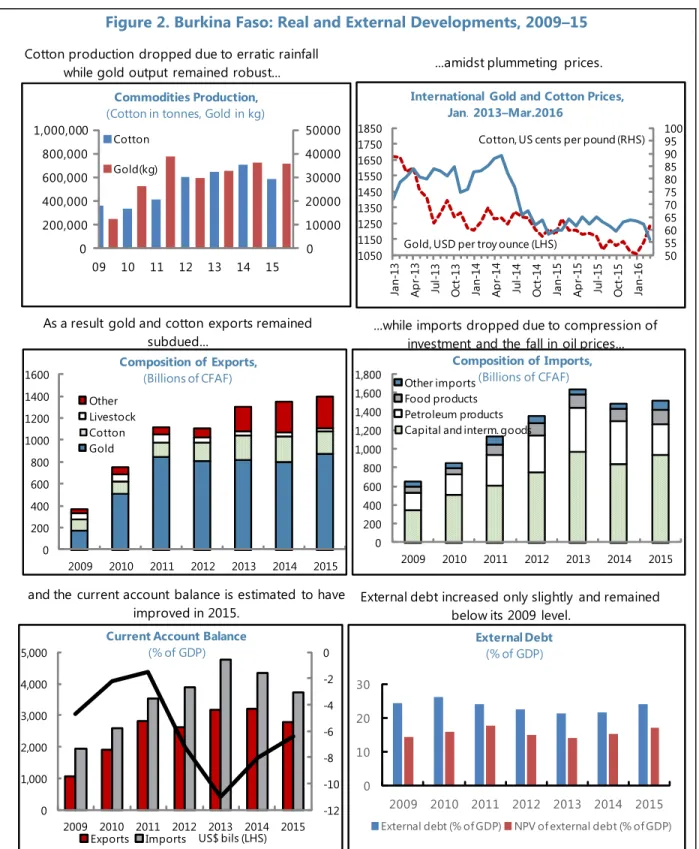
CREDIT FACILITY AND REQUEST FOR MODIFICATION
OF PERFORMANCE CRITERIA—PRESS RELEASE; STAFF
REPORT; AND STATEMENT BY THE EXECUTIVE
DIRECTOR FOR BURKINA FASO
In the context of the fourth and fifth reviews under the Extended Credit Facility and Request for Modification of Performance Criteria, the following documents have been released and are included in this package:
A Press Release including a statement by the Chair of the Executive Board. The Staff Report prepared by a staff team of the IMF for the Executive Board’s
consideration on June 10, 2016 following discussions that ended on April 8, 2016, with the officials of Burkina Faso on economic developments and policies underpinning the IMF arrangement under the Extended Credit Facility. Based on information available at the time of these discussions, the staff report was completed on May 26, 2016.
An Informational Annex prepared by the IMF staff. A Statement by the Executive Director for Burkina Faso.
The documents listed below have been or will be separately released: Letter of Intent sent to the IMF by the authorities of Burkina Faso*
Memorandum of Economic and Financial Policies by the authorities of Burkina Faso*
Technical Memorandum of Understanding* *Also included in Staff Report
The IMF’s transparency policy allows for the deletion of market-sensitive information and premature disclosure of the authorities’ policy intentions in published staff reports and other documents.
Copies of this report are available to the public from International Monetary Fund Publication Services
PO Box 92780 Washington, D.C. 20090 Telephone: (202) 623-7430 Fax: (202) 623-7201 E-mail: [email protected] Web: http://www.imf.org
Price: $18.00 per printed copy
International Monetary Fund
Washington, D.C.
Press Release No. 16/278
FOR IMMEDIATE RELEASE
June 13, 2016
IMF Executive Board Completes Fourth and Fifth ECF Reviews for Burkina Faso and
Approves US$26.2 Million Disbursement
The Executive Board of the International Monetary Fund (IMF) today completed the fourth
and fifth reviews of Burkina Faso’s economic performance under an economic program
supported by an Extended Credit Facility (ECF) arrangement.
1The decision enables the
disbursement of SDR18.57 million (about US$26.2 million), bringing total disbursements
under the arrangement to the equivalent of SDR46.70 million (about US$65.9 million).
In completing the reviews, the Executive Board also approved the authorities’ requests for
the modification of performance criteria. The 36-month ECF arrangement was approved by
the Executive Board on December 27, 2013 (see Press Release 13/542) for the equivalent of
SDR 27.09 million (about US$38.2 million, or 45 percent of Burkina Faso’s quota). An
augmentation of access of 40 percent of quota was approved in June 2015 by the Executive
Board, bring total access to SDR 51.17 million (about US$72.2 million).
Following the Executive Board's discussion today, Mr. Min Zhu, Deputy Managing Director
and Acting Chair issued the following statement:
“Despite challenging internal and external circumstances, Burkina Faso’s performance under
the Fund-supported program has remained satisfactory. Although the terrorist attacks posed
some setback to economic recovery, growth should regain momentum in 2016-17,
underpinned by robust mining activity, improved energy supply and enhanced public
investment execution. The main risks to this favorable outlook relate to the fragile security
situation, the challenges of meeting pent-up social and investment demands, and the impact
of further declines in commodity prices.
International Monetary Fund
Washington, D.C. 20431 USA
“The authorities’ main objective for 2016 is to create adequate fiscal space for priority social
and infrastructure spending, including implementation of their new development plan. To
this effect, they are undertaking a broad package of tax and customs administration measures
aimed at regaining the ground lost in domestic revenue mobilization. Continued efforts to
contain recurrent spending, including the public wage bill and to address bottlenecks in
project execution will be needed to allow public investment to recover quickly toward
pre-crisis levels.
“The authorities are also seizing the opportunity of the oil price decline to address
longstanding structural deficiencies in the energy sector. Full implementation of these
measures will contribute to reducing state subsidies and contingent liabilities to the sector
and support higher investments in electricity production. Going forward, it will also be
important to take action to diversify the agriculture sector and provide a supportive
environment to boost credit for the private sector.”
BURKINA FASO
FOURTH AND FIFTH REVIEWS UNDER THE EXTENDED CREDIT
FACILITY ARRANGEMENT AND REQUEST FOR MODIFICATION OF
PERFORMANCE CRITERIA
EXECUTIVE SUMMARY
Context. Growth is projected to increase moderately from 4 percent in 2014-15 to 5.2 percent in 2016, as the broad-based recovery anticipated in the wake of the November elections has been dampened by the January terrorist attacks. Following almost two years of political crisis and transition, the central policy challenge facing the authorities is to create the necessary fiscal space to deliver tangible improvements in the quality of life of the Burkinabè people.
Risks. Domestic risks stem from looming security threats and social demands on the budget. While Burkina Faso has benefitted from the fall in oil prices and favorable euro/U.S. dollar developments, depressed external demand and lower prices for its main export commodities, particularly cotton, could put pressure on the external position and have large social
repercussions.
Policy recommendations:
Implement tax and customs administration reforms to effectively enhance controls and
curb fraud, so as to increase revenue.
Continue with efforts to rebalance spending towards priority investments. Resist pressures to further increase the public wage bill and other recurrent spending. Address contingent liabilities in the cotton sector.
Given limited resources, carefully prioritize new investments in line with the government’s development strategy, while addressing remaining bottlenecks to project execution.
Capture the oil price windfall to address longstanding issues in the energy sector and support higher investment in electricity production.
Program performance. Program implementation has remained satisfactory despite the challenging backdrop. Other than the non-observance of the indicative target on domestic revenues at end-June and end-December 2015, all other quantitative targets and most structural benchmarks have been met.
Program status. The 2nd/3rd ECF reviews were approved on June 5, 2015, and access was
augmented by 40 percent of quota (pre-14th general review). The current ECF arrangement
2 INTERNATIONAL MONETARY FUND
Approved By
Abebe Aemro Selassie and Peter Allum
Discussions were held in Ouagadougou during March 29-April 8, 2016. The staff team comprised Corinne Deléchat (head), Liam
O’Sullivan, Ahmat Jidoud (all AFR), José Luis Diaz Sanchez (FAD), aided by Jean-Baptiste Le Hen (Resident Representative) and Bamory
Ouattara. Mr. Diakité (OED) accompanied the mission. HQ assistance was provided by Nadia Margevich. The mission met with Prime Minister Thieba, Economy, Finance and Development Minister Coulibaly Sori, Mining and Energy Minister Dissa, and Mr. Ki-Zerbo, National Director of the Central Bank of West African States, as well as other senior officials, private sector representatives, and development partners.
CONTENTS
Glossary____________________________________________________________________________________________4 BACKGROUND AND RECENT DEVELOPMENTS ________________________________________________ 5 A. A Challenging Start for the New Government __________________________________________________ 5 B. Program Performance: Staying the Course Amidst Political Turmoil ____________________________ 7 POLICY DISCUSSIONS ____________________________________________________________________________ 8 A. Outlook and Risks ______________________________________________________________________________ 8 B. Fiscal Policy Challenges: Creating Space for Public Investment _________________________________ 9 C. Capturing the Oil Price Windfall to Boost Electricity Supply ___________________________________ 13 D. Other Policy Discussions _______________________________________________________________________ 14 PROGRAM MONITORING AND RISKS _________________________________________________________ 16 STAFF APPRAISAL _______________________________________________________________________________ 17 BOXES
1. Poverty Reduction Strategy Implementation ___________________________________________________ 6 2. Key Measures in the 2016 Budget _____________________________________________________________ 10 FIGURES
1. Recent Economic Developments _______________________________________________________________ 19 2. Real and External Developments, 2009–15 ____________________________________________________ 20 3. Fiscal Developments, 2009–15 _________________________________________________________________ 21
TABLES
1. Selected Economic and Financial Indicators, 2013–19 _________________________________________ 22 2a. Consolidated Operations of the Central Government, 2013–19 ______________________________ 23 2b. Consolidated Operations of the Central Government, 2013–19 (in percent of GDP) ________ 24 3. Monetary Survey, 2013–19 _____________________________________________________________________ 25 4. Balance of Payments, 2013–19 _________________________________________________________________ 26 5. Risk Assessment Matrix ________________________________________________________________________ 27
6. Indicators of Capacity to Repay the Fund, 2015–26 ____________________________________________ 28
7. Schedule of Disbursements Under ECF Arrangement 2013–16 ________________________________ 29 ANNEXES
I. Technical Annex on Energy Sector Reform _____________________________________________________ 30 II. Debt Sustainability Update ____________________________________________________________________ 33 APPENDIX
I. Letter of Intent _________________________________________________________________________________ 43 Attachment I. Memorandum of Economic and Financial Policies for 2016 ______________ 46 Attachment II. Technical Memorandum of Understanding ______________________________ 67
4 INTERNATIONAL MONETARY FUND
Glossary
AfDB African Development Bank
AFRITAC Africa Regional Technical Assistance Centers
BCEAO Central Bank of West African States
CIPDH Comité interministériel de détermination des prix des hydrocarbures (inter-ministerial
committee in charge of setting hydrocarbon prices)
DGI Direction Générale des Impôts(internal revenue service)
DGD Direction Générale des Douanes (customs)
DSA Debt Sustainability Analysis
INSD L'Institut national de la statistique et de la démographie (Statistical Agency)
MDGs Millennium Development Goals
MEFP Memorandum of Economic and Financial Policies
MW Megawatts
SCADD Stratégie pour une Croissance Accélérée et pour le Développement Durable
(Strategy for Accelerated Growth and Sustainable Development)
SONABEL Société Nationale d'électricité du Burkina Faso (state-owned electricity provider)
SONABHY Société Nationale des Hydrocarbures (public oil importing company)
SONAPOST Société Nationale des Postes du Burkina Faso (state-owned postal company)
WAEMU West African Economic and Monetary Union
BACKGROUND AND RECENT DEVELOPMENTS
A.
A Challenging Start for the New Government
1. Following two years of political turmoil, the new government faces a number of key
challenges.
Economic activity has weakened and fiscal space is constrained. Following the 2014 insurrection, the transition authorities managed to maintain macroeconomic stability, and the November 2015 election was widely recognized as transparent and fair. Nonetheless, the political uncertainty led to reduced investment and growth. Revenue collection has declined by 2 percentage points of GDP since 2013 owing to rising tax evasion, lapses in revenue administration, and the decline in retail fuel prices and gold prices. Public investment was halved, from 14.2 percent of GDP in 2013 to 7.7 percent in 2015, while the wage bill rose by 1.3 percent of GDP.
The popular insurrection has raised expectations regarding the pace of the country’s development. As a result, the authorities are facing significant pressures to improve social and human
development outcomes quickly. Burkina Faso has a remarkably young population—almost 65 percent of which is under 25, and the young emerged as a driving force for change in the process that led to the popular uprising. The authorities recognize these challenges and are addressing them by adopting urgent social measures in the 2016 budget. Youth employment is a key priority in the new National Economic and Social Development Plan (PNDES), following on
from the previous poverty reduction strategy (SCADD) in 2015 (Box 1 and MEFP ¶7-12).
The threat to security from terrorism also needs addressing.The political and security situation has remained generally calm following the January terrorist attacks, but concerns remain in rural and border areas. Following the dismantlement of the elite presidential guard in 2015, the
government’s challenge is to rebuild a functional security apparatus, which adds to already high demands on the budget. Mining companies in particular note that they have had to step up security measures as they cannot fully rely on the police or army.
2. Economic activity remained sluggish over the course of 2015 and in early 2016, amidst
political uncertainty and weather shocks (MEFP ¶2). Real GDP growth is estimated to have remained below trend at 4 percent in 2015, as in 2014. After the expected rebound in the first quarter (relative to a difficult first quarter in 2014), economic activity slowed again (Figure 1). The coup attempt in September 2015 mostly impacted the services and manufacturing sectors while erratic rains adversely affected cereal production (-6.3 percent) and cash crops (-11 percent).
Headline inflation remained subdued at 0.9 percent in December 2015 and 1 percent in March 2016 (y/y), reflecting subsidized food prices and the impact of reductions in domestic fuel prices.
6 INTERNATIONAL MONETARY FUND
Box 1. Burkina Faso: Poverty Reduction Strategy Implementation
The Strategy for Accelerated Growth and Sustained Development (SCADD) for 2011-15 sets out economic and social objectives to support broad-based growth, sustained poverty reduction and progress towards the MDGs. The strategy comprises four main pillars:
development of accelerated growth poles, consolidation of human capital and promotion of social protection, strengthening of governance, and crosscutting priorities in development policies. The overall cost of implementation of the strategy was estimated at CFAF 7,496.2 billion of which 34.5 percent was financed by external resources.
The implementation of the strategy took place in a difficult political environment, marked by several political crises. As a result, overall performance under the strategy has been somewhat unsatisfactory. Growth did not accelerate as projected and remained on average at 5.5 percent over 2011-2015, well below the anticipated 10 percent. However, despite the volatile environment, a number of actions have been initiated, including the development of the Bagré growth pole, along with other initiatives to promote pro-poor growth through the development of value chains in agriculture as well as the implementation of a plan to strengthen resilience and support vulnerable populations. Despite the lower-than-envisaged growth rates, poverty declined from 47 percent in 2009 to 40 percent in 2014, and the Gini coefficient was reduced from 0.4 to 0.35 in the same period.
There has been good progress in human capital development and social protection. Most importantly, the government implemented a number of programs to support employment creation and vocational training, including through the provision of technical and financial support to young entrepreneurs, the implementation of high labor intensity projects, and the financing of income generating activities for young people and women. Other noteworthy actions include (i) the improvement of education infrastructure and an increase in teaching staff at all levels of education, (ii) the building of additional health facilities (iii) the training of health personnel and free provision of certain medications and care, and (iv) improved access to water and sanitation facilities.
Institutions and governance for faster economic and social development were strengthened.
Importantly, a new mining code has been adopted to regulate the sector and to provide strong incentives for exploration while securing resources for economic and social development. Progress has also been made under the remaining pillars of the strategy (strengthening governance and crosscutting priorities in development policies) including the multisectoral survey on poverty, and the implementation of the anti-corruption law.
In January 2016, the government decided to develop a 2016-2020 National Economic and Social Development Plan (PNDES) to replace the SCADD. The PNDES focuses on the three main pillars of the government’s program, namely (i) economic governance; (ii) human capital development; and (iii) structural transformation of the economy and private sector development. Youth employment is the main transversal theme. The authorities aim to finalize the PNDES by May 2016 and to present subsequently it to development partners at the occasion of a donor round table.
0 5 10 15 20 2013 2015
Text Figure 1: Government Revenues
(in percent of GDP)
Income and Profit Taxes
Domestic Goods and Services (incl VAT) International Trade Taxes
Other Tax Revenues
18.5% 16.2% S -0.5% -0.6% -0.3%
Sources: Burkinabè authorities and IMF staff estimates. 3. The overall fiscal deficit increased by
0.3 percentage points of GDP compared with 2014, as the sharp decline in revenues was offset by expenditure compression (MEFP ¶4).
Total revenues (excluding grants) decreased by 1.2 percent of GDP relative to 2014, due largely to a contraction of VAT revenues and corporate taxes. Current spending declined somewhat from 14. 4 percent of GDP in 2014 to 14.2 percent of GDP in 2015, but public investment declined from 9 percent of GDP to 7.7 percent of GDP. The overall fiscal deficit rose to 3.4 percent of GDP on a cash basis due to the payment of commitments carried over from 2014 (Text Figures 1-2, Table 2b and Figure 3). 4. The current account deficit is
estimated to have declined from 8 percent of GDP in 2014 to 6.4 percent of GDP in 2015 driven by an improved trade balance and a recovery in current transfers (Table 4 and Figure 2).Exports increased by 3.1 percent owing to the impact of the stronger dollar on
gold prices. Imports increased by 5.4 percent in volume terms after remaining flat in 2014. However, with the oil import bill improving by CFAF 120 billion (1.8 percent of GDP), total imports value increased by only 2 percent. Current transfers were boosted by a sharp increase in official grants compared with 2014.
5. Private sector credit declined sharply last year (Table 3). Despite increasing deposits, private sector credit growth reached only 7 percent at end-December 2015 (y/y) largely reflecting the underlying political uncertainty, compared with 18.9 percent in 2014 and an average of about 21 percent in 2011-14. Instead, commercial banks accumulated foreign assets in the regional bond market. These developments persisted into early 2016 as credit to the economy expanded by only 4.8 percent (y/y) at end-March.
B.
Program Performance: Staying the Course Amidst Political Turmoil
6. Program implementation has remained satisfactory under the challenging
circumstances. All quantitative performance criteria for end-June and end-December 2015 were met. All indicative targets were also met, except the floor on revenue collection, which was missed by
0 5 10 15 20 25 30 2013 2015 (est.)
Text Figure 2. Government Expenditure
(in percent of GDP)
Wages and salaries Other current expenditure Domestically financed investment Externally financed investment
-2.1% -5.2% -0.7% +1.3% 27.8% 21.2%
8 INTERNATIONAL MONETARY FUND
7. Most structural benchmarks were implemented, albeit some with delays (MEFP ¶6,
Appendix Table 2).
Seven out of 11 structural benchmarks planned for 2015 were met and significant progress is being made on most others. The virtual liaison system for imports and exports operations (SYLVIE) was launched in February 2016 while all customs scanners have been installed. However the invoicing based on delivery prices for fuel transport has not been implemented due to strong push-back from transporters: this measure will be replaced by an alternative approach based on a sealed valve and tagging system for fuel delivery trucks.
Out of the five reforms that were planned for January-May 2016, one has been implemented ahead of schedule (establishment of a controls and investigations unit at the tax administration), the annual audit of pending payments is expected to be finalized by end-May, while the
finalization of the study on the viability of production and energy import options by SONABEL and the SONAPOST feasibility study on provision of decentralized financial services are ongoing but delayed. The standardized VAT invoicing for both large and medium-sized enterprises will become effective at end-June 2016, as part of the 6th ECF review structural benchmarks.
POLICY DISCUSSIONS
A.
Outlook and Risks
8. Growth is projected to gradually recover in 2016, albeit at a slower rate than
anticipated at the time of the 2nd/3rd ECF reviews (Text Table 1, MEFP ¶13).Real GDP growth is
forecast to reach 5.2 percent in 2016, compared with 6 percent at the time of the 2nd/3rd ECF review,
as the recovery in industry and services associated with the successful political transition gains traction and two new gold mines start production. This rebound is, however, likely to be dampened by the impact of the January terrorist attacks on the investment climate, together with delays in the establishment of the new government and approval of the revised budget in April.
9. The medium-term outlook is supported by new mining production and an upturn in
public investment. Growth is expected to reach about 6 percent on average in 2017-19 as overall mining activity is ramped up, supported by continued expansion of gold production and the expected onset of production at the Tambao manganese mine. Successful rebalancing of
government spending towards investment, together with implementation of the new development strategy, would also boost growth. This baseline is more conservative than envisaged at the time of the 2nd/3rd ECF reviews, in line with the more subdued global and regional growth prospects.
10. Risks to the outlook stem from domestic sources as well as the worsening global
economic environment (Table 5). On the domestic side, delays in public investment implementation could lead to lower growth, perceptions that the government is slow in addressing social demands could trigger further unrest, and a worsening of the regional security situation could discourage investment. Over the medium term, exploitation of the Tambao manganese mine could increase GDP by up to 20 percent when operating at full capacity, but there is considerable uncertainty with regard to the timing of the related infrastructure investment. Although they have thus far been mitigated by
2017 2018 2019 Est. 2nd/3rd Rev Proj. 2nd/3rd Rev Proj. Proj. Proj. Proj.
GDP at constant prices 6.6 4.0 5.0 4.0 6.0 5.2 5.9 6.1 6.2
Consumer prices (annual average) 0.5 -0.3 0.7 0.9 1.8 1.6 2.0 2.0 2.0
Credit to the private sector 26.3 18.9 15.1 7.0 16.8 9.9 12.0 15.3 15.8
Terms of trade -12.8 -5.5 -3.4 4.1 -3.3 8.2 -2.9 -1.6 -0.4
Current Account -11.0 -8.0 -7.6 -6.4 -7.8 -5.9 -5.3 -5.7 -6.0
Overall fiscal balance, incl. grants (commitments) -3.5 -1.8 -2.5 -2.1 -3.0 -3.1 -3.0 -3.0 -3.0
Total public debt 29.6 28.1 33.1 32.1 32.4 36.3 36.2 36.5 36.4
Sources: Burkinabè authorities; and IMF staff estimates and projections.
2016
(Annual percentage change, unless otherwise indicated)
(Percent of GDP, unless otherwise indicated)
Text Table 1. Burkina Faso: Selected Economic and Financial Indicators, 2013–19
2013 2014 2015
O utturn Bud g e t Pro g .
T otal reven u e an d gran ts 19.6 21.8 21.1
To ta l revenue 16.1 17.9 17.3
Ta x revenue 14.3 16.0 15.6
G ra nts 3.5 4.0 3.8
Expenditure an d n et len din g 21.7 25.1 24.2
Current exp end iture 14.2 14.7 14.6
W a g es a nd sa la ries 7.2 7.2 7.2
G o o d s a nd s ervices 1.7 2.0 2.0
Current tra nsfers 4.6 4.7 4.7
Inves tm e nt exp end iture 7.7 10.5 9.6
D o m es tica lly fina nced 5.4 5.5 5.5
E xterna lly fina nced 2.3 5.1 4.1
N et le nd ing -0.2 0.0 0.0
O verall balan ce (co m m itm en t basis) -2.1 -3.3 -3.1
O verall balan ce (cash basis) -3.4 -3.3 -3.1
Fin ancin g 3.4 3.0 2.8
Fo reig n fina ncing 1.4 2.2 1.4
D o m e stic fina ncing 2.0 0.9 1.4
2016 Te xt Ta ble 2. Bu rkin a Fa so : Fisca l Fra m e w o rk
2015
favorable exchange rate developments, further declines in cotton and gold prices would put pressure on the current account and could depress investment in these sectors. This would have large social repercussions in the case of the cotton sector and points to the urgent need for a strategy of agricultural diversification towards higher value-added products.
B.
Fiscal Policy Challenges: Creating Space for Public Investment
The 2016 Budget
11. Fiscal policy in 2016 will remain prudent and anchored by the WAEMU convergence criterion (MEFP ¶15-16). The overall cash deficit will only decline marginally compared with 2015, from 3.4 to 3.1 percent of GDP, but a recovery in revenue and foreign project financing will allow expenditure to increase from compressed levels. The 2016 revised budget was approved by the National Assembly in April 2016 and reflects the new government’s focus on health, education and infrastructure (Text Table 2, Box 2).
10 INTERNATIONAL MONETARY FUND
administration, including enhanced controls and fraud prevention, as well as systematic cross-checking of tax and customs declarations are projected to increase revenue by 1.2 percent of GDP relative to last year (Text Table 3, Appendix Table 3).The 2016 budget envisages a larger revenue increase of 0.6 percent of GDP compared with the agreed program framework, based on more optimistic expectations regarding the impact of the revenue measures and of the new mining code. To mitigate risks associated with these additional revenues, the authorities agreed to identify and withhold a corresponding amount of non-priority spending (MEFP ¶19). With Q1 2016 tax collection 6 percent above budget, however, staff agreed that the authorities’ target could be within reach provided this performance is sustained.
13. The revised mining taxation code approved a the end of 2015 is not expected to yield
significant additional revenue in the short term. The new mining code, which benefited from technical advice from the Fund and the World Bank, is broadly comparable to the mining codes of
Box 2. Burkina Faso: Key Measures in the 2016 Budget
The 2016 revised budget incorporates a number of new spending measures aligned with the government’s focus on health, education, infrastructure and security.
Health. The budget includes the exemption of health care costs for mothers and children under five, as well as the hiring of 16,000 community health care agents (0.25 percent of GDP).
Education. The budget envisages the hiring of up to 4,200 young graduates together with the building of new education infrastructure (0.04 percent of GDP).
Infrastructure. High-labor intensity public work projects could temporarily employ up to 9,500 young people. The rental of additional thermal generators during the peak season would help avoid frequent power cuts (0.2 percent of GDP).
Security. A new intelligence agency is being created in addition to other security expenses.
The budget also incorporates a number of commitments by the transition authorities regarding the public wage bill, and resources for the cotton sector.
The revision of the employment statutes of civil servants (“Law 081) will increase public employees’ salaries to the (higher) level of contractual employees, and salary increases have also been awarded to specific categories of civil servants (including judges). The total budgetary impact of these measures will be CFAF 40 billion or 0.6 percent of GDP over three years, but the authorities plan for a gradual implementation with only 0.3percent of GDP included in the 2016 budget.
An amount of 0.3 percent of GDP would cover the cost of previously unpaid subsidies to the cotton sector. Standardized invoicing for large and medium firms and establishment of the Tax Investigations and Intelligence Directorate
0.24 Exhaustive survey of medium-sized enterprises and firms
segmentation 0.19
Activation of input crosschecks for customs declarations 0.13 Estimated increase in mining revenues compared to 2015 0.10 New policy measures: (i)reduction in certain tax
exemptions; (ii) new stamp duties; (iii) increased tax rate for certain alcoholic beverages and tobacco
0.19 Supervision of taxpayers using the single taxpayer
identification number to cross-check information between tax offices
0.09 Recovery of unpaid 2015 taxes 0.07 Virtual Liaison System for Import and Export operations
(SYLVIE) 0.07
Addressing fraud in the market for motorcycles imports 0.04 GPS tracking system and customs scanners 0.03 Additional revenues from tolls 0.004
Total 1.2
Text Table 3. Burkina Faso: Projected Yield of Revenue Measures
(in percent of GDP)
WAEMU convergence criterion 0 1 2 3 4 5 6 7 8 9 2012 2015
Text Figure 3: Wages and Salaries in WAEMU Countries
Panel 1 : in percent of GDP Burkina Faso Benin Guinea-Bissau Mali Niger Senegal Côte d'Ivoire Togo SSA 0 10 20 30 40 50 60 70 2012 2015
Panel 2: in percent of tax revenue
Burkina Faso Benin Guinea-Bissau Mali Niger Senegal Cote d'Ivoire Togo
Sources: WAEMU country authoritiesand IMF Staff estimates. WAEMU convergence criterion
peer countries and mainly differs from the 2003 code by specifying that the corporate tax rate applicable to the sector will be the standard 27.5 percent (compared to the preferential rate of 17.5 percent payable under the 2003 mining code). However, the authorities and staff agreed that,
pending a review of individual contracts, most of which include fiscal stability clauses, existing mining operations would likely remain taxable under the previous code’s conditions. The new mining code also specifies that 35 percent of royalties (about CFAF 14 billion in 2015) have to be allocated to the financing of local development funds. Staff pointed out that this provision could undermine budget transparency and introduce spending rigidities. The authorities agreed that the full amount of royalties would still be reflected in the budget, together with the transfers to the development funds, but indicated that further revisions to the code were not currently envisaged.
Containing Recurrent Expenditure and Boosting Public Investment
14. The authorities and staff agreed on the
importance of continuing with efforts to contain the wage bill (MEFP ¶21). The public wage bill is projected to increase by around CFAF 39 billion in 2016 (0.6 percent of GDP), in large part due to the new salary measures included in the revised budget (Box 2). Staff pointed out that the wage bill was already one of the highest in the region (Figure 3 and Text Figure 3) and encouraged the authorities to either reconsider the blanket increase in civil
servants’ salaries or to limit the wage increases to a relatively small number of civil servants based on evidence of relevant competencies and
qualifications. The authorities should also strive to contain the medium-term impact of these measures and to identify options to gradually reduce the public wage bill in line with the WAEMU
convergence criterion. The authorities agreed and expressed interest in receiving further Fund advice in this area.
15. The recurrent nature of some of the new social measures in the budget could also lead
to further increases in the wage bill. Staff noted that, while some of the new health, education and labor-intensive infrastructure measures would also provide a temporary boost to youth employment, they could prove difficult to unwind over time and lead to permanent increases in the public wage bill. Staff emphasized that the private sector should play a leading role in new employment creation,
12 INTERNATIONAL MONETARY FUND
mainly from a low capacity to absorb available external financing, together with reduced fiscal space for domestically-financed investment. The authorities pointed out that recent measures to accelerate the approval of foreign loans, streamline procurement procedures and allow dedicated partner agencies to oversee project implementation should help improve investment execution rates. Given limited resources available, the new investments identified as part of the governments’ development plan will have to be carefully prioritized. The authorities welcomed the prospects of conducting a Public Investment Management Assessment (PIMA) in the first half of 2016 to identify remaining bottlenecks.
Implementing Realistic Financing Plans
17. External financing would remain stable in
real terms in 2016, as the decline in budget support would be compensated by higher project financing.
Budget support is projected to decline sharply to 1.4 percent of GDP, from the exceptionally high levels of 2015 (Text Table 4). While the budget envisages that project grants and loans would more than double in real terms, the program fiscal framework includes
staff’s more conservative projection of external financing, justified by remaining absorption
difficulties and poor investment spending execution in the first quarter partly as a result of delays in finalizing the revised budget.
18. Although the government has ready access to domestic and regional financing, plans
for local issuances should be better aligned with actual financing needs to avoid a suboptimal accumulation of deposits and unnecessarily large amortization payments. For 2016, the
authorities’ Treasury Plan anticipates gross T-Bill and T-bond issuances reaching 6.9 percent of GDP, compared with a 1.4 percent of GDP net domestic financing need. Moreover, the longer maturity on the T-Bills to be issued in 2016 would imply significant amortization payments in 2017-18. The authorities clarified that, for the year as a whole, issuances would remain limited to actual financing
needsbut that they would prefer to keep some intra-year liquidity buffer to ensure smooth budget
execution (MEFP ¶23). For program monitoring, they agreed that the ceiling on net domestic financing would be set in line with the actual fiscal financing need.
Strengthening Cash Management and Treasury Single Account Implementation
19. Efforts to strengthen cash management to avoid the recurrence of domestic payment
arrears and to effectively move to a Treasury Single Account are ongoing. An FAD mission had identified that up to 0.9 percent of GDP in domestic arrears had accumulated by March 2015, due in part to unpaid VAT reimbursements. As a result, the authorities agreed to prepare regular reports on the status of pending payments at the Treasury, and to conduct a full audit of central and general government pending payments. The reports received so far indicate that arrears had fallen to CFAF 4
billion by end-December 2015 (MEFP ¶27), and the full audit of central government pending
payments should be finalized in May 2016. Staff reminded the authorities of the importance of
e 2015 2016 Budget Support 200.5 104.6 World Bank 88.5 50.9 EU 56.7 37.7 AfDB 33.3 0 Others 22.0 16.0
Sources: Burkinabè authorities and donor agencies. Text Table 4. 2015/16 Budget Support
carrying out an inventory of pending payments outside the Treasury, as various suppliers and companies had raised concerns regarding unpaid bills.
C.
Capturing the Oil Price Windfall to Boost Electricity Supply
20. Staff and the authorities agreed that the recent dramatic drop in international fuel
prices represents a clear opportunity to address some of the underlying imbalances in the energy sector (MEFP¶ 29, Annex I).The drop in oil prices since 2014 has resulted in a windfall gain in terms of lower fuel import bill of
CFAF 120 billion in 2015 (1.8 percent of GDP), and could lead to a further windfall of almost CFAF 100 billion (1.5 percent of GDP) to the country in 2016 based on current WEO projections (Text Table 5 and Text Figure 4). Under current policies, 21 percent of the windfall has accrued to SONABHY (the state-owned hydrocarbon importer), with 37.5 percent benefiting consumers as a result of the various pump price reductions agreed in 2015 and in May 2016.
21. The reforms proposed by the authorities will result in a much more even distribution of
the windfall across the energy sector (Text Table 5).First, a new, flexible price structure for the sale of fuel from SONABHY to SONABEL (the state-owned electricity company) has become effective as of May 1st, 2016. The new price structure is based on actual fuel import prices and will be adjusted on a
monthly basis. At current oil prices, this will much reduce the need for state subsidies and will allow SONABEL to benefit from the oil price decline and make a profit. Should oil prices reach high levels again, the price structure also incorporates a breakeven fuel purchase price which would
automatically result in a proportional state subsidy (MEFP ¶34). The impact of the price change is expected to generate savings of around CFAF 20 billion for
0 200 400 600 800 1000 Jan -1 3 Ma r-13 May -1 3 Ju l-13 Se p -1 3 Nov -1 3 Jan -1 4 Ma r-14 May -1 4 Ju l-14 Se p -1 4 Nov -1 4 Jan -1 5 Ma r-15 May -1 5 Ju l-15 Se p -1 5 Nov -1 5 Jan -1 6
international market price
Transport & marketing
taxes
latest price reduction Text Figure 4. Gasoline Cost Structure and Retail Price,
Jan.13-Feb.16 (CFAF/liter)
Sources: SONABHY and IMF staff estimates.
Central
Government SONABHY
Retail
Consumers SONABEL Total
A. Reduction in import bill 0.0 213.9 0.0 0.0 213.9
B. Reduction in retail fuel prices -17.3 -46.3 63.6 0.0 0.0 - of which:change in VAT and DD Revenue -17.3 0.0 17.3 0.0 0.0
- of which: change in SONABHY Profit 0.0 -46.3 46.3 0.0 0.0
C. Reduction in sale price to SONABEL 0.0 -20.0 0.0 20.0 0.0
(CFAF billions)
14 INTERNATIONAL MONETARY FUND
agreed that a portion of SONABEL’s arrears to SONABHY will be cleared via the payment of an extraordinary dividend of CFAF 40 billion from the oil company’s windfall profits in 2015-16 (MEFP ¶33). Staff welcomed these reforms which, along with the authorities’ intention to gradually increase the share of (cheaper) solar power and imported electricity in the country’s energy mix, ought to put SONABEL on a stronger financial footing and enable it to pursue much-needed investments in the sector.
22. The authorities and the management of both energy companies are also committed to
implement the recommendations of the 2014 audits of SONABHY and SONABEL. A technical memorandum between SONABHY, SONABEL and the state covering financial and logistical operations between the two companies, including outstanding liabilities and establishing rules covering the supply, payment and subsidization of delivered goods has been finalized, as recommended by the audits. The authorities also agreed on a much closer monitoring of the accounts of the two state enterprises, and regular financial reports will be made available (MEFP ¶35). At the same time, the two companies will follow up on the 2014 audit recommendations regarding enhanced management and accounting practices and start implementing their performance contracts, including the identification of pertinent performance indicators and
appointment of monitoring committees (MEFP ¶30-32).
23. Over the medium term, the authorities agreed that the gradual introduction of more
flexible domestic fuel prices and a review of the electricity tariff structure would be desirable.
The difficult budget situation might not warrant further domestic fuel prices reductions at the moment, but the eventual re-introduction of the automatic price adjustment mechanism would help put SONABHY on a more sustainable financial footing and remove the state’s own obligation to pay subsidies to cover losses arising from selling below market price. Once the financial situation of SONABEL has stabilized and energy supply improved, the government could consider reviewing the electricity tariff structure to allow for cost recovery while continuing to protect poorer consumers.
D.
Other Policy Discussions
24. Staff and the authorities discussed implementation of the Fund’s new debt limit policy
(MEFP ¶24-26). Staff’s debt sustainability analysis (DSA) update suggests that Burkina Faso remains at moderate risk of debt distress (Annex II). Given Burkina Faso’s low debt-monitoring capacity, the new policy calls for a performance criterion (ceiling) on new non-concessional borrowing and a
memorandum item on concessional borrowing, as of end June 2016.1 With non-concessional
borrowing at CFAF 159.9 billion in December 2015, the authorities are requesting a moderate increase in the existing PC from CFAF 200 billion to CFAF 230 billion to accommodate an additional CFAF 63.7 billion in non-concessional borrowing to finance priority infrastructure projects. The authorities have also indicated that concessional borrowing could amount to CFAF 256.4 billion for
1Burkina Faso owes a small amount of pre-HIPC Initiative arrears to non-Paris Club creditors which continue to be deemed away
under the revised arrears policy for official creditors, as the underlying Paris Club agreement was adequately representative and the authorities make best efforts to resolve the arrears.
2016 (MEFP Table 1). Finally, the authorities would welcome technical assistance to improve the quality of their debt management strategy by linking it more closely to the macro program and integrating both domestic and external borrowing. Planned capacity building activities include enhanced risk management, improved technical management of new issuances and training in financial programming.
25. Financial indicators suggest that the banking sector remains sound but the persistent
decline in private sector credit is a concern (Text Table 6). Burkina Faso’s commercial banks exhibit the lowest nonperforming loans ratio in the WAEMU region at 9.5 percent at end-June 2015 but with the second highest concentration ratio, reflecting banks’ selectivity in favor of a limited number of highly solvent clients. Although impacted by the increase in the regulatory capital requirement from CFAF 5 to CFAF 10 billion, the regulated risk-weighted ratio is consistent with the regional average. Given already-low access to credit compared with the region, the recent sharp decline in private sector credit growth is a concern. The share of the population above 15 with an account at a financial institution was only 13.4 percent at end-2014 (11.8 percent for women and 15.1 percent for men), well below the sub-Saharan Africa average of 28.9 percent. The authorities shared staff’s view and noted that a task force chaired by the Prime Minister was looking into measures to improve the business environment and access to credit, including improved incentives for banks to increase agency coverage in remote areas, increased use of microcredit institutions and the adoption of mobile banking technologies using telecommunications networks.
26. The 2013 safeguards assessment of the WAEMU regional central bank, the BCEAO,
found a continuing strong control environment. All recommendations from the assessment have
been implemented. These include strengthening the external audit arrangements by appointment of an international firm with ISA experience for the audits of FY 2015–17, reinforcing the capacity of the audit committee with external expertise to oversee the audit and financial reporting processes, and adoption of IFRS starting with the financial year 2015.
Dec-11 Dec-12 Dec-13 Dec-14 Mar-15 Jun-15
Reg. capital to risk-weighted assets 11.7 12.4 10.2 11.4 11.2 11.2
Gross NPLs / Total loans 13.5 10.3 9.9 8.6 9.0 9.5
5 largest clients / equity 103.0 157.9 108.4 158.4 169.5 178.5
Liquid assets / total assets 33.9 34.8 34.7 34.8 35.3 32.5
Reg. capital to risk-weighted assets 12.5 12.8 12.9 12.7 12.3 11.6
Gross NPLs / Total loans 15.9 16.0 15.3 14.9 15.5 15.3
5 largest clients / equity 92.9 92.3 75.1 88.6 86.1 94.2
Burkina Faso
WAEMU
16 INTERNATIONAL MONETARY FUND
27. A strategy to reduce the reliance on state subsidies for the cotton sector in the context
of persistently falling prices is urgently needed. With a balance of CFAF 4.5 billion, the cotton stabilization fund resources are drying up and need to be replenished, in spite of repeated resort to state subsidies and advances (about CFAF 15 billion in 2014-15)(MEFP ¶36). More importantly, following a disappointing 2014-15 campaign, additional resources will be needed in the second half of the year to support the 2016-17 season through a CFAF 31.5 billion subsidy (0.4 percent of GDP). Staff recommended that this be financed by a combination of deferred non-priority spending and additional budget support within the supplemental budget being envisaged in the Summer-early Fall. Going forward, the authorities agreed on the necessity to devise a strategy aiming at minimizing calls on future state support in the context of the trend decline in cotton prices.
28. Work on updating the base year for the national accounts has been interrupted by the
political upheaval but the statistical agency has begun to publish quarterly national account data (MEFP ¶37). These data will form the basis for the new annual GDP series at constant prices. The series will also be rebased from 1999 to 2008, pending the finalization of a survey of the informal sector, including in mining, which should be completed in the next year. This important project is supported by technical assistance from AFRITAC West.
PROGRAM MONITORING AND RISKS
29. Staff supports the authorities’ requests for modifications of program targets to
accommodate the significantly altered macro-fiscal outlook since the 2nd/3rd ECF reviews.
The ceiling for net domestic financing will be raised by CFAF 15 billion to CFAF 111 billion in part
to accommodate higher financing needs of the government and also to close a 2016 financing
gap that had been identified at the time of the 2nd/3rd reviews. The PC on non-concessional debt
will be raised modestly by CFAF 30 billion to accommodate new infrastructure projects and related risks of exchange rate fluctuations.
Indicative revenue targets for end-June are reduced by CFAF 20 billion to take into account the
weak revenue performance over the past two years. The authorities’ projection for poverty-reducing social spending over the whole year remains in line with previous commitments, but the end-June target for such spending is reduced by about CFAF 40 billion to reflect low investment budget execution in the first quarter relating to the delayed establishment of the new
government,
Proposed structural benchmarks for the 6th and final ECF review support policies agreed in the
MEFP. Given the delay in program implementation, 4th and 5th ECF reviews SBs include measures
initially programmed up to May 2016.
30. Staff and the authorities agreed that closer monitoring of the PC on net domestic
financing of the government was warranted. Difficulties in attributing financing between banks and nonbanks have complicated the reconciliation of the monetary and Treasury data on the net government position vis-à-vis commercial banks. The end-December net domestic financing PC was almost compromised by the unexpected sale by SONABHY of a government bond that had been
transferred to SONABHY’s accounts to cover operational losses in 2012. The authorities have agreed to provide quarterly reports reconciling monetary data with government financial statistics in order to better track these liabilities.
31. The ECF-supported program is fully financed. Based on identified budget support
commitments, the projected ECF disbursements would close the remaining financing gap of 0.3 percent of GDP. Completion of the 4th/5th ECF review would unlock a disbursement equivalent to
SDR 18.57 million, including the remainder of the 40 percent of quota augmentation of access approved at the time of the 2nd/3rd ECF reviews. Total outstanding Fund credit currently amounts to
120 percent of quota, well below the (revised) cumulative access limit of 225 percent of quota and Burkina Faso’s capacity to repay the Fund remains adequate.
32. Program risks have receded with the appeased political environment. Nonetheless,
there are fiscal risks associated with the ambitious revenue projections, social pressures to increase the public wage bill and other recurrent spending, and additional investment needs arising from the revised national development plan. The strategy adopted by the authorities to address revenue shortfalls is appropriate, and they intend to conduct a thorough mid-year review of budget execution to prevent expenditure overruns. The authorities are taking advantage of the favorable conditions in the domestic and regional markets and increasing their reliance on bank financing, but would there are vulnerabilities arising from a future tightening of regional monetary conditions.
STAFF APPRAISAL
33. The growth outlook is improving even though output remains below potential.
Following two difficult years, the return to political stability ought to be accompanied by a broad-based recovery.The delay in the establishment of the new government and the impact of the January terrorist attacks have weakened prospects for 2016, but growth should nonetheless gradually
accelerate towards 6 percent and beyond over the medium term supported by the increase in mining output, potential gains in energy supply and improved investment budget execution. This favorable outcome is however predicated on the authorities’ ability to address looming security threats, and to build fiscal space by curbing the growth in recurrent spending while boosting revenue mobilization.
34. The authorities’ commitment to the program’s objectives has remained exemplary
under difficult circumstances. All continuous and end-June and end-December 2015 quantitative targets have been met, with the exception of the indicative target on the revenue floor, and
structural reforms have continued to advance, albeit with some delays.
35. The authorities are taking steps to ensure that domestic revenue mobilization quickly
makes up the ground lost in the past two years. Falling commodity prices and sociopolitical instability both contributed largely to the decline in revenue performance but the reversal of these trends represents a clear opportunity for the authorities to move forward with important reforms
18 INTERNATIONAL MONETARY FUND
36. Dealing with pent up social and political pressures to increase recurrent spending at
the expense of investment will be a major challenge for the government. The 2016 budget is fully financed but there is little space to accommodate further pressures, particularly as the public wage bill remains high and new measures to boost youth employment will further inflate recurrent spending. Staff strongly encourages the authorities to minimize the future budgetary impact of the revised status of public servants, and to resist further pressures to increase the public wage bill including by setting very clear expectations regarding temporary hiring measures. Reducing contingent liabilities from the cotton sector by implementing a medium-term agriculture diversification strategy will also be necessary given the long-term trend of declining prices.
Strengthened cash management practices will contribute to avoiding the accumulation of any new
arrears.
37. Additional spending commitments stemming from the new development strategy
would have to be carefully prioritized and sequenced, given the limited short term fiscal space. While acknowledging the vast social and infrastructure needs, staff encourages the authorities to target high-impact projects in key sectors among the broad pillars of their development strategy. At the same time, urgent efforts are needed to enhance the quality and execution of investment spending. The planned PIMA will help address remaining bottlenecks.
38. The significant oil price windfall represents a unique opportunity to address
longstanding structural deficiencies in the energy sector. Staff congratulates the authorities for the important reforms addressing the financial instability issues which have plagued the power sector over the past decade. By removing the financial constraints, these measures will pave the way for a significant improvement in electricity supply over the medium term.
39. Based on the strength of the authorities’ policy commitments, staff supports
completion of the 4th and 5th reviews under the ECF arrangement and the authorities’ requests for modification of performance criteria. The final program review is scheduled for December 2016 and will be combined with the next Article IV consultation.
Figure 1. Burkina Faso: Recent Economic Developments After rebounding in 2015Q1 and Q2, economic
activity weakened in Q3 but picked up somewhat in Q4.
Private credit growth slowed to levels unseen since 2010.
Inflation remained subdued in 2015 but started rising in 2016 owing to higher food prices.
Taxes revenues continued to fall short of expectations...
The slowdown affected all sectors of the economy.
....constraining public investment. 0 10 20 30 40 Ja n-13 Ma r-13 Ma y-1 3 Ju l-1 3 Se p-1 3 No v-13 Ja n-14 Ma r-14 Ma y-1 4 Ju l-1 4 Se p-1 4 No v-14 Ja n-15 Ma r-15 Ma y-1 5 Ju l-1 5 Se p-1 5 No v-15 Ja n-16 Ma r-16
Private Credit Growth, Jan. 13–Mar. 16 (y/y % change) -8 -6 -4 -2 0 2 4 6 8 10 2009 2010 2011 2012 2013 2014 2015
Sectoral Contribution to Growth (y/y % change)
Services
Industry and Mining Agriculture NGDP_R Real GDP Growth -8 -4 0 4 8 Ja n-12 Ma r-12 Ma y-1 2 Ju l-12 Se p-1 2 No v-12 Ja n-13 Ma r-13 Ma y-1 3 Ju l-13 Se p-1 3 No v-13 Ja n-14 Ma r-14 Ma y-1 4 Ju l-14 Se p-1 4 No v-14 Ja n-15 Ma r-15 Ma y-1 5 Ju l-15 Se p-1 5 No v-15 Ja n-16 Ma r-16 Inflation, Jan. 2012–Mar. 2016 (y/y % change)
Headline Food Non-food
30 50 70 90 110 130 150 Ja n-12 Ap r-12 Ju l-1 2 Oc t-12 Ja n-13 Ap r-13 Ju l-1 3 Oc t-13 Ja n-14 Ap r-14 Ju l-1 4 Oc t-14 Ja n-15 Ap r-15 Ju l-1 5 Oc t-15
Tax Revenue Performance, Jan. 12 - Dec. 15 (in % of program, cumulative)
Other Tax % CIT % Vat %
0 20 40 60 80 100 120 140 160 2009 2010 2011 2012 2013 2014 2015
Investment Spending Execution1 (% of program)
Domestically financed Externally financed
1Excluding capital transfer in 2013
-4 -2 0 2 4 6 2013 Q4 2014 Q1 2014 Q2 2014 Q3 2014 Q4 2015 Q1 2015 Q2 2015 Q3 2015 Q4 Real GDP Growth , 2013-2015 (q/q%)
20 INTERNATIONAL MONETARY FUND
Figure 2. Burkina Faso: Real and External Developments, 2009–15
Sources: Burkinabè authorities and IMF staff calculations. and the current account balance is estimated to have
improved in 2015.
As a result gold and cotton exports remained
subdued... ...while imports dropped due to compression of investment and the fall in oil prices... Cotton production dropped due to erratic rainfall
while gold output remained robust...
External debt increased only slightly and remained below its 2009 level.
0 200 400 600 800 1,000 1,200 1,400 1,600 1,800 2009 2010 2011 2012 2013 2014 2015 Composition of Imports, (Billions of CFAF) Other imports Food products Petroleum products Capital and interm. goods
-12 -10 -8 -6 -4 -2 0 0 1,000 2,000 3,000 4,000 5,000 2009 2010 2011 2012 2013 2014 2015
Current Account Balance
(% of GDP)
Exports Imports US$ bils (LHS)
...amidst plummeting prices.
0 200 400 600 800 1000 1200 1400 1600 2009 2010 2011 2012 2013 2014 2015 Composition of Exports, (Billions of CFAF) Other Livestock Cotton Gold 0 10000 20000 30000 40000 50000 0 200,000 400,000 600,000 800,000 1,000,000 09 10 11 12 13 14 15 Commodities Production,
(Cotton in tonnes, Gold in kg) Cotton Gold(kg) 50 55 60 65 70 75 80 85 90 95 100 1050 1150 1250 1350 1450 1550 1650 1750 1850 Ja n-13 A p r-13 Ju l-13 O ct -13 Ja n-14 A p r-14 Ju l-14 O ct -14 Ja n-15 A p r-15 Ju l-15 O ct -15 Ja n-16
International Gold and Cotton Prices, Jan. 2013–Mar.2016
Cotton, US cents per pound (RHS)
Gold, USD per troy ounce (LHS)
0 10 20 30 2009 2010 2011 2012 2013 2014 2015 External Debt (% of GDP)
Figure 3. Burkina Faso: Fiscal Developments, 2009–15
...while current spending is trending up...
...owing to an expanding wage bill.. ... and constraining investment spending.
The fiscal deficit was halved. Debt levels remain modest, but rising.
0 1 2 3 4 5 6 15 20 25 30 35 2009 2010 2011 2012 2013 2014 2015 Fiscal Balance (% of GDP)
Total revenue and grants (LHS) Expenditure and net lending (LHS) Overall fiscal deficit (incl. grants, RHS)
Sources: Burkinabè authorities and IMF staff calculations.
Domestic revenue continue to decline, falling below peers... 0 5 10 15 2009 2010 2011 2012 2013 2014 2015 Current Spending (% of GDP) Current transfers(%GDP) Goods and services(%GDP) Wages and salaries(%GDP)
0 10 20 30 40 2009 2010 2011 2012 2013 2014 2015 Total Public Debt
(% of GDP)
Domestic debt (% of GDP) External debt (% of GDP)
0 2 4 6 8 10 12 2009 2010 2011 2012 2013 2014 2015
Public Investment Spending1
(% of GDP)
Domestically financed Externally financed
1Excluding capital transfer in 2013
0 20 40 2010 2011 2012 2013 2014 2015 Domestic Revenue (% of GDP) Benin Mali Togo Senegal Burkina Faso 0 2 4 6 8 10
Burkina Faso WAEMU SSA
2012 2013 2014 2015
Public Wage Bill
22 INTERNATIONAL MONETARY FUND
Table 1. Burkina Faso: Selected Economic and Financial Indicators, 2013–19 2017 2018 2019 Est. Est. 2nd/3rd Rev Prel. 2nd/3rd Rev Proj. Proj. Proj. Proj.
GDP and prices
GDP at constant prices 6.6 4.0 5.0 4.0 6.0 5.2 5.9 6.1 6.2
GDP deflator -0.8 -1.7 1.3 1.6 1.9 2.6 2.0 2.0 2.0
Consumer prices (annual average) 0.5 -0.3 0.7 0.9 1.8 1.6 2.0 2.0 2.0
Consumer prices (end of period) 0.1 -0.1 1.6 1.3 1.8 1.6 2.0 2.0 2.0
Money and credit
Net domestic assets (banking system) 1 19.6 20.0 18.1 7.3 16.7 11.3 11.8 11.6 12.2 Credit to the government (banking system) 1 5.3 4.9 5.2 1.8 1.4 4.5 3.4 1.1 1.4
Credit to the private sector 26.3 18.9 15.1 7.0 16.8 9.9 12.0 15.3 15.8
Broad money (M3) 11.3 11.9 14.3 19.9 15.0 13.9 14.9 15.7 15.0
Private sector credit/GDP 24.8 28.8 30.5 29.2 33.0 29.7 30.8 32.8 35.0
External sector
Exports (f.o.b.; valued in CFA francs) 17.2 3.6 2.3 3.1 2.0 7.1 9.8 8.8 7.8
Imports (f.o.b.; valued in CFA francs) 21.3 -9.3 10.9 2.0 5.0 1.6 13.2 12.3 11.1
Terms of trade -12.8 -5.5 -3.4 4.1 -3.3 8.2 -2.9 -1.6 -0.4
Current Account (percent of GDP) -11.0 -8.0 -7.6 -6.4 -7.8 -5.9 -5.3 -5.7 -6.0
Real effective exchange rate 1.7 … … … …
Central government finances
Current revenue 18.5 17.3 17.3 16.1 17.9 17.3 17.8 18.6 19.4
Of which: tax revenue 16.5 15.3 15.7 14.3 16.1 15.6 16.0 16.7 17.3
Total expenditure and net lending 27.4 23.3 24.8 21.7 25.6 24.2 25.3 26.2 27.0
Of which: current expenditure 13.6 14.4 14.7 14.2 14.1 14.6 15.1 15.1 15.1
Overall fiscal balance, excl. grants (commitments) -8.9 -6.0 -7.5 -5.6 -7.7 -6.9 -7.5 -7.5 -7.6 Overall fiscal balance, incl. grants (commitments) -3.5 -1.8 -2.5 -2.1 -3.0 -3.1 -3.0 -3.0 -3.0
Total Public Debt 29.6 28.1 33.1 32.1 32.4 36.3 36.2 36.5 36.4
Public external debt 22.1 20.2 23.3 23.5 23.8 23.6 23.1 23.7 23.9
Central government domestic debt 7.5 7.9 9.8 8.6 8.5 12.7 13.1 12.7 12.5 Memorandum items:
Nominal GDP (CFAF billion) 6,026 6,162 6,561 6,509 7,085 7,024 7,587 8,211 8,895
Nominal GDP per capita (US$) 722 717 631 615 663 646 684 721 763
Euro/US$ (annual average) 1.33 1.33 1.13 1.11 … … … … …
Sources: Burkinabè authorities; and IMF staff estimates and projections. 1 Percent of beginning-of-period broad money.
2016 (Annual percentage change, unless otherwise indicated)
(Percent of GDP, unless otherwise indicated)
Table 2a. Burkina Faso: Consolidated Operations of the Central Government, 2013–19 2017 2018 2019 Act. Act. 2nd/3rd Review Prel. 2nd/3rd Review Proj. Proj. Proj. Proj.
Total revenue and grants 1441.7 1321.1 1462.8 1277.7 1603.4 1481.7 1691.4 1898.1 2135.2 Total revenue 1117.4 1064.7 1137.2 1047.7 1270.4 1215.3 1350.0 1528.6 1726.1 Tax revenue 1 992.6 940.7 1032.5 929.0 1142.4 1092.5 1214.2 1373.7 1539.3
Of which: Gold Mining CIT 49.4 50.0 51.1 25.4 53.0 25.4 28.4 29.9 34.5 Nontax revenue 2 124.8 124.0 104.8 118.7 128.0 122.8 135.8 154.8 186.8
Of which: Royalties from gold 33.6 32.0 31.7 31.4 32.9 35.2 41.6 44.4 44.4
Grants 324.4 256.4 325.6 230.0 333.0 266.4 341.4 369.5 409.2
Project 205.2 157.5 181.6 105.2 198.4 200.2 204.8 221.7 240.2
Program 119.1 98.9 143.9 124.8 134.6 66.2 136.6 147.8 169.0
Expenditure and net lending 3 1652.6 1434.5 1626.5 1411.6 1812.9 1698.3 1915.8 2147.2 2405.5
Current expenditure 818.9 886.7 965.7 923.2 1001.1 1028.8 1144.8 1237.6 1341.1 Wages and salaries 355.5 437.3 456.7 468.5 488.8 507.9 555.4 607.6 658.2 Goods and services 118.6 102.4 110.1 109.4 116.2 139.9 159.3 172.4 186.8 Interest payments 34.7 44.0 39.7 43.8 41.8 49.5 51.4 55.2 60.3 Domestic 21.9 29.3 24.0 27.9 24.7 27.8 29.4 29.3 29.2 External 12.8 14.7 15.7 15.9 17.1 21.7 22.0 25.9 31.1 Current transfers 310.1 303.0 359.2 301.5 354.2 331.4 378.7 402.3 435.8 Investment expenditure 858.4 554.1 663.7 501.0 814.7 672.4 773.9 912.5 1067.4 Domestically financed 592.7 338.4 424.4 349.4 510.1 383.8 470.4 558.3 693.8 Externally financed 265.7 215.7 239.3 151.6 304.6 288.6 303.5 354.2 373.6 Net lending -24.8 -6.2 -2.9 -12.6 -2.9 -2.9 -2.9 -2.9 -2.9 Overall balance 3 -210.8 -113.4 -163.7 -133.9 -209.5 -216.6 -224.4 -249.1 -270.3
Cash basis adjustment 50.8 75.9 -60.0 -89.2 0.0 0.0 0.0 0.0 0.0 Overall balance (cash basis) -160.0 -37.5 -223.7 -223.1 -209.5 -216.6 -224.4 -249.1 -270.3
Financing 162.5 42.0 193.3 220.8 148.5 197.9 224.4 249.1 270.3
Foreign financing 34.4 51.4 74.4 89.2 103.5 99.3 119.5 201.5 206.4
Drawings 60.5 82.2 117.2 122.1 141.7 126.8 162.4 247.2 253.9
Project loans 60.5 58.2 57.7 46.4 106.3 88.4 98.6 132.5 133.4 Program loans 0.0 24.0 59.5 75.7 35.4 38.4 63.7 114.8 120.5 Amortization (excl. IMF) -26.0 -30.8 -42.7 -32.9 -38.1 -27.5 -42.8 -45.8 -47.5 Domestic financing 128.1 -9.4 118.9 131.7 45.0 98.6 104.8 47.6 63.9 Bank financing 92.4 -34.7 114.1 84.8 35.0 117.2 99.8 37.6 53.9 Central bank 75.8 -58.5 114.1 -4.4 35.0 -79.7 11.2 27.6 43.9 Commercial banks 16.7 23.8 0.0 89.2 0.0 196.9 88.6 10.0 10.0 Nonbank financing 35.7 25.3 4.8 46.9 10.0 -18.6 10.0 10.0 10.0
Errors and Omissions -2.5 -4.5 2.3
Financing gap 0.0 0.0 30.3 0.0 61.0 18.7 0.0 0.0 0.0
Of which: IMF future disbursements 0.0 0.0 10.6 0.0 7.0 18.7 0.0 0.0
Of which: IMF augmentation 19.7 0.0
Memorandum items:
Mining revenue 183.1 168.6 156.2 153.2 180.4 190.9 202.0
Overall Balance excl. mining revenue -343.1 -282.0 -290.1 -369.8 -404.8 -440.0 -472.3 Sources: Burkinabè authorities; and IMF staff estimates and projections.
2
2014 includes several one-offs such as large dividend payments and fines.
3 Commitment ("engagement") basis.
2013 2014 2015 2016
(CFAF billions)
24 INTERNATIONAL MONETARY FUND
Table 2b. Burkina Faso: Consolidated Operations of the Central Government, 2013–19 2017 2018 Act. Act. 2nd/3rd Review Prel. 2nd/3rd Review Proj. Proj. Proj.
Total revenue and grants 23.9 21.4 22.3 19.6 22.6 21.1 22.3 23.1
Total revenue 18.5 17.3 17.3 16.1 17.9 17.3 17.8 18.6
Tax revenue 16.5 15.3 15.7 14.3 16.1 15.6 16.0 16.7
Of which: Gold Mining CIT 0.8 0.8 0.8 0.4 0.7 0.4 0.4 0.4
Nontax revenue 1 2.1 2.0 1.6 1.8 1.8 1.7 1.8 1.9
Of which: Royalties from gold 0.6 0.5 0.5 0.5 0.5 0.5 0.5 0.5
Grants 5.4 4.2 5.0 3.5 4.7 3.8 4.5 4.5
Project 3.4 2.6 2.8 1.6 2.8 2.9 2.7 2.7
Program 2.0 1.6 2.2 1.9 1.9 0.9 1.8 1.8
Expenditure and net lending 2 27.4 23.3 24.8 21.7 25.6 24.2 25.3 26.2
Current expenditure 13.6 14.4 14.7 14.2 14.1 14.6 15.1 15.1
Wages and salaries 5.9 7.1 7.0 7.2 6.9 7.2 7.3 7.4
Goods and services 2.0 1.7 1.7 1.7 1.6 2.0 2.1 2.1
Interest payments 0.6 0.7 0.6 0.7 0.6 0.7 0.7 0.7 Domestic 0.4 0.5 0.4 0.4 0.3 0.4 0.4 0.4 External 0.2 0.2 0.2 0.2 0.2 0.3 0.3 0.3 Current transfers 5.1 4.9 5.5 4.6 5.0 4.7 5.0 4.9 Investment expenditure 14.2 9.0 10.1 7.7 11.5 9.6 10.2 11.1 Domestically financed 9.8 5.5 6.5 5.4 7.2 5.5 6.2 6.8 Externally financed 4.4 3.5 3.6 2.3 4.3 4.1 4.0 4.3 Net lending -0.4 -0.1 0.0 -0.2 0.0 0.0 0.0 0.0 Overall balance 2 -3.5 -1.8 -2.5 -2.1 -3.0 -3.1 -3.0 -3.0
Cash basis adjustment 0.8 1.2 -0.9 -1.4 0.0 0.0 0.0 0.0
Overall balance (cash basis) -2.7 -0.6 -3.4 -3.4 -3.0 -3.1 -3.0 -3.0
Financing 2.7 0.7 2.9 3.4 2.1 2.8 3.0 3.0
Foreign financing 0.6 0.8 1.1 1.4 1.5 1.4 1.6 2.5
Drawings 1.0 1.3 1.8 1.9 2.0 1.8 2.1 3.0
Project loans 1.0 0.9 0.9 0.7 1.5 1.3 1.3 1.6
Program loans 0.0 0.4 0.9 1.2 0.5 0.5 0.8 1.4
Amortization (excl. IMF) -0.4 -0.5 -0.7 -0.5 -0.5 -0.4 -0.6 -0.6
Domestic financing 2.1 -0.2 1.8 2.0 0.6 1.4 1.4 0.6
Bank financing 1.5 -0.6 1.8 2.0 0.5 1.7 1.3 0.5
Central bank 1.3 -0.9 1.7 -0.1 0.5 -1.1 0.1 0.3
Commercial banks 0.3 0.4 0.0 1.4 0.0 2.8 1.2 0.1
Nonbank financing 0.6 0.4 0.1 0.7 0.1 -0.3 0.1 0.1
Errors and Omissions 0.0 -0.1 0.0 0.0 0.0 0.0 0.0 0.0
Financing gap 0.0 0.0 0.5 0.0 0.9 0.3 0.0 0.0
Of which: IMF future disbursements 0.0 0.0 0.2 0.0 0.1 0.3 0.0 0.0
Of which: IMF augmentation 0.3 0.0
Memorandum items:
Mining Revenue 3.0 2.7 2.4 2.4 2.3 2.2 2.4 2.3
Overall Balance excl. mining revenue -5.7 -4.6 -4.9 -4.5 -5.3 -5.3 -5.3 -5.4 Nominal GDP (CFAF billions) 6,026 6,162 6,561 6,509 7,085 7,024 7,587 8,211 Sources: Burkinabè authorities; and IMF staff estimates and projections.
1
2014 includes several one-offs such as large dividend payments and fines.
2
Commitment ("engagement") basis.
2016 (In percent of GDP)