Crowdlending in Microfinance: A New Source of Debt
Capital
Universität Regensburg
Regensburg, Germany
Capital
Dissertation zur Erlangung des Grades eines Doktors der
Wirtschaftswissenschaft
eingereicht an der Fakultät für Wirtschaftswissenschaften an der
Universität Regensburg
vorgelegt von: Eva-Maria Oswald
Berichterstatter:
Prof. Dr. Gregor Dorfleitner
Prof. Dr. Klaus Röder
Acknowledgement
I would like to express my sincere thanks to Prof. Dr. Gregor Dorfleitner for his continuous and great support for my PhD study. I am grateful for giving me the opportunity to pursue the doctoral dissertation, sharing your knowledge and experience and providing valuable guidance for my empirical research and scientific writing.
My gratitude also goes to Prof. Dr. Klaus Röder for being my second advisor. Furthermore, I would like to thank my family for the outstanding support which has made my PhD study possible. Special thanks to my parents for their generous encouragement and keeping me highly motivated throughout the last three years. Big thanks to my sister for welcoming me in her flat whenever I traveled to Regensburg. Moreover, I would like to say thank you to my partner for accompanying me through the ups and downs and being patient whenever I had to work during the weekend.
1 Introduction 1
1.1 A spotlight on classical microfinance . . . 1
1.2 Introductory aspects on commercial peer-to-peer crowdlending . 3 1.3 Crowdlending as a source of debt capital in microfinance . . . . 4
1.4 Research objective of this dissertation . . . 7
2 Repayment behavior in peer-to-peer microfinancing 10 2.1 Introduction . . . 11
2.2 Theoretical background and hypotheses . . . 13
2.3 Data and methodology . . . 19
2.4 Results . . . 28
2.5 Robustness checks . . . 39
2.6 Conclusion . . . 44
3 The access of MFIs to financing via the worldwide crowd 45 3.1 Introduction . . . 46
3.2 The Kiva microfinancing model . . . 48
3.3 Theory and hypotheses development . . . 49
3.4 Data and methodology . . . 55
3.5 Regression analysis . . . 64
3.6 Conclusion . . . 75
4 Funding determinants in interest-free P2P lending 77 4.1 Introduction . . . 78
4.2 Kiva’s funding model for direct loans . . . 80
4.3 Theory and hypotheses development . . . 81
4.4 Data and methodology . . . 86
4.5 Results . . . 94
4.6 Conclusion . . . 106
4.7 Appendix . . . 107
5 Conclusion 108 5.1 Contribution of this dissertation . . . 108
5.2 Limitations and suggestions for future research . . . 109
List of Tables
2.1 Definition of explanatory variables . . . 22
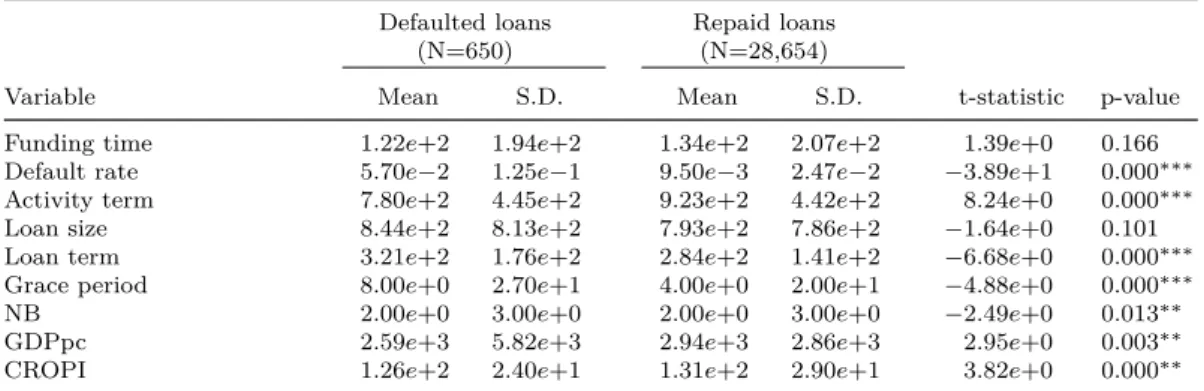
2.2 Descriptive statistics for metric variables . . . 24
2.3 Descriptive statistics for categorical variables . . . 25
2.4 Key figures of our data sample vs. the same MFIs’ loan portfolios 26 2.5 Bravais-Pearson correlation coefficients for metric variables . . . 27
2.6 Independent t-test for metric variables among defaulted loans and repaid loans . . . 28
2.7 Descriptive statistics for categorical variables for defaulted and repaid loans . . . 29
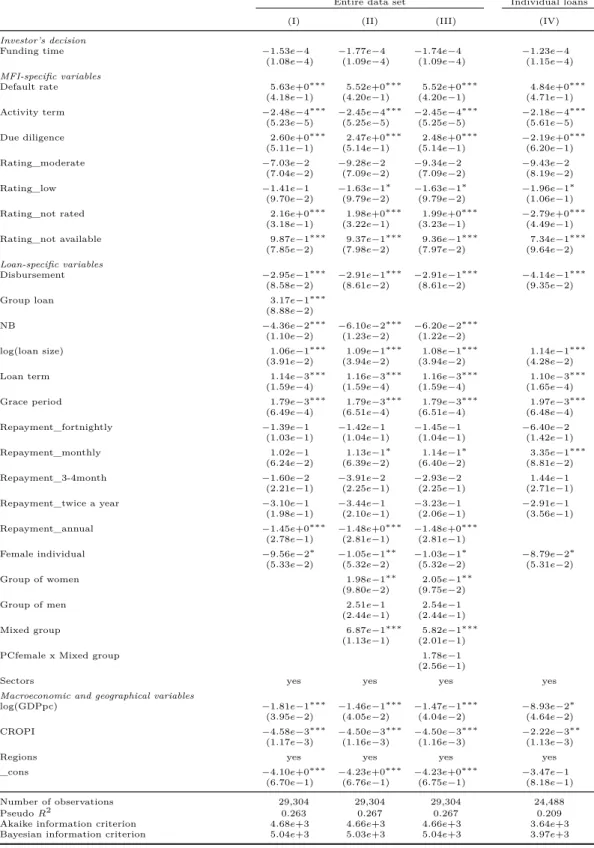
2.8 Coefficients of probit models – entire data set and individual loans 34 2.9 Coefficients of linear regression – entire data set . . . 35
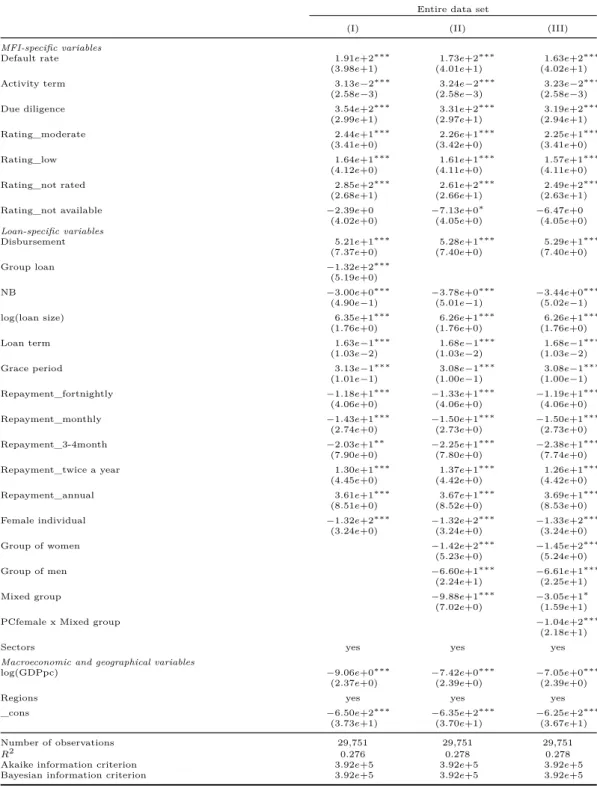
2.10 Coefficients of probit models – group loans . . . 38
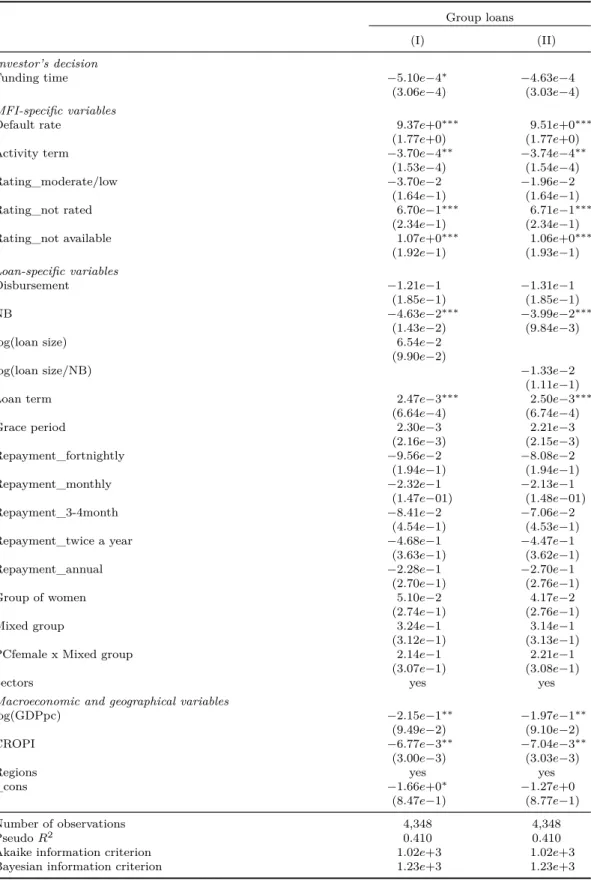
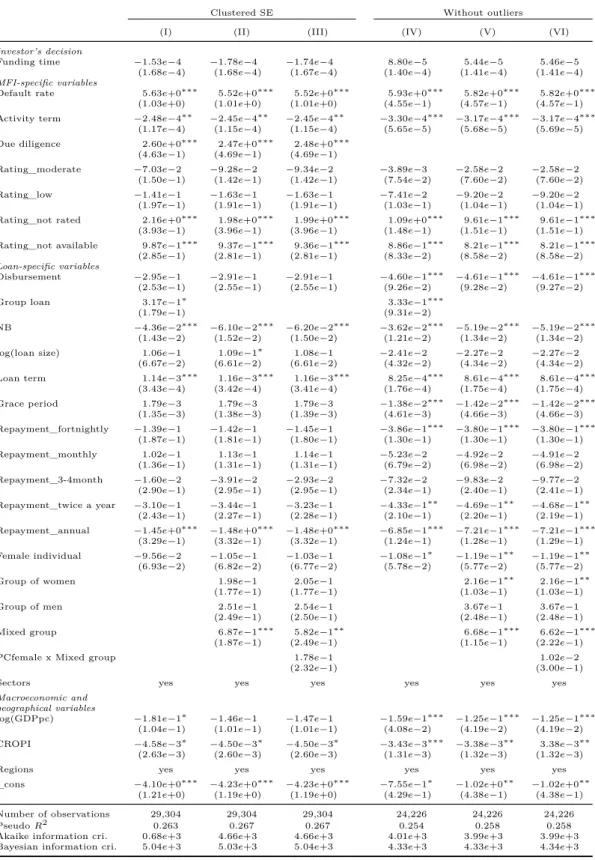
2.11 Coefficients of probit models with clustered SE and without outliers – entire data set . . . 41
2.12 Coefficients of probit models with clustered SE and without outliers – subsamples . . . 42
2.13 Coefficients of probit models with clustered SE and without outliers – subsamples continued . . . 43
3.1 Definition of explanatory variables . . . 59
3.2 Descriptive statistics for metric variables . . . 62
3.3 Descriptive statistics for categorical variables . . . 63
3.4 Independent t-test for metric variables . . . 63
3.5 Bravais-Pearson correlation coefficients for metric variables . . . 64
3.6 Coefficients of pooled logistic regressions with access as dependent variable . . . 67
3.7 Coefficients of pooled logistic regressions with the termination of the partnership as dependent variable . . . 69
3.8 Coefficients of Cox proportional hazards models on the event of closing . . . 71
3.9 Regression results of robustness analysis . . . 74
4.1 Definition of variables . . . 89
4.2 Categorical variables depicting possible keywords in the descrip-tion text . . . 90
4.3 Descriptive statistics for main categorical variables . . . 92
4.4 Descriptive statistics for metric variables . . . 93
4.6 Coefficients of logistic models on funding success . . . 97 4.7 Coefficients of tobit models on reversed funding time . . . 100 4.8 Coefficients of Cox proportional hazard models . . . 103 4.9 Robustness analysis through further logistic and probit models
on funding success . . . 105 A1 Descriptive statistics for categorical variables - controls . . . 107
List of Figures
1.1 Main actors in the intermediation-based model and the direct peer-to-peer model on the microfinancing platform Kiva . . . 6 3.1 Kiva’s intermediation-based microfinancing model . . . 48 4.1 Kiva’s direct P2P model for direct loans in the United States . . 80
Introduction
1.1
A spotlight on classical microfinance
The microfinance industry is a financial sector which has risen sharply in the past years and which continues to grow in outreach, service offers and its mission. The global outreach of microfinance is clearly illustrated by the number of customers having increased from 13 million in 1997 towards 211 million customers in 2013 (Cull and Morduch, 2018). The microfinance movement has its foundations in the Grameen bank in Bangladesh, a pioneer in successfully granting microcredits to the poor without credit history or collateral. Microfinance institutions (MFIs), which aim to provide financial services to the unbanked poor have been established mostly in developing countries. The service offers have highly been extended by establishing saving possibilities through deposits, insurances and payment services for the poor part of the population (Bogan, 2012; Hoque et al., 2011). In line with the growth, the mission of microfinance has been broadened from poverty alleviation of the poorest in developing countries (Morduch, 1999) towards financial inclusion of the unbanked population, which is not served by the mainstream financial market (Helms, 2006).
This thesis focuses on microcredits, the core of the microfinance movement. Therefore, a spotlight on classical microfinance with regards to innovations in the contract, the mitigation of credit default risks and the rising demand for debt capital of MFIs is provided in the following.
Information asymmetry in credit markets resulting in adverse selection and moral hazard risks is very well known (e.g. Akerlof, 1970; Stiglitz and Weiss, 1981; Hoff and Stiglitz, 1990). In the microfinance sector, lenders, in particular MFIs, have to deal with the problem of imperfect information and imperfect enforcement due to lacking collateral of the poor (Hoff and Stiglitz, 1990). Apart from direct screening and monitoring activities, MFIs have the possibility to use indirect mechanisms in order to reduce the information asymmetry. Indirect mechanisms are e.g. introducing reasonable interest rates, the threat of terminated access to credit, instrumentalizing the risk of reputational loss and establishing an interlinkage of credit transactions with other markets (Stiglitz and Weiss, 1983; Hoff and Stiglitz, 1990). However, additional key innovations
have been the main drivers that make lending to the poor without collateral possible and successful (Morduch, 1999; Armendáriz de Aghion and Morduch, 2010).
Group lending with joint liability: Loans are granted to a group of borrowers who is jointly responsible for the total loan amount and jointly burdens the credit default risk. Therefore, group members have an incentive to select appropriate peers of similar risk, monitor their peers’ entrepreneurial activities and enforce successful loan repayment (Ghatak, 1999; Stiglitz, 1990; Besley and Coate, 1995).
Progressive lending: MFIs build up the borrowers’ expectation to receive future loans of increasing size dependent on their repayment performance (Churchill, 1999). MFIs are able to test the borrowers’ creditworthiness with small loans, to increase the opportunity cost of default and to enforce loan repayment in particular ex-post (Armendáriz de Aghion and Morduch, 2000).
Regular repayment schedule: Borrowers are required to repay small install-ments following a regular weekly or monthly schedule immediately after loan disbursement. Thus, MFIs steadily obtain information about the borrowers’ repayment behavior and skim off the borrowers’ outside income independently of the investment return (Armendáriz de Aghion and Morduch, 2000).
Targeting women: Several studies have identified female borrowers to be better credit risks than their male peers (e.g. D’Espallier et al., 2011; Kevane and Wydick, 2001). Women’s limited mobility, the severe risk of damage by social sanctions, missing alternative sources of credit and the non-existence of a female labor market are proven to be reasons for the lower moral hazard risk of female borrowers (Goetz and Gupta, 1996; Morduch, 1999; Demirgüç-Kunt et al., 2008; Emran et al., 2011).
The classical microfinance movement has experienced widespread success around the globe accompanied by the development of a huge number of MFIs (Bruton et al., 2011). Thus the MFIs’ demand for capital resources rises. Applying life cycle theory in the context of microfinance, the MFIs’ need for capital differs in the distinct phases of institutional development. In the initial youth phase, MFIs have a high demand for risk-tolerant capital and quite often, donor funds are the main source (de Sousa-Shields and Frankiewicz, 2004; Bogan, 2012). In the growth phase, MFIs attempt to realize the transformation into a regulated institution. As this process is costly, the majority of MFIs remains dependent on external subsidized capital (Helms, 2006; Bogan, 2012). Donations and subsidies from international donors are one of the main sources for debt capital. However, donor funds are limited (Bogan, 2012). The transformation also provides new opportunities for an MFI. First, the MFI’s access to commercial funding sources is enhanced (Mersland and Urgeghe, 2013). However, for the majority of MFIs the access to mainstream capital markets remains a challenge and is not used to its full extent (Helms, 2006; Hoque et al., 2011). Second, MFIs obtain the possibility to mobilize deposits. Deposit taking is known to be a stable and sustainable source of debt capital which helps MFIs to become less dependent on subsidized external capital (Caudill et al., 2009; Helms, 2006;
Bogan, 2012). But, in general, only regulated MFIs are allowed to mobilize deposits, which limits the use of this funding source (Bogan, 2012). Also in the phase of maturity, debt capital sources increase in importance, even though equity financing becomes available (de Sousa-Shields and Frankiewicz, 2004; Fehr and Hishigsuren, 2006; Bogan, 2012; Mersland and Urgeghe, 2013). Despite the increasing openness towards mainstream capital markets, the majority of external capital still comes from non-commercial investors which does not fulfill the MFIs’ demand for funding and therefore, results in an increasing funding gap (de Sousa-Shields and Frankiewicz, 2004; Mersland and Urgeghe, 2013). The debt capital demand of MFIs in developing countries is not expected to fade.
Classical microfinance, in general, is mainly associated with poverty alleviation and financial progress in developing countries. Apart from this, the microfinance movement has also been present in developed countries with the aim to serve the poor (Conlin, 1999). In recent years, some researchers have taken interest in investigating microfinance programs in developed countries such as Canada, the United States, and the European Union. But one can say that the various patterns of microfinance in developed economies are still under-researched (Pedrini et al., 2016).
1.2
Introductory aspects on commercial
peer-to-peer crowdlending
Crowdlending is an innovative approach which connects a crowd of private investors who are willing to fund loans requested by a private borrower without financial intermediation (Lin et al., 2013). Apart from crowdlending, several types of crowdfunding such as donation-based, equity-based and reward-based funding have emerged and are mainly accessible online to the public (Berns et al., 2018; Mollick, 2014). However, for this thesis the only relevant strand is peer-to-peer (p2p) crowdlending which implies that investors employ capital by granting loans and in exchange receive interest rates and the repayment of the loan principal. Commercial crowdlending as a source of debt capital through loans has emerged in the internet since 2005. The concept is realized by several commercial peer-to-peer lending platforms such as Zopa or Prosper.com which have grown impressively in recent years (Gonzalez and McAleer, 2011). To date (Sep.18), the first launched platform Zopa has transferred loans of more than 3.63 billion British pound in the UK and the leading platform Prosper.com has accompanied loan transactions valued 13 billion USD (Zopa.com, 2018; Prosper.com, 2018).
Commercial P2P platforms have intensively been researched. Analogous to the traditional credit market, the actors on online peer-to-peer lending marketplaces face the problem of information asymmetry. Adverse selection and moral hazard risk might be even more severe due to the anonymity of lenders and borrowers, the limited information mainly provided by borrowers themselves and missing monitoring and enforcing possibilities for lenders (Herzenstein et al., 2011;
Bachmann et al., 2011; Lin et al., 2013; Emekter et al., 2015). Despite the obstacles of information asymmetry, investors and borrowers engage with each other using the online debt capital marketplaces which has evoked research on the behavior of the main actors – investors and borrowers. Several studies have examined the investors’ funding behavior and credit default risk of borrowers. Loan characteristics (Emekter et al., 2015), borrowers’ characteristics and appearance (e.g. Pope and Sydnor, 2011; Duarte et al., 2012; Ravina, 2018), the social network (Lin et al., 2013; Freedman and Jin, 2017), soft facts in the narrative (Dorfleitner et al., 2016) have been proven to be main predictors of funding success and loan repayment. Additionally, Herzenstein et al. (2011) and Zhang and Liu (2012) observe herding behavior of investors following the ’wisdom of crowd’ with the expectation to gain better insights by observing and imitating the crowd (Surowiecki, 2004). Furthermore, the narratives provided by borrowers to share information about themselves and the project idea are shown to be crucial with regards to the reduction of information asymmetries (e.g. Dorfleitner et al., 2016; Larrimore et al., 2011).
Even though the mentioned studies do not at all represent a complete list of the different stands of literature1, it illustrates the great interest of researchers on commercial peer to peer lending in recent years. Commercial peer-to-peer lending itself and the listed empirical results are of interest for this thesis. One can assume that the investors’ and borrowers’ behavior on commercial debt-based marketplaces are similar to the ones in the context of microfinance. However, as the market conditions are totally different, the investors’ funding decision and the borrowers’ repayment performance are worth to be researched separately for crowdlending of microloans without interest.
1.3
Crowdlending as a source of debt capital
in microfinance
Microcredits as the starting point of the classical microfinance movement found global attention when in 2005 the United Nations announced the ’year of microcredit’ and shortly afterwards in 2006, the Grameen Bank and its founder Muhammad Yunus were awarded the Nobel Peace Price (United Nations, 1998; Nobel Peace Price Committee, 2006). Almost simultaneously with the rising interest of socially-oriented investors, the first online microfinancing platforms such as Kiva, Deki and Rang De were launched with the idea to enable individual investors to participate in the microfinancing development. The platforms connect a worldwide crowd of socially-oriented investors with microentrepreneurs in financial need. Despite differences in terms of lending model, size and concept, all platforms aim to materialize crowdlending as a source of debt capital for the microfinance sector.
1For a more extensive summary, the review papers of e.g. Bachmann et al. (2011) and
Gonzalez and McAleer (2011) provide an informative overview. Furthermore, the research paper of Dorfleitner et al. (2016) spends an introductory part on existing literature on commercial p2p lending.
Kiva is the pioneer of this business model. The success of facilitating micro-financing through the crowd is illustrated by Kiva’s impressive numbers: A funded loan volume of 1.2 billion USD by 1.7 million lenders to 3.0 million borrowers located in 83 countries since Kiva’s foundation in 2005 until Septem-ber 2018 (Kiva.org, 2018a). Kiva emphasizes its own strong social mission and requests a high social commitment from participants.
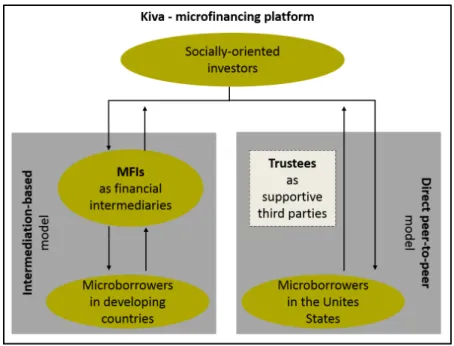
Kiva enables microfinancing trough two different microfinancing models. The first and most famous one is theintermediation-based model based on financial intermediation by MFIs. Kiva partners with several local MFIs in developing countries after conducting a due diligence process2. The partnered MFIs are responsible for selecting and monitoring borrowers and enforcing loan repayment. These MFIs post the granted loans on Kiva’s webpage with the aim to receive refinancing through potential investors. The loan amount in USD is transferred to the MFI as soon as the request is fully funded which has been the case for nearly all loan requests in the last years.
The second and more recent model follows the direct peer-to-peer concept by connecting investors directly with borrowers in the United States without any financial intermediation. Additional to Kiva’s due diligence process3, borrowers have to emphasize their creditworthiness by mobilizing their personal network to support the loan request. The ’social underwriting’ is expected to strengthen the borrower’s commitment to successful loan management, even though the social underwriter is not financially responsible. Additionally, borrowers can be endorsed by a third-party trustee. This is not the case for all borrowers. Afterward, borrowers are allowed to post the loan application on Kiva’s online webpage in order to reach potential investors. In contrast to the indirect model, the past records show that only around two third of the applications have been successfully funded.
The socially-oriented investors do not receive any interest rate on the employed capital, but fully bear the risk of credit default in both the intermediation-based model and the direct p2p model. Despite the fact of donating the interest rate, crowdfunding through Kiva differs from purely charitable giving as investors highly value the repayment of the loan principal in order to further empower several borrowers in the long run (Ly and Mason, 2012a). While investors contribute to refinancing microloans granted by MFIs in the intermediation-based model, investors enable microloans to borrowers in the direct peer-to-peer model.
Regarding the microborrowers, there is a notable difference between the two models. Loans to microborrowers who are located in developing countries around the globe are refinanced through the indirect model. These borrowers are requested to pay interest rates to the MFIs. In contrast, the direct peer-to-peer model is only available to US citizens who are in pursuit of an entrepreneurial
2Kiva staff reviews the MFI’s financial stability, value, possible risks and especially its social
commitment.
3Kiva staff reviews the borrower’s financial history, his personal constitution and the pursued
activity but lack financial resources. These borrowers do not pay any interest rate for the debt capital directly provided by socially-oriented investors. The main actors in the two different microfinancing models established and maintained by the online platform Kiva are summarized in Figure 1.1.
Figure 1.1: Main actors in the intermediation-based model and the direct peer-to-peer model on the microfinancing platform Kiva
In recent years, Kiva’s social mission, the socially-oriented lenders, microborrow-ers and partnered MFIs have been subject to several studies. First, with respect to Kiva’s mission, Bajde (2013) studies Kiva’s ideology and Schwittay (2014) sheds light on Kiva’s social impact in terms of poverty alleviation. Second, the decision making process of investors has found high attention. The cultural and physical difference, social distance, transaction costs, the personal motivation as well as the characteristics of the narratives describing the borrower and the underlying project are discussed and identified as predictors of the funding behavior of investors (e.g. Burtch et al., 2014; Galak et al., 2011; Meer and Rigbi, 2013; Liu et al., 2012; Allison et al., 2013; Jancenelle et al., 2018). Third, Jenq et al. (2015) studies the borrower’s physical and social appearance and draws conclusion mainly on funding success and as a side aspect on the credit default risk of borrowers.
Last but not least, the rising competition between MFIs on Kiva, organizational characteristics and the appearance of MFIs have been examined to impact the MFI’s success of attracting investors and receiving interest-free refinancing (Ly and Mason, 2012a; Moss et al., 2015; Berns et al., 2018). It is noteworthy, that all these empirical studies focus on the transactions using the intermediation-based model, whereas to our knowledge research on transactions through the direct peer-to-peer model is missing.
Also, this thesis makes use of the debt capital transactions on Kiva between socially-oriented investors, MFIs and borrowers. Both microfinancing models –
the intermediation-based model and the direct p2p model – are of empirical interest.
1.4
Research objective of this dissertation
This dissertation combines aspects from classical microfinance and online com-mercial crowdlending in order to investigate several aspects which are important, but still under-researched in the field of crowdlending through socially-oriented investors in microfinance.
As stated above, Kiva’s intermediation-based microfinancing model has exten-sively been researched regarding several topics. However, we noticed a lack of knowledge regarding the credit default risk of microborrowers which results in financial losses for investors. Additionally, very little is known about the MFIs which are the core of this microfinancing model. But this is important as MFIs are simultaneously financial intermediaries and recipients of interest-free capital. This thesis addresses these two gaps in empirical research. It aims to shed light on, firstly, the determinants of credit default risk and, secondly, the characteristics of the MFIs in the context of microfinancing through the world-wide crowd. The third part of this dissertation provides very first insights on the funding behavior of investors who enable microloans requested in developed countries via Kiva’s direct peer-to-peer model without intermediation.
The research projects contribute to the literature on microfinance and crowdlend-ing through examincrowdlend-ing MFIs refinanccrowdlend-ing their loan portfolio with interest-free debt capital, analyzing credit risk factors and discussing the funding behavior of investors who enable microloans in a developed country.
The following three academic research papers are the core of this dissertation: 1. Repayment behavior in peer-to-peer microfinancing: Empirical evidence
from Kiva
2. The access of microfinance institutions to financing via the worldwide crowd
3. From credit risk to social impact: On the funding determinants in interest-free P2P lending
Below, the academic papers are briefly summarized regarding their research objective, the data set, the methodology, empirical findings and the contribution.
1. Repayment behavior in peer-to-peer microfinancing: Empirical evidence from Kiva
Subject of this study is the repayment behavior of microentrepreneurs in the intermediation-based model of Kiva. The research is based on a data sample of microloans which were refinanced by the worldwide crowd of investors between 2010 and 2013.
By performing probit regressions on the probability of credit default, we find evidence that the credit default risk is dependent on the screening and
moni-toring quality of the respective MFI which grants the microloan. Additionally, credit conditions such as the loan size, the loan term and a grace period before the first repayment obligation is due reveal themselves to be main predictors of credit default. Female individual borrowers appear to be more creditworthy than their male counterparts. However, this phenomenon is not observable for group loans. As a second aspect, the attractiveness of a loan measured by the funding time is analyzed. The results lead us to conclude that investors care about credit risk as well as social purpose when supporting microloans. Regarding credit risk, the funding time does not serve as a predictor.
Our empirical findings on credit risk provide valuable implications mainly for MFIs and investors. MFIs have an incentive to use the gained insights to maintain a good repayment performance. A reliable reputation on Kiva is crucial to attract potential investors and therefore, ensure refinancing of mi-croloans. Knowledge about the determinants of credit default enables investors to adequately choose low-risk loans as the repayment is highly valued in order to support several borrowers in the long-run.
2. The access of microfinance institutions to financing via the world-wide crowd
This study examines the characteristics of MFIs which have access to and make use of refinancing through the worldwide crowd of socially-oriented investors from the demand and supply perspective. The research is based on a panel data set consisting of MFI-specific information such as social performance measures and financial indicators derived from MIX Market. The information about the MFI’s access to the microfinancing platform Kiva between 2005 to 2015 is added.
First, binary regressions are performed to explore the probability of access to Kiva. The results show that the MFI’s social performance measured by targeting female borrowers, ensuring a reliable portfolio quality and charging low interest rates is a main predictor. The financial performance and the MFI’s extent of deposits are negatively associated with access to Kiva. We find evidence that mature MFIs and MFIs operating in less-developed countries are more likely to refinance microloans using Kiva. Second, the termination of the partnership between an MFI and Kiva, which is observable in some cases, is examined. The female share within the MFI’s portfolio and the MFI’s extent of deposits appear to be main predictors as these MFIs appear to be less likely to retain the partnership with Kiva.
This research paper contributes valuable insights about the characteristics of MFIs which make use of the refinancing possibility of microloans through the crowd. Empirical evidence identifies the determinants which are crucial for Kiva’s and the MFI’s decision to enter into a partnership. Additionally, the study clarifies what encourages MFIs to be reluctant to partially refinancing their loan portfolio using Kiva.
3. From credit risk to social impact: On the funding determinants in interest-free P2P lending
This study investigates the funding behavior of investors who have both financial and prosocial concerns once providing interest-free capital to US citizens via the direct p2p model of Kiva. The unique data set of more than 6,000 US direct loans is highly expanded by the addition of detailed information directly obtained from original loan campaigns.
By performing logistic regressions on funding success and tobit regressions on funding time, we find evidence that a third-party endorsement for loan applications is highly appreciated by investors. The borrower’s willingness to share information is positively related to funding success. The possibility to empower women and groups of borrowers appears to positively attract investors. The borrower’s responsibility for family members does not appear to be favorable with regards to funding success. The result shows that immigrants are more likely to be funded by investors choosing non-endorsed loans. But this is not observable for loans endorsed by a trustee.
To conclude, we gain the insights that prosocial investors strive for both mini-mizing credit risk and maximini-mizing social impact of their investment. The study also contributes to the field of microfinance as a measurement to reduce financial exclusion in developed countries such as the United States. Socially-oriented investors reveal themselves to be willing to enable interest-free microloans to US citizens in financial need.
The remainder of this dissertation is organized as follows. Chapter 2 repre-sents the research paper on the repayment behavior of microborrowers in the intermediation-based microfinancing model of Kiva. In chapter 3, the empirical findings on the access of microfinance institutions to debt capital from the worldwide crowd of socially-oriented investors are outlined. Chapter 4 consists of the research paper on the investors’ funding behavior concerning credit risk and social impact in the direct peer-to-peer model of Kiva. Chapter 5 concludes with a brief summary of the implications and limitations of the conducted research.
Chapter 2
Repayment behavior in
peer-to-peer microfinancing:
Empirical evidence from Kiva
This research project has been carried out jointly by Gregor Dorfleitner and Eva-Maria Oswald. The article has been published as: Dorfleitner, G., Oswald, E., 2016. Repayment behavior in peer-to-peer microfinancing: Empirical evidence from Kiva. Review of Financial Economics, 30(1), 45-59
Abstract: Based on a sample of microloans (to individuals and to groups)
that were refinanced through the peer-to-peer microfinancing platform Kiva, we study the determinants of the repayment behavior of micro-entrepreneurs whose loans are available to international charitable lenders. We perform binary regressions and account for influential factors such as the time required for funding or the type of entrepreneurial activity. The screening and monitoring quality of the microfinance institution which selects the borrowers is a main driver of credit default. We find evidence that the loan size, the loan term and the length of a possible grace period influence the probability of default. Moreover, women demonstrate better repayment behavior which is, however, not the case for groups of women.
Keywords: Crowdfunding, microfinance, financial intermediation
2.1
Introduction
In recent years, microfinance has been growing rapidly with more than 195 million clients having received microloans from microfinance institutions (MFIs) by the end of 2011 (Reed, 2013). The MFIs refinance the loans they grant partly through deposits and partly through international investors who provide capital through indirect or direct investments. The rising interest of socially oriented investors in contributing to microfinance development is recognized by several online microfinancing platforms, such as Deki, Babyloan, Rang De and Kiva. The most popular of these platforms is Kiva, which enables individual lenders to fund microloans to poor entrepreneurs around the world without receiving interest but, at the same time, fully bearing the credit risk. Lenders donate their interest in the sense of charitable giving. However, microfinancing via Kiva is beyond charitable giving as lenders are able to use the same funds after loan repayment to empower several low-income borrowers.
In contrast to conventional P2P platforms, Kiva builds on the financial inter-mediation performed by the participating MFIs which select and monitor the borrowers. MFIs seek to appeal to investors in order to receive microloan-related refinancing on Kiva.
The aim of this study is to identify the determinants of the repayment behavior on Kiva which is crucial for investors who cannot compensate losses through a risk-adjusted interest rate. To this end, we investigate the influence of several variables such as loan characteristics on the default probability of a microloan refinanced by individual lenders on Kiva. As Kiva selects the loans with respect to their attractiveness to international investors, the default drivers may be different to those known from other studies. Furthermore, we investigate the impact of the MFIs’ screening and monitoring abilities on the default probability. By identifying the credit risk drivers of Kiva loans we can also address the question of financial motives (here minimization of losses) versus social ones in the investment decision of the charitable lenders by utilizing the time to complete funding as a measure of a loan’s attractiveness.
Kiva has been of academic interest in recent years. Its ideology has been studied by Bajde (2013), the competition faced by the MFIs on the platform has been considered by Ly and Mason (2012a) and Kiva’s impact on poverty alleviation has been discussed by Schwittay (2014). While the decision making process of the lenders with respect to the entrepreneurial narrative representing a microborrower’s profile, social distance, motivation and transaction costs are addressed by Burtch et al. (2014), Liu et al. (2012), Galak et al. (2011) and Meer and Rigbi (2013), little is known about the repayment behavior on Kiva. Only Jenq et al. (2015), who focus on the impact of the borrowers’ appearance on the funding behavior of lenders, consider the impact of these characteristics (and some controls) on credit default as a peripheral aspect. Due to their rather small sample and their different focus, they only find the loan term and the loan amount to be significant credit risk drivers.
Information asymmetry is known to be a main challenge in microfinance when it comes to repayment behavior. Credit default and innovative means to
overcome this problem are explored by several theoretical studies of Ghatak (1999), Stiglitz (1990), Besley and Coate (1995) and Armendáriz de Aghion and Morduch (2000). In classical microcredit literature, the influence of variables such as group lending, loan conditions or gender on the repayment have been studied by Gine et al. (2010); Godquin (2004); Field et al. (2013); D’Espallier et al. (2011).
Review papers on commercial P2P lending demonstrate the academic interest in online P2P lending platforms (Gonzalez and McAleer, 2011; Bachmann et al., 2011). Credit default on commercial P2P lending platforms is studied in terms of, for instance, financial intermediation, herding behavior, social networks and personal characteristics of the borrowers (Berger and Gleisner, 2009; Herzenstein et al., 2011; Lin et al., 2013; Pope and Sydnor, 2011).
In this study we connect aspects of classical microfinance and crowdfunding, as we are interested in the determinants that play a role in the repayment by borrowers on microfinancing platforms. Thereby, we contribute to the literature analyzing credit risk aspects in microfinance. As Kiva is a microfinance platform, which actually aims at refinancing MFIs through philanthropic investors, our findings are very important for exactly these two groups of microfinance actors. We focus on researching the influence of the funding behavior, the financial intermediary, the borrower’s gender and the credit conditions on the repayment behavior. We investigate the impact on the repayment behavior of individual borrowers and of groups of borrowers by conducting several binary regressions. Kiva connects social investors from developed countries with low-income bor-rowers from developing countries based on theindirect model which contrasts with classical P2P lending. Kiva works with local partner MFIs which screen potential microfinance borrowers and submit internet profiles representing en-trepreneurial and personal characteristics and the contractual conditions with Kiva. Potential lenders from all over the world can browse the borrowers’ inter-net profile and lend to individual borrowers or groups of borrowers. Usually, all loan requests are fully funded and Kiva transfers the money to the MFI that is in charge of the loan. In less than 1% of all cases Kiva has to refund loans to lenders which is mainly due to a violation of Kiva’s policy and occasionally due to incomplete funding. MFIs acting as local financial intermediaries are responsible for selecting the borrowers. According to Allison et al. (2013), Kiva explicitly requires their partner MFIs to focus on social impact and to select rather poor borrowers, who are in urgent need of funding. Besides meeting this condition, MFIs have an incentive to select creditworthy borrowers in order to repeatedly attract potential lenders to fund their loans because lenders may consider the MFI’s overall repayment reputation in their lending decision. From this perspective, it is rational to present the most reliable borrowers in terms of repayment on Kiva in order to ensure a good reputation and a quick funding. As Kiva explicitly recommends lenders to use repaid loans to lend again, the repayment of loans becomes valuable to charitable lenders in terms of supporting several low-income borrowers in the long run. The loan does not yield interest for the lenders. Therefore, lenders are not able to compensate for a potential default through a higher interest rate, making research on the
determinants of credit default even more valuable.
To date (Dec/05/2015), the total amount lent through Kiva is more than 787 million US dollars to more than 1.8 million microfinance borrowers. Our empir-ical analysis is based on a randomized sample representing 29,304 transactions on Kiva between February 2011 and October 2013. The data sample exclusively includes closed, i.e. matured, loans that are successfully repaid or defaulted upon. The overall repayment rate is 98.78%.
Our research yields some interesting findings. We find evidence to support the fact that MFIs with fewer loan defaults in the previous period are also able to limit the credit risk of their new loans, emphasizing the importance of adequately selecting and highly monitoring the borrowers. Furthermore, loan conditions such as the loan size and term play a significant role in the repayment. Women also appear to make a more ambitious effort to repay loans than men, while group loans are more risky up to a size of seven members. An analysis of the funding time which proxies the attractiveness of the loan applications to the social investors, yields deeper insights into the motives of the lenders. The first important finding is that lenders indeed do care about the credit risk of a loan which shows that they have financial motives even though they abstain from receiving interest payments. However, also variables indicating a social purpose such as loans to groups of women, can also make a loan attractive even if the credit risk is increased by this purpose. Altogether the funding time is not a significant determinant of the creditworthiness of borrowers.
The remainder of this article is organized as follows. In Section 2 we develop the hypotheses from the findings of previous research. After describing the data set and methodology in Section 3, Section 4 represents the results of the probit regression models. Section 5 discusses several robustness checks that were carried out. Section 6 concludes with possible implications for P2P microfinancing and future research.
2.2
Theoretical background and hypotheses
2.2.1
Information asymmetry in the microcredit market
Risk of uncertainty due to information asymmetry in credit markets has been widely researched (e.g. Hoff and Stiglitz, 1990; Sufi, 2007). Yum et al. (2012) state that the information asymmetry problem exists to a larger extent in the (online) P2P microcredit markets as private lenders lack information on microfinance borrowers and on the MFIs which act as financial intermediaries. Additionally, the majority of private lenders are non-professional investors and thus not experienced in assessing creditworthiness (Yum et al., 2012). Private lenders are unable to monitor and impose social sanctions against borrowers in the case of bad repayment performance which increases the repayment risk (Herzenstein et al., 2011). Not only the lenders but also the MFIs themselves
face the problem of imperfect information and imperfect enforcement. The severity of information asymmetry and the lack of effective loan enforcement cause adverse selection problems and moral hazard risk. Additionally, the missing collateral reinforces moral hazard behavior.
MFIs have the possibility of employing indirect or direct mechanisms to obtain information on the characteristics and actions of borrowers to ensure loan repayment. The contract itself can serve as an indirect mechanism. MFIs are able to obtain information on the borrower’s riskiness and actions by requiring an appropriate interest rate, using reputation effects and interlinking loan contracts with other transactions in related markets (Stiglitz and Weiss, 1983; Hoff and Stiglitz, 1990). Therefore, a direct mechanism is established as lenders are able to select and monitor clients based on additional information obtained by market participation and communication (Siamwalla et al., 1990). Moreover, MFIs rely on the direct screening and monitoring of borrowers to prevent adverse selection, to support a borrower’s success and to inhibit strategic defaults. The direct screening and monitoring process is quite often costly and difficult. Geography and the kinship group have revealed themselves to be crucial in successful monitoring and loan enforcement as living near each other provides a source of information and enforcement mechanisms such as social sanctions. In the past, local moneylenders, for instance, were more likely to grant unsecured loans more successfully than financial institutions without access to local information on borrowers (Stiglitz, 1990; Hoff and Stiglitz, 1990). Thus, the main challenges for MFIs are obtaining information on the riskiness of borrowers, to creating incentives for borrowers to exert efforts to succeed and enforcing repayment to limit the probability of default.
To conclude, indirect and direct mechanisms are used by MFIs to resolve the three main problems which are endemic to the credit market in developing countries. The MFI’s resources to screen and monitor clients and to enforce contracts are crucial in inhibiting credit default. Therefore, we expect the probability of default to depend on the screening and monitoring abilities of MFIs.
Hypothesis 1 (H1). The loans of MFIs which select and monitor
borrowers more carefully have a lower probability of default.
In addition to the traditional screening, monitoring and enforcing elements, the Grameen bank, as a pioneer of the MFIs in Bangladesh, has established new mechanisms to ensure loan repayment by low-income borrowers without collateral. Group lending, progressive lending, regular repayment schedules and targeting women as borrowers are the key innovations which have largely made microfinance possible and are still widely employed. We discuss these items in the subsequent subsections.
2.2.2
Group lending with joint-liability
Group lending with joint liability is a key innovation in microfinance which is uncommon in standard banking. Loans are provided to a group of borrowers
who are burdened with joint liability payments in the case of one group member defaulting. The MFI transfers screening, monitoring and enforcing costs to the borrowers by establishing an interdependence among group members regarding borrowing costs (Morduch, 1999). Borrowers utilize local information embodied in social networks to screen and self-select group members. Ghatak (1999) demonstrates the fact that borrowers tend to form homogeneous groups. This homogeneous grouping enables MFIs to price discriminate even though all borrowers receive the same loan contract because the effective borrowing costs are less for safe types of borrowers than for risky ones burdened with higher expected joint liability payments. Therefore, safe types of borrowers are driven back into the market and the average probability of default decreases (Ghatak, 1999; Morduch, 1999). In addition to peer selection, group lending provides benefits in terms of peer monitoring and peer pressure as mechanisms to inhibit ex-ante and ex-post moral hazard risks. Group members are willing to monitor each other because one’s utility is dependent on the success of the projects undertaken by the peers. Monitoring is done by borrowers who have local information of each other’s entrepreneurial project and the level of effort employed by their peers to succeed (Stiglitz, 1990; Morduch, 1999). Moreover, peers have local knowledge about the return on the project and can judge whether the group member may refuse payment. In the case of strategic default, group members have the possibility to apply peer pressure to each other to ensure loan repayment by their peers (Besley and Coate, 1995). Group lending has been researched intensively. Gine et al. (2010) and Ahlin (2010) acknowledge the self-selection of borrowers into risk homogenous groups. According to the theory, the anecdotal studies by Wydick (1999), Karlan (2007), Ahlin and Townsend (2007) and Gine et al. (2010) show that peer monitoring and peer pressure improve the repayment performance of groups. In a laboratory experiment, Abbink et al. (2006) also observe that groups of borrowers outperform individual borrowers. However, the findings of Abbink et al. (2006), Gine et al. (2010) and Fischer (2013) are partly contradictory regarding the risk-taking of borrowers under joint liability. In a field experiment, Giné and Karlan (2014) do not find any evidence of the advantage of group lending over individual lending. Additionally, the findings of Wydick (1999) and Karlan (2007) do not acknowledge the fact that group lending outperforms individual lending.
By considering peer selection, peer monitoring and peer pressure as important mechanisms in ensuring loan repayment in theory and the empirical evidence found in several studies, we expect groups of borrowers to have a better repayment rate ompared with individual borrowers.
Hypothesis 2 (H2). Groups of borrowers are less likely to default
compared to individual borrowers.
2.2.3
Progressive lending
Regardless of the question of whether group or individual lending is applied, progressive lending serves as a dynamic incentive for loan repayment. The
MFI grants the borrower access to future loans of increasing size over time conditioned on the repayment history of previous and current loans (Churchill, 1999). Reliable customers with a good repayment performance can expect to receive larger loans over time whereas customers in arrears are denied access to future loans. Through this mechanism, the MFI is able to increase the opportunity costs of default faced by borrowers and thus to enforce repayment and to prevent strategic default. Progressive lending is widely implemented in microfinance programs (Morduch, 1999; Armendáriz de Aghion and Morduch, 2000). Robinson (2001, p.111ff) reports that the repayment of nearly all loans disbursed by 18 different microfinance programs in various countries is ensured through progressive lending as an enforcement element. The study of Gine et al. (2010) shows that the possibility of having access to future loans decreases the choice of riskier projects associated with ex-ante moral hazard by 21.5% and increases the repayment rate by 12.3%. The threat of not providing re-financing to bad risk/defaulted borrowers enables the MFI to test borrowers regarding their reliability and trustworthiness. Vogelgesang (2003) reports that loan officers provide smaller loans to clients who are more likely to default. Despite this caution, loan size and credit risk appear to be positively correlated. According to Sharma and Zeller (1997) and Godquin (2004), there is a positive relationship between the loan size and credit default. The higher the loan size, the higher the probability of default as the difficulty in meeting repayment obligations in case of project failure increases as well as the gain of moral hazard behavior in terms of non-repayment increases.
Regarding the loan term, in classical credit risk literature it is a stylized fact that a borrower’s probability of default increases over time (Hull, 2015). Various authors also confirm this finding for microloans (e.g. Roslan and Abd Karim, 2009; Van Gool et al., 2012). Generally, Ledgerwood (1999) states that the cash flow partially determines the debt-serving capacity of borrowers. On the one hand, long loan terms may exceed the maturity of businesses undertaken by borrowers and borrowers struggle to save enough revenue to meet the repayment obligations in the future. Additionally, a long loan term may lead to a decrease in a borrower’s discipline in repaying a loan over time as current revenues are spent instead of saved for repayment obligations due in the future. On the other hand, short loan terms may make it difficult for borrowers to generate enough revenue to meet repayment obligations on time. In line with the latter argument, there is also evidence (Mokhtar et al., 2012; Awunyo-Vikor, 2012) that longer loan terms can reduce the borrower’s difficulty in repaying loans. However, as Kiva focuses on very poor borrowers, who may have more difficulties in buffering cash flows over a longer period, we tend to expect the classical credit risk term structure in the Kiva setting.
In summary, we state two hypotheses.
Hypothesis 3a (H3a). The loan size is positively related to the
probability of default.
Hypothesis 3b (H3b). The length of the loan term is positively
2.2.4
Regular repayment schedule
A standard feature of the classic microloan contract is to require small regular installments one or two weeks after loan disbursement. Despite high transaction costs, it is relatively common that MFIs demand weekly, fortnightly or monthly payments, even before investment returns are realized by microfinance borrowers. One reason is that the regular repayment schedule serves as an early warning system. Credit officers become aware of emerging problems due to the steady flow of information regarding repayment capacity and repayment discipline. The credit officer is immediately able to expand the monitoring activities if a borrower is in arrears with payments. Borrowers who have difficulties in saving their income are disciplined through regular installments. Furthermore, the regular repayment schedule helps MFIs select low-risk microfinance borrowers. Due to the repayment obligations beginning immediately after loan disbursement, microfinance borrowers need to have another source of earnings besides the entrepreneurial activity to repay installments. Therefore, MFIs effectively lend partly against a borrower’s outside income ensuring loan repayment even if the investment does not generate the expected revenues (Armendáriz de Aghion and Morduch, 2000).
The impact of a regular repayment schedule on the probability of default is only explored by a few studies. Field and Pande (2008) do not identify a relation between highly frequent repayment installments and the probability of default in a field experiment in urban India. McIntosh (2008) finds no difference in repayment performance between borrowers paying weekly installments and borrowers paying fortnightly installments either. In a further field experiment in India, Field et al. (2013) note a positive correlation between the grace period and the probability of default. Loans with a grace period of two months are more likely to default in the short- and long-run compared with classic loan contracts. Furthermore, the regular repayment schedule gives credit officers the ability to establish a personalized relationship by frequently communicating with the microfinance borrowers. Credit officers become acquainted with clients and their needs.
Hypothesis 4a (H4a). Loans with highly regular repayment
obli-gations are less likely to default.
Hypothesis 4b (H4b). Loans with a grace period default more
often.
2.2.5
Targeting Women
In microfinance it is relatively common to give priority to female borrowers because they demonstrate better repayment behavior when compared with men (see Gibbons and Kasim (1990), Roslan and Abd Karim (2009), Hulme (1991), Sharma and Zeller (1997) and Kevane and Wydick (2001) for evidence supporting this fact in various countries). A global study surveyed by D’Espallier et al. (2011) shows a significantly negative relationship between the proportion of female clients and both the portfolio risk and the portfolio write-offs of MFIs.
The global study identifies women as being better credit risks and also the fact that giving loans to women prevents credit default. Apart from the pure financial aspects, there is evidence that businesses run by female entrepreneurs out-survive businesses owned by male entrepreneurs (Kalnins and Willians, 2014). The phenomenon that women appear to be more reliable than their male counterparts can be explained in terms of more risk-averse investments and lower moral hazard risk (Kevane and Wydick, 2001). Women’s lower level of mobility, their sensitivity to social sanctions, lacking credit alternatives and the missing female labor market appear to be reasons for the lower moral hazard risk (Demirgüç-Kunt et al., 2008, p. 124; Emran et al., 2011). Due to the lower mobility level, credit officers and peers are better able to monitor women’s investment activities, to intervene in terms of arrears and to enforce loan repayment (Armendáriz de Aghion and Morduch, 2010; Goetz and Gupta, 1996). Additionally, women appear to be more sensitive to social sanctions in terms of peer pressure or financial exclusion by credit officers as microfinance credit programs provide an important socializing opportunity for women. (Goetz and Gupta, 1996). Demirgüç-Kunt et al. (2008, p. 124) and Armendáriz de Aghion and Morduch (2010) report that women are better customers due to fewer alternative sources of credit caused by cultural, social or legal constraints. Women tend to honor their loan contracts and the access to financial services more than men. Additionally, access barriers to the formal labor market in many developing countries could be a reason (Emran et al., 2011). By being excluded, to an extent, from the formal labor market, women are dependent on microfinance credit programs if they seek to attain self-employment through entrepreneurial activity. The economic opportunity to generate returns serves as an incentive to successfully repay loans in order to ensure the business opportunity.
In summary, we state our last hypothesis.
Hypothesis 5 (H5). Women and groups of women as
microbor-rowers are less likely to default.
2.2.6
Lender’s behavior and the funding time
Kiva lenders are charitable lenders and do not seek a financial return. How-ever, one can assume that lenders value the repayment of loans in order to subsequently use the amount of money to support several projects in a row, which differentiates microlending from charitable giving (Ly and Mason, 2012a). Besides these credit risk aspects though, which comprise the focus of this paper, lenders also appear to consider social aspects when funding a loan request, such as the empowerment of women or the preference of poor borrowers (Liu et al., 2012). As for each funded loan, we can observe the time that was required to fully fund the loan, we can draw conclusions from this variable concerning the attractiveness of a loan request for the lenders. A higher level of attractiveness can be due to more advantageous credit risk characteristics as well as to a perceived greater social impact.
By including the funding time in the analysis of credit risk, we can draw conclusions about whether the loans preferred by investors have a lower or higher credit risk which would indicate that the investors either put more emphasis on the credit risk component (if they are able to assess it correctly ex ante) or more on the social impact component, which they could pursue while consciously sacrificing financial interests. A third possibility is that the funding time does not explain much of the credit risk. Thus, we do not formulate an ex ante hypothesis on this issue.
An additional analysis of the funding time can be used for a direct estimation of the determinants of a loan’s attractiveness. Analyses of this kind have already been performed in previous literature. Galak et al. (2011), Ly and Mason (2012a), Allison et al. (2013) and Jenq et al. (2015) all use the funding time to assess the attractiveness of a loan request and to analyze how it is influenced by the social distance, the competition between MFIs, the entrepreneurial rhetoric of the description texts and the appearance of the borrowers, respectively. We mainly add the connection of the funding time to the drivers of credit risk to this literature, but only as a side aspect of our research.
2.3
Data and methodology
2.3.1
Data description
All individual loan data and MFI-specific information used in our analysis have been retrieved via Kiva’s public Application Programming Interface provided online. We study loans posted on Kiva between February 1, 2010, when Kiva changed the default protection rules (Kiva.org, 2010), and October 13, 2013. This change of the protection rules ensures that the loans of defaulted borrowers are not repaid by the MFI itself, which used to be common practice before the change.1 MFIs considered the option to compensate a borrower’s default in approximately 90% of all posted loans in 2006 to 2008, in 75% and 69% of all loan requests in 2009 and 2010 before the policy change in February 2010 was implemented. As we are not able to observe the defaults of those loans paid back by the MFI itself, we conclude that the default variable was biased before the change and consequently exclude loans posted on Kiva before February 2010 from our research.
All of these loans either have the status repaid, i.e. repaid fully, or defaulted, i.e. not repaid fully. We make use of simple random sampling to obtain 30,110 representative observations. Moreover, macroeconomic indicators such as GDP per capita and Crop production index and geographical regions are obtained from the World Bank. After removing observations with missing macroeconomic
1Such behavior is only rational if the (average) screening costs per loan for selecting better
credit risks are higher than the (average) losses and consequently a thorough screening does not take place. Thus, for those MFIs that frequently used to pay back defaulted loans to Kiva we can assume that the selection process has become more stringent since the change.
data and unrealistic values regarding loan term and activity term of partner MFIs the final data sample contains 29,304 observations and includes individual and group loans.
Credit default is the dependent binary variable with a value of one if the loan is defaulted and zero otherwise. Kiva defines a loan as defaulted if repayment by a borrower or partner MFI is doubtful or if the amount expected as of 180 days previously is not cumulatively repaid as of a quarterly reconciliation (Kiva.org, 2014). Of the 29,304 considered loans, 650 loans are defaulted. These loans are attributable to 71 different MFIs. The default rate over the entire sample data is 2.22%.
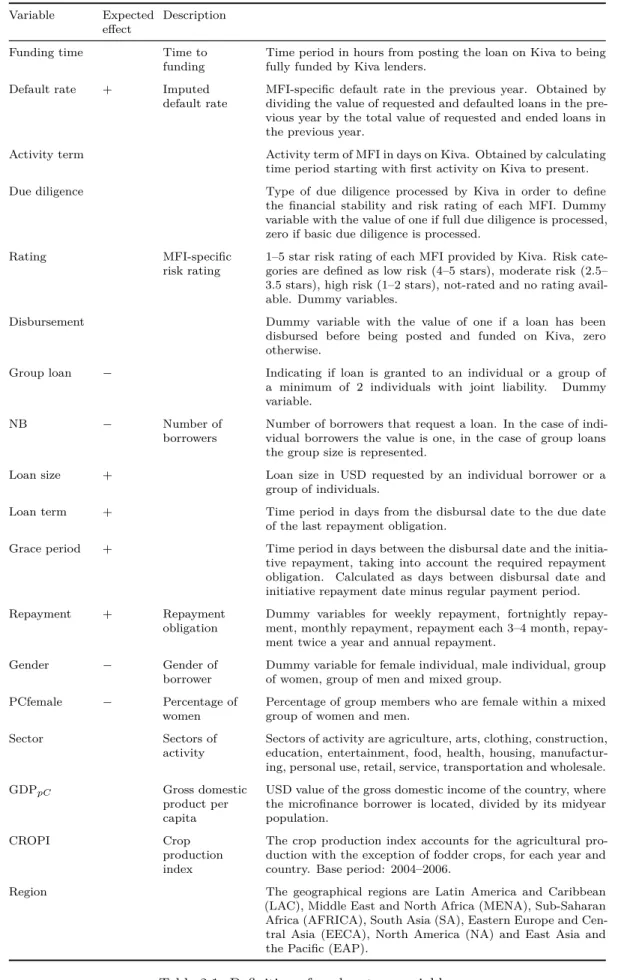
All explanatory variables are defined in detail in Table 2.1.
As pointed out above, we use the variablefunding timeas a proxy for the lenders’ behavior in the sense that the faster a loan is funded the more attractive it must have been for the lenders.
The default rate of the previous year is employed as a proxy for the screening
and monitoring quality of an individual MFI. Loans are considered to belong to a respective calender year if the majority of the loan term (more than 50%) is in that year. Therefore, considering a loan of yearx, the default rate of the year x−1 is used as proxy. The default rate of the previous year displays the share of requested and defaulted loans in yearx−1. Several partner MFIs did not have a default rate in the previous year. The metric variable is imputed with its mean conditioned on the year in order to prevent the loss of these observations.
Theactivity term of an MFI describes its experience in credit financing on Kiva
and is included as a control variable. Kiva reviews partner MFIs in a full or basic due diligence to obtain information on the financial stability of each MFI. Based on the due diligence process, Kiva provides a one-to-five starrisk rating, indicating the financial risk related to the failure of a MFI. A five star-rating represents the lowest risk. A dummy variable for the type of due diligence and the MFI-specific risk rating are included as MFI-specific control variables. Relatively frequently, MFIs use the possibility of refunding loans which have already been disbursed to the respective borrowers. Therefore, we include a dummy variable indicating disbursement before or after publication on Kiva. Loan characteristics are considered to be possible determinants of credit default. To this end, a dummy variable for group loans is included in the analysis.
Furthermore, the number of borrowers in a group compared with individual
borrowers is of interest and included as a control variable. The loan size requested on Kiva and the loan term until the loan matures are included in order to test H3a and H3b. The classic microloan contract requires regular repayments, starting immediately after loan disbursement. The metric variable
grace period describes the time period before the initial repayment is due. The
categorical variablerepayment obligations is classified by the categories weekly, fortnightly, monthly, every three to four months, twice a year and annual. Dummy variables represent the corresponding categorical values.
We also include dummy variables representing the gender of an individual borrower. Moreover, if a group loan is granted to a mixed group, we include
the percentage of women in these groups to explore the gender effect.
To account for the stated (mostly entrepreneurial) purpose of the requested loan, sectors of activity are included as loan-specific control variables.
To display macroeconomic influences, we include control variables such as the
GDP per capita, the CROPI as a proxy for the agricultural production in a
Variable Expected effect
Description
Funding time Time to funding
Time period in hours from posting the loan on Kiva to being fully funded by Kiva lenders.
Default rate + Imputed default rate
MFI-specific default rate in the previous year. Obtained by dividing the value of requested and defaulted loans in the pre-vious year by the total value of requested and ended loans in the previous year.
Activity term Activity term of MFI in days on Kiva. Obtained by calculating time period starting with first activity on Kiva to present. Due diligence Type of due diligence processed by Kiva in order to define
the financial stability and risk rating of each MFI. Dummy variable with the value of one if full due diligence is processed, zero if basic due diligence is processed.
Rating MFI-specific
risk rating
1–5 star risk rating of each MFI provided by Kiva. Risk cate-gories are defined as low risk (4–5 stars), moderate risk (2.5– 3.5 stars), high risk (1–2 stars), not-rated and no rating avail-able. Dummy variables.
Disbursement Dummy variable with the value of one if a loan has been disbursed before being posted and funded on Kiva, zero otherwise.
Group loan − Indicating if loan is granted to an individual or a group of a minimum of 2 individuals with joint liability. Dummy variable.
NB − Number of
borrowers
Number of borrowers that request a loan. In the case of indi-vidual borrowers the value is one, in the case of group loans the group size is represented.
Loan size + Loan size in USD requested by an individual borrower or a group of individuals.
Loan term + Time period in days from the disbursal date to the due date of the last repayment obligation.
Grace period + Time period in days between the disbursal date and the initia-tive repayment, taking into account the required repayment obligation. Calculated as days between disbursal date and initiative repayment date minus regular payment period. Repayment + Repayment
obligation
Dummy variables for weekly repayment, fortnightly ment, monthly repayment, repayment each 3–4 month, repay-ment twice a year and annual repayrepay-ment.
Gender − Gender of
borrower
Dummy variable for female individual, male individual, group of women, group of men and mixed group.
PCfemale − Percentage of women
Percentage of group members who are female within a mixed group of women and men.
Sector Sectors of
activity
Sectors of activity are agriculture, arts, clothing, construction, education, entertainment, food, health, housing, manufactur-ing, personal use, retail, service, transportation and wholesale. GDPpC Gross domestic
product per capita
USD value of the gross domestic income of the country, where the microfinance borrower is located, divided by its midyear population.
CROPI Crop
production index
The crop production index accounts for the agricultural pro-duction with the exception of fodder crops, for each year and country. Base period: 2004–2006.
Region The geographical regions are Latin America and Caribbean (LAC), Middle East and North Africa (MENA), Sub-Saharan Africa (AFRICA), South Asia (SA), Eastern Europe and Cen-tral Asia (EECA), North America (NA) and East Asia and the Pacific (EAP).
2.3.2
Methodology
As the dependent variable is a binary variable, we use a probit regression model with the following specification:
probit{P(Yi = 1|(Ui, Vi, Xi, Zi))}=β0+β1Ui+β2Vi+β3Xi+β4Zi+i,
where Ui represents the variable describing the funding behavior of individual
Kiva lenders (the funding time) and Vi describes characteristics of the loan
contract, such as loan size, loan term, grace period, repayment obligations, type of lending, purpose and gender. Xi is a vector of variables at the level of the
partner MFI andZi is a vector of macroeconomic and geographical variables.
The symbol i ∼ N(0, σ2) is the error term. We apply Eicker–Huber–White
heteroskedastic-consistent standard errors in all regressions.
2.3.3
Descriptive statistics
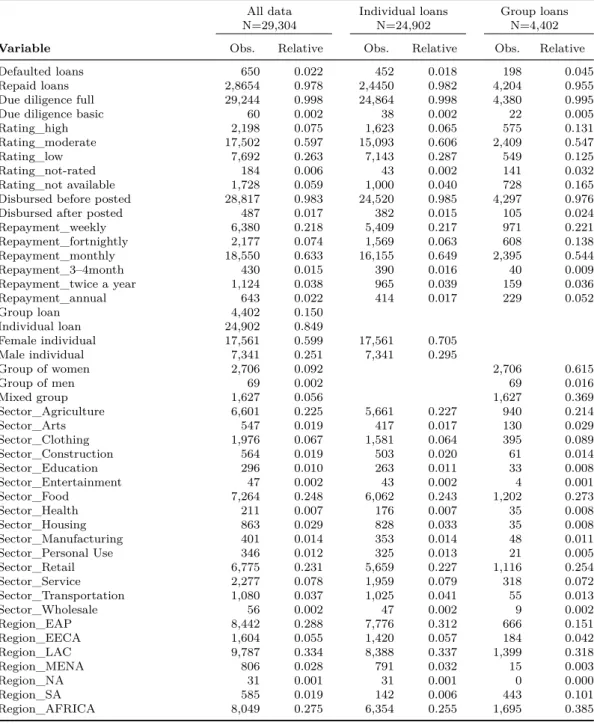
The descriptive statistics for the metric and the categorical variables based on the data set are reported in Table 2.2 and 2.3, respectively.
The average time to funding on Kiva.org is 133.37 hours which does not differ greatly between individual loans and group loans. The average default rate in the previous year is 1.06%, whereby some MFIs display a default rate of zero and one MFI even has a default rate of 66.2%. The median value of 0.06% indicates the skewness of the distribution. More than 98% of loans are already disbursed before being posted on Kiva. Approximately 85% of loans are given to individual borrowers and the remaining loans to groups of at least two individuals up to a maximum of 45 individuals. The average loan size is $794.42. The average loan size given to groups of borrowers ($1,758) is more than twice as high as the loan size given to individual borrowers ($624.09). In contrast, the average loan term of individual loans exceeds the loan term of group loans. The grace period ranges from –366 days to 441 days. Both extreme cases correspond to loans with an annual repayment. The median grace period is zero days. After an average grace period of 3.65 days, 21.77% of loans require weekly repayment and 63.30% monthly repayment. Slightly less than 12% comprise part of the remaining categories of repayment obligations. The largest part of the loans is obtained by female individuals or groups of women. Male and mixed groups are rare.
The average GDPpc is $2,933, including countries with a GDPpc of $219 as well as countries with a GDPpc of $51,748. It is obvious that there are no group loans in North America.
All data (N=29,304)
Variable Mean S.D. Min Median Max
Funding time 1.33e+2 2.06e+2 1.67e−2 3.53e+1 1.59e+3 Default rate 1.06e−2 3.16e−2 0.00e+0 6.00e−4 6.62e−1 Activity term 9.21e+2 4.42e+2 0.00e+0 9.09e+2 2.23e+3 Loan size 7.94e+2 7.87e+2 5.00e+1 5.75e+2 1.00e+4 Loan term 2.85e+2 1.42e+2 7.00e+0 2.80e+2 1.11e+3 Grace period 3.65e+0 2.04e+1 −3.66e+2 0.00e+0 4.41e+2 NB 2.11e+0 3.43e+0 1.00e+0 1.00e+0 4.50e+1 GDPpc 2.93e+3 2.96e+3 2.19e+2 2.29e+3 5.18e+4 CROPI 1.31e+2 2.94e+1 7.32e+1 1.23e+2 2.91e+2 Individual loans (N=24,902)
Variable Mean S.D. Min Median Max
Funding time 1.34e+2 2.13e+2 1.67e−2 3.16e+1 1.59e+3 Default rate 1.05e−2 2.83e−2 0.00e+0 6.00e−4 6.62e−1 Activity term 9.05e+2 4.36e+2 0.00e+0 8.85e+2 2.22e+3 Loan size 6.24e+2 4.95e+2 5.00e+1 5.00e+2 1.00e+4 Loan term 2.97e+2 1.45e+2 7.00e+0 3.00e+2 1.11e+3 Grace period 4.27e+0 2.08e+1 −3.66e+2 0.00e+0 4.41e+2 GDPpc 3.03e+3 2.99e+3 3.26e+2 2.36e+3 5.18e+4 CROPI 1.30e+2 3.02e+1 7.32e+1 1.21e+2 2.90e+2 Group loans (N=4,402)
Variable Mean S.D. Min Median Max
Funding time 1.28e+2 1.66e+2 2.81e−2 5.27e+1 8.57e+2 Default rate 1.12e−2 4.60e−2 0.00e+0 6.31e−4 5.89e−1 Activity term 1.01e+3 4.63e+2 0.00e+0 1.06e+3 2.09e+3 Loan size 1.76e+3 1.28e+3 1.00e+2 1.33e+3 7.60e+3 Loan term 2.15e+2 9.35e+1 2.80e+1 1.83e+2 1.08e+3 Grace period 1.54e+1 1.74e+1 −1.84e+2 0.00e+0 4.39e+2 NB 8.36e+0 5.67e+0 2.00e+0 7.00e+0 4.50e+1 GDPpc 2.37e+3 2.62e+3 2.19e+2 1.21e+3 1.55e+4 CROPI 1.29e+2 2.39e+1 9.59e+1 1.26e+2 1.95e+2
Table 2.2: Descriptive statistics for metric variables based on the imputed data set
Notes: The data set is derived from the Kivas official webpage for researchers and the World Banks data base. The entire data sample contains 29,304 loans. It is divided into the subsample of individual loans with N=24,902 and the subsample of group loans with N=4,402. Mean, S.D., maximum, median and minimum of metric variables are displayed. The variables are defined in Table 2.1. Data source: Kiva, World Bank.