POLICY RESEARCH WORKING PAPER
-1312
The
-New
Wave
of
Private
In most cases. pushi. LowerThe
Ne
Wav
ofP-vt
-
ff -0ff
f
international interest rates a're
Capital Inflows
a key factor in the new. wave-of Capital info 4to .
d&'elopinj countries.
Push or Pull?
:r
Wi- e. that wv is-sustainable depends on the.:
Eduardo Fernandez-Arias economic perftxma~nce,of
industeial countries. This makes d eveloping countries -vulnerable bu a softa
anding is fea~sibe
TeWorld Bank
International Enornoics Department
Debt and Intermationial Finance Division June 1994
Public Disclosure Authorized
Public Disclosure Authorized
Public Disclosure Authorized
POLICY RESEARCH WOR}KING PAPER 1312
Summary findings
Widespread private capiral inflows to middle-income capital inflows, he applies the model to data for a
countries have surged over the pasr three years. At the representative panel of middle-income countries.
esame time, Brady-type debr reduction operations and The main empirical resulr is that (except in Argentina,
domestic policy reform took place, indicators of country the Republic of Korea, and notably, Mexico), the surge creditworthiness improved dramatically, and of capital inflows appears to be driven more by low - international interest ratcs plummeted. Which factors returns in industrial countries than by domestic
factrt.-most fully explain the wave of capital inflows? How So recent levels of cap-.;al inflows would be unslistainable : sustainable is it? if global interest rates returned soon to higher levels and
Some see this new wave of voluntary capital inflows as cautious policies should be followed.
being mostly 'pulled" by attractive domestic conditions, Two other important conclusions are obtained. First, which open new and profitable investment opportunities depressed returns in industrial countries caused the in the domestic economy and improve country improved creditworthiness in indebted countries through credirworthiness. Under this interpretation, if successful their effect on discount rates. Country creditworthiness domestic policies are maintained, capital inflows will be was an important transmission mecthanism for external sustained. shacks and is the key to reconciling the push and pull
Others see these inflows as being mostly "pushed" by interpretations of market data.
conditions (especially low interest rates) in industrial Second, a sofr landing appears feasible. Stock countries. Under this interpretation, capital inflows adjustment does not-appear to be a significanr
would diminish and possibly urm to outflows if component of the adjustment mechanism manifested in - - sinternational real inrerest rates returned to the higher' the surge of capital inflows. In other words, the evidence
levels of the 1980s. 5so far suggests that a gradual increase in international
* . Fernandez-Arias presents an analytical model of interest rates would result in less capiral inflow, or
international portfolio investment in developing moderate capital outflows in some countries, rather than countries based on non-arbitrage conditions between massive capital outflows that quickly bring do,>n the external returns and domestic returns adjusted by srock of foreign liabilities. By and large, if there are country risk. He uses the model to explain why the new capital outflows, they are unlikely to match past inflows wave of private capital inflows is mostly a middle-income unless the reversal in external conditions coincides with a country phenomenon. To analyze the issue-of private . worsening of domestic conditions.
This paper-iproduct of the Debt and Inrernational Finance Division, International Economics Deparrment-is part of a larger efforr in the departmenr ro analyze foreign investment in emerging markets. Copies of the paper are available free from the World Bank, 1818 H Street NW, Washington, DC 20433. Please contact Ronald Tutt, room 58-040, extension 31047 (40 pages). June 1994.
The Policy Resarch Working Paper Series disseminates the findings of work mr progress to encourage the exchange of ideas about
development issues An objective of the seri!s is to get the fsndings ow quickly, cuen ir the presentations r,- less than fuUy polisbhe The
papers cany the names of the autbors and should be usedand cited accu'ingly. The fmdigs. interpretations, and condusions are the authors' own and sbould not be attributed to the World Bank. its Executive Board of Directors, or any of its ean ber countries.
38
ppendix
I-
Data.
i
(
-
~~ ~~~~PF)
'Fi4,,
=,(
--
7cpl+
)(GNP
FDE
V4
R-,
RDE,,
=V (L?,lR, LRI49)PDEV,
--F,..
9- =-
-Average of RF over 1 989
R1.39 -
Aveage ofLR over 1989
P,.
s
---
=-Average of RF over 1989
4 -
Total Portfolio Flows. Source:ECDI staff estimates
US- 10
year government
bond yield - Source: line 61 IMF
International Financial Statistics. The monthly interest rate was
taken and the quarterly annualized average was calculated.
-
--=
-Log of secondary market price:of Commerical Bank debt. Two
weekly data was taken and the quarterly average was calculated..
Source: Salomon
Brothers.-VP,
--Gross National -product - Source - IMF Intermational Financial
Statistics
"us=- Consumer price index for the US - Source:
IM
International
Financial Statistics.
SUMMARY
Widespread private capital inflows to middle-income countries have surged over the last
three years. At the same time, Brady-type debt reduction operations and domestic policy refonn-took place, country creditworthiness indicators dramatically improved, and international interest
rates plummeted. Which factors are most important in explaining this wave of capital inflows and,
consequently, how sustainable is it? This is a subject of debate with important implications for
policy as well Fas positive analysis.
Some see this new wave of voluntary capital inflows as being mostly "pulled" by attractive domestic conditions, which open new and profitable investment opportunities in the domestic
economy and improve country creditworthiness. Under this interpretation, successfiul domestic
policies are the key and, if maintained, capital inflows would be sustained. Others, however, see
t - -Lhese inflows as being mostly "pushed" by conditions in industrial countries, especially the low
interest rates prevailing there. In this interpretation, capital inflows would not be sustained if international real interest rates returned to- the higher levels of the 1980s.
This paper presents an analytical model of international portfolio investment in developing
countries based on non-arbitrage conditions between external returns and domestic returns adjusted by country risk. This model is used to explain why the new wave of private capital
inflows is mostly a middle-income country phenomenon. To analyze the issue at hand, the model.
is operationalized and a tractable estimating equation is obtained and used for a representative
panel of middle-income countries. The main empirical result is that, with a few -exceptions, most
* notably Mexico, the surge of capital inflows appears to be largely driven by low returns in industrial countries, as opposed. to domestic factors. Consequently, recent levels of capital
The structural analysis of this process yields two important insights. First, it'is shown both
theoretically and empirically that depressed returns in industrial countries cause the improvement
of creditworthiness in indebted countries through their effect on discount rates, which supports
the view that country creditworthiness has been an important transmission mechanism of external
shocks and provides the key for reconciling the "push" and "pull" interpretations of'similar data. Second, soft landing appears feasible. The dynamic observed behavior of capital inflows does not, appear to have a significant:component of stock adjustment. Therefore, prevailing. conditions, determine capital inflows irrespective of their accumulated stock. This implies that
sudden capital outflows. rapidly reversing past. inflows are not to be expected unless the reversal in
INTRODUCTION
Widespread private capital inflows to middle-income countries have surged over the last three years. At the same time, Brady-type debt reduction operations and domestic policy reform took place, country creditworthiness indicators dramatically improved, and intemational interest rates plummeted. Which factors are most important in explaining this wave of.capital inflows and, consequently, how sustainable is it? Policy designed to deal with capital inflows and their consequences requires a clear understanding of these-issues.: The surge in voluntary private capital inflows over the last few years to several developing countries, including many of the classical Latin American debt crisis examples, has reminded both analysts and policymakers that reluctant foreign investment. and capital rationing is not an unavoidable, sad fact of life and that international capital markEets could. again be a significant. source of finance. Unfortunately, economists are not yet ready to. answer whether these capital flows are being "pushed" by low interest rates in industrial countries or "pulled by higher returns in developing countries, nor to assess the sustainability of these capital inflows.
Some see this new wave of voluntary capital inflows and rapidly improving creditworthiness as the evidence that debt strategies have worked and domestic policies are on the right track. In this view, domestic factors are more important than external factors in explaining these inflows. This is the "pull" story (see Chuhan, Claessens and Mamingi, 1993). It leads to the optimistic view that the sustainability of these flows is to a large extent a function of domestic policies which are under the control of developing countries. Under this interpretation, successful domestic polices are the key and, if maintained, capital inflows would be sustained. By contrast, for others (Calvo, Leiderman and Reinhart (1993)) the surge in capital inflows is the result of factors external to developing countries, such as the fall in international interest rates. This "push" story leads to the concern that these flows are highly volatile because they are subject to factors beyond the control of policymaker and calls for cautious policies. In this interpretation,
capital inflows would not be sustained if international interest rates returned to the higher levels of the 1 980s.
The "1pull" story in Chuhan et al. is partly based on the observation that country creditworthiness appears to play a very substantial rolec in explaining the inflows compared to that of international interest rates. However, the critical and seemingly obvious assumption that country creditworthiness indicators reflect domestic factors as opposed to external factors, is unwarranted. In this paper I show, both theoretically and empirically, that external factors have a substantial impact on country creditworthiness, a channel through which domestic economies are exposed to exogenous shocks. Therefore country creditworthiness is not a good proxy for do., estic factors. For -this conceptual reason, as well as other more technical reasons, this paper radically.differs in its interpretation and reaches very different conclusions despite broadly similar data.
In this paper, I find .clear support for the "push" story. With very few exceptions, most notably Mexico, external factors appear to be the.most important in explaining the recent surge in capital infl&ws. Consequently, recent levels of capital inflows will prove to .be transitoy if global interest rates, soon return to the higher levels of the. 1980s. Nevertheless, soft landing may be possible. The dynamic behavior of capital inflows does not appear to have a significant component of stock- adjustment. Capital inflows appear to be responding only to contemporaneous conditions irrespective of their accumulated stocks. Therefore, they should not be. seen as a way. of accomplishing stock levels in line with prevailing conditions, a result that could be obtained depending on the relative importance of the channels through which inflows affect returns, as later explained. This implies that sudden capital outflows rapidly reversing past inflows, that is negative stock adjustments, are not to be expected unless reversal in extemal conditions is coupled with a concurrent worsening in domestic conditions -'
3~~~~~~~~~~~~~~~~~~~~~~~~~~~~~~~~~~~~~~~~~~~~~~~~~ Figure 1 ~~I D. - --- I- m- - I
-so
. 60 40 . - I - . - - -.. . -_. 75. 0 * V69 p90- WI~~~~~199 1992 )br*L - -Private Capital Flows Forcign Direct Inestment plus Total Portfolio flowas to all Developing
countnes.
Source: World Debt Tables and FECDI staff cstimates. Interest rate 10 year US Govt. bond yield.
Price: Ovcrall Annual avcrage of secondary marklet prices. Soutce: Salomon Brothers.
This paper develops a structural model of intemational portfolio allocation in which the importance of country creditworthiness is made explicit and its detenninants analvzed. This structural analysis is able to overcome some of the limitations of the
"push" story in Calvo et aL. where capital inflows in Latin America are proxied by changes in international reserves' and inferences are based only on the statistical analysis of common factors. First, quarterly portfolio capital inflows are measured directly for a comprehensive panel of middle-income developing countries. Second, the underlying linkages and channels are addressed both analytically and empirically. Third, the findings in Calvo et al. appear hard to reconcile with the traditional portfolio model where the key,
4
determinant of flows is return differentials. In such a model equal changes in domestic
'.
and foreign returns
shouldhave effects
on flows equal in size. Since significant changes in domestic returns have systematically failed to cause large capital inflows over the last several years, the effects of international interest rates in Calvo et al. would be implausibly large compared to that of domestic returns. Furthermore, the absence of voluntary private inflows to entire regions, such. as Sub-Saharan Africa, contradicts the presumption -of widespread inflows across countries (as found in Latin America) which is the basis for the'' conclusions in their paper. The model here is, by. contrast, consistent with all the evidence.This paper is organized as follows. Section I sketches a simplified international portfolio allocation model focusing on the role of country creditworthiness and its determinants. In particular, it provides the analytical framework. for the key issues discussed later in the paper: -the nature of the factors underlying the increased inflows. the -channels through which they operate, and their volatility and dyniamic implications.
Sec-ion II operationalizes the model in section I by considering a suitable burden-sharing model of country risk and treating improvements in the domestic economic climate as an underlying unobserved variable. Section III contains the empirical statistical, analysis of such a model in connection with the issues discussed above and Section IV concludes. Appendixes with statistical information follow.
1. A SIMPLE INTERNATIONAL PORTFOLIO ALLOCATION MODEL
The Model
The key reason why the financial evaluation of foreign investment differs from domestic investment is that the first requires the analysis of relevant "country" factors, such as future exchange rates, balance of payments difficulties and controls, and, more generally, the various ways in which foreign investors can be taxed implicitly or expicitly.
Returns to investment abroad can be thoughit as coming from two sour-ces: the individual "project" and global "country factors. The first source is com-mon with domestic
invest.ors of the recipient counitry. The second source is specific to foreign investors.2
This second source of. returns is.particularly relevant and. caninot be. ignored by
foreign investors invescing in developing countries. Its main com-ponents are "volatility"
(for example, -future exchange rates may be subject to great uncertainty) and "defau'lt riskY" While the first type of factors would only. affect. the variability of returns but not its
expected mrean, the presence of "default: risk" does reduce mean returns (swlas further
increasing return variability). The combina~tiion of tl~iese country factors results in the need
.for adjusting "project' returns: expected.mean returns shiould be revised downwards and.
variability should be increasd.3
In developing countries with substantial default risk and low creditworthiness the effect of shocks on- mean returns is likely to be relatively more significant, and therefore dominate the effect on variability. For these countries, first moments, as opposed to second moments, arc likely to be a sufficiently good approximation to describe changes in foreign investors' choices between investing in these developing countries or elsewhere. The standard mean-variance portfolio models based on the trade-off's between first arid second moments facing risk-averse in'vestors is less relevant when default risk is not negligible aild country creditworthiness is low. First; shocks to country creditworthiness can be expected to be relati'vely more significant when it is low and therefore more sensitive to the realization of uncertain developments. Hence, in developing couintries
these shocks are likely to be a more important factor in determiuning capital inflows.
Second, once country creditworthiness is too low, capital is rationed and the resulting involuntary flows emerging from negotiations are largely independent, of the specific
Thsabstracts fronm "country" factors affecting domestic investors,which may lead to capital flight.
6
characteristics of the return profiles. Therefore first moments are also the.key for the characterization of these "corner' solutions where lack of creditworthiness segments
markets de facto,
This simplified
model
of private international portfolio allocation is based onnon-arbitrage. conditions- for mean returns for the various types of flows, indexed by s, which
hold dynamically in discrete periods.indexed by t. The three key variables are: domiestic
"project" expected return Dst. country creditworthiness adjustment factor Cst (I for a develojped country). and the opportunity cost represented by the. return in developed countries Rst. In this context, Dst is the contractual return adjusted by idiosyncratic
factors. From the point of view of.foreign investors of type s, the overall return
bf
investing abroad (the adjusted domestic return) is DstCst and the-alternative return (the .foreign return) is Rst. The marginal equilibrium condition for voluntary private flows is the equality between adjusted domestic and foreign returns:
DstCst = Rst for s voluntary4
[I]
-.Let Ft denote the vector of net flows fst across types s in period t. Let St denote the vector of end-of-period stocks. While Rst can be assumed to be exogenous given the
relative unimportance of developing countries in world financial markets, both factors underlying domestic returns, Dst and Cst, can be assumed to negatively depend on these
~~~~~~~~~~~~~~~~~~~S,
vectors. Domestic project returns decline as foreign capital inflows increase because the
- quality of the pool of available investment opportunities iu the domestic economy decline
as a result of diminishing returns and adjustment costs. As discussed later in the context
of burdensharing, country creditworthiness can be assumed to decrease as the stock of
I4n the case of involuntary flows such as commercial bank debt in countries where payments result from ex-post bargaining given die constraints on enforcing international contracts, this condition wvould hold as an inequality (smaller than).
foreign liabilities increase. Therefore:
DSt lDs(dt,Ft),
DI
>0 and D2 -0
.0 .[2]
Cst
Cs(ct.St, C I >0 and C2 < 0-
.3]where dt and et are shift parameters
reflecting
the underlying
economic
climate concerning
the investment
returns and the country's
ability to
tpay respectively.
F.-.*or
voluntary private flows, say s] to v, the v non-arbitrage equilibriunm
.t~~~~~ ~o vout prvt flws sa s= :.
conditions in [1] hold. For them, flows fst are. endogenously
determined
based on the
exogenous
variables ct, -dt and Rst. and their initial stocks (as well as stocks and flows of
other types of flows). If country creditworthiness
is. extremely low, these interior
equilibrium
conditions
may call for outflows that exceed the country's payment limit; In
that case, capital rationing and involuntary
flows reflecting
the country's payment ceiling
would result instead (such as the case of the involuntary
restructuring
of commercial
bank
debt). Involuntary
flows (s>v) are the result of a "corner" solution
rather than the interior
solution yielded by the non-arbitrage
conditions
[1], which would hold as inequalities
5.
To make the model interesting
as an explanation
for the surge of capital inflows,'
I will
assume that the set. of flow types that are voluntary,.
whose level is deternined by the
non-arbitrage conditions,
is large and certainly
not empty. It should be kept in mind, however,
that if vO tbe.above-mentioned
non-arbitragc
conditions have no bite and all capital
inflows would be exogenous to the model and therefore not affected by its parameters.
Arguably, this corner solution is -a good representation
of countries with very severe
creditworthiness
problems,
such as Sub-Saharan
Africa.
5
-This paper focuses on volutntary flows. For an analysis of how involuntary flows are detennined in a bargainiing framework see Eduardo Fernandez-Arias (1991).
In this model, under general regularity conditions and assuming that external returns Rst are positive functions of Rt, a slift parameter reflecting the underlying external investment climate, in equilibrium voluntary flows co-move in the sense that shocks to the' underlying parameters -ct, dt,- and Rt cause them to move in the same. direction.'. This
condition would therefore qualitatively validate partial equilibrium analysis. In particular,
for all voluntary private flows s=l to v, it holds true that 5sf>O when Ac>O or Ad>O or A
R<O.6 Instead of attempting to specify further the general equilibrium conditions that..
would determine the precise quantitative impact on each type of flow, here we simply assume that the above equation [I] holds for voluntary private flows in the aggregate. Let Ft and St denote these aggregate flows and stocks: For simplicity, let the parameters dt
and Ct subsume, respectively, the flows and stocks of types other than private voluntary
(say commercial bank debt inclusive of Brady bonds and official debt). We then arrive at the non-arbitrage condition:
D(dt,Ft) =Rt/C(ct,St) [4]
This non-arbitrage condition equates domestic returns D to foreign returns R multiplied by 1/C, which can be interpreted as the country risk- premium factor. Substituting St-St_1+Ft allows to obtain both terms of [4] as finctions of Ft, which are graphically depicted in Figure 2:
6
Empirically, the dliscriniination betwveen equity and debt flows in the contex't of an earlier draft confrms this theoretical presumption.
9
Figure 2
F
Returns
:
:
R/C
Ft*
Ft
I
The -comparative statics of private voluntary flows Ft can be -easily derived by totally differentiating [4] (substituting St and using the sign restrictions in [2] and [3]) and
confirmed by inspecting Figure 2., The reduced-form solution is such that
Ft =F(dt.ct,Rt,St-1) [5]
The slopes of the curves in Figure 2, and therefore the size of the comparative
statics derivatives, depend on the sensitivity of the functions D and C to the equilibrating
flows as measured by DF and
CS
(since given the predetermined St-1, C =CF). Theimpact of various shocks and policies can be traced'through their impact on those slopes.
For example, the policy of counteracting capital inflows with international reserves accumulation make's the D curve flatter. To the extent that domestic project returns D are
depressed by-net capital inflows (reserves accumulation amnounts to investing abroad),
l:
magnifies the effects of the underlying shocks, resulting in larger capital inflows from
abroad and increased volatility. To the extent that country creditworthiness depends on
gross foreign liabilities and therefore gross capital inflows, capital inflows are to some extent limited at the cost of creditworthiness.
Stock Adjustment and Dynamnics
Voluntary capital flows F equilibrate shocks to the system through two channels:
- "project" return D (flow adjustment) and creditworthiness C (stock adjustment). The
relative contribution of these channels to the equilibrating adjustment depends on their
relative impact on overall adjusted domestic returns DC. On the 'margin this is measured
by their relative elasticities with respect to flows, that is (F/D)DF relative to (FIC)CS (since CS=CF). Since CS and DF relate to slopes in Figure 2, this can also be grasped
graphically. The key parameter summarizing the relative contribution of stock adjustment'
is the relative elasticity X=(CS/C)/(DF/D + CS/C), which under the assumptions made in
[2] and [3] ranges between 0 and 1. Two polar cases are interesting:
i) Stock adjustment is ineffective (X0). In this case CS=0, which implies a
horizontal R/C curve in Figure 2. Here all the adjustment takes place through D and the resulting flow Ft from [4] does not depend on the initial stock St-1. Then:
Ft = F(dt,ct,Rt) [5i].
ii) Flow adjustment is ineffective (A=I). In this case DF=O, which implies a horizontal D curve in Figure 2. Here all the adjustment takes place through C and the solution to [4] can be rewritten in terms of stocks only:
St - S(dt ctRt) [5i-]
These.two polar cases have quite different dynamic implications. To see this.
consider the case where at some point in time T the underlying parameters return. to their initial levels at time 0 (that is, (dT,cT,RT)=(do,co,Ro)). In case (i), FT=FO. If in the interim period flows were larger than initially, flows will decline to reach the initial level but outflows would not undo the accumulated inflows in the interim period. In case (ii),
Sp-So. Here flows would not only decline but would abruptly turn to outflows
immediately undoing all the cumulative gains in increased flows.
Sharper insights can be obtained by explicitly solving a linearized version of [5]. Notice that by differentiating [4] it can be easily checked that dFt/dSt l=-A. which. provides an alternative interpretation of the parameter K. A linear solution is fonnally
obtained in the next section in equation [14]. For our purposes here it is enough to write:
Ft=Kt-XSt 1 [6]
where the constant Kt depends on the underilying parameters (dtctRt) and the coefficient
of St-] is
-x
as discussed above. It is clear. that flows crucially depend on the.contemporaneous. conditions reflected in Kt and that the worsening of those conditions
would lead to flow reduction. For any given Kt, inflows are smaller Lhe larger the
7~~~~
accumulated stock and the parameter X as measured by XSt -*7 The ratio x =Kt/St-I l
defines a threshold level for X: if X?A, a condition that large accumulated stocks make
more likely, outflows would result.. More. generally; the contemporaneous inflow_ level..
associated with fixing the condition K to a certain level (for. a given accumulated stock) is larger the smaller the parameter X. In particular, the -immediate inflow reduction
hn gaphic terms, increasing stocks mak-e the cunre R/C to shift upwards over time. Ceteris paribus, this leads to lower equilibrium tlows. The magnitude of this reduction depends on the slopes of both curves in suclh a way that iL ispropoitionial to k
12
associated with setting K to a low level would be minimized when ?=O. In that case, Ft=Kt and outflows would result only when they are required by the underlying parameters as measured by Kt<O.P
As noted above, if i=0 then the dynamics of Ft collapses into a static equation. lf
X is not zero9. however, flows exihibit interesting dynamics. Rewriting [6] as a difference
equation in stocks, letting S be initial stock in the relevant period (t=O) and assuming for
simplicity that over that period Kt takes the constant value K1 0. the solution is:
St = K/L + (S-K/21j(l -)t [7]
This solution is stable and converges to the long-run equilibrium stock K/A. Convergence is monotonic (increasing or decreasing depending on whether the initial stock S is below or above the long-mn equilibrium), where the speed of convergence to equilibrium increases with X (and is infinite when X=l): Notice that during an expansive phase (S<KIX) there is a trade-off between the level of the long-run equilibrium and the how fast that level is approached: for given K (and given initial stock S assumed to be non-negative), the larger X, the faster the adjustment to the equilibrium stockl but the lower such equilibrium. It can be easily shown that this second factor prevails by differentiating [7] to obtain dSt/dX<O for all t>O under the assumptions. In other words,
the smaller X the faster stocks accumulate. Stocks accumulate the fastest when Xz=O, in
which case St=S+Kt.
Alwavs tmder the mainttined assumption that a solvency crisis does not develop. Otherwse the basic non-arbitrage condition would not hold and forced repayments would occur.
9The previous static case for X=0 can also be obtained as a limiting case as
X approaches 0.
10Smooth growth of K can be casilv modelled. Anotlter wray to interpret this simple fornulation is that K is a
13
The dynamics of a reversal of conditions as reflected in K can be analyzed usilig [7]. Let K be the less favorable conditions and S the accumulated stock when the reversal
takes place. The bulk of the adjustmnent takes place up-front, as can be checked by taking
.~~~~~~~~~ I
time differences in [71 to obtain: Ft=(K-kS)( l-)t1. Whether the new stock levels entail
outflows depends on whether the initial stock S is larger than the long-run equilibrium K/I
* Permanent (as opposed to simply short-run) outflows would result if
?L>g
(despitedecreasing stocks), and. conversely, permanent inflows if Xc< . Regarding the cumulative
adjustment as measured by S-St. if K is not negative (the reversal is not catastrophic), then
the adjustment is uniformly more severe the larger the parameter X and is therefore
minimized when X=O. The swiftness of the flow reduction and possible outflows if
favorable underlying conditions reversed depends on x and is minimized when 2 is zero.
Where the parameter X lies is ultimately an empirical question, which is addressed as such
in section 11.11
Tke Role of Country Credtworthiiness
The creditworthiness channel corresponds to curve C(ct,St) in Figure 2. First, it plays a role as part of the adjustment mechanism through stock adjustments as long as CScO as discussed above. Its effect is to dampen the flow adjustment needed to restore equilibrium (a consequence of the positive slope of the R/C curve in Figure 2) and magnify the dynamic adjustment as discussed above. Second, it plays a role as a channel for transmitting shocks on the country's ability to pay (ct9, either exogenous or policy
iF completeness, it may be interesting to analyze the case wherc c<O. This casc would require thiat ceteris paribus, given K, foreign investors be more willing to invest the larger their colletive exposure. The opposite assumption is made in this paper on the grounds tdat cointry creditworthiness w%ould decline in that case, and therefore 2L4U is ruled out by assumption. Wlhile Ibis appears to be a very reasonable assumption, the herd behavior
implicit in k<O is not inconceivable, perlhaps as a rational response in the context of imperfect information. In that case, the solution in l7I is explosive: stocks wvould increase (decrease) without bound as long as S is bigger (smaller) than KfA.
14
determined such as the level of debt outstanding. 12
Shocks improving country creditworthiness would move downwards the curve R/C and cause capital inflows as an equilibrium response. If effects on C are negligible, the creditworthiness channel Would not be important for the transmission of shocks. If,
firther, stock adjustment is not significant, then C is constant and the model collapses to the traditional model where only returns Rt and Dt matter. In fact, in this case [5]
collapses to Ft F(dt,Rt). Otherwise this channel would be important for the
determination of voluntary capital inflows.
Since the adjustment factor C is at most one, when country creditworthiness is not an important concern, such as in developed countries, this factor is approximately equal to the constant one and therefore largely insensitive to shocks and stock accumulation. In that case, this channel is not important and the traditional model is applicable. By
13
contrast, when country creditworthiness is low this channel is potentially important. The factors underlying country creditworthiness in that case, many of which are subject to significant variations, are analyzed in what follows.
Disentangling ESternal and Domestic Factors
Whether capital inflows are caused by external or domestic factors depends on the ultimate nature of the shocks underlying the adjustment, rather than the channels through which they operate. While foreign return Rt is clearly external and the domestic investment climate parameter dt is clearly domestic, the factors underlying country creditworthiness and the country's ability to pay index ct are less clear. To the extent that
'2The effect of debt reduction can also be analyzed along the lines of this model. I leave this for another paper. 1 As discussed above, when creditworthiness is extremely loxv, however, even if sensitive to shocks and stocks of liabilities, country creditworthiness may be irrelevant because capital is rationed and the solution for capital flowvs collapses to a constant corner solution determined outside the model, as opposed to the interior solution depicted in Figure 2.
the country creditworthiness channel is important, the assessment of thie role of external and domestic factors requires the analysis of the nature of the factors underlying country creditworthiness.
The parameter ct depends on both external and domestic factors. Conceptually. this parameter can be thought as reflecting the expected present value of the resources available for external payments. On the one hand, its present value nature implies that it is. sensitive to the investors' discount rate, which is of course an external factor. This is a generally overlooked powerful channel of external influence. On the other hand, the stream of resources being discounted is possibly related to resource bases such as export earning capacity or public revenue capacity, which in turn result from a combination of' domestic and external factors (such as world growth or terms of trade).
The key elements relevant for this analysis can be represented in the following
simple model of country's ability to pay measured by c (subindex t dropped for simplicity):
c = W/(i-g) [8]
where the discount rate in the present value calculation is i and the relevant wealth base from which resources available for payment in each period are obtained is assumed to grow at the rate g starting from the value W.
The appropriate (average) discount rate in this present value calculation is some medium or long-term risk-free international interest rate in the currency in question.
Similarly, the (average) growth rate g is some expected medium or long-term growth rate.
Under these simplifying assumptions, the elasticity of c with respect to international interest rates is minus 1(1-gA). Even if external influences underlying W and g are left aside, an interest rate elasticity of minus one (or possibly larger in absolute value in a growing economy) amounts to a potentially powerful channel of external influence.'
16
Falling international interest rates may easily account for sharp improvements in country
creditworthiness.
--11. OPERATIONALIZING TIIE MODEL
In order to make the model empirically tractable it is required to relate the parameters and variables to observable statistics. I first analyze how to measure the country creditworthiness adjustment factor and returns, and then specify functional forms leading to a tractable closed-form solution for capital inflows.
Country Credtitwortiness and Burden Shlaring
To the extent that the maximum recovery value of each type of foreign liability depends at least in part on common factors such as the factors underlying the country's ability to pay index c, shocks to these common factors will induce co-movement of those values. When those maximum recovery values are below contractual values, they are the market values of those claims and their ratio to contractual values implicitly defines market prices. In that case, shocks to the country's ability to pay translate into co-movement of implicit market pr.
qs-This co-movement of implicit market prices allows to relate the default risk associated with voluntary stock St to the observable commercial bank debt secondary
market price. Let Pt be the secondary market price of commercial bank debt stock Bt and
Qt be the (implicit) price of commercial voluntary stock St. Burdensharing among various creditor classes boils down to the rules that determine the repayment amounts that each. class would be able to force the country to make in present value terms, which depends on contractual rights and bargaining powers. Here I assume a simple burdensharingmmodel where the associated forced repayment capacities of both classes are given increasing
17
functions fl and f2 of the capacity to pay index c (subindex t dropped for clarity).4 Then
P=fl(c)/B and Q=f2(c)S=f(PB)/S, where f is f2(fl-l) and therefore f>O. Of course, the
above assumes that the resulting prices P and Q are smaller than one, which in turns implies rationing of both types of financing. However, if f(PB)/S is sufficiently large, then the resulting Q>1. This is.arguably the relevant case currently in the countries under review, where B is rationed but S is not. In that case, Q=1 (in this simple burdensharing model P is unchanged). In order to focus on P and S, which show much more variability
than B, I take B as constant. Consequently, I assume that the sharing of country risk is
such that:
Qt
=Min(1,f(PO/St))
[9]
By definition, the country creditworthiness adjustment fictor C is equal. to expected Q next period:
Ct =Et[Qt+l] [10]
Assuming thai the pair (Pt,St) is. a sufficient statistic for f(Pt+l)/St+l (that it absorbs all the relevant information available at time t concerning that ratio), which is a reasonable assumption given that stocks move slowly. and secondary market prices for debt incorporate expected zero profit conditions, then:
Ct=C(tS- . [I ]
:4This is a particular case of the "creditor-specific collateral" model in DeimgUc-Kunt and Femandez-Arias (1992). See that paper for an elaboration on how it differs firm the traditional "single collateral model and why, contry to the corporate case, it may be more applicable in ffie context of sovereign debt
18
Of course, to the extent that the market value for commercial bank debt relates to the country's ability to pay index ct, the interest rate sensitivity of that parameter discussed above will
be transmitted to the market price Pt, and therefore to country creditworthiness Ct through [11].
Measuring International Returns
Measuring returns R and i is difficult because unobservable expected (ex-ante). real returns are
needed. The usual way out is to measure ex-post real returns and hope that some form of rational expectations will make this solution somehow reasonable. A complicating factor in this case is
that the relevant retums, especially i,* should refer to medium-term maturities which fall outside
the observabl_ time frame. Therefore this quite imperfect solution is not even feasible.1 5
Within the feasible alternatives, the various choices do not seem to make substantial difference for the issue at hand. First, yields on various maturities exhibit a large degree of multicoDlinearity
which makes unimportant the carefull modeling of the term structure. Second, relevant nominal
rates and observable ex-post real rates are also highly collinear. For example, long-term nominal yields (10-year US bonds) and ex-post short-term real rates (3-month US LIBOR deflated by the US GDP deflator) track one another extremely well over the relevant period (see Figure 3) and
their regression yields an R-squared of 0.o.8 016
5
Survey data on. US infladon expecations could be very usefial but to my knowledge there is no available information for recent years. Market information on inflation-indexed claims is not available. to the best of my knowledge. Iam not aware of successful forecasig models which could be used for this purpose.
19
FiRure
3
Regression
of US Noninal 10 year bond
yield and the
real 3 month
LIBOR
1038 -
Actual
89ql 90ql 91ql 92q I 93q I
To make the presentation cleaner I chose not to distinguish between the maturities of the two intemational returns R and i (they are both called R).. Since i should. be medium-term as explained above, a ten-year maturity yield was used. Given the difficulties in estimating the unobservable ex-ante real rates, nominal rates were used instead as a proxy based on the assumption that inflation expectations over the mediumn term are slow-moving. As shown above, the use of other combination of maturities or ex-post short term real rates would not make much relevant difference.
Capturing the domestic investment climate
The measurement of retums within the domestic economy (D) would be even harder than the measurement of intemational returns. The instability of the developing economies. makes both nominal rates and ex-post real rates not very useful for proxying expected real retums. In particular, ex-post retums in domestic stock markets, a commonly used measure for those countries where it is available, may contain more noise
than information.'7
-20
In any event, what needs to be captured is the domestic investment climate d, to which flows react, rather than the resulting returns D. That is not an easy task. One alternative to capture d, which can be interpreted as the-availability of new investment
opportunities, is to measure the resulting investmrent or savings volume. One difficulty
witlh this approach is that it would require careful modeling of the investment and savings
- ffunctions in order to control for other variables as well as endogeneity biases.18 In
summary, returns are not an appropriate proxy and domestic investment or savings may
* - introduce more noise than information and yield misleading results. ideally, the domestic
economic environment and policies should be incorporated explicitly. In practice, this
exercise is a difficult one in a country study and even more so in a cross-country study like this one.
Fortunately, while the explicit modeling of the underlying policies would be
unavoidable-if the issue at hand were the evaluation of policies, for the present purpose it is sufficient to consider. the. domestic climate parameter (dt) as an unobservable and
estimate its effect indirectly as the residual capital flows which are not accounted for the other variables. in the model. The assumptions needed to recover such latent variable are
discussed in Section III.
Solving the Emprical Model
A linearized model is obtained when the following functional forms are assumed as empirical counterparts of [2] and [3]:
to established finns due to investment rigidities in tapping new opporunities, which may have a tenuous relation with the return of those opportunities. Large stock narket gains may be more the result of a rigid economy than of high-return investment opportunities, either realized or still untapped. The insignificance and sometimes wrongly signed estimates for the effect of this variable in Chuhan et al. (1993) confirns these problems.
I8Whule this route appears worth exploring. the lack- of improvement of low domestic savings rates in some of the Latin American countries that are seen as successful in this study strongly suggest that this approach would probably only contribute to an even stronger 'push" case.
2 1
CtWPXCxp(-YSI)
[1]
Dt-d clxp(-ZFj) - 1 3]
wherc WX,Y atid Z are positive constanis, Recwizinig the cquiliibriuim condiiioni [41 in
logarithmic iform (log D + log C -log R) anid solving for Fl using 1 [ 21 and [13] lekids to
the following linear empirical countcrpart of [5] (tlhat is ani cxplicil .form of [6])D.
Ft = It - Pirt + ypt - XSt- I [14]
where r and p are the logarithms of interest rates and prices R and P respectively, and F
and S are voluntary capital flows and stocks respectively. Regarcding Ihe parameters, 13
=l/(Y+Z), y=X/(Y+Z), X=Y/(Y+Z), and the intercept is It=(log(dt)+1og(W))/(Y+Z). The general sign assumptions on (X,Y,Z) imply that (,,y) are positive and X lies between zero and one (while the intercept It is not constrained). This is of course in agreement with the-general solution (5), since (It,rt,pt) proxies (the logarithm ot) (dt,Rt,ct, Notice that the
coefficient of St I is X.=Y/(Z+Y) as derived in Section I and used in [6], where Kt=lt-Prt+
YPt. Furthermore,.the structural parameters (X,Y,Z) are identified in this model since they can be recovered from (f3,y,). In particular, the elasticity of the (multiplicative) country risk premium (1 IC) to secondary market prices, equal to -X, can be recovered as -y/,B.
III. STATISTICAL ANALYSIS
Sample and Statistical Assumptions
The statistical analysis was conducted based on quarterly information for 1989-1992 and the first half of 1993, (indexed by t) for a panel of thirteen middle-income developing countries receiving private portfolio flows in the period. Since country
22
* ~~~creditworthiness plays a' crucial role in the analysis, only countries with consistent
creditworthiness information over time were' included.'1 9 The resulting- panel is still highly
* ~~representative. In terms of portfolio flows in the period, it represents 85 percent of
middle-income countries and 75 percent of all developing countries.2
Portfolio flows (both equity and debt21 were used in the analysis because high
frequency (quarterly) data was avaiable and the purely financial nature of these
transactions could justify, the assumption of no adjustment lags.2 2 Portfolio flows were
measured in dollars and deflated by the
US CPI
index to arrive at flows in -real dollars.The stocks of portfolio liabilities were proxied by accumulating portfolio flow after 1988.
The external return and country's capacity-to-pay parameters, Rt and ct respectively, were
proxied along the- lines explained in. the previous section. External returns were proxied by annualized 10-year US bond nominal yields. The country's capacity to pay -index was
proxied by the debt secondary market price except
for. Korea, Malaysia and Thailandwhere it is not available. An implicit uni't price was assumed for these countries to reflect.
that they remrained -creditworthy throughout the period.23 (For more details on- the data
see Appendix I.) For the reasons explained in the previous section, the domestic investment climate parameter dIt is indirectly measured as a residual.
The panel framework increases statistical efficiency by assuming that the relativ'e
effect on capital flows of changes in external returns and country creditworthiness is the
19The countries are Algeria, Argentina, Brazil, Chile, Korea, Malaysia, Mexico, Panama. Philippines, Poland, Thailand, Uruguiay anid Veneznd!a.
2
Based oni World Bank- (1 992) definitions and statistics.
2
Portfa1io debt flows include shiort-term flows except those trade related.
Other voluntary private flows, namely foreign direct investment, are available only with annual fr-equency anid are probably -subject to adjustment lags. Preliminary analysis done in an earlier draft using annual data showed that the same qualitative conclusions apply to both portfolio and direct investmecnt
2The. credit- ratings in fntsrizvlional Inivestor- fiurther 'supports this assumption, sinc the ratings of these three
23'
same for all countries in the period. Relative effect is meant to be relative to the size of
the country (and is defined as capital flows as a fraction of 1988 GNP).24 This makes
sense because these two explanatory variables are already standardized across countries: external returns are common and the country's ability to pay index is similar in magnitude.
This relative measure can be expected to eliminate heteroscedasticity problems.2 5 As
usual, idiosyncratic differences across countries are accommodated in country-specific intercepts to relax the equality assumptions.on marginal impacts.,
The final problem to be dealt with is one of identification. Because the domestic climate variable is treated as a latent variable, the country specific intercepts would reflect not only structural country characteristics but also that variable. This confusion of both effects would not allow any attribution of capital flows to domestic climate through inter-country comparisons unless countries are assumed to be structurally identical. Even then, the common structural component would not be identified and therefore a complete decomposition of variable capital inflows, that is their non-structural portion due to changes in the domestic investment climate, could not be accomplished.
This identification problem was solved as follows. First, all variables (capital flows
and stocks ratios, extemal returns and creditworthiness) are measured as deviations from their 1989 average level, which eliminates structural differences across countries. In other words, this model explains the increase in portfolio flows in terms of the chanees in the explanatory variables taken 1989 as a benchmark. Second, it was assumed that there was a country-specific quantum change in the investment climate in each country after 1989.
.-While this is. an imperfect assumption, it reflects the notion that in many countries. there
2 4
When used, stocks are also standardized by quarterly GNP.
25
It is worth noting that equal absolute effects on flows, an assumption sometimes used in similar studies, does not
seem reasonable in a panel with very dissimilar countries. This niisspecification error is likely to lead to non-robust estimations which, coupled with unchecked heteroscedasticity, would mostly reflect tie larger countries in the sample, thus undermiinig the power of the panel approach.
.24
was a policy sea chatnge after the Brady Initiative'( 1989) that underlies the surge in inflows
thereafter. Then the portion of the increase in portfolio flows due to improvements in the domestic economic investment climate in each country (for given country
creditworthiness) is identified as the country specific intercept in such. a model. (The same
idea was also used when analyzing the.increase in country creditworthiness.)
Econometric Estimation and Testing
Following the derivation in the previous section, the basic estimating structural equation is:
Yit (xi -
lrt
+ YPit -Xs;it.1
+ uit [15]where r and p are the logarithms of interest rates and prices R and P respectively, y is capital inflow as percentage points of GNP and s results from its accumulation over time.
All the variables are expressed as deviations from their 1989 average. level. The resulting
sample size is therefore 182, resulting from 14 quarterly observations (1990.1 to 1993.2)
over i3 countries indexed by i. The qualitative analysis conducted in the previous section indicates that the country-specific intercept (xi is not restricted, and the common parameters ,B, y and K are positive. In particular- k is the fraction of the inflows that can be attributed to stock adjustment and lies between zero and one.
The consistency of OLS estimators crucially depends on the uncorrelation between
- . regressors and contemporaneous error terms. It appears reasonable to assume that both. rt
and Pit are uncorrelated with uit: interest rates because they are exogenous and prices.
- because under the burdensharing model developed in the previous section they do not
depend on Sit. The absence of correlation between Sit and uit is plausible as long as
25
point estimate. for X (l=-0.08) and a Durbin-Watson statistic in the no serial correlation
range for usual confidence levels (2.17), This was interpreted as evidence that stock adjustment, and their dynamic implications discussed above, are not an important element in the present surge of capital inflows.
In order to make the rest of the discussion cleaner, it was assumed that X=O and the explanatory variable si,t I was neglected in the rest of the paper. Since in light of the theoretical discussion in Section I this parameter ranges between zero and one, th's assumption is filily consistent with the empiricai evidence. As discussed in Section I, this
* - pure flow adjustment mechanism implies the lowest volatility in the case of a reversal.
* . Consequently, the estimating equation finally selected is:
Yit (xi - + vit + Uit [16)
The estimation using OLS leads to the point estimates b=3.46 and c=1. 1 7. These estimates have the expected sign and are significantly different from zero at usual confidence levels. This implies that both opportunity costs and. country creditworthiness. are relevant considerations in investors' reactions. In particular, the elasticity of the country risk adjustment factor to secondary market prices can be estimated as c/b=0.34. The point, estimates ai, which reflect the impact of changes in the domestic conditions beyond their effect on creditworthiness after 1989, are mixed and certainly not consistently positive. Mexico is the outstanding good case, followed by Korea. and Argentina. Worsening cases include Algeria and Philippines (and also Chile due to domestic policy restrictions to capital inflows and a successful 1989). (See Equation I in Appendix 2.for further details.)
26
These estimators are the preferred ones after a number of tests were run:
i) Alternative burdensharing models would lead to prices p dependent on
stocks S.26 The endogeneity of prices could induce correlation between p and u,
especially after neglecting the stock adjustment mechanism, biasing the results. Instrumental variable regression where Pit was instrumented by lagged prices yielded less efficient point estimates not significantly different from the OLS estimators. This was interpreted as a validation of the OLS estimations and eliminated the need for a
simultaneous equations -approach where prices would be endogenous, because such.
system can be a&0umed to be recursive. In any event, if the IV estimators were used
instead the same qualitative conclusions would emerge.
ii) Inconsistency due to non-stationarity does not appear to be a problem.
The variables used can be presumed to be stationary either because of their nature (interest rates) or because they are bounded (ratios, prices). Nevertheless, the sample profile
appears to be consistent with a non-stationary situation. The Dickey-Fuller. cointegration
test was run stacking vectors of within-country residual-based statistics and the no cointegration hypothesis was clearly tejeajed.
iii) Serial autocorrelation of the disturbance term. does not appear to be a
problem according to Durbin-Watson statistic. Zero autocorrelation is not rejected at
* usual confidence levels and therefore reported estimator standard errors are accepted.2 7
Even then, this effect can be expected to be small as long as B/S is large.
if anything, the evidence points to negative, rather than positive, serial autocorrelation, possibly due to the luInpiness of investment with quarterly frequency.
27
iv) A random effects specification, as opposed to the fixed effects specification
implicit in the use of deterministic country dummies, would lead to more efficient estimators of. common parameters if the country-specific random component is uncorrelated with prices (interest rates are not a problem because they are country invariant). The point estimates obtained with the error component model were extremely close to the ones obtained' with fixed effects (b'=3.40 and c'= 1.23), so that the use of this method would have made no difference for the conclusions. Although the Hausman test for the consistency of the random effects model would allow its use at high confidence levels, the discrepancies in the parameter point estimates were so small and the theoretical gains in accuracy under the null hypothesis of ,zero correlation so marginal that the simpler fixed effects model was selected. One of the clear advantages of this choice is that the orthogonality properties of the fixed effects model leads to exact -factorial
decompositions at the country level, which is exploited in the tables that
follow-v) Results are robust to the proxies used. As discussed in the previous
section, the 10-year nominal interest rate used is very highly correlated with ex-post 3-month real LIBOR, which would have been an alternative regressor. As- noted in
Claessens, Diwan and Fernandez-Arias (1992), debt prices for instruments emerging fror-i
Brady operations do .not accurately reflect country risk. because of various enhancements. The use of stripped prices in the relevant countries and periods made essentiasy no
difference (b'=3.46 and c1=I.15). .
Decomposing Capital Inflows into Prximate Causes /
A country-by-country decomposition of the increase in portfolio inflows (as a percentage of GNP) after 1989, measured as its average level relative to its 1989 level, is presented in Table 1. The decomposition is based on the average of each explanatory
f . . . - f~~~~~~~~~~~~~~~~~~~~~~~~
f . - - . . :-, As ~ ~~ ~~~~~ .'- ~~~~~~~~~~~~~~~~~~~~~~~~~~~~~~~~~~~~~~'..:
28
variable (which are also measured in terms of deviations from their 1989. level) multiplied by its estimated coefficient. The resulting three-way decomposition is based on the following equality for each country i:
y.=
ai
-br + cpi [117]where yi. r. and p; are averages across time. Therefore this decomposition based on first moments directly addresses the issue of what portion of the increase in flows is due to changes in the explana'toiy variables. Since the question is to assess the sources of the surge of flows in the period (rather than its variation in general for which second moment
- - methods are designed), this methiod appears the most natural in this case.28 Since interest
rates fell in the period, their contribution is positive. Prices in most countries increased in the period, making also a positive contribution.
2 8
This decomposition based on first moments is also invariant to the use of alternative explanatory variables collinear with the ones used, so that results do not depend on the particular proxies chosen. But unlike second moment methods, it is exhaustive (because each counurys residuals add up to zero due to OLS orthogonality properties) and invariant to the order in which factors are analyzed. By contrast, to achieve this the traditional Analysis or Variance requires orthogonality among regressors (which does not hold- in this case) oT arbirary assumptions, such as in decompositions based on standardized coefficients.
29
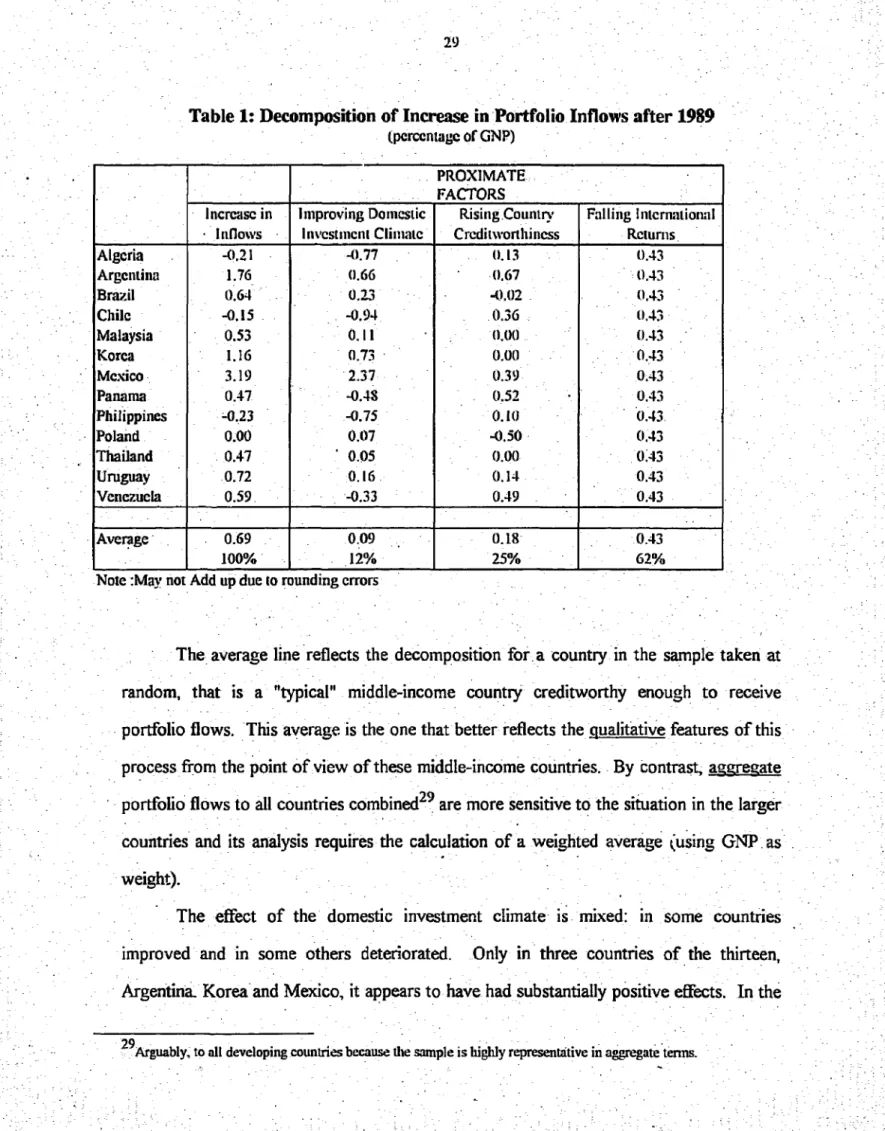
Table 1: Decomposition of Increase in Portfolio Inflows after 1989
(percentagc of GNP)
PROXIMATE
.___.__.___._ FACTORS -_._._:
: ncrcasc in improving Donestic Rising CoLntry Falling Intcritional In1lows Investmncti Climatc Credithvorthincss Rclurms.
Algcria . -0.21 -0.77 . 0. (.13 0.430 Argentina 1.76 0.66 0,67 t0.43 Brazil 0.64 0.23 -0.02 (1.43 Chilc -0.15 -0.94 . 0.36 (1.43 Malaysia 0.53 0. I1 (1.00 0.43 Korca 1.16 (3.73 0.0(n
-
0.43 Mexico 3.19 2.37 0.39 0.43 Panama 0.47 -0.48 . 0.52 0.43 Philippines -0.23 : -0.75 0.10 0.43. Poland 0.00 0.07 -0.50 -0.43 Thailand 0.47 0.05 0.00 0:43 Uruguay 0.72 0.16. 0.14 0.43 Venczucla 0.59. -0.33 0.49 0.43 Average . 0.69 0.09 - 0.18 0.43 - . - ____ 100% 12% 25% 62%Note :Mav not Add up due to rounding crrors
The average line reflects the decomposition for, a country in the sample taken at random, that is a "typical" middle-income country creditworthy enough to receive portfolio flows. This average is the one that better reflects the qualitative features of this
process from the point of view of these middle-income countries. By contrast, agareizate
portfolio flows to all countries combined2 9 are more sensitive to the situation in the larger
countries and its analysis requires the calculation of a weighted average kusing GNP. as
weight).
The effect of the domestic investment climate is mixed: in some countries improved and in some others deteriorated. Only in three countries of the thirteen, Argentina. Korea and Mexico, it appears to have had substantially positive effects. In the
typical middle-income country the improvement in domestic investment climate has not been significant and made only a marginal contribution to the attraction of portfolio flows (12%), which can be well accounted by the fall in international interest rates and the
improvement in creditworthiness. Had the dcomestic investment climate in developing
countries remained unchanged, we would have still witnessed a generalized surge in portfolio inflows across countries.31)
Increased country creditwonhiness played an important role in explaining capital inflows in many countries, but generally smaller than that of international interest rates (with the only clear exception of Argentina).-. For the typical middle-income country improvements in country creditworthiness made less than half the contribution of interest rates (about 40%).32 (In. aggregate dollar terms over the developing world, the contribution of improvements in country creditworthiness relative to that of international interest rates appears to be about 30%)
The factor that clearly stands out. Is international interest rates, which ceteris paribus "pushed" portfolio flows in the amount of almost half a point of GNP to these countries over the period. This mass of flows amounts to most of the portfolio flows.
received by the typical country (63%).3 Still, this. appears to leave room. for .an
- important effect of "pull" factors. As analyzed before improvements in the domestic
30While almost hair of the aggregate dollar amount in the developing world may be attributed to this factor, this is mainly the result of compositional etTects due. to larger countries doing better rather than a widespread and easily -, replicable featurc of this phenomenon in middle-income cotmtries.
31
Korea, Malaysia and Thailand were asswned to have an implicit unit price in tle period, and therefore in these countries changes in creditworthiness made zero contribution by assumption.
-2The same qualitative conclusions were reached in an earlier draft based -on annual observaLions of total private flows including foreign direct investment. Using standardized coeficients (the product of the absolute value of the coefiicient times the standard,dev'iation of the regressor) to measure the relative contribution of creditwvorthiness also leads to the same qualitative conclusions in this model. It should be noted that, if at it is customary, the regressors are considered in levels rather than increments, creditworthiness would,appear more important that interest rates because the between-country variationi of prices tlat the panel approach is designed to filter out would umduly inflate the variation of prices.
33
7-31
investment climate in the typical. country were not substantial, but if added to ihe contribution of improvements in creditworthiness (25%) they would amount to an
unimpressive but still important contribution of 37%.34 This would be a gross
overestimation of the contribution of "pull" factors, however, because. as explained above external factors have an important bearing on country creditworthiness.. In what follows I tackle this issue empirically and give a final assessment of the contribution of external and domestic factors.
Thze Contribution of External (Push) and Donmestic (Pull) Factors
In this model, the analysis of the-role of external and domestic factors and the assessment of their contribution requires the analysis of the determinants of secondary
market prices. One non-structural approach would be to assume that co-movement of=
prices of different countries reflect external common factors and the rest of the variation
corTesponds to domestic factors. In order to make the point that international interest
rates are the ultimate driving force in this "push" process of capital inflows, here a more structural approach is followed, where prices are explicitly explained by intemational interest rates based on the theory presented in -previous sections. To make the analysis clean and simple, a constant price-interest rate elasticity across the 10 countries with
creditworthiness problems (that is excluding Korea, Malaysia and Thailand)35 is assumed:
Pit=i .- s rt + "it [18]
34
1t could be further argued that the relative inaccuracy with which anld T are estimated and the negative correlation between b and c due to some degree of multicollinearity between the regressors does not allow to rule out the possibility that the contribution of creditworthiness is significantly higher than 25% (up to about 50% if interest rates are deleted from the regression).
35Since these countries are assumed to have unit prices the theory developed in Section II does not.apply. For them
32
The intercept J±j reflects the change in domestic factors leading to improvements in
creditworthiness (as opposed to the domestic investment clinate aj). The parameter s is .(the absolute value o6 the interest rate elasticity and is expected to be positive. In this analysis, both domestic factors and external factors (conservatively restricted to international interest rates rt) act thirough two channels: i) directly affecting external and domestic retums (j3rt and ai respectively), and ii) indirectly through creditworthiness for those countries still having gains to be made as described in equation [18. For these
countries domestic and external factors are accounted for by ait and f'rt respectively.
according to the following expressions:
* ai'=cj+ypu; - [19]
. .+7
-~~~~~f
--
yThe analysis of the relative contribution of domestic and external factors can be done along the lines of Table 1 usin.g[19]. Considering estimates mi and e in [18] such
that pi. mi - er, the nice features of the decomposition are preserved. (For Korea,
Malaysia and Thailand [17] is not applicable and no change needs to be made.) In that case the resulting decomposition is:
Yi;
(ai+6icmi)
- (b+bice)r .[2]where 8i=O for Korea, Malaysia and Thailand and b6I= for the rest of the countries in the sample.
The more sensitive prices to interest rates as measured by the elasticity e, the more, important external factors compared to domestic factors. If e=O there is no extemal linkage and it would be valid to fully attribute, the contribution of creditworthiness to