University of Arkansas, Fayetteville University of Arkansas, Fayetteville
ScholarWorks@UARK
ScholarWorks@UARK
Theses and Dissertations 5-2020
Secure and Efficient Models for Retrieving Data from Encrypted
Secure and Efficient Models for Retrieving Data from Encrypted
Databases in Cloud
Databases in Cloud
Sultan Ahmed A AlmakdiUniversity of Arkansas, Fayetteville
Follow this and additional works at: https://scholarworks.uark.edu/etd
Part of the Databases and Information Systems Commons, and the Information Security Commons
Citation Citation
Almakdi, S. A. (2020). Secure and Efficient Models for Retrieving Data from Encrypted Databases in Cloud. Theses and Dissertations Retrieved from https://scholarworks.uark.edu/etd/3578
This Dissertation is brought to you for free and open access by ScholarWorks@UARK. It has been accepted for inclusion in Theses and Dissertations by an authorized administrator of ScholarWorks@UARK. For more information, please contact [email protected].
Secure and Efficient Models for Retrieving Data from Encrypted Databases in Cloud
A dissertation submitted in partial fulfillment of the requirements for the degree of Doctor of Philosophy in Computer Science
by
Sultan Ahmed A Almakdi King Khalid University
Bachelor of Science in Computer Science, 2010 University of Colorado at Denver
Master of Science in Computer Science, 2014
May 2020 University of Arkansas
This dissertation is approved for recommendation to the Graduate Council.
Brajendra Panda, Ph.D. Dissertation Director
Susan Gauch, Ph.D. Mark Arnold, Ph.D.
Committee Member Committee Member
Miaoqing Huang, Ph.D. Committee Member
Abstract
Recently, database users have begun to use cloud database services to outsource their databases. The reason for this is the high computation speed and the huge storage capacity that cloud owners provide at low prices. However, despite the attractiveness of the cloud computing environment to database users, privacy issues remain a cause for concern for database owners since data access is out of their control. Encryption is the only way of assuaging users’ fears surrounding data privacy, but executing Structured Query Language (SQL) queries over encrypted data is a challenging task, especially if the data are encrypted by a randomized encryption algorithm. Many researchers have addressed the privacy issues by encrypting the data using deterministic, onion layer, or homomorphic encryption. Nevertheless, even with these systems, the encrypted data can still be subjected to attack. In this research, we first propose an indexing scheme to encode the original table’s tuples into bit vectors (BVs) prior to the encryption. The resulting index is then used to narrow the range of retrieved encrypted records from the cloud to a small set of records that are candidates for the user’s query. Based on the indexing scheme, we then design three different models to execute SQL queries over the encrypted data. The data are encrypted by a single randomized encryption algorithm, namely the Advanced Encryption Standard AES-CBC. In each proposed scheme, we use a different (secure) method for storing and maintaining the index values (BVs) (i.e., either at user’s side or at the cloud server), and we extend each system to support most of relational algebra operators, such as select, join, etc. Implementation and evaluation of the proposed systems reveals that they are practical and efficient at reducing both the computation and space overhead when compared with state-of-the-art systems like CryptDB.
©2020 by Sultan Almakdi All Rights Reserved
Acknowledgments
First of all, I would like to thank Prof. Brajendra Panda for his endless support and guidance while pursuing my Ph.D. Without his guidance and advises, this dissertation wouldn't have been completed.
Second, special thanks go out to my family for their love and motivations during the journey of pursuing the PhD. Without their unlimited support and motivations, I would not be able to complete the research.
Third, I want to acknowledge Najran University and the ministry of higher education in Saudi Arabia for offering me the opportunity to study in the United States. Without their financial support, I would not be able to make this achievement.
Last but not least, I would like to thank Dr. Mark Arnold, Dr. Susan Gauch, and Dr. Miaoqing Huang for being members of my committee, and for their valuable comments and suggestions during this dissertation. Also, I thank staff members at the computer science department and the University of Arkansas in general.
Table of Contents 1 Introduction ...1 1.1 Encryption Algorithms...3 1.1.1 Order-Preserving Encryption ...3 1.1.2 Deterministic Encryption ...3 1.1.3 Homomorphic Encryption ...4 1.1.4 Randomized Encryption...4 1.1.5 Onion Encryption ...4 1.2 Summary of Contributions ...5 2 Related Work ...6
2.1 Security Issues in Cloud Computing...7
2.2 Encryption-Based Solutions to Protect Cloud Databases ...8
2.3 Current Approaches to Process SQL Queries over Encrypted Databases ...9
3 Methodology ...15
3.1 Introduction ...15
3.2 Encryption Strategy ...16
3.3 The Query Manager (QM) ...16
3.4 Partitioning Tree (PT) ...17
3.5 Encoding Approach ...19
3.6 Developed Prototypes ...21
3.6.1 Bit Vectors as a Matrix (BVM) ...21
3.6.1.1 System Description ...21
3.6.1.2 Basic Operations ...21
3.6.1.3 Relational Algebra Operators ...25
3.6.1.3.1 Join ...25
3.6.1.3.2 Union...29
3.6.1.3.3 Intersection ...30
3.6.1.3.4 Difference ...33
3.6.1.3.5 Duplication Removal ...33
3.6.1.3.6 Aggregation and Sort ...34
3.6.1.3.7 Project ...37
3.6.2 Bit Vectors as Column(n) (BVSAC) ...38
3.6.2.1 System Description ...38
3.6.2.2 Condition Rewriting...41
3.6.2.3 Basic Operations ...43
3.6.2.4 Relational Algebra Operators ...44
3.6.2.4.1 Join ...44
3.6.2.4.2 Union...46
3.6.2.4.3 Intersection ...46
3.6.2.4.5 Duplication Removal ...47
3.6.2.4.6 Aggregate and Sort ...47
3.6.2.4.7 Project ...49
3.6.3 Bit Vectors as an Independent Table (BVSIT) ...50
3.6.3.1 Model Description ...50
3.6.3.2 Basic Operations ...51
3.6.3.3 Relational Algebra Operations ...55
3.6.3.3.1 Join ...55
3.6.3.3.2 Union...58
3.6.3.3.3 Intersection ...58
3.6.3.3.4 Duplication Elimination, Aggregation Functions, and Project ...58
4 Experiments and Evaluation ...59
4.1 Experimental Setup ...59
4.2 Datasets and Partitioning Tree ...60
4.3 Evaluation ...62
4.3.1 Execution Delay Comparison ...62
4.3.1.1 Original Database Encryption and Insert Statements ...62
4.3.1.2 Basic Statements ...64
4.3.1.2.1 Experiment 1 ...64
4.3.1.2.2 Experiment 2 ...65
4.3.1.2.3 Experiment 3 ...66
4.3.1.2.3.1 Select (*) Latency ...66
4.3.1.2.3.2 Select (col) Latency ...72
4.3.1.2.3.3 Throughput ...76
4.3.1.2.4 Experiment 4: Update and Delete Statements ...77
4.3.1.1 Aggregation Functions ...80
4.3.1.1.1 Experiment 5 ...80
4.3.1.2 Join, Union, and Intersection ...81
4.3.1.2.1 Experiment 6 ...81
4.3.1.3 Query Rewriting at the QM ...85
4.3.1.3.1 Experiment 7 ...85
4.3.1.4 Cloud Server Computation versus QM Computation ...87
4.3.2 Space Requirement ...88
4.3.3 Factors that Increase the Efficiency of the Proposed Systems ...91
4.4 Discussion ...92
5 Conclusion and Future Work ...97
5.1 Summary ...97
5.2 Future work ...98
6 References ...99
List of Figures
Figure 1.1 Anticipated market growth in 2023 ...2
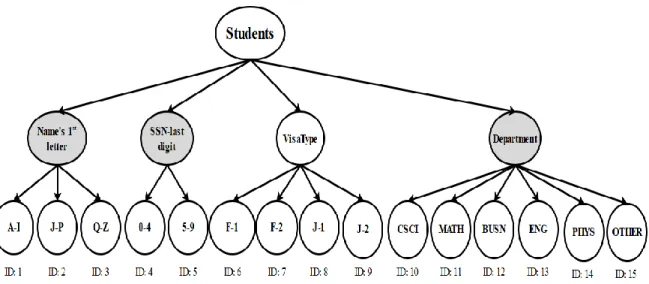
Figure 3.1 An example of the partitioning tree (PT) of the students table ( Table 3.1) ...18
Figure 3.2 The BVs of Table 3.1 ...20
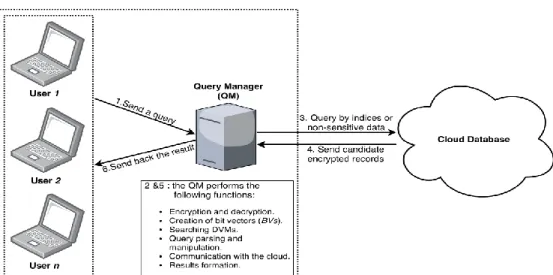
Figure 3.3 BVM Architecture. ...22
Figure 3.4 An example of joining two tables by the equality of salary values ...28
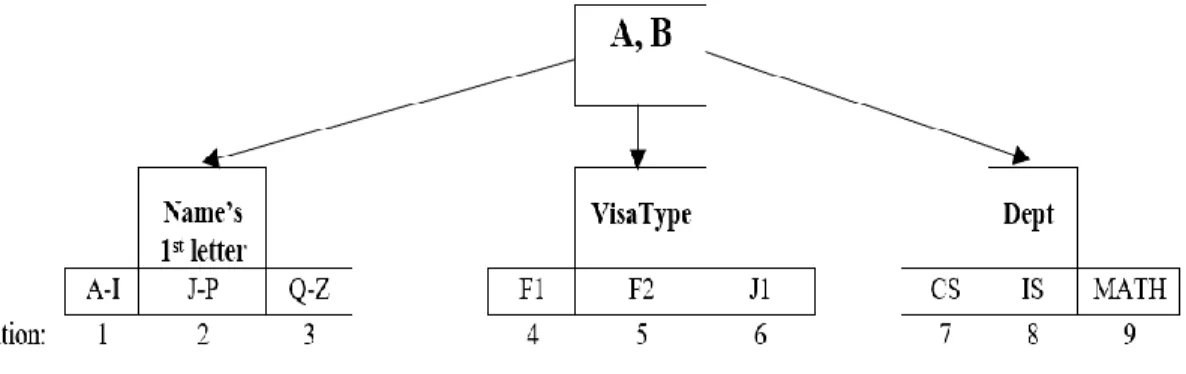
Figure 3.5 An example of a PT for Table A and Table B. ...31
Figure 3.6 BVSAC Architecture. ...38
Figure 3.7 The PT of Table 3.2 ...40
Figure 3.9 BVSIT Architecture...51
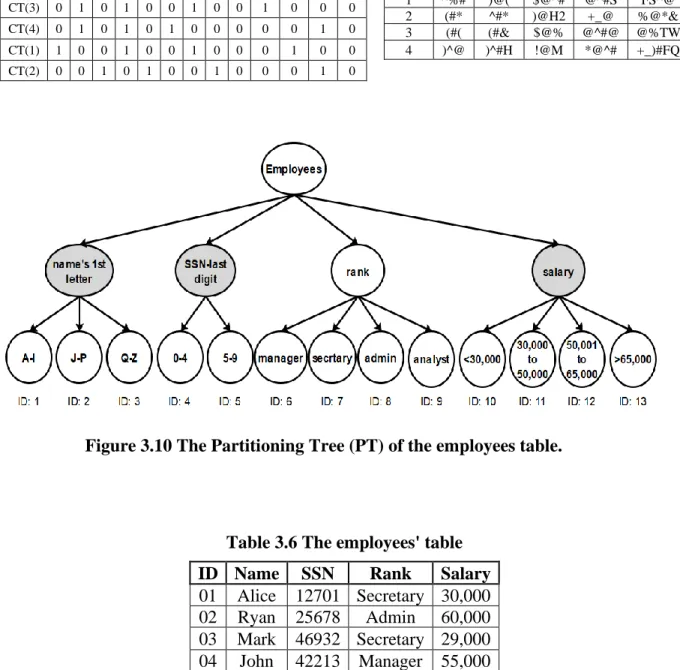
Figure 3.10 The Partitioning Tree (PT) of the employees table. ...52
Figure 4.1 The delay comparison of insert statements for all systems, in milliseconds. ...63
Figure 4.2 The percentage of retrieved encrypted tuples for all proposed models ...64
Figure 4.3 Average percent of entirely decrypted tuples ...66
Figure 4.4 The delay comparison of executing select all statements (select *) for all models in ms when the query condition contains only one clause. ...69
Figure 4.5 The delay comparison of executing select all statements (select *) for all models in ms when the query condition contains two clauses. ...70
Figure 4.6 The delay comparison of executing select all statements (select *) for all models in ms when the query condition contains three clauses. ...71
Figure 4.7 The delay comparison of executing select statements to retrieve a single column’s value for all models in ms when the query condition contains only one clause ...73
Figure 4.8 The delay comparison of executing select statements to retrieve only one column’s value for all models in ms when the query condition contains two clauses. ...74
Figure 4.9 The delay comparison of executing select statements to retrieve only one column’s value for all models in ms when the query condition contains three clauses. ...75
Figure 4.10 The percent of throughput of all systems compared with the throughput of MySQL when requesting unencrypted data. ...77
Figure 4.11 Comparison of the average delay of update statements for all models to update a number of existing tuples (100, 200, 500, and 1,000 tuples). ...79
Figure 4.12 Comparison of the average delay of delete statements for all models to delete a different number of tuples (100, 200, 500, and 1,000 tuples). ...79
Figure 4.13 Join delay comparison among the proposed systems ...84
Figure 4.14 Union delay comparison among the proposed systems ...84
Figure 4.16 The average query translation cost at the QM for each model ...86 Figure 4.17 The percentage of the computation at the QM versus at the cloud server ...88 Figure 4.18 Comparison of the increase factor of encrypted table space among all systems...91
List of Tables
Table 3.1 The Students Table ...17
Table 3.2 Graduate students ...40
Table 3.3 The encrypted graduate students table ...41
Table 3.4 Bits table of Table 3.5 ...52
Table 3.5 Encrypted employees table ...52
Table 3.6 The employees table ...52
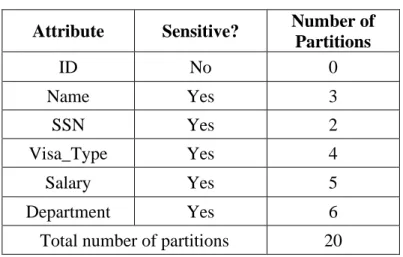
Table 4.1The structure of the original (plain) students' table ...61
Table 4.2 The sensitive attributes and the number of partitions for students table ...61
Table 4.3 The delay of the original database encryption comparison among all systems in minutes ...63
Table 4.4 Delays in milliseconds of executing (select *). ...68
Table 4.5 Delays in milliseconds of executing (select single column). ...72
Table 4.6 The amount of plain data in kB that each system can deliver to the user per second. ..77
Table 4.7 Delay comparison in milliseconds of executing SUM, AVERAGE, AND COUNT functions ...81
Table 4.8 Delay comparison in milliseconds of executing MAX and MIN functions ...81
Table 4.9 Specifications of the joined tables ...82
Table 4.10 The structure of TA students table. ...83
Table 4.11 The structure of original international students table ...83
Table 4.12 Query rewriting stages ...85
Table 4.13 Storage requirement per record at the server (cloud) of the encrypted student table (Table 4.1) in all the systems ...90
Table 4.14 Bits’ storage requirements at the QM when the students’ table has a different number of tuples ...90
Table 4.15 Summary of the advantages and disadvantages of the schemes evaluated in this dissertation. ...94
1
1 Introduction
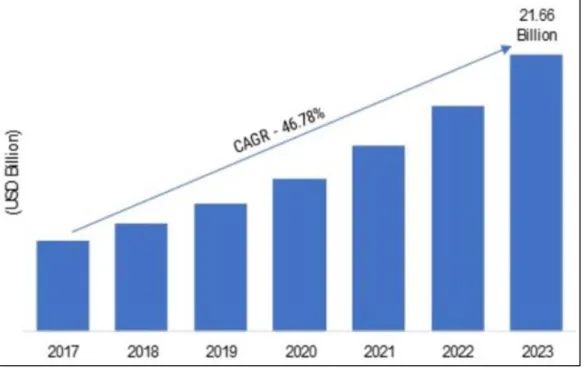
In the contemporary electronic era, both individuals and organizations need scalable data storage and high-performance computing units to process and store their data. Historically, only large organizations/ companies have been able to own such units, as they were not affordable for most individuals and small companies. With the rise of cloud computing, however, this problem has been solved, as users can now rent storage and computational units as needed at an affordable price. Most cloud providers provide databases as a service, which allow individual users and companies to outsource their data and access them at any time, from any location. According to the report in [1], the compound annual growth rate (CAGR) of cloud database market is anticipated to be 46.78% in 2023 [Figure 1.1]. However, given that privacy breaches are one of the most common threats in the cloud computing environment, many people have expressed concerns about privacy when outsourcing sensitive data. For instance, untrustworthy cloud service providers might steal personal customer information—such as email addresses, mailing addresses, and phone numbers—and sell that information to third parties, who can then use it to send irritating advertisements to users via email, mail, and telephone.
More importantly, attackers who target a cloud provider can gain access to customers’ sensitive personal information, such as social security numbers (SSNs). This has serious consequences, as criminals can use these data to impersonate customers in situations such as financial transactions (e.g., telephone banking). Thus, sensitive data are restricted from being processed or sold to a third party. Therefore, significant evolutions in the cloud computing environment could make such services unattractive to consumers if changes occur without also providing appropriate solutions for privacy breach issue. Such an issue must be tackled if cloud
2
providers are to gain the trust of users and organizations so that they will outsource sensitive data without worrying about data leakages.
Data encryption effectively solves the problem of privacy breaches by ensuring that cloud providers cannot learn from the data they store. The easiest way is to encrypt the entire table and outsource it. Then to process a query, the entire table must be retrieved and decrypted. However, the application of this technique conflicts with purpose of the databases and the critical functionalities of cloud environments (e.g., searching). Other researchers have used a proxy (i.e., a trusted third-party server), rather than the user, as an additional component to carry out the encryption and decryption processes. To make this approach practical, each datum must be encrypted with more than one encryption algorithm to support various query types [2]. However, in the case of very large data sets, this approach comes with the penalty of a significant computational burden, as each datum might be decrypted more than once. Various researchers
Figure 1.1 Anticipated market growth in 2023
3
have proposed numerous systems using different encryption techniques to protect data confidentiality. In the following subsection, we explore the common encryption algorithms that have been adopted in state-of-the-art research on cloud database security.
1.1 Encryption Algorithms
1.1.1 Order-Preserving Encryption
Order-preserving encryption (OPE) is a functional encryption technique to encrypt data such that range queries (e.g., maximum, minimum, and inequality operators) can be implemented on encrypted data without encrypting the operands or decrypting the data [3], [4]. This type of encryption uses a function to compare the order of the ciphertexts to allow comparison operations of the encrypted numeric data. This type of algorithm preserves the original data order. For example, if c1 is the ciphertext of m1, and c2is the ciphertext of m2, then the comparison of c1 and
c2 is as follows:
(c1 < c2 if m1 < m2 ); (c1 > c2 if m1 > m2 ); or (c1 =c2 if m1 = m2)
The security of this type of encryption is downgraded if the adversary infers the ciphertext of a certain plaintext. Also, this type of encryption is vulnerable to inference attacks as in [5], [6].
1.1.2 Deterministic Encryption
In deterministic encryption (DE) schemes, given the encryption key k and the messages m, the ciphertext of m is always the same when encrypted with k, even in multiple executions of DE. While DE can be used in keyword searches, it does not preserve the order if used with numeric values. AES-SIV is an example of a deterministic algorithm. DE is widely used in securing cloud databases. However, privacy can be compromised in this scheme if the attacker is able to identify the ciphertext of a certain plaintext word (e.g., if he establishes the ciphertext of “Alice,” then he is able to determine which tuples contain “Alice”).
4
1.1.3 Homomorphic Encryption
Homomorphic encryption (HOM) is a method of encryption that allows for the performance of certain arithmetic operations (i.e., addition and multiplication) on ciphertexts without the need to decrypt them. There are two types of HOM: partially HOM and fully HOM. Partially HOM supports either addition or multiplication, while fully HOM supports both operations. HOM can secure numeric data in cloud environments; however, encrypting with HOM produces long ciphertexts, since this type of encryption is based on an asymmetric encryption system. Also, computation performance on HOM ciphertexts is downgraded as the volume of ciphertexts increases [7].
1.1.4 Randomized Encryption
Randomized encryption intends to produce different ciphertexts for each plaintext, i.e., no more than one ciphertext has the same plaintext. Essentially, in this scheme, in addition to the secret key, an initialization vector (IV) must be XORed with the first block of the plaintext, and a new ciphertext must therefore be obtained each time the algorithm is executed [8]. While this encryption technique provides the highest security level for outsourced databases, it has a major drawback in cloud databases—namely, the inability to execute SQL queries over ciphertexts.
1.1.5 Onion Encryption
The term “onion layers encryption” was first developed by the authors in [2]. In onion encryption, cloud servers are able to execute different SQL statements while data remain secret. In the onion encryption, each layer is a ciphertext of a specific encryption methodology (e.g., DET, OPE, HOM, or RAN). The inner layer is the ciphertext of the algorithm with the lowest security level, while the outer layer is the ciphertext with the highest security level (i.e., randomized). The main flaw of this approach is the intensive computation that results from decrypting all of the encryption
5
layers, which leads to slower query processing. In addition, the space required for the encrypted databases is about 3.75 times that required for the unencrypted databases [2].
1.2 Summary of Contributions
In this dissertation, we first designed a novel indexing scheme for randomized encrypted databases, which is based on defining a partitioning tree (PT) for all domain partitions for sensitive columns in a table (i.e., dividing each column into sub-columns where each sub-column represents a set of values). The PT is then used to encode records into bit vectors (BVs), wherein each bit position is mapped to a specific partition and is only set to one if the value belongs to the set of values represented by that partition. The BVs are used to retrieve only part of the outsourced encrypted records. Second, we suggested three secure prototypes based on our proposed indexing technique. In each model, we use a different method of storing and handling the BVs (either on a private cloud server or on a third-party cloud server). Third, for each system, we proposed different algorithms to process most of the relational algebra operators on encrypted data without revealing the confidentiality of data. Fourth, we conducted several experiments to evaluate different aspects of the proposed systems—including, but not limited to, time overhead and space overhead—-against three well-known approaches: CryptDB [2], columns-based fragmentation [9], and one block-based encryption [10]. Our experiments showed that the proposed systems outperformed most of the competing approaches in both time and space overhead.
The rest of this document is organized as follow: in section 2, we explain different security enforcement schemes for the cloud databases, then we survey the state-of–the-art approaches to secure outsourced databases. Section 3 details the proposed systems in this dissertation, followed by the implementation and evaluation details in section 4. Finally, we provided a conclusion of this dissertation and discussed some of the future work in section 5.
6
2 Related Work
The powerful features of the cloud computing environment—such as enormous capacity and high-performance computing units—have attracted database owners in both small and large companies. These features have made it necessary to obtain and maintain the incredibly expensive storage and computation units to process vast databases at affordable prices. In spite of the advantages of cloud computing, data security is the main drawback of using cloud services to outsource databases. The work of securing databases began when networking and internet technology advanced and were adopted by major companies. This, in turn, fueled the need for databases as a service for individuals and entities requiring high storage capacity and computation. Data privacy, integrity, and confidentiality are in danger when databases are outsourced, since the database owner loses control over who can access and read their data.
To address these issues, researchers began to develop various approaches to protect user data from unauthorized access and data breaches, using data access control, data encryption, or both [11], [12]. Data access control functions by regulating what object O a subject S can access and what operations Op that S can perform on O. Encryption, in contrast, works by encoding plaintext data into ciphertext (i.e., an unreadable format). Each method has its advantages and disadvantages. For example, access control is intended to increase computing performance, while encryption decreases it. In addition, encryption protects against data breaches from both internal and external attacks, whereas data privacy can be compromised in such cases when the access control mechanism is enforced, since adversaries might bypass predefined access roles to access data. Regardless of the heavy computational work required by encryption schemes, encryption is still the preferred security mechanism for most database users.
7
2.1 Security Issues in Cloud Computing
Despite the powerful features of cloud computing, there are many issues and vulnerabilities that can be exploited by malicious actors against outsourced data. One type of security issues— privileges abuse—involves the use of legitimate privileges for malicious purposes (e.g., a user in company A with the privilege to view company A’s sales records who uses their privileges to fetch sales tuples and pass them to competitor company B). Another vulnerability in the cloud environment occurs when a user is assigned privileges that exceed what is necessary to perform their job. This can create a potential threat if such privileges are abused, either by the user or an attacker compromising the user’s account. Cloud environments may also be vulnerable to SQL injection, i.e., injecting SQL queries to act against the objective of an application. The injected SQL statement is inserted into an executable statement which, in turn, can fetch data that the attacker wants to obtain (e.g., injecting a query to retrieve all of the records in a given table). Malicious insider attacks are a form of attacks that are performed from inside the cloud organization, with very little chance of detection. The attacker can access sensitive data and leak or maliciously process them in a way that violates system policies.
A data breach is defined as the accessing or obtaining of sensitive information—such as medical records, student information, employees’ salaries, and so on—in an unauthorized manner. Such problems occur when data access is not restricted and when API access control is weak. Other cloud attacks may exploit the following: weak authentication; unpatched services; or insecure system architecture (e.g., keeping sensitive and non-sensitive data in the same database without implementing any form of encryption for the sensitive data).
One solution to concerns about the above-mentioned vulnerabilities is applying data encryption to the sensitive data. For example, in an SQL injection attack, if the attacker injects a
8
query to fetch the entire set of the database, the attacker will learn nothing if the sensitive data are encrypted. However, security level differs by the type of encryption used. Weak encryption techniques can be compromised by cryptographic attacks, which exploit a vulnerability in the cryptographic, such as a weakness in a cipher, key management scheme, code, or cryptographic protocol. In this dissertation, we focus on encryption strategy as a method of protecting data from the cloud database vulnerabilities listed above. In the next sub-section, we survey the most popular encryption schemes that have been used by state-of-the-art database security systems in the field of cloud computing.
2.2 Encryption-Based Solutions to Protect Cloud Databases
Encryption is defined as encoding plaintext into unreadable formats, which preserves the confidentiality and privacy of the data. There are two types of encryptions: symmetric and asymmetric. In symmetric encryption, only one encryption key (i.e., the secret key sk) is used to encrypt and decrypt the data. The sk is known by both the encryptor and decryptor entities; however, it must be kept secret. The most popular symmetric encryption algorithms are the Advanced Encryption Standard (AES) and Blowfish algorithms. In [13], the authors conducted a comparative analysis of the AES and Blowfish algorithms and found that AES was faster than Blowfish by nearly 200 ms when used to encrypt or decrypt the same file. Asymmetric encryption, on the other hand, involves using two keys—a public key and a private key—to encrypt and decrypt the data. To guarantee confidentiality, the receiver’s public key is used to encrypt the data, while the private key, associated with the receiver’s public key, is the only key used in the decryption process and must be kept secret. Asymmetric encryption systems are computationally intensive and slow down the encryption and decryption processes [14]. Some examples of
well-9
known asymmetric encryption systems include RSA, ElGamal, Diffie-Hellman, and ECC. For more details about asymmetric encryption algorithms, see [15], [16], and [17].
When choosing an encryption system, a variety of factors must be considered, including security level, computation overhead, and complexity, among others. For instance, the computation overhead of asymmetric encryption is higher than that of symmetric encryption because, in an asymmetric system, the usage of CPU cycles is higher than in a symmetric scheme. Moreover, the security level in both systems differs based on the type of algorithm used (e.g., randomized algorithms are more secure than deterministic algorithms) and whether a strong sk was used to encrypt the data. In a symmetric system, the security level is high, and the chance of compromising the sk (for, e.g., a sk length of 256 bits in AES) is virtually nonexistent. Accordingly, symmetric algorithms are more widely used than asymmetric algorithms.
Data encryption is the only solution for protecting outsourced databases that prevents data leakage resulting from any form of unauthorized data access in the cloud. However, it is challenging to execute SQL queries over encrypted databases. The existing literature on cloud database security offers a variety of techniques to overcome this problem and deal with outsourced encrypted databases. While most state-of-the-art systems aim to provide security, efficiency (i.e., time required to execute SQL queries) varies depending on the technique used; the higher security level provided, the lower performance level achieved. In the following subsection, we explore each strategy used to deal with outsourced encrypted databases. We then review the research offering solutions within each strategy.
2.3 Current Approaches to Process SQL Queries over Encrypted Databases
Early attempts to secure databases encrypted the whole database, with each record encrypted as one block (e.g., if a table has four sensitive columns before encryption, the encrypted table will
10
have just one column to store the encrypted values). However, as mentioned earlier, problems occur when SQL queries must be executed over the encrypted data. The simplest solution to this matter is to fetch the entire outsourced table and decrypt it, then execute the query. While this approach can work well for small databases, it suffers from higher computation costs when applied to larger databases (e.g., a table holding millions of records).
Researchers have proposed numerous solutions to avoid retrieving entire outsourced encrypted databases by classifying records into categories before proceeding to the encryption process. The encrypted table will have an additional column(s) to store the category of the record. By using these categories, the end-user is able to retrieve only part of the encrypted data. In addition, the amount of fetched encrypted tuples is impacted by how data are categorized in the cloud (i.e., the more data categories there are, the fewer data are fetched). To address the issue of categorizing data, many authors (e.g., [18]–[20]) have proposed approaches to dividing attributes into categories that can be used to query encrypted data. The techniques are based on dividing each attribute into ranges. The main encrypted table in the cloud will then have additional attributes— as many as the number of partitions among all attributes—to hold numeric values. The whole record will then be encrypted as one block and stored as an attribute value in the cloud. The early attempts technique was developed by [10], who proposed different techniques to execute relational algebra operators over the encrypted records. Their solution assigned an identifier for each value in the tuple, then used those identifiers to retrieve only encrypted records whose identifiers matched the requested identifier. Nevertheless, there are several limitations to using such an approach, including vulnerability to statistical attacks, as mentioned in [21], and heavy client-side computation due to decrypting every retrieved record’s data (because all the fields of each record are encrypted as one block). The authors in [22] proposed a system to build an index for the plain
11
data, then encrypt each page of the index individually. To execute a query, the corresponding page is loaded and decrypted. However, since all pages are encrypted with one key, the security of this scheme is downgraded. In addition, the size of the index will continue to grow, which could impact performance. To improve the security level, a unique encryption key could be used to encrypt each page of the index. In [21], the researchers suggested building a B-tree index, maintained on the client-side, over the plaintext data. In [23], the authors introduced a single values level encrypted index and suggested splitting the index into sub-indexes, i.e., each sub-index is for encrypted values using the same key in the column. The authors in [24] proposed a none–order-preserving index for the encrypted database. This index does not require interaction with the user once the query is submitted. The security of this scheme is higher than that of models based on order-preserving indexes, which may be vulnerable to statistical attacks. Hahn et al. [25] propose a system to join encrypted databases. The idea is based on applying a selection operation first, then enforce the join over selected data. That only leaks the frequency of use and access patterns. This method is interesting; however, the delay is high because of the asymmetric cryptosystem they use.
In [2], Popa et al. developed CryptDB as the first practical system for executing Standard Query Language (SQL) queries over encrypted databases. Two attack scenarios were addressed using onion layers encryption: cloud attack and proxy attack. Each datum is encrypted by more than one encryption algorithm in which the outer layer ciphertexts produced by a randomized encryption algorithm. CryptDB uses a proxy to perform the crypto operations for the user. One of the drawbacks of CryptDB is that, because of the excessive crypto operations and many layers of decryption, it introduces a high computational burden. In addition, because it is challenging to execute an analytical load to encrypted data on a server, CryptDB was improved in [26] to support
12
complex queries and large data sets. MONOMI solves this problem by splitting the execution into two sets: a set of queries to outsourced encrypted data and a set to be executed on decrypted data on the user’s side. Authors in [27] proposed an enhanced version of CryptDB to accelerate query processing. Instead of using AES, they used AES-NI, which was reflected in the speed of the query processing time. They also suggested improvements to the hardware to accelerate query processing in CryptDB. There are many different systems proposed on top of CryptDB, such as the one presented in [28].
Liu et al. [29] proposed a fully homomorphic order-preserving encryption system (FHOPE) to execute complex SQL queries over encrypted numeric data. This system allows cloud providers to run arithmetic and comparison operators over encrypted data without repeating the encryption, thus helping to resist homomorphic order-preserving attacks. The downside of that study is that the authors conducted their experiments using tables with less than 9,000 records. For improved measuarment of the efficiency and scalability of this system, the tables should have more records (e.g., 100,000 or more). A variety of studies related to this system are provided in references [30]– [34].
Cui et al. proposed P-McDb [35], a privacy-preserving search approach that allows users to execute queries over encrypted data. To avoid inference attack, this system requires two cloud servers, one for database re-randomizing and shuffling and one for data storing and searching. Instead of a total search, P-McDb supports partial searches of encrypted records that are described as a sub-linear manner. Further, P-McDb is a multi-user system. In the case of a user revocation, the data cannot be re-encrypted. Another limitation of this system is that communication with two cloud providers will add more latency when compared to other systems such as those described in [2]. More proposed systems related to P-McDb are described in references [9], and [36]–[39].
13
Osama et al., in [40], proposed different approaches for partitioning attributes of tables into multiple sub-columns based on the attribute’s domain values. The methods were tested and introduced various delays. They use an order-preserving mapping function, which enables cloud servers to run different types of SQL-queries. The major disadvantage of this research is that only attributes with numeric values but not with string values were considered. Moreover, such a system only supports select statements.
In [41], the researchers proposed a secure database (SDB) approach, a system that divides data into sensitive and non-sensitive, with only sensitive data being encrypted. The initial idea was to split the sensitive data into two shares. The data owner (DO) keeps one share, and the second share is kept by the cloud service provider (CSP). Assuming the CSP is curious, the CSP can learn nothing from its share unless it obtains the DO’s share. Also, the SDB allows different operators to share the same encryption, thus providing secure query processing with data interoperability. Similar studies can be found in [26], [42], and [43].
As presented in [44], some researchers used a technique called “Bucketization,” in which the tuples are mapped to more than one bucket. This technique enables a “database as a service” (DAS) server to execute SQL-style queries over encrypted data. Each bucket contains a set of encrypted records ranging from the minimum to maximum value and assigned an identification (ID). Several studies based on this approach have been conducted [45]–[48].
Some researchers ([35], [49], [50]) have addressed cloud database privacy by adopting what is called a hybrid cloud. The technique is based on dividing data into sensitive and non-sensitive. Then, the sensitive data or attributes are outsourced to the user’s private cloud while the non-sensitive data are migrated to the public cloud. The problem is that, because most users
14
consider their data to be sensitive, this scheme is not practical for users of non-sensitive data. Also, the complexity of integration for this solution is high.
On the other hand, Amjad et al. [9] proposed a technique to prevent untrusted and suspicious cloud service providers from being able to learn from private data. This technique is based on vertical fragmentation, in which each sensitive encrypted column is outsourced to a different cloud server (slave cloud). In contrast, while the whole encrypted table is stored at the central server (master cloud). Because the encryption algorithms [2] and the proxy were used in this system, the proxy performed all the work of interpreting queries, encryption, and decryption. One of the limitations of this work is more communication delays, especially if the query condition contains more than one clause. Another example of research that uses this technique is [51].
Bouganim et al. [52] introduced a hardware/software system to address the problem of confidentiality leakage in the outsourced databases. The idea is that the user maintains and controls a mediator smartcard that is plugged in on the side. This smartcard is responsible for encrypting the data before putting them into the database and decrypting data before sending them to the user. The major disadvantage of this technique is that the user is limited by the capacity of the smartcard and cannot benefit from the storage provided by the cloud services. Similar studies can be found in [52]–[54].
SafeBox [55] is a system based on an approach called access security broker (CASB). This approach allows users to search and share encrypted data while protecting sensitive information from being leaked if an attacker gains access to the cloud server (CS). This technique can be applied over encrypted databases or files and supports keyword-based searches within the encrypted contents. Several studies that use CASB can be found in [56] and [57]. Also, a detailed survey about the use of brokers in the Cloud can be found in [58].
15
3 Methodology
3.1 Introduction
The primary goal of this research is to address the significant drawbacks of some of the state-of-the-art research in the field of cloud database security. They are described below.
Onion layers encryption means encrypting each datum using different encryption algorithms. The inner layer is the ciphertext of the algorithm with the lowest security level, while the outer layer is the ciphertext of the algorithm with the highest security level (i.e., randomized encryption algorithm) [2]. When it comes to search for a value, the whole column’s values must be updated to the next layer (take off layers) This process might be executed more than once to achieve the desired result. For a large encrypted table, more excessive crypto operations are performed, leading to substantial computational overhead. To enable the cloud server to remove and adjust layers, the secret key is passed to the server, making the system vulnerable to an in-session attack. Also, the trusted but curious cloud provider(s) could learn about the data if the security layer is adjusted to a low-security level layer. To overcome this limitation, our proposed approaches are designed to encrypt each datum in the table using only a randomized encryption algorithm (AES-CBC). Also, we fetch only those encrypted rows from the cloud server that are related to the query of the user, which reduces undesirable computations. We eliminate passing the secret keys to the cloud server to ensure that curious cloud provider(s) cannot learn from the outsourced database.
In systems that use vertical fragmentation (i.e., column-based fragmentation), the table is fragmented throughout a multi-cloud. So, each column is outsourced to a different cloud to preserve privacy and speed up the query processing [9]. This approach might be practical for tables that have a few attributes but not for tables that have hundreds of attributes. The reason is because
16
the table owner must have multiple accounts with more than one cloud server. If two or more cloud providers collude, privacy will be compromised.
Communication delay is another concern when using such systems. To address this issue, the developed systems require only one server to outsource the encrypted table, a feature that will minimize communication costs, improve privacy, and accelerate query processing.
Homomorphic encryption (HE) is a technique in which SQL queries can be executed over the ciphertexts as if the data were not encrypted. HE is used to encrypt only numeric values and support arithmetic operators over encrypted numeric data. However, the space required to store the ciphertexts is too large. Also, the integrity of encrypted data is not preserved in such systems because the attacker can change the ciphertexts undetected. To date, this type of encryption supports only addition and multiplication over encrypted digital data. To overcome this, we use a symmetric randomized algorithm AES-CBC to preserve integrity because the modification of a ciphertext leads to an incorrect decryption result.
3.2 Encryption Strategy
To provide privacy and a high level of security, all of our approaches used AES-CBC to encrypt sensitive data. Only the query manager (QM) keeps and maintains the secret keys (SKs). We used a symmetric algorithm rather than an asymmetric algorithm to gain a higher level of security and faster crypto processing.
3.3 The Query Manager (QM)
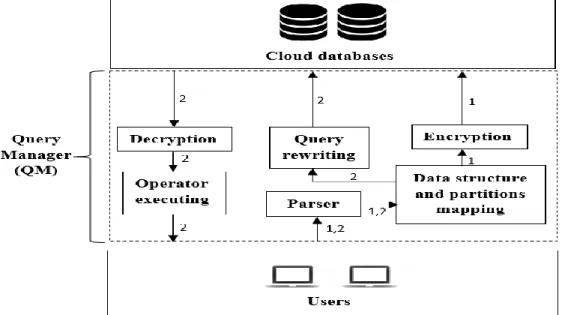
In our work [59]–[61], we defined the query manager (QM) as a trusted server that resides in an organization’s or company’s private cloud. It works as an intermediary between users and the Cloud and is responsible for processing queries and encoding BVs for each table (we explain this step in detail in the discussion of partitioning trees). Also, the proposed prototypes support
17
individuals’ cases in which QM would be light software residing in the end user’s system. For an organization, it performs the same functions as the QM server. While we assume that the user can encrypt only columns that have sensitive data, the proposed approaches even support encrypting all of a table’s attributes.
3.4 Partitioning Tree (PT)
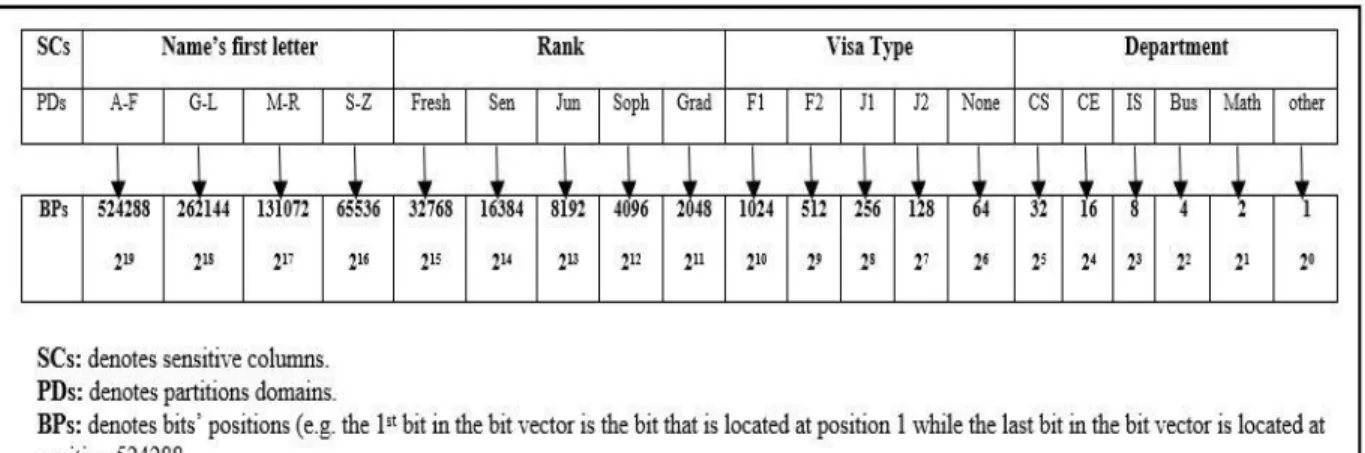
As stated in our previous studies [59-61], the PT is the primary element of all proposed systems in which the query is appropriately rewritten for execution by the cloud server. The owner of the table participates in the construction of the PT by specifying which columns are sensitive and should be encrypted. Then, the table owner defines the possible partitions for each column and indicates whether the partitions are ranges of values or non-ranges of values. Thus, the values in each column are partitioned into multi-partitions in which each partition includes a set of values. Then, the QM builds the PT based on these specifications. As shown in Figure 3.1., the name of the table is the root of the tree, and the second-level nodes are the sensitive columns that have to be encrypted. Nodes in the third level, each of which is assigned an ID, represent the partitions of all the sensitive columns.
Table 3.1 The Students Table
ID Name SSN VisaType Department
01 Alice 12701 J-1 MATH
02 Ryan 25678 F-2 BUSN
03 Mark 46932 F-1 CSCI
18
The second-level nodes are assigned a color of either white or gray. Gray nodes imply that the partitions of the column are ranges of values (e.g., the Name column must have range partitions based on the first letter of the name, while students Visa Type have non-range partitions, such as F-1, F-2, etc.). The PT is stored locally in the QM. We encourage the data owner to define as many as possible partitions for each SC, which can narrow the range of retrieved encrypted records from the outsourced table and, in turn, increase the performance of the proposed systems, and achieve faster query processing.
We are not concerned about memory consumption in our solutions because the sensitive information in every row is encoded into bits (i.e., the smallest computation unit). Based on the PT, this does not consume memory or searching time. In section 3.6, we explain in detail how and where to store bit vectors in each proposed system. Algorithm 1 shows how the QM constructs the PT of the students' table (Table 3.1) and Figure 3.1 shows the PT of the students’ table.
19
Algorithm1: PT construction
1: Input: file.txt containing the name of the table, sensitive columns, and partitions.
2: Create a tree and add a node, represent the table name (TN), as the root of the tree.
3: Int Id=0
4: For each sensitive column SCi
5: Nodei = TN.addchild (‘the name of the SCi’) 6: If SCicontains range of values
7: Nodei.AssignColor (‘Gray’) 8: Else
9: Nodei.AssignColor (‘White’) 10: While (partitions! = null)
11: Nodej = Nodei.addchild(‘partition value’)
3.5 Encoding Approach
The encoding process is an essential step in the proposed systems. The proposed scheme is used to encode records’ sensitive data into bit vectors (BVs), which can be exploited to retrieve the required encrypted records (i.e., candidate records for the user's query without the need for decrypting data). The QM parses each record to get the names of the sensitive columns and their values. It then uses the PT to encode the tuples before proceeding to the encryption process, to bit vectors (BVs). Each bit position in the BV is mapped to a partition node from the third level nodes (e.g., the first bit in the BV is mapped to the node having the ID =1). The encoding process is accomplished as follows:
1) For each record Rj in the main table T, the QM creates a BV having a length equal to the
number of nodes in the third level of the corresponding PT. It then initializes all its bits to zeroes (e.g., if the bit vector has 10 bits, the number of nodes at the third level of the PT is 10).
20
2) For each record Rj, the bit bm that mapped to the partition node PNm under SCiis set to one if the datum equals the values represented by PNm. Then, the QM assigns an index to the newly created BV.
For the sake of clarity, the encoded BVs of the records in Table 3.1 are as follows:
How and where to store the BVs differs for each proposed system. In section 3.6, for each prototype, we present the details of how and where to store the BVs (i.e., either locally at the QM or by migrating them to the cloud server). We also discuss the security and the potential threats in each model and show how to solve them. Algorithm 2 delineates the process of the encoding step.
Algorithm 2: Encoding algorithm
1: Define a vector V
2: For each record Rjin Table T
Parse Rjto get the value(s) of the sensitive columns SCs
3: Define a bit vector BVjof length n where n = the number of nodes in the 3rd
level of the T
4: For each SCi in Rj
5: If value v = value of the nth sub-node of the SCi OR v ∈ value of the nth
sub-node of SCi 6: Set nth bit in BVj to 1 7: Else 8: Set nth bit in BVj to 0 9: End for 1 <100100010010000> 2 <001010100001000> 3 <010101000100000> 4 <010100010000010>
21
3.6 Developed Prototypes
3.6.1 Bit Vectors as a Matrix (BVM)
In this section, we discuss the model that uses bit verctors as a matrix. Some passages, figures, tables, and algorithms presented in subsections (3.6.1.1 and 3.6.1.2) have been quoted verbatim from our published work in [59].
3.6.1.1 System Description
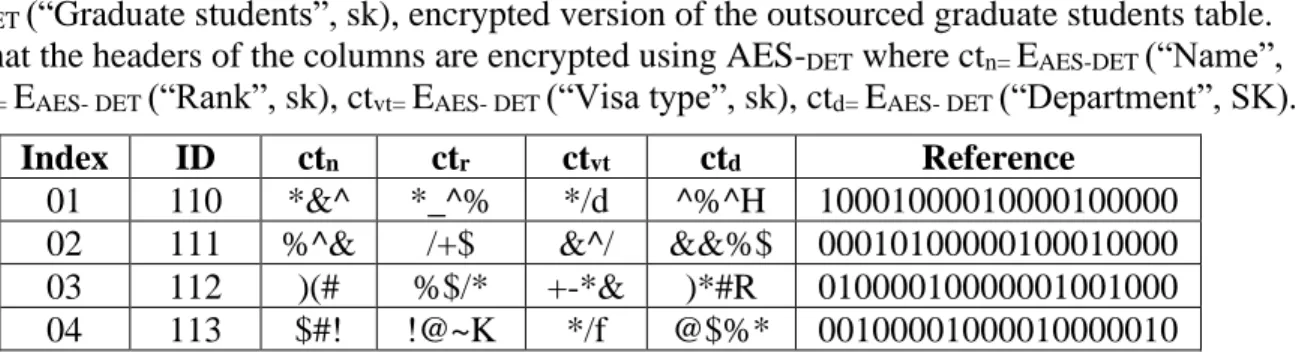
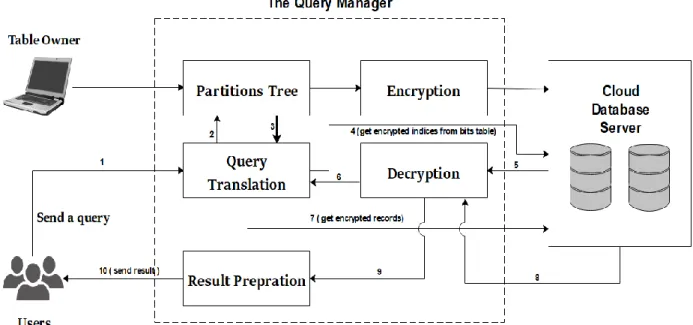
In this prototype, we store and process the BVs of each outsourced table locally at the QM. We assume that the QM is a trusted server residing in either the end user’s machine as an application or in the private cloud (Figure 3.3). Because the only thing outsourced in this prototype is the encrypted table, the highest level of security is provided. The outsourced encrypted table preserves the structure of the original table. However, we add a column (used as a foreign key) to store the rows’ indices (during the encoding process, the QM assigns a unique index number to every encrypted row and its BV). Further, we need these indices to fetch the encrypted records. To process a query, the QM needs to load the BVs to the main memory from the hard disk drive (HDD) and perform a rapid look-up to find which records are candidates for the user’s query. Then, it pushes their indices into a list and rewrites the query to fetch any record whose index is on the list. In the following sub-sections, we present the supported statements for the relational algebraic operations.
3.6.1.2 Basic Operations
The basic operations in database applications are insert, select, update, alter, and delete
22
Insertion statements are straightforward. The QM receives the insert query, creates a new
BV for the newly inserted record, appends it to the corresponding bit vectors matrix (BVM), and then encrypts sensitive data and sends it to the Cloud.
Select is an essential statement in all database applications. In our approach, it is also part
of the execution of other statements like update and delete. In the QM, the process of executing the select statement algorithm is to check which of the following cases is applicable and then enforce it.
Case 1: None of the column(s) in the query condition is sensitive, so they are not stored in encrypted form in the Cloud. In this case, the QM directly searches and retrieves the data corresponding to the query condition from the Cloud. For example, in Table 3.1, Figure 3.1, and Figure 3.2, if the query condition is “WHERE ID = 03”, the QM retrieves the records directly from the Cloud that satisfy this condition.
Case 2: All column(s) in the query condition are sensitive, so they are stored in encrypted form in the Cloud. In this case, for each column that appears in the query condition, the QM retrieves the indices of corresponding bit vector(s) (BVs) from the BVM. Then it performs logical
23
AND/OR operations based on conditions among indexes returned for each column. For example, if the query condition is “Name = Mark AND visa type = F1”, the QM will find any BV having the bit that mapped to the node representing the values of the PD “Q-Z.” Because “Mark” belongs to this group (i.e., PD “Q-Z”), any BV has the bit mapped to this partition is set to one will be added to a list L[]. The QM will do the same for visa type, then perform the logical operation AND between the two lists and rewrite the query accordingly to fetch the candidate records.
Algorithm 3: select
1: Receive user query < Table name, List of columns {c1, c2, c3 …}, list of values {v1, v2, v3 …}>
2: Check query columns used in search condition
3: CASE 1:
4: If none of columns mentioned in query is sensitive
5: Search the corresponding table in cloud
6: Return data.
7: CASE 2:
8: If each column Ci is sensitive
9: For each value v being searched for under column Ci
10: Search the column representing that domain value in PT then for each BVj
entry under domain value in Ci
11: If bit =1
12: Add the index of BVjto List Li [ ]
13: Define list F where F [ ] is the final list that contains the indices from the lists ( L1 [
], L2[ ],…, Li [ ]) after performing AND or OR (based on query conditions) operations between them.
14: Return F
15: Retrieve encrypted records from the cloud based on the list F [ ].
16: Decrypt and return data
17: CASE 3:
18: If mixed columns (Sensitive and Non-sensitive)
19: Do Case 1 AND Case 2
20: Remove duplication if found
24
The update process is one of the functions provided by the QM. Through this function, the
user issues a query to update record(s). The QM identifies record(s) using our select algorithm. Then based on the results of select algorithm, the QM issues a query to retrieve encrypted record(s) from the Cloud, decrypts them to find the exact records that match the query conditions, and issues a query to update the encrypted record and its BV. The steps are shown in Algorithm 4.
Algorithm 4: update
1: Receive user query < Table name, List of columns {c1, c2, c3 …}, List of values {v1, v2, v3 …}>
2: Use search Algorithm (Algorithm 3) to find the candidate record(s)
3: Fetch the record(s) from the encrypted table
4: Decrypt and find the exact record(s)
5: For each update value uv in record Rj
6: If uv falls under non-sensitive column
7: Update the old value with uv in the outsourced table
8: If uv falls under a sensitive column SCi
9: For each SCi in the update query
10: If the uv falls under a PD other than the previous PD
11: Set the bit that mapped to this PD to 1 and unset the
rest of bits that mapped to other PDs for this SCi..
12: Encrypted the updated values
13: Send data back to the cloud
The delete process is used to delete a record from a table. In this case, the QM uses the
search algorithm to find the candidate record(s), then removes the record(s) from the outsourced encrypted table and deletes the corresponding BVs from the BVM. Algorithm 5 outlines the steps in the deletion process.
25
Algorithm 5: delete
1: Use Algorithm 3 (select algorithm) to find the required record.
2: Add the index of each fetched record satisfying the delete condition into list L [].
3: Generate a delete query to delete any record from the outsourced encrypted table its
index is in L [].
3: Delete the BVs of the deleted records from the corresponding BVM.
Alter is one of the fundamental operations in any database that allows users to drop/add
columns from/to relations. However, in this model, the QM first determines whether the dropped or added column is a sensitive column. In the case of “drop,” the QM will look at the corresponding partitioning tree (PT) and drop all partition nodes of the predecessor node that represents the dropped column. It then deletes all bits mapped to the deleted nodes from the BVM. The QM then forwards the alter query to the Cloud, which will execute the query to drop the encrypted column. In the “add column” case, the QM asks the user if the column is sensitive. If it is sensitive, then it will add it with its partitions to the PT after receiving information from the user.
3.6.1.3 Relational Algebra Operators
3.6.1.3.1 Join
Most current research in database security does not support the join operator because dealing with encrypted databases it is not a straightforward task, especially if AES-CBC is the encryption algorithm. The simple solution for such a task is to retrieve all encrypted tables from the Cloud and perform the join operator after decrypting them. However, this is not the optimal choice when it comes to massive tables. In this model, to avoid unnecessary computation, we need to move as much of the join computation as possible to the cloud site without decrypting data, leaving minimal work for the QM. To make BVM both practical and efficient in the join operator, we need to consider the following cases for the join condition:
26
1) The join condition has only non-sensitive columns.
2) The join condition involves only sensitive columns having limited distinct value partitions such as USA visa types.
3) The join condition contains only sensitive columns that have range partitions such as salary. 4) The join condition has at least two of the previous cases. So, we design an algorithm to enable the cloud provider to implement a join operator over encrypted tuples without decrypting the encrypted attributes.
To solve the first case, in which the join condition involves only non-sensitive attributes (i.e., unencrypted attributes), the QM will first determine if the attributes are sensitive or not. If they are non-sensitive, it will forward the query to the cloud database, which will implement the join query and return the join result to the QM. The QM then decrypts the join result and removes duplication if found. In the second case, the join condition contains only sensitive attributes that are not ranges of values. In this case, the QM creates a list Li [ ] for every partition of the attribute mentioned in the join condition, where Li [ ] will have the index of any record having its bit that mapped to partition node i is set to 1, before searching the BVM. Then the QM will rewrite the query to join all the tuples from both tables based on the indices of these lists. For example, there are two tables, A and B, both having the same attributes: ID, name, rank, department, salary. Now, assume that the query was to join them where A.rank = B.rank. Then let us say that the partition domains for rank attributes are manager, secretary, and employee. Now, the QM will create three lists for each table. The first list will contain the indices of the bit vectors in the corresponding BVM that have their bits mapped to the PD “manager” set to 1. The second list will hold the indices that have the bits mapped to the PD “secretary” set to 1, and the third list will contain the indices that have the bits mapped to the PD “employee” set to 1. In the next step, the QM rewrites the query to join the
27
tuples that have their indices in list Li [ ] from Table A with the tuples that have their indices in list Li [ ] from Table B. In the third step, the Cloud will execute the query and return the result to the QM, which will decrypt and remove any duplications before sending the result back to the user.
In the third case, the join condition contains only sensitive columns that are ranges of values. This case is similar to the second case. However, in this case, the mapping between joined partitioning lists can be one too many. To illustrate this, consider Figure 3.4. Assume we want to join tables A and B by equality of salary. The salary column in Table A has three PDs that are [(10,000 to 20,000), (20,001 to 30,000), (30,001 to 40,000)], and the salary column has two PDs that are [(10,000 to 25,000), (25,001 to 40,000)]. We need to make sure that the QM rewrites the join query in a way that it maps the PDs from Table A to the corresponding PDs from Table B. To do that, the QM will create n lists for each table where n is the number of PDs in the table that has the fewest PDs in the joining column. So, in the above example, n =2 since Table B has the least PDs. In the first list L1[ ] in table A, the QM adds indices with bits that represent PD1, or PD2 is 1. In the second list L2[ ] of table A, the QM adds indices with bits that represent PD2 or PD3 as 1. The following figure, Figure 3.4, shows how the PDs are mapped. The QM rewrites the query before forwarding it to the Cloud. After getting the join result back from the Cloud for each tuple, the QM decrypts only the encrypted column’s value (only the encrypted columns involved in the join condition) and enforces the join condition. If the join condition is satisfied, the QM proceeds to decrypt all of the tuple’s values before moving to the next tuple. If the join condition is not met, the QM will not decrypt the entire tuple’s values and will move to the next tuple. We do so to avoid unnecessary decryption processes for those tuples that do not meet the join condition. The
28
last case is when the join condition involves two or more of the previous cases. In that case, the QM might rewrite the query. Algorithm 6 below shows how the QM performs the join.
Algorithm 6: Join
1: Input: the QM Parses user’s query to get tables’ names, attributes, and values.
2: QM checks the PT of each table in the join and performs the following:
3: Case 1
4: If join column(s) is non-sensitive (not present in the PT) THEN
5: Forward the query to the cloud server (CS)
6: Define LinkedHashSet s
7: For every fetched record i
8: decrypt all values in i
9: push i to s
10: send s to the user
11: Case 2
12: If join column(s) is a sensitive AND not ranges, THEN
13: For each PDj under the node that represent a SCi in PT of Table x
14: Create a list Lxj [ ]
15: For each BV in BVMx
16: If the bit mapped to PDj is not 0
17: Push the BV’ index to Lxj [ ]
18: For each PDj under the node that represent a SCi in the PT of Table x1
19: If the value v of PDj of SCi from table x1 equals to the v of PDj of SCi from
Table x2
20: PDj of x1⋈ PDj of x2
21: Rewrite the query and send it to the cloud
22: Define LinkedHashSet s
Figure 3.4 An example of joining two tables by the equality of salary values Table B Partitions of salary 10,000 to 25,000 25,001 to 40,000 Table A Partitions of salary 10,000 to 20,000 20,001 to 30,000 30,001 to 40,000
29
23: For every fetched record i
24: decrypt all values in i
25: push i to s
26: Send s to the user
27: Case 3
28: If join column(s) is a sensitive AND ranges, THEN
29: For each PDj under the node that represent the SCi in PT of Table x
30: Create a list Lxj [ ]
31: For each BV in BVMx
32: If the bit mapped to PDj is not 0
33: Push the BV’ index to Lxj [ ]
34: For each PDj under the node that represent the SCi in PT of Table x1
35: If the PDj of SCi from table x1 contains at least one value v where v ∈PDj from
table x2 36: PDj of x1⋈ PDj of x2
37: Rewrite the query and send it to the cloud
38: Define LinkedHashSet s
39: For each fetched record i
40: Decrypt only the join columns’ values
41: If the join condition satisfied
42: Decrypt the whole tuple’s values
43: Push i to s
44: Else
45: Proceed to the next encrypted tuple
46: Send s to the user
47: Case 4
48: The query involves two or more of the above cases.
3.6.1.3.2 Union
Union is one of the widely used operations in database systems in which tuples from two or more tables are merged. However, to execute a union operator, the number of attributes and datatype of both tables must be compatible. Even though the union operation removes the duplication from the union results, dealing with encrypted data complicates this step. To accomplish this, we could enable the cloud server to execute the union operator over encrypted tables and then send the result back to the QM. Doing so will move the union computation to the cloud server leaving only
30
decryption and duplication removal to the QM. The QM will decrypt each tuple in the union result set and add it into a LinkedHashSet as soon as it receives it from the Cloud. Note that both tables must be encrypted with the same secret key to execute the union algorithm. Algorithm 7 delineates the processes.
Algorithm 7: union
1: Forward the user’s query to the cloud server
2: Define a vector v
3: For each fetched record i in the union result set
4: Decrypt i
5: Add i to v 6: v.distinct()
7: Send v to the user.
8: v.clear()
3.6.1.3.3 Intersection
Intersection is the process of finding the common subset out of two or more sets. However, executing intersection over encrypted databases is not easy without decrypting the data. If the tables to be intersected have a large number of records, the user is going to add a significant computational overhead by decrypting the whole set of the encrypted tuples from the intersected tables before executing the intersection operator. As a result, we cannot benefit from the cloud services because the computation is moved to the user’s side rather than on the cloud side. Some of the previously proposed systems in [2], [9], [10] can process queries over encrypted databases but will experience delays if the tables to be intersected have large numbers of tuples.
In this model, our goal is to move the computation as much as possible to the cloud side while eliminating unnecessary decryption processes at the QM. Moreover, we want to execute the intersection operator partially in the cloud database server leaving only the elimination of duplication at the QM. In this way, we exploit the high computational speed provided by a cloud
31
database server to accelerate the query processing time. We explain the simulation of intersection as follows:
• The user sends the query to the QM, which is going to parse it to remove the headers of tables and columns.
• If the intersect operation involves k columns out of n columns, where n denotes the total
number of columns in a table, the QM uses our join algorithm to join both tables by k -columns and then rewrites the query. Otherwise, the QM chooses all SCs that are not in ranges to join the tables using our join algorithm before rewriting the query.
• The QM sends the translated query to the cloud database server, which will execute the query and send back the join result to the QM.
• Before returning the intersecting result to the user, the QM decrypts the encrypted join set
and pushes it to a hash list to remove duplicates, if found.
To illustrate the process, consider this example. Suppose we have two tables, A and B, and we want to carry out an intersection between them. Assume both tables have the same columns and the same PT as those shown in Figure 3.5.
The translation process of the intersection query is accomplished as follows: Figure 3.5 An example of a PT for Table A and Table B.