© 2016, IRJET | Impact Factor value: 4.45 | ISO 9001:2008 Certified Journal
| Page 486
Privacy Preserving Classification over Semantically Secure Encrypted
Relational Data in Cloud Environment
Mr. Gaikwad Vijayendra Sanjay
1, Dr. Khan Rahat Afreen
21
PG student, Deogiri Institute of Engineering and Management Studies, Dr. Babasaheb Ambedkar Marathwada
University, Aurangabad, Maharashtra state, India.
[email protected]
2
Associate Professor, CSE Department, Deogiri Institute of Engineering and Management Studies, Dr. Babasaheb
Ambedkar Marathwada University, Aurangabad, Maharashtra state, India. [email protected]
---***---Abstract— The Cloud environment, with its extensive resourceshas become a good choice for organizations to keep their data and access it on demand. When the organization’s need is to just upload their data and use it as and when required from the cloud, the cloud service itself encrypts that data with its own credentials or in some cases, for maintaining the confidentiality, the data owners encrypt their data prior to outsourcing it. But there is no provision for processing some data within the cloud environment and at the same time maintain data confidentiality and privacy of user query. As a consequence, for classification, either the data needs to be decrypted by the cloud at some point of time and then processed to take proper classification decision or the data owner has no choice but to perform the same task at his/ her end partially or fully. Since the data used for classification is encrypted and placed onto a cloud, the conventional privacy preserving classification methods are not suitable. Some recent work has been done in this direction, but it is proven to be computationally costly and also not very practical. Our proposed system is an effort towards resolving this very problem of classifying encrypted user queries over encrypted data in a more effective and time efficient manner. This is achieved re- designing the existing privacy preserving protocol from a different perspective and by leveraging the properties of homomorphic cryptosystem. Our approach is computationally inexpensive and does not compromise the privacy of user query or the confidentiality of the database outsourced by the data owner.
Keywords— encrypted database, homomorphic
cryptosystem, k- nearest neighbors, security
1. INTRODUCTION
The recent trends in cloud services have revolutionized the outlook of organizations towards leveraging the benefits of outsourcing their data. Cloud computing, with its platform as a service (PaaS) feature, has seriously grabbed the attention of organizations desiring to completely outsource their valuable data along with the some data management tasks. But, despite of various facilities that cloud avails, there are still some data confidentiality and privacy issues that keep the
organizations from utilizing them. When data is straight away uploaded to the cloud, the cloud itself encrypts it, for securing it from any third party theft and then stores it. By doing so, the data is open for the cloud service providers at the first place which can be threat. If the data contains very sensitive information such as medical records of patients, then somewhere down the line the patients’ privacy gets compromised. To avoid this, the first solution that organizations use is to encrypt their data, prior to uploading it to the cloud. But what when the use of this data is just not limited to its retrieval? To perform some processing over this encrypted data at the cloud without ever decrypting it is very difficult task.
The privacy issues involved in this kind of situations can be explained by the example. Consider that a hospital keeps their patients encrypted database on cloud along with the data mining task. Now, when a doctor wants assert about symptoms of a disease of the patient, which he/ she cannot affirmatively treat, the doctor can use relative classification process and find out the disease with which the patient is suffering. For getting a precise response, the doctor needs to trigger a query for the classification process on cloud, which would contain patient’s highly personal information. So, it is very obvious that this query must be encrypted prior to sending it to the cloud, in order to protect the patient’s privacy. Thus, it is important to consider the privacy of the users’ query when it is involved in the data mining task. Also, any cloud malfunction activity can determine useful information about data access patterns although data are always encrypted. Therefore, we can say that, while performing a classification or any other data mining task on encrypted data in an outsourced environment as cloud, the data owner’s confidentiality, user query’s privacy and preventing the cloud from learning any access patterns must be the foremost objectives.
© 2016, IRJET | Impact Factor value: 4.45 | ISO 9001:2008 Certified Journal
| Page 487
the classification techniques has their own pros and cons,our work concentrates only on the k-nearest neighbor technique; it being the most suitable for our work.
1.1 Problem Definition
Consider a data owner having a database with m attributes and n records where the first attribute (practically kept as ) is the identifier, I, for the record and attribute refers to the class label, c. The database is encrypted attribute- wise by the data owner, such that,
( ) corresponds to an encrypted record value, for 1 ≤
i ≤ n and 0 ≤ j ≤ m, where t is a tuple. The encryption
function, belongs to a semantically secure encryption scheme [1]. The data owner then outsources his/her encrypted database, denoted by EDB along with the classification process and hereafter has no intervention in the classification process.
Any authorized user with query, denoted as
Q=( ……. ), will query this EDB in order to gain the
class label, denoted as, , for the query.
1.2 Our Contributions
In this paper, we present an improvised privacy preserving k- NN classifier [2] which works over semantically secure encrypted data. This improvised classifier is considerably inexpensive in terms of computational cost and proves to be a practically more feasible solution to the classification over encrypted data problem. As mentioned in [2], following are the privacy requirements for a privacy preserving k- NN protocol:
User’s query should not be disclosed to the cloud i.e. it should remain encrypted throughout the classification process.
The actual database contents or the intermediate results of the process must not be revealed to the cloud.
The records corresponding to the k- nearest neighbors of Q must neither be revealed to cloud nor to the user.
The resulting class label, , must be only revealed to the user.
Our efforts in this paper are motivated by the work of Samanthula, Elmehdwi and Jiang in [2]. As mentioned in [2] about the scope for improvements in the efficiency of
protocol, we concentrate on improving the time requirements of SMIN and some other sub- protocols. On a practical note, it has been observed that Paillier cryptosystem is not very effective in handling negative values as result of any Paillier addition. This problem might occur while performing attribute- wise subtraction in secure squared Euclidean distance (SSED) protocol [3]. To address this situation, we have proposed a new solution to securely compute the squared Euclidean
distance. It is worth mentioning that, during our improvised protocols, all the above mentioned privacy requirements are satisfied as, the cloud remains unaware of which database records correspond to the derived nearest neighbors. Also, any intermediate values that are computed and are visible to the cloud are either encrypted random values or random numbers. Moreover, the final output is not known to cloud.
2. EXISTING RELATED WORK
Here, it is worth mentioning that any data mining task over encrypted data can be performed with comparatively less efforts using fully homomorphic cryptosystems [4], as this cryptosystem supports any number of arbitrary functions on encrypted data without having to decrypt it. But, these cryptosystems are very expensive in terms of computation and hence, their use may require extensive hardware support.
2.1 Privacy Preserving Protocols and their
Limitations
In the recent past, there have been a few systems proposed for privacy preservation in data mining applications such as data perturbation by Agrawal and Srikant [5] and data distribution by Lindell and Pinkas [6]. The former one is the first decision tree based solution but, is not suitable for semantically secure encrypted data while, the later one is first decision tree solution that works in a two party setup, but it considers that data is distributed in plaintext form over many parties and not encrypted.
The SCONDB model proposed in [7] is a secure query processing model where, the nearest neighbors of the query are given to the user, who then decrypts uses the conventional k- NN technique to find the most relative class label. However, this model reveals the k- NN to the user out writes our objective.
In the most recent work [2], the k- nearest neighbors are not revealed to the cloud nor to the user. In [2], Samanthula, Elmehdwi and Jiang propose the PPkNN protocol and many new the security primitives along with their solutions and supporting security proofs, namely, secure minimum (SMIN), secure minimum from n numbers ( ), secure frequency (SF). PPkNN protocol intially uses the secure squared Euclidean distances (SSED) protocol to determine the encrypted distance
(d) of each record in the database from the user query.
© 2016, IRJET | Impact Factor value: 4.45 | ISO 9001:2008 Certified Journal
| Page 488
Our primary aim is to reduce this computational costwithout compromising on the security and privacy objectives mentioned in [2]. In this paper, we propose an improvised version of the PPkNN protocol by re- designing the SMIN protocol and removing the overhead incurred by SBD and SBOR protocols. We also present experimental results to support our predictions. Also, it is our observation that in the SSED protocol mentioned in [2], whenever a negative value result from a Paillier addition, these values cannot be deduced to their correct plaintext form. This is because Paillier addition does not support negative values as the result. Our work addresses this issue by seeing the SSED problem from a different perspective.
2.2 Paillier Cryptosystem
Paillier cryptosystem [1] is additively homomorphic in nature. It is a probabilistic public key encryption scheme that provides semantic security. If we assume is an encryption function with public key pk given by (N, g), where N is product two large prime and g is a generator in . Also, is the decryption function with secret key sk, then for any two plaintexts x and y , the Paillier encryption scheme has the following properties:
a) Homomorphic Addition
( )
b) Homomorphic Multiplication
( ) ( )
3. IMPROVISED PRIMITIVES FOR PRIVACY
PRESERVATION
In this section we discuss the working of some sub- protocols that act as the building blocks for computing the k- nearest neighbors in a more efficient way. We will hereafter consider a federation of two non- colluding, semi honest cloud service providers, and . is hosting the secret key sk and pk is public (known to both and ).
3.1 Improvised Secure Minimum (I-SMIN)
This protocol takes as input two vectors, a= ( , , ) and b= ( , , ) where, I denotes the unique identifier for each record, is the distance of a record from the given query and is the class label corresponding to that record. The aim of this protocol is to determine the minimum ) of the two, without revealing it to and .
Algorithm 1: I-SMIN (a, b) ( , ,
)
Requires: holds a= ( , , ) and b= ( , , ) and holds the secret key sk.
1) :
Generate a random number r
Encrypt r with pk to get (r)
Now, randomize the all elements of both vectors a and b with (r) , as follows:
So we have, a= ( , , ) and similarly
b= ( , , )
Send a and b to 2) :
Receive a and b from and decrypt them using sk as,
a.) u= and v=
Now, compare and
a.) if ≤ , then α= u b.) else α= v
Encrypt α as,
a.) αꞌ = ; and send αꞌ to 3) :
Receive αꞌ from and remove randomization effect from all elements of αꞌ,
a.) b.) c.)
© 2016, IRJET | Impact Factor value: 4.45 | ISO 9001:2008 Certified Journal
| Page 489
3.2 Protocol to securely compute the Squared
Euclidean Distance
The aim of this protocol is securely calculate the square of the distance between an encrypted database record and the user’s query , for 1≤ i ≤ n, where n is total number of records. Here, all the encryptions are done with the public key pk, known to both clouds and and user. The secret key sk is only known to . In order to classify a query over an encrypted database, the user is first required to select values for the predefined attributes. At the user’s end these attribute values are summed together to get, and squaring this summation we get, , where m is the total number of attributes in the encrypted database. Finally, the user encrypts these two values with the data owner’s public key pk, prior to sending them on as a classification request. So, this protocol is invoked with inputs, the encrypted query attribute summation, , encrypted square of query attribute summation, and encrypted record attribute summation, ( ) (independently computed on ). Following are the step involved in our new, Improvised SSED (I- SSED) protocol, where and jointly compute .
In this protocol, and compute the encrypted square of ( ) using the secure multiplication (SM) protocol proposed in [2], for 1≤ i ≤ n, where n is number of records. Similarly, we compute the encrypted product of and . The resulting values from SM are only known to . Now, we can apply the homomorphic properties with reference to the mathematical formula, , to get the encrypted squared Euclidean distance, . There slight difference in the setting of information exchange between user and as compared to the SSED protocol in [2]. In our protocol, we require the user to send an encrypted sum of all query attributes to instead of sending individual encryptions of attribute values. This does not incur the user any additional overhead as the user performs simple summation and then encrypts only the sum. In fact, compared to the requirements in [2], our protocol reduces the number of encryptions to be performed at the user’s end from 6 to just 2. Also, the number of Paillier additions required for performing attribute- wise subtraction are reduced.
Algorithm 2: I-SSED ( ( ), ( ), ( ))
Requires: holds , , ( ) and holds the secret key sk.
1) and :
Compute ( ) using standard SM protocol
Compute ( ) using again standard SM protocol
2) :
Compute the encrypted squared Euclidean distance, , as,
( )
3.3 Secure Elimination protocol (S- ELIM)
Whenever a database record is found to be the nearest neighbor to the query, it is necessary that the corresponding distance is updated to exclude this record from participating in further classification process. But, since the Paillier homomorphic scheme is semantically secure, is unable to find which record corresponds to and . The aim of this protocol is to update the distance to a maximum value so that it is automatically left out in the next iterations. One input to this protocol is the collection of ( , , ), for 1 ≤ i ≤ n, where n is total number of records. For convenience, we refer this collection as I_d_c_Map. Other inputs include , and which are credentials of the record that is found to be nearest to the query in an iteration. The output will a same collection with an updated encrypted distance for the appropriate record (refered here as Updated_Map) . initially computes δ, since it involves an exponentiation and is referred n times. Then, a vector named ID is used to store the Paillier subtraction of δ from each of the , for 1 ≤ i ≤ n. Here it is worth noting that only one of the entries in ID will be computed as . Now, ID is sent to , where it is decrypted. Now, a new vector Θ is constructed by replacing all entries of non- zero values with and 0s with (maximum threshold considered as 100). will occur exactly once in Θ. This vector Θ is sent to . At , an entry in Θ is Paillier added to its corresponding . As a result, obliviously updates only the encrypted distance corresponding to the nearest record and all other
Algorithm 3: S- ELIM ( , , ,
I_d_c_Map)Updated_Map
Requires: holds Record_Cred_Map, newly computed nearest neighbour credentials ( , ,
© 2016, IRJET | Impact Factor value: 4.45 | ISO 9001:2008 Certified Journal
| Page 490
1) : Compute, δ =
Compute a vector, ID, for i=1 to n a.) Send vector ID to
2) :
Receive ID from and decrypt it as, a.) ID=
Now, compute vector Θ, for i=1 to n a.) if , then b.) else
Send vector Θ to 3) :
Receive Θ from and update all as, for i=1 to n
a.)
Updated_Map (( , , ), ……, ( , , ))
remain unchanged. As intended, and do not know which is updated.
4.
SECURITY
ANALYSIS
OF
IMPROVISED
PROTOCOLS
Although, while improving the efficiency of protocols in [2], we have changed the functioning and the protocol requirement, the final output of all improvised protocols are always in encrypted format and are only known to . In fact, the changes induced always contributed towards reducing the computations. Also, deals with only random values which have no relevance with original ones. Values computed on are always conveyed to in encrypted form. Following is the formal security analysis of all proposed improvisations.
4.1 Security Analysis for I- SMIN Protocol
To start with, the inputs given to this protocol are all encrypted and the encryption scheme being semantically secure, these inputs are never revealed. The main strength of I- SMIN protocol lies in the fact that, the scope of the random number r generated from is limited to and hence, after randomizing the encrypted distance values and , cannot predict them. The decision taken by is based on randomized values due to which no extra information is leaked at . Moreover, each time I- SMIN takes a new pair for comparison, a new random number is generated, so that should not acquire any knowledge on the relation between last and current pairs. On finding the minimum, encrypts its result prior to sending it to . The ciphertext corresponding to the minimum distance received at (whether or
) is different from the one it was prior to sending it to . Hence, cannot predict which of the two distances it sent to was found to be minimum. All together, it is evident that neither nor learns anything about , , , .
4.2 Security Analysis for I- SSED Protocol
In the problem setting of PPkNN [2], user was required to provide six encrypted attributes values which constituted the query for classification. The SSED proposed in [3] uses the Paillier additive property to perform an attribute- wise subtraction between the encrypted attributes of the record and query. However, the Paillier cryptosystem does not support a negative output of any subtraction performed using Paillier additive property. For example, if we perform a Paillier addition, , the expected output is an encryption of -5. However, decrypting this output does not give us the desired result. To tackle this problem, we introduce a new equation for securely computing the squared Euclidean distance. With this change, the user is now required to provide only two encrypted values, and
as described in algorithm- 2. During this protocol,
is securely computed using with the SM protocol [3]. Also, is computed using the same SM protocol. The security proof for SM protocol is already mentioned in [3]. The output of SM protocol is only known to . Also, the results of the Paillier additions performed on are in encrypted form. Thus, the output of our I-SSED protocol is encrypted and only known to .
4.3 Security Analysis for S- ELIM Protocol
This protocol ensures that the corresponding to nearest record at the end of an iteration, is restricted from participating in the next iteration. For this purpose, forms the vector ID which contains the encrypted differences. When decrypts this vector, it does not have any understanding about this vector and simply substitutes 0s with and non- zero values with . On receiving this vector Θ, adds this vector component- wise to the corresponding values, using Paillier additive property. Thus, even does not acquire any information about which is updated.
5. IMPROVISED PP
k
NN PROTOCOL (I- PP
k
NN)
© 2016, IRJET | Impact Factor value: 4.45 | ISO 9001:2008 Certified Journal
| Page 491
required, during the execution of the sub- protocols. Theseclouds do not collude and are curious to learn any information about the data they exchange. The data owner outsources the encrypted database, EDB, to and the secret key sk to . The public key pk is communicated to all the participating entities. The class label for user’s query is computed with the help of I- PPkNN protocol that executes in two stages, which are explained below.
5.1 Securely Determining the
k
- Nearest Class
Labels (SD
k
-NCL)
The user selects the query attribute values ( ) sums them up to get , where m is total number of attributes in EDB. Also, he/ she computes . User then encrypts these two values with the public key (pk) of the data owner and sends a classification request to with these encrypted values. After receiving the query, computes the encrypted sum of all attribute values of each record in the EDB, ( ), using Pailler additive property, where 1 ≤ i ≤ n. jointly compute the encrypted squared Euclidean distance, , between the query and each
of EDB records, using our proposed I- SSED protocol.
now build an identifier-distance-class label map (I_d_c_Map) where, and are the and attribute values, respectively, of the record. Now, the I- SMIN protocol, with two entries at a time from the
I_d_c_Map, iteratively computes , ,
corresponding to the first nearest neighbour. Then, the S- ELIM protocol securely updates the in
I_d_c_Map corresponding to this , so that the
record corresponding to is automatically excluded from the next iterations. is the first among k- nearest class labels. In the next k-1 iterations, we determine all of the k- nearest class labels. This set, ( ) is then given to SDMCL protocol to find the most frequently occurring class label from these k class labels.
Algorithm 4: SDk-NCL ( , q) ( )
Requires: holds EDB and public key pk, user has pk and holds the secret key sk.
1) User:
Select query attribute values and compute
and
Encrypt these values, as and and send to
2) :
Receive and from user
for i=1 to n
a.) computes, ( ) b.) I-SSED( ,
, ( ))
I_d_c_Map(( , , ), ……,
( , , ))
Next_level_Map I_d_c_Map
for s=1 to k, do
a.) Next_level_Map I_d_c_Map
b.) for p=1 to size of Next_level_Map, do
- , ,
I-SMIN(a, b) where, a= ( ), ( ),
( ) and b= ( ), ( ), ( )
- Add ( , ,
) to Temp_Map
- p=p+2
c.) if size of Temp_Map >1
- Next_level_Map Temp_Map
- Repeat from a.)
else
-
- I_d_c_Map S- ELIM ( ,
, , I_d_c_Map) 3) SDMCL ( ,…,. )
5.2 Securely Determining the Majority Class Label
(SDMCL)
Firstly, we assume that the data owner also outsources the list of all encrypted class labels ( ,…., ) to , where w is the total number of unique class labels in
EDB. In the first step, compute the encrypted
© 2016, IRJET | Impact Factor value: 4.45 | ISO 9001:2008 Certified Journal
| Page 492
. So, the user computes the final output class label forher/ his query as, .
6. EXPERIMENTAL RESULTS AND PERFORMANCE
In this section, we declare the system configuration and other setting for successful implementation of our proposed protocols. We have used evaluated the performance of our protocols on Intel® CORE i5® CPU with processing speed of 1.7 GHz and 4 GB of RAM running on Windows 8 operating system. The additive homomorphic scheme used throughout our algorithms is Paillier cryptosystem [1], and hence, our evaluated results are easily comparable with those in [2].6.1 Dataset
For our implementation, we have also used the Car Evaluation dataset from the UCI KDD archive [8], as used in the experimental setup of [2]. This dataset consists of 1728 records i.e. n= 1728, and 6 attributes. One more attribute is there to represent the class label. Moreover, as per our requirement, we have added one more identifier attribute to all the records in the dataset (i.e. now, m=8). This dataset is classified into 4 unique classes, w=4. We have encrypted our dataset using Paillier encryption with key size of 512 bit (K=512) and varied the value for k.
6.2 Performance evaluation of I- PP
k
NN Protocol
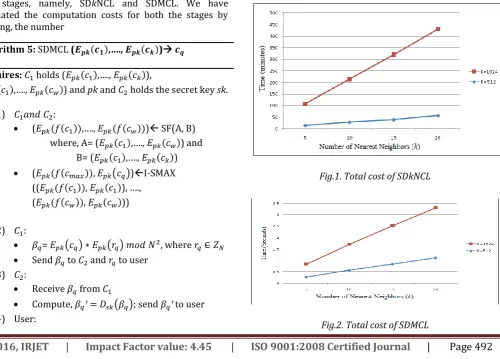
As mentioned in section 5, the I- PPkNN protocol has two stages, namely, SDkNCL and SDMCL. We have evaluated the computation costs for both the stages by varying, the number
Algorithm 5: SDMCL ( ,…., )
Requires: holds ( ,…., ),
( ,…., ) and pk and holds the secret key sk. 1) :
( ,…., ) SF(A, B) where, A= ( ,…., ) and B= ( ,…., )
( , ( ))I-SMAX (( , ), ….,
( , ))
2) :
= ( ) ( ) , where
Send to and to user 3) :
Receive from
Compute, ( ); send to user 4) User:
Receive from and from
of nearest neighbors (k) from 5 to 15.We have also assessed the performance by varying the key size as, K=512 and K=1024. We now compare our results with those in [2] under exactly same parameter settings. For K=512, SDkNCL takes 14.7 minutes to 57.5 minutes when k is change from 5 to 20, respectively. Thus, the computation cost increases linearly with k. Fig. 1 shows this linear change. It is also observed that as k is doubled the cost of SDkNCL also gets doubled. So, when k=10, the computation time of SDkNCL was 28.6 minutes. With K=512 and k=5, the Stage- 1 of PPkNN in [2] incurred 9.98 minutes. However, they evaluated the computation costs on a machine with Intel® XEON® Six- Core CPU with processing speed of 3.07 GHz and 12 GB of RAM. So, considering our machine configuration (which is 3 times smaller), we can assert that our proposed improvisations to the protocols in [2] can reduced the overall computation cost considerably.
[image:7.595.58.559.440.799.2]On the other hand, for K=1024, SDkNCL takes 93.6 minutes to 372.94 minutes when k is change from 5 to 20, respectively. With K=1024 and k=5, the Stage- 1 of PPkNN in [2] incurred 66.97 minutes. Again, considering the differences in machine configuration, our results are very good.
Fig.1. Total cost of SDkNCL
[image:7.595.310.562.441.596.2]© 2016, IRJET | Impact Factor value: 4.45 | ISO 9001:2008 Certified Journal
| Page 493
With K=512, our SDMCL takes 0.281 to 1.118 secondswhen k is scaled from 5 to 20, respectively. On the other hand, with K=1024, our SDMCL takes 0.556 to 2.184 seconds when k is scaled from 5 to 20, respectively. Fig. 2 shows the linear growth in the cost of SDMCL as k is increased. We can observe that, SDMCL incurs very low cost as compared to SDkNCL, since the number of computations in I-SMAX are significantly less than those in I-SMIN.
7. CONCLUSION AND FUTURE WORK
Our work in this paper proposed some improvisations to the existing PPkNN [2] protocol in order to improve its efficiency and to overcome some of the limitations of its sub- protocols. To address the issue of, negative values as result of any Paillier addition, while performing attribute- wise subtraction in secure squared Euclidean distance (SSED) protocol [3], has been resolved by our I-SSED protocol. In this protocol, we introduce a new approach to compute the squared Euclidean distance securely effectively and more efficiently. With the security analysis and practical implementation, we emphasize that, during our improvised protocols, all the privacy requirements mentioned in section 1 are met; the cloud and remains unaware of which database records correspond to the derived nearest neighbors. Also, any intermediate values that are computed and are visible to either of the clouds, are encrypted random values or random numbers. The work by Samanthula, Elmehdwi and Jiang to propose PPkNN [2] is the first of its type and after evaluating the performance, we can optimistically conclude that our improvised protocols are computationally inexpensive than those proposed in [2] under the same experimental settings.
Executing the I-SMIN protocol in parallel will be a huge boost to compute the k- nearest neighbors. This is can be possible as records are independent of each other and a cluster of servers, to execute I-SMIN in parallel, can be easily configured in a single cloud environment. Similarly, the I-SSED protocol can also be parallelized and we plan to do it in our future work.
REFERENCES
[1] P. Paillier, “Public key cryptosystems based on
composite degree residuosity classes,” in Eurocrypt, pp. 223–238, 1999.
[2] B. K. Samanthula, Y. Elmehdwi, and W. Jiang, “k-
Nearest Neighbor Classification over Semantically Secure Encrypted Relational Data,” IEEE Transactions on Knowledge and Data Engineering, Volume: 27, 2015.
[3] B. K. Samanthula, Y. Elmehdwi, and W. Jiang, “Secure
k- Nearest Neighbor Query over Encrypted Data in Outsourced Environment,” in IEEE ICDE, pp. 664- 675, 2014.
[4] C. Gentry, “Fully homomorphic encryption using ideal
lattices,” in ACM STOC, pp. 169–178, 2009.
[5] R. Agrawal and R. Srikant, “Privacy-preserving data
mining,” in ACM Sigmod Record, volume: 29, pp. 439– 450, ACM, 2000.
[6] Y. Lindell and B. Pinkas, “Privacy preserving data
mining,” in Advances in Cryptology (CRYPTO), pp. 36– 54, Springer, 2000.
[7] W. K. Wong, D. W. Cheung, B. Kao, and N. Mamoulis,
“Secure kNN computation on encrypted databases,” in ACM SIGMOD, pp. 139–152, 2009.
[8] Bohanec and B. Zupan. The UCI KDD Archive, 1997.
http://archive.ics.uci.edu/ml/datasets/Car+Evaluatio n.
BIOGRAPHIES
Mr. Gaikwad Vijayendra Sanjay received the Bachelors degree in Information technology from Pune Vidhyarthi Griha’s College of Engineering and Technology in 2014. He is currently pursuing Masters degree in Computer Science and Engineering from Deogiri Institute of Engineering and Management Studies. Areas of interest are data mining and cloud backup techniques and secured clouddata processing.