Work-integrated learning in Civil Engineering: an activity theoretical study by
Joseph Victor Bronkhorst THESIS
submitted in fulfilment of the degree DOCTOR OF EDUCATION
in the
Faculty of Education and Social Sciences Cape Peninsula University of Technology Supervisor: Associate Prof. J. Garraway
Co-supervisor: Dr S. Wickham Cape Town
2013
CPUT copyright information
The thesis may not be published either in part (in scholarly, scientific or technical journals), or as a whole (as a monograph), unless permission has been obtained from the University
ii
DECLARATION
I, Joseph Victor Bronkhorst, declare that the contents of this thesis represent my own unaided work, and that the thesis has not previously been submitted for academic examination towards any qualification. Furthermore, it represents my own opinions and not necessarily those of the Cape Peninsula University of Technology.
………. ………..
iii
ABSTRACT
The aim of this research is to present recommendations for knowledge and practice relations between Further Education and Training (FET) colleges and Civil Engineering (CE) workplaces, and to present a work-integrated learning (WIL) model that could assist with the preparation of CE students for the workplace.
Recently, FET colleges have been under the spotlight in terms of student preparedness for the CE workplace. Many questions have been posed by students studying at FET colleges and by CE workplace supervisors in respect of whether the current CE curriculum adequately prepares students for the workplace, or whether the curriculum has become obsolete in terms of knowledge and practice relations. The CE industry is of the opinion that students are insufficiently prepared in terms of skills and knowledge. In the light of this uncertainty, I researched the learning taking place at FET colleges and CE workplaces. I examined similarities and differences in the learning environment of the students.
The research provides a theoretical overview of Activity Theory (AT) and its principle of contradictions. The lens of AT and its contradictions provide a versatile tool to enquire into various aspects of WIL, taking into account individual and institutional perspectives, as well as changes over time. Activity Theory and its principle of contradictions provide insights into how transformation may occur within Activity Systems (ASs) in a CE context.
The study was conducted over a number of years with participants from three ASs, namely, the classroom, workshop/college yard and workplace. During the research, this study proposed a conceptual framework, rooted in AT, and substantiated by empirical evidence, for describing and analysing the learning taking place in the FET college sector and within the CE workplace environment. The analysis focuses on the perceptions of learning taking place in the ASs. Results reveal a knowledge and practice divide, mediated by AS elements of mediating artefacts, object, subject, division of labour, community and rules.
iv
Through a particular focus on the contradictions of the elements of an AS which occur, the objective for this study was to determine ‘knowledge and practice relations’. The components of knowledge and practice are extremely isolated, and by bringing the argument and the empirical findings together, the findings propose:
Links between knowledge(‘the classroom’) and practice(‘the workplace’)
The surfacing of the disconnect between knowledge and practice between the FET college sector and the CE workplace supports the idea of establishing links between these two sectors. This collaboration could be the turning point in better preparing students for the workplace.
Policy formulation and implementation
The need for policy review to enhance the integration of knowledge and practice relations in the sector has become apparent. Colleges are expected to undergo a radical transformation and to make major contributions to policy. However, these institutions are new and fragile, and are based on historically weak predecessors. Much of the reform process is oblivious of the connections between college and workplace.
The research has established that both CE industries and FET colleges should ensure that they increase their involvement with and participation in the provision of adequately preparing students for the workplace in the Western Cape Province.
v
ACKNOWLEDGEMENTS
The production of this thesis is the culmination of a long, excruciating period of hard work, inspired by my undying desire for knowledge. This desire has spanned my early years of learning at Klipfontein Primary School in Cape Town, South Africa, to my current position as a research student at the Cape Peninsula University of Technology. That I have emerged from this period of severe financial and social challenges is an accomplishment simply beyond my comprehension. It is in this context that I thank God for His abundant grace, love and compassion, and for granting me good health which has sustained me through this period.
During the years it took to complete this thesis, a great number of people have accompanied and supported me. They deserve my heartfelt gratitude. My deepest thanks go to my supervisors, Prof. James Garraway and Dr Sharman Wickham. Without their constant support through the good and bad times alike, their invaluable comments on and constructive criticism of my numerous ‘drafts of drafts’ and their eternal patience, I doubt very much that this thesis would have ever been completed. I am forever grateful to them for giving me the opportunity to pursue my interest in activity theory and for helping me so well to shape and express my thoughts. I would also like to thank the CEOs of FET colleges for providing me with an opportunity to conduct the research at their institutions and for making my visits to the different campuses pleasant occasions.
I also wish to thank my colleagues from the National Department of Basic Education, especially Dr Aaron Nkosi, who had to endure my lengthy discussions on activity theory on numerous occasions. Thank you so much for putting up with me all those years! You all have been a great source of inspiration and I have learned so much from you in the last three years. Thank you to all of you in the Curriculum Department for always doing everything you could to help me with this research. Special thanks go to Gerald Vollenhoven, a fellow doctoral student and colleague from the Western Cape Education Department for his unfailing support and for listening endlessly and patiently to my activity theory arguments.
vi
To my colleagues in the civil engineering departments at the various FET colleges, thank you for your unconditional support for allowing me to involve your students. I am also indebted to all my past and present students, whether they particpated in this particular project or not. Many more friends and colleagues (too many to mention) in the CE community and beyond have been a source of inspiration and strength.
Closer to home, my utmost gratitude goes to my family for being who you are and most of all to my mother, Maria Bronkhorst and late father, Douglas Bronkhorst, who instilled in me a love for learning. To my wife, Charmaine, and my two sons, Ryan and Carl, thank you for being the best family ever. You have always been and will always be the most precious people in my life.
I am grateful for the financial assistance of the National Research Foundation towards this research. Opinions expressed in this thesis and the conclusions arrived at, are my own and are not necessarily to be attributed to the National Research Foundation.
vii
LIST OF ACRONYMS/ABBREVIATIONS
AS Activity System
AT Activity Theory
CE Civil Engineering
CEOs Chief Executive Officers
CETA Construction Education and Training Authority D.O.L Division of labour
DHET Department of Higher Education and Training DoE Department of Education
ECSA Engineering Council of South Africa
EL Expansive Learning
FET Further Education and Training
FG Focus Group
GET General Education and Training
HE Higher Education
JN Junior NATED student
NATED National Technical Education NCV National Certificate Vocational NQF National Qualifications Framework NSF National Skills Fund
PDAs Personal Digital Assistants
SAQA South African Qualifications Authority SETAs Sector Education and Training Authorities
SN Senior NATED student
WIL Work-integrated Learning
viii
TABLE OF CONTENTS
DECLARATION ii
ABSTRACT iii
ACKNOWLEDGEMENTS v
LIST OF ACRONYMS/ABBREVIATIONS vii
TABLE OF CONTENTS viii
LIST OF APPENDICES xiii
LIST OF FIGURES xiv
LIST OF TABLES xv
LIST OF GRAPHS xvi
CHAPTER ONE 1
INTRODUCTION, PROBLEM STATEMENT AND AIMS OF THE RESEARCH
1
1.1 INTRODUCTION TO THE STUDY 1
1.2 INTRODUCTION TO THIS CHAPTER 2
1.3 THE ESTABLISHMENT OF TECHNICAL COLLEGES IN SOUTH
AFRICA: 1867 – 1994
2
1.4 FROM TECHNICAL COLLEGES TO FET COLLEGES (1994) 4
New legislation 4
The purpose of FET colleges 7
1.5 THE CONTEXT OF THE CIVIL ENGINEERING COURSE AT FET COLLEGES AND CHALLENGES FACED
9
1.6 A MODEL FOR LEARNING ACROSS DIFFERENT SITES IN THE FET SECTOR
12
1.7 RESEARCH PROBLEM AND QUESTIONS 16
1.8 LIMITATIONS OF THE STUDY 19
ix
CHAPTER TWO 21
LITERATURE REVIEW AND THEORETICAL FRAMEWORK FOR UNDERSTANDING LEARNING AT DIFFERENT SITES
21
2.1 INTRODUCTION
21
2.2 WORK-INTEGRATED LEARNING ACTIVITIES IN THE FET
SECTOR 23
2.2.1 Current WIL model in the college and workplace 24
2.3 KNOWLEDGE AND PRACTICE IN THE COLLEGE AND
WORKPLACE
33
2.4 INTEGRATION OF KNOWLEDGE, PRACTICE AND TRANSFER 37
2.5 PURPOSE FOR USING ACTIVITY THEORY 40
2.5.1 Vygotsky’s theorising 41
2.5.2 Engeström’s theorising 43
2.5.3 Engeström’s five principles of activity theory 46 2.5.4 Other researchers’ views of using Activity Theory 52
2.6 CONTRADICTIONS BETWEEN ACTIVITY SYSTEMS 55
2.7 THEORETICAL FRAMEWORK OF MY RESEARCH STUDY 60
2.8 SUMMARY 64
CHAPTER THREE 66
RESEARCH DESIGN AND METHODOLOGY 66
3.1 INTRODUCTION 66
3.2 RATIONALE FOR USING ACTIVITY SYSTEMS AS
ANALYTICAL TOOL
66
3.2.1 How I have used ASs as units of analysis 67
3.3 RESEARCH DESIGN 73
3.4 RESEARCH SITES AS ACTIVITY SYSTEMS 76
3.4.1 FET college sites with two Activity Systems 76
3.4.2 CE workplace sites as one Activity System 77
3.5 DATA COLLECTION METHODS 77
3.5.1 Survey data 78
3.5.2 Interview data 79
3.5.3 Observational data 81
x
3.6.1 Capture and analysis of survey data 83
3.6.2 Capture and analysis of interview data 84
3.6.3 Capture and analysis of observational data 85
3.7 RELIABILITY AND VALIDITY OF THE DATA 86
3.7.1 Participants 86
3.7.2 Pilot testing 87
3.7.3 Triangulation of the data 88
3.8 ETHICAL CONSIDERATIONS 88
3.9 LIMITATIONS OF THE STUDY 89
3.10 SUMMARY 90
CHAPTER FOUR 91
STUDENTS’ AND LECTURERS’ PERCEPTIONS OF THE CLASSROOM ENVIRONMENT
91
4.1 INTRODUCTION 91
4.2 ACTIVITY SYSTEM OF STUDENT LEARNING IN THE
CLASSROOM
92
4.3 CONCLUSION 118
CHAPTER FIVE 119
STUDENTS’ AND LECTURERS’ PERCEPTIONS OF THE WORKSHOP/ COLLEGE YARD ENVIRONMENT
119
5.1 INTRODUCTION 119
5.2 ACTIVITY SYSTEM OF STUDENT LEARNING IN THE
WORKSHOP/ COLLEGE YARD
120
xi
CHAPTER SIX 146
STUDENTS’ AND WORKPLACE SUPERVISORS’ PERCEPTIONS OF THE WORKPLACE ENVIRONMENT
146
6.1 INTRODUCTION 146
6.2 ACTIVITY SYSTEM OF STUDENT LEARNING AT THE
WORKPLACE
146
6.3 CONCLUSION 166
CHAPTER SEVEN 168
KNOWLEDGE AND PRACTICE RELATIONS IN CIVIL
ENGINEERING: CONTRADICTIONS AND ANALYSIS
168
7.1 INTRODUCTION TO THE CHAPTER 168
7.2 CONTRADICTIONS, MISFITS AND DISTURBANCES 170
7.3 INTRODUCTION TO CONTRADICTIONS BETWEEN
ELEMENTS OF ACTIVITY SYSTEMS IN CIVIL ENGINEERING
170 7.3.1 Community contradictions: What groups of people work
together on the object?
172
7.3.2 Rules contradictions: What are the rules governing the performance of the activity?
173
7.3.3 Division of labour (D.O.L) contradictions: Who is responsible for what in the activity?
175
7.3.4 Object contradictions: The purpose of the activity 176 7.3.5 Mediating artefacts/tool contradictions: Are these fulfilling
the needs in preparing students for the workplace?
177
7.4 ANALYSIS OF CONTRADICTIONS BETWEEN SUB-SYSTEMS
OF ACTIVITY SYSTEMS
179
7.4.1 Sub-system of the Subject, Community, and Object 181 7.4.2 Sub-system of the Subject, Rules, and Object 183 7.4.3 Sub-system of the Subject, Division of Labour (D.O.L), and
Object
185
7.4.4 Sub-system of the Subject, Mediating artefacts, and Object 188
xii
CHAPTER EIGHT 193
STRENGTHENING KNOWLEDGE AND PRACTICE RELATIONSHIPS IN CIVIL ENGINEERING
193
8.1 INTRODUCTION 193
8.1.1 Summary of findings 194
8.1.2 Historical roots of differences between college and workplace
198 8.1.3 Workshop/yard to serve as a bridge between the college
and the workplace
200
8.2 RECOMMENDATIONS AS DEVELOPMENTS 201
8.2.1 Links between knowledge ‘the college’ and practice ‘the
workplace’
203
8.2.2 Policy formulation and implementation 204
xiii REFERENCES 207 APPENDICES 221 Appendix A 222 Appendix B 223 Appendix C 224 Appendix D 225 Appendix E 226 Appendix F 232 Appendix G 239 Appendix H 244 Appendix I 247 Appendix J 249 Appendix K 250 Appendix L 252 Appendix M 254 Appendix N 256
xiv
LIST OF FIGURES
Figure 1.1: The knowledge notes for constructing a concrete column 14 Figure 1.2: A student constructing a simulated concrete column in the
workshop
14
Figure 1.3: Newly constructed concrete column constructed on site 15
Figure 2.1: The integration of the three WILs 24
Figure 2.2: Franz’s (2000) WIL model 28
Figure 2.3: Kolb and Fry’s (1975) learning cycle 30
Figure 2.4: Supporting learning environment 33
Figure 2.5:Vygotsky’s (1978) Basic Mediation Triangle 43
Figure 2.6: Engeström’s (1987) Activity Theory Model 44
Figure 2.7: Compactors used in the learning environments 59
Figure 2.8: Application of Engeström’s (1987) Activity System 61 Figure 3.1: Learning that takes place in each Activity System 68 Figure 3.2: Learning that takes place in one Activity System 71
Figure 3.3: A comparison of the sub-system triangles 73
Figure 7.1: Differences in the three integrating Activity Systems 171
Figure 7.2: Tools used in each of the ASs 178
Figure 8.1: The continuum which gives rise to the disconnection 196
Figure 8.2: Activity Systems comparing sub-systems 198
xv
LIST OF TABLES
Table 2.1: Martin’s (1997) WIL model 29
Table 3.1: A summary of the data sources and methods at FET colleges and the workplace
75
Table 4.1: Gender (N=137) 92
Table 4.2: Language (N=137) 93
Table 4.3: Age (N=137) 93
Table 4.4: Grade previously passed (N=137) 94
Table 4.5: Programme registered for (N=137) 94
Table 4.6: Duration of study (N=137) 94
Table 4.7 Students’ perception of the curriculum (N=137) 103
Table 4.8: Enjoying the course (N=137) 106
Table 4.9: Lectures (N=137) 116
Table 5.1: Gender (N=13) 120
Table 5.2: Language (N=13) 121
Table 5.3: Age (N=13) 121
Table 5.4: Curriculum (N=13) 128
Table 5.5: Students’ understanding of the goals of lesson (N=13) 134
Table 5.6: Students’ skills in the subject area (N=13) 137
Table 5.7: Lecturers rectifying the skill problem immediately (N=13) 138
Table 5.8: Industry visits (N=13) 140
Table 6.1: Gender (N=07) 147
Table 6.2: Language (N=07) 147
Table 6.3: Age (N=07) 148
Table 6.4: Training at FET colleges fulfil the needs of industry (N=07) 153
Table 6.5: Students’ understanding of instructions (N=07) 156
Table 6.6: Students applying different tasks (N=07) 158
Table 6.7: Rating students’ skills (N=07) 158
Table 6.8: Rectifying a skills problem by the student (N=07) 159
Table 6.9: Working relationship with students (N=07) 162
xvi
LIST OF GRAPHS
Figure 4.1: Physical tools used in the classroom 96
Figure 4.2: Teaching aids used in the classroom 98
Figure 4.3: Teaching/facilitation & media methods 100
Figure 4.4: Methods used when students work or study 102
Figure 4.5: Aspects the civil engineering course addresses 108
Figure 4.6: Rules students adhere to 116
Figure 5.1: Tools used during activities 123
Figure 5.2: Teaching and learning aids used during lectures 124
Figure 5.3: Teaching/facilitation & media methods 126
Figure 5.4: Methods used when students work or study 127
Figure 5.5: Aspects the civil engineering course addresses 132
Figure 5.6: Rules students adhere to 143
Figure 6.1: Tools used on site to train students 149
Figure 6.2: Different projects companies take on 161
CHAPTER ONE: INTRODUCTION, PROBLEM STATEMENT AND AIMS OF THE RESEARCH
1.1 INTRODUCTION TO THE STUDY
This study aims to make a contribution to the understanding of the current realities and challenges the FET college sector is facing. Specifically, my study examines the relationship between learning practices at different sites – college classroom, yard/workshop and workplace currently undergone by Further Education and Training (FET) college civil engineering (CE) students. The relationship between the three sites of learning is investigated in order to help answer the main research question: “Does the FET college adequately prepare
the CE student for the workplace?” The study does not just focus on a curriculum
analysis, but the curriculum is identified as one of the factors affecting the relationship between the three sites. Thus what is in fact analysed is the whole system at different sites, which includes the curriculum.
The demand for work-ready graduates, who are familiar with workplace practices, is increasing, and so the need for better prepared CE graduates is a growing concern for the FET college sector and the industry. Both the college and the workplace engage students in various educational activities; however, do these educational activities provide a meaningful experience within the workplace that is intentional, organised and recognised by the institution, in order to secure learning outcomes for the student that are both transferable and applied? (Stephenson & Weil, 1992).
With the establishment of FET colleges in 1994, knowledge and practice have become core strategic issues. However, many challenges exist in the process of the integration of learning and work in both environments. The challenges that do exist are, for example, the diverse focuses of the college and the workplace. The college’s focus is mainly on knowledge in the classroom, rather than practical experience in the workshop/college yard, while the workplace focus is mostly on the practical component as a form of production for profit.
Harvey (1999) writes that the primary purpose of education and training is to transform students by enhancing their knowledge, skills and abilities. The interface that Harvey (1999) refers to is seen as the integration of knowledge and practice for the purpose of this study.
1.2 INTRODUCTION TO THIS CHAPTER
This chapter focuses on the South African context and, in particular, the way in which knowledge and practice have been planned and implemented, initially in the technical colleges and, more recently, in the FET college sector and the civil engineering workplace. It begins with a brief history of technical colleges in South Africa and the changes to FET colleges. The purpose of these institutions is described, along with recent changes in legislation. Attention is then given to the current learning model across the different sites, and the research problem and questions are foregrounded.
1.3 THE ESTABLISHMENT OF TECHNICAL COLLEGES IN SOUTH AFRICA: 1867 – 1994
This section describes the history of technical colleges and the developments which led to tensions between college and work, with special reference to the disparate domains of knowledge and practice.
South Africa’s technical education can be traced to the early development of the South African economy – specifically to the discovery of diamonds in Kimberley between 1867 and 1875, and the later gold rush in the Witwatersrand and Mpumalanga (the then Eastern Transvaal), with the concomitant need for railways to transport the labour force into remote areas of the country. These developments created a demand for technical training in the fields of civil, mechanical, and electrical engineering. The first technical training classes for railway workers commenced in 1884 in Durban and similar classes started in Cape Town and Pretoria in 1902 (Abedian & Standish, 1992). These technical classes were based on mandatory practical training, whereas the theoretical
knowledge was acquired on an ad-hoc basis. Already there were indications of knowledge and practice disconnect.
When De Beers dominated the gold and diamond mines in the country, and made the attendance of training classes compulsory in 1896, a school of mines opened in Kimberley. During the early 1900s, interest in technical education continued to grow, and in 1902, the High Commissioner for the Transvaal and the Orange River Colony convened a conference for the heads of the various colonies. A resolution was passed that technical schools should be established in conjunction with higher education institutions (Pittendrigh, 1988; Sooklal, 2004). The Transvaal School of Mines was established in 1904 and all the students in Kimberley were transferred to this school.
Between 1906 and 1916, a number of new technical colleges emerged. These included the Pretoria Polytechnic and the Durban Institute, which opened in 1906 and 1907 respectively, and the SA Cape College in Cape Town. By 1994, there were 152 technical colleges in the country.
With the promulgation of the Apprenticeship Act of 1922, state regulation of the apprenticeship system was introduced. The Act introduced a second component into the apprenticeship curriculum, namely mandatory knowledge classes in technical education to be undertaken at a technical college. The theoretical component is referred to as the National Technical Education (NATED) programmes N1 – N6. This only formed one part of the apprenticeship programme. Besides the theoretical component, the apprentice students completed all practical training at their places of employment (McGrath, 2004). The apprenticeship contract between student and employer regulated this phase of the apprenticeship system. However the employer relationship became more distant, owing to the compulsory attendance of classes for students at technical colleges.
Prior to 1994 there was a shared responsibility between the college and the workplace, for example, even though students were contracted by the employer as apprentices, it was compulsory for the employer to send the student to college
for three months of the year to engage with theoretical knowledge, while the employer was responsible for practice in the workplace. Two programmes were offered in technical fields, the National Technical Education (NATED) programme, which was ‘knowledge based’, and the apprenticeship programme that was ‘practically based’. On the basis of undergoing knowledge and practice training, students became qualified civil engineering artisans.
After the election of the current government in 1994, the focus shifted from technical education to higher education and training; this brought about a decline in the number of apprentices trained. With the decline in the number of apprenticeships, the institutional level of apprenticeship training was transformed from one where apprentices were sponsored by industry, had the status of employees and were trained by means of day- or block-release, to one where most students studied full-time, with no employer sponsorship, and therefore little or no opportunity was available for practical, on-the-job training (Gamble, 2003). In other words, colleges service two kinds of students: the students who are connected to a company who attend three months per year at the college and another group of students who attend a full year without being connected to a company. This effected the change in the way knowledge and practice were offered and the way in which students were prepared by the college for the workplace.
1.4 FROM TECHNICAL COLLEGES TO FET COLLEGES (1994)
New legislation
During the existence of technical colleges, many challenges regarding the training programmes, as well as the training of students, were experienced by the colleges and the workplace. The challenges which technical colleges experienced were also experienced by the FET colleges and workplaces, even though the focus had now shifted from technical education to higher education and training.There was also a decline in the number of apprentices trained. Change was required, through new legislation, and with the assistance and cooperation of various state departments.
The Department of Education and Training and the Department of Labour played a significant role in changing the nature and direction of education and training in South Africa. One of the main aims was to close the gap between the knowledge and practice divide in the FET college sector. The White Paper on Education and Training (RSA, 1995), the two Further Education and Training Acts (DoE,1998; RSA, 2006), and the Skills Development Act (DoL, 1998), envisaged that significant legislation would shape the character of future education and training provision in South Africa. However, as Tsolo (2001:83) writes, “the FET colleges immediately felt the impact of this legislation in areas of organisation, management and governance”. With all these policies in place, the DHET hoped for better integration of knowledge and practice.
The central aim of the Further Education and Training Acts of 1998 and 2006 was to create a single, coordinated system of education and training. Not only did the FET Act of 1998 see the clustering of 152 technical colleges to form 50 mega FET colleges, but a distinction was made between the professional management of FET colleges and their governance, thereby offering a sound framework for the functioning of the colleges. The Acts stipulate that certain governance functions be performed by an FET college council, while the guidelines provide for the professional management of an education and training institution, and include functions that the head of a college is required to perform. In other words, more flexibility was given to the colleges to try to establish links with industry for the enhancement of knowledge and practice relations.
FET colleges are learning sites, and the types of learning that are to take place within this environment are described as, “knowledge, skills and values that are transferable to different work and learning contexts” in the Education White Paper 4 of the Department of Education (RSA, 1998a:21). This White Paper also states that the Ministries of Education and Labour have taken it upon themselves to provide education and training pathways for young people and adult workers, and to develop more effective linkages between training and work. The introduction of learnership programmes into FET colleges is an important development in this regard. The programme funding is made available to these institutions through
the Sector Education and Training Authorities (SETAs) and the National Skills Fund (NSF).
According to Moran and Rumble (2004), Government views the FET colleges as ideal platforms through which the national skills development priorities can be achieved. These authors argue that a ‘transformed’ Further Education and Training college could be considered an important investment for the future. A number of policy reforms have been introduced in order to streamline this sector. Both the Department of Education and the Department of Labour have managed to put policies such as the Further Education and Training Acts (DoE, 1998; RSA, 2006) and the Skills Development Act (DoL, 1998), in place. Powell and Hall (2002), in their review of the South African technical colleges, support these policies where issues of specific reforms are spelled out.
Since the demise of the apartheid regime, the Government has tried to implement a strategy on the vital role skills can play in building a better future for all South Africans. In addition to this, serious consideration has been given to the development of skills programmes for economic and social growth. Unfortunately the programmes introduced at FET colleges were more theoretical than practical. In other words, the college focus was on teaching students to pass the examinations in theoretical knowledge, as this is what they were assessed on. Later, the evolution of attitudes towards the skills required by the labour market and the exigencies of the economy resulted in a seriously dysfunctional skills development system. This resulted in the Skills Development Actof 1998. This was thought to be a solution, but then became problematic in the way knowledge and practice were dealt with.
With the introduction of the Skills Development Act of 1998, workplace education and training were also affected negatively because of unclear guidelines with regard to knowledge and practice relations. The subsequent confusion arose because of the vague policy guidelines for students undergoing mandatory workplace practice. In other words, the policy does not state that students must undergo practical training in the workplace and that the workplace should conform to specific norms and standards. Colleges acknowledged that if students
were given proper access to workplace training, this would lead to a skilled and experienced workforce.
The purpose of FET colleges
The FET college sector constitutes a large, diverse and critically important part of the education and training system, costing the country over R10 billion annually. The Department of Education (DoE, 1998) highlights the fact that the purpose and mission of the FET strategies is to respond to the human resources needs of South Africa for personal, social, civic and economic development. A transformed, high-quality, responsive FET system is seen as a vitally important investment in the future of South Africa and its people. In essence, the purpose of the FET policy is to take a strategic view of how education and training can rapidly change the technological, social and economic environment. These policies should be met through the provision of appropriate skills and knowledge in a range of activities.
The re-entry of South Africa into the competitive international market has created an imperative for FET colleges to develop a skilled, innovative and technologically competent labour force, taking cognisance of the collapse of the youth labour market in South Africa (RSA, 1999). The Department of Education (RSA, 1998a) acknowledged that globalisation might have negative consequences for vulnerable and marginalised groups and communities. This meant that companies in South Africa would have the financial backing of Government through the Sector Education and Training Authority (SETA), but the people at grassroots most likely would not have the skills (owing to a lack of practical training) to grow the economy as anticipated by Government. These skills could be developed through a skills strategy and the assistance of FET colleges in South Africa.
The Green Paper (RSA, 1998b) argues that the challenge for the FET strategies
is to respond to the demands of global economic competition, as well as to the local challenge of meeting basic needs. It sees local needs and priorities shaping
interaction with the global economy through the implementation of equitable, relevant and effective policies related to the development of resources.
The Department of Education provided initial clarification regarding FET in its
Green Paper on Further Education and Training (RSA, 1998b). It describes FET
as a specific band, located between General Education and Training (GET) and Higher Education (HE), both of which draw a wide diversity of groups of learners and stakeholders into one qualifications framework. These groups include pre-employed, employed and unemployed youth and adults. FET is not compulsory education and, by definition, it has no age limit. Its goal is to promote lifelong learning and on-the-job education. Thus, the Education Ministry’s commitment is given to the development and expansion of high-quality, innovative, flexible FET colleges, based on the principles of open learning and responsiveness to the needs and demands of all post-15-year-old learners (RSA, 1998b).
Nkosi et al. (2000) point out that most students enter FET from the GET band on their way to higher education or work. In future it is anticipated that increasing numbers will retrace their steps, turning from employment or unemployment to the FET system to provide either retraining, ‘second chance’ learning opportunities, personal development or leisure courses. Furthermore it is anticipated that higher education graduates will turn to FET as a means of changing career direction, acquiring career-orientated training or meeting a range of community and personal needs (RSA, 1998b).
For years, many learners at school who could not keep up academically were directed towards the vocational colleges, which were widely regarded by parents and communities as a second option to academic studies at universities. This began to change in the 1990s, when the Government, together with the Department of Education, took several steps to overhaul career and technical education. This allowed FET colleges to establish stronger ties with industry. The stronger ties which were established assisted in the recruitment of more skilled lecturers and instructors with expertise in specific fields. They also allowed students to find employment during their studies and after they had graduated.
Through this process students also became more focused on their particular career choices.
1.5 THE CONTEXT OF THE CIVIL ENGINEERING COURSE AT FET COLLEGES AND CHALLENGES FACED
The National Department of Higher Education and Training (DHET), FET colleges and the CE industries’ involvement within the CE programme operate in environments which should involve the integration of knowledge and practice. The context in which these operate is therefore described.
FET colleges present the CE curriculum to students and the CE industries engage the students in workplace training while simultaneously progressing towards enhanced work-integrated learning. The programmes offered are apprenticeships, learnerships, National Certificate Vocational programmes (NCVs), and the National Technical Certificate (N1 – N6) programmes.
An apprenticeship is a non-unit-standard-based registered qualification which is governed by sections 13 – 29 of the Manpower Training Act (56 of 1981) and falls within NQF level 4. It comprises the integration of workplace and institutional learning and culminates in a national qualification. Students who are registered for the apprenticeship programme sign a contract with the company with which they are employed. This contract could be anything from two to four years. Apprentices are sent by their employer to an FET college for one trimester (equivalent to three months) per annum. During their time at the college they are taught various knowledge components of the trade and this allows them to complete the N1 – N2 course. The apprenticeship aims to provide a firm foundation for those wishing to pursue a career in CE, in trades such as carpentry, plumbing, bricklaying and painting. The intention is to allow students to build on their natural aptitudes and interests in an organisation of their choice, and gain valuable experience in the organisation while learning related vocational subjects, such as trade knowledge, mathematics, building science and building drawing, which are taught to them at the college. The division of tasks is visible in
the two components that are offered separately, which causes a problem for knowledge and practice integration.
A learnership is a vocational education and training programme which falls in the NQF Levels 2, 3 and 4. It combines knowledge and practice, culminating in a qualification that is registered with SAQA under the Skills Development Act (DoL, 1998). The CE learnership programme was introduced to provide students with a sound understanding of skills associated with CE techniques, as well as entrepreneurial industry skills, with the opportunity to make the transition from college to work. Through this experience, students should be able to make a more informed career choice, as well as gaining the opportunity to develop into mature and responsible young adults. This programme should work well if implemented correctly for the integration of knowledge with practice.
The National Certificate course is a knowledge course which is linked to NQF levels 4 and 5. The course was introduced at technical colleges (now known as FET colleges) from N1 – N6 (the ‘N’ indicating that it is a National Technical qualification). These courses are linked to the apprenticeship programme. In this programme it is assumed that students are equipped with relevant theoretical skills for the workplace. The course intends to prepare students for a career in engineering, with options of vocations such as engineering technicians, industrial engineers, project engineers, maintenance engineers, mining-related careers, certified engineers and artisans.
The National Certificate Vocational (NCV) programme is registered under the
FET Act 11 of 2006. The course is a new and modern qualification at NQF levels
2, 3 and 4. It gives Grade 9 learners a vocational alternative to an academic Grade 10 – 12 by offering industry-focused training. The main aim of the NCV programme has been to ensure that FET colleges meet the growing need for vocational and technical training in the country. It has provided students with an opportunity to experience work situations during their period of study.
Of the four civil engineering programmes offered at FET colleges, it is only the ‘N’ programme, in, for example, the various theoretical subjects, that does not cater
for practical training at college sites. The other courses, such as the NCV, learnerships and apprenticeships, have a practical component built into the curriculum. However, many FET colleges do not expose their students to the practical component of those CE courses. No work experience is a problem, and Gamble (2003) suggests that workplace training offers more opportunities to students. This is because the student can be developed in work-related knowledge and skills, including knowledge in and about the workplace that is not usually written down or spoken about. She also contends that students should be provided with positive opportunities that will expose them to the contemporary problems in a hands-on way, as they will be working with new machines and equipment.
Students are trained in one of the CE programmes which include the ‘N’ subjects, learnership or NCV at FET college sites to carry out various activities, such as interpreting civil engineers’ plans and the construction of all types of buildings, houses, industrial plants, bridges, roads and railways, waterways and water re-servoirs.
However, despite the CE programmes offered at FET colleges as described above, the FET college sector is characterised by various challenges, such as the integration of theoretical knowledge and practical skills, varying from levels of provision of resources, vague policy, quality of offerings and limited opportunities for collaboration with the labour market (Gewer, 2002), as well as the fact that the public attitude tends to favour ‘academic’ rather than ‘vocational’ education (RSA, 1998b).
The main challenge is, as Gamble (2003) suggests, that this is not just a question of classroom training or practical training on their own, but of bringing the two together so that students can reflect on both practice and knowledge in order to solve problems. This is what is meant by ‘competence’ or more correctly ‘applied competence’ (SAQA, 1995).
1.6 A MODEL FOR LEARNING ACROSS DIFFERENT SITES IN THE FET SECTOR
Work-integrated learning (WIL) comes in many shapes and sizes. It has always formed a significant component of educational processes, particularly in the FET college sector. The reason for this is that there have always been components of knowledge and practice which are integrated in the civil engineering course. There have been many different opinions on whether the FET colleges or the workplace should be responsible for WIL, and where WIL experiences should take place. Dillenbourg and Betrancourt (2006) contend that the WIL experience can be off- or on- campus, real or simulated, depending on the discipline, but should involve clearly stated outcomes and assessment which are consistent with quality teaching and learning.
For the purpose of this study, WIL is understood to refer to civil engineering educational activities that integrate knowledge learning with practical application, both in the college and in the workplace. These civil engineering educational activities provide a meaningful experience for students in the workplace, and are organised by the FET colleges and recognised by industry. When these activities take place, they ensure learning. FET college students that are involved in WIL should encounter learning experiences that expose them to a culture of theoretical knowledge and workplace practice.
In the FET colleges and CE workplace sectors there are three levels of WIL: the knowledge WIL 1, the practice WIL 2, and the CE workplace WIL 3. The civil engineering knowledge aspects such as learning about construction drawings and the specifications of concrete columns are taught to the students by the lecturers. In WIL 1, the weighting of theoretical knowledge is large, and the practical end product, such as the concrete column, is only imagined. Winberg et al. (2011) therefore suggest that a curriculum should reflect the integration of work knowledge and skills, and include more knowledge at all levels.
On the other hand, WIL 2 is an extension of the knowledge leading to practice, for example, the students are taught all aspects of constructing a concrete
column in the workshop or in the yard of the college. They are monitored, guided and assessed by the senior students and lecturers. The simulated practice and construction of small models in WIL 2 outweigh the knowledge acquired in WIL 1. In this case, the knowledge becomes progressively internalised and is used as the basis for constructing simulated models of concrete columns.
In WIL 3, practice is done at a real civil engineering workplace. The workplace supervisor takes over the responsibility of the college lecturer. He or she ensures that the knowledge and practice that was taught by the college is embedded through the practical component. Although the focus is solely on the workplace in WIL 3, it is still educational.
An example of how the theoretical knowledge and practice in the FET colleges and the CE workplace operate.
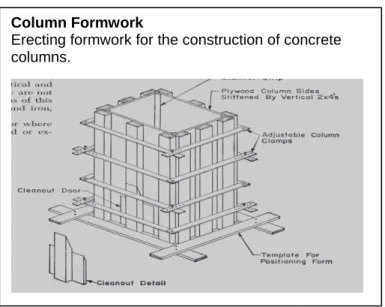
Figure 1.1 is a typical example of what students learn in the knowledge classroom at the college. This is a worksheet of knowledge pertaining to formwork for concrete columns. It contains knowledge notes as well as drawings of a concrete column. Students are expected to draw and learn the knowledge and the methods of constructing concrete columns. After the learning has taken place, they are assessed on the knowledge aspect, for example, by having to complete a sketch of the formwork for a concrete column. The focus is not on the concrete column itself, but rather on the formwork into which the column will be constructed.
Figure 1.1: The knowledge notes for constructing a concrete column
Figure 1.2 illustrates how the students apply the theoretical knowledge in a practical task. According to the specifications, they must construct the formwork for a concrete square column and make a simulated model. As can be seen, the student is constructing this column at the college in the workshop. Although the students are exposed to the practical skill, it is, however, done on a smaller scale compared with the same exercise in the workplace. They are exposed to simulations, rather than to the actual tasks. The exercise is for the student to link knowledge with practice.
Figure 1.2: A student constructing a simulated concrete column in the workshop
Figure 1.3 is a picture of concrete columns that were constructed by students under the supervision of the workplace supervisor. The real completion of such a
Column Formwork
Erecting formwork for the construction of concrete columns.
task brought together the knowledge and simulated models done by the students at the college. This is where they are exposed to real work situations. More practical learning takes place on site. On completion of the task, the lecturer visits the site and assesses the students’ work. If the students are found to be competent, the task will then be signed off as completed in the students’ logbooks.
Figure 1.3: Newly constructed concrete column constructed on site
As can be seen from the above WIL activities, WIL lends itself to many opportunities to develop educational tasks to support the process of student learning, as well as students’ understanding of the demands of employers when they enter the workplace. Students come to realise the necessity of being properly skilled in order to be competitive individuals in the workplace.
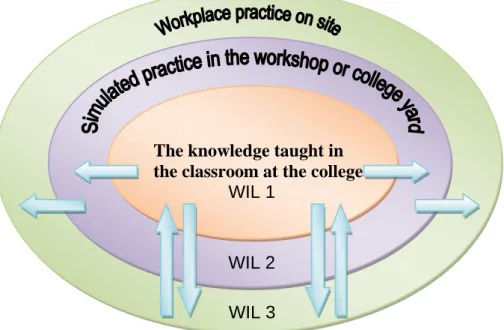
The theoretical knowledge in the classroom (WIL 1), simulated practice in the workshop or the yard of the college (WIL 2), and workplace practice on site (WIL 3) integrate with one another. As well as integrating, these three WIL experiences also depend on one another. All activities move across boundaries between the activities in WIL 1, WIL 2, and WIL 3.
At the workplace, students are expected to exercise their professional, ethical and technical skill judgement to the best of their ability. Although some organisations will not be able to offer an extended work experience or an
adequate work space in which to carry out the student project, such organisations may still offer valuable opportunities. In such cases it is important that the student honestly assesses his or her ability to work independently without constant supervision.
In the Apprenticeship programme, students spend three months at the college in the classroom and workshop, doing WIL 1 and WIL 2. The rest of the year they spend at work under supervision of the workplace supervisor, doing WIL 3. The cycle continues until they graduate after four years.
The integration of the three WILs allows the students to experience an easier transition from college to workplace. These two worlds, the college and the workplace, are linked by a relationship formed through interaction between the college lecturers, students, and workplace supervisors. The pictures in Figures 1.1, 1.2, and 1.3 give an indication of what students do and how WIL 1, WIL 2, and WIL 3 operate in the FET college sector and the workplace.
The college should therefore ensure that students are required to focus on the integration of theoretical knowledge with practice that allows them to connect college or disciplinary learning with workplace application by recognising that workplace practice, together with theoretical knowledge, can be used as a catalyst for integrative learning. Interpretation of and reflection on the experience of professional practice and application of knowledge in context should be at the heart of learning experiences for students in WIL (Sanders, 2005).
1.7 RESEARCH PROBLEM AND QUESTIONS
There are considerable variations in the way that knowledge and practice and the relationship between them are understood in the field of civil engineering. Traditionally, the idea has been that practical skills are supported by knowledge, but current debates by the students, lecturers and workplace supervisors are centred around the knowledge and practice divide in the CE programmes at FET colleges.
According to various researchers (Fisher et al., 2003; Hawthorne, 2004; McGrath, 2004), the vocational needs of the civil engineering industry have neither been met, nor have FET colleges been able to meet their clients’ needs or have they responded effectively to the civil engineering delivery requirements. In this section I shall focus on the theoretical perspective of the relationship between knowledge and practice at FET colleges and the workplace.
According to Hull et al. (2000), the role of vocational education in the new system is clearly not job training as provided in the past (that is, simply skills around the workings of a particular machine or procedure), but vocational education should now attempt the integration of knowledge and practice between the college and the workplace. Hull et al. (2000) also posit that this education in the new system cannot be accomplished by lecturers working in isolation from the workplace, but will require that lecturers with particular interests in the field be grouped together with workplace supervisors who are teamed to create and deliver the curriculum.
Barnett (2006) suggests that an academic curriculum differs from a vocational curriculum because an academic curriculum faces only one way, as its purpose is to induct students into a disciplinary field of knowledge. In contrast, in a vocational curriculum, the purpose is to induct students into a field of practice, with the theoretical knowledge that underpins practice as the basis for integration of the two components. If there is no integration, then there is a disjuncture.
According to Martinez and Badeaux (1994), FET colleges need rigorous work- integrated learning (WIL) programmes that integrate knowledge and practice to meet the future needs of a young population by addressing workplace realities and the changing world of technology. One of the great challenges of curriculum planning for FET colleges has traditionally been the integration of academic competencies into vocational education curricula. For these reasons, they also face challenges to constantly examine course content, strategies and implementation, as well as to update course curricula, and explore new areas to include in the overall CE curriculum.
Young (2004:16) argues while all jobs require specific knowledge, “many jobs also require knowledge involving theoretical ideas shared by a community of specialists” located within disciplines. He also believes that workers need to be able to use theoretical knowledge in different ways, and in different contexts, as their work grows in complexity and difficulty. Apart from knowledge, there are also qualifications that should provide students with the disciplinary requirements to study at higher levels within their field, in addition to immediate occupational outcomes. Young therefore suggests that an engineering curriculum needs to provide students with access to both types of knowledge, the theoretical knowledge that underpins practice within a specific field. But an exclusive focus on learning in the workplace only also denies students access to disciplinary systems of meaning. He has a strong sense of knowledge and practice relations between the institutions of learning and the workplace.
On the other hand, Gamble (2003) describes how many college graduates in South Africa complete their programmes of study without having had access to practical on-the-job training which is deemed vital for occupational preparation (Kraak & Hall, 1999). Her views are that procedures and facts are not good enough; a strong practical component at the workplace should support these facts and procedures. For this very reason work-based learning has therefore become not only a desirable but an essential core element of FET college provision. Work-based learning in some of the CE programmes offered at these colleges is absent, hence the reason for my argument for closer links between knowledge and practice. For Gamble, this is also a process of integration that would give students the opportunity to function much better and be more productive in the workplace.
As has been indicated in the history and purpose of FET colleges, the main intent of vocational education is the preparation of students for work. However, as various theorists have indicated, there are possible tensions between teaching and learning practices in the college environment and related practices at work, and such integration is necessary for successful vocational education. This is a challenge for the FET sector and has led to my research question:
“Does the FET College adequately prepare the CE student for the workplace?”
This question is followed by three sub-questions.
1) What is the relationship between knowledge and practice with particular reference to CE at FET colleges and the workplace?
2) How can Activity Theory address the learning community at the various FET sites?
3) What are the current practices of learning in the college and at work, and what are the emerging differences within and across the three sites with particular reference to knowledge and practice?
In order to address these questions, I need to deal with the relationship between knowledge and practice at the different sites of learning.
As I shall be comparing different sites (colleges and workplaces), I shall use Activity Theory (AT) which will allow me to compare different systems. This is more fully discussed in Chapters 2 and 3.
1.8 LIMITATIONS OF THE STUDY
As this study was limited to four FET colleges in the Western Cape, the results cannot be generalised. The research study foregrounds description of the practices, challenges and outcomes, providing tentative conclusions which could serve as hypotheses for future studies. Owing to time constraints and safety aspects, only eight civil engineering sites were visited; seven workplace supervisors allowed me to interview them and completed a questionnaire.
1.9 STRUCTURE OF THE THESIS
The thesis is divided into eight chapters. Chapter 2 provides a literature review of current practices between the FET college sector and the CE workplace, and how these influence the functioning of FET college students on site. Consideration is given to the elements in which WIL operates in the context of
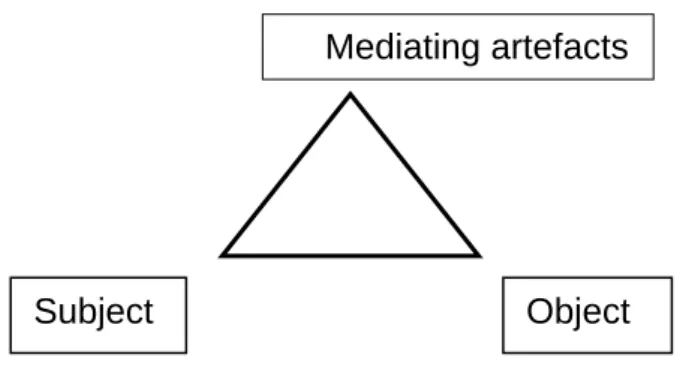
the CE course. The chapter also speaks to the theoretical framework for WIL and begins with an adoption of Vygotsky’s AT triangle (Vygotsky, 1978). The AT model provides a powerful tool/framework for illustrating how the use of various tools across different contexts impacts on students and lecturers from FET colleges, as well as on workplace supervisors.
Chapter 3 specifies the methodological strategy and design, the sample, the method used to collect data, the data analysis and the interpretation of the findings. The following three chapters cover the presentation, analysis and interpretation of the findings of the civil engineering students’ learning in the classroom at the FET colleges (Chapter 4), learning in the workshop/college yard at the FET colleges (Chapter 5) and learning at the workplace on site (Chapter 6). Chapter 7 deals with the analysis of the findings from the collected data within the context of the theoretical framework and literature overview, while Chapter 8 presents conclusions to the study and makes recommendations based on these.
CHAPTER TWO: LITERATURE REVIEW AND THEORETICAL FRAMEWORK FOR UNDERSTANDING LEARNING AT DIFFERENT SITES
2.1 INTRODUCTION
This chapter incorporates the literature review with the theoretical framework. It describes the knowledge and practice in the context of civil engineering (CE) courses at Further Education and Training (FET) colleges and in the workplace. It outlines how Activity Theory (AT) addresses the learning community at the various sites and what the current practices at colleges and workplaces are. It further examines the emerging differences within the three sites, with particular reference to knowledge and practice, and the transfer of learning in the sector. Activity Theory, the work of Vygotsky and Engeström, and how others have used the theory, are adumbrated. In summation, I also propose my vision of AT as an analytical framework.
For the purpose of this study, ‘work-integrated learning’ (WIL) is regarded as the integration of knowledge and practice in college and the workplace. Huber (2005) note that WIL is learning that results from an integration of workplace experience, knowledge and practice. The phrase ‘work-integrated learning’ is also used to describe curricula designed to bring about this kind of integrative learning in different environments. Stephenson and Weil (1992) contend that WIL is the term used to describe educational activities that integrate theoretical learning with its application in the workplace. My WIL research experience is based upon Stephenson and Weil (1992) where I refer to it as educational activities which integrate knowledge and practice.
Dillenbourg and Betrancourt (2006) refer to WIL as a term used to describe educational activities that integrate theoretical learning with its application in a workplace, profession, career or future employment. The concept of WIL can be applied to a broad range of programmes and can be recognised through student assessment in these programmes. The WIL experience can be off- or on-campus, real or simulated, depending on the discipline, but should involve clearly
stated outcomes and assessment, and be consistent with quality teaching and learning.
However, in the FET college sector, WIL has a long history dating to 1903 when it was first introduced at Sunderland Technical College for architectural and engineering students (Franks & Blomqvist, 2004). To date there has been little research on WIL in the FET college sector but considerable WIL research has been done in higher education and in non-formal education. From the research there are clear lessons for the FET colleges and the CE workplace. The knowledge and practice divide is prevalent both in the college and workplace, which makes it difficult for students to be successful in both environments. If a workable WIL model is applied in both these settings, there could be benefits for the students, colleges, and workplaces.
There have been repeated calls for FET colleges to be more responsive, accountable, relevant and accessible (Kraak & Hall, 1999). This could imply a possible disjuncture between policy objectives and the ability of FET colleges to deliver on their mandate. According the Skills Development Act (DoL, 1998), the mandate of the colleges is to prepare students for the workplace. Discussion documents and debates on a human resource development strategy, along with
the South African Qualifications Authority Act (SAQA, 1995) and the Skills
Development Act (DoL, 1998), offer opportunities to allow FET colleges to focus
on the integration of knowledge and practice in the FET college sector. Whether this is happening in the sector remains to be seen.
On the other hand, Case and Light (2011) have argued that there is a very close link between engineering education and higher education, where external influences, particularly from professional bodies and industrial concerns, play a significant role in determining what is valued. The same cannot be said from an FET perspective. My argument is therefore mainly focused on the relationship between knowledge and practice with the FET sector. In other words, are FET colleges preparing CE students for the workplace? I shall focus on the various ASs at each site. The curriculum is just one focus within each system. However Case and Light (2011) contend that some external influences provide on-going
fuel to the curriculum debate in engineering education, largely focusing on a concern about what graduates can actually ‘do’ when they enter the workplace. The debate has been endemic in the circle of FET contemporaries.
According to ECSA (2012) there is currently a misconception that college education in engineering subjects is an alternative to university or university of technology engineering programmes. Further Education and Training colleges are involved in artisan education and engineering-support occupations. ECSA (2012) believe that FET colleges should ensure that the engineering curriculum remains relevant and responsive to the demands of professional practice and the needs of business in a changing world, and flexible enough to cater successfully for a diverse student intake. In addition, the salient point is the relationship between knowledge and practice, which is part of this flexibility.
Gamble (2003) argues that FET colleges in South Africa are often admonished to be more responsive to the needs of industry and commerce, as well as to the needs of local communities. This is indeed their curriculum task, but they cannot fulfil this task if they are not responsive on their own terms, as educational institutions that serve the public well. FET colleges owe it to themselves to build a strong and independent educational identity that shows that the shift from technical colleges to FET colleges is indeed more than a name change. The success of engineering in the future of South Africa is the mandate of government, industry and professionals.
2.2 WORK-INTEGRATED LEARNING ACTIVITIES IN THE FET SECTOR
At FET colleges, students gain the theoretical knowledge of setting out a building, but when they proceed to the workplace, the knowledge is integrated with practice, which in many cases is the ‘real work’ which the students must deal with. In the FET college sector, WIL is described as a means of preparing civil engineering students to work in a field of practice. One of the reasons why WIL is perceived as ineffective in the FET college and workplace environment could be the lack of knowledge and practice integration; on the other hand, possibly WIL is not actually executed.
2.2.1 Current WIL model in the college and workplace
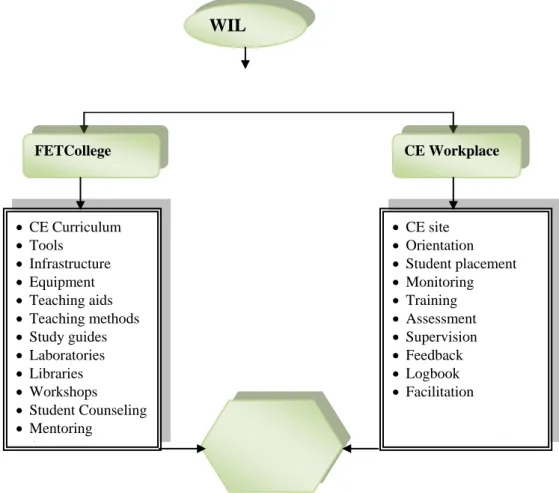
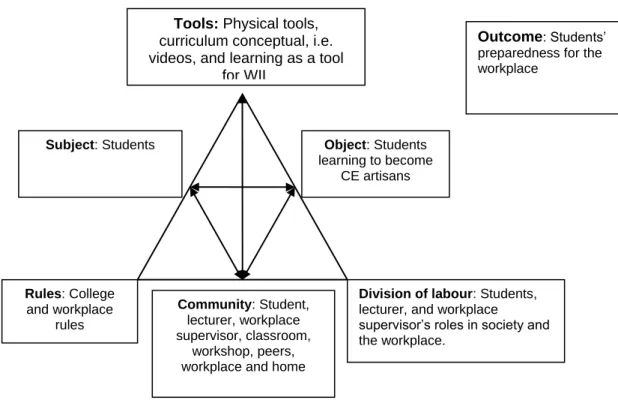
Figure 2.1 is related to WIL in CE to demonstrate that the student’s learning environment is combined with his or her past and current knowledge, and plays a crucial role in meaning making, since the student integrates the knowledge with the practice. Students move across the three WILs over time to attain certain goals and ultimately qualify as CE artisans or technicians. The three WIL layers describe what learning takes place in each of these layers, namely, WIL 1, WIL 2, and WIL 3. Each of these layers also represents an activity system as described in my theoretical framework.
Figure 2.1 will be used to further unpack and illustrate how the three WILs operate separately but work together for the students to qualify as CE artisans or technicians. In the FET college, there are two levels of WIL: WIL 1 refers to the civil engineering knowledge aspects, such as construction drawings and specifications of concrete columns that are taught to students by lecturers. This is only classroom text and various descriptions of making concrete columns. This is not only knowledge; WIL is taking place because it actually focuses on instructions, principles and steps for constructing the column. WIL 1 is about
The knowledge taught in the classroom at the college WIL 1
WIL 2 WIL 3 Figure 2.1: The integration of the three WILs
learning work-related subjects in the classroom, and the student being an active or passive participant in the teaching-learning process.
Barnett (2006) describes how the content of vocational subjects should be drawn from the current workplace practice. If it is not done in this way, the content may become out of date or obsolete. WIL in CE is derived from a selection of relevant content knowledge, and should be based on an understanding of the workplace. If there is no workplace involvement, or not much understanding, then the curriculum will not allow for knowledge gained in the classroom to be transferred in appropriate ways to other WIL sites.
The traditional subjects within the CE course have various elements of mathematics and physical science. For example, some of the elements, such as strength of materials, stress and strain from the physics, and areas and volumes from the mathematics, are used to determine the strength of the volume of a concrete slab which is constructed in the workplace. Since the inception of vocational subjects such as bricklaying, concrete works, and carpentry, these subjects have been considered pertinent to the workplace, and are still in operation. The college curriculum is designed using ideas from work, and where these may be the wrong ones, then there is a possibility of their being outdated. According to the Barnett (2006) model, if a curriculum is out of date, it could make the knowledge irrelevant or obsolete.
WIL 2 draws on the learning experience of the student in WIL 1 because this comprises the college unit. If WIL 1 is not properly executed in the classroom, students come with little or no experience to the workshop or college yard, which makes practical teaching and learning extremely difficult for the lecturer and student in WIL 2. The knowledge experience from the classroom is paramount for the students, for they can draw on it when they are confronted with construction problems. This links with Dewey’s (1963) contention in 1938 that ‘learning by doing’ is more effective. Knowledge is assessed by performance, for example, if the student is required to build a simulated formwork for a concrete column, on completion the lecturer will know that the student has an understanding of the force of concrete, proper securing methods and the reinforcement of steel.