Evaluation of Content Management Systems (CMS): a Supply
Analysis
Clara Benevolo and Serena Negri DiTEA, University of Genoa, Italy [email protected] [email protected]
Abstract: Content management systems (CMS) provide an optimal solution by organising information and, mostly, creating and managing an enterprise’s knowledge. Nevertheless there is a big confusion about the functionalities that characterise CMS and about the differences with less performing products such as web content management systems, document and records management systems and enterprise content management systems. This paper aims to show the mismatches between companies’ needs and those information management products, which are often called CMS even if they are not.
For this reason the authors first make a theoretical comparison between the functionalities of CMS and those of the systems they are often confused with. Then they show the results of an empirical research on 22 products offered by international vendors. By using an original scheme, enterprises’ needs in terms of information collection, management and publication and of knowledge management are compared with the functionalities of the aforementioned systems. The result consists of performing definitions for CMS and the other systems for managing information. Content Management products are analysed, compared and evaluated by using a special table created to point out the actual functionalities of the products offered on the market, despite vendors’ declarations. Moreover the highlights are displayed in a matrix to evaluate the level of personalisation-flexibility of the different products. The paper conclusions show how, on the demand side, companies’ needs are growing in a confused framework; at the same time the supply side keeps on feeding this confusion, reducing company satisfaction in regard to knowledge and information management.
Keywords: Content management, web content management, enterprise content management, knowledge management, ICT supply and demand
1
From data to knowledge:
challenges in enterprise
management
Data, information, content and knowledge are terms often used as synonyms, but which actually have a precise meaning which distinguishes one from the other. In this paper we adopt the approach given by Boiko (2002) and the most commonly accepted definitions.
Data: small piece of information, without any
“human” connotation (significance, context, etc.); it can be collected in file or stored in database. It is an elementary unit to be handled.
Information: any form of recorded
communication, like any kind of text (articles, books, etc.), sounds (music, conversations, etc.), images (pictures, draws, etc.), movements (video, animations, etc.), computer files (Word documents, PowerPoint presentations, etc.), which can contain, at the same time, all or none of the “human” connotations. Therefore, just about anything can be considered information, including data. Information allows data to be interpreted and find hidden meanings and unexpected relations.
Content: information becomes content when it
is used for one or more purposes. Its value is
the sum of its primary form (information), application, usability, significance and uniqueness. It is information plus a layer of data that sets it in a specific context.
Knowledge: the state of mind of the person
who owns information, not just a communication; it is the condition of knowing something with the confidence due to a practical experience.
ISSN 1566-6379 ©Academic Conferences Ltd
9
Considering the four concepts as parts of a speech, data represent the single words, information is a sentence, content is the sentence in a specific context, knowledge is the state of mind of the person who has read or heard the sentence and has understood it. Speaking of information means that a person owns a concept to communicate, he transforms it in words, sounds or images through a creative and intellectual work, and records it on any support. The difference between data, information, content and knowledge is particularly important to understand the challenges of managing the content of an enterprise with ICT. For example, computers were built to process data and not content. As Boiko (2002) notices, ten years ago people used computers to load, process and output data, while nowadays they use them to search and output content. Otherwise, for computers only data exist. Computers use information separated in its primary elements (data) risking to lose the original
meaning and the context in which information was inserted. To manage information by a computer it is necessary to separate it into a set of elements, or metadata, that permits it to be treated as information and not as data. To manage content it is necessary to put information into a context (Boiko 2002:9).
In practice, content is information enriched with data. Basically content is a suite of structured data that a computer can organise in a system for their collection, management and publication. Until computers can manage content, people will have to find ways to use technologies for data management to collect and distribute content. From this derives the enterprise’s challenges in creating and managing knowledge both through the processes of creating, distributing and sharing individual wisdom (Nonaka and Takeuchi 1995:97-114; Von Krogh, Nonaka and Nishiguchi 2000:97-98,89-109), and through the realisation of an efficient information system in the enterprise. From this point of view, the need to manage information and content find an initial answer in knowledge management projects and, partly, in content management ones, which enterprises of any productivity sector and dimension often find themselves contending with (Di Bernardo and Rullani 1990; Capaldo et al 2004). Using a CMS an enterprise can strengthen the diffusion of internal knowledge externalising tacit wisdom owned by the single person inside the system, who interacts with the other company members: everyone can reach information collected in the system and transform it into knowledge to share through the creation of new information.
2 Content
management
2.1 DefinitionContent management (CM) is one of the
instruments that an enterprise needs to own to
implement a knowledge management project. It is a system of methods and techniques to collect, manage and publish content in a company. From this perspective, CM does not come along with computers, but from the invention of writing and the foundation of the first libraries. What has determined the subject’s actuality is the conjugation of CM and information technologies as an answer to the exponential proliferation of
documents and information that has come with Internet technologies and the World Wide Web. In this paper we define content management as a system of methods and techniques to automate the processes of content collection, management and publishing using information technologies (McKeever 2003:687-688; Boiko 2002:65). CM bases its logic on the separation of content and its format. Content management systems provide to control the creation and the distribution of information. They permit the knowledge and the monitoring of the value of information and also to decide the receiver (acceptor) and to manage the
transmission of those data
.
2.2 Lifecycle
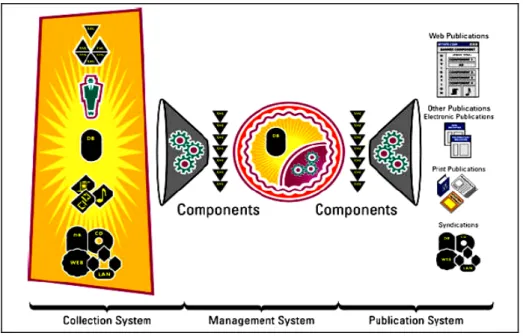
A CMS, as represented in figure 1, consists of three phases: information passes through the collection system, where it is transformed in content components, then through the management system, a kind of complex database where components are stored, and, lastly, through the publication system, where information is automatically transformed into publications (Boiko 2002:83). The three areas are often largely overlapped and work in strict relation with each other (Boiko 2002:81; McKeever 2003:686-687).
2.2.1 The collection system
The collection system consists of the instruments, the procedures and the human resources that have to obtain the content, which will be managed in a second time, and to elaborate the single parts, which constitute content before they are ready for publication. The processes involved are (Boiko 2002:83-84):
Authoring, to create content;
Acquisition, to acquire information;
Conversion, to filter the content, created or
acquired, from the superfluous layers of information and translate it into a specific mark-up language;
Aggregation, to separate content into
components to which is assigned a tag, so as to be able to insert that content in the chosen metadata system;
Collection services, programs and functions
Figure 1: Overview of a content management system (Boiko 2002:82)
2.2.2 The management system
The management system is responsible for content storage and for the instruments utilised to find and organise the same content and metadata collected in the first phase of the lifecycle. This system comprehends the repository, administration and workflow functions that allow one to know which content the enterprise owns and where it is. In practice the management system permits one to find the answer to any question about content, its collection, or the publications created from it.
2.2.3 The publishing system
The publishing system extracts content from the repository and automatically creates from it the final publications, not only designated for an external audience, but also and mostly for enterprise internal communications (Boiko 2002:104, 887).
The outputs are not only websites, but also any publication that could be electronic (CD-ROM, newsletter), or print (newspaper articles, leaflets,), or syndication (the payment distribution of content
on the internet).
“
A publication is information thatyou release that you’ve unified and that has the following characteristics: a purpose, publishers,
an audience, a set of messages, authorship,
content, structure, cycles” (Boiko 2002: 507-508). The heart of the publication system are templates (Boiko 2002a:104, 519-534, 889), i.e. programs
that substitute the manual work of adapting the neutral content of the repository to formats and structures typical of specific publications. In particular, a template is used for: linking CMS with the final release of a publication; handling at the same time both the static and the dynamic parts of a publication; automatically constructing publication pages; creating more publications from a single content; using logic to define how content needs to be treated; containing other templates.
3
Content management products
Our purpose is to trace the borderline between the products which actually are CMS by the definition given and the ones, which descend from CMS but present different characteristics. In fact, vendors often define CMS very different products, sometimes specialised in just one area, but that pretend to support the entire lifecycle. The different product called “content management systems” can be classified in four
macro-categories analysed below (Mescan 2004:54-55;
Robertson 2004; Robertson 2003).
3.1 Content management systems
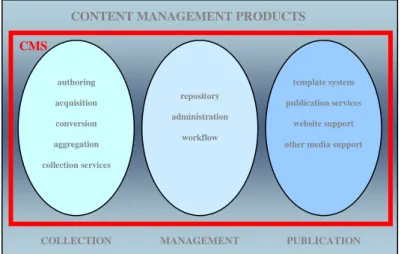
They are the systems presented in the previous paragraph and which we refer to as the “true” content management system. Figure 2 highlights the completeness of the functionalities offered by CMS
CMS authoring acquisition conversion aggregation collection services
CONTENT MANAGEMENT PRODUCTS
repository administration workflow template system publication services website support other media support
COLLECTION MANAGEMENT PUBLICATION
Figure 2: Areas of competence of CMS
3.2 Web content management (wcm) systems
WCM comes from enterprises’ need to organise and update the high volume of information published on their website. Implementing a WCM software allows for managing a great amount of content (from text to sound, from images to videos) using simple and flexible instruments. WCM are the systems more commonly (and wrongly) called CMS. The misunderstanding is because CMS result from the application of WCMS to all the company’s content (e.g.: management of all enterprise’s content and not only the information to be published on the web, multi-channel ready publications, etc.).
3.3 Document management (dm) and records management (rm) systems
Document management (DM) is one of the first disciplines born to manage high volumes of documents in their original format making easier
their collection and storage (Robertson 2003;
Amami and Beghini 2000:6-19). DM systems are the electronic correspondent of librarians. DM can be defined as a system able to help organisations
in managing document creation and storage by a
centralised repository and a workflow based on prefixed rules and metadata.
Records management (RM) systems are applications able to manage high volumes of documents both in paper and electronic format
through secure storage and access methods, cross databases and precise rules for document conservation (Robertson 2004). RM systems are the electronic correspondent of archivist. In general, neither DM systems neither RM ones own any content publication functionality (Sprehe 2004:54-62; Frost 2001:34-37; Medina and Fenner 2005:20-22).
3.4 Enterprise content management (ecm) systems
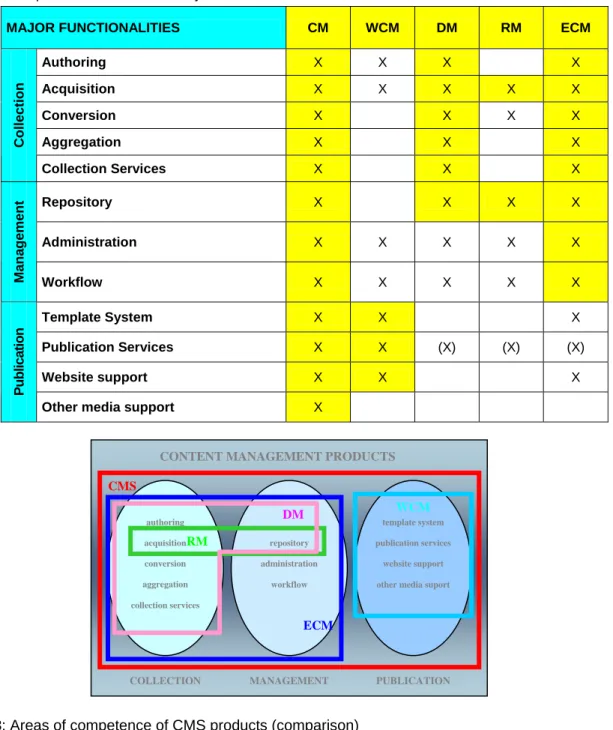
ECM represents an integrated approach to manage all enterprise information (paper documents, data, reports, websites and all the digital asset). An ECM comprehends strategies, instruments, processes and knowledge a company needs to manage its information asset, independently of their format (Smith and McKeen 2003:647-659). The functionalities that characterise ECM systems come from the fusion between document management, records management and web content management systems, focusing on information collection and management (Frost 2001:34-37). Table 1 and figure 3 compare the functionalities offered by the analysed systems. In particular, in table 1,
publication services of DM, RM andECMsystems
are marked with “(X)” because they are not core functionalities, not always offered by the vendors and, if existing, they are not well developed. It is clear that the only complete product is CMS.
Table 1: Comparison between the major functionalities of CMS
MAJOR FUNCTIONALITIES CM WCM DM RM ECM
Authoring X X X X Acquisition X X X X X Conversion X X X X Aggregation X X X Co llectio n Collection Services X X X Repository X X X X Administration X X X X X Ma na ge me nt Workflow X X X X X Template System X X X Publication Services X X (X) (X) (X) Website support X X X Publicatio n
Other media support X
CONTENT MANAGEMENT PRODUCTS
Figure 3: Areas of competence of CMS products (comparison)
4 The
survey
4.1 Survey purpose and object
The purpose of our survey (carried out in spring 2005) originates from the absolute absence of precise and generally recognised definitions to delimit the areas of competence of the different products offered in content management market. The consequence is that enterprises find it hard both to choose which system to adopt and to compare the products offered on the market. The survey’s objective is the set of products called ECM, offered by the world major players. We have verified the effective functionalities offered by these products trying to redefine them using the CM types analysed in the previous paragraph
(CMS, WCM, DM, RM). The selected products are offered by 22 international companies (vendors with revenues of $10 million or greater), which
offer ECM systems. These companies have been
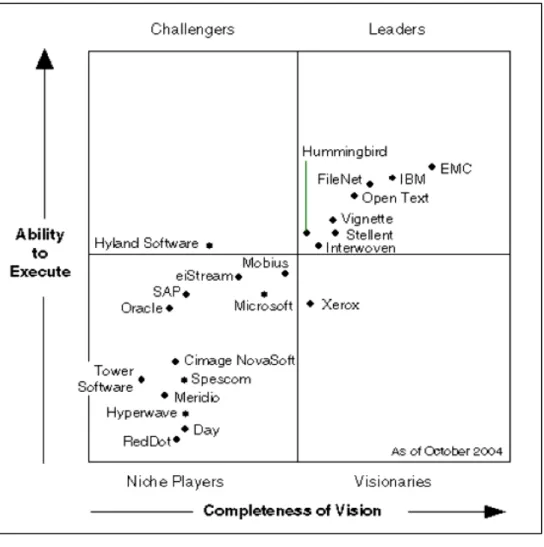
analysed by Gartner Inc., the world leader company in research and analysis in the IT sector. In its Magic Quadrant for Enterprise Content Management Gartner positioned the vendors by intersecting their ability to execute with their completeness of vision (Shegda et al 2004) (Figure 4). We have selected the products considering, for each company, only the one having the greater number of functionalities in terms of number of phases of information lifecycle involved. CMS authoring acquisition conversion aggregation collection services repository administration workflow template system publication services website support other media suport
COLLECTION MANAGEMENT PUBLICATION WCM RM
ECM DM
Figure 4: The gartner magic quadrant for enterprise content management
4.2 Evaluation table
To analyse, evaluate and compare the selected products we have realised a screening chart. This way we were able to verify if the functionalities of CM lifecycle were offered or not (the aspects considered were much more articulated than the one in figure 2). The functionalities taken into consideration are listed below.
Collection:
Support to authoring process
Support to acquisition process
Automatic format conversion
Support to aggregation process
Information reusability and consistent content
segmentation into metadata Management:
System security
Content storage in a neutral format
Automatic indexing
Simple and rapid research system
Utilisation of standard technologies and
languages
Simple content modifying
Document versioning
Content management through a single
interface
Management of all type of formats
Possibility of automatic updating
Possibility of automatic deletion
Compatibility with other applications
Content condivision with other applications
System scalability
Automatic workflow
System simple and flexible
Security of all content approval processes
Publication:
Template utilisation to create publications
Automatic content conversion
Support to simultaneous creation of more
publications
Advanced personalisation system
Support to multiple-language interface
We have, moreover, evaluated the specialisation level of the surveyed functionalities. At the end of the analysis of each area we assigned a grade of
completeness based on the number of functionalities surveyed (low, medium, high). Lastly, we have evaluated the level of personalisation offered by the single product, a very important aspect for this survey. This characteristic refers to the possibility for the enterprise-client to obtain a solution with just a few functionalities of a product or many of different products. This will mean being able to evaluate if a vendor offers content management products (as defined earlier in this paper), or products of different type.
5 Survey
results
The survey on the products offered by the Gartner’s Magic Quadrant vendors was able to highlight, given the definitions accepted in this paper, which kind of content management systems are offered on the market. In particular, we have compared both the definition given by Gartner for enterprise content management systems and the one given by vendors for their own products with the one adopted in the present work.
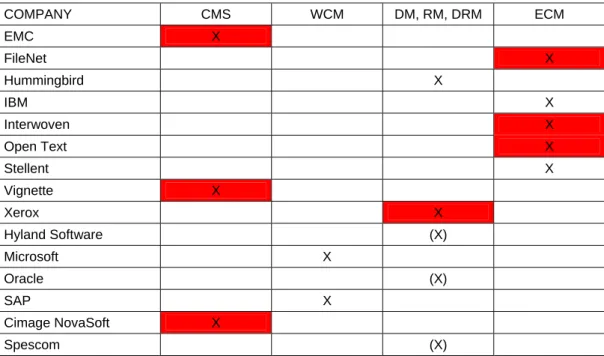
The results are synthesised in table 3. The main products offered are ECM systems, since between DM, RM and DRM (systems given by the sum of DM and RM functionalities) we have noticed four products of which the collected material was evaluated as incomplete
(represented as “(X)”). The boxes in red (dark) mean that there is correspondence between the definition given by the vendor and ours. The whole product analysis has been articulated in three parts, to highlight the type of product offered by each vendor, the specialisation in the different
areas of information lifecycle for eachtype, and
the personalisation and flexibility level offered in a comparison of all products selected.
5.1 The products offered
In the first part of the survey, we have evaluated if the definition of the selected products given by Gartner (ECM systems) and the vendors (different systems depending on the specific case) corresponds to the definitions accepted in this work. To understand the kind of system offered,
we have considered, for each product selected,
the number of functionalities of the information lifecycle and their specialisation in order to highlight the core areas of the different CM solutions.
The results are the following:
CMS – The products evaluated as CMS are
those offered by EMC (Documentum), Vignette (V7) and Cimage NovaSoft (e3). Cimage NovaSoft product, e3, is not completely finalised, since, in the publication area, the multi-channel support is not well developed (mainly marketing communications are addressed). By its very nature a CMS product needs to offer a number of functionalities from “medium high” to “high” in all phases of information lifecycle. EMC and Vignette products can be classified with sufficient confidence as CMS, since they offer a profound specialisation in the functionalities offered, and on their websites numerous technical information is available to guarantee a completeness of vision.
Table 3: Synthesis of the results obtained
COMPANY CMS WCM DM, RM, DRM ECM EMC X FileNet X Hummingbird X IBM X Interwoven X Open Text X Stellent X Vignette X Xerox X Hyland Software (X) Microsoft X Oracle (X) SAP X Cimage NovaSoft X Spescom (X)
COMPANY CMS WCM DM, RM, DRM ECM Mobius X eiStream (X) Meridio X Tower Software X Hyperwave X Day X RedDot X TOTAL 22 3 3 9 7
WCM – None of the products judged by us as
WCM are defined the same way by the respective vendor. In particular, Microsoft (Content Management Server 2002) and RedDot (XCMS) name their products CMS, while SAP (NetWeaver) call it an ECM. In the first case the absence of correspondence between the definitions can be easily explained with the original erroneous consideration of WCM as content management systems par excellence. In the second one it is harder to understand the different evaluation of SAP product. We propose two hypothetical explanations: it is possible that some characteristics were not considered during the analysis (maybe because just mentioned in the brochures), or it is possible that SAP has a different way to consider the specialisation of some functionalities that has brought us to consider WCM core characteristics, and not of a ECM. Anyway, even in case of a misunderstanding, the SAP product would not be considered an ECM but a CMS, given its capability of supporting more publications.
DM, RM – The products offered by Hyland
(Onbase) and Hyperwave (IS/6) result as DM systems, both defined by the vendors ECM solutions. The Hyperwave product can be effectively considered a DM system and not an ECM because the vendor itself declares that does not offer solutions to cover all information lifecycle, but just the functionalities in which it excels, that are the ones offered by document management systems.
RM systems are offered by Hummingbird
(Hummingbird Enterprise), Oracle (Enterprise Manager 10g), Spescom (eB), eiStream (G360 BPM Suite). Hummingbird product is defined as a CMS, but it owns very limited functionalities in the collection and publication systems (it supports only web publication), while the management system is very well developed (great number and well specialised functionalities for storage and retrieval). For
these reasons we consider our evaluation of the solution as an RM system to be correct. DRM products are offered by Xerox (Knowledge Sharing products, the equivalent of DRM systems), Meridio (Meridio 4.3) and Tower (TRIM Context), all defined as DRM by the vendors too. They cannot be considered only document management systems because they have very specialised storage functionalities, often referred to specific and strict rules related to the storage of enterprise documentation. At the same time they cannot be considered records management systems because they have specific collection capabilities, absent in this kind of system (e.g. support to the authoring process).
• ECM – Lastly we have classified as ECM the
product offered by FileNet (FileNet P8), IBM (Content Management), Interwoven (Enterprise Content Management), Open Text (Livelink), Stellent (Universal Content Manager), Mobius (ViewDirect TCM) and Day (Communiqué). FileNet, Interwoven and Open Text define their solutions as ECM systems, our same evaluation. On the contrary, IBM, Stellent, Mobius and Day name their products CMS: it is not correct to consider the Mobius product as a CMS because it does not offer sufficient specialisation in the different areas of the lifecycle (publication in particular, since, even if it supports more media, it is specialised in web publication). Instead, in the other cases, the definition of CMS is incorrect because those solutions support only web publications. The final result is that ten of the twenty-two Magic Quadrant companies have defined their products coherently with the definitions accepted in this work for the different types of content management systems. The twelve companies left claim to offer complete CMS (six) or ECM systems (six). Nevertheless, please note that four products which claim to offer ECM solutions do not have a complete evaluation because of the poor information available.
5.2 Specialisation in the different areas of information lifecycle
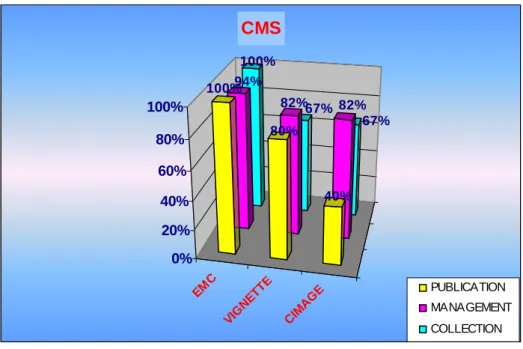
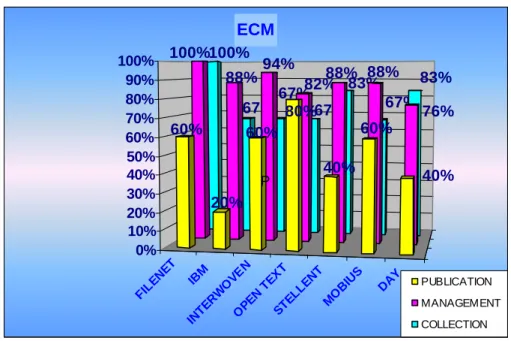
In the second part of the survey we have evaluated, for each type of content management system, company strategies in terms of more specialisation in just one area of the information lifecycle, or in terms of less specialisation but covering all areas. To do this we have compared the percentage of functionalities in the three areas of the lifecycle (e.g. 100% in collection if the product has all functionalities of the collection system) through a three-dimensional histogram which permits the three values of each product to be compared at the same time.
These graphs show company specialisation strategies for collection, management and publication, and, in particular, if they tend to offer more complex solutions in terms of number of functionalities, or products ad hoc with fewer functionalities but very specialised in one area.
Figure 5 shows CMS products. We notice that EMC offers a complete and very specialised product, Vignette offers a product with many functionalities in all lifecycle phases, Cimage NovaSoft has a product with a good number of functionalities in collection and management but a scarce publication area. The result is that the first company has chosen to be specialised in all lifecycle areas, indifferently; the second one is specialised in the entire cycle, but focusing on just some functionalities; the third has preferred to concentrate its offer on fewer functionalities in the three areas of the lifecycle. Notice that a product, to be defined as CMS, does not need to possess all the functionalities of the information lifecycle, but just some specific ones which distinguish it from the other typologies.
EM C VIG NET TE CIM AG E
CMS
100% 94% 100% 67% 67% 82% 82% 0% 20% 40% 60% 80% 100% 80% 40% PUBLICATION MANAGEMENT COLLECTION Figure 5: CM productsMIC RO SO FT SA P RE D DO T 40% 40% 20% 76% 65% 71% 50% 33% 33% 0% 20% 40% 60% 80% 100%
WCM
PUBLICATION MANAGEMENT COLLECTION Figure 6: WCM productsFigure 6 shows WCM products. Microsoft, SAP and RedDot products seem to have the same level of specialisation and number of characteristics (low in collection, medium-high in management and medium-low in publication). This means that WCM systems offered on the market are very similar, partly because the “critic” functionalities are fewer than CMS ones, partly because it is quite an old market niche, out of which grew the possibility of expanding the
technology for managing all enterprise data, and not just the ones dedicated to the web.
Figure 7 shows DM, RM and DRM products. Only three products possess functionalities in the publication system (the ones offered by Hummingbird, Xerox and Hyland). Collection and management phases are in the same proportion. The result was predictable, since document and records management systems are specialised in the mentioned areas.
HU MM ING BIR D XE RO X HYL AN D OR AC LE SP ESC OM eiS TRE AM ME RID IO TO WER HY PER WA VE 50% 83% 67% 50% 50% 17% 67% 50% 50% 76% 88% 71% 65%71%65% 82% 65% 59% 20% 60% 60% 0% 0% 0% 0% 0% 0% 0% 10% 20% 30% 40% 50% 60% 70% 80% 90% 100%
DM, RM, DRM
PUBLICATION MANAGEMENT COLLECTIONFILE NET IBM INTE RW OVE N OPEN TE XT STELLE NT MO BIU S DA Y 100% 67%67%67% 83% 67% 83% 100% 88%94% 82%88% 88% 76% 60% 20% 60% 80% 40% 60% 40% 0% 10% 20% 30% 40% 50% 60% 70% 80% 90% 100% ECM PUBLICATION MANAGEMENT COLLECTION P
Figure 8: ECM products
Figure 8, lastly, shows ECM products. There are three types of products: FileNet, Interwoven and Mobius ones present a medium-high specialisation level in the different areas (a very well developed management system, a collection system with a pretty high number of functionalities and a relevant presence even in the publication); IBM, Stellent and Day products have a very well developed management system, a medium developed collection and a poorly represented publication system; Open Text product presents high level of specialisation in management and publication and a medium level in collection. Anyway, to have an ECM system a product must be medium-high specialised in collection and management, while its presence in publication is less important, as it is limited to a support of web publications (internet, intranet o extranet).
5.3 Evaluation of personalisation – flexibility
Lastly, we verified the existence of a correlation between the number of solutions offered per
product (modules which compose the product)
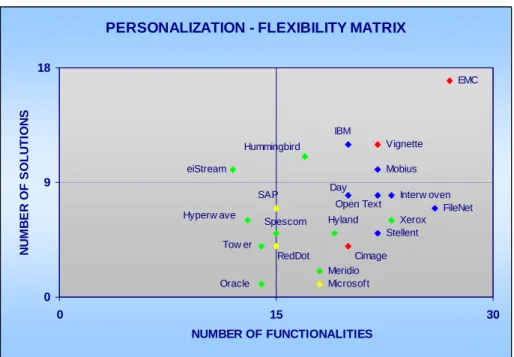
and the level of completeness of information lifecycle (number of functionalities of the whole lifecycle offered by the product), to explain the actual market trend. The two variables proposed are intersected in the matrix in figure 9. Solutions refer to the number of functionalities, considering the entire information lifecycle, that a product owns, to measure the personalisation capabilities. Completeness refers to the number of modules that compose the product and it is utilised as a measure of the product flexibility, which means its capability of easy and rapid adaptation to the client’s needs.
PERSONALIZATION - FLEXIBILITY MATRIX EMC FileNet Hummingbird IBM Interw oven Open Text Stellent Vignette Xerox Hyland Microsof t Oracle SAP Cimage Spescom Mobius eiStream Meridio Tow er Hyperw ave Day RedDot 0 9 18 0 15 NUMBER OF FUNCTIONALITIES N U M B ER O F SO L U T IO N S 30
Figure 9: Personalisation – flexibility Matrix
The products which offer the highest grade of flexibility and personalisation are the ones in the upper right quadrant, where the number of solutions and functionalities is greater. In that quadrant figure EMC, Vignette, IBM, Mobius and Hummingbird products. This means that here we find CM and ECM systems and (just one) DRM. In the bottom right quadrant figure products which offer a high number of functionalities but a limited number of solutions (Interwoven, Open Text, Day, FileNet, Xerox, Stellent, Hyland, Cimage NovaSoft, Meridio and Microsoft products, in practice any type of CM system). In the upper left quadrant are located products with a limited number of functionalities but with a high number of solutions (only eiStream product). Lastly, in the bottom left quadrant appear products with both few functionalities and few solutions (SAP, Spescom, RedDot, Hyperwave, Tower and Oracle products, which are DRM and WCM systems). The first observation is that a great number of the selected products are located in the two quadrants with a medium-high number of functionalities. This means that the companies are moving towards omni comprehensive solutions. Secondly, looking at the entire matrix we notice another characteristic: going from the upper right corner along the diagonal which connects that point with the origin of the axes, we notice that CMS are in the upper right end, going down we find the ECM systems and at the bottom left end there are WCM, DM, RM and DRM systems. This consideration confirms that vendors tend to move their offer from specific products to solutions with an ever-growing number of functionalities, so as to be able to better respond to the clients’ need of
personalisation without making great changes to the original product. Personalisation is becoming
the synonym of many integrated modules (or
solutions) which can be combined in order to respond to clients’ needs.
6 Conclusions
The great success of CM products, as our analysis shows, is in contrast with the market characteristics. The most evolved CMS offer opportunities regarding the three specific areas (collection, management and publication) but, generally, the system is effectively specialised in one area only. This is because the enormous market potentiality and the weak entrance barriers, in terms of starting costs, have attracted many companies which offer very simplex and low competitive systems. An organisation should carefully evaluate the different products on the market, trying to select the one which best responds to its specific needs and agree with the vendor on a personalised solution (Robertson 2004) but few client-enterprises understand that a
content management solution is much more than
a software (The Gilbane Report 2003:3).
Nowadays, much of the interest in developing CMS is referred to the possibility of creating easily manageable websites of great dimensions. Actually the potentiality of content management systems are greater, mainly in terms of company support in managing all the phases from content creation to its storage and publication in many formats. A content management system answers to the need of integrating information with knowledge, as to reach a better decision process. At the same time, a CMS permits creation costs of
information and knowledge to be minimised, maximising their value. The need to adopt a CMS is, firstly, to find an answer to the challenge of managing, modifying and updating a big volume of information. The need to use the same content on different media with different characteristics requires suitable systems of collection and management. Lastly, CMS make personalisation
very easy to reach, with the advantage of
communicating in different ways, depending on the target. Moreover, there is no standard and
commonly accepted definition for Content Management. The trouble is that, not only do vendors of so-called CMS actually offer very
different systems, but even enterprises interested
in content management systems do not call them correctly, without a precise idea of the functionalities to request. Until companies are able to clearly define the product they offer/are looking for, in talking about content management, finding the most appropriate solution will be very hard work.
References
Amami, M., and Beghini, G. (2000), “Project Management and Communication of Product Development Through Electronic Document Management”, Project Management Journal, June, pp6-19.
Boiko, B. (2002), Content Management Bible, Hungry Minds, New York, pp5-7,9,65,81-84,104,507-508,887. Capaldo, G., Esposito, G., Passiante, G. and Raffa, L. (2004), “Tecnologie ICT ed imprese Knowledge-Based”,
SviluppoandOrganiszazione, no. 203, pp80-90.
Di Bernardo, B. and Rullani, E. (1990), Il management e le macchine, Il Mulino, Bologna
Frost, J. P. (2001), “Web Technologies for Information Management”, The Information Management Journal, October, pp132-133.
McKeever, S. (2003), “Understanding Web content management systems: evolution, lifecycle and market”, Industrial Management and Data Systems, no. 103/9, pp686-688.
Medina R. and Fenner, J. (2005), “Controlling Your Documents”, The Information Management Journal, January/February, pp20-22.
Mescan, S. (2004), “Why Content Management Should Be Part of Every Organisation’s Global Strategy”, The Information Management Journal, July/August, pp54-55.
Nonaka, I. and Takeuchi, H. (1995), The Knowledge Creating Company, Oxford University Press, New York, pp97-114. Pasin, M. (2004), Teoria della conoscenza nella società Post-Fordista, IT Consult, [online], avalaible:
http://www.itconsult.it.
Quagli, A. (2001), Knowledge Management: la gestione della conoscenza aziendale, il caso Cap Gemini ErnstandYoung, EGEA, Milano, pp63-64,94,99-100,106-112.
Robertson, J. (2003), “Is it document management or content management?”, Step Two Design, CM Briefing 2003-04, Published on 14 February 2003, [online], avalaible: http://www.steptwo.com.au/papers/cmb_dmorcm/index.html. Robertson, J. (2004), “Definition of information management terms”, Step Two Design, CM Briefing 2004-04, Published on 5 February 2004, [online], avalaible: http://www.steptwo.c.om.au/papers/cmb_definition/index.html.
Shegda, K. M., Chin, K., Lundy, J., Bell, T., Logan, D. and Eid, T. (2004), Magic Quadrant for Enterprise Content Management, 2004, Gartner, 19 October, [online], avalaible:
www.mediaproducts.gartner.com/reprints/vignette/123392.html.
Smith, H. A. and McKeen, J. D. (2003), “Developments in Practise VIII: Enterprise Content Management”,
Communications of the Association for Information Systems, vol. 11, pp647-659.
Sprehe, J. T. (2004), “A Framework for EDMS/ERMS Integration”, The Information Management Journal, Novembre/December, pp54-62.
The Gilbane Report (2003), The Classification and Evaluation of Content Management Systems, vol. 11, no. 2, March, p3.
Von Krogh, G., Nonaka, I. and Nishiguchi, T. (2000), Knowledge Creation, Macmillan Press Ltd., London, pp97-98,89-109.