10.1177/1534484305280866 ARTICLE Human Resource Development Review / December 2005
Joo / EXECUTIVE COACHING
Executive Coaching:
A Conceptual Framework From
an Integrative Review of Practice and
Research
BAEK-KYOO (BRIAN) JOO
University of Minnesota
Executive coaching has become increasingly popular despite limited em-pirical evidence about its impact and wide disagreement about necessary or desired professional qualifications. This article examines the practice of executive coaching, investigating the useful underlying theories by reviewing previous research. It also provides a conceptual framework of executive coaching, integrating the literature on executive coaching and related areas such as mentoring, career success, 360-degree feedback, and training and development. The significance of this article lies in its inte-gration of the extant literature on executive coaching and the development of a conceptual framework of executive coaching and related propositions derived from the literature. The article discusses the implications for future research and for human resource development.
Keywords: executive coaching; management development; leadership
development
In their recent article in Harvard Business Review, Sherman and Freas (2004) stated that executive coaching is “Like the Wild West of yesteryear, the frontier [executive coaching] is chaotic, largely unexplored, and fraught with risk, yet immensely promising” (pp. 82-83). During the past decade, consultation focused on managers and senior leaders in organizations has increasingly been referred to asexecutive coaching(Kilburg, 1996). The fact that executive coaching is growing at a rapid pace has been well docu-mented in recent years (Bacon & Spear, 2003; Diedrich, 2001; Kampa-Kokesch & Anderson, 2001; Kilburg, 1996).
Integrative Literature Review
I thank Dr. Connie Wanberg of the Carlson School of Management for her ideas early in this study and Dr. Richard Swanson and my colleague Russ Korte at the University of Minnesota for their criti-cal reviews and detailed suggestions, which I have incorporated in this article. I extend my gratitude for guidance provided by the editors and anonymous reviewers.
Human Resource Development Review Vol. 4, No. 4 December 2005 462-488 DOI: 10.1177/1534484305280866
Joo / EXECUTIVE COACHING 463
Berglas (2002) stated that there were more than 10,000 professional coaches in the United States, and this figure was expected to exceed 50,000 by 2007. The growth in executive coaching is not just a United States but a global phenomenon. The Chartered Institute of Personnel and Development (CIPD), the largest professional body in the management and development of people in the United Kingdom, expected a similar picture to emerge over the next 5 years in the United Kingdom (Jarvis, 2004). According to the International Coach Federation (ICF), its membership has soared from about 1,500 in 1999 to more than 8,200 members as of the end of February 2005. Members have vastly different profiles: psychotherapists, former executives, athletes, lawyers, business academics, and management consul-tants. Most of them work either freelance or for boutique consultancies, off-shoots of larger consultancies, and training organizations. The coaching market is worth around $1 billion worldwide, a number that Harvard Busi-ness School expects will double in the next 2 years (“Corporate Therapy,” 2003).
The growing popularity of executive coaching is a response to workplace demands. Today, executives may expect emotional intelligence and soft skills from managers and colleagues. According to Sherman and Freas (2004), executives of flatter, leaner, faster-moving organizations are recog-nizing a subtler set of competencies: the communication and interpersonal skills necessary for influencing employees, adaptability to rapid change, and respect for people of diverse backgrounds.
Problem Statement
Executive coaching is one of the areas that the practice is way ahead of theory. While executive coaching has become an established practice, how-ever, it still is ill-defined (Kampa-Kokesch & Anderson, 2001; Kilburg, 1996; Orenstein, 2002; Sherman & Freas, 2004). Although executive coach-ing has been proposed as an intervention to help executives improve their performance and ultimately the performance of the overall organization, whether or not it does what it proposes remains unknown due to the lack of empirical evidence for what happens, why it happens, and what makes it effective or ineffective (Bacon & Spear, 2003; Kilburg, 1996).
In terms of HRD, coaching has rapidly become a significant part of many organizations’ learning and development strategy. Lack of transfer in learn-ing and lack of sustained behavioral change pointed toward the need for more individualized, more engaged, more context-specific learning (Bacon & Spear, 2003). Learning, development, behavioral change, performance, leadership, career success, and organizational commitment are the issues related with executive coaching. These are all in the domain of HRD. How-ever, not a single article about executive coaching has been found in the HRD journals yet; although there are some articles about themanager as a
464 Human Resource Development Review / December 2005
coach. Thus, little attention has been paid to the emerging practice of
execu-tive coaching by HRD scholars and no efforts for theory building to guide future research have been made yet.
The purpose of this article is to examine the practice of executive coach-ing, investigating the useful underlying theories by reviewing previous research. It also aims to provide a conceptual framework of executive coach-ing, integrating the extant literature on executive coaching and related areas such as mentoring, career success, 360-degree feedback, and training and development. This article is divided into five parts. The first part provides research method and a brief summary of the literature on executive coach-ing. The second part summarizes the definitions, objectives, and approaches to executive coaching. The third part investigates the existing research, including qualitative and quantitative research. The fourth part provides a conceptual framework of executive coaching. The final part discusses future research areas of executive coaching, implications of HRD, and con-clusions. In short, the first half is a literature review, and the second half offers a conceptual framework.
Method
This article focuses on published research on executive coaching in the workplace. Articles for this review were identified through searches of
Business Source Premier,PsychArticles,Interscience, andScience Direct
databases (through June 2005), using the key wordsexecutive coachingand
coaching. The researcher reviewed the reference list of each article to
iden-tify additional citations that were not revealed by other search means. The majority of the research on executive coaching in the workplace has been published within the past 10 years. However, it should be noted that most articles are from practice journals such as Harvard Business Reviewand
Consulting Psychology Journal: Practice & Research. A special issue of
Consulting Psychology Journal was dedicated to executive coaching in
1996. Book chapters on executive coaching also have been published, and discussions of the topic have been included in recent chapters on behavior change, leadership development, and developmental relationships. Books on the general topic of coaching in the workplace and on executive coaching have recently appeared (Bacon & Spear, 2003; Fitzgerald & Berger, 2002; Kilburg, 2000).
Coaching has traditionally been viewed as a way to correct poor perfor-mance and to link individual effectiveness with organizational perforperfor-mance (Ellinger, Ellinger, & Keller, 2003). There should be a distinction between
themanager as a coachand executive coaching. In manager as a coach, the
manager plays a role as a coach, whereas the executive is being coached by professional (mostly external) coach, in executive coaching. Whereas the literature about manager as a coach has been identified as a way of
motivat-Joo / EXECUTIVE COACHING 465
ing, developing, and retaining employees in organizations (Evered & Selman, 1989; Orth, Wilkinson, & Benfari, 1987), executive coaching, a relatively new practice in coaching fields, emphasizes self-awareness and learning by the one-on-one relationship between the coach and the executive. Thus, even if there is increasing number of articles aboutmanager as a coachor managerial and/or supervisory coaching that focuses on the added role of managers, they are not included in this review, due to the difference of the focus.
A total of 78 articles from academic and practice journals and magazines were searched and read completely in reviewing the executive coaching lit-erature. As a result, the researcher could categorize the literature by the type of journal (practice versus academic), research methodology (qualitative versus quantitative), definition and purpose, and focus of coaching (coach-ing versus counsel(coach-ing). It is noted that the categorization was based solely on the researcher’s judgment. To categorize the literature that was con-ducted for this study, 71% were found in practice journals, whereas 15% in academic journals, and 14% in magazines. Regarding the contents of the articles, about 40% of articles were written on the basis of therapy or clinical psychology, whereas the rest were from management and HRD perspec-tives. In general, what does exist falls into three categories: (a) definition and designation of the practice, (b) description of specific executive coach-ing methodologies by practitioners in the field, and (c) case studies of exec-utive coaching. Out of 78 articles on execexec-utive coaching, only 11 were research articles, including 6 quantitative studies and 5 qualitative studies. Among 6 quantitative studies, only 1 study was based on correlational study using inferential statistics. This shows that little empirical research has been conducted on this practice (Kampa-Kokesch & Anderson, 2001; Kilburg, 1996, 1997, 2001; Orenstein, 2002; Sherman & Freas, 2004), even if there are a number of case studies portraying successful instances of executive coaching (e.g., Diedrich, 1996; Kiel, Rimmer, Williams, & Doyle, 1996; Peterson, 1996; Tobias, 1996).
The Practice of Executive Coaching
As Kets de Vries (2005) stated, “It isn’t always clear whether the client is the person being coached or someone else in the organization—perhaps someone higher up the management ladder or someone in the human resources department” (p. 74). Before going into detail, therefore, it is helpful to define basic terms: coach, coachee, and client.Coachrefers to the one who provides one-on-one coaching.Coacheerefers to the one who gets the pro-fessional service; namely, it is the executive. Finally, in this article,client
refers to the stakeholders, including more senior executives and/or HR rep-resentatives. The following includes a brief history of executive coaching, along with definitions and purposes, and approaches of executive coaching.
466 Human Resource Development Review / December 2005
History of Executive Coaching
It is not clear when exactly executive coaching first began (Kampa-Kokesch & Anderson, 2001). According to Witherspoon and White (1996), the word
coachwas first used in English in the 1500s.
(Coach) refers to a particular kind of carriage. Hence, the root meaning of the verb
to coachis to convey a valued person from where one was to where one wants to be—a solid meaning for coaching executives today! (Witherspoon & White, 1996, p. 124)
Harris (1999) maintained that a few professionals used a blend of organiza-tion development (OD) and psychological techniques in working with execu-tives, even before the term was coined. According to Tobias (1996), the term,
executive coaching, came into the business world in the late 1980s. He also
argued that coaching is “simply a repackaging of certain practices that were once subsumed under the more general terms consulting or counseling” (p. 87). Sherman and Freas (2004) stated “Most executive coaching is intellectually indebted to a small number of disciplines, including consulting, management, organization development, and psychology” (p. 85).
McCauley and Hezlett (2001) argued that executive coaching was ini-tially developed to rescue talented individuals who are in danger of stalling their careers or losing their jobs because of a particular defect in their per-formance. It would “encompass the diamond in the rough who needs to soften the rough edges” (Tobias, 1996, p. 87). The other group of individu-als who may participate in coaching are high potential executives and man-agers who need additional development for advancing up the corporate lad-der (McCauley & Hezlett, 2001). Recently, some organizations began to provide executive coaching as an executive perquisite.
Definitions and Purposes of Executive Coaching
Table 1 presents various definitions of executive coaching based on dif-ferent perspectives. Executive coaching involves practical, goal-focused forms of one-on-one learning and behavioral change (Hall, Otazo, & Hollenbech, 1999; Peterson, 1996). Definitions in Table 1 range from cific to comprehensive. For instance, some defined executive coaching spe-cifically limiting it to individual level (Peterson, 1996; Kampa-Kokesch & Anderson, 2001; McCauley & Hezlett, 2001; Orenstein, 2003); others pre-ferred a broader definition, extending it to the organizational level (Bacon & Spear, 2003; Hall et al., 1999; ICF, 2003; Kilburg, 1996).
Although most definitions state that executive coaching is based on a one-on-one relationship, Kets de Vries (2005) stressed the coaching in groups as the preferred tool for behavior change. He argued that coaching in
467 TA B L E 1 :
Definitions and Purposes of Ex
ecutiv
e Coaching
Author(s)
Year
Def
inition and Purpose
Peters on 1996 C o aching is the p ro cess o f e quipping people w ith th e tools, knowledg e, and opportunities the y need to de v elop themselv es and b ecome more ef fecti v e (p. 78). Kampa-K o k esch and A nders on 2001 C o aching is a for m o f a sy st ematic feedbac k inter vention aimed at enhancing pr ofessional skills, interpersonal aw ar enes s, and pers onal ef fectivenes s . Orens tein 2002 Ex ecuti v e coaching is referred to as a “ one-on-one inter vention w ith a senior m ana g e r for the pur pos e o f impr o v ing o r e nhancing m ana g e ment skills ” (p. 356). McC aule y and H ezlett 2001 Ex ecuti v e coaching in v olv es a ser ies o f one-on-one inter a ctions between a m anager or ex ecuti v e and an exter-nal coach in order to further the p ro fes si onal de velopment o f the mana g e r (p. 321). B acon and Spear 2003 C o aching in b us ines s conte x ts can generally be def ined as an informed d ialogue whos e purpos e is the facilita-tion o f n ew skills, possibilities, and insights in the inter e st of individual le arning and or ganizational advancement (p. xvi). Hall, Otazo, and Hollenbeck 1999 C o aching is m eant to b e a p ra ctical, goal-focus ed for m of pers onal, one-on-one lear ning for b usy ex ecuti v es and m ay be used to impr o v e p erformance o r executive b ehavior , enhancing a career or pre v ent d erailment, and w ork through or g anizational issues or change initiati v es (p. 40). Kilb ur g 1996 Ex ecuti v e coaching is a helping relations hip formed b etween a client who h as managerial authority and responsibility in an or g anization and a consultant wh o u ses a wide v ariety o f b eha v ioral techniques and methods to as si st the c lient to ac hie v e a mutually identif ied set of goals , to impr o v e h is or her p ro fes si onal per for mance and pers onal sa tis faction , and cons equently to impr o v e the ef fectivenes s o f the client’ s or gani -zation within a formally def ined coaching agreement (p. 142). International C oaching Federation (ICF) 2003 Profes si onal coaching is an ongoing pr ofes si onal re lations hip that help s p eople p roduce extr aor dinar y res ults in their lives , c ar eers , b u si nes se s, or or ganiz a tions . T hrough the p roces s o f coaching, clients d eepen their learning, impro v e their p erformance, and enhance their quality of life.
468 Human Resource Development Review / December 2005
a group setting has “the highest payoff: high-performance organizations; results-oriented and accountable people; boundaryless organizations; and true knowledge management” (p. 75).
According to Sherman and Freas (2004), the purpose of executive coach-ing is to producelearning,behavioral change, andgrowthin the coachee for the economic benefit of the client that employs the coachee. Although there is a slight difference, the common purpose of executive coaching could be reduced to behavioral change, self-awareness, learning, and ultimately career success and organizational performance.
Reviewing all the definitions of previous literature, in this article, execu-tive coaching is defined as a process of a one-on-one relationship between a professional coach and an executive (coachee) for the purpose of enhancing coachee’s behavioral change through self-awareness and learning, and thus ultimately for the success of individual and organization. This definition will be the basis of the conceptual framework that will be presented later.
Coaching Approach: Counseling Versus Consulting
It seems that counseling and consulting occupy opposite ends of a continuum of coaching approach. Some (Hart, Blattner, & Leipsic, 2000; Hodgetts, 2002; Kets de Vries, 2005) divided the coaching approach into
two:therapyandcoaching; others (Bacon & Spear, 2003) preferred the term,
thecoach as a directorand thecoach as a psych-therapist. Thus, although
there are slight differences in nuance, in most articles, the termstherapy,
counseling, and remedial are used interchangeably, whereas the words
coaching,consulting, anddevelopmental have the same connotations. In
this article, however, the termscounselingandconsultingwill be used. Counseling approach and consulting approach share certain feat-ures. Both aim at behavioral change, both help individuals enhance self-awareness and learning, and both are conducted by professionals who establish strong alliances of trust with their clients (Hodgetts, 2002). Yet, in certain important and essential ways, counseling approach and consult-ing approach are different and should not be confused (Hodgetts, 2002). Hart et al. (2000) compared and contrasted consulting with counseling through the review of the thoughts and concerns expressed by 30 profes-sionals who practice consulting (coaching), counseling (therapy), or both. Major distinctions between the two are described in Table 2.
According to Bacon and Spear (2003), the most rigorous forms of psy-chological therapy arepsychiatric treatmentandpsychoanalysis, followed
by psychological counseling. Highly trained, licensed professionals can
perform those practices. Berglas (2002), who is an executive coach with a background in psychology, argued that “in an alarming number of situa-tions, executive coaches who lack rigorous psychological training do more harm than good. . . . When an executive’s problems stem from undetected or
ignored psychological difficulties, coaching can actually make a bad situa-tion worse” (p. 87). Arnaud (2003) also spoke ofpsychoanalyticcoaching, inspired by psychoanalysis. Although Kilburg’s (2000) definition seems to be one of the most comprehensive ones, his background is therapeutic and clinical experience, emphasizing hispsychodynamictheory. Kilburg (1997) contended that executive coaching deals with issues of character and of unconscious psychological conflict in individuals and in the groups and organizations that they affect, striving for improved self-awareness of the coachee as the goal. Thus, those who believe in this approach tend to have backgrounds in clinical or counseling psychology.
On the contrary, Goldsmith, whose approach to coaching is pragmatic and antipsychological, argued that coaches are supposed to care about exec-utives’ future behaviors rather than their past, their feelings, and/or their inner psyches (Bacon & Spear, 2003). Sherman and Freas (2004) also warned that there are many self-styled executive coaches who know little about business and/or coaching. Executive coaching provides executives with the opportunity to develop their leadership skills along with interper-sonal skills, and become more skillful in leading teams of people through organizational upheaval and business transformation (Niemes, 2002). Many of those supporting this approach have backgrounds in management, HR management and/or development, or industrial and/or organizational psy-chology. The methodology of consulting approach consists of defining competencies, identifying the style and social motives of the individual,
Joo / EXECUTIVE COACHING 469
TABLE 2: Comparison of Counseling Approach and Consulting Approach
Counseling (Therapy) Approach Consulting (Coaching) Approach
Primary purpose Remedial Developmental
Helping those who are Increasing capacity and damaged or in crisis reaching goals Self-awareness through Result oriented, action
self-reflection and wellness based, and outwardly defined
Background Clinical and/or counseling Management, I/O psychology, psychology human resource development
Focus onpast Focus onpresentand Knowledge about pathology future
is important in order to Having business savvy is recognize danger signal. important.
Relationship Traditionalexpert-client Flexible and collaborative and activities Less defined, wandering More structured and task
process of uncovering focused, involving and discovery concrete action plans Listening is important. Listening is not enough.
and providing ongoing feedback and coaching for individual performance (Diedrich, 1996; Orenstein, 2002).
In summary, this controversial debate between counseling and consult-ing is likely to continue for a while. As Wasylyshin (2003) stated, however, talented executive coaches need to be grounded in both business and psy-chology. Regarding business, psychologists who have no experience in business roles must accumulate their business knowledge over time and through the experiences in different companies and industries, and by im-mersing themselves in the business literature, as well as pertinent training experiences. With regard to psychology, there are certain general psycho-logical skills essential for effective coaches, including interpersonal effec-tiveness, listening, empathy for widely differing groups, patience, adaptability, analytical problem solving, creativity, and humor (Wasylyshin, 2003).
Research on Executive Coaching
Findings of Research on Executive Coaching
As mentioned earlier, much of the research on executive coaching are case studies based on interviews and observation in coach’s perspective. There are only a handful of empirical studies that were written by practitio-ners rather than researchers. With regard to quantitative studies, among six studies, only one was based on correlational study using inferential statis-tics. The rest of them were analyzed using descriptive statistics for only one party, either coachees or coaches. Table 3 summarizes the research litera-ture reviewed in this article.
Some of the research reviewed here is flawed as a result of limited infor-mation regarding their methodologies and samples that in turn limits the applicability and generalizability of the studies. It should be noted that none of them were based on the dyadic analysis that would produce higher quality findings about the coach-coachee dyad relationship. In short, except for Smither, London, Flautt, Vargas, and Kucine’s (2003) study, most of them have potential limitations in research quality, due to small sample sizes and weak statistical methods employed. These studies will be reexamined in the conceptual framework.
Review of Related Literature
Because the research on executive coaching is in its infancy, the literature from related areas such as mentoring, career success, 360-degree feedback, and training and development had to be reviewed. Among others, mentoring is the closest area with coaching. Thus, the literature review about mentor-ing will be summarized and the comparison between mentormentor-ing and
471 TA B L E 3 : Summar y of Resear ch Literatur e on Ex ecutiv e Coaching Author(s) Methodolo gy Major Findings
Coach and/or coachee
Judge and Co
well
Quantitati
v
e-Coaches come from a wide range of educational backgrounds,
characteristics (1997) descripti v e with under
graduate degrees ranging from drama to psychology
.
(60 coaches)
Roughly 90% had a master’
s de
gree, 45% doctoral de
grees,
80% were male, and the a
v
erage w
ork e
xperience w
as 24 years.
The majority used 360-degree assessments by intervie
w-ing people close to the e
x
ecuti
v
es. The most common
requests for coaching were to help (a) modify the coachee
’s
interaction style, (b) deal more ef
fecti
v
ely
with change, and (c) b
uild trusting relationships.
Orenstein (2002) Qualitati v e— E x ecuti v
e coaching must be vie
wed as a process that focuses on
3 case studies
more than the indi
vidual and more than what is conscious.
Coaches need training that emphasizes self-a
w
areness and
self-reflection, and should be able to use oneself as a f
inely
calibrated instrument, to select and implement appropriate interv
entions, and to monitor indi
vidual and or
g
anizational
change.
472
Garman et al.
Quantitati
v
e—
Although 82% of the articles vie
wed described e x ecuti v e (2000) content analysis coaching f av orably
, psychologists were not vie
wed as uniquely
of 72 articles
v
aluable service providers (only one third vie
wed psychologists fa v orably). T w
o possible sources of dissatisf
action with psychologists are as
follo
ws: (a) some clinical psychologists are entering the field
without appropriate retraining and (b) some coachees percei
v
e
that psychologists use e
xtensi v e assessment in e x ecuti v e
coaching simply in increase billable hours.
Lask e (1999) Qualitati v e The de v elopmental le v
el of the coachee and coach are
important for f
acilitating transformational change.
T
o
e
xperience transformativ
e ef
fects of coaching, coachee must
be de
v
elopmentally ready to e
xperience them. Coaching may
ha v e transformati v e ef fect, b ut the de v elopmental le v el of the
coach must also be such that it allo
ws the coach to co-generate
these ef
fects in the coaching relationship.
Coaching process W asylysh yn (2003) Quantitati v e— T alented ex ecuti v
e coaches must be grounded in both b
usiness descripti v e and psychology . ( n = 87) T
op criteria for successful coaching (as cited by coaches) were as follo
ws: sustained beha
vior change (63%), increased
self-a w areness (48%), more ef fecti v e leadership (45%),
credibility of coach (29%), and company satisf
action (31%). T ABLE 3 (contin ued) Author(s) Methodolo gy Major Findings
473 W itherspoon and Qualitati v e—
The process and focus of coaching should be v
aried by the
White (1996)
4 case studies
situation and needs of coachees: to learn specific skills, to impro
v
e performance, or to prepare for adv
ancement in
b
usiness or professional life.
Hall et al. (1999)
Qualitati
v
e
Honesty
, challenging feedback, and helpful suggestions were
(intervie w with factors contrib uting to coaching ef fecti v eness. 75 e x ecuti v es and
External coaches were most appropriate under conditions
15 coaches) requiring e xtreme conf identiality , when the v aried e xperience
of the coach is benef
icial, or when “speaking the unspeakable”
is necessary
, whereas internal coaches were appropriate when
possessing inside kno
wledge of compan y procedures and politics is helpful. Coaching outcomes Oli v ero et al. Quantitati v e in a E x ecuti v e coaching as a follo
w-up to a training program w
as (1997) public sector sho wn to increase producti vity by 88% in public-sector municipal managers, which w as a signif icantly greater g ain compared agenc y ( n = 31)
with training alone.
Luthans and
Quantitati
v
e—
360-de
gree feedback, combined with coaching aimed at
Peterson (2003)
descripti
v
e
enhancing self-aw
areness, may lead to impro
v
ed self and
(20 managers and
emplo
yee attitudes and e
v entually e v en impro v ed 67 w ork ers) or g anizational performance. Smither et al. Quantitati v e— E x ecuti v es who w ork
ed with coaches (compared to those who
(2003)
correlational
did not), set more specif
ic goals, were more lik
ely to share
(
n
= 1,361)
their feedback and solicit ideas from supervisors (b
ut not peers
or subordinates), and had impro
v
ed performance ratings (based
tive coaching will be presented in this section. Because it is used as the basis for developing the conceptual framework, the literature on 360-degree feed-back, career success, and training and development is reviewed later in the conceptual framework section.
Mullen (1994) defined mentoring as a one-on-one relationship between a less experienced (i.e., protégé) and a more experienced person (i.e., men-tor), and is intended to advance the personal and professional growth of the less experienced individual. Mentors perform five specific career develop-ment functions—exposure, protection, coaching, sponsorship, and chal-lenging assignments (Kram, 1983; Kram & Isabella, 1985). The general goal of these functions is to help protégés progress in their careers. The four psychosocial functions of a mentor are counseling, friendship, role model-ing, and acceptance/confirmation (Kram, 1983; Kram & Isabella, 1985). Thus, some argue that coaching has been proposed as one particular mentor-ing role, along with sponsorship, protection, challengmentor-ing assignments, and exposure to senior-management thinking (Day, 2001).
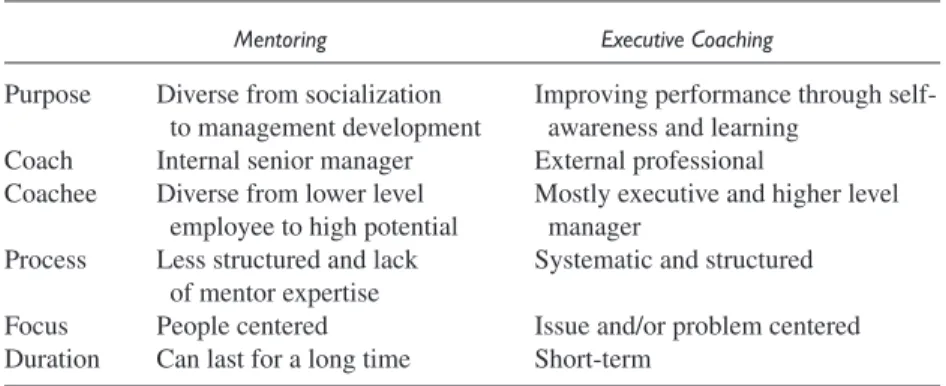
There are a great deal of similarities between coaching and mentoring because both involve a one-to-one relationship that provides an opportunity for individuals to reflect, learn, and develop. However, when comparing coaching with the mentoring, there are some key differences (Jarvis, 2004). At this point, it would be beneficial to compare and contrast executive coaching with mentoring. Table 4 summarizes the comparison between the two practices.
First, executive coaches are external professionals, whereas mentors are internal members who are in a higher position. Especially when it comes to confidentiality, external coaches separated from political issues are pre-ferred. It is believed that external coaches are most appropriate under condi-tions requiring extreme confidentiality, when the varied business experi-ence of the coach is beneficial, or when speaking the unspeakable is necessary (Hall et al., 1999). Second, the primary purpose of executive
474 Human Resource Development Review / December 2005
TABLE 4: Comparison Between Mentoring and Executive Coaching
Mentoring Executive Coaching
Purpose Diverse from socialization Improving performance through self-to management development awareness and learning
Coach Internal senior manager External professional
Coachee Diverse from lower level Mostly executive and higher level employee to high potential manager
Process Less structured and lack Systematic and structured of mentor expertise
Focus People centered Issue and/or problem centered Duration Can last for a long time Short-term
coaching is self-awareness and learning to improve performance, whereas the purpose of mentoring varies widely from socialization of newcomers to management development. Third, executive coaching provides systematic approaches, including a personality inventory, interviews, 360-degree feed-back, and action planning; whereas mentoring has less systematic tools. Formal mentoring programs have potential problems of lack of mentor expertise (i.e., lack of interpersonal or technical competence) and general dysfunctionality (i.e., mentor had a negative attitude and/or personal prob-lems) (Eby, McManus, Simon, & Russell, 2000). Fourth, mentoring is peo-ple focused, whereas coaching is issue focused. Mentoring takes a longer-term and broader view of the person, whereas executive coaching is short-term and focused on specific areas or issues. Thus, in spite of the superficial similarity, there are many differences between the two.
A Conceptual Framework for Executive Coaching
As Lynham (2000) mentioned, because theory building has only recently been introduced to HRD scholars, there are a number of voids in this body of knowledge: (a) the lack of explicit philosophical assumptions and frame-work to guide the task of theory building, (b) the absence of well-researched and tested methods of theory building, and (c) the lack of shared and com-mon understanding of the core concepts of theory and theory building in HRD. Executive coaching is not an exception. This article suggests a con-ceptual framework and propositions as a preliminary attempt to build theory for executive coaching.
Van de Ven (2000) suggested a systematic research process, proposing that there are four steps in conducting a theory research study: (a) diagnose the problem or situation as it exists in the real-world, (b) select a conceptual model and research question to deal with this problem or situation, (c) build a theory and design research to examine the research question, and (d) con-duct the research and analyze the findings to produce a solution. This study covers the first two steps. Problem diagnosis has already discussed earlier in this article. What follows is the presentation of an executive-coaching conceptual model and propositions.
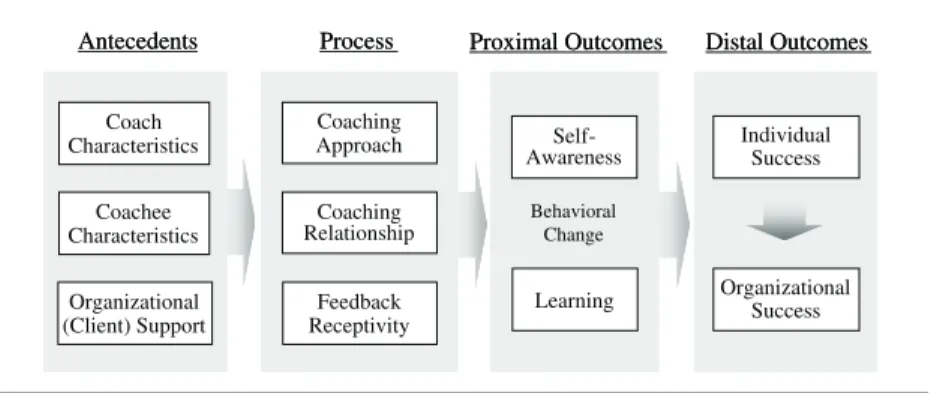
The conceptual framework is the basis of creating propositions relevant to the following three questions. First, what are the antecedents of positive outcomes in executive coaching? Second, what is the process through which executive coaching leads to positive outcomes? Third, what outcomes might executive coaching achieve? The conceptual framework, presented next, was developed from a review of the literature on mentoring, career success, 360-degree feedback, and training and development. This literature is dis-cussed in the following section because it was used as the basis for develop-ing the conceptual framework. Figure 1, the results of this effort, presents a
conceptual framework of executive coaching in order to help further under-stand executive coaching and to guide future research.
The antecedents are the characteristics of coach and coachee and organi-zational support. Coaching approach, coaching relationship, and feedback receptivity are the important constructs of coaching process. Finally, two outcomes of executive coaching are proximal and distal outcomes. Proxi-mal outcomes refer to behavioral change that includes self-awareness and learning. Distal outcomes, which are the ultimate purposes of executive coaching, consist of individual success and organizational success. It is noted that this conceptual framework is inspired partly by Wanberg, Welsh, and Hezlett’s (2003) conceptual-process model of formal mentoring in that it focuses on the dyad relationship and distinguishes the proximal and distal outcomes.
Antecedents
As Sherman and Freas (2004) stressed, the triangular relationship among coach, coachee, and client (organization, higher executive, and/or HR) is critical for the success of executive coaching. This triangular relationship is the basis of the antecedents of effective executive coaching: coach charac-teristics, coachee characcharac-teristics, and organizational support.
Coach characteristics. Important coach characteristics include coaching
experience and academic background. No universal credential seems to exist to identify competent coaches. However, the role of coach in successful executive coaching cannot be overemphasized. It is believed that the most important qual-ifications for a coach are character and insight, distilled as much from the coach’s personal experience as from formal training. Those characteristics are integrity, confidence, experience, and high developmental level.
First, as Sherman and Freas (2004) put, coaching is best practiced by coaches who have an acute perception, sound judgment, and the ability to resolve
con-476 Human Resource Development Review / December 2005
Individual Success Organizational Success Distal Outcomes Coaching Relationship Coachee Characteristics Coach Characteristics Process Antecedents Coaching Approach Feedback Receptivity Behavioral Change Learning Proximal Outcomes Self-Awareness Organizational (Client) Support Individual Success Organizational Success Distal Outcomes Coaching Relationship Coachee Characteristics Coach Characteristics Process Antecedents Coaching Approach Feedback Receptivity Behavioral Change Learning Proximal Outcomes Self-Awareness Organizational (Client) Support
flicts effectively with integrity. Second, when the coach has knowledge and credibility, coaches have confidence in the coaching (Bacon & Spear, 2003). Third, the richer and deeper one’s experience, the more likely one is to have seen similar issues before, and one will remember how one helped previous coaches with those issues (Bacon & Spear, 2003). Last, effective coaching requires the right attitudes about coaching and the right temperament. Coaching may have transformative effect, but the developmental level of the coach must also be such that it allows the coach to co-generate these effects in the coaching relationship (Laske, 1999).
Proposition 1a: Coach’s integrity, confidence, experience, and high developmental status will have a positive impact on coaching process (coaching relationship, coaching approach, and feedback receptivity) and coaching outcomes (proximal and distal).
Judge and Cowell (1997) found that coaches come from a wide range of edu-cational backgrounds, with undergraduate degrees ranging from drama to psy-chology. As Smither et al. (2003) stated, there is a need for evidence to support whether the effects of coaching are related to the coach’s style. It is considered that the background of executive coaches (e.g., counseling psychology) may be well suited for some situations (e.g., helping a senior manager overcome an aggressive or demeaning interpersonal style) but not for others (e.g., helping a senior executive integrate organizational cultures during a merger or acquisi-tion). Thus, depending on the background of the coaches, the approach of exec-utive coaching can be directed differently. As discussed earlier, the primary purpose of the counseling approach is to help those who are damaged or in crisis, while the consulting approach is to increase executive capacity and achieve goals.
Proposition 1b: The academic background of a coach will define the coaching approach (counseling or consulting), and thus affect coaching process and outcomes.
Coachee characteristics. Strumpf (2002) maintains that there are five
gen-eral types of coachee. Most executives fall into one of the following categories: (a) high potential, (b) valuable but at risk of derailing, (c) newly hired or newly promoted, (d) expatriate, and (e) diamond in the rough. To experience trans-formative effects of coaching, coachee must be developmentally ready to expe-rience them (Laske, 1999). Colquitt, LePine, and Noe (2000) also found that individual characteristics had direct and indirect relationships with training motivation, learning levels, transfer of learning, and job performance.
Because it is important to qualify the executive to be coached, a more sys-tematic approach to evaluating the candidate’s readiness and suitability for coaching is necessary. Regardless of the situation, clients and coaches should make sure that coaching is something the executive really wants— and that the executive’s efforts to change and grow will be appreciated. Important coachee characteristics include personality factors and
tion factors. In this conceptual model,proactivityis an important personal-ity factor, whereasgoal orientationis a relevant motivation factor.
The review of career success literature highlighted proactivity as an important coachee characteristic. Bateman and Crant (1993) defined pro-activity as an individual characteristic described as a belief in one’s ability to overcome constraints by situational forces and the ability to affect changes in the environment. Proactive individuals look for opportunities, show initiative, take action, and are persistent in successfully implementing change. The results of Seibert, Kraimer, and Crant’s (2001) study suggested that executives with “specific proactive behaviors that can create conditions leading to extrinsic and intrinsic career success” (p. 866) tend to actively engage in career planning and seek career-related feedback and they are likely to achieve an extrinsically rewarding and intrinsically satisfying career.
The successful outcome of coaching depends in part on the coachee’s open-ness to feedback and willingopen-ness to change (Bacon & Spear, 2003; Hodgetts, 2002). Otherwise, it will risk wasting a great deal of time and money. Clearly, executives who lack proactivity are not good coaching candidates, because no matter how much quality coaching they receive, they are unlikely to change (Bacon & Spear, 2003).
Proposition 2a: Coachee’s proactivity will have a positive relationship with one’s coach and will have a positive impact on feedback receptivity and coaching outcomes.
Goal orientation is a motivational variable expected to affect the allocation of effort during learning (Fisher & Ford, 1998). Goal orientation can be summa-rized into two categories: learning (task or mastery) orientation and perfor-mance (ego and/or social) orientation.Learning (Mastery) orientationrefers to a desire to increase one’s competence by developing new skills and mastering new situations. Those with learning orientations have adaptive response pat-terns, thus leading to positive outcomes. According to incremental theory, abil-ity is a malleable attribute and can be developed (Bell & Kozlowski, 2002; Fisher & Ford, 1998). On the contrary,performance orientation refers to a desire to demonstrate one’s competence to others and to receive positive evalua-tions from others. Ability is a fixed, uncontrollable, personal attribute and there-fore extra effort indicates low ability (Bell & Kozlowski, 2002; Fisher & Ford, 1998). In summary, the coachee’s goal orientation would affect the effort used in executive coaching.
Proposition 2b: Coachees with learning orientation will have higher feedback receptivity and more positive coaching outcomes than those with performance orientation.
Organizational (client) support. For executive coaching to draw keen atten-tion from busy executives, it needs high-level support and close links to busi-ness imperatives. The more supportive the organization is, the more likely it is that coachees will be open to and accepting of coaching help (Bacon & Spear, 2003). Therefore, like organization development interventions, it would be better to launch any coaching program only if it has won a strong support from top management, to be more specific, from the CEO (Sherman & Freas, 2004). Unless coaching is applied in a planned and strategic way, it is a waste of time and money that dilutes the value of a development opportunity.
HR is in the best position to provide the stewardship necessary to ensure effectiveness, integrity, and accountability in the use of executive coaching (Knudson, 2002). HR engagement includes overseeing the whole coaching pro-cess, consulting with all parties involved regarding the requirements for a success-ful outcome, ensuring alignment with business needs, managing the coaches, communicating logistic requirements, ensuring explicit contracting and clarity regarding roles, and keeping track of goals and expensed incurred (Knudson, 2002). In addition, how to integrate coaching with other initiatives and systems, such as compensation, evaluation, and job assignment is important (Tansky & Cohen, 2001).
Proposition 3: A higher level of organizational support from top management and HR will have a positive impact on the overall coaching process and eventually on the outcomes of executive coaching.
Coaching Process
The executive coaching process is central to the conceptual framework. Based on related literature such as mentoring, career success, 360-degree feedback, and training and development, the important constructs in the process are coaching approach, the relationship between the coach and the coachee, and the feedback receptivity of the coachee.
Coaching approach. The most important questions for the successful
coach-ing are as follows: What kind of coachcoach-ing does the coachee want (directive or nondirective)? What would be most helpful to the coachee: advice, counsel, teaching, feedback, a sounding board (Bacon & Spear, 2003)? In other words, the process and focus of coaching should be varied by the situation and needs of coachees: to learn specific skills, to improve performance, or to prepare for advancement in business or professional life (Witherspoon & White, 1996).
Counseling (remedial) approach and consulting (developmental) approach are the two ends of the continuum of executive coaching. Coach’s educational background tends to define the scope or approach of coaching. Organizations use coaching for both remedial and developmental purposes. In remedial situa-tions, coaching focuses on bringing some aspect of an individual’s performance
up to acceptable standards (Hodgetts, 2002). In contrast, developmental coach-ing emphasizes preparation for a new or expanded role or job that requires addi-tional skills and competencies. Thus, counseling approach emphasizes self-awareness, whereas consulting approach focuses on learning.
Proposition 4: Counseling (remedial) approach will have a positive impact on self-awareness, whereas consulting (developmental) approach will have a positive impact on learning.
Coaching relationship. Selecting executive coaches and matching them to
individuals is critical in coaching effectiveness (Bacon & Spear, 2003; Kilburg, 1996, 2001). The interaction of the characteristics of two individuals is particu-larly critical in determining the characteristics of relationship (Wanberg et al., 2003). Hodgetts (2002) maintained that personal chemistry between coaches and coaches and such factors as gender, socioeconomic background, and life experiences are also important considerations in making effective coaching matches. Therefore, a good match and relationship between the coachee and coach is a critical factor for enhancing self-awareness, learning, and thus behav-ioral change.
Proposition 5: A well-matched and good relationship between the coach and the coachee will have a positive impact on other coaching process and coaching outcomes.
Feedback receptivity. According to Judge and Cowell’s (1997) study, the
majority of executive coaches used 360-degree assessments by interviewing people close to the executives. The most common requests for coaching were to help (a) modify the coachee’s interaction style, (b) deal more effectively with change, and (c) build trusting relationships.
Therefore, another important area is individual differences in receptivity to coaching and feedback. A well-managed 360-degree assessment can identify particular behaviors with great precision and link them to corporate goals, val-ues, and leadership models (Luthans & Peterson, 2004; Thach, 2002). As a result of interviews with 75 executives and 15 coaches, Hall et al. (1999) con-cluded that honesty, challenging feedback, and helpful suggestions were factors contributing to coaching effectiveness. Brett and Atwater (2001) found that self-other rating discrepancy was negatively related with perceived accuracy of feed-back and perceived usefulness of feedfeed-back, whereas favorability of the rating was positively related with reaction to feedback and with perceived usefulness of feedback. Another study found that 360-degree feedback, combined with coaching aimed at enhancing self-awareness, may lead to improved self and employee attitudes and eventually even improved organizational performance (Luthans & Peterson, 2003). In short, how receptive the coachee is to feedback is critical to proximal and distal outcome variables.
Proposition 6: Feedback receptivity of the coachee will have a positive impact on behavioral change through self-awareness and learning, and eventually on indi-vidual and organizational success.
Proximal Outcomes
Some practitioners might focus more on self-awareness (counseling), whereas others on learning (consulting), depending on coaching approach. However, the destination is the same—behavioral change of the executives in terms of immediate or proximal outcomes.
Self-awareness. Sherman and Freas (2004) demonstrated the importance of
self-awareness, explaining why executive coaching has received the spotlight in the business arena for the past 10 years or so.
It is remarkable how many smart, highly motivated, and apparently responsible people rarely pause to contemplate their own behaviors. Often more inclined to move on than to reflect deeply, executives may reach the top ranks without addressing their limitations. Coaching gets them to slow down, gain awareness, and notice the effects of their words and actions. That enables coaches to perceive choices rather than simply react to events; ultimately, coaching can empower them to assume responsibility for their impact on the world. (Sherman & Freas, 2004, p. 85)
Those who use the counseling approach tend to emphasize self-awareness and self-reflection in executive coaching (Kilburg, 1997; Orenstein, 2002), using the metaphor of awindowandmirror(Sherman & Freas, 2004). The pur-pose of executive coaching is to provide them with more time to look into the mirror instead of looking through the window.
Proposition 7: Increased self-awareness that lead to behavioral change will have a positive impact on individual success, especially on psychological satisfaction.
Learning. Coaching does not end with self-awareness. Executive coaching
can be a strategic learning tool of organization. Wanberg et al. (2003), in their mentoring study, suggested three of the areas of protégé change (cognitive, skill-base, and affective learning) that were derived from Kraiger, Ford, and Salas’s (1993) classification of learning outcomes that stem from training inter-vention. Among these, learning in executive coaching would be focused on cognitive and affective learning. Cognitive learning represents enhancements in declarative knowledge, procedural knowledge, strategic or tacit knowledge, knowledge organization, or cognitive strategies that may occur as a result of the coaching relationship. Affective learning would be attitudinal (e.g., changes in values, improved tolerance for diversity, or reconciliation of work-life balance issues) or motivational (e.g., changes in the coachee’s motivational disposition, self-efficacy, or goal-setting).
It is the active learning that transfers essential leadership and managerial skills such as visioning, communication, interpersonal relationship, and action planning skills (Sherman & Freas, 2004). Executive coaching, especially in con-sulting approach, aims to help leaders adapt to new responsibilities, reduce destructive behaviors, enhance teamwork, align individuals to collective goals, and support organizational changes. For those with a consulting approach, therefore, learning could be an immediate outcome of executive coaching.
Proposition 8: Learning that lead to behavioral change will have a positive impact on individual success, especially on performance and career satisfaction.
Distal Outcomes
Distal outcomes are divided into individual success and organizational success. Individual success includes individual performance, compensa-tion, promocompensa-tion, job satisfaction and commitment, and psychological well-ness, whereas organizational success includes organizational performance, talent retention, and organizational transformation.
Individual success. Individual benefits from executive coaching may be
enhanced problem solving, managerial and interpersonal skills and ability, better relationships, greater confidence, adaptability to change, work-life bal-ance, and reduced stress levels (Jarvis, 2004). Smither et al.’s (2003) found that executives who worked with coaches (compared to those who did not) set more specific goals, were more likely to share their feedback and solicit ideas from supervisors (but not peers or subordinates), and had improved performance rat-ings (based on multisource feedback).
Career success can serve as a proxy for individual success. According to the recent descriptive study of Wasylyshyn (2003), the vast majority of executive coaching engagements focused on behavior changes that executives wished to make for continued career success. Career success is defined as the real or per-ceived achievements individuals have accumulated as a result of their work experiences (Boudreau, Boswell, & Judge, 2001; Judge, Higgins, Thoreson, & Barrick, 1999; Siebert, Kraimer, & Crant, 2001). Career success reflects the accumulated interaction between a variety of individual, organizational, and societal norms, behaviors, and work practices. The career success literature dif-ferentiates between objective or extrinsic career success (represented by more observable career achievement indices, such as promotions and compensation level) and subjective or intrinsic career success (represented by reports of job satisfaction, career satisfaction and commitment, and work-life balance) (Wan-berg et al., 2003). Thus, those who feel subjective and objective success will contribute to organizational success.
Proposition 9: Objective (extrinsic) and subjective (intrinsic) individual success will have a positive impact on organizational success.
Organizational success. Organizational success is expected to be generated from the proximal and distal outcomes (Wanberg et al., 2003). For instance, executive coaching as a follow-up to a training program was shown to increase productivity by 88% in public-sector managers, which was a significantly greater gain compared with training alone (Olivero, Bane, & Kopelman, 1997). These organizational outcomes can be as diverse as improved productivity, quality, customer service, and shareholder value, increased commitment and satisfaction (retention), better transfer, and support for training and develop-ment and OD efforts (Jarvis, 2004).
In summary, the conceptual framework represents a preliminary attempt to portray the relationships among the factors related to executive coaching. One contribution of this model is its integration of useful theory and research from related literatures, such as mentoring, career success, 360-degree feedback, and training and development. Given the limited research on executive coaching, this framework will hopefully stimulate more empir-ical research in this area.
Implications for Future Research
Regarding future research areas, Smither et al. (2003) pointed out that research should examine how the impact of executive coaching is shaped by a variety of factors such as its purpose, length, organizational context, and individual differences among coaches and among those being coached. As mentioned at the end of the conceptual framework, research on the anteced-ents, process, and outcomes of executive coaching would enhance the theo-retical understanding of executive development, feedback processes, and behavior change. However, it is noted that the suggested conceptual frame-work is far from complete and there are several caveats. First, criteria and instruments for assessing the constructs and evaluating the coaching effec-tiveness need to be developed. Second, it would be difficult to test this framework because of the multitude of variables. It would require a number of related studies, including longitudinal studies and the coach-coachee dyad analysis. Third, there could be important variables missing in this framework. It should be refined as the practice and research of executive coaching improve and develop over time.
Here are some additional suggestions for future research. First, future research on executive coaching need to be clear about the coaching ap-proach: counseling and consulting. These two approaches can have differ-ent purposes and place emphasis on differdiffer-ent aspects of the coaching rela-tionship. Second, because executive coaching is still in its infancy and most case studies were based on the perspective of coaches, interpretive research using a phenomenological approach that examines the perspectives of exec-utives being coached could add significantly to knowledge about executive coaching. Third, coach-coachee dyad analysis should be examined in future
research. Most research has collected data from only one member of the coach and/or coachee dyad. Analysis of dyads would allow the researchers to delve into a deeper understanding of coach and/or coachee relationships and would help to decrease concerns about mono-method bias (Wanberg et al., 2003). Last, future research should examine the impact of executive coaching relationships through longitudinal studies because coaching can be considered a cause as well as a consequence. In other words, a time lag exists between time 1 (when coaching occurs) and time 2 (when outcomes are produced). Thus, longitudinal studies that cover at least 6 months would help to evaluate the distal outcomes of executive coaching.
Implications for HRD
The use of executive coaching has grown drastically as organizations have discovered the benefits of providing high potential executives and managers with individual coaching to address specific skill deficits, en-hance performance, or help them grow into expanded leadership roles (Hodgetts, 2002). Witherspoon and White (1998) identified the four coach-ing areas in executive coachcoach-ing: learncoach-ing, development, performance, and leadership agenda. Because they are all in the territory of HRD, HRD researchers should pay more attention to executive coaching.
As discussed earlier, there is a gray area between coaching approach and counseling approach. As Wasylyshin (2003) pointed out, it is most ideal that executive coaches have knowledge and experience in both management and psychology. However, some even warn that they would leave the door open for coaches, especially those with clinical training and backgrounds, to practice therapy at the company’s expense, with potentially negative conse-quences (Hodgetts, 2002). Garman, Whiston, and Zlatoper (2000) found that although 82% of the articles viewed described executive coaching favorably, psychologists who might lack management knowledge and expe-rience were not viewed as uniquely valuable service providers (only one third viewed psychologists favorably). Niemes (2002) maintained that the primary emphasis in a business setting should be developmental rather than corrective or remedial action.
In this vein, for HRD professionals, executive coaching could be focused more on the developmental (consulting) purpose of executive coaching rather than the remedial (counseling) purpose. According to Sherman and Freas (2004), the purpose of executive coaching is to produce learning, behavioral change, and growth in the coachee. An effective coach with an HRD background should help a coachee achieve agreed-upon goals, where-as also transferring the knowledge and skills needed to sustain ongoing development. Therefore, coaches do not have to be licensed psychologists, but they need to be trained and certified in coaching (Bacon & Spear, 2003).
However, executive coaches must know the ethical issues and the warning signs when deeper psychological issues exist such as chronic depression and should be able to refer their clients to competent professionals when they cannot provide help themselves (Bacon & Spear, 2003; Sherman & Freas, 2004). In summary, HRD scholars should pay more attention to exec-utive coaching as an area for further research. HRD practitioners need to focus more on developmental purpose, while understanding ethical and psy-chological issues.
Conclusions
The purpose of this article was to explore the practice of executive coach-ing, investigating the underlying theories, and to provide a conceptual framework of executive coaching. The significance of this article lies in its integration of the extant literature on executive coaching and the develop-ment of a conceptual framework of executive coaching and related proposi-tions derived from the literature.
Is executive coaching a merefad? The answer to this question appears to be “No.” Executive coaching has become increasingly popular despite lim-ited empirical evidence about its impact. There has been little agreement about which executive coaching approach should be followed and there has been wide disagreement about necessary or desired professional qualifica-tions for coaches. The problem is not the practice per se, but the lack of research and theory to advance the field. It is hoped that the conceptual framework and propositions will stimulate further research on executive coaching withrigorand relevance(Marsick, 1990). Finally, the question about how to evaluate the effectiveness and outcome of executive coaching should be addressed head on. Otherwise, it might come and go as many other management fads have.
References
Arnaud G. (2003). A coach or a couch? A Lacanian perspective on executive coaching and
consult-ing.Human Relations,56(9), 1131-1154.
Bacon, T. R., & Spear, K. I. (2003).Adaptive coaching: The art and practice of a client-centered
approach to performance improvement. Palo Alto, CA: Davis-Black.
Bateman, T. S., & Crant, J. M. (1993). The proactive component of organizational behavior: A mea-sure and correlates.Journal of Organizational Behavior,14(2), 103-118.
Bell, B. S., & Kozlowski, S.W.J. (2002). Goal orientation and ability: Interactive effects on self -efficacy, performance and knowledge.Journal of Applied Psychology,87(3), 497-505. Berglas, S. (2002). The very real dangers of executive coaching.Harvard Business Review,80(6),
86-91.
Boudreau, J. W., Boswell, W. R., & Judge, T. A. (2001). Effects of personality on executive career success in the United States and Europe.Journal of Vocational Behavior,58(1), 53-81. Brett, J. F., & Atwater, L. E. (2001). 360-degree feedback: Accuracy, reactions, and perceptions of
usefulness.Journal of Applied Psychology,86(5), 930-942.
Colquitt, J. A., LePine, J. A., & Noe, R. A. (2000). Toward an integrative theory of training and moti-vation: A meta-analytic path analysis of 20 years of research.Journal of Applied Psychology,85 (5), 678-707.
Corporate therapy. (2003, November 13).Economist, p. 61.
Day, D. V. (2001). Leadership development: A review in context.Leadership Quarterly,11(4), 581-613.
Diedrich, R. C. (1996). An iterative approach to executive coaching.Consulting Psychology
Jour-nal: Practice & Research,48(2), 61-66.
Diedrich, R. C. (2001). Lessons learned in—and guidelines for—coaching executive teams.
Con-sulting Psychology Journal: Practice & Research,53(4), 238-239.
Eby, L. T., McManus, S. E., Simon, S. A., & Russell, J.E.A. (2000). The protégé’s perspective regard-ing negative mentorregard-ing experiences: The development of a taxonomy.Journal of Vocational
Behavior,57(1), 1-21.
Ellinger, A. D., Ellinger, A. E., & Keller, S. B. (2003). Supervisory coaching behavior, employee sat-isfaction, and warehouse employee performance: A dyadic perspective in the distribution
indus-try.Human Resource Development Quarterly,14(4), 435-458.
Evered, R. D., & Selman, J. C. (1989). Coaching and the art of management.Organizational Dynam-ics,18, 16-32.
Fisher, S. L., & Ford, J. K. (1998). Differential effects of learner effort and goal orientation on two learning outcomes.Personnel Psychology,51(2), 397-420.
Fitzgerald, C., & Berger, J. G. (2002). Coaching in the organizations. In C. Fitzgerald & J. G. Berger (Eds.),Executive coaching: Practices and perspectives(pp. 27-58). Palo Alto, CA: Davis-Black. Garman, A. N., Whiston, D. L., & Zlatoper, K. W. (2000). Media perceptions of executive coaching and the formal preparation of coaches.Consulting Psychology Journal: Practice & Research,52 (3), 201-205.
Hall, D. T., Otazo, K. L., & Hollenbeck, G. P. (1999). Behind closed doors: What really happens in executive coaching.Organizational Dynamics,27(3), 39-43.
Harris, M. (1999). Look, it’s an I-O psychologist . . . no, it’s a trainer . . . no, it’s an executive coach. TIP,36(3), 1-5.
Hart, V., Blattner, J., & Leipsic, S. (2001). Coaching versus therapy: A perspective.Consulting
Psy-chology Journal: Practice & Research,53(4), 229-237.
Hodgetts, W. H. (2002). Using executive coaching in organizations: What can go wrong (and how to prevent it). In C. Fitzgerald & J. G. Berger (Eds.),Executive coaching: Practices and
perspec-tives(pp. 203-223). Palo Alto, CA: Davis-Black.
International Coach Federation. (2003).The ICF code of ethics. Retrieved June 20, 2005, from http:// www.coachfederation.org/ethics/code_ethics.asp
Jarvis, J. (2004).Coaching and buying coaching services: A guide. London: CIPD. Retrieved July 6, 2005, from http://www.cipd.co.uk/guides
Judge, T. A., & Higgins, C. A., Thoreson, C. J., & Barrick, M. R. (1999). The big five personality traits, general mental ability, and career success across the life span.Personnel Psychology,52 (3), 621.
Judge, W. Q., & Cowell, J. (1997). The brave new world of executive coaching.Business Horizons, 40(4), 71-77.
Kampa-Kokesch, S., & Anderson, M. Z. (2001). Executive coaching: A comprehensive review of the literature.Consulting Psychology Journal: Practice & Research,53(4), 205-228.
Kets de Vries, M. F. R. (2005). Leadership group coaching in action: The Zen of creating high perfor-mance teams.Academy of Management,19(1), 61-76.
Kiel, F., Rimmer, E., Williams, K., & Doyle, M. (1966). Coaching at the top.Consulting Psychology
Journal: Practice & Research,48(2), 67-77.
Kilburg, R. R. (1996). Toward a conceptual understanding and definition of executive coaching.
Consulting Psychology Journal: Practice & Research,48(2), 134-144.