Enabling Data Dynamic and Indirect Mutual
Trust for Cloud Computing Storage Systems
Ayad F. Barsoum and M. Anwar Hasan
Department of Electrical and Computer Engineering,
University of Waterloo, Ontario, Canada.
Abstract
Currently, the amount ofsensitivedata produced by many organizations is outpacing their storage ability. The management of such huge amount of data is quite expensive due to the requirements of high storage capacity and qualified personnel. Storage-as-a-Service (SaaS) offered by cloud service providers (CSPs) is apaidfacility that enables organizations to outsource their data to be stored on remote servers. Thus, SaaS reduces the maintenance cost and mitigates the burden of large local data storage at the organization’s end. A data owner pays for a desired level of security and must get some compensation in case of any misbehavior committed by the CSP. On the other hand, the CSP needs a protection from any false accusation that may be claimed by the owner to get illegal compensations.
In this paper, we propose a cloud-based storage scheme that allows the data owner to benefit from the facilities offered by the CSP and enablesindirectmutual trust between them. The proposed scheme has four important features: (i) it allows the owner to outsource sensitive data to a CSP, and perform full block-level dynamic operations on the outsourced data, i.e., block modification, insertion, deletion, and append, (ii) it ensures that authorized users (i.e., those who have the right to access the owner’s file) receive the latest version of the outsourced data, (iii) it enables indirect mutual trust between the owner and the CSP, and (iv) it allows the owner to grant or revoke access to the outsourced data. We discuss the security issues of the proposed scheme. Besides, we justify its performance through theoretical analysis and experimental evaluation of storage, communication, and computation overheads.
Index Terms
Outsourcing data storage, dynamic environment, mutual trust, access control
F
1
INTRODUCTION
Cloud computing has received considerable attention from both academia and industry due to a number of important advantages including: cost effectiveness, low management overhead, immediate access to a wide range of applications, flexibility to scale up and down information technology (IT) capacity, and mobility where customers can access information wherever they are, rather than having to remain at their desks. Cloud computing is a distributed computational model over a large pool of shared-virtualized
computing resources (e.g., storage, processing power, memory, applications, services, and network band-width). Cloud service providers (CSPs) offer different classes of services (Storage-as-a-Service (SaaS), Application-as-a-Service, and Platform-as-a-Service) that allow organizations to concentrate on their core business and leave the IT operations to experts.
In the current era of digital world, different organizations produce a large amount of sensitive data including personal information, electronic health records, and financial data. The amount of digital data increases at a staggering rate; doubling almost every year and a half [1]. This data needs to be widely distributed and stored for a long time due to operational purposes and regulatory compliance. The local management of such huge amount of data is problematic and costly. While there is an observable drop in the cost of storage hardware, the management of storage has become more complex and represents approximately 75% of the total ownership cost [1]. SaaS offered by CSPs is an emerging solution to mitigate the burden of large local data storage and reduce the maintenance cost via the concept of outsourcing data storage.
Through outsourcing data storage scenario, data owners delegate the storage and management of their data to a CSP in exchange for pre-specified fees metered in GB/month. Such outsourcing of data storage enables owners to store more data on remote servers than on private computer systems. Moreover, the CSP often provides better disaster recovery by replicating the data on multiple servers across multiple data centers achieving a higher level of availability. Thus, many authorized users are allowed to access the remotely stored data from different geographic locations making it more convenient for them.
Since the owner physically releases sensitive data to a remote CSP, there are some concerns regarding confidentiality,integrity, andaccess controlof the data. In some practical applications, data confidentiality is not only a privacy concern, but also a juristic issue. For example, in e-Health applications inside the USA the usage and exposure of protected health information should meet the policies admitted by Health Insurance Portability and Accountability Act (HIPAA) [2], and thus keeping the data private on the remote storage servers is not just an option, but a demand. The confidentiality feature can be guaranteed by the owner via encrypting the data before outsourcing to remote servers.
For verifying data integrity over cloud servers, researchers have proposed provable data possession (PDP) technique to validate the intactness of data stored on remote sites. A number of PDP protocols have been presented to efficiently validate the integrity ofstaticdata, e.g., [3]–[10]. Another class of PDP schemes was concerned with thedynamicbehavior of data over remote servers [11]–[15]. This class allows the owner to outsource a data file and perform updating or scaling operations on the outsourced data. Later, a verifier validates that the remote servers keep the data intact and compatible with the dynamic requests issued by the owner. A complementary line of research on PDP has focused on multiple data copies stored over different servers [16]–[19]. Proof of retrievability (POR) [20]–[25] was introduced as a stronger technique than PDP in the sense that the entire data file can be reconstructed from portions of the data that are reliably stored on the servers.
Commonly, traditional access control techniques assume the existence of the data owner and the storage servers in the same trust domain. This assumption, however, no longer holds when the data is outsourced to a remote CSP, which takes the full charge of the outsourced data management, and resides outside the trust domain of the data owner. A feasible solution can be presented to enable the owner to enforce access control of the data stored on a remote untrusted CSP. Through this solution, the data is encrypted under a certain key, which is shared only with the authorized users. The unauthorized users, including the CSP, are unable to access the data since they do not have the decryption key. This general solution has been widely incorporated into existing schemes [26]–[29], which aim at providing data storage security on untrusted remote servers. Another class of solutions utilizes attribute-based encryption (ABE) to achieve fine-grained access control. ABE [30]1 is a public key cryptosystem for one-to-many communications that enables fine-grained sharing of encrypted data. The ABE associates the ciphertext with a set of attributes, and the private key with an access structure (policy). The ciphertext is decrypted if and only if the associated attributes satisfy the access structure of the private key. Access revocation in ABE-based systems is an issue since each attribute is conceivably shared by many users. Examples of ABE-based systems for achieving access control of remotely stored data are [32]–[34].
Different approaches have been investigated that encourage the owner to outsource the data, and offer some sort of guarantee related to the confidentiality, integrity, and access control of the outsourced data. These approaches can prevent and detect (with high probability) malicious actions from the CSP side. On the other hand, the CSP needs to be safeguarded from a dishonest owner, who attempts to get illegal compensations by falsely claiming data corruption over cloud servers. This concern, if not properly handled, can cause the CSP to go out of business [35].
In this work, we propose a scheme that addresses some important issues related to outsourcing the storage of data, namely data dynamic, newness, mutual trust, and access control. One of the core design principles of data outsourcing is to provide dynamic scalability of data for various applications. This means that the remotely stored data can be not only accessed by authorized users, but also updated and scaled by the owner. After updating, the authorized users should receive the latest version of the data (newness property), i.e., a technique is required to detect whether the received data is stale. This issue is crucial for applications in which critical decisions are taken based on the received data. For example, in e-Health applications a physician may write a prescription based on a patient’s medical history received from remote servers. If such medical data is not up-to-date, the given prescription may conflict with the patient’s current circumstances causing severe health problems. Mutual trust between the data owner and the CSP is another imperative issue, which is addressed in the proposed scheme. A mechanism is introduced to determine the dishonest party, i.e., misbehavior from any side is detected
1. The construction presented in [30] is called key-policy ABE (KP-ABE), which contrasts with another construction called ciphertext-policy ABE (CP-ABE) [31]. In the CP-ABE, an access structure is associated with the ciphertext, and a set of attributes is associated with the private key.
and the responsible party is identified. Last but not least, the access control is considered, which allows the data owner to grant or revoke access rights to the outsourced data.
Main contributions. Our contributions can be summarized in two main points.
1) The design and implementation of a cloud-based storage scheme that has the following features:
• It allows a data owner to outsource the data to a remote CSP, and perform full dynamic
operations at the block-level, i.e., it supports operations such as block modification, insertion, deletion, and append
• It ensures the newness property, i.e., the authorized users receive the most recent version of the
data
• It establishesindirectmutual trust between the data owner and the CSP since each party resides
in a different trust domain
• It enforces the access control for the outsourced data
2) We discuss the security features of the proposed scheme. Besides, we justify its performance through theoretical analysis and experimental evaluation of storage, communication, and computation over-heads.
Paper organization. The remainder of the paper is organized as follow. Section 2 contains related work. Our system and assumptions are presented in Section 3. Section 4 reviews some techniques pertaining to our construction. The proposed scheme is elaborated in Section 5. The security analysis is given in Section 6. The performance analysis and experimental evaluation are shown in Section 7. Concluding remarks are given in Section 8.
2
RELATED
WORK
Existing research close to our work can be found in the areas of integrity verification of outsourced data, cryptographic file systems in distributed networks, and access control of outsourced data.
Different variations of PDP protocols have been presented forstaticor warehoused data; for example, see [3]–[10]. Some other PDP schemes consider the case ofdynamicdata that are usually more prevailing in practical applications. Examples of PDP schemes that deal with dynamic data are [11]–[15]. While the schemes [3]–[15] are for asinglecopy of a data file, PDP schemes have been presented for multiple copies of staticdata, e.g., [16]–[18]. Reference [19] addresses a PDP construction for multiplecopies ofdynamic data. Proof of retrievability (POR) is a complementary approach to PDP, and is stronger than PDP in the sense that the entire data file can be reconstructed from portions of the data that are reliably stored on the servers. This is due to encoding of the data file, for example using erasure codes, before outsourcing to remote servers. References [20]–[25] are examples of POR schemes that can be found in the literature. Kallahalla et al. [26] designed a cryptography-based file system called Plutus for secure sharing of data on untrusted servers. Some authorized users of the data have the privilege to read and write, while
others can only read the data. In Plutus, a file-group represents a set of files with similar attributes, and each file-group is associated with a symmetric key called file-lockbox key. A data file is fragmented into blocks, where each block is encrypted with a unique symmetric key called afile-block key. The file-block key is further encrypted with the file-lockbox key of the file-group to which the data file belongs. If the data owner wants to share a file-group with a set of users, the file-lockbox key is just distributed to them. Plutus supports two operations on the file blocks: read and write/modify. Delete operation can be supported by overwriting an existing block withnull.
Goh et al. [27] have presented SiRiUS, which is designed to be layered over existing file systems such as NFS (network file system) to provide end-to-end security. To enforce access control in SiRiUS, each data file (d-file) is attached with a metadata file (md-file) that contains an encrypted key block for each authorized user with some access rights (read or write). More specifically, the md-file represents the d-file’s access control list (ACL). The d-file is encrypted using a file encryption key (FEK), and each entry in the ACL contains an encrypted version of the FEK under the public key of one authorized user. For large-scale sharing, the authors in [27] presented SiRiUS-NNL that uses NNL (Naor-Naor-Lotspiech) broadcast encryption algorithm [36] to encrypt the FEK of each file instead of encrypting using each authorized user’s public key. SiRiUS supports two operations on the file blocks: read and write/modify. Based on proxy re-encryption [37], Ateniese et al. [28] have introduced a secure distributed storage protocol. In their protocol, a data owner encrypts the blocks with symmetric data keys, which are encrypted using a master public key. The data owner keeps a master private key to decrypt the symmetric data keys. Using the master private key and the authorized user’s public key, the owner generates proxy re-encryption keys. A semi-trusted server then uses the proxy re-encryption keys to translate a ciphertext into a form that can be decrypted by a specific granted user, and thus enforces access control for the data.
Vimercati et al. [29] have constructed a scheme for securing data on semi-trusted storage servers based on key derivation methods of [38]. In their scheme, a secret key is assigned to each authorized user, and data blocks are grouped based on users that can access these blocks. One key is used to encrypt all blocks in the same group. Moreover, the data owner generates public tokens to be used along with the user’s secret key to derive decryption keys of specific blocks. The blocks and the tokens are sent to remote servers, which are not able to drive the decryption key of any block using just the public tokens. The approach in [29] allows the servers to conduct a second level of encryption (over-encryption) to enforce access control of the data. Repeated access grant and revocation may lead to a complicated hierarchy structure for key management [39].
The concept of over-encryption to enforce access control has also been used by Wang et al. [39]. In their scheme, the owner encrypts the data block-by-block, and constructs a binary tree of the block keys. The binary tree enables the owner to reduce the number of keys given to each user, where different keys in the tree can be generated from one common parent node. The remote storage server performs
over-encryption to prevent revoked users from getting access to updated data blocks.
Popa et al. [35] have introduced a cryptographic cloud storage system called CloudProof that provides read and write data sharing. CloudProof has been designed to offer security guarantees in the service level agreements of cloud storage systems. It divides the security properties in four categories: confidentiality, integrity, read freshness, and write-serializability. CloudProof can provide these security properties using attestations (signed messages) and chain hash. Besides, it can detect and prove to a third party that any of these properties have been violated. Read freshness and write-serializability in CloudProof are guaranteed by periodic auditing in acentralizedmanner. The time is divided into epochs, which are time periods at the end of each the data owner performs the auditing process. The authorized users send the attestations – they receive from the CSP during the epoch – to the owner for auditing. Like Plutus and SiRiUS, CloudProof supports two operations on the file blocks: read and write/modify.
Discussion. Some aspects related to outsourcing data storage are beyond the setting of both PDP and POR, e.g., enforcing access control, and ensuring the newness of data delivered to authorized users. Even in the case of dynamic PDP, a verifier can validate the correctness of data, but the server is still able to cheat and return stale data to authorized users after the auditing process is done. The schemes [26]–[29] have focused on access control and secure sharing of data on untrusted servers. The issues of full block-level dynamic operations (modify, insert, delete, and append), and achieving mutual trust between the data owners and the remote servers are outside their scope. Although [39] have presented an efficient access control technique and handled full data dynamic over remote servers, data integrity, newness property, and mutual trust are not addressed. Authorized users in CloudProof [35] are not performing immediate checking for freshness of received data; the attestations are sent at the end of each epoch to the owner for completing the auditing task. Instantaneous validation of data freshness is crucial before taking any decisions based on the received data from the cloud. CloudProof guarantees write-serializability, which is outside the scope of our current work as we are focusing on owner-write-users-read applications.
3
O
URS
YSTEM ANDA
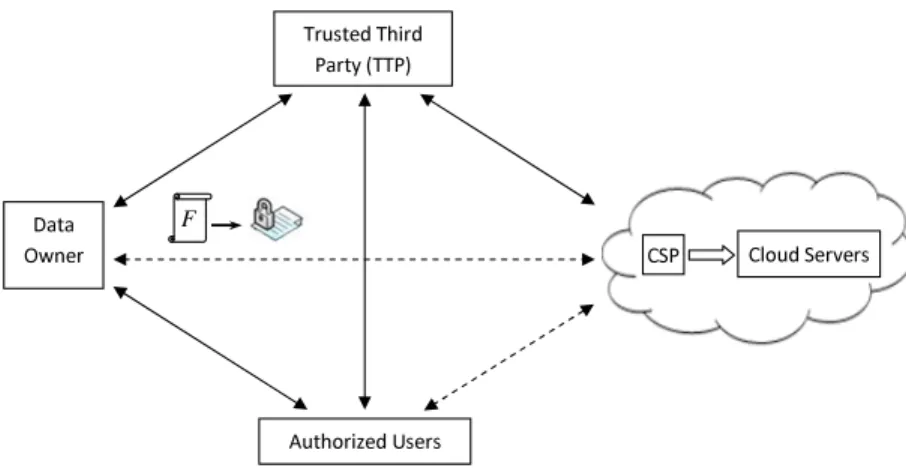
SSUMPTIONSSystem components and relations. The cloud computing storage model considered in this work consists of four main components as illustrated in Fig. 1: (i) a data owner that can be an organization generating sensitive data to be stored in the cloud and made available for controlled external use; (ii) a CSP who manages cloud servers and provides paid storage space on its infrastructure to store the owner’s files and make them available for authorized users; (iii) authorized users – a set of owner’s clients who have the right to access the remote data; and (iv) a trusted third party (TTP), an entity who is trusted by all other system components, and has expertise and capabilities to detect and specify dishonest parties.
In Fig. 1, the relations between different system components are represented by double-sided arrows, where solid and dashed arrows represent trust and distrust relations, respectively. For example, the data
^W F ĂƚĂ KǁŶĞƌ dƌƵƐƚĞĚdŚŝƌĚ WĂƌƚLJ;ddWͿ ƵƚŚŽƌŝnjĞĚhƐĞƌƐ ůŽƵĚ^ĞƌǀĞƌƐ
Fig. 1:Cloud computing data storage system model.
owner, the authorized users, and the CSP trust the TTP. On the other hand, the data owner and the authorized users have mutual distrust relations with the CSP. Thus, the TTP is used to enable indirect mutual trust between these three components. There is a direct trust relation between the data owner and the authorized users.
The storage model used in this work can be adopted by many practical applications. For example, e-Health applications can be envisioned by this model, where the patients’ database that contains large and sensitive information can be stored on cloud servers. In these types of applications, a medical center can be considered as the data owner, physicians as the authorized users who have the right to access the patients’ medical history, and an independent-trusted organization as the TTP. Many other practical applications like financial, scientific, and educational applications can be viewed in similar settings. Remark 1. The idea of using a third party auditor has been used before in outsourcing data storage systems, especially for customers with constrained computing resources and capabilities, e.g., [8], [9], [13], [40]. The main focus of a third party auditor is to verify the data stored on remote servers, and give incentives to providers for improving their services. The proposed scheme in this work uses the TTP in a slightly different fashion. The auditing process of the data received from the CSP is done by the authorized users, and we resort to the TTP only to resolve disputes that may arise regarding data integrity or newness. Reducing the storage overhead on the CSP side is economically a key feature to lower the fees paid by the customers. Moreover, decreasing the overall computation cost in the system is another crucial aspect. To achieve these goals, a small part of the owner’s work is delegated to the TTP. Outsourcing, updating, and accessing. The data owner has a file F consisting of m blocks to be outsourced to a CSP, where storage fees are pre-specified according to the used storage space. For confidentiality, the owner encrypts the data before sending to cloud servers. After data outsourcing, the owner can interact with the CSP to perform block-level operations on the file. These operations
includes modify, insert, append, and delete specific blocks. In addition, the owner enforces access control by granting or revoking access rights to the outsourced data.
An authorized user sends a data-access request to the CSP, and receives the data file in an encrypted form that can be decrypted using a secret key generated by the authorized user (more details will be explained later). We assume that the interaction between the owner and the authorized users to authenticate their identities has already been completed, and it is not considered in this work. Moreover, all authorized users have the same privileges, i.e., the issue of access hierarchy is outside the current scope.
The TTP is an independent entity, and thus has no incentive to collude with any party in the system. However, any possible leakage of data towards the TTP must be prevented to keep the outsourced data private. The TTP and the CSP are always online, while the owner isintermittentlyonline. The authorized users are able to access the data file from the CSP even when the owner is offline. Throughout this paper, the terms cloud server and cloud service provider are used interchangeably.
Threat model. The CSP is untrusted, and thus the confidentiality and integrity of data in the cloud may be at risk. For economic incentives and maintaining a reputation, the CSP may hide data loss (due to hardware failure, management errors, various attacks), or reclaim storage by discarding data that has not been or is rarely accessed. To save the computational resources, the CSP may totally ignore the data-update requests issued by the owner, or execute just a few of them. Hence, the CSP may return damaged or stale data for any access request from the authorized users. Furthermore, the CSP may not honor the access rights created by the owner, and permit unauthorized access for misuse of confidential data.
On the other hand, a data owner and authorized users may collude and falsely accuse the CSP to get a certain amount of reimbursement. They may dishonestly claim that data integrity over cloud servers has been violated, or the CSP has returned a stale file that does not match the most recent modifications issued by the owner.
Security requirements. Confidentiality: outsourced data must be protected from the TTP, the CSP, and users that are not granted access.Integrity: outsourced data is required to remain intact on cloud servers. The data owner and authorized users must be enabled to recognize data corruption over the CSP side. Newness: receiving the most recent version of the outsourced data file is an imperative requirement of cloud-based storage systems. There must be a detection mechanism if the CSP ignores any data-update requests issued by the owner.Access control: only authorized users are allowed to access the outsourced data. Revoked users can read unmodified data, however, they must not be able to read updated/new blocks. CSP’s defence: the CSP must be safeguarded against false accusations that may be claimed by dishonest owner/users, and such a malicious behavior is required to be revealed.
Combining the confidentiality, integrity, newness, access control, and CSP’s defence properties in the proposed scheme enables the mutual trust between the data owner and the CSP. Thus, the owner can
benefit from the wide range of facilities offered by the CSP, and at the same time, the CSP can mitigate the concern of cheating customers.
4
S
YSTEMP
RELIMINARIES 4.1 Lazy RevocationThe proposed scheme in this work allows the data owner to revoke the right of some users for accessing the outsourced data. In lazy revocation, it is acceptable for revoked users to read (decrypt) unmodified data blocks. However, updated or new blocks must not be accessed by such revoked users. The notation of lazy revocation was first introduced in [41]. The idea is that allowing revoked users to read unchanged data blocks is not a significant loss in security. This is equivalent to accessing the blocks from cashed copies. Updated or new blocks following a revocation are encrypted under new keys. Lazy revocation trades re-encryption and data access cost for a degree of security. However, it causes fragmentation of encryption keys, i.e., data blocks could have more than one key. Lazy revocation has been incorporated into many cryptographic systems [35], [39], [42], [43].
4.2 Key Rotation
Key rotation [26] is a technique in which a sequence of keys can be generated from an initial key and a master secret key. The sequence of keys has two main properties: (i) only the owner of the master secret key is able to generate the next key in the sequence from the current key, and (ii) any authorized user knowing a key in the sequence is able to generate all previous versions of that key. In other words, given thei-th keyKi in the sequence, it is computationally infeasible to compute keys {Kl} forl > i without
having the master secret key, but it is easy to compute keys {Kj} forj < i.
The first property enables the data owner to revoke access to the data by producing new keys in the sequence, which are used to encrypt updated/new blocks following a revocation (lazy revocation). It is intended to prevent a user revoked during the i-th time from getting access to data blocks encrypted during the l-th time forl > i.
The second property allows authorized users to maintain access to blocks that are encrypted under older versions of the current key. It enables the data owner to transfer only a single keyKito authorized
users for accessing all data blocks that are encrypted under keys {Kj}j≤i (rather than transferring a
potentially large set of keys {K1, K2, . . . , Ki}). Thus, the second property reduces the communication
overhead on the owner side.
The proposed scheme in this work utilizes the key rotation technique [26]. LetN =pqdenote the RSA modulus (p&qare prime numbers), a public key =(N, e), and a master secret keyd. The keydis known only to the data owner, anded≡1mod (p−1)(q−1).
Whenever a user’s access is revoked, the data owner generates a new key in the sequence (rotating forward). Let ctrindicate the index/version number of the current key in the keys sequence. The owner
generates the next key by exponentiating Kctr with the master secret key d: Kctr+1 = Kctrd mod N.
Authorized users can recursively generate older versions of the current key by exponentiating with the public key component e:Kctr−1=Kctre mod N (rotating backward). The RSA encryption is used as a
pseudorandom number generator; it is unlikely that repeated encryption results in cycling, for otherwise, it can be used to factor the RSA modulus N [44].
4.3 Broadcast Encryption
Broadcast encryption (bENC) [45], [46] allows a broadcaster to encrypt a message for an arbitrary subset of a group of users. The users in the subset are only allowed to decrypt the message. However, even if all users outside the subset collude they cannot access the encrypted message. Such systems have the collusion resistance property, and are used in many practical applications including TV subscription services and DVD content protection. The proposed scheme in this work uses bENC [45] to enforce access control in outsourced data. ThebENC[45] is composed of three algorithms: SETUP, ENCRYPT, and DECRYPT.
SETUP. This algorithm takes as input the number of system usersn. It defines a bilinear group Gof
prime orderpwith a generatorg, a cyclic multiplicative group GT, and a bilinear mapeˆ:G×G→GT,
which has the properties of bilinearity, computability, and non-degeneracy [47]. The algorithm picks a randomα∈Zp, computesgi=g(α
i)
∈Gfori= 1,2, . . . , n, n+ 2, . . . ,2n, and setsv=gγ ∈Gforγ∈RZp.
The outputs are a public keyP K= (g, g1, . . . , gn, gn+2, . . . , g2n, v)∈G2n+1, andnprivate keys{di}1≤i≤n,
wheredi=g γ i ∈G.
ENCRYPT. This algorithm takes as input a subsetS⊆ {1,2, . . . , n}, and a public keyP K. It outputs a pair (Hdr,K), where Hdr is called the header (broadcast ciphertext), andK is a message encryption key. Hdr = (C0, C1)∈G2, where for t∈R Zp, C0 =gt and C1 = (v·
Y
j∈S
gn+1−j)t. The key K = eˆ(gn+1, g)t is
used to encrypt a messageM (symmetric encryption) to be broadcast to the subset S.
DECRYPT. This algorithm takes as input a subsetS ⊆ {1,2, . . . , n}, a user-IDi∈ {1,2, . . . , n}, the private keydi for useri, the header Hdr =(C0, C1), and the public keyP K. Ifi∈S, the algorithm outputs the
keyK= ˆe(gi, C1)/ˆe(di· Y
j∈S j6=i
gn+1−j+i, C0), which can be used to decrypt the encrypted version ofM.
In the above construction of the bENC [45], a private key contains only one element of G, and the
broadcast ciphertext (Hdr) consists of two elements of G. On the other hand, the public key P K is
comprised of2n+ 1elements ofG. A second construction, which is a generalization of the first one was
presented in [45] to trade theP K size for the Hdr size. The main idea is to run multiple parallel instances of the first construction, where each instance can broadcast to at mostB users. SettingB=b√ncresults in a system withO(√n)elements ofGfor each ofP K and Hdr. The private key is still just one element.
In this work, we utilize the second construction to achieve a balance between the sizes ofP Kand Hdr. For an organization (data owner) with 105users, each ofP K and Hdr contains only 317 elements of
5
PROPOSED
CLOUD-BASED
STORAGE
SCHEME
5.1 Warmup DiscussionBefore presenting our main scheme, we discuss a straightforward solution. Once the data has been outsourced to a remote CSP, which may not be trustworthy, the owner loses the direct control over the sensitive data. This lack of control raises the data owner’s concerns about the integrity of data stored in the cloud. Conversely, a dishonest owner may falsely claim that the data stored in the cloud is corrupted to get some compensation. This mutual distrust between the data owner and the CSP, if not properly handled, may hinder the successful deployment of cloud architecture.
A straightforward solution to detect cheating from any side is through using authentication tags (digital signatures). For a file F = {bj}1≤j≤m, the owner attaches a tag OWNσj with each block before
outsourcing. The tags are generated per block not per file to enable dynamic operations at the block level without retrieving the whole outsourced file. The owner sends{bj,OWNσj}1≤j≤m to the CSP, where
the tags {OWNσj}1≤j≤m are first verified. In case of failed verification, the CSP rejects to store the
data blocks and asks the owner to re-send the correct tags. If the tags are valid, both the blocks and the tags are stored on the cloud servers. The tags {OWNσj}1≤j≤m achieve non-repudiation from the
owner side. When an authorized user (or the owner) requests to retrieve the data file, the CSP sends
{bj,OWNσj,CSPσj}1≤j≤m, whereCSPσj is the CSP’s signature/tag onbj||OWNσj. The authorized user first
verifies the tags {CSPσj}1≤j≤m. In case of failed verification, the user asks the CSP to re-perform the
transmission process. If{CSPσj}1≤j≤mare valid tags, the user then verifies the owner’s tagOWNσj on the
blockbj ∀j. If any tagOWNσj is not verified, this indicates the corruption of data over the cloud servers.
The CSP cannot repudiate such corruption for the owner’s tags {OWNσj}1≤j≤m are previously verified
and stored by the CSP along with the data blocks. Since the CSP’s signatures{CSPσj}1≤j≤mare attached
with the received data, a dishonest owner cannot falsely accuse the CSP regarding data integrity. Although the previous straightforward solution can detect cheating from either side, it cannot guarantee the newness property of the outsourced data; the CSP can replace the new blocks and tags with old versions without being detected (replay attack). The above solution increases the storage overhead – especially for large files in order of gigabytes – on the cloud servers as each outsourced block is attached with a tag. Moreover, there is an increased computation overhead on different system components; the data owner generates a signature for each block, the CSP performs a signature verification for each outsourced block, and the authorized user (or the owner) verifies two signatures for each received block from the cloud servers. Thus, for a file F containing m blocks, the straightforward solution requires 2m signature generations and3m signature verifications, which may be computationally a challenging task for large data files. For example, if the outsourced file is of size 1GB with 4KB block size, the straightforward solution requires219 signature generations and3×218 signature verifications.
the signature operations are not needed since the trusted entity has no incentive for repudiation or collusion. Therefore, delegating a small part of the owner’s work to the TTP reduces both the storage and computation overheads. However, the outsourced data must be kept private and any possible leakage of data towards the TTP must be prevented.
5.2 Overview and Rationale
The proposed scheme in this work addresses important issues related to outsourcing data storage: data dynamic, newness, mutual trust, and access control. The owner is allowed to update and scale the outsourced data file. Validating such dynamic data and its newness property requires the knowledge of some metadata that reflects the most recent modifications issued by the owner. Moreover, it requires the awareness of block indices to guarantee that the CSP has inserted, added, or deleted the blocks at the requested positions. To this end, the proposed scheme is based on usingcombinedhash values and a small data structure, which we call block status table (BST). The TTP establishes the mutual trust among different system components in an indirect way.
For enforcing access control of the outsourced data, the proposed scheme utilizes and combines three cryptographic techniques:bENC, lazy revocation, and key rotation. The bENCenables a data owner to encrypt some secret information to only authorized users allowing them to access the outsourced data file. Through lazy revocation, revoked users can read unmodified data blocks, while updated/new blocks are encrypted under new keys generated from the secret information broadcast to the authorized users. Using key rotation, the authorized users are able to access both updated/new blocks and unmodified ones that are encrypted under older versions of the current key.
5.3 Notations
− F is a data file to be outsourced, and is composed of a sequence ofmblocks, i.e.,F={b1, b2, . . . , bm} − his a cryptographic hash function
− DEK is a data encryption key
− EDEK is a symmetric encryption algorithm under DEK, e.g., AES (advanced encryption standard) − EDEK−1 is a symmetric decryption algorithm underDEK
− Fe is an encrypted version of the file blocks
− F HTTP is a combined hash value forFe, and is computed and stored by the TTP − T HTTP is a combined hash value for the BST, and is computed and stored by the TTP
− ctris a counter kept by the data owner to indicate the version of the most recent key
− Rot= hctr,bENC(Kctr)iis a rotator, wherebENC(Kctr)is a broadcast encryption of the keyKctr − ⊕ is an XOR operator
5.4 Block Status Table
The block status table (BST) is a small dynamicdata structure used to reconstruct and access file blocks outsourced to the CSP. The BST consists of three columns: serial number (SN), block number (BN), and key version (KV).SN is an indexing to the file blocks. It indicates the physical position of each block in the data file. BN is a counter used to make a logical numbering/indexing to the file blocks. Thus, the relation betweenBN andSN can be viewed as a mapping between the logical numberBN and the physical positionSN.KV indicates the version of the key that is used to encrypt each block in the data file.
The BST is implemented as a linked list to simplify the insertion and deletion of table entries. During implementation, SN is not needed to be stored in the table; SN is considered to be the entry/table index. Thus, each table entry contains just two integers BN andKV (8 bytes), i.e., the total table size is 8m bytes, wheremis the number of file blocks.
When a data file is initially created, the owner initializes both ctrandKV of each block to 1. If block modification or insertion operations are to be performed following a revocation,ctris incremented by 1 and KV of that modified/new block is set to be equal toctr.
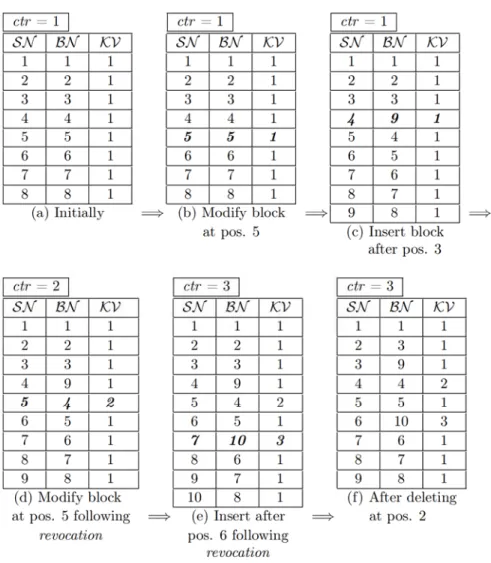
Fig. 2 shows some examples demonstrating the changes in the BST due to dynamic operations on a data fileF ={bj}1≤j≤8. When the file blocks are initially created (Fig. 2a),ctr is initialized to 1, SNj = BNj = j, and KVj = 1: 1 ≤j ≤8. Fig. 2b shows no change for updating the block at position 5 since
no revocation is performed. To insert a new block after position 3 in the fileF, Fig. 2c shows that a new entry h4,9,1i is inserted in the BST after SN3, where 4 is the physical position of the newly inserted
block, 9 is the new logical block number computed by incrementing the maximum of all previous logical block numbers, and 1 is the version of the key used for encryption.
A first revocation in the system incrementsctrby 1 (ctr= 2). Modifying the block at position 5 following a revocation (Fig. 2d) results in setting KV5 = ctr. Thus, the table entry at position 5 becomes h5,4,2i.
Fig. 2e shows that a new block is to be inserted after position 6 following a second revocation, which incrementsctr to be 3. In Fig. 2e, a new table entryh7,10,3i is inserted afterSN6, where KV7 is set to
be equal to ctr (the most recent key version). Deleting a block at position 2 from the data file requires deleting the table entry atSN2 and shifting all subsequent entries one position up (Fig. 2f). Note that
Fig. 2: Changes in the BST due to different dynamic operations on a fileF ={bj}1≤j≤8.SN is the serial number, BN is the block number, and KV is the key version.
5.5 Procedural Steps of the Proposed Scheme
Setup and File Preparation. The setup is done only once during the life time of the data storage
system, which may be for tens of years. The system setup has two parts: one is done on the owner side, and the other is done on the TTP side.
Owner Role. The data owner initializesctrto 1, and generates an initial secret keyKctr/K1.Kctr
can be rotated forward following user revocations, and rotated backward to enable authorized users to access blocks that are encrypted under older versions ofKctr.
For a file F = {bj}1≤j≤m, the owner generates a BST with SNj = BNj = j and KVj = ctr.
where˜bj=EDEK(BNj||bj)and DEK=h(Kctr).2 Moreover, the owner creates a rotatorRot= hctr,bENC(Kctr)i, where bENC enables only authorized users to decrypt Kctr and access the
outsourced file. The owner sends {F ,e BST, Rot} to the TTP, and deletes the data file from its
local storage.
Embedding BNj with the block bj during the encryption process helps in reconstructing the
file blocks in the correct order. If the encrypted blocks{˜bj}1≤j≤m are not corrupted over cloud
servers, but randomly delivered to an authorized user, the latter can utilize the embeddedBNj
and the BST to orderly reconstruct the data fileF. More details will be explained later.
TTP Role. As previously explained, a small part of the owner’s work is delegated to the TTP to reduce the storage overhead and lower the overall system computation. For the TTP to resolve disputes that may arise regarding data integrity/newness, it computes and locally stores com-bined hash values for the encrypted fileFeand the BST. The TTP computesF HT T P =⊕mj=1h(˜bj)
andT HT T P =⊕mj=1h(BNj||KVj), then sends{F ,e BST}to the CSP. The TTP keeps only F HT T P
andT HT T P on its local storage.
Remark 2. The BST is used by the authorized users to reconstruct and access the outsourced data file. The proposed scheme in this work assumes that the data owner isintermittentlyonline and the authorized users are enabled to access the data file even when the owner is offline. To this end, the CSP stores a copy of the BST along with the outsourced data file. When an authorized user requests to access the data, the CSP responds by sending both the BST and the encrypted fileFe.
Moreover, the BST is used during each dynamic operation on the outsourced data file, where one table entry is modified/inserted/deleted with each dynamic change on the block level. If the BST is stored only on the CSP side, it needs to be retrieved and validated each time the data owner wants to issue a dynamic request on the outsourced file. To avoid such communication and computation overheads, the owner keeps a local copy of the BST, and thus there are two copies of the BST: one is stored on the owner side referred to as BSTO, and the other is stored on the CSP side referred to
as BSTC. Recall that the BST is a small dynamic data structure with a table entry size = 8 bytes. For
1GB file with 4KB block size, the BST size is only 2MB (0.2% of the file size). Table 1 summarizes the data stored by each component in the proposed scheme.
TABLE 1:Data stored by each component in the proposed scheme.
Owner TTP CSP
ctr,Kctr, BSTO Rot,F HT T P,T HT T P Fe, BSTC
Dynamic Operations on the Outsourced Data. The dynamic operations in the proposed scheme are performed at the block level via a request in the general formhBlockOp, TEntryBlockOp, j, KVj, h(˜bj), RevFlag, b∗i, where BlockOp corresponds to block modification (denoted byBM), block insertion (denoted by BI), or block deletion (denoted byBD). TEntryBlockOp indicates an entry in BSTO
corre-sponding to the issued dynamic request. The parameter j indicates the block index on which the dynamic operation is to be performed, KVj is the value of the key version at index j of BSTO
before running a modification operation, andh(˜bj) is the hash value of the block at indexj before
modification/deletion. RevFlag is a 1-bit flag (true/false and is initialized to false) to indicate whether a revocation has been performed, andb∗ is the new block value.
Modification. Data modification is one of the most frequently used dynamic operations in the outsourced data. For a fileF ={b1, b2, . . . , bm}, suppose the owner wants to modify a blockbj
with a blockb0
j. Fig. 3 describes the steps performed by each system component (owner, CSP, and
TTP) during block modification. The owner uses the technique of one-sender-multiple-receiver (OSMR) transmission to send the modify request to both the CSP and the TTP.
The TTP updates the combined hash valueF HT T P forFethrough the stepF HT T P =F HT T P⊕
h(˜bj)⊕h(˜b0j), which simultaneously replaces the hash of the old block h(˜bj)with the new one
h(˜b0
j). This is possible due to the basic properties of the⊕operator. The same idea is used when RevFlag= true to update the combined hash value T HT T P on the TTP side by replacing the
hash of the old table entry at indexj with the hash of the new value.
Insertion. In a block insertion operation, the owner wants to insert a new block¯b after index j in a file F ={b1, b2, . . . , bm}, i.e., the newly constructed file F0 ={b1, b2, . . . , bj,¯b, . . . , bm+1},
where bj+1 = ¯b. The block insertion operation changes the logical structure of the file, while
block modification does not. Fig. 4 describes the steps performed by each system component (owner, CSP, and TTP) during block insertion.
Append. Block append operation means adding a new block at the end of the outsourced data. It can simply be implemented via insert operation after the last block of the data file.
Deletion. Block deletion operation is the opposite of the insertion operation. When one block is deleted all subsequent blocks are moved one step forward. Fig. 5 describes the steps performed by each system component (owner, CSP, and TTP) during block deletion. The step F HT T P =
F HT T P⊕h(˜bj)is used to delete the hash value of the block˜bj from the combined hashF HT T P
(properties of⊕operator). The same idea is used with theT HT T P value.
Data Access and Cheating Detection. Fig. 6 shows the verifications performed for the data received
from the CSP, and presents how authorized users get access to the outsourced file.
An authorized user sends a data-access request to both the CSP and the TTP to access the outsourced file. For achieving non-repudiation, the CSP generates two signatures σF and σT for Fe and BSTC,
/*Modification of a blockbj with b0j for the outsourced file*/
/*RevFlagis initialized to false */ Data Owner
1) Ifthe access of one or more users has been revoked then a) RollsKctr forward (using key rotation)
b) Incrementsctr=ctr + 1, and setsRevFlag= true c) Copies KVj from BSTO toKVj (i.e.,KVj=KVj)
d) Sets KVj =ctrin BSTO, and generatesRot=hctr,bENC(Kctr)i
e) SendsRot to the TTP
2) Creates an encrypted block˜b0j=EDEK(BNj||b0j), whereDEK =h(Kctr)
3) Forms a block-modify table entry TEntryBM={BNj,KVj}
4) Sends a modify requesthBM, TEntryBM, j, KVj, h(˜bj), RevFlag, ˜b0jito both the CSP and the TTP
(OSMR transmission), where h(˜bj)is the hash of the outsourced block to be modified. The KVj is
not sent in the modify request if RevFlag= false
5) The CSP accepts the modify request only if {BNj,KVj}sent from the owner matches{BNj,KVj}
in BSTC, andh(˜bj)is equal to the hash of the block˜bj on the cloud server (to guarantee that correct
values are sent to the TTP)
CSP /*upon accepting the modify request from the owner */ 1) Replaces the block bj withb0j in the outsourced fileFe
2) IfRevFlag= true then
Updates the table entry at index j of BSTC using TEntryBMcomponents
TTP
1) UpdatesF HT T P =F HT T P⊕h(˜bj)⊕h(˜b0j)
2) IfRevFlag= true then
a) Updates the previously storedRot with the newly received value b) UpdatesT HT T P =T HT T P⊕h(BNj||KVj)⊕h(BNj||KVj)
Fig. 3:Block modification procedure in the proposed scheme.
respectively. The authorized user receives {Fe, BSTC σF, σT} from the CSP, and {F HT T P, T HT T P,
Rot} from the TTP. The authorized user verifies the signatures, and proceeds with the data access procedure only if both signatures are valid.
The authorized user verifies the contents of BSTC entries by computing a combined hash value
/*Insertion of a block¯bafter indexj in the outsourced file*/ /*RevFlagis initialized to false */
Data Owner
1) Ifthe access of one or more users has been revoked then a) RollsKctr forward (using key rotation)
b) Incrementsctr=ctr + 1, and setsRevFlag= true c) GeneratesRot=hctr,bENC(Kctr)i
d) SendsRot to the TTP
2) Constructs a new block-insert table entry TEntryBI = {BNj+1,KVj+1} = {1 + M ax{BNj}1≤j≤m,
ctr}, and inserts this entry in BSTO after indexj
3) Creates an encrypted block˜¯b=EDEK(BNj||¯b), whereDEK =h(Kctr)
4) Sends an insert request hBI, TEntryBI, j, null, null, RevFlag, ˜¯bi to both the CSP and the TTP (OSMR transmission)
CSP /*upon receiving the insert request from the owner */ 1) Inserts the block˜¯b after indexj in the outsourced fileFe
2) Inserts the table entry TEntryBIafter indexj in the BSTC
TTP
1) UpdatesF HT T P =F HT T P⊕h(˜¯b)
2) UpdatesT HT T P =T HT T P ⊕h(BNj+1||KVj+1)
3) IfRevFlag= true then
Replaces the previously storedRot with the newly received value
Fig. 4:Block insertion procedure in the proposed scheme.
TTP. If the authorized user claims thatT HU 6=T HT T P, a report is issued to the owner and the TTP
is invoked to determine the dishonest party.
In case of T HU = T HT T P, the authorized user continues to verify the contents of the file Fe. A
combined hash value F HU = ⊕mj=1h(˜bj) is computed and compared with F HT T P. If there is a
dispute that F HU 6= F HT T P, the owner is informed and we resort to the TTP to resolve such a
conflict.
For the authorized user to access the encrypted file Fe = {˜bj}1≤j≤m, BSTC and Rot are used to
generate the key DEK that decrypts the block˜bj. bENC(Kctr) is decrypted to get the most recent
key Kctr. Using the key rotation technique, the authorized user rotates Kctr backward with each
/*Deletion of a blockbj from the outsourced file */
Data Owner
1) Copies the entry at indexj from BSTO to a block-delete table entry TEntryBD ={BNj,KVj}
2) Deletes the entry at indexj from BSTO
3) Sends a delete request hBD, TEntryBD, j, null, h(˜bj), false, nulli to both the CSP and the TTP
(OSMR transmission), whereh(˜bj) is the hash of the outsourced block to be deleted
4) The CSP accepts the delete request only if TEntryBDsent from the owner matches {BNj,KVj} in
BSTC and h(˜bj) is equal to the hash of the block˜bj on the cloud server (to guarantee that correct
values are sent to the TTP).
CSP /*upon receiving the delete request from the owner */
1) Deletes the block at indexj (block˜bj) from the outsourced fileFe
2) Deletes the entry at indexj from the BSTC
TTP
1) UpdatesF HT T P =F HT T P⊕h(˜bj)
2) UpdatesT HT T P =T HT T P ⊕h(BNj||KVj)
Fig. 5:Block deletion procedure in the proposed scheme.
KVj can determine how many rotation steps for Kctr with each block˜bj. Decrypting the block ˜bj
returns(BNj||bj).BNj and BSTCare utilized to get the physical block positionSNj into which the
blockbj is inserted, and thus the fileF is reconstructed in plain form.
Optimization. In Fig. 6, the backward key rotation done in the inner for loop of step 7.b can be highly optimized by computing a set of keysQ={Ki}fromKctr. Each key Ki inQis the result of
rotating Kctr backward ctr−i times. For example, ifctr = 20, a setQ={K1, K5, K10, K15} can be
computed fromKctr. To decrypt a block˜bj, the authorized user chooses one keyKi from Q, which
has the minimum positive distancei− KVj. The key Ki is then rotated backward to get the actual
key that is used to decrypt the block ˜bj. A relatively large portion of the outsourced data is kept
unchanged on the CSP, and thusK1fromQcan be used to decrypt many blocks without any further
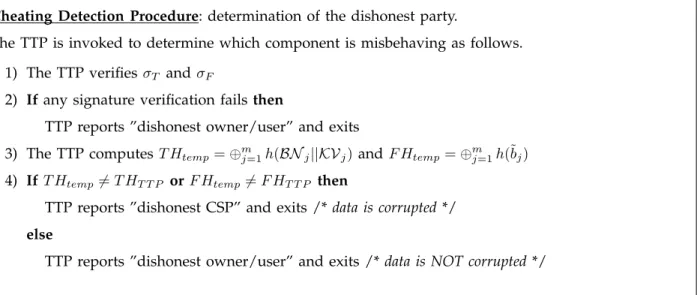
key rotation. The size of the setQis negligible compared with the size of the received data file. Fig. 7 shows how the TTP determines the dishonest party in the system. The TTP verifies the signatures σT and σF, which are previously verified and accepted by the authorized user. If any
signature is invalid, this indicates that the owner/user is dishonest for corrupting either the data or the signatures. In case of valid signatures, the TTP computes temporary combined hash values T Htemp =⊕mj=1h(BNj||KVj) andF Htemp =⊕mj=1h(˜bj). If T Htemp 6=T HT T P orF Htemp 6=F HT T P,
1) An authorized user sends a data-access request to both the CSP and the TTP
2) The CSP responds by sending the outsourced file Fe = {˜bj}1≤j≤m associated with a signature σF
(CSP’s signature on the entire file), and sending BSTCassociated with a signatureσT (CSP’s signature
on the entire table) to the authorized user
3) The authorized user verifiesσF andσT, and accepts the data only ifσF andσT are valid signatures
4) The TTP sendsF HT T P ,T HT T P, and Rot=hctr,bENC(Kctr)ito the authorized user
5) Verification of the BSTC entries
a) The authorized user computesT HU =⊕mj=1h(BNj||KVj)
b) Ifthe authorized user claims thatT HU 6=T HT T P thenreport ”integrity violation” to the owner
and invoke cheating detection procedure (Fig. 7) 6) Verification of the data file Fe
a) The authorized user computesF HU =⊕mj=1h(˜bj)
b) If the authorized user claims that F HU 6= F HT T P then report ”integrity violation” to the
owner and invoke cheating detection procedure (Fig. 7) 7) Data access
a) The authorized user getsKctr by decryptingbENC(Kctr)part inRot
b) forj = 1 to mdo
/*rotate backward the current Kctr to the version that is used to decrypt the block˜bj */
– SetKj =Kctr
– for i= 1 toctr -KVj do
. Kj =(Kj)e modN /*N is the RSA modulus and(N, e)is the RSA public key */
end for
– (BNj||bj)= EDEK−1 (˜bj), whereDEK =h(Kj)
– Get the physical positionSNj ofbj usingBNj and BSTC
– The authorized user placesbj in the correct order of the decrypted fileF
end for
Fig. 6:Data access procedure in the proposed scheme.
this indicates that the CSP is dishonest for sending corrupted data to the authorized user, otherwise the owner/user is dishonest for falsely claiming integrity violation of received data.
Cheating Detection Procedure: determination of the dishonest party.
The TTP is invoked to determine which component is misbehaving as follows. 1) The TTP verifiesσT and σF
2) Ifany signature verification failsthen
. TTP reports ”dishonest owner/user” and exits
3) The TTP computesT Htemp=⊕mj=1h(BNj||KVj)and F Htemp=⊕mj=1h(˜bj)
4) IfT Htemp6=T HT T P orF Htemp6=F HT T P then
. TTP reports ”dishonest CSP” and exits /*data is corrupted*/ else
. TTP reports ”dishonest owner/user” and exits /*data is NOT corrupted*/
Fig. 7:Cheating detection procedure in the proposed scheme.
6
SECURITY
ANALYSIS
In this section we investigate the security features of the proposed cloud storage scheme.
• Data confidentiality. The outsourced data is kept secret; the data owner creates an encrypted versionFe
of the data fileF={bj}1≤j≤m. The encryption of each blockbj is done using a keyDEK=h(Kctr),
whereKctr is accessed only by the data owner and the authorized users.
• Detection of data integrity violation. Due to preimage and second-preimage resistance properties of the
used cryptographic hash function halong with the non-collusion incentive of the TTP, the data (Fe
and BSTC) cannot be corrupted on cloud servers without being detected. We explain this feature
for the outsourced fileFe, and the same ideas are applied to BSTC. During the data access phase of
the proposed scheme, the authorized user receives Fe ={˜bj}1≤j≤m and the authentic F HT T P from
the CSP and the TTP, respectively. The authorized user computes F HU = ⊕mj=1h(˜bj), and checks
F HU ?
= F HT T P. If F HU 6= F HT T P, then Fe has been corrupted on the server. For violating data
integrity without being detected there are two possible scenarios. First, the CSP has to send a file
e
F0={˜b0j}1≤j≤min which at least one block˜b0j6= ˜bj, buth(˜b0j) =h(˜bj)∀j. Due to the second-preimage
resistance property ofh, there is no such a fileFe0. Second, the CSP has to generate values{h∗j}1≤j≤m
such that F HT T P =⊕mj=1h ∗
j, and at least oneh∗j 6=h(˜bj). If the CSP could create blocks {b∗j}1≤j≤m
with h∗j =h(b∗j)∀j, the cheating is possible. Due to the preimage-resistance property of h(one-way function), the CSP cannot generate such blocks{b∗j}1≤j≤m.
Remark 3. The encrypted block˜bj =EDEK(BNj||bj).BNj is embedded with the blockbjto be used
along with BSTC to orderly reconstruct the fileF if the blocks{bj}1≤j≤mare randomly received. It
BSTC without changing their contents can cause the fileF to be reconstructed in an incorrect order.
Although the CSP has no incentive and no financial benefit of doing such swapping, one can defend this weird behavior by storing the BN column of BSTO on the TTP side. The authorized user can
retrieve and use this column during the data access phase. This countermeasure adds little extra storage on the TTP (4mbytes).
• Assurance of newness property. Assurance of newness property is identical to detection of data integrity
violation. With each dynamic operation (modification, insertion, deletion, append), the TTP update the valuesF HT T P andT HT T P to reflect the most recent state of the outsourced data. Thus, the CSP
cannot respond to an access request by sending stale data without being detected.
• Enforcement of access control. The proposed scheme combines the techniques of lazy revocation, key
rotation, and broadcast encryption to enforce access control of outsourced data. It is acceptable for revoked users to access unmodified data blocks. However, updated/new blocks must not be accessed by such revoked users. In case of data modification/insertion following a revocation, the data owner rollsKctr forward:Kctr+1 =Kctrd modN, and then incrementsctrby 1 (preparing for next rotation).
The owner createsRot=hctr,bENC(Kctr)i. Only authorized users can decryptbENC(Kctr)and get
Kctr to read the outsourced data, and thus the access control is achieved in the proposed scheme. • Detection of dishonest owner/user. The CSP signs both the file Fe and the table BSTC. The generated
signaturesσF andσT are sent along withFeand BSTCto the authorized user during the data access
phase. If the signature scheme is existentially unforgeable, the owner/user cannot falsely accuse the CSP regarding data integrity; the TTP performs signature verifications if there is a claim of data corruption. Recall that the signaturesσF and σT are accepted by the authorized user as valid
signatures in the beginning of the data access phase (step 3 in Fig. 6).
7
PERFORMANCE
ANALYSIS AND
EXPERIMENTAL
EVALUATION
The fileF used in our performance analysis and experimental evaluation is of size 1GB with 4KB block size. Without loss of generality, we assume that the desired security level is 128-bit. Thus, we utilize a cryptographic hash hof size 256 bits (e.g., SHA-256), an elliptic curve defined over Galois field GF(p) with|p|= 256 bits (used forbENC), and BLS (Boneh-Lynn-Shacham) signature [48] of size 256 bits (used to compute σF and σT).
7.1 Performance Analysis
Here we evaluate the performance of the proposed scheme by analyzing the storage, communication, and computation overheads. We investigate overheads that the proposed scheme brings to a cloud storage system forstaticdata with only confidentialityrequirement. This investigation demonstrates whether the features of our scheme come at a reasonable cost. The computation overhead is estimated in terms of the used cryptographic functions, which are notated in Table 2.
TABLE 2:Notation of cryptographic functions
Notation Description
h Cryptographic hashing F R Forward key rotation BR Backward key rotation
Sσ Signature genration Vσ Signature verification
bENC−1 Decryption ofbENC
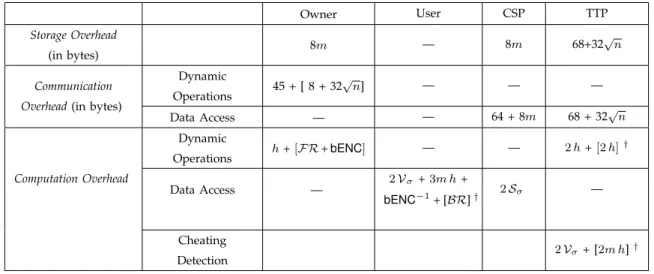
Let m and n denote the number of file blocks and the total number of system users, respectively. Table 3 presents a theoretical analysis for the storage, communication, and computation overheads of the proposed scheme. The notation [*] indicates that the parameter * does not always exist in the overhead expression.
TABLE 3:Overhead analysis of the proposed scheme. The notation [*] indicates that the parameter * does not always exist in the overhead expression.†The⊕is not considered (negligible effect)
Owner User CSP TTP Storage Overhead (in bytes) 8m — 8m 68+32 √ n Communication Overhead(in bytes)
Dynamic Operations 45 + [ 8 + 32 √ n] — — — Data Access — — 64 + 8m 68 + 32√n Computation Overhead Dynamic Operations h+[F R+bENC] — — 2h+[2h] † Data Access — 2 Vσ +3m h+ 2Sσ — bENC−1+ [BR]† Cheating Detection 2 Vσ+ [2m h]† 7.2 Comments
Storage overhead is the additional storage space used to store necessary information other than the outsourced file Fe. The overhead on the owner side is due to storing BSTO. An entry of BSTO is of
size 8 bytes (two integers), and the total number of entries equals the number of file blocks m. During implementationSN is not needed to be stored in BSTO; SN is considered to be the entry/table index
(BSTO is implemented as a linked list). The size of BSTO for the file F is only 2MB (0.2% of F). BSTO
size can be further reduced if the file F is divided into larger blocks (e.g., 16KB). Like the owner, the storage overhead on the CSP side comes from the storage of BSTC. To resolve disputes that may arise
regarding data integrity or newness property, the TTP stores F HT T P and T HT T P, each of size 256 bits.
Besides, the TTP storesRot=hctr,bENC(Kctr)ithat enables the data owner to enforce access control for
the outsourced data. ctris 4 bytes, and bENC has storage complexityO(√n), which is practical for an organization (data owner) withn= 100,000 users. A point on the elliptic curve used to implementbENC
can be represented by 257 bits (≈32 bytes) using compressed representation [49]. Therefore, the storage overhead on the TTP side is close to 10KB, which is independent of the outsourced file size. Overall, the storage overhead of the proposed scheme for the fileF is less than 4.01MB (≈0.4% ofF).
The communication overhead is the additional information sent along with the outsourced data blocks. During dynamic operations, the communication overhead on the owner side comes from the transmission of a block operation BlockOP (can be represented by 1 byte), a table entry TEntryBlockOP (8 bytes), and a block index j (4 bytes). If a block is to be modified following a revocation process, KVj (4 bytes) is
sent to the TTP. Moreover, in case of a block modification/deletion, the owner sends a hash (32 bytes) of the block to be modified/deleted to the TTP for updating F HT T P. Recall that the owner also sends
Rot (4 + 32√n bytes) to the TTP if block modifications/insertions are to be performed following user revocations. Therefore, in the worst case scenario (i.e., block modifications following revocations), the owner’s overhead is less than 10KB. TheRotrepresents the major factor in the communication overhead, and thus the overhead is only 45 bytes if block modification/deletion operations are to be preformed without revocations (only 13 bytes for insertion operations). In practical applications, the frequency of dynamic requests to the outsourced data is higher than that of user revocations. Hence, the communication overhead due to dynamic changes on the data is about 1% of the block size (the block is 4KB in our analysis).
As a response to access the outsourced data, the CSP sends the file along withσF (32 bytes),σT (32
bytes), and BSTC (8m bytes). Moreover, the TTP sendsF HT T P (32 bytes), T HT T P (32 bytes), and Rot.
Thus, the communication overhead due to data access is 64 +8mbytes on the CSP side, and 68 +32√n bytes on the TTP side. Overall, to access the fileF, the proposed scheme has communication overhead
≈0.2% ofF.
A cloud storage system for static data with only confidentiality requirement has computation cost for encrypting the data before outsourcing and decrypting the data after being received from the cloud servers. For the proposed scheme, the computation overhead on the owner side due to dynamic operations (modification/insertion) comes from computingDEK =h(Kctr), i.e., the overhead is one hash operation.
If a block modification/insertion operation is to be performed following a revocation of one or more users, the owner performs F R to rollKctr forward, and bENCto generate the Rot. Hence, the computation
overhead on the owner side for the dynamic operations ish+F R+bEnc(worst case scenario). Updating BSTOand BSTCis done without usage of cryptographic operations (add, remove, or modify a table entry).
To reflect the most recent version of the outsourced data, the TTP updates the values F HT T P and
on the TTP side. Therefore, the maximum computation overhead on the TTP side for updating both F HT T P andT HT T P is 4h.
Before accessing the data received from the CSP, the authorized user verifies two signatures (generated by the CSP), BSTCentries, and the data file. These verifications cost2Vσ+2m h. Moreover, the authorized
user decryptsbENC(Kctr) part in theRotto getKctr. For each received block,Kctris rotated backward to
obtain the actual key that is used to decrypt the data block. The optimized way of key rotation (using the setQ) highly affects the performance of data access; many blocks need a few or no rotations. Moreover, one hash operation is performed per block to computeDEK. Overall, the computation overhead due to data access is2Vσ +3m h +bENC−1 + [BR] on the owner side, and 2Sσ on the CSP side.
For determining a dishonest party, the TTP verifies σT and σF. In case of valid signatures, the TTP
proceeds to compute T Htemp and F Htemp. The values T Htemp and F Htemp are compared withT HT T P
and F HT T P, respectively. Hence, the maximum computation overhead on the TTP side due to cheating
detection is2Vσ +2m h.
7.3 Experimental Evaluation
In this section we experimentally evaluate the computation overhead the proposed scheme brings to a cloud storage system that has been dealing with static data with only confidentiality requirement. The experiments are conducted using C++ on a system with an Intel(R) Xeon (R) 2-GHz processor and 3GB RAM running Windows XP. Algorithms (hashing, broadcast encryption, digital signatures, etc.) are implemented using MIRACL library version 5.5.4. For a 128-bit security level,bENCuses an elliptic curve with a 256-bit group order. In the experiments, we utilize SHA-256, 256-bit BLS signature, and Barreto-Naehrig (BN) [50] curve defined over prime fieldGF(p)with |p|= 256 bits and embedding degree = 12 (the BN curve with these parameters is provided by the MIRACL library).
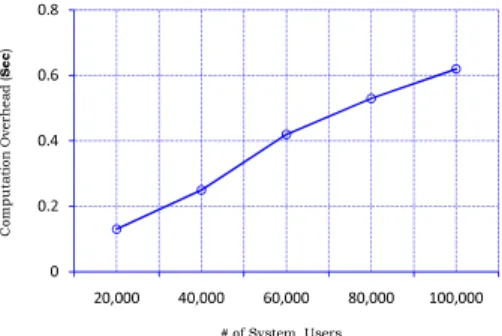
To evaluate the computation overhead on the owner side due to dynamic operations, we perform 100 different block operations from which 50% are executed following revocations (this percent is higher than an average value in practical applications). For different number of system users, Fig. 8 shows the owner’s average computation overhead per operation.
Ϭ Ϭ͘Ϯ Ϭ͘ϰ Ϭ͘ϲ Ϭ͘ϴ ϮϬ͕ϬϬϬ ϰϬ͕ϬϬϬ ϲϬ͕ϬϬϬ ϴϬ͕ϬϬϬ ϭϬϬ͕ϬϬϬ Co mp ut ati on O ve rh ea d ( S ec ) # of System Users
Scalability (i.e., how the system performs when more users are added) is an important feature of cloud storage systems. The access control of the proposed scheme depends on the square root of the total number of system users. Fig. 8 shows that for a large organization with 100,000 users, performing dynamic operations and enforcing access control for outsourced data remains practical (0.62 seconds).
In the worst case, the TTP executes only 4 hashes per dynamic request to reflect the change on the outsourced data. Thus, the maximum computation overhead on the TTP side is about 0.08 milliseconds, i.e., the proposed scheme brings light overhead on the TTP during the normal system operations.
The computation overhead on the user side due to data access comes from five aspects divided into two groups. The first group involves signatures verification and hash operations to verify the received data (file and table). The second group involves broadcast decryption, backward key rotations, and hash operations to compute theDEK. The first group costs about 10.77 seconds, which can be easily hidden in the receiving time of the data (1GB file and 2MB table).
To investigate the computation time of the second group, we access the file after running 100 different block operations (50% of them are done following revocations). Moreover, we implement the backward key rotations in the optimized way. The second group costs about 1.03 seconds, which can be considered as the user’s computation overhead due to data access.
As a response to the data access request, the CSP computes two signatures: σF and σT. Thus, the
computation overhead on the CSP side due to data access is about 10.75 seconds and can be easily hidden in the transmission time of the data (1GB file and 2MB table).
To identify the dishonest party in the system in case of disputes, the TTP verifies two signatures (σF
and σT), computes combined hashes for the data (file and table), and compare the computes hashes
with the authentic values (T HT T P and F HT T P). Thus, the computation overhead on the TTP side is
about 10.77 seconds. Through our experiments, we use only one desktop computer to simulate the TTP and accomplish its work. In practice, the TTP may choose to split the work among a few devices or use a single device with a multi-core processor which is becoming prevalent these days, and thus the computation time on the TTP side is significantly reduced in many applications.
8
C
ONCLUSIONSOutsourcing data to remote servers has become a growing trend for many organizations to alleviate the burden of local data storage and maintenance. In this work we have studied different aspects of outsourcing data storage: block-level data dynamic, newness, mutual trust, and access control.
We have proposed a cloud-based storage scheme which supports outsourcing of dynamic data, where the owner is capable of not only archiving and accessing the data stored by the CSP, but also updating and scaling this data on the remote servers. The proposed scheme enables the authorized users to ensure that they are receiving the most recent version of the outsourced data. Moreover, in case of dispute regarding data integrity/newness, a TTP is able to determine the dishonest party. The data owner enforces access