R E S E A R C H G R O U P F O R
Distributed Systems
Master’s Thesis
at the Institute for Pervasive Computing, Department of Computer Science, ETH Zurich
Scalability for IoT Cloud Services
by Martin Lanter
Spring 2013
ETH student ID: 08-928-368
E-mail address: [email protected] Supervisors: Dipl.-Ing. Matthias Kovatsch
Prof. Dr. Friedemann Mattern Date of submission: 15 October 2013
Declaration of Originality
I hereby declare that this written work I have submitted is original work which I alone have authored and which is written in my own words.
With the signature I declare that I have been informed regarding normal academic citation rules and that I have read and understood the information on ’Citation etiquette:’
http://www.ethz.ch/students/exams/plagiarism_s_en.pdf
The citation conventions usual to the discipline in question here have been respected. This written work may be tested electronically for plagiarism.
Zurich, 15 October 2013
Acknowledgements
Many thanks to Matthias Kovatsch for his dedicated support and the inspiring discussions we had about the Internet of Things. Special thanks for the opportunity to write on a scientific paper and our proposal for the blockwise transfer of CoAP messages.
Special thanks to the IT Service Group (ISG) of the Computer Science Department at ETH Zurich for the provision and setup of two NUMA machines for my server bench-marks.
I would like to gratefully and sincerely thank my parents for their lifelong support for everything I do. Your support allowed me to focus on my studies, projects, and in particular this thesis.
Abstract
The Internet of Things (IoT) is envisioned as a global network of billions of smart devices. Traditional protocols known from the Internet do not fit well with the constrained environment these devices typically are found in. Thus, the IETF has standardized the Constrained Application Protocol (CoAP). Devices can communicate over CoAP and be integrated into Cloud services. We focus on the backend of such services that run on an unconstrained machine. High numbers of services and especially clients call for efficient processing and scalable services with high throughput. HTTP server architectures that perform well in regards to these properties have been researched for over 15 years. We analyze HTTP server designs thoroughly and apply the lessons learned to a new CoAP framework for IoT Cloud services, a re-implementation of Californium (Cf). We present a CoAP server design that is scalable and able to fully utilize a modern multi-core computer. We evaluate our new and the old version of Californium and five HTTP servers on a 4-core SMP and a 16-core NUMA system. Our implementation achieves a throughput of about 140,000 requests per second and even outperforms state-of-the art HTTP servers by 15%-45%. The results substantiate that CoAP is superior to HTTP for IoT services not only in constrained but also unconstrained environments. Furthermore, we propose a powerful, yet simple API to develop scalable services for the IoT Cloud in an efficient and productive way.
Contents
Abstract vii Acronyms xi Objectives xiii 1 Introduction 1 1.1 Background . . . 1 1.2 Related Work . . . 2 1.3 Outline . . . 3 2 CoAP vs. HTTP 5 2.1 Conceptual Comparison . . . 62.2 Server Specific Comparison . . . 8
3 Server Architectures 11 3.1 Multi-Process . . . 11
3.2 Multi-Threaded . . . 12
3.3 Single-Process Event-Driven . . . 13
3.4 Asynchronous Multi-Process Event-Driven . . . 14
3.5 Staged Event-Driven Architecture . . . 15
3.6 Multi-Threaded Pipelined . . . 15
3.7 Comparison . . . 16
3.8 Alternative Scalability Strategies . . . 17
4 Design 19 4.1 Design Goals . . . 19 4.1.1 Completeness . . . 19 4.1.2 Scalability . . . 20 4.1.3 Flexibility . . . 20 4.1.4 Usability . . . 20 4.1.5 Understandability . . . 20 4.2 Architecture . . . 21 4.2.1 Resource . . . 22 4.2.2 Endpoint . . . 22 4.2.3 Connector . . . 23
Contents 4.3 Concurrency Model . . . 24 5 Implementation 29 5.1 Messages . . . 29 5.2 Exchange . . . 31 5.3 Layer Interface . . . 33 5.4 Synchronization . . . 34 5.5 Separate Stacks . . . 35 6 Performance Evaluation 37 6.1 Experimental Environment . . . 38
6.2 Californium vs. Old Californium . . . 39
6.3 HTTP Servers . . . 40
6.4 Performance on a Many-Core System . . . 45
6.5 Discussion . . . 47
7 Optimization 51 8 Application Programming Interface 55 8.1 Design Guidelines . . . 55
8.2 Novice-Friendly Client API . . . 58
8.3 Novice-Friendly Server API . . . 59
9 Conclusion 63
Bibliography 65
Acronyms
AMPED Asynchronous Multi-Process Event-Driven API Application Programming Interface
CoAP Constrained Application Protocol DTLS Datagram Transport Layer Security HTTP Hypertext Transfer Protocol IETF Internet Engineering Task Force IoT Internet of Things
JVM Java Virtual Machine MID message identifier MP Multi-Process MT Multi-Threaded
NUMA Non-Uniform Memory Access PIPELINED Multi-Threaded Pipelined REST Representational State Transfer SEDA Staged Event-Driven Architecure SPED Single-Process Event-Driven TCP Transmission Control Protocol UDP User Datagram Protocol
Objectives
The student will evaluate alternative API designs in terms of learnability, usability, main-tainability, extendibility, and efficiency. The most promising solution shall be implemented to improve functional scalability of the framework.
The student shall re-design Cf’s internal architecture to improve load scalability, i.e., the throughput of handled requests.
The student shall make use of an appropriate testbed that enables stress testing the system.
CoAP shall be compared to HTTP in an M2M scenario. Throughput, latency, and reliability shall be evaluated using the testbed and a deployment of real devices, which will be provided.
1 Introduction
The vision of the Internet of Things (IoT) is a world in which billions of everyday objects are interconnected and extend today’s Internet pervasively into our daily lives. Sensors and actuators of all forms and purposes and even the infrastructure of whole cities are expected to be globally accessible and controllable in real-time [31]. Driven by Moore’s law, the density of transistors continuously increases. Nevertheless, chip manufacturers are more likely to utilize technological advances by reducing the size, costs and energy-consumption of devices instead of their computing power [7]. Therefore, these devices and their ability to communicate with others are constrained and traditional protocols known from the Internet do not fit well. TheInternet Engineering Task Force (IETF) has standardized the Constrained Application Protocol (CoAP) which is designed for the constrained environment that we find within the IoT [42].
CoAP implements a subset of HTTP’s RESTful [18] operations (GET, POST, PUT and DELETE) and allows for a straight-forward mapping between the two protocols. Therefore, they are often referred to as being cousins. However, CoAP has its own mechanisms for (optional) reliability, observation, group communication, and discovery of resources.
An essential part of the IoT is the autonomous, smart behavior of its devices. A middleware allows building services that run in the Cloud and interoperate with devices. Interoperability can be bidirectional in the sense that services access and control devices and vice versa. Services can be combined to build new services and top-level applications can be built to export the system’s functionality to the end-user [2, 9]. We focus on the backend of services. We assume services to run on a strong, unconstrained machine and simultaneously processing requests in the role of a server or send requests in the role of a client.
1.1 Background
In 2011, the Californium (Cf) project started at ETH Zurich. Cf is a modular, open-source framework that facilitates deployment of backend services [25]. Cf serves as intermediary between the logic of a service and the IoT, i.e., it abstracts the communication over CoAP and provides the developer with a powerful API to develop services in an efficient and productive way. A first version of Californium was intended as prototype and “running
1 Introduction
code” implementation of the CoAP standard and has progressively grown to test CoAP extensions. In 2012, support for DTLS [22, 39] and CoAP and HTTP proxies [14] were added to Cf. Actinium (Ac) [24] is a runtime container for JavaScript services built upon Cf. Ac exposes a RESTful interface to install, configure, and update JavaScript services, which can build an arbitrary resource structure to export their functionality.
Originally not designed for multi-threading, Cf does not scale well in the presence of a multi-core processor. The belated addition of multiple threads has led to race conditions, e.g., with non-thread-safe caches. The design of a static message gateway, called a “communicator,” limits Cf to one port only, and therefore to only one transport protocol, one CoAP processing implementation and one tree of resources. In particular, the integration of DTLS and proxies was not seamless. Furthermore, Cf contained several bugs and inconveniences that required incisive reimplementation. Therefore, it appeared more economical to start over and use the learned lessons from the first version to design and implement a new, second version with a better architecture, higher efficiency, and scalability and an improved API. In this thesis, we call the first version “Old Californium (OCf)” and our new solution “Californium (Cf)”.
Hosting a high number of services that all communicate with a large amount of devices can lead to significant demand in computing power and message throughput. Our goal is to design and implement a server that is able to utilize today’s prevalent multi-core processors to perform well in both regards. Architectures that improve the throughput of servers have been subject to research for over 15 years, albeit with focus to CoAP’s cousin HTTP. We believe that insights into architectures for HTTP servers are invaluable for the design of a CoAP server. Therefore, this thesis gives a detailed survey in the field of server-architecture design and discusses implications that go inherent with CoAP and HTTP. With the knowledge gained from OCf and HTTP servers, we design a new scalable CoAP server architecture for Californium and compare its throughput to OCf and five state-of-the-art HTTP servers.
1.2 Related Work
Several CoAP implementations already exist and either target constrained or unconstrained platforms. CoAPBlip for TinyOS [36], CoAPSharp1 for the .NET Micro Framework, SMCP2, libcoap [26], and Erbium (Er) for Contiki [23] are optimized for embedded devices. Although these libraries could also be deployed on an unconstrained platform, they are not designed for scalability and are not suitable for developing and maintaining complex service systems. Sensinode3has developed the “Sensinode NanoService Platform” that includes libraries in C and Java for devices. These libraries are commercial and not
1http://www.coapsharp.com/, October 10, 2013
2https://github.com/darconeous/smcp, October 10, 2013 3http://www.sensinode.com/, October 10, 2013
1.3 Outline
publicly available. For unconstrained platforms, there is the CoAP Python library by UC Berkeley4, which primarily targets easy interaction with devices, though. The two Java frameworks jCoAP5 and nCoap6both target unconstrained platforms and are best comparable to Californium. However, both do not implement the latest CoAP draft version 18 and are still in an early optimization stage. Therefore, we cannot yet compare Californium to those systems. None of these projects focus on scalability to the extent that this thesis does. To the best of our knowledge, there is no related work on this topic yet. Commercial solutions might have similar goals but there are no results published yet.
1.3 Outline
The particular, the contributions of this thesis are:
1. An extensive scalability evaluation of CoAP for service backends in comparison to HTTP solutions.
2. The design of a scalable, efficient and extensible architecture for CoAP servers and a simple open-source CoAP implementation.
3. A novice-friendly API for synchronous and asynchronous CoAP operations 4. A generic, distributed benchmark tool for CoAP servers
Chapter 2 explains and compares CoAP and HTTP in detail and discusses different requirements for respective servers. In Chapter 3, we present six server architectures and variations that were proposed during the last 15 years. We will use the gained knowledge to design a new architecture for Californium in Chapter 4. Design decisions and implementation details are covered in Chapter 5. In Chapter 6, we evaluate Cf, OCf and five HTTP servers on a commodity quad-core notebook and on a many-core NUMA system and discuss the results with respect to scalability in terms of multiple cores and large number of concurrent clients. Chapter 7 points out some optimizations that improved Californium’s performance on different platforms. Chapter 8 presents our new novice-friendly API to develop CoAP services and to send asynchronous and synchronous CoAP requests. Finally, we conclude in Chapter 9.
4http://www.openwsn.org/, October 10, 2013
5http://code.google.com/p/jcoap/, October 10, 2013 6https://github.com/okleine/nCoAP, October 10, 2013
2 CoAP vs. HTTP
TheConstrained Application Protocol (CoAP) understands itself as “a specialized web transfer protocol for use with constrained nodes and constrained [. . . ] networks” [42]. In the IoT, constraints on nodes typically emerge in terms of limited power supply, manu-facturing costs, RAM, ROM, and generally low processing capabilities. Yet, constrained nodes, i.e., devices, are powerful enough to send and receive network packets and benefit from a connection to the Internet as they can be integrated into a distributed service. A protocol such as theHypertext Transfer Protocol (HTTP) [5,17], however, is too expensive in terms of implementation code space and network resource usage [7]. Therefore, CoAP has been designed to serve as a powerful, yet simple communication protocol in such an environment. Since CoAP can easily be mapped to HTTP and since both follow the Rep-resentational State Transfer (REST) architectural style, CoAP and HTTP applications can be connected via transparent proxies and integrated into the same system. HTTP is based on the reliableTransmission Control Protocol (TCP) [35]. Its reliability encompasses not only the autonomic retransmission of unacknowledged messages but also duplicate detection, message ordering, segmentation of large messages, and flow and congestion control. CoAP instead is based on the unreliableUser Datagram Protocol (UDP) [34], and therefore has to implement certain guarantees of TCP on its own. Since TCP was developed for the unconstrained Internet, CoAP uses different techniques that better suit the constrained environment.
An entity participating in the CoAP protocol is called an endpoint [42]. An endpoint lives on a network node and is identified by its IP address, port, and security associa-tion. CoAP can be thought of as having two sublayers: the request/response-layer and the message-layer. Messages are either confirmable (CON), non-confirmable (NON), acknowledgements (ACK) or resets (RST). Confirmable and non-confirmable messages carry requests or responses. When an endpoint receives a confirmable message, it replies with an acknowledgement. The response to a confirmable request can be sent piggy-backed with the ACK or in a separate confirmable response. An endpoint retransmits confirmable messages with an exponentially increasing back-off timer until it receives an acknowledgement, a reset or the maximum retransmission count is reached. 1 If an endpoint receives a CON or NON that it does not know how to process, it rejects it with a RST. A message is identified by a message ID (MID) and an endpoint needs to temporarily remember incoming MIDs to detect duplicates. On the request/response-layer, requests have a method code (GET, POST, PUT, or DELETE) and responses have a response
2 CoAP vs. HTTP
code (either of class 2.xx (success), 4.xx (client error), or 5.xx (server error)). A token, chosen by the client, serves as identifier for a request. The server endpoint must include the request token in the response so that the client endpoint knows to which request the response belongs to. Additionally, CoAP requests and responses can be accompanied by simple options, similar to HTTP header options. For example, options may describe the content format or destination URI.
It is important to note that CoAP is more than just a compressed form of HTTP and moreover provides several features that are beneficial in an M2M application. In this section, we discuss how CoAP + UDP are superior to HTTP + TCP in constrained environments.
2.1 Conceptual Comparison
Fewer messages: A typical CoAP exchange consists of 2 messages, i.e., a request and a response. In contrast, an HTTP request first requires the client to establish a TCP connection and later terminate it. This results in at least 9 messages for only one request [11]. Note that this argument is not necessarily true for large payloads. After TCP’s slow-start phase, it is able to send multiple packets at once and acknowledge all of them with a single acknowledgement. CoAP’s blockwise transfer [8] though, requires an acknowledgement for each block and leads to more messages and higher transfer time. Since we expect the majority of CoAP messages to be rather short, this is of less importance. However, CoAP’s blockwise mechanism allows a constrained server to not only receive but also process a large request block-by-block. This would not be possible if we used HTTP and TCP.
Compressed format: CoAP encodes option values in binary format while an HTTP request is one large, verbose text. This saves the effort for converting numbers as text to integers and makes the encoding more compact in general. A minimum CoAP header is only 4 bytes long and a minimum UDP header is only 8 bytes long. In contrast, a minimum TCP header alone is 20 bytes long plus what comes from HTTP2. As a result, a message occupies less memory in a buffer or a network packet. A bare CoAP request is not human-readable though.
Observe pattern: The observe pattern is a well-known architectural design pattern: a client declares its interest in the occurrence of a specific type of event to a server and is notified by the server when such an event occurs. In CoAP, a client can establish such an observe relation with a resource which sends a notification when its state changes. This mechanism is highly efficient, in particular compared to HTTP’s
2To give a rough idea: According to
http://serverfault.com/questions/163511/what-is-the-mandatory-information-a-http-request-header-must-contain (Sept. 25, 2013), a minimum legal HTTP request header consists of 14 bytes. According to Google, http://dev.chromium.org/spdy/spdy-whitepaper (Sept. 25, 2013), today’s request headers typically vary between 200 bytes and 2 KB in the unconstrained Internet.
2.1 Conceptual Comparison
polling where the same GET request must be resent over and over. There exist workarounds for HTTP [28] but still “[...] generate significant complexity and/or overhead and thus are less applicable in a constrained environment.” [21]
Resource discovery: CoAP defines a well-known URI /.well-known/core which lists the URIs to available resources on a CoAP endpoint. URIs and descriptions of resources are encoded in the Core Link Format [41] and can be requested by a GET request from a client. The server can complement URIs with further attributes that describe the resource. This mechanism allows autonomous devices and services to efficiently discover other CoAP resources in a uniform and standardized way. In contrast, the most prevalent technique for HTTP is crawling. A crawler starts at a starting point, e.g.,index.html, and analyzes all its content to find and follow links to other resources and successively building up a resource tree. The client basically needs to download and analyze the whole content of the server to have a complete overview, making this mechanism highly inefficient.
Group communication allows a client to address multiple servers at once. This can obviously save some effort for the client and can especially be useful for discovery. CoAP features IP multicast [38]. Nodes can join a group represented by an IP address and receive messages addressed to it. The source does not even know who the destination nodes are. This is a best-effort approach and therefore unreliable. Since IP multicast is very efficient [37], it fits the constrained environment well and can in principle be implemented with existing (routing) protocols.3 Reliability for IP multicast has been discussed [37, chapter 3.3.5.3] but later been dismissed [38]. IP multicast violates TCP’s connection oriented paradigm, and is therefore not applicable for HTTP.
Deduplication: One disadvantage of CoAP is that it has to detect and filter duplicates on its own, unlike HTTP, which inherits the reliability guarantees from TCP. A CoAP server identifies a message by the pair of its source andmessage identifier (MID) and has to remember it for a specific time4. Under heavy load, this becomes a considerable overhead in terms of memory consumption and book-keeping effort. TCP has comparable costs for managing connections. Within a connection, however, TCP assigns a one-by-one increasing sequence number to each message, which allows for a much simpler duplication detection mechanism. Obviously, TCP’s advantage fades away when the number of clients, and therefore connections, grows large as we expect in the theInternet of Things (IoT).
3https://www.ietf.org/proceedings/81/slides/core-11.pdf, August 28, 2013
2 CoAP vs. HTTP
2.2 Server Specific Comparison
The executions of the two protocols CoAP and HTTP share similarities, yet have funda-mental differences. To properly use knowledge about HTTP servers for an efficient CoAP server, it is important to identify such similarities and differences and outline uncertainties. Here, we only discuss the details of the two protocols in the context of a powerful server running on an unconstrained platform. Servers on constrained platforms such as a simple device have to address memory limitations or energy consumption instead.
Traditionally, HTTP has been used to access static content on a Web server. Typically, a server had to load the content from a hard disk or a cache. Workloads for such Web servers clearly were disk-bound, meaning the disk was the bottleneck and throughput and response time heavily depended on the disk and I/O performance. Furthermore, disk accesses are a source for synchronization overhead. With the emergence of CGI5scripts and servlet-like technologies to create dynamic Web sites, workloads shifted towards being more dependent on the computational performance of a Web server. Yet, HTTP servers still need to serve static content as well and should therefore perform well for I/O intensive workloads. HTTP benefits from the rich infrastructure the Internet provides with powerful network nodes and high-bandwidth links. For a CoAP server, the expected workload is rather uncertain. Since CoAP is used in a constrained environment where the message size is much more critical than for HTTP, it is rather uncommon that a CoAP server needs to load hundreds of KB from a disk and send them over the network. Instead, responses should be rather small and easily fit into a cache or be newly computed when requested [7].
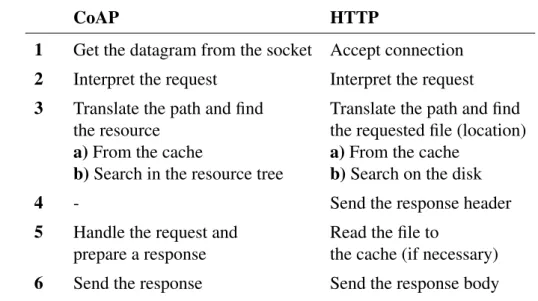
The typical structure of steps for handling CoAP and HTTP requests look quite similar as shown in Table 2.1. In step 3, both servers need to find the exact destination of the request. If the amount of files on an HTTP server or the amount of resources on the CoAP server is small, the paths might be cached and the cache entries might even contain a ready-to-use file descriptor or pointer to the resource. Otherwise, an HTTP server might have to find the file on the disk or the CoAP server in the data structure that holds its resources. Step 4 of the HTTP server is included in step 7 of the CoAP server. In HTTP this step is useful because the client can already start to process the header while the server is copying large amounts of data from the disk to the network interface controller. The biggest difference is step 5 in which an HTTP server might read a large file from the disk if it is not a dynamically generated Web page, while the CoAP server rather loads data from memory or computes a response.
For an HTTP server thread, it might be much more important to be independent of the data fetching (loading from disk) than it is for a CoAP server thread to be independent of a resource that generates a response. An HTTP server might benefit from exporting data loading to another thread, process or, in case of unblocking I/O, the OS. While the OS
5http://www.w3.org/CGI/
2.2 Server Specific Comparison
CoAP HTTP
1 Get the datagram from the socket Accept connection
2 Interpret the request Interpret the request
3 Translate the path and find Translate the path and find the resource the requested file (location)
a)From the cache a)From the cache
b)Search in the resource tree b)Search on the disk
4 - Send the response header
5 Handle the request and Read the file to
prepare a response the cache (if necessary)
6 Send the response Send the response body
Table 2.1: Structures of the processes for handling CoAP and HTTP requests.
loads data, the HTTP thread is able to compute something else. In contrast, a CoAP server might even suffer from unnecessary context switches. Let us assume, we have one thread to processes a request and generate the response and another thread that traverses through the CoAP stack and ultimately sends the request. The first thread might load the response from the main memory into the cache or newly compute it. Either way, since the other thread might be running on another core, not only do we need a context switch but also does the response data need to be transferred to the other core’s cache. Both penalties can be avoided if the same thread processes the request and sends the response back.
3 Server Architectures
Concurrent servers have been subject to research for more than fifteen years, in particular HTTP Web servers. Originally, concurrent handling of requests was introduced to allow servers to accept connections form multiple clients at the same time. The goal was to better utilize the CPU during I/O operations but was not intended to scale servers over multiple cores. At the latest with the advent of HTTP/1.1 in 1999, clients were allowed to keep connections alive for multiple consecutive requests. A typical Web page contained several links to images, flash content and other pages. Instead of repeatedly connecting to the server for each link, a temporary connection allowed sending multiple consecutive requests, and therefore avoiding many 3-way handshakes and TCP slow-starts. In subsequent years, engineers came up with different server architectures that attempt to increase server efficiency by mitigating bottlenecks such as synchronization. When servers were equipped with multiple cores, the very same techniques of parallelizing concurrent computations were used to utilize their multiplied computational capacity. In this chapter, we present the most significant server architectures found in the literature:
1. Multi-Process (MP) 2. Multi-Threaded (MT)
3. Single-Process Event-Driven (SPED)
4. Asynchronous Multi-Process Event-Driven (AMPED) (1999) 5. Staged Event-Driven Architecure (SEDA) (2001)
6. Multi-Threaded Pipelined (PIPELINED) (2005)
Note that MP, MT, SPED, and AMPED originally have been proposed for single-core systems.
3.1 Multi-Process
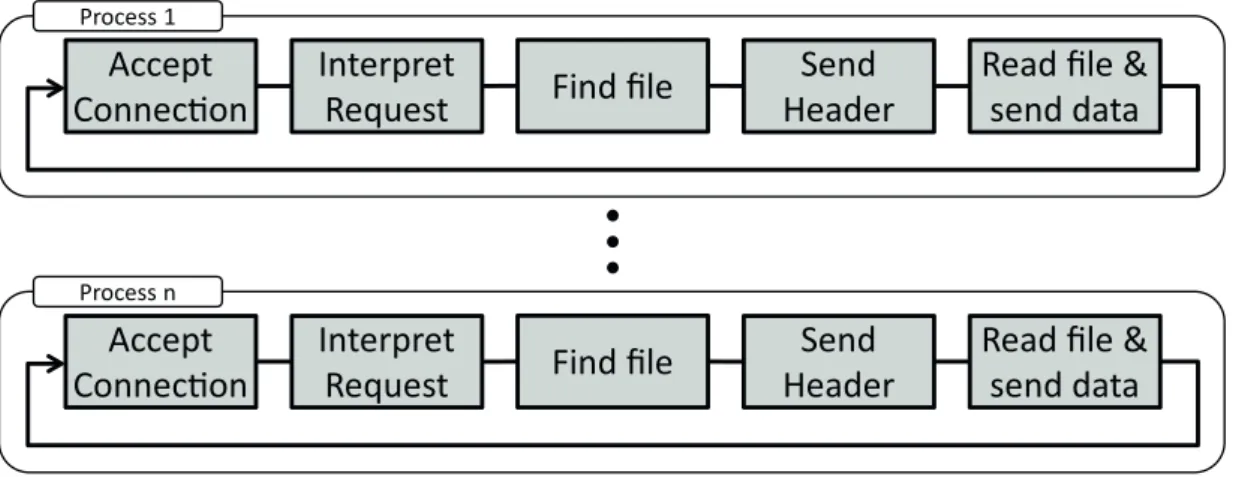
The Multi-Process (MP) architecture distributes the workload over multiple processes. Most operating systems support multiple processes and make use of a sophisticated strategy to schedule processes on one or more cores to optimally utilize their computational power and guarantee fairness (especially the absence of starvation). Multiple processes are rarely able to share global information such as a cache, though.1 When a client establishes a
3 Server Architectures
new TCP connection, the server forks a new process which processes all messages for that connection. The MP architecture is shown in Figure 3.1.
Accept Connecon
Interpret
Request Find file
Send Header
Read file & send data Process 1
Accept Connecon
Interpret
Request Find file
Send Header
Read file & send data Process n
Figure 3.1: Multi-process architecture: Each process processes all protocol steps.
3.2 Multi-Threaded
The Multi-Threaded (MT) architecture distributes the workload over multiple threads with a shared memory address space as shown in Figure 3.2. It is crucial that the underlying operating system supports kernel-threads. Since an application manages user-level threads in user-space, they cannot be distributed over multiple cores. Worse, since user-level thread scheduling is a form of cooperative scheduling, the kernel’s interrupt-handler cannot preempt a user-level thread that invokes a blocking I/O operation and schedule another user-level thread. The I/O operation blocks the whole application.
Accept Connec!on
Interpret
Request Find file
Send Header
Read file & send data
Figure 3.2: Multi-threaded architecture: Each thread processes all protocol steps. Threads are able to access a shared cache concurrently. Modern programming languages provide powerful synchronization tools and there exist whole libraries for efficient caching. Yet, the synchronization of a large number of threads can lead to a significant overhead. In a typical multi-threaded HTTP server, a welcome socket accepts new TCP connections, creates a new socket and assigns a thread to it, thus, there is one thread per connection. Usually, a thread closes its connection after a timeout has expired with no events on the socket. As a result, there are two main factors that influence the server performance: the
3.3 Single-Process Event-Driven
amount of available threads and the connection timeout. Beltran et al. [4] have found to get the best performance for a server when setting the amount of threads to the amount of expected concurrent connections and the timeout to infinity. Obviously, the amount of concurrent connections is hard to estimate but can be adjusted at runtime with some effort.
A common disadvantage of MP and MT is that a large number of processes or threads is required to support a large number of concurrent clients. If the allowed number of processes (threads) is limited and all processes (threads) assigned, no further connections can be accepted until a process (thread) closes its connection and is ready for a new one. Creating and terminating a process (thread) is expensive. Therefore, most implementations use a pool of reusable processes (threads). Processes (threads) allocate a considerable amount of memory for their state and especially their stack. On a 64-bit Java Virtual Machine, the default stack size of a thread is 1 MB.2 Nonetheless, MP and MT have been the architectures of choice for Apache’s HTTP server at the end of the 1990ies and remained prevalent up to the present day.
The large number of threads is MT’s greatest weakness and all the following architec-tures specifically try to avoid it. Notice that this is different for a CoAP server because there are no connections. In CoAP, the requests of all clients arrive at the same socket and no thread is blocked by an idle but still open connection. An MT solution for CoAP could concurrently serve many clients with only few threads.
3.3 Single-Process Event-Driven
The Single-Process Event-Driven (SPED) architecture splits up the message handling process into small tasks. Tasks use non-blocking I/O operations. When an event is triggered (e.g., a new connection arrives, a file operation completes or a client socket has received data or has space in its send buffer) a resulting task is added to the event queue. A single event dispatching thread keeps popping tasks from the queue and executes them one after another as shown in Figure 3.3. SPED is able to parallelize CPU, disk, and network operations despite having only one thread. Since there is only one thread, no synchronization is required, context switches can be saved, and data are always cache-local. In return, SPED cannot benefit from multiple cores and, unfortunately, many operating systems do not provide suitable support for non-blocking operations [30]. However, when the new 1.4 release of the J2SE introduced the NIO (New I/O) API, Beltran et al. showed in 2004 that an event-driven Web server written in Java and using NIO “[. . . ] scales as well as the best of the commercial native-compiled Web server, at a fraction of its complexity and using only one or two worker threads” [3]. In 2007 Pariag et al. proposed an extension to SPED called Symmetric Multi-Processor Event Driven (SYMPED) which forks multiple SPED processes [33]. Whenever a (SPED) process is stuck in a blocking I/O operation, the OS switches to a process that is able to run.
3 Server Architectures
Accept Connec!on
Interpret
Request Find file
Send Header
Read file & send data Event Dispatcher
Figure 3.3: Single-threaded event-driven architecture: A single thread jumps from task to task and uses non-blocking I/O operations.
3.4 Asynchronous Multi-Process Event-Driven
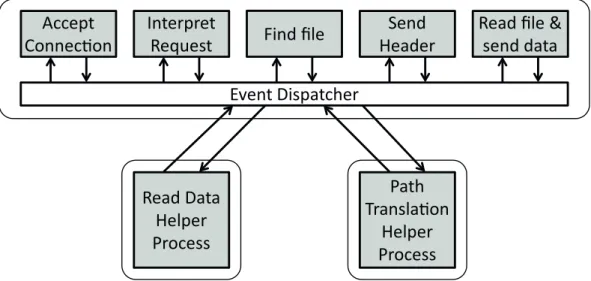
The Asynchronous Multi-Process Event-Driven (AMPED) [30] architecture uses, similarly to SPED, a single dispatching thread as shown in Figure 3.4. The dispatcher, however, only serves cache-hit requests. If there is a cache-miss, the dispatcher forwards the request to a helper process (or thread) which fetches the data. Basically, AMPED wraps blocking I/O operations in a separate process (or thread) to make them asynchronous. In 1999 (still the age of unicore processors), Vivek at al. implemented AMPED in a server called Flash [30]. In 2000, PalChaudhuri et al. released a Co-AMPED version of Flash for multiprocessors that used one AMPED process per core and outperformed Apache’s MP implementation [32].
Accept Connecon
Interpret
Request Find file
Send Header
Read file & send data Event Dispatcher Read Data Helper Process Path Translaon Helper Process
Figure 3.4: Asynchronous Multi-Process Event-Driven architecture: Outsources blocking operations to separate processes.
3.5 Staged Event-Driven Architecture
3.5 Staged Event-Driven Architecture
The Staged Event-Driven Architecture (SEDA) [47] splits the message handling process into multiple stages as shown in Figure 3.5. For instance, one stage is responsible for interpreting a request and another one for loading data from the disk. Each stage consists of an incoming event queue, a thread pool, and an event handler. The event handler can be thought of as a function that executes the logic of the stage. The threads pull events from the event queue and invoke the event handler which can forward new events to a next stage. A stage is managed by a controller that can dynamically allocate new threads according to a policy. Therefore, each stage of a SEDA server can self-tune itself to have the optimal number of threads to exploit the benefits of parallel execution without the drawbacks of a too large number of threads.
Welsh et al. invented SEDA and implemented an HTTP server called Haboob. Haboob easily outperformed MP Apache and AMPED Flash [47]. Unfortunately, they compared SEDA only to Apache’s MP version but not MT. In 2002, Larus at al. showed that a SEDA server can even further increase its throughput when threads not only pull one but a batch of events from the event queue at once and therefore improve cache-locality [27]. However, in 2003, von Beren et al. suggested using compiler support to improve synchronization and memory stack management of MT servers and presented results that outperformed Haboob once again [46].
Accept Connec!on
Interpret
Request Find File
Read File & Send Data Send
Header
Figure 3.5: Staged Event-Driven Architecture: Each protocol step is a stage. Each has its own thread-pool and forwards processed messages to the next stage over a queue.
3.6 Multi-Threaded Pipelined
A chain of stages can be seen as a pipeline. In contrast to SEDA, Multi-Threaded Pipelined (PIPELINED) only has one thread per stage. Within a pipeline one thread forwards results to the next thread. A PIPELINED server creates one pipeline per core as shown in Figure 3.6. Additionally, a pipeline can use helper threads to which it outsources blocking I/O in case of cache-misses, similar to AMPED [12]. In 2005, Choi et al. have shown that MT and PIPELINED outperformed all other architectures in terms of memory usage and throughput [12]. In 2007, Pariag et al. showed that SYMPED (see above) and PIPELINED can achieve an 18%higher throughput than MT [33].
3 Server Architectures
Accept Connecon
Interpret
Request Find File
Read File & Send Data Send Header Pipeline n Accept Connecon Interpret
Request Find File
Read File & Send Data Send
Header
Pipeline n
Figure 3.6: Pipelined architecture: The protocol steps form a pipeline where each step is processed by one thread. Blocking operations can be outsourced to additional threads (not in the image).
3.7 Comparison
The main difference between SEDA and PIPELINED is that a thread in SEDA forwards an event to any thread of a next stage where a thread in PIPELINED always forwards an event to the same thread in the next stage. An advantage of SEDA and PIPELINED over MT is that fewer threads are necessary to handle a large amount of parallel connections, and therefore reduce synchronization overhead. However, they both need to synchronize threads between each stage. Furthermore, the time a request spends in the system can increase due to traveling from stage to stage. Each stage change for a request means a thread change which implies a context switch and a potential loss of cache-locality. This can increase the latency a client experiences. In MP and MT, there should be much fewer context switches while a request is processed. In 2010, M. Welsh, the author of SEDA, reviewed his design and wrote in his blog: “Most stages should be connected via direct function call.” 3 This basically means to merge two stages together, since too many stages are just not worth it.
Genev`es compared the MT architecture to AMPED and SEDA on an eight core machine [19]. When varying incoming connections per second, all models reached the peak throughput simultaneously at 9000 connections per second. Eight cores achieved only 2.3 times the performance of a single core and the difference between four and eight cores was only marginal. He found that with eight cores, the memory bus between cores was totally overloaded, allowing no further performance improvement when using even more cores. Beltran et al. showed in 2008 that a hybrid Tomcat server [10] that combined MT and SPED was able to outperform MT Tomcat on CPU-bound workloads if the number of concurrent clients exceed 2000 (but they perform equally up to that point) [4]. In 2012,
3http://matt-welsh.blogspot.ch/2010/07/retrospective-on-seda.html, August 02, 2013
3.8 Alternative Scalability Strategies
Harji et al. extensively benchmarked multiple Web servers on quad-core SMP systems and concluded “[. . . ] that implementation and tuning of Web servers is perhaps more important than server architectures.” [20]
In summary, there exist a plethora of models, implementations, workloads, and experi-ments. Results depend heavily on the underlying platform (caching protocol, non-blocking I/O support, etc.) and used workloads (disk-bound, memory-bound, computation-bound, small/large files, cache-hit rate, etc.). Results of different papers are often contradictory. Our evaluation in Chapter 6 is going to show, whether Californium exhibit similar behavior as their HTTP cousins and whether the simpler CoAP protocol allows better scalability than HTTP.
3.8 Alternative Scalability Strategies
Using multiple processors and cores in one machine is a form of vertical scaling. Papers that suggest horizontal scaling, i.e., using multiple machines with load balancing, have been published as well [29]. Since horizontal scaling is out of the scope of this thesis and CoAP application workloads are not expected to be disk-bound, these approaches are less important for us. On the other side of the spectrum, the HTTP protocol has been translated into a finite state machine to ease HTTP integration into constrained devices [13]. There have been many further approaches to increase Web server performance. Since the main purpose of most HTTP servers is to only serve HTML Web pages or media files to clients and therefore need to read a lot of data from the hard disk, engineers have presented approaches to boost disk-bound workloads. For instance, the server scans the HTML files served to a client for links to local files, e.g., images, and starts to preload these files into the cache as it is to be expected that the client will request them right away [1]. Some approaches focus on dynamic content. In 2009, Hop Web Server [40] was proposed, a server that compiled third-party software at runtime and merged it into the server’s runtime environment. Hob Web Server outperforms Web servers that rely on CGI or FastCGI protocols.
4 Design
In this chapter, we discuss our proposal for the architecture of our CoAP server, the re-implementation of Californium (Cf). We first highlight the most relevant goals that have influenced our design decisions. Second, we describe how we structure the elements that make up CoAP and how they exchange information. Finally, we propose a concurrency model that specifies how the elements are parallelized.
4.1 Design Goals
In the field of software engineering, the list of expressions for software qualities is long. ISO/IEC 25010:20111alone defines 40 of them—from “accessibility” to “user-interface aesthetics.” Some of them are rather obvious, e.g., correctness; others are synonyms or at least do overlap, e.g., maintainability, extensibility, and adaptability. This section gives a non-exhaustive list of non-obvious goals and explains why we believe them to be relevant for Californium.
4.1.1 Completeness
Californium enables an application to appear as both CoAP client and CoAP server. First, it enables the application to send CoAP requests to CoAP resources and receive the response. Second, as server, the application is able to export CoAP resources which process incoming CoAP requests and respond to them. Since Cf is able to not only receive but also send requests, it can also serve as intermediary such as a caching proxy. We identify the following three main high-level workflows in Cf:
1. Construct a server and add resources. The server should be able to be started and stopped.
2. Receive a request, find its target resource, let the resource process the request and send the response back to the client.
3. Issue requests as client and wait for responses to allow for proxies or more complex services that use and aggregate Web services themselves.
4 Design
Californium must be designed so that these workflows can be implemented.
4.1.2 Scalability
A traditional indicator for server performance is throughput, i.e., processed requests per second. It is not our prior goal to achieve a throughput as high as an optimized C library for CoAP. Instead, we favor vertical scalability when multiple processor cores are available. Cf’s architecture should allow the whole processing chain to be efficiently distributed over multiple cores. To this end, we will need a concurrency model that specifies which and how processes are parallelized and synchronized. Concurrency is often a source for race conditions and causes the need for synchronization. Overhead due to synchronization among parallel processes is the nemesis of scalability. Therefore, our goal is to introduce as little synchronization as possible but as much as required for satisfying the CoAP protocol.
4.1.3 Flexibility
It is clear that there is no silver bullet that scores highest in all aspects. For instance, synchronization that comes with multi-threading clearly is an adversary to understand-ability. In general, optimizations often come in form of shortcuts that lessen flexibility, extensibility, and in particular maintainability. Typically, a design decision affects different machines and applications much differently. Therefore, our goal is to keep Cf as flexible as possible and give the programmer instruments to modify Cf’s behavior as much as possible.
4.1.4 Usability
Californium should be easy to learn to use. Developers should be able to compose services that export their functionality in resources, build up resource trees, and connect servers to the network. It should be simple to synchronously or asynchronously send requests and react to responses or failures. It should be easy for the developer or even the end-user to dynamically configure the parameters of Californium. Therefore, we need a well-designed API that is simple and powerful.
4.1.5 Understandability
Even though the core of CoAP is on the verge of becoming an RFC, CoAP is still subject to extensions. Cf’s design should accommodate for that. It is natural to understand CoAP
4.2 Architecture
as a combination of multiple semantic components such as reliability of transactions, deduplication of messages, blockwise transfer and so on.2 These components are not necessarily independent of each other. For instance, when a confirmable notification of an observed resource fails to be transmitted to the client and timeouts, the observe relation should be canceled. Furthermore, blockwise transfer splits up the exchange of a single request and a single response into an exchange of a potentially much larger amount of requests, responses, and acknowledgements. Some components require information whether a given message is the full message or only a block of it.
The proposed architecture should define the place of these separate conceptual com-ponents in the system and how they interact so that the required dependencies can be satisfied. With such an architecture at hand, we can reason about whether the system satisfies the semantics of CoAP and the understanding of the system eases maintenance and leverages further extensions. Therefore, the placement of these components and the way they exchange information must be chosen carefully. The more logical and simpler CoAP’s conceptual components are connected, the easier a developer, who looks into the code, can understand the system and the less prone to errors it becomes.
4.2 Architecture
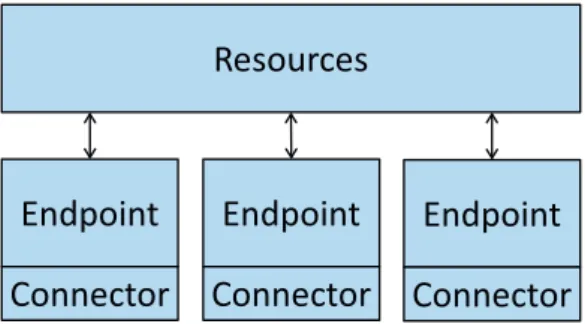
We propose to logically split up a CoAP server into three stages: resources, endpoints, and connectors. Figure 4.1 visualizes how these three stages build up a Cf server. A program that appears only as client would only operate with endpoint and connector. We explain these three stages in the following sections.
Endpoint Connector Endpoint Connector Endpoint Connector Resources
Figure 4.1: We split up Californium into three stages. The server has a resource tree, one or more endpoints and each endpoint has exactly one connector.
2Unfortunately, not only the environment CoAP is meant for but also our human brain has limitations so
that we are unable to grasp the complete CoAP protocol as one piece but require dividing it into simple human-brain-understandable concepts.
4 Design
4.2.1 Resource
Resources are the main building blocks that the developer is going to use to export the functionality of its application over CoAP to the world. A CoAP resource provides a RESTful interface to clients. It makes itself accessible and modifiable by reacting to requests that carry one of the four request codes defined in CoAP: GET, POST, PUT, or DELETE. Each server holds a tree structure where each node is a resource. Each resource is identified by a URI that is composed of the URI of its parent plus its own name. When a request arrives at the server, it searches the resource tree for a resource that corresponds to the destination URI of the request. If the server finds the resource, the resource processes the request and responds with an adequate response code, options, and payload according to the CoAP protocol. If the server cannot find the destination resource, it responds with a 4.04 (Not Found) error code.
4.2.2 Endpoint
Endpoint Encoding Token Blockwise Reliability Resources Delivery Observing Connector Deduplica on Matching Figure 4.2:Structure of the CoAP stack in an endpoint. Each component (green) is implemented as a layer.
An endpoint wraps the implementation of the CoAP protocol, i.e., it contains the processing chain that processes incoming and outgoing CoAP messages. A server has one or more endpoints that are connected to its resource tree. When a CoAP request arrives, the endpoint processes the required steps according to the protocol, e.g., decoding the datagram into a request-object, duplication detection, etc. Finally, the endpoint forwards the request to the resource tree, which will handle it and respond with a response over the same endpoint. An application can also use the endpoint to send requests to another CoAP server and will later receive the response.
As described in section 4.1.5, we understand CoAP as a com-position of conceptual components; some of which depend on information from each other and some do not. The structure in which we place these components has to satisfy all these depen-dencies. We identify the following conceptual components:
1. Token management to generate an ID for new requests. 2. Observe relations from clients to a resource.
3. Blockwise transfer to split up the transmission of one large message into multiple smaller ones.
4. Transfer reliability through retransmitting unanswered confirmable messages.
4.2 Architecture
5. Matching of incoming responses, acknowledgements, and resets to former outgoing messages and duplicate detec-tion.
6. Encoding messages to byte strings and decoding byte strings into an internal representation of a message.
Notice that not all these components can be properly associated to one of the two logical sublayers [42, p. 10] that CoAP describes (request/response layer and message layer). The layer for blockwise transfer, for instance, needs to receive acknowledgements (part of message layer) and responses (part of request/response layer) to initiate the transmission of a next block.
In the first version of Californium (OCf), it was proposed to implement these compo-nents as layers stacked upon each other and using a common interface to forward messages upwards through the stack as well as downwards. The main advantage of such a layered structure is understandability and extensibility. The resulting workflow is linear by design and the order in which these conceptual components are invoked is strict for all messages. This is simple and better understandable than a finite state machine, for example. We have adopted this design from OCf and will refine its implementation in Chapter 5 to achieve even better understandability, maintainability, and support for concurrency. The stack of layers that Californium uses is shown in Figure 4.2.
Using a stack of layers leads to a few implications: First, the order in which messages are processed is static and strict, not dynamically modifiable. When sending a message, the order in which it is processed by the components is exactly the reverse of when the message is being received. Furthermore, forcing the components to implement a common interface and letting them only call the layer above and below using only methods defined in this interface is a restriction. The interface for a layer must be expressive enough. These restrictions might not be reasonably applicable to any protocol. Our implementation, however, shows that we can implement CoAP in spite of these restrictions and benefit from its simplicity.
4.2.3 Connector
A connector abstracts how the server sends and receives messages, i.e., the transport protocol. A connector has no knowledge about the format of CoAP messages. Instead, an endpoint passes encoded messages as opaque bit strings together with the destination address and port to the connector to send it over the network. When a connector receives a message in form of a bit string, it passes it to the endpoint together with the source address and port. Typically, the connector uses the UDP protocol and sends and receives datagrams over a socket. Other connectors might useDatagram Transport Layer Security (DTLS), TCP or any other transport protocol. For example, we use some modified connectors
4 Design
in our JUnit tests to circumvent the OS and network and neglect undesirable delays by forwarding a message from a client directly to the server.
A connector should not be confused with a socket. An endpoint does not query the connector for receiving another message. Instead the connector calls its associated endpoint and hands over new messages. Vice versa, an endpoint hands outgoing messages over to the connector. The methods of the connector should be non-blocking and the connector has its own concurrency-policy. Rich functionality can be implemented in a connector. Scandium3, for example, is a DTLS implementation for secure communication between endpoints.
4.3 Concurrency Model
One of the main goals of Cf is scalability over multiple cores of a machine. Therefore, Cf’s architecture has to define which of its elements can be parallelized. A parallel element defines its own concurrency model, e.g., whether it uses a single thread or a thread pool to execute its code. An element could even implement an event-driven or multi-process concurrency model but for our implementation, we have not found these models useful. One encounters different conflicting factors when parallelizing the elements of a server. Naively, the more elements run in parallel, the more can they exploit large numbers of cores and achieve better performance. In practice this hardly holds true. In fact, the information flow between two parallelized elements becomes much more costly. Making a caller thread of a method also executing the logic behind that method is straight forward in programming, i.e., a normal method call. Such method calls are synchronous by design and easy to reason about. If the callee element is supposed to run concurrently to the caller element though, and therefore the caller thread has to get a thread of the callee element to process the logic behind the method, the effort for such a method call significantly increases. First of all, a context switch is required before the callee thread can execute the method’s logic. Second, the callee thread might run on another core than the caller thread so that the memory of the method parameters is not in the cache of the core. Finally, to pass parameters from one thread to another, one typically uses a shared queue to which the caller writes and from which the callee reads and which causes further synchronization overhead. As a result, the total amount of computation and latency per message increases and the performance could decline. There are further issues such as the impact of a large number of threads to the system, e.g., in terms of additional memory consumption. Finally, more fine-grained parallelism leads to higher complexity, potential race conditions and hampers maintainability.
One advantage of parallelization is that it allows protecting the system from failures in elements that are not relevant to the whole system. Assume, for example, a resource that spends five seconds’ time in a critical section to respond to requests. If the threads
3https://github.com/mkovatsc/Scandium, October 12, 2013
4.3 Concurrency Model
that process requests for other resources also invoke the handler of this ‘slow’ resource, they might all get stuck waiting to enter the critical section. In this case, a broken resource breaks the whole system. We can solve this issue by modeling a ‘slow’ resource as an independent element with its own thread. The threads that process requests in the endpoint-stage no longer invoke the handler but pass the requests to the specified thread of the resource. This makes the resource non-blocking and congesting requests will no longer delay the threads of the remaining system.
As stated above, a parallel element defines its own concurrency model, e.g., the number of threads it uses to execute the programming code. Using only a single thread for all computations frees the element internally from concurrency issues such as race conditions. Using a thread pool allows to run independent computations concurrently, e.g., processing independent requests. The number of threads can be chosen at runtime and even adjusted dynamically. Depending on the application, it might be advantageous to prioritize certain elements, e.g., certain resources or endpoints, to find an optimal balance. The server behavior becomes more flexible. Furthermore, we can optimize the server for a specific platform it runs on, for instance depending on the number of cores it provides. On a quad-core machine running Windows, we have measured that using four threads, we can receive almost twice as many request per second through a UDP socket than if we use only one thread. On a 16-core NUMA Red Hat Linux system, we found quite the opposite, having a 40% lesser throughput using two threads instead of one.
Our concurrency design opts for finding the optimal tradeoff among these advantages and disadvantages. The most coarse-grained design would be to use one single concurrency model for the whole server. The most fine-grained design defines a separate concurrency model per object, e.g., each CoAP component of an endpoint defines its own threads. We believe the optimum to be between these extremes. We propose to let each connector, each endpoint, and each resource choose its own concurrency model. That means, each of our three defined stages has its own concurrency model, similar to SEDA. We have chosen a stage-based model and subdivided the server into the aforementioned stages for the following reasons.
Since our benchmarks have shown that on certain platforms one thread instead of multiples can receive more packets per second through a socket, such a thread should be burdened with as less different code as possible to achieve the best performance. Since a connector defines its own concurrency model, the number of threads reading from and writing to a socket can be configured independently from the rest of the server.
The main advantage for giving each endpoint its own concurrency model is that it allows us to make them independent from the resource-stage. Resources that block threads compromise the whole system, and therefore, giving the developer instruments to protect endpoints from ‘slow’ resources is important. The endpoint consists of the processing chain of the CoAP protocol. Each incoming or outgoing message is processed by one of its components after another. Although it is possible to parallelize the components of an
4 Design
endpoint as well, it introduces too many context switches to be efficient. Each component is relevant for the whole endpoint, and therefore the balancing argument does not apply.
Resources are imaginable in many flavors. A resource could be very simple in respond-ing to requests but just as well wrap a complex procedure. In particular, some resources might be able to process requests concurrently while others consist of critical sections. Orthogonally, the potential effort to process a given request ranges from a few instructions up to several seconds’ time of computation. Since each resource is able to define its own concurrency model, i.e., thread pool, with an arbitrary number of threads that process requests, the developer has high flexibility. If a resource does not define a thread pool, the thread pool of its parent or transitively its ancestor will be used. If no resource on the path to the root defines a thread pool, the same thread that has processed the CoAP protocol will also process the code of the resource. In this case, there is no context switch for passing the request to the thread pool which benefits performance. If the request processing code of a resource contains critical sections, there are two simple ways how to guarantee mutual exclusion. First, the developer can choose a resource with a single-threaded pool. As
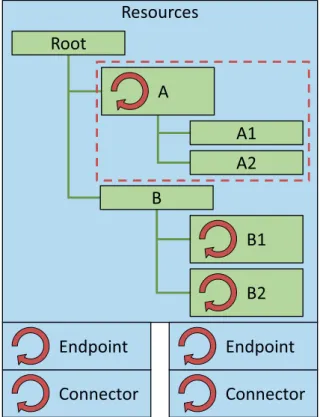
Resources Root B B1 B2 A A1 A2 Connector Endpoint Connector Endpoint
Figure 4.3: Each Connector, endpoint and, resource (green) is able to define its own concurrency model (represented by a rotating, red arrow). In this example, requests to A, A1, and A2 will be all handled by A’s thread pool. Requests to B1 and B2 will be handled by their respective thread pools. Requests to B and the root will be handled by the thread from the endpoint that forwards the request to the resource.
4.3 Concurrency Model
a result, all requests for the resource will be processed by the one and only thread and concurrency is not an issue in the first place. Second, the developer can simply add the keyword ‘synchronized’ to the method declaration that processes requests or to the critical section. Figure 4.3 gives an example of a server with two endpoints and a resource tree where resources A, B1, and B2 define their own concurrency model. Requests to these resources or their children will be processed by their respective thread pool.
The staged architecture can be seen as a combination of several architectures from Chapter 3. Each stage can create its own thread pool which is what the MT model postulates. Threads have to wait until a message comes through the queue, which makes it event-driven as well. Therefore, expertise from these architectures also improves the staged architecture. Since we use Java, any multi-process architecture would not be appropriate. We also do not consider the PIPELINED architecture applicable for a CoAP servers. The CoAP protocol processing chain has components that cannot simply be replicated; the replicas had to communicate and synchronize their state, e.g., the component for duplicate detection. Since an HTTP server benefits form TCP’s reliability guarantees, it is more eligible for such an architecture. Typically, the OS provides a TCP implementation, and therefore already solves the problem how to achieve these guarantees. CoAP, on the other hand, has to do it in the application layer, which the server architecture has to account for.
5 Implementation
In the previous chapter, we have explained the three-stage architecture of Californium and how we structure the CoAP processing chain as a stack of layers within an endpoint. In this chapter, we give a more detailed discussion, how Californium implements these layers and how they communicate with each other.
5.1 Messages
A CoAP message is a collection of values: message type, message identifier (MID), message code, token, options, and payload. These values are defined in the CoAP specification [42]. The MID is needed to match an acknowledgement to a message and the token is needed to match a response to the origin request. It is impractical to keep messages encoded in the binary format CoAP describes. Dealing with bit strings is cumbersome and error prone. Since Cf is written in Java, we also opt for an object-oriented model for messages. With an appropriate internal representation not only have we convenient object-oriented methods to read and modify a message’s values but also benefit from type-checking at compile time. High-level programming languages provide modeling instruments such as subtyping and inheritance. We do not want to over-engineer our class-model, though, and make only carful use of such instruments.
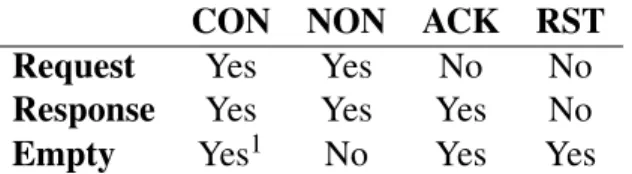
One of the most important values of a message is its message type: confirmable (CON), non-confirmable (NON), acknowledgement (ACK) or reset (RST). The message code defines whether a message carries a request, a response or is empty. Request codes are further divided into GET, POST, PUT, and DELETE while response codes are divided into the three classes Success, Client Error, and Server Error which again are divided into multiple status codes. Depending on the type of the message and whether it carries a request or response, different other properties can hold, e.g., we can only respond with a status code 2.05 (Content) to a GET but no other requests. However, many properties still hold for most messages. We believe it is worth only implementing the code for these properties once in a class and let all messages use it either due to inheritance (for example MID and token) or due to having an object representing them (for example options). Table 5.1 shows what message type can carry a request or response. Multiple reasonable division strategies for messages are imaginable.
5 Implementation
CON NON ACK RST Request Yes Yes No No
Response Yes Yes Yes No
Empty Yes1 No Yes Yes
Table 5.1: Not all message types and message codes can be legally combined.
No division: We might just use one class to represent them all. However, we feel this design is too coarse. We believe that different classes can hint the developer to what actions and properties belong to a message and ultimately improve the developer’s understanding of Californium.
Division according to message type: This allows giving different methods to mes-sages according to their message type. Confirmable mesmes-sages would provide ac-knowledge() and reject(), non-confirmables only reject() and empty messages neither. However, most processing parts in CoAP depend more on whether a message carries a request or a response than what message type it has. The most inconvenient drawback of this division is that it requires a lot of confusing looking code for checking what a message actually is. We believe that in general, the CoAP message layer is of little interest to the application developer and prefer keeping it transparent in our API.
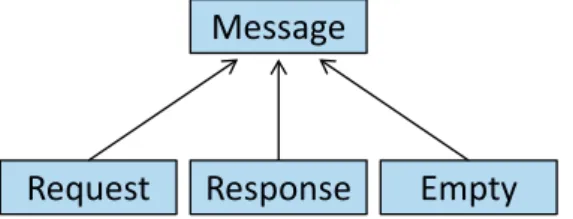
Division according to message code: We believe that it is most natural for the devel-oper to think in terms of requests and responses about CoAP and our goal is to hide as much complexity as possible. We observe that a lot of code for the different mes-sage types is unitary while code for requests, responses, and empty mesmes-sages often differ. Therefore, we propose to division all messages into three classes for requests, responses, and empty messages. Values that belong to all messages independent of their code (for exampleMID and token) are collected into a common superclass
Messageas shown in Figure 5.1. Methods that depend only on the message type, e.g., retransmission depends only whether it is CON but not whether it is a request or response, can work with the common supertypeMessageso that no duplicate code must be written.
We could even further division requests into one class per request code or the responses into one class per response code. This, however, yields a large amount of classes with little to no difference. Therefore, we consider this over-engineering and decide against it.
1Can be used to trigger an RST from an endpoint to test if it is reachable
5.2 Exchange
Request Response Empty Message
Figure 5.1: Message model: the classes for requests, responses, and empty messages have a common superclass.
5.2 Exchange
We call the process of sending a request and receiving one or more corresponding responses and empty messages an exchange. In its simplest case, an exchange consists only of one request and response. If a request must be split up into multiple blocks each block belongs to a single exchange stemming from the origin request. The same applies to all responses. This section explains how the state of an exchange can become complicated and our solution how Cf keeps track of messages and manages its state of exchanges. In CoAP, The reasons for most complexity are the three following CoAP extensions that lead to multiple responses.
a) A response is split up into multiple blocks due to its large size (block-12 [8]). b) In case of an observe relation, we receive multiple notifications (observe-08 [21]). c) In case of a multicast request, we receive responses from multiple endpoints
(groupcomm-16 [38]).
Reasons a) and b) can occur within the same exchange but should not at the same time. Blockwise transferred notification should be transferred one after another. Reasons a) and c) could but should not occur at the same time. Endpoints should not respond with a blockwise transfer to a multicast request. The same is true for multicast requests because they must be sent non-confirmable while a blockwise transfer requires confirmable messages. Finally, reasons b) and c) can never occur at the same time. “If multiple subjects are of interest to an observer, the observer must register separately for all of them” [21, p. 3].
The state of an exchange seen by a client and seen by the server is not always the same but must be synchronized to eventually reach consensus. On first view, CoAP may seem to be a protocol where always only one participant triggers a new action but this is not true. A timeout at an endpoint, for instance, might cause it to resend a message, and therefore an endpoint must expect to receive duplicate messages that belong to the same exchange and only process one of them. A client application might just cancel a request in the middle of sending it blockwise. An observed resource on a server might cancel a notification that is being transferred blockwise and send a new one. A cancelation of a large message must be propagated to its blocks and must be recognized by both endpoints so that both can
5 Implementation
clean up their state. As a result, the state of an exchange can be modified concurrently due to numerous events. Endpoints must be able to deal with an arguably complex space of possible states that an exchange might be in. If an endpoint uses only a single thread to modify its state of a specific exchange the concurrently triggered events automatically linearize and the program code becomes easier. In a multi-threaded environment, however, judicious use of synchronization is required.
The implementation of OCf has shown one major flaw: the state the endpoint sees of an exchange is distributed over all layers. Each layer has one or more hash maps that contain mappings of tokens to the partial state of exchanges that the layer requires. The layer for blockwise transfer, for instance, uses an inner class to hold the current status of the blockwise transfer. Whenever a block arrives, the layer finds the corresponding blockwise transfer status in its hash map and uses is for its next actions. Drawbacks of this approach are
Difficult to clean up: When a program cancels a request, all layers must realize that they have to remove the corresponding state they hold.
Memory usage: Each entry needs a very small amount of memory. Under heavy load with many exchanges, the memory nevertheless becomes a problem and using more hash maps than necessary is wasteful.
Efficiency: Finding a mapping of a token to its state is fast. However, doing it more often than necessary is wasteful.
Scalability: A hash map that maps tokens to state is a source for synchronization overhead when multiple threads write to it.
Atomicity: There exist concurrent hash maps that provide powerful APIs that can bundle multiple operations to one atomic operation. However, multiple atomic operations on different hash maps are not atomic. In case multiple threads operate on the hash maps additional synchronization is required.
Note that the last two reasons were not really drawbacks for OCf because it was meant as single-threaded system.
We propose to collect all state an endpoint knows of an exchange within a single object. We call this object an Exchange (with capital E). Whenever a client intents to send a request, it first creates an Exchange. When the request traverses downwards through the CoAP stack, each layer updates the Exchange and forwar