V3_DSS_R2_2013SEP
HL7 Version 3 Standard: Decision
Support Service (DSS),
Release 2
DSTU Ballot, September 2013
Project Lead and Editor:
Kensaku Kawamoto, MD, PhD; University of Utah
Contributors:
Ohad Young; dbMotion
David Boaz; dbMotion
David Shields; University of Utah
Bryn Rhodes; Veracity Solutions
Brett Esler; Pen Computer Systems
Ken Rubin; Hewlett-Packard
Manfred Koethe, MS; 88solutions
Alean Kirnak; Software Partners
Clayton Curtis, MD, PhD; Veterans Health Administration
Robert Hausam, MD; OntoReason
Alan Honey, PhD; ii4sm
Project Sponsor:
HL7 CDS Work Group
Copyright © 2013 Health Level Seven International ® ALL RIGHTS RESERVED. The reproduction of this material in any form is strictly forbidden without the written permission of the publisher. HL7 and Health Level Seven are registered trademarks of Health Level Seven
Table of Contents
Table of Contents ... 2
1
Preface ... 4
2
Revision History ... 5
2.1
Revisions of HL7 DSS Release 1 Specification Compared to OMG CDSS Version 1.0 Specification .. 5
2.2
Revisions of HL7 DSS Release 2 Specification Compared to HL7 DSS Release 1 Specification ... 6
3
Acronyms ... 7
4
Service Overview and Business Case ... 8
4.1
Problem Addressed by the Specification ... 8
4.2
Functional Capabilities of a Decision Support Service (DSS) ... 10
4.3
Overall Potential Scope of the Service ... 12
4.4
Reason Why the Service Specification is Needed ... 13
4.4.1 Explanation of Why the Service is Needed ... 13
4.4.2 Explanation of Why a Standard is Needed for the Service ... 13
4.4.3 Vendor Viewpoint and Potential Business Opportunity or Niche ... 14
4.4.4 Consumer Viewpoint and the Value Offered by the Work Product ... 14
5
Normative References ... 15
6
DSS Platform Independent Model ... 16
6.1
Foundational Model Elements ... 16
6.1.1 Described Data Object ... 16
6.1.2 Scoping Entity ... 16
6.1.3 Entity Identifier and Interaction Identifier ... 17
6.1.4 Item Identifier ... 18
6.1.5 Scoped Data Object ... 18
6.2
Metadata Model Elements ... 19
6.2.1 Service Profile ... 19
6.2.2 Semantic Signifier and Related Classes ... 21
6.3
Knowledge Module Model Elements ... 24
6.3.1 Knowledge Module Description ... 24
6.3.2 Semantic Requirement ... 29
6.3.3 Trait ... 31
6.3.4 Knowledge Module Data Requirement Elements ... 34
6.3.5 KM Evaluation Result Semantics ... 39
6.4
Exception Model Elements ... 40
6.5
KM Search Criteria Model Elements ... 42
6.5.1 Search Criteria ... 42
6.6
Evaluation Payload Elements ... 44
6.6.1 Evaluation Request Model ... 44
6.6.2 Evaluation Response Model ... 46
6.7.1 listProfiles... 49 6.7.2 describeProfile ... 49 6.7.3 describeScopingEntity ... 49 6.7.4 describeScopingEntityHierarchy ... 49 6.7.5 describeSemanticRequirement ... 50 6.7.6 describeSemanticSignifier ... 50 6.7.7 describeTrait ... 50
6.8
Query Interface ... 51
6.8.1 listKMs ... 51 6.8.2 findKMs ... 52 6.8.3 getKMDescription ... 53 6.8.4 getKMEvaluationResultSemantics ... 53 6.8.5 getKMDataRequirements ... 53 6.8.6 getKMDataRequirementsForEvaluationAtSpecifiedTime ... 546.9
Evaluation Interface ... 55
6.9.1 evaluate ... 55 6.9.2 evaluateAtSpecifiedTime ... 56 6.9.3 evaluateIteratively ... 57 6.9.4 evaluateIterativelyAtSpecifiedTime ... 586.10
Profiles and Semantic Requirements Specified as a Part of this Specification ... 59
6.10.1 Overview ... 59
6.10.2 HSSP Simple Evaluation DSS Functional Profile, Version 2.0 ... 60
6.10.3 HSSP Complete DSS Functional Profile, Version 2.0 ... 60
6.10.4 HSSP Minimum DSS Semantic Profile, Version 2.0 ... 61
6.10.5 HSSP Minimum DSS Trait Set Requirement, Version 2.0 ... 61
6.10.6 HSSP Simple Evaluation DSS Conformance Profile, Version 2.0 ... 68
6.10.7 HSSP Complete DSS Conformance Profile, Version 2.0 ... 68
6.11
Minimal Requirement for Claiming Conformance to HSSP DSS Standard ... 69
6.12
Future Specifications of Profiles and Semantic Requirements... 69
7
DSS Platform Specific Model for SOAP XML Web Services ... 70
7.1
PSM-Specific Conformance Criteria ... 70
8
DSS Platform Specific Model for RESTful XML Web Services ... 71
8.1
PSM-Specific Conformance Criteria ... 71
8.2
Example Security Implementation Using HMAC ... 71
8.2.1 Assumptions ... 72
8.2.2 Prelude ... 72
8.2.3 Transaction ... 72
8.3
Exception Handling ... 73
9
Appendices ... 74
9.1
Appendix I: Description of Associated Machine Consumable Files ... 74
9.2
Appendix II: Relationship to OMG Specifications... 75
1 Preface
A decision support service (DSS) receives patient data as the input and returns patient-specific conclusions as the output. As such, it can significantly facilitate the implementation of systems that require patient-specific inferencing, such as clinical decision support (CDS) systems and quality reporting systems. The present DSS specification represents one member of a family of healthcare service specifications being jointly developed by HL7 and the Object Management Group (OMG) through the Healthcare Services Specification Project (HSSP).1,2 As per the HSSP process, the required capabilities of a DSS were identified in an HL7 Draft Standard for Trial Use (DSTU) in December 2006 (the HL7 DSS Service Functional Model, Version 1.0).3 Subsequently, a fully implementable DSS specification based on the HL7 DSTU was developed by the OMG Healthcare Domain Task Force. This OMG DSS specification was first adopted as an OMG draft standard and then recommended for adoption as a normative OMG standard in December 2010 (the OMG CDSS Specification, Version 1.0).4,5 Within OMG, the DSS standard is known as the Clinical Decision Support Service (CDSS) standard to indicate its focus on the clinical domain. In this document, the terms DSS and CDSS are used interchangeably when referring to the OMG DSS specification. The OMG DSS standard was developed in close consultation with members of the HL7 CDS Work Group to ensure that the DSS specification could be brought back into the HL7 community following completion of the OMG standardization process.
This present specification is a normative HL7 specification that is based on the normative OMG DSS standard, with minor revisions that are clearly noted in Section 2. These minor revisions are expected to be introduced back into the OMG standard, as the intent is for the HL7 and OMG DSS standards to be semantically interoperable. Like the OMG standard, the present DSS specification includes a platform-independent model (PIM) for the DSS as well as a platform-specific model (PSM) for SOAP XML Web services. The original HL7 DSS DSTU was a functional specification that described the behavior of a DSS but was intentionally not specified at a technical level required for implementation. The present HL7 DSS normative specification includes technical details required for implementation, including WSDLs and XSDs for implementing a DSS as a SOAP Web service. A catalogue of these machine-consumable files can be found in Appendix I of this document.
Of note, an open-source implementation of this specification will be made available through the multi-institutional OpenCDS effort (http://www.opencds.org).
1
Kawamoto, K., Honey, A. and Rubin, K. (2009). The HL7-OMG Healthcare Services Specification Project: motivation, methodology, and deliverables for enabling a semantically interoperable service-oriented architecture for healthcare. Journal of the American Medical Informatics Association 16, 874-81.
2
Healthcare Services Specification Project (HSSP) Homepage. Available at http://hssp.wikispaces.com. Accessed August 1, 2013. 3
Health Level 7 (HL7). HL7 Service Functional Model Specification – Decision Support Service (DSS). HL7 Draft Standard for Trial Use - Release 1. Available at http://www.hl7.org/dstucomments/ex_showdetail.cfm?dstuid=12. Accessed August 1, 2013.
4
Object Management Group (OMG). OMG Clinical Decision Support Service Specification, Version 1.0. Available at http://hssp-dss.wikispaces.com/omg_specification. Accessed August 1, 2013.
5
Object Management Group (OMG). Machine-Readable Files for OMG Clinical Decision Support Service Specification, Version 1.0. Available at http://hssp-dss.wikispaces.com/omg_specification. Accessed August 1, 2013.
2 Revision History
2.1 Revisions of HL7 DSS Release 1 Specification Compared to OMG
CDSS Version 1.0 Specification
At the core of this specification are the Platform Independent Model (PIM) and Platform Specific Model (PSM) for the DSS, along with the accompanying machine-readable files. These core aspects of the present specification are semantically identical to the OMG CDSS Version 1.0 specification, except as specified below. It is expected that these revisions will be brought back into the OMG community in the future to ensure full alignment of the OMG and HL7 DSS standards.
Revision 1: addition of DSSRuntimeException to all operations
o In order to account for runtime errors not otherwise covered by other named exceptions, a DSSRuntimeException has been added to all DSS operations.
Revision 2: correction of business IDs of trait and trait criteria semantic signifiers
o The semantic signifiers of trait and trait criteria specified in Section 6.10.5 have been corrected so that their business IDs include root global element names, which had been omitted in error. For example, for the Explanation trait, its semantic signifier's business ID is now HsspDssTraitSchema.Explanation instead of HsspDssTraitSchema.
Revision 3: clarification of KMItem description
o The description of KMItem has been clarified to note that its scoping entity may be a knowledge module or another entity. The exact change is as follows:
o Original description:
The superclass of all knowledge module sub-items. For example, Data Requirement Group or Item. It contains the item identifier, which consists of the identifier of the knowledge module as well as a unique identifier within the knowledge module. It inherits name and description information from DescribedDO.
o Revised description:
The superclass of all knowledge module sub-items. For example, Data Requirement Group or Item. It contains the item identifier, which consists of the identifier of the scoping entity as well as a unique identifier within the scoping entity. The scoping entity may be the knowledge module within which the KMItem resides, a different knowledge module, or an entity other than the knowledge module. This approach enables items such as data requirements to be decoupled from specific knowledge modules and reused across knowledge modules. This class inherits its name and description information from DescribedDO.
Revision 4: updating of versioned namespaces of machine-consumable files
o Where the above changes resulted in updates to machine-consumable files, versioned namespaces have been updated to use the date-based version of "201105" instead of "201012".
Furthermore, while the OMG CDSS Version 1.0 specification includes informative Resource Directory Description Language (RDDL) files to describe its XML namespaces, this specification does not include RDDL files. RDDL files are not included as the use of such resource descriptors are expected within the OMG community but not within the HL7 community.
2.2 Revisions of HL7 DSS Release 2 Specification Compared to HL7 DSS
Release 1 Specification
• Added a responseId element to the iterative and final response messages.
o This enables logging of outputs to be traced separately for each requested Knowledge Module.
• Added a new profile to support RESTful Web services for the Evaluation interface as an alternative to the
original SOAP interface.
o No changes were made to any defined operations, and the new RESTful interface is functionally identical to the SOAP interface.
• Extended the DSS Evaluate Profile to include both the evaluate operation and the evaluateAtSpecifiedTime
operation.
• Added a requestId and responseId to all evaluation response messages.
o The requestId is identical to the interactionId provided as part of the associated request. o The responseId is a system-generated identifier for tracking and trouble-shooting purposes.
• Updated HL7 version 3 schemas referenced in the specification to the 2012 Normative Edition.
• Added optional CDS output specification to KM Evaluation Result Semantics. Updated Semantic Requirement
model to reflect this change (EvaluationResultRequirementBase, AllowedEvaluationResultRequirement, and RequiredEvaluationResultRequirement).
• Updated profile version numbers and dates in schema namespaces. • Added to responses to all operations a requestId and a responseId.
3 Acronyms
There are a number of acronyms used in this document.
The following is a brief list of what the most common ones stand for. Acronym Full Name
ANSI American National Standards Institute (U.S.A.) CDS Clinical decision support
CDSS Clinical Decision Support Service (synonymous with DSS) DRG Data requirement group
DRI Data requirement item DSS Decision Support Service
HITSP Health Information Technology Standards Panel (U.S.A.) of ANSI HL7 Health Level 7
HSSP Healthcare Services Specification Project IHE Integrating the Healthcare Enterprise
ISO International Organization for Standardization KM Knowledge module
OMG Object Management Group PIM Platform Independent Model PSM Platform Specific Model
RIM Reference Information Model defined by HL7
RM-ODP Reference Model of Open Distributed Processing defined by ISO SDO Standards Development Organization
SFM Service Functional Model UML Unified Modeling Language
4 Service Overview and Business Case
4.1 Problem Addressed by the Specification
The problem addressed by the specification is the need for a standardized approach for leveraging machine-executable medical knowledge in an application-independent manner. Further elaboration on this targeted problem is provided below.
In recent years, research has emerged showing that the healthcare delivered in many industrialized nations falls short of optimal, evidence-based care. In the United States, a nationwide audit assessing 439 quality indicators found that American adults receive only about half of recommended care,6 and the U.S. Institute of Medicine has estimated that up to 98,000 Americans die each year as the result of preventable medical errors.7 In the United Kingdom, a retrospective analysis at two London hospitals found that 10.8% of admitted patients experienced adverse events, of which 48% were judged to be preventable and of which 8% led to death.8 Similarly in Australia, a review of medical records from 28 hospitals identified adverse events in 16.6% of admissions, of which 51% were deemed preventable and of which 4.9% led to death.9
One of the most promising strategies for addressing this crisis in care quality is the use of clinical decision support (CDS) systems, which are systems that provide physicians and other healthcare stakeholders with patient-specific assessments or recommendations in order to aid in clinical decision making. Examples of CDS systems include outpatient systems that attach care reminders to the charts of patients in need of specific preventive care services, computerized provider order entry (CPOE) systems that provide patient-specific recommendations as part of the order entry process, and laboratory alerting systems that page physicians when critical lab values are detected. CDS systems can be highly effective at improving care quality and ensuring patient safety. In a recent systematic review, for example, CDS systems possessing four critical features were found to significantly improve clinical practice in 94% of randomized controlled trials.10 Despite these promising results, however, the availability of decision support capabilities remains limited in most health care facilities in the U.S. and elsewhere. Although many barriers contribute to this limited use of decision support systems, one important barrier is the difficulty and cost associated with implementing effective decision support systems.
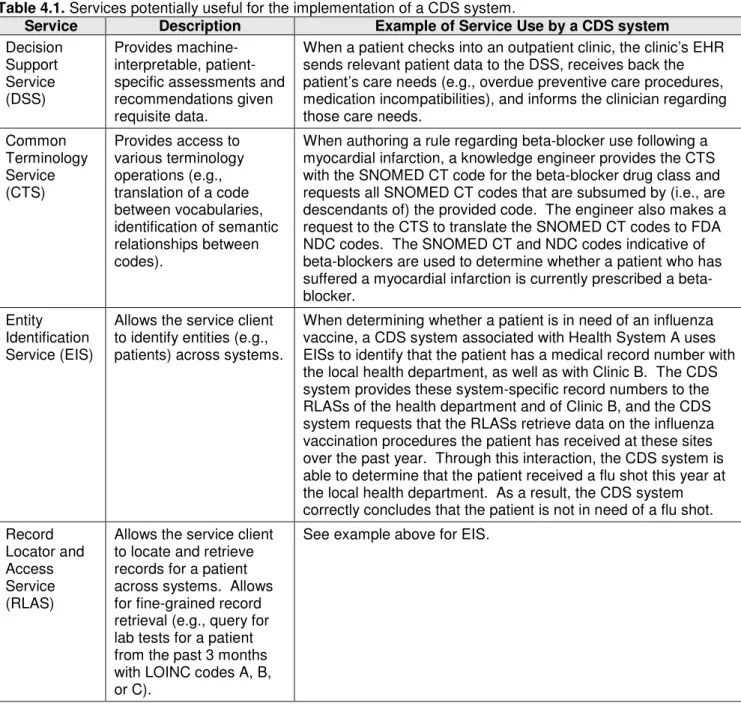
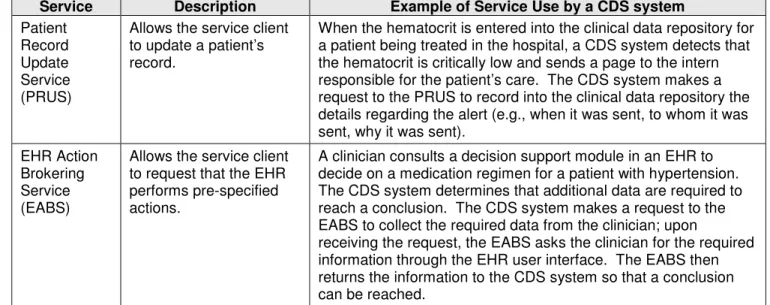
As with other types of applications, a CDS system could be more easily implemented and maintained if software services were available to provide functionality required by the application. Table 4.1 lists some of the services that may be useful for the implementation of a CDS system, including: (i) a DSS, which uses patient data to draw machine-interpretable conclusions regarding patients; (ii) a common terminology service (CTS), which provides access to various terminology operations; (iii) an entity identification service (EIS), which enables the identification of entities (e.g., patients) across systems; (iv) a record locator and access service (RLAS), which facilitates the retrieval of patient records across systems, and which also allows for fine-grained queries for patient data; (v) a patient record update service (PRUS), which allows the service client to update the patient record; and (vi) an electronic health record (EHR) action brokering service (EABS), which permits the service client to invoke various actions within an EHR. Of note, the HL7-OMG Healthcare Services Specification Project (HSSP) has developed or is developing standards for a number of these services.11
6
McGlynn EA, Asch SM, Adams J, et al. The quality of health care delivered to adults in the United States. N Engl J Med. 2003;348:2635-2645. 7
Kohn LT, Corrigan JM, Donaldson MS, eds. To Err is Human: Building a Safer Health System. Washington, DC: National Academy Press; 1999.
8
Vincent C, Neale G, Woloshynowych M. Adverse events in British hospitals: preliminary retrospective record review. BMJ. 2001;322:517-519. 9
Wilson RM. The quality in Australian Health Care Study. Medical Journal of Australia 163:458-71, 1995. 10
Kawamoto K, Houlihan CA, Balas EA, Lobach DF. Improving clinical practice using clinical decision support systems: a systematic review of trials to identify features critical to success. BMJ. 2005;330:765-772.
11
All of the services just described facilitate the implementation of a CDS system, as they allow a CDS system to fulfill many of its functional requirements by making requests to existing services. Specifically with regard to the DSS, the service allows a CDS system to reach conclusions regarding a patient by making requests to one or more DSSs. Furthermore, the service allows a single DSS to simultaneously fulfill the patient evaluation requirements of multiple decision support applications. Because the specification and updating of machine-executable decision logic represents one of the most expensive aspects of developing and maintaining a decision support system, this arrangement could significantly reduce the effort required for a CDS system implementation. This reduction in the effort required to implement and maintain a CDS system is the primary business purpose for the DSS. It is hoped that the DSS standard will facilitate the more widespread adoption of CDS systems, which in turn should result in higher quality care and improved patient safety.
Table 4.1. Services potentially useful for the implementation of a CDS system.
Service Description Example of Service Use by a CDS system Decision Support Service (DSS) Provides machine-interpretable, patient-specific assessments and recommendations given requisite data.
When a patient checks into an outpatient clinic, the clinic’s EHR sends relevant patient data to the DSS, receives back the patient’s care needs (e.g., overdue preventive care procedures, medication incompatibilities), and informs the clinician regarding those care needs.
Common Terminology Service (CTS) Provides access to various terminology operations (e.g., translation of a code between vocabularies, identification of semantic relationships between codes).
When authoring a rule regarding beta-blocker use following a myocardial infarction, a knowledge engineer provides the CTS with the SNOMED CT code for the beta-blocker drug class and requests all SNOMED CT codes that are subsumed by (i.e., are descendants of) the provided code. The engineer also makes a request to the CTS to translate the SNOMED CT codes to FDA NDC codes. The SNOMED CT and NDC codes indicative of beta-blockers are used to determine whether a patient who has suffered a myocardial infarction is currently prescribed a beta-blocker.
Entity Identification Service (EIS)
Allows the service client to identify entities (e.g., patients) across systems.
When determining whether a patient is in need of an influenza vaccine, a CDS system associated with Health System A uses EISs to identify that the patient has a medical record number with the local health department, as well as with Clinic B. The CDS system provides these system-specific record numbers to the RLASs of the health department and of Clinic B, and the CDS system requests that the RLASs retrieve data on the influenza vaccination procedures the patient has received at these sites over the past year. Through this interaction, the CDS system is able to determine that the patient received a flu shot this year at the local health department. As a result, the CDS system correctly concludes that the patient is not in need of a flu shot. Record
Locator and Access Service (RLAS)
Allows the service client to locate and retrieve records for a patient across systems. Allows for fine-grained record retrieval (e.g., query for lab tests for a patient from the past 3 months with LOINC codes A, B, or C).
Service Description Example of Service Use by a CDS system Patient Record Update Service (PRUS)
Allows the service client to update a patient’s record.
When the hematocrit is entered into the clinical data repository for a patient being treated in the hospital, a CDS system detects that the hematocrit is critically low and sends a page to the intern responsible for the patient’s care. The CDS system makes a request to the PRUS to record into the clinical data repository the details regarding the alert (e.g., when it was sent, to whom it was sent, why it was sent).
EHR Action Brokering Service (EABS)
Allows the service client to request that the EHR performs pre-specified actions.
A clinician consults a decision support module in an EHR to decide on a medication regimen for a patient with hypertension. The CDS system determines that additional data are required to reach a conclusion. The CDS system makes a request to the EABS to collect the required data from the clinician; upon
receiving the request, the EABS asks the clinician for the required information through the EHR user interface. The EABS then returns the information to the CDS system so that a conclusion can be reached.
4.2 Functional Capabilities of a Decision Support Service (DSS)
A DSS can be conceptually understood as the guardian of one or more modules of medical knowledge, wherein each DSS knowledge module is capable of utilizing coded patient data to arrive at machine-interpretable conclusions regarding the patient under evaluation. The scope of a typical DSS knowledge module is the assessment of a single patient in a specified topic area. The topic area may be narrow (e.g., the need for a glycated hemoglobin test for a patient with diabetes) or broad (e.g., the existence of contraindications to any medications prescribed or about to be prescribed for a patient).
A DSS is used by a DSS client, which is alternatively referred to as a “client” or as a “client system” in this specification. A DSS client is any external entity that interacts with a DSS to obtain its services. Examples of DSS clients include a DSS query system used by an engineer to find and explore knowledge modules at design time or an operational CDS system that interacts with a DSS at run-time.
When requesting a patient evaluation, a client CDS system specifies the knowledge modules to use for the evaluation, and the CDS system also submits the patient data required by the knowledge modules. In return, the DSS returns inferences regarding the patient in a format that has been pre-defined for that knowledge module. For example, an online immunization registry might submit data on a patient’s allergies and on her past immunizations to a DSS and request that the patient be evaluated using the service’s immunization knowledge module. In return, the DSS might return a list of the vaccines for which the patient is ineligible due to contraindications, a list of the vaccines for which the patient is up-to-date, and a list of the vaccines for which the patient is due.
Of note, a DSS knowledge module may or may not have a one-to-one correspondence with an underlying computational construct. For example, the immunization knowledge module just described may be implemented using one computational construct (i.e., a single construct that checks for the need for a number of vaccines) or multiple computational constructs (e.g., one construct that checks for the need for a flu vaccine, a second construct that checks for the need for a pneumococcal vaccine, etc.).
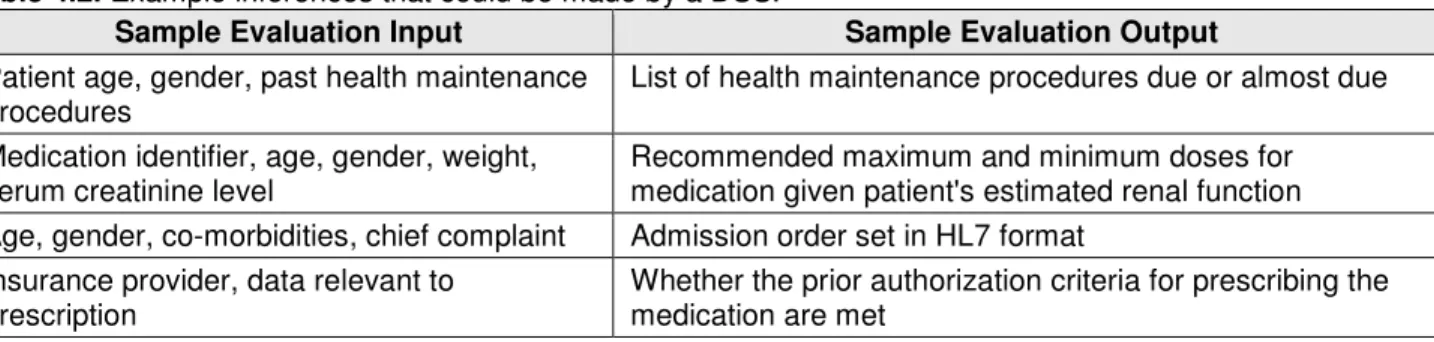
Table 4.2. Example inferences that could be made by a DSS.
Sample Evaluation Input Sample Evaluation Output
Patient age, gender, past health maintenance procedures
List of health maintenance procedures due or almost due Medication identifier, age, gender, weight,
serum creatinine level
Recommended maximum and minimum doses for medication given patient's estimated renal function Age, gender, co-morbidities, chief complaint Admission order set in HL7 format
Insurance provider, data relevant to prescription
Whether the prior authorization criteria for prescribing the medication are met
In order to acquire patient evaluations in this manner, a client must be able to obtain several supplemental pieces of information from a DSS. These supplemental information needs consist of the need to (i) identify the knowledge modules that could be used to meet client needs; (ii) know what patient data must be submitted to the DSS in order to obtain an accurate evaluation; and (iii) know the meaning and format of any results that will be returned by the DSS following a patient evaluation.
Table 4.3 lists these supplemental client information needs; a brief description is also provided for the primary DSS operations that meet these information needs.
Table 4.3. Supplemental information required for obtaining patient evaluations using a DSS, and brief descriptions of the primary service operations that provide the required information.
Supplemental Information Need
Primary Operation Providing
Required Information Description of Service Operation Identification of knowledge
modules meeting client needs
findKMs Identifies the service’s knowledge
modules that meet client search criteria. It is anticipated that the search for
appropriate knowledge modules will generally occur at design time. Information on the data
required for evaluating a patient using the specified DSS
knowledge modules
getKMDataRequirements Explicitly specifies the data required for evaluating a patient using the selected knowledge modules
Specification of the meaning and format of the patient evaluation results that will be returned by the specified DSS knowledge modules
getKMEvaluationResultSemantics Specifies how evaluation results will be returned when the module is used to evaluate a patient
KM = knowledge module
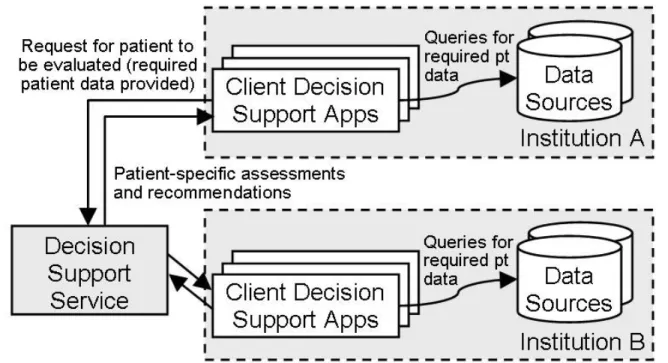
Through the use of these supplemental operations, a service client is able to identify the knowledge modules that are available from one or more DSSs for meeting the service client’s CDS needs. Furthermore, the service client is able to determine what data are needed for requesting a patient evaluation, as well as what will be returned by the DSS as a result of the patient evaluation request. Thus, when the need for a patient evaluation arises in a CDS system, the CDS system is able to (i) obtain the required patient data from its clinical data repositories, (ii) provide the requisite data to the DSS and request that the patient be evaluated using the specified knowledge modules, (iii) obtain machine-interpretable decision support results regarding the patient, and (iv) parse and use the results as appropriate in meeting the functional requirements of the application. Figure 4.1 illustrates this interaction graphically.
Figure 4.1. Schematic representation of interaction between clients and a DSS.
As an optional feature, a DSS may allow the client to specify an analysis time other than the present when requesting a patient evaluation. This feature is useful, for example, when outpatient care reminder sheets need to be printed in batch during the business day prior to the actual clinic session. Furthermore, the ability to designate any time in the past or the future as the evaluation time significantly facilitates testing, as static test cases will not become obsolete with the passage of time. This ability to specify the time at which a knowledge module evaluation is to take place is similar to how a HL7 v3 RIM Act can be scheduled to occur at a desired point in time through the use of the “intent” mood and the specification of the relevant activityTime.
4.3 Overall Potential Scope of the Service
The primary functionality provided by a DSS is the receipt of patient data as the input and the return of patient-specific conclusions as the output. A DSS also provides supplemental operations to support this patient evaluation functionality (Table 4.3).
Of note, a DSS could be used to evaluate entities other than individual patients (e.g., patient populations). For example, a DSS could be used to evaluate a group of patients to assess whether there are any indications of an emerging infectious disease outbreak within that population. However, the primary focus of this specification lies in the use of a DSS to evaluate individual patients.
As described earlier in Section 4.2, the scope of a DSS knowledge module may be narrow (e.g., an infant’s need for a varicella vaccination) or broad (e.g., a patient’s need for any general health maintenance procedures). With regard to the data required for generating the inferences, a DSS knowledge module may require the provision of various types of data. These data requirements may include, but are not limited to, demographic data, data on healthcare acts (e.g., procedures), and data on context (e.g., whether the patient is currently being seen in an outpatient or inpatient setting, or whether a specific diagnostic test can be performed at the current health care facility).
A DSS is permitted to return evaluation results using a variety of information constructs. Information constructs that may be used for communicating decision support results may include, but are not limited to, RIM acts (e.g., an HL7 medication entity with a mood code indicating that the medication should be ordered), dates (e.g., the date that a
test was last performed, or the date at which a test will be due), and Boolean values (e.g., whether a patient is in need of a pneumococcal vaccine).
Of note, for both DSS inputs and outputs, the HL7 Virtual Medical Record (vMR) standard may be used as DSS payloads.12
With regard to the types of applications intended to be supported by the specification, the DSS is designed primarily to facilitate the implementation and maintenance of systems that assist patient-specific decision making by clinicians (i.e., CDS systems targeted to clinicians). However, the DSS could be used to support other types of applications as well. For example, the inferences obtained from a DSS could be used to generate care reminder letters for patients. Also, patient evaluation requests could be repeated across a patient population in order to obtain population-level statistics. For example, by asking a DSS provider to evaluate each diabetic patient in a clinic with regard to the patient’s compliance with diabetes care guidelines, a reporting system would be able to easily calculate the proportion of diabetic patients in the clinic in compliance with the recommended care metrics. Finally, a DSS could be adapted so that it returns reference information relevant to the care of a patient rather than an assessment or a recommendation regarding the patient.
Of note, several aspects of the DSS are considered to be out of scope in terms of formal specification and standardization. To begin, what a client does with the evaluation result provided by a DSS is considered out of scope for the purposes of standardization. In addition, the mechanism used by a client to obtain the data required for evaluating a patient is also considered to be out of scope. Finally, the mechanism used by a DSS to generate patient-specific evaluation results is also considered out of scope for the purposes of standardization. As long as a DSS meets the functional requirements of the service, it is free to use whatever knowledge representation formalism it believes is most appropriate when implementing its decision support capabilities.
4.4 Reason Why the Service Specification is Needed
4.4.1 Explanation of Why the Service is Needed
As discussed in section 4.1, the rationale for creating the DSS specification is as follows: (i) there is a great need to improve the quality and safety of health care; (ii) CDS systems represent one of the most promising strategies for improving care quality, but their use is limited; (iii) one important reason for this limited utilization is the difficulty and cost associated with implementing effective CDS systems; (iv) the widespread adoption of the DSS standard should reduce the cost of implementing and maintaining a CDS system, thereby increasing the utilization of CDS systems in clinical care; and (v) increased utilization of CDS systems should help to improve care quality and to ensure patient safety.
4.4.2 Explanation of Why a Standard is Needed for the Service
Without a commonly agreed upon standard for the DSS, service clients would need to implement different interfaces when dealing with different DSSs or when switching DSSs. Similarly, the lack of a standard would result in service providers reaching only a small fraction of potential clients, as clients would need to invest in provider-specific interfaces before being able to make use of the functionality offered by a DSS.
A commonly accepted standard for the DSS would make it more attractive for service clients to invest in the infrastructure required for using the DSS to meet its decision support needs, as they would be able to use the same interface to interact with multiple service vendors. From the vendor’s perspective as well, a standard for the DSS is needed to increase the pool of potential customers and to reduce the risk involved with investing in the service framework.
12
4.4.3 Vendor Viewpoint and Potential Business Opportunity or Niche
From the perspective of a vendor, the acceptance of the DSS as an HL7 standard would provide several important benefits. First, a DSS standard should lead to a significant expansion of their potential client base. This expansion should occur due to the fact that clients should be more inclined to invest in the interface required for interacting with a vendor, as the interface would no longer be vendor-specific and would be re-usable for accessing knowledge from other DSS providers. Given this expansion of the client base, and given the highly scalable nature of the service framework, a DSS provider that achieves economies of scale would be able to increase its revenues and earnings, maintain a high quality of service, and lower the price that it charges on a per-client basis.
Also, because the DSS can be implemented as a service wrapper around existing capabilities, a DSS provider that has an established client base would be able to continue providing knowledge services using existing approaches as well (e.g., via existing application programming interfaces). Furthermore, because the DSS does not dictate how knowledge should be represented, the DSS provider can continue to encode medical knowledge using the approach that it deems to be most appropriate for its purposes.
Finally, a vendor with a superior DSS implementation would be able to license its implementation of the framework to other knowledge vendors or to other entities interested in sharing its patient evaluation capabilities via a DSS. Non-vendor entities that may wish to become DSS providers include federal or state organizations with an interest in finding more effective ways of getting their recommendations implemented in practice, such as Medicare, Medicaid, and the Agency for Healthcare Research and Quality in the United States. Also, health systems may be interested in supplementing the knowledge available from commercial DSS providers by acting as a DSS provider itself.
4.4.4 Consumer Viewpoint and the Value Offered by the Work Product
DSS consumers would potentially include any entity that wishes to facilitate the implementation and maintenance of decision support systems. These service consumers may include EHR, CPOE, e-Prescribing, and hospital information system (HIS) vendors, as well as healthcare institutions and their clinical departments.
From the viewpoint of these DSS customers, the primary value offered by the work product is the ability to leverage the decision support capabilities of multiple DSSs through a common service interface. By leveraging the capabilities of the DSS, the service customer should be able to reduce the cost and difficulty associated with developing and maintaining decision support applications.
Another advantage of the DSS framework is that it is highly secure. The DSS client rather than the DSS retrieves all patient data, and there is usually no need for a DSS to know who is being evaluated. Consequently, patient identifiers do not need to be sent to a DSS. Also,the DSS does not need to be authorized to access the client’s data repositories. As a result, a high level of security is attained by the fact that the client controls all read/write calls to its clinical repositories.
A final advantage to the DSS framework is that it significantly facilitates CDS system maintenance, as the medical decision logic used to reach patient evaluations are encapsulated in discrete knowledge modules that are tagged with meta-data, version-controlled, and maintained centrally on behalf of multiple clients.
5 Normative References
The following normative documents contain provisions which, through reference in this text, constitute provisions of this specification. For dated references, subsequent amendments to, or revisions of, any of these publications do not apply.
Web Services Description Language (WSDL) 1.1, W3C Note 15 March 2001, http://www.w3.org/TR/wsdl Web Services Description Language (WSDL) 2.0 W3C 26 June 2007 http://www.w3.org/ns/wsdl/
Simple Object Access Protocol (SOAP) Version 1.2 Part 1: Messaging Framework (Second Edition), W3C Recommendation 27 April 2007, http://www.w3.org/TR/soap12-part1/
XML Schema Part 2: Datatypes, W3C Recommendation 02 May 2001, http://www.w3.org/TR/xmlschema-2
XML Path Language (XPath) 1.0, W3C Recommendation 16 November 1999, http://www.w3.org/TR/xpath
ISO/IEC Standard 19757-3:2006, Information technology -- Document Schema Definition Language (DSDL) -- Part 3: Rule-based validation – Schematron, Edition 1, 1 June 2006,
http://standards.iso.org/ittf/PubliclyAvailableStandards/c040833_ISO_IEC_19757-3_2006(E).zip
Uniform Resource Locators (URL): A Syntax for the Expression of Access Information of Objects on the Network, 21 March 1994, http://www.w3.org/Addressing/URL/url-spec.txt
HL7 Version 3 Normative Standard, 2012 Edition. Available free to the public at
http://www.hl7.org/implement/standards/product_brief.cfm?product_id=282.
HL7 Decision Support Service, Release 1, Service Functional Model Specification. Available free to the public at
http://www.hl7.org/dstucomments/ex_showdetail.cfm?dstuid=12.
ISO Standard 3166-1, Country Codes, http://www.iso.org/iso/english_country_snames_and_code_elements ISO Standard 639-1, Codes for the Representation of Names of Languages, http://www.loc.gov/standards/iso639-2/php/code_list.php
Service Specifications Framework (SSF), Healthcare Services Specification Project (HSSP), http://hssp.wikispaces.com
6 DSS Platform Independent Model
The Platform Independent Model (PIM) for DSS represents a platform-independent definition of the DSS interfaces.
The PIM is defined in the accompanying normative UML model, represented as an XMI file. The source Enterprise Architect .EAP model is also provided on a non-normative, reference basis. Elements of this model are presented in this section to clarify and provide guidance on this model.
Note that the models provided below are extracts from the accompanying normative UML model.
6.1 Foundational Model Elements
This section defines foundational model elements used by various operations in the DSS.
6.1.1 Described Data Object
The Described Data Object (DescribedDO) is an abstract class that is accompanied by a String description and name. This class is defined in the common package. Note that for the diagram below, as well as for all other model fragment diagrams that follow, the “class” referenced in the top left corner of the diagram (e.g., “class common” in the diagram below) actually refers to the package in which the class resides (e.g., the “common” package for DescribedDO).
class common
DescribedDO + description: string + name: string
Figure 6.1. Model for Described Data Object.
6.1.2 Scoping Entity
A Scoping Entity (ScopingEntity) is a class that extends the Described Data Object and represents an entity that scopes business objects within a DSS. This class is defined in the metadata.scopingentity package. The Scoping Entity is identified by a String “id.” The intent of this id is to allow scoping entities to be uniquely identified, so that business objects can be identified in a globally unique manner as long as business object identifiers are unique within a scoping entity.
The “id” must start with lowercase English representations of one of the top-level Internet domain names, currently com, edu, gov, mil, net, org, or one of the English two-letter codes identifying countries as specified in ISO Standard 3166-1 (see Section 5, Normative References). Subsequently, the “id” must start by defining the domain name that is associated with the scoping entity (e.g., “com.clinica,” “com.dbmotion,” “edu.duke,” “org.hl7”). Subsequent identification within the domain associated with the scoping entity, if any, may be specified as is appropriate for the internal naming conventions by the scoping entity. Also, Scoping Entities may have a hierarchical structure described by the existence of parent and children Scoping Entities.
class scopingentity ScopingEntity + id: string + parentSEId: string [0..1] common::DescribedDO + description: string + name: string 0..1 +childScopingEntity 0..*
Figure 6.2. Model for Scoping Entity.
6.1.3 Entity Identifier and Interaction Identifier
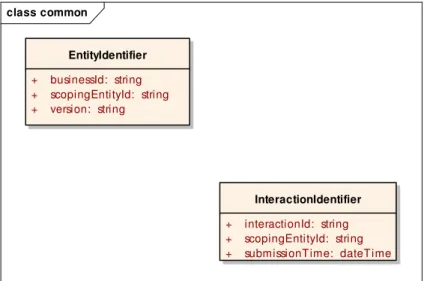
The Entity Identifier (EntityIdentifier) is used to identify business objects within a DSS. The Entity Identifier consists of the “id” of its Scoping Entity, a String “businessId,” and a String “version.” The Entity Identifier (the combination of scopingEntityId + businessId + version) must be globally unique. The only restriction on the version relates to the versioning of Knowledge Modules, which is discussed later in Section 6.3.1.2, Knowledge Module Version. This class is defined in the common package.
The Interaction Identifier (InteractionIdentifier) represents information that is transmitted as a part of an interaction with a DSS to identify that interaction for logging and debugging purposes. The InteractionIdentifier consists of a scopingEntityId, as well as an interactionId that is unique within the scopingEntityId. A submissionTime is also provided to help identify the interaction. This class is defined in the common package.
class common EntityIdentifier + businessId: string + scopingEntityId: string + version: string InteractionIdentifier + interactionId: string + scopingEntityId: string + submissionTime: dateTime
6.1.4 Item Identifier
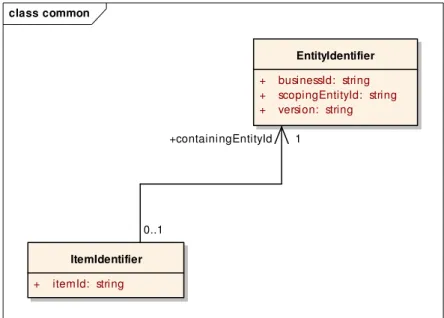
The Item Identifier (ItemIdentifier) is used to identify individual items that constitute subunits of business objects within a DSS. The Item Identifier consists of the Entity Identifier of its containing entity, as well as a String “itemId.” The “itemId” must be unique within the scope of the containing entity, and the complete ItemIdentifier (i.e., combination of containingEntityId + itemId) must be globally unique. This class is defined in the common package.
class common EntityIdentifier + businessId: string + scopingEntityId: string + version: string ItemIdentifier + itemId: string 0..1 +containingEntityId 1
Figure 6.4. Model for Item Identifier.
6.1.5 Scoped Data Object
The Scoped Data Object (ScopedDO) is an extension of the Described Data Object that represents the business object scoped by a scoping entity. This class includes a description, name, and an Entity Identifier. This class is defined in the common package.
class common EntityIdentifier + businessId: string + scopingEntityId: string + version: string DescribedDO + description: string + name: string ScopedDO 0..1 +entityId 1
6.2 Metadata Model Elements
This section describes the model elements related to service metadata.
6.2.1 Service Profile
The Service Profile (ServiceProfile) is an abstract class that represents a service profile. This class is defined in the metadata.profile package.
6.2.1.1 Overview of Service Profiles
By design, this specification is designed as a generic service framework which can be adapted in various ways to meet clients’ clinical decision support needs. While this flexibility is desirable, too much flexibility could make it more difficult to implement a DSS and/or to achieve plug-and-play interoperability among multiple DSSs. The specification of profiles allows the service to be constrained to the degree required for implementation and interoperability.
Of note, it is envisaged that many profiles will be defined after the adoption of this specification. Some of these profiles may be specified as formal, balloted profiles defined by standards development organizations such as HL7 and OMG, while other profiles may be specified as informal profiles defined by individual vendors, institutions, geographic regions, and other domains.
6.2.1.2 Profile Types
Table 6.1 summarizes the types of profiles that may be specified.
Table 6.1. Types of profiles that may be specified for a DSS.
Profile Type Description
Functional profile Specifies the list of supported service operations.
Semantic profile Specifies that all knowledge modules hosted by the service fulfill a specified set of semantic requirements (described in Section 6.3.2, Semantic Requirement).
Conformance profile Specifies a list of one or more supported functional profiles and one or more supported semantic profiles.
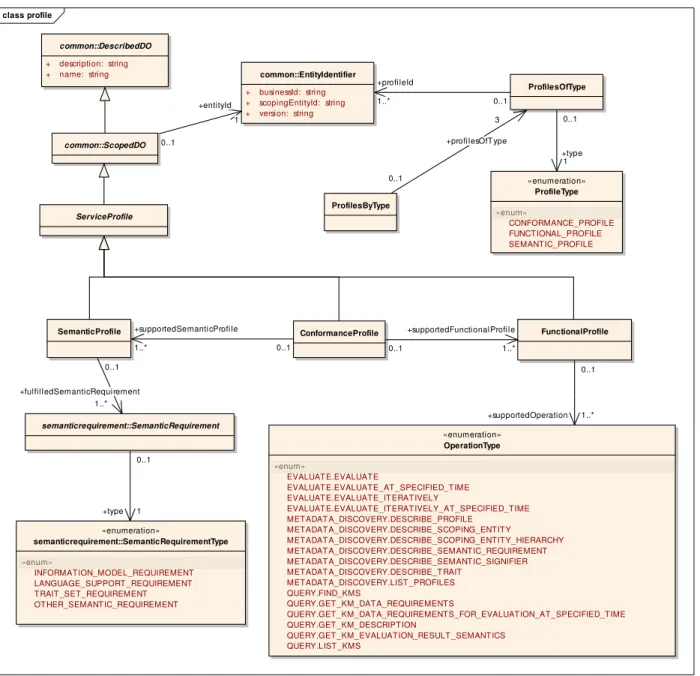
6.2.1.3 Service Profile Model
The Service Profile’s class model is shown below. In addition, a model that groups profiles by type, used in the metadata discovery interface, is provided below for reference.
class profile ConformanceProfile FunctionalProfile ServiceProfile common::ScopedDO common::DescribedDO + description: string + name: string semanticrequirement::SemanticRequirement «enumeration» ProfileType «enum» CONFORMANCE_PROFILE FUNCTIONAL_PROFILE SEMANTIC_PROFILE SemanticProfile «enumeration» semanticrequirement::SemanticRequirementType «enum» INFORMATION_MODEL_REQUIREMENT LANGUAGE_SUPPORT _REQUIREMENT T RAIT_SET_REQUIREMENT OT HER_SEMANT IC_REQUIREMENT ProfilesOfType common::EntityIdentifier + businessId: string + scopingEntityId: string + version: string ProfilesByType «enumeration» OperationType «enum» EVALUAT E.EVALUATE
EVALUAT E.EVALUATE_AT _SPECIFIED_T IME EVALUAT E.EVALUATE_IT ERAT IVELY
EVALUAT E.EVALUATE_IT ERAT IVELY_AT_SPECIFIED_TIME METADAT A_DISCOVERY.DESCRIBE_PROFILE
METADAT A_DISCOVERY.DESCRIBE_SCOPING_ENTITY
METADAT A_DISCOVERY.DESCRIBE_SCOPING_ENTITY_HIERARCHY METADAT A_DISCOVERY.DESCRIBE_SEMANT IC_REQUIREMENT METADAT A_DISCOVERY.DESCRIBE_SEMANT IC_SIGNIFIER METADAT A_DISCOVERY.DESCRIBE_T RAIT
METADAT A_DISCOVERY.LIST _PROFILES QUERY.FIND_KMS
QUERY.GET _KM_DATA_REQUIREMENTS
QUERY.GET _KM_DATA_REQUIREMENTS_FOR_EVALUAT ION_AT_SPECIFIED_TIME QUERY.GET _KM_DESCRIPTION
QUERY.GET _KM_EVALUATION_RESULT _SEMANT ICS QUERY.LIST_KMS 0..1 +fulfilledSemanticRequirement 1..* 0..1 +supportedSemanticProfile 1..* 0..1 +entityId 1 0..1 +supportedFunctionalProfile 1..* 0..1 +type 1 0..1 +supportedOperation 1..* 0..1 +profilesOfT ype 3 0..1 +type 1 0..1 +profileId 1..*
6.2.2 Semantic Signifier and Related Classes
A Semantic Signifier (SemanticSignifier) is a class that represents an information model. This class is defined in the metadata.semanticsignifier package.
6.2.2.1 Overview of Semantic Signifiers
The HSSP defines semantic signifiers as identifiers of information constructs that specify the structure and meaning of data. Semantic signifiers may identify standardized information constructs from HL7 (e.g., an HL7 version 3 Refined Message Information Model [RMIM]), standardized information constructs from a standards development organization other than HL7 (e.g., a DICOM image format), or non-standard local information constructs (e.g., Health System A’s laboratory data exchange format).
6.2.2.2 Use of Semantic Signifier within DSS
In this specification, semantic signifiers are used for the following purposes: (1) to specify the semantics by which data should be provided to the DSS for evaluating patients using a knowledge module; (2) to specify the semantics by which the query conditions for knowledge module data requirements are expressed by the DSS; (3) to specify the semantics by which patient evaluation results will be returned by the DSS; (4) to specify the semantics related to the traits and trait search criteria of DSS knowledge modules; and (5) to specify the semantics by which warnings are provided related to knowledge module evaluations.
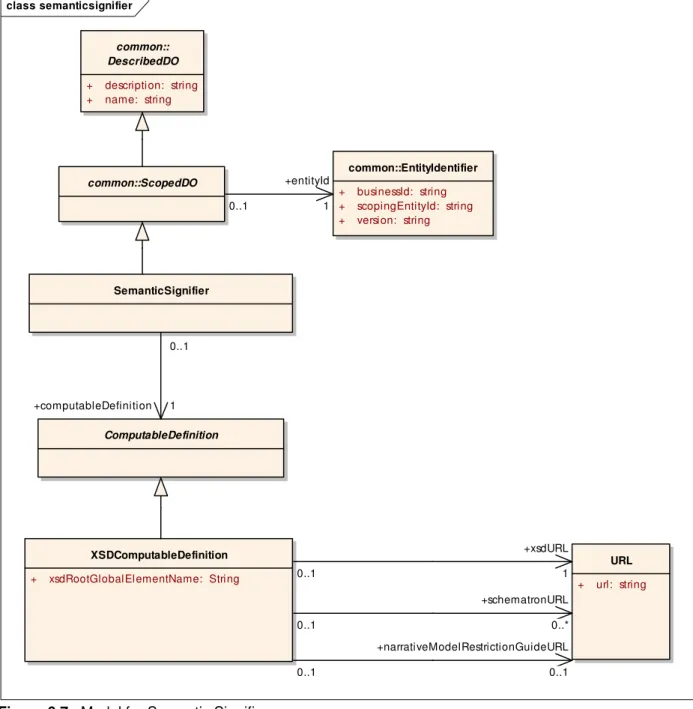
6.2.2.3 Semantic Signifier Model
The Semantic Signifier Data Object model is shown below. As noted, a semantic signifier is a Scoped Entity with a computable information model definition (e.g., an XML Schema Definition [XSD]) and zero or more computable integrity ruleset definitions (e.g., Schematrons) and an optional narrative model restriction guide. Currently, these definitions are made accessible via URLs. For the XML Web Service PSM defined in this specification, the XSDComputableDefinition defined below shall be used, consisting of a Uniform Resource Locator (URL) to a single XSD, URLs to zero or more Schematrons, an optional URL to a narrative model restriction guide, and a specification of the global element that serves as the root element of the information model. Note that an XSD used in this context must have the root element defined as a global element so that it can be directly used for automated instance validation. See Section 5, Normative References for normative references to the XSD, Schematron, and URL standards.
class semanticsignifier SemanticSignifier ComputableDefinition XSDComputableDefinition + xsdRootGlobalElementName: String common::ScopedDO common:: DescribedDO + description: string + name: string common::EntityIdentifier + businessId: string + scopingEntityId: string + version: string URL + url: string 0..1 +computableDefinition 1 0..1 +entityId 1 0..1 +narrativeModelRestrictionGuideURL 0..1 0..1 +schematronURL 0..* 0..1 +xsdURL 1
6.2.2.4 Convention for Referring to HL7 Version 3 Semantic Signifiers
For referring to HL7 version 3 semantic signifiers, the use of the following convention is recommended. Making these recommendations mandatory will be considered in the future.
• For the scoping entity identifier, use “org.hl7” • For the business identifier, use the following:
o First part: “v3” followed by the folder tree in which the schema is included in the HL7 Normative Edition of the Version 3 standards. For example, in the HL7 Version 3 Normative Edition for 2012, the first part of the business identifier would be as follows:
v3.infrastructure.cda for CDA.xsd, because its folder path is “infrastructure” and then “cda”
v3.processable.multicacheschemas for HL7 version 3 messaging schemas, because their folder path is “processable” and then “multicacheschemas”
o Second part: The name of the schema (e.g., COCT_HD010000UV01, FICR_IN310201UV02), followed by a period and then by the root element or complex type to be used from the schema. For example, if the complex type of interest with the schema COCT_HD010000UV01 is named COCT_HD010000UV01.Encounter, then make this part of the business identifier COCT_HD010000UV01.COCT_HD010000UV01.Encounter.
• For the version, use "1.0" since HL7 version 3 schemas are assigned different identifiers when modified (e.g.,
MODELX, MODELXUV, MODELXUV01, etc.).
• In the case of XML schemas, almost all HL7 version 3 schemas currently define complex types but do not
define elements that can be used for the purposes of automated instance validation. Therefore, it is recommended that DSS providers wishing to use HL7 version 3 XML schemas provide clients with a separate XML schema that defines its focal, root element using the name and semantics of the HL7 complex type. For example, org.hl7.v3.multicacheschemas' COCT_HD010000UV01 schema defines a complex type named COCT_HD010000UV01.Encounter. To use this concept, it is recommended that a DSS provider do the following:
o Create or otherwise obtain an XML schema in which an element named COCT_HD010000UV01.Encounter is defined, whose type is the COCT_HD010000UV01.Encounter complex type defined in the HL7 version 3 schema.
• An example using this convention is as follows:
Schema COCT_HD010000UV01 Schema Location within HL7 Normative Edition processable\multicacheschemas Complex Type of Interest COCT_HD010000UV01.Encounter Scoping Entity Identifier org.hl7 Business Identifier v3.processable.multicacheschemas.COCT_HD010000UV01.COCT_HD010000UV01.Encounter
6.3 Knowledge Module Model Elements
This section describes the model elements related to knowledge modules (KMs).
6.3.1
Knowledge Module Description
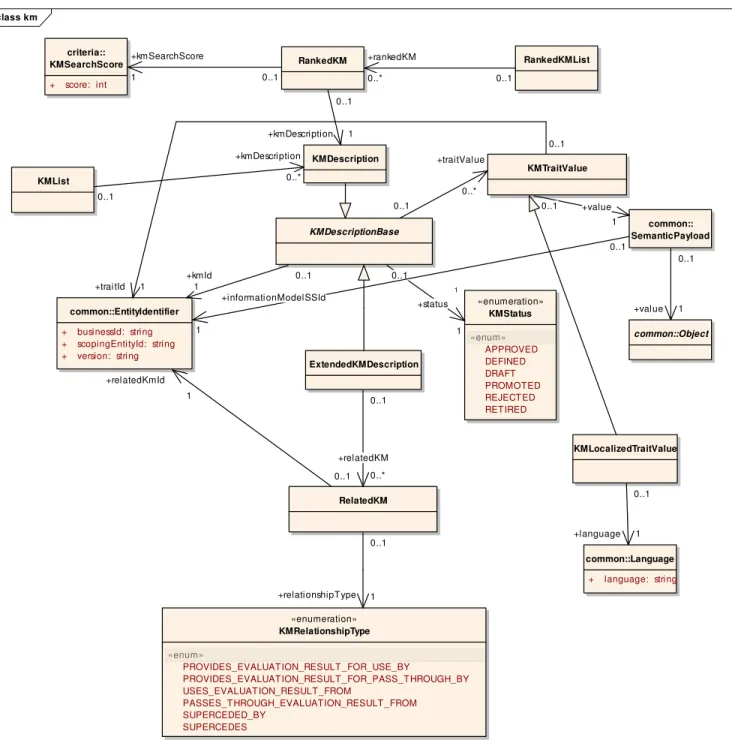
The Knowledge Module Description (KMDescription) and Extended Knowledge Module Description (ExtendedKMDescription) provide core meta-data regarding a DSS knowledge module. The class is modeled in the query.km package. The model is provided below, and relevant aspects of this model are described thereafter.
Figure 6.8. Model for Knowledge Module Description.
1 class km RelatedKM KMDescriptionBase «enumeration» KMRelationshipType «enum» PROVIDES_EVALUATION_RESULT_FOR_USE_BY PROVIDES_EVALUATION_RESULT_FOR_PASS_THROUGH_BY USES_EVALUATION_RESULT_FROM PASSES_THROUGH_EVALUATION_RESULT_FROM SUPERCEDED_BY SUPERCEDES «enumeration» KMStatus «enum» APPROVED DEFINED DRAFT PROMOTED REJECTED RETIRED KMTraitValue RankedKM RankedKMList criteria:: KMSearchScore + score: int common::EntityIdentifier + businessId: string + scopingEntityId: string + version: string common:: SemanticPayload common::Object KMList KMLocalizedTraitValue common::Language + language: string ExtendedKMDescription KMDescription 0..1 +status 1 0..1 +value 1 0..1 +value 1 0..1 +language 1 0..1 +kmDescription 1 0..1 +informationModelSSId 1 0..1 +traitValue 0..* 0..1 +relationshipType 1 0..1 +traitId 1 0..1 +relatedKmId 1 0..1 +kmId 1 0..1 +kmDescription 0..* 0..1 +rankedKM 0..* 0..1 +kmSearchScore 1 0..1 +relatedKM 0..*
6.3.1.1 Knowledge Module Status
The allowed values and definitions of a KM status are as follows:
• DRAFT - the KM has been created and can be modified.
• DEFINED - the KM has been defined and is currently in unit test. • REJECTED - the KM has been tested un-successfully.
• APPROVED - the KM has been tested successfully and can be deployed. • PROMOTED - the KM has been deployed on a production platform.
• RETIRED - the KM was deployed or approved on a production platform but is no longer active.
The accompanying lifecycle diagram is as follows. Note that the term “rule” in the diagram should be considered to be equivalent to the concept of “KM” in the rest of this specification.
Furthermore, the following are accompanying guidelines for the management of KM status. These guidelines are to be considered normative.
• When a KM is created its status is “DRAFT.” As long as the KM is in this status, every change made does not
affect the KM version.
• Every time the KM status changes to “DRAFT,” a new KM version is created, i.e., the lifecycle is restarted. • Once a KM is “PROMOTED” the user cannot update it. He needs to create a new KM version and restart
• A “RETIRED” KM should no longer be used (e.g., due to changes in underlying clinical guidelines or the
availability of an improved version of the KM). A “RETIRED” KM may still be usable, but continued support is not guaranteed. The expectation is that a “RETIRED” KM will be replaced by an improved “PROMOTED” KM. However, this is not guaranteed, as in the case when a KM must be quickly retired due to the emergence of new evidence that a drug that was previously recommended should no longer be prescribed due to serious side effects, but a replacement KM cannot be developed, tested, and promoted before the original KM is retired.
• Whether a given DSS client is allowed to search for and/or use KMs of a given status is outside of the
scope of this specification and is up to the DSS provider. For example, a DSS provider may make “DRAFT” KMs available only to internal developers, or a DSS provider may allow clients to continue using “RETIRED” KMs as long as the clients are aware that continued support for such KMs cannot be guaranteed indefinitely. Similarly, KMs with a status other than “PROMOTED” may be searchable by internal developers using the DSS interface but not searchable by a typical client.
• Similar to the above consideration, within KMs of the same status, it is outside of the scope of this
specification which KMs are visible to and usable by a DSS’s clients. For example, a DSS provider may decide to segment KMs into sets of knowledge which require different levels of licenses to access.
6.3.1.2 Knowledge Module Version
A component of the Entity Identifier for a knowledge module is the version. The following are defined as normative requirements for the version.
• As noted above, a new KM version is created each time that a new KM is created or its status is changed
to “DRAFT.”
• The KM version shall take the following form: [Major Version Number].[Minor Version Number].[Revision
Number] (e.g., 1.0.0).
• Conceptually, the different components of the KM version can be understood as follows:
o Major Version Number - reflects major changes in the KM’s run-time interface and/or the underlying clinical logic. Starts with 1, and increments up by 1.
o Minor Version Number - reflects minor changes in the KM’s run-time interface and/or the underlying clinical logic. Starts with 0 within a major version, and increments up by 1.
o Revision Number - reflects revisions that do not make any significant changes to the KM’s run-time interface or the underlying clinical logic. Starts with 0 within the combination of a major version and minor version, and increments up by 1.
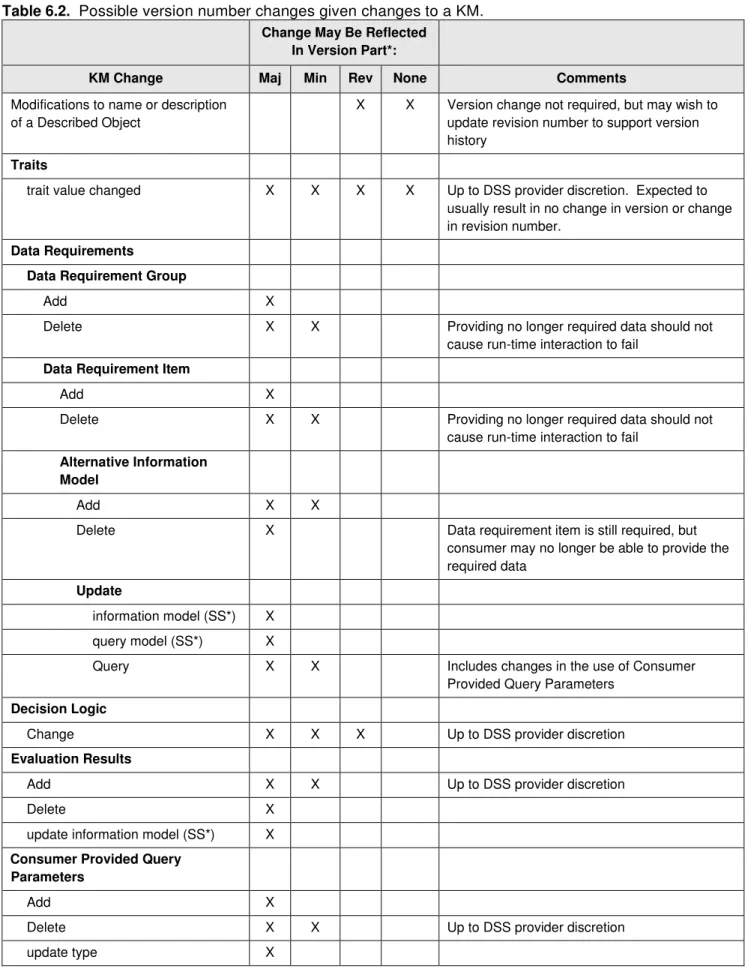
• Which version part to change is up to the discretion of the DSS provider under the conceptual framework
above. However, if a KM change involves one of the aspects specified in Table 6.2, then the version change must adhere to the versioning approach specified in the table.
Table 6.2. Possible version number changes given changes to a KM.
Change May Be Reflected In Version Part*:
KM Change Maj Min Rev None Comments
Modifications to name or description of a Described Object
X X Version change not required, but may wish to update revision number to support version history
Traits
trait value changed X X X X Up to DSS provider discretion. Expected to
usually result in no change in version or change in revision number.
Data Requirements
Data Requirement Group
Add X
Delete X X Providing no longer required data should not
cause run-time interaction to fail
Data Requirement Item
Add X
Delete X X Providing no longer required data should not
cause run-time interaction to fail
Alternative Information Model
Add X X
Delete X Data requirement item is still required, but
consumer may no longer be able to provide the required data
Update
information model (SS*) X
query model (SS*) X
Query X X Includes changes in the use of Consumer
Provided Query Parameters
Decision Logic
Change X X X Up to DSS provider discretion
Evaluation Results
Add X X Up to DSS provider discretion
Delete X
update information model (SS*) X
Consumer Provided Query Parameters
Add X
Delete X X Up to DSS provider discretion
Change May Be Reflected In Version Part*:
KM Change Maj Min Rev None Comments
Fulfilled Semantic Requirements
Add X X Up to DSS provider discretion
Delete X X Up to DSS provider discretion
*Maj = Major Version Number; Min = Minor Version Number; Rev = Revision Number; None = No change in version. SS = semantic signifier.
The following are valid ways of specifying the version number of a knowledge module to use in the Evaluation operations (see Section 6.9, Evaluation Interface):
• The specific version number (e.g., 2.1.0) - This will result in the evaluation of version 2.1.0.
• The specific major and minor version, with * as the revision number (e.g., 2.1.*) - This will result in the
evaluation of the highest revision with the specified major and minor version number (e.g., 2.1.0, 2.1.1, or 2.1.2, depending on the latest available revision).
• The specific major version, with * as the minor version and * as the revision number (e.g., 2.*.*) - This will
result in the evaluation of the highest minor version, and the highest revision within that minor version (e.g., if the highest minor version within major version 2 is 3, and the highest revision within version 2.3 is revision 1, then 2.3.1 would be used).
6.3.1.3 Knowledge Module Relationship
A KM relationship may be of the following types:• USES_EVALUATION_RESULT_FROM - The current KM uses one or more of the evaluation results from the
related KM as an evaluation input.
• PROVIDES_EVALUATION_RESULT_FOR_USE_BY - The current KM provides one or more of its evaluation
results to the related KM for usage as an evaluation input.
• PASSES_THROUGH_EVALUATION_RESULT_FROM - The current KM passes through to the consumer
one or more of the evaluation results obtained from the related KM.
• PROVIDES_EVALUATION_RESULT_FOR_PASS_THROUGH_BY - The current KM provides one or more of its
evaluation results to the related KM for passing the evaluation result through to the consumer.
• SUPERCEDED_BY - The current KM was superceded by the related KM. That is, the related KM should be
used instead of the current KM if possible.
• SUPERCEDES - The current KM supercedes the related KM. That is, the current KM should be used instead
of the related KM if possible.
6.3.1.4 Knowledge Module Traits
6.3.2
Semantic Requirement
A Semantic Requirement (SemanticRequirement) is an abstract class that represents a requirement placed on all knowledge modules within a DSS instance. A DSS semantic profile specifies which semantic requirements must be fulfilled by its KMs (Section 6.2.1.2, Profile Types). The Semantic Requirement class is defined in the metadata.semanticrequirement package. Note that this requirement used to be referred to as KM Requirements in the HL7 DSS SFM DSTU.
6.3.2.1 Semantic Requirement Types
The table below specifies the types of semantic requirements that may be specified.
Table 6.3. Types of semantic requirements. Semantic Requirement
Type
Description
Trait set requirement Specifies the list of traits (see Section 6.3.3, Trait) that will or may be associated with the DSS’s knowledge modules. Traits are identified by the identifier of the trait’s scoping entity, the trait identifier, and the trait version. The requirement also specifies if the trait is required or optional for knowledge modules.
Information model requirement
The InformationModelRequirement specifies the information models that (a) can or (b) must be used by DSS knowledge modules claiming conformance to this requirement.
This information model requirement consists of one or more of the following: (i) allowedDataRequirement - specifies the superset of data requirement models and associated query models that can be used.
(ii) requiredDataRequirement - specifies the data requirement models and associated query models, if any, that must be used.
(iii) allowedWarningModelSSId - specifies the superset of models that can be used by the service to provide warnings regarding evaluations.
(iv) allowedEvaluationResultRequirement - specifies the superset of evaluation result models that can be used and associated CDS output specification models that can be used.
(v) requiredEvaluationResultRequirement - specifies the evaluation result models and associated CDS output specification models, if any, that must be used. Language support
requirement
Specifies the languages that are supported by the DSS.
Other semantic requirement
6.3.2.2 Language Specification
Language shall be specifiied as either a 2-character ISO 639-1 language code or a combination of a 2-character ISO 639-1 language code and a 2-character ISO 3166-1 geographical code, concatenated with a hyphen. Example valid language specifications include: “en,” “en-US,” “en-GB,” and “fr.” ISO 639-1 codes are available at
http://www.loc.gov/standards/iso639-2/php/English_list.php, and ISO 3166-1 codes are available at
http://www.iso.org/iso/english_country_names_and_code_elements. See Section 5 for normative references to these standards.
6.3.2.3 Semantic Requirement Model
The Semantic Requirement class model is shown below. class semanticrequirement DataRequirementBase SemanticRequirement «enumeration» SemanticRequirementType INFORMATION_MODEL_REQUIREMENT LANGUAGE_SUPPORT_REQUIREMENT TRAIT _SET_REQUIREMENT OTHER_SEMANTIC_REQUIREMENT InformationModelRequirement TraitRequirement + isMandatory :boolean TraitSetRequirement common::EntityIdentifier + scopingEntityId :string + businessId :string + version :string LanguageSupportRequirement common::Language + language :string common::DescribedDO + name :string + description :string common::ScopedDO
Allow edDataRequirement RequiredDataRequirement OtherSemanticRequirement
+ requirementSpecification :string
EvaluationResultRequirementBase
Allow edEv aluationResultRequirement RequiredEv aluationResultRequirement 0..1 +allowedWarningModelSSId 0..* 0..1 +traitRequirement 0..* 0..1 +allowedDataRequirement 0..* 0..1 +allowedQueryModelSSId 0..* 0..1 +supportedLanguage 1..* 0..1 +informationModelSSId 1 0..1 +requiredDataRequirement 0..* 0..1 +requiredQueryModelSSId 0..1 0..1 +traitId 1 0..1 +entityId 1 0..1 +type 1 0..1 +informationModelSSId 1 0..1 +requiredEvaluationResultRequirement 0..* 0..1 +allowedEvaluationResultRequirement 0..* 0..1 + re q u ir e d C D S O u tp u tS p e c if ic a ti o n M o d e lS S Id 0..1 0..1 + a llo w e d C D S O u tp u tS p e c if ic a ti o n M o d e lS S Id 0..*
6.3.2.4 Comprehensive Capture of Key Service Characteristics within Semantic Requirements
and Semantic Profiles
In order to allow a DSS consumer to be able to fully understand the key characteristics of a DSS at the level of semantic profiles and constituent semantic requirements, the following are specified as mandatory requirements:
• All traits used within a DSS must be included within a TraitSetRequirement.
• All langua