Notes
ALGORITHMIC ADVERTISING DISCRIMINATION
Joseph Blass
ABSTRACT—The ability of social media companies to precisely target
advertisements to individual users based on those users’ characteristics is changing how job opportunities are advertised. Companies like Facebook use machine learning to place their ads, and machine learning systems present risks of discrimination, which current legal doctrines are not designed to deal with. This Note will explain why it is difficult to ensure such systems do not learn discriminatory functions and why it is hard to discern what they have learned as long as they appear to be performing well on their assigned task. This Note then shows how litigation might adapt to these new systems to provide a remedy to individual plaintiffs but explains why deterrence is ill-suited in this context to prevent this discrimination from occurring in the first place. Preventing machine learning systems from learning to discriminate requires training those systems on broad, representative datasets that include protected characteristics—data that the corporations training these systems may not have. The Note proposes a proactive solution, which would involve a third party safeguarding a rich, large, nationally representative dataset of real people’s information. This third party could allow corporations like Facebook to train their machine learning systems on a representative dataset, while keeping the private data themselves out of those corporations’ hands.
AUTHOR—J.D.–Ph.D Candidate, Northwestern Pritzker School of Law and
McCormick School of Engineering, Department of Computer Science. I would like to thank Professors Deborah Tuerkheimer and Sarah Lawsky for their invaluable help shaping this work, and Professors Ken Forbus, Doug Downey, and Brian Pardo for their discussions on machine learning. Thanks as well to the editors of the Northwestern University Law Review for their work on this piece, particularly Will French, Kathleen Gould, Matthew Erickson, Matthew Freilich, Andrew Kunsak, Abigail Bachrach, Andrew Borrasso, and Annie Prossnitz. All errors are my own.
INTRODUCTION ... 416
I. FRONTIERS IN DIGITAL EMPLOYMENT ADVERTISING ... 420
A. Using Explicit Proxy Variables ... 420
B. Lookalike Audiences ... 422
C. Algorithmic Bias in Machine Learning Systems ... 423
II. EMPLOYMENT ADVERTISING DISCRIMINATION LAW ... 439
A. Discrimination Law for Employment Agencies ... 440
B. Relevant Title VII Employment Discrimination Actions ... 442
III. APPLYING AND ADAPTING EMPLOYMENT DISCRIMINATION TO MACHINE LEARNING ... 446 A. Disparate Treatment ... 448 B. Antistereotyping Theory ... 449 C. Disparate Impact ... 450 D. Word-of-Mouth Hiring ... 453 E. Reckless Discrimination ... 454
IV. COUNTERING ALGORITHMIC DISCRIMINATION REACTIVELY AND PREVENTATIVELY ... 456
A. The Insufficiency of Reactive Solutions ... 457
B. Proactive Solutions ... 459
CONCLUSION ... 466
INTRODUCTION
In May 2015, Google launched Google Photos, a free service that allowed users to upload unlimited numbers of pictures and later search through those images using words.1 Google Photos automatically tags each
picture with words describing its content based on predictions generated by Google’s artificial intelligence image analysis system.2 But barely a month
after rolling out its new service, Google suffered a major public embarrassment when a user discovered that Google Photos had labeled images of black people as “gorillas.”3 Google immediately apologized and
1Google Photos, GOOGLE, https://www.google.com/photos/about [https://perma.cc/F5ZD-MQGD]. 2Devon Delfino, ‘How Does Google Photos Work?’: Everything You Need to Know About Google's Photo Storage App for IPhone and Android, BUS. INSIDER (June 27, 2019, 5:25 PM), https://www.businessinsider.com/how-does-google-photos-work [https://perma.cc/A6DM-L3EL].
3 Conor Dougherty, Google Photos Mistakenly Labels Black People ‘Gorillas’, N.Y.TIMES:BITS
BLOG (July 1, 2015, 7:01 PM), https://bits.blogs.nytimes.com/2015/07/01/google-photos-mistakenly-labels-black-people-gorillas [https://perma.cc/WAC2-57T4].
promised to fix the problem, and yet, years later, its solution still has not advanced from simply preventing its software from tagging any image as containing a gorilla.4 Apparently, Google could not find a solution to reliably
prevent such racist image mislabeling to occur.5
The world has entered a new era of big data and machine learning, where more and more decisions are being made based on patterns algorithmically extracted from large datasets.6 Machine learning systems
ingest large amounts of data and learn to make predictions about some element of interest (e.g., a label for an image) based on that data (e.g., attributes of the image itself).7 If these datasets encode the biases of the
humans generating the datasets, then machine learning systems trained on those datasets are likely to replicate those biases or even introduce new biases based on patterns that happen to be present in those data.8 But because
machine learning systems are not easily inspected or explained,9 such biases
may pass largely undetected.
Big data and machine learning have already transformed advertising. The old model of advertising based on newspapers, billboards, and television is declining in favor of a model in which consumers see ads online, such as on Google and Facebook.10 Companies are now recruiting employees by
4 Tom Simonite, When It Comes to Gorillas, Google Photos Remains Blind, WIRED (Jan. 11,
2018, 7:00 AM), https://www.wired.com/story/when-it-comes-to-gorillas-google-photos-remains-blind [https://perma.cc/T27M-8SG9].
5 In this instance, a Google engineer attributed the source of the error to two problems: the general
difficulty of facial recognition and the fact that cameras have long been calibrated to produce higher-quality photos of white people than nonwhite people, which in turn provides worse inputs to facial recognition systems for nonwhite people. See Yonatan Zunger, Asking the Right Questions About AI, MEDIUM (Oct. 11, 2017), https://medium.com/@yonatanzunger/asking-the-right-questions-about-ai-7ed2d9820c48 [https://perma.cc/D8W8-8A3N].
6 See, e.g., Editorial, How Artificial Intelligence Is Edging Its Way into Our Lives, N.Y.TIMES
(Feb. 12, 2018), https://www.nytimes.com/2018/02/12/technology/artificial-intelligence-new-work-summit.html [https://perma.cc/XBV5-Q92H].
7 Tom M. Mitchell, Does Machine Learning Really Work?, 18 AIMAG. 11, 11–13 (1997). 8 Will Knight, Biased Algorithms Are Everywhere, and No One Seems to Care, MITTECH.REV.
(July 12, 2017), https://www.technologyreview.com/s/608248/biased-algorithms-are-everywhere-and-no-one-seems-to-care [https://perma.cc/3P5J-9LAH]; see also Zunger, supra note 5 (explaining that a Google Image search for “‘[t]hree white teenagers’ turned up stock photography of attractive, athletic teens; [while] ‘three black teenagers’ turned up mug shots, from news stories about three black teenagers being arrested. [This outcome was not due to] a bias in Google’s algorithms: it was a bias in the underlying data[,] . . . a combination of ‘invisible whiteness’ and media bias in reporting.”).
9 Seeinfra Section I.C.
10 See, e.g.,Hamza Shaban, Digital Advertising to Surpass Print and TV for the First Time, Report Says, WASH.POST (Feb. 20, 2019), https://www.washingtonpost.com/technology/2019/02/20/digital-advertising-surpass-print-tv-first-time-report-says [https://perma.cc/S9E4-V4GH] (reporting forecasts by EMarketer).
advertising job opportunities through social media, a practice that will likely become more and more commonplace.11 The old advertising model may have
targeted a general audience, but the new advertising model targets individual users with extreme precision.
As social media websites increasingly become platforms for employee recruitment, the mechanisms through which they target job ads to users or allow employers to request that those ads be targeted have faced growing scrutiny. Facebook, for example, has over a billion users and makes money by promising advertisers it will show their ads to users likely to click them.12
Thus, its business depends on its ability to effectively target specific ads to individual users. Doing this manually would take a global army of employees, who would not necessarily be effective. Instead, Facebook uses machine learning technology to predict which kinds of ads particular users might click.13
Though it is illegal to target job ads using statutorily defined protected characteristics (such as sex, race, age, and others),14 Facebook has recently
faced criticism and legal action for targeting such ads in these exact ways.15
11 Though rigorous empirical research on this claim is currently lacking, there is consensus among
job candidate recruitment organizations that this is the case. See, e.g., JOBVITE,JOBVITE RECRUITER
NATION REPORT 2016:THE ANNUAL SOCIAL RECRUITING SURVEY 14 (2016) (showing both recruiters and job seekers use social media to find and vet candidates).
12 Ben Gilbert, How Facebook Makes Money from Your Data, in Mark Zuckerberg’s Words, BUS.
INSIDER (Apr. 11, 2018, 10:25 AM), https://www.businessinsider.com/how-facebook-makes-money-according-to-mark-zuckerberg-2018-4 [https://perma.cc/MM6D-MLM7].
13 Machine Learning, FACEBOOK: RESEARCH, https://research.fb.com/category/machine-learning
[https://perma.cc/PN8E-PPMQ].
14 Title VII of the Civil Rights Act of 1964, 42 U.S.C. § 2000e(e)(17) (2012). Indeed, the Equal
Employment Opportunity Commission recently found reasonable cause to believe that several employers violated Title VII by placing job ads on Facebook and directing that the ads not be shown to women or older users. See In Historic Decision on Digital Bias, EEOC Finds Employers Violated Federal Law When They Excluded Women and Older Workers from Facebook Job Ads, ACLU (Sep. 25, 2019), https://www.aclu.org/press-releases/historic-decision-digital-bias-eeoc-finds-employers-violated-federal-law-when-they [https://perma.cc/VTT2-JM6X]. For copies of the letters themselves, see U.S. Equal Emp. Opportunity Comm’n, Letters of Determination (July 5, 2019), available at
https://www.onlineagediscrimination.com/sites/default/files/documents/eeoc-determinations.pdf [https://perma.cc/4LNE-F3N5].
15 Julia Angwin & Terry Parris Jr., Facebook Lets Advertisers Exclude Users by Race, PROPUBLICA
(Oct. 28, 2016, 1:00 PM), https://www.propublica.org/article/facebook-lets-advertisers-exclude-users-by-race [https://perma.cc/G53V-A63F]; Julia Angwin et al., Facebook Job Ads Raise Concerns About Age Discrimination, N.Y. TIMES (Dec. 20, 2017), https://www.nytimes.com/2017/12/20/business/ facebook-job-ads.html [https://perma.cc/K4LX-XV5Y]; Noam Scheiber, Facebook Accused of Allowing Bias Against Women in Job Ads, N.Y.TIMES (Sept. 18, 2018), https://www.nytimes.com/2018/09/18/ business/economy/facebook-job-ads.html [https://perma.cc/AU28-5C7D]. The ACLU’s complaint in its lawsuit against Facebook can be found at Facebook EEOC Complaint—Charge of Discrimination, ACLU
Indeed, Facebook recently settled several such lawsuits, agreeing to change the way housing, employment, and credit ads can be targeted to its users.16
Yet, as this Note will demonstrate, these changes may be insufficient to prevent discrimination.
Furthermore, Facebook is not the only company at risk of discriminating through its use of machine learning systems. Other social media and online advertising companies, such as Google, Twitter, and LinkedIn, will be susceptible to similar claims to the extent they use machine learning to target advertisements. Although these issues can involve discrimination along any characteristic protected by Title VII,17 this Note
specifically focuses on sex discrimination and on Facebook’s employment advertising algorithms.
The new era of online employment advertising and machine learning is in fundamental tension with Title VII because Title VII is not designed to deal with the ways in which machine learning systems might discriminate. The law must therefore adapt to the ways discrimination will manifest through such systems.18 Indeed, in the context of employment, scholars have
already begun to examine how Title VII might be amended to eliminate obstacles faced by those alleging discrimination in companies’ online recruiting efforts.19 But this Note will explain why eliminating bias in
machine learning systems requires a proactive rather than reactive response: these systems must learn to avoid discrimination as they are developed and before they are deployed, and the threat of litigation may not suffice to ensure this occurs effectively.
This Note proceeds as follows: Part I discusses digital advertising and machine learning, explaining the basics of how deep learning neural network algorithms work and the challenges involved in understanding what they have learned. Part II describes the requirements employment discrimination laws place on those who advertise employment opportunities and how people can challenge violations of these laws. Part III explains why current doctrine
(Sept. 18, 2018), https://www.aclu.org/legal-document/facebook-eeoc-complaint-charge-discrimination [https://perma.cc/4PMM-WBJ2] [hereinafter “Complaint”].
16 See Summary of Settlements Between Civil Rights Advocates and Facebook, ACLU
(Mar. 19, 2019), https://www.aclu.org/other/summary-settlements-between-civil-rights-advocates-and-facebook [https://perma.cc/U4MY-7GUW] [hereinafter “Settlement”]. Notwithstanding the settlement of several of these cases, the Department of Housing and Urban Development (HUD) is continuing to pursue a lawsuit against Facebook over its discriminatory housing advertising practices. Facebook, No. 01-18-0323-8, (DEP’T OF HOUSING &URB.DEV.Charge of Discrimination Mar. 28, 2019), https://www. hud.gov/sites/dfiles/Main/documents/HUD_v_Facebook.pdf [https://perma.cc/5SH6-6KNE].
17 Title VII of the Civil Rights Act of 1964, 42 U.S.C. § 2000e (2012), forbids employment
discrimination along certain characteristics. See infra Section II.B.
18 See infra Part III. 19 See infra Part III.
is ill-equipped to deal with the challenges posed by modern machine learning technology, addresses the pros and cons of proposed solutions to these challenges, and examines potential adaptations to existing doctrine that may support claims of algorithmic advertising discrimination. Part IV then explains why providing recourse for individual plaintiffs is insufficient to prevent advertising discrimination from occurring in the first place. This Part instead proposes a proactive legal mechanism to prevent such discrimination: entrusting a third party (such as a new government agency, a nonprofit organization, or some other entity) with a diverse and representative dataset of real people’s data. By allowing systems engineers, like Facebook, to train their systems on these data, this entity would give those engineers the best chance possible to avoid building discriminatory systems and would be able to evaluate the extent to which those systems discriminate, all while maintaining the privacy and integrity of people’s data.
I. FRONTIERS IN DIGITAL EMPLOYMENT ADVERTISING
Systems such as Facebook’s ad-placement algorithm are likely to operate in a discriminatory fashion unless steps are actively taken to prevent them from doing so, both because of the tools Facebook makes available to advertisers and because of the general principles underlying big data machine learning technology. This Part describes social media ad-placement methods and shows why they may result in discriminatory outcomes, from the easiest-to-recognize form of discriminatory targeting to the most insidious. It describes how user data can be used as proxies for sensitive information (like sex). It then explains how machine learning systems can discern and rely upon such sensitive information through combinations of otherwise innocuous characteristics. Finally, it describes emergent techniques that can help mitigate these risks.
A. Using Explicit Proxy Variables
Up until its recent settlement, Facebook required advertisers to specify the gender of users to whom the ad will be shown (“Male,” “Female,” or “All”).20 The settlement prohibits such explicit targeting, as well as targeting
ads based on data that serve as direct proxies for protected characteristics (meaning they can be used to target particular genders, races, etc.).21 For
example, Facebook will no longer allow advertisers to target users who
20 Complaint, supra note 15, at 1. 21 Settlement, supra note 16, at 1.
reside within a mile of a particular address or within a specific zip code.22 By
specifying addresses in homogenous areas and setting small radii, advertisers had been able to create target audiences along a protected characteristic without ever specifying that characteristic—a familiar callback to historical redlining practices.23
But although advertisers can no longer use precise location information to target employment, housing, or credit ads, Facebook still allows targeting based on users’ interests, which may be proxies for protected characteristics.24 At least prior to Facebook’s settlement, Facebook’s ad
targeting system could be used to create audiences homogenous along a protected characteristic, which therefore discriminated by excluding those without that characteristic.25 For example, targeting an ad at users interested
in the brand “Marie Claire” generated an audience that was 90% female.26
If an employer is seeking a cosmetics salesperson, then targeting job ads towards an interest in cosmetics is legitimate. But if these variables are being used only as proxies for protected characteristics, they might run afoul of antidiscrimination law.27 It may be possible to identify individual variables
that are proxies for protected characteristics and forbid their use in targeting job ads. Indeed, Facebook’s settlement promises that Facebook will identify and forbid the use of such proxy variables.28 There may be variables,
22 Id.
23 See, e.g., NAACP v. Am. Family Mut. Ins. Co., 978 F.2d 287, 290 (7th Cir. 1992) (“‘Redlining’
is charging higher rates or declining to write insurance for people who live in particular areas [, and that can be discriminatory] when insurers draw their lines around areas that have large or growing minority populations.”).
24 The Settlement indicates that housing, employment, and credit ads can no longer be targeted using
characteristics that “appear to be related to personal characteristics or classes protected under anti-discrimination laws.” Settlement, supra note 16, at 1. The Settlement does not indicate who will determine whether an interest acts as such a proxy, or how. Id.
25 Till Speicher et al., Potential for Discrimination in Online Targeted Advertising, 81 PROC.
MACHINE LEARNING RES.(CONF. ON FAIRNESS ACCOUNTABILITY &TRANSPARENCY) 1, 8–9 (2018). These researchers also identified proxy variables and interests that tracked with or excluded specific races, sexual orientations, and religions, and which could therefore be used to either target ads to users along those lines or prevent members of particular groups from seeing such ads. Id.
26 Id. Note that the claim is not that 90% of women are interested in the brand Marie Claire, but that
targeting an ad on the basis of such an interest will be effective at excluding men from the target group.
Id.
27 Title VII does allow that protected characteristics like race, sex, religion, etc., may be used if they
are in fact employment qualifications. Seeinfra Part II.
28 See Settlement, supra note 16, at 1 (“[Housing, employment, and credit] ads will not have targeting
options that describe or appear to be related to personal characteristics or classes protected under anti-discrimination laws.”). The settlement does not specify how this will occur; that is, whether Facebook will assess whether a variable is a proxy for a protected characteristic as used on an ad-by-ad basis or only whether that variable globally acts as a proxy variable. Some personal attributes, like interests, may
however, that do not by themselves act as proxies for protected characteristics but do so in conjunction with other variables.29
B. Lookalike Audiences
“People just like your customers are waiting to hear from you,” announces Facebook’s page on lookalike audiences.30 Lookalike audiences
allow advertisers to provide Facebook with a list of people the advertiser knows it wants to target and, in turn, have Facebook target other people who look like those users.31 Under the terms of the settlement, the lookalike tool
will not use characteristics protected by Title VII to expand audiences for job ads.32 But even if Facebook blocks its lookalike tool from picking
audiences based on protected characteristics or their proxies, what if a protected characteristic emerges through a combination of otherwise non-proxy variables? That is, what if that characteristic is encoded through several variables, not just one? Being between ages eighteen and twenty-two is not a proxy for gender, nor is living near the Smith College campus, as Northampton, Massachusetts is not an all-women’s town. But being between ages eighteen and twenty-two and living near Smith College, an all-women’s school, may be highly correlated with gender.33 In that scenario, if you run a
pizzeria in Northampton with a mostly student clientele and you want to target job ads to people like the visitors to your website, your audience may skew towards women, without the ad being explicitly targeted on the basis of sex.
not alone act as a proxy for a protected characteristic, but may do so in a particular region, or in conjunction with other attributes. See infra Section I.C.
29 See Joshua A. Kroll et al., Accountable Algorithms, 165 U.PA.L.REV. 633, 681, 685 (2017)
(“Blindness to a sensitive attribute has long been recognized as an insufficient approach to making a process fair. The excluded or ‘protected’ attributes can often be implicit in other nonexcluded attributes.”).
30 Lookalike Audiences, FACEBOOK,
https://www.facebook.com/business/learn/facebook-ads-lookalike-audiences [https://perma.cc/Y3WT-2AU8].
31 Id. The source users might be a client list, or visitors to some website the advertiser controls. Id.
Advertisers can leave it in Facebook’s hands who to target using that audience list, can specify characteristics with which to define what a “lookalike” user is, and can specify to Facebook how similar the lookalike audience should be to the source audience. Facebook Advertising Targeting Options, FACEBOOK, https://www.facebook.com/business/a/facebook-ads-targeting-tips [https://perma.cc/9PVY-YV2R].
32 Settlement, supra note 16, at 1–2. Facebook will not allow any targeting along legally protected
characteristics for housing, employment, or credit ads, not just characteristics protected under Title VII.
Id. at 1. The fact that Facebook now promises not to let its lookalike audience tool to rely on protected characteristics may suggest that the tool could previously do so.
33 It is unknown whether these features, taken together, do in fact predict gender; this is meant only
But what if the restaurant now wants to open a location in Amherst, Massachusetts? Amherst is also a college town, but the local schools are mixed-gender, so the potential student worker population is now more gender-neutral. If the restaurant provides Facebook’s lookalike audience tool the group of mostly young women from Northampton, that population will no longer represent the underlying local population in Amherst. The previously innocuous gender imbalance may thus turn into a biasing factor, even without gender being explicitly relied upon. Accordingly, whether an audience is discriminatory along some characteristic may turn on nothing more than the demographics of the place the ad is shown.
It is thus not enough to preclude expanding the audience based on age or gender when other characteristics can both serve as such proxies and form the basis for expanding the audience. This problem points to the most pernicious problem—pernicious not for any malicious intent, but because the problem is difficult to recognize or correct once it has been introduced. This is the problem of algorithmic bias in machine learning systems.
C. Algorithmic Bias in Machine Learning Systems
The greatest challenges for employment discrimination doctrine relating to online job ads stem from issues involving machine learning. Machine learning (ML) refers to a class of artificial intelligence approaches that involve feeding data (often millions of datapoints) into a computer algorithm, which extracts information used to make predictions about similar data.34 ML systems learn functions that, given some input data (e.g.,
information Facebook has about a user), output some value (e.g., whether she should be shown a particular advertisement). ML has recently seen rapid advancements in many domains, including image labeling and visual scene analysis, language translation, artistic creativity, medical diagnosis, and
games.35 Facebook already uses ML to determine which ads to show to
whom.36
This Section will explain how certain ML approaches yield black-box functions, such that a user (or the system’s engineers) cannot understand how its output was derived from the inputs.37 It will show that although there may
be many functions that could generate that output from the inputs, the system will only have learned one.38 Because the systems are black boxes, they can
only be evaluated by their performance upon data to which they have been exposed so far, which may not be representative of all the data upon which the system will eventually operate. These systems might learn impermissibly discriminatory functions, making predictions on the basis of complex combinations of factors that together act as proxies for protected characteristics. The rest of this Part is concerned with explaining why this process happens, and what, so far, can be done about it.
Understanding why algorithmic bias occurs requires understanding certain aspects of ML systems’ functionality. To begin with, ML systems do not see data the way humans do. Generally, data are input into ML systems as feature vectors, which are essentially a list of qualities describing each datum.39 Whoever assembles the dataset determines those qualities that
describe every piece of data in the dataset. For example, a dataset of simple geometric objects might describe each object in terms of their shape, size, and color: a large red circle would be represented as [shape: circle; size:
35 See, e.g.,Andrej Karpathy & Li Fei-Fei, Deep Visual-Semantic Alignments for Generating Image Descriptions, 39 IEEETRANSACTIONS ON PATTERN ANALYSIS &MACHINE INTELL. 664, 664 (2017) (image labeling); Dzmitry Bahdanau et al., Neural Machine Translation by Jointly Learning to Align and Translate, ARXIV (May 19, 2016), https://arxiv.org/pdf/1409.0473.pdf [https://perma.cc/S3RQ-ZHWC] (machine translation); Hannu Toivonen & Oskar Gross, Data Mining and Machine Learning in Computational Creativity, 5 WILEY INTERDISC.REVS.:DATA MINING & KNOWLEDGE DISCOVERY 265 (2015) (computational creativity); David Ferrucci et al., Watson: Beyond
Jeopardy!, 199 ARTIFICIAL INTELLIGENCE 93, 95 (2013) (describing how IBM Watson can be used in the healthcare domain); David Ferrucci et al., Building Watson: An Overview of the DeepQA Project, 31 ARTIFICIAL INTELLIGENCE MAG.59, 60 (2010) (describing how the IBM Watson Team built the system that was able to win Jeopardy!); David Silver et al., Mastering the Game of Go Without Human Knowledge, 550 NATURE 354 (2017) (describing the system that beat the world-champion, human player of the game Go); Matej Moravčík et al., DeepStack: Expert-Level Artificial Intelligence in Heads-Up No-Limit Poker, 356 SCIENCE 508 (2017) (describing a system that could beat human, professional, no-limit Texas Hold’em poker players).
36 FACEBOOK, Machine Learning, supra note 13. 37 See infra Section I.C.1.
38 See infra Section I.C.1.
39 See Hannah Pang et al., Feature Vector, BRILLIANT, https://brilliant.org/wiki/feature-vector
[https://perma.cc/NYN7-GEFV] (“A vector is a series of numbers . . . . A feature is a numerical or symbolic property of an aspect of an object. A feature vector is a vector containing multiple elements about an object.”).
large; color: red], while a small blue square would be [shape: square; size: small; color: blue]. For a feature vector based on a social network profile, then, an individual will be represented as the set of the qualities that user has provided to the company and other qualities the company has gleaned about the user,40 and the absence of such features.41
ML systems use these feature vectors to predict information of interest to them. Usually, the ML algorithm will use all but one of the features to predict the remaining one. In the simple-geometric-shapes example, a system might learn to predict an object’s color given its shape and size. For a more real-world example, by taking pictures of an individual and adding them to a dataset of images of other people, an ML system can be trained to predict whether the first person is pictured in the other images.42
The class of ML techniques that have recently received the most attention, for underlying many recent advances, are “neural networks,” specifically deep learning neural networks (DLNNs).43
40 Importantly, this claim about the representations used by social media companies is speculation—
the feature vectors and indeed algorithms used by social media corporations are trade secrets and have not been inspected for this Note. If the assumption is correct, however, a social network’s feature vector for a person may include information such as [Sex (0=male, 1=female, 2=nonbinary), age, from-USA, likes-coffee, . . . ], so that a twenty-two-year-old Canadian woman who likes coffee (among other things) would be represented as [1, 22, 0, 1, . . . ]. However, this is for illustrative purposes only, and likely bears little surface resemblance to the feature vectors used to represent individuals in systems such as the ones used by Facebook and other social networks.
41 Machine learning systems need every feature in every vector they might use to be filled for every
training datapoint; if those data are missing for an individual, they must either be treated as implicitly absent, or at least unknown. See, e.g., IAN H.WITTEN ET AL., DATA MINING:PRACTICAL MACHINE
LEARNING TOOLS AND TECHNIQUES 62 (4th ed. 2017). So in the previous example, if researchers do not know whether someone likes coffee or not, they can either assume they do not and assign them a 0, assume they do and assign them a 1, do either of those things according to some probabilistic formula, or assign some “unknown” or “neutral” variable (like 0.5).
42 See, e.g.,Sidney Fussell, Facebook’s New Face Recognition Features: What We Do (and Don’t) Know, GIZMODO (Feb. 27, 2018, 3:30 PM), https://gizmodo.com/facebooks-new-face-recognition-features-what-we-do-an-1823359911 [https://perma.cc/GS3R-TFE6]. These algorithms are not actually this simplistic—there is not a separate system trained to recognize each individual person. Instead, the algorithm will have an output variable for all, or nearly all, people whose faces it learns to predict, will assign each of those a probability based on the extent to which the system thinks that person is the person pictured, and will label the picture based on the highest-probability output. This approach to prediction is known as One Hot Encoding, see Using Categorical Data with One Hot Encoding, KAGGLE, https://www.kaggle.com/dansbecker/using-categorical-data-with-one-hot-encoding
[https://perma.cc/8NFB-JBWG].
43 See Yann LeCun et al., Deep Learning, 521 NATURE 436, 436–38 (2015). This Note focuses on
DLNNs due to their widespread use and the attention they have recently received.
There are certainly other classes of ML algorithms that are similarly widely used, some even more than DLNNs for certain kinds of tasks. Reinforcement learning in particular has received a lot of attention recently for its use in robotics. See generally Jens Kober et al., Reinforcement Learning in Robotics: A Survey, 32 INT’L J.ROBOTICS RES. 1238 (2013) (surveying the work of reinforcement learning for
1. Basic Principles of Deep Learning Neural Networks
Neural networks are a kind of ML algorithm that learn to map inputs to outputs based on mathematical relationships extracted from the input data. They are so called because they draw inspiration from the connectivity of neural structures in the brain.44 Neural networks are made up of units, or
nodes in a graph, and weights, the edges connecting those nodes.45 They take
a feature vector as their input layer of units; these inputs are transformed as they are passed through the network until they reach the output layer, which gives the values to be predicted. Between the input and output layers are one or more hidden layers (Figure 1).46 Deep learning works by extracting
meaningful information from the connections between low-level features, and the connections between those connections.
behavior generation in robots). Reinforcement learning is used to learn appropriate actions to take in given states across time, rather than classification tasks based on large standardized datasets. Id. at 1238– 39. It also featured in game-playing systems of the kind that recently beat the world champion in the game Go. See David Silver et al., Mastering the Game of Go with Deep Neural Networks and Tree Search, 529 NATURE 484, 485–86 (2016).
Many machine learning techniques are more easily interpreted than neural network models. For example, one of the oldest ML techniques, nearest neighbor, makes a prediction for an input by finding one or more most-similar examples it already knows about and outputting the same prediction; this naïve algorithm is easily interpretable by examining the similarity function and the neighbors the algorithm returns. See T. M. Cover & P. E. Hart, Nearest Neighbor Pattern Classification, 13 IEEETRANSACTIONS ON INFO.THEORY 21, 22 (1967). Another technique, support vector machines, find multidimensional planes to separate data into categories in a way that can sometimes be graphed and interpreted by humans.
See generally Chih-Wei Hsu & Chih-Jen Lin, A Comparison of Methods for Multiclass Support Vector Machines, 13 IEEETRANSACTIONS ON NEURAL NETWORKS 415 (2002). Another area that has been extremely fruitful recently is Bayesian probabilistic modeling. See generally Zoubin Ghahramani,
Probabilistic Machine Learning and Artificial Intelligence, 521 NATURE 452 (2015). Bayesian modeling can find hierarchical structures (including causal structures) that shape a dataset. Id. at 458. The challenge with Bayesian modeling is that it is computationally expensive to find the factors that are actually relevant and requires a thorough, representative dataset that captures those factors. Id. at 456. Another relatively old machine learning technique that continues to be fruitful and relevant today is the genetic algorithm.
See generally HANDBOOK OF GENETIC ALGORITHMS (Lawrence Davis ed., 1991). Genetic algorithms generate multiple solutions to problems or to achieve some task, measure how well those systems perform at the task, then take the best solutions and cross them together to “breed” a new generation of solutions, continuing the cycle until they arrive at the best solution. Id. at 1.
Many ML achievements in recent years (including AlphaGo, the system that is now the world champion at Go, and DeepStack and Libratus, which are champion-level Texas Hold’em Poker-playing systems) use a combination of several different kinds of algorithms for different subtasks involved in their overall functionality. All of these systems face difficulties with causal explanation of the models they construct, with Bayesian models generally being the most interpretable and neural networks being the least.
44See, e.g., Larry Hardesty, Explained: Neural Networks, MITNEWS (Apr. 14, 2017), http://
news.mit.edu/2017/explained-neural-networks-deep-learning-0414 [https://perma.cc/VA56-D4EQ].
45 See LeCun et al., supra note 43, at 436–37. 46 Id. at 438.
FIGURE 1:ABASIC DEEP LEARNING NEURAL NET ARCHITECTURE47
In Figure 1, the white nodes on the left are the input data, and the left-most layer of light gray nodes encode relationships that can exist between the input data. The middle set of light gray nodes encode relationships between the left-most layer of light gray nodes, and so on. So at each level, the DLNN is discerning meaningful relationships between the things at the level below. That information layers on top of itself as it moves through the network until, eventually, a picture emerges to the system, and it makes a prediction (the black and rightmost node in Figure 1).48
DLNNs learn to predict the output variable by training on datasets for which the output variable is known.49 A DLNN does not automatically know
what relationships to discern between things at the level below; it learns these relationships during training.50 DLNNs represent these relationships as a
47 All images by author.
48 For a tutorial and a neat visual explainer on how this works, see Chris Olah et al., Feature Visualization, DISTILL (Nov. 7, 2017), https://distill.pub/2017/feature-visualization [https://perma.cc/DAC7-STNB].
49 This is called supervised learning. Many but not all DLNNs work this way. See LeCun et al., supra
note 43, at 436.
50 In brief, the mechanism is as follows. Recall that information is extracted from the data by the
DLNN through the nodes and the weights connecting the nodes. The nodes are always a pure function of their inputs: at the input layer, the nodes simply take the feature vector values; subsequent layers of nodes are determined as a function of the weights and the values of the previous layer. LeCun et al., supra note 43, at 437 fig.1.c. The weights allow the DLNN to manage the transfer and transformation of information
complex, high-dimensional mathematical function that is extracted from patterns in the data and encoded throughout the DLNN. DLNNs use all the features in the data set except the desired output feature to predict that output feature. So if a DLNN was presented with colored shapes of different sizes, it might learn to use the color and shape to predict a given object’s size.
Because all the information in the system between the input and output layers is purely mathematical, these systems largely defy inspection and explanation. In turn, this leads to the fundamental problem of neural networks: it may be difficult or even impossible to determine what the system is learning, so long as it is performing well on the training dataset.51
Until a DLNN is deployed into the world, the only measure of accuracy the system engineers have is how well the system performs on the data to which they already have access. If the data are not representative of the underlying population, or contain patterns that correlate to outcomes but are not the “true” underlying function, then the system might learn to make predictions that are accurate on the training data but are not the kinds of predictions the engineers want the system to make. As long as the system performs well on the training data, engineers will not know the difference until they deploy the system.
To illustrate this, consider the following (highly simplified) scenario. Imagine a company wants to train a DLNN to determine whether to give job candidates an interview. Their training data encodes whether the candidates have an advanced degree, relevant work experience, a strong reference, and
through the system. DLNNs learn by adjusting these weights, based on the DLNN’s performance on the training data.
To begin training a DLNN, all weights between layers of nodes are set randomly, such that the input features are at first randomly mathematically manipulated to generate some prediction. Because in the training dataset the output variable to be predicted is known, the system can determine the extent to which its prediction, initialized randomly, is correct or not. To the extent the prediction is accurate, a signal is sent to strengthen the connections responsible for that prediction; to the extent it is inaccurate, a corrective signal is sent to update the weights accordingly. The DLNN repeatedly runs through the training dataset, examining the predictions made and strengthening or weakening the weights as needed.
DLNNs determine which weights to adjust and by how much using a technique called gradient descent, which is an application of the chain rule from high school calculus for decomposing derivatives. For more information on the chain rule, see LeCun et al., supra note 43, at 437. For a comprehensible resource on how neural network systems are initialized and trained, see Jason Brownlee, Why Initialize a Neural Network with Random Weights?, MACHINE LEARNING MASTERY (Aug. 1, 2018), https://machinelearningmastery.com/why-initialize-a-neural-network-with-random-weights
[https://perma.cc/KS3A-LJYD].
51 See Pedro Domingos, A Few Useful Things to Know About Machine Learning, 55 COMM’S ACM
78, 81 (2012). A system learns a set of weights that can extract from the input data a useful signal predicting the output category. But there may be many such configurations of weights, and the system will only learn one of those.
of course whether they in fact received a job interview.52 Further imagine
that, in this scenario, the “true function” that the DLNN ought to learn is that candidates with two or three of the input variables should get an interview, but candidates with only one, or none, should not. The company trains its system on the data in Table 1.53
TABLE 1:DATA WITH WHICH ONE MIGHT TRAIN A DLNN TO PREDICT WHETHER TO GIVE JOB INTERVIEWS
Candidate Advanced Degree?
Work
Experience? References?
Did they get a job interview?
1 Yes Yes No Yes
2 Yes No No No
3 No Yes Yes Yes
4 Yes Yes Yes Yes
5 No No Yes No
6 No No No No
7 No Yes Yes Yes
Note that that in this dataset, everyone with two or more qualifications indeed received a job interview, and all others did not. But in addition, every candidate who got a job interview (candidates 1, 3, 4, and 7) had work experience, but none of the candidates who did not get a job interview (candidates 2, 5, and 6) had work experience. Thus, according to these data, although having two or more qualifications perfectly predicts whether a candidate got a job interview, so does the work experience attribute alone. If a single feature is highly correlated with an outcome, it represents a simple signal for the system to discern as “relevant” to that outcome, and the path of least resistance may lead the system to rely upon it.54
52 The training data must have the output variable in addition to the input variables if the system is
to learn. The system uses the training data to learn a function mapping inputs to outputs. When the DLNN later receives applications with only the input variables, the system will itself be able to predict the output variable.
53 With such a simple function to be learned, humans could easily do this manually; furthermore, a
real DLNN requires orders of magnitude more training data. This example is overly simplistic for illustration’s sake.
54 See generally Domingos, supra note 51, at 81. The correlation versus causation distinction is a
simplification: DLNNs can learn functions more complicated than correlations, including theoretically any function a computer can run. See Hava T. Siegelmann & Eduardo D. Sontag, On the Computational Power of Neural Nets, 50 J.COMPUTER &SYS.SCI. 132, 133 (1995). But the distinction is a useful framework with which to understand these systems: just as many variables in a dataset may be correlated but not all causally related, there may be many functions—only one of which is “true”—that account for the patterns in a training dataset. See Domingos, supra note 51, at 86. If there is a set of factors highly
As such, it is easy to imagine how unintentional bias may arise where the candidates who were granted interviews were largely—and completely by chance—men, and the candidates who were denied interviews generally—and again by chance—were women. Even if the system engineers training the DLNN do not believe that gender predicts whether candidates should get job interviews, they are stuck with the dataset they have. Such dataset artifacts can be misleading to a DLNN, and can lead to problematic discrimination down the line, depending on the function the DLNN learns.55
Unfortunately, and key to the problem described in this Note, it is not enough simply to remove sex (and potential proxies, like interest-in-Marie-Claire) from the collection of features being input into the system56 because
all the other features that remain can likely be used together to predict sex.57
In other words, sex, like the actual outcome the system is seeking to learn, may be latently encoded in patterns in the data.58 If so, the DLNN (with sex
removed as an input) could be used to predict sex as easily as the target prediction (Figure 2).
correlated with the outcome in the training set, DLNNs may rely upon those factors instead of the true “causes” of the outcome. See Brian Hu Zhang et al., Mitigating Unwanted Biases with Adversarial Learning, 2018 PROC.AAAI/ACMCONF. ON ARTIFICIAL INTELLIGENCE ETHICS &SOC’Y 335, 335, https://dl.acm.org/citation.cfm?doid=3278721.3278779 [https://perma.cc/5UFP-NGJL]. Ultimately, DLNNs generate predictions, not explanations. Id.; see also Allan G. King & Marko J. Mrkonich, “Big
Data” and the Risk of Employment Discrimination, 68 OKLA.L.REV. 555, 560–63 (2016).
55 Bias can manifest through ML systems in a variety of ways, a discussion which falls outside the
scope of this Note. See Jon Kleinberg et al., Discrimination in the Age of Algorithms, 10 J.LEGAL
ANALYSIS 27–31 (Apr. 22, 2019), https://academic.oup.com/jla/article-pdf/doi/10.1093/jla/ laz001/29186834/laz001.pdf [https://perma.cc/R8L2-8GD6].
56 That is, were it even possible to determine what all the proxy features were.
57 This is known as “omitted variable bias.” See Kristian Lum & James E. Johndrow, A Statistical Framework for Fair Predictive Algorithms, ARXIV 1(Oct. 25, 2016), https://arxiv.org/ pdf/1610.08077.pdf [https://perma.cc/PG77-9ES9].
58 E.g., people who live in area A1 and have income I1 and like movies M1 are likely to be women;
people who live in the same area A1 but have income I2 and like artists Q1 are likely to be women; people who live in area A2 and enjoy restaurants R1 and like brand B1 are likely to be women; etc. Sex, race, religion, and many other attributes may be latently encoded in the rest of a person’s data, just like the network’s target variable.
FIGURE 2:THE SAME NETWORK, WITH THE SAME ARCHITECTURE AND INPUTS,COULD BE USED TO PREDICT SEX
Moreover, if the network could predict sex, it would mean the final hidden layer implicitly encodes the sex information of the person, extracted from patterns in the data. Accordingly, the network may still be making a prediction based on sex as a latent proxy variable, stymieing the efforts of the engineers who removed sex from the network’s inputs (Figure 3). Put differently, it is possible the model is not only predicting sex but is relying upon that prediction in reaching the final output, even when “sex” is removed from the set of inputs.
FIGURE 3:WHAT THE NETWORK MIGHT BE LEARNING TO DO
But a DLNN is just comprised of numbers pointing at other numbers, and the way it searches for a meaningful signal is not a conscious effort to discover specific intermediary features, like “sex.”59 There will therefore
never be a unit easily labeled “sex” that a diligent engineer might identify as encoding sex and which could be blamed for the outcome. Instead, the attribute “sex” will be distributed within the network, such that one or more states the final hidden layer might encode correspond to “female” while another set of states corresponds to “male.” Therefore, a better representation of a network predicting on the basis of sex, even without sex as an input, is that in Figure 4.
59 The input layer is also just numbers, but for the input layer we have a direct mapping from numbers
to value. So while the DLNN might see ones and zeroes at the input layer, the engineers know, based on which unit the ones and zeroes appear at, how to convert those ones and zeroes into information that is meaningful to a human.
FIGURE 4:WHAT THE DLNNMIGHT ACTUALLY BE LEARNING,LEADING TO THE
RESULT IN FIGURE 3
Thus, a protected characteristic may still be used as a predictive factor, but not one easily recognized or excised.
None of this is hypothetical. Amazon recently announced it was discontinuing using a system it had trained to vet resumes because it was displaying this problem.60 Because the pool of resumes sent to Amazon was
(for historical and structural reasons)61 heavily skewed towards men, the
system was downgrading women’s resumes. Blinding the system to terms that explicitly flagged the applicant’s gender did not solve the problem.62
In the job offer example from Table 1, a single candidate who was qualified without work experience, or who only had work experience and
60 Jeffrey Dastin, Amazon Scraps Secret AI Recruiting Tool that Showed Bias Against Women,
REUTERS (Oct. 9, 2018, 10:12 PM), https://www.reuters.com/article/us-amazon-com-jobs-automation-insight/amazon-scraps-secret-ai-recruiting-tool-that-showed-bias-against-women-idUSKCN1MK08G [https://perma.cc/GM2Z-DCLB].
61 That ML training datasets reflect the inequities of the world within which they are created is a
serious problem outside the scope of this Note. See, e.g.,Julia Angwin et al., Machine Bias, PROPUBLICA
(May 23, 2016), https://www.propublica.org/article/machine-bias-risk-assessments-in-criminal-sentencing [https://perma.cc/AT37-A3EC] (describing bias against Blacks in the computed risk assessment scores used by courts to predict future criminal behavior).
was unqualified, would have prevented the system from learning the wrong function. But for most complex real-world applications, no dataset will encode only the “right” function that explains it; indeed, it is hard even to recognize the “right” equation, let alone ensure the system learns that equation.63 As a result, an ML system performing well on its training data
will not necessarily perform well on new data.64
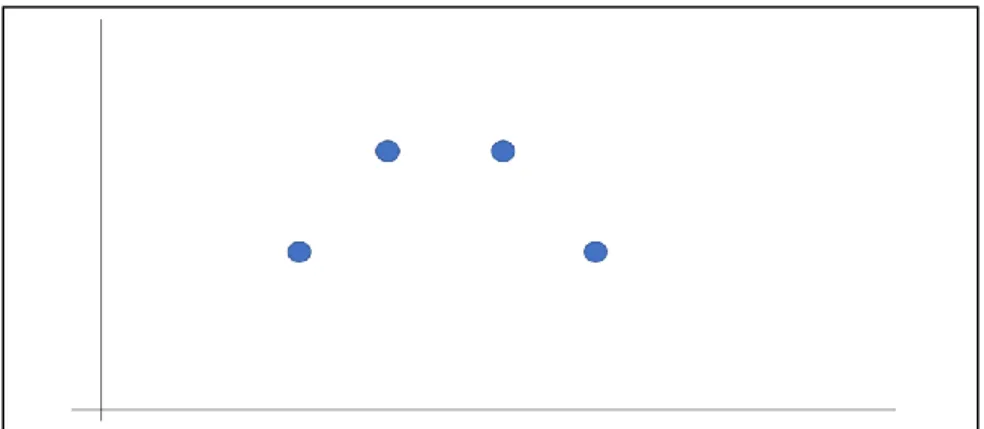
To further illustrate and understand the problem, imagine that someone is trying to learn the simple, single-input mathematical function65 that
generated the data in Figure 5.66
63 This problem follows from a family of theorems known as the no free lunch theorems, which
indicate that across all problems, no one algorithm will consistently outperform all others. See David H. Wolpert & William G. Macready, No Free Lunch Theorems for Optimization, 1 IEEETRANSACTIONS ON
EVOLUTIONARY COMPUTATION 67, 70–71 (1997); David H. Wolpert & William G. Macready, No Free Lunch Theorems for Search 1, 2 (Santa Fe Inst. Working Paper No. 1995-02-010, 1995). The problem is akin to the philosophical problem of induction, where one cannot be certain of one’s beliefs drawn only from observation. See DAVID HUME, 1 ATREATISE OF HUMAN NATURE 82–84 (L.A. Selby-Bigge ed., Clarendon Press 1896) (1739); see also Robert A. Peterson & Dwight R. Merunka, Convenience Samples of College Students and Research Reproducibility, 67 J.BUS.RES. 1035, 1035 (2014) (showing that some psychology studies may reflect not the cognition of humanity writ large, but that of the American undergraduate psychology majors upon whom the studies were conducted).
64 Domingos, supra note 51,at 81. Computer science students are taught this principle via a parable
about a defense contractor that wanted to train a neural network to detect tanks. The contractor went out one day and took pictures of tanks in a variety of environments, then took the same pictures the next day without the tanks. The contractor trained a DLNN, which performed perfectly on the contractor’s images but could not detect a single tank in new images. One of the days had been sunny and the other overcast: the contractor had trained a sunshine detector. The story is apparently apocryphal. See Gwern Branwen,
The Neural Net Tank Urban Legend, GWERN (Sept. 20, 2011, updated Aug. 14, 2019), https://www.gwern.net/Tanks [https://perma.cc/NZL2-XQAH]. Nonetheless, given its ubiquity in artificial intelligence education and how cleanly it illustrates the principle, it is included here.
65 E.g., f(x) = y.
FIGURE 5:SOME DATA ABOUT WHICH ONE MIGHT WANT TO LEARN
Figure 6 shows three functions that a ML system could learn that perfectly fit the data and might be equally good at predicting within this range.
FIGURE 6:THREE FUNCTIONS THAT FIT THE DATA
As long as the system operates on input data within this range, the engineers will have no way to know which of these three functions the system has learned. But once the system tries to predict the value of a point far off to either side of the training data, that prediction will look very different depending on which function the system has learned.67
In sum, just because a system is good at predicting the data on which it was trained (or similar data), it may not fare well on data that does not resemble its training data. This happens because there are many functions that fit the training data and the system will only learn one; it is hard to detect it because before deploying the system, engineers can only verify its
accuracy on the data they already have. Without a sufficiently diverse training dataset representing the full range of inputs an algorithm will operate over after deployment, this problem is a major concern.68 The best way to
mitigate the problem is to have a better, richer dataset.69
From a legal perspective, it is not clear whether there is any consistent way to properly apportion responsibility for an algorithm’s decisions.70 If the
data encode latent biases that the dataset assemblers should have detected (or if those biases were intentionally incorporated), then the dataset engineers could be held responsible for the flaws in their dataset. But given historical and social inequities, it may be impossible to build a dataset free of bias, so we might want to hold the system’s engineers responsible to incentivize them to do everything they can to mitigate those biases.
2. Understanding and Dealing with Hidden Biases
This Section returns to the problem with both lookalike audiences and DLNNs in general: protected characteristics are embedded in other data, so even if a system does not see those characteristics, it may still discriminate on the basis of them.71 Because DLNNs are largely inscrutable except insofar
as they appear to perform well, biases can stay hidden until the system operates on data dissimilar to its training data.72 Fortunately, there are options
other than simply not using DLNNs that can control for these problems. By forcing systems to be bad at predicting protected variables73 and using tools
that can give insight into a DLNN’s decisions, engineers can better manage the dangers DLNNs pose.74
68 There exists an associated problem known as poisoning attacks. See, e.g.,Matthew Jagielski et al., Manipulating Machine Learning: Poisoning Attacks and Countermeasures for Regression Learning, 39 IEEESYMP. ON SECURITY &PRIVACY 19 (2018). These involve malicious actors generating and promulgating free training datasets with a hidden factor that is hard to detect but can be exploited in systems that train on that data. Id. For example, the actor might create a dataset of videos of people either lying or not lying to create a lie detector; given how hungry machine learning engineers are for data, such a dataset might be extremely valuable and useful. But if the dataset creators include a few videos where a person with a distinctive style of mustache is lying but is labeled as telling the truth, the system might learn that that mustache is an indicator that the person is truthful. It would be hard to detect this feature in the dataset or to identify it in the system after it had been trained, but the actor who created the dataset could pass lie detector tests trained on the data by having that particular mustache.
69 Domingos, supra note 51, at 84. 70 See Kleinberg et al., supra note 55, at 6. 71 See supra Section I.C.1.
72 Supra Section I.C.1.
73 Zhang et al., supra note 54, at 335.
74 See Marco Ribeiro et al., “Why Should I Trust You?” Explaining the Predictions of Any Classifier,
2016 PROC.22ND ACMSIGKDDINT’L CONF. ON KNOWLEDGE DISCOVERY &DATA MINING (KDD’16) 1135, 1138–39; Chris Olah et al., The Building Blocks of Interpretability, DISTILL (Mar. 6, 2018), https://distill.pub/2018/building-blocks [https://perma.cc/64UM-NXHV]. The most effective way to
A technique called bias mitigation seeks to ensure that whatever function the system is learning, it is not learning simply to predict a forbidden characteristic.75 To train a bias mitigation system, the system learns not only
to predict the desired outcome but also to predict the forbidden characteristic (e.g., sex).76 To the extent the system is bad at predicting the desired output,
it is sent a signal to help it improve as usual.77 But to the extent that the
system is good at predicting the forbidden characteristic, it is sent a signal to make its performance worse.78 The goal is to have the system accurately
predict the target variable but be unable to predict the forbidden characteristic, meaning its prediction of the target variable is entirely independent of the protected characteristic.79 This solution mitigates rather
than solves the problem of engineers being unable to discern what a DLNN has learned because it still does not explain which function the system is actually learning, but simply forecloses certain functions. Nonetheless, insofar as it prevents a DLNN from learning to rely on a protected characteristic, bias mitigation represents an important improvement over just letting the system learn whatever seems useful.
There are three challenges to widespread adoption of the bias mitigation approach. First, training these systems is more computationally expensive and may make systems less accurate overall.80 System designers may not be
inclined to use bias mitigation unless they are compelled to do so by ethics or the law. A bias mitigation system must not only learn a useful function but also ensure it is not learning a forbidden one, and this means more training time. All protected characteristics that are not to be predicted must be known in advance and precluded all at once, and each additional one means additional computation costs. Because it often takes a long time to train these systems, and because most companies rent the necessary
mitigate these problems is through careful engineering that encodes sensible assumptions about the mathematical properties of the domain to be modeled. See Domingos, supra note 51, at 84–85. Even with diligent engineering, however, these problems exist; this Note assumes conscientious engineers are doing their best when building their systems and therefore will not delve into the mathematical considerations they must take into consideration.
75 Zhang et al., supra note 54, at 335. 76 Id. at 336–37.
77 Id. See supra note 50 for an explanation of DLNNs’ learning mechanisms and how accuracy is
converted into signals to improve the DLNN’s performance.
78 Zhang et al., supra note 54, at 337. 79 Id. at 337–38.
computation power from server farms, extra computation translates directly to extra costs.81
Second, these approaches are in their early days, and problems with them may yet be revealed. For example, these systems could theoretically learn to predict using protected characteristics and simultaneously learn to hide that they are doing so. Of course, this is not necessarily the case: these techniques are promising and may point to an eventual solution to the problem overall. But DLNNs are still black boxes, learning functions that cannot be directly examined, and it is too early to declare that bias mitigation is the ultimate solution to algorithmic bias.
But the greatest obstacle is that, to ensure a DLNN is not learning a forbidden characteristic, that characteristic must be present in the training data.82 Engineers cannot learn to avoid predicting on the basis of sex from
training data unless the characteristic of sex is in the training data.83
Collecting this information may often prove awkward and problematic, and people may resist sharing such information with corporations, even if they are told why the corporation wants it. This may not be a great concern with Facebook in particular since Facebook users are accustomed to sharing private information. But mortgage applicants, for example, might balk if a bank started asking for race, sex, religion, and sexual orientation information on mortgage applications, and they might not be assuaged when told the bank was collecting that information to make sure it was not discriminating against them.84
The other avenue for hope is not about mitigating bias but detecting it. Researchers have been working on techniques to explain ML systems’
81 See, e.g.,Peter Turney, Types of Cost in Inductive Concept Learning, 2000 PROC.COST-SENSITIVE
LEARNING WORKSHOP 17TH ICML-2000CONF. 1, 3–5. Though many tasks still require extensive training time, these costs are coming down and may soon not be a major obstacle. See Rob Matheson,
Kicking Neural Network Design Automation into High Gear, MIT NEWS (Mar. 21, 2019), http://news.mit.edu/2019/convolutional-neural-network-automation-0321
[https://perma.cc/B6LU-SUPZ].
82 See Kroll et al., supra note 29, at 686.
83 Zhang, supra note 54, at 335; see also Kleinberg et al., supra note 55, at 34.
84 For a discussion of why people feel uncomfortable being asked such questions and how to ask
them respectfully, see Sarai Rosenberg, Respectful Collection of Demographic Data, MEDIUM (Mar. 14, 2017), https://medium.com/@anna.sarai.rosenberg/respectful-collection-of-demographic-data-56de9fcb80e2 [https://perma.cc/5U3A-P43H]. Not only might people be uncomfortable with such questions, but it could lead them to believe that discrimination is in fact occurring. See, e.g., Illegal Interview Questions, BETTERTEAM (July 30, 2019), https://www.betterteam.com/illegal-interview-questions [https://perma.cc/J77Y-D8D3].