L.S. Ferreira
11 Faculty of Architecture and Urbanism, University of São Paulo, Brazil
Keywords:
environmental offsets, urban forest management, vegetation clearance
Introduction
Humanity has evolved to interact with nature, with human behaviour in turn being influenced by nature (Carson, 2010; Wilson, 1994). In the last century, however, changes produced by human activities have altered nature, generating unknown effects, especially in cities, which are home to more than half of the world’s population. The replacement of natural vegetation by construction materials, such as concrete and asphalt, is one of the most common alterations produced by urbanisation. This replacement, combined with air, water and soil pollution and changes in microclimate, worsens environmental problems. The benefits of urban vegetation, such as the removal of air and water pollutants, the provision of soil stability, and the decreasing of air temperatures and increasing of air humidity, have been widely emphasised (Spangenberg, 2009; Mascaró, 1996; Givoni, 1998; Nowak, 1994). Quantitatively, in term of trees these benefits depend on leaf density and shape, tree canopy size and location within a city. These characteristics, except for location, can vary according to season, tree species and age.
According to Nowak (1994), many of the benefits of urban green areas increase with increasing leaf area, with positive effects on the urban microclimate being strongest in the surroundings closest to green areas (Givoni, 1998). Consequently, it is important for urban landscapes to have larger numbers of small green areas than a few larger ones.
Abstract
The environmental aspects that the urban forest provides, such as water management, soil stability and
biodiversity, have been disregarded since the foundation of São Paulo. The low-income population, which has few housing alternatives, has occupied environmentally fragile areas such as riverbanks on illegal allotments. Although less harmful to the environment, than the occupation of the illegal allotments, the urban designs favoured in São Paulo do not take into account the positive environmental characteristics of the city, such as the topography, green areas, fauna, etc. Indeed, there would be less tree cutting and fewer impacts on nature if the urban
designers/planners did consider the environment. The suppression of vegetation in the form of tree felling is one of the problems caused by the city’s urbanisation. Consequently, to protect landscape vegetation and regulate management processes, 48 laws were in existence in São Paulo in 2012. Through a complex offset process, all tree
felling and removal must be environmentally compensated either financially or through the process of planting new trees. Analysis of the systems to authorise tree felling and define the compensation process demonstrated that the costs and benefits of the São Paulo urban forest are not considered in their totality. Despite an attempt
to assign ecological values for each tree removed, it was not possible to identify the theoretical foundation of the
official compensation process. Analysis of the Vila Andrade neighbourhood, the São Paulo district with the most
authorised tree removals between 1997 and 2011, indicated that the high number of environmental compensation
agreements did not positively influence the tree cover. The restrictions on tree removal and the rise of
environmental compensation agreements do not at present guarantee the preservation of São Paulo’s urban forest.
Vegetation Management in São Paulo, Brazil:
Urban vegetation has financial costs that must be addressed in order to develop a more sustainable vegetation management strategy. The costs of planting, rrigation, pruning, tree and branch removal and disposal, storm damage, winter thermal discomfort, and public safety have to be considered (Spangenberg, 2009). Since the foundation of the city of São Paulo, Brazil, in 1554, these environmental aspects have been disregarded, and a widely dispersed human urbanisation process has resulted in the occupation of valleys, hills and slopes and the removal of virtually all of the existing vegetation, with little concern for the social and environmental consequences of this predatory approach to territory occupation. Within São Paulo, this predatory occupation refers both to legal and illegal allotments. Although illegal non-authorised occupation generates the greatest environmental impacts, legal occupation can also detrimentally affect the environment through excessive soil sealing, the channelling of streams and elevated pollution levels. It is therefore necessary to question the criteria that guide São Paulo laws to protect the environment in order to evaluate whether sufficient environmental restrictions have been considered. The first part of this paper outlines the relationship between the city of São Paulo and nature throughout São Paulo’s historical growth and development. The second part presents important aspects of tree removal and the ensuing environmental compensation processes, and examines the loss of vegetation between 1997 and 2011. The district with the greatest recorded tree cutting and felling is analysed in detail. Finally, recommendations for stakeholders to improve vegetation management within São Paulo are presented.
Although the illegal cutting and felling of trees constitutes the majority of the vegetation loss in São Paulo, this process does not follow any standard procedure. Consequently, it is not possible to discuss this phenomenon accurately within the scope of this paper. Thus, the focus of the discussion is the legal and authorised tree cutting processes and systems.
São Paulo’s Urban Growth: The Relationship
Between the City and Environment
São Paulo city, the capital of São Paulo state, is located in the south-western region of Brazil. It is the most important economic centre in Latin America and the largest city in the southern hemisphere, and
exerts strong regional and international influences in all aspects of economic, political and cultural development. The city is located on a plateau around 760 m above sea level in the basin of the Tiete River. Although relatively flat, São Paulo’s topography includes Cantareira Sierra’s steep slopes to the north and the Mar Sierra ridge to the south.
The predominant original native vegetation was rainforest, which varied from a drier forest in the higher areas to a wetter forest in the areas closer to the sea (Raimundo, 2006; Tabarelli e Mantovani, 1999). Along with the rainforest, open fields and wetlands pre-dominate, forming a heterogeneous and diverse array of vegetation (São Paulo SMA, 2007). São Paulo city has an area of 1,530 km2, 11,253,503 inhabitants and forms one of the biggest metropolitan areas in the world (IBGE, 2010).
The city was found in 1554 by Jesuit missionaries, who established a college at the central point of a slope between two rivers, the Tamanduateí and Anhangabaú. From this small commercial centre, the city expanded following smooth topographies and well drained land, avoiding wetlands, valley bottoms and hilly areas, which were considered natural barriers to growth. Until the mid-19th century, urban growth was limited to the territory between the Tamanduateí and Anhangabaú rivers. From 1870, the city’s population grew 25-fold in less than 50 years. Due to the expansion of coffee plantations around the city and São Paulo state, the railroad also expanded to connect the countryside and Santos Port, and acquired great economic and political importance. This process, however, devastated most of the existing forest cover of São Paulo state (São Paulo SVMA, 2004; Silva and Grostein, 2008). After the price of coffee declined, areas that were not occupied by other agricultural crops were less accessed and occupied by humans. This resulted in the appearance of secondary natural vegetation – rainforest and open fields – with great tree density in the rugged areas of Cantareira Sierra and Mar Sierra, which nowadays form the outskirts of São Paulo (São Paulo SVMA, 2004).
Between 1875 and 1940, several new allotments were built, both near and far from the city centre. Simultaneously, interrupted and diffuse urban
occupation began, interspersed by periods where lots were left empty while owners waited for an increase in land value (Langenbuch, 1971; Silva and Grostein, 2008). While the affluent neighbourhoods of the
coffee elite, such as Jardins and Higienópolis, followed the design principles of Ebenezer Howard’s Garden City, many of the poorest allotments were built by the dwellers themselves without following any principles or rules. According to Spangenberg (2009), even the affluent ‘garden neighbourhoods’followed the common practice of clear-cutting sites, removing all of the native vegetation and planting exotic (non-Brazilian) species following land division.
With the establishment of São Paulo as an industrial metropolis from 1940, regular and irregular
settlements were built further away from the downtown area to house new workers (Silva and Grostein, 2008; Meyer, Grostein and Biderman, 2004). The expansion of the suburbs was strongly influenced by the substitution of the tram system by a petrol-driven vehicle system. Following the implementation of the Urban Plan (1924) designed by Prestes Maia in 1940, São Paulo adopted a road system in to replace the tram system, with radial-concentric avenues built on the riverbanks. Some of the rivers were diverted or channelled to receive these new roads.
The economic recession and lack of public housing policies in the 1980s triggered a population
densification around the outskirts of the city, primarily in environmentally protected areas, that continues today (Silva and Grostein, 2008).
According to Maricato (1996), the natural
characteristics of the environmentally fragile areas, along with the restrictions imposed by legislation and the lack of official enforcement, defined the devaluation of these areas and their rejection by the real estate market. Consequently, the most environmentally fragile areas supported low-income occupations (Silva and Grostein, 2008), which generated worse environmental impacts. Although less harmful to the environment, regular official occupations also have environmental impacts, especially when urban designers appear unaware of site environmental characteristics, weaknesses and potentialities. As McHarg described, “it is most disconcerting to conclude that not only does uncontrolled growth fail to recognise intrinsic suitabilities and unsuitabilities for urban growth, but that the formal planning process is almost as culpable” (McHarg, 1992, p. 155)
Since 1971, both legal and illegal occupation have removed 31% of the existing natural vegetation,
destroyed hills, filled floodplains with favelas and avenues, and moved onto the water reservoirs (located in the south of the city), damaging the water quality. In the period between 1965 and 1990, 1,021 km2 of natural areas have been incorporated into the 745 km2 of the original urban area (Meyer, Grostein and Biderman, 2004). At the beginning of São Paulo’s development, natural particularities were major obstacles to city growth. With technological and constructive advances, these initial obstacles have gradually been overcome, allowing the occupation of areas that were initially impossible to occupy. Thus, the city has imposed itself on the territory, but not without suffering the social and environmental consequences of its actions.
An ecosystem perspective has been systematically disregarded in São Paulo´s urban design, not just because of a lack of knowledge, but also due to ‘illicit and suspicious political and economic interests’. Due to the perception that natural resources are unlimited, São Paulo’s population is severely affected on a daily basis (Lima, 1996).
Legal Instruments to Protect Vegetation and
Define Compensation
According to the São Paulo Environmental Atlas (São Paulo SVMA, 2004), despite the lack of systematic data about the evolution of green areas in São Paulo, it can be deduced that a decrease in the urban forest has occurred over the past decades. Filho (2005) indicated in his studies comparing data from 1911 to 2002 that there has been a simplification of the São Paulo’s once complex tree cover, and a sizeable reduction in the extent of the urban forest due to both legal and illegal occupation. The high rates of illegal occupation of environmentally sensitive areas can be seen as a failure of the law to preserve urban vegetation, for several reasons, such as the fact that environmental protection laws require intense public and social control over a territory, which to date has not occurred throughout São Paulo. The reduction in tree cover within the legal allotments and worsening environmental problems indicate that compensation for authorised tree felling may not avoid the impacts caused by tree removal, and may not promote increased vegetation cover. Therefore, an assessment of the legislation is needed in order to clarify this process.
São Paulo’s Vegetation Clearance Legislation
According to the Brazilian Constitution (1988), the task of legislating on environmental issues, including vegetation clearance, is a common competence of the federation, states and municipalities.By 2012, in the city of São Paulo there were
approximately 48 laws directly and indirectly related to vegetation management, which makes assessment of the subject complex. There have been some initiatives to simplify matters, such as grouping several laws into one statement, but to date the legislation is still divided among federal, state and municipal laws.
It is not the purpose of this paper to explain all of the laws and terms related to vegetation management in São Paulo, however, the following important points are set out to guide the discussion.
All trees with a trunk diameter of more than 5 cm (measured at 1.5 m above the ground) are
considered common interest goods, and any removal of such trees must be authorised by the government, even if it is undertaken by a public authority to construct a road or building.
The laws define particular areas for preservation, called Permanent Preservation Areas (APPs). These areas, which may or may not be covered by native vegetation, encompass riversides, water springs, mountaintops, hills with slopes greater than 45° and mangroves. The width of an APP depends on the width of the river, and can vary from 30 m from the riverside to up to 500 m.
Vegetation clearance in APPs will only be approved to prevent the imminent fall of a structurally unsound tree or if the landholder finds it impossible to find any other construction alternative.
The removal of all woody plant species with a trunk diameter larger than 5 cm must be compensated. The type of compensation offered can vary. If the tree is dead, for example, the landholder only has to plant another tree, but if an arboreal mass exists with native and rare species, the landholder will have to plant many trees to replace those lost.
To define the compensation amount, a landholder must apply for clearing approval and sign an agreement to perform works or activities to offset the environmental impact caused by tree removal. This agreement is known as an
Environment Compensation Agreement or Termo de Compensação Ambiental (TCA).
Compensation may include:
– The planting of trees on site, or, if there is not sufficient space, on nearby streets or other locations within the same watershed. If none of these options can be applied, the Environment Agent can define another location for tree planting
– supplying tree seedlings to the Municipal Tree Nursery
– exceptionally trees that should be planted can be converted into monetary values, and that value applied to public works or services related to green areas or environmental education. Normally this ‘exception’ is applied to construction companies faced with large compensation values, i.e. higher than U$ 500,000, and to public works, such as roads or highways. These companies can design and build public parks, provide city sewers or, in special cases, give the money to the Environmental Agency to purchase land (if there is a shortage of public land to build parks). In practice, this type of conversion is not as ‘exceptional’ as the law stipulates and is, therefore, the preferred option for the construction companies, given that planting trees is not their field of expertise.
Removal Procedure
To remove a tree for a new development or allotment construction, the landholder must apply for approval from the Municipal Environmental Agency. If the removal refers to a single tree in a garden or on a pavement, authorisation can be obtained at the district city hall.
If a Municipal Environmental Agency license is needed, the proponent must present the building or allotment project, a topographic map of the site survey, an inventory of all trees on site including those to be removed and a table of species, trunk diameter and tree health. In addition, all trees on site must be identified with a metal tag. This information is then analysed by a committee and the compensation defined according to the laws presented below. An agreement setting out all of the on-site activities that are required to compensate for the vegetation loss must be signed.
Landholders must commence the compensation process immediately after vegetation clearance. When both clearance and compensation are completed, a public agent checks that all of the processes were carried out in accordance with the compensation agreement. If there is any
disagreement, fines may be applied. If everything has been performed correctly, the landholder is given a license to prove that the development is legal. This process can take months or years.
Defining Compensation
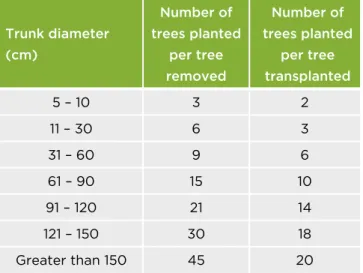
The formula to calculate the number of trees to be planted is defined by a Municipal Law (Portaria 130/ SVMA/2013). Trunk diameter is one of the aspects considered, and a distinction has to be made between cut and transplanted trees. The ratio of compensatory trees to removed trees is shown in Table 1.
Table 1: Ratio of removed to planted trees in São
Paulo (based on Municipal Law 130/SVMA/2013)
Trunk diameter (cm) Number of trees planted per tree removed Number of trees planted per tree transplanted 5 – 10 3 2 11 – 30 6 3 31 – 60 9 6 61 – 90 15 10 91 – 120 21 14 121 – 150 30 18 Greater than 150 45 20
Other factors considered in defining compensation are:
location of the removed trees: APP, heritage area or other high value location
tree species: invasive, exotic, native, species protected by law, endangered species
grouping: isolated tree or forest fragment smaller or bigger than 1000 m2.
These characteristics appear in the compensation formula as multiplying factors according to Table 2:
Table 2: Multiplying factors considered in defining
environmental compensation (based on Municipal
Law 130/SVMA/2013)
Multiplying
factor Specifications
10 Trees considered free from preservation according to the Federal Law 12.651/2012; Federal Resolution CONAMA 303/2012 and Municipal Law 10.365/1987
5 Endangered tree species
4 Forest fragments with a canopy area larger than 1,000 m2 (Federal
Resolution CONAMA 01/1994)
3 Forest fragments with a canopy area smaller than 1,000 m2 (Federal Resolution CONAMA 01/1994 Permanent preservation trees with more than 50% of native species, most of which with trunk diameters between 31 and 60 cm
2 Environmental Heritage (State Law
30.443/89 and Municipal Law 10.365/87)
Permanent preservation trees with more than 50% of native species, most of which with trunk diameters between 10 and 31 cm 1 All other situations
A reduction factor also needs to be applied if the trees to be planted have a trunk diameter greater than 3 cm. For example, if the trunk diameter is 5 cm there will be a 30% reduction in the number of trees to be planted; if the diameter is 7 cm the reduction will be 50%.
Converting Trees Into Public Works and Services
To convert the number of trees to be planted into a monetary value, the following formula is applied:VFC = FC x V
where:
VFC = the value (in Reais – R$) of the final environmental compensation
FC = the final compensation (the number of trees to be planted)
V = the monetary value of each tree planted (tree planting cost plus maintenance for two years). This value is calculated by the Environmental Agency each month. In March 2014, this value was R$243.59 or £62.46.
Loss of Vegetation Between 1997 and 2011
(Official Data)
Studies conducted by the Municipal Environmental Agency using Landsat satellite images revealed that 5,345 ha of green area was removed between 1991 and 2000, approximately one third of the existing vegetated area in 1988 (Silva Filho, 2005). Some São Paulo districts, such as Itaim Paulista and Lajeado located on the east edge side of the city, lost more than 80% of their green areas within the analysed period.
Table 3: Loss of vegetation in São Paulo between 1991 and 2000
District/Area
Percentage of existing vegetation in 1991 that was removed by 20001
Itaim Paulista (1,222ha) 88.3
Lajeado (889ha) 82.9
São Mateus (1,283ha) 69.9
Vila Jacuí (784ha) 67.8
Ponte Rasa (655ha) 63.9
1 Data collected from São Paulo SVMA (2004) and personal
information obtained at the Environmental Agency.
A comparison of the vegetation loss as extracted from satellite images with the number of requests for legal tree cutting made to the Environmental Agency revealed no spatial coincidence between these two pieces of information.
Table 4: Number of trees removed between 1997 and
2000 (São Paulo SVMA, 2004)
District/Area Number of trees removed between 1997 and 2000
Vila Andrade (1,031ha) 3185
Vila Sônia (1,002ha) 708
Morumbi (1,147ha) 338
Campo Grande (1,301ha) 305
From data extracted from satellite images classified by area of deforestation and data on the number of requests classified by the amount of tree cutting, it
was determined that the locations where the highest deforestation rates were recorded were not the same as those with the highest number of requests for clearing, confirming that most deforestation within São Paulo is illegal.
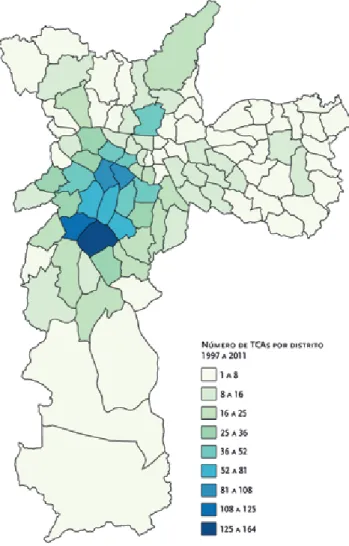
Based on official data provided by the Municipal Environmental Agency regarding the number of requests for vegetation clearance, the number of tree removals and the number of environmental compensation agreements (TCA) signed between 1997 and 2011, this study revised and mapped all of the relevant information to create a spatial database of authorised vegetation loss in São Paulo.
Figure 1: Number of environmental compensation agreements signed between 1997 and 2011 per São Paulo district
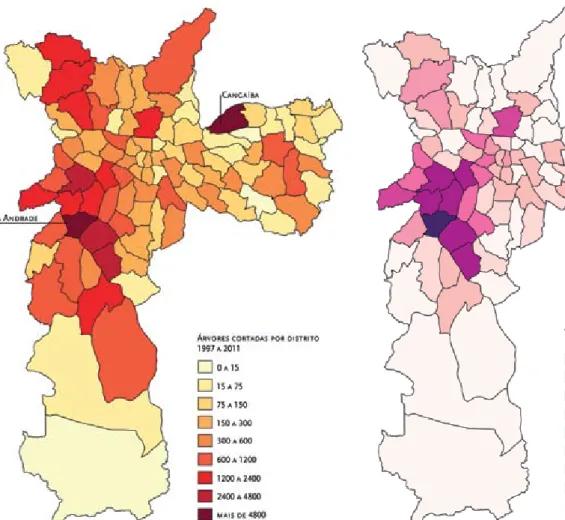
Figure 2: Number of legally removed trees between 1997 and 2011 per São Paulo district
Figure 3: Number of legally removed trees per São Paulo district by area between 1997 and 2011
Figure 4: Comparison of the number of environmental compensation agreements, the number of legally removed trees and the number of new real estate developments between 1997 and 2009
The São Paulo district with the highest number of tree removals, Vila Andrade, was subjected to a more detailed analysis.
Vila Andrade
Vila Andrade is a district located in the south-western region of São Paulo, an area intentionally left for land development at a later date This temporary abandonment allowed for the natural restoration of vegetation. Consequently, several areas of dense tree cover exist.
Vila Andrade has a single particularity. In this district, affluent buildings co-exist with the second biggest favela in São Paulo, Paraisópolis. The occupation of Vila Andrade is recent, and a construction boom in late 1990 resulted in many new residential buildings being built.
Between 1997 and 2011, 13,454 trees were felled in Vila Andrade, or 1,299 trees/km2. These trees were felled with permission from the Municipal Environmental Agency through the agreement of 125 environmental compensation payments, totalling an average of 107.6 trees removed per agreement. As a comparison,
in the same period for the entire city, there was an average of 37.8 trees removed per agreement.
This study analysed all the environmental agreements made in 1999 and 2009, the two years with the highest rates of deforestation.
Despite environmental compensations agreements defining that a higher number of trees should be planted than removed, the data in Tables 5 and 6 demonstrates that in both 1999 and 2009 almost the same amount of trees were planted as were removed. This indicates that tree cover is not increasing, but is marginally decreasing. This indicates a loss of overall vegetation, as the survival rate of planted trees is monitored only during the first two years.
Comparing environmental compensation data from 1999 and 2009 shows that in 1999 most trees were delivered to the Municipal Nursery, while in 2009 most trees were converted into monetary values and applied to public works.
Discussion
General Issues
All of the laws enforced in São Paulo regarding vegetation management consider the stage of the vegetation as the criteria for defining its future preservation. This prevents broader landscape planning that considers both landscape necessities and possibilities, such as the regeneration of young forest regrowth.
The number of laws addressing the procedures for vegetation clearance and those describing the punishment for unauthorised clearance are considerably higher than the number of laws that encourage preservation. Considering the lack of governmental control over the São Paulo territory, especially on the outskirts of the city where most of the preserved forest fragments remain, it seems important to develop new programmes and preservation measures that encourage the maintenance and increase of tree cover. At present, the existing laws analyse primarily removed trees, including palm trees, to define environmental compensation. Herbaceous and shrub species are not appraised. Considering that the original vegetation of São Paulo was composed not only of rainforest, but also open fields, and given the wildlife that exists on herbaceous and shrub species,
it is important that future laws encompass the environmental offsetting of these vegetation types. Despite some laws mentioning wildlife, there is no requirement for a mandatory inventory of wildlife for development approval. According to the last official wildlife inventory, São Paulo is home to 700 species, including crustaceans, arachnids, insects, fish, amphibians, reptiles, birds and mammals. Although wildlife inventories for small tree removals may not be necessary, they are fundamental for larger tree removals in order to evaluate the wildlife impact caused by the loss of such trees.
Compensation Calculation
It was not possible in this study to accurately identify the theoretical foundation of the formula that defines the proportion between removed trees (by transplant or cut) and those planted (Table 1 and 2), even after consultation with the Environmental Agency. Clearly, in the existing formula, there is an attempt to assign an ecological value to each tree removed and to measure the environmental impact of their loss. However, at present recognised vegetation benefits for urban areas are not being considered in the existing formula. Consequently, the ecological effectiveness of the approval process for vegetation clearing and compensation cannot be measured, as
Management Compensation Cut trees Transplanted trees Planting on site Planting outside site Supply of tree seedlings to Municipal Nursery Supply of tree metal protection to Municipal Nursery Trees converted into public works 2,805 102 2,686 100 31,406 15,779 0
Total: 2,907 Final compensation: 34,192 seedlings and 15,779 tree protection
Management Compensation Cut trees Transplanted trees Planting on site Planting outside site Supply of tree seedlings to Municipal Nursery Trees converted into public works 2,826 373 2398 360 3967 30354
Total: 3.199 Final compensation: 37.1 seedlings protection Table 5: Vila Andrade’s vegetation management (1999)
the damage caused by vegetation loss does not seem to be well evaluated.
At present the compensation process for tree removal does not consider the amount of existing vegetation. Consequently, tree removal in a densely vegetated area is compensated using the same criteria as tree removal in an urbanised or arid region.
Also, legislation does not address matters concerning the form of preserved forest fragments or planting areas. Considering the urban forest edge effect, it is important to take the shape of the forest fragment into account in order to minimise this effect.
Despite the number of formulas and factors involved in defining compensation, the existing process still permits the removal of vegetation once protected by law (endangered species) and located in heritage areas. The compensation offered under the existing system does not influence high-standard developments. The environmental compensation is simply another fee to be paid, and will be passed on to the final consumer in the price of the property. It was not possible to
identify a significant change in the relationship between developments and the natural conditions of the site for public or private developments, although a few exceptions do exist (Parque das Corujas and the Centro de Educação para Sustentabilidade Alphaville).
Loss of Vegetation Between 1997 and 2011
The number of TCAs within the analysed study period showed a concentration of TCAs in the southwest sector of the city, which was also same sector with the highest number of new construction developments (Figure 4). This illustrates a predictable tendency of formalisation in the affluent neighbourhoods of São Paulo. In addition, a single TCA can be responsible for a substantial amount of tree cutting. The Cangaíba District of São Paulo (Figure 2) is a prime example, where a single TCA was responsible for 8,000 tree removals, giving this district one of the highest legal deforestation rates in the study period. However, it is important to mention that these removals were due to a public road expansion.
The number of trees removed does not provide an exact overview of vegetation loss, as tree trunk diameter was the only official information available. No leaf or canopy area loss was monitored. In
addition, tree cover loss was only computed in 1991 and 2000 by satellite images. No ‘real time’ monitoring with satellite images was performed.
Concluding Remarks
Analysis of the approval process for vegetation clearance and the environmental compensation methods in force in São Paulo shows that the process does not consider the costs and benefits of the urban forest in their totality.
For the dependent relationship between the city and nature to be re-established, the incorporation of natural processes in decision-making must be recognised. This requires the recognition of the benefits of the urban forest, and thus its accurate valuation.
As São Paulo’s Municipal Environmental Agency uses the conversion of trees to be planted into funds for services or works as a compensation method to offset tree loss, it is now necessary to establish better parameters for this conversion process. Given the worldwide efforts to find methods to value environmental goods and services, it is not sufficient to consider the value of a tree as primarily the cost of planting. This study indicated that the higher number of environmental compensation agreements has not increased existing tree cover. This suggests that increasing restrictions on tree removal and the value of environmental compensation, decoupled from other measures, does not guarantee the preservation of vegetation, especially in areas where there is interest from the high-income real estate market. Among other limitations is the lack of physical space to re-plant trees once construction works have finished. These findings suggest the need for an alternative plan to guide tree removal, environmental compensation and re-planting based on the benefits and environmental costs of urban vegetation. Understanding the value of the urban forest in São Paulo, and the social and environmental impacts of its removal, would be a way forward. At present, it has not been possible to establish an environmental compensation policy because the ‘environmental damage’ is not well defined. Implementing a clear policy may provide decision makers with a better foundation for more sustainable urban tree management in São Paulo.
Acknowledgement
This research was undertaken as part of a Master project developed at the Laboratory of Environment and Energy Studies (LABAUT) at the University of São Paulo and was supported by the CAPES foundation of the Ministry of Education of Brazil.
References
Carson, R. (2010) Primavera Silenciosa. Gaia, São Paulo, Brazil.
Givoni, B. (1998) Climate Considerations in Building and Urban Design. John Wiley & Sons, New York, USA.
Instituto Brasileiro De Geografia e Estatística – IBGE (2010) Censo Demográfico. Available at: www. censo2010.ibge.gov.br (accessed 5 January 2012).
Langenbuch, J.R. (1971) A Estruturação da Grande São Paulo: Estudo de Geografia Urbana. Instituto Brasileiro de Geografia, Rio de Janeiro, Brazil.
Lima, C.P.C.D.S. (1996) A natureza na cidade. PhD thesis, Universidade de São Paulo, Brazil.
Maricato, E. (1996) Metrópole na Periferia do Capitalismo: Ilegalidade, Desigualdade e Violência. Hucitec, São Paulo, Brazil.
Mascaró, L. (1996)Ambiência Urbana, 3rd edn. Porto Alegre: Masquatro Editora.
McHarg, I.L. (1992)Design with Nature. John Wiley and Sons, New York, USA.
Meyer, R., Grostein, M. D. and Biderman, C. (2004)
São Paulo Metrópole. Edusp, São Paulo, Brazil.
Nowak, D. J. (1994) Understanding the structure. Journal of Forestry, 92, 42–46.
Raimundo, S. (2006) A Paisagem Natural
Remanescente na Região Metropolitana de São Paulo. São Paulo em Perspectiva. Available at: http://www. seade.gov.br (accessed 20 September 2013).
São Paulo SVMA. (2004) Atlas Ambiental do Município de São Paulo. SVMA, São Paulo, Brazil.
São Paulo SMA. (2007)Nos Caminhos da
Biodiversidade Paulista. Imprensa Oficial, São Paulo, Brazil.
São Paulo SVMA. (2013) Portaria 130. Diário Oficial do Município, São Paulo, p.14.
Silva Filho, C.A.D. (2005) Proteção e fomento da vegetação no município de São Paulo: possibilidades, alcance e conflitos. PhD thesis, Universidade de São Paulo, Brazil.
Silva, L.S. and Grostein, M.D. (2008) A floresta e a cidade: uma abordagem histórica. Proceedings of IV Encontro Nacional da Anppas. Brasília.
Spangenberg, J. (2009) Nature in megacities. PhD thesis, Bauhaus Universität. Weimar.
Tabarelli, M. and Mantovani, W. (1999) A riqueza de espécies arbóreas na floresta atlântica de encosta no estado de São Paulo (Brasil).Revista Brasileira de Botânica 22, 2, 217–223.
Wilson, E.O. A ética ambiental. In: Diversidade da Vida. Companhia das Letras, São Paulo, pp. 368–377.