Scholarworks@UAEU
Scholarworks@UAEU
Information Security Theses Information Security
4-2020
Sdhcare: Secured Distributed Healthcare System
Sdhcare: Secured Distributed Healthcare System
Mohammed R. S. Al BaqariFollow this and additional works at: https://scholarworks.uaeu.ac.ae/info_sec_theses
Part of the Information Security Commons
Recommended Citation Recommended Citation
Al Baqari, Mohammed R. S., "Sdhcare: Secured Distributed Healthcare System" (2020). Information Security Theses. 6.
https://scholarworks.uaeu.ac.ae/info_sec_theses/6
This Thesis is brought to you for free and open access by the Information Security at Scholarworks@UAEU. It has been accepted for inclusion in Information Security Theses by an authorized administrator of Scholarworks@UAEU. For more information, please contact [email protected].
Title
United Arab Emirates University
College of Information Technology
Department of Information Systems and Security
SDHCARE: SECURED DISTRIBUTED HEALTHCARE SYSTEM
Mohammed R. S. Al Baqari
This thesis is submitted in partial fulfilment of the requirements for the degree of Master of Sciense in Information Security
Under the Supervision of Dr. Ezedin Baraka
Declaration of Original Work
I, Mohammed R. S. Al Baqari, the undersigned, a graduate student at the United Arab Emirates University (UAEU), and the author of this thesis entitled “SDHCARE: Secure Distributed Healthcare System”, hereby, solemnly declare that this thesis is my own original research work that has been done and prepared by me under the supervision of Dr. Ezedin Baraka, in the College of Information Technology (CIT) at UAEU. This work has not previously been presented or published, or formed the basis for the award of any academic degree, diploma or a similar title at this or any other university. Any materials borrowed from other sources (whether published or unpublished) and relied upon or included in my thesis have been properly cited and acknowledged in accordance with appropriate academic conventions. I further declare that there is no potential conflict of interest with respect to the research, data collection, authorship, presentation and/or publication of this thesis.
Copyright
Copyright © 2020 Mohammed R. S. Al Baqari All Rights Reserved
Approval of the Master Thesis
This Master Thesis is approved by the following Examining Committee Members: 1) Advisor (Committee Chair): Ezedin Barka
Title: Associate Professor
Department of Information Systems and Security College of Information Technology
Signature Date 23/4/2020
2) Member: Khaled Shuaib Title: Professor
Department of Information Systems and Security College of Information Technology
Signature Date 23/4/2020
3) Member (External Examiner): Khaled Salah Title: Professor
Department of Electrical Engineering and Computer Science Institution: Khalifa University- Abu Dhabi, UAE
This Master Thesis is accepted by:
Dean of the College of Information Technology: Professor Taieb Znati
Signature Date
Dean of the College of Graduate Studies: Professor Ali Al-Marzouqi
Signature Date
Copy ____ of ____
02/07/2020
Abstract
In healthcare sector, the move towards Electronic Health Records (EHR) systems has been accelerating in parallel with the increased adoption of IoT and smart devices. This is driven by the anticipated advantages for patients and healthcare providers. The integration of EHR and IoT makes it highly heterogenous in terms of devices, network standard, platforms, types data, connectivity, etc. Additionally, it introduces security, patient and data privacy, and trust challenges. To address such challenges, this thesis proposes an architecture that combines biometric-based blockchain technology with the EHR system. More specifically, this thesis describes a mechanism that uses patient’s fingerprint for recovery of patient’s access control on their EHRs securely without compromising their privacy and identity. A secure distributed healthcare system (SDHCARE) is proposed to uniquely identify patients, enable them to control access to, and ensure recoverable access to their EHRs that are exchanged and synchronized between distributed healthcare providers. The system takes into account the security and privacy requirements of Health Insurance Portability and Accountability Act (HIPAA) compliance, and it overcomes the challenges of using secret keys as patient’s identity to control access to EHRs. The system used distributed architecture with two layers being local to each healthcare provider that is member of SDHCARE, and two layers shared across all members of SDCHARE system. SDHCARE system was prototyped and implemented in order to validate its functional requirements, security requirements and to evaluate its performance. The results indicated successful fulfillment of design requirements without significant overhead on the performance as required by healthcare environments.
Title and Abstract (in Arabic)
ﻧ
ﻈ
ﺎ
م
ا
ﻟ
ﺮ
ﻋ
ﺎﯾ
ﺔ
ا
ﻟ
ﺼ
ﺤ
ﯿ
ﺔ
ا
ﻟ
ﻤ
ﻮ
ز
ع
ا
ﻵ
ﻣ
ﻦ
اﻟ ﻤ ﻠ ﺨ ﺺﻓ
ﻲ
ﻗ
ﻄ
ﺎ
ع
اﻟ
ﺮ
ﻋ
ﺎﯾ
ﺔ
اﻟ
ﺼ
ﺤ
ﯿ
ﺔ
،
ﻛ
ﺎ
ن
اﻟ
ﺘ
ﺤ
ﺮ
ك
ﻧ
ﺤ
ﻮ
أﻧ
ﻈ
ﻤ
ﺔ
اﻟ
ﺴ
ﺠ
ﻼ
ت
اﻟ
ﺼ
ﺤ
ﯿ
ﺔ
ا
ﻹ
ﻟ
ﻜ
ﺘ
ﺮ
و
ﻧﯿ
ﺔ
)
EHR (ﯾ
ﺘ
ﺴ
ﺎ
ر
ع
ﺑ
ﺎﻟ
ﺘ
ﻮ
ا
ز
ي
ﻣ
ﻊ
ز
ﯾﺎ
د
ة
ا
ﻋ
ﺘ
ﻤ
ﺎ
د
إ
ﻧﺘ
ﺮ
ﻧ
ﺖ
ا
ﻷ
ﺷ
ﯿﺎ
ء
و
ا
ﻷ
ﺟ
ﮭ
ﺰ
ة
اﻟ
ﺬ
ﻛ
ﯿ
ﺔ
،
و
ھ
ﺬا
ﻣ
ﺪ
ﻓ
ﻮ
ع
ﺑ
ﺎﻟ
ﻤ
ﺰ
اﯾ
ﺎ
اﻟ
ﻤ
ﺘ
ﻮ
ﻗ
ﻌ
ﺔ
ﻟ
ﻠ
ﻤ
ﺮ
ﺿ
ﻰ
و
ﻣ
ﻘ
ﺪ
ﻣ
ﻲ
ا
ﻟ
ﺮ
ﻋ
ﺎﯾ
ﺔ
ا
ﻟ
ﺼ
ﺤ
ﯿ
ﺔ
،
و
ﻋ
ﻠ
ﻰ
ا
ﻟ
ﺮ
ﻏ
ﻢ
ﻣ
ﻦ
ا
ﻟ
ﻤ
ﺰ
اﯾ
ﺎ
اﻟ
ﻤ
ﺮ
ﺟ
ﻮ
ة
ﻓﺈ
ن
د
ﻣ
ﺞ
ا
ﻟ
ﺴ
ﺠ
ﻼ
ت
اﻟ
ﺼ
ﺤ
ﯿ
ﺔ
ا
ﻹ
ﻟ
ﻜ
ﺘ
ﺮ
و
ﻧﯿ
ﺔ
ﻣ
ﻊ
إ
ﻧﺘ
ﺮ
ﻧ
ﺖ
ا
ﻷ
ﺷ
ﯿﺎ
ء
ﯾ
ﺠ
ﻌ
ﻠ
ﮭ
ﺎ
ﻏ
ﯿ
ﺮ
ﻣ
ﺘ
ﺠ
ﺎﻧ
ﺴ
ﺔ
ﻟ
ﻠ
ﻐ
ﺎﯾ
ﺔ
ﻣ
ﻦ
ﺣ
ﯿ
ﺚ
ا
ﻷ
ﺟ
ﮭ
ﺰ
ة
،
و
ﻣ
ﻌ
ﯿﺎ
ر
اﻟ
ﺸ
ﺒ
ﻜ
ﺔ
،
و
ا
ﻷ
ﻧ
ﻈ
ﻤ
ﺔ
ا
ﻷ
ﺳ
ﺎ
ﺳ
ﯿ
ﺔ
،
و
أﻧ
ﻮ
ا
ع
ا
ﻟﺒ
ﯿﺎ
ﻧﺎ
ت
،
و
ا
ﻻ
ﺗ
ﺼ
ﺎ
ل
،
و
ﻣ
ﺎ
إﻟ
ﻰ
ذﻟ
ﻚ
،
إ
ﺿ
ﺎﻓ
ﺔ
إ
ﻟ
ﻰ
ﺧ
ﺼ
ﻮ
ﺻ
ﯿ
ﺔ
اﻟ
ﻤ
ﺮ
ﯾ
ﺾ
و
اﻟ
ﺒﯿ
ﺎﻧ
ﺎ
ت
،
و
ﺗ
ﺤ
ﺪ
ﯾﺎ
ت
ا
ﻟﺜ
ﻘ
ﺔ
،
و
ﻟ
ﻤ
ﻮ
ا
ﺟ
ﮭ
ﺔ
ھ
ﺬ
ه
اﻟ
ﺘ
ﺤ
ﺪ
ﯾﺎ
ت
،
ﺗ
ﻘﺘ
ﺮ
ح
ھ
ﺬ
ه
ا
ﻷ
ط
ﺮ
و
ﺣ
ﺔ
ﺑ
ﻨﯿ
ﺔ
ﺗ
ﺠ
ﻤ
ﻊ
ﺑﯿ
ﻦ
ﺗ
ﻘﻨ
ﯿ
ﺔ
ا
ﻟﺒ
ﻠ
ﻮ
ﻛ
ﺘ
ﺸ
ﯿ
ﻦ
ا
ﻟ
ﻤ
ﺴ
ﺘﻨ
ﺪ
ة
إﻟ
ﻰ
ا
ﻟ
ﻤ
ﻘﺎ
ﯾﯿ
ﺲ
ا
ﻟ
ﺤ
ﯿ
ﻮ
ﯾ
ﺔ
و
ﻧ
ﻈ
ﺎ
م
EHR.
ﺗ
ﺤ
ﺪ
ﯾ
ﺪًا
،
ﺗ
ﺼ
ﻒ
ھ
ﺬ
ه
ا
ﻷ
ط
ﺮ
و
ﺣ
ﺔ
آﻟ
ﯿ
ﺔ
ﺗ
ﺴ
ﺘ
ﺨ
ﺪ
م
ﺑ
ﺼ
ﻤ
ﺔ
ا
ﻟ
ﻤ
ﺮ
ﯾ
ﺾ
ﻻ
ﺳ
ﺘ
ﻌ
ﺎ
د
ة
اﻟ
ﺘ
ﺤ
ﻜ
ﻢ
ﻓ
ﻲ
ﺳ
ﺠ
ﻼ
ﺗ
ﮫ
ا
ﻟ
ﺼ
ﺤ
ﯿ
ﺔ
ا
ﻟ
ﺨ
ﺎ
ﺻ
ﺔ
EHRﺑﺄ
ﻣ
ﺎ
ن
و
د
و
ن
اﻟ
ﻤ
ﺴ
ﺎ
س
ﺑ
ﺨ
ﺼ
ﻮ
ﺻ
ﯿﺘ
ﮫ
و
ھ
ﻮ
ﯾﺘ
ﮫ
،
ﺣ
ﯿ
ﺚ
ﯾ
ﻘﺘ
ﺮ
ح
ﻧ
ﻈ
ﺎ
م
ر
ﻋ
ﺎﯾ
ﺔ
ﺻ
ﺤ
ﯿ
ﺔ
ﻣ
ﻮ
ز
ع
آ
ﻣ
ﻦ
)
SDHCARE(
ﻟ
ﺘ
ﺤ
ﺪ
ﯾ
ﺪ
اﻟ
ﻤ
ﺮ
ﺿ
ﻰ
ﺑ
ﺸ
ﻜ
ﻞ
ﻓ
ﺮ
ﯾ
ﺪ
،
و
ﺗ
ﻤ
ﻜ
ﯿﻨ
ﮭ
ﻢ
ﻣ
ﻦ
ا
ﻟﺘ
ﺤ
ﻜ
ﻢ
ﻓ
ﻲ
ا
ﻟ
ﻮ
ﺻ
ﻮ
ل
إ
ﻟ
ﻰ
ﺳ
ﺠ
ﻼ
ﺗ
ﮭ
ﻢ
ا
ﻟ
ﺼ
ﺤ
ﯿ
ﺔ
،
و
ﺿ
ﻤ
ﺎ
ن
ا
ﻟ
ﻮ
ﺻ
ﻮ
ل
اﻟ
ﻘﺎ
ﺑ
ﻞ
ﻟ
ﻼ
ﺳ
ﺘ
ﺮ
دا
د
إ
ﻟ
ﻰ
ا
ﻟ
ﺴ
ﺠ
ﻼ
ت
ا
ﻟ
ﺼ
ﺤ
ﯿ
ﺔ
ا
ﻹ
ﻟ
ﻜ
ﺘ
ﺮ
و
ﻧﯿ
ﺔ
ا
ﻟ
ﺨ
ﺎ
ﺻ
ﺔ
ﺑ
ﮭ
ﻢ
ا
ﻟﺘ
ﻲ
ﯾﺘ
ﻢ
ﺗﺒ
ﺎ
دﻟ
ﮭ
ﺎ
و
ﻣ
ﺰ
ا
ﻣ
ﻨﺘ
ﮭ
ﺎ
ﺑﯿ
ﻦ
ﻣ
ﻘ
ﺪ
ﻣ
ﻲ
اﻟ
ﺮ
ﻋ
ﺎﯾ
ﺔ
اﻟ
ﺼ
ﺤ
ﯿ
ﺔ
اﻟ
ﻤ
ﻮ
ز
ﻋ
ﺔ
،
و
ﯾﺄ
ﺧ
ﺬ
اﻟ
ﻨ
ﻈ
ﺎ
م
ﻓ
ﻲ
ا
ﻻ
ﻋ
ﺘﺒ
ﺎ
ر
ﻣ
ﺘ
ﻄ
ﻠﺒ
ﺎ
ت
ا
ﻷ
ﻣ
ﺎ
ن
و
اﻟ
ﺨ
ﺼ
ﻮ
ﺻ
ﯿ
ﺔ
ﻟ
ﻼ
ﻣ
ﺘﺜ
ﺎ
ل
ﻟﻘ
ﺎﻧ
ﻮ
ن
ﻗﺎ
ﺑﻠ
ﯿ
ﺔ
اﻟ
ﺘﺄ
ﻣ
ﯿ
ﻦ
اﻟ
ﺼ
ﺤ
ﻲ
و
اﻟ
ﻤ
ﺴ
ﺎ
ء
ﻟ
ﺔ
)
HIPAA(
،
و
ﯾﺘ
ﻐ
ﻠ
ﺐ
ﻋ
ﻠ
ﻰ
ﺗ
ﺤ
ﺪ
ﯾﺎ
ت
ا
ﺳ
ﺘ
ﺨ
ﺪا
م
اﻟ
ﻤ
ﻔﺎ
ﺗﯿ
ﺢ
ا
ﻟ
ﺴ
ﺮ
ﯾ
ﺔ
ﻛ
ﮭ
ﻮ
ﯾ
ﺔ
ا
ﻟ
ﻤ
ﺮ
ﯾ
ﺾ
ﻟ
ﻠﺘ
ﺤ
ﻜ
ﻢ
ﻓ
ﻲ
ا
ﻟ
ﻮ
ﺻ
ﻮ
ل
إ
ﻟ
ﻰ
ا
ﻟ
ﺴ
ﺠ
ﻼ
ت
ا
ﻟ
ﺼ
ﺤ
ﯿ
ﺔ
ا
ﻹ
ﻟ
ﻜ
ﺘ
ﺮ
و
ﻧﯿ
ﺔ
.
و
ﯾ
ﺴ
ﺘ
ﺨ
ﺪ
م
اﻟ
ﻨ
ﻈ
ﺎ
م
ﺑ
ﻨﯿ
ﺔ
ﻣ
ﻮ
ز
ﻋ
ﺔ
ﻣ
ﻊ
ط
ﺒﻘ
ﺘﯿ
ﻦ
ﻣ
ﺤ
ﻠﯿ
ﺘﯿ
ﻦ
ﻟ
ﻜ
ﻞ
ﻣ
ﻘ
ﺪ
م
ر
ﻋ
ﺎﯾ
ﺔ
ﺻ
ﺤ
ﯿ
ﺔ
ﻋ
ﻀ
ﻮ
ﻓ
ﻲ
SDHCARE،
و
ط
ﺒﻘ
ﺘﯿ
ﻦ
ﻣ
ﺸ
ﺘ
ﺮ
ﻛ
ﺘﯿ
ﻦ
ﻋ
ﺒ
ﺮ
ﺟ
ﻤ
ﯿ
ﻊ
أ
ﻋ
ﻀ
ﺎ
ء
ﻧ
ﻈ
ﺎ
م
SDCHARE،
ﺣ
ﯿ
ﺚ
ﺗ
ﻢ
ﺗ
ﺼ
ﻤ
ﯿ
ﻢ
ا
ﻟﻨ
ﻈ
ﺎ
م
و
ﺗ
ﻄ
ﺒﯿ
ﻘ
ﮫ
ﻣ
ﻦ
أ
ﺟ
ﻞ
ا
ﻟﺘ
ﺤ
ﻘ
ﻖ
ﻣ
ﻦ
ﻣ
ﺘ
ﻄ
ﻠﺒ
ﺎﺗ
ﮫ
ا
ﻟ
ﻮ
ظ
ﯿﻔ
ﯿ
ﺔ
و
ﻣ
ﺘ
ﻄ
ﻠﺒ
ﺎ
ت
ا
ﻷ
ﻣ
ﺎ
ن
و
ﺗﻘ
ﯿﯿ
ﻢ
أ
دا
ﺋ
ﮫ
،
و
أ
ﺷ
ﺎ
ر
ت
ا
ﻟﻨ
ﺘﺎ
ﺋ
ﺞ
إ
ﻟ
ﻰ
ﺗ
ﺤ
ﻘﯿ
ﻖ
ﻣ
ﺘ
ﻄ
ﻠﺒ
ﺎ
ت
ا
ﻟﺘ
ﺼ
ﻤ
ﯿ
ﻢ
ﺑﻨ
ﺠ
ﺎ
ح
د
و
ن
أ
ﻋ
ﺒﺎ
ء
ﻛ
ﺒﯿ
ﺮ
ة
ﻋ
ﻠ
ﻰ
ا
ﻷ
دا
ء
ﻛ
ﻤ
ﺎ
ھ
ﻮ
ﻣ
ﻄ
ﻠ
ﻮ
ب
ﻓ
ﻲ
ﺑ
ﯿﺌ
ﺎ
ت
ا
ﻟ
ﺮ
ﻋ
ﺎﯾ
ﺔ
ا
ﻟ
ﺼ
ﺤ
ﯿ
ﺔ
.
ﻣ
ﻔ
ﺎ
ھ
ﯿ
ﻢ
ا
ﻟﺒ
ﺤ
ﺚ
ا
ﻟ
ﺮ
ﺋﯿ
ﺴ
ﯿ
ﺔ
:
اﻟ
ﺒﻠ
ﻮ
ﻛ
ﺘ
ﺸ
ﯿ
ﻦ
،
و
اﻟ
ﺮ
ﻋ
ﺎﯾ
ﺔ
ا
ﻟ
ﺼ
ﺤ
ﯿ
ﺔ
،
EHR،
ﺑ
ﺼ
ﻤ
ﺎ
ت
ا
ﻷ
ﺻ
ﺎﺑ
ﻊ
،
ا
ﻟﺒ
ﯿ
ﻮ
ﻣ
ﺘ
ﺮ
ﯾ
ﺔ
،
اﻟ
ﺘ
ﺤ
ﻜ
ﻢ
ﻓ
ﻲ
ا
ﻟ
ﻮ
ﺻ
ﻮ
ل
.
Acknowledgements
I would like to express my sincere gratitude to my advisor Dr. Ezedin Barak for his continuous support of my master’s study and research and for his patience, motivation, enthusiasm, and immense knowledge. His guidance helped me as I researched and wrote this thesis. I could not have imagined a better advisor and mentor for my master’s study.
Besides my advisor, I would like to thank the rest of my thesis committee, Prof. Khaled Shuaib and Dr. Khalid Saleh, for their encouragement and insightful feedback. In addition, I would like to thanks all of the members of the Information Security Department of the College of IT of United Arab Emirates University for assisting me with my studies and research. My special thanks are extended to the Library Research Desk for providing me with relevant reference materials.
Special thanks go to my parents, brothers, and sisters who helped me along the way. I am sure they suspected it was endless.
Dedication
Table of Contents
Title ... i
Declaration of Original Work ... ii
Copyright ... iii
Approval of the Master Thesis ... iv
Abstract ... vi
Title and Abstract (in Arabic) ... vii
Acknowledgements ... viii
Dedication ... ix
Table of Contents ... x
List of Tables ... xii
List of Figures ... xiii
List of Abbreviations ... xv
Chapter 1: Introduction ... 1
1.1 Overview ... 1
1.2 Statement of the Problem ... 5
1.3 Research Objectives ... 6 1.4 Research Methodology ... 6 1.5 Literature Review ... 9 1.5.1 Blockchain Basics ... 10 1.5.2 Blockchain Security ... 16 1.5.3 Blockchain in Healthcare ... 24 Chapter 2: Methods ... 38 2.1 Design Overview ... 38
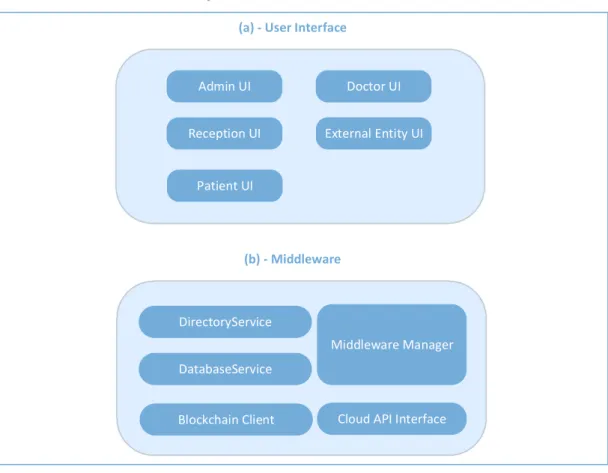
2.1.1 User Interface (UI) Layer ... 39
2.1.2 Middleware Layer ... 41
2.1.3 Blockchain Layer ... 43
2.1.4 Cloud Store Layer ... 48
2.2 Functional Use Cases ... 48
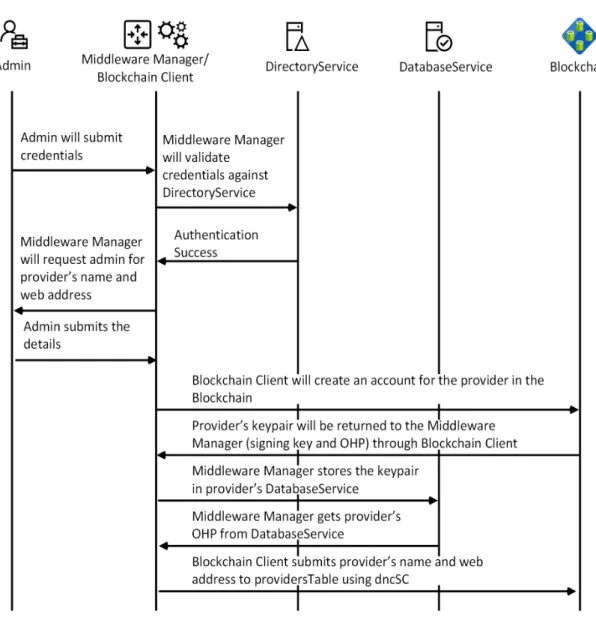
2.2.1 SDHCARE Provider Enrollment ... 48
2.2.2 Patient Registration ... 50
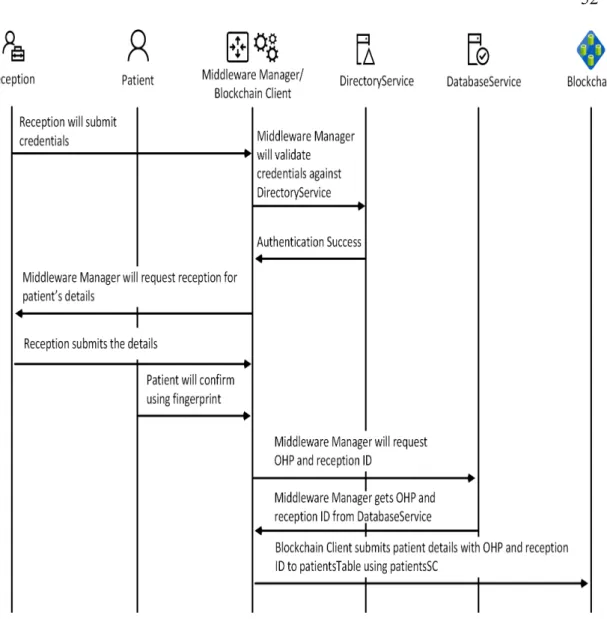
2.2.3 Patient Appointment Management ... 52
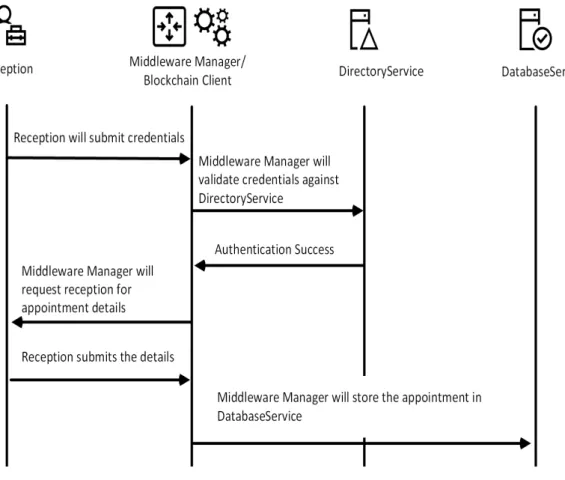
2.2.4 Doctor’s EHR Access ... 55
Chapter 3: Implementation ... 61
3.1 Prototype Components ... 61
3.3 System Implementation ... 65
3.3.1 Building the Runtime Environment ... 65
3.3.2 Initializing SDHCARE Web and Database Components ... 67
3.3.3 Building SDHCARE Django Code ... 70
3.3.4 Building Ethereum Smart Contracts ... 83
3.3.5 Integrating Django with Ethereum ... 87
Chapter 4: Testing and Performance Evaluation ... 91
4.1 Functional Testing ... 91 4.2 Security Testing ... 93 4.3 Performance Evaluation ... 99 Chapter 5: Conclusion ... 104 References ... 106 Appendix ... 111
List of Tables
Table 1: Summary of EHR Requirements and Blockchain Opportunities ... 3
Table 2: Summary of the Literature ... 10
Table 3: Factors for Blockchain Transaction Delay Variation ... 21
Table 4: Access Control Matrix by accessControlSC ... 47
Table 5: Python Libraries Required for SDHCARE ... 67
Table 6: Summary of Views Functions ... 77
Table 7: Summary of Forms Functions ... 79
List of Figures
Figure 1: Percentage of EHR Systems Adoption in US ... 2
Figure 2: General Chain of Block ... 11
Figure 3: Block Structure ... 13
Figure 4: The Effects of Tampering with One Block in the Ledger ... 19
Figure 5: Eclipse Attack ... 24
Figure 6: SDHCARE High-Level Architecture ... 39
Figure 7: Summary of providersTable Data ... 44
Figure 8: Summary of patientsTable Data ... 45
Figure 9: Summary of ehrHashTable Data ... 46
Figure 10: Hospital Enrollment Sequence Diagram ... 50
Figure 11: Summary of the Patient Registration Process ... 52
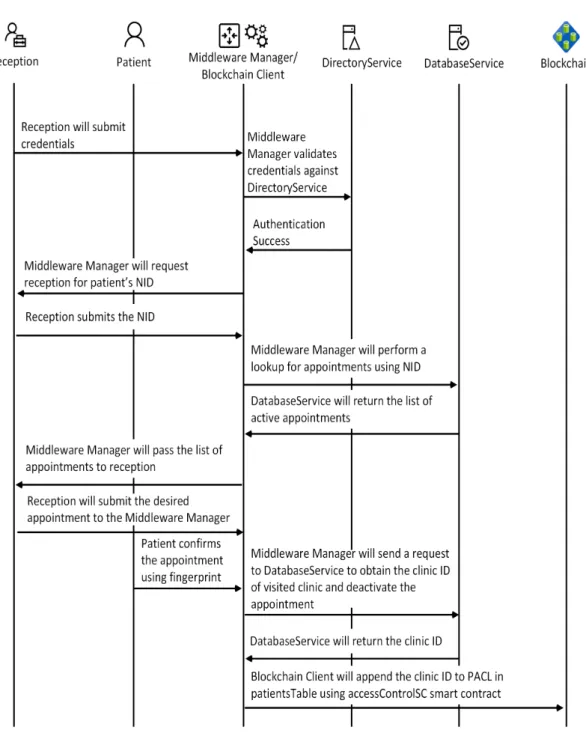
Figure 12: Process for Booking a New Appointment ... 53
Figure 13: Booking Confirmation and Access Granting Summary ... 55
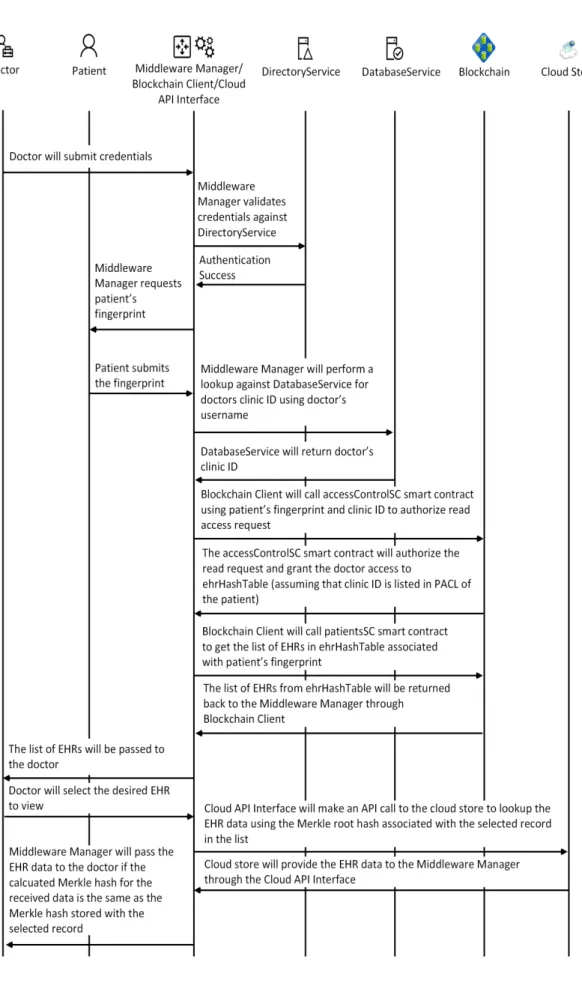
Figure 14: Summary of the EHR Read Process ... 58
Figure 15: Summary of the EHR Write Process ... 60
Figure 16: Django Web Development Architecture ... 63
Figure 17: MacOS Software Version for SDHCARE ... 65
Figure 18: PyCharm SDHCARE Project with Python 3.8 Interpreter ... 66
Figure 19: Example of Users, Groups, and Group Assignment ... 68
Figure 20: Example of SDHCARE Databases ... 70
Figure 21: Summary of HTML SDHCARE Template Structure ... 71
Figure 22: Admin UI with Forms and Views ... 72
Figure 23: Doctor UI with Forms and View ... 72
Figure 24: Reception UI with Forms and Views ... 73
Figure 25: Healthcare Provider’s getProviderInfo Page ... 74
Figure 26: SDHCARE Home Page ... 80
Figure 27: SDHCARE About Page ... 80
Figure 28: SDHCARE Login Page ... 81
Figure 29: SDHCARE Admin UI Page ... 81
Figure 30: SDHCARE Admin UI Submit Page ... 82
Figure 31: SDHCARE-Reception UI Page ... 82
Figure 32: SDHCARE Doctor UI Page ... 83
Figure 33: Summary of Ethereum Transactions ... 86
Figure 34: Integrating Django with Ethereum ... 87
Figure 35: Infura Account Details ... 89
Figure 36: Custom Python Module Operation ... 90
Figure 37: Synchronization of Patient’s EHR ... 92
Figure 38: Verifying EHR Recovery Using Patient ID ... 92
Figure 39: Verifying Hash as Names in Azure Files ... 93
Figure 41: Fingerprint Validation before Writing an EHR ... 95
Figure 42: Failed Attempt to Write a New EHR ... 95
Figure 43: Failed Attempt to Read a Patient’s HER ... 96
Figure 44: Sample Audit Logs for New EHR ... 97
Figure 45: Sample of Anonymized Data Store in Azure Files ... 98
Figure 46: Performance Measurement using Google Chrome ... 100
Figure 47: Read Performance Testing ... 101
Figure 48: Write Performance Testing ... 101
List of Abbreviations
ABI API BBDS
Application Binary Interface
Application Programmable Interface Blockchain-Based Data Sharing CA Certificate Authority
CIA Confidentiality, Integrity, and Availability DOA Decentralized Autonomous Organization
DOB Date of Birth
DOS Denial of Service
EHR Electronic Health Record
FHIR Fast Healthcare Interoperability Resources
GETH Go Ethereum
HIPAA Act Health Insurance Portability and Accountability Act [US] HITECH Act Health Information Technology for Economic and Clinical
Health Act [US]
HL7 Health Level Seven
IoT IP
Internet of Things Internet Protocol
IT Information Technology
NHA National Health Authority NHS National Health Service [UK] NID National Identity
NIST National Institute of Standardization and Technology OHP Owner Healthcare Provider
ONC OS
Office of the National Coordinator Operating System
PACL Patient Access Control List
PII Personal Identification Information POA Proof of Authority
POW Proof of Work
POS Proof of Stack
POV Proof of Verification PPG
RBAC
Photo Plethysmo Gram Role-Based Access Control UAEU United Arab Emirates University
UI User Interface
Chapter 1: Introduction 1.1 Overview
In the healthcare sector, the move towards electronic health record (EHR) systems has been accelerating in parallel with the increased adoption of IoT and smart devices. This is driven by the anticipated advantages for patients and healthcare providers. The Office of the National Coordinator (ONC) for Health Information Technology within the U.S. Department of Health and Human Services [1], defined EHR as “a digital version of a patient’s paper chart. EHRs are real-time, patient-centered records that make information available instantly and securely to authorized users. While an EHR does contain the medical and treatment histories of patients, an EHR system is built to go beyond standard clinical data collected in a provider’s office and can be inclusive of a broader view of a patient’s care. They are built to share information with other health care providers, such as laboratories and specialists, so they contain information from all the clinicians involved in the patient’s care".
Some advantages of EHR systems as indicated by ONC [1] are:
• They maintain and synchronize patients’ medical history, diagnoses, medications, treatment plans, immunization dates, allergies, radiology images, and laboratory and test results
• They allow access to evidence-based tools that providers can use to make decisions about patients’ care
• They automate and streamline provider workflow
In 2009, the U.S. government passed the Health Information Technology for Economic and Clinical Health Act (HITECH Act) to motivate the adoption and
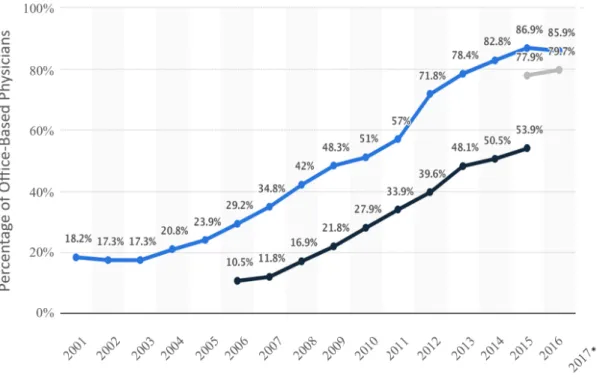
meaningful use of EHR systems. Additionally, they included this objective in the Federal Health IT Strategic Plan [2]. Figure 1 represents the progress of EHR system adoption in the United States since 2001.
Figure 1: Percentage of EHR Systems Adoption in US
In parallel with the move towards EHR healthcare systems, Blockchain technology was introduced by Satoshi Nakamoto in 2009 [3]. Blockchain technology has received significant attention from the research community. Blockchain’s decentralized nature along with its cryptographic services increased its potential to be the future platform for distributed systems. The initial phase of Blockchain technology was limited to the financial sector and mainly focused on cryptocurrency such as Bitcoin, which has evolved to become the most popular cryptocurrency application.
Over time, Blockchain technology has evolved with the introduction of Ethereum and its smart contracts capability Buterin [4], which provides the programmability component of Ethereum Blockchain. This step gave Blockchain technology huge potential and expanded its scope from the financial to other sectors, including healthcare, education, government, and manufacturing. In particular, for the healthcare sector and EHR systems, Blockchain technology offers many capabilities that can fulfill several EHR requirements, as described by McGhin, Choo, Liu, and He [5], and summarized in Table 1.
Table 1: Summary of EHR Requirements and Blockchain Opportunities
EHR Requirements Blockchain Opportunities
System security, including authentication, integrity, access control, and non-repudiation for multiparty integrated EHR systems
Security, assurance, and immutability are provided using cryptography, namely private and public keys combined with hash-chaining between blocks of data
Interoperability between different EHR standards implemented by various healthcare providers, research entities, insurance providers, and pharmacies
Smart contracts capability provides an abstraction layer to enable communication among miners in distributed healthcare providers running different EHR standards
Data sharing of health records The decentralized architecture allows multiple entities to share health records Mobility of healthcare systems with the
introduction of IoT and smart devices that allow patients to share and access their health records
Shared data across distributed ledgers enables near real-time updates across the network to all parties
Availability of the healthcare system The technology provides high availability and resilience through its decentralized model of operation
The close convergence between EHR requirements and Blockchain capabilities listed in Table 1 is a key driver that has led many proposals to include Blockchain-based EHR applications, including EHR monitoring and auditing, mobility applications, and exchange of information.
Despite the promising convergence between Blockchain and EHR systems, some limitations have been identified regarding the integration between Blockchain and EHR systems, specifically:
• Key management in current implementations of Blockchain are based on private/public key pairs. In Blockchain-based EHR systems, patients that use their private keys as their identities to control access to and to sign their EHRs are subject to permanent loss of access to their records in the case of lost private keys, as discussed in McGhin [5]. This is because, in asymmetric cryptography, a private key is not recoverable from the public key (computationally infeasible).
• The lack of standardization for various deployments of Blockchain in healthcare systems generates a challenge regarding the interoperability and exchange of EHRs, which limits the success of deployments [5]. • There is the potential for privacy leakage due to the unencrypted nature
of blocks that hold information related to patients’ health. Even with encrypted blocks, the ability to access the blocks publicly, in public ledgers, makes them subject to cryptanalysis attacks, which can exploit patients’ privacy if the encryption algorithms are compromised [5]. • Scalability and IoT overhead can occur due to the increased number of
network. The more IoT devices joining the Blockchain network, the more the computational complexity of the ledger, which leads to the need for more computational power on these IoT devices. However, these IoT devices have very limited computational capabilities and are not designed to support the complex operations required by Blockchain hashing algorithms [5].
• Blockchain entails security vulnerabilities, which are discussed in detail in Section 1.5.2.
Accordingly, the scope of the present thesis focuses on investigating solutions to overcome the privacy leakage and key recovery challenges. Specifically, the focus is on finding a solution that enables blockchain-based synchronization and exchange of EHRs between distributed healthcare providers while:
• Ensuring recoverable access to patients’ EHRs • Maintaining the unique patients’ identities in EHRs • Controlling access to EHRs
• Providing anonymity to patients’ EHRs in the datastores • Detecting any modifications to EHRs, and
• Logging any activities on EHRs.
1.2 Statement of the Problem
There are several limitations when deploying Blockchain technology in the healthcare industry, as detailed in Section 1.1. The problem statement targeted by this research is patients’ inability to recover access to their EHR records in the case of missing patient identities. This can occur in many cases such as lost private keys or emergency access to EHRs by unauthorized healthcare providers.
1.3 Research Objectives
The core objective of this research project is to propose an EHR exchange and synchronization system based on Blockchain that can provide patients with an access recovery mechanism to their EHRs. In addition to this objective, the proposed system fulfills the requirements of Health Insurance Portability and Accountability Act (HIPAA Act). These legislative requirements include the authentication of access to EHRs, maintenance of EHR isolation and privacy for each patient, guaranteed integrity of EHRs, governance of access control to EHRs, and guaranteed audit logs for patient’s EHRs.
1.4 Research Methodology
This section describes the methodology followed to conduct the research project. The methodology was structured in a logical order to enable gaining in-depth knowledge about the research topic, and divided into several phases:
• A literature review to understand the status of current research on Blockchain-based EHR systems and identify areas for research. • Verification of the uniqueness of the proposal to address the issues
presented in the statement of the problem.
• Development of high-level design architecture of the proposed solution followed by a low-level design.
• A prototype of the proposed design, using Python and Ethereum, to simulate the functional and security requirements.
• Analysis of the strengths and weaknesses of the proposed solution from functional and security perspectives.
Google Scholar was used to search several bibliographic databases for literature related to the current state of research on blockchain in healthcare. The search string deployed was:
Blockchain AND (Healthcare OR EHR) AND (source: ieee OR source: springer OR source: acm OR source: sage OR source: Elsevier).
The output from Google Scholar identified 3,390 papers, of which 3,210 papers were published since 2015.
Initially, only review papers were considered to obtain an overall understanding of current research. Only top five cited papers were considered for the literature review. These papers were obtained using the UAEU E-Library, which provides access to the selected databases used in the Google Scholar filter.
From the initial results, the identified papers were classified into three main categories:
• Blockchain core technology – Top five cited papers • Blockchain security – Top five cited papers
• Blockchain in healthcare – Top 10 cited papers
From this review, limitations in the existing blockchain-based EHR proposals were identified, forming the scope of research for the present thesis.
Google Scholar was consulted again to identify literature related to the use of biometrics in Blockchain deployment in healthcare. One paper was identified that details the use of Fuzzy Vault combined with photoplethysmogram (PPG) signals for key management (see Section 1.5.3).
The next step was to specify the high-level design requirements and assumptions to build a low-level proposal. The following design requirements were considered:
• Provide a distributed platform to exchange and replicate EHRs • Ensure unique patient identity across the platform
• Ensure unique EHR-to-patient mapping
• Ensure patient validation to EHR access control requests. • Provide an access recovery mechanism for patients’ EHRs • Implement audit logging for access requests to EHRs • Provide an EHR integrity validation mechanism
• Provide a mechanism for emergency access to EHRs by non-authorized providers
• Ensure the anonymity of EHRs in the datastore across the platform Additionally, some assumptions were made that were excluded from the design requirements:
• All healthcare providers must use the SDHCARE system.
• All EHRs must be recorded in the same format (e.g., HL7 or FHIR). • Secure links are used for communication between healthcare providers,
the Blockchain and the datastore.
Based on the above requirements and assumptions, the low-level design proposal was developed. More details are provided in Chapter 2.
The next phase was a prototyping phase to build a sample that can implement the required functional and security features of SDHCARE. The low-level design blocks were analyzed, and the tools and software required to provide the desired features and functions for each design block were identified. The final selection of tools was based on the following criteria:
• Security capabilities of the tool.
• Compatibility and interoperability between the tool and other components of the SDHCARE system.
The final phase of the research was testing and results analysis. This was divided into two sections:
• Validating that design requirements were achieved and can provide the expected functions.
• Performance evaluation to measure the average time and speed of transactions across the SDHCARE system.
The details of system prototyping, implementation, and testing are covered in Chapters 3 and 4.
1.5 Literature Review
This section covers the literature related to blockchain technology and its adoption in EHR systems. The reviewed literature covers the progress of research in the following areas:
• Blockchain core functionality
• Blockchain security capabilities and limitations • Limitations of legacy centralized EHR systems • EHR security, privacy, and compliance requirements • Existing proposals for Blockchain-based EHR systems
Table 2: Summary of the Literature
Category Literature List
Blockchain Technology Nakamoto [3], Buterin [4], Weber [8], Yaga, Mell, Roby, and Scarfone [9]
Blockchain Security
Joshi, Han, and Wang [7], Halpin and Piekarska [10], Zhong, Zhong, Mi, Zhang, and Xiang [12], Cash and Bassiouni [13], Tosh et al. [14]
Blockchain in Healthcare
McGhin, Choo, Liu, and He [5], Magyar [15],
Pilkington [16], Zhang, Walker, White, Schmidt, and Lenz [17], Dagher, Mohler, Milojkovic, and Marella [18], Azaria, Ekblaw, Vieira, and Lippman[19], Xia, Sifah, Smahi, Amofa, and Zhang[20], Yang et al.
[21], Roehrs, da Costa, and da Rosa Righi [22], Fan, Wang, Ren, Li, and Yang [23]
1.5.1 Blockchain Basics
According to the US National Institute of Standardization and Technology (NIST), Blockchain is defined as:
Distributed digital ledgers of cryptographically signed transactions that are grouped into blocks. Each block is cryptographically linked to the previous one (making it tamper evident) after validation and undergoing a consensus decision. As new blocks are added, older blocks become more difficult to modify (creating tamper resistance). New blocks are replicated across copies of the ledger within the network, and any conflicts are resolved automatically using established rules [6].
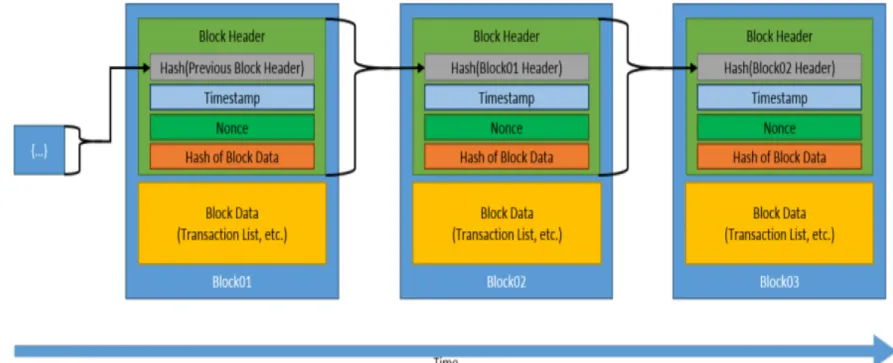
The entire blockchain is stored in each miner (as single unit) for synchronization instead of storing individual blocks. Figure 2 providers an overview of the structure of the blocks.
Figure 2: General Chain of Block
1.5.1.1 Block Components
Joshi, Han, and Wang [7] described the structure of the block as follows.
• Data: This is the application data held in the distributed blocks. The block can hold any type of data and is thus application-independent. Further, the block can hold multiple data units from diverse types of applications. Each data unit in the block is called a ‘message’ or a ‘transaction’.
• Hash: In a single block, three types of hash values exist: the hash value of the previous block (which is used to chain the blocks), the root hash representing all transactions stored in the block, and the hash value of the current block at the time it is committed to the chain.
• Timestamp: The timestamp at which the block was added to the chain.
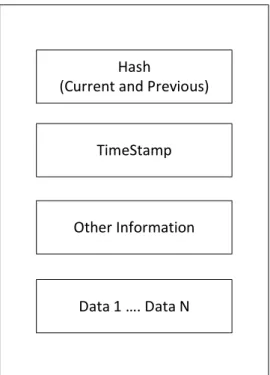
• Other information: This includes information such as the software version used by the miner and the current difficulty level. An essential information element called a ‘nonce’ is used for block validation and the consensus algorithm. Figure 3 depicts this structure.
Figure 3: Block Structure
1.5.1.2 Types of Blockchains
Types of blockchains are defined according to how miners join the Blockchain network. Joshi, Han, and Wang [7] classified Blockchain networks as follows:
• Public Blockchain (permissionless): This type of Blockchain is publicly accessible without permissions or restrictions, eliminating the limitations of a central authority. Any node running the mining software (such as GETH for Ethereum Blockchain) can participate and start adding blocks, executing the consensus algorithm, voting to discard blocks, and obtaining access to any unencrypted information stored in the blocks.
• Private Blockchain (permissioned): This type of Blockchain is a permission-based platform established by a group of firms, individual firms, or divisions within a firm in which data can be accessed by users that are part of the mining group and properly authenticated.
Hash
(Current and Previous) TimeStamp
Other Information
• Consortium Blockchain: The consortium Blockchain is a hybrid between the no single trusted entity model of public Blockchain and the single, highly trustable entity model of private Blockchain. It is perceived as a partially decentralized Blockchain.
1.5.1.3 Transaction Lifecycle
The lifecycle of transactions varies depending on the type of Blockchain. For example, in Ethereum, Weber et al. [8] summarized the transaction lifecycle as follows:
• The sender prepares its transaction with the application data and sends it to its local miner. The sender signs the transaction with its private key, which is validated by the local miner.
• The local miner generates a transaction ID and broadcasts the ID to the pool of miners. This transaction ID is a hash value of the hashed transaction.
• The miners maintain a pool of queued transactions. This queue is generally sorted based on the fees (called gas) paid by senders to process their transactions. Miners prefer to pick transactions with higher incentives (higher gas).
• Once a miner picks a certain number of queued transactions, it builds a block to include them. Next, the miner attempts to solve a crypto-puzzle to be elected to broadcast the block (This is called the consensus algorithm and varies based on the type of Blockchain. Ethereum uses a proof of work (POW) algorithm for consensus that is based on solving crypto-puzzles).
• Upon successful puzzle resolution, the miner posts the block in the Blockchain and waits for confirmation from other miners on the block that
it is committed to the main chain. Ethereum considers the presence of 12 proceeding blocks after the committed block as confirmation.
1.5.1.4 Blockchain Consensus
Yaga, Mell, Roby, and Scarfone [9] described consensus as the process that determines which user publishes the next block. Different models of consensus are used in Blockchains. These vary between CPU-intensive models, which is suitable for permissionless Blockchains for additional security, and low CPU models, which is suitable for permissioned Blockchains that assume a level of trust between miners. Some commonly-used consensus models are listed by [9]. The following sections describe the different models used in Blockchain for reaching consensus.
1.5.1.4.1 Proof of Work (POW)
In the POW model, a complex crypto-puzzle is published to all miners in the Blockchain. The first miner that solves the puzzle is granted permission to publish its blocks. The miner has to submit the solved puzzle as a “proof”, which is validated by other miners, and then the block is accepted. The difficulty of the puzzle varies and is continuously adjusted to maintain an average block committing time (e.g. 10 minutes in Bitcoin). Accordingly, POW is considered highly CPU-intensive and is usually used in permissionless Blockchains to reduce attackers’ interests in participating.
1.5.1.4.2 Proof of Stack (POS)
The POS model uses the amount of stack that miners invest in the system as an indication of their genuine intention and disinterest in compromising the Blockchain. The actual stack of the Blockchain varies based on its type, but cryptocurrency is generally used. The miners invest in the cryptocurrency of the Blockchain, which is
unusable expect for being a measure of their trust.
This model is currently being evaluated in permissionless Blockchains as it eliminates the high computational requirements of the POW model.
1.5.1.4.3 Proof of Authority (POA)
The POA model is based on maintaining a level of trust between miners and is used only in permissioned Blockchains. This level of trust is established through proven identities, which are verified by Blockchain members (e.g., authorized documents). During Blockchain runtime, the reputation of miners varies depending on their behavior, number of accepted blocks, and other factors. Miners with a better reputation will be awarded more slots to publish blocks while malicious miners will not be awarded sufficient slots to publish blocks.
1.5.1.4.4 Round Robin Consensus
Similar to the POA model, round robin consensus is limited to permissioned Blockchains. In this model, miners are awarded equal slots to submit blocks. An advantage of this model is that it guarantees that no miner can create a majority of blocks without the need for complex computation for validation.
1.5.2 Blockchain Security
In this section confidentially, integrity and availability (CIA) aspects of blockchain technology are investigated, as well as some common attacks against blockchain.
1.5.2.1 Confidentiality
restrictions on information access and disclosure, including means for protecting personal privacy and proprietary information”. Hence, confidentiality is focused on authorization and privacy.
NIST [6] defines authorization as “access privileges granted to a user, program, or process or the act of granting those privileges”, which is not a feature natively provided by Blockchain technology. Similarly, privacy is not a native feature of Blockchain. Current implementations of Blockchain technology do not have the capability of encrypting the contents of the blocks or transactions before committing them to the ledger. The lack of authorization and privacy can introduce a substantial risk of a malicious miner joining the mining pool, obtaining a copy of the blocks and analyzing/exploiting their vulnerabilities. An example of this is the decentralized autonomous organization (DOA) attack [10]. DAO was an application developed and executed in Ethereum blockchain with the purpose of maintaining financial contributions for blockchain-based applications. It had an identity verification vulnerability which was exploited in 2016, leading to compromised security and losses totaling more than US$50 million [11]. Lack of privacy and authorization allowed the attacker to read DOA blocks and identify the vulnerability.
Zhong, Zhong, Mi, Zhang, and Xiang [12] proposed a new model of privacy-protected Blockchain that encrypts data within an agreed upon time to add privacy capability to the technology. Cash and Bassiouni [13] proposed a two-tier Blockchain network that provides permissionless Blockchain at tier-1 with a POW consensus algorithm and permissioned Blockchain at tier-2 with a POA consensus algorithm. In this model, tier-2 provides access control to data specific to data owners and the users with whom they are sharing the data. Nodes from the permissionless tier can be
members of tier-2, which allows them to pass data and make transactions according to pre-defined access control contracts.
1.5.2.2 Integrity
NIST [6] defines integrity as “guarding against improper information modification or destruction and includes ensuring information non-repudiation and authenticity”. Nakamoto [3] explained how Blockchain technology implements strict integrity verification to avoid manipulation and tampering of data inside the blocks. This is implemented at three levels: the transaction, block, and miner level.
• At the transaction level, each miner verifies the hash value of the received transactions. Only valid transactions are queued in the block to be published in the ledger. The miner uses the sender’s public key to verify the received transaction hash value against the locally calculated value. Thus, this eliminates spoofing of senders’ public keys.
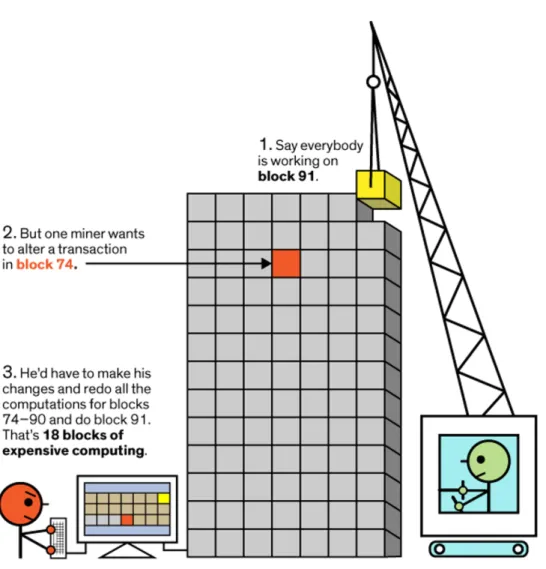
• At the block level, the miner uses the hash values of all transactions to calculate the root hash value that represents all transactions in the block (Bitcoin uses the Merkle tree while Ethereum uses the Patricia tree). The miner will use the hash value of the last block in the ledger, the root hash of the queued block, and the nonce value to calculate the local block hash. This nested hashing represents the actual chaining of the blocks and ensures blockchain integrity because tampering in any block will require a change in the hash values of all proceeding blocks in the ledger. Altering one block and all proceeding blocks is required before a new block is published in the ledger. Figure 4 below shows the detection of data tampering at the block level.
Figure 4: The Effects of Tampering with One Block in the Ledger
• At the miner level, for each new block, the miner verifies the block hash before accepting it in the ledger as the new last block. Further, the miner verifies the order of the new block by comparing the hash reference of the current last block in the ledger against the value listed in the new block. A block that fails the integrity check by miners or is placed out of order will be discarded if the majority of miners vote for the same result (i.e., more than 51% of miners vote to discard the block).
The nested hashing within the block and between blocks in the ledger guarantees the integrity of the data stored in Blockchain and makes it immutable (irreversible). This capability requires a thorough evaluation of the data policy before posting it on the Blockchain. If sensitive data such as medical records are encrypted and stored in the Blockchain and the encryption algorithm is later exploited, there could be significant exposure of sensitive information that cannot be revoked. Another example is a DOA attack where the Ethereum community cannot revoke the vulnerable DOA code without forking the ledger (i.e., discarding all the data inserted after the vulnerable DOA code).
1.5.2.3 Availability
Availability is defined by NIST [6] as “ensuring timely and reliable access to and use of information”. Availability is well implemented in Blockchain technology. The distributed architecture of the Blockchain network and the synchronization of the entire Blockchain across all miners in the pool provides robust resilience against single-point-of-failure scenarios. Failure in one or more node(s) does not stop the Blockchain network from introducing new blocks to the chain and/or serving access requests to the existing blocks. However, failure could impact the availability of the applications utilizing Blockchain.
Weber et al. [8] investigated the availability provided by Blockchain from an applications perspective. The research is focused on how the availability of Blockchain-based applications is affected by the time required to post a transaction on Blockchain. Using a sample of transactions from the Ethereum and Bitcoin Blockchains, Weber et al. found that 61.5% of transactions took more than 3 minutes to be committed in a Blockchain, while 13.8% of the transactions took more than 4.5
minutes to be committed. Such variation in time can introduce the unavailability of client applications.
Additionally, Weber et al. [8] investigated the factors that can influence the delay to commit transactions. Some of these are common between Ethereum and Bitcoin while others are unique to each, as indicated in Table 3.
Table 3: Factors for Blockchain Transaction Delay Variation
Ethereum Bitcoin
Transaction fees paid by the client ✔ ✔
Transactions’ order of arrival ✔ ✔
Locktimes: indicating that a transaction is invalid until a certain block sequence number is mined
✔
Network delays ✔ ✔
Gas limit (per block) ✔
Weber et al. [8] analyzed the impact of DOS attacks on Ethereum Blockchain and found that the measures currently implemented by Ethereum that use a gas limit counter DOS attacks and provide strong availability for smart contract applications.
1.5.2.4 Common Blockchain Attacks
Over time, different techniques have been used to attack active Blockchains, including Ethereum and Bitcoin. These attacks have targeted the core Blockchain technology rather than the applications running on the Blockchain (application attacks are subject to the vulnerabilities in applications). Tosh et al. [14] analyzed attacks on permissionless Blockchains that utilize POW as their consensus algorithm (the same attacks apply to permissioned Blockchains with lower risk due to the controlled
admission of miners). The following section reviews the literature on common attacks on Blockchain.
1.5.2.4.1 Double-spend Attack
In a double-spend attack, the same cryptocurrency (e.g., bitcoins) for more than one transaction. A malicious miner spends a certain number of bitcoins, for example, at block i. Starting from block i, the malicious miner privately mines to extend the Blockchain as fast as possible without publicizing it. The private chain does not include the bitcoins spent by the attacker in block i. Once the private chain (malicious) is longer (i.e., has more mined blocks) than the public chain (genuine), the malicious miner posts the malicious chain, which appears as a fork. Miners vote to resume the malicious chain and discard the genuine chain because the malicious chain is longer (which means that genuine transactions are discarded starting from block i, and the same bitcoins can be reused for other transactions).
1.5.2.4.2 Selfish Mining Attack
In a selfish mining attack, a pool of malicious miners colludes to mine together (which increases their hashing power) and distributes the incentives among themselves. This increases their profitability by enabling them to receive regular incentives (because they dominate the Blockchain with their hashing power) instead of receiving random incentives when mining independently. At the same time, it reduces the profitability of honest miners. Honest miners may prefer to join an honest pool to increase their mining power compared to a selfish pool, generating higher incentives. Thus, the pool eventually becomes the major player controlling the Blockchain, and decentralization no longer holds.
1.5.2.4.3 Eclipse Attack
An eclipse attack is aimed at isolating Blockchain miners and hijacking their mining power to form a malicious pool of miners controlled by the attacker. This malicious pool can be used to generate a fork and commit malicious blocks (i.e., overwrite the decentralization of Blockchain). Each miner in the ledger is limited to a certain number of concurrent, outgoing peers to maintain the peer-to-peer network (Bitcoin implementation limits each node to eight outgoing connection peers while Ethereum limits this to 11). In addition, it can accept a certain number of unsolicited incoming connections to form peers on the node’s public IP (Bitcoin allows up to 117 connections).
Considering Bitcoin, each miner maintains a table of IPs for incoming peers sending unsolicited requests. The miner selects eight peers from the table to initiate outgoing connections. The selection of IPs is systematic (not random). An attacker can rapidly and repeatedly initiate unsolicited connection requests to the victim’s node from controlled nodes. The victim’s node populates its table with attacker-controlled miners’ IPs. The attacker continues to overwhelm the victim’s node with irrelevant information until it restarts. With such effort, there is a high chance that the victim will have the eight outgoing connections to attacker-controlled nodes after restarting, which isolates the victim from an honest pool, as indicated in Figure 5.
Figure 5: Eclipse Attack
1.5.2.4.4 Block Withholding Attack
In this type of attack, some pool members who have joined to help mining blocks never publish any blocks, thus decreasing the expected revenue of the pool.
1.5.2.4.5 Block Discarding Attack and Difficulty Raising Attack
Block discarding and difficulty raising attacks rely on the attacker’s hashing power to mine blocks faster than others in the ledger, which leads to an increase of complexity, affecting the performance of the Blockchain network [14].
1.5.3 Blockchain in Healthcare
The literature reviewed in this section covers the challenges, capabilities, and some proposed implementations of blockchain in EHR, specifically:
• The challenges in integrating existing legacy centralized EHR systems
• The required capabilities in any blockchain-based EHR systems to be accepted
• Proposals for blockchain-based EHR systems, including:
o BBDS
o OmniPHR
o MedShare
1.5.3.1 Centralized-Based EHR
The move towards Blockchain-based EHR systems to integrate distributed healthcare providers raises questions about the challenges of integrating current centralized EHR systems that are distributed among healthcare providers with existing legacy technology. Magyar [15] listed four challenges in integrating existing centralized EHR systems:
• In centralized systems, EHRs are maintained in different formats that suit each provider’s business model. This requires various interfaces and protocols for integration, and there is no single protocol accepted across all providers. Because of this complexity, there is high potential of compromising the security of EHRs and the privacy of patients across the different utilized middleware technologies and protocols.
• The current model of centralized systems provides high central authority to the dominant health provider of the patient, which complicates the exchange of health information in the case of unplanned treatment in an emergency situation and can cause serious results such as fatality because of the lack of timely access to EHRs.
• Auditing patients’ history and traceability is a significant concern in centralized EHR systems as the information passes multiple healthcare providers. This is especially a concern when institutional incentives influence the history of a patient’s data
• The availability of patient data in integrated, centralized EHR systems is inconsistent, and the related regulations are unclear. It is subject to the resilience of each centralized healthcare provider.
An example of integrating centralized EHR systems was a five-year agreement in 2016 between Google DeepMind and the Royal Free London NHS Foundation Trust. This integration encountered significant problems, which were summarized by Pilkington [16]:
• Lack of transparency and privacy
• Mismanagement of patients’ data and identities
• Delayed treatment due to malicious software infections, which caused delayed service recovery
1.5.3.2 Blockchain-Based EHR Required Capabilities
Zhang, Walker, White, Schmidt, and Lenz [17] conducted research on the required metric for any blockchain-based EHR system to be accepted. The researchers identified seven metrics:
1. Entire workflow of the system is HIPAA-compliant 2. Framework supports Turing-complete operations 3. Support for user identification and authentication 4. Support for structural interoperability at minimum
5. Scalability across large populations of healthcare participants 6. Cost-effectiveness
1.5.3.2.1 Entire workflow of the system is HIPAA-compliant
For a healthcare solution to be accepted and adopted, it must fulfill the regulatory requirements of a country’s National Health Authority (NHA). Considering the HIPAA Act, as an example of health regulation act in the US, Dagher, Mohler, Milojkovic, and Marella [18] analyzed its requirements and concluded that Title II of five HIPAA titles is relevant to Blockchain-based EHR. This title comprised the standards for privacy of individually identifiable health information (privacy rule) and the security standards for the protection of electronic protected health information (security rule). Magyar [15] further analyzed HIPAA requirements and concluded that Blockchain technology can fulfill the HIPAA requirements of secured access, privacy, lack of centralized government, and cost reduction.
Zhang, Walker, White, Schmidt, and Lenz [17] highlighted precautions that should be considered when implementing HIPAA-complaint Blockchain-based solutions. Peng et al. stated, “A core tenet of HIPAA compliance is that Personally Identifiable Information (PII) must be protected against a confidentiality breach. In particular, the end-to-end workflow of a healthcare app from entering to processing then delivering the data must be HIPAA compliant”. This can be achieved in centralized systems using encryption techniques. However, in Blockchain, encryption may not be useful because any data stored in the Blockchain is replicated across all the miners and accessible by any party. Therefore, any breach of the currently used encryption algorithms makes the EHR information vulnerable, especially data in the Blockchain that is immutable and cannot be deleted. Accordingly, Zang et al. recommended storing encrypted metadata of the EHRs in the Blockchain (with a minimum level of information), which ensures that EHR data is securely stored [17].
1.5.3.2.2 Framework supports Turing-complete operations
Zhang, Walker, White, Schmidt, and Lenz [17] stated that any Blockchain-based EHR system should be Turing-complete and have programming capabilities to enable simple integration and interoperability with legacy systems. In addition, it should have the capability for simple upgrades and feature enhancements. Blockchain networks built specifically for healthcare applications are not scalable and cannot fulfill these requirements.
1.5.3.2.3 Support for User Identification and Authentication
In EHR systems, users are classified as patients and healthcare professionals. As [17] stated that any Blockchain-based EHR system should be able to uniquely identify and distinguish each user while maintaining their anonymity on the Blockchain, securely authenticate users, and be capable of recovering user’s authentication information if it is lost or stolen.
1.5.3.2.4 Support for Structural Interoperability at Minimum
The system should enable the exchange of medical data and interpretation of received data in its current standards [17], i.e., the system should be able to communicate with known industry standards such as FHIR and HL7.
1.5.3.2.5 Scalability across Large Populations of Healthcare Participants
This was described in [17] thus: “A successful health app should leverage the Blockchain to enhance interoperability, while maintaining its quality when users or components of the app scale up and out”.
1.5.3.2.6 Cost-effectiveness
Any blockchain-based EHR system should be cost-effective compared to the existing legacy systems without affecting its capabilities [17]. This factor has a significant impact on the selection of blockchain parameters, including type, consensus algorithm and incentives model.
1.5.3.2.7 Support of Patient-centered Care Model
According to [17], any Blockchain-based EHR system should provide patients with the ability to control or monitor their information without compromising other functionalities. These features may include self-reporting health information, access to personal medical records and prescription history from different providers, auditing existing access to patient health records, and the ability to share or revoke access to patients’ own medical data.
1.5.3.3 MedRec
MedRec was proposed by Azaria, Ekblaw, Vieira, and Lippman [19] to utilize Blockchain technology to integrate existing centralized EHR systems among distributed healthcare providers. The solution uses Ethereum Blockchain’s smart contracts capability to facilitate this integration. Each healthcare provider should contribute an Ethereum mining node (usually a dedicated server) to participate in MedRec. In addition, patients should also contribute an Ethereum mining node (on a PC or mobile device) to participate in MedRec. The main functions of MedRec are to:
• Enable inter-provider access to patients’ EHRs using API interfaces. The API information of the providers is stored in the Blockchain.
Access control lists for patients and providers are stored in the Blockchain.
• Detect and notify patients about new access requests to their EHRs. Access can be granted or rejected only by patients.
• Notify patients about changes to their EHRs and log the changes in the Blockchain.
• Provide a copy of EHRs on patients’ nodes and dominant providers’ nodes. Although MedRec accelerates the deployment of EHR systems by integrating with existing systems using Blockchain technology to overcome the major limitations of centralized EHR systems, MedRec has shortcomings that limit its feasible production implementation:
• A mandatory component of MedRec is the presence of patients’ nodes, which are used to communicate with patients for access control management. This limits the scope of MedRec solutions to Blockchain-enabled patients (i.e., patients should have an Ethereum account). This is a major limitation of the solution from the patients’ perspective (but not the providers’ perspective). Any proposed solution should be capable of supporting all patients without restrictions.
• Ethereum Blockchain uses POW as its consensus algorithm, which is known to have significant computing power requirements. While healthcare providers can contribute powerful mining nodes to use MedRec, this cannot be (practically) achieved for patients, whose nodes are on PCs or mobile devices, making MedRec practically infeasible.
• If a patient loses the private key to their Ethereum account (which is possible using a mobile device or PC), MedRec does not provide a mechanism for a
patient to recover control of their EHR.
• The use of current centralized EHR systems raises an interoperability problem regarding inter-provider access. The solution must assume that all providers utilize the same EHR format standard such as HL7 or FHIR [19], which is not the case with the current centralized systems.
• MedRec does not provide a mechanism for emergency access to EHRs if a patient is admitted to a non-authorized hospital for emergency treatment.
1.5.3.4 BBDS
Xia, Sifah, Smahi, Amofa, and Zhang [20] proposed a Blockchain-based data sharing (BBDS) system to provide access control management to EHRs stored in the cloud based on the Blockchain technology. The proposed BBDS system utilizes permissioned Blockchain consisting of an issuer that grants users or organizations access to the system, a verifier that validates requests from system members and grants corresponding access rights, and consensus nodes that facilitate the interface between members and the verifier in addition to logging requests in Blockchain for auditing and forensics purposes. The BBDS system provides the following functionalities:
• A proof of verification (POV) algorithm between the issuer and users/organizations to enroll them in the BBDS system. The POV algorithm is based on a proposed lightweight Diffie-Helman key exchange to generate a session key for encryption and an electronic registration form to be validated by the issuer.
• Controlled access to EHRs, stored in the cloud, by a verifier node for members of the BBDS system. This verification process is based on a per-member private key generated during the registration phase by the issuer and
communicated to members and the verifier. After successful verification of a member’s identity, the verifier validates the request against member rights and, if access is granted, the verifier retrieves data from the cloud and passes it to the member, or read data from the member and posts it in the cloud.
• Audit logging in the Blockchain ledger using consensus nodes, where each member’s request to read or post an EHR is stored in a separate block. The information recorded in the block includes user identity, purpose of the request, processing consensus node, verification result, and timestamps, including request creation, request retrieval from unprocessed requests pool, verification time, block broadcast time, and data send time.
Although the BBDS system is not limited by cryptography key recovery and emergency access restrictions (because the actual EHRs are not stored in the Blockchain and their access is controlled by the issuer/verifier), it has other limitations with the current implementation:
• The use of permissioned Blockchain eliminates decentralized authority, which is a core advantage of Blockchain technology. The model provides central authority to the issuer (not the patient) to verify and accept members in the system.
• Because of the use of non-Turing-complete Blockchain (i.e., no smart contracts), the BBDS system records each event in a single block to be able to uniquely identify the events by the block reference. This limits the scalability of the system because of recording a large number of blocks in a very short time.