MRAP: A Novel MapReduce-based Framework to Support
HPC Analytics Applications with Access Patterns
Saba Sehrish
1, Grant Mackey
1, Jun Wang
1, and John Bent
2 1University of Central Florida
ssehrish, gmackey, [email protected]
2Los Alamos National Laboratory
[email protected]
ABSTRACT
Due to the explosive growth in the size of scientific data sets, data-intensive computing is an emerging trend in com-putational science. Many application scientists are looking to integrate data-intensive computing into computational-intensive High Performance Computing facilities, particu-larly for data analytics. We have observed several scientific applications which must migrate their data from an HPC storage system to a data-intensive one. There is a gap be-tween the data semantics of HPC storage and data-intensive system, hence, once migrated, the data must be further re-fined and reorganized. This reorganization requires at least two complete scans through the data set and then at least one MapReduce program to prepare the data before analyz-ing it. Runnanalyz-ing multiple MapReduce phases causes signif-icant overhead for the application, in the form of excessive I/O operations. For every MapReduce application that must be run in order to complete the desired data analysis, a dis-tributed read and write operation on the file system must be performed. Our contribution is to extend Map-Reduce to eliminate the multiple scans and also reduce the num-ber of pre-processing MapReduce programs. We have added additional expressiveness to the MapReduce language to al-low users to specify the logical semantics of their data such that 1) the data can be analyzed without running multi-ple data pre-processing MapReduce programs, and 2) the data can be simultaneously reorganized as it is migrated to the data-intensive file system. Using our augmented Map-Reduce system, MapMap-Reduce with Access Patterns (MRAP), we have demonstrated up to 33% throughput improvement in one real application, and up to 70% in an I/O kernel of another application.
Categories and Subject Descriptors
D.1.3 [Concurrent Programming]: Distributed
Program-ming;
D.1.3 [Concurrent Programming]: Parallel Programming;
H.3.4 [Systems and Software]: Distributed Systems;
General Terms
I/O Performance of HPC Applications, Large-scale data pro-cessing systems
Keywords
HPC Analytics Applications, HPC Data Access Patterns, MapReduce
1. INTRODUCTION
Today’s cutting-edge research deals with the increasing vol-ume and complexity of data produced by ultra-scale simula-tions, high resolution scientific equipment and experiments. These datasets are stored using parallel and distributed file systems and are frequently retrieved for analytics applica-tions. There are two considerations regarding these datasets. First, the scale of these datasets [6, 33] that affects the way they are stored (e.g. metadata management, indexing, file block sizes, etc). Second, in addition to being extremely large, these datasets are also immensely complex. They are capable of representing systems with high levels of dimen-sionality and various parameters that include length, time, temperature, etc. For example, the Solenoidal Tracker at the Relativistic Heavy Ion Collider (STAR; RHIC) experi-ment explores nuclear matter under extreme conditions and can collect seventy million pixels of information one hun-dred times per second [10]. Such extraordinarily rich data presents researchers with many challenges in representing, managing and processing (analyzing) it. Many data pro-cessing frameworks coupled with distributed and parallel file system have emerged in recent years to cope with these datasets [3, 16, 17, 20].
However, the raw data obtained from the simulations/sensors needs to be stored to data-intensive file systems in a format useful for the subsequent analytics applications. There is an information gap because current HPC applications write data to these new file systems using their own file seman-tics, unaware of how the new file systems store data, which generate unoptimized writes to the file system. In HPC an-alytics, this information gap becomes critical because source of data and commodity-based systems do not have the same data semantics. For example, in many simulations based ap-plications, data sets are generated using MPI datatypes [21] and self describing data formats like netCDF [7, 25] and HDF5 [4, 8]. However, scientists are using frameworks like MapReduce for analysis [18, 24, 26, 27, 30] and require datasets to be copied to the accompanied distributed and
Input Data
MapReduce
MapReduce
Output Data
a) HPC Analytics in MapReduce b) HPC Analytics in MRAP Write Write/ Read Write/ Read Read Input Data MapReduce MapReduce Output Data
...
N...
M N > MFigure 1: Steps performed in writing HPC analytics using both MapReduce and MRAP.
parallel file system e.g. HDFS [13]. The challenge is to identify the best way to retrieve data from the file system following the original semantics of the HPC data.
One way to approach this problem is to use a high level programming abstraction for specifying the semantics and bridging the gap between the way data was written and the way it will be accessed. Currently, the way to access data in HDFS like file systems is to use the MapReduce programing abstraction. Because MapReduce is not designed for seman-tics based HPC analyseman-tics, some of the existing analyseman-tics ap-plications use multiple MapReduce programs to specify and analyze data [24, 30]. We show the steps performed in writ-ing these HPC analytics applications uswrit-ing MapReduce in Figure 1 a). In Figure 1 a),NMapReduce phases are being used; the first MapReduce program is used to filter the origi-nal data set. If data access pattern is complex, then a second MapReduce program will perform another step on the data to extract another dataset. Otherwise, it will perform the first step of analysis and generate a new data set. Simi-larly, depending on the data access pattern and the analysis algorithm, multiple phases of MapReduce are utilized.
For example, consider an application, which needs to merge different data sets followed by extracting subsets of that data. Two MapReduce programs are used to implement this access pattern. That is, the first program will merge the data set and the second will extract the subsets. The overhead of this approach is quantified as 1) the effort to transform the data patterns in MapReduce programs, 2) number of lines of code required for MapReduce data pre-processing and 3) the performance penalties because of reading excessive datasets from disk in each MapReduce program.
We propose a framework based on MapReduce, which is capable of understanding data semantics, simplify the writ-ing of analytics applications and potentially improve per-formance by reducing MapReduce phases. Our aim in this project is to utilize the scalability and fault tolerance bene-fits for MapReduce and combine them with scientific access
patterns. Our framework, calledMapReduce with Access
Patterns (MRAP), is a unique combination of the data
access semantics and the programming framework
(MapRe-Scientific Data HPC Storage (PFS ,
GPFS )
Data Intensive file system (HDFS , GFS )
MapReduce MRAP API
Scientific Data Intensive HPC
MRAP Data Restructuring
Figure 2: High-Level System View with MRAP
duce), which is used in implementing HPC analytics appli-cations. We have considered two different types of access patterns in the MRAP framework. The first pattern is for the matching, or similar analysis operations where the input data is required from two different data sets. These applica-tions access data in smaller contiguous regions. The second pattern is for the other types of analysis that uses data in multiple smaller non-contiguous regions. MRAP framework consists of two components to handle these two patterns; MRAP API and MRAP data restructuring.
MRAP API is used to specify both access patterns. It is flex-ible enough to specify the data pre-processing and analytics in fewer MapReduce programs than currently possible with traditional MapReduce as shown in the Figure 1 b). Figure 1 shows that MRAP is utilizingM phases, andM < N, where
N is the number of corresponding phases in a MapReduce
based implementation. With MRAP, M < N is possible
because it allows the users to describe data semantics (var-ious access patterns based on different data formats) in a single MRAP application. As mentioned in the previous ex-ample, two MapReduce programs are used to describe an access pattern which requires merge and subset operations on data before analyzing it. In MRAP, only one MapReduce program is required, because data is read in required merge pattern in the Map phase, and subsets are extracted in the reduce phase.
MRAP data restructuring reorganizes data with the copy operation to mitigate the performance penalties resulting from non-contiguous small I/O requests (second access pat-tern). Our prototype of MRAP framework includes ba-sic implementation of functions that allow users to specify data semantics and data restructuring to improve the per-formance of our framework. Figure 2 shows the high level system view with MRAP. Our results with a real application in bioinformatics and an I/O kernel in astrophysics, show up to 33% performance improvement by using MRAP API, and up to 70% performance gain by using data restructuring.
This paper is organized as follows: Section 2 discusses the motivation for our MRAP approach. Section 3 describes the overall framework and its design, and how API effects the data layout and how optimization like data restructuring is used in the framework. Results are presented and analyzed in Section 4. Section 5 describes the related work in large scale data processing, access patterns in scientific applica-tions and optimization on these patterns. Conclusion and future work is in Section 6.
2. MOTIVATION FOR DEVELOPING MRAP
In this section we describe the motivation for developing MRAP. Data for analysis comes in all types of formats, file semantics, and comes from many various sources; whether it be weather data to high energy physics simulations. Within these patterns, we also need to provide for efficient file ac-cesses. Current approaches show that in order to implement these access patterns, a series of MapReduce programs is utilized [24, 30], also shown in the Figure 1.In a MapReduce program, the map phase always reads data in contiguous chunks, and generates data in the form of (key, value) pairs for the reduce phase. The reduce phase then combines all the values with the same keys to output the result. This approach works well when the order and se-quence of inputs do not affect the output. On the other hand, there are algorithms that require data to be accessed in a given pattern and sequence. For example, in some im-age pattern/template matching algorithm, the input of the function must contain a part of the original image and a part of the reference image. Using MapReduce for this particular type of analysis would require one MapReduce program to read the inputs from different image files and then combine them in the reduce phase for further processing. A second MapReduce program would then analyze the results of the pattern matching. Similar behavior has been observed in two other application as shown in the Figure 3 and Figure 7 a). Figure 3 describes a distributedFriends-of-Friends algo-rithm; the four phases are MapReduce programs [24]. Fig-ure 7 a) is discussed in the Section 4. Both these figFig-ures show the multi-stage MapReduce applications developed for scientific analytics.
Using this multi-stage approach, all the intermediate MapRe-duce programs write data back to the file system while sub-sequent applications read that outputted data as input for their task. These excessive read/write cycles impose perfor-mance penalties and can be avoided if initial data is read more flexibly as compared with traditional approach of con-tiguous chunks read. Our proposed effort, MRAP API, is designed to address these performance penalties and to pro-vide an interface that allows these access patterns to be spec-ified in fewer MapReduce phases. Hence, the goal of the MRAP API is to deliver greater I/O performance than the traditional MapReduce framework can provide to scientific analytics applications.
Additionally, some scientific access patterns generally re-sult in accessing multiple non-contiguous small regions per task, rather than the large, contiguous data accesses seen in MapReduce. Due to the mismatch in sizes of distributed file system (DFS) blocks/chunks and the logical file requests of these applications, small I/O problem arises. The small I/O requests from various access patterns impact the per-formance by accessing excessive amount of data, when im-plemented using MapReduce. The default distributed file system chunk used in current setup is either 64/128 MB. Most of the scientific applications store data with each value comprising of a few KBs. Each small I/O region (a few KBs) in the file may map to large chunks (64/128 MB) in the file system. If each of the requested small I/O region is 64 KB, then a 64 MB chunk will be retrieved to process only 64 KB making it extremely expensive.
A possible approach can be to decrease the chunk size to reduce the amount of extra data accessed. These smaller chunks increase the size of metadata [5]. Also, the small I/O accesses also result in a large number of I/O requests sent to the file system. In MapReduce framework, smaller chunks and large number of I/O requests become extremely challenging because there is a single metadata server ( Na-meNode) that handles all the requests. These small I/O re-quires efficient data layout mechanisms because the patterns can be used to mitigate performance impact that would oth-erwise arise. Hence, providing semantics for various access patterns which generate small I/O requires optimizations at both the programming abstraction and the file system levels.
3. DESIGN OF MRAP
The MRAP framework consists of two components; 1) MRAP API, that is provided to eliminate the multiple MapReduce phases used to specify data access patterns, and 2) MRAP data restructuring, that is provided to further improve the performance of the access patterns with small I/O problem. Before we describe each component of the MRAP frame-work, it is important to understand the steps that existing HPC MapReduce applications perform in order to complete an analysis job. These steps are listed as follows:
• Copy data from external resource (remote storage, sen-sors, etc) to HDFS/similar data-intensive file system with MapReduce for data processing.
• Write at least one data pre-processing application (in MapReduce) to prepare data for analysis. The number of MapReduce applications depends on the complexity of initial access pattern.
– This data preparation can be a conversion from
raw data to scientific data format or in general filtering of formatted data.
• Write at least one MapReduce application to analyze the prepared datasets. The number of MapReduce ap-plications for analysis varies with the number of steps in the analytics algorithm.
As compared with this existing MapReduce setup, our MRAP framework will allow the following steps:
• Copy data from external resource to HDFS/similar file system (perform MRAP data restructuring if specified by the user).
• Write an MRAP application to specify the pattern and subsequent analysis operation.
– If data was restructured at the copy time, then map/reduce phases will be written only for the analysis operation.
We discuss the two components, i.e. MRAP API and MRAP data restructuring in detail in the next subsections.
Reduce
Write the Intermediate Output to the disk
Map Read the Input from the disk Map Read the Input from the disk Reduce
Write the final Output to the disk
Map Read the Input from the disk Map Read the Input from the disk Reduce Write the Intermediate Output to the disk
Reduce
Write the Intermediate Output to the disk
Partition Local Cluster Hierarchical Merge Relabel
Figure 3: Overview of the distributed FoF algorithm using 4 MapReduce phases [24].
3.1 MRAP API
The purpose of adding this data awareness functionality is to reduce the number of MapReduce programs that are used to specify HPC data access patterns. We provide an inter-face for two types of data access patterns; 1) applications that perform match operations on the data sets, and 2) ap-plications that perform other types of analysis by reading data non-contiguously in the files. At least one MapReduce
program is used to implement either 1 or 2. Note: There
are some complex access patterns which consist of different combinations of both 1 and 2. We first briefly describe how MapReduce programs work, and why they require more pro-gramming efforts when it comes to HPC access patterns.
A MapReduce program consists of two phases: a Map and a Reduce. The inputs and outputs to these phases are defined
in the form of a key and a value pair. Each map task
is assigned a split specified in InputSplit to perform data processing. A FileSplit and a MultiFileSplit are the two implementations of the interface InputSplit. The function
computeSplitSize calculates the split size to be assigned to each map task. This approach guarantees that each map task will get a contiguous chunk of data. In the example with merge and subset operations on data sets, following two MapReduce programs will be used.
• MapReduce1:
(inputA, inputB, functionA, outAB)
• functionA(merge)
map1(inputA, inputB, splitsizeA, splitsizeB, merge, outputAB)
where merge has different criteria, e.g. merge on exact or partial match, 1 match of inputA and inputB, 1-all match of inputA and inputB, etc.
reduce1(outputAB, sizeAB, merge_all, outAB)
• MapReduce2:
(outAB, functionB, outC)
• functionB(subset)
map2(outAB, splitsizeAB,subset)
where subset describes the offset/length pair for each split of size splitsizeAB.
reduce2(subset, outC)
We now describe MRAP API, classes and functions, and how it allows the user to minimize the number of MapRe-duce phases for data pre-processing. Then, we describe the provided user templates that are pre-written MRAP pro-grams. The user templates are useful in the cases when the access patterns are very regular and can be specified by us-ing different parameters in a configuration filee.g, a vector
Output Data
a) HPC Analytics (Matching ) in MapReduce MapReduce Write
...
Input A Input B M1 M2 Mn R1Read per Map Task
Write Analysis
b) HPC Analytics (Matching ) in MRAP Write
...
Input A Input B
M’1 M’2 M’n
*MapReduce Reads = Single Sequential *MRAP Reads Analysis R’1 R’2 Output Data R2 *MapReduce Reads
*MRAP Reads = Multiple Sequential Reads per Map Task
Figure 4: A detailed View of comparing MapReduce and MRAP for applications that perform matching.
access pattern can be described by the size of data set, size of a vector, number of elements to skip between two vectors, and number of vectors in the data set.
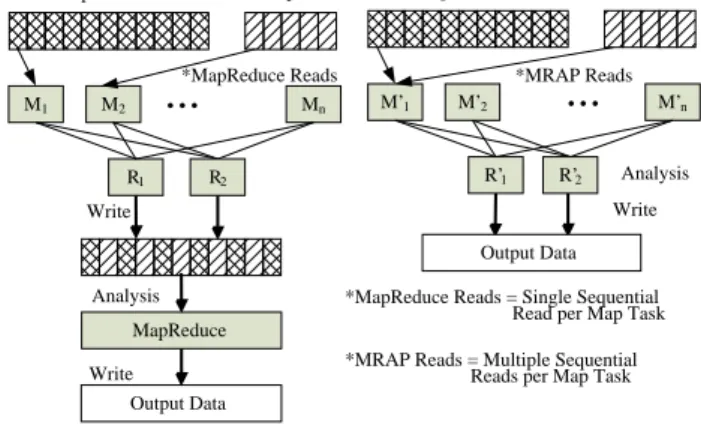
In MRAP, we provide a set of two classes that implement customized InputSplits for the two aforementioned HPC ac-cess patterns. By using these classes, users can read data in one of these two specified patterns in the map phase and con-tinue with the analysis in the subsequent reduce phase. The first pattern for the applications that perform matching and similar analysis is defined by (inputA, inputB, splitSizeA, splitSizeB, f unction). inputA/inputBrepresents both sin-gle or multi-file inputs. Each input can have a different split size, and then thefunction describes the sequence of opera-tions to be performed on these two data sets. The new Se-quenceMatchingclass implementsgetSplits(), such that each
map task reads the specified splitSizeA frominputA and
splitSizeB frominputB. This way of splitting data saves one MapReduce data pre-processing phase for the applica-tions with this particular behavior as shown in the Figure 4.
The second access pattern is a non-contiguous access, where each map task needs to process multiple small non-contiguous regions. This pattern is defined as (inputA,(list of of f sets/ maptaks, list of lengths/maptask), f unction). These terns are more complex to implement, because these pat-terns are defined by multiple offset/length pairs. Each map task can either have the same non-contiguous pattern, or different pattern. Current abstraction forgetSplits() either return an offset/length pair or a list of filenames/lengths
to be processed by each map task. The new
AccessInput-Format class with our new getSplits() method implements the above-mentioned functionality to the MapReduce API.
Logical layout of an example sequence in file
After data restructuring all regions are packed into one chunk
No data restructuring results in accessing four chunks
Chunk 1 Chunk 2 Chunk 3 Chunk 4
Data of Interest Unused data
Figure 5: An example showing the reduction in number of chunks per map task after data restructuring
These patterns are generally cumbersome to describe us-ing MapReduce existus-ing split methods because the existus-ing splits are contiguous, and require the pattern to be trans-formed to the MapReduce (key, value) formulation.
The above mentioned access pattern with merge and subset operations, is specified in one MRAP program, as follows:
• (inputA, inputB, functionAB, outC)
• functionAB(merge, subset)
map1(inputA, inputB, splitsizeA, splitsizeB, merge, outAB)
Read data from all sources in the required merge pat-tern
reduce1(outAB, sizeAB, subset, outC)Extract data of interest from the merged data
We now explain the user templates. User templates are pre-written MRAP programs using new input split classes that read data according to the pattern specified in configuration file. We provide template programs for reading the astro-physics data for halo finding, and general strided access pat-terns. In the configuration file (see Appendix), we require type of application, e.g. any MPI simulation, or astrophysics to be specified. Each of these different categories generate data in different formats and access data in different pat-terns. By providing a supported application type, MRAP can generate a template configuration file to the user.
We give a few examples of the access patterns that can be described in a configuration file. Avector based access pat-tern is defined as if each request having the same number of bytes (i.e. a vector) and is interleaved by a constant or vari-able number of bytes (i.e. a stride) and number of vectors (i.e. a count). A slightly complex vector pattern is anested
pattern, that is similar to a vector access pattern. However, rather than being composed of simple requests separated by regular strides in the file, it is composed ofstrided segments
separated by regular strides in the file. That is, a nested pattern is defined by two or more strides instead of one as in a vector access pattern. Atiled access patterns is seen in datasets that are multidimensional, and are described by number of dimensions, number of tiles/arrays in each di-mension, size of each tile, size of elements in each tile. An
indexed access pattern is more complex, it is not a regular pattern and describe a pattern using a list of offsets and
lengths. There are many more patterns used in HPC appli-cations, but we have included the aforementioned patterns in this version of MRAP.
3.2 MRAP Data Restructuring
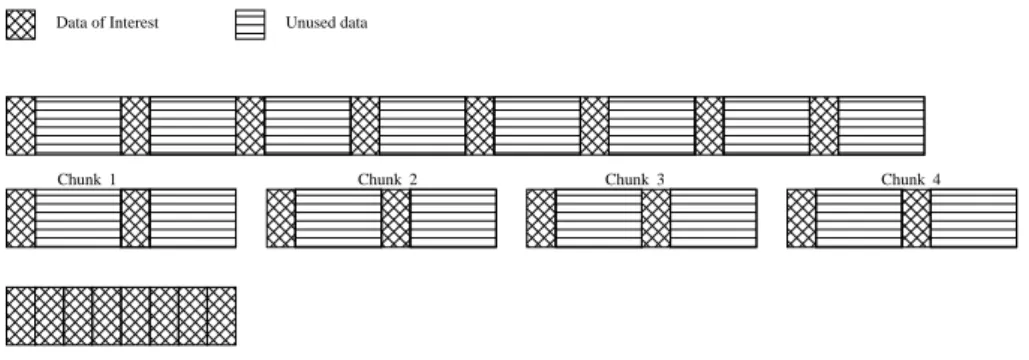
MRAP data restructuring is provided to improve the perfor-mance of access patterns which access data non-contiguously in small regions to perform analysis. Currently, there is a little support for connectivity of HDFS to resources that gen-erate scientific data. In most cases, data must be copied to a different storage resource and then moved to HDFS. Hence, a copy operation is the first step performed to make data available to MapReduce applications. We utilize this copy phase to reorganize the data layout and convert small I/O accesses to large by packing small (non-contiguous) regions into large DFS chunks (also shown in the Figure 5). We im-plement data restructuring as an MRAP copy operation that reads data, reorganizes it and then writes it to the HDFS. It reorganizes the datasets based on user specification when data is copied to HDFS (for the subsequent MapReduce ap-plications). The purpose of this data restructuring when copying data is to improve small I/O performance.
The MRAP copy operation is performed in one of two ways. The first method copies data from remote storage to the HDFS along with a configuration file, the second method does not have a configuration file. For the first method, in order to reorganize datasets, MRAP copy expects a configu-ration file, defined by the user, describing the logical layout of data to be copied. In this operation, the file to be trans-ferred to HDFS and the configuration file are submitted to MRAP copy. As the file is written to HDFS, MRAP re-structures the data into the new format defined by the user. When the copy operation is completed, the configuration file is stored with the restructured data.
This configuration file is stored with the file because of a very important sub-case of the MRAP copy operation, on-the-fly data restructuring during an MRAP application. In this case, a user runs an MRAP application on a file that was previously restructured by the MRAP copy function. In this job submission, another configuration file is submitted to define how the logical structure of the data in said file should look before the current MRAP application can be-gin. As shown in Figure 6, the configuration file stored with data during the initial restructuring is compared with the configuration file submitted with MRAP application. If the two configuration files match, that is, the logical data
lay-Use MR Read operation is already optimized Use MRAP Read operation is optimized using replicas Configuration File submitted with the
application Configuration File
used with File Copy
Reads
File layout Match ? Yes
Original Data Reads No Data Restructuring ? Data re -organized in contiguous chunks No Use Copy with
Configuration utility to organize data in contiguous
chunks Yes
Figure 6: Flow of operations with data restructuring
out of the stored file matches what the MRAP application is expecting, then the MRAP operation begins. Else, data restructuring occurs again and the MRAP application runs once the file is restructured.
In the case of the second copy method, data is copied to HDFS from remote storage without any file modification. This option would be used when the user wants to maintain the original format in which the data was written. Hence, option two in MRAP will be performed as a standard HDFS copy. As discussed in the paragraph above, this option is amenable to use if the file in question is constantly being restructured. The approach used to optimize file access for this case is discussed later in the section.
As mentioned earlier that MRAP copy operation performs data restructuring, we now explain the data restructuring al-gorithm. The data restructuring converts small non-contiguous regions to large contiguous regions, and can be formulated as abin packing problem where different smaller objects are packed in a minimal number of larger bins.
Definition: Given a set of items with sizess1, . . . , sn, pack them into the fewest number of bins possible, where each bin is of sizeV.
This problem is acombinatorial NP-hardand there are many proposed heuristics to solve this. In data restructuring each item from bin packing problem corresponds to a smaller non-contiguous region, whereas each bin corresponds to a DFS chunk of size V. We use First-fit algorithm to pack the smaller regions into chunks.
The time to perform data restructuring based on Algorithm 1 is determined by the following: number of regions in the ac-cess patterns that are needed to be combined into chunks is
m, and size of each region issi. time to access each region
TreadS, number of chunks after restructuringpwhere size of each chunk isV, time to write one region to the chunk is
Tchunk and time to update metadata for the new chunk is
Tmeta. The time to perform data restructuring will be
Tdr= (m×TreadS) + (p×(V /si)×Tchunk) + (p×Tmeta). We can also determine the execution time of the application withM tasks, that will involve the time to read any access pattern (M×m×TreadS) and processing timeTp,
Tcomp=Tp+ (M×m×TreadS).
Algorithm 1Data Restructuring Algorithm
Input:A setUwhich consist of all smaller region size required by a map task in a MapReduce Application,U={s1, s2, ..., sm}, where
sicorresponds to size ofithregion, andmis the number of
non-contiguous regions requested the task. A setCof empty chunks
C={c1, c2, ..., cp}, where capacity of eachcxisV. p=V /s1×m
when allsiare of the same size elsepis unknown.
Output: Find minimalpsuch that all smaller regions are packed
intopnumber of chunks.
Steps:
for i is 1 tom, [Iterate through all the elements in setU]
∀cj∈C= empty, 0< j < p ifPisi≤V)
Addith element toc
j
else Addcj toC
incrementji.e. start a new chunk
end for
p=j, sincejis keeping track of when a new chunk is added.
Data restructuring will be not beneficial if Tdr > Tcomp. However, Tdr < Tcomp will result in contiguous accesses, significantly improving the performance.
The benefit of data restructuring is that when an application is run multiple times and requires only one data layout, the read operation has been highly optimized, making the total execution time of the operation much shorter. It minimizes the number of chunks required by a map task because after restructuring all smaller regions that are scattered among various chunks are packed together as shown in the Figure 5. However, if each application uses the file in a different way, that is, the file requires constant restructuring, then data restructuring will incur more overhead as compared to the performance benefits.
4. RESULTS AND DISCUSSION
In the experiments, we demonstrate how MRAP API per-forms for the two types of access patterns as described in Section 3.1. The first access pattern performs matching op-eration on the data sets, whereas the second access pattern deals with the non-contiguous accesses. We also show the performance improvement due to data restructuring for the second access pattern.
The most challenging part of this work is to fairly evalu-ate MRAP framework using various data access patterns against the same patterns used in the existing MapReduce implementations. Unfortunately, most HPC analytics appli-cations which could enunciate the benefit from MRAP still need to be developed. Also, there are no established bench-marks currently available to test our design. We have used one application from the bioinformatics domain, an open source MapReduce implementation of the “read-mapping al-gorithm”, to evaluate the MRAP framework. This appli-cation performs sequence matching and extension of these sequences based on the given criteria and fits well with the description of the first access pattern. For the second access pattern, we use both MRAP and MapReduce to read as-trophysics data in tipsy binary format that is used in many applications for operations like halo finding. In the next subsection, we describe our testbed and benchmark setup.
4.1 Testbed and Benchmarks Description
There are 47 nodes in total with Hadoop 0.20.0 installed on it. The cluster nodes configurations are shown in theTable 1: CASS Cluster Configuration
15 Compute Nodes and 1 Head Node
Make& Model Dell PowerEdge 1950
CPU 2 Intel Xeon 5140, Dual Core, 2.33 GHz
RAM 4.0 GB DDR2, PC2-5300, 667 MHz
Internal HD 2 SATA 500GB (7200 RPM) or 2 SAS
147GB (15K RPM)
Network Connection Intel Pro/1000 NIC
Operating System Rocks 5.0 (Cent OS 5.1),
Kernel:2.6.18-53.1.14.e15
31 Compute Nodes
Make& Model Sun V20z
CPU 2x AMD Opteron 242 @ 1.6 GHz
RAM 2GB - registered DDR1/333 SDRAM
Internal HD 1x 146GB Ultra320 SCSI HD
Network Connection 1x 10/100/1000 Ethernet connection
Operating System Rocks 5.0 (Cent OS 5.1),
Kernel:2.6.18-53.1.14.e15
Cluster Network
Switch Make & Model Nortel Nortel BayStack 5510-48T
Giga-bit Switch
Table 1. In our setup, the cluster’s master node is used as theNameNodeandJobTracker, whereas the 45 worker nodes are configured to be theDataNodesandTaskTrackers.
The first application, CloudBurst consists of one data for-mat conversion phase and three MapReduce phases to per-form read mapping of genome sequences as shown in the Figure 7 a). The data conversion phase takes an “.fa” file and generates a sequence file with a format following HDFS sequence input format. It breaks the read sequence into 64KB chunks and write sequence in the form of these pairs (id,(sequence, start of f set, ref /read)). The input files con-sist of a reference sequence file and a read sequence file. During the conversion phase, these two files are read in to generate the pairs for “.br” file. After this data conversion phase, the first MapReduce program takes these pairs in the map phase and generatesmerssuch that, the resulting (key, value) pairs are (mers,(id, position, ref /read, lef t f lank, right f lank)). The flanks are added to the pairs in the map phase to avoid random reads in HDFS. These key, value pairs are then used in the reduce phase to generate SharedMers
as (read id,(read position, ref id, ref position, read lef t f lank, read right f lank, ref lef t f lank, ref right f lank)). The second MapReduce program generates Mers per read. The Map phase does nothing and reduce phase groups the pairs generated in the first MapReduce program byread id.
In MRAP, this whole setup is performed such that there is one map and one reduce phase as shown in the Figure 7 b). We do not modify the conversion phase in generating the .br file. The first phase reads from both reference and read sequence files to generate the SharedMers and they are coalesced and extended in the reduce phase. The only reason we can allow a the map phase to read chunks from multiple files is because, MRAP API allows for a list of splits per map task. Essentially, each mapper reads from two input splits and generate (read id,(read position, ref id, ref position, read lef t f lank, read right f lank, ref lef t f lank, ref right f lank)) for the shared mers. The reduce phase aligns and extends the shared mers. It results in a file, which contains every alignment of every read with at most some defined number of differences.
Genome and Read Sequences
Sorted Mers
Shared Mers
Mers per Read
Shared Seeds Extended Seeds Read Mappings Map Map Map Reduce Reduce Reduce M e rR e d u ce S e e d R e d u ce E xt e n d R e d u ce
Genome and Read Sequence Data in .FA
Data Conversion
Genome and Read Sequences
Shared Mers
Shared Seeds and Read Mappings Genome and Read Sequence Data in .FA
Data Conversion
Map phase in MRAP
Reduce phase in MRAP
a) CloudBurst in MapReduce b) CloudBurst in MRAP
Figure 7: a) Overview of the Read-Mapping Algo-rithm using 3 MapReduce cycles. Intermediate files used internally by MapReduce are shaded [30]. b) Overview of the Read-Mapping Algorithm using 1 MapReduce cycle in MRAP.
In the second case, we perform a non-contiguous read op-eration on astrophysics data set used in halo finding appli-cation, followed by the grouping of given particles. There are two files in the downloaded data set: particles name, which contains the positions, velocities and mass of the par-ticles. In addition to the particles name file, an input data file summarizing cosmology, box-size etc and halo catalogs (ascii-files), containing: mass, position and velocity in dif-ferent coordinates are also provided [2, 1].
Finally, we used a micro benchmark to perform small I/O requests using MRAP to show the significance of data re-structuring. We use three configurable parameters to de-scribe a simple strided access pattern [15]. These parameters are stripe, stride anddata set size. We show the behavior of changing the stripe size with various data sizes, where the stride was dependent on the number of processes and stripe size. The stripe size is the most important parame-ter for these experiments because it deparame-termines the size and the number of read requests issued per process. We write a MapReduce program to perform the same patterned read operation. In the map phase each process reads a contiguous chunk, and marks all the required stripes in that contiguous chunk. In the reduce phase, all the stripes required by a single process are combined together.
4.2 Demonstrating Performance for MRAP
Bioinformatics Sequencing Application: We compare
the results of MRAP and the existing MapReduce imple-mentation of the read-mapping algorithm. As shown in the Figure 7, the traditional MapReduce version of the Cloud-Burst algorithm requires three MapReduce applications in
0.5 GB 1 GB 2 GB 4 GB 0 1.25 2.5 3.75 5 6.25 7.5 8.75 10 11.25 12.5 Bytes Accessed (GB)
Different Read Sequences
HDFS Bytes Read HDFS Bytes Written MRAP MRAP MRAP MRAP MR MR MR MR
Figure 8: This graph compares the number of bytes accessed by the MapReduce and MRAP implemen-tation of Read-mapping, and shows that MRAP
ac-cesses≈47% less data.
order to complete the required analysis as compared with one MapReduce phase required in MRAP. Because the MRAP implementation requires only one phase of I/O, we antici-pate that it will significantly outperform the existing Cloud-Burst implementation. We first show the total number of bytes accessed by both MRAP and MapReduce implemen-tations in the Figure 8. Each stacked bar shows the number of bytes read and written by MRAP and MapReduce im-plementation. The number of bytes read is more than the number of bytes written because reference data sequences are being merged at the end of reduce phases. The number of bytes accessed in the MRAP application are on average 47.36% less than the number of bytes accessed in the MapRe-duce implementation as shown in Figure 8. This reMapRe-duced number of I/O accesses result in an overall performance im-provement of upto 33%, as shown in the Figure 9.
We were also interested in looking at the map phase timings because each map phase in MRAP was reading its input from two different data sets. Further break down of the execution time showed that map task took≈55secin each phase to finish, and there were three map phases making this time equal to 2min,45sec. In MRAP, this time was ≈ 1min,17sec, because MRAP reads both read and reference sequence data in the map phase, as opposed to reading either read or reference sequence in the map phase. Hence, the time of a single map task in MRAP is greater than the time of a single map task in MapReduce, but the benefit comes from multiple stages in MapReduce based implementation.
The MRAP implementation of CloudBurst application ac-cesses multiple chunks per map task. Multiple chunks per map task generate remote I/O requests if all the required chunks are not present on the scheduled node. In this test,
≈ 7−8% of the total tasks launched caused remote I/O
accesses, slowing down the MRAP application. Hence, sup-plemental performance enhancing methods, such as dynamic chunk replication or scheduling multiple chunks, are required to be implemented with MRAP framework. Since, this
par-0.5 GB0 1 GB 2 GB 4 GB 7.5 15 22.5 30 37.5 45 52.5 60 67.5 75
Execution time in minutes
Different Read Sequences MRAP
MR
Figure 9: The graph compares the execution time of the Read-mapping algorithm using MRAP and MapReduce (MR).
ticular access pattern does not access data non-contiguously, data restructuring is not an appropriate optimization for it.
Astrophysics Data sets: We ran a set of experiments
to demonstrate the performance of MRAP over MapReduce implementation for reading non-contiguous data sets. In this example, we use an astrophysics data set and show how MRAP deals with non-contiguous data accesses. As described earlier the halo catalog files contains 7 attributes, i.e. mass (mp), position (x,y, z) and velocity (Vx,Vy and
Vz) for different particles. In the setup, we require our test application to read these seven attributes for only one par-ticle using the given catalogs, and scan through the values once to assign them a group based on a threshold value. Since MRAP only reads the required data sets, we consider this case where less data as compared with total data set is required by the application. The MapReduce application, reads through the data set and marks all the particles in the Map phase. The reduce phase filters out the required particle data. We assume that the data set has 5 different particles, and at each time step we have attributes of all the 5 particles. Essentially, the map phase reads entire data set, and the reduce phase writes only 1/5thof the data sets. The second MapReduce application, scans through this filtered dataset and assigns the values based on the halo mass. The MRAP implementation, reads the required 1/5thdata in the map phase, and assigns the values in the reduce phase. We show the results in Figure 11 and 10 by testing this config-uration on different data sets.
The application has access to data sets from 1.5−10 GB in the form≈6.3 MB files, and the data of interest is≈0.3−2 GB. Figure 10 shows that amount of data read and written
in an MRAP application is≈75% less than the MapReduce
implementation. The reason is that MRAP API allows to read the data in smaller regions, hence, instead of reading the full data set only data of interest is extracted in the map phase. This behavior anticipates significant improvement in the execution time of the MRAP application when compared
1.5 GB 2.5 GB 5 GB 10 GB 0 1.8 3.6 5.4 7.2 9 10.8 12.6 14.4 16.2 18 Bytes Accessed (GB)
Size of Halo Catalogs (Ascii Files) HDFS Bytes Read HDFS Bytes Written MRAP MRAP MRAP MRAP MR MR MR MR
Figure 10: This graph shows the number of effective data bytes Read/Written using MRAP and MR. MRAP only reads the requested number of bytes from the system, as compared with MR, and shows
≈75% fewer bytes read in MRAP.
1.5 GB12 2.5 GB 5 GB 10 GB 18 24 30 36 42 48 54 60
Execution Time in minutes
Size of Halo Catalogs (Ascii Files)
MRAP MapReduce
Figure 11: The graph compares the execution time of an I/O kernel that read Astrophysics data using MRAP and MapReduce. MRAP shows an
improve-ment of up to≈14%. 15 GB 30 GB 45 B 60 GB 0 1800 3600 5400 7200 9000 10800 12600 14400 16200 18000
Execution Time in seconds
Data Size Contiguous Read 1 MB Stripe 256 KB Stripe 64 KB Stripe 32 KB Stripe 16 KB Stripe 1 KB Stripe
Figure 12: This figure shows the performance penal-ties due to small I/O by running a micro
bench-mark. The non-contiguous read operation with
smaller stripe sizes has more performance penalties because of the amount of excessive data read and the number of I/O requests made.
with MapReduce. The results are shown in Figure 11, and
they only show an improvement of≈14%, because HDFS is
not designed for small I/O requests. In the next subsection, we further elaborate on the small I/O problem, and show the results of proposed solution i.e. data restructuring.
4.3 Data Restructuring:
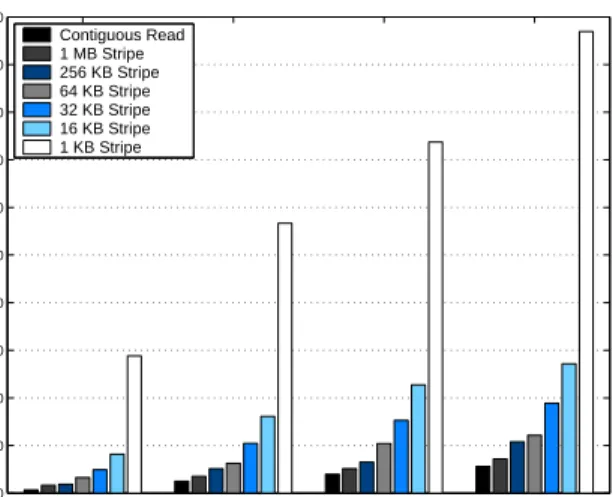
In the section 4.2, we saw the performance benefits of MRAP for applications with different data access patterns, where it minimized the number of MapReduce phases. Some pat-terns e.g. non-contiguous accesses incur an overhead in the form of small I/O, as we demonstrate in the Figure 12. We used random text generated data sets of 15 GB, 30 GB, 45 GB and 60 GB in this experiment to show that small I/O degrades performance of read operations. We have used 15 map tasks, each map task reads 1, 2, 3 and 4 GB using small regions (stripe sizes) ranging from 1 KB to 1 MB. We choose this range for stripe sizes because 1) there are many appli-cations that store images which are as small as 1 KB [14], 2) 64 KB is a very standard stripe size used in the MPI/IO applications running on PVFS2 [9] and 3) 1 MB to 4 MB is the striping unit used in GPFS [31]. We have used the default chunk size of 64 MB in this experiment.
Figure 12 shows that smaller stripe sizes have larger perfor-mance penalties because of the number of read requests that are issued for striped accesses. 1 KB depicts the worst case scenario, where for 1 GB per map task will have 1,048,576 read calls which results in much more calls for larger data sets. Figure 12 also shows the time it takes to perform contiguous read for the same 1, 2, 3 and 4 GB per map task. Overall larger stripe sizes tend to perform well because as they approach the chunk size, they issue fewer read re-quests per chunk. These rere-quests become contiguous within a chunk as the stripe size becomes equal to or greater than the chunk size.
1.5 GB 2.5 GB 5 GB 10 GB 0 10 20 30 40 50 60 70 80 90 100
Execution Time in minutes
Size of Halo Catalogs (Ascii Files) Data Copy Time
Application Execution Time
MRAP + Data Copy MR + Data Copy
MRAP + Data Copy with Restructuring
MRAP + Data Copy
MRAP + Data Copy
MRAP + Data Copy
MR + Data Copy
MR + Data Copy
MR + Data Copy
MRAP + Data Copy with Restructuring
MRAP + Data Copy with Restructuring
MRAP + Data Copy with Restructuring
Figure 13: This figure shows the execution time of the I/O kernel for halo catalogs, with three
imple-mentations. MRAP API with data restructuring
outperforms MR and MRAP API implementations.
A contiguous read of 1 GB with 64 MB chunks will result in reading 16 chunks. On the other hand, with 1 MB stripe size, there will be 1024 stripes in total for 1 GB set. The up-per bound of the number of chunks that eventually provides these 1024 stripes is 1024. Similarly, for 1 KB stripe size, there are 65536 stripes that generate as many read requests, and may map to 65536 chunks in the worst case. In short, we could use some optimizations to improve this behavior, such as data restructuring, which are studied in this paper.
We run a test by restructuring astrophysics data, and then read the data to find the groups in the given particle at-tributes. We restructure data such that the attributes at different time steps for each particle are stored together. In the example test case, we run the copy command and re-structure data. The overhead of running copy command is shown in the Figure 13. After that we run the application to read the same amount of data as it was reading in Fig-ure 11 and show the time it took to execute that operation. It should be noted that the amount of data read and writ-ten is the same after data restructuring. Data restructuring organizes data to minimize the number of I/O requests not the size of total requested data. In these tests, size of each request was≈6.3M B, and the number of I/O requests gen-erated, for example for a 10GBdata set is 1625. When data is restructured, 10 small regions each of 6.3 MB are packed into a single chunk of 64 MB, and reduce the number of I/O requests by 10 times. In the figure, we can see that data restructuring significantly improve the performance by up to≈68.6% as compared with MRAP without data
restruc-turing and≈70% as compared with MapReduce. The
over-head of data restructuring includes time to read the smaller regions, and put them into contiguous data chunks.
We would also like to describe that once restructured, subse-quent runs with the same access patterns will perform con-tiguous I/O and have further performance improvement over non-restructured data. We present this case in the Figure 14, and show that data restructuring is useful for the
applica-run10 run2 run3 run4 run5 run6 run7 run8 run9 run10 60 120 180 240 300 360 420 480 540 600
Execution time in sec
Different Runs for Reading Halo Catalogs
MRAP without Data Restructuring MR
MRAP with Data Restructuring
Figure 14: This figure shows the benefits of Data
Restructuring in the long run. Same application
with three different implementations (MR, MRAP, MRAP + data restructuring) is run over a period of time.
tions with repeated access patterns. For the same configu-ration used in the Figure 13, we run the same application on 10 GB data set after data restructuring. It is evident from the graph, that even with the overhead as shown in Figure 13, data restructuring is giving promising results.
5. RELATED WORK
Large scale data processing frameworks are being devel-oped because of the information retrieval for web scale com-puting. Many systems like MapReduce [16, 17], Pig [28], Hadoop [3], Swift [29, 36], Dryad [22, 23, 35] and many more abstractions are there that allow large scale data pro-cessing. Dryad has been evaluated for HPC analytics appli-cations in [19]. However, our approach is based on MapRe-duce, which is well-suited for the data parallel applications where data dependence does not exist and applications run on a shared-nothing architecture. Some other approaches like CGL MapReduce [18] also propose a solution to improve the performance of scientific data analysis applications de-veloped in MapReduce. However, their approach is funda-mentally different from our work. In CGL MapReduce they do not address decreasing the number of MapReduce phases, rather they mitigate the file read/write issue by providing an external mechanism to keep read file data persistent across multiple map reduce jobs. Their approach does not work with HDFS, and relies on a NFS mounted source.
Scientific applications use high level APIs like NetCDF [7], HDF5 [4] and their parallel variants [8, 25] to describe the complex data formats. These APIs and libraries work as an abstraction with the most commonly used MPI
frame-work by utilizing the MPI File views [11]. NetCDF
(Net-work Common Data Form) is a set of software libraries and machine-independent data formats that support the cre-ation, access, and sharing ofarray-oriented scientific data[7]. The data model represented by HDF5 support very complex data objects, metadata and a completely portable file for-mat with no limit on the number or size of data objects in
the collection [4]. We develop ways of specifying access pat-terns similar toMPI datatypes and MPI File views within MapReduce. The motivation for our approach is to facili-tate data-intensive HPC analytics particularly the ones with access patterns and are developed using MapReduce.
To improve the small I/O problem, many approaches have been adopted in HPC community particularly for the appli-cations using MPI/MPI-IO. These techniques are supported both at the file system and programming abstraction level. Data sieving allows the processes to read excessive contigu-ous data set in a given range instead of making small I/O requests to multiple non-contiguous chunks. The limitation of this approach is that each process reads excessive amount of data [34]. Similarly, collective I/O also allows a process to read a contiguous chunk of data but then using MPI’s communication framework, it redistributes the data among multiple processes as required by them [34]. In large-scale systems with thousand of processes, collective I/O with its two-phase implementation results in communicating a large amount of data among processes. Other approaches are for checkpointing applications like PLFS, which adds a layer be-tween the application and the file systems and re-maps an application’s write access pattern to be optimized for the underlying file system [12]. DPFS provides striping mecha-nisms that divide a file into small pieces and distribute them across multiple storage devices for parallel data access [32]. Our approach of data restructuring is significantly different from these approaches because we re-organize data such that processes are not required to communicate with each other, and maintain shared-nothing architecture for scalability.
6. CONCLUSION AND FUTURE WORK
We have developed an extended MapReduce framework to allow users to specify data semantics for HPC data ana-lytics applications. Our approach reduces the overhead of writing multiple MapReduce programs to pre-process data before its analysis. We provide functions and templates to specify the sequence matching, and strided (non-contiguous) accesses in reading astrophysics data, such that access pat-terns are directly specified in the map phase. For experi-mentation, we ran a real application from bioinformatics and an astrophysics I/O kernel. Our results show a maximum throughput improvement up to 33%. We also studied the performance penalties due to the non-contiguous accesses (small I/O requests) and implemented data restructuring to improve the performance. Data restructuring uses a user-defined configuration file and reorganizes data such that all non-contiguous chunks are stored contiguously, and show a performance gain of up to 70% for the astrophysics data set.These small I/O requests also map to multiple chunks that are assigned to a map task, and require schemes to improve performance by selecting optimal nodes for scheduling map tasks on the basis of multiple chunk locations. The study of improving chunk locality is left for the future work. In the future, we would implement the dynamic chunk replica-tion and scheduling schemes on a working Hadoop cluster to address the data locality issue. We would also like to de-velop more real world HPC data analytics applications using MRAP, and also explore new applications with their differ-ent access patterns than the ones described in this paper.
7. ACKNOWLEDGMENTS
This work is supported in part by the US National Sci-ence Foundation under grants CNS-0646910, CNS-0646911, CCF-0621526, CCF-0811413, US Department of Energy Early Career Principal Investigator Award DE-FG02-07ER25747, and National Science Foundation Early Career Award 0953946.
8. REFERENCES
[1] Astrophysics - Hashed Oct-tree Algorithm.
http://t8web.lanl.gov/people/salman/icp/hot.html. [2] Cosmology Data Archives.
http://t8web.lanl.gov/people/heitmann/arxiv/codes.html. [3] Hadoop. http://hadoop.apache.org/core/. [4] HDF5. http://www.hdfgroup.org/hdf5/. [5] Hdfs metadata. https://issues.apache.org/jira/browse/hadoop-1687. [6] http://www.cisl.ucar.edu/dir/09seminars/roskies 20090130.ppt. [7] netCDF. http://www.unidata.ucar.edu/software/netcdf/. [8] Parallel HDF5. http://www.hdfgroup.org/hdf5/phdf5/. [9] Parallel virtual file system version 2.
http://www.pvfs.org/.
[10] Relativistic Heavy Ion Collider. http://www.bnl.gov/rhic.
[11] MPI-2: Extensions to the message-passing interface. http://parallel.ru/docs/parallel/mpi2, July 1997. [12] John Bent, Garth Gibson, Gary Grider, Ben
McClelland, Paul Nowoczynski, James Nunez, Milo Polte, and Meghan Wingate. PLFS: A checkpoint filesystem for parallel applications. InSupercomputing, 2009 ACM/IEEE Conference, Nov. 2009.
[13] Dhruba Borthaku. The Hadoop Distributed File System: Architecture and Design.
[14] Philip Carns, Sam Lang, Robert Ross, Murali Vilayannur, Julian Kunkel, and Thomas Ludwig. Small-file access in parallel file systems. In Proceedings of the 23rd IEEE International Parallel and
Distributed Processing Symposium, April 2009. [15] Avery Ching, Alok Choudhary, Kenin Coloma, Wei
keng Liao, Robert Ross, and William Gropp. Noncontiguous I/O accesses through MPI-IO. In
CCGRID ’03: Proceedings of the 3st International Symposium on Cluster Computing and the Grid, page 104, Washington, DC, USA, 2003. IEEE Computer Society.
[16] Jeffrey Dean. Experiences with mapreduce, an abstraction for large-scale computation. InPACT ’06: Proceedings of the 15th international conference on Parallel architectures and compilation techniques, pages 1–1, New York, NY, USA, 2006. ACM. [17] Jeffrey Dean and Sanjay Ghemawat. Mapreduce:
simplified data processing on large clusters. In
OSDI’04: Proceedings of the 6th conference on Symposium on Opearting Systems Design & Implementation, pages 10–10, Berkeley, CA, USA, 2004. USENIX Association.
[18] J. Ekanayake, S. Pallickara, and G. Fox. Mapreduce for data intensive scientific analyses. IneScience, 2008. eScience ’08. IEEE Fourth International
Conference on, pages 277–284, 2008.
[19] Jaliya Ekanayake, Thilina Gunarathne, Geoffrey Fox, Atilla Soner Balkir, Christophe Poulain, Nelson Araujo, and Roger Barga. Dryadlinq for scientific analyses. InE-SCIENCE ’09: Proceedings of the 2009 Fifth IEEE International Conference on e-Science, pages 329–336, Washington, DC, USA, 2009. IEEE Computer Society.
[20] Sanjay Ghemawat, Howard Gobioff, and Shun-Tak
Leung. The Google File System. InSOSP ’03:
Proceedings of the nineteenth ACM symposium on Operating systems principles, pages 29–43, New York, NY, USA, 2003. ACM.
[21] William Gropp, Rajeev Thakur, and Ewing Lusk.
Using MPI-2: Advanced Features of the Message Passing Interface. MIT Press, Cambridge, MA, USA, 1999.
[22] Michael Isard, Mihai Budiu, Yuan Yu, Andrew Birrell, and Dennis Fetterly. Dryad: distributed data-parallel programs from sequential building blocks.EuroSys ’07: Proceedings of the ACM SIGOPS/EuroSys European Conference on Computer Systems 2007, pages 59–72, 2007.
[23] Michael Isard and Yuan Yu. Distributed data-parallel computing using a high-level programming language. InSIGMOD ’09: Proceedings of the 35th SIGMOD international conference on Management of data, pages 987–994, New York, NY, USA, 2009. ACM. [24] YongChul Kwon1, Dylan Nunley2, Jeffrey P.
Gardner3, Magdalena Balazinska4, Bill Howe5, and Sarah Loebman6. Scalable clustering algorithm for n-body simulations in a shared-nothing cluster. Technical report, University of Washington, Seattle, WA, 2009.
[25] Jianwei Li, Wei keng Liao, A. Choudhary, R. Ross, R. Thakur, W. Gropp, R. Latham, A. Siegel, B. Gallagher, and M. Zingale. Parallel netcdf: A high-performance scientific i/o interface. In
Supercomputing, 2003 ACM/IEEE Conference, pages 39–39, Nov. 2003.
[26] Xuhui Liu, Jizhong Han, Yunqin Zhong, Chengde Han, and Xubin He. Implementing WebGIS on Hadoop: A Case Study of Improving Small File I/O
Performance on HDFS. InIEEE Cluster ’09, 2009.
[27] Andr´ea Matsunaga, Maur´ıcio Tsugawa, and Jos´e Fortes. Cloudblast: Combining mapreduce and virtualization on distributed resources for bioinformatics applications. InESCIENCE ’08: Proceedings of the 2008 Fourth IEEE International Conference on eScience, pages 222–229, Washington, DC, USA, 2008. IEEE Computer Society.
[28] Christopher Olston, Benjamin Reed, Utkarsh Srivastava, Ravi Kumar, and Andrew Tomkins. Pig latin: a not-so-foreign language for data processing. In
SIGMOD ’08: Proceedings of the 2008 ACM SIGMOD international conference on Management of data, pages 1099–1110, New York, NY, USA, 2008. ACM. [29] Ioan Raicu, Yong Zhao, Catalin Dumitrescu, Ian
Foster, and Mike Wilde. Falkon: a fast and light-weight task execution framework. InSC ’07: Proceedings of the 2007 ACM/IEEE conference on Supercomputing, pages 1–12, New York, NY, USA,
2007. ACM.
[30] Michael C. Schatz. Cloudburst: highly sensitive read mapping with mapreduce.Bioinformatics,
25(11):1363–1369, 2009.
[31] Frank Schmuck and Roger Haskin. GPFS: A
shared-disk file system for large computing clusters. In
FAST ’02: Proceedings of the 1st USENIX Conference on File and Storage Technologies, page 19, Berkeley, CA, USA, 2002. USENIX Association.
[32] Xiaohui Shen and Alok Choudhary. DPFS: A Distributed Parallel File System.Parallel Processing, International Conference on, 0:0533, 2001.
[33] Volker Springel, Simon D. M. White, Adrian Jenkins, Carlos S. Frenk, Naoki Yoshida, Liang Gao, Julio Navarro, Robert Thacker, Darren Croton, John Helly, John A. Peacock, Shaun Cole, Peter Thomas, Hugh Couchman, August Evrard, Jorg Colberg, and Frazer Pearce. Simulations of the formation, evolution and clustering of galaxies and quasars.Nature,
435(70422):629–636, June 2005.
[34] Rajeev Thakur, William Gropp, and Ewing Lusk. Data sieving and collective I/O in ROMIO. In
FRONTIERS ’99: Proceedings of the The 7th Symposium on the Frontiers of Massively Parallel Computation, page 182, Washington, DC, USA, 1999. IEEE Computer Society.
[35] Yuan Yu, Michael Isard, Dennis Fetterly, Mihai Budiu, ´
Ulfar Erlingsson, Pradeep Kumar Gunda, and Jon Currey. Dryadlinq: A system for general-purpose distributed data-parallel computing using a high-level language. In Richard Draves and Robbert van Renesse, editors,OSDI, pages 1–14. USENIX Association, 2008. [36] Yong Zhao, M. Hategan, B. Clifford, I. Foster, G. von
Laszewski, V. Nefedova, I. Raicu, T. Stef-Praun, and M. Wilde. Swift: Fast, reliable, loosely coupled parallel computation. InServices, 2007 IEEE Congress on, pages 199–206, July 2007.
APPENDIX
A sample configuration file for a strided access pattern is as follows.
<configuration>
Defining structure of the new file
<property>
<name>strided.nesting level</name> <value>1</value>
<description>It defines the nesting levels. < /description> <property>
<name>strided.region count</name> <value>100</value>
<description>It defines the number of regions in a non-contiguous access pattern. < /description>
</property> <property>
<name>strided.region size</name> <value>32</value>
<description>It defines the size in bytes of a region, i.e. a stripe size. < /description>
</property> <property>
<name>strided.region spacing</name> <value>10000</value>
<description>It defines the size in bytes between two consecutive regions, i.e. a stride. < /description>
</property> </configuration>