AVERTISSEMENT
Ce document est le fruit d’un long travail approuvé par le jury de
soutenance et mis à disposition de l’ensemble de la
communauté universitaire élargie.
Il est soumis à la propriété intellectuelle de l’auteur : ceci
implique une obligation de citation et de référencement lors de
l’utilisation de ce document.
D’autre part, toute contrefaçon, plagiat, reproduction illicite de
ce travail expose à des poursuites pénales.
Contact :
[email protected]
LIENS
Code la Propriété Intellectuelle – Articles L. 122-4 et L. 335-1 à
L. 335-10
Loi n°92-597 du 1
erjuillet 1992, publiée au
Journal Officiel
du 2
juillet 1992
http://www.cfcopies.com/V2/leg/leg-droi.php
THESIS
THESIS
in partial fulfillment of the requirements for the degree of
PHD
Delivered bythe University of Toulouse
Knowledge base ontological debugging guided by linguistic
evidence
by
Julien CORMAN
JURY
Laure VIEU Senior researcher Supervisor
Nathalie
AUSSENAC-GILLES
Senior researcher Co-supervisor
Renata WASSERMANN Professor Rapporteur
Bernardo MAGNINI Senior researcher Rapporteur
Marie-Christine ROUSSET Professor Examiner Bernardo CUENCA-GRAU Professor Examiner
Fabian SUCHANEK Associate professor Examiner
Doctoral School and Specialty:
MITT: Domaine STIC: Intelligence Artificielle
Research Unit:
Institut de Recherche en Informatique de Toulouse (UMR 5505)
Supervisors:
Laure VIEU and Nathalie AUSSENAC-GILLES
Abstract
When they grow in size, knowledge bases (KBs) tend to include sets of axioms which are intuitively absurd but nonetheless logically consistent. This is particularly true of data expressed in OWL, as part of the Semantic Web framework, which favors the aggregation of set of statements from multiple sources of knowledge, with overlapping signatures.
Identifying nonsense is essential if one wants to avoid undesired inferences, but the sparse usage of negation within these datasets generally prevents the detection of such cases on a strict logical basis. And even if the KB is inconsistent, identifying the axioms responsible for the nonsense remains a non trivial task.
This thesis investigates the usage of automatically gathered linguistic evidence in order to detect and repair violations of common sense within such datasets. The main intuition consists in exploiting distributional similarity between named individuals of an input KB, in order to identify consequences which are unlikely to hold if the rest of the KB does. Then the repair phase consists in selecting axioms to be preferably discarded (or at least amended) in order to get rid of the nonsense.
A second strategy is also presented, which consists in strengthening the input KB with a foundational ontology, in order to obtain an inconsistency, before performing a form of knowledge base debugging/revision which incorporates this linguistic input.
This last step may also be applied directly to an inconsistent input KB.
These propositions are evaluated with diferent sets of statements issued from the Linked Open Data cloud, as well as datasets of a higher quality, but which were automatically degraded for the evaluation. The results seem to indicate that distri-butional evidence may actually constitute a relevant common ground for deciding between conĆicting axioms.
Contents
1 Introduction 16
1.1 Semantic Web and violations of common sense . . . 21
1.1.1 Multiple meanings of a constant or predicate . . . 21
1.1.2 Lack of negation and consistency by default . . . 25
1.2 SpeciĄcation . . . 27
1.2.1 Intended meaning . . . 27
1.2.2 Consistency and preserved knowledge . . . 29
1.2.3 Syntax dependent debugging. . . 30
1.2.4 ABox/TBox . . . 31 1.2.5 Ontological debugging . . . 32 1.3 Proposals . . . 35 1.3.1 Distributional evidence . . . 35 1.3.2 Debugging strategies . . . 39 1.3.3 Evaluation . . . 40 1.4 Content . . . 41
2 Notation and preliminary notions 46 2.1 Sets . . . 46
2.2 Ordering . . . 46
2.3 Description Logics . . . 47
2.3.1 Datatypes and datatypeProperties . . . 48
2.3.2 Syntax . . . 50
2.3.3 Signature . . . 53
2.3.4 semantic . . . 54
2.3.5 Consistency and coherence . . . 56
2.3.6 Entailment . . . 56
2.3.7 TBox/ABox . . . 57
2.3.8 Reasoning . . . 58
2.3.8.1 Tractable and intractable DLs . . . 59
2.3.8.2 Tableau algorithm . . . 59
2.4 Typographical conventions . . . 61
2.4.1 Predicate names, individual names and linguistic labels . . . . 61
2.4.2 Variables. . . 62
3 Knowledge base debugging: state of the art 64 3.1 Typology . . . 65
3.1.1 Strengthening/weakening. . . 65
3.1.2 Automating detection and repair . . . 67
3.1.3 Syntactic/semantic veriĄcations . . . 67
3.1.4 Abstract characterization/concrete debugging . . . 68
3.2 Reviewing models . . . 69
3.3 Formal ontology . . . 70
3.4 Syntactic patterns. . . 70
3.5.1 Glass-box algorithms . . . 75
3.5.1.1 Computing one justiĄcation. . . 76
3.5.1.2 Computing all justiĄcations . . . 79
3.5.2 Black-box algorithms . . . 82
3.5.2.1 Computing one justiĄcation . . . 82
3.5.2.2 Computing all justiĄcations. . . 83
3.6 Belief change . . . 84
3.6.1 Belief set contraction/revision . . . 85
3.6.1.1 Formula-based contraction/revision . . . 85
3.6.1.2 Model-based contraction/revision . . . 96
3.6.2 Syntax-based contraction/revision . . . 107
3.6.2.1 Belief bases VS belief sets . . . 108
3.6.2.2 Diagnoses and justiĄcations . . . 112
3.7 Conclusion . . . 114
4 Linguistic evidence for KB debugging 117 4.1 NLP for information extraction and ontology learning . . . 118
4.1.1 Cooccurrence patterns for relation extraction. . . 119
4.1.2 Fine-grained axiom extraction from deĄnitorial or encyclopedic context. . . 122
4.1.3 Taxonomy induction based on term distribution . . . 124
4.1.4 Ontology population . . . 127
4.2 Proposal . . . 133
4.2.1 JustiĄcation of the approach . . . 134
4.2.1.1 Linguistic grounding of the input KB . . . 134
4.2.1.3 Distributional evidence. . . 136 4.2.2 Running example . . . 137 4.2.3 Plausibility . . . 139 4.2.4 Extensions . . . 143 4.2.4.1 Complex concepts . . . 143 4.2.4.2 Distinct individuals. . . 144
4.2.5 Ranking candidate subbases . . . 145
4.3 Distributional similarity . . . 148
4.3.1 Vector space model . . . 149
4.3.2 Corpus . . . 151
4.3.3 Contexts . . . 152
4.3.4 Selectional preferences and frequency weighting . . . 155
4.3.5 Similarity . . . 157 4.4 Conclusion . . . 157 5 Datasets 160 5.1 DBpedia subsets . . . 162 5.1.1 DBpedia . . . 162 5.1.2 DatatypeProperties . . . 165 5.1.3 Extraction procedure . . . 165 5.1.3.1 Thematic cohesion . . . 166
5.1.3.2 Seed individuals selection . . . 167
5.1.3.3 Axiom extraction procedure . . . 168
5.1.4 List of DBpedia subsets . . . 169
5.2 Automatically degraded KBs . . . 171
5.2.2 STLab gold standard . . . 172
5.2.3 Fragment of the NeOn Ąsheries ontology . . . 173
5.2.4 Degrading procedure . . . 174 5.3 Linguistic corpora . . . 175 5.3.1 Homonymy . . . 176 5.3.2 Corpus retrieval . . . 177 5.4 Conclusion . . . 178 6 Trimming a consistent KB 180 6.1 Plausibility: experiments . . . 181 6.1.1 Distributional settings . . . 182 6.1.2 Results. . . 183
6.2 Trimming a single axiom: experiments . . . 187
6.3 Trimming multiple axioms . . . 189
6.3.1 Lack of an obvious algorithmic solution . . . 190
6.3.2 Algorithms . . . 192
6.3.2.1 Iterated trimming . . . 192
6.3.2.2 Exact lexicographic trimming . . . 196
6.4 Conclusion . . . 211
6.5 Proofs . . . 214
7 Introducing explicit ontological distinctions 237 7.1 Formal ontology and foundational ontologies . . . 239
7.2 OntoClean . . . 243
7.2.1 Overview . . . 243
7.2.3 Limitations . . . 247
7.3 Shallow ontological analysis with a top-level . . . 248
7.3.1 Attachments. . . 249
7.3.2 Selective attachments . . . 250
7.3.3 Advantages and drawbacks. . . 251
7.3.4 Alternatives . . . 253
7.4 Evaluation . . . 254
7.4.1 Objective of the evaluation . . . 254
7.4.2 Datasets . . . 255 7.4.3 Foundational ontology . . . 255 7.4.4 Attachments. . . 256 7.4.5 Results. . . 257 7.5 Conclusion . . . 259 8 Syntax-based contraction/revision 261 8.1 Characterization . . . 263
8.1.1 Input and task . . . 264
8.1.2 Example . . . 265
8.1.3 Useful notions . . . 267
8.1.3.1 Hitting set . . . 267
8.1.3.2 Base remainders . . . 268
8.1.3.3 Selection function. . . 271
8.1.3.4 Diagnoses and incisions . . . 271
8.1.3.5 JustiĄcations . . . 272
8.1.4 Practical limitations . . . 274
8.1.4.2 Computational cost . . . 274
8.2 State of the art . . . 277
8.2.1 Structural heuristics . . . 277
8.2.2 Prioritized base contraction/revision . . . 279
8.3 Minimal conĆicts VS diagnoses: algorithms . . . 282
8.3.1 Black-box: ReiterŠs algorithm . . . 283
8.3.2 Glass-box: saturated tableau and axiom pinpointing. . . 289
8.4 Computing ℛ○r: algorithm . . . 300
8.5 Computing ○�. . . 304
8.6 Evaluation: prioritized base revision guided by linguistic evidence . . 308
8.6.1 Datasets . . . 308 8.6.2 Results. . . 310 8.7 Conclusion . . . 313 8.8 Proofs . . . 316 9 Conclusion 344 9.1 Main contributions . . . 345 9.1.1 Linguistic evidence . . . 345
9.1.2 Integration to a KB debugging process . . . 346
9.1.2.1 Consistent input KB . . . 346
9.1.2.2 Inconsistent/incoherent input KB . . . 346
9.1.3 Experiments . . . 348
9.1.3.1 Plausibility . . . 348
9.1.3.2 Trimming a single axiom . . . 349
9.1.3.3 Trimming multiple axioms . . . 349
9.1.3.5 Syntax-based revision guided by linguistic evidence . 350
9.2 Cohesion . . . 350
9.3 Scope and interpretation . . . 351
9.3.1 Non-exhaustiveness . . . 351
9.3.2 Interpretations of the empirical results . . . 351
9.3.2.1 Dataset selection . . . 351
9.3.2.2 Parameters . . . 352
9.4 Continuation . . . 353
9.4.1 Scalability . . . 354
A Relevance postulate for revision in �ℒ�ℋ� 355 A.1 Preliminaries . . . 359
A.1.1 Typographical conventions . . . 359
A.1.2 Complementation . . . 360
A.1.3 Postulates . . . 361
A.1.4 Generalized Postulates for Revision . . . 361
A.1.5 Relevance postulate for revision . . . 362
A.1.6 �ℒ�ℋ�: Syntax . . . 362
A.2 Main propositions . . . 363
A.2.1 Suicient condition for the redundancy of relevance for revision 363 A.2.2 Application: the case of �ℒ�ℋ� . . . 364
A.3 Proof of proposition A.2.1.1 . . . 364
A.4 Proof of proposition A.2.2.1 . . . 371
A.4.1 Lemmas . . . 371
B Foundational ontology, attachments and erroneous axioms 385 B.1 TMEO . . . 386 B.1.1 Subsumption axioms . . . 386 B.1.2 Disjointess axioms . . . 388 B.1.3 Attachment: examples . . . 389 B.1.3.1 Individuals . . . 390 B.1.3.2 Atomic concepts . . . 390 B.1.3.3 DatatypeProperties. . . 390 B.1.3.4 ObjectProperties . . . 391
B.2 Erroneous axioms: examples . . . 391
C Abbreviations 393
List of Figures
2-1 Syntax of�ℛ�ℐ� . . . 51
2-2 Syntax of�ℒ� . . . 53
2-3 Standard model-theoretic semantic for�ℛ�ℐ� concepts . . . 54
2-4 Standard model-theoretic semantic for�ℛ�ℐ� roles . . . 55
2-5 Standard model-theoretic truth conditions for �ℛ�ℐ� . . . 55
8-1 expansion rules for a tableau algorithm with tracing in �ℒ� with individuals (blocking conditions omitted) . . . 293
A-1 Syntax of�ℒ�ℋ� . . . 363
B-1 Subsumption in TMEO: most abstract categories . . . 386
B-2 Subsumption in TMEO:TangibleEntity and subsumed categories . 387
List of Tables
4.1 Concept hierarchy induction with FCA, reproduced from [Cim06] . . 125
5.1 Input KBs: statistics . . . 162
6.1 Evaluated consequences for all 100 degraded versions of �STLab and
�fisheries . . . 184
6.2 Average ranking among Ψ�i of the lowest-ranked and highest-ranked
formulas of Ψrandi, and p-value for the rankings of all formulas of all
Ψrandi . . . 185
6.3 Average ranking of�fisheries within each��, and p-value for such a low average ranking . . . 189
6.4 Actually erroneous axioms among the 20 Ąrst discarded ones in �DBP
1 196
6.5 Randomly generated statements among the 20 automatically discarded ones for the degraded version of �fisheries . . . 196
7.1 Shallow ontological analysis: results . . . 258
Acknowledgements
First and foremost, I want to thank my supervisors, Laure Vieu and Nathalie Aussenac-Gilles, for their guidance, patience and (almost unconditional) support during these three years.
I would also like to thank the members of my jury, Renata Wassermann, Bernardo Magnini, Marie-Christine Rousset, Bernardo Cuenca-Grau and Fabian Suchanek, for the close attention they paid to our work, the time and eforts they spent reviewing it, and the useful insights they provided.
Thanks also once again to Renata Wassermann, as well as Giancarlo Guizzardi and the members of their respective research groups for their warm welcome during my stay in Brazil.
Finally, I want to thank my labmates (and friends) for their support and precious help.
I beneĄted from arguably ideal conditions to write this thesis, in a very stim-ulating environment, and am very grateful for that, not only to the people just mentioned, but also to all members of the IRIT or University of Toulouse I have had the occasion to work with but did not mention here.
Chapter 1
Introduction
A knowledge base (KB) may be described as an elaborated form of database, more expressive than a traditional relational database (RDB), with a focus on (mostly deductive) reasoning, in order for instance to infer additional knowledge out of the explicitly expressed one.
As a very simple illustration, just like a RDB, a KB may express the fact that ŞReva Gerstein was born in TorontoŤ. In Ąrst-order logic (FOL), this could be ex-pressed with the formula:
(1) birthplace(Reva Gerstein, Toronto)
This is actually a real statement, extracted from the KB DBPedia [MJB12],1 as well as all examples used in this introduction, unless explicitly mentioned. The nota-tion is simpliĄed here for readability: each predicate (likebirthplace) or individual constant (like Reva Gerstein) has a longer and non-ambiguous identiĄer in this KB (precisely, an IRI 2), such that no confusion can be made with another Reva
Ger-1DBpedia will be introduced in more details in Chapter5Section 5.1.1
2For “Internationalized Resource Identifier”. IRIs are extensions of URIs (“Universal Resource
stein, another Toronto, or another birthplace. Similarly, the following statement expresses the fact that the occupation of Reva Gerstein is Psychologist.
(2) occupation(Reva Gerstein, Psychologist)
A predicate may appear in multiple statements. For instance, birthplace and
occupation also appear in the following ones:
(3) birthplace(Rob Shuter, Birmingham) (4) occupation(Rob Shuter, Gossip columnist)
A KB may also express the fact that the second argument of the predicatebirthplace
is a place, i.e.:
(5) ∀�, � :birthplace(�, �)⊃Place(�)
In this case, it can be inferred that Toronto and Birmingham are instances of the predicatePlace, i.e. the formulas Place(Toronto) and Place(Birmingham) are con-sequences of statements 1 to 5, although they are not explicitly stated in the KB. Explicitly stated formulas like statements 1 to 5 are often calledaxiomsin the knowl-edge representation community, and this is also the terminology adopted in this thesis. As a further illustration, here are a few additional axioms:3
(6) ∀�:Place(�)⊃ ¬Agent(�)
(7) ∀�, � :knownFor(�, �)⊃Person(�) (8) ∀�:Person(�)⊃Agent(�)
Now let us assume that axioms 1 to 8 are extended with an additional axiom ã =
knownFor(Toronto,Canadian National Tower).4 Then the KB composed of these 9
3still extracted from DBpedia
4ãis not a real DBpedia statement, which is the only reason why it is not designated with axiom
axioms is logically inconsistent: Agent(Toronto) is a consequence of axioms¶7,8♢ ∪ ¶ã♢, but from axioms ¶1,5,6♢, one may also infer¬Agent(Toronto).
Important eforts have been devoted in the last 15 years to the promotion of such forms of knowledge representation (see [HKR09]). In particular, successful standards for data exchange have been designed, the most inĆuential being arguably the ones developed by the W3C, as part of the Semantic Web (SW) project.
An important advantage of KBs and logic-based knowledge representation lan-guages is Ćexibility. A KB can not only be viewed, but also manipulated as a set of logical statements: axioms can be added, deleted or edited, with very few con-straints other than being syntactically valid. For instance, in the above example, the inconsistency can be solved by directly editing the axioms of the KB. Among other possibilities,5 one may decide to get rid of axiom 7, 8 or ã, or even weaken axiom 5 into ∀�, � : birthplace(�, �) ⊃ (Place(�)∨Organization(�)). An important diference from RDBs is that both the data (sometimes called theABox, i.e axioms
¶1,2,3,4♢∪¶ã♢above) and the data schema (sometimes called theTBox, i.e. axioms {5,6,7,8}) of a KB may be edited. In contrast, the data schema of a RDB is viewed as constraining the data, and cannot be easily updated without compromising the data.
Another important advantage is modularity (see for instance [SSZ09] for an in-troduction). It is possible in theory to build a KB for a given application out of fragments of other KBs. For instance, in the above example, one may be inter-ested in knowledge pertaining to the city of Toronto only, in which case only axioms {1,5,6,7,8} and ã are relevant (the case of (2) remains debatable). Other Toronto related axioms may be added from other source KBs, provided they are expressed
5Potentially an infinite number of them, if “solving the inconsistency” is not defined more
in the same logic (or a less expressive one), yielding a Toronto focused KB. Ideally, if the overlap in the signatures of the diferent source KBs goes beyond Toronto, i.e. if other predicates or individual constants are shared by these sources (e.g. Agent,
birthPlaceorReva Gerstein), some additional knowledge may be inferred from the Toronto KB, which could not be inferred from the source KBs individually. This is one of the reasons why shared vocabularies among KBs (or alternatively align-ments6 between the signatures of diferent KBs, see [ESo07]) are at the core of the SW project.
Flexibility and modularity can both be viewed as a blessing and a curse though. When they grow in size or integrate axioms from multiple sources, KBs also tend to have undesired properties, one of the most obvious ones being logical inconsistency, illustrated above. But a consistent KB may have undesired properties as well. These may be computational: for instance, in some very expressive Description Logics (such as�ℛ�ℐ�, described in [HKS06]), even if all axioms of a consistent KB are syntactically valid when considered individually, this may not be suicient to ensure decidability of entailment, and additional syntactic constraints on the KB as a whole may need to be respected. Even in less expressive logics, some (diferent) constraints on the KB as a whole may be needed in order to ensure tractability of some reasoning tasks.
But a consistent KB may also have undesired semantic properties, which is the focus of the work presented in this thesis. As an illustration, consider the above
6A set �of alignments is a set of formulas expressing equivalence (or sometimes subsumption)
between predicates or individual constants from the signatures of two KBs�1and�2. For instance,
an alignment may express the fact that the predicate PhysicalPlace in �1 is equivalent to the
predicate Place in �2, or more specific. More complex alignments are also possible, involving
multiple predicates or individual constants appearing in�1and�2. But alignments are themselves
axioms, so formally, one may as well consider that the signatures of�1∪�and�2overlap. Therefore
in the following, a “signature overlap” will be used as a generic term to designate both genuine overlap and overlap with alignments.
example, without axiom ã, and extended with the two following DBpedia axioms: (9) ∀�, � :occupation(�, �)⊃PersonFunction(�)
(10) occupation(Montgomery C. Meigs, Smithsonian Institution)
From axioms {2,4,9,10}, the Smithsonian Institution is a PersonFunction just like
Psychologist and Gossip columnist are, which is arguably counterintuitive. But the KB composed of axioms {2,4,9,10} is nonetheless logically consistent. More impor-tantly, it turns out that no information within DBpedia can be used to detect this nonsense on a logical basis (this claim will be made more explicit in section1.1.2). Worse, such cases tend to be the norm rather than exceptions, because statements expressing some form of negation (like axiom 6) are very infrequent in practice, at least among datasets adopting the SW standards, as will be illustrated.
KB debugging deals with the detection and/or repair of undesired properties of an input KB. This is not restricted to inconsistency, and KB debugging encompasses a wide variety of techniques, reviewed in Chapter 3. For consistent KBs though, automated debugging remains limited to syntactic veriĄcations which generally do not address the type of semantic errors just illustrated, or only accidentally. On the other hand, for inconsistent7 KBs, current approaches sufer from the number of candidate outputs. Among other contributions, this thesis investigates the use of linguistic evidence automatically gathered from web pages in order to address both of these issues, which to our knowledge is an original proposal. Repair is understood as the automated weakening of the input KB. An additional phase may be needed afterwards, which consists in rephrasing the information lost during the weakening phase, but this posterior reformulation falls out of the scope of this work.
7orincoherent in its technical sense in the Description Logics community, defined in Chapter2
The focus is put on KBs expressed in OWL, a knowledge representation language based on Description Logics (DLs), and a widely used W3C standard. The latest version of OWL is OWL 2, deĄned by Ąve W3C recommendations published in 2012.8 DLs are decidable fragments of FOL, for which numerous algorithms have been designed, covering a variety of tasks, like checking satisĄability or subsumption, but also computing modules, minimal conĆicts. . .9
Section 1.1 further illustrates and characterizes the problem at hand, whereas Section1.2lists some of the main constraints and commitments underlying this work, positioning it wrt to alternative existing approaches. Section 1.3 brieĆy introduces the concrete solutions proposed in this thesis, and Section1.4 reviews the content of the diferent chapters.
1.1
Semantic Web and violations of common sense
1.1.1
Multiple meanings of a constant or predicate
OWL is a knowledge representation language designed as part of the SW framework, in order to publish, share and reuse structured data issued from multiple sources. In particular, data publishers are encouraged to reuse predicates or constants from already published datasets. In other words, interoperability between two OWL KBs is primarily understood as a signature overlap.
Integrating knowledge from diferent sources can easily lead to intuitively ab-surd sets of axioms though, due to multiple and incompatible meanings of the same constants or predicates. This may be the case when two diferent datasets with
over-8http://www.w3.org/TR/2012/REC-owl2-overview-20121211/#Documentation_Roadmap
lapping signature are (partially) merged, or queried altogether. But this phenomenon is also frequent within large datasets, in particular in cross-domain and (partially) collaborative KB such as Freebase [BEP+08] or DBpedia.
The introductory example given above remained very simple on purpose, and could easily be solved manually. The following is a more in-depth illustration of the issue, even though it is composed of 12 DBpedia axioms only. When the syntactic formulations difer, the axioms are given both in DL and FOL:
Ex 1.1.1.(1) keyPerson(Caixa Bank,CEO) (2) keyPerson(Sina Bank,CEO) (3) occupation(Peter Munk, CEO)
(4) keyPerson(BrookField Office Properties, Peter Munk)
(5) ⊤ ⊑ ∀keyPerson.Person
∀�, � : keyPerson(�, �)⊃Person(�)
(6) occupation(Montgomery C. Meigs, Smithsonian Institution)
(7) ⊤ ⊑ ∀occupation.PersonFunction
∀�, � : occupation(�, �)⊃ PersonFunction(�) (8) ∃hasPersonName.⊤ ⊑PersonFunction
∀�, � : hasPersonName(�, �)⊃PersonFunction(�) (9) occupation(Ernest Noel, Ernest Noel 1)
(10) occupation(Ernest Noel, Ernest Noel 2)
(11) employer(Frederick Knab, Smithsonian Institution)
(12) ⊤ ⊑ ∀employer.Organisation
∀�, � : employer(�, �)⊃ Organisation(�)
Axioms 1 to 5, when considered altogether, violate some common sense intu-itions, for instance the fact that nothing (CEO here) should be both a key person
of something, and the occupation of someone (Peter Munk) who is himself a key person of something. Two intuitively incompatible meanings of keyPerson coexist. In axioms 1 and 2, the intending meaning of keyPerson seems to be Şhas as a key person someone whose occupation isŤ, whereas it seems to be Şhas as a key personŤ in axioms 4 and 5.
Three diferent meanings of the predicate occupation can also be observed in axioms 3, 6, 7, 9 and 10: it takes an organization (Smithsonian Institution) as object in axiom 6, but a profession (CEO) in axiom 3. The meaning of occupation in axioms 9 and 10 is less obvious: Ernest Noel 1 and Ernest Noel 2 actually stand for ŞErnest Noel as a businessmanŤ and ŞErnest Noel as a member of ParliamentŤ respectively,10 such that occupation ranges this time over individual roles (akin to the qua-individuals of [MGV+05]) which are speciĄc to a given human being. This
last view is reinforced by axiom 8, which suggests a mapping from such roles to person names. Finally, the intended meaning of occupation in axiom 7 remains unclear. It may be in line with its use in axiom 3, in which case a PersonFunction
in axiom 7 should be understood as an activity (likeCEO). Oroccupationin axiom 7 should be understood as it is in axioms 9 and 10, in which case PersonFunction
has the same meaning of individual role in axioms 7 and 8.
This kind of nonsense hinders the reliability of a KB, limiting its potential use. It may in particular lead to undesired inferences. For instance, according to axioms 1, 2 and 5, Caixa Bank and Sina Bank have the same Person as a keyPerson, which was certainly not intended, and turns out to be false (they do not share a key employee). This thesis investigates several strategies in order to automatically detect such violations of common sense, and suggest one or several weaker version(s)
10which can be seen from additional DBpedia statements, not reproduced here. This example is
of the input KB as a repair.
Two additional useful observations can be made about this example:
∙ These axioms when taken individually do not convey erroneous information (likedirector(Citizen Kane,Woody Allen)), neither outdated information (like
president(USA,George W. Bush)), but they are nonetheless absurd when con-sidered together. Even axiom 6 (occupation(Montgomery C. Meigs, Smith-sonian Institution)) has an intuitively clear (and factually correct) intended meaning, i.e. this use of occupation may appear as incorrect only if axiom 6 if compared to other axioms whereoccupation appears.
∙ Identifying mutually exclusive sets of axioms in this small sample is already non-trivial, which suggests that a manual repair for realistically sized KBs can be potentially very complex.
∙ In most cases, deciding from this sample only which of the two or three in-compatible meanings of a same predicate is the correct one may arguably be perceived as an arbitrary choice. Instead, the dominant meaning of this predi-cate within the whole KB should probably be taken into account. For instance, ifkeyPersonis mostly understood within DBpedia as ranging over person func-tions like ���, then statements 4 and 5 are the erroneous ones. If it mostly ranges over human beings instead (likePeter Munk), then statements 1 and 2 are the outliers.
1.1.2
Lack of negation and consistency by default
Another interesting observation about example 1.1.1 is the absence of explicit con-tradiction, i.e. the fact that this set of axioms is logically consistent,11 even though intuitively absurd.
Some form of negation is required for an inconsistency to be derived. For in-stance, nothing in example 1.1.1 explicitly prevents a same individual to be both a Person and a PersonFunction (like CEO is), or both a PersonFunction and an Organisation (like the Smithsonian Institution is). It turns out that nothing prevents it in DBpedia either. More generally, aside from cardinality restrictions (like functional restriction on datatyProperties, described in Chapter2Section2.3), negation is very sparsely used in datasets published as part of the SW project. As an illustration, according to the LODstats survey tool [ADML12], which provides statistics about a sample of the Linked Open Data Cloud (described in [BHBL09]), the two OWL constructs involving concept negation, namely owl:disjointWith
and owl:complementOf, which are possibly the two most straightforward ways to express negation in OWL,12 have been observed 333 times and twice respectively, against more that 89 000 occurrences of the constructrdfs:subClassOf.
This does not mean that these datasets are necessarily consistent.13 For instance, taken as a whole, DBpedia is inconsistent, as illustrated by the following set of statements:
(a) creator(News Bites,Studio 23)
11 and logicallycoherent in the DL sense, defined in Chapter2Section2.3.5
12but not the only ones. Among other possibilities are the cardinality restrictions already
men-tioned, but also non-identity between individual constants (the unique name assumption is not made by default in OWL), and nominals. These constructs are reviewed in Chapter2Section 2.3.
(b) Place(Studio 23)
(c) ⊤ ⊑ ∀creator.Person
∀�, � : creator(�, �)⊃ Person(�) (d) Person ⊑Agent
∀�:Person(�)⊃Agent(�) (e) Place⊑ ¬Agent
∀�:Place(�)⊃ ¬Agent(�)
But the inconsistency of DBpedia is independent from the common sense violations identiĄed among some of the 12 axioms of example1.1.1. For instance, axioms 1 and 4 of example 1.1.1 involves two intuitively incompatible meanings of the predicate
keyPerson. But there is no subset � of DBpedia such that ¶1,4♢ ⊖ �, � ⊢ ⊥, and for all �′ ⊆ �, �′ ̸⊢ ⊥. In other words, in any proof of the inconsistency of
DBpedia, at least one of axioms 1 and 4 is not needed. This does not hold of {1,4} only, but also of all minimal intuitively absurd sets of axioms of example 1.1.1, like
¶2,4♢,¶1,5♢,¶3,6♢,¶6,7♢, etc. As a consequence, even if it could be done, solving the inconsistency is very unlikely to address the problems identiĄed in example1.1.1
(at best marginally and as a non-intended side efect, provided axiom 1 or axiom 4 for instance appears in a minimal inconsistent subset� of DBpedia).
Another consequence of this sparse usage of negation within SW OWL datasets is that a KB built out of fragments of other KBs, like the Toronto KB mentioned in introduction, is very likely to be consistent, even if it contains intuitively absurd sets of statements, and even if some of the source KBs are inconsistent.
1.2
Specification
The automated weakening of an input KB in order to get rid of undesired con-sequences has already been studied in the Ąelds of KB debugging and belief revi-sion/contraction (with an emphasis on inconsistent input KBs for the latter). This section introduces a list of formal or informal requirements adopted for the work de-scribed in this thesis, which motivate the choices presented in the following chapters, ruling out alternative proposals made in the literature.
1.2.1
Intended meaning
The Ąrst (informal) principle followed in this work aims at avoiding the coexistence of two conĆicting meanings of a same predicate or constant in the (deductive closure of) the output KB. Let � be the input KB, and ã an axiom of �, such that ã is still a consequence of the output KB �′. If � is an element of the signature of ã
(a constant or a predicate), then ideally, there should be no consequence å of �′
such that the meaning of� inå is incompatible with its meaning inã. For instance, consider the 4 following axioms:
Ex 1.2.1.� =
(1) director(Museum of the Rockies,Smithsonian Institution) (2) director(Hannah and her sisters,Woody Allen)
(3) ∃director.⊤ ⊑Movie
∀�, � : director(�, �)⊃ Movie(�)
(4) ⊤ ⊑ ∀director.Person
∀�, � : director(�, �)⊃ Person(�) ♢
con-sequence å of �′ should be such that the meaning of either director, Museum
of the Rockies or Smithsonian Institution in å is incompatible with its meaning in ã. In particular, this rules out some proposals like the one made by [QLB06] for instance (introduced in Chapter 3, Section 3.6.1), and inspired by belief set revi-sion/contraction [AGM85], which, when applied to FOL (or some DLs), may amount to hard-coding exceptions. These views are motivated by minimal information loss expressed as a semantic distance between sets of models (in the model-theoretic sense). Let us assume that one wants to rule out the possibilities that the Mu-seum of the Rockies is a Movie and that the Smithsonian institution is a Person, or in other words,Movie(Museum of the Rockies) andPerson(Smithsonian Institution) have been identiĄed as two undesired consequences of�. Then according to the ap-proach of [QLB06],14 any KB equivalent to15 the following would be an admissible solution for example 1.2.1:
�′ =
(1) director(Museum of the Rockies, Smithsonian Institution) (2) director(Hannah and her sisters, Woody Allen)
(3Š) ∃director.⊤ ⊑Movie⊔ ¶Museum of the Rockies♢
∀�, � :director(�, �)⊃ Movie(�)∨�=Museum of the Rockies
(4Š) ⊤ ⊑ ∀director.Person⊔ ¶Smithsonian Institution♢
∀�, � :director(�, �)⊃ Person(�)∨�=Smithsonian Institution } Axioms 3 and 4 have been weakened in order to accommodate for axioms 1, 2, and the fact that Movie(Museum of the Rockies) and Person(Smithsonian Institution)
14 Specifically, the approach of [QLB06] applies to the case of revision, i.e. assuming here that
� is revised by {¬Person(Smithsonian Institution),¬Movie(Museum of the Rockies)} understood conjunctively. See Chapter3 Section3.6for an introduction to revision.
should not hold. The predicate director must now have a Şmovie or the Museum of the RockiesŤ as its Ąrst argument, and a Şperson or the Smithsonian InstitutionŤ as its second argument. �′ is strictly weaker than �. In particular, Movie(Museum
of the Rockies) andPerson(Smithsonian Institution) are not consequences of �′, as
intended. But it still holds that Woody Allen directed Hannah and her sisters just like theSmithsonian Institution directed the Museum of the Rockies, such that if å
is 2 (an axiom is also a consequence), then the meaning of director in å does not correspond to its meaning in ã, which contradicts the above principle.
1.2.2
Consistency and preserved knowledge
As will be seen in Chapter3, KB debugging and belief set revision/contraction have largely focused on inconsistent input KBs, or on KBs for which a set of undesired consequences is already identiĄed. But as explained in Section 1.1.2, absurd but nonetheless consistent OWL KBs are a common phenomenon. Therefore it is as-sumed that the input KB may or may not be logically consistent.16 And that some undesired consequences may have been identiĄed beforehand or not. In other words, the detection of nonsense may be an integral part of the process, and not only the repair.
The output KB on the other hand should be consistent, and if there were unde-sired consequences, they should not be entailed by it.
Additionally, it may be desirable to preserve some subset Θ of the input KB �
during the debugging process, if Θ is considered more reliable than the rest of �. This possibility should be granted, provided Θ is consistent.
1.2.3
Syntax dependent debugging
Debugging strategies based on belief set revision/contraction are also characterized by their independence from syntax. The input KB� and the output of the process are primarily viewed as (deductively closed) theories, regardless of their syntactic formulations. For instance, let ã1 = � ⊑ � (in FOL, ∀� : �(�) ⊃ �(�)), let
ã2 = � ⊑ �, and ã3 = � ⊑ � ⊓� (in FOL, ∀� : �(�) ⊃ (�(�)∧�(�)). And
let �1 = ¶ã1, ã2♢, and �2 = ¶ã3♢. According to this view, although they difer
syntactically,�1 and �2 would be considered as the same input KB.
Another approach to KB debugging, more widespread in the DL community [SC03, Sch05, BP10], requires that the output KB �′ be a syntactic subset of the
input KB. In this case, �′ cannot be identical for �
1 and �2, unless �′ =∅. This
view may seem counterintuitive, but is often relevant in order to ensure traceability, i.e. to keep track of the original formulation (together with the source) of the axioms of the input KB. It is generally the case for SW datasets, which tend to rely on the integration of axioms imported from other KBs. Therefore this is also the approach followed in this thesis.
Another motivation for this choice, illustrated by example 1.1.1, is the fact that axioms tend to make sense when considered individually, even if the KB as a whole is intuitively absurd. Therefore it may be useful to keep track of the initial syntactic formulation of the discarded knowledge as well, in order to rephrase these axioms accordingly (as mentioned in introduction though, this posterior reformulation falls out of the scope of this work).
An additional and more technical argument for syntax dependent debugging is discussed in Chapter3. To our knowledge, aside from model-based semantic distances like the one just mentioned in Section1.2.1, belief set revision (but not contraction)
for certain DLs does not currently provide an efective principle which guarantees minimal information loss. On the other hand, syntax dependent debugging ofers a relatively intuitive solution, which is maximality wrt set inclusion among semanti-cally admissible candidate subbases of �.
A Ąnal advantage of syntax dependent debugging is that some preference relation over the axioms of� may be used to guide the debugging process. This preference relation may for instance come from diferent conĄdence levels attributed to the respective sources of the axioms of �. Or it may come from an external source of knowledge, in particular from linguistic evidence, as illustrated in Chapter 8.
1.2.4
ABox/TBox
Let us focus again on the 5 Ąrst axioms of example 1.1.1:
Ex 1.2.2.� =
(1) keyPerson(Caixa Bank, CEO) (2) keyPerson(Sina Bank, CEO) (3) occupation(Peter Munk, CEO)
(4) keyPerson(BrookField Office Properties, Peter Munk)
(5) ⊤ ⊑ ∀keyPerson.Person
∀�, � :keyPerson(�, �)⊃ Person(�) ♢
One may choose to consider that facts or so-called ABox axioms (see Chapter
2, Section 2.3.7), like 1, 2, 3 and 4, as more reliable than an abstract axiom like 5, called a TBox axiom, because assessing a raw fact is arguably less error-prone that coining an abstract property. According to this view, the meaning of keyPerson
which should prevail is Şhas as a key person someone whose occupation isŤ, because it is dominant among ABox axioms. Conversely, one may consider that TBox axioms
as more fundamental due to their structuring role for the KB, by analogy to a RDB schema. According to this latter view, the meaning of keyPerson which should prevail in example1.2.2 is Şhas as a key personŤ.
By default, the choice is made in this thesis to remain agnostic, i.e. to consider that neither the ABox or the TBox should prevaila priori. It turns out for instance that both the DBpedia ABox and the DBpedia TBox can be edited (directly or indirectly) by anonymous contributors. But if this is justiĄed by the application, or by the sources of the data, the debugging solutions presented in chapters6and8are Ćexible enough to either enforce the preservation of a consistent ABox or TBox, or prioritize the removal of axioms from one of the two.
There is also a more technical argument supporting this view, explained in Chap-ter 2, Section 2.3.5, which is that the ABox/TBox distinction tends to blur for ex-pressive Descriptions Logics, as soon as so-called nominals are allowed.
As a consequence, without further information, either the Ąrst or the second meaning of keyPerson may prevail in example1.2.2, and according to the principle introduced in Section1.2.1, at most one of them can be preserved in the output KB.
1.2.5
Ontological debugging
The term ŞontologyŤ has seen an important gain in popularity in knowledge rep-resentation in recent years. The most cited deĄnition is probably the one given in [Gru95], where an ontology as a computational artifact is presented as an Şexplicit speciĄcation of a conceptualizationŤ. This is unfortunately not formal enough for the work presented here, and there seems to be no consensus among computer scientists about what an ontology concretely is.
Similarly, an ontology is essentially characterized as a (function-free) Ąrst-order the-ory in [GOS09], with a standard model-theoretic semantic for FOL (introduced in Chapter 2 Section2.3.4), with the additional (informal) requirement that it should be as faithful as possible, i.e. that the actual models of the theory should ideally cor-respond to the models intended by the KB engineer. But another widespread usage consists in using the term ŞontologyŤ to refer to a TBox exclusively,17 or sometimes only part of it.
An illustration of this terminological ambiguity can for instance be found on the web page describing the DBpedia ontology.18 On the one hand, the ABox compo-nent is presented as part of the ontology (ŞThe DBpedia Ontology currently contains about 4,233,000 instancesŤ), including binary predicates instances (labeled as ŞDB-pedia Ontology other A-Box propertiesŤ). On the other hand, in Şthe ontology is a directed-acyclic graph, not a tree. Classes may have multiple superclasses. . . Ť, the term ontology apparently refers to part of the TBox, namely its taxonomy. The term ŞtaxonomyŤ itself is ambiguous. It may designate the set of all statements of a KB of the form � ⊑ � (∀� : �(�) ⊃ �(�) in FOL), where � and � are atomic DL concepts, like Person or Organization. But it may or may not include so-called
disjointness axioms, i.e. axioms of the form � ⊑ ¬� (∀�:�(�)⊃ ¬�(�) in FOL). Furthermore, it may or may not include formulas of these two types which are not explicitly stated, but are part of the deductive closure of the KB.
This is the reason why the terms ŞKBŤ and ŞTBoxŤ, arguably less ambiguous, are preferred in this thesis. But the term Şontological debuggingŤ is nonetheless used, and with a very speciĄc meaning, which needs to be speciĄed. ŞOntologicalŤ here refers to a more philosophical understanding of the term, used for instance in
17or the union of the TBox and the so-calledRBox of a DL KB, see Chapter2Section 2.3.7
[GG95]. It indicates that the input data are not just factually erroneous, but absurd, and that this is the type of errors targeted by the debugging strategies proposed in the following chapters. In other words, considered as a whole, an input set of state-ments like example 1.1.1 violates intuitions about reality which may be viewed as necessary, as opposed to contingent ones. For instance, it violates Şnothing can be both a person and the occupation of a personŤ, which would probably be viewed by many as a necessary truth, whereas ŞPeter Munk is a CEOŤ would rather be viewed as a contingent one. Another illustration is ŞWoody Allen is a movie director and has an entrance feeŤ, which may be viewed as a necessarily false, as opposed to ŞWoody Allen directed Citizen KaneŤ, which may be viewed as factually false only. This distinction is prototypically the one modeled by epistemic or alethic modal logics, which DLs under standard Ąrst-order semantic cannot express. The distinction is also possibly subjective, but a relative consensus is nonetheless often evidenced by natural languages, which is of particular interest for this work. Syntactically cor-rect but semantically ill-formed sentences are a well-attested linguistic phenomenon, notoriously illustrated by Noam ChomskyŠs ŞColorless green ideas sleep furiouslyŤ. Similarly, many English speakers would consider Şduring Woody AllenŤ or Şclosing Woody AllenŤ as improbable phrases. On the other hand, picking up a random sen-tence containing ŞOrson WellesŤ from the web and replacing it by ŞWoody AllenŤ will probably yield a semantically well-formed sentence, even if factually incorrect.
1.3
Proposals
1.3.1
Distributional evidence
Section 1.2 listed some of the requirements to be met (strictly for some of them, ideally for others) by the debugging strategies proposed in this thesis. But almost no indication has been given yet regarding the efective selection of adequate subset(s) of the input KB.
One of the main contributions of this work is the use of linguistic evidence automatically gathered from web pages for that purpose.19 More exactly, linguis-tic evidence allows for the identiĄcation of marginal meanings of some constants and predicates within the input KB. The approach is based on relatively simple techniques issued from named entity classiĄcation/ontology population, and makes use of distributional semantics (for an introduction to distributional semantics, see [TPo10, Cla13], as well as Chapter 4 section 4.3). The underlying assumption is that individuals which instantiate the same concepts in a consistent/coherent KB also tend to share the same linguistic contexts, and conversely. It can be viewed as a generalization of a well-known linguistic phenomenon named selectional preferences
[Res97], i.e. the fact that some words (verbs, adjectives, prepositions, . . . ) tend to select select nouns or noun phrases of a certain semantic or ontological type as their syntactic arguments. For instance, ŞX was born inŤ tends to select a human being, whereas ŞX was launchedŤ does not. The assumption adopted here can be viewed as a generalization of this phenomenon, in that it is not restricted to a small list of abstract semantic types (like Person, Place, Event, . . . ), but applies to arbitrary
19This is not the only investigated possibility. In particular, Chapter7focuses on an alternative
(or possibly complementary) approach, which is the detection of nonsense on a logical basis, by manually introducing explicit ontological distinctions.
unary predicates of the signature of the input KB. As such, it was successfully used for ontology population by [TM08] or [GG08]. But the proposals made in Chapter
4 Section 4.2 actually go further in that direction, investigating the applicability of this hypothesis to so-calledcomplex DL concepts (deĄned in Chapter2Section2.3.2), more speciĄcally to the complement of an atomic concept (i.e. the complement of a unary predicate in FOL), as well as concepts such as Şthings which have an authorŤ or Şthing that own somethingŤ.
If � is a candidate subbase of the input KB � (possibly � itself), and ifå is a consequence of� of the form �(�), with � a (possibly complex) DL concept and �
a constant, then it should be possible to evaluate whether å is likely to hold if the rest of � does, according to linguistic evidence. As an illustration, consider the 3 following axioms from example1.2.1:
Ex 1.3.1.Δ =
(1) director(Museum of the Rockies, Smithsonian Institution) (2) director(Hannah and her sisters, Woody Allen)
(3) ⊤ ⊑ ∀director.Person
∀�, � :director(�, �)⊃ Person(�) }
And let us assume that these 3 axioms are part of a larger consistent20 KB �. Then the following formulas are all consequences of �:
(�1) Person(Smithsonian Institution)
(�2) Person(Woody Allen)
(�3) ∃director.⊤(Museum of the Rockies) ∃�:director(Museum of the Rockies, �) (�4) ∃director.⊤(Hannah and her sisters) 20and coherent in the DL sense
∃�:director(Hannah and her sisters, �) (�5) ∃director⊗.⊤(Smithsonian Institution)
∃�:director(�,Smithsonian Institution) (�6) ∃director⊗.⊤(Woody Allen)
∃�:director(�,Woody Allen)
Now let us assume that there are other instances ofPerson according to�, and that these individuals are human beings, for instance:
� ⊢Person(Margaret Atwood)
� ⊢Person(Elizabeth Iorns)
� ⊢Person(Peter Munk) . . .
Then one may expect the linguistic behavior of the linguistic term ŞWoody AllenŤ to be relatively similar to the behaviors of terms denoting other instances of Person
according to � (precisely, more similar than it is to the behavior of a random indi-vidual of �). Conversely, one may expect the similarity between Şthe Smithsonian InstitutionŤ and terms denoting other instances of Person according to � to be relatively low. For instance, sequences of words like ŞWoody Allen was bornŤ or ŞWoody Allen grew upŤ are more probable than Şthe Smithsonian institution was bornŤ or Şthe Smithsonian institution grew upŤ. Therefore, and ceteris paribus,
Person(Woody Allen) would be identiĄed as likely to hold if the rest of� holds, and
Person(Smithsonian Institution) as unlikely.
Similarly, let us assume that the second argument of the relation director ac-cording to � is generally a movie director, for instance:
� ⊢ ∃director⊗.⊤(Terry Gilliam) . . .
Then again, one may expect the linguistic behavior of ŞWoody AllenŤ (ŞWoody AllenŠs workŤ, ŞWoody Allen was bornŤ, . . . ) to be relatively similar to the behavior of terms denoting other instances of ∃director⊗.⊤, and that it is not the case for Şthe Smithsonian InstitutionŤ.
Finally, let us assume that the Ąrst argument of the relationdirectoraccording to� is generally a movie, for instance:
� ⊢ ∃director.⊤(Citizen Kane)
� ⊢ ∃director.⊤(The meaning of life) . . .
Then again, one may expect the linguistic behavior of ŞHannah and her sistersŤ to be relatively similar to the behavior of terms denoting other instance of ∃director.⊤
(ŞHannah and her sisters was released onŤ, Şplayed in Hannah and her sistersŤ, . . . ), and that it is not the case for Şthe Museum of the rockiesŤ.
In order to keep the example simple, let us make the following additional assump-tions:
∙ within�, only the 3 axioms of Δ are candidate for removal
∙ �∖Δ̸⊢Person(Smithsonian Institution)
�∖Δ̸⊢Person(Woody Allen)
�∖Δ̸⊢director.⊤(Museum of the Rockies) etc.
Then according to the requirements listed in Section 1.2, there is only one way Δ can be weakened in order to get rid of the 3 unlikely consequences above (�1, �3 and
�5), and retain the 3 likely ones (�2, �4 and �6), namely discarding axiom 1, which is
Several conditions must be met for this approach to be applied. First, it focuses on the contexts of individual constants (an in-depth discussion of this choice is pro-vided in Chapter4Section4.2.1), therefore the input KBŠs signature should contain individual constants, and they should have linguistic labels (like ŞWoody AllenŤ is a linguistic label for the constant Woody Allen). A second condition for this approach to be applied is that it should be possible to retrieve with a search engine a suicient number of web pages where these linguistic labels appear.
1.3.2
Debugging strategies
This form of linguistic evidence in incorporated to several of the debugging strategies proposed (and for some of them evaluated) in Chapter6 and Chapter8.
For each candidate subbase � and each consequence å of � of the form �(�) decribed above, a score sc�(å) called aplausibility score and based on distributional semantics is computed, which evaluates to what extentå is likely to hold if the rest of � does. These scores are then used to select optimal subbases of �, returned as output of the process.
If the input KB� is consistent, two alternative algorithms are proposed in Chap-ter 6 Section 6.3.2, which select subbases of � as outputs, based on plausibility scores.
If the input KB�is inconsistent,21an original form of base debugging is proposed in Chapter 8, which relies on the previous computation of all minimal conĆicts or
justifications for the inconsistency. For each potentially faulty axiom ã of � (i.e. involved in the inconsistency of �), two bases �ã and �∖ã are computed, which represent the part of � which would necessarily be preserved if ã was respectively
retained or discarded, according to the minimal information loss principle mentioned in Section 1.2.3, (i.e. that an output subbase must be maximal wrt set inclusion among consistent subbases of �). �ã and �∖ã may in particular be evaluated on a linguistic basis,22 which yields a preference relation over all candidate axioms for removal. Then a form a prioritized base debugging is performed, which favors the removal of least preferred axioms while respecting this minimal information loss principle.
A third option is also investigated in Chapter 7, which consists in manually ex-tending a consistent input KB with a foundational ontology, introducing fundamental distinction between abstract concepts, in order to yield an inconsistency. The result-ing inconsistent KB may then serve as input to the second debuggresult-ing strategy just introduced, with the additional requirement that the foundational ontology should be preserved during the debugging process.
1.3.3
Evaluation
Two very diferent categories of input are used for the diferent evaluations described in the following chapters. The Ąrst category consists of sets of logical statements (up to≡ 8000 axioms) automatically extracted from DBpedia.
Such data are likely to contain intuitively nonsensical sets of statements, as il-lustrated by example1.1.1, and therefore are relevant application scenarios for these debugging strategies.
But it turns out that manually evaluating the performance of a debugging algo-rithm on a real dataset is non trivial, as illustrated by example 1.1.1. As noted in Section1.1.1, three conĆicting meanings of occupationseem to coexist, and
ing to the commitment made in Section1.2.1, at most one of them should be retained. But it is not obvious for a human evaluator to decide which of these 3 meanings is the correct one, and therefore which axioms should be preferably discarded.
This is why a second and fully automated evaluation protocol was also designed. It takes as input sets of statements of an arguable higher quality (described in Chap-ter 5, Section 5.2), but automatically degraded, by generating random additional axioms out of their signatures, the underlying assumption being that these random axioms are very likely to be absurd. A debugging strategy is then evaluated based on its ability to automatically spot the randomly generated axioms.
1.4
Content
This section gives an overview of the organization of the thesis. Due its interdisci-plinary character, technical reviews of existing works are not all grouped into a single chapter, although most of them are at least introduced in Chapter3.
In addition, in order to avoid possible misunderstandings, it should be noted that the succession of the diferent chapters is essentially dictated by readability, and is not meant to reĆect a unique global debugging process, neither the chronological order in which the respective contributions were made. More generally, this thesis should be viewed a series of relatively independent and more or less practical/theoretical contributions, all motivated by the same objective, namely the detection and/or repair of nonsense in an OWL KB.
1.4.1
Chapter
2
: notation and preliminary notions
This chapter introduces Description Logics, as well as the main notational conven-tions adopted throughout the thesis.
1.4.2
Chapter
3
: KB debugging, state of the art
This chapter is a general overview of KB debugging techniques, with a strong em-phasis on algorithms involving some form of reasoning, as well as an introduction to belief change.
1.4.3
Chapter
4
: linguistic evidence
This chapter focuses on linguistic aspects. Section 4.1 gives an overview of some of the main paradigms used in information extraction/ontology learning, and discusses their applicability to the problem at hand. The main proposals of this chapter are made in Section4.2. A so-called plausibility score is Ąrst deĄned which, for a given consequence å of a candidate output base � of a debugging process, evaluates to what extent å is likely to hold if the rest of � does, assuming some distributional representations of the linguistic labels of the individuals of the input KB �. Then four alternative preference relations over the family of candidate output bases are deĄned, based on the plausibility scores of their respective consequences. These pref-erence relations will be used to guide some of the debugging processes introduced in Chapters 6, and to a lesser extent in 8. Finally, Section 4.3 discusses the computa-tion of distribucomputa-tional representacomputa-tions of individual labels, and introduces the speciĄc distributional settings used for the experiments described in the following chapters. Most proposals made in Chapter 4were published in [CAGV15a].
1.4.4
Chapter
5
: datasets
Chapter5describes the datasets (and linguistic corpora) used for the experiments of chapters 6, 7 and 8. The choice was made to group the presentation of all datasets in a single chapter, because some of them are used multiple times in the following ones. Two very diferent types of datasets are presented. Datasets of the Ąrst type are automatically extracted subsets of DBpedia (up to several thousands of axioms), which are likely to contain violations of common sense of the kind presented in example 1.1.1. As an alternative, datasets of the second type are arguably more reliable KBs, issued from academic research projects, but automatically degraded for the sake of the diferent evaluations, i.e. extended with random axioms generated out of their signature, the assumption being that such axioms are very likely to be absurd wrt to the rest of the KB.
1.4.5
Chapter
6
: trimming a consistent KB
Chapter6investigates the usage of linguistic evidence to debug a consistent input KB
�. Section 6.1 evaluates the plausibility score deĄned in Chapter 4, and section6.2
evaluates the four preference relations over candidates subbases (deĄned in Chapter
4 too), but for the case where a single faulty axiom needs to be identiĄed. Both evaluations rely on the automatically degraded datasets presented in Chapter5.
Section6.3 addresses the identiĄcation of sets of faulty axioms within�. It Ąrst discusses the diiculty of computing exactly the optimal subbases according to at least two of the four preference relations deĄned in Chapter 4. Two algorithms are then proposed, and the Ąrst one evaluated with both real and automatically degraded datasets. The third algorithm is a more complex procedure, which yields all optimal subbases of � wrt one of the aforementioned four preference relations. Correctness
is proven, together with the fact that given a Ąnite set Ψ of consequences of �
with plausibility scores, worst-case complexity for this problem is identical to that of computing for each å ∈ Ψ the family of maximal subsets of � which do not entail
å. A small part of the work described in Chapter 6 was published in [CAGV15d] and [CAGV15a].
1.4.6
Chapter
7
: introducing explicit ontological
distinc-tions
As an alternative (or complement) to linguistic evidence, Chapter7 investigates the identiĄcation of common sense violations within � on a logical basis, and in par-ticular the possibility of extending� with domain-independent explicit distinctions issued from the Ąeld of formal ontology. A shallow manual extension strategy is pro-posed and evaluated, which relies on an external foundational ontology. The main motivation behind this proposal is to limit the manual cost of the operation, as op-posed to deeper but time-consuming methodologies like Ontoclean [GW00]. If � is the resulting inconsistent KB, then among other possibilities, a syntax-based revision process like the ones presented in Chapter 8 may be applied to � as a follow-up to this manual extension.
This work was published in [CAGV15b].
1.4.7
Chapter
8
: syntax-based contraction/revision
Chapter 8 focuses on a speciĄc form of KB debugging, which aims at identifying sets of axioms to be preferably discarded from an inconsistent input KB. The prob-lem has been designated in the literature as syntax-based contraction/revision, base contraction/revision, or diagnosis.
Section8.1characterizes the problem, and identiĄes two issues which are inherent to the task, namely the number of candidate output bases (or equivalently the number of diagnoses), and computational cost.
Section8.2 reviews solutions proposed in the literature in order to address these two issues, showing their respective limitations. The approach adopted to deal with the Ąrst issue is known as prioritized base contraction/revision. Intuitively, provided a preference relation○�over the axioms of the input KB�, it consists in prioritizing the removal of least preferred axioms wrt ○� until consistency is reached, together with discarding minimal sets of axioms wrt to set inclusion.
Section8.4 proposes an algorithm which performs prioritized base contraction/ revision, provided the family of justiĄcations (deĄned in Chapter 3 Section 3.5) for the inconsistency is known, but without the need to compute all diagnoses (deĄned in Chapter3 Section 3.6.2.2).
Section8.5proposes a general framework in order to obtain the preference relation
○�, in the form of two bases �ã and �∖ã which, for each candidate axiom ã for removal, represent what part of the input KB would necessarily be retained ifãwas respectively retained or discarded. In particular, it is shown that these two bases can be computed in polynomial time if the justiĄcations for the inconsistency of �
are known.
Section 8.6 Ąnally evaluates this strategy, for the speciĄc case where the com-pliance (as deĄned in Chapter 4) of �ã and �∖ã to some automatically gathered linguistic input is used to rank candidate axioms for removal.
Chapter 2
Notation and preliminary notions
2.1
Sets
If� is a set, 2� will designate the power set of �, and 22X
will stand for 2(2X)
, i.e. the power set of 2�.
2.2
Ordering
If○ is a total or partial preorder (transitive, reĆexive, but not necessarily antisym-metric) over some Ąnite set Δ, then:
∙ min○Δ (resp. max○Δ) is the set of minimal (resp. maximal) elements of Δ
wrt ○.
∙ Ó1 ∼Ó2 stands for Ó1 ○Ó2 and Ó2 ̸○Ó1.
ŞminŤ (resp. ŞmaxŤ) may also be used without subscript, and in this case, it should be understood as min⊘ (resp. max⊘).
∙ ≍� is the equivalence relation over Δ induced by ○�.
∙ Δ/≍� denotes the quotient set of Δ by ≍�.
∙ Δ○a = (Δ○a
1 , ..,Δ○�a) is the list of ordered elements of Δ/≍�, such that 1⊘� < � ⊘� if for all Ó∈Δ○� , and for all Ó′ ∈Δ○
�, Ó∼Ó′ holds.
2.3
Description Logics
The prototypical target input KBs for the debugging strategies presented in this work are expressed in OWL, although many proposals apply to other knowledge representation languages as well.
The expression Şexpressed in OWLŤ is actually slightly misleading, because OWL is a family of languages, not a single language. OWL is a W3C recommendation since 2004, the latest version (2012) being available at this address: http://www.w3. org/TR/2012/REC-owl2-overview-20121211/. Most languages of the OWL family correspond to a Description Logic (DL), and all DL based languages of the OWL family to date are at most as expressive as OWL 2, which corresponds to the DL
�ℛ�ℐ�(�). Therefore this is the DL introduced in this section (provided a slight
simpliĄcation pertaining to datatypeProperties, explained in Section2.3.1, such that the presented DL is actually�ℛ�ℐ�, without the(�) superscript). �ℛ�ℐ�(�) and
less expressive DLs are decidable fragments of First Order Logic (FOL).
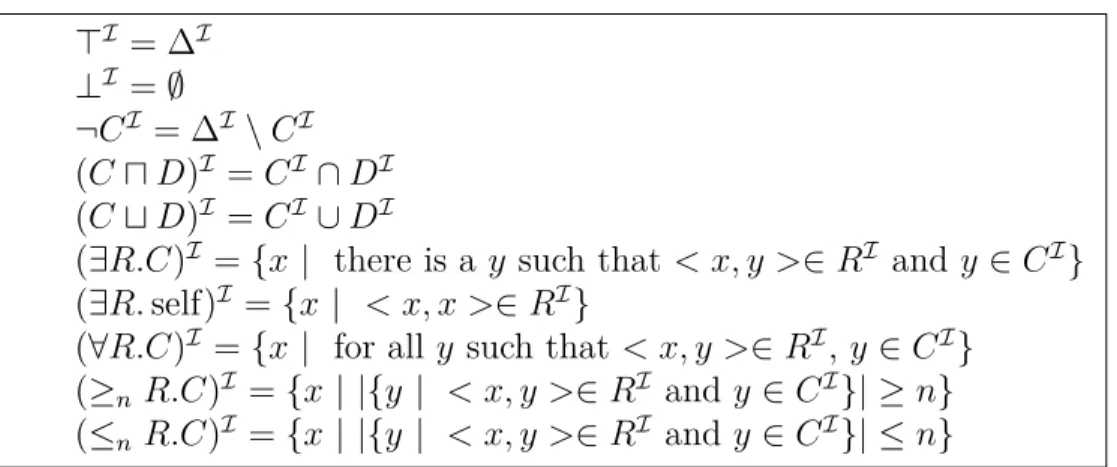
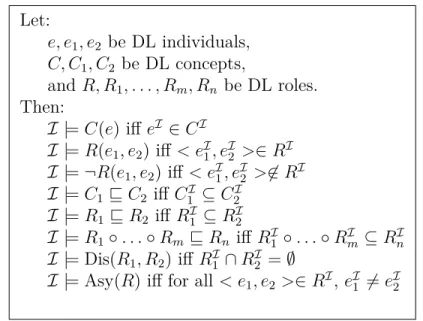
This upper bound on expressiveness remains a theoretical limitation though. For instance, most current of-the-self libraries to reason with OWL datasets do not sup-port all OWL 2 features. The full expressiveness of OWL 2 / �ℛ�ℐ�(�) is also
![Table 4.1: Concept hierarchy induction with FCA, reproduced from [Cim06]](https://thumb-us.123doks.com/thumbv2/123dok_us/1363854.2682585/126.918.207.719.142.300/table-concept-hierarchy-induction-fca-reproduced-cim.webp)