Staines, Z. (2018) ‘Ground-Level Impacts of Remote Employment Policy: Social Disadvantage Under the Community Development Programme’ Journal of Australian Political Economy No. 82, pp. 107-32.
EMPLOYMENT POLICY: SOCIAL
DISADVANTAGE UNDER THE COMMUNITY
DEVELOPMENT PROGRAMME
Zoe Staines
Indigenous Australians continue to experience significant socio-economic disadvantage across the life course (PMC 2018a; Productivity Commission 2016). This includes comparatively low labour-force participation and employment rates, especially in remote communities. Un- and under-employment can serve to further compound disadvantage by reducing household income, which has negative flow-on effects for access to basic needs like food, education and healthcare. Successive Australian governments have responded by delivering community development and employment programmes, the most recent of which is now in its third year of operation.
The Community Development Programme (CDP) was introduced in 2015. Since then, literature regarding the programme’s efficacy and impacts has continued to grow. However, most of the extant research presents high-level policy discussions concerning programme design (e.g. Staines 2018), or draws on high-level administrative data (e.g.
Fowkes 2016a). Others draw in the experiences of particular Indigenous communities (Altman 2016; Jordan 2016), service providers (Fowkes 2016b), and partial accounts of individual participants’ experiences with the programme (Kral 2016; Paterson 2016). Nevertheless, there are none in the existing academic literature that focus specifically on the ground-level experiences of CDP participants through case-study research.
However, it is critical to understand participants’ experiences under CDP in order to inform future policy and programme design.
This paper contributes to the existing literature by drawing on 24 case studies of CDP participants from two remote regions: the first in Far North Queensland (FNQ); and the second in the Top End of the Northern Territory (NT). CDP participants in these regions are overwhelmingly Indigenous. Collectively, the cases illuminate how individals in different circumstances are affected by CDP and demonstrate the various implications of the current policy approach. In turn, they provide further empirical grounding for some of the assessments in the existing literature, and also provide useful lessons that could inform future policy development. These lessons are timely, given the Australian Government’s plans to reform CDP in early 2019. Ultimately, the paper argues that CDP is, in many ways, ill-equipped to deliver the outcomes it sets out to and that policies in this area need to be fundamentally reformed if outcomes are to improve.
Indigenous employment in remote Australia
Successive government programmes have been introduced across remote Australia to improve labour-force participation and employment outcomes for (predominantly) Indigenous Australians. These have included the Community Development Employment Program (CDEP) (1977–2015),1 the Job Network (JN) (1998–2009), Job Services Australia (JSA) (2009–2013),2 and the Remote Jobs and Communities Program (RJCP) (2013–2015). CDP was introduced in 2015 as a replacement for the RJCP.3
The number of Indigenous Australians serviced by these remote programmes is typically reported as being somewhere between 26,000 and 32,000 (ANAO 2017; DEEWR 2012; Fowkes and Sanders 2016;
1 CDEP began to be gradually phased out from 2007 onwards, though it was not completely removed until 2015.
2 JSA was replaced by RJCP in remote areas in 2013, though it continued in urban areas until 2015.
3 CDP was technically a variation to the existing RJCP contract, but the variation was so fundamental that it is reasonable to describe it as a new programme.
PMC 2017a). At September 2017, 33,000 people were reportedly participating in CDP, of whom more than 80% identified as Indigenous (around 26,400 individuals) (ANAO 2017; PMC 2017a).
Despite these programmes, employment rates have worsened over recent years. Employment rates for Indigenous Australians in remote areas fell between the last two Censuses (2011 and 2016), by 4% for women and 9% for men (see Venn and Biddle in this special issue). The gap between Indigenous and non-Indigenous employment in remote areas also widened considerably (Venn and Biddle this issue). Over a longer timeframe, from 2006 to 2016, the overall Australian Indigenous employment rate fell from 48% to 46.6% (PMC 2018a).
This is, at least in part, the result of the gradual removal of CDEP from 2007–2015; CDEP participants who were previously counted in Census data as being ‘employed’ are now counted as ‘unemployed.’ However, even when data on CDEP participants are excluded from the 2006 and 2011 Censuses (as per the process undertaken by Gray et al. 2013) employment is still only improving at a very slow rate. It will take decades to ‘close the gap’ particularly in remote Australia (Staines 2018). Remote employment programmes are only one influence on these data; there are also others. For example, the size of the Indigenous working-age population in remote areas grew by approximately 6% between 2011–16, thereby increasing demand for jobs in these areas (Venn and Biddle 2018). Broader economic policy and market shifts have likely also played a role. However, even outcomes measured through evaluations of programmes that have operated in remote areas are
generally poor (e.g. DEEWR 2006, 2007, 2012; Productivity
Commission 2002; Stromback 2008). There are also still many unknowns with regard to the specific impacts of these programmes on remote participants, because although evaluation work on CDEP did focus on remote areas (e.g. Altman et al. 2000), evaluations of JN and JSA did not (e.g. DEEWR 2012; Productivity Commission 2002).4 There have also been no evaluations of the remote-specific RJCP, and although an evaluation of CDP is ostensibly ongoing, no findings had been publicly released at the time of writing this article (SSCFPA 2017: 18).
4 DEEWR’s (2012) evaluation of JSA did focus explicitly on Indigenous participants, of which around one third lived remotely. However, it did not focus exclusively on remote areas.
Meanwhile, Indigenous individual and household incomes in remote areas have dropped. The median disposable household income in very remote areas dropped by $12 per week from 2011–2016 (Markham and Biddle 2018). The gap between Indigenous and non-Indigenous incomes in remote communities has also widened (Markham and Biddle 2018; Staines 2017). This is particularly worrying, given it may serve to further compound the entrenched poverty already experienced by many remote-living Indigenous Australians. Access to a regular and stable income is crucial in determining the wellbeing of individuals and their families. It helps put food on the table, enables access to healthcare and educational opportunities, and can contribute to mental health and wellbeing (Wycherley et al. 2017).
The Community Development Programme
CDP represents the latest programme to emerge from a decade of continual programme change. Although its underlying policy settings remain very similar to JN, JSA and RJCP (Staines 2018), it ushered in a new set of rules and regulations for participants and providers. CDP has a strong emphasis on Work for the Dole activities, with required participation increasing from around 15 hours per week to up to 25 hours per week, spread across five days. This directly affects around 53% of the CDP caseload who are undertaking Work for the Dole activities, while the remaining 47% are ‘basic service’ participants (ANAO 2017: 17).5
Where participants do not undertake required Work for the Dole activities, they may be subject to No Show No Pay (NSNP) penalties, meaning they lose one working day’s payment for each penalty applied (Australian Government 2018; Campbell et al. 2018: 16). Participants can also attract penalties for failing to fulfil other obligations, like attending appointments with their service provider. If a participant accumulates three NSNP penalties within six months, or refuses suitable work, they can be subject to a serious failure penalty, whereby their income support can be suspended for up to eight weeks (Fowkes 2016c).
5 Basic service participants are not required to participate in Work for the Dole activities because they are either not aged 18-49 years, or are not receiving activity-tested income support payments.
Where a serious penalty period is applied as a result of NSNP penalties, and the participant re-engages in activities, payments can be reinstated before the eight-week period has ended. However, as Fowkes (2016c) pointed out, missed payments are rarely back-paid.
Other aspects that existed under RJCP, which enabled providers to deliver extra support to severely disadvantaged participants, were reduced under CDP. For example, there is less up-front funding for case management of participants’ diverse needs (as opposed to the Participation Account under RJCP, which could be used to cater to these needs), and the ‘streamed’ system to triage participants according to their level of need (as per the previous JN and JSA programmes) no longer exists. Although the funding framework was simplified under CDP, the administrative complexity is still high. Providers are eligible for service payments to deliver support to participants (up to $4,000 per participant annually) and Work for the Dole activities (up to $12,450 per participant annually) (ANAO 2017). They are also able to receive payments for employment outcomes – that is, where participants move into and stay in employment for 13 weeks and 26 or more weeks. To be eligible for the 26-week outcome payment, participants must work consecutively for 26 weeks (as opposed to RJCP, where they could work for 26 weeks over 52 consecutive weeks) (ANAO 2017). Where participants work for 26 or more weeks, their employers are also eligible for Employer Incentive Funding – a one-off payment made directly to the employer who keeps the participant in work (ANAO 2017).
Although CDP was introduced on the basis that it would deliver ‘stronger economic and social outcomes in remote Australia’ (Department of Jobs and Small Business 2018), it involved a reduction in funding for broader economic development. For example, the Community Development Fund that existed under RJCP was worth $47.5 million per year. This was replaced under CDP with the Indigenous Enterprise Development Fund, worth $25 million per year (ANAO 2017).
Existing evidence and debate concerning CDP
Since it began operating, CDP has been the subject of ongoing and widespread debate. Although the Australian Government has continued to assert the apparent benefits of CDP, others have identified flaws with the programme.
Outcomes under CDP
The Commonwealth Minister for Indigenous Affairs, Nigel Scullion (2017) has claimed that CDP has been a ‘success’ in terms of its ability to deliver ‘jobs and support for remote jobseekers.’ A representative of PMC (Williams in Commonwealth Hansard 2016: 82) reported in a senate estimates hearing that there had been a higher proportion of participants placed in and attending activities under CDP than under RJCP. However, it is unclear whether increased participation resulted in either improved work readiness or transitions into employment. Further, Fowkes (2016b: 15) argued that these figures were probably administrative artefacts.
In terms of job-placement outcomes, PMC (2018b) reported that, between the inception of CDP until 30 September 2017, the programme had resulted in 15,062 participants being placed into 19,748 jobs; 14,316 (72%) of these placements were for 10,960 Indigenous participants. Most (73%) of the total placements were in casual employment, with the remaining 12% in part-time and 14% in full-time positions. However, there is no further qualitative evidence available regarding the nature of these placements (e.g. whether the placements aligned with participants’ skillsets, were suitable to their needs and circumstances, and/or whether they provided opportunity for sufficient income). These have been recognised as problems in past programmes (Stromback 2008).
Over the same time period, 44% of the total Indigenous job placements resulted in at least a 13-week outcome, while 29% resulted in 26-week outcomes. There is no indication in the available reports of longer-term outcomes for these participants. It is also unclear what level of disadvantage was experienced by participants who achieved these results, which may be an indication of whether CDP is able to support both the least and most disadvantaged.
It is difficult to determine whether these results are better or worse than those achieved under RJCP and other previous programmes, because comparable data are not available (e.g. ANAO 2017: 26). An evaluation of the JN was able to demonstrate (with some methodological limitations) that participants placed in certain programme phases were more likely than those not in the programme to move into employment (DEEWR 2008), but the available data reported against both RJCP and CDP do not consider counterfactuals.
Despite Government reports of successful outcomes under CDP, there is yet to be any rigorous evaluative evidence provided. Although an independent evaluation of CDP is ongoing (SSCFPA 2017: 18), and was due for completion in mid-2018, it has not yet been released. Meanwhile, assessments of the programme in the broader literature represent a stark contrast to the Australian Government’s complimentary rhetoric.
Accounts of CDP in the literature
A key criticism of CDP has been the perceived unfairness of its dramatic increase in Work for the Dole obligations, which outstrip those under previous programmes, as well as in comparable urban schemes (Altman 2016; Fowkes 2016a). The fact that CDP participants have to undertake up to 25 hours per week of activities means their average hourly income is below the Australian award rate (Jordan 2016). These heavy requirements also leave little time available to pursue enterprising opportunities beyond CDP (Altman 2016; Altman and Klein 2018). This increase in participation requirements is also likely one of the causes of the dramatic increase in penalties applied under CDP. Fowkes (2016a: 16) reported that, since CDP began, the number of penalties applied under the scheme has exceeded those applied in comparable urban schemes like Jobactive ‘even though Jobactive has more than 20 times the number of participants.’ In its first year of operation, more than 125,000 NSNP penalties had been enforced under CDP (Fowkes 2016a: 16). This trend continued into 2017 (Department of Employment 2017). The ANAO (2017) reported that the penalties applied per year under CDP exceed those applied under RJCP. However, there is no evidence that this higher application of penalties has resulted in any improved outcomes for participants (Fowkes 2016a). In fact, many have argued that outcomes have worsened (e.g. Jordan 2016; Kral 2016).
There have been reports of participants being subject to situations of extreme poverty as a result of experiencing non-payment periods under CDP. Kral (2016) reported that, in the Ngaanyatjarra communities in Western Australia, participants often go without food and cannot afford housing payments when income is stopped under the CDP compliance framework. An inability to pay fines can also result in a higher risk of later imprisonment, which Kral (2016: 22) argued effectively
criminalises poverty. Where food is scarce, some participants may also turn to theft.
In relation to the Aṉangu people of the APY Lands, Jordan (2016: 144– 145) stated that service providers have suggested that, although penalties applied under CDP:
might encourage some Aṉangu to engage more fully…, more likely outcomes include further alienation of those with the greatest barriers to steady employment, an intensification of existing patterns in which Aṉangu rely on kinship networks for material needs, and escalating resentment, intra-community violence, poverty and theft.
Remote-living Indigenous Australians experience multifaceted and extreme disadvantage at higher rates than other Australians (PMC 2018a; Productivity Commission 2016). CDP participants are, therefore, more likely to be experiencing complex employment barriers. Under the previous JN program, for example, around 90% of Indigenous participants were eligible for Intensive Assistance, which was designed for the most severely disadvantaged participants (DEEWR 2002: 115). Involvement with the criminal justice system, both in the cases of defaulting on fines or committing theft for survival (as described above), may then create additional barriers to employment.
The service provider payment structure under CDP has also been criticised for its potential to create perverse incentives for providers to disregard the circumstances of severely disadvantaged participants (ANAO 2017; Fowkes 2016b: 14; Staines 2018). Others have criticised CDP because of its failure to take into account the low availability of employment in most remote Australian communities. Simultaneously, government-led efforts to bolster remote economies have too often produced negligible outcomes (though there are exceptions to this rule).6 For instance, the Indigenous Procurement Policy and Indigenous Business Australia have had mixed success (e.g. Jacobs 2017; Piesse
6 There have also been some broader efforts that have proven more successful, such as the Working on Country Indigenous ranger programmes, which are typically delivered by Indigenous organisations with Commonwealth funding. These programmes have reportedly improved opportunities for economic engagement and employment, while also providing other social benefits (Urbis Pty Ltd 2012; WalterTurnbull 2010).There are also Indigenous-led and private-sector initiatives that have created further remote employment opportunities (e.g. Centre for Appropriate Technology 2014; Cape York Enterprises 2015; Rio Tinto n.d.).
2016). Further, Jobs Australia (2015: 21) reported that minimal funding had been received under the CDP Enterprise Development Fund and that the creation of job opportunities were not, on the whole, being supported. Overall, the literature is overwhelmingly critical, and highlights a number of areas where CDP has had negative impacts for participants and service providers alike. Although the existing literature draws lessons from administrative data (Fowkes 2016a), the experiences of particular communities (Altman 2016; Jordan 2016), service providers (Fowkes 2016b) and some partial accounts of individual participants (Kral 2016; Paterson 2016), there are no studies that present case-study research to illuminate how individuals in different circumstances are affected by CDP. This study fills this gap and contributes to the existing literature by drawing on case studies of 24 CDP participants across two remote regions. These cases offer further empirical grounding for some of the assessments of CDP in the existing literature, and also suggest some potential lessons for future policy and programme design.
Methodology
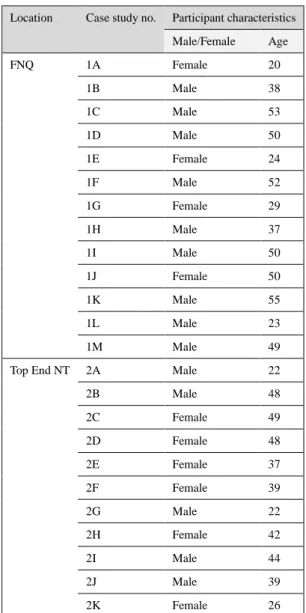
This paper draws on two sets of case studies of CDP participants from remote regions in FNQ and the Top End of the NT (see Table 1). The first set of case studies (n=13) was developed by the author in partnership with a CDP provider in a remote area of FNQ. The provider randomly selected 13 participants from their caseload, using a random-number generator. The case studies were developed by triangulating case managers’ own knowledge about the participants with data contained in their administrative files.
The second set of case studies (n=11) was developed by the North Australian Aboriginal Justice Agency (NAAJA) and published in its submission to the 2017 Australian senate inquiry into ‘the appropriateness and effectiveness of the objectives, design, implementation and evaluation’ of CDP (NAAJA 2017). These cases were included in order to provide a second perspective from a different region. Although other submissions to the senate inquiry also contained
partial and some full case studies (e.g. NPY Lands Empowered
Communities 2017), the NAAJA cases were the most comprehensive. NAAJA (2017) developed the case studies based on feedback from CDP participants who are also clients of NAAJA.
Table 1. Summary of case study details (N=24)
Location Case study no. Participant characteristics Male/Female Age FNQ 1A Female 20 1B Male 38 1C Male 53 1D Male 50 1E Female 24 1F Male 52 1G Female 29 1H Male 37 1I Male 50 1J Female 50 1K Male 55 1L Male 23 1M Male 49
Top End NT 2A Male 22
2B Male 48 2C Female 49 2D Female 48 2E Female 37 2F Female 39 2G Male 22 2H Female 42 2I Male 44 2J Male 39 2K Female 26
Source: Compiled by the author from CDP administrative files (FNQ) and NAAJA 2017 (NT).
The specific regions in which these participants reside, as well as the names of the service providers that deliver CDP to them, have not been identified here to ensure the participants’ anonymity is protected. Both sets of case studies were thematically coded, using a grounded-theory approach. This enabled the data to ‘speak for itself’ and core themes to emerge inductively.
Limitations
Neither set of case studies is intended to be representative of the experiences of all CDP participants in these locations, or elsewhere. The different sources of the two sets of case studies likely influences their foci and the information they contain. The NAAJA cases are based on first-hand accounts from its clients who are also aggrieved CDP participants. The clients had been engaged by NAAJA’s civil lawyers and the cases were subsequently selected for inclusion in its 2017 submission to the senate inquiry into CDP – that is, for the express purpose of advocacy (NAAJA 2017: 5). Because the clients were engaged by NAAJA to potentially pursue civil action, and also because the cases were selected and published as a means of advocacy to the senate inquiry, there is likely a degree of sampling bias, which produces a less favourable representation of participant experiences under CDP.
The FNQ cases were randomly sampled. However, they were developed predominantly based on second-hand information about CDP participants, which was contained in their administrative files, case notes and case managers’ own accounts. Thus, they are based on information that has been gathered primarily for the purpose of service delivery. Although these included some first-hand descriptions from CDP participants (e.g. when these were captured verbatim in case notes), future research should consider directly engaging participants to relay their stories and experiences first hand. Because the FNQ cases are based on provider accounts, they are less likely to include critical views of provider actions, and are less useful for understanding what participants think are the best or worst aspects of CDP. Alternatively, they are very useful in highlighting the day-to-day functioning of CDP and challenges that arise for providers in managing and delivering the programme. The two sets of cases are dissimilar in terms of their scope and perspectives. However, there is nevertheless sufficient consistency in the
issues that arise from them to generate useful analysis of how CDP affects individual participants. These core issues are discussed separately below.
Results and discussion
Of the total 24 CDP participants in this study, 14 (58%) were male and 10 (42%) were female. The average age of the participants was 39.4 years (min=20, max=55) and all were Indigenous, aside from case 2D, whose Indigenous/non-Indigenous status was unclear. The following sections describe and discuss common themes that arose from the case studies.
Balancing family, culture and programme participation
The CDP participants in this study often had diverse responsibilities to family and kin, for example as carers for children and grandchildren (case studies 1E, 2A, 2B, 2C, 2G) and ill spouses and kin (e.g. case studies 1H, 2B, 2C, 2E). Two participants (case studies 2B and 2C) were full-time carers for two children, and had other family and grandchildren living with them. They also provided ongoing care for one of their daughters and a cousin sister, who both had significant medical conditions.
Another participant (case study 2E) was a primary carer for her husband, who was disabled in a car accident, as well as her mother-in-law who was also disabled and living with the participant, her four children and two grandchildren. The participant had to balance these caring responsibilities against their CDP activity obligations; often the balance was difficult to achieve. As a result, they had been subject to multiple NSNP penalties and a serious penalty period of eight weeks. She was ultimately able to have her family obligations recognised as ‘home care’ activities for CDP, but this has not been the case for other participants (e.g. 1G, 1H) for reasons that are unclear.
Some participants also had cultural obligations, which had to be balanced against CDP participation. For example, one participant (2A) could not complete his CDP activities when he was required to undertake a six-month-long men’s initiation ceremony – a significant cultural
responsibility. The ceremony required the participant to spend time at a remote outstation where he was unable to take a phone or to leave: both actions would have meant breaking lore. Because he was unable to contact his provider or Centrelink, his payments stopped for the period while he was away and were not reinstated for more than a year (as described later, he had made attempts to advise Centrelink before he left, but these were unsuccessful).
Difficulty in balancing cultural, family and employment obligations have also been noted by others in the broader literature (e.g. Jordan 2017; Karmel et al. 2014; Ngurratjuta Pmara Ntjarra Aboriginal Corporation 2017; Pearson and Daff 2010; SSCFPA 2017). For example, in relation to mutual obligations more broadly, Pearson and Daff (2010: 32) argued that ‘long rosters and working hours… lead to absences from family and prevent the maintenance of kinship relations.’ The case studies indicate that the limited flexibility built into CDP means that participants are sometimes essentially punished for fulfilling their family and cultural obligations (Carmody in SSCFPA 2017: 38). The recognition of family responsibilities as ‘home care’ activities under CDP in one case study (2E) is promising, but the thresholds for this decision are unclear and there are no other examples in the cases where this exception has been made, despite similar circumstances.
Health issues
Many of the participants in this study experience complex health needs (e.g. case studies 1A, 1B, 1D, 1K, 2D, 2H, 2I). In some instances, this affects their ability to fulfil their CDP activity obligations, but exemptions are not always provided. One participant (case study 2H) has diabetes, back and kidney problems, fluid around her heart, and high blood pressure. She reported that she had attempted to tell her provider that this affected her ability to participate in CDP activities, but that her payments were nevertheless suspended when she was unable to participate. In 2017, her payments were cut off for eight weeks because of a failure to participate.
Another participant (case study 2C) had been in a car accident three years earlier and had ongoing health concerns. She was required to participate in a sewing programme under CDP, which caused considerable pain to her back and neck. She subsequently chose not to
attend some activities, which led to her payments being temporarily suspended. She told her provider about her health condition, but ‘no exemption was actioned by them’ (NAAJA 2017: 12).
In another case (1D), a participant who had suffered a significant heart attack alerted his provider, who applied to have his participation requirements reassessed. However, the provider described Centrelink’s reassessment process as being ‘extremely difficult’ and, ultimately, the individual was not reassessed until nine months after his heart attack. In the interim, the participant had to regularly contact Centrelink to repeatedly explain his medical condition so that he could be exempted from activities and avoid penalties.
There are other similar examples in the case studies where participants have been placed in activities that are unsuitable and exacerbate existing health conditions (e.g. case studies 2B and 2I). Three of the 24 cases (1A, 1B and 1K) also included participants who experienced serious mental health issues. The 20-year-old female participant in case study 1A had been diagnosed with schizophrenia. She has a strong family history of the illness, and had been hospitalised multiple times over the previous two years due to severe psychotic episodes. These involved her hearing voices and making threats of self-harm. The participant receives regular anti-psychotic injections administered by a local mental health nurse, but continues to have ongoing mood disturbances and auditory hallucinations. Despite her condition, which has been well documented, a recent Centrelink assessment stated that ‘The client’s personal factors have low impact on their ability to work, obtain work or look for work.’ She has been formally assessed by Centrelink as being capable of undertaking eight to fourteen hours of ‘light, less-skilled’ activities per week. Her CDP service provider reported that this is unrealistic because of the severity of the participants’ health needs, but they have little choice but to continue to try and engage her. Ironically, the participant has also been rated by Centrelink as being ‘high risk’ for noncompliance, in which case she is also high risk of experiencing non-payment periods. Arguably, Centrelink’s assessment that the participnt represents a high noncompliance risk is at least a partial admission that she is not a suitable candidate for CDP because the compliance assessment is presumably based on the severity of her schizophrenia.
Another participant (case study 1B) – a 38-year-old male – was also diagnosed with schizophrenia (alongside other barriers, including chronic
substance abuse). He has ongoing sleep disturbances, thought disturbances, poor self-care and anger-management issues. He also participated in Stream C under a previous programme (also formerly known as Stream 4, which was reserved for participants experiencing extreme barriers to employment). However, despite his circumstances, he was assessed by Centrelink as being able to look for work and participate in CDP for 15–22 hours per week, with a view to transitioning to 23–29 hours per week within two years. The service provider commented that this was unreasonable, given the participant’s ongoing health and drug-dependency issues. Ultimately, the provider feels that the individual should be receiving intensive health-care support, rather than participating in an employment programme.
In at least some cases (e.g. 2B, 2I) a lack of locally-available medical personnel, or difficulty engaging with available healthcare services also made it difficult to obtain medical documentation needed to account for missed activities. In one case (1K), the service provider strongly suspected a participant was experiencing undiagnosed mental health issues. However, despite repeatedly referring the individual to a local clinic, they did not attend and thus, their participation requirements have not been able to be reassessed. The participant has subsequently experienced regular non-payment periods, and the provider commented that this may serve to further undermine their health.
Ultimately, an inability to access adequate healthcare – either because of barriers to engagement, or a lack of availability – appears to be a key issue for at least some of the participants in this study. This aligns with reports elsewhere about lack of health services, including mental health services, for remote participants (SSCFPA 2017: 35–36). In at least some cases it appears to further increase the risk of NSNP penalties being applied. For individuals already experiencing significant health issues, reductions in their income (and in some cases removal of income for extended periods) is likely to further compound their disadvantage. In some of the cases described here there is also an apparent incongruity between Centrelink assessments of participant capabilities and local knowledge about their needs – an issue also raised in the senate inquiry (SSCFPA 2017: 52–53). This indicates a need to reconsider assessment protocols, including whether decisions are based on sufficient information and local knowledge, and whether they are made in participants’ best interests. It also supports other findings, such as those
by the Commonwealth Ombudsman (2016) concerning the difficulties faced by remote-living Indigenous Australians in accessing the Disability Support Pension (DSP). It is likely that at least some individuals participating in CDP, including some described in this study, would be more suited to and better served by DSP.
Hardships as a result of suspended payments
Many of the participants in these case studies had spent periods of time not receiving an income due to an inability to comply with CDP programme requirements (e.g. case studies 1D, 1G, 1J, 2A, 2B, 2G). One participant (2A) had no income for more than a year. The participant in case study 2E reported consistently struggling with money to purchase food to feed her large family who were dependent on her. She was having money taken out of her payments to service loans but had also had two NSNP penalties and an eight-week non-payment penalty imposed. Another participant (case study 2G), who was a primary carer for his two-year-old son, had struggled to pay for food after two weeks without payments. He was particularly concerned about finding money to feed his son, highlighting the flow-on effects that non-payment periods can have for other vulnerable family members.
These findings are consistent with those reported elsewhere about the severity of the CDP compliance framework and the widespread application of NSNP and serious penalty periods (Fowkes 2016c; Kral 2016; SSCFPA 2017: 43). Wycherley et al. (2017) demonstrated that even short-term fluctuations in an income cycle can reduce the nutrient value of the diets of remote-living Indigenous Australians, which can exacerbate lifestyle-related disease risks. This indicates that the impacts of CDP on income availability, and the potential flow-on impacts for health and wellbeing, need to be more carefully considered under future programmes – particularly if employment policies are meant to complement other strategies designed to ‘close the gap’ in health and wellbeing for Indigenous Australians.
Interactions with the criminal justice system
Indigenous Australians continue to be more likely than other Australians to have involvement with the criminal justice system, both as victims and
offenders (ALRC 2017). Of the 24 cases in this study, six (25%) had at least some record of contact with the criminal justice system (case studies 1C, 1E, 1J, 1L, 1M, 2A) – five as perpetrators (for various offences including trespass and stealing) and one as a victim of violent crime.
One participant (case study 1E) is a young woman who was described by her service provider as having ‘much potential’ and a ‘strong’ desire to work. However, she is a victim of severe domestic violence which has significantly hindered her ability to participate in CDP and move into employment. She had transitioned into three jobs in the previous year but could not sustain them because she needed to regularly take time off to recover from often severe domestic-violence-related injuries. Recently, the participant’s partner was convicted and is now serving an extended period of gaol time for the violence committed against her. Since her partner was incarcerated the participant has commenced a traineeship and is excelling – she is now looking to move back into employment. In this case CDP has helped the participant but only after another significant barrier was removed.
In other cases, there is some evidence that CDP may create an environment that contributes to increased potential for criminality, especially where payments are suspended for periods of time. In case study 2A, the participant had contact with the criminal justice system after being cut off from Centrelink payments for more than a year. He was charged with stealing and trespass: NAAJA (2017) indicated that the participant’s actions were likely motivated by the poverty he experienced from having no income. This is similar to accounts reported elsewhere (Jordan 2016; Kral 2016; SSCFPA 2017: 55–56). The participant pleaded guilty and was given a suspended sentence, as well as a substantial fine. However, he cannot set up a payment plan for his fine because he is still not receiving Centrelink payments. He told NAAJA (2017: 8) that ‘he does not know how he will pay the fine.’ Across Australia, defaulting on fines is a key gateway for entrance into the criminal justice system, especially for Indigenous Australians (Methven 2018; Western Australian Ombudsman 2017). This is a potential outcome if this participant fails to pay his fine, which supports Kral’s (2016: 22) previous contention that the conditions created under CDP can, in some cases, effectively criminalise poverty.
In two other cases (1J, 1M) participants supplemented their income through the sale of prohibited items (illicit drugs and alcohol) and, thus, were less affected by non-payment periods which they experienced regularly. The first participant (1J) is facing charges while the second (1M) is incarcerated. Whether or not these participants had done the same under previous programmes, or would do so under different circumstances, is unclear. In further cases examined in this study, there are also other factors that play a clear role in heightening propensity for participants’ involvement in the criminal justice system. These include family dynamics and parental criminality (e.g. case study 1L).
Even though the disadvantage experienced by many remote-living Indigenous Australians goes beyond mere ‘income poverty’ (Hunter 2001) it is also possible that, by exacerbating poverty through extended non-payment periods, CDP may help to create an anomic environment where general strain may contribute to propensity for crime for some participants (Agnew 1992). Further research is needed in this regard, especially to tease out the complex factors that contribute to these (and potentially other) participants’ criminality. However, the potential influence of employment policy on crime should be at least a partial consideration for future policymaking.
Engaging with Centrelink
Many participants experience barriers to engaging with CDP providers and Centrelink (e.g. case studies 1D, 2A, 2B). One participant (case study 2A) had attempted to contact Centrelink before attending a cultural ceremony, but ‘could not get onto them beforehand and found it hard to explain because ceremony is a secret business so hard to talk about with strangers.’ Low English language literacy also plays a role in making it difficult for some participants to engage with Centrelink (e.g. case studies 1D, 2B, 2J). One participant (2I), who speaks English as a second language, reported that it was difficult to talk to Centrelink officers over the phone because they ‘speak fast’ and ‘ask a lot of questions.’ Another participant (2J) reported that Centrelink staff spoke to him in a ‘fancy way’ that he could not properly understand.
The participant in case study 2B spoke English as a second language and demonstrated signs of gratuitous concurrence (Lauchs 2010) but, as NAAJA (2017: 8) indicated, ‘This can be subtle, and would be extremely
difficult for persons with little experience of dealing with Aboriginal people to detect over a telephone conversation.’ The participant requested that Centrelink provide an interpreter, but none was subsequently provided. Ironically, the participant’s wife (case studies 2B, 2C) gave up her own employment in order to help her husband re-instate his Centrelink payments by acting as his interpreter.
Participants reported feeling frustrated, powerless and ashamed at not being able to communicate clearly with Centrelink, nor understand what was required of them in terms of programme participation (case studies 2B, 2E, 2F, 2J). Inadequate access to information about CDP, including access to interpreters where appropriate, is a significant issue. If participants do not understand the rules there is little hope of their being able to follow them to maintain their income. In some cases participants responded by withdrawing entirely (e.g. case study 2B). The 2017 senate inquiry into CDP (SSCFPA 2017: 107) recommended that the Department of Human Services invests in employing local Indigenous interpreters in remote communities to support Indigenous CDP participants. This may represent a positive step and also provide further employment opportunities, however, it is unclear whether this will form part of the revised programme due for implementation in 2019.
In addition to language and cultural barriers, CDP participants also experience frustration at trying to contact Centrelink over the phone because of long wait times. One participant (2F) tried to call Centrelink to have her payments reinstated and ended up spending eight to nine hours on the phone. NAAJA (2017: 14) reported that this participant’s experience was objectively confirmed by CDP provider staff because she used the CDP provider’s phone. Other participants also experienced frustration at long waiting times (e.g. case studies 1D, 2B, 2G, 2I). These accounts align with other reports about Centrelink waiting times, which have worsened under CDP (ANAO 2017: 47; Conifer 2017; Tjuwanpa Outstation Resource Centre Aboriginal Corporation 2017). Despite this, the ANAO (2017) reported that average call times for Centrelink from remote areas were lower than in urban areas. It reported the maximum call wait time in remote areas as 2 hours and 44 minutes – less than some of the wait times reported in the case studies in this article. It is possible that this could be related to differences in counting
methods.7 Nevertheless, inaccessibility appears to be a key issue under CDP and is exacerbated by language barriers.
Transitions into employment
Altman (2016) argued that intensive Work for the Dole requirements, such as those experienced under CDP, can reduce potential to pursue enterprising opportunities that may lead to partial or full self-employment over time. This was reflected in one of the case studies considered for this research, where a male participant (case study 1F) was also a well-known and respected artist who had been able to sell his art in the past to generate a partial income. Because his art-based income is sporadic, he also receives welfare income and participates in CDP. Initially, intensive CDP participation left little time for him to pursue his art and, thus, reduced his ability to generate his own income. After speaking with the participant about his ambitions, the CDP service provider placed him into activities8 at a local art centre, which has allowed him to continue creating and selling his art. In this instance, the participant has benefited from being able to align his activities with his business goals, but this is only because the provider demonstrated flexibility in placing him and could find a placement that was suitable. In other cases participants may not be as fortunate. Thus, the possible impact of intensive Work for the Dole requirements on undermining enterprise should be carefully considered.
Only one of the participants considered in this research (case study 1I) was, at the time this research was undertaken, employed as a result of CDP. This participant had fewer identified barriers to employment and had also previously been employed. After participating in CDP he began working as a part-time cleaner for a local business. The CDP provider reports that he has indicated that he is ‘happy’ with the work. Although
7 For instance, the average call wait time reported by the ANAO represented the average time a caller spends in a queue after going through the automated answer service, but it is unclear whether callers could wait in multiple queues during the same call. It is also possible that the participants in the case studies were calling repeatedly, rather than waiting on hold.
8 Under CDP, activities can be delivered by the service provider or by ‘host organisations’ such as businesses or not-for-profits. The activity in this instance was delivered by a host organisation through a hosted-placement arrangement.
the outcome for this participant has been positive, his story provides a counter-narrative to the significant challenges involved in supporting participants in the remaining case studies, many of whom experience multiple and complex barriers, into paid work.
Conclusion
CDP operates on the basis that increasing downward pressure on participants in the form of harsher penalties and stricter requirements will ‘push’ them into employment. However, as Jordan and Altman (2016: 10) stated:
if one acknowledges the major structural barriers to employment opportunity, it is difficult to accept that withholding welfare payments unless recipients display the ‘correct’ behaviours (judged according to mainstream Australian norms) will be sufficient to lead to a job.
Firstly, there are generally few employment opportunities available in remote communities (SSCFPA 2017). Secondly, CDP does little to address other individual-level barriers to employment, including multifaceted circumstances of disadvantage experienced by many participants.
Unemployment can be a by-product of complex circumstances of disadvantage such as those described in this study. Withholding payments does not alleviate these circumstances. The only logical outcome is that, by reducing income, disadvantage is further entrenched. Although the overarching goal of CDP is apparently to move participants into paid work over time, the experiences of many of the individuals described in this study indicate that, ironically, it can have the result of establishing further barriers to employment. It may also reduce incentives and opportunity for some participants to pursue their own enterprise. This indicates that there are inherent flaws in the design of CDP. Although there are undoubtedly a minority of participants who benefit from the programme, this research suggests that it is more likely to be those who are experiencing fewer barriers. The FNQ provider in this study described CDP as a ‘one size fits all’ programme. This inflexible approach does not appear to provide similar positive benefits to those experiencing complex disadvantage.
Indigenous organisations have proposed alternatives to CDP that should be given thorough consideration (e.g. APO NT 2017). However, early indications of what the revised programme, set to replace CDP in early 2019, might look like do not instil hope of significant change and do not align with these alternative proposals (PMC 2017b). In keeping with the severe incrementalism that has characterised remote employment policies since 2007 (Staines 2018), it is unlikely that the new programme will incorporate the kinds of policy shifts necessary to alleviate entrenched disadvantage and improve longer-term outcomes. However, significant change is needed if any traction is to be gained in improving remote employment while simultaneously reducing (rather than worsening) other symptoms of disadvantage.
Zoe Staines is a Sessional Academic/Senior Research Assistant at Queensland University of Technology and an independent research consultant. She has held research and policy positions in government and the not-for-profit sector, most recently as a Manager of Evaluation at an Indigenous-led organisation. Zoe holds degrees, including a PhD, in criminology.
References
Agnew, R. (1992) Foundation for a general strain theory of crime and delinquency, Criminology, 30(1), pp. 47–88.
ALRC (Australian Law Reform Commission) (2017) Pathways to justice: an inquiry into the incarceration rate of Aboriginal and Torres Strait Islander peoples, Sydney: Australian Law Reform Commission.
Altman, J. (2016) A most egregious transition: CDEP to CDP, in Jordan, K. and Fowkes, L. (eds.), Job creation and income support in remote Indigenous Australia: moving forward with a better system, CAEPR Topical Issue 2/2016, Canberra: Centre for Aboriginal Economic Policy Research, Australian National University, pp. 4–8.
Altman, J., Gray, M. and Sanders, W. (2000) Indigenous Australians working for welfare: what difference does it make? The Australian Economic Review, 33(4), pp. 355–362. Altman, J. and Klein, E. (2018) Lessons from a basic income programme for Indigenous Australians, Oxford Development Studies, 46(1), pp. 132–146.
ANAO (Australian National Audit Office) (2017) Design and implementation of the Community Development Program, ANAO Report No. 14, 2017-18 Performance Audit, Canberra: ANAO.
APO NT (Aboriginal Peak Organisations Northern Territory) (2017) Fair work and strong communities: Proposal for a remote development and employment scheme, Darwin: APO NT.
Australian Government (2018) Guide to social security law, 3.1.13.20 no show, no pay failure, Canberra: Australia Government.
Campbell, R., Browne, B. and Grudnoff, M. (2018) Remote control: the Community Development Programme, remote Australia’s work for the dole scheme, Canberra: The Australia Institute.
Cape York Enterprises (2015) Cape York Enterprises, Website, https://capeyorkpartnership.org.au/game-changers/cape-york-enterprise/ Centre for Appropriate Technology (2014) Economic Development, Website, http://cfat.org.au/economic-development/
Commonwealth Hansard (2016) Senate Finance and Public Administration Legislation Committee, 21 October,
https://parlinfo.aph.gov.au/parlInfo/download/committees/estimate/31fc2138-32d8-4182-
a387-c265614e06dd/toc_pdf/Finance%20and%20Public%20Administration%20Legislation%20 Committee_2016_10_21_4524_Official.pdf;fileType=application/pdf
Commonwealth Ombudsman (2016) Department of Human Services: accessibility of Disability Support Pension for remote Indigenous Australians, Canberra: Commonwealth Ombudsman.
Conifer, D. (2017) Controversial work-for-the-dole scheme taking a toll on young Indigenous people, ABC News Online, 30 September, https://www.abc.net.au/news/2017-09-30/remote-cdp-taking-a-toll-on-young-indigenous-people/9002888
DEEWR (Department of Education, Employment and Workplace Relations) (2002) Job Network evaluation, stage three: effectiveness report, Canberra: Australian Government. DEEWR (2006) Customised assistance, job search training, work for the dole and mutual obligation, a net impact study, Canberra: Australian Government.
DEEWR (2007) Active participation model evaluation, July 2003–June 2006,Canberra: Australian Government.
DEEWR (2008) Labour market assistance: long-term outcomes, Canberra: Australian Government.
DEEWR (2012) Servicing Indigenous jobseekers in Job Services Australia—evaluation of Job Services Australia 2009–2012, Canberra: Australian Government.
Department of Employment (2017) Jobseeker compliance data—December quarter 2017, Canberra: Australian Government.
Department of Jobs and Small Business (2018) Community Development Programme (CDP), Website, https://www.jobs.gov.au/community-development-programme-cdp Fowkes, L. (2016a) Impact of CDP on income support of participants, in Jordan, K. and Fowkes, L. (eds.), Job creation and income support in remote Indigenous Australia: moving forward with a better system, CAEEPR Topical Issue 2/2016, Canberra: Centre for Aboriginal Economic Policy Research, Australian National University, pp. 15–19.
Fowkes, L. (2016b) CDP and the bureaucratic control of providers, in Jordan, K. and Fowkes, L. (eds.), Job creation and income support in remote Indigenous Australia: moving forward with a better system, CAEEPR Topical Issue 2/2016, Canberra: Centre for Aboriginal Economic Policy Research, Australian National University, pp. 12–15. Fowkes, L. (2016c) Update on impact of the Community Development Programme on social security penalties, Carlton South: Jobs Australia.
Fowkes, L. and Sanders, W. (2016) Financial penalties under the Remote Jobs and Communities Program, CAEPR Working Paper 108/2016, Canberra: Centre for Aboriginal Economic Policy Research, Australian National University.
Gray, M., Hunter, B. and Howlett, M. (2013) Indigenous employment: a story of continuing growth, CAEPR Topical Issue 2/2013, Canberra: Centre for Aboriginal Economic Policy Research, Australian National University.
Hunter, B. (2001) Tackling poverty among Indigenous Australians, in Fincher, R. and Saunders, P. (eds.) Creating unequal futures: rethinking poverty, inequality and disadvantage, Sydney: Allen & Unwin.
Jacobs, C. (2017) Risky business: the problems of Indigenous business policy, Sydney: Centre for Independent Studies.
Jobs Australia (2015) Feedback from the RJCP Providers’ Network on proposed RJCP reforms, Carlton South: Jobs Australia.
Jordan, K. (2016) Looking for ‘real jobs’ on the APY Lands: intermittent and steady employment in CDEP and other paid work, in Jordan, K. (ed.) Better than welfare? Work and livelihoods for Indigenous Australians after CDEP, Canberra: ANU Press, pp. 125– 154.
Jordan, K. (2017) The appropriateness and effectiveness of the objectives, design, implementation and evaluation of the Community Development Programme (CDP), submission to the Senate Finance and Public Administration Committee, Submission No. 30, Canberra: Senate Standing Committees on Finance and Public Administration. Jordan, K. and Altman, J. (2016) From welfare to work, or work to welfare?, in Jordan, K. (ed.) Better than welfare? Work and livelihoods for Indigenous Australians after CDEP, Canberra: ANU Press, pp. 1–29.
Karmel, T., Misko, J., Blomberg, D., Bednarz, A. and Atkinson, G. (2014) Improving labour market outcomes through education and training, Issues Paper No. 9,Canberra: Closing the Gap Clearinghouse.
Kral, I. (2016) Only just surviving under CDP: the Ngaanyatjarra Lands case study, in Jordan, K. and Fowkes, L. (eds.), Job creation and income support in remote Indigenous Australia: moving forward with a better system, CAEEPR Topical Issue 2/2016, Canberra: Centre for Aboriginal Economic Policy Research, Australian National University, pp. 19– 23.
Lauchs, M. (2010) Rights versus reality: the difficulty of providing ‘access to English’ in Queensland Courts, Brisbane: Queensland University of Technology.
Markham, F. and Biddle, N. (2018) Income, poverty and inequality, 2016 Census Paper No. 2, Canberra: Centre for Aboriginal Economic Policy Research, Australian National University.
Methven, E. (2018) We need evidence-based law reform to reduce rates of Indigenous incarceration, The Conversation, April 9, http://theconversation.com/we-need-evidence-based-law-reform-to-reduce-rates-of-indigenous-incarceration-94228
NAAJA (North Australian Aboriginal Justice Agency) (2017) The appropriateness and effectiveness of the objectives, design, implementation and evaluation of the Community Development Programme (CDP), submission to the Senate Finance and Public Administration Committees, Submission No. 40, Canberra: SSCFPA.
Ngurratjuta Pmara Ntjarra Aboriginal Corporation (2017) The appropriateness and effectiveness of the objectives, design, implementation and evaluation of the Community Development Programme (CDP), submission to the Senate Finance and Public Administration Committees, Submission No. 27, Canberra: SSCFPA.
NPY Lands Empowered Communities (2017) The appropriateness and effectiveness of the objectives, design, implementation and evaluation of the Community Development Programme (CDP), submission to the Senate Finance and Public Administration Committees, Submission No. 28. Canberra: SSCFPA.
Paterson, J. (2016) What happened to the E in CDEP?—CDP’s disastrous impact on remote communities, in Jordan, K. and Fowkes, L. (eds.), Job creation and income support in remote Indigenous Australia: moving forward with a better system, CAEEPR Topical Issue 2/2016, Canberra: Centre for Aboriginal Economic Policy Research, Australian National University, pp. 10–11.
Pearson, C. and Daff, S. (2010) Education and employment issues for Indigenous Australians in remote regions: a case study of a mining company initiative, Journal of Human Values, 16(1), pp. 21–35.
Piesse, E. (2016) Perth entrepreneurs left frustrated by Indigenous business agency, ABC News Online, 21 October, https://www.abc.net.au/news/2016-10-16/iba-failing-indigenous-business-perth-entrepreneurs/7929414
PMC (Department of the Prime Minister and Cabinet) (2017a) Where does CDP operate? Canberra: Australian Government.
PMC (2017b) Discussion paper: remote employment and participation, Canberra: Australian Government.
PMC (2018a) Closing the gap Prime Minister’s report 2018, Canberra: Australian Government.
PMC (2018b) Questions on notice, Senate Estimates: official Hansard, Portfolio question number 89, February 1.
Productivity Commission (2002) Independent review of the Job Network, Melbourne, Productivity Commission.
Productivity Commission (2016) Overcoming Indigenous disadvantage: key indicators 2016, Melbourne: Productivity Commission.
Rio Tinto (no date) Local and Indigenous participation, Website, http://www.riotinto.com/australia/local-and-indigenous-participation-16134.aspx
Scullion, N. (2017) Minister Scullion: Coalition Government support for Indigenous jobs and business sector, Media Release, 9 May,
https://www.indigenous.gov.au/news-and- media/announcements/minister-scullion-coalition-government-support-indigenous-jobs-and
SSCFPA (Senate Standing Committees on Finance and Public Administration) (2017) The appropriateness and effectiveness of the objectives, design, implementation and evaluation of the Community Development Programme (CDP), report, Canberra: Parliament of Australia.
Staines, Z. (2017) We’re not closing the gap on Indigenous employment, it’s widening, The Conversation, December 2, https://theconversation.com/were-not-closing-the-gap-on-indigenous-employment-its-widening-89302
Staines, Z. (2018) Lessons from the recent policy experience in the Australian Indigenous community-employment sector, Australian Journal of Labour Economics, 20(3), pp. 229– 248.
Stromback, T. (2008) The Job Network and underemployment, Economic Papers, 27(3), pp. 286–302.
Tjuwanpa Outstation Resource Centre Aboriginal Corporation (2017) The appropriateness and effectiveness of the objectives, design, implementation and evaluation of the Community Development Programme (CDP), submission to the Senate Finance and Public Administration Committees, Submission No. 13. Canberra: SSCFPA.
Urbis Pty Ltd (2012) Assessment of the social outcomes of the Working on Country Program, Sydney: Urbis Pty Ltd.
Venn, D. and Biddle, N. (2018) Employment outcomes, 2016 Census Paper No. 5, Canberra: Centre for Aboriginal Economic Policy Research, Australian National University.
WalterTurnbull (2010) Working on Country evaluation report, final, Canberra: WalterTurnbull.
Western Australian Ombudsman (2017) A report on the monitoring of the infringement notices provisions of The Criminal Code, Volume 3: the impact on Aboriginal and Torres Strait Islander and other communities, Perth: Western Australian Ombudsman.
Wycherley, T., Pekarsky, B., Ferguson, M., O’Dea, K. and Brimblecombe, J. (2017) Fluctuations in money availability within an income cycle impacts diet quality of remote Indigenous communities, Public Health Nutrition, 20(8), pp. 1431–1440.