AN ANALYSIS OF COACH PERSPECTIVES ON INTERCOLLEGIATE ATHLETICS SCHOLARSHIP MODELS
Jonathan A. Teich
A thesis submitted to the faculty of the University of North Carolina at Chapel Hill in partial fulfillment of the requirements for the degree of Master of Arts in the Department of Exercise
and Sport Science (Sport Administration)
Chapel Hill 2016
ABSTRACT
Jonathan A. Teich: An Analysis of College Coach Perspectives on the Current College Scholarship Model
(Under the direction of Erianne Weight)
This study explored NCAA Division I coach perceptions of the current scholarship model in regards to scholarship limits, head count and equivalency sports, and
TABLE OF CONTENTS
LIST OF TABLES ... V
CHAPTER I: INTRODUCTION ... 1
Introduction ... 1
Purpose of Study ... 2
Research Questions ... 2
Significance of Study ... 3
Definition of Terms ... 3
Limitations ... 4
Delimitations ... 4
Assumptions ... 4
CHAPTER II: LITERATURE REVIEW ... 5
College Athletic Scholarships ... 5
History... 5
Title IX and Financial Aid ... 7
Current Scholarships ... 9
Criticisms of the current Scholarship Model ... 10
Scholarships as a Violation of Antitrust Law ... 10
Pay-for-Play ... 12
Suggestions to Improve the Scholarship Model ... 14
Referent Cognitions Theory ... 16
Subjects ... 20
Instrumentation ... 20
Data Analysis ... 21
CHAPTER IV: RESULTS ... 22
Demographics ... 22
Coaches Satisfaction with Current NCAA Scholarship Model ... 23
Coaches Feedback on the Current NCAA Scholarship Model ... 25
Strengths of the Headcount Model ... 25
Areas the Headcount Model Could Be Improved ... 27
Strengths of the Equivalency Model ... 28
Areas the Equivalency Model Could be Improved ... 29
Impact of Knowledge of Scholarship on Satisfaction Level with Scholarship Model .. 30
Potential Alternative Models ... 31
CHAPTER V: DISCUSSION ... 33
Satisfaction with Current Scholarship Model ... 33
Feedback on the Current Scholarship Model ... 32
Impact of Knowledge on Satisfaction with the Scholarship Model ... 34
Future Studies ... 35
APPENDIX A: CURRENT NCAA SCHOLARSHIP LIMITS ... 38
APPENDIX B: THESIS SURVEY ... 40
APPENDIX C: THESIS INVITATION EMAIL ... 44
LIST OF TABLES
Table 1 Demographics Table ... 22
Table 2 Satisfaction with current NCAA scholarship model ... 24
Table 3 Strengths of the current headcount sport scholarship allocation model ... 27
Table 4 Improvements to the current headcount scholarship allocation model ... 28
Table 5 Strengths of the current equivalency sport scholarship allocation model ... 29
Table 6 Improvements to the current headcount sport scholarship allocation model ... 30
CHAPTER I: INTRODUCTION Introduction
As intercollegiate athletics grew in popularity and took a foothold within the American academy in the 1930s, debates about professionalism became prevalent. Although athletic scholarships were not approved by the NCAA until 1956, the concept of a grant-in-aid became common in the 1940’s as schools that could not compete with the prestige of the Big Ten and Ivy League would try to attract recruits with the promise of a free education (Gibson, 2012). Attempts to reform intercollegiate athletics began with the 1929 Carnegie Report, then the 1949 NCAA Sanity Code, and the American Council on Education Report in 1972 (Ridpath, 2008). These reform efforts have been continued by groups such as the Knight Commision on Intercollegiate Athletics and faculty groups like The Drake Group and The Coalition on Intercollegiate Athletics. The goal of these groups is to align athletics with the mission of higher education. With
discussions about compensating student-athletes, full cost-of–attendance, and antitrust laws, these reform groups and scholars have tried to determine the best balance for awarding scholarships at the NCAA level.
There are many critics who believe that full scholarships are not adequate compensation for student-athletes (Goplerud, 1997; Hakim, 2000; Miller, 2011; Schott, 1996; Sobocinski, 1996). A body of literature advocates that current scholarship limits violate antitrust laws, student-athletes should be paid a salary, and the current amateur model disbanded (Acain, 1998; Chin, 1993; Kahn, 2007; Kreher, 2006; Schott, 1996; Sobocinski, 1996).
research examines the coach’s perception of the current scholarship model, and also provides a framework to collect coaches suggestions to modify the current scholarship model.
Purpose of Study
The purpose of this study is to explore NCAA Division I coach perceptions of the current NCAA scholarship model in regards to scholarship limits, head count and equivalency sports, and modifications to the distribution of scholarship dollars. Additionally, this study will facilitate a voice to provide suggestions for modifications to the current NCAA scholarship model.
Research Questions
Based on the review of literature, the following research questions were formed for this study:
RQ 1: How satisfied are Division I coaches with the current NCAA scholarship model in regards to scholarship limits, head count and equivalency sports, and the distribution of scholarship dollars?
RQ 2: What suggestions for modification to the current NCAA scholarship model do Division I head coaches suggest (if any)?
RQ 3: Are there differences in satisfaction about the current NCAA scholarship model between coaches in the following categories?
a) Revenue Sports b) Non-revenue Sports c) Headcount Sports d) Equivalency Sports
Significance of Study
This study is relevant in today’s college athletic landscape because it adds a new perspective to the previous literature on the criticism of athletic scholarships in intercollegiate athletics—the perspective of head coaches. Although there has been some research discussing reforms to the current scholarship model, there is little research that examines the insights of coaches about the current NCAA scholarship model. This study seeks to add to the research base by providing the perspective of coaches on scholarship reform and provide new information that can help the NCAA understand how its coaches and administrators feel about scholarships. One hope is the results will spark more focused and informed discussions about examining the current scholarship model and determining if it is the best model for the intercollegiate athletics today. The discussions may include looking at scholarships from a non-traditional perspective and bring about new models that better fit the needs of the institutions and the student-athletes currently.
Definition of Terms
1. National Collegiate Athletic Association - A voluntary organization composed of various universities and colleges that compete in intercollegiate athletics. It is also the governing body that creates and enforces the rules for all of its members.
2. Scholarship model – The structure of scholarship limits assigned to each sport based on NCAA legislation.
3. Power-5 – The Power Five represents the conferences within the NCAA that have
decision-making autonomy. It includes the Atlantic Coast Conference, Big 10 Conference, Big 12 Conference, Pac 12 Conference, and the Southeastern Conference.
5. Non-Revenue Sports – Olympic sports that generally operate at a financial loss and garner less media attention and spectator attendance than revenue sports.
6. Head Count Sports - Sports that have a limit to the total number of counters in an academic year (NCAA Manual, 2015).
7. Equivalency Sports - Sports that have a limit on the value of financial aid awards that an institution may provide in an academic year to scholarship athletes (NCAA Manual, 2015). 8. Counters – An individual who is receiving financial aid that is countable against the aid
limitations in a sport (NCAA Manual, 2015). Limitations
1. This study is limited to coaches at NCAA Division I universities in Power 5 conferences with a published email address.
2. There is the possibility of non-response bias, depending on the response rate, because of the nature of a voluntary study.
Delimitations
1. This study is delimited to full time employed NCAA Division I coaches in Power 5 conferences during the 2015-2016 academic year and therefore results may not be generalized to coaches in the NCAA Divisions II or III.
Assumptions
1. The completion of this study is voluntary for all subjects.
CHAPTER II: LITERATURE REVIEW College Athletic Scholarships
History
In 1905, President Theodore Roosevelt commissioned an organization to oversee the conduct and various issues that had been occurring with the growth of college football (Smith, 2011). This group was originally known as the Intercollegiate Athletic Association, but in 1910 the name was changed to the National Collegiate Athletic Association (Smith, 2011). The NCAA could recommend policies, but could not enforce them until the 1940’s (Oriard, 2012). Reform discussions were frequent throughout the 1920’s; the Carnegie report sparked discussion about reform in college athletics because of the focus on the commercialism of college football and eligibility concerns (Oriard, 2012). These issues all took place prior to the concept of athletic scholarships, which were not put in place until 1956 (Oriard, 2012).
not participating (Noll, 2013).
The concept of a grant-in-aid became common in the 1940’s as schools that could not compete with the prestige of the Big Ten and Ivy League would try to attract recruits with the promise of a free education (Gibson, 2012). This meant a major cost increase for those schools but it was deemed worthwhile because it increased the school’s chances for a larger share of college football’s revenue (Gibson, 2012). In 1948, the Big Ten schools tried to include the prohibition of grants-in-aid in the Sanity Code. But when schools who continued to offer scholarships were not being punished by the NCAA, the code was abandoned (Gibson, 2012). By 1952, with all the major football schools offering grants-in-aid to remain competitive, the Big Ten decided to adopt the idea as well (Gibson, 2012).
In 1956, the NCAA took control of grants-in-aid and regulated their distribution and what could be included (Gibson, 2012). The NCAA determined that scholarships would last a
maximum of four years with most schools offering a four year “no-cut” scholarship, while caps on total grants-in-aid were determined by the the conferences (Gibson, 2012). However, it was only a matter of time until more regulations were put in place. In 1973, the NCAA eliminated four-year athletic scholarships which enabled schools to give one-year renewable scholarships (Gibson, 2012). Then in 1976, in an attempt to limit the rising costs in college athletics, the NCAA placed a cap on total scholarship numbers (Gibson, 2012). The NCAA also changed the definition of common expenses and created the current divide between a full grant in aid and full cost of attendance (Noll, 2013).
allowed to exceed the grant in aid cap at a limit of $900 for Division 1. The limit on Pell Grants exceeding the cap was removed in 1996 (Noll, 2013). In 1989, the NCAA determined what additional expenses could be provided to the student-athletes. This included support services, entertainment, room and board, and travel (Noll, 2013). The majority of changes since 1989 have included what additional services can be provided to student-athletes and what expenses they can be reimbursed for. Since the NCAA’s inception there have been changes made to scholarships, including the classification of sports as head-count or equivalency, although there was no
reasoning provided for the classifications. Often forgotten in this discussion is federal legislation that has had a profound impact on the history of college athletics -- Title IX.
Title IX and Financial Aid
Title IX has made one of the largest impacts on the college athletics landscape. After its inception in 1972, schools were required to treat women’s athletic programs equally, even though they were not a part of the current NCAA structure (Sperber, 1990). Title IX states that “no person in the United States shall, on the basis of sex, be excluded from participation in, be denied the benefits of, or be subjected to discrimination under any education program or activity receiving federal financial assistance” (20 U.S.C §). Since college athletics are a part of universities that receive federal funding, they must comply with Title IX (Civil Rights Restoration Act, 1987). According to George (1999), there have been two waves of Title IX litigation, the first focused on proportionality rates while the second focused on the scholarship dilemma. The first wave of litigation occurred in the 1990s and was prompted by institutions decisions to cut men’s and women’s teams (George, 1999). The next wave came around in 1997 when the OCR filed allegations against 25 institutions claiming they were in violation of Title IX for providing a smaller proportion of financial aid to female student-athletes (George, 1999).
NCAA also fought to keep athletics out of Title IX regulations and filed the first lawsuit against the United States Department of Education complaining that the regulations should be invalidated (NCAA v. Califano, 1978). The NCAA did not even include women’s sports in the constitution and bylaws until 1981 (Bass et al., 2015). There is also no current NCAA bylaw mandating Title IX compliance (Elliot & Mason, 2001).
One of the possible reasons the NCAA has been slow to formally support Title IX is evidenced in some of the historical concerns – particularly the increase in costs and the impact on football. In 1979, Southeastern Conference leaders were vocal about their concerns with inflation and the cost of adding sports to the program (Thelin, 2000, p. 392). Even in 1979, the Southeastern Conference athletic directors were determined to increase fundraising efforts as opposed to cutting sports, which is similar to the arms race today (Bass et al., 2015). Adding sports results in the need to provide more athletic aid to the new teams.
One of the biggest challenges in Title IX is balancing football (Bass et al., 2015). Football has around 100 participants and it would take drastic measures in order to help schools with football be compliant with Title IX (Bass et. al., 2015). One strategy currently being utilized is to add women’s sports with large roster sizes (e.g. rowing, ice hockey, handball, and water polo). However, it is clear that these are not very popular sports in the United States (Bass et. al., 2015). Unfortunately, athletics administrators have chosen to remove opportunities for men’s nonrevenue teams rather than increase women’s participation opportunities, although there are other ways to reallocate resources (Bass et al., 2015). Title IX is a key factor in the distribution of athletic aid as institutions must comply with Federal law and provide equal opportunities for both genders. This can result in an increase in athletic scholarships as a school might have to add teams or
Current Scholarships
Bylaw 15 in the NCAA Division I Manual details all of the requirements for financial aid provided to student-athletes. This includes financial aid renewals, maximum amounts of financial aid, and limits per sport among many other regulations. “Financial aid is defined in the manual as funds provided to a student-athlete from various sources to assist in paying their cost of education,” (NCAA Manual, 2015, p.187). The bylaw states that financial aid cannot exceed the cost of
attendance and consists of tuition and fees, room and board, books, and other expenses related to attending the institution (NCAA Manual, 2015).
The limits per sport are broken down into head-count and equivalency sports. A head-count sport means that there are restrictions to the number of athletes that can be on the scholarship and all athletes on scholarship receive full grant in aid (NCAA Manual, 2015). These sports include men’s and women’s basketball, football, women’s tennis, and women’s gymnastics. The remainder of sports offered by the NCAA are equivalency sports in which a set amount of scholarships are distributed amongst the participants at the coach’s discretion. Baseball is the only equivalency sport which designates a minimum amount of financial aid that can be given to a student-athlete. A baseball student-athlete on scholarship must receive a minimum of 25 percent of a full equivalency (NCAA Manual, 2015). There are also some equivalency sports which limit the number of
participants as well. These include baseball (27), ice hockey (30), beach volleyball (14), and Football Championship Subdivision football (85) (NCAA Manual, 2015). Appendix A lists the scholarship limits for all sports currently offered by the NCAA in 2015-2016. These limits have remained consistent since the 1990s but more sports have been added to provide more
opportunities for student-athletes. One of the biggest driving forces behind providing more opportunities was Title IX, which also plays a large role in athletic scholarships.
states that “cost of attendance” is an amount calculated by an institutional financial aid office that includes tuition and fees, room and board, books and supplies, transportation, and other expenses related to attendance at the institution (NCAA Manual, 2015, Bylaw 15.0.2). This is calculated by using the same policies and procedures used for students in general (NCAA Manual, 2015). Bylaw 15.02.5 now defines a full grant-in-aid (Bylaw 15.02.5) as financial aid that covers all expenses related to attendance as established in Bylaw 15.02 and 15.02.01 (NCAA Manual, 2015, Bylaw 15.02.05). Similarly, Bylaw 15.1 now states that a student-athlete can receive aid for athletics ability up to the cost of attendance at the student-athlete’s institution (NCAA Manual, 2015, Bylaw 15.1). Providing student-athletes with additional financial support may calm some critics of
athletics scholarships but there are others who still find many issues with the current scholarship model.
Criticisms of the Current Scholarship Model
Despite the opportunities that scholarships can provide for student-athletes, there are still many critics who believe that scholarships are not adequate compensation for student-athletes (Goplerud, 1997; Hakim, 2000; Miller, 2011; Schott, 1996; Sobocinski, 1996). A growing body of literature has specifically amplified arguments that the current scholarship model violates antitrust laws, that student-athletes should be paid, and the NCAA should disband the current amateur model (Acain, 1998; Chin,1993; Kahn, 2007; Kreher, 2006; Schott, 1996; Sobocinski, 1996,). These criticisms have resulted in some changes to the scholarship package, such as providing student-athletes with full cost of attendance, to provide more financial support for student-athletes. But reformers would like to see even more radical changes to scholarships. This section will take a more in-depth look at these criticisms.
Scholarships as a Violation of Antitrust Law
and commercial transactions (Chin, 1993). The Sherman Act prohibits conspiracy in restraint of trade or commerce among the United States (15 U.S.C. § 1-7, 1890). There are two sections to the Sherman Act. Section 1 prohibits any action that restrains trade and section 2 addresses wrongful application of monopoly power (15 U.S.C. § 1-7, 1890) The courts analyze Section 1 complaints in two ways. First, a court may determine that certain restraints are illegal regardless of the reason for the restraints or illegal per se. More typically in sport-related cases, the court will apply a “rule-of-reason” analysis by performing a thorough review of the market impact of the restraint (NCAA v. Board of Regents, 1984). As many agreements among competitors in a marketplace restrain trade in some way, it soon became apparent the courts needed to interpret which agreements were reasonable (Goldman, 1990). Antitrust law allows agreements that enhance the market and prevents those that have a negative effect on the market (Kreher,2006). Sport cases present a unique dynamic because the opinion applied in other cases is difficult to apply to the unique competitor arrangements that are necessary in sports (Kreher,2006).The NCAA had been able to avoid applications of antitrust law because its activities were seen as noncommercial (Chin, 1993). However, this idea changed following the ruling in Goldfarb v. Virginia State Bar (1975). The court ruled that self-regulatory organizations, such as the NCAA, were not immune from antitrust law (Goldfarb v. Virginia State Bar, 1975). Court precedent has established the NCAA acts in two markets: a commercial and profit-driven market and an educational market that focused on
preserving amateurism (Chin, 1993). When NCAA activities are purely commercial they are subject to antitrust laws, whereas rules attempting to preserve amateurism are not subject to antitrust (Chin, 1993). Most individuals who attempt to bring a suit against the NCAA struggle to separate the commercial and noncommercial activities (Chin, 1993).
“NCAA regulations violate antitrust law because they restrict price competition among schools, limit consumer choice, and lower product quality” (p.242). Further, Gibson (2012), claims that scholarship limits are a strategic way to lower costs for an athletic department. Gibson (2012) also believes that imposing one-year scholarships and per-sport limits is an example of the NCAA’s history of anticompetitive behavior. Powell (2006) strongly believes that FCS football dividing 63 scholarships among 85 student-athletes and FBS football providing a full grant-in-aid to the same amount is an example of price-fixing by the NCAA. The current rules restrict the amount of money in the form of scholarships that schools are allowed to provide their student-athletes (Powell, 2013). “The NCAA rule prevents numerous buyers and sellers (colleges and universities) from acting independently and rationally, and turns the NCAA into a price (scholarship amount) setter” (Davis & Malagrino, 2012, p.624). Davis and Malagrino (2012) also state, “To establish a natural equilibrium price, the market participants should instead base their decisions on the supply of student-athletes and the demand for student-athletes driven by available scholarship funds” (p.624). One concept that has been discussed to counteract alleged price fixing is to remove scholarships and to compensate student-athletes for their participation in intercollegiate athletics. Pay-for-Play
Staurowsky, 1998) also argue that the time demands on student-athletes and other NCAA regulations prevent them from finding outside employment for additional income.
Murphy and Pace (1994) use scholarship compensations theory to demonstrate how student-athletes are exploited by the NCAA. This theory states that, “Universities claim that providing student-athletes with a scholarship and paying for their education is sufficient compensation” (Murphy & Pace, 1994, p.174). Murphy and Pace (1994) introduce a plan that would allow monetary compensation for student athletes. In the study they point out that the general student body can receive funds from their talents while a student-athlete is not able to use their skills to profit (Murphy & Pace, 1994). For example, an English literature major could write a novel and receive the profits without any institutional limitations even though the intended major was English (Murphy & Pace, 1994). These critics believe it is not fair to hold student-athletes and the general student population to different standards (Murphy & Pace, 1994). Compensation is also not equal among athletes as a superstar athlete’s value is not reflected in a scholarship (Murphy & Pace, 1994). A stand-out player is more responsible for sell-out crowds and media revenue but is still compensated the same as the student-athlete who sits on the bench (Murphy & Pace, 1994). Murphy and Pace (1994) compare it to the business world where it would be unreasonable to expect a janitor and a CEO to earn the same salary.
If pay-for play advocates had their way, the commercial/education model would be put in place to replace the current scholarship model. The commercial/education model claims that college sports are a commercial enterprise and should be treated with the same economic considerations as other industries (Acain, 1998). By establishing commercialism as a main
product (Acain,1998). One way to provide student-athletes with compensation would be to recognize them as employees (Mondello & Beckham, 2003). However, NCAA institutions fear that recognizing athletes as employees would detract from the educational mission of higher education (Mondello & Beckam, 2003). Each of these critics believe their model would be the best for college athletics and have suggested many different ideas to improve scholarships for student-athletes.
Suggestions to Improve the Scholarship Model
There have been multiple attempts by organizations such as the Knight Commission, the Drake Group and the Commission on Intercollegiate Athletics (COIA) to reform intercollegiate athletics in attempt to align it with the mission of higher education (Ridpath, 2008; Sack, 2009). These reform groups have also presented ideas to reform the athletic scholarship. For example, one of the main focuses of the COIA is finances and finding ways to reduce costs primarily in
scholarships, squad sizes, season length, and recruitment (Ridpath, 2008). The Drake Group went even further to suggest that one-year renewable scholarships should be replaced with need-based financial aid or multi-year athletic scholarships (Ridpath, 2008).
Another popular suggestion is the elimination of athletic scholarships and the adoption of the need-based model across all the NCAA divisions. This is a practice that is used in the Ivy league as well as Division III (Sobocinski, 1996). This model does not allow student-athletes to receive funding for athletic ability but only for their financial need (Sobocinski, 1996). The intent of this model is to return the focus to academics and minimize the emphasis currently placed on athletics at universities (Sobocinski, 1996). The Drake Group believes that this demonstrates a commitment to the student-athletes whose value to the university exceeds their role in athletics (Ridpath, 2008).
for a revenue sharing model that would give student-athletes a piece of the pie. Acain (1998) suggests that a structure be in place to share the increasing revenues with the student-athletes who are essential in producing the revenue. He proposed a revenue-sharing plan that is used in
professional sports leagues and conferences to split revenues among teams or member institutions (Acain, 1998). Acain (1998) proposes allowing student-athletes to receive a percentage of the revenues produced by their team. However, the revenues would be tiered based on seniority. For example, a fourth year participant would receive 1% of revenues while a first year participant would receive .25% (Acain, 1998). If a team does not make a profit for a school year, each student-athlete would rely only on the scholarship for compensation (Acain, 1998).
Acain (1998) has three areas he feels the student-athletes should receive revenue from. First, from post season-compensation the schools could take a 65% cut and give the student-athletes 35% following a successful post-season run (Acain, 1998). Next, he suggests rewarding student-athletes for being named an athletic or academic all-american. Currently the NCAA limit is $300 for these rewards (Acain, 1998). Acain (1998) proposes that the NCAA could find a sponsor or collect donations from all Division 1 schools to reward the student-athletes who excel on the court and in the classroom. Last, Acain (1998) believes that student-athletes should receive a share of the endorsements and merchandising a school earns.
more evenly and make college football an even better product (Ross, 2011). Players will try to go where they are valued highest and that should create less of a gap between the very good and elite teams (Ross, 2011). This reform idea would limit costs, increase college football competition, and increase revenue (Ross, 2011).
Ross’s fifth article suggests that scholarships range from a quarter of a scholarship to a full scholarship plus a cash subsidy to stand-out student-athletes that would not be greater than one half of the full cost of attendance at the school (Ross, 2011). The goal for this proposal is to reduce the frequency and unnecessary costs of improper payment scandals (Ross, 2011). This proposal would help limit the perception of student-athletes being exploited as well (Ross, 2011). This would allow student-athletes whose value in a free market is greater than the current scholarship to earn closer to their market worth (Ross, 2011). Ross (2011) suggests using baseball’s Value Over
Replacement Player (VORP) to determine how much a star player is worth and only for a few athletes would the difference between the star athlete and his or her replacement be equal to a full scholarship. This is another way a recruit could determine his value as at one school he may be offered the cash subsidy but not at another university (Ross, 2011).
These suggestions are important to the study as it provides a framework for what scholars believe are the important to change with the current scholarship model. This will allow for a comparison between the suggestions the coaches provide to see if there are any similarities or differences.
Referent Cognitions Theory
fairness regarding process elements. Interactional justice focuses on fairness with interpersonal interactions. Distributive justice is built around outcomes and allocations (Cropanzano, Byrne, Bobocel, & Ropocel, 2001). Referent cognitions theory falls under distributive justice as does equity theory.
Equity theory was one of the first to explore the processes involved in fairness judgments, with a focus on distributive judgments (Adams, 1965). This theory states people determine if they are treated fairly by examining inputs against the outputs and comparing those to another person’s ratio (Cropanzano, Byrne, Bobocel, & Rupp, 2001). If another employee is putting in same effort but is receiving greater outcomes that could be deemed as unfair (Cropanzano et al., 2001). Others’ outcomes are important for individuals when forming justice judgments (Kulik & Ambrose, 1992). However, equity theory has been described by some researchers as not broad enough in the
determining if a situation is fair or not. First, it only considers outcomes when determining if a situation was fair (Folger & Cropanzano, 2001). Equity theory also fails to consider the impact of procedures on fairness evaluations (Folger & Cropanzano, 2001).
high referent outcome that will not produce injustice because it came from a fair process
(Cropanzano & Folger, 1989), when a favorable outcome will be assigned in the future (Folger, Rosenfeld, Rheaume & Martin, 1983), or when an adequate justification is provided (Folger, Rosenfeld, & Robinson, 1983).
Other researchers have found similar results. If an individual perceives their intergroup situation as legitimate or stable, they will accept a situation in which they are disadvantaged. The opposite occurs if they feel the intergroup is instable or illegitimate (Cropanzano et al., 2001). If there are alternative options, that will also make people feel their situation is unfair. Folger recognized some shortcomings with his referent cognitions theory and into Folger’s fairness theory. His fairness theory stated that social injustice occurs when an individual is able to hold someone else accountable for a situation when their well-being has been threatened (Folger & Cropanzano, 1998, 2001).
Goldman (2002), utilized referent cognitions theory to analyze the different legal claims filed by terminated workers. He believed that this theory was useful because referent cognitions theory is based on an individual’s frame of reference. This is also important when a person decides to file a legal claim as well (Goldman, 2002). For example, a terminated employee may feel that he would have not been fired had the company used standard procedures also used by other
companies (Goldman, 2002). Goldman’s (2002) results showed that referent cognitions theory was the proper theory to help understand the various legal claims.
found encouraging results for integrating referent cognitions theory when examining voluntary turnover. The theoretical model confirmed that the relationship between referent outcomes and outcome satisfaction was negative and that the relationship between interpersonal justification and supervisory satisfaction was positive (Allen et al., 1997).
CHAPTER III: METHODS
This study collected and analyzed NCAA Division I coaches’ perceptions of the NCAA scholarship model in regards to scholarship limits, head count and equivalency sports, and a potential modification for the distribution of scholarship dollars. Additionally, this study provided coaches the opportunity to suggest modifications to the current model.
Subjects
The subjects for this study are coaches at NCAA Division I institutions in the 2015-16 academic year who were invited to participate in the study. This included head and assistant coaches for the ten most sponsored sports for both genders at the NCAA Division I level. This is representative of the entire NCAA sport offering as it includes a mix of headcount and equivalency sports and allows for response from the most coaches Coaches at the NCAA Division II and III levels were not included in this study because of the significant differences in scholarship models. Instrumentation
Respondents completed a survey created to collect data on the scholarship issues. The survey instrument was created with the guidance and expertise of research experts who helped with structure and format. These experts included three sport administration professors. To ensure the reliability and validity of the survey, coaches and administrators were also asked to examine the instrument and provided feedback. Prior to releasing the survey, a pilot survey was conducted with coaches at the University of North Carolina at Chapel Hill to gather feedback and to ensure the instrument’s reliability.
The survey was divided into two sections. The first section of questions focused on
the suggestions coaches have to modify the current scholarship model. Each question on the survey pertains to one of the three research questions. Likert scale questions, “check all that apply”, and open-ended questions were used for this survey.
The survey was emailed to all head and assistant coaches of the selected sports at NCAA Division I institutions. Email addresses were collected from athletic department staff directories. The survey questions were entered into the online survey service provider, Qualtrics, and coaches were provided with a link to the survey. The online survey asked participants toprovide
demographic information and respond to various questions designed to determine their perceptions regarding the current NCAA scholarship model. Demographic information included gender, age, sport affiliation and conference affiliation.
Data Analysis
CHAPTER IV: RESULTS Demographics
The survey was sent to 3,154 Division I Power 5 coaches and was completed by 529 for a response rate of 16.7%. Demographic information was collected using athletic department
websites prior to survey distribution. The majority of participants (61%, n = 323) were assistant coaches and 39% (206) were head coaches. In regards to conference affiliation, most of the coaches came from the Big 10 (28%, n = 146), and the ACC (23%, n = 132). A representative majority of the coaches (92%, n = 487) were coaches of non-revenue sports, with 8% (n = 42) coaches of revenue sports. Coaches from all of the included sports participated in the survey with the most participants (18%, n = 93) being Cross Country/Track and Field coaches, followed by Women’s Volleyball coaches (11%, n = 56), and then Swimming/Diving coaches (10%, n = 55). A complete listing of respondent demographic information is presented in Table 1.
Table 1
Demographic information of participants
% n
HeadCoach/Assistant Coach
Assistant Coach 61% 323
Head Coach 39% 206
Conference
Big 10 28% 146
ACC 25% 132
SEC 16% 85
Pac 12 16% 82
Big 12 14% 73
Other 2% 11
Revenue Sport/Non-Revenue Sport
Non-Revenue 92% 487
Men's Team/Women's Team
Women's Team 39% 208
Men's Team 33% 172
Both 28% 149
Sport
Cross Country/ Track 18% 93
Women's Volleyball 11% 56
Swimming & Diving 10% 55
Women's Soccer 8% 40
Baseball 7% 38
Men's Golf 6% 34
Women's Golf 6% 30
Football 5% 29
Softball 5% 26
Men's Tennis 4% 21
Wrestling 4% 21
Women's Basketball 4% 20
Women's Rowing 4% 20
Men's Soccer 3% 17
Women's Tennis 3% 16
Men's Basketball 2% 13
N = 529
Coaches Satisfaction with Current NCAA Scholarship Model
Participants were asked about their satisfaction level with four different aspects of the current scholarship model utilizing a five-point Likert scale that ranged from 1 (very dissatisfied) to 5 (very satisfied). These aspects of the scholarship model that coaches ranked included: 1) the overall NCAA scholarship model, 2) head count sport scholarship allocation, 3) equivalency sport scholarship allocation, and 4) the distribution of scholarship dollars. Coaches were most satisfied with the headcount sport scholarship allocation (M = 3.25, SD = 1.09) and least satisfied with the overall NCAA scholarship model (M = 2.68, SD = 1.16). A full list of satisfaction levels is shown in Table 2.
determine whether there was a significant difference between the satisfaction of head count and equivalency sport coaches and between revenue sport and non-revenue sport coaches. In all four aspects of the current scholarship model headcount and revenue sport coaches were significantly more satisfied than equivalency and non-revenue sport coaches. Of note, revenue sport coaches were significantly more satisfied (M = 3.83) than non-revenue sport coaches (M = 2.59) with the overall NCAA scholarship model, F (1, 477) = 41.10. Similarly, head count sport coaches are also significantly more satisfied (M = 3.60) than equivalency sport coaches (M = 2.38) with the overall NCAA scholarship model, F (1,477) = 124.64. A full list of satisfaction levels and sub-group differences are listed in Table 2.
Table 2
Satisfaction with current NCAA scholarship model between different coaching categories
Overall
Mean (SD)
Mean A (SD)
Mean B (SD) Overall NCAA Scholarship Model 2.68 (1.16)
Revenue vs. Non-Revenue 3.83 (0.85) 2.59 (1.14)
Headcount vs. Equivalency 3.60 (0.95) 2.38 (1.07)
Headcount Sport Scholarship Allocation 3.25 (1.09)
Revenue vs. Non-Revenue 3.69 (0.79) 3.21 (1.10)
Headcount vs. Equivalency 3.84 (0.91) 3.05 (1.07)
Equivalency Sport Scholarship Allocation 2.71 (1.16)
Revenue vs. Non-Revenue 3.29 (0.71) 2.67 (1.18)
Headcount vs. Equivalency 3.30 (0.70) 2.53 (1.22)
Distribution of Scholarship Dollars 3.64 (1.10)
Revenue vs. Non-Revenue 4.48 (1.12) 3.58 (1.07)
Satisfaction with current NCAA scholarship model between different coaching categories
Mean Difference F p
Overall NCAA Scholarship Model
Revenue vs. Non-Revenue 1.24 41.10 0.000
Headcount vs. Equivalency 1.22 124.64 0.000
Headcount Sport Scholarship Allocation
Revenue vs. Non-Revenue 0.48 6.56 0.011
Headcount vs. Equivalency 0.79 51.68 0.000
Equivalency Sport Scholarship Allocation
Revenue vs. Non-Revenue 0.62 7.38 0.007
Headcount vs. Equivalency 0.77 34.73 0.000
Distribution of Scholarship Dollars
Revenue vs. Non-Revenue 1.22 16.30 0.000
Headcount vs. Equivalency 0.86 47.70 0.000
Note: Scale from (1) very dissatisfied to (5) very satisifed.
Coaches Feedback on the Current NCAA Scholarship Model
The survey provided participants the opportunity to share thoughts about the strengths and areas that could be improved of the headcount and equivalency sport scholarship allocation models.
Strengths of the Headcount Model. From the responses about the strengths of the
headcount scholarship allocation model, five categories emerged: 1) Provides equal scholarship to the entire team; 2) Facilitates easier administration of scholarships; 3) Allows for level recruiting between institutions; 4) Eliminates financial burden for the student athletes; and 5) Provides a full scholarship to the student-athlete.
Of the 221 respondents to the strengths of the headcount scholarship allocation model question, 25.3% of the coaches mentioned that the headcount scholarship model provides equal scholarship amounts to the entire team. One assistant Track and Field coach from the SEC
the money to at least field every position with a full ride” (Respondent 55). An ACC (Atlantic
Coast Conference) Women’s Basketball coach wrote that she believed that the equal scholarship amongst the entire team is good for team chemistry (Respondent 245).
Of the coaches who responded, 24.4% mentioned that the headcount model allows for easier administration of scholarships. One ACC (Atlantic Coast Conference) Women’s Soccer head coach wrote, “I like the fact that you as a coach you would only have to deal with offering or not offering a scholarship. You would not have to deal with the terms of the scholarship and
working with the family to make the equivalency work for four years. The amount of time we have
to spend trying to manage our scholarship equivalencies along with following new NCAA rules
regarding equivalency scholarship allotments is mind boggling” (Respondent 516).
Another common response (20.8%), was that the headcount sport scholarship allocation model allowed for level recruiting between institutions. One Big Ten Men’s Golf assistant coach wrote, “Everyone knows what everyone has. It's black or white so the recruit will pick a school based upon what's best for him or her and not just on how much money they are getting”
(Respondent 315).
A smaller number of coaches (8.6%) thought that the headcount scholarship allocation model eliminated the financial burden for student-athletes. One Big Ten Baseball assistant coach wrote, “It would make it easier for kids to go to college without many student loans when they come out even if receiving a scholarship” (Respondent 356). Another small percentage of coaches
Table 3
Strengths of the current "headcount sport" scholarship allocation model
Theme n %
Equal scholarship amongst an entire team 56 25.3% Easier administration of scholarships 54 24.4% Level recruiting between institutions 46 20.8% Eliminates financial burden for student-athletes 19 8.6% Provides a full scholarship to the
student-athlete 18 8.1%
Other 28 12.7%
Areas the Headcount Model Could be Improved. From the responses to “improvements to
the current headcount scholarship allocation model” question, five primary categories formed: 1) Make all sports equivalency; 2) Change football’s scholarship limit; 3) Nothing can be improved; 4) Increase the number of scholarships per sport; and 5) Expand the number of headcount sports.
Of the 164 respondents, 14.0% of the coaches felt that all sports should be equivalency sports. There were also a number of responses that did not fit in the five previous categories. One Big 12 Women’s Tennis assistant coach stated, “We should eliminate Head Count Sports and make everything Equivalency. We have too many athletes on too much scholarship that could be
spread out to more deserving athletes in other sports. It will also even the playing field and slow
down some of the same traditional powers from continuing to dominate in a number of head count
sports. Dividing up scholarships = More Parity = Better for college sports” (Respondent 182).
There were also some coaches who wanted to see a change to football’s scholarship limit (9.1%). One Pac 12 track and field head coach emphasized a need for, “fewer football
scholarships...if the NFL only needs a 53-man roster plus seven practice players playing 16-19
games a season why does college football need 85 full scholarship players?” (Respondent 399). A
who wanted to see more scholarships per sport in the headcount sport scholarhship allocation model. Each of the themes and their prevalence are included in Table 4.
Table 4
Improvements to the current "headcount sport" scholarship allocation model
Theme n %
Not sure 43 26.2%
Make all sports equivalency 23 14.0%
Change football's scholarship limit 15 9.1%
Nothing can be improved 14 8.5%
Increase number of scholarships per sport 12 7.3%
Other 57 34.8%
Strengths of the Equivalency Model. Based on the responses to the strengths of the current
equivalency sport scholarship allocation model, five categories emerged: 1) Flexibility with scholarships; 2) Opportunities for more student-athletes to receive aid; 3) No improvements; 4) Opportunities to reward student-athletes based on ability; 5) Affordability for the university and the athletic department.
Of the 211 respondents, (34.6%, n = 73) of the coaches mentioned flexibility with scholarships. One Big 10 Women’s Volleyball assistant coach said, “You can spread the total amount of scholarship dollars available within the whole team. Families and athletes that need
more money can receive it while families who are not in need do not” (Respondent 519).
Another common theme (29.4%, n = 62) was that the equivalency scholarship model provides opportunities for more student-athletes to receive aid. One Pac-12 Women’s Soccer assistant coach wrote, “You have the ability to provide more players a small piece of the money pool so you can help more players” (Respondent 246). While 27 coaches felt that there were not
any strengths with the current equivalency sport scholarship allocation model.
ability was a strength of the current equivalency sport scholarship allocation model. One Big Ten Wrestling head coach coach wrote, “Being able to have young men increased(aid) as they
grow/develop! That’s teaching the student/athlete how the real world works. You have earn more
by the work ethic and discipline you demonstrate each year, in the classroom, sport, and in your
social life” (Respondent 311). Eleven coaches (5.2%) also felt that the equivalency sport
scholarship allocation model was the most affordable for the university and the athletic department. Each of the themes and their prevalence are included in Table 5.
Table 5
Strengths of current "equivalency sport" scholarship allocation model
Theme n %
Flexibility with scholarships 73 34.6%
Provides opportunities to more student-athletes to receive aid 62 29.4%
None 27 12.8%
Reward based on ability 25 11.8%
Affordability 11 5.2%
Other 13 6.2%
Areas the Equivalency Model Could be Improved. The responses about the improvements
to the equivalency sport scholarship allocation model led to the creation of five categories: 1) More scholarships; 2) Not sure; 3) Ability to combine athletic and institutional aid; 4) Eliminate it; 5) Provide enough scholarships to match roster/starting lineup needs per sport. There were also a number of responses as that did not fit in the five previous categories.
Of the respondents, 34.5% mentioned a need for more scholarships for equivalency sports. One Big 10 Wrestling assistant coach stated, “Having more scholarships to work with. We have 10 weight classes and only 9.9 scholarships.” (Respondent 420). Another concept that was presented
without penalty to scholarship numbers. If student-athlete welfare is truly important, why are we
limiting opportunities for students to maximize financial opportunities?” (Respondent 141).
Twenty-eight coaches (14.4%) were not sure about what improvements could be made to the equivalency sport scholarship allocation model.
Fifteen coaches (7.7%) advocated that the best way to improve the equivlanecy sport scholarship allocation model was to eliminate it. A SEC Men’s Golf head coach wrote, “Get rid of it completely. It turns coaches into used car salesmen, parents into agents and speeds up the
recruiting process to the point that everyone is making decisions based solely on money”
(Respondent 156).
A smaller percentage of coaches (6.2%) wanted to keep the equivalency sport scholarship model, but expressed an interest in having enough scholarships to meet the needs for the roster or the starting lineup. One Big 12 Men’s Tennis head coach wrote, “Make the amount of aid
correspond with the number of players in the starting lineup. We should have enough to at least
put the entire starting lineup on aid. Other sports are three or four deep with players on aid”
(Respondent 176). Each of the themes and their prevalence are included in Table 6. Table 6
Improvements to the current "equivalency sport" scholarship allocation model
Theme n %
More Scholarships 67 34.5%
Not sure 28 14.4%
Ability to combine athletic and institutional aid 17 8.8%
Eliminate it 15 7.7%
Enough scholarships to match roster/starting lineup needs for
sport 12 6.2%
Other 55 28.4%
than their own and also their satisfaction level with the overall NCAA scholarship model,
headcount scholarship allocation, equivalency sport scholarship allocation, and the distribution of scholarship dollars) of the current NCAA scholarship model. The five-point Likert scale included 1 (not all knowledgeable) to 5 (very knowledgeable). To measure satisfaction level, a five-point Likert scale was used that included 1 (very dissatisfied) to 5 (very satisfied). A one-way ANOVA was then run between knowledge and satisfaction levels to determine if knowledge had an impact on satisfaction with the four aspects of the current NCAA scholarship model.
Participants who answered very knowledgeable of scholarship limits for sports other than their own were less satisfied with the overall NCAA scholarship model (M = 2.09, SD = 1.068), the equivalency sport scholarship allocation (M = 2.01, SD = 1.10), and the financial distribution of scholarship dollars (M = 3.09, SD = 1.06). There was a significant overall effect between knowledge level and satisfaction with the overall scholarship model, F (3, 476) = 10.85,
satisfaction with equivalency sport scholarship allocation F (3, 411) = 12.43, and satisfaction with the financial distribution of scholarship dollars F (3, 382) = 9.12.
Potential Alternative Models
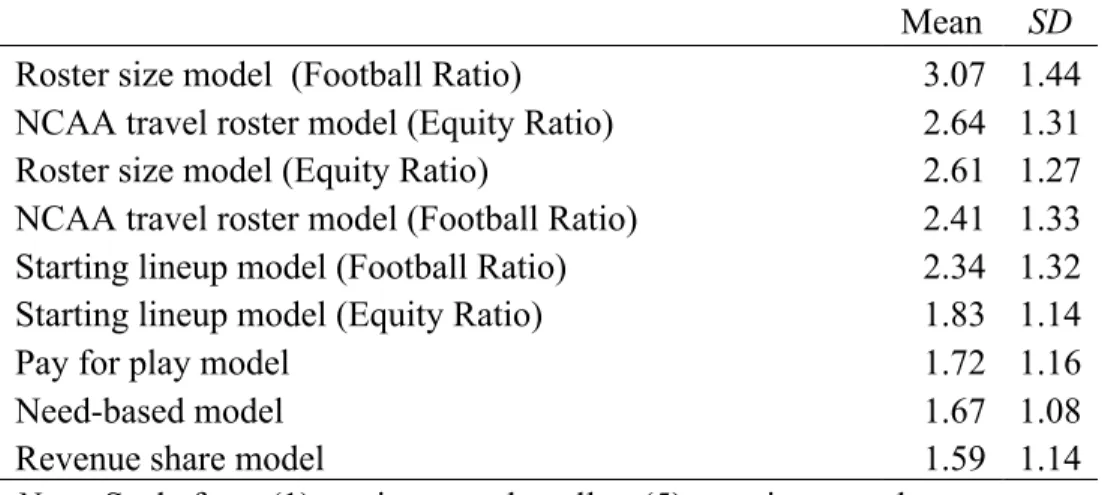
Finally, the participants were asked about nine possible alternative models and their interest in them as an alternative to the current NCAA scholarship model. The five-point Likert scale included 1 (not interested at all) to 5 (very interested). Means and standard deviations were calculated for the nine models. The participants were most interested in the football ratio roster size model (Appendix B) (M = 3.07, SD = 1.44) and least interested in a revenue share model (M = 1.59, SD = 1.14). A complete list of coach interest in alternative models is listed in Table 7.
Table 7 Preferred Alternative Model
Mean SD
Roster size model (Football Ratio) 3.07 1.44 NCAA travel roster model (Equity Ratio) 2.64 1.31
Roster size model (Equity Ratio) 2.61 1.27
NCAA travel roster model (Football Ratio) 2.41 1.33 Starting lineup model (Football Ratio) 2.34 1.32 Starting lineup model (Equity Ratio) 1.83 1.14
Pay for play model 1.72 1.16
Need-based model 1.67 1.08
Revenue share model 1.59 1.14
CHAPTER V: DISCUSSION Satisfaction with Current Scholarship Model
Although multiple scholars claim that the current scholarship model does not provide adequate compensation for student-athletes (Goplerud, 1997; Hakim, 2000; Miller, 2011; Schott, 1996; Sobocinski, 1996), the results of this study demonstrate that for the most part coaches are satisfied with the current scholarship model. However, there are some differences in the
satisfaction level between different coaching groups and between the four aspects of the
scholarship model (overall NCAA scholarship model, equivalency sport scholarship allocation, headcount sport scholarship allocation, and financial distirubtion of scholarships).
situation there wouldn’t be a need to look for a better alternative. This was evident in Table 2, which demonstrates satisfaction levels between the coaching categories.
Feedback on the Current Scholarship Model
To fill a gap that was found in the literature review related to the suggestions for reform from groups such as the Knight Commission, the Drake Group, and the Commission on
Intercollegiate Athletics that did not include the coaches perspectives (Ridpath, 2008; Sack,2009), this research asked coaches to provide feedback on the current scholarship model. The feedback from coaches was centered on areas of strength and opportunities for improvement for both the headcount sport scholarship allocation and equivalency sport scholarship models.
Coaches provided feedback on the strengths of the current headcount and equivalency scholarship allocation models. The results indicate that coaches thought the ability to provide equal scholarships to the entire team and the easier administration of scholarships were the strengths of the headcount scholarship allocation, while the results demonstrate that coaches found the
flexibility with scholarships and the ability to provide need based on a student-athlete’s situation or need as the strengths of the equivalency model. The literature focused more on the criticisms of the current scholarship model and how it doesn’t provide enough for student-athletes (Acain, 1998; Chin,1993; Kahn, 2007; Kreher, 2006; Schott, 1996; Sobocinski, 1996). The results do indicate a desire to be able to provide more for their student-athletes, however coaches indicated a desire to do it within the current framework of the amateur model.
align with the criticisms found in the literature review that the current scholarhip model violates antitrust laws, paying student-athletes, and disbanding of the amateur model (Acain, 1998; Chin,1993; Kahn, 2007; Kreher, 2006; Schott, 1996; Sobocinski, 1996). The difference in perspectives between coaches and scholars demonstrates that the perspective of those involved with scholarship model had not been taken into account previously. It further emphasizes the need for additional research into the coach perspective on any potential changes in the current
scholarship model. This research would especially helpful with input from coaches who would be considered a high referent according to Folger’s referent cognitions theory. These coaches would have the highest awareness of alternative options that would best fit their needs.
Impact of Knowledge on Satisfaction with the Scholarship Model
The theoretical foundation for this study was based on referent cognitions theory. Referent cognitions theory claims that an unfair judgment will result from a situation where an individual believes a more favorable outcome would have resulted from an alternative procedure that should have been used (Cropanzano et al., 2001). The referent is the awareness that there is a procedural alternative that would result in a more favorable outcome (Cropanzano et al., 2001). According to Folger, there are two types of referents high and low. High referents are individuals who are aware of an alternative option that would lead to a better outcome. A low referent is an individual who is not aware of an alternative option that would have led to better results (Cropanzano et al., 2001).
become more educated abut the scholarship model the more unhappy they will be with their current situation. If more coaches educate themselves about the overall NCAA scholarship model this could create more unrest with the scholarship model and lead to dynamic changes to the NCAA scholarship model. This research provides the necessary information for this discussion by providing the concerns of coaches with the current scholarship model as well as their suggestions of how to improve the model. This information can help facilitate more educated discussions about any possible changes to the NCAA scholarship model.
Future Studies
There are multiple studies that could expand upon this thesis. The next study that would best follow this would be to replicate this study but open the survey up to all Division I head and assistant coaches, rather than limiting participants to only Power-5 head and assistant coaches. The purpose of this thesis was to gather coach perspectives of the current NCAA scholarship model. The goal was to provide a new perspective that has not existed in evaluating the effectiveness of the current scholarship model. Replicating this study and opening it up to all Division I coaches will provide insights as to the broader generalizability of the findings herein. This research demonstrated a divide between revenue and non-revenue and “head count” and “equivalency” sport coaches in the Power-5 conferences which according to some would be considered the group in college athletics who should be able to provide enough for all of their sports. These additional findings would be valuable to determining if the current scholarship model is sufficient for coaches at all NCAA Division I institutions.
Another possible study would be to have further discussion with coaches and
for coaches at the Divisions II level and see how their thoughts and satisfaction compare with Division I coaches. Another potential study would be to compare satisfaction levels of Division I coaches and Division III coaches with their respective models and potential interest in switching to the other division’s scholarship model.
APPENDIX A: CURRENT NCAA SCHOLARSHIP LIMITS
Head Count Sports
FBS Football 85 Men’s Basketball 13 Women’s Basketball 15 Women’s Volleyball 12 Women’s Tennis 8 Women’s Gymnastics 12
Equivalency Sports
Men’s Sports (Bylaw 15.5.3.1.1) (NCAA Manual, 2015)
Cross Country/Track and Field 12.6 Skiing 6.3
Fencing 4.5 Soccer 9.9
Golf 4.5 Swimming & Diving 9.9
Gymnastics 6.3 Tennis 4.5
Lacrosse 12.6 Volleyball 4.5
Rifle 3.6 Water Polo 4.5
Wrestling 9.9
Women’s Sports (Bylaw 15.5.3.1.2) (NCAA Manual, 2015)
Bowling 5 Skiing 7
Cross Country/Track and Field 18 Soccer 14
Equestrian 15 Softball 12
Fencing 5 Swimming & Diving 14
Field Hockey 12 Triathlon
5.5 2016-17
Golf 6 Water Polo 8
Lacrosse 12 Rowing 20
APPENDIX B: THESIS SURVEY
Q1) How knowledgeable are you about the numeric scholarship limits for your sport?
• Very Knowledgeable – I know the number of scholarships allowed and the related
regulations.
• Somewhat Knowledgeable – I know the number of scholarships allowed but am not
confident in the details of the regulations.
• Minimally Knowledgeable – I vaguely understand the numeric scholarship limits
and regualtions.
Q2) How knowledgeable are you about the numeric scholarship limits for sports other than your own?
• Very Knowledgeable – I know the number of scholarships for other sports allowed
and the related regulations.
• Somewhat Knowledgeable – I know the number of scholarships for other sports
allowed but am not confident in the details of the regulations.
• Minimally Knowledgeable – I vaguely understand the numeric scholarship limits
for other sports and the regulations.
Q3) How knowledgeable are you about the sports that are listed as headcount sports?
• Very Knowledgeable – I know what sports are listed as headcount and equivalency
sports in the current NCAA scholarship model.
• Somewhat Knowledgeable – I know a few of the sports that are listed as headcount
and equivalency sports in the current NCAA scholarship model
• Minimally Knowledgeable – I vaguely know the sports that are listed as headcount
and equivalency sports in he current NCAA scholarship model Q4)OVERALL NCAA SCHOLARSHIP MODEL
Please indicate your level of satisfaction with the following scholarship allocation practice:
• Current numeric scholarship limits on the number of scholarships that can be
allocated per sport as set by the current NCAA scholarship model? Follow up – with not satisfied/neutral
Would you like to see the limits increased or decreased? Q5)HEADCOUNT SCHOLARSHIP ALLOCATION MODEL
Please indicate your level of satisfaction with the following scholarship allocation practice:
• The “headcount sport” scholarship allocation model wherein all scholarship
recipients in football, men’s basketball, women’s basketball, gymnastics, volleyball, and women’s tennis are counted as if each player is on a full grant-in-aid.
Follow up (All):
Would you like to see other sports be designated as “headcount sports”? If yes, what sports?
• What are the strengths of having the current “headcount sport” scholarship
allocation model?
• What could be improved upon by modifying the current “headcount sport”
Q6)EQUIVALENCY SPORT SCHOLARSHIP ALLOCATION MODEL
Please indicate your level of satisfaction with the following scholarship allocation practice:
• The “equivalency sport” scholarship allocation model wherein all sports (except
those listed in previous bulleted section) are given a designated number of scholarships to divide amongst the entire roster?
Follow up (All):
Would you like to see other sports be designated as “equivalency sports”? If yes, what sports?
• What are the strengths of having the current “equivalency sport” scholarship
allocation model?
• What could be improved upon by modifying the current “equivalency sport”
scholarship allocation model? Follow up (All):
In your opinion, which scholarship model treats ALL student-athletes the most fairly?
• Headcount model • Equivalency model • Other (Open) • Follow up: Why?
FINANCIAL DISTRIBUTION OF SCHOLARSHIPS
Q7) What is your satisfaction level with the distribution of scholarship dollars based on the current financial and numeric scholarship limits in the NCAA scholarship model allocations?
Follow up with not satisfied/neutral: Why are you not satisfied with the current distribution of scholarship dollars?
Q8) What is your satisfaction level with the distribution of scholarship dollars between sports at your institution?
Follow up with not satisfied: Why are you not satisfied with the current distribution of scholarship dollar?
Q9) What does the average scholarship package include for your sport? Scale
0-100% tuition 0-100% books 0-100% room 0-100% board
0-100% cost of attendance 0-100% fees
0-100% other expenses
Q10) Do you offer multi-year scholarships?
Would you support your ideal number of scholarships if you knew the institution could not afford it, but other institutions did?
ALTERNATIVE SCHOLARSHIP MODELS
Q13) What would your interest level be in the following possible alternative models to the current scholarship model from your most preferred.
• Pay for play model – A model where student-athletes are not given scholarships but instead
are compensated as if they were an employee/professional athlete.
• Revenue share model – A model where student-athletes would receive a percentage of the
revenue from their program to provide them with additional compensation
• Need-based model – A model where no aid is provided for athletic ability. The only
financial aid is provided from the institution for merit or need-based aid.
• Roster Size Model (Football Ratio) – A scholarship allocation model based on roster size.
Scholarship allocations for all sports would be assigned based on football’s ratio (0.72) of numeric scholarship limit (85) to its average roster size (117.5). (For example: Baseball’s Average Roster Size is 36.1 and current scholarship limit is 11.7. In this model 36.1 x .72 = 26.1 scholarships)
• Roster Size Model (Equity Ratio) – A scholarship allocation model based on roster size.
Scholarship allocations for all sports would be assigned based on the ratio (0.38) of total number men’s and women’s scholarships (440.3) to the total average roster sizes for men’s and women’s sports (1164.3). (For example: Baseball’s Average Roster Size is 36.1 and current scholarship limit is 11.7. In this model 36.1 x .38 = 13.7 scholarships)
• NCAA Travel Roster Model (Football Ratio) – A scholarship allocation model based on
travel squad limits. Scholarship allocations for all sports would be assigned based on football’s ratio (1.42) of numeric scholarship limit (85) to its travel squad size (60). (For example: Baseball’s Travel Squad Size is 27 and current scholarship limit is 11.7. In this model 27 x 1.42 = 38.3 scholarships) *Does not include sports that do not have travel squad limits
• NCAA Travel Roster Model (Equity Ratio) – A scholarship allocation model based on
travel squad limits. Scholarship allocations for all sprts would be assigned based on the ratio (0.66) of total number men’s and women’s scholarships (380.3) to the total travel squad sizes for men’s and women’s sports (578). (For example: Baseball’s Travel Squad Size is 36.1 and current scholarship limit is 11.7. In this model 27 x 0.66 = 17.8
scholarships) *Does not include sports that does not have travel squad limits
• Starting Lineup Model (Football Ratio) – A scholarship allocation model based on startling
lineups. Scholarship allocations for all sports would be assigned based on football’s ratio (3.54) of numeric scholarship limit (85) to its starting lineup (24). (For example: Baseball’s starting lineup is 10 and the current scholarship limit is 11.7. In this model 10 x 3.54 =35.4 scholarships) *Does not include sports that do not have starting lineups
• Starting Lineup Model (Equity Ratio) - A scholarship allocation model based on starting
APPENDIX C: THESIS INVITATION EMAIL Alternative Scholarship Models
Dear Coach (Last Name)
My name is Jonathan Teich and I am a graduate student at the University of North Carolina at Chapel Hill and currently work for the Athletic Director as the Administration Intern. My team of researchers and I are interested in examining the perspective of current college coaches on the current NCAA Scholarship Model and their thoughts on the possibility of alternative models. In order to achieve this objective, we are conducting an online survey that should take approximately 5 minutes to complete. You have been selected to represent your elite institution in the sample, and your input is critical. As data analysis is complete, we will be happy to share the study results with you if you indicate interest at the conclusion of the survey.
By clicking the link to the survey below, you agree to be a participant in this research study.
https://unc.az1.qualtrics.com/SE/?SID=SV_08wrg41WzHqBfud
Your participation is voluntary, and you may skip any question for any reason. Your identity and responses will be confidential. If you have any questions or concerns about the study, please feel free to contact me directly by email ([email protected]) Further, you may also contact the UNC Institutional Review Board by phone (919-966-3113) or email ([email protected]) if you have questions or concerns about your rights as a research subject referencing study # 16-0381.
Sincerely,