Indian Journal of Public Health Research & Development
EXECUTIVE EDITOR
Prof Vidya Surwade
Associate Professor, Dr Baba Saheb Ambedkar, Medical College & Hospital, Rohinee, Delhi INTERNATIONAL EDITORIAL ADVISORY BOARD
1. Dr. Abdul Rashid Khan B. Md Jagar Din, (Associate Professor)
Department of Public Health Medicine, Penang Medical College, Penang, Malaysia 2. Dr. V Kumar (Consulting Physician)
Mount View Hospital, Las Vegas, USA 3. Basheer A. Al-Sum,
Botany and Microbiology Deptt, College of Science, King Saud University, Riyadh, Saudi Arabia
4. Dr. Ch Vijay Kumar (Associate Professor)
Public Health and Community Medicine, University of Buraimi, Oman 5. Dr. VMC Ramaswamy (Senior Lecturer)
Department of Pathology, International Medical University, Bukit Jalil, Kuala Lumpur 6. Kartavya J. Vyas (Clinical Researcher)
Department of Deployment Health Research, Naval Health Research Center, San Diego, CA (USA) 7. Prof. PK Pokharel (Community Medicine)
BP Koirala Institute of Health Sciences, Nepal
NATIONAL SCIENTIFIC COMMITTEE
1. Dr. Anju D Ade (Professor)
Community Medicine Department, SVIMS, Sri Padamavati Medical College,Tirupati, Andhra Pradesh.
2. Dr. E. Venkata Rao (Associate Professor) Community Medicine, Institute of Medical Sciences & SUM Hospital, Bhubaneswar, Orissa. 3. Dr. Amit K. Singh (Associate Professor) Community Medicine,
VCSG Govt. Medical College, Srinagar – Garhwal, Uttarakhand 4. Dr. R G Viveki (Associate Professor) Community Medicine,
Belgaum Institute of Medical Sciences, Belgaum, Karnataka 5. Dr. Santosh Kumar Mulage (Assistant Professor)
Anatomy, Raichur Institute of Medical Sciences Raichur(RIMS), Karnataka 6. Dr. Gouri Ku. Padhy (Associate Professor) Community and Family
Medicine, AII India Institute of Medical Sciences, Raipur 7. Dr. Ritu Goyal (Associate Professor)
Anaesthesia, Sarswathi Institute of Medical Sciences, Panchsheel Nagar 8. Dr. Anand Kalaskar (Associate Professor)
Microbiology, Prathima Institute of Medical Sciences, AP 9. Dr. Md. Amirul Hassan (Associate Professor)
Community Medicine, Government Medical College, Ambedkar Nagar, UP 10. Dr. N. Girish (Associate Professor) Microbiology, VIMS&RC, Bangalore 11. Dr. BR Hungund (Associate Professor) Pathology, JNMC, Belgaum. 12. Dr. Sartaj Ahmad (Assistant Professor),
Medical Sociology, Department of Community Medicine, Swami Vivekananda Subharti University, Meerut,Uttar Pradesh, India
13. Dr Sumeeta Soni (Associate Professor)
Microbiology Department, B.J. Medical College, Ahmedabad, Gujarat,India
NATIONAL EDITORIAL ADVISORY BOARD
1. Prof. Sushanta Kumar Mishra (Community Medicine) GSL Medical College – Rajahmundry, Karnataka
2. Prof. D.K. Srivastava (Medical Biochemistry)
Jamia Hamdard Medical College, New Delhi
3. Prof. M Sriharibabu (General Medicine) GSL Medical College, Rajahmundry, Andhra Pradesh
4. Prof. Pankaj Datta (Principal & Prosthodentist)
Indraprastha Dental College, Ghaziabad
NATIONAL EDITORIAL ADVISORY BOARD
5. Prof. Samarendra Mahapatro (Pediatrician)
Hi-Tech Medical College, Bhubaneswar, Orissa
6. Dr. Abhiruchi Galhotra (Additional Professor) Community and Family Medicine, AII India Institute of Medical Sciences, Raipur
7. Prof. Deepti Pruthvi (Pathologist) SS Institute of Medical Sciences & Research Center, Davangere, Karnataka
8. Prof. G S Meena (Director Professor)
Maulana Azad Medical College, New Delhi
9. Prof. Pradeep Khanna (Community Medicine)
Post Graduate Institute of Medical Sciences, Rohtak, Haryana 10. Dr. Sunil Mehra (Paediatrician & Executive Director)
MAMTA Health Institute of Mother & Child, New Delhi
11. Dr Shailendra Handu, Associate Professor, Phrma, DM (Pharma, PGI Chandigarh)
12. Dr. A.C. Dhariwal: Directorate of National Vector Borne Disease Control Programme, Dte. DGHS, Ministry of Health Services, Govt. of India, Delhi
Print-ISSN: 0976-0245-Electronic-ISSN: 0976-5506, Frequency: Quarterly (Four issues per volume)
Indian Journal of Public Health Research & Development is a double blind peer reviewed international journal. It deals with all aspects of Public Health including Community Medicine, Public Health, Epidemiology, Occupational Health, Environmental Hazards, Clinical Research, and Public Health Laws and covers all medical specialties concerned with research and development for the masses. The journal strongly encourages reports of research carried out within Indian continent and South East Asia.
The journal has been assigned International Standards Serial Number (ISSN) and is indexed with Index Copernicus (Poland). It is also brought to notice that the journal is being covered by many international databases. The journal is covered by EBSCO (USA), Embase, EMCare & Scopus database. The journal is now part of DST, CSIR, and UGC consortia.
Website : www.ijphrd.com
©All right reserved. The views and opinions expressed are of the authors and not of the Indian Journal of Public Health Research & Development. The journal does not guarantee directly or indirectly the quality or efcacy of any product or service featured in the advertisement in the journal, which are purely commercial.
Editor
Dr. R.K. Sharma
Institute of Medico-legal Publications
Logix Office Tower, Unit No. 1704, Logix City Centre Mall, Sector- 32, Noida - 201 301 (Uttar Pradesh) Printed, published and owned by
Dr. R.K. Sharma
Institute of Medico-legal Publications
Logix Office Tower, Unit No. 1704, Logix City Centre Mall, Sector- 32, Noida - 201 301 (Uttar Pradesh) Published at
Institute of Medico-legal Publications Logix Office Tower, Unit No. 1704, Logix City Centre Mall, Sector- 32, Noida - 201 301 (Uttar Pradesh)
Indian Journal of Public Health
Research & Development
www.ijphrd.com
Contents
Volume 10, Number 4
April 2019
I
1. A Study of Experiences of Beneficiaries, Enrollees and Stakeholders of Tamil Nadu Chief Minister’s Comprehensive Health Insurance Scheme (CMCHISTN) : A Qualitative Study ... 01 P Shirisha
2. Effectiveness of Self Myofascial Release, Static Stretching and Neural Tissue Mobilization on
Hamstring Flexibility in Athletes ... 06 Gatha Patel, Khushboo Bathia, Smita Kanase, Amrutkuvar Pawar, Vishnupriya Deshpande,
Prachi Jain
3. Effect of Ground Level Reverse Treadmill Walking Versus Incline Reverse Treadmill Walking as an Adjunct to Conventional Physiotherapy in Chronic Knee Osteoarthritis Subjects ... 12 Amruta Khilwani, Amrutkuvar Pawar, Trupti Warude, Khushboo Bathia
4. Influence of Dietary Solvents on the Strength of Nanofill, Microfill and Minifill Composites ... 19 Ayush Razdan Singh, Raazia Khan, B Rajkumar, K K Dixit, Gayathri S Jethwani, Alok Mishra
5. A Study of Factors affecting Online Shopping in Chennai ... 24
V. Andal, G. Mythili
6. Perceived Benefits & Risks of Online Grocery Shopping: Role of Cognitive Influences ... 29 Sneha Ghai, Somya Tripathi
7. Effect of Barefoot Functional Rehabilitation in Flat Foot among Obese Women ... 36 Hemali Patel, S Anandh
8. Effect of Core Stability Exercise Programme Using Swiss Ball, Theraband and Floor Exercises on Abdominal Girth and Core Strength in Post Menopausal Women ... 41 Vishakha Panchal, Amrutkuvar Pawar, Trupti Warude, Khushboo Bathia
9. A Community based Cross Sectional Study to Assess the Association between Indices of Obesity and Hypertension ... 48 Arun Varghese, Prakash M Durgawale, Satish V Kakade, Dhirajkumar A Mane, Supriya S Patil
10. Attitude Towards Ageing among Older Population ... 54 B Jayabharathi, Nisha Yadav, Tharageshwari, Buvana
11. Impact of Farm Technology on Rice Production in Madurai District, Tamilnadu ... 60 S Thangamayan, B Chithirairajan, S Sudha
12. A System Dynamics Approach to Understand Respiratory Health Risk in Rural Population ... 65 Snehlata Tigala, Anu Rani Sharma, Kamna Sachdeva
VI
71. Seroprevalence of HBV, HCV, and HIV among Blood Donors in Main Blood Bank in Najaf Province, Iraq ... 385 Rana Talib Al-Nafakh, Shaymaa Abdul lteef Al-Fadhul,Hashim Ali Abdulameer Al-Sherees,
Alaa H. Al-Charrakh
72. System Analysis of Public Health Surveillance in School-Age Children ... 391 Arief Hargono, Kurnia Dwi Artanti, Fariani Syahrul
73. Dental Health Behavior in Elderly based on Demographic Characteristics ... 397 Aulia Feresia Mauline, Taufan Bramantoro, Retno Palupi
74. Cryoglobulin Responses and Herd Immunity Plots among Periodontitis Patients ... 402 Baha, Hamdi Hakim Al-Amiedi, IMS Shnawa, Zainb, M. Hameed
75. Effect of Obesity in the Mode of Delivery ... 406 Ban Amer Mousa
76. Post- Traumatic Stress Disorder among Women with Breast Cancer in Iraq: A Preliminary Report ... 411 Aqeel S. Mahmood, Mushtaq T. Hashim, Eman A. Al-Kaseer
77. Molecular Diagnosis and Phylogenetic Analysis of 5.8s rDNA Gene of Cutaneous Leishmaniasis Species in Holy Karbala/Iraq ... 414 Dhamiaa Maki Hamza, Laith Hasan Obayes, Fadhil Sami Zghair
78. Association of Certain HLA –II/ DR Alleles with Incidence of Thyroiditis in Iraqi Patients ... 420 Samir S. Raheem; Mussa M. Alkhatib, Mohammed M. Alomari
79. Factors Associated with Self-Empowerment among Patients with Diabetes Mellitus in South
Kalimantan ... 423 Endang Sri Purwati Ningsih, Syamsul Firdaus
80. Irisin, Resistin and 25-Hydroxyvitamin D in Iraqi Obese and Non-Obese Type 2 Diabetic Patients .. 428 Gumar O Zamil, Halla G Mahmmod, Basil O Saleh
81. Diagnostic Value of Clinical Assessment in Comparison to Ultrasound in Meniscal Injury ... 433 Mahmoud Khudair Yaseen, Faiq I. Gorial
82. Legal Protection of Midwives Based on Professional Justice in Midwifery Practices ... 437 Fitriani Nur Damayanti, Absori, Kelik Wardiono
83. Study of Biochemical Criteria of Blood for Thalassemia Patients ... 442 Hanan Jassim Hammod, Zainab Kareem Al-Kazazz, Hassan A Farman
84. Performance Analysis of Indonesian Public Hospitals: A Panel Data Method ... 447 Jon Hendri Nurdan, Sjafrizal, Hefrizal Handra,Hardisman Dasman
85. Evaluation of Platelet Rich Fibrin Effect in the Bone Density after Teeth Extraction by Cone Beam Computed Tomography ... 453 Kamal Saheb Mezal, Sahar Shakir Al-Adili, Ali S. Al-Haddad
86. Future Ready Strategy Development and Healthcare Performance An Evidence from Private Healthcare Sector in Iraq ... 457 Hashim Fawzi Dabbas, Safa Tayeh Muhemmed
Performance Analysis of Indonesian Public Hospitals:
A Panel Data Method
Jon Hendri Nurdan1, Sjafrizal2, Hefrizal Handra2 Hardisman Dasman3
1Student of Doctoral Program of Public Health Sciences, Faculty of Medicine, 2Department of Economic
Studies, Faculty of Economics, 3Department of Community Medicine and Public Health, Faculty of Medicine,
Andalas University, Padang, Indonesia
Abstract
Balanced Score Card approach to health sector organizations measures performance based on financial and non-financial aspects which are divided into four perspectives, namely customer perspective, business and internal process perspectives, learning and growth perspectives, and financial perspective. The study uses a quantitative approach with panel data regression analysis. Panel data is used to analyze the hospital performance with balanced scorecard approach in Indonesian public hospitals, based on patient satisfaction, service quality, human resources competencies and cost efficiency. Data analysis used the cross section data of 14 public hospitals in Indonesia and the time series data from 2015 to 2017 so that there are longitudinal data as many as 42 data. Based on the results of panel data regression analysis concluded that significantly patient satisfaction, service quality, human resources competencies and cost efficiency affect the hospital performance and they are the critical success factors of hospital performance with balanced scorecard approach in Indonesian Public Hospital.
Keywords : Health Sector Organization, Balanced Scorecard, Hospital Performance
Corresponding author:
Hardisman Dasman, MD, MHID, DrPH Department of Community Medicine and Public Health, Faculty of Medicine, Andalas University, Padang, Indonesia.
Email: [email protected]
Introduction
Kaplan in 2001 states that balanced scorecard approach could be used in health sector organizations and non-profit organizations with the modification of balanced scorecard according to the characteristics of the organization itself. Modifications to balanced scorecard are very necessary because organizational characteristics in the private sector and public sector are different where the private sector prioritizes financial perspectives.(1, 2)
Balanced scorecard approach has been used in many health service sectors, both profit and non-profit, including: a) Hospitals; b) Health Service System; c) University Hospital / Department of Health; d) Long-term Services; e) Center for Mental Health; f) Pharmacy
Services; g) Health Insurance Company. (3)
Hospitals as public service institutions must to implement a performance management that is oriented to patient satisfaction. Indonesia public hospitals must be able to create superior performance or performance excellence, as well as hospitals as providers of health services through the provision of services in accordance with service standards. One of the strategies carried out by hospital managers in increasing patient satisfaction is service quality.(4)
The central public hospitals as one of the government
agencies must be able to provide accountability to the government and the community as service users. Therefore there needs to be a performance measurement that covers all aspects. Balanced scorecard is the right choice for measuring performance from both financial and non-financial aspects.(4)
Balanced Scorecard approach to public sector organizations measures performance based on financial and non-financial aspects which are divided into four perspectives, namely customer perspective, business
448 Indian Journal of Public Health Research & Development, April 2019, Vol. 10, No. 4
and internal process perspectives, learning and growth perspectives, and financial perspective. Financial perspective looks at performance from the point of view of profitability in achieving financial targets, so it is based on sales growth, return on investment, operating income, cash flow, and cost efficiency. Customer perspective is based on patient satisfaction, customer profitability, customer retention, and market share. Business and internal process perspectives identify critical factors in the organization’s internal processes by focusing on developing new processes that are customer needs. Service efficiency, service effectiveness and service quality are things that must be developed and improved to achieve the goals of increasing value for customers and stakeholders. learning and growth perspective measures factors related to technology, development of human resources, systems and procedures, and other factors that need to be updated.(4)
Research conducted by Aurora seeks to implement balanced scorecard for use in public sector organizations. The results of the study indicate that performance measurement using balanced scorecard is better than using traditional performance measurements. Balanced scorecard is deemed appropriate to be used as a tool to measure public sector performance because it not only emphasizes the quantitative-financial aspects, but also considers the qualitative and non-financial aspects. This is in line with the objectives of the public sector which places profits not only as a key performance measure, but services that tend to be qualitative and non-financial(4)
The Mackay Memorial Hospital in Taiwan shows that balanced scorecard approach is useful in order to sharpen its competitive advantage. It helps to take a more strategic approach that would differentiate services and attract more business. Balanced scorecard approach also improve collaboration and communication between all levels of key stakeholders and staff.(5)
Hogland Hospital in Swedia also uses balanced scorecard as a tool to measure financial control and service quality improvement, along with human resources developments. At first, balanced scorecard was used as a two-year trial but continued because of the success of the trial. (6)
This study aims to analyze the hospital performance with balanced scorecard approach in Indonesian public hospitals, based on patient satisfaction, service quality,
human resources competencies and cost efficiency.
Method
This study uses a quantitative approach with panel data regression analysis to determine factors that affect hospital performance with balanced scorecard approach in Indonesia public hospital. Data analysis used the cross section data of 14 public hospitals in Indonesia and the time series data from 2015 to 2017 so that there are longitudinal data as many as 42 data.
Data used for analysis is secondary data in the form of government agency performance accountability report, annual report, business strategy plan, and budget business plan from 2015 to 2017 at Indonesian Public Hospital. The following are described in the stages of this research.
Results
Panel data regression analysis in this study is used to analyze several variables that affect the hospital performance based on four perspectives of balanced scorecard, which is based on previous theory and the results of previous studies. The independent variables used in panel data regression analysis in this research were patient satisfaction, service quality, human resources competencies and cost efficiency during 2015 to 2017.
Hospital performance variable is proxied from the percentage of hospital performance achievement figures based on indicator of public service agency. Patient satisfaction is proxied from the ratio of community satisfaction index assessment results divided by the maximum scale of the community satisfaction index value. Service quality are proxied from the ratio of each indicator of service timeliness, namely outpatient waiting time, emergency response time, length of stay, waiting time for radiology services, waiting time for laboratory service, waiting time before surgery, and speed of prescription services for finished drugs. Human resources competencies is proxied from the ratio of the number of hospital human resources divided by the number of human resources according to the hospital’s minimum service standard. Cost efficiency is proxied from the ratio of PNPB income divided by operating costs. Data used in this study are time series data for three periods (2015-2017) and cross section data as many as 14 RSUP. So that the longitudinal data is 42 data.
Indian Journal of Public Health Research & Development, April 2019, Vol. 10, No. 4 449
One of the requirements in panel data regression analysis is that data must be met with normal elements. Data that is not met by normality, usually due to data that has extreme values or outliers or is also commonly used in terms of outliers. The purpose of this normality test is as a tool to see whether the standardized residual values on the model are normal or not. To find out, it can be seen with most of the standardized residual values approaching the mean.
Normality test in this study was carried out by using the graph method and histogram with Jarque-Bera test. Dependent variable is the average value of hospital performance depicted in the graph as the vertical axis. The horizontal axis shows standardized residual values. To see whether the distribution of data found to be normal or not is seen from the value of Jarque-Bera and its probability value. Data is not normally distributed if the statistical test results obtained p-value <0.05. Whereas, if the statistical test results obtained p-value > 0.05 then data is normally distributed. Based on the statistical test results, Jarque-Bera value is 0.625919 and p-value is 0.731280 (> 0.05), it can be concluded that data is normally distributed and panel data regression analysis can or is feasible.
Regression equations can be estimated using three models, namely Common Effect Model (CEM), Fixed Effect Model (FEM), and Random Effect Model (REM). Common effect model and fixed effect model are estimated using panel least squares method, while random effect model is estimated using GLS method. Of the three models, one of the more appropriate models will be chosen to be used in analyzing the factors that influence the hospital performance using balanced scorecard approach in Indonesian public hospitals. Which approach estimation model will be used in analyzing the factors that influence the hospital performance with balanced scorecard approach in Indonesian public hospitals depending on the results of model selection. The selection of this model is done by testing the model using Chow test, Hausman test, and Lagrange Multiplier (LM) test.
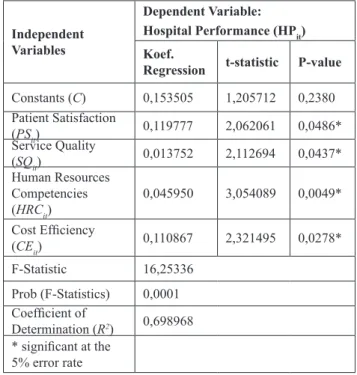
Table 1: Regression Model for Performance Analysis of Indonesian Public Hospital with Random Effect Model
Independent Variables
Dependent Variable: Hospital Performance (HPit)
Koef.
Regression t-statistic P-value Constants (C) 0,153505 1,205712 0,2380 Patient Satisfaction (PSit) 0,119777 2,062061 0,0486* Service Quality (SQit) 0,013752 2,112694 0,0437* Human Resources Competencies (HRCit) 0,045950 3,054089 0,0049* Cost Efficiency (CEit) 0,110867 2,321495 0,0278* F-Statistic 16,25336 Prob (F-Statistics) 0,0001 Coefficient of Determination (R2) 0,698968 * significant at the 5% error rate
Redundant fixed effect test/chow test shows that the probability of cross-section chi-square is 0.0003 (<0.05), it can be concluded that the most appropriate model used between common effect and fixed effect is fixed effect.
Correlated random effect test/hausman test shows that the probability of cross-section random is 0.3478 (<0.05), it can be concluded that the most appropriate model used between fixed effect and random effect is random effect.
Omitted random effect test/lagrange multiplier test shows that the probability of cross-section breusch-pagan is 0.0017 (>0.05), it can be concluded that the most appropriate model used between common effect and random effect is random effect. Based on chow test and hausman test, it can be concluded that the most appropriate model used for panel data regression analysis in this study is random effect model.
Model that has been prior to analysis is conducted prior classical assumptions underlying panel data regression model in order to obtain a model that is efficient, visible and consistent. With the Random Effect model selected, it is not relevant to do the Classic Assumption test. This is because the Random Effect model uses the estimated Generalized Least Square (GLS) method. GLS technique can overcome
450 Indian Journal of Public Health Research & Development, April 2019, Vol. 10, No. 4
the time series autocorrelation and correlation between observations (cross section). GLS method produces an estimator to fulfill the Best Linear Unbiased Estimation (BLUE) characteristic which is a treatment method to overcome violations of heteroscedasticity assumptions and autocorrelation.
Goodness of fit test in this study consisted of three tests. There are F-statistic, t-statistic and coefficient of determination. F-statistic test was conducted to determine whether the independent variables in the overall significantly affect the dependent variable.
Based on Table 1. the probability of F-statistic is 0.0001 (<0.05). It can be concluded that the regression model is used to explain the effect worthy of patient satisfaction, service quality, human resources competencies and cost efficiency of the hospital performance. t-statistic test was done to see how far the influence of independent variables individually explain the variations of dependent variable. Table 5 shows that patient satisfaction (p=0.0486), service quality (p=0.0437), human resources competencies (p=0.0049), and cost efficiency (p=0.0278) significantly
affect the hospital performance.
Coefficient of determination test was conducted to measure that the independent variables in the regression model was able to explain the dependent variable. Table 1 shows that the value of R2 is 0.698968, it means
patient satisfaction, service quality, human resources competencies and cost efficiency has an influence on the proportion of hospital performance by 69.90%. Indeed, 1.57% is influenced by other variables that are not in the regression model.
The regression equation (1) indicates that HPit is the hospital performance, PSit is patient satisfaction, SQit is
service quality, HRCit is human resources competencies and CEit is cost efficiency. β0 is the regression coefficient constants, β1 is the regression coefficient of patient satisfaction, β2 is the regression coefficient of service quality, β3 is the regression coefficient of human resources competencies and β4 is the regression coefficient of cost efficiency. t0 is the t-statistic constants, t1 is the t-statistic of patient satisfaction, t2 is the t-statistic of service quality, t3 is the t-statistic of human resources competencies and t4 is the t-statistic of cost efficiency.
The regression equation (2) means that for any increase in patient satisfaction indicator by 1 if the other variable is assumed to remain, the hospital performance will increase by 0.119777. Any increase in service quality indicator by 1 if the other variable is assumed to remain, the hospital performance will increase by 0.013752. Any increase in human resources competencies indicator by 1 if the other variable is assumed to remain, the hospital performance will increase by 0.045950. Any increase in cost efficiency indicator by 1 if the other variable is assumed to remain, the hospital performance will increase by 0.110867.
Discussion
Ramon-Jeremino et al. shows that the balanced
scorecard would allow a proper monitoring and tracking system for the main healthcare indicators. This contributes to a better control in comparison with standards that are associated with adequate quality assistance. It is necessary to adapt the balanced scorecard to the specific characteristics of the clinical field, redefining both perspectives and indicators. (7)
Chang and Wu examined the implementation of the Balanced Scorecard in hospital cases in Taiwan. In order to improve its competitive position, hospitals began implementing the Balanced Scorecard in 2001. This was the first hospital to implement the Balanced Scorecard in the health system in Taiwan and one of the few successful implementations. The hospital is a pioneer in implementing the Balanced Scorecard
Indian Journal of Public Health Research & Development, April 2019, Vol. 10, No. 4 451
for health organizations in Taiwan. Furthermore, the implementation of the Balanced Scorecard in hospitals is for all entities, not just for certain departments. The implementation of the Balanced Scorecard is initiated and evaluated through four sequential phases, which take a complete eight years. By identifying the determinants of success, it can overcome some serious challenges and difficult conditions faced by the Balanced Scorecard that will be implemented. (5)
Edward et al. began examining trends from 29 key performance indicators over a period of 5 years (2004-2008). The findings show that the Balanced Scorecard was successfully used to increase the capacity of the health and service systems through the performance of benchmarking over a 5-year research period. The most important thing is that the use of the Balanced Scorecard helps to show the effects of investment, facilitates policy changes, and culture-based decision making in the primary health care system in Afghanistan. Furthermore, the researchers reminded that the continued success of the Balanced Scorecard in Afghanistan will greatly depend on the ability to accommodate all changes in existing health system policies. (8)
Edward et al. also stated that significantly there was an increase in the domain of patient and community satisfaction with services with p <0,0001. There was also a significant increase in the service quality domain from 2004-2008 with p <0,0001. The availability of drugs, equipment, clinical guidelines, laboratory use, and knowledge of service providers and training shows a significant increase since 2004. (8)
According to Bitner argues that perceived service quality is the result of a comparison of performance and received by consumers from service providers.(9) Oliver and Burke state that overall service
quality is determined by the suitability of desires that result from a comparison of wants and performance perceived by consumers. Quality services will create satisfaction for service users who can ultimately provide benefits, including harmonious relationships between service providers and customers, providing a solid basis for repurchase, and creating customer loyalty. (10)
Conclusion
Patient satisfaction, service quality, human resources competencies and cost efficiency affect the hospital performance significantly and they are the critical
success factors of hospital performance with balanced scorecard approach in Indonesian Public Hospital.
Conflict of Interest Statement: The authors declare that there is no conflict of interest.
Ethical Clearance: Research ethics approval was obtained from the Faculty of Medicine, University of Andalas Padang, granted number 352/UN.14.2/ KEP/2018.
Source of Funding: The study was funded by Center of Standardization and Continuous Education of Indonesian Ministry of Health of Indonesia and The Government of Bengkulu Province.
References
1. Kaplan RS, Norton DP. Transforming the balanced scorecard from performance measurement to strategic management: Part I. Accounting horizons. 2001 Mar;15(1):87-104.
2. Kaplan RS, Norton DP. Transforming the balanced scorecard from performance measurement to strategic management: Part II. Accounting horizons. 2001 Jun;15(2):147-60.
3. Zelman WN, Pink GH, Matthias CB. Use of the balanced scorecard in health care. Journal of health care finance. 2003;29(4):1-6.
4. Aurora N, Rahardja R. Penerapan Balanced Scorecard Sebagai Tolak Ukur Pengukuran Kinerja (Studi Kasus Pada RSUD Tugurejo Semarang) (Doctoral dissertation, Universitas Diponegoro).
5. Chang W, Kuo T, Wu A. The Successes in Long-Term Implementation of Balanced Scorecard: A Healthcare Organization Study. Social science Library. 2009.
6. McDonald B. Review of the Use of the Balanced Scorecard in Healthcare. BMCD Consulting: Newcastle, UK. 2012 Apr.
7. Ramon-Jeronimo JM, Florez-Lopez R, Dominguez-Lario N. Usefulness of the budget and the balanced scorecard in managing Primary Care Centres. Impact on staff motivation. Atencion primaria. 2018;50(3):166-75
8. Edward A, Kumar B, Kakar F, Salehi AS, Burnham G, Peters DH. Configuring balanced scorecards for measuring health system performance: evidence from 5 years’ evaluation in Afghanistan. PLoS
452 Indian Journal of Public Health Research & Development, April 2019, Vol. 10, No. 4
medicine. 2011 Jul 26;8(7):e1001066.
9. Bitner MJ. Evaluating service encounters: the effects of physical surroundings and employee responses. the Journal of Marketing. 1990 Apr 1:69-82.
10. Oliver RL, Burke RR. Expectation processes in satisfaction formation: A field study. Journal of Service Research. 1999 Feb;1(3):196-214.