J
OURNAL OF
P
RISON
E
DUCATION
&
R
EENTRY
Dialogue for researchers & practitioners
Painting by an incarcerated
artist in Ireland
Vol 5
No 1
June 2018
FEATURE--HISTORICAL VIGNETTE
An Example: Why the History of Prison Reform is Called “The Hidden Heritage”
by THOM GEHRING
California State University, San Bernardino, USA
The definitive political biography of reform warden Thomas Mott Osborne—Tannenbaum, F. [1933]. Osborne of Sing Sing. Chapel Hill: University of North Carolina Press—was acquired by the United States Library of Congress (LOC) in its year of publication. In 2005 the Center for the Study of Correctional Ed-ucation director (the current author) told a New York State jails educator about it. The book had clearly not been read before and an LOC librarian confirmed from the record that it had not been borrowed until then. That book has an introduction by US president Franklin Delano Roosevelt. The president had been a close friend of Osborne’s. In other words, no one, not even presidential historians, was aware of, or took the time to learn, about a very important prison reformer and prison educator. The rest of this vignette is based on the Tannenbaum book.
In 1913, after being requested by the prisoners at New York’s maximum security Auburn Prison, and with the warden’s permission, Osborne helped the prisoners organize themselves into what they later called the Auburn Prison Mutual Welfare League. The League developed their own constitution, elected represen-tatives from each prison shop and a slate of League officers, and managed the prison democratically. It was a great success. Osborne went on to be warden at the infamous Sing Sing Prison in 1915, and later at the U.S. Naval Prison in Portsmouth, New Hampshire. At these locations the prisoners also developed their own Mutu-al Welfare Leagues, and then the Auburn, Sing Sing, and NavMutu-al Prison Leagues were in touch with each other. They even organized an “outside branch” in the free community. It was a consolidated, four site League, a system which demonstrated that the best security system is a good organizational culture. That system made a silent film called The Right Way in 1921, on how to do prison reform. It got a very good, half-page review in the New York Times. Together, the Leagues generated a great deal of public discussion throughout the U.S. on the positive results of shared management in prisons and the benefits of treating prisoners as people. This was a front page topic in many newspapers around the US. But, because of the dominant “coercion only” paradigm in the nation, that whole tradition was relegated to the hidden heritage of prison reform and prison education.
_______________________________________________________________________________________ Thom Gehring is the research director of the Center for the Study of Correctional Education at California State University, San Bernardino. His scholarly emphasis is on the history of correctional education and prison reform. He has been a correctional educator since 1972. Thom did his Ph.D. dissertation on the correctional school dis trict pattern of organization. He serves as the historian for the Correctional Education Association. Thom is a professor of education who directs the EDCA correctional and alternative masters degree program.
Correspondence: Thom Gehring, Email: [email protected]
(Accepted: 2/20/2018) ISSN: 2387-2306 doi: http://doi.org/10.25771/wgj5-zb41
RESEARCH PAPER
The Conduits and Barriers to Reentry for Formerly Incarcerated Individuals in
San Bernardino
by ANNIKA YVETTE ANDERSON
California State University, San Bernardino, United States NOÉ J. NAVA
University of Illinois, Urbana-Champaign, United States PATRICIA CORTEZ
California State University, San Bernardino, United States
Abstract: Numerous scholars have noted that the majority of prisoners will be reincarcerated within three years of their release. However, while there has been extensive research on recidivism, much less attention has been paid to the reentry process in the sociological and criminological literature. Given the high rates of former prisoners reentering society with struggles that may affect their friends, family members, and com-munities, policymakers and practitioners should understand the successful methods for their reintegration. In this paper, we explore the conduits and barriers to reentry for a sample of San Bernardino county callers
us-ing United Way’s 211 Reentry Call Center from 2014-2015. We find that human needs resources (i.e. housus-ing,
clothes, and food assistance) and legal assistance are the two most frequently requested services. The callers in our sample have intersecting, disadvantaged identities and require multiple services which suggests a need for collaboration across agencies.
Keywords: San Bernardino, reentry, criminology, 211 call center
Correspondence: Annika Yvette Anderson, Email: [email protected] (Accepted: 12/13/2017) ISSN: 2387-2306 doi: http://doi.org/10.25771/sdf0-1631
Except where otherwise noted, content on this site is licensed under a Creative Commons Attribution 4.0 International License.
Since 2002, the United States has had the highest incarceration rate in the world (Anderson, 2015;
Wakefield & Uggen, 2010, p. 390). After incarceration, some ex-offenders become law-abiding citizens and
successfully reenter society and some continue to commit crimes but do not return to prison. In other cases, some ex-offenders commit new crimes and return to prison, while others do not commit new crimes yet still
return to prison (e.g. for a technical violation of probation or parole). According to the Bureau of Justice
Statistics’ Recidivism Study of State Prisoners (which tracked a sample of former prisoners from 30 states
for five years after their release in 2005), 67.8% of released prisoners were arrested for a new crime within 3 years, and 76.6% were arrested within 5 years (Bureau of Justice Statistics, 2017). California has had one of
the highest recidivism rates in the country for over a decade, which contributes to overcrowding in the state’s
prison system (Lofstrom, Raphael, & Grattet, 2014, p. 6). However, according to the California Department of
Corrections and Rehabilitation’s most recent recidivism report, “the total three-year return-to-prison rate for
all offenders released during fiscal year 2010-2011 is 44.6 percent, down from 54.3 percent last year” (OPEC Staff, 2016). There have been several concerted efforts to address the high recidivism rates and promote suc -cessful reentry in California.
California was one of the first states to reanalyze the value of community-based parole rehabilitation programs (Zhang, Roberts, & Callanan, 2006). For example, the Preventing Parolee Crime Program (PPCP)
attempts to provide resources to alleviate the problems associated with employment, substance abuse,
educa-tion, skill growth and housing (Zhang et al., 2006). “Nearly 60% of PPCP participants who failed to achieve any program goals were reincarcerated at the same rate as the statewide non-PPCP population” (Zhang et al.,
2006, p. 562). However, the participants who met at least one treatment goal had significantly lower odds of reincarceration compared to non-PPCP parolees. In another study, Hipp, Petersilia, and Turner (2010)
observed a link between reentering parolees in California and regions with concentrated disadvantage. They found that parolees living in regions with a higher availability of social services are less likely to recidivate
(Hipp et al., 2010). Therefore, states with community-based rehabilitation programs that provide services such as job training and substance abuse treatment can be influential (Freudenberg, Daniels, Crum, Perkins, & Richie, 2005; Zhang et al., 2006).
According to Mukamal, Silbert, and Taylor (2015), “over 50,000 people will be released from Cali
-fornia prisons within the next two years” (p. 15). Furthermore, Cali-fornia corrections officials will adopt new sentencing rules to reduce the state prison population by nearly 9,500 inmates in the next four years (Ulloa, 2017). However, “within three years of release more than six out of every ten individuals leaving prison are re-incarcerated for a parole violation or new conviction” (Mukamal et al., 2015, p. 18). While there has been
extensive research on the topic of recidivism, there is much less attention given to the reentry or criminal
desistance process (Bahr, Harris, Fisher & Armstrong, 2010; Trimbur, 2009). Given the limited research ex
-amining prisoner reentry in the United States (Schram, Koons-Witt, Williams III, & McShane, 2006), there
needs to be a better understanding of life for individuals after they exit prison and the successful methods for
their reintegration (Bales & Mears, 2008, p. 288). This is particularly important because of the high rates of
returning prisoners who try to reintegrate back into society with problems that may affect their friends, family members, and communities.
In this paper, we begin with a brief review of the academic discourse and previous studies on the conduits and barriers to successful reentry. The second major section discusses reintegrative shaming theory
and social disorganization theory. We use these theories, along with previous research, to argue that commu
-nity characteristics, access to services, prosocial institutions and ties to prosocial individuals all affect the reintegration of our callers. The third major section focuses on data, methods, and descriptive statistics: We explore the conduits and barriers to reentry for a sample of callers using United Way’s 211 Reentry Call Center from 2014-2015. Using data from San Bernardino County’s 2111 service, we describe the socio-demographic
characteristics, criminal history, and needs of our callers. We illustrate examples of the prosocial ties and in-stitutions that motivate these individuals to seek resources. We also discuss callers’ most frequently requested
services and the 211 operator’s referrals. In the final section, we discuss our limitations and conclude by sug -gesting a few lingering questions that provide opportunities for future research. Although this study is largely exploratory, the results will contribute to the literature by giving insight into the reentry process for individuals released into the San Bernardino area.
Literature Review
Offender reentry is the process of leaving an institution of incarceration and rejoining conventional
society (Spjeldnes & Goodkind, 2009; Visher & Travis, 2003). Each prisoner in the reentry process experience four stages: “(a) life prior to prison, (b) life in prison, (c) the moment of release and immediately after prison release, and (d) life during the months and years following prison release” (Visher & Travis, 2003, p. 94).
Within three years of their release, the majority of prisoners will be reincarcerated (Bahr et al., 2010; Marbley
& Ferguson, 2005). The rearrest, reconviction, or reincarceration of ex-offenders is referred to as recidivism (Spjeldnes & Goodkind, 2009; Visher & Travis, 2003). Ex-prisoners can be reincarcerated for a new crime, a minor offense, a felony or a parole revocation (Bellair & Kowalski, 2011). Most research on former prison -ers typically examine the factors that predict recidivism and focus on whether or not the outcome is an arrest
(Visher & Travis, 2003) or uses recidivism as a dependent variable (Hannon & Defina, 2010, p. 615). Yet, the
lack of information about the reentry process can lead to enacting counterproductive policies that may exac-erbate recidivism rates. In the next section, we use previous literature to explore the conduits and barriers to successful reentry.
Conduits and Barriers to Successful Reintegration
A range of individual pre-prison circumstances predict recidivism and affect post-prison reintegration
including substance abuse history and mental and physical health issues (Visher & Travis, 2003). Compared
to the general population, incarcerated and paroled individuals have a higher prevalence and variety of health
problems (Marlow, White, & Chesla, 2010). For example, communicable or infectious diseases such as hep
-atitis and HIV/AIDS are prominent among the incarcerated population (Spjeldnes & Goodkind, 2009; Wake
-field & Uggen, 2010). There are also high rates of substance abuse and mental illnesses such as schizophrenia/ psychosis, Post-Traumatic Stress Disorder, and anxiety (Wakefield & Uggen, 2010). Formerly incarcerated individuals have difficulties managing these illnesses because they are often uninsured or lack access to pri
-mary care services, which increases their need for emergency care services (Marlow et al., 2010, p. 2). Con
-sequently, these health problems may make it difficult for prisoners to secure stable employment.
Although there is evidence to suggest that financial assistance reduces the likelihood of recidivism among its recipients (Wikoff, Linhorst, & Morani, 2012), stable employment can be especially critical to an ex-prisoner’s successful reentry (Visher & Travis, 2003). The literature demonstrates that a job is the conduit that best reduces recidivism, regardless of an offender’s race or gender (Bahr et al., 2010; Berg & Huebner, 2011; Duwe, 2012; Duwe, 2015; Philips & Spencer, 2013). According to Giordano, Cernkovich, & Rudolph (2002), jobs act as “hooks for change” that keep ex-offenders out of environments in which they are likely
to reoffend by placing them in situations in which they see themselves in a positive manner. Legitimate em-ployment after release provides these individuals with a valuable alternative to unconventional, illegal jobs.
However, many reentering individuals with inadequate education and job skills have difficulties securing stable employment (Berg & Huebner, 2011; Spjeldnes & Goodkind, 2009). The stigma of a criminal convic -tion combined with an unstable history of employment also serves as a major barrier in securing stable
em-ployment (Berg & Huebner, 2011). Furthermore, many law breakers are legally barred from child-related and healthcare jobs (Spjeldnes & Goodkind, 2009). Consequently, the inability to find employment contributes to both incarceration and reincarceration (Marbley & Ferguson, 2005).
After incarceration, some types of former prisoners also encounter policies that limit their housing
options (Philips & Spencer, 2013; Spjeldnes & Goodkind, 2009). In some instances, renters are required to disclose criminal history, decreasing former prisoners’ chances to rent a home (Philips & Spencer, 2013). Former prisoners also have a hard time finding a place to live since they do not usually have the money to cover security deposits, nor references that allow them to be seen as good tenants (Philips & Spencer, 2013).
Research on housing instability supports the link between homelessness and recidivism through social stigma
(Lutze, Rosky, & Hamilton, 2014). Lutze and colleagues (2014) explain that housing instability increases the
rates of recidivism by creating a social stigma that motivates former prisoners to engage in unlawful activities. These housing issues result in recidivism, homelessness or formerly incarcerated individuals living in impov-erished, crime-ridden communities. To overcome these barriers to reentry, formerly incarcerated individuals seek help from a variety of sources, including The 211 Service.
The 211 Service (“which originated in Atlanta, Georgia and was launched by the United Way Atlanta” in 1997) provides callers with information and referrals about human services using the referral categories: Human Needs Resource; Physical and Mental Health Resources; Employment Support; Support for Older
Americans and Persons with Disabilities; Support for Children, Youth and Families; Volunteer Opportuni
-ties and Donations (CMAP Strategy Report, 2008, p. 3). According to the Chicago Metropolitan Agency for Planning (CMAP) Strategy Report (2008), which provides an overview of 211 services in the nation, in some
regions, Legal Assistance is also a referral category. Across several states, the most frequently requested area
of support is human needs resource (specifically shelters/housing, utility bill assistance, and rental assistance) with the least frequently requested area being legal assistance (CMAP Strategy Report, 2008, p. 12). However,
this trend represents all callers who requested services, even those who had no previous incarceration history. Using data from San Bernardino County’s 211 service, and focusing only on the formerly incarcerated
popu-lation, we compare the patterns from our study to the findings in the CMAP Strategy Report and discuss their implications for reentry. Based on prior literature, we hypothesize that human needs resources (which includes food banks, clothing, shelters/housing, utility bill assistance, and rental assistance) will be the most frequently
requested services. While legal assistance was the least frequently requested service by callers in some regions
Theoretical Framework
In their conceptualization of social disorganization theory, Shaw and McKay (1942) argued that low economic status, ethnic/racial heterogeneity and residential mobility (structural factors) in Chicago neighbor
-hoods led to the disruption of community social organization. This leads to the weakening of social control by
the community, the development of delinquent subcultures and increased delinquency rates (Shaw & McK
-ay, 1942). Population density, poverty, transience and dilapidation increase opportunities and motivation for crime and diminish social control (Stark, 1987). As a result, these areas attract deviant people and activities to a neighborhood and drive out the least deviant people (Stark, 1987). Therefore, neighborhood disadvantages can have a negative influence on returning prisoners’ ability to reintegrate and avoid recidivism.
According to several studies, ex-prisoners returning to highly segregated or impoverished
communi-ties are at a higher risk of offending (Hipp et al., 2010; Kubrin & Stewart, 2006; Mears, Wang, Hay, & Bales, 2008; Wikoff et al., 2012). For example, Wikoff et al. (2012) argue that former inmates often return to urban
communities plagued with concentrated social and economic disadvantages including active drug markets, high unemployment and crime rates, limited social services, public housing restrictions, and homelessness
(p. 290). These ex-prisoners may exacerbate the reentry barriers of the communities they return to increasing the likelihood to recidivate and creating a “loop” (Morenoff & Harding, 2014) or a revolving door through the criminal justice system. Hipp et al. (2010) found that California parolees residing in economically disad
-vantaged tracts are more likely to recidivate. However, the presence of more service providers nearby reduces their risk of recidivism (Hipp et al., 2010).
Another perspective that takes into account community influences is shaming theory. Braithwaite (1989) explains that there are two types of shaming: disintegrative (stigmatization) and reintegrative. Offend
-ers who experience disintegrative shaming are stigmatized, treated as outcasts and may not be welcomed into their community (Braithwaite, 1989). In reintegrative shaming, offenders are initially meant to feel shame
or guilt but are subsequently shown forgiveness and reintegrated into conventional or law abiding society
(Braithwaite 1989). Family and friendship ties can signify the success of ex-offenders’ reintegration into their communities (Sung, 2011). Researchers have found that family acceptance, encouragement and emotional support during prison are related to post-release success for inmates (Visher & Travis, 2003, p. 100). Social
support “during and after prison can serve as the critical differentiating factor between those who desist from
offending and those who persist” (Bales & Mears, 2008, p. 292). Ex-prisoners may avoid illegal activities in order to maintain a job or an association with a partner or child (Bahr et al., 2010). Employment enhances attachment and commitment to conventional roles (Bellair & Kowalski, 2011). Moreover, family ties are im -portant among ex-offenders with poor human capital and short employment history since family members can
serve as references or contacts to help during ex-prisoners’ job search (Berg & Huebner, 2011). Shaming theo -ry would predict less recidivism and lower crime rates in communities that are forgiving and t-ry to reintegrate formerly incarcerated individuals.
Successful post-release supervision and community reintegration necessitates adequate linkage to
healthcare (physical and psychological), substance abuse treatment, job skills, employment opportunities, and stable housing (Salem, Nyamathi, Idemundia, Slaughter, & Ames 2013, p. 9). As a result of the 2008 Second
Chance Act, “most states have created reentry councils to coordinate health, work force development,
educa-tion and other social service agencies to improve prospects for individuals returning home” (Travis, Crayton & Mukamal, 2009, p. 2). In September 2011, The San Bernardino County Reentry Collaborative (SBCRC), a partnership of agencies, organizations and individuals, received funding through the Second Chance Act from
the U.S. Department of Justice “to enhance public safety and reduce recidivism though rehabilitation and
re-entry services” (Strategic Plan, 2012, p. 3). Many of the agencies in the SBCRC are registered with 211 and
listed as resources in their database. Using data from San Bernardino County’s 211 service, we describe the socio-demographic characteristics and criminal history of our callers and illustrate examples of their prosocial ties to individuals and institutions. We also discuss their needs, service requests, and 211 operator referrals. Al-though San Bernardino County has the second highest homeownership rate in Southern California, due to its racial and ethnic diversity, high unemployment rates, and high poverty rates (Community Indicators Report,
access to services, agencies and prosocial individuals are conduits that can have a positive effect on former prisoners reintegrating back into the county.
Data/Methods
San Bernardino County’s 211 is a confidential service that facilitates the connection between ex-pris -oners, reentry programs and services. 211 is an easy number to remember and, within the U.S., callers can
access the service from anywhere. However, its most important social asset is its extensive list of services that
are offered at the community level. San Bernardino County’s 211 has a database of more than 1100 agencies,
3500 programs, and almost 5,000 services that serve San Bernardino County (211 San Bernardino, 2017). 211
operators use this database to provide current, comprehensive, and accurate information to San Bernardino County residents. After dialing 211 on their phone, clients can choose from several menu options, which ul-timately connects them to an operator. Then, operators identify the needs of the callers and the communities they call from and refer them to local agencies that offer services or resources such as health care, food, and shelter. Ex-prisoners can also get help obtaining the legal documentation necessary to apply for jobs, housing
aid, information about their rights and obligations, and support during the first few crucial months following their release (211 San Bernardino, 2017).
In San Bernardino County, 211 is one of the only comprehensive information and referral entities that
offer referral services to its clients and keeps a record of each call. Based on the confidential information pro -vided by each caller, operators use an intake form to collect data. Information from the intake form is used to create a database that represents the socio-demographic background, criminal history, health and economic needs, and social characteristics of ex-prisoners returning to San Bernardino County (211 San Bernardino,
2017). Additionally, the database includes a brief narrative of each call, the 211 operator’s comments, the
caller’s feedback and the referrals given to each caller. With this database, we can expand our understanding of the reentry barriers that ex-prisoners face in Southern California.
The first author was awarded a $5000 Community-Based Research Mini-Grant from the Office of
Community Engagement at California State University, San Bernardino to hire two undergraduate student
research assistants (the second and third authors) for this study. This research involved the analysis of existing
data provided by San Bernardino County’s 211 Call Center2. We requested access to San Bernardino County’s
211 database of 1,145 calls that occurred between 2014 and 2015, stripped of personally identifiable informa
-tion so that the calls cannot be linked to specific individuals. Furthermore, pseudonyms were used to protect the confidentiality of the callers.
Since our goal is to explain the conduits and barriers to reentry that ex-prisoners face when returning to San Bernardino County, we included only cases related to the formerly incarcerated population, reducing
our sample to 842 calls. We present both quantitative and qualitative analyses of the dataset. For the qualita -tive portion of the paper, we took a simple random sample of calls that was 20 percent of the population by using random.org to generate 168 random numbers. We put the population of calls in an excel spreadsheet and
selected the calls that corresponded to the random numbers. From there, we selected excerpts from the call
narratives, the 211 operator’s comments, and the caller’s feedback. We also used the United Way’s referral
categories (i.e. Human Needs Resource, Physical and Mental Health Resources, Employment Support, Sup
-port for Older Americans and Persons with Disabilities, Sup-port for Children, Youth and Families and Legal Assistance) (CMAP Strategy Report, 2008) to identify the types of referrals that were provided to callers.
Results Descriptive Statistics of Socio-demographic Characteristics
Most previous research focuses on individual-level factors that consistently predict recidivism
includ-ing race, gender, educational attainment and employment (Bellair & Kowalski, 2011, p. 180). In Table 1, we
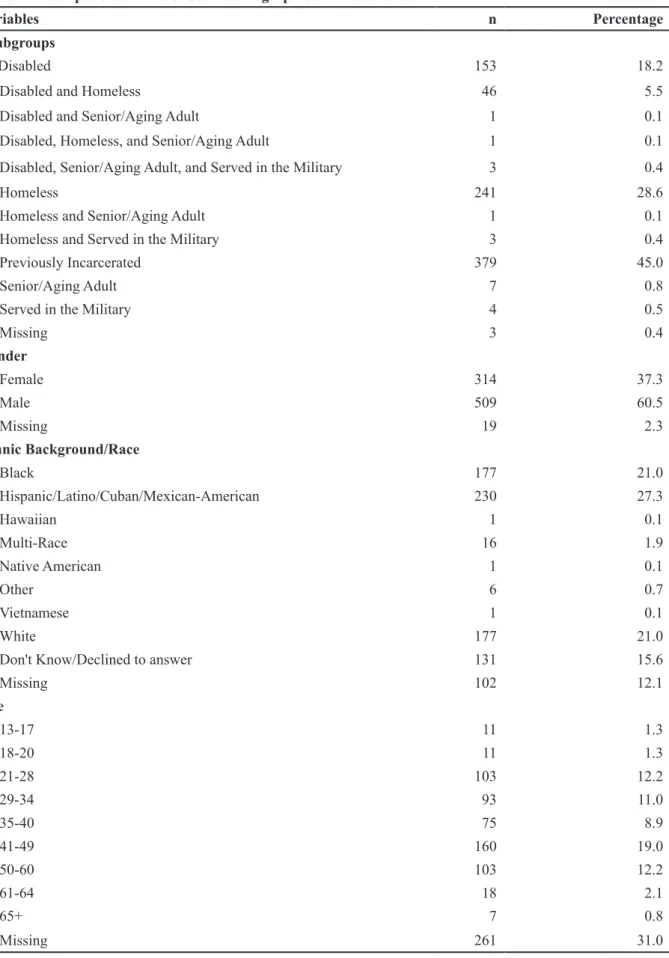
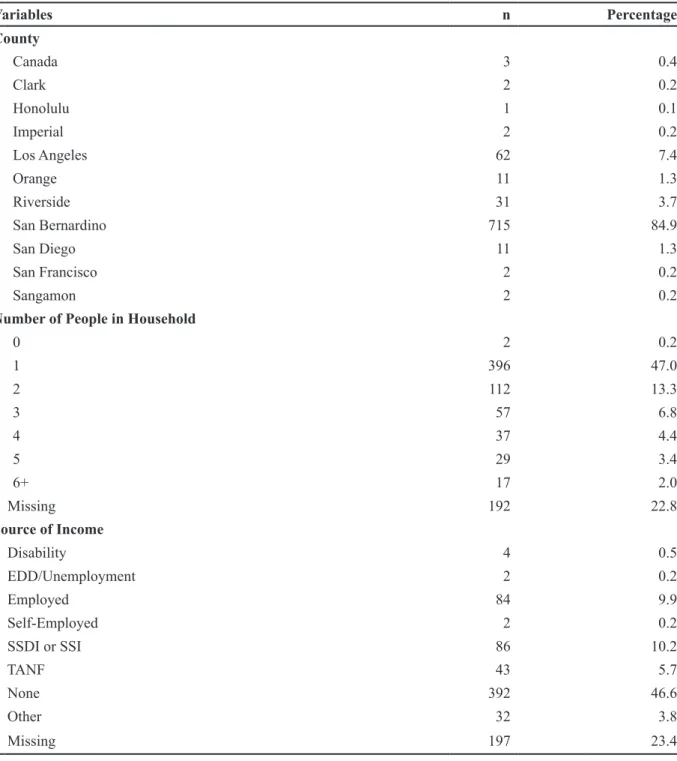
address some of those factors by illustrating the socio-demographic characteristics of formerly incarcerated individuals asking for 211 assistance. The majority of callers seeking services are from San Bernardino
Coun-ty (n = 84.9%) with the other calls coming from counties that are relatively close in proximiCoun-ty to San
Bernard-2 The authors do not work for the 211 call center or have any conflicts of interest. The views expressed here are those of the authors and do not represent the positions of the funding agency or 211.
ino County. All of the calls came from someone who identified as previously incarcerated or who called on behalf of their formerly incarcerated friend, partner, or family member. In fact, 12.6% called for a family member, 58.2% called for themselves and 1% called for a friend (not shown in the tables). When asked “do you fall into any of the following categories?” some callers reported that the person seeking services belonged
Table 1: Descriptive Statistics of Socio-demographic Characteristics
Variables n Percentage
*Subgroups
Disabled 153 18.2
Disabled and Homeless 46 5.5
Disabled and Senior/Aging Adult 1 0.1
Disabled, Homeless, and Senior/Aging Adult 1 0.1
Disabled, Senior/Aging Adult, and Served in the Military 3 0.4
Homeless 241 28.6
Homeless and Senior/Aging Adult 1 0.1
Homeless and Served in the Military 3 0.4
Previously Incarcerated 379 45.0
Senior/Aging Adult 7 0.8
Served in the Military 4 0.5
Missing 3 0.4 Gender Female 314 37.3 Male 509 60.5 Missing 19 2.3 Ethnic Background/Race Black 177 21.0 Hispanic/Latino/Cuban/Mexican-American 230 27.3 Hawaiian 1 0.1 Multi-Race 16 1.9 Native American 1 0.1 Other 6 0.7 Vietnamese 1 0.1 White 177 21.0
Don't Know/Declined to answer 131 15.6
Missing 102 12.1 Age 13-17 11 1.3 18-20 11 1.3 21-28 103 12.2 29-34 93 11.0 35-40 75 8.9 41-49 160 19.0 50-60 103 12.2 61-64 18 2.1 65+ 7 0.8 Missing 261 31.0 (continued)
Table 1. (continued) Variables n Percentage County Canada 3 0.4 Clark 2 0.2 Honolulu 1 0.1 Imperial 2 0.2 Los Angeles 62 7.4 Orange 11 1.3 Riverside 31 3.7 San Bernardino 715 84.9 San Diego 11 1.3 San Francisco 2 0.2 Sangamon 2 0.2
Number of People in Household
0 2 0.2 1 396 47.0 2 112 13.3 3 57 6.8 4 37 4.4 5 29 3.4 6+ 17 2.0 Missing 192 22.8 Source of Income Disability 4 0.5 EDD/Unemployment 2 0.2 Employed 84 9.9 Self-Employed 2 0.2 SSDI or SSI 86 10.2 TANF 43 5.7 None 392 46.6 Other 32 3.8 Missing 197 23.4 Note: *All of the people in the subgroups have been previously incarcerated, but the table shows that some may have also been homeless, disabled, elderly or military veterans. The percentages may not add up to 100 due to rounding.
to multiple disadvantaged groups. While 45.0% of the sample had only been previously incarcerated, 28.6% of the sample was also homeless; 18.2% was also disabled; and 5.5% was disabled, homeless, and previously incarcerated. This information is significant because it reveals that the people requesting 211 services have
intersecting, disadvantaged identities and require multiple services.
According to the Vera Institute of Justice (2015), in 2014, males had an incarceration rate of 716.4 per
100,000 while women were arrested at much lower rates in San Bernardino (108.6 per 100,000). This demo
-graphic characteristic mirrors that of the 211 callers in our sample who are mostly males (n = 60.5%) but is contrary to the gender profile reported in the CMAP Strategy Report (2008). In fact, 80% of the callers who
used 211 San Bernardino in June 2008 were females (CMAP Strategy Report, 2008, p. 13). Two other im
-portant demographic trends of note include race and income. In 2014, in San Bernardino, African Americans
(354.2 per 100,000) with significantly lower rates (Vera Institute of Justice, 2015). In our sample, callers were mostly Hispanic/Latino (n = 27.3%), Black (n = 21.0%) or White (n = 21.0%). Therefore, while Latinos
are the least likely to be incarcerated, they are the most likely to use 211 services. Race is also an important factor since African American ex-prisoners who recidivate have shorter periods of time before reoffending
than white ex-prisoners (Bellair & Kowalski, 2011). This is due, in part, to the fact that over 80% of white
parolees return to neighborhoods with unemployment rates below 10 percent while slightly more than half of African American ex-prisoners return to neighborhoods with unemployment rates below 10 percent (Bellair
& Kowalski, 2011, p.193). According to the CMAP Strategy Report (2008), only 28% of 211 San Bernardino callers were employed, while 14% had income from SSI, but 28% had no income at all (p.13). In our sample, approximately 10% of 211 San Bernardino callers were employed, 10.2% had income from SSDI or SSI, but 46.6% reported having no source of income.
In a recent report, the director of 211 reported an increase in requests for employment resources,
not-ing that callers often indicate that they have multiple jobs or work less than 40 hours a week (Madden, 2016).
However, “as serious as employment and wages are, they seem to be completely overshadowed by the shock
-ing leap in requests for hous-ing” (Madden, 2016, p. 2). In fact, “211 CRAs (Community Resource Advisors)
can offer hundreds of anecdotal examples of callers indicating that they are homeless, in danger of becoming
homeless, or in many cases, doubled or tripled up in a single family residence, or even living in a garage” (Madden, 2016, p. 3). Therefore, although they may be dissatisfied with their current living situation, we were surprised to find that a significant proportion of our callers (n = 47.0%) live alone. Furthermore, callers that did live with others often expressed the desire to live by themselves. For example, Brad “does not want to live with a group of people. He wishes to live independently. Brad’s main priority is to find a place of his own. He struggles to find a place due to transportation. He just acquired a Disability ID for reduced bus fare.” When the callers live with others they may encounter problems, as in the case of Heidi: “Heidi says that the gentleman who is living there waiting for his wife to get out, is still giving her problems. He makes her feel uncomfort
-able and she stays locked in her room most of her time at home.” Still, there are others who are looking to
secure housing, despite a potentially negative living situation, like Brianna who “put herself on the waiting list for the residential program but needs shelter now. She is alone and just applied for SSI. Brianna is also waiting
on a phone call already from the Salvation Army for shelter.”
Another interesting finding surrounds the age range of the callers. According to the CMAP Strategy Report (2008), the callers that used 211 San Bernardino, were mostly in the age range 21-29 (n = 25.0%), 30-39 (n = 36.0%), 40-49 (n = 19.0%) and 50-59 (n = 9.0%) (p. 13). However, in our dataset, the most prominent group to use this service was between the ages of 41-49 (n = 19.0%), followed by 50-60 year-olds (n = 12.2%), and 21-28 year-olds (n = 12.2%). Therefore, across both studies, older adults are more likely to use this service
than younger adults in their twenties. Descriptive Statistics of Criminal History
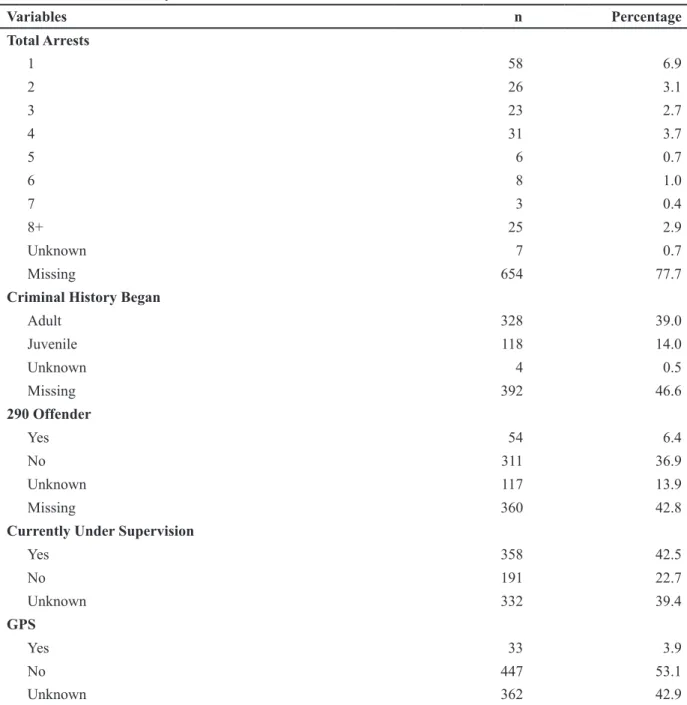
In Table 2 we present the criminal history of the callers. Most of the callers began their criminal history
as adults (n = 39.0%) while only 14% began their criminal history as juveniles. Of the 842 cases, 14.6% of our sample admitted to being arrested more than once while only 6.9% were arrested once. Additionally, when 211 operators asked whether or not callers were 290 offenders, 36.9% reported that they were not 290 offenders while only 6.4% admitted to being 290 offenders. 211 operators also asked formerly incarcerated individuals questions related to their release. Our data shows that 42.5% of callers reported that they were currently under supervision and 3.9% have a GPS device. Despite this valuable information, ultimately, most of the callers did not provide specific information about their criminal history. They identify as formerly incarcerated but will
not elaborate on their history, perhaps due to the stigma associated with their criminal label. Another explana-tion is that since family, friends and partners call to get informaexplana-tion on behalf of these currently or formerly incarcerated individuals, the caller has incomplete knowledge of that person’s criminal history.
Descriptive Statistics of Barriers/Needs
In Table 3, we examine the structural factors that represent reentry barriers for some of the callers.
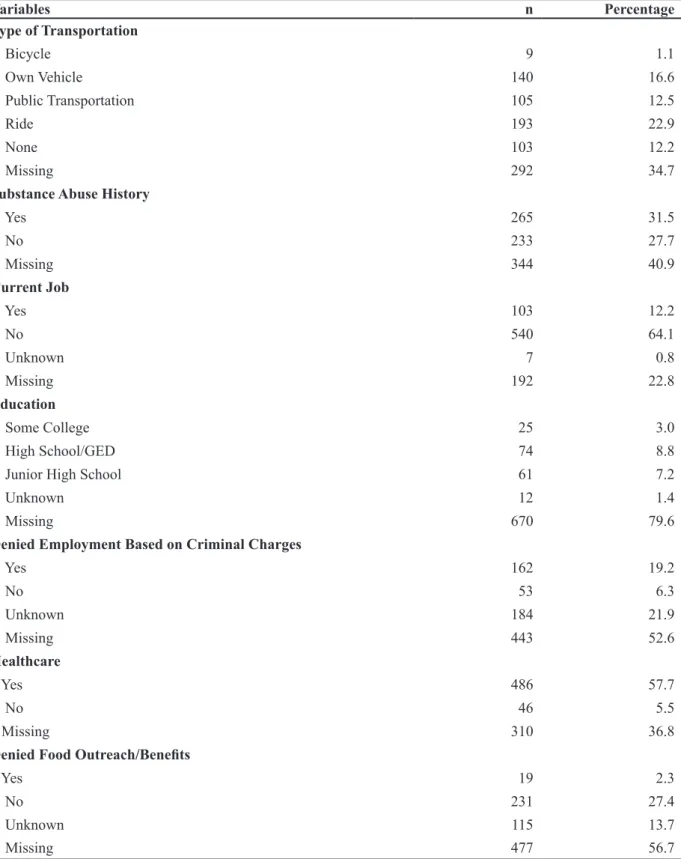
When asked, “Do you currently have a job that will still be available once you are released?” 64.1% of callers responded with a “no.” Furthermore, 19.2% of callers were denied employment based on criminal charges.
Table 2: Criminal History Characteristics Variables n Percentage Total Arrests 1 58 6.9 2 26 3.1 3 23 2.7 4 31 3.7 5 6 0.7 6 8 1.0 7 3 0.4 8+ 25 2.9 Unknown 7 0.7 Missing 654 77.7
Criminal History Began
Adult 328 39.0 Juvenile 118 14.0 Unknown 4 0.5 Missing 392 46.6 290 Offender Yes 54 6.4 No 311 36.9 Unknown 117 13.9 Missing 360 42.8
Currently Under Supervision
Yes 358 42.5 No 191 22.7 Unknown 332 39.4 GPS Yes 33 3.9 No 447 53.1 Unknown 362 42.9
Note: Some respondents did not give a precise number of arrests (e.g. 5+), so those cases are categorized as unknown. The percentages may not add up to 100 due to rounding.
However, employment would be useful to callers such as Reynold who set up work release in Riverside Coun
-ty, “but moved to San Bernardino due to housing issues. He has been working in IHSS, and is not receiving a paycheck, but lodging instead.” Another formal institution that would reduce recidivism is education: Former -ly incarcerated individuals who are young and have limited education can experience relative-ly high rates of
recidivism (McDonald, 2014; Wikoff et al., 2012).
Almost 20% of callers reported some type of educational history (3.0% had some college experience; 8.8% graduated from high school or have obtained a GED, and 7.2% only completed junior high school). However, over 80% of callers provided no educational information for themselves or on behalf of the person they were calling for. Yet, it is very common to find low levels of education among offenders suggesting that it may predict deviant behavior in the first place (Lynch & Sabol, 2001; Wikoff et al., 2012). One person who seeks to enroll in a vocational school is Clifford “who had a BOG fee waiver from prison for Victor Valley
Community College. But he no longer wishes to go there and now hopes to sign up for Skyway Truck driving
school. He does not know if they accept BOG fee waivers and would like to see if the school accepts them.”
Table 3: Descriptive Statistics of Barriers/Needs Variables n Percentage Type of Transportation Bicycle 9 1.1 Own Vehicle 140 16.6 Public Transportation 105 12.5 Ride 193 22.9 None 103 12.2 Missing 292 34.7
Substance Abuse History
Yes 265 31.5 No 233 27.7 Missing 344 40.9 Current Job Yes 103 12.2 No 540 64.1 Unknown 7 0.8 Missing 192 22.8 Education Some College 25 3.0 High School/GED 74 8.8
Junior High School 61 7.2
Unknown 12 1.4
Missing 670 79.6
Denied Employment Based on Criminal Charges
Yes 162 19.2 No 53 6.3 Unknown 184 21.9 Missing 443 52.6 Healthcare Yes 486 57.7 No 46 5.5 Missing 310 36.8
Denied Food Outreach/Benefits
Yes 19 2.3
No 231 27.4
Unknown 115 13.7
Missing 477 56.7
Note: The percentages may not add up to 100 due to rounding.
making it to classes, jobs, and important appointments is a lack of reliable transportation.
Some of our callers (n = 53.1%) had at least one type of transportation available to them. However, 12.2% did not have any type of transportation, as in the case of John: “John is looking for work. He says he is having a hard time finding employment and he does not have transportation. His girlfriend is the only one who would be able to provide transportation but that is limited to certain days. He says he will not be able to travel out of the city.” Another example is Ellen’s family “who said that they are trying their hardest to get an appointment with the organization (the Family Service Association for homeless assistance). They are waiting on a couple of possible rides but say that they will take the bus if they have to get to the appointment.”
These callers also have other basic needs including access to food: 27.4% of callers have been able to access food outreach or benefits, despite their circumstances. Others are still in the process of accessing food benefits: One example is Patricia who “said that the food was their only need at this time…. She says due
to their situation they have had to buy food daily and that is more costly than being able to buy for days at a
time. She is on probation. Her children’s ages are 8, 9, and 11.” Another example is Dylan who is “living with his mom at this time, has no income and wants to apply for Cal-fresh. He says he needs all the help and tools he can get. He wants to find work. He also needs to get some mental health sessions as ordered by his parole agent. These have already been set up through his agent.” A majority of offenders who called 211 had health care (n = 57.7%) but there is additional data (not shown in the tables) about several mental health conditions
that serve as reentry barriers.
As previously stated, in this population, there are high rates of mental illnesses such as schizophrenia/ psychosis, post-Traumatic Stress Disorder, and anxiety (Wakefield & Uggen, 2010). In the current study, more than a fifth of 211 callers had some mental and physical health conditions such as learning disabilities, schizo
-phrenia, depression, and ADD. For example, Paulette “says her son is very smart but is unstable. Bob has already tried to commit suicide and has been committed before. He usually takes off once he is released and is hard to find. Paulette is worried about him because she says he has mental health issues and he is unstable. She hopes to find an inpatient program for Bob as most of his prior cases have been the result of his episodes.”
Another case is Allan who “was diagnosed with depression after his father murdered his mother (and) is look
-ing for a program where he and his family can live together. He was open to the offer for family and couples therapy.” In addition to mental health issues, some callers have issues with chemical dependency or substance
abuse.
Inmates who are dependent on drugs or abuse drugs in state prisons are more likely than other
prison-ers to have a prior offense (Mumola & Karberg, 2006, p.8), which indicates an association between chemical dependency and recidivism. For example, one caller, Denise, said that “her brother is an alcoholic. Jesse got out of prison in March. He poisoned himself by drinking rubbing alcohol while in a rehab. It was not a clinical rehab but more of a men’s home. His last charge was for terrorist threats. Jesse is a 290 offender and has made suicidal remarks… Denise says that her brother is depressed and is giving up on himself. His health is also an issue. His drinking is a real problem to the point that he needs to be monitored. He can get out of control at times. Jesse gets sick when he can’t drink as a symptom of alcohol dependency.” Another case is Antoine who “is on suicide watch, transgender, bipolar, and struggles with a moderate to severe addiction. He has been in Cedar House but was removed from the program. He cannot be boarded with men due to his sexual orientation. He has been denied SSI before but they would like to reapply and get him a psych evaluation.” Ex-offenders who constantly abuse substances will have a hard time finding stable employment and will be more likely to recidivate (Travis, Western, & Redburn, 2014).
Summary of 211 Call Referrals
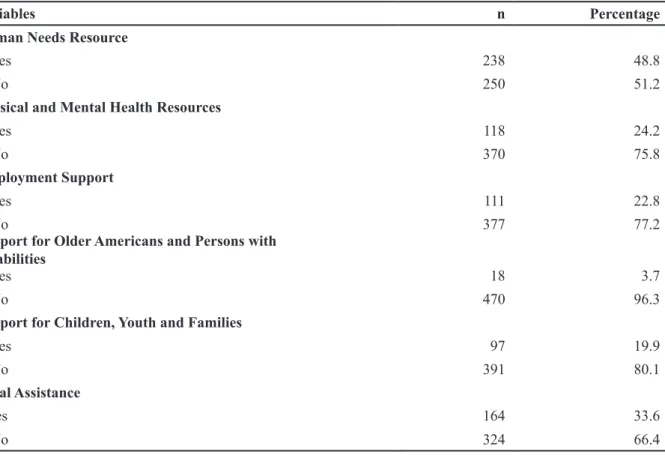
After taking each call, 211 operators referred callers to several agencies that sought to address their needs. Out of the 842 calls made to 211, the operators made 488 referrals to agencies. Based on prior literature,
we hypothesized that human needs resources would be the most frequently requested services. Our data sup
-ports this hypothesis, since, according to Table 4, almost half of the referrals (n = 48.8%) were to agencies that
provided services or assistance with food, clothes, shelters/housing, utility bill assistance, and/or rental
assis-tance. For example, some of the most commonly referred agencies or services included the Electric Assistance Fund (EAF); Food Pantry; CalFresh (Food Stamp Program); Clothes Closet; Transitional Housing or Shelters (e.g. Special Little Angels, Veronica’s Home of Mercy, etc.); Rental Listings; and Affordable Housing. These
referrals are critical since, in the period immediately following release, housing options should help formerly
incarcerated individuals desist from criminal activity (Bales & Mears, 2008).
While legal assistance was the least frequently requested area of support by callers in some regions
(CMAP Strategy Report, 2008), we hypothesized that legal assistance would be a priority for the callers in our sample. Our data supports this hypothesis since a third of the referrals (n = 33.6%) were to agencies that provided legal assistance, court ordered classes, and/or were reentry organizations. In some cases, when callers needed only legal assistance, they were referred to the public defender’s office, parole offices, or day
reporting centers. Some callers also needed to take court ordered classes such as domestic violence, DUI, and/
or anger management classes. For callers who had multiple needs, operators referred them to comprehensive,
multi-service programs such as The Fontana Re-entry Support Team (F.R.S.T.) and the Cal State Reentry Ini
-tiative.
Table 4: Summary of Referrals Made To Callers
Variables n Percentage
Human Needs Resource
Yes 238 48.8
No 250 51.2
Physical and Mental Health Resources
Yes 118 24.2
No 370 75.8
Employment Support
Yes 111 22.8
No 377 77.2
Support for Older Americans and Persons with Disabilities
Yes 18 3.7
No 470 96.3
Support for Children, Youth and Families
Yes 97 19.9
No 391 80.1
Legal Assistance
Yes 164 33.6
No 324 66.4
The third most frequently requested area of support was physical and mental health resources (n =
24.2%). The operators referred callers to agencies that address the substantive and long-term needs associated
with their offenses or rehabilitation including drug and alcohol intervention, rehabilitation, physical and occu-pational therapy, mentally ill homeless programs, walk-in clinics, and counseling. Despite the heavy emphasis placed on employment in prior literature, it was only the fourth most requested area of service for the callers
in our sample (n = 22.8%). Callers were referred to agencies that could assist with job training, transportation
assistance, workforce development, and/or vocational rehabilitation. We found that support for children, youth
and families (n = 19.9%) and support for older Americans and persons with disabilities (n = 3.7%) were the
least requested areas of support from callers.
Individuals who receive rehabilitation services may have the catalysts that can prevent future criminal activity. As previously stated, participants in one reentry program that provided substance abuse treatment, job training and job placement services, recidivated less than parolees not involved in the program (Zhang et al.,
2006, p. 552). Although life skills and substance abuse programs are the most common reentry programs, the most impactful programs also include housing assistance (Wright, Zhang, Farabee, & Braatz, 2014). The data
collected by 211 shows that there are many former prisoners, and their family members, who are proactively
seeking these programs and services (especially housing and legal assistance) for their rehabilitation and rein -tegration back into society.
Conclusion
There has been extensive research examining the factors that predict recidivism but less emphasis placed on the successful methods for a former prisoner’s reintegration. In this paper, we explored the conduits and barriers to reentry for a sample of callers using United Way’s 211 Reentry Call Center from 2014-2015. We illustrated examples of individuals seeking basic resources, their ties to family members and their quest to
that our sample of 211 callers have intersecting, disadvantaged identities and require multiple services since they are not only previously incarcerated, but are often homeless, disabled and/or mentally ill. Our sample
is largely composed of Hispanic males who are in their 40s and unemployed. We expected that inadequate income and insufficient housing would be two areas of reentry that still need to be addressed (Madden, 2016). However, the current study shows that legal assistance and physical and mental health resources are also
prominent needs for reentering individuals. Programs should focus on both individual-level interventions
and the community context when addressing reentry issues (Travis et al., 2009). This suggests a need for a
coordinated, collaborative effort among agencies that can be accomplished under the umbrella of The San
Bernardino County Reentry Collaborative (SBCRC). Although ex-prisoners might initially feel shame or guilt
when seeking help from others, this collaborative can help reintegrate them into conventional society.
Although San Bernardino County’s 211 service generously provided us access to their database of 1,145 calls between 2014 and 2015, this database has several limitations that opens the door for further
ex-ploration: As is common in large datasets with multiple variables, there is missing data in several fields. Since
callers were not always honest or knowledgeable during the call, (particularly regarding criminal history and
mental health status), in some cases the information was recorded as missing or unknown in the dataset. In oth -er cases, due to 211 op-erator -error, the information was simply misspelled. To address this, we used auto-cor-rect to revise the spelling errors. Otherwise, the quotes were intact. Another issue is that since this is only one
year of data, we cannot address the recidivism rates of our callers. Furthermore, since the database captures calls, but does not track individual callers, one caller can call several times and it is difficult to ascertain if they
used the referrals given to them. While some callers were provided with referrals to several agencies, it is also
unclear why almost half of the calls (n = 42%) did not result in referrals to any agencies.
The results of our study give insight into the reentry process for individuals released into the San
Bernardino area. One surprising finding is that compared to the CMAP Strategy Report (2008), our sample is
predominantly male. We also found that support for children, youth, families, older Americans and persons with disabilities were the least requested areas of support from callers. What role does the age of the offender
(i.e. elderly or juvenile offenders) play in the reintegrative shaming process? Are female ex-prisoners, disabled
ex-prisoners or parents who are ex-prisoners, more likely than male, single or able-bodied ex-prisoners to be
shown forgiveness and reintegrated back into society? Are these ex-prisoners more likely (or able) to access resources on their own, thus not needing 211 assistance? Future researchers should investigate how theory (including social disorganization theory and shaming theory) may account for these trends or address these
questions.
While we are focused on the reentry process, desistance and recidivism are components that should
also be addressed for this sample. Future researchers using this dataset can also ask the following questions: How would official data contrasted with this self-reported dataset further illuminate the desistance-reentry
process? How have the agencies in the 211 database aided callers in this process? These questions will pro
-vide future research opportunities for scholars and give a better understanding of the conduits and barriers to successful reentry for ex-prisoners in San Bernardino.
References
Anderson, A. Y. (2015). The Impact of Socio-demographic Characteristics and Cognitive Transformation on
Desistance from High Risk Behaviors (Doctoral dissertation). Retrieved from http://research.wsulibs. wsu.edu/xmlui/handle/2376/6186
Bahr, S. J., Harris, L., Fisher, J. K., & Harker, A. A. (2010). Successful Reentry: What Differentiates Success -ful and Unsuccess-ful Parolees? International Journal of Offender Therapy and Comparative
Criminolo-gy, 54(5), 667-692. doi: https://doi.org/10.1177/0306624X09342435
Bales, W., & Mears, D. (2008). Inmate Social Ties and the Transition to Society. Journal of Research in Crime
and Delinquency, 45(3), 287-321. doi: https://doi.org/10.1177/0022427808317574
Bellair, P., & Kowalski, B. (2011). Low-Skill Employment Opportunity and African American-White Differ
-ence in Recidivism. Journal of Research in Crime and Delinquency, 48(2), 176-208.
Berg, M. T., & Huebner, B.M. (2011). Reentry and the Ties that Bind: An Examination of Social Ties, Em -ployment, and Recidivism. Justice Quarterly, 28(2), 382-401. doi: https://doi.org/10.1080/07418825.20 10.498383
Braithwaite, J. (1989). Crime, Shame and Reintegration. Cambridge: Cambridge University Press. doi: https://
doi.org/10.1017/CBO9780511804618
Bureau of Justice Statistics. (2017). Recidivism of Offenders Placed on Federal Community Supervision in
2005: Patterns from 2005 to 2010 (NCJ 249743). Retrieved from
https://www.bjs.gov/index.cfm?ty=pb-detail&iid=45642.
CMAP Strategy Report. (2008). An Overview of 211 Services in the Nation. Retrieved from http://www. cmap.illinois.gov/documents/10180/199018/211+Strategy+Research+Report. pdf/8eb875d8-7df5-46c3-94ee-c6c274103960.
Community Indicators Report. (2015). 2015 San Bernardino County Community Indicators Report. Retrieved
from http://cms.sbcounty.gov/Portals/21/Resources%20Documents/CIR_2015_Report.pdf.
Duwe, G. (2012). Evaluating the Minnesota Comprehensive Offender Reentry Plan (MCORP): Results from
a Randomized Experiment. Justice Quarterly 29(3), 347-383. doi: https://doi.org/10.1080/07418825.20
11.555414
Duwe, G. (2015). The Benefits of Keeping Idle Hands Busy: An Outcome Evaluation of a Prisoner Reentry Em
-ployment Program. Crime & Delinquency, 6(4), 559-586. doi: https://doi.org/10.1177/0011128711421653
Freudenberg, N., Daniels, J., Crum, M., Perkins, T., & Richie, B.E. (2005). Coming Home From Jail: The So
-cial and Health Consequences of Community Reentry for Women, Male Adolescents, and Their Families
and Communities. American Journal of Public Health, 95(10), 1725-1736. doi: https://doi.org/10.2105/ AJPH.2004.056325
Giordano, P. C., Cernkovich, S. A., & Rudolph, J. L. (2002). Gender, Crime, and Desistance: Toward a Theory
of Cognitive Transformation. American Journal of Sociology,107(4), 990-1064.
Hannon, L., & DeFina, R. (2010). The State of the Economy and the Relationship Between Prisoner Reentry
and Crime. Social Problems, 57(4), 611-629.doi: https://doi.org/10.1525/sp.2010.57.4.611
Hipp, J. R., Petersilia, J., & Turner, S. (2010). Parolee Recidivism in California: The Effect of Neighbor -hood Context and Social Service Agency Characteristics. Criminology, 48(4), 947-979. doi: https://doi. org/10.1111/j.1745-9125.2010.00209.x
Kubrin, C. E., & Stewart, E.A. (2006). Predicting who Reoffends: The Neglected Role of Neighborhood Context
in Recidivism Studies. Criminology, 44(1), 165-197. doi: https://doi.org/10.1111/j.1745-9125.2006.00046.x
Lofstrom, M., Raphael, S., Grattet, R. (2014). Is public safety realignment reducing recidivism in California?
San Francisco, CA: Public Policy Institute of California. Retrieved from https://gspp.berkeley.edu/assets/ uploads/research/pdf/p80.pdf
Lutze, F. E., Rosky, J. W., & Hamilton, Z. K. (2014). Homelessness and Reentry: A Multisite Outcome Eval
-uation of Washington State’s Reentry Housing Program for High Risk Offenders. Criminal Justice &
Behavior, 41(4), 471-491. doi: https://doi.org/10.1177/0093854813510164
Lynch, J. P., & Sabol, W. J. (2001). Prisoner Reentry in Perspective (Crime Policy Report,Volume 3). Urban
Institute Justice Policy Center. Retrieved from http://citeseerx.ist.psu.edu/viewdoc/download;jsession-id=630B49ECD5A27939FE4436EBB8B2D89A?doi=10.1.1.507.2088&rep=rep1&type=pdf.
Madden, G. (2016). Special Trends Report. Retrieved from https://211sb.org/wp-content/uploads/2016/07/
Special-Trends-Report-July-2016.pdf.
Marbley, A. F., & Ferguson, R. (2005). Responding to Prisoner Reentry, Recidivism, and Incarceration of
Inmates of Color: A Call to the Communities. Journal of Black Studies, 35(5), 633–649. doi: https://doi. org/10.1177/0021934704270254
Health Care. Journal of Correctional Health, 16(1), 17-26. doi: https://doi.org/10.1177/1078345809348201
McDonald, D. (2014). The Role of Intensive Case Management Services in Reentry: The Northern Kentucky Female Offender Reentry Project. Women & Criminal Justice, 24(3), 229-251. doi: https://doi.org/10.1080/ 08974454.2014.909759
Mears, D. P., Wang, X., Hay, C., & Bales, W. D. (2008). Social Ecology and Recidivism: Implications for Prison -er Reentry. Criminology, 46(2), 301-340 doi: https://doi.org/10.1111/j.1745-9125.2008.00111.x
Morenoff, J. D., & Harding, D. J. (2014). Incarceration, Prisoner Reentry, and Communities. Annual Review of
Sociology, 40, 411-429. doi: https://doi.org/10.1146/annurev-soc-071811-145511
Mumola, C. J., & Karberg, J. C. (2006). Drug Use and Dependence, State and Federal Prisoners, 2004 (Special
Report). Washington, DC: U.S. Department of Justice, Bureau of Justice Statistics.
Mukamal, D., Silbert, R., & Taylor, R. M. (2015). Degrees of Freedom: Expanding College Opportunities for
Currently and Formerly Incarcerated Californians. Stanford Criminal Justice Center, February 2015. Re -trieved from https://www.law.berkeley.edu/files/DegreesofFreedom2015_FullReport.pdf.
OPEC Staff. (2016). California’s return-to-prison rate falls for the 5th straight year to 44.6 percent. California
Department of Corrections and Rehabilitation News.Retrieved from http://www.insidecdcr.ca.gov/2016/08/ californias-return-to-prison-rate-falls-for-the-5th-straight-year-to-44-6-percent/.
Philips, L. A., & Spencer, M. W. (2013). The Challenges of Reentry from Prison to Society. Journal of Current Issues in Crime, Law and Law Enforcement, 6(2), 123-133.
Salem, B. E., Nyamathi, A., Idemundia, F., Slaughter, R., & Ames, M. (2013). At a crossroads: reentry challenges
and healthcare needs among homeless female ex-offenders. Journal of Forensic Nursing, 9(1), 14-22. doi:
https://doi.org/10.1097/JFN.0b013e31827a1e9d
Schram, P. J., Koons-Witt, B.A., Williams, F. P., & McShane, M. D. (2006). Supervision Strategies and Ap
-proaches for Female Parolees: Examining the Link between Unmet Needs and Parolee Outcome. Crime &
Delinquency, 52(3), 450-471. doi: https://doi.org/10.1177/0011128705281845
Shaw, C. R., & McKay, H. D. (1942). Juvenile Delinquency and Urban Areas:A Study of Rates of Delinquency in Relation to Differential Characteristics of Local Communities in American Cities. Chicago, Ill: The Uni-versity of Chicago Press.
Spjeldnes, S., & Goodkind, S. (2009). Gender Differences and Offender Reentry: A Review of the Literature.
Journal of Offender Rehabilitation, 48(4), 314-335. doi: https://doi.org/10.1080/10509670902850812
Stark, R. (1987). Deviant Places: A Theory of the Ecology of Crime. Criminology, 25(4), 893-910. doi: https:// doi.org/10.1111/j.1745-9125.1987.tb00824.x
Sung, H. (2011). From Diversion to Reentry: Recidivism Risks among Graduates of an Alternative to Incarceration
Program. Criminal Justice Policy Review, 22(2), 219-234. doi: https://doi.org/10.1177/0887403410376588
Strategic Plan: The San Bernardino County Reentry Collaborative (SBCRC). (2012). Retrieved fromhttp://cms.
sbcounty.gov/Portals/42/Resources/Other/SBCRC%20Strategic%20Plan.pdf.
Travis, J., Western, B., & Redburn S. (2014). The Growth of Incarceration in the United States: Exploring Causes
and Consequences. Washington, DC: The National Academies Press.
Travis, J., Crayton, A., & Mukamal, D. A. (2009). New Era in Inmate Reentry. Retrieved from http://johnjay.jjay. cuny.edu/files/web_images/president/A_New_Era_in Inmate_Reentry.pdf.
Trimbur, L. (2009). Me and the Law is Not Friends: How Former Prisoners Make Sense of Reentry. Qualitative
Sociology, 32(3), 259–277.doi: https://doi.org/10.1007/s11133-009-9134-4
211 San Bernardino: Get Connected. Get Answers. (2017). About. Retrieved from http://www.211sb.org/about.
Ulloa, J. (2017, March 24). Officials Unveil Controversial Guidelines for the Release of More Inmates to Relieve
Prison Overcrowding. Los Angeles Times. Retrieved from http://www.latimes.com/politics/la-pol-sac-prop-osition-57-regulations-20170324-story.html.
http://trends.vera.org/rates/san-bernardi-no-county-ca?incarcerationSource=all.
Visher, C. A., & Travis, J. (2003). Transitions from Prison to Community: Understanding Individual Pathways. Annual Review of Sociology, 29(1), 89-113. doi: https://doi.org/10.1146/annurev.soc.29.010202.095931
Wakefield, S., & Uggen, C. (2010). Incarceration and Stratification. Annual Review of Sociology,36(1), 387-406.
doi: https://doi.org/10.1146/annurev.soc.012809.102551
Wikoff, N., Linhorst, D. M., & Morani, N. (2012). Recidivism among Participants of a Reentry Program for Pris -oners Released without Supervision. Social Work Research, 36(4), 289-299. doi: https://doi.org/10.1093/ swr/svs021
Wright, B. J., Zhang, S. X., Farabee D., & Braatz, R. (2014). Prisoner Reentry Research 2000 to 2010: Results of
a Narrative Review. Criminal Justice Review, 39(1), 37-57. doi: https://doi.org/10.1177/0734016813501192
Zhang, S., Roberts, R., & Callanan, V. (2006). Preventing Parolees From Returning to Prison Through Communi -ty-Based Reintegration. Crime & Delinquency, 52(4), 551-571. doi: https://doi.org/10.1177/0011128705282594
_________________________________________________________________________________________
Competing interests statement:The authors do not work for the 211 call center or have any conflicts of inter-est. The views expressed in this paper are those of the authors and do not represent the positions of the funding agency or 211.
_______________________________________________________________________________________ Annika Yvette Anderson is an Assistant Professor in the Department of Sociology where she teaches classes on deviant behavior, criminology, social psychology, race and ethnic relations. She is also the Director of Project Re-bound, a campus-based reentry program that helps formerly incarcerated students prepare for, apply to, enroll in, and graduate with high-quality degrees from California State University, San Bernardino. She received her B.A. in Public Relations from Pennsylvania State University and her M.A. and Ph.D. in Sociology from Washington
State University. Her research interests are in criminology, social stratification, sexuality, social psychology, race
and ethnic relations.
Noé J Nava is a graduate student at the University of Illinois at Urbana-Champaign where he is specializing in price analysis, international, policy and development economics. He is also an intern for The USDA’s National
Agricultural Statistics Service. Previously, Noé was a student at California State University, San Bernardino
where he obtained a B.A. in economics focusing on Mathematics and political economics. He has worked for the U.S. Department of Agriculture, a political party in Mexico, and advises a non-profit organization placed in
Zapopan, Jalisco, Mexico.
Patricia Cortez is pursuing a Bachelor of Arts in Political Science, with a minor in Criminal Justice from Cali-fornia State University, San Bernardino, CA.
RESEARCH PAPER
Identity, Discourse, and Rehabilitation in Parole Hearings in the United States
by DANIELLE LAVIN-LOUCKS
Valparaiso University, United States KRISTINE M. LEVAN University of Idaho, United States
Abstract: Research on parole in the United States has primarily followed a deterministic approach, favoring an examination of variables contributing to release. However, a great deal of prior research neglects a cen-tral aspect of the parole process: mainly the hearing. Adopting an ethnographically informed conversation analytic approach, this article addresses one tactic offenders utilize to appeal to a state parole board for release– claiming rehabilitated status. Offenders appealing for parole attempt to establish, in a performative space, their identity as rehabilitated. More globally, this article addresses how individuals manage, assert, and negotiate identity in the course of interaction. The achievement of “rehabilitation” is substantiated when it results in early release from prison.
Keywords: rehabilitation, parole hearing, ethnography, identity, discourse
Correspondence: Danielle Lavin-Loucks, Email: [email protected]
(Accepted: 07/14/2017) ISSN: 2387-2306 doi: https://doi.org/10.25771/byad-k017
Except where otherwise noted, content on this site is licensed under a Creative Commons Attribution 4.0 International License.
Parole hearings in the United States have traditionally been characterized as perfunctory or purely cer-emonial events in which parole boards simply reveal mutually agreed upon backstage decisions or justify
pre-determined outcomes based on officially mandated criteria (Cavender & Knepper, 1992; Conley & Zimmer
-man, 1987; Garber & Maslach, 1977). However, some qualitative research has portrayed parole hearings as a
series of interactive exchanges dedicated to establishing the identityof offenders and assessing their suitability
for release (Martel, 2010; Silverstein, 2006, 2001; Lavin, 2002; Radelet & Roberts 1983; Watson, 1982). We treat the concept of a rehabilitated “identity” much like Silverstein (2006, 2001), Holstein (1988), and Snow and Anderson (1987) treated identity in their respective studies: as a multifaceted construct that is invoked,
alluded to, or expressly formulated in and through interaction. Though one person can occupy many different
identities within one interaction, a concept Goffman (1979) refers to as changes in footing, the management
and presentation of identity in people processing systems such as the parole system involves the strategic
pre-sentation of a particular identity. However, given the nature of parole hearings as interactive, discourse-based events, identities are negotiated in the context of a performative space, where one side possesses significantly more institutional power (Wright, 2014; Butler, 1988; Foucault, 1977).
Decisions to release offenders are made in situ, and as such parole hearing proceedings can be de-scribed as venues where identity assessments and decisions about what to do with offenders are literally
“talk-ed into being” (Heritage, 1984, p. 290); offenders and parole board members debate facts contain“talk-ed in official
records, counter and ratify accounts, and make and modify claims collaboratively such that offenders come to
be seen either as deviants (deserving of continued incarceration) or as rehabilitated (meriting parole release).
Thus, one way in which offenders structure claims is by assembling a case for their own rehabilitated identity.
However, the accomplishment of a rehabilitated identity is not unilateral. For inmates’ claims to be effective,
they must be accepted by parole board members, who rely on the discursive strategies of offenders, a theory of
office (Drass & Spencer, 1987), experiential knowledge, official records, and interactional resources to make
their assessments.
an interaction assert identity and create and sustain a sense of order: (1) to illuminate the process whereby
offenders make a claim to rehabilitation; (2) to illustrate how the rehabilitated identity is constructed, modi
-fied, and altered through real time interaction in the hearing and during the deliberation; and (3) to examine
how offenders come to be seen, or not seen, “for all practical purposes,” as rehabilitated and ready for release.
Given the complexity of interactions in parole hearings, we seek to analyze potential parolees’ presentation of
self, the reaction(s) of the parole board, the interaction between parolees and the parole board, and the conse
-quences of these interactions.
Parole in the United States
At yearend in 2015, there were approximately 870,500 adults on parole in the United States, eighty
seven percent of whom are male (Kaeble & Bonczar, 2016). While the majority of parolees are whites (44%), African Americans and Hispanics collectively make up over half of the parolee population at fifty four percent (Kaeble & Bonczar, 2016). The increasing number of parolees in the U.S. has meant that many post-release release programs do not have sufficient resources to keep pace with the growing need for surveillance, and the frequency of technical violations of parole rules (Massoglia & Warner, 2011). In 2015, almost thirty percent
of parolees were reincarcerated, either due to revocation of their parole, assessments of a need for additional
treatment, or via a new sentence (Kaeble & Bonczar, 2016).
Despite the status of parole as a significant gateway to reentry, public perceptions of parole, primari
-ly based on media representations and high-profile cases, remain large-ly negative (Caplan, 2012; Petersilia,
2001). Due to public pressures, parole decisions are often considered to be more political, and based on retri
-bution, than professionally informed and tied to rehabilitation (Paparozzi & Caplan, 2009). Moreover, a lack
of consistency in the decision-making processes of state parole boards and vastly different procedures only
serve to reinforce these claims (Caplan, 2012). For instance, some jurisdictions use a mandatory sentencing
system, while others use a discretionary system. Major differences in the constitution of paroling authorities,
including board size and member qualifications, exist between states as well, suggesting that there is no aver
-age parole board (Paparozzi & Caplan, 2009).
Relevant Literature
Like the work of actors in most institutions, operations in the various facets of the justice system in the
United States are inevitably the production of interaction (Schegloff, 1986). And, like other people processing
institutions, much of this work involves determining facts and assessing identities insofar as case disposition
requires. In legal proceedings especially, identity can determine outcome. For instance, if defendants in a criminal trial construct their identity as an innocent, law-abiding citizen, they effectively deflect the criminal
label. The construction of non-criminal identities during trial can be linked to: the capacity of defendants to
manage accusations (Komter, 1994; Atkinson & Drew, 1979), the way in which the prosecution manages victims (Frohmann, 1998), the ability of attorneys to contest evidence by designing questions that discredit witnesses and instill doubt (Conley & O’Barr, 1998; Drew, 1992; O’Barr, 1982), or even experts’ skills in documenting individual interpretation as factual evidence (Matoesian, 1999).
Likewise, in plea bargaining, lawyers’ personal descriptions of clients can convince judges and prose
-cutors to accept a plea bargain (Maynard, 1984). Furthermore, prominent features of discourse in involuntary
commitment hearings can document the competence or incompetence of patients, whether testimony is in
alignment or at odds with the facts of the case (Holstein, 1988, 1993). Psychiatrists routinely describe patient
behavior as unstable. During direct examination, lawyers bolster patients’ claims to sanity by limiting inco
-herent or unintelligible talk, and structuring questions to elicit simple yes/no answers, while lawyers in cross
examination elicit nonsensical talk, producing contradictions and conversationally allowing and encouraging
“crazy talk” (Holstein, 1988). Thus, trial processes and other criminal justice system outcomes can depend
wholly or in part on “which side best wields language as an instrument of persuasion, of domination” (Matoe
-sian, 2001, p. 30). In these cases, identity matters; more importantly, it is through the nuances of language and negotiation that identity is created and sustained, and outcomes decided (Matoesian, 2001; Maynard, 1984; Wodak, 1980; Atkinson & Drew, 1979).
Searle (1969) explains that “speech acts,” or the context of a conversation, should be considered the