Christian Grund*
DO
FIRMS
PAY FOR
PERCEIVED
RISKS AT
WORK?**
ABSTRACT
The theory of compensating wage differentials is generally accepted. It states that firms have to pay wage bonuses for hazardous work. However, there is as yet no strong or even contrary evidence for compensating wage differentials in Germany. By estimating wage regressions with data from the German Socio-Economic Panel (GSOEP) and using individually perceived hazards of work accidents as a risk variable, evidence that firms do pay risk premiums for hazardous work are found even though other effects could dilute the existing wage bonuses. Taking into account these results, the incentives for German firms to invest in accident prevention are discussed in the context of the existing institu-tional conditions.
JEL-Classification: M12, J28, J31.
1 INTRODUCTION
Imagine that you have just received a degree from a college of engineering and that your job search has turned up two interesting job offers. The offers are com-parable in all their essential characteristics, e.g., promotion prospects, location of plants, working hours, and especially the wages. The only difference between the two job offers is that in firm A, there are irritations of noise and an increased risk of work accidents, but not in firm B. Which job do you choose? – The job in firm B, of course! The only thing firm A can do is to compensate you for worse working conditions by paying an extra bonus.
This scenario illustrates the idea behind the theory of compensating wage differ-entials, a theory that is now an integral part of most personnel and labour eco-nomics textbooks1. The seminal idea bases on Adam Smith’s theory of net
advan-tages2. Already in 1776 he assumed that within a labour market equilibrium,
people with worse working conditions get higher wages. Due to these theoretical results employers must take into account the important trade-off between wage costs and costs for accident prevention.
* Dr. Christian Grund, Betriebswirtschaftliche Abteilung II, Rheinische Friedrich-Wilhelms-Universität Bonn, Adenauerallee 24 – 42, 53113 Bonn, e-mail: [email protected].
** I am grateful for helpful comments from Robert Flanagan, Knut Gerlach, Matthias Kräkel, Edward Lazear, Andrea-Eva Smolkaand two anonymous referees. This paper was completed during a stay at the Graduate School of Business at Stanford University, which was made possible by financial support of the DAAD.
1 See Franz(1996), pp. 328 – 329, Borjas(1996), pp. 188 – 219, Ehrenberg/Smith(1997), pp. 247 – 285, Lazear(1998), pp. 377 – 407, Backes-Gellner et al. (2001), pp. 403 – 453 for example.
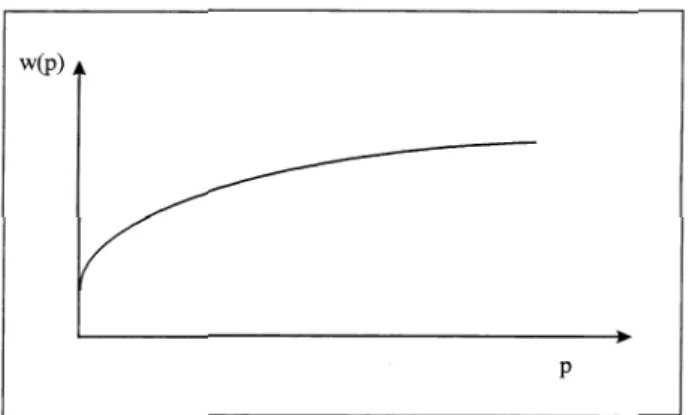
In a competitive market, firms can only acquire employees if they supply an attractive relation between wages (w) and probability of work accidents (p), because employees will choose jobs as described in the scenario above3.
Utility-maximising employees will not accept jobs with lower wages at a certain risk level of working accidents or jobs with higher risks at a certain wage level. Hence, the function w(p) describes a possible offer curve of jobs defined by [p,w (p)] combi-nations (see Figure 1). In this sense, bonuses for risks at work generate incentives for firms to invest in accident prevention, as long as the prevention costs do not exceed the economised wage costs.
3 See Ehrenberg/Smith(1997), pp. 259 – 264.
4 See Viscusi(1993) for a summary of these studies and Dorman/Hagstrom(1998) for a critical view. 5 See Lorenz/Wagner (1988a; 1988b; 1989), Schmidt/Zimmermann (1989; 1991) and Bellmann
(1994).
Figure 1: Trade-off between wages and risks
The theory of compensating wage differentials is generally accepted. There are several studies that confirm that compensating wage differentials for dangerous work are paid in the U.S.4. Only few papers analyse possible compensating wage
differentials in Germany5. Until now, only Schmidt/Zimmermann (1989; 1991)
have found some evidence for wage bonuses related to risks at work in Germany. Surprisingly, Lorenz/Wagner (1988a) cannot find any evidence for risk compensa-tions. Bellmann (1994) only observes these premiums for increased probabilities of fatal, but not for non-fatal, accidents. As a consequence, if there is no bonus that must be paid for risks at work, firms will also lack incentives to invest in acci-dent prevention.
The results of this paper show that there are compensating wage differentials for dangerous work in Germany, even though other effects, such as a sorting mecha-nism of employees, can weaken the risk compensation. Section 2 presents a short summary of the empirical results of the German and the U.S. studies. Section 3 shortly introduces the data, the used variables and the methodology. In Section 4 compensating wage differentials are analysed on the basis of wage regressions using perceived individual hazards of work accidents as a risk variable according
to the data of the Socio-Economic Panel (GSOEP). Section 5 discusses the empiri-cal results and section 6 concludes.
2 EMPIRICALRESULTS OFEARLIERSTUDIES
Several studies identify the relevance of risk premiums for dangerous work that are paid by U.S. firms. Viscusi(1993) summarizes these studies. Most approaches use industry-wide averages of fatal and non-fatal work accidents as risk variables and find compensating wage differentials for both categories. Viscusi mentions that “the main deficiency of based data is that they pertain to industry-wide averages and do not distinguish among the different jobs within that indus-try”6. That is why the results could be interpreted as industry wage premiums
rather than risk premiums7. Following this assumption, Dorman/Hagstrom (1998)
include industry-level variables (e.g., value added per worker, and union density) and find reduced evidence for compensating wage differentials in the U.S.
So far, only few empirical papers deal explicitly with compensating wage differen-tials in Germany. Lorenz/Wagner (1988a) use five German samples to analyse the effects of fatal as well as non-fatal accidents at work and occupational illnesses on monthly net wages in the early 1980s. They base their risk variables on occupa-tional, rather than industry, averages. However, due to lack of data they could not observe individual risks. Lorenz and Wagner estimate wage regressions for male full-time employees, using schooling, experience (and its square), tenure, firm size as well as dummies for overtime hours, university degree, and executive position as control variables. If compensating wage differentials could be discerned, the coefficients of the risk variables should be significantly positive. But none of the 20 coefficients fulfils this requirement. To the contrary, their results even show sig-nificantly negative coefficients for non-fatal accidents at work8.
Bellmann (1994) uses the same average occupational risk variables and also observes their effects on the loss-of-life expectancy. He bases his study on the 1979 employment sample of the German Institute of Employment Research (IAB) and restricts his approach to blue collar workers. Bellmanncontrols for schooling, experience (and its square), and change of industry. He finds significant positive effects of fatal accidents at work and non-fatal occupational illnesses of male employees. Nevertheless, in accordance with Lorenz and Wagner, the coefficients for non-fatal accidents at work are significantly negative.
The authors partly explain their results due to their imprecise risk variables. The use of average occupational risks might be too rough an estimate of workers’ per-sonal risks of work accidents. Strictly speaking, Lorenz/Wagner and Bellmann
measure – due to restrictions of their data sets – inter-occupational wage
differen-6 Viscusi(1993), p. 1928.
7 See Dorman/Hagstrom(1998), p. 117. Lalive(2000) points out the impreciseness of the conven-tional studies, too. On the basis of an Austrian linked employer-employee data set, he demon-strates that the variance of illness and injury risks is much greater among firms than on industry level. This fact substantially influences the observed premiums paid for risks at work.
tials, which do not necessarily equate with compensating wage differentials for hazardous work. Some occupations are more likely to occur in huge firms and in industries with above average wages, for example9. Lorenz/Wagner (1988a) bear
hope for further empirical work with better data10.
To date, only the Schmidt/Zimmermann(1989; 1991) studies use data from individ-ual risks of work accidents as a risk variable. However, the authors do not focus on the analysis of risk-related compensating wage differentials. Instead, they use this variable as a control variable in their wage regression on the basis of data of the Zentralarchiv für Empirische Sozialforschung zu Köln from 1978. Schmidtand Zim-mermannfind some evidence for risk premiums due to hazardous work. Individu-als, which claim to be exposed to a high accident risk obtain about 4% higher wages than do workers who are not exposed to higher risks of work accidents11.
Thus, we see that so far, there is very little – and more than two decades old – evidence on compensating wage differentials, especially for non-fatal risks, in Germany. This problem is tackled in the following empirical study, in which per-sonal assessments of work accidents are included in wage regressions and are controlled by several independent variables. Additionally, in contrast to Schmidt
and Zimmermann, the sample is divided between blue- and white-collar workers, and between West- and East-Germany.
3 DATA AND METHODOLOGY
The following study is based on data from the German Socio-Economic Panel (GSOEP), a yearly sample survey of persons living in Germany12. Some limitations
are imposed on the sample for this study. Only male full-time employees of 1995 are observed. The observation period is restricted to 1995 because the risk vari-able is sampled only in this year. These restrictions result in a sample size of 2460 employees.
Within the GSOEP questionaire people are required to say whether they “are exposed to an increased risk of work related accidents”13. Within this particular
question “increased” does not have a temporal meaning. It means that work acci-dents are more probable in the worker’s job than in other jobs. The question allows three categories of answers: “applies fully”, “applies partly” and “does not apply”. Hence, in contrast to the studies of Lorenz/Wagner and Bellmann, we have a variable for individual risks and not just risk averages by industry or occu-pation. Even though this variable is based on a subjective perception, its meaning-fulness is considerable. It can be argued that in reality, employers recompense only perceived increased risks14. A certain disadvantage of this risk variable
con-9 See Schmidt/Zimmermann(1991), Gerlach/Hübler(1998) for evidence and explanations of firm size wage differentials and Haisken-DeNew/Schmidt(1994) for inter-industry wage differentials in Germany.
10 See Lorenz/Wagner(1988a), p. 379. 11 See Schmidt/Zimmermann(1989), p. 200.
12 The data is available at the German Institute for Economic Research (DIW), Berlin. 13 See the questionnaire of the GSOEP at http://www.diw.de/english/sop.
sists in the fact that it is only an ordinal variable. Hence, unlike other studies, quantitative statements on the returns to a percentage increase of the probability of work accidents are not possible.
The regression includes several other independent variables that account for further wage determinants. These variables include age and its square, tenure, actual working hours, and dummy variables for marital status, East-Germany, schooling degrees, vocational degrees, firm size, occupational position, and indus-try15. This is another difference between this and prior German studies, which
control only for a few independent variables. It should be kept in mind that inter-industry wage differentials are separated from compensating wage differentials due to this approach in contrast to many other studies16.
I estimate simple OLS wage regressions using the log of gross monthly wages as the dependent variable (LNWAGE). Except for a general computation of the whole sample, further regressions of subgroups (blue- and white-collar workers, West-and East-Germany) are estimated in order to determine possible differences between these groups17. Compensating wage differentials will be found, if the
coefficients of the dummies for partly increased risk of work accidents (PART-RISK), and especially for fully increased risk of work accidents (FULL(PART-RISK), are significantly positive.
4 EMPIRICALRESULTS
The perceived risks of accidents at work are remarkable. A partly increased risk of work accidents is indicated by 38% of the employees and 17% are even affected by a fully increased risk of work accidents. Table 1presents the descriptive statis-tics of these and the other variables.
Table 2 shows the results of the wage regressions. Before focusing on the risk variable, it should be mentioned that in accordance with the theory of human capital, positive returns to age (which is a proxy for experience), tenure, school-ing and education can be observed. Furthermore, as expected, I find higher wages for West-German employees, for longer working hours, and for people working in huge firms.
Much more attention should be paid to the risk variables. The coefficients of both risk variables (PARTRISK and FULLRISK) are positive within the regression of the whole sample. Additionally, the result for FULLRISK is significant at the 95% level.
14 See Kunreuther et al.(1978) for empirically observed barriers of perception in decision making. 15 See Table 1for a complete list of the descriptions and names of these variables.
16 As mentioned above, Lorenz/Wagner(1988a; 1988b; 1989) and Bellmann(1994) use occupational averages as risk variables. Schmidt/Zimmermann(1989; 1991) do not control for different indus-tries within their wage regression, and thus cannot be sure if they partly measure inter-industry wage differentials, too.
17 These distinctions are made, because blue-collar workers are much more affected by work acci-dents than white-collars, and the East-German labour market differs remarkably from that of West-Germany, e.g. with regard to the rate of unemployment.
Employees with fully increased risks of accident at work receive an average wage premium of 3%, as compared to people without increased dangers of work acci-dents18. The regressions for the separate groups show that this result does not
hold for all subgroups. Significant compensating wage differentials attributable to the risk of work accidents can only be observed for blue-collar employees and in West-Germany, but not for white-collar and East-German workers. The returns for FULLRISK are 4.6% for blue-collars and 3.3% in West-Germany, respectively. In
18 In contrast to metric variables, the coefficient of dummy variables must not be directly interpreted as wage returns. These coefficients (c) have to be transformed with g = exp(c)−1 to get the exact wage premium of the dummy relative to the base group (see Halvorsen/Palmquist (1980)). Still, the differences with regard to the results of this study are very small.
Table 2: Wage regressions of male full-time employees (absolute T-values in parentheses)
contrast, there are even (insignificantly) negative returns to risks for white-collar workers. The following section discusses these results and gives an explanation.
5 DISCUSSION OF THE RESULTS
In contrast to the prior German studies, compensating wage differentials for increased risks of work accidents can be observed particularly for blue-collar workers and in West-Germany. As opposed to the studies of Lorenz/Wagner
(1988a; 1988b; 1989) and Bellmann (1994), in this approach an individual risk variable has been included. Therefore, compensating wage differentials can be discerned in a better way, whereas most of prior studies measure inter-industry or occupational wage premiums rather than strictly compensating wage differentials due to restrictions of their data sets.
Several explanations can be given as to the question why there is no evidence for compensating wage differentials for white-collar workers and in East-Germany. An essential assumption within the theory of compensating wage differentials is the existence of a competitive labour market. This assumption must be regarded criti-cally, especially for the East-German labour market. During the first years after the German reunification, many employees lost their jobs. The regional rate of unem-ployment was 14.9% in 1995 and tended to increase, while the unemunem-ployment rate in West-Germany was only 9.3%. Thus, the lack of a competitive labour market might account for the non-existence of compensating wage differentials in East-Germany. People are happy just to have a job, and they know that they have very little chance of getting another, possibly less risky, one. Hence, it is not surprising that compensating wage differentials cannot be found in East-German firms. Addi-tionally, people in general, and particularly in East-Germany, are not perfectly mobile, a fact that strengthens this effect19.
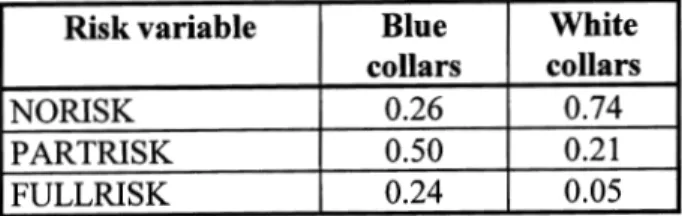
Another finding could explain the differences between blue- and white-collar workers. Blue-collar workers are much more affected by increased risks of work accidents than are white-collar workers (see Table 3)20. Three quarters of
white-collar employees, but only 26% of the blue-white-collar workers, do not perceive increased risks. However, this aspect alone does not account for the fact that com-pensating wage differentials can be measured only for blue-collar workers. In order to explain the phenomenon, it has to be kept in mind that there will always be unobserved heterogeneity in workers’ ability21. This heterogeneity cannot be
measured with this data, fact why an underlying sorting mechanism cannot be controlled for either. Only a few white-collar jobs bear an increased risk. Hence, high ability white-collar workers should have no problems in finding a job that carries no increased risks. On the other hand, low ability white-collar workers partly have to be content with risky jobs. This observation leads to the assumption that compensating wage differentials cannot be observed because of the
counter-19 More than 50% of the East-Germans in this sample could not imagine changing their current city of residence for job-related reasons.
20 Additionally, increased risks of work accidents reported by blue-collar workers are probably much more serious than those for white-collar workers.
21 See Hwang et al.(1990). There will also be unobserved heterogeneity in workers’ risk aversion. Very risk averse employees will choose jobs or occupations with less danger of work accidents. This is another argument for relatively small risk premiums due to work accidents in general. There would be bigger risk premiums if employees were allocated to jobs by chance.
vailing sorting effect in the staffing of the jobs with increased risks of work acci-dents.
This effect will not hold for blue-collar workers, because most blue-collar jobs bear a certain risk and even high ability blue-collar employees must accept an increased risk of work accidents. That is why a sorting mechanism is of less importance for blue-collars, and compensating wage differentials can be found for blue-collar rather than white-collar workers22.
22 Unobserved heterogeneity may be relevant in another way as well. The amount of the risk at a certain job may be unfluenced by the ability of the employee. In this case, high ability employees would face lower risk at work on average anyway.
23 See Schauenberg (1999) for the German accident insurance system and a comparison of the German and the U.S. system. See Section 6 for an additional discussion.
Table 3: Distribution of risk of work accidents within blue-collar and white-collar workers
Some further aspects lead to the assumption that the results are biased down-wards, and that the real wage bonuses due to risks of work accidents are even higher. First, a measurement error is possible. Hamermesh (1978) hypothesises (and Elliott/Sandy (1998) find evidence) that workers with relatively low wages, and who are thus dissatisfied with their pay, will overstate the magnitude of their risks of work accidents. Hence, the premium due to risk of work accidents could be biased downwards. Further on, a basic difference between German and U.S. labour market institutions has to be mentioned. In contrast to the U.S., an insur-ance against work accidents is part of the German social security system23. People
are compensated ex post at least for non-fatal risks of work accidents. Hence, employers need only partly compensate risky work ex ante through higher wages and so wage bonuses for hazardous work are more likely to be paid by U.S. firms. But even in spite of these restrictions evidence for compensating wage dif-ferentials in Germany is found.
Some special notes have to be provided with regard to the used data. The GSOEP contains additional information on working conditions, e.g., participation in shift work or requirements of physical strength. This information is not used, because employees have fundamentally different preferences with respect to these vari-ables in contrast to work accidents. E.g., some people like physical effort, but other employees try to avoid it. Integrating these variables in the estimation shows that participation in work shift increases wages, whereas physically demanding work reduces wages.
The GSOEP database also includes information about actual work accidents, which are significantly positively correlated with the perceived risks. I do not use this information, because the result might be influenced by two opposed effects. On the one hand, higher wages have to be paid when risks at work “materialize” in actually occurring accidents. On the other hand, work accidents often imply absence due to illness. Hence, disadvantages with respect to the career for the affected employees may occur, because their human capital gets depreciated. Thus, using this variable would have no obvious effect on wages. An estimation with this variable produce no significant results.
Unfortunately, the risk variable is included only in the 1995 data of the GSOEP and not in that of further years, so that it is not possible to estimate panel regressions.
6 CONCLUDINGREMARKS
Wage premiums for hazardous work motivate firms to invest in accident preven-tion, because they can reduce wage costs with these investments. The conse-quences of this result affect intra-firm risk regulation.
Taking into account the empirical results of Lorenz/Wagner (1988a; 1988b; 1989) andBellmann (1994), Schauenberg(1999) analyses the German regulation system of risks at work. He distinguishes prescriptionson the one hand and incentiveson the other as observable institutions of risk regulation in Germany. Prescriptions, e.g., those concerning the approval or use of hazardous plants, are the predomi-nant method of risk regulation in Germany. These regulations have a negative effect, in that they decrease further incentives for technological innovations24.
Incentives exist only within the German accident insurance, which is part of the social security system, and which is a compulsory insurance for all German firms. Generally, the contributions are calculated in solidarity according to risk categories in each of the 36 German employers’ mutual insurance associations ( Berufs-genossenschaften). Most of the employers’ mutual insurance associations offer dis-counts to firms with a low number of accidents and charge higher rates to firms with a high number of work accidents. The median of these discounts and addi-tional charges is 10%. Hence, the incentives for firms to invest in risk decreasing activities are not very high25. Thus, Schauenberg, concerned about accident
pre-vention in German firms, asks for an enlargement of discounts and additional charges as to the contributions for the employers mutual insurance associations26.
This empirical study shows that wage premiums for hazardous work exist, espe-cially in West-Germany. The consequential incentives for accident prevention have to be taken into account for an evaluation of the German system of risk regula-tion. Nevertheless, I can agree with Schauenberg’s concerns, especially since no
24 See Schauenberg(1999), pp. 440 – 444.
25 Note that the mean contribution of a German plant to the employers mutual insurance association amounts to less than 1.5% of the sum of salaries in 1995.
26 This advice seems to be sensible. Kötz/Schäfer(1993) have found evidence that increased dis-counts and additional charges lead to dramatic reductions of work accidents.
premiums due to risks at work can be observed in East-Germany, probably because of the high unemployment rate in East Germany.
To sum up, I can state that firms in Germany pay for risks. First, if many accidents occur within a firm, the firm must pay additional charges for accident insurance. But in spite of the ex post compensation for accidents at work by the employers mutual insurance associations, firms also pay wage bonuses due to hazardous work.
REFERENCES
Backes-Gellner, Uschi/Lazear, Edward P./Wolff, Birgitta(2001), Personalökonomik.
Bellmann, Lutz(1994), Entlohnung als Risikokompensation, in: Mitteilungen aus der Arbeitsmarkt- und Berufsforschung, 4. Jg., S. 351 – 358.
Borjas, George J.(1996), Labor Economics.
Dorman, Peter/Hagstrom, Paul(1998), Wage Compensation for Dangerous Work Revisited, in: Indus-trial and Labor Relations Review, Vol. 52, (1998), pp. 116 – 135.
Ehrenberg, Ronald G./Smith, Robert S.(1996), Modern Labor Economics.
Elliott, Robert F./Sandy, Robert(1998), Adam Smith May Have Been Right After All: A New Approach to the Analysis of Compensating Differentials, in: Economics Letters, Vol. 59, pp. 127 – 131.
Franz, Wolfgang(1996), Arbeitsökonomik.
Gerlach, Knut/Hübler, Olaf(1998), Firm Size and Wages in Germany – Trends and Impacts of Mobility, in: Empirica, Vol. 25, pp. 245 – 261.
Haisken-De New, John P./Schmidt, Christoph M.(1994), The Industrial Structure of German Earnings 1980 – 1990, in: Allgemeines Statistisches Archiv, 78. Jg., S. 141 – 159.
Halvorsen, Robert/Palmquist, Raymond(1980), The Interpretation of Dummy Variables in Semilogarith-mic Equations, in: American EconoSemilogarith-mic Review, Vol. 70, pp. 474 – 475.
Hamermesh, Daniel S.(1978), Economic Aspects of Job Satisfaction, in: Ashenfelter, O./Oates, W. (Eds.), Essays in Labor Market Analysis, pp. 53 – 72.
Hwang, Hae S./Reed, W. Robert/Hubbard, Carlton (1990), Compensating Wage Differentials and Unob-served Productivity, in: Journal of Political Economy, Vol. 100, pp. 835 – 858.
Kötz, Hein/Schäfer, Hans-Bernd(1993), Economic Incentives to accident prevention: An Empirical Study of the German Sugar Industry, in: International Review of Law and Economics, Vol. 13 , pp. 19 – 33. Kunreuther, H. et al.(1978), Disaster Insurance Protection. Public Policy Lessons.
Lalive, Rafael(2000), Did we Overestimate the Value of Health? Institute for Empirical Research in Eco-nomics. University of Zurich. Working Paper No. 60.
Lazear, Edward P.(1998), Personnel Economics for Managers.
Lorenz, Wilhelm/Wagner, Joachim (1988a), Gibt es kompensierende Lohndifferentiale?, in: Zeitschrift für Wirtschafts- und Sozialwissenschaften, 108. Jg., S. 371 – 381.
Lorenz, Wilhelm/Wagner, Joachim (1988b), Kompensierende Lohndifferentiale, in: Wirtschaftswis-senschaftliches Studium, S. 515 – 518.
Lorenz, Wilhelm/Wagner, Joachim (1989), Kompensierende Lohndifferentiale und geschlechtsspezifi-sche Einkommensdiskriminierung, in: Gerlach, Knut/Hübler, Olaf (Hrsg.), Effizienzlohntheorie, In-dividualeinkommen und Arbeitsplatzwechsel, S. 248 – 270.
Schauenberg, Bernd (1999), Risiko und Risikoregulierung von Beschäftigungsverhältnissen, in: Wagner, G. R.(Hrsg.), Unternehmensführung, Ethik und Umwelt – Hartmut Kreikebaum zum 65. Geburtstag. S. 424 – 453.
Schmidt, Christoph M./Zimmermann, Klaus F. (1989), Der implizite Markt für Arbeitsbedingungen, in: Jahrbuch für Sozialwissenschaft, 40. Jg., S. 187 – 201.
Schmidt, Christoph M./Zimmermann, Klaus F.(1991), Work Characteristics, Firm Size and Wages, in: The Review of Economics and Statistics, Vol. 73, pp. 705 – 710.
Smith, Adam (1976), An Inquiry into the Nature and Causes of the Wealth of Nations.
Viscusi, W. Kip(1993), The Value of Risks to Life and Health, in: Journal of Economic Literature, Vol. 31, pp. 1912 – 1946.