:
'
G2,6/fiFr
/VcC6.,-0'
POLICY RESEARCH WORKING
PAPER
0~~~~~~~~~~~~~~~~~~~~~~t ,fA 4 '
.- ~~~~~~~~~~~~~~~~~~~~~~~~~~~~ . -'"
Technical and Marketing
- ;2muw~~~~~~eKifnvinmet
-Support Systems
-or Successful S mall and
Medium-Size
Enterprises
l
in Four Countries
- --
_--Brian
Levywith
Albert Benry, Motoshige Itoh, Lins Kim,=
Jeffrey Nugent, and Shzcjiro Urata _
Ihe World Bank a
Policy Researc Department
Fimance and P:iae Sector Development Diisioi ;
-Decmber 1994
-_-_X___
Public Disclosure Authorized
Public Disclosure Authorized
Public Disclosure Authorized
IPOLICY
RESEARCH WORKING PAPER 1400Summary -findings
Studies of successful small and medium-size enterprises technological capability. Demand for collective (SMEs) and their marketing and technical support mcchanisms tended to be greater when technological systems were undertaken for Colombia, Indonesia, requirements of production were comple,' or when the Japan, and the Republic of Korea. Three to four endowments of privare technological netwo rks in certain
subsectors were examined in each country. Thc sample countries or industries were weak.
worldwide amounted to 445 firms. Broad-based collective technical support facilitates the
Mechanisms to support export marketing varied across emergence of an information-rich environment for firms, countries and subsectors How they varied depended and may be worth pursuing in many settings. Examples
greatly on whether SMEs operated within well- of such support include:
deveoped private networks. When market peneation * Sponsoring courses on specialized topics.
begins, nansacrion costs are high and collective Facilitating the use of cxpert consultants (either narketing support can be importanL As marl -ts direcdy, by making a consultant available to a broad "thicken," initiatives by foreign buyers become more array of firms, or indirectly, by providing financial important. Gcercally the most effective collective support for the use of consultants).
marketing support was of the kind that can be provided * Promoting information-sharing among fiirms. more cffcctively by decentralized organizations - such Countres that already have strong broad-based as industry associations or local governments and colleccive support and that are moving into
chanbers of commerce (to support firms' participation in technologically more advanced activities might consider trade firs, for example) - than by central government "high-intensity" support, but should proceed with
institutions. caution.
Private mechanisms were more important than collective mechanisms for helping firms improve their
- Ths paper -a product of the Finance and Private Sector Development Division, Policy Research Department -is part
of a larger effort in the department to examine the impact of proactive intervention on SME -performance. Copies of the paper are available free from the World Bank, 1818 H Street NW, Washington, DC 20433. Please contact Daniele Evans,
room N9-055, extension 38526 (43 pages). December 1994.
Il
Poliy ReMb Wo*iug Pae Series dissemwcs the fzns of work in progress to encomuge tt exchnge of iWs aboutdeopment issu An ob)cthse of the sets is toga rhe finngs out qiddy, cvn 'the estatinare kss tha fuiy pol she .
papsmaea" the names of th ators and soud be sed and eied accordigly. The frimdtgs interprtaton, and condusions ar dth
aut hs' own and should nos auributed to the Word BDank, its Executive Board of Directors, or any of its mmnbercountrkc
Technical and Marketing Support Systems
for Successful Small and Medium-Size Enterprises
in Four Countries
Brian Levy
with
Albert Berry, Motoshige Itoh, Linsu Kim
Urata-Table of Contents
1. Research Background
Research Issues and Methodology ...
Some Background Characteristics of Subsectors, Entrepreneurs and Firms ... 6
11. Export Marketing and its Support Systems ... ... a Leading Mechanisms of Export Marketing ... 9
Cumulative Processes and the Role of Collective Marketing Support ... 17
The Delivery of Collecfive Marketing Support ... ... 19
Public Policy towards Export Marketing ... 23
IIl. The Acquisition of Technolgoical Capability and its Support Systems ... ... 25
Leading Sources of Technological Capability ... 26
Collective Technical Support Its Demand and Use... 30
The Delivery of Collective Support. 32 Public Policy Towards the Acquisition of Technological Capability . .38 IV. Some Commons Themes .. ... ... 3.. 35
; ~~Tables: Table 1: The Sample of Countries and Subsectors ...- 5 Table 2: The Growth of Fims ... -a
Table 3: Education and Experience of Entrepreneurs ... 6b
Table 4:- The Impact of Country Characteristcs and Industrial Organzation on
Mechanisms of Export Markefing - A Summary of Country Experiences .9a
Table 5: Marketing Contacts Among Rattan Fumiture Exporter ... lla
Table 6: Exports by Korean SMEs in Four Subsectors. . 12a
Table 7: Korea -The Reblfive Usefulness of Extemal Marketing Support . 12b
Table 8: Colombia - The Relative Usefulness of Extemai Marketing Support. 15a
Table 9: Indonesia - The Relative Usefulness of Extemal Markedng Support .. .... X a
Table 9a:- Changes in Private Versus Collective Marketing Support Over Industry
and Firm Life Cycles in Seven Subsectors .a.
Table 10: Collective Marketing Support What Works? ... 20a
Table 11: The Relative Usefulness of Export Marketing Services of Industry
Associations and National Export Agencies in Korea . . - 21a
Table 12: Leading External Sources of Technological Upgrading 27a
Table 13: Mechanisms of Extemal Technical Support in Four Countries - An Overview . 29a
Table 14: The Usefulness of Broad-Based Collective Technical Support in Selected
SubsectorsandCountres 32a
Table 15: Utiliation of Korea's Leading Specialist Technology Institutions in Four
Subsectors ... 36a
E
Fgures---Figure 1: Use of Collective Marketng Support ... 17a
in Fouroui
by, Brian Levy with contributions from
Albert Berry, Motoshige Itoh, Linsu Kin, Jeffrey Nugent and Shujiro Urata
This paper analyzes comparatively the results of country sudies of successful small and medium enterprises (SMEs) and their support systems m Indonesia, Japan, Korea and
-Colombia. The objective of the research was to shed empirical light on the policy question of what should be the appropriate role of goverment in the development of marketi and technological support systems for SMEs.]l We begin by describing thfe research issues and methodology, and some background features of the counties. subsectors and firms in which field research was conducted. Thereafter, we present in turn for each of the dtree support
stems the major results of the research, and their implictions for policy. We conclude by
highlightig some general themes that emerge from the analysis of individual support systems.
1: RESEARCH BACKGROUND
I 1: Research Issue and
Methodology-Lawn.
Two presumptions underlie the decision to focus the research on government and SME support systems. The first presumption is that the micro-environment of private, govem l and NGO (non-governmental organization) market and istional supports external to the firm is an important detrminant of SME success.2j Large finms can use non-marketmedhanisms to internalize within the firm many of the functoal tchnical and marketing skils that that they need to conduct business. SMEs, by contrast, lack he rsources and in-house
f1 The research examined also fiancial support sstems in Japan and Korea. The resuts are reported in the individual country studies.
2- This idea is implicit in the literatre which ghights the role of the e eur in
large firms in developing counties as a "gap filler. See Jones ain Sakong (1980); Kilby (1971); and Leibenstein (1963, 1968). For the link between ffie development of private and public support systems and SME parcipaton, see Jacobs (1969); Pior and Sabel. (1984); Ranis and Schive (1986); Rhee (1988); and Levy (1991).
2
functional diversificiation of their larger counerparts, and depend more on exteral sources to acquire technological and marketing capability. Acquiring the resources they need involves transactions costs. It follows that the less developed are technical and marketing support systems, the higher will be the transctions costs to SMEs, with a corresponding impainnent in their competitive position. So one key goal of the research is to learn what are the
characteristics of well-functioning :upport systems.-.
The second presumption is that the social reums of well-functioning SME support systems
-and, more broadly, of SME success - exceed the private returns to individual firns. This
presumption can be defended via four distinct lines of reasoning. First1 and most filiar, is the
argument that there exist rm and other market failures associated with the provision
of technical and marketing support to SMEs.4/ Second, a proliferation of rapidly-grwing
SMEs holds the promise of providing a seedbed for the emergence of dynamic and efficient arge-scale national firms, and consequently a more flexble and competitive domestic
economy.51 Third, there can be important political economy advantages of broadening the base of private sector pauicipation. A broader private base imples less concentrtion of economic
power, which can rcduce the risk of the emergence of a mutualy beneficial, but socially
-unproductive, rent-seekiqg relaionship between business and goverunent. Moreover,
broad-1i Note that this goal is substantially narrower than that of learing what are the
determinants of SME success (which could inclide a myriad of policy and human capital variables), with important implications for the design of the research.
4- For marketing and technical support, the public good character of informtion implies
that the socially optimal supply of information exceeds what would be supplied privately.
Collectve action problems could inhibit firms from organizing to jointly supply 'intra-industry"
public goods.
Technically, this
argument
can be viewed as one of 'inter-temporal spilloversInvestments today which expand the number of successful firms make the economy more capable in the future for resonding flexibly to shocks, and ting advantage of new (currently unknowable) opportnities as they emerge See Bruton (1985, 1989, 1993) for a concepta
discussion which makes the case that it is socially desirable for developing country
-3
based participation in the private sector can ease social tensions, especially in countries where there are strong divisions between the economicaUy dominant group, and other groups in society. Fourth, there is some evidence that a substantial role for SMEs contributes to a more equitable distribution of inconle.A/ Given these four lines of reasoning, the corollary follows that if government can intervene in a cost-effective manner to improve the prospects of SME success beyond what would be achieved in a wholly private marketplace, it should do so.
Taken together, the two presumptions shift the terrain of cebate as to whether
governments should intervene to strengthen narketing and technological support systems from an ideological to an empirical one. Surprisingly, while there is ample documentation of failed atempts at intervention, there has been remarkably little empirical research as to whether collective (governmental, business association and NGO) interventions have been impoItant for the successful development of support systems.2f The research summaried here is the fruit of
a susined effort to fill this gap.
Mefibgoggx- Our starting point for analysis of the role of collective interventions was with the SMEs themselves. We sought to learn from stuctred field inteviews how these firis took care of their marketing and technological tasks, to what extent they drew on external supports to undertake these taslcs, and what was the relative utilization and usefilness (as perceived by the finms themselves) of private and collective supports. Our goal in adopting this approach, rather than studying directly specific imtventions made by colective istuons, was to anchor any broader judgements as to the role of government in an ue ng of the dynamics of the private marketplace itself.
fit See, for example the analysis in Fei, Ranis and Kuo (1979) of the relation between the evolution of income distrbution in Taiwan and the role of SMEs.
-U - For some studies of the role of technical and mar support, see Hogan. Keesing and Singer (1991); Schmitz and Musyck (1993); Cortes, Berry and Lshaq (1987); Berry and Mazumdar (1991); and Nugent (1990). Rhee, Ross-Larson and Pursell (1984) used a... methodology similar to the present one to examine the acquisition of technical and maketing. capability by large firms.
4
How we selected our sample of firms was crucial for the broader validity of our policy judgements. The key decision was to target the empirical analysis on successes: successful
countries, successful subsectors, successful firms. The underlying presumption was that the economic institutions identified by firms as important for successful outcomes are themselves at least reasonably efficient.BI The research followed the lead of other analyses,2/ and used direct or indirect participation in export markets as the primary criterion of success (although, as will be seen, in conducting the research it was not possible to adhere rigidly even to this criterion of export-orientation).
While in general the presumption that the.institutions identified by firms as efficient
were indeed so seems reasonable to us, the reader can continully test any policy judgements
we draw from our evidence by posing questions as to the cou
uribcua.
Key questions to keepin mind include: Given that the SMEs surveyed inleed appear efficient is it probable that, in
the absence of some co'1ective institution identified as impormtant, their performance would have
worsened? Alternatively, should there be reason to qution whether the. surveyed firms indeed
are economically efficient, is it nonetheless probable that any collective institution deemed to be
making a positive contriLution would still be socially useful in an environment populated by. economically efficient firms?
In principle, variations across subsectors in their tecihologies and patterns of indusrial. .orgnization might influence the role of collective supports. Similarly,. their role could be affected by -variations across countries in the levels of development of their private sectors, and .the manner of their integration into the world economy. To account for these variations, we sampled across a broad range of countries and subsectors.
. / This presumption is standard in the economic analysis of institutions. See, for example,
-- - -Oliver Williamson's (1985, 1975) analyses of transactions costs, and Douglass North's (1981)
3nalysis of the relatonship between property rights and economic growth. While at the limit
* - applications of the presumption can degenerate into tautologies, with careful design it is
possible to formulate empirically testable propositions.
92/ For example, Pack and Westphal (1986), Krueger (1984), and the World Bank's
5
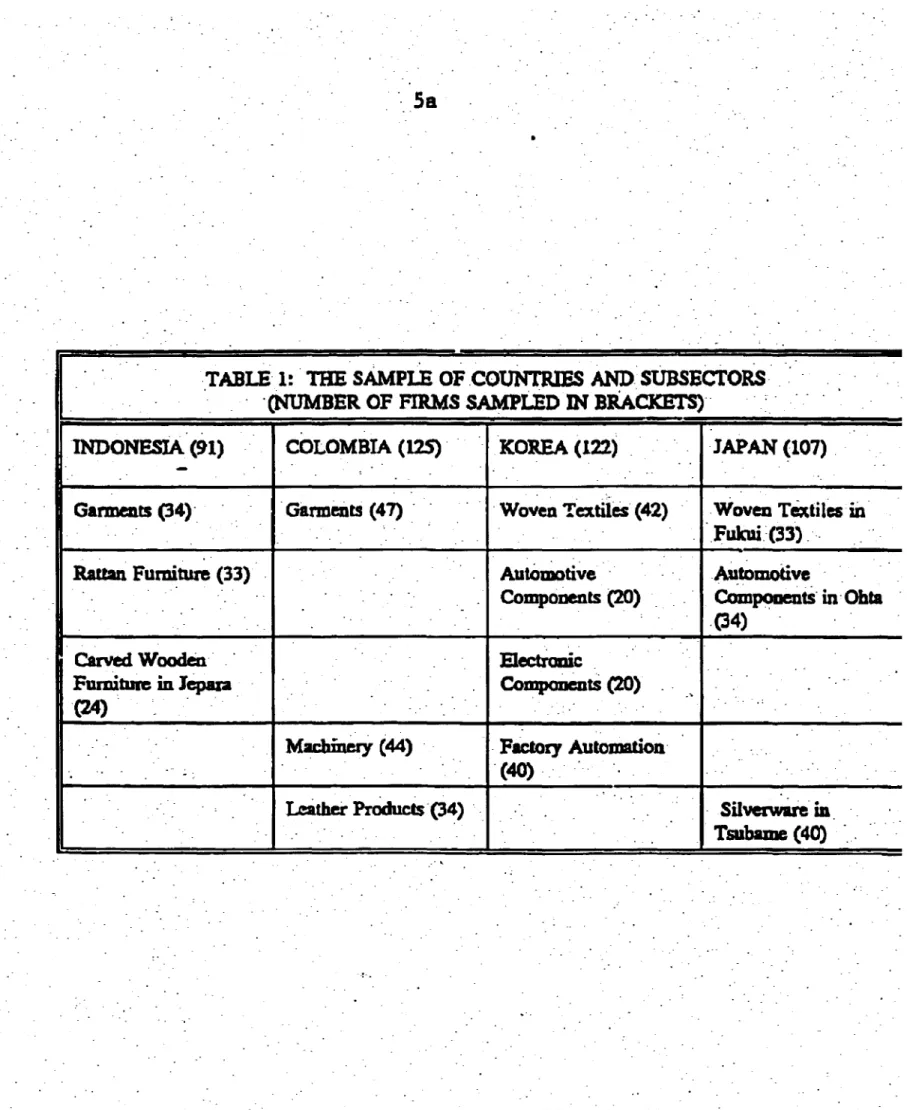
-:lbe samW. Ideally, the sample of countries and subsectors would have been large enough to make it possible to analyze cross-country variations in support systems for a particular subsector, as well as cross-sectoral variations in support systems widtin individual countries. In practice, as Table I summarizes, budget limitations restricted the research to four countries; 34 subsectors were examined in each country, with the sample worldwide
amounting to 445 firms. Details of sampling decisions with respect to subsectors and firns are contined in the individual country studies.
While all four countries presently are judged to be relatively "successful" examples of development, they were intentionally chosen to encompass a wide spectrum of development
experiences. They vary radically in 1991 per capita incomes - from $610 for Indonesia, to
$1,260 for Colombia, $6,330 for Korea and $26,930 for Japan. Two of the countries are located in North-East Asia, one in South-East Asia, and one in Latin America.
Unavoidably, given the wide variety of levels of development (and resource endowments), and the. desire to focus on export-oriented subsectors, it was not possible to achieve much overlap in the subsectors studied across countries. Yet the costs of limited overlap are less than they might first appear. For one thing, even within seemingly identical subsectors, there are substantial variations across countries in both the specific products produced and in the patterns of iudustrial organization.j/ For another, as the analyses of marketing and technical support systems will reveal, it is not product-type per se that is the crucial basis for comparson. For marketing support systems, what turns out to be crucial is the distinction between subsectors in which SMEs are embedded in pre-existing private networks,
JQ/ To cite one example, Levy (1991) compares the footwear export industries of Korea
- and Taiwan. Not only are there differences in their mixes of products (Taiwan produces
relatively more plastic footwear, Korea relatively more leather), even when the product is identical (e.g. running shoes with leather uppers) there have historically been radical
differences in their paterns of industial organization, with large firms dominant in Korea and SMEs in Taiwan.
5a
TABLE 1:THE SAMPLE OF COUNTRIES AND) SUBSECTORS
(NUMBER OF FIRMS SAMPLED IN BRACKES)
INDONESIA (91)
COLOMBIA (125)
KOREA (122)
JAPAN (107).
Garments (34)"
Garments (47)
Woven Textiles (42)
Woemet!sin
_____________ _ _ _ _ _ _ _ _ _ _ _ _ _ ~~ ~~~~Fukui-1(33).
Rattan Furniture (33)
Automotive
Automotive
Components (20)
Copnsin
Ohta
_____________ _____________ ____________~~_ (34)
Carved Woodetn
Eectranic
Furniture in Jepara
Conmponets (20)
(24)_ _ _ _ __ ___
Machfiney (44)
Factory Automaion
_______ ~~~~~~~~~(40)_ _ _ _
Leather Produt (3)Silverware
in
6
and activities where no such networks exist; six of fte subsectors selected fit into the former category, and seven into the latter. For technical support systems, a crucial distinction is between simple, craft-based and complex, engineering and science based technologies.
1.2 omne Backgound Characteristics of Subsectors. Entrereneurs and Firms
Here we highlight three sets of characteristics of the firn samples: the rates of growth of the firms surveyed; the education and experience of entrepreneurs; and the relation between the fimns surveyed and pattems of subcontracting in their respective subsectors.
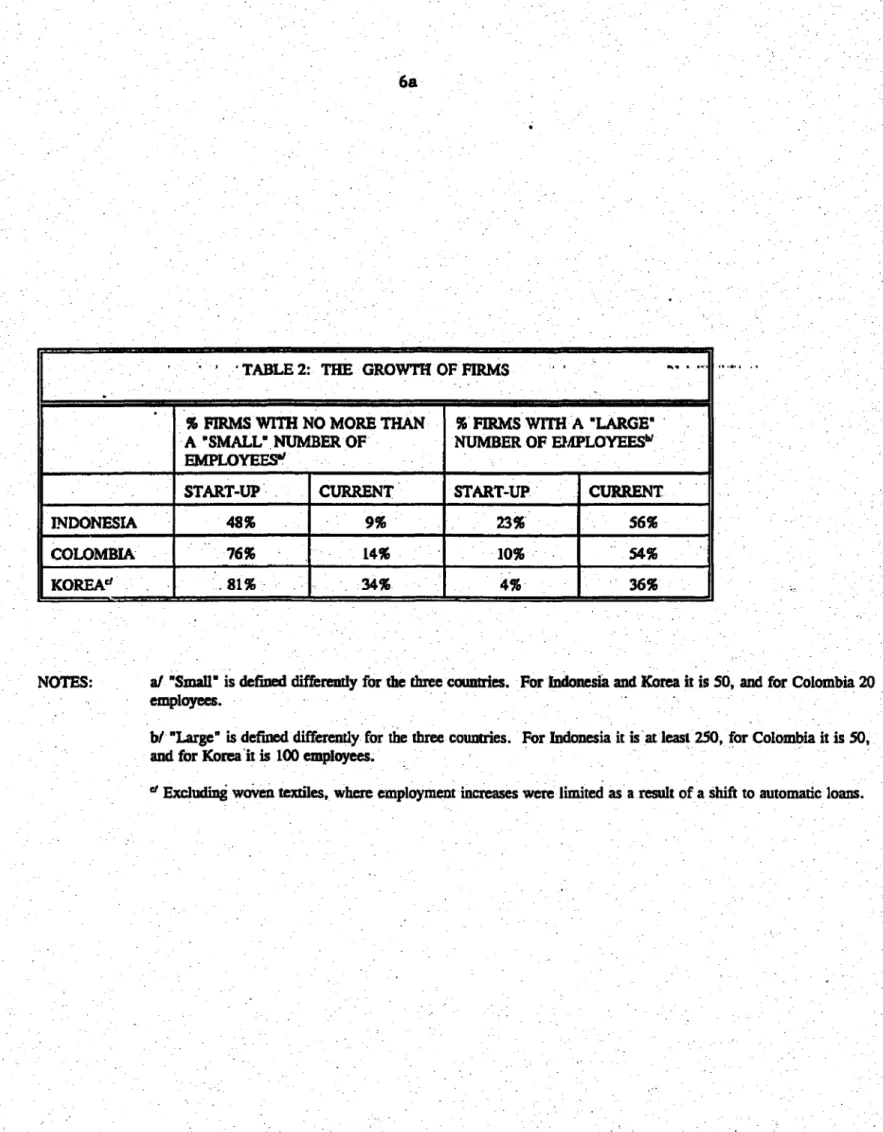
Not surDrisingly, given our focus on success, the Indonesian, Colombian and Korean firms sampled all have enjoyed very substantdal expansion since stal-up.1l/ As Table 2 shows,
the start-up size of the Colombian firms sampled was very nmaii, with 76 percent of them
having 20 or fewer employees, and only 10 percent 50 or more employees. By the time of the survey, however, these proportions had virtually reversed, with 54 percent in excess of 50 employees, and only 14 percent with fewer than 20. The averge start-up size of firms sampled in Indonesia was larger; even so, 48 percent of them commenced with fewer than 50
employees, and only 23 percent with more than 250. But by survey time only 9 percent still had fewer than 50 employees, while 56 percent had 250 or more. As for Korea, Table 2
documents substantial firm growth, though less than in the other countries. However, for Korea in particular these employment data subsanmially underestimate the grorith of firms, since Korean wages have risen very rapidly and firns have responded by substituing capital for labor, while achieving very rapid increases in viue added.
As Table- 3 shows, the levels of education of these successful SMEs are stiingly high. In both Korea and Colombia, over 80 percent of the entrepreneurs sampled bad completed at least some university; and, at 75 percent, the proportion was almost as high for Indonesia's garment and rattan entrepreneurs. Half of the Korean sample had undertaken their university studies in the field of science or engineering. And prior to startng their firms, over 90 percent
6a
TABLE 2: THE GROWTH OF FIRMS
% FIRMS WITH NO MORE THAN % FIRMS WITH A *LARGE"
A "SMALLO NUMBER OF NUMBER OF E)APLDYEESW'
EMPLOYEES'
START-UP CURRENT START-UP CURRENT.
INDONESIA 48% 9% 23% 56%
COLOMBIA 76% 14% 10% 54%
KORAd .81% 34% 4% 36%
NOTES: a! 'SmallI is defined differently for dhe three countries. For Indonesi'a and Korea it is 50, and for Colombia 20
employees
b/ 'Large" is defined differently for thie three countries. For Indonesia it is'at least 250, for Colombia it is 50,
and for Korma it is 100 employees.
6b
TABLE 3: EDUCATION AND EXPERIENCE.OF ENTREPRENEURS
PERCENTAGE OF ENTREPRENEURS SAMPLED WITH:- ______
HIGH ~~SOME UNIVERSITY IEDUCATION' PRIOR
SCHOOL OF WCTEXEENEIN
EDUCATION- RELATED
OR LESS BUSINESS
COUNTRY AT LEASr GRADUATE A SCIENCE OR
SOME - ENGINEERING PRIOR_:_-__
INDONESIA
__OR_LESS_ .:BUNS : *Ganents 'and 25% 75% . Rattan -Iepara -7i..--:71 29 -COLOMBIA 17 83 19% (ALL) ______ FKOREA (ALL) 13 87. .11 50% 91%
7
of the Koreans had experience in a related business, almost 60 percent of them in a
management position. A substantial majority of the Japanese sample also reported having had prior experience in a related business.
The exceptions to the overall pattern of high education are revealing. The export entrepreneurs from Jepara, Indonesia are shown in Table 3 to be substantially less educated tha in the other countries and subsectors; uniquely among the subsec-tors studied, their source of competitive advancage lies in unusually well-developed wood-carving skills. Also, although not shown in the table, the owners of the Japanese SMEs samnpled, espec-ially those in their
fifties or older, tend to have no more than high school
education.
However,
as the
diLscussion Ofmarketing supportsystems below will highlight, they appear to face fewer marketing demands tha the other entrepreneurs, inoar as they operate within a well-developed network of inter-firm relatins.
Finally, subcontracting relations are ubiquitous in all four countries. As thie cotuntry~ case describes in detail, all of the Japanese firms surveyed are embedded in vertical, multi-tier prodution and marketing relations. In Korea, 82 percent of the firms surveyed subcontract, out either specific- production tasks or fabrication of the entire product; the corresponding figures for Indonesia and C-olombia are 76 percent and 67 percent. What is remarkablc about the Korean experience in particular is the rapidity of change in the role of subcontracting, in
industrial production. In 1973, only 25 percent of all Korean SMEs earned any-revemue from subcontracting; by 1990, subcontracting was a source of revenue for 70 percent of Korean firms, and fulfly 90 percent of these earned over 80 percent of their revenue in this
manner-For all of the pervasiveness of subcontracting, and for all that its expansion (as in Kore) doubtless multiplies the opportunities available to small business, the results of the: Indonesian and Colombian firm surveys sound a note of' caution as to whether subcontracting can serve straightforwardly as a stepping-stone to SME success mn export markets. Fewer than 14 percent of the Colomobian SME exporters surveyed, and fewer tha 22 percent of the hidoneian SUE exporters, had themselves had prior experience as subcontractors prior to becomning direct exporters. Considered together with the evdneeneucto lees, these
8
data point to the possibility of substantial dualism among SMEs, with an educated minority successfully "graduating" to become direct exporters, and the majority more-or-less permanently engaged in the international marketplace, if at all, only indirectly as
subcontractors.
II: EXPORT MARKETIG AND lTS SUPPORT SYSTEMS
Even with favorable market conditions, exports do not proceed spontaneously, but through the medium of institutions, and via exchanges which involve both ecx ante and ecx post transactions costs. Ex ante transactions costs comprise the costs of search by buyers and sellers to identify a party with whom to transact Ex post transactions costs comprise the costs to one party that result from non-performance by the other. SME success in export markets thus requies the presence of mechanisms which reduce the costs of search to SME suppliers and to their buyers, and which can reliably signal the reputaion of suppliers to putative buyers (and vice versa).
A central goal of this stLdy is to leam what was the role of collective marketing support systems - how extensively they were used by SME exporters, how much value SMEs ascnrbed
to them, and what specific lknds of collective support were most highly valued by SMEs. Yet firms do not make their decisions on the use of collective marketing support in a vacuum. There also exist a range of private channels which reduce the tasactions costs to firms of participating in export markets - trading intermediari, search efforts by foreign buyers,
opportnities for indirect exporting via subcontracting, and the presence of other prc-enistg private networks that can ease entry into export markets. Where they exist, these private networks represent substite channels which reduce SME demand for collective support. Additionally, SMEs eager to export can make direct efforts of their own to win orders
-although collective support Cif it Is availale) is likely to complement, rather than substitute for,
such efforts.
IbThe next subsections analyze comparatively for Indonesia, Japan, Korea and Colombia the supply of private mechanisms of export support, and the impact of their availalit on the
9
use of collective support. Thereafter, we describe in some detail the specific kinds of collective marketing support have proven useful in the sample countries, and the specific institutional mechanisms that have been most effective in delivering them.
I1. 1: 1hadingMchanisms of Eport Marketing
The field research uncovered very substantial variation in the mechanisms of export marketing across countries and subsectors. Taken together, three propositions appear to sumnarize much of this variation:
* Variations in industrial organization infuence the m anisms of export
marketing. In some instances, SMEs are embedded in well-developed, pre-existing private networks, with low tasactions costs of entering export markets, and with virtually no role for collective support. In others, the challenge of linking into the iternational marketplace is more formidable,
involves higher transactions costs to SMEs and calls for distictive m g
mechanLisms.
-ntertemporal. variations within individual iadustdes influence the mechanisms of export marketing. In the initial period of market penetration of a new export industry, transactions costs are high and domestic-resources play an important role. Subsequently, markets "thicken", inidatives by foreign buyers become
more important, and the transactionm costs of export entry by SMEs declie. (A
parallel pattern is evident over the life cycle of firms, regardless of the tining of first export entry.)
* Variations across counties in the extent of their engagement in the
international marketplace influence the mehanisms of export marketing. The challenges and mechanisms of export marketing are very different, and the transactions costs of penetrating these markets are lower, for SMEs active in countries that are already "on the map" as export suppliers, than for those active in countries whose export drive is still in its infimcy.
Table 4 offers capsule summaries of the experiences of the four countries studied in relation to these propositions. The experiences of Japan and Indonesia iustrae the impact on marketing patterns of industrial organization and related pre-existing networks, and those of Korea and Colombia (plus Indonesia again) illustrate both the evolution of marketing mechanisms from the pioneering export phase onward, and the impact on this evolution of a country's profile in the global marketplace.
:a.
TABLE 4: THE IMPACT OF COUNTRY CHARACTERISTICS AND INDUSTRIAL ORGANIZATION ON MECHANISMS OF EXPORT
MARKETING - A SUMMARY OF COUNTRY EXPERIENCES
INDUSTRIAL COUNTRY'S EXPORT ORGANIZATION
PROFILE-JAPAN No direct marketing; SMEs Not Applicable
embedded in dense, pre-existing private networking
INDONESLA Extended Chinese communitky Nascent reputation as export
confers marketing advantages supply source on non-Pribumi Firms.
Pribumis use substitLte
mechanim-s
KOREA Emergent network of export Strong reputation as exporter
traders (inter-temporal, simplifies direct export
Dimension) marketing for SMEs
(subsubent to initial market
. . . ~~~~~enty)-
COLOMBIA Limited pre-existing networks Limited exposure to export marketplace complicates
10
In different ways, the Japanese and Indonesian studies highlight the power of pre-exisdng private networks in facilitating SME participation in the export marketplace.
Jpan. Across the gamut of Japanese industry, the marketing of SME products is taken care of virtually automatically by pre-existing private production and trading networks, with no direct interface between the firm and its foreign buyer, and virtually no role for collective support The three subsectors examined in the Japan case study illustrate the wide variety of patterns of industrial organization that yield this outcome.
Multi-ter. subcontracting relations among Japanese SMEs engaged in the production of automobile components in the town of Ohta comprise a by-now familiar example of a pre-existing private network. Fuji Industries (assembler of the Subarn automobile) is located in the
region, and half of Obta's first-der subcontractors supply parts .o the company. Sales to Fuji Industries account for 43 percent of sales of these firms, with vitualy all other sales going to other automobile assemblers in Japan. Dependence on a dominant parentfin grew for the tehnically less-sophisdcated second-tier and lower-tier subcontractors, with 75 percent of sales of second-tier subcontractors going to their parent fErms.
In Japan's silverware and textile subsectors, the pre-existing private networks comprised interactions with trading houses and withi mput suppliers. Tsubame's silverware exports have long been channelled tbrough the country's export trading houses; indeed, as of the time of our survey these trading houses continued to account for 80% of export sales. And SME. weavers of synthetic textiles in Fukui-Ishilkawa are embedded in center-satellite relations to an even larger degree than their silverware counterparts: about 85% of textile weaving takes place under 'service fee contracts" in which trading houses or yar-producing chemical companies supply yarn to SME weavers, which is woven and dyed, and then retumed to the yam supplier for subsequent sale.
In all, indirect exporting through pre-existing private networks was so pervasive in Japan that it proved infeasible to systematically sample firms as to the relative value of different kinds of marketing support for direct exports.
Indonesia. In Indonesia, the impact of another kind of pre-existing network is highlighted by sharp differences in the mechanisms of export marketing of pribumi and non-pribumi (Chinese) finns. These differences appear to be the result of linkages among an extended Chinese community that transcend national boundaries and provide an informal
private network into which Indonesia's entrepreneurs of Chinese origin - but not their pribumi
counterparts - can straightforwardly connect.
As Table 5 suggests for rattan furniture exporters, pre-existing linkages translate into a superior ability on the part of non-pribumi firms to make initial export contacts outside of Indonesia: 63% of initial export contacts of non-pribumi Indonesian finis were made outside the country (via a business trip abroad, or a friend or agent based abroad), as compared with only 15% for pribumi firms. As the table shows, the disparity in the role of contacts made abroad continues even as fims become established in export markets. In garments, too, 53 % of
the most recent export contacts for non-pribumi firms - but none for pribumi firms -were
made abroad-42/ Lacking both contacts abroad and ready access to buyers visiting Indonesia, pnriumi garment and rattan furniture firms made use of substitute mechanim. Thus over half -the pribumi firms in Table 5 (but under 20 percent of the non-pribui) used
collective-mechanisms to link up with export markets.
Korea. Colombia (and Indonesia again: Penetrating the Exportn Marketlace de Novo
Unike Japanese and non-pnbumi Indonesian firms, SMEs in Korea and Colombia generally lacked access to pre-existing prvate networks, as did Indonesia's pribumi SMEs.-Consequently, empirical analysis of these settings holds the promise of showing how marketing mechanisms start-up and evolve as specific new export activities take hold, with resultant declines in tie transactions costs of export entry by SMEs. Additionally, the radicaly different export profiles of Colombia on the one hand, and Korea and Indonesia on the other, provides.
121 Note, though, that despite extensive search it was only possible to identify six pribmi.
garment firms for inclusion in the sample. The third Indonesian case, that of carved furniture exports from Jepara, does not shed any useful light on the role of pre-existing networks; all but one of the firms surveyed were pnbumi, and they were not embedded in any pre-existing network.
lla
TABLE 5: MARKETING CONTACTS AMONG RATrAN FURNrrURE EXPORTER
INITIAL CONTACTS CURRENT- CONTACTS
Pribumni NonProbumi Prium
fNon~Pribumi
PRIVATE__ _ _ _ _ _ _ _ _ _ In County 4 3 13 13 Abroad 210 4 26 COLLECTIVE 7 3 1s 6 TOTAL 13 16 3-5 45 -~ --- .-
12
-an. opportunity to explore how much inpact a.country's broader profile in theintemnational marketplace has on the development of export marketing mechanisms.
Korea The way in which Korean SMEs have been incorpoated into that country's industrial economy is different from the Japanese patten. Whereas Japanese indusrial
organization is characterized by a dense network of interaction between large and small firms along the lines described'above, Korea's industrial success in the 1960s and early. 1970s was built on its giant industrial conglomerates, with SMEs playing an increasing role only afier 1977. Moreover, the ties between large and small firms have been looser in Korea than in Japan, with a correspondingly greater extent of direct participation in exports among Korean
SMEs1.'
As Table 6 shows, large firms tended to be the export pioneers, but direct SME exports expanded rapidly in all four subsectors studied. While in the woven textile and electronic parts
subsectors exports were substantidal aready in 1983, in the remaining two subsetors the move
by SMEs into export markets took place only in the lat half of the 1980s. For woven teffiles
the pioneering phase of SME exports actually predates the export start-Wp of most of our
sample firms.
Table 7 details for each subsector the relative importnce of four mecnisms of export
marketing at various points in time.- For Korea, export 'sLoflmtigfl refers to manufacture
against specifications for export by traders, fl to production of components for assemblers
who export finisheaL products. As Table 7 confirms, in all periods marketing of woven textiles .
is dominated by a network of specialist export traders/subcontractors with headquarters or branch offices clustered in the area of Taegu, the location of almost 80 percent of Korea's
woven textile firns. As noted, woven teffile SMEs already had established a position in export
131
In the automobile and electronic components subsectors, the majority of firms surveyedwere embedded in subcontracting relations with large assemblers,Sales to assembler-principals accounted for over 90% of sales for 14 of the 20 Korean auto parts firms surveyed, and for 9 of 20 electronic parts firms. However, even in these sectors over 60 percent of surveyed firms :-manuactued at least some products direcdy for export markets; these direct exports were the focus of the analysis of export marketing in the Korean case study.
12a
TABLE 6: EXPORTS BY KOREAN SMEs IN FOUR SUBSECTORS (MILLION OF USS)
1- ~ ~~~ -. . , T . .
WOVEN AUTO PARTS ELECTRONIC METAL CUTTING
TEXTILES jPARTS |EQUIPMENT
19 83 _ _ _ _ _ _ _ _ _ _ _ _ _ _ _ _ _ _ _ _ _ _ _ _ _ _ _ _ _ _
SME Export Value - 349 4 199 21
|(USMilions) _ _ SME Shares of 21.3% 9.6% 19.5% Total Exports -1988. SMEExport Value 1,454 83 134% 68 = (USsKllions) -SME Shares of 42.8% 25.9% 22.9% Total Exports I991 SMEExportValue 3,453 - 184 2380 123
(USMMIIions)
SME Shares of 60.6% 44.1% 24.8% Total Exports - =12b
TABLE 7: KOREA -THE RELATIVE USEFULNESS OF EXTERNAL
MARKETING SUPPORT (ALL FIRMS I LEAST USEFUL; 5 = MOST USEFUL)
DIRECT BUYER SUBCONTRACTING COLLECTIVE
-MARKETING_ INITIATIVE PRINCIPAL - i SUPPORT
-Woven Textiles * Start-up, Pioneers- 2.4 3.2 4.2 1.2 | Start-up, Followers 2.5 2.4 4.0 1.3 urQ
t,
All 2.5 -2.8 3.7 - 1.3 Auto Parts : -_ . -Start-up, Pioneer 2.5 1.0 3.3- 2.2_ Start-up, Followers 1.5 3.8 2.2 - 2.0. Current, Alt 3.0 - 3.6 2.8 1.3 Electronic Parts - ___-_-_::-Start-up, Pioneers 2.0 1.8 2.8 3.3 |Strt-up. Followers- .6j
1.8 3.0 2.4 Current, All 3.4 3.9 .1.6 1.5 Factory Automation -Start-up, Pioneers 3.2 2.7 2.8 1.5 Start-up, Followers 2.3 3.6 -2.2 2.0 Current, All 4.0 3.6 2.0 - * 2.013.
markets by the late 1970s, and there is very little variation across periods in the relative
importance of the various export marketing mechanisms. The export marketing patterns for this subsector parallel more those of Japan and non-pribumi Indonesian firmns than they do those of the remaining three Korean (and the Colombian) subsectors. For the rest, the Korean survey results illustrate vividly how export marketing channels evolve - how SME exports get going in individual subsectors, and how the transactional environment for export marketing
"thickens" as the number of SME exporters proliferates.
Table 7 organizes the subsectoral data on the relative importance of various marketing mechanisms into three time-related subgroups - the time of the field survey; and firms' initial
period of entry into export markets, with initial export entry in turn disaggregated between pioneer SME exporters and SMEs that moved into international markets only once the industry
had established its role as an exporter. As the table shows, the initial imnpetus for exports in the three subsectors came primarily from resources already within the country - from export
traders, from coilective marketing support institutions, and from exporting firms themselves. Traders/subcontractors played the leading pioneer role for auto parts SMEs, and the second most inportant role in electronic parts and factory automation SMEs. Their prominent early role can be interpreted as an important spillover for Korean SMEs from being active in a country with a strong export profile, insofar as it was the country's earlier export success. (typically by larger firms) that brought these traders/subcontractors onto the scene. Collective marketing support leads among pioneer electronic parts SME exporters, and has a significant
subsidiary role in auto parts. Direct marketing efforts by firms provided the critical initial impetus in the factory automation subsector, and also scored high among autoparts pioneers. In aU three subsectors the role of direct marketng declines for the export start-up of follower exporters, but picks up again for current exports.
Over time, initiatives of foreign buyers come to the fore. Buyer initiatives are identified in Table 7 as the least important mechanism for initial export entry by pioneer SMEs in the auto and electronic parts subsectors, and second least important for factory automation. But information appears to spread rapidly as Korean firms come on line as a primary international
14
supply source for yet anotherproduct. Indeed, in the later periods initiatives by foreign buyers emerge in all three subsectors as the leading mechanism for facilitating participation in export markets.
In all, then, the evidence from Korea on export marketing suggests that "export entry begets export entry", that a cumunlative process can take hold.14 In all three subsectors for which we have data, local actors (presumably prompted by numerous export incentives) led the pioneering phase of SME exports. Their activity took place against the backdrop of Korea's strong overall reputation as a reliable and cost-effective supplier of exports. Once exports of a
new product were underway, foreign buyers came onto the scene, and the momentum of sustaining the export drive shifted increasingly into their hands, with complementary efforts by
increasingly committed export suppliers. Throughout the process, the transactions costs of linling into export markets progressively declined, with corresponding increases in
opporunities for export entry by SMEs.
Colokmbia. Like their Korean (but unlike their Japanese or non-pnbumi Indonesian) counterparts, Colombian SMEAs lacked access to pre-existing private networks to link into the export marketplace. The Colombian garment industry experienced an export surge in the 1970s with exports in 1980 amounting to over $110 million already in 1980, too early for the
pioneenng export phase to be depicted adequately by our firm sample. The export take-offs in the leather products and machinery subsectors came over a decade laterIjf and so offer evidence of the pioneering phase of export marketing of new products.
As was observed for Korea domestic resources played a leading role in the pioneering export efforts of Colombian firms in the leather and machinery subsectors. Direct marketing
- 4/ Hirscbman (1958) was a pioneering study of the role of cumulative processes in economic development. Levy (1989) modelled formally the role of cumulative processes in the development of export markets.
:1.5/ Garment exports subsequently declined to a low of $40 miWion in 1983, but expanded later in the decade to reach $449 million by 1991. In the machinery. subsector, too, exports peaked at $39 million in 1980, subsequently declined to $12 million, but then expanded in recent years to reach $102 million by 1992. Leather product exports got underway only in the 1980s, rising from $14 million in 1984 to $106 million by 1991.
15
efforts of firms emerge in Table 8 as the leading mechanism of export market penetration for pioneer firms in both subsectors. Collective marketing support plays a signiflcant subsidiary role for pioneer exporters, as well as a continuing useful (though diminishied) role as the subsector matures.
Aside from this central similarity, there also are some striking differences between Colombia and Korea in the marketing mechanisms of pioneer exporters, differences which plausibly result from the divergent export profiles of the two countries. For all that Colombia has the reputation of being one of the few Latin American countries to have maintained a
relatively liberal trade regime for a sustained period of time, until very recently Colombian industrial policy placed nowhere near the emphasis on exports as did Korea's, and Colombian firms have had nowhere near the sustained presence in manufactures export markets as have the Koreans. One consequence of this limited history which is evident in Table & is the virtual absence of trading and subcontracting ties as a mechanism of export market.penetration for - Colombian SMEs; by contrast, such ties were of central inportance for pioneering Korean
A second and somewhat more puzzling difference is in the role of foreign buyers: despite Colombia's lower export profile, foreign buyers are relatively more important at the pioneering phase for Colombian than for Korean SME exporters. One plausible resolution of this apparent paradox may be that, by comparison with their Korean counterparts, Colombian firms historically have been less interested in international opportunities at the early stages of export market development, and so have left relatively more of the (modest in absolute terms):
early running to foreign buyers. Further, whereas in Korea the relative importance of direct marketing efforts and initiatives by foreign buyers shifted sharply in favor of foreign buyers as the export drive deepened, in Colombia direct marketing initiatives play the leading role even
in the current period. Plausibly, this tardier responsiveness of foreign buyers to emerging opportunities to source from Colombia is a consequence of the lower profile of the country in. the global marketplace. Put differently, the evidence suggests that the cumWulative process of
15a
TABLE 8: COLOMBIA - THE RELATIVE USEFULNESS OF EXTAERAL
MARKETING SUPPORT (ALL FIRMS 1 = LEAST USEFUL; 5 = MOST USEFUL)
-. -1 - _ _ _ I _ _ _ I _ _ _ _ __ I _ _'' _ _-i _
_.-.-.DIRECr B YER SUBCONTRACTING COLLECTIVE
* MARKETING INITIAITVE PRINCIPAL
SUPPORT-Leather Products ._-_._ ._ . Start-up, Pioneers 4.4 : 3.5 1.8 2.6 Start-up, Follower. 3.5 3.7 2.3 1.8 Current, All 3.9 3.4 1.4 .2.5 Garments ._- _- __ - ___ -_ -_:. Start-up, Pionsers 3.7 3.9 1.4 3.0 Start-up, Followers -3.7 3.6 1.2 1.3 Curret, All 3.8 3.6- 1.1 2.4 MachLinery _ - . -_._____:_-__ Start-up, Pioneers 3.9 3.0 1.0 2.5 Start-up, Followers 4.2 3.6 1.3 1.9 CUrrent, A1l L3.8 3.2 . 1.2 I 2.2
16
increasing participation by SMEs has not yet taken hold in Colombia with anything like the vigor that we observe for Korea.
-donesia (again). For all three ndonesian subsectors, our surveys yielded evidence on the evolutdon of export channels. As Table 9 shows, relative to both Korea and Colombia, initiatives by buyers turn out to be unusually dominant in all time periods.
For the pioneering periods, the explanation for buyer dominance vanes across subsectors. For garments, the presence of pre-existing networks among the extended Chines community along the lines nated earlier provides sufficient explnation, since the vast majority of that industry's garment exporters are Chinese in background. By contrast, most of the wooden fumiture exporters in the sample were pnibumi, based in the traditional woodcarving center of Jepara, who took advantage of the area's abundant supply of carving skills to produce reproduction antique furniture for export markets. Paralleling ihe pattern hypothesized for Colombia, Jeparan producers had not initially set their sights beyond the domestic market. So, - - as the case study details, and as is signalled by the score for buyer initiatives im Table 9, the
initial impetus for exports came from outsiders.
For rattan funiture, it is necessary to distngish between the "prehistory and the acuala period of export take-off. in the 1970s and early 1980s, rattan furniture exports were pioneered by a small number of predominandy prbumi entrepreneurs. They are the finns grouped in the "pioneer" category and, as can be seen in Table 9 and consistent with the
discussion earlier, were disproportionately dependent on collective support for the initial export efforts. However, take-off of rattan fritmre exports came only in the latter 1980s, at about the --- time the Indonesian govermnent banned the export of raw and semi-processed ratan. The
majonty of new exporters during this phase were Chinese (many of them former traders in raw rattan) who, as in garments- were able to rely on their extended network to penetrate export markets. Thus, as Table 9 shows, at export start-up non-pribumi "follower" firns identified buyer initatives as their most important source of support. To be sure, some of the "follower" -entrants were pibumi. However, they lacked access to the network and hence, as is evident in
-16a
TABLE 9: INDONESIA -THE RELATIVE USEFULNESS OF EXTERNAL
MARKEnNG SUPP(RT (ALL FIRMS 1 LEAST USEFUL; 5 = MOST USEFUL)
I
DIRECT - BUYE | SUBCONTRACTING COLLECTIVE._____ |MARKETING__| INiTIATRVE | PRINCIPAL SUPPORT
Start-up, Pioneers 3.4 4.1 2.3 | _2.1_._.
Start-up, Followers 3.1 3.4 2.5 2.
:_Curet, All _3.9_1_7 3.3 1.8
Carved Wooden Fumnifte from Jepama _ - ._.
-Start-up, Pioneers 1.8 3.4 2.4 -2.0
Current, Al 1.3 4.7 1.9 1.7
Rattan Furiture, All - . -_:
Start-up, Pioner 2.5 3.5 1.0 4.8
Start-up, Followes 3.4 3.7 . 1.4 2.8
Crent, All
j
3.1 4.3 1.1 3.1Rattan Furniture, Non-Pribumi
Start-up, Pioneers : , -
-Start-up, Followers 3.0 4.2 - 1.1- 2.6
Current, All
f
2.8 4.5 1.1 2.9Rattan Furiture, Pribumi .n;n._._X
Start-up, Pioneers 2.5 . 3.5 1.0 4.8
Start-up, Followers 4.1 2.9 1.8 3.1
17
Table 9, depended disproportionately on their own efforts and collective support to penetrate export markets.
Tuming to the high scores for buyer. initiatives in the current period, while in the early 1980s Indonesia barely had any presence on intemadonal markets for manufactures,
manufactures exports subsequently expanded at an astonishingly rapid rate to reach $14.7 billion by 1991. By that time, like Korea but unlike Colombia, the country had achieved a high export profile and foreign buyers were flocking in to take advantage of its low production. costs. Hence the dominant role of buyer initiatives in the current period evident in Table 9 for all three subsectors.
. . .~~~~~~~inr
11.2: Cunulative Processes and the Role of Collective Marketing Suport
Using a simple demand and supply framework, we summarize the previous discussion in a way that highlights the sources of variation in the demand and. use of collective marketing support across countries and subsectors. The three propositions highlighted earlier account for much of the observed vzriation.
The first proposition was that, insofar as private and collective markeing mechanisms
are substittes, the presence of pre-exig private networks at the inital stages of expansion
into export markets is an importnt deterinaniof the demand for collective marktii'g suppeot. Heuristcally, DlDl in Figure 1 represents those countries, subsectors and fms which lack access to pre-existing private networks and hence might demand quite substantial collective
marketing support, while D2D2 re-presents countries, .subsectors and firms which enjoy access
to pre-existing networks and so have less demand for collective supporclj/ In seven subsectors reviewed above, private networks already were in place as of the time of export entry of the firms surveyed:
"'silverware, auto parts and textiles in Japan;
IW Fonnally, Qd = f(Xp,X2...Xn), where Qd is the demand for collective support, Xp
is the cost to te firm of using that support, and X2-Xn are other determinants of demand. As the figure shows, we make the standard assumption as to the negative relation between price and quantity demanded. In the text, we explore three of potentially many non-pnce
17a
Figure 1
Dl Si D2\ - -/ .. ,Dl D218
* nonpribumi garment and rattan exporters in Indonesia;
* Korea's textile SMEs in the industrial district of Taegu; and
* Colombia's garment SMEs.
By and large, SMEs in these subsectors had relatively less use for collective support than did SMEs in the remaining seven subsectors, where pre-existing private networks were
underdeveloped:
* pribumi rattan and firniture exporters in Indonesia;.
* Korea's auto parts, eletrnic parts, and factory automation SMEs; and
* Colombia's leather and machinery SMEs.
Evidence from these latter seven subsectors offers strong support for a second
proposition highlighted earlier, namely that intertemporal variations within individual industie influence the mechanisms of export marketing. Table 9A presents in summary form some key
patterns that were evident in Tables 7-9. The data are normalized, with the average usefulness
scores for "buyer initiative" set at one for each subsector. Each subsector's average score for collective marketing support is recalculated as a ratio of the "buyer initiative score". Averaging these normalized scores across subsectors (within counties), and across all subsecors and countries yields the patterns evident in the table.
Table 9A highlights the powerfil cumulative processes at work in the evolution of the
mechanisms of export marketing. The usefulness of collective marketing relative to buyer initiative is highest for an industry's export pioneers as they sta-up their export efforts, and then subsequently declines as foreign.buyers come onto the scene and the transactional
environment for export marketing 'thickens", with a corresponding fall in the transactions costs of using entirely private mechanisms of export marketing. As Table 9A shows, in general this pattern is evident not only over the industry life cycle (compare the relative scores at entry for export pioneers and export followers), but also over the firm life cycle (compare the current scores versus the scores at entry for all firms). The decline in use of collective mechanisms can be illustrated as a continuing leftward shift of the demand schedule, DIDI in Figure 1.
18a
TABLE 9A: CHANGES IN PRIVATE VERSUS COLLECTIVE MARKETING SUPPORT OVER INDUSTRY AND FIRM LIFE CYCLES IN SEVEN SUBSECTORS
RELATIVE USEFULNESS SCORES:
COLLECTIVE SUPPORT/BUYER INITIATIVE
Pioneer Firms, Follower Firms, All Firms,
|Entry Entry Current
All Countries and 1.2 0.7 0.6
SubSectors
KOREA 1.5 0.8- 0.4
INDONESIA 1.0 0.8a 0.6
COLOMBIA 0.8 0.5 0.7.
al For Jepara, this score was estimated as the midpoint between the Pioneer and
19
The powerful empirical pattern.evident in Table 9A should not be interpreted as implying that collective support, though evidently helpful in the initial stages, is a necessaly catalyst for the take-off of a new export industry. Indeed, as is evident in Tables 7-9, only
i-'-two of the seven subsectors - electronic parts in Korea, and rattan exports from Indonesia by
pribumi-owned firms - did collective efforts comprise the leading source of support for export
pioneers. In three subsectors - factory automation in Korea, and leather products and
machinery in Colombia - direct marketing efforts by firns themselves, were crucial to the
initial penetration of export markets. In one subsector (Korean auto parts) traders played the crucial catalytic role. And in the final subsector, exports of carved wooden furniture from Jepara, notwithstanding the overall pattern evident in Table 9A, buyer initiave comprised the crucial catalyst.
The third proposition highlighted earlier was that inter-country variations in the extent of engagement in the export marketplace influence export marketing mechanisms. The relevant-comparisons here are between Colombia with its relatively low export profile on the one hand, and Korea and Indonesia with their higher profiles on the other. Colombia's lower export profile, and consequenly weaker visibility to foreign buyers, might be hypothesized to
correspond with a higher demand for collective support - DIDI in Figure 1, versus D2D2 for
Korean and Indonesia. Surprisingly, Korea's higher export profile than Colombia's did not translate into more foreign initiative in the pioneering phase of SME exports in a new industry, wit a correspondingly lower demand for domestic resources, collective or otherwise. But, as Table 9A summarizes, subsequent to the initial phase of export entry, the predicted differences were evident, with a sharper relative decline in the usefulness of collective marketing supports
in Korea than in Colombia. These differences can perhaps be interpreted as signalling the
failure us far of Colomnbia to "lock-in" its presence in the international marketplace, and set
in motion the cumulative process of increased participation by both foreign buyers and domestic suppliers which has proven so crucial for Korea's economic success.
20
In al four country studies, private mechanisms of export marketing support turn out to
be more important than collective ones. Yet, at least some firns, subsectors and countries
benefit quite substantially from the presence of collective marketing support. So, given a policy
decision to support SMEs, the question arises as to how to provide such support. We answer this question in two steps. First, we examine what specific kinds of collective support have proven most useful to SMEs. Thereafter, we examine what kinds of institutions have proven most effective in delivering this
support-Collective support: what works? The Colombian, Idonesian and Korean field surveys
collected detailed information from firms as to the relative usefulness of different types of
collective marketing support for their export efforts. Table 10 reports the results for each specific type of support that was used by at least 20% of the firms sampled in an individual
eubsector. The results are strikiingly similar across countries.
First, finms ascnbe a high value to participation in trade fairs at home and abroad as a means of penetrating export markets. Trade fairs emerged as the leading or second most valued coliective source of export marketing support in seven of the nine subsectors for which data are reported in Table 10. Moreover, as we shall see in the analysis of tehnical support systems,
trade fairs also turn out to be an important source of technological learning.
Second, only in the garment and textile industry (but within that industry systematically in all three countries) do frms identify infornation on export opporunities, rather than
participation in trade fairs, as themost important source of marketing support only in the
garment and textile industies. This result reminds us that international trade is conducted in
different ways for different industries: for some, high profile fairs are the high points of the
trading season, for others an ongoing search by individual buyers and sellers for trading
partners matters more.
Third, SMEs ascnbe very limited value to direct intoduction of buyers by official export agencies. Efforts along these lines played virtually no role in either Colombia or Indonesia. In Korea, the electroics parts subsector provides a partial exception to the general pattern even though it is noteworthy that recipients of this kind of support (every single one
20a
TABLE 10: COLLECTIVE MARKETING SUPPORT: WHAT WORKS?
A: AVERAGE USEFULNESS FOR ALL RESPONDENTS
B: SERVICE USERS AS PERFECTAGE OF RESPONDENTS
C: AVERAGE USEFULNESS FOR USERS ONLY
(I = LEAST USEFUL; 5 MOST USEFUL)
TRADE FAIR TRADE FAIR INFORMATION ON INTRODUCE
ABROAD HOME EXPORT
1
BUYERS__
__ __OPPORTUNMES
__ __ COLOMBIA ._-:_-._:-_ Leather A 2.7 3.1 1.8 B 53% 68% 41%. C 4.3 4.1 2.9 . Gannent A 2.2 2.5 2.5 1.7 B 40% 49% 60% 34% C _4.0 3.9 3.5 3.1 Machinery A 2.8 - 2.8 1.9 1.5 . - - B 57% - 64% 41% 32% C 4.1 3.9 3.2 2.6 INDONESIA . . . _._ -_____ Rattan Furniture A 3.0 2.7 1.9 1.9 B 58% 76% 33% 52% C 4.3 3.2 2.4 2.8 Garments A 1.8 1.9 2.0 1.7 B 34% 50% 53% 28% C 3.3 2.8 2.9 3.4 KOREA _ _ _ _ _ _ _ _ _ _ _ _ Wovea Textiles A - - 1.8 B - - 32% C - - 3.5 -Auto Parts A - -T
1.5 B - - 25% C - - 2.9 Electronic Parts A 1.6 2.0 .1.7 2.9 B 20% -40% 27% 100% c *3.,9 3.5 3.5 .2.9 Factory Automation A 2.4 2.2 2.4 1.8 B 50% 50% 57% 43% C 3.9 3-5 3.5 2.9.21
of the sample finnsl) ascribe it only moderate value. The Korea Trading Company played an exceedingly limited role. For all that its explicit mandate was to serve as the "general trading company' for SMEs, orny 4 of 72 direct Korean exporters in the sample actually made their export sales through its channels!
Collective support: who should provide? Any suggestion that governments should support the collective. provision of marketing support has to confront the reality that the
institutional capability to deliver such support is weak in most developing countries. Indeed, the developing world is littered with failed export support programs and 'white elephant' export institutions.
The hopeful message of the present study is that there may be instituional alternatives to elaborate export agencies. The empirical evidence highghts the benefits of interventions with a "light touch' that provide firms with the wherewithal to find buyers for themselves, rather than attempt to substitute for efforts by putatve exporters. Moreover, the evidence suggests that the delivery of export marketing support might usefully be decentralized, tailored to the specific realities of individual marketplaces so as to be able to respond to the enormous diversity of players and market mechnisms across subsectors.
All three country studies offer empirical support for the proposition that delivery of export marketin support to SMEs should be decentralized..Z Korea's flagship export agency, KOTRA, has developed elaborate .export information systems, multiple tools. for promoting national exporters, and extensive international networks of offices. Yet as Table 11 sihws, aside from the electronics subsector, there is virtually no difference in the extent of support. provided by KOTRA and by industry associations.jl/ Of 72 direct exporters included in the sample, 29 reported using KOTRA's services, and 23 reported receiving support from their
12/
In Japan, too, industry associations and chambers of commerce. were the. primary direct channels of export marketing support for those few firms who sought to market directly. -B! - It is worth noting explicitly that no judgernent is intended here as to the nett benefits. to Korea of KOTRA, whose goals went well beyond providing support specifically for SMEs. The point is rather that a KOTRA-like agency is not necessary for the effective provision of21a
TABLE 11: THE RELATIVE USEFULNESS OF EXPORT MARKETING SERVICES
OF INDUSTRY ASSOCIATIONS
AND NATIONAL EXPORT AGENCIES IN KOREA
Average Score Number of users Average Score
.____________ : _________ ._________ _ l (all firms) . . (Users) _. _ . - |
Number Number of KOTRA Associa-. KOTRA Associa- KOTRA
Associa-of Firms Exporters tion tion tion
Woven 42 31 1. 15 8 - 9 3.4 3.2 Textiles Auto Parts 20 14 1.2 1.3 4 4 1.8 2.5 Electronic 20 15 1.7 1.2 8 I 2.8 5.0 Parts Factory 40 12 1.5 1.5 .9 9 3.4 3.1 Automation X . L L :-TOTAL 122 72 _ _-
1
29 .. 3.0 3.122
trade association. Moreover, the average rating of the value of the services of the two sets of suppliers was virtually identical.
The Indonesian experience offers three lessos - one cautionary, one niixed and one
hopeful.- The cautionary lesson concerns the role of centralized export institutions. Like many other developing countries, Indonesia erected in the 1970s two elaborate export institutions
-NAFED, whose prime responsibility is to promote trade fairs with Indonesian participation, and the Iternational Trade Promotion Center, an international network- of commercial offices located in Indonesian embassies abroad. Yet by 1985, fairs aside, the perception was
widespread that these insftituons were of limited usefulness.
The mixed lesson concerns the role of industry associations. Parts of Indonesia's furniture and garment associations emerged in the firm surveys as useful sources of collective support. Yet in general Indonesia's industry associations tend to be exceedingly weak. They are not professionally staffed; they are rarely accountable to their members; they tend to be'
captured by powerful players in their industries; and their umbrella organization lacks credible autonomy from government. As the country study makes clear, it will be no simple matter to re-orient a substantial number of the country's industry associations to play a constructive
- promotional role ...
The hopeful lesson concerns the experience of the Export Support Board, created in 1985 in response to the perception of filure of the exisdng export institutions. The ESB represents an intriguing departure from the institutional model adopted earlier in that its role was to finance marketing support, not deliver it directly: it provided partial subsidies to nascent exporters who sought to participate in trade fairs abroad, to develop export promotional material, and (as discussed farther under the rubric of technical support systems) to employ technical consultants from abroad. Its complement of professional staff never exceeded 10 persons, yet its services were more widely used, and were rated more highly among the firms surveyed, than those provided by the elaborate, central export edifices.
23
-The performance of Colombia's national export agency, PROEXPO (created in 1967), in providing direct marketing support to firns also has been less than impressive.2/ Relatively few of the Colombian firms which used collective support (Table 10), reported that it came from PROEXPO. The industry associations, by contrast, show considerable promise in this area, especially those in the leather and (more recently) garments industries. Working closely witi their member firms, these industry associations are developing the sort of sector-specific knowledge and skills which cannot realistically be expected from general purpose agencia like PROEXPO. A successful hybrid form which is beginning to take hold is for PROEXPO and other public sector agencies to work collaboratively with industry associations - with the public agencies providing some funding to help organize fairs and assist visits abroad by potential exporters.
11.4: public Policy towards Expor Markting.
For decades, countries have used high profile national export agencies to support their export efforts. Compartive empirical analysis in Indonesia, Japan, Korea and Colombia suggests that, viewed from the SME perspective, and judging by the experience of successful exporters, initiatives along these lines may be misplaced. For one thing, private networks tum out to be the dominant means whereby SMEs enter into cxport markets. For anotcb*r, for the subgroups of firms for whom collective marketing support has proven to be useful, it has generaLly been of a kind that can more effectively be provided by decentralized organizations such as industry associations, or local govermnents and chambers of commerce. Whether these decentralized organizations indeed provide useful support to SMEs appears to depend in part, however, on whether tiey are dominated by large finns, or whether SMEs have a significant voice. A number of levels of government plausibly could play a usefully role in facilitating the development of decentralized organizations capable of sponsoring participation in fairs and
-offering SMEs other forms of effective marketing support.
12/
Although note that its primary focus has been on the provision of credit for exporters, an activity which it apparently has undertaken impressively.24
Turning specifically to national authorities, aside from facilitating a supportive business and incentive enviroment for exporting, is their appropriate role in supporting export
marketing? One task is to "market the country" - to raise international awareness of the
potential advantages of doing business, including export business, with the emergig export nation.2Q/ What emerges from t'lis study is that a case can also be made to encourage through partial subsidies - as opposed to directly deliver - the use of export marketing supports.
Consideration could also be given to using the lure of financial support to encourage the development of decentralized delivery of export marketing senrices - to facilitate the
establishment of subsector specific industry associations that are responsive to SME concerns, to encourage those that function primarily as lobbying organizations to develop the capability to provide export marketing and other services to their members, or to encourage the emergence of private providers of export marketing services, including for-profit sponsors of trade fairs.
Finally, looking beyond specific collective services, public policy may have some role to play in nurturing the private networks that have emerged in this comparative study as the bedrock of export marketing efforts. Although not studied in any depth, the case studies uncovered tanalizng hints of pr-active goverment efforts to promote such networks: public support for the development of private trading companies in Korea and, earlier, in Japan; Japanese legislation to protect the iterests of smal firms embedded in subcontractng
relationships; actions in Korea to designate specific lines of business for subcontracting rather than vertically integrated production. To be sure, as is documented by both the individual case
studies and the volrmniinous literatre on the determinants of inter-firm contacting
arrangementss,2J/ the development of these networks has largely been the result of spontaneous-private forces, often deeply rooted in national history and culture. Yet, insofar as incentives
can encourage subcontracting or entry by export traders (both large and small) the opporunities
2Q/ For a detailed discussion of how to proceed with this task, see Wells and Wint (1990).
2 L1/ - For one key contrbution, see Williamson (1985).